Volume 3 — OLD-FASHIONED STORIES (continued 4)
Reading edition
THE PURPLE JAR
By MARIA EDGEWORTH
Rosamond, a little girl about seven years old, was walking with her mother in the streets of London. As she passed along she looked in at the windows of several shops, and saw a great variety of different sorts of things, of which she did not know the use, or even the names. She wished to stop to look at them, but there was a great number of people in the streets, and a great many carts, carriages, and wheelbarrows, and she was afraid to let go her mother's hand.
"Oh, mother, how happy I should be," she said, as she passed a toy-shop, "if I had all these pretty things!"
"What, all! Do you wish for them all, Rosamond?"
"Yes, mamma, all."
As she spoke they came to a milliner's shop, the windows of which were decorated with ribbons and lace, and festoons of artificial flowers.
"Oh, mamma, what beautiful roses! Won't you buy some of them?"
"No, my dear."
"Why?"
"Because I don't want them, my dear."
They went a little farther, and came to another shop, which caught Rosamond's eye. It was a jeweler's shop, and in it were a great many pretty baubles, ranged in drawers behind glass.
"Mamma, will you buy some of these?"
"Which of them, Rosamond?"
"Which? I don't know which; any of them will do, for they are all pretty."
"Yes, they are all pretty; but of what use would they be to me?"
"Use! Oh, I am sure you could find some use or other for them if you would only buy them first."
"But I would rather find out the use first."
"Well, then, mamma, there are buckles; you know that buckles are useful things, very useful things."
"I have a pair of buckles; I don't want another pair," said her mother, and walked on.
Rosamond was very sorry that her mother wanted nothing. Presently, however, they came to a shop, which appeared to her far more beautiful than the rest. It was a chemist's shop, but she did not know that.
"Oh, mother, oh!" cried she, pulling her mother's hand, "look, look! blue, green, red, yellow, and purple! Oh, mamma, what beautiful things! Won't you buy some of these?"
Still her mother answered, as before, "Of what use would they be to me, Rosamond?"
"You might put flowers in them, mamma, and they would look so pretty on the chimney-piece. I wish I had one of them."
"You have a flower-pot," said her mother, "and that is not a flower-pot."
"But I could use it for a flower-pot, mamma, you know."
"Perhaps if you were to see it nearer, if you were to examine it you might be disappointed."
"No, indeed, I'm sure I should not; I should like it exceedingly."
Rosamond kept her head turned to look at the purple vase, till she could see it no longer.
"Then, mother," said she, after a pause, "perhaps you have no money."
"Yes, I have."
"Dear me, if I had money I would buy roses, and boxes, and buckles, and purple flower-pots, and everything." Rosamond was obliged to pause in the midst of her speech.
"Oh, mamma, would you stop a minute for me? I have got a stone in my shoe; it hurts me very much."
"How came there to be a stone in your shoe?"
"Because of this great hole, mamma,—it comes in there; my shoes are quite worn out. I wish you would be so very good as to give me another pair."
"Nay, Rosamond, but I have not money enough to buy shoes, and flower-pots, and buckles, and boxes, and everything."
Rosamond thought that was a great pity. But now her foot, which had been hurt by the stone, began to give her so much pain that she was obliged to hop every other step, and she could think of nothing else. They came to a shoemaker's shop soon afterwards.
"There, there! mamma, there are shoes; there are little shoes that would just fit me, and you know shoes would be really of use to me."
"Yes, so they would, Rosamond. Come in."
She followed her mother into the shop.
Mr. Sole the shoemaker, had a great many customers, and his shop was full, so they were obliged to wait.
"Well, Rosamond," said her mother, "you don't think this shop so pretty as the rest?"
"No, not nearly; it is black and dark, and there are nothing but shoes all round; and, besides, there's a very disagreeable smell."
"That smell is the smell of new leather."
"Is it? Oh!" said Rosamond, looking round, "there is a pair of little shoes; they'll just fit me, I'm sure."
"Perhaps they might; but you cannot be sure till you have tried them on, any more than you can be quite sure that you should like the purple vase exceedingly, till you have examined it more attentively."
"Why, I don't know about the shoes, certainly, till I have tried; but, mamma, I am quite sure that I should like the flower-pot."
"Well, which would you rather have, a jar or a pair of shoes? I will buy either for you."
"Dear mamma, thank you—but if you could buy both?"
"No, not both."
"Then the jar, if you please."
"But I should tell you, that in that case I shall not give you another pair of shoes this month."
"This month! that's a very long time, indeed! You can't think how these hurt me; I believe I'd better have the new shoes. Yet, that purple flower-pot. Oh, indeed, mamma, these shoes are not so very, very bad! I think I might wear them a little longer, and the month will soon be over. I can make them last till the end of the month, can't I? Don't you think so, mamma?"
"Nay, my dear, I want you to think for yourself; you will have time enough to consider the matter, while I speak to Mr. Sole about my clogs."
Mr. Sole was by this time at leisure, and while her mother was speaking to him, Rosamond stood in profound meditation, with one shoe on, and the other in her hand.
"Well, my dear, have you decided?"
"Mamma!—yes,—I believe I have. If you please, I should like to have the flower-pot; that is, if you won't think me very silly, mamma."
"Why, as to that, I can't promise you, Rosamond; but when you have to judge for yourself you should choose what would make you happy, and then it would not signify who thought you silly."
"Then, mamma, if that's all, I'm sure the flower-pot would make me happy," said she, putting on her old shoe again; "so I choose the flower-pot."
"Very well, you shall have it; clasp your shoe and come home."
Rosamond clasped her shoe and ran after her mother. It was not long before the shoe came down at the heel, and many times she was obliged to stop to take the stones out of it, and she often limped with pain; but still the thoughts of the purple flower-pot prevailed, and she persisted in her choice.
When they came to the shop with the large window, Rosamond felt much pleasure upon hearing her mother desire the servant, who was with them, to buy the purple jar, and bring it home. He had other commissions, so he did not return with them. Rosamond, as soon as she got in, ran to gather all her own flowers, which she kept in a corner of her mother's garden.
"I am afraid they'll be dead before the flower-pot comes, Rosamond," said her mother to her, as she came in with the flowers in her lap.
"No, indeed, mamma, it will come home very soon, I dare say. I shall be very happy putting them into the purple flower-pot."
"I hope so, my dear."
rosamond ran up to it with an exclamation of joy
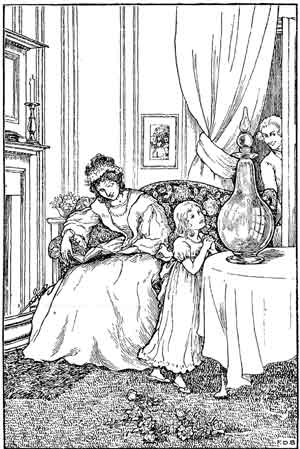
The servant was much longer returning home than Rosamond had expected; but at length he came, and brought with him the long-wished-for jar. The moment it was set down upon the table, Rosamond ran up to it with an exclamation of joy: "I may have it now, mamma?"
"Yes, my dear, it is yours."
Rosamond poured the flowers from her lap upon the carpet, and seized the purple flower-pot.
"Oh, dear, mother!" cried she, as soon as she had taken off the top, "but there's something dark in it which smells very disagreeably. What is it? I didn't want this black stuff."
"Nor I, my dear."
"But what shall I do with it, mamma?"
"That I cannot tell."
"It will be of no use to me, mamma."
"That I cannot help."
"But I must pour it out, and fill the flower-pot with water."
"As you please, my dear."
"Will you lend me a bowl to pour it into, mamma?"
"That was more than I promised you, my dear; but I will lend you a bowl."
The bowl was produced, and Rosamond proceeded to empty the purple vase. But she experienced much surprise and disappointment, on finding, when it was entirely empty, that it was no longer a purple vase. It was a plain white glass jar, which had appeared to have that beautiful color merely from the liquor with which it had been filled.
Little Rosamond burst into tears.
"Why should you cry, my dear?" said her mother; "it will be of as much use to you now as ever, for a flower-pot."
"But it won't look so pretty on the chimney-piece. I am sure, if I had known that it was not really purple, I should not have wished to have it so much."
"But didn't I tell you that you had not examined it; and that perhaps you would be disappointed?"
"And so I am disappointed, indeed. I wish I had believed you at once. Now I had much rather have the shoes, for I shall not be able to walk all this month; even walking home that little way hurt me exceedingly. Mamma, I will give you the flower-pot back again, and that purple stuff and all, if you'll only give me the shoes."
"No, Rosamond; you must abide by your own choice; and now the best thing you can possibly do is to bear your disappointment with good humor."
"I will bear it as well as I can," said Rosamond, wiping her eyes; and she began slowly and sorrowfully to fill the vase with flowers.
But Rosamond's disappointment did not end here. Many were the difficulties and distresses into which her imprudent choice brought her, before the end of the month.
Every day her shoes grew worse and worse, till as last she could neither run, dance, jump, nor walk in them.
Whenever Rosamond was called to see anything, she was detained pulling her shoes up at the heels, and was sure to be too late.
Whenever her mother was going out to walk, she could not take Rosamond with her, for Rosamond had no soles to her shoes; and at length, on the very last day of the month, it happened that her father proposed to take her with her brother to a glass-house, which she had long wished to see. She was very happy; but, when she was quite ready, had her hat and gloves on, and was making haste downstairs to her brother and father, who were waiting for her at the hall door, the shoe dropped off. She put it on again in a great hurry, but, as she was going across the hall, her father turned round.
"Why are you walking slipshod? no one must walk slipshod with me. Why, Rosamond," said he, looking at her shoes with disgust, "I thought that you were always neat; no, I cannot take you with me."
Rosamond colored and retired.
"Oh, mamma," said she as she took off her hat, "how I wish that I had chosen the shoes! They would have been of so much more use to me than that jar: however, I am sure, no, not quite sure, but I hope I shall be wiser another time."
THE THREE CAKES
By ARMAND BERQUIN
"There was a little boy named Henry," said Mr Glassington "about your age. His parents had but lately fixed him at a boarding-school.
"He was a special boy, forever at his book, and happened once to get the highest place at exercises. His mother was told it. She could nohow keep from dreaming of the pleasure; and when morning came, she got up early, went to speak with the cook and said as follows:
"'Cook, you are to make a cake for Henry, who yesterday was very good at school.'
"'With all my heart,' replied the cook, and set immediately about it. It was as big as—let me see—as big as—as a hat when flapped. The cook had stuffed it with nice almonds, large pistachio nuts, and candied lemon-peel, and iced it over with a coat of sugar, so that it was very smooth and a perfect white. The cake no sooner was come home from baking than the cook put on her things, and carried it to school.
"When Henry first saw it, he jumped up and down like any Merry Andrew. He was not so patient as to wait till they could let him have a knife, but fell upon it tooth and nail. He ate and ate till school began, and after school was over he ate again; at night, too, it was the same thing till bedtime—nay, a little fellow that Henry had for a playmate told me that he put the cake upon his bolster when he went to bed, and waked and waked a dozen times, that he might take a bit. I cannot so easily believe this last particular; but, then, it is very true, at least, that on the morrow, when the day was hardly broke, he set about his favorite business once again, continuing at it all the morning, and by noon had eaten it up. The dinner-bell now rung; but Henry, as one may fancy, had no stomach, and was vexed to see how heartily the other children ate. It was, however, worse than this at five o'clock, when school was over.
"His companions asked him if he would not play at cricket, tan, or kits. Alas! he could not; so they played without him. In the meantime Henry could hardly stand upon his legs; he went and sat down in a corner very gloomily, while the children said one to another: 'What is the matter with poor Henry, who used to skip about and be so merry? See how pale and sorrowful he is!'
"The master came himself, and, seeing him, was quite alarmed. It was all lost labor to interrogate him. Henry could not be brought to speak a single word.
"By great good luck, a boy at length came forward in the secret; and his information was that Henry's mother had sent him a great cake the day before, which he had swallowed in an instant, as it were, and that his present sickness was occasioned only by his gluttony. On this, the master sent for an apothecary, who ordered him a quantity of physic, phial after phial. Henry, as one would fancy, found it very nauseous, but was forced to take the whole for fear of dying, which, had he omitted it, would certainly have been the case. When some few days of physic and strict regimen had passed, his health was re-established as before; but his mother protested that she would never let him have another cake."
Percival. He did not merit so much as the smell of such a thing. But this is but one cake, father; and you informed me that there were three, if you remember, in your story.
Mr. G. Patience! patience! Here is another cake in what I am now going to tell.
"Henry's master had another scholar, whose name was Francis. He had written his mother a very pretty letter, and it had not so much as a blotted stroke; in recompense for which she sent him likewise a great cake, and Francis thus addressed himself: 'I will not, like that glutton Henry, eat up my cake at once, and so be sick as he was; no, I will make my pleasure last a great deal longer.' So he took the cake, which he could hardly lift by reason of its weight, and watched the opportunity of slipping up into his chamber with it, where his box was, and in which he put it under lock and key. At playtime every day he slipped away from his companions, went upstairs a-tiptoe, cut a tolerable slice off, swallowed it, put by the rest, and then came down and mixed again with his companions. He continued this clandestine business all the week, and even then the cake was hardly half consumed. But what ensued? At last the cake grew dry, and quickly after moldy; nay, the very maggots got into it, and by that means had their share; on which account it was not then worth eating, and our young curmudgeon was compelled to fling the rest away with great reluctance. However, no one grieved for him."
Percival. No, indeed; nor I, father. What, keep a cake locked up seven days together, and not give one's friends a bit! That is monstrous! But let us have the other now.
"There was another little gentleman who went to school with Henry and Francis likewise, and his name was Gratian. His mother sent him a cake one day, because she loved him, and, indeed, he loved her also very much. It was no sooner come than Gratian thus addressed his young companions: 'Come and look at what mother has sent me; you must every one eat with me.' They scarcely needed such a welcome piece of information twice, but all got round the cake, as you have doubtless seen the bees resorting to a flower just blown. As Gratian was provided with a knife, he cut a great piece off, and then divided it into as many shares as he had brought boys together by such a courteous invitation. Gratian then took up the rest, and told them that he would eat his piece next day; on which he put it up, and went to play with his companions, who were all solicitous to have him choose whatever game he thought might entertain him most.
"A quarter of an hour had scarcely passed as they were playing, when a poor old man, who had a fiddle, came into the yard.
"He had a very long white beard, and, being blind, was guided by a little dog, who went before him with a collar round his neck. To this a cord was fastened, which the poor blind man held in his hand.
"It was noticed with how much dexterity the little dog conducted him, and how he shook a bell, which, I forgot to say, hung underneath his collar, when he came near any one, as if he had designed to say by such an action, 'Do not throw down or run against my master.' Being come into the yard, he sat him down upon a stone, and, hearing several children talking round him, 'My dear little gentlemen,' said he, 'I will play you all the pretty tunes that I know, if you will give me leave.' The children wished for nothing half so much. He put his violin in tune, and then thrummed over several jigs and other scraps of music, which, it was easy to conjecture, had been new in former times.
"Little Gratian saw that while he played his merriest airs, a tear would now and then roll down his cheeks, on which he stopped to ask him why he wept?
"'Because,' said the musician, 'I am very hungry. I have no one in the world that will give my dog or me a bit of of anything to eat. I wish I could but work, and get for both of us a morsel of something; but I have lost my strength and sight. Alas! I labored hard till I was old, and now I want bread.'
"The generous Gratian, hearing this, wept too. He did not say a word, but ran to fetch the cake which he had designed to eat himself. He brought it out with joy, and, as he ran along, began: 'Here, good old man, here is some cake for you.'
"'Where?' replied the poor musician, feeling with his hands; 'where is it? For I am blind, and cannot see you.'
"Gratian put the cake into his hand, when, laying down his fiddle on the ground, he wiped his eyes, and then began to eat. At every piece he put into his mouth, he gave his faithful little dog a bit, who came and ate out of his hand; and Gratian, standing by him, smiled with pleasure at the thought of having fed the poor old man when he was hungry."
Percival. Oh, the good, good Gratian! Let me have your knife, father.
Mr. G. Here, Percival; but why my knife?
Percival. I will tell you. I have only nibbled here a little of my cake, so pleased I was in listening to you! So I will cut it smooth. There, see how well I have ordered it! These scraps, together with the currants, will be more than I shall want for breakfast; and the first poor man that I meet going home shall have the rest, even though he should not play upon the violin.
AMENDMENT
Charles Grant lived in a good house, and wore fine clothes, and had a great many pretty toys to play with; yet Charles was seldom happy or pleased; for he was never good. He did not mind what his mother said to him, and would not learn to read, though he was now seven years old.
He called the servants names, pinched and beat his little sister Clara, and took away her playthings, and was not kind and good to her, as a brother should be. "Oh, what a sad boy Charles is!" was his mother's daily bitter exclamation.
His father was a proud, bad man, who let Charles have his own way, because he was his only son, and he thought him handsome. But how could anyone be handsome that was so naughty? I am sure that when he was froward, and put out his lip, and frowned, he looked quite ugly. Mother told him so, and said that no one was pretty that was not good; but Charles did not mind his mother, and was so vain he would stand before the looking-glass half the day, instead of learning his lessons; and was so silly he would say, "What a pretty little boy I am! I am glad I am not a shabby boy, like Giles Bloomfield, our cowboy." At such times his mother would say to him: "I wish, Charles, you were only half as good as Giles; he is not much older than you, yet he can read in the Bible quite well; he works hard for his poor mother, and never vexes her, as you do me; and when he comes home of an evening, he nurses the baby, and is kind to all his sisters. I dare say he never pinched nor beat any of them in his life."
"Oh!" said that wicked Charles, "I hate him for all that, for he wears ragged clothes, and has no toys to play with."
"Oh fie, Charles!" said his mother; "you are a wicked boy: have not I often told you that God made the poor as well as the rich, and He will hate those who despise them? Now, Charles, if God, to punish you for your pride, were to take away your father and me, and you had no money to buy food, and your clothes became old and ragged, you would then be a poor, shabby boy, and worse off than Giles; for you could not earn your own living, as he does; and you would consequently be starved to death if God did not take care of you. And if, while you were rich, you hated the poor, how could you expect God to care for you when you grew poor, like those you had scorned?"
But Charles, however, was so naughty he would not stay to hear what his mother said, but ran away into the fields.
Then Charles's mother was so vexed that she could not help crying at his being such a wicked, proud boy; and she could not sleep all that night for the grief his conduct had occasioned her. The next day she was forced to take a long journey to visit a friend who was very ill, and who lived in London. She was very sorry to leave her children, for she knew if Charles behaved naughty when she was with him, he would be a sad boy indeed when he was left to himself, and had none to correct him and tell him of his faults.
When the carriage that was to take Mrs. Grant to London drove to the door, she kissed her children a great many times, and begged that they would be very good while she was away from them.
"You, my dear Clara, I know, will mind what nurse says to you, and will try to be good while I am gone; for you know that God will see everything you do amiss, if I do not; and I hope you will never forget to say your prayers to Him night and morning."
Clara kissed her dear mother, and promised that she would attend to all she said; and her mother was satisfied, for she knew that Clara never told stories, though she was but a little girl.
Then Mrs. Grant turned to Charles, and said: "As for you, Charles, I cannot help feeling great pain at leaving you; for you are such a bad, wilful boy that I shall not have a happy moment while I am away from you, lest you should do anything amiss. But if you love me, you will try to be good; and whenever you are about to do anything wrong, say to yourself, 'How much this would grieve my poor mother if she knew it! and how much it will offend God, who does see, and knows, not only everything I do, but even my most secret thoughts! And He will one day bring me to an account for all I do or say against His holy will and my kind parents' commands.'"
Charles, who knew he was a bad boy, hung down his head, for he did not like to be told of his faults.
Then his mother said: "My dear Charles, do try and be good, and I will love you dearly."
"But what will you bring me from London," said Charles, "if I am a good boy? for I never will behave well for nothing."
"Do you call the love of God and of dear mother nothing?" said Clara; "I will behave well, even if mother forgets to bring me the great wax doll, and the chest of drawers to keep her clothes in, which she told me about yesterday."
Mrs. Grant smiled fondly on her little girl, but made no reply to Charles; and soon the coach drove away from the door.
Charles was very glad when his mother was gone, and he said: "Now mother is gone to London, I will do just as I please: I will learn no ugly lessons, but play all day long. How happy I shall be! I hope mother may not come for a whole month."
But Charles soon found he was not so happy as he thought he should have been; he did not know the reason, but I will tell you why he was not happy. No one can be happy who is not good, and Charles was so naughty as to resolve not to obey his kind mother, who loved him so much.
Charles brought out all his toys to play with, but he soon grew weary of them, and he kicked them under the table, saying, "Nasty dull toys, I hate you, for you do not amuse me or make me happy. I will go to father, and ask him to give me something to please me that I am not used to."
But father was busy with some friends in the study, and could not attend to his wants. Charles was a rude, tiresome boy; so he stood by his father, and shook his chair, and pulled his sleeve, and teased him so much that his father at last grew angry, and turned him out of the room.
Then Charles stood and kicked at the door, and screamed with all his might, when one of the gentlemen said to him: "If you were my little boy, I would give you something to cry for." So Charles's father told him if he did not go away, he would come out of the study and whip him.
When Charles heard this, he ran away, for he was afraid of being beaten; but, instead of playing quietly with his toys, he went and laid under the great table in the hall and sulked and fretted till dinner-time.
When nurse came to call him to dinner, he said: "I won't come; Go away, ugly nurse!"
Then said nurse: "Master Charles, if you like to punish yourself by going without your dinner, no one will prevent you, I am sure."
Then Charles began to cry aloud, and tried to tear nurse's apron; but nurse told him he was a bad boy, and left him.
Now, when Clara sat down to dinner, she said to nurse: "Where is brother Charles? Why is he not here?"
"Miss Clara, he is a naughty child," said nurse, "and chooses to go without his dinner, thinking to vex us; but he hurts no one but himself with his perverse temper."
"Then," said Clara, "I do not like to dine while Charles goes without; so I will try and persuade him to come and eat some pie."
"Well, Miss Clara," said nurse, "you may go, if you please; but I would leave the bad boy to himself."
When Clara came to Charles, and asked him if he would come and eat his dinner, he poked out his head, and made such an ugly face that she was quite frightened at him, and ran away.
Nurse did not take the trouble of calling him to tea; and, though he was very hungry, he was too sulky to come without being asked; so he lay under the table, and cried aloud till bedtime. But when it grew dark, he was afraid to stay by himself, for bad children are always fearful; so he came upstairs and said in a cross, rude tone of voice: "Nurse, give me something to eat."
Nurse said: "Master Charles, if you had been good, you would have had some chicken and some apple-pie for your dinner, and bread and butter and cake for your tea; but as you were such a bad boy, and would not come to your meals, I shall only give you a piece of dry bread and a cup of milk, and you do not deserve even that."
Then Charles made one of his very worst faces, and threw the bread on the ground, and spilt the milk.
Nurse told him that there were many poor children in the world who would be glad of the smallest morsel of what he so much despised, and that the time would come when he might want the very worst bit of it; and she bade him kneel down and say his prayers, and ask God to forgive him for having been such a wicked boy all day.
But Charles did not mind what she said, and went crying to bed. Thus ended the first day of Charles Grant's happiness.
He awoke very early the next morning, and told nurse to get him his breakfast, for he was very hungry. But nurse said he must wait till eight o'clock, which was the breakfast hour.
He now found it was of no use sulking, as no one seemed to care for his tempers; so he looked about for something to eat, but found nothing but the piece of bread he had thrown on the ground the night before; and he was glad to eat that, and only wished there had been more of it.
As soon as breakfast was over, Clara brought her books, and began to learn her lessons, and nurse asked Charles if he would do the same. But Charles said, "No, indeed! I do not mean to learn any lessons while mother is away, for I mean to please myself and be happy."
"You did as you pleased yesterday, Master Charles," said nurse; "yet I do not think you were so very happy, unless happiness consists in lying under a table and crying all day, and going without dinner and tea, merely to indulge a sullen, froward temper."
Now, Charles hated to be told of his faults, so he left nurse, and went into the garden to try and amuse himself. When there, instead of keeping in the walks, as he ought to have done, he ran on the beds, trampled down the flowers, and pulled the blossoms from the fruit-trees.
The gardener's boy earnestly requested Charles not to do so much mischief; but Charles told him he was a gentleman's son, and would do as he pleased. So he again ran over the new-raked borders, and pulled up the flowers; and the poor boy was sadly vexed to see his nice work all spoiled.
Charles did not care for that, and would have behaved still worse, had not the gardener, who then came up, taken him in his arms, and carried him into the house, in spite of his kicking and screaming. He cried for a long time, and made a sad noise; but, finding that no one paid any regard to him, he became quiet, and went into the nursery, and asked Clara to come and play with him.
"I cannot come just now, brother Charles," said she; "for I want to finish this frock that I am making for Giles Bloomfield's little sister."
"I am sure," said Charles, "if I were you, I would much rather play than sit still and sew."
"Not if you knew what pleasure there is in doing good," said Clara; "but if you will wait till I have finished it, you shall go with me and give it to the poor woman, and then you will see how pleased she will be, and how nicely the baby will look when she is dressed in this pretty frock, instead of her old faded, ragged one."
Charles did not know how to amuse himself, so he sat down on his little stool, and watched his sister while she worked.
When Clara had finished making the frock, she said: "Thank you, dear nurse, for cutting out and fixing the frock for me." So she threw her arms round nurse's neck, and kissed her cheek; and nurse put on Clara's tippet and her new bonnet, and walked with Charles and her to Dame Bloomfield's cottage.
The good woman took the baby out of the cradle, and laid it on Clara's lap, and Clara had the pleasure of dressing it herself in the nice new frock; and the baby looked so neat and pretty, and the poor mother was so pleased, that Clara was much happier than if she had spent her time in playing or working for her doll.
While Clara was nursing and caressing the baby, Charles went into the little garden, where he found Giles Bloomfield, who had just returned from working in the fields, with a beautiful milk-white rabbit in his arms, which he had taken out of the hutch, and was nursing with much affection.
"Oh, what a pretty rabbit!" said Charles. "Giles, will you sell it to me?"
"No, Master Charles," said Giles, "I cannot sell my pretty Snowball."
"And why not?" asked Charles in a fretful tone.
"Because, Master Charles, the old doe, its mother, died when Snowball was only a week old, and I reared it by feeding it with warm milk and bran; and it is now so fond of me that I would not part with it for a great deal."
So saying, he stroked his pretty favorite, who licked his hand all over, and rubbed her soft white head against his fingers.
Then Giles said: "My dear Snowball, I would not sell you for the world."
"But you shall sell Snowball to me," said Charles, making one of his ugly faces. "I will give you a shilling for her; and if you do not let me carry her home this very day, I will tell father of you, and he will turn you out of the cottage."
When Giles's mother heard Charles say so, she came out of the house, and said: "Pray, Giles, let Master Charles have the rabbit."
"Dear mother," said Giles, "Master Charles has a pony and a dog, and a great many fine toys to play with, and I have only my pretty Snowball; and it will break my heart to part with her."
"Then," said his mother, "would you rather see your mother and sisters turned out of doors than part with your rabbit? You know, Giles, that I had so many expenses with your poor father's illness and death that I have not paid the rent due last quarter-day; and you know it is in our landlord's power to turn us into the streets to-morrow."
"Well, mother," cried Giles, bursting into tears, "Master Charles must have the rabbit. But oh!" continued he, "he does not love you as I do, my pretty Snowball; he will not feed and take care of you as I have done, and you will soon die, and I shall never see you again." And his tears fell fast on the white head of his little pet as he spoke.
Clara was quite grieved, and begged her naughty brother not to deprive poor Giles of his rabbit; but Charles was a wicked and covetous boy; he therefore took Snowball from Giles, and carried her home in his arms, and put her in a box. He went into the fields and gathered some green herbs for her to eat, and said: "I am glad I have got Snowball; now I shall be quite happy."
But how could Charles be happy when he had broken God's holy commandment, which says, "Thou shalt not covet?" Nurse and Clara told him so, and begged him to give Snowball back again to Giles. But Charles said he would not, for he meant to keep her all his life; but the next morning, when he went into the stable to look at her, he found her stretched at the bottom of the box. He called her, but Snowball did not stir; he then took her out of the box to see what ailed her; but she was quite cold and dead.
Oh dear! how Charles did cry! But it was of no use. He had better not have taken her away from Giles, for he did not know what to feed her with, and had given her among the greens he had gathered a herb called hemlock, which is poisonous and will kill whatever eats of it; and it had killed poor Snowball.
The coachman told Charles so when he saw how swollen she was, and Charles cried the more. Giles cried too when he heard what a sad death poor Snowball had died; but he had been a good dutiful boy in parting with her when his mother wished it, though it had cost him much pain and many tears.
Well, Charles's mother was gone a long time, more than a month, and it would quite shock you to be told how naughty Charles was all that time; at last a letter came to say she was very ill, and then another to tell them she was dead.
What would Charles then have given if he had not grieved her so often with his perverse temper and wicked conduct? He now said when he saw her again, he would beg her to forgive him; but when Charles did see his poor mother again she was in her coffin and could not hear him; and he cried exceedingly, and wished he had been good. Clara, though she cried as much as Charles for her dear mother, was glad she had obeyed her, and been so good while she was away.
"And I will always be as good as if dear mother could see me, and love me for it too," said she to nurse the day after her mother was buried.
"My dear young lady," said nurse, "your mother will see it, and love you for doing your duty."
"How can dear mother see me? Her eyes are closed, and she is in the dark grave," said Clara.
"But she will see you from heaven, Miss Clara, where she is gone to receive the reward of her good conduct in this world; for though her body is in the earth, her spirit is in heaven."
"And shall I never see my own dear mother again?" said Clara.
"Yes, Miss Clara; if you are good, you will go to heaven when you die, and become an angel like her."
"Then," said Clara, "I will pray to God to make me good, and when I am going to do anything wrong I will say to myself, 'If I do this, I shall never go to heaven, and see my dear mother when I die.'"
"I wish," said nurse, "that Master Charles was like you, and would try to be good."
But though Charles was sometimes sorry for his bad behavior, he did not try to mend, because he thought it was too much trouble to be good, and said he did not care, because he was the son of a gentleman.
Charles did not know that at this very time his father had spent all his money, and owed a great many debts to different people; and at last he ran away that he might not be put in prison; and the people to whom he owed so much money came and seized his fine house and gardens, and the coach, and all the furniture, and sold them by auction, to raise money to pay the debts; so Charles found that, instead of being rich, he was now very, very poor.
When the auction was over and all the things were sold, and it was getting quite dark (for it was in the month of November), Clara and Charles stood in one of the empty parlors, and wondered what they should do for supper, and where they should sleep that night; for all the beds were sold, and they saw the servants go away one after another.
At last nurse came in with her bonnet and cloak, and said: "Miss Clara, I am going away to my own cottage, and as you have always been a kind, good child, you shall go with me, and I will take care of you."
Then Clara said, "Thank you; but will you not take Charles also?"
"No," said nurse; "he has always been such a proud bad boy that I will not take him. I have very little to spare, for I am a poor woman, and what I have is not more than will keep my own children and you, Miss Clara."
Saying this, she got into the cart, and took Clara on her lap, and one of the footmen got in after her, and drove away from the door.
Charles stood on the step of the door, and looked after them till they were out of sight; and then he began to cry as if his heart would break. The servant of the gentleman who had purchased the house came and locked the door, so Charles could not get in any more, and he sat down on the stone steps, and covered his face with his hands, and cried bitterly.
"Unhappy child that I am," sobbed he; "what will become of me? Oh, if I had but been good like Clara, I should have found a friend, as she has; but no one cares what becomes of me, because I have been so wicked. I used to despise the poor, and God, to punish me, has made me poor indeed."
It was very cold, and the snow began to fall fast, and it grew quite dark. Charles rested his head on his knees, and was afraid to look round; his clothes were almost wet through, and his limbs were benumbed with cold; he had no place where he could ask shelter, for no one loved him; and he thought he should be obliged to stay there all night, and perhaps be frozen to death.
Just then some one softly touched his hand, and said: "Master Charles, I have been looking for you for more than an hour."
Charles looked up; but when he saw it was Giles Bloomfield who had come to seek him in his distress, he remembered how ill he had behaved to him, so he hid his face, and began to weep afresh.
Then Giles sat down by him on the steps, and said: "Dear Master Charles, you must not stay here. See how fast it snows. You will catch your death of cold."
"Yes, I am very cold and hungry," sobbed Charles, "but I have no home now; I have nowhere else to go, and must stay here all night."
"No, Master Charles," said Giles, "you shall come home with me, and shall share my supper and my bed, though it is not such as you have been used to; notwithstanding we are very poor, we will do our best to make you comfortable."
"Oh, Giles!" said Charles, throwing his arms round Giles's neck, "I do not deserve this kindness; I have been such a proud, wicked boy, and have treated you so ill. I am sure you can never forgive me for having taken your pretty Snowball; and if you forgive me, I can never forgive myself."
"Dear Master Charles, do not think of that now," said Giles, taking both Charles's cold hands in his. "Indeed, Master Charles, I should never dare say my prayers if I was so wicked as to bear malice; and, now you are in distress, I would do anything in my power to serve you. So pray come home with me, and warm yourself, and get some supper."
But Charles hid his face on Giles's bosom, and cried the more; at last he said:
"Giles, I am so ashamed of having behaved so cruelly to you, that I can never go to your home, and eat the food that you are obliged to labor so hard for."
"Master Charles," said Giles, "that is because you are so proud."
"Oh no, no!" sobbed Charles, "I am not proud now, and I think I shall never be proud again." So he kissed Giles, and they both went home to Dame Bloomfield's cottage together.
When Giles's mother saw Charles, she said: "Why did you bring this proud, cross, young gentleman here, Giles?"
Charles, when he heard her say so, thought he should be turned out again into the cold, and began to cry afresh; but Giles said:
"Dear mother, Master Charles has no home to go to now; he is cold and hungry; I am sure you will let him stay here, and share my bed and my supper."
"He can stay here if he likes," said Dame Bloomfield; "but you know, Giles, we are forced to work hard for what food we have, and I am sure we cannot afford to maintain Master Charles."
"Then," said Giles, "he shall have my supper to-night: he wants it more than I do, for he has had no food all day."
"You may please yourself about that, Giles: but remember, if you give your food to Master Charles, you must go without yourself."
"Well," said Giles, "I shall feel more pleasure in giving my supper to Master Charles than in eating it myself."
So he brought a stool, and, placing it in the warmest corner by the fire, made Charles sit down, and chafed his cold frozen hands, and tried to comfort him; for Charles was greatly afflicted when he saw that everyone hated him; but he knew that it was his own fault, and a just punishment for his pride and bad conduct.
When Giles brought his basin of hot milk and bread for his supper, he could not thank him for crying; and he was ashamed to eat it while Giles went without; but he was so hungry, and the milk looked so nice, that he did not know how to refuse it; and Giles begged him so earnestly to eat that at last he did so, and once more felt warm and comfortable.
Then Giles said to him: "Now, Master Charles, will you go to bed? Mine is but a coarse, hard bed, but it is very clean." So he took the lamp to show Charles the way to the chamber in which he was to sleep.
Charles was surprised at seeing no staircase, but only a ladder. Giles laughed when he saw how Charles stared, and he said:
"You have been used to live in a grand house, Master Charles, and know nothing of the shifts the poor are forced to make."
Then Charles climbed up the ladder, and Giles showed him a little room, not much larger than a closet, with no furniture in it, but a stump bed without any hangings, and covered with a coarse, woolen rug. Charles Grant had never even seen such a bed before, but he was thankful that he could get any place to sleep in, out of the cold and snow.
Giles helped Charles to undress, for Charles was so helpless he did not know how to undress himself. When he was going to step into bed, Giles exclaimed:
"Will you not say your prayers before you go to bed, Master Charles?"
Charles blushed and hung down his head, for he had been so naughty that he had not said his prayers for a long time past, and had almost forgotten what his dear mother had taught him; and he told Giles so at last.
"Dear, dear!" said Giles, "I never dare go to bed without saying mine."
Then Charles said: "I am sorry I have been so naughty as to forget my prayers; will you teach me yours, and I will never forget them again?"
Then they both knelt down by the side of the little bed, and Giles taught Charles such prayers as he knew, and Charles went to bed much happier than he had been for a long time.
Though the bed was hard, and the sheets brown and coarse, Charles was so weary that he soon fell asleep, and slept so soundly that he did not awake till it was broad day, and Giles was up and gone to work in the fields.
When Charles looked round he thought he had never seen such a shabby room in his life. There was not so much as a chair or table or carpet in it; he could see all the thatch and the rafters in the roof, for the chamber was not even ceiled, but showed the thatch and rafters, and, as I said before, there was not a single article of furniture in the room, except the bed. How different from the pretty little chamber in which Charles used to sleep, with the nice white dimity window-curtains and hangings and mahogany tent-bed, with such comfortable bedding and handsome white counterpane! However, he now thought himself very fortunate that he had any roof to shelter him, or any bed, however homely it might be, on which he could sleep.
He thought he should like to get up and go downstairs, but he had always been used to have a servant to dress him, and he did not know how to dress himself, so while he was considering what he should do Giles came into the chamber. He had returned to get his breakfast, and not seeing Charles downstairs he concluded the cause of his absence, and came to assist him to dress. Charles observed how this matter was arranged, and resolved to do it for himself the next morning.
When he was dressed they both knelt down by the bedside and said their prayers, for though Giles had said his at the dawn of day, yet he never omitted an opportunity of repeating his thanksgivings and praises to his heavenly Father for the mercies and blessings which he enjoyed through His grace, for Giles possessed a grateful and contented heart, which made him look upon that state of life unto which it had pleased God to call him, as that which was meet and fit for him, so he worked hard, and ate the bread of labor with cheerfulness and satisfaction.
When Charles and Giles joined the family below Dame Bloomfield set a porringer of milk and a piece of brown bread for every one but Charles, who looked ready to cry, but Giles put his porringer before him, and gave him another spoon, and said: "Master Charles, we will eat together, for there will be enough for both of us." The tears came into Charles's eyes, and he whispered: "Dear Giles, you are very good." So these boys ate out of the same porringer, and broke of the same bread.
After breakfast Giles went out to work, and Charles thought it very dull till he returned to dinner. When Dame Bloomfield gave her children their dinners there was a dumpling for everyone but Charles; then Giles cut his dumpling in half, and gave one part to Charles, and ate the other half himself. Now this was very good of Giles, for he was very hungry himself, but he could not bear to see Charles sad and hungry while he was eating, and Giles liked to do good because he knew it was pleasing to God.
As soon as dinner was over, Giles went out to work again, and Charles was as dull as he had been in the morning, for all the family were at work in some way or other, and could not spare time to amuse or talk to him, and he did nothing but sigh and fret to himself till evening, when Giles came home from work.
Giles's eldest sister made a bright fire, and they all sat round it and talked and told stories, and Giles nursed the baby, and played with the other little ones, and seemed quite happy, and so he was, for he had done his duty, and every one loved him for being so good.
After supper Giles taught those of his sisters who were old enough to read and write, and when they had finished learning their tasks Charles took up the book, and said: "Giles, will you teach me to read?" and Giles said: "Certainly, Master Charles, but I am sure you must know how to read a great deal better than such a poor boy as I am."
"I might have done so," said Charles, "but Giles, I was a sad, naughty, perverse boy, and hated to learn any thing that was good; but I hope I know better now, and if you will only take the trouble of teaching me I will try and make up for my lost time."
So Giles gave Charles a lesson that very night, and every evening after supper he heard him read and spell what he had learned during the day, and Charles took such pains that he soon began to read so well that he used to amuse himself by reading pretty stories, and by teaching little Betty, one of Giles's youngest sisters, to read.
Still Charles used to be exceedingly hungry, for he had not more than half the quantity of food he was used to eat, and Giles was hungry too, and grew pale and thin.
Then Charles said to himself: "It is not right for me to eat the bread which poor Giles works so hard to earn; I will try and get my own living, for why should I not do so, as well as Giles?" So one morning, when Giles rose, as usual, at five o'clock, Charles got up too. Then Giles said:
"Why do you rise so early this cold morning, Master Charles?"
"Because I am going out to work with you, Giles, if you will permit me," answered Charles.
"Oh, Master Charles, such work as I do is not fit for a young gentleman like you," said Giles.
"You must not call me a young gentleman now, for I am only a poor boy, and poorer than other poor boys, for they can earn their own living, while I should have been starved to death had not you given me half of the bread you work so hard for. But I will not be a burthen to you any longer, but learn to work and get my own living as you do."
Charles now meant to keep his word, and they both went out into the fields, and worked together at picking stones off the young crops of wheat and clover, and before breakfast. Giles had picked up two bushels of stones and Charles one, and the farmer gave them a penny per bushel for gathering them up.
Then they made haste back to the cottage, and Giles gave his mother the money he had earned, and Charles did the same, and when the dame poured out the milk for the family Charles saw that she filled a porringer for him also, and they had all a good breakfast that morning, and Charles felt quite happy because he had not eaten the bread of idleness. So he went out to work with Giles again, and earned twopence before dinner.
When Dame Bloomfield took up the dumplings Charles saw there was one for him, and he felt happy that poor Giles had not to deprive himself of half his food that he might eat.
Charles went out to work every day with Giles, and in the evening he learned to read and write. He became quite good and gentle, and enjoyed more happiness than he had experienced in his life before, And why was Charles happy? I will tell you, my dear children. Because he was no longer a proud, froward boy as he had been, but was kind and sweet-tempered to every one, and did his duty both to God and himself.
The winter passed swiftly away, and the spring came, and the birds began to sing, and the trees looked green and gay, and the pretty flowers bloomed in the gardens and covered the meadows all over, and scented the air with their fragrance, and Charles thought it very pleasant to work in the fields, and hear the birds sing as they tended their young, or built their nests among the green boughs or in the hedges.
One day Giles said to Charles: "Master Charles, we cannot work together in the fields any more; I have got a new employment"
"But why cannot I work with you?" asked Charles.
"Because, sir, you will not like to work where I am going," answered Giles. Charles asked where that was. "In the garden of the great house, Master Charles, where you used to live," said Giles.
Charles looked very sorrowful, and remained silent for some minutes; at last he said: "Well, Giles, I will go with you; my clothes are grown shabby now, and nobody will know me, and if they did I hope I am too wise to be ashamed of doing my duty, so let us go directly."
Then Giles took Charles into the garden, and the gardener gave them each a hoe and a rake, and told them to hoe up the weeds on the flower borders, and then rake them neatly over, and promised if they worked well he would give them eight-pence per day.
Now this was much pleasanter than picking stones in the field, but Charles was very sad, and could not refrain from shedding tears when he thought of the time when he used to play in that very garden, and he thought, too, of his dear mamma who was dead, and of his sister Clara, whom he had not seen for so many months, but he worked as hard as he could, and the gardener praised them both, and he gave them a basket to put the weeds in, and showed them how to rake the borders smooth.
Just as they had finished the job, and Charles was saying to Giles, "How neat our work looks!" a little boy, dressed very fine, came into the garden, and, as he passed them, said: "I am glad I am a gentleman's son, and not obliged to work like these dirty boys."
When Charles thought the little boy was out of hearing, he said to Giles: "That little boy is as wicked as I used to be, and I doubt not but that God will punish him in the same way if he does not mend his manners."
The little boy, who had overheard what Charles said, was very angry, and made ugly faces, and ran into the newly-raked beds, and covered them with footmarks. Then Charles said: "I am sorry for you, young gentleman, for I see you are not good."
"How dare you say I am not good?" said this naughty child. "I am a great deal better than you, for I am a gentleman, and you are only a poor boy."
"Yes," said Charles, his eyes filling with tears as he spoke, "I am, indeed, only a poor boy now, but I was once rich like you, and lived in this very house, and wore fine clothes, and had plenty of toys and money, and was just as proud and naughty as you are, but God, to punish me, took away my parents and all those things that I had been so proud of, and that I had made such a bad use of, and reduced me to a poor boy, as you see."
When the little boy heard this he looked very serious, and said: "I have been very naughty, but I will do so no more," and he went into the house, and never teased Charles or Giles again.
A few months after this, when Charles and Giles were working as usual in the garden, they saw a gentleman come down one of the walks, leading by the hand a little girl dressed in a black silk frock and bonnet trimmed with crape.
"Ah, Giles," said Charles, "how like that young lady is to my sister Clara. I wonder whether I shall ever see my dear sister Clara again."
"Brother Charles, dear brother Charles, you have not then quite forgotten your sister Clara," said the little girl, throwing her arms round his neck as she spoke.
When Charles saw that it was, indeed, his own dear sister Clara, he kissed her and cried with joy.
Then he told Clara all that had happened to him since the day they had parted, and how sorry he had been for all his past conduct, and he asked her who the gentleman was that had brought her into the garden.
"It is our uncle, dear Charles. You know our dear mother had a brother who lived in India that she used frequently to talk about. Well, when he came home, and heard that mother was dead, and we were in distress, he came to nurse's cottage, and took me home to his house, and has now come to find you, for he is very good and kind, and loves us both for our dear mother's sake."
"And will he take me home too?" said Charles.
"Yes, my boy," said Charles's uncle, taking him by the hand, "because you are good and kind, and are no longer cross and proud, as I heard you used to be. You shall come home with me this very day, if you please, and I will teach you everything that a young gentleman should know, and you and Clara shall be my children so long as you continue to be deserving of my love, and are not unkind, nor despise those who are beneath you in situation."
"Indeed, uncle," said Charles, "I can now feel for the poor, and I would rather remain as I am than be rich if I thought I should ever behave as I used to do."
"My dear child," said his uncle, kissing him with great affection, "continue to think so, and you will never act amiss. The first and greatest step toward amendment is acknowledging our faults. What is passed shall be remembered no more, and I doubt not but that we shall all be happy for the time to come."
"But uncle," said Charles, laying his hand on his uncle's arm, "I have something to ask of you."
"Well, Charles, and what would you have of me?" said his uncle.
Then Charles led Giles to his uncle, and related all he had done for him; how he had taken him to his own home, and given him half of his food and his bed, and taught him to read and to work; he, likewise, told his uncle how ill he had behaved to Giles in depriving him of his pretty Snowball, and he said: "Dear uncle, will you allow Giles to share my good fortune, for I cannot be happy while he is in want, and he is better than me, for he returned good for evil."
Then his uncle said: "Charles, I should not have loved you had you forgotten your kind friend." And he asked Giles if he would like to go to his house and live with him, and spend his time in learning to read and write, and in improving his mind, instead of hard labor.
"I should like it very much indeed, sir," said Giles, "but I cannot accept your kind offer."
"And why not, my good little friend?"
"Because, sir," said Giles, bursting into tears, "my poor mother and sisters must go to the workhouse or starve if I did not stay and work for them, and I could not be happy if I lived in a fine house, and knew they were in want of a bit of bread to eat."
"Then," said the gentleman smiling, "for your sake they shall never want anything, for I will put them into a cottage of my own, and will take care of them, and you shall live with me, and I will love you as if you were my own child, and remember, Giles, I do this as a reward for your kindness to Charles when he was unhappy and in great distress."
Charles's uncle was as good as his word, and Giles received the blessings of a good education, while his mother and sisters were maintained by the benevolence of his benefactor.
Charles was so careful not to relapse into his former errors that he became as remarkable for his gentleness and the goodness of his heart as he had formerly been for his pride and unkindness, and in the diligent performance of his duty, both to God and man, he proved to his uncle the sincerity of his amendment.
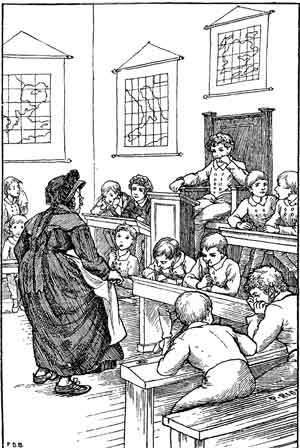
widow dorothy careful made a curtsey
TRIAL
Of a Complaint made against Sundry Persons for Breaking in the Windows of Dorothy Careful, Widow and Dealer in Gingerbread
By JOHN AIKIN AND MRS. BARBAULD
The court being sat, there appeared in person the widow Dorothy Careful to make a complaint against Henry Luckless, and other person or persons unknown, for breaking three panes of glass, value ninepence, in the house of the said widow. Being directed to tell her case to the court, she made a curtsey and began as follows:
"Please, your lordship, I was sitting at work by my fireside between the hours of six and seven in the evening, just as it was growing dusk, and little Jack was spinning beside me, when all at once crack went the window, and down fell a little basket of cakes that was set up against it. I started up and cried to Jack: 'Bless me, what's the matter?' 'So,' says Jack, 'sombody has thrown a stone and broke the window, and I dare say it is some of the schoolboys.' With that I ran out of the house, and saw some boys making off as fast as they could go. So I ran after them as quick as my old legs would carry me, but I should never have come near them if one had not happened to fall down. Him I caught and brought back to my house, when Jack knew him at once to be Master Henry Luckless. So I told him I would complain of him the next day, and I hope your worship will make him pay the damage, and I think he deserves a good whipping into the bargain for injuring a poor widow woman."
The Judge, having heard Mrs. Careful's story, desired her to sit down, and then calling up Master Luckless, asked him what he had to say for himself. Luckless appeared with his face a good deal scratched, and looking very ruefully. After making his bow and sobbing two or three times, he said:
"My lord, I am as innocent of this matter as any boy in the school, and I am sure I have suffered enough about it already. My lord, Billy Thompson and I were playing in the lane near Mrs. Careful's house when we heard the window crash, and directly after she came running out towards us. Upon this Billy ran away, and I ran too, thinking I might bear the blame. But after running a little way I stumbled over something that lay in the road, and before I could get up again she overtook me, and caught me by the hair, and began lugging and cuffing me. I told her it was not I that broke her window, but it did not signify; so she dragged me to the light, lugging and scratching me all the while, and then said she would inform against me. And that is all I know of the matter."
"I find, good woman," said the Judge, "you were willing to revenge yourself without waiting for the justice of this court."
"My lord, I must confess I was put into a passion, and did not properly consider what I was doing."
"Well, where is Billy Thompson?"
"Here, my lord."
"You have heard what Henry Luckless says. Declare upon your honor whether he has spoken the truth."
"My lord," said Billy, "I am sure neither he nor I had any concern in breaking the window. We were standing together at the time, and I ran on hearing the door open, for fear of being charged with it, and he followed; but what became of him I did not stay to see."
"So you let your friend," the Judge remarked, "shift for himself, and thought only of saving yourself. But did you see any other person about the house or in the lane?"
"My lord, I thought I heard some one creeping along the other side of the hedge a little before the window was broken, but I saw nobody."
"You hear, good woman, what is alleged in behalf of the person you have accused. Have you any other evidence against him?"
"One might be sure," the widow replied, "they would deny it, and tell lies for one another; but I hope I am not to be put off in that manner."
"I must tell you, mistress, that you give too much liberty to your tongue, and are as guilty of as much injustice as that of which you complain. I should be sorry indeed if the young gentlemen of this school deserved the general character of liars. You will find among us, I hope, as just a sense of what is right and honorable as among those who are older, and our worthy master would certainly not permit us to try offences in this manner if he thought us capable of bearing false witness in each other's favor."
"I ask your lordship's pardon; I did not mean to offend; but it is a heavy loss for a poor woman, and though I did not catch the boy in the act, he was the nearest when it was done."
"As that is no more than a suspicion, and he has the positive evidence of his schoolfellow in his favor, it will be impossible to convict him consistently with the rules of justice. Have you discovered any other circumstance that may point out the offender?"
"My lord, next morning Jack found on the floor this top, which I suppose the window was broke with."
"Hand it up. Here, gentlemen of the jury, please to examine it, and see if you can discover anything of its owner."
"Here is 'P.R.' cut upon it."
"Yes," said another boy, "I am sure I remember Peter Riot having just such a one."
"So do I," still another remarked.
"Master Riot, is this your top?"
"I don't know, my lord," said Riot; "perhaps it may be mine. I have had a great many tops, and when I have done with them I throw them away, and any body may pick them up that pleases. You see, it has lost its peg."
"Very well, sir. Mrs. Careful, you may retire."
"And must I have no amends, my lord?"
"Have patience; leave everything to the court. We shall do you all the justice in our power."
As soon as the widow was gone the Judge rose from his seat, and with much solemnity thus addressed the assembly:
"Gentlemen, this business, I confess, gives me much dissatisfaction. A poor woman has been insulted and injured in her property, apparently without provocation, and although she has not been able to convict the offender, it cannot be doubted that she, as well as the world in general, will impute the crime to some of our society. Though I am in my own mind convinced that in her passion she charged an innocent person, yet the circumstance of the top is a strong suspicion—indeed, almost a proof—that the perpetrator of this unmanly mischief was one of our body.
"The owner of the top has justly observed that its having been his property is no certain proof against him.
"Since, therefore, in the present defect of evidence the whole school must remain burdened with both the discredit of this action and share in the guilt of it, I think fit, in the first place, to decree that restitution shall be made to the sufferer out of the public chest, and, next, that a Court of Inquiry be instituted for the express purpose of searching thoroughly into the affair, with the power to examine all persons upon honor who are thought likely to be able to throw light upon it. I hope, gentlemen, these measures meet with your concurrence."
The whole court bowed to the Judge, and expressed their entire satisfaction with his determination.
It was then ordered that the Public Treasurer should go to the Widow Careful's house, and pay her a sum of one shilling, making at the same time a handsome apology in the name of the school; and six persons were taken by lot of the jury to compose the Court of Inquiry, which was to sit in the evening.
The Court then adjourned.
On the meeting of the Court of Inquiry the first thing proposed by the President was that the persons who usually played with Master Riot should be sent for. Accordingly Tom Frisk and Bob Loiter were summoned, when the President asked them upon their honor if they knew the top to have been Riot's.
They said they did. They were then asked if they remembered when Riot had it in his possession.
"He had it," said Frisk, "the day before yesterday, and split a top of mine with it."
"Yes," said Loiter, "and then as he was making a stroke at mine the peg flew out."
"What did he do with it?"
"He put it into his pocket, and said as it was a strong top he would have it mended."
"Then he did not throw it away, or give it to any one?"
"Yes; a day or two before he went to the Widow Careful's shop for some gingerbread; but as he already owed her sixpence, she would not let him have any till he had paid his debts."
"How did he take the disappointment?"
"He said he would be revenged on her."
"Are you sure he used such words?"
"Yes. Loiter heard him as well as myself."
"I did, sir," said Loiter.
"Do either of you know any more of this affair?"
"No, sir," replied both boys together.
"You may go," said the President, adding "that these witnesses had done a good deal in establishing proof against Riot; for it was pretty certain that no one but himself could have been in possession of the top at the time the crime was committed, and it also appeared that he had declared a malicious intention against the woman, which it was highly probable he would put into execution. As the court were debating about the next step to be taken they were acquainted that Jack, the widow's son, was waiting at the school-door for admission; and a person being sent out for him, Riot was found threatening the boy, and bidding him go home about his business. The boy, however, was conveyed safely into the room, when he thus addressed himself to the President:
"Sir, and please your worship," said Jack, "as I was looking about this morning for sticks in the hedge over against our house, I found this buckle. So I thought to myself, 'Sure this must belong to the rascal that broke our window.' So I have brought it to see if any one in the school would own it."
"On which side of the hedge did you find it?"
"On the other side from our house, in the close."
"Let us see it Gentlemen," said the President, "this is so smart a buckle that I am sure I remember it at once, and I dare say you all do."
"It is Riot's!" exclaimed all together.
"Has anybody observed Riot's shoes to-day?" the President asked.
"Yes; he has got them tied with strings," a boy replied.
"Very well, then, gentlemen, we have nothing more to do than to draw up the evidence we have heard, and lay it before his lordship. Jack, you may go home."
"Pray, sir, let somebody go with me, for I am afraid of Riot, who has just been threatening me at the door."
"Master Bold will please to go along with the boy."
The minutes of the court were then drawn up, and the President took them to the Judge's chamber. After the Judge had perused them, he ordered an indictment to be drawn up against Peter Riot: "For that he meanly and clandestinely and with malice aforethought had broken three panes in the window of Widow Careful with a certain instrument called a top, whereby he had committed an atrocious injury upon an innocent person, and had brought a disgrace upon the society to which he belonged."
At the same time he sent an officer to inform Master Riot that his trial would come on the next morning.
Riot, who was with some of his gay companions, affected to treat the matter with great indifference, and even to make a jest of it. However, in the morning he thought it best to endeavor to make it up, and accordingly, when the court was assembled, he sent one of his friends with a shilling, saying that he would not trouble them with further inquiries, but would pay the sum that had been issued out of the public stock. On the receipt of this message the Judge rose with much severity in his countenance, and observing that by such contemptuous behavior towards the court the criminal had greatly added to his offence, he ordered two officers with their staves immediately to go and bring in Riot, and to use force if he should resist them.
The culprit, thinking it best to submit, was presently led in between the two officers, when, being placed at the bar, the Judge then addressed him: "I am sorry, sir, that any member of this society can be so little sensible of the nature of a crime and so little acquainted with the principles of a court of justice as you have shown yourself to be by the proposal you took the improper liberty of sending us. If you mean it as a confession of your guilt, you certainly ought to have waited to receive from us the penalty we thought proper to inflict, and not to have imagined that an offer of the mere payment of damages would satisfy the claims of justice against you. If you had only broken the window by accident, and on your own accord offered restitution, nothing less than the full damages could have been accepted; but you now stand charged with having done this mischief meanly, secretly, and maliciously, and thereby have added a great deal of criminal intention to the act. Can you, then, think that a court like this, designed to watch over the morals, as well as protect the property of our community, can so slightly pass over such aggravated offences? You can claim no merit from confessing the crime now that you know so much evidence will appear against you. And if you choose still to plead not guilty, you are at liberty to do it, and we will proceed immediately to the trial without taking any advantage of the confession implied by your offer of payment."
Riot stood silent for some time, and then begged to be allowed to consult with his friends what was the best for him to do. This was agreed to, and he was permitted to retire, though under guard of an officer. After a short absence he returned with more humility in his looks, and said that he pleaded guilty, and threw himself on the mercy of the court. The Judge then made a speech of some length, for the purpose of convincing the prisoner, as well as the bystanders, of the enormity of his crime. He then pronounced the following sentence:
"You, Peter Riot, are hereby sentenced to pay to the public treasury the sum of half a crown as a satisfaction for this mischief you have done, and your attempt to conceal it.
"You are to repair to the house of Widow Careful, accompanied by such witnesses as we shall appoint, and then, having first paid her the sum you owe her, you shall ask her pardon for the insult you offered her. You shall likewise to-morrow after school stand up in your place and before all the scholars ask pardon for the disgrace you have been the means of bringing upon the society, and in particular you shall apologize to Master Luckless for the disagreeable circumstances you were the means of bringing him into. Till after this is complied with you shall not presume to come into the playground or join in any of the diversions of the school, and all persons are hereby admonished not to keep you company till this is done."
Riot was then dismissed to his room, and in the afternoon he was taken to the widow, who was pleased to receive his submission graciously, and at the same time to apologize for her own improper treatment of Master Luckless, to whom she sent a present of a nice ball by way of amends.
Thus ended this important business.
A PLOT OF GUNPOWDER:
AN OLD LADY SEIZED FOR A GUY
Ascribed to WILLIAM MARTIN ("PETER PARLEY")
Gunpowder! Yes, it is a dreadful thing, and many a little boy has lost his eyesight by it. Next to playing with fire, I do not know anything so bad as playing with gunpowder.
Every one knows of the fifth of November, the day set apart for commemorating the deliverance of King James and his Parliament from the horrible plot to blow them up with gunpowder, and how on that day Guido Fawkes, who was to have put the plan in execution, has his effigy paraded about.
Well, it was on the fifth of November, in the year 1789, when Peter Parley was a boy, that the circumstances took place of which I am going to give a relation. The boys of those days, I think, were more fond of Guy Fawkes, and bonfires, and squibs, and crackers than they are now.
I remember it was the first of November, early in the morning, that a lad, who was on a visit to my father, and who was my second cousin, got out of bed and said to me (for we both slept in one room):
"Peter," said he, "do you have a guy in this town? I had a famous one last year, and such a bonfire as you never saw, for we burnt down a haystack. I should like to have a guy this year; do let us make one."
I was only about twelve years old, and very fond of a bit of fun, and so I said:
"That is a good idea. I was thinking of the same thing last night, because the clerk gave out in the church that there would be prayers on the fifth of November, on account of the Gunpowder Plot; and, as I came out of the church porch I saw a very old woman sitting there. She looked just like an old witch, and I said to myself, 'I should like to seize her for a guy.'"
"Seize an old woman for a guy! Well, that would be the drollest thing that ever happened," said he; "and I should like to go you halves. Shall we go partners in it? We can easily get a chair and tie her down in it, and get a dark lantern and some matches and all that."
"But she must be dressed like a man," said I; "there never was a female Guy Fawkes. The people would laugh at us."
"So much the better," said he; "that is just what we want. I like something original, out of the common way. Now, a female Guy Fawkes is a thing that few persons ever saw, or even heard of."
"But shall we not be taken up," said I, "perhaps put in prison, and get ourselves into a hobble?"
"Well, what if we do? But we shall not do that. I am sure it is all right enough. But, however, to be quite certain, if you like we will ask Ephraim Quidd. You know, his father is a lawyer, and he will tell us in a minute. So when we go to school we will ask him, shall we?"
"With all my heart," said I. And so with that we began to dress ourselves, and went downstairs to breakfast. I was so full of the matter that I sat and thought of it all the time I was eating my food; and at last my imagination painted the old woman sitting in a chair, calling out, "I am no guy! I am no guy!" the mob laughing, and the boys hurrahing so vividly that I burst into a fit of laughter myself.
"Why, Peter," said my father, "'what is the matter now?"
Instead of telling him I continued to laugh, till at last he grew very angry with me, and ordered me from the breakfast-table. I then took my hat and bag, and went off to school. Simon Sapskull—for that was my cousin's name—soon followed me.
When he came up with me he said:
"I thought what you were laughing at. It will be good fun. Let us make haste and see Quidd before he goes in. It will be good fun, won't it?"
And here Master Simon jumped and capered about with delight.
When we came to the schoolyard there were several boys assembled and Quidd among them. Simon immediately ran up to him.
"Quidd," said he, "I want to ask you a question. You know the law, do you not? Your father is the town clerk, and you ought."
"I do know the law," said Quidd. "Have I not been bred to it? And is not my father to be made Recorder next year?"
"Well, then, answer me this," said Simon. "Is there any law against seizing an old woman for a guy?"
The next morning Sapskull and myself, with Thomas Hardy and half a dozen other boys, met with a view to talk about the intended exploit. We withdrew to the backyard of the schoolroom, and there, in a corner where we thought we could not be overheard, we began to plot against the liberty of Dame Clackett.
Hardy was one of the rarest boys for making fireworks I ever knew in my life. He had bought a book called "Every Boy his own Squib-Maker," in which were directions for making squibs, crackers, rockets, Roman candles, serpents, slow fire, blue lights, and other descriptions of fireworks. This he nearly knew by heart. Sapskull said:
"Look in your book and see if there is not in it how to make a guy."
So Hardy looked all over the book, but to no purpose; there was no description of a guy manufactory. It was of no consequence; we had a guy in our head, and we only now wished to know how we should get hold of the old lady, and what we should do on this joyful occasion.
Hardy said he had several pounds of gunpowder, and would sell us all squibs and crackers. But these we did not so much want. What we wanted was an old chair, an old jacket, hat, and other matters to dress up the old lady when we could catch her. But how to get her into the chair was the difficulty, and some proposed one thing and some another. Sapskull said, "We must make her merry with some beer." Hardy said, "We must tie her down." But I proposed to ask her to sit for her picture as a guy, and then to carry her off. Master Quidd was, however, more cunning than any of us, and said, "I know how to nab her; I have a plan, and a capital one it is, too."
"What is it? what is it?" said all of us.
The fact was old Dame Clackett was a very staunch churchwoman, and used always to go both on Wednesdays and Fridays, Rain or sunshine, hot or cold, nothing could keep her away from her church, and we silly boys laughed at her for it. Poor old creature! she felt more real pleasure in this than we could imagine.
"I will tell you what we will do," said Quidd. "There is in our outhouse an old wheeled chair which my mother used to ride about in when she was so long ill, a year or two ago. Now, I know old Dame Clackett is very lame just now, from having let fall her fender on her foot. I will take this chair down, and offer to draw her to church in it, and then, when we have once got her in the chair, we can do as we like with her. Hurrah!"
"Won't that be fun?" continued Quidd. "Let us do it—let us do it. There is no law against it; the thing was never thought of. It is just like the law that was never made among the Romans that I read about in my lessons yesterday: there was no law against a child killing his own father. I tell you," said he, "if there were twenty old women to be seized and burnt, nobody could be hurt for it. But you do not mean to burn her, I suppose, do you?"
"Oh no," said we; "we only want to have some fun. We should like to make a guy of her, that is all, and rare fun it will be."
"Let me join you," said one; "Let me join," said another, till at last the whole school entered into the plot.
We all forgot what we should have remembered—namely, that, instead of despising or ridiculing people who are old and helpless and poor, we ought to treat them with kindness, respect, and consideration. We forgot that we, if suffered to live long enough, should also become old, and that it would be hard for us to bear the coldness and neglect of the world, but much harder to endure the ridicule and ill-behavior of wicked children. Ay, we were thoughtless lads, and so we suffered for it, as you will afterwards hear.
The old lady whom I had seen sitting in the church porch, who was so ugly, as I thought, and so withered and old, was a very poor widow. Her husband had died in battle long ago, and she had from year to year supported herself by her spinning wheel and the little relief she had from the parish. She lived in a little hut on a piece of waste ground, and kept a little poultry, and now and then a pig or two.
Among other animals, the old lady kept an enormous goat, or, rather, he kept himself. It was one her husband had brought her from abroad, of the Syrian breed. It was quite young when it came over, but at last grew and grew so, as to become a very formidable animal, so strong and fierce, that every dog was afraid of it, being, no doubt, terrified by the sight of its large horns and undaunted aspect. The name of this dread animal was Hannibal.
Poor old Goody Clackett—for that was her name—had little thoughts of ever being "smugged," as it was termed, by our schoolfellows to make a guy on the fifth of November, and sat quietly enough spinning her wheel and drawing out her yarn. Sometimes the thrum of the old wheel would send her soundly to sleep, and then she never dreamed of such a thing as was to happen to her.
Every boy was delighted with this proposition, and it was arranged that on the following evening I and my cousin Simon should assist in the endeavor to get the chair from the outhouse to a convenient place, while Hardy was to provide lantern, matches, cap, and feathers, with red and black paint to disfigure the features of the poor old creature.