Volume 3 — GULLIVER'S TRAVELS (continued 4)
Reading edition
While Friday kept on firing, Robinson ran to the white prisoner and cut his bonds. The man said he was a Spaniard and began to thank Robinson for what he had done. Robinson handed him the cutlass and a pistol, telling him, if he had any strength left, to go and do what he could against the savages. As soon as the man got the weapons in his hands, he ran with fury at the cannibals and cut two down, and with equal fury attacked the rest. With the Spaniard to help them, Robinson and Friday were soon able to clear the place of these dreadful cannibals, many of whom jumped into the sea.
robinson ran to the white prisoner and cut his bonds
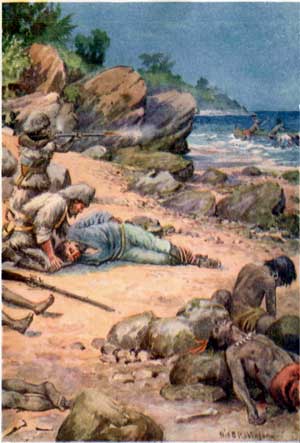
Friday advised Robinson to take a canoe and go after them lest they return with hundreds of others to avenge the death of their friends. So the two ran to the beach and began to shove off a canoe. But to their surprise, on the bottom of the canoe lay another prisoner, an old man, tied so hard, neck and heels, that even when his bonds were cut he could not move.
No sooner did Friday look at him and hear him speak, than he began to dance and shout and laugh, and then kneeling down, rubbed noses with the savage (which is what these folks do instead of kissing each other), and he was so excited that for some time he could not explain what was the matter. As soon as he could speak, he told Robinson that the man whom they had found was his father.
Both Friday's father and the Spaniard, who was worn out with fighting, had to be carried up to the castle.
No cannibals were ever again known to visit this island.
VII
ARRIVAL OF AN ENGLISH SHIP; ROBINSON SAILS FOR HOME
Soon after this Robinson had a long talk with the Spaniard, who told him how he and his comrades had been wrecked four years since, on that part of the coast where Friday's tribe lived. He said that they were well treated by the natives, but that they were put to very great straits now for want of clothes, that their powder was finished, and that they had lost all hope of ever getting back to their own country. He himself, he said, had been captured in one of the many small wars that are always taking place among the various tribes.
It struck Robinson that it might be possible for him to get these men over to his island, provided that he could be sure of their good faith, and that when they came, they did not take the island from him by treachery. It was a risk, he thought, but then, if he got so many men, it would not be difficult to build a small ship that could carry them all to England.
So he asked the Spaniard if he would promise, and if he thought he could get his comrades to take an oath that, if Robinson helped them, they would look on him as their captain, and would swear to obey him in all things. The Spaniard readily promised for himself, and said that he was sure his comrades would keep faith.
It was arranged, therefore, that in about six months, when the next harvest was reaped, and there would be plenty of food for so many extra men, the Spaniard and Friday's father should go over to the mainland in one of the canoes which had been taken from the savages.
Meantime, all hands set about the curing of very large quantities of raisins, and much other work was done to be in readiness for the coming of these men.
When the harvest was reaped, Robinson gave the Spaniard and Friday's father each a musket and a supply of powder and bullets, and loaded the canoe with food, enough to last them and the others about a fortnight, and the two men set off for the mainland in fine weather, and with a fair wind.
It was about eight days after this, and when Robinson had begun to look out for their return, that one morning very early, when Robinson was asleep, Friday came running in, shouting, "Master! Master! They come." Up jumped Robinson, and hurrying on his clothes, ran out.
Looking towards the sea, he soon made out a sailing-boat making for the shore, coming from the south end of the island, but still some miles away. This was not the direction from which the Spaniard and his comrades would come, nor were they likely to be in a sailing-boat. So Robinson took his telescope, and went to the top of the hill to see if he could make out who were on board, before they landed.
Hardly had he got on to the hill when he noticed a ship at anchor some distance from the shore. She looked like an English vessel, he thought, and the boat like an English long-boat.
This was a wonderful sight to Robinson, but yet he was not easy in his mind. It was not a part of the world where an English ship was likely to come, because in those days they were nearly all Spanish vessels that traded in these seas, and the English and Spaniards were bitter enemies. What could an English ship be doing here? There had been no storm to drive her out of her course.
Robinson feared that if she was English there must be something wrong about her. Perhaps, he thought, she was a pirate. So he was careful not to show himself or Friday.
Presently, as he watched, he saw the men in the boat run her ashore and draw her up on the beach, about half a mile from his castle. When they had landed, he could easily see through his glass that they were Englishmen.
There were eleven men, but three of them had their hands tied behind their backs, and were evidently prisoners. When the first four or five men had jumped ashore, they brought out these three, all the while ill-treating them, and behaving as if they meant to kill their prisoners. Friday was sure that they meant to eat them.
Soon, without further harming the three men, the others scattered about among the trees near the shore, leaving the three sitting on the ground very sad-looking, but with their hands now untied.
At the time the boat was run aground, it was just high-water, and the two sailors who had been left in charge of her, and who had evidently been drinking too much rum, went to sleep, and never noticed that the tide was going out. When they woke, the boat was high and dry, and with all the strength of the whole crew they could not move her, because the sand at that part of the beach was very soft. This did not seem to trouble any of them very much, for Robinson heard one of the sailors shout, "Let her alone, Jack, can't ye? She'll float next tide."
All forenoon Robinson watched, and when the hottest time of the day had come, he noticed the sailors throw themselves down under the trees, and go to sleep, some distance away from the three prisoners.
Then Robinson and Friday, taking their muskets and pistols, stole down cautiously behind the three men, to try to speak to them without the others knowing.
Robinson had put on his goatskin coat and the great hairy hat that he had made for himself; and with his cutlass and pistols in his belt, and a gun over each shoulder, he looked very fierce.
The men did not see him till he spoke, and they were so startled by his wild look, and by the sight of two men armed to the teeth, that they nearly ran away. But Robinson told them not to be alarmed; he was an Englishman, and a friend, and would help them if they would show him how it could be done.
Then they explained to him what had happened. One of the three was Captain of the ship that lay at anchor off the island. Of the others, one was mate of the ship, and the third man was a passenger. The crew had mutinied, the Captain told Robinson, and had put him and the other two in irons, and the ringleaders in the mutiny had proposed to kill them. Now they meant to leave them on the island to perish.
The Captain was so astonished at finding anybody there who proposed to help him, that he said in his wonder: "Am I talking to a man, or to an angel from heaven?"
"If the Lord had sent an angel, sir," said Robinson, "he would probably have come better clothed."
Then he asked if the boat's crew had any firearms, and was told that they had only two muskets, one of which was left in the boat. "The rest should be easy, then," Robinson said; "we can either kill them all, or take them prisoners, as we please."
The Captain was unwilling to see the men killed, for he said if two of the worst of them were got rid of, he believed the rest would return to their duty.
Robinson made a bargain that if he saved the Captain from the mutineers, and recovered the ship, he and Friday were to be taken home to England in her, free of cost; and to this the Captain and the others agreed.
Then Robinson gave each of them a musket, with powder and ball, after which the Captain and the mate and the passenger marched towards the spot where the mutinous sailors lay asleep. One of the men heard them advance, and turning round, saw them, and cried out to his companions. But it was too late, the mate and the passenger fired, and one of the ringleaders fell dead. A second man also fell, but jumped up immediately and called to the others to help him. But the Captain knocked him down with the butt of his musket, and the rest of the men, seeing Robinson and Friday coming, and knowing they had no chance against five armed men, begged for mercy. Three others who had been straying about among the trees came back on hearing the shots, and were also taken, and thus the whole crew of the boat was captured.
The Captain and Robinson now began to think how they might recover the ship. There were on board, the Captain said, several men on whom he thought he could depend, and who had been forced by the others into the mutiny against their wills. But it would be no easy thing to retake the ship, for there were still twenty-six men on board, and as they were guilty of mutiny, all of them, if taken back to England, would most likely be hanged. Thus they were certain to make a fight for it.
The first thing that Robinson and the others now did was to take everything out of the boat—oars, and mast, and sail, and rudder; then they knocked a hole in her bottom, so that she could not float. While they were doing this, and drawing her still further up on the beach, they heard first one gun and then another fired by the ship as signals to the boat to return.
As she of course did not move, Robinson saw through his glass another boat with ten men on board, armed with muskets, leave the ship, coming to bring the others back.
This was serious enough, for now Robinson and his party had to make plans whereby they might capture also this fresh boat's crew. Accordingly, they tied the hands of all the men they had first taken, and sent the worst of them to the cave under the charge of Friday and of one of the men that the Captain said was to be trusted, with orders to shoot any who tried to give an alarm or to escape. Then Robinson took his party and the rest of the prisoners into the castle, where, from the rock, they watched for the landing of the second boat.
The Captain and mate were very nervous, and despaired of taking this fresh body of men, but Robinson was quite confident of success, and put heart into them by his cheerfulness.
Of the prisoners in his castle, there were two whom the Captain believed to be honest men, and on their promising solemnly to keep faith, and to fight for him, Robinson released them.
The crew of the second boat, when they landed, were terribly surprised to find the first boat empty and stove in, and they were seen anxiously consulting what to do. Then they hallooed and fired volleys. Getting no reply, they were evidently alarmed, for they all jumped into their boat and began to pull off to the ship. In a few minutes, however, they seemed to change their minds, for again they landed, this time leaving three men in charge of the boat, and keeping her in the water. The other seven came ashore, and started in a body across the island to look for their lost comrades. But they did not care to go far, and soon stopped, again firing volleys and hallooing. Getting again no reply, they began to march back to the sea. Whereupon Robinson ordered Friday and the mate to go over the creek to the west and halloo loudly, and wait till the sailors answered. Then Friday and the mate were to go further away and again halloo, thus gradually getting the men to follow them away from shore.
This plan succeeded very well, for when the sailors, thinking they heard their missing friends hail, ran to find them, their way was stopped by the creek, over which they had to get the boat to carry them. They took with them, then, one of the three men whom they had left in the boat, and ordered the others to moor the boat to a tree, and remain there.
This was just what Robinson wanted. And, moreover, one of the men played still further into his hands, for he left the boat and lay down under a tree to sleep. On him the Captain rushed, and knocked him down as he tried to rise to his feet, whereupon the sailor left in the boat yielded, and more readily that he had joined the mutineers very unwillingly, and was now glad of the chance to rejoin his Captain.
Meantime Friday and the mate, by hallooing and answering, drew the rest of the boat's crew from hill to hill through the woods, till at last they had got them so far astray that it was not possible for them to find their way back before dark. When they did get back to where the boat had been left, and found the men whom they had left in her gone, they were in a terrible fright.
It was not difficult for Robinson and his men to surround them, and it chanced that the boatswain of the ship, who was the greatest villain of the lot, and the chief cause of all the trouble, walked in the darkness close to the Captain, who jumped up and shot him dead. The others then surrendered, believing what they were told, that they were surrounded by fifty armed men. All begged hard for their lives, and a few whom the Captain said he could trust were set at liberty on promising to help retake the ship. The others were bound and put in the cave.
Robinson and Friday remained on shore to look after the prisoners, while the Captain and the mate and the passenger, with those of the crew who were trustworthy, having patched up the damaged boat, pulled off in her and in the other to the ship, which they reached about midnight. When they were a short distance off, the Captain made one of the crew hail the ship and say that they had brought off the boat and the men they had gone in search of. Then both boats ran alongside at once, one on each side of the vessel, and before the mutineers knew what was happening they were overpowered, one or two of them being killed. Only one of the Captain's party was hurt, the mate, whose arm was broken by a musket-ball.
As soon as the ship was secured, the Captain ordered seven guns to be fired, that being the signal he had agreed to make to let Robinson know if he succeeded in taking the ship.
Robinson's stay in the island had now come to an end, after more than twenty-eight years, for in a few days he and Friday sailed for England in the ship. Some of the mutineers were left on the island, and were afterwards joined by the Spaniard and his comrades, for whom Robinson left a letter.
Robinson did not forget, when he left, to take with him the money and gold bars he had got from the wreck of the Spanish ship, and he took also, as a memento, the goatskin coat and the great hairy hat. But the Captain was able before the ship sailed to give him proper clothing, the wearing of which at first put him to dreadful discomfort.
The voyage was a long one, but they sighted the English coast at last.
It was thirty-five years since Robinson had set foot in England. And that morning, when at last, after the weary years of exile, he again saw his native land, he laid his head down on his arms and cried like a child.
And, may be, you too some day may know the joy of coming home, out of the land of bondage.
CANTERBURY TALES
By GEOFFREY CHAUCER
ADAPTED BY JANET HARVEY KELMAN
I
DORIGEN
Once upon a time a young knight, whose name was Arviragus, dwelt in Brittany. In the same country lived a beautiful lady called Dorigen. And the knight loved the lady.
For years Arviragus did not know whether she loved him or not. She was a great lady and very fair, and he was afraid to ask her. But she knew that he loved her, for when he rode past her window on his way to the wars, she could see her colors streaming from his helmet. At first she did not think much of this, for many knights fought for love of her; but as she heard of new and greater deeds that this noble knight did year by year, she began to care for him a great deal. When she thought of his goodness and of the honor in which he held her, she knew that there was no one else that she could love as she loved Arviragus. And when Arviragus knew that she loved him and was willing to be his wife, his heart was full of joy. So greatly did he wish to make Dorigen happy with him, that he said to her that he would obey her and do what she wished as gladly all his life as he had done while he was trying to win her love. To this she replied:
"Sir, since in thy great gentleness thou givest me so high a place, I pray to God that there may never be strife between us two by any fault of mine. Sir, I will be thy true and humble wife until I die!"
Then Arviragus took his bride home with him to his castle by the sea. He honored Dorigen as much as he had done before his marriage, and tried to fulfil her wishes in everything. Dorigen was just as eager to please Arviragus as he was to please her, and they were happy together in all their work and play.
Arviragus stayed quietly at home for a year, but after that he grew restless. He felt that no true knight had a right to live on quietly at home, with nothing to do except to order his castle and to hunt. So he sailed away to England that he might win honor and renown in the wars there.
Dorigen stood by the castle and watched his sails disappear in the north. Poor Dorigen! her husband was gone, and she did not know if he would ever come back to her. For weeks she wept and mourned. At night she could not rest, and by day she would not eat. All the things that she had cared most to do were now dull and worthless to her because Arviragus was away.
Her friends saw her sorrow, and tried to comfort her in every way they could. When they found she would not be comforted, they spoke harshly to her, and told her that it was very wrong of her to kill herself with sorrow, when Arviragus hoped to come home again strong and famous. Then they began to comfort her again, and to try to make her forget her sadness.
After a long time Dorigen's sorrow began to grow quieter. She could not have lived if she had always felt her grief as deeply as she did at first. Indeed, as it was, this sorrow would have broken her heart, if letters had not come from Arviragus. They brought her tidings of his doings, and of the glory he had won. But what comforted her most was that they told her that he would soon return.
alas! of all the ships i see, is there never one that will bring my lord home?
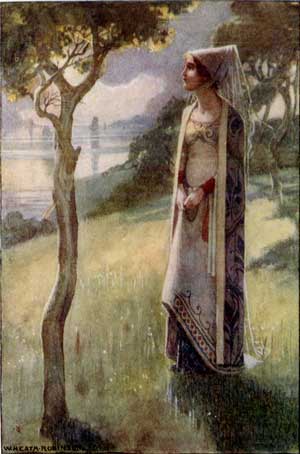
When Dorigen's friends saw that she was less hopeless, they begged her to come and roam with them to drive away the last of her dark fears. This she did. Often she walked with them by the edge of the cliffs on which her castle stood. But there she saw the white ships and the brown barges sailing, one north, another south, to the havens for which they were bound. Then she would turn away from her friends and say to herself:
"Alas! of all the ships I see, is there never one that will bring my lord home? Then should I need no comfort. My heart would be cured of this bitter smart."
At times as she sat and thought, she leaned down and looked over the brink of the cliffs. But, when she saw the grisly, black rocks, her very heart trembled within her. Then she would sink down on the grass and wail:
"O God, men say Thou hast made nothing in vain, but, Lord, why hast Thou made these black, grisly rocks? No man nor beast is helped by them in all the world. Rocks have destroyed a hundred thousand men, and which of all Thy works is so fair as man? No doubt wise men will say, 'All is for the best.' But, oh Thou God, who makest the winds to blow, keep Thou my lord! And—would to God that these black rocks were sunk in the deep for his sake! They slay my heart with fear."
Dorigen's friends saw that the sea brought back her sorrow. They led her then by rivers and springs, and took her to every lovely place they knew, from which there was no glimpse of the sea.
In the valley, to landward of the castle, lay many beautiful gardens. One day in May, when the soft showers of spring had painted in brightest colors the leaves and flowers, they spent the whole day in the fairest of these gardens. They had games there, and they dined under a spreading tree. The breath of the fresh green leaves and the sweet scent of the flowers blew round them.
After dinner they began to dance and sing—every one except Dorigen. She had no heart to sing, and she would not dance because, of all who joined in the dance, not one was Arviragus. But, though she would not dance, she watched her friends and sometimes forgot her sorrow for a little.
Among the dancers there was a young squire named Aurelius. He was much beloved because he was young, and strong, and handsome. Men thought him wise and good, but he was not always wise and good.
When the dancing was over, Aurelius came up to Dorigen and asked her to give him a beautiful jewel that she wore on her breast. He said to her, "Madam, of what use is thy jewel to thee when thou wearest it on thy bosom? Give it to me, and I will share with thee the price of it."
Dorigen turned and gazed at him.
"Is this what thou dost wish? I knew not what thou didst mean when thou didst look at me, but now I know. Listen, this is all I have to say to thee. I shall never part with my jewel, not though I were in rags and without food."
Then she remembered how Arviragus had loved to see her wear her jewel, as she always did, on a chain of gold that he had given to her on her wedding day. She thought of the sea that separated him from her, and of the cruel black rocks, and said in play:
"Aurelius, I will freely give thee my jewel when thou dost remove every rock on the shore from end to end of Brittany."
Then her anger at the selfishness of Aurelius rose again, and she bade him begone.
"Madam," he said, "it is impossible to move the rocks."
With that word he turned away, and went home to his own house. There his brother Austin found him in a trance, for Aurelius wished Dorigen's jewel more than he wished anything else on earth, and the thought that he could not get it made him so sad that he became dazed. Austin carried him to bed, and tried to soothe him in his grief and vexation.
The jewel that Aurelius wished to get from Dorigen was no common one. It had been given to her at her birth. It was clear as crystal, but far more rare, and it shone in the daylight like the sun. When Dorigen was a little child her mother told her of this wonderful stone. She told her that it would bring her joy and peace and the love of all who were good and true, if she kept it bright and pure; but that, if she ever gave it away, she would lose her youth and her beauty, and would be hidden away from all her friends and left alone in the world.
Dorigen shuddered at the thought of parting with her jewel. She did not know how her mother's words could come to pass, if she did give it away, nor by what magic power she could be so lost that no one who loved her could find her again. But she was sure that what her mother had said must be true.
And that was why Dorigen was so angry with Aurelius. She knew that he must have heard what sorrow she would suffer if she gave him her jewel, for all the court knew the story of the wonderful stone.
Not long after this, Arviragus came home. He had won more honor than before, and was now the very flower of chivalry. I cannot tell you how great the joy was, with which he greeted Dorigen, nor how soon she forgot her fears of the sea and the grisly rocks.
For two years, while they lived a joyful life together, Aurelius lay in bed unable to rise, with no one to take care of him except his brother Austin. This brother mourned over Aurelius in secret and wept at his unhappy fate, till one day he remembered a book of magic that he had seen when he was a student in Orleans. In that book he had read of the strange ways in which Magicians can make things seem what they are not. His heart leapt up. He said to himself, "My brother shall be cured. I am sure I have heard of stranger things than that the rocks should seem to vanish. Once I heard of a Magician who made every one believe that a great brown barge was rowing up and down a sheet of water inside the hall of a castle! If he could do that, then surely we shall be able to find a Magician who will make those black rocks seem to vanish. Then Dorigen will have to keep her promise and give Aurelius her wonderful jewel."
Austin then ran to his brother's room and told him about the book of magic at Orleans. No sooner had Aurelius heard him than he leapt out of bed. In less time than one would think possible he was ready to start on the long ride to Orleans.
When they came near the city they met a Magician. They knew him to be a Magician because of the strange look in his eyes, and because of his curious dress. When they rode up to him he bowed before them and wished them "Good day." Then he began to tell them why they had come to Orleans. Aurelius wondered how it was that this stranger knew so much about him and his errand. He thought he must be a very wise man indeed, and leaping from his horse in surprise and joy, he went home with the Magician to his house. His brother went too.
The house was the finest that Aurelius had ever seen. When he entered the study he looked in wonder at the rows of books that lined the walls, and at the quaint pictures and the strange old armor.
In one corner a curious light burned. It was not like the light of a lamp or of a candle, but cold and blue. Above it hung a map of the stars, and other strange drawings. Below the light stood a table, and on it lay a great book which was chained to the wall.
Austin saw Aurelius look at this book. He whispered to him, "It is the same book from which I read long ago."
This corner with its blue light made Aurelius frightened. A shudder passed over him when he saw the Magician cross over into the circle of the light and wave his wand.
In a moment Aurelius forgot all about the Magician and his own fear, for he and his brother saw before them the edge of a forest with a park stretching from the trees far, far away.
The sun shone, and the branches waved a little in the breeze. In the park the brothers saw herds of deer. Beautiful animals they were, with the highest antlers deer ever had. At first the deer fed in peace and safety. Then archers, clad in green, came to the edge of the forest. They glided out and in among the trees to see where they could best take aim with their arrows. When the archers had let their arrows fly, hounds broke out from behind them, and soon there was not one living deer of all the herd left in sight.
In a moment a calm river flowed where the park had been. In the shallow water at the river's edge tall herons stood. They watched for the little fishes that swam in the river. Again, into this quiet place a hunter came. He had no arrows. He had no dogs. But on his wrist he had an iron bracelet to which one end of a chain was fastened. The other end of the chain was round a hawk's foot, and the hawk sat on his master's wrist. When the hunter came near the river he loosed the chain from the bird's foot. The hawk flew over the river and swooped down among the herons. In a moment they had all vanished.
Aurelius had scarcely time to sigh, when the river itself was gone, and a plain lay where it had been. There he saw the knights of King Arthur's Table jousting. Beautiful ladies sat and watched the struggle, and one more fair than all held the prizes the knights might win.
Then the figures of the knights began to grow dim and uncertain. The plain changed into a great hall where knights and ladies danced. Everything was bright and sparkling. Mirrors lined the walls, and their cut edges flashed back the light that fell on them. As Aurelius watched the dance, he started. There, before him, more beautiful than ever, was Dorigen. His heart gave a great leap, for, as he watched her, he saw that she no longer wore her jewel. In his delight he swayed to the music of the dance. Clap! clap! went the Magician's hands, and all was gone.
The great room that had seemed so splendid to Aurelius when he entered it, looked cold and plain now when he returned to it from fairyland.
The Magician called his servant and asked for supper. Then he led the brothers away and feasted them royally.
After supper the three men began to talk about what the Magician should get from Aurelius if he made the rocks vanish. The Magician said, "I cannot take less than a thousand pounds, and I am not sure if I can do it for that!" Aurelius was too delighted to bargain about what the cost would be. He said gladly: "What is a thousand pounds? I would give thee the whole round world, if I were lord of it. The bargain is made. Thou shalt be paid in full. But do not delay. Let us start to-morrow morning without fail."
"Thou mayest count on me to-morrow," said the Magician.
They went to bed, and Aurelius slept soundly and well; because of the hope he had that the Magician would make the rocks vanish.
Next morning they rose early. It was Christmas time, and the air was cold and frosty as they rode away. The very sunlight was pale, and the trees were bare. When they reached home the neighbors gathered round and wished them a Merry Christmas. "Noel, Noel," they said, but they would not have done so had they known what sorrow the riders brought to their beautiful lady Dorigen.
For many days the Magician worked with his maps and figures. Aurelius waited impatiently. There was nothing for him to do except to make the Magician as comfortable as he could, and to show him as much kindness as possible.
One morning Aurelius looked from his window towards the sea. He saw the Magician standing on the shore. As Aurelius gazed out to sea, the rocks vanished from north to south. His heart stood still. Then he rushed out and away to the edge of the cliffs for fear some rocks might still lie close to the land. But no, there was not one.
He went to meet the Magician and fell at his feet with the words, "Thanks to thee, my lord, thanks to thee, my cares are gone!"
After he had thanked the Wise Man, he hurried away to meet Dorigen. When he saw her he trembled. She was so pure and beautiful. His heart sank. Then he looked out to sea and saw the smooth surface of the water, and he grew selfish again.
Dorigen came quietly on. She had not noticed that the rocks had vanished, for Arviragus was safe on land, and she did not fear the sea any more. She had almost forgotten Aurelius and his selfish, greedy words. It was more than two years since she had seen him, and she had not heard of him since then.
She started back when he greeted her. Before she had time to speak he said, "My lady, give me thy jewel."
He saw Dorigen's face grow cold and angry, and said, "Think well lest thou break thy word, for, madam, thou knowest well what thou didst say. In yonder garden in the month of May thou didst promise to give me thy jewel when I should move the rocks. I speak to save thine honor. I have done as thou didst command me. Go thou and see if thou wilt, but well I know the rocks are vanished."
He left her then. She stood still, white and sick. She had never dreamt that such a trap as this could close on her.
"Alas," she said, "that such a thing could happen! I never thought a thing so strange and unheard-of could come to pass!"
Home she went in sadness and dismay. She was so weak with fear that she could scarcely walk. She had to suffer her sorrow alone for three days, for Arviragus was away, and she would tell no one but him. Her ladies saw her distress, but they could not comfort her. To herself she moaned, "Alas, O Fortune, I lay the blame on thee; thou hast so bound me in thy chain, that I see no help nor escape save only in death."
Arviragus came home on the third day after the rocks had vanished. He came at night, so he noticed nothing strange about the shore. Though every one was talking of the curious thing that had happened, no one liked to tell him. They knew he would not like to hear of it. He would think his country was bewitched.
Arviragus looked for Dorigen in the hall. When he could not see her there, he hurried to her room, to make sure that she was safe and well. As he sprang up the broad staircase, the sheath of his sword and the spurs at his heels clanked harshly on the stone steps.
Dorigen heard him, but, instead of going to meet him, she buried her head deeper in her cushions and wept. Arviragus crossed the room to where she sat, and knelt before her. He drew her hands from her eyes and said, "Dorigen, what is it? Why dost thou weep like this, my beloved?"
For a little time Dorigen's tears only fell the faster, then she said brokenly: "Alas, that ever I was born! I have said it! Arviragus! I have promised!"
"What hast thou promised, my wife?"
Then Dorigen told Arviragus all that had happened; told him that she had promised to give her jewel to Aurelius when he would take all the rocks away.
Arviragus leapt up and went to the window. The moon had burst through a cloud, and everything was bright and clear. He looked away north, as Dorigen had so often looked to watch for his coming. In the moonlight Arviragus saw the sea lie smooth and cold. His eyes swept the skyline. It seemed as as if all the rocks had sunk into his heart, it was so heavy.
He turned towards Dorigen, and saw how great was her sorrow.
Then he said very gently: "Is there aught else than this, that thou shouldst weep, Dorigen?"
"Nay, nay, this is indeed too much already," she sighed.
"Dear wife," he said, "something as wonderful as the sinking of the rocks may happen to save us yet. God grant it! But whether or not, thou must keep thy troth. I had rather that my great love for thee caused me to die, than that thou shouldest break thy promise. Truth is the highest thing that man may keep."
Then his courage broke down, and he began to sob and weep along with Dorigen.
Next morning he was strong and brave again. He said to Dorigen, "I will bear up under this great sorrow."
He bade her farewell, and she set out with only a maid and a squire to follow her.
Arviragus could not bear to see Dorigen as she went down from the castle, so he hid himself in an inner room. But some one saw her go out. It was Aurelius. For three days he had watched the castle gate to see what she did, and where she went. He came forward and said, "Whither goest thou?"
Dorigen was almost mad with misery, but she said bravely, "To thee, to keep my troth, and give my jewel to thee, as my husband bids me. Alas! alas!"
Aurelius was full of wonder when he heard this. He began to be sorry for Dorigen, and for Arviragus the worthy knight, who would rather lose his wife than have her break her word. He could be cruel no longer.
"Madam," he said, "say to thy lord Arviragus that since I see his great honor and thy sad distress, I had rather bear my own sorrow than drive thee away from him and all thy friends. I give thee back thy promise. I shall never trouble thee more. Farewell, farewell! thou truest woman and best that I have ever seen."
Down on her knees, on the roadway, fell Dorigen to thank Aurelius. Her blessing followed him as he turned and left her.
But how can I tell of Dorigen's return? She seemed to be treading on air. When she reached the room where her husband sat with his head sunk on his arms, she paused. She had not known the greatness of his love till then. He looked old and forlorn after the night of sorrow.
She spoke, and he raised his eyes to gaze on her, as if she had been a lady in a dream. But when she told him all, when he knew that she was there herself, and for always, he could not speak for joy.
Aurelius wished he had never been born when he thought of the thousand pounds of pure gold that he owed to the Magician.
He said to himself, "What shall I do? I am undone! I must sell my house and be a beggar. I will not stay here and make my friends ashamed of me, unless I can get the Magician to give me time. I will ask him to let me pay him part of my debt year by year till all is paid. If he will, my gratitude will know no bounds, and I will pay him every penny I owe."
With a sore heart he went to his coffer and took out five hundred pounds of gold. These he took to the Wise Man, and begged him to grant him time to pay the rest.
"Master," said he, "I can say truly, I never yet failed to keep a promise. My debt shall be paid to thee, even if I go begging in rags. But if thou wilt be so gracious as to allow me two years, or three, in which to pay the, rest, I will rejoice. If not, I must sell my house; there is no other way."
When the Magician heard this he said, "Have not I kept my promise to thee?"
"Yes, certainly, well and truly!"
"Hast thou not thy jewel?"
"No, no," said Aurelius, and sighed deeply.
"Tell me, if thou mayest, what is the cause of this?"
"Arviragus in his honor had rather die in sorrow and distress than that his wife should break her word. Dorigen would rather die than lose her husband and wander alone on the earth. She did not mean to give me her promise. She thought the rocks would never move. I pitied them so much that I gave her back her promise as freely as she brought her jewel to me. That is the whole story!"
The Magician answered, "Dear brother, you have each behaved nobly. Thou art a squire, he is a knight, but by God's grace I can do a noble deed as well as another. Sir, thou art free from thy debt to me, as free as if thou hadst this moment crept out of the ground, and hadst never known me till now. For, sir, I will not take a penny from thee for all my skill, nor for all my work. It is enough! Farewell! Good day to thee!"
Whereupon the Magician bowed once and again, mounted his horse, and rode away.
Dorigen and Arviragus were walking on the cliffs as the Magician parted from Aurelius. They noticed the two men, and when the horseman rode away they saw a strange white mist rise from the sea and follow the rider.
Dorigen caught her husband's arm, for there, there, out at sea, and close by the cliffs, were the rocks, grisly and black and fearsome as before. The sunlight fell on her jewel, and it shone more brightly than of old, nor did its light ever grow dim in all the happy years that followed.
II
EMELIA
Emelia the Radiant lived in a great castle in Athens.
Hippolyta, Emelia's sister, had once been queen of the Warrior Women, and had led her armies to battle. But Emelia had never fought in these battles. When she was still a child, Duke Theseus of Athens had fought with Hippolyta and conquered her. Instead of sending his royal captive to prison, Theseus married her, and took her home to Athens with him. When he took her there, he took Emelia with her. He was very kind to them both, and the castle in Athens was a happy home for Hippolyta and her little sister.
As Emelia grew up she became most beautiful. She was more graceful than a lily on its stem, and the flush on her cheeks was more delicate than the hue of the rose-petals in the old Greek castle garden. Her golden hair fell in heavy masses round her face, and lay in a great plait down her back. It caught all the light that fell on it, and sent it out again to make glad the hearts of those who looked on her. So men called her Emelia the Radiant, and all who met her smiled for joy at the sight of so beautiful a maid.
One May morning Emelia went into the castle garden to bathe her face in the early dew. Everything was dim and gray in the twilight. She looked up at the great dungeon tower which overshadowed the garden, and thought of the two young princes who were prisoners there. Duke Theseus had brought them from Thebes. He was very proud of them, and would not give them up, although the people of their land offered to give him gold and jewels for their ransom. The princes were cousins, and were the last of the royal line of Thebes. In the stillness Emelia murmured their names to herself, "Palamon and Arcite, Palamon and Arcite. How miserable they must be in their narrow cell!" she thought. Then she sighed that life should be so sad for them while it was so bright for her!
As she roamed up and down and gathered roses white and red to make a garland for her hair, the sun broke through the mist and shone into the garden. Once more she raised her eyes to the tower. This time she did not look at it, but at the sunlit clouds beyond. The light from the east fell on her. Her hair shone like gold, and her face was radiant with happiness.
Palamon at that moment came to the narrow iron-barred window through which alone he and his cousin could see the sky and the fields and the city. He saw the morning light fall on the fair buildings of Athens, and on the plains and hills beyond. Then a glad song which burst from Emelia's happy heart floated up to him. He looked down. Before him stood the maiden bathed in sunlight.
She seemed to him the very Spirit of Beauty. He thought of all the joy and life and freedom that he could never have. He started back from the window and cried aloud.
His cousin Arcite sprang from his couch and said, "My cousin, what aileth thee? I pray thee that thou bear our imprisonment in patience. Sad it is in truth, but we must abide it. We can do nought else."
But Palamon said: "Thou art mistaken. Prison walls drew not that cry from me. An arrow hath entered my heart through mine eye, and I am wounded. What life can give is bound up for me in the fairness of a maiden who roams in yonder garden. Be she Spirit or woman I know not! But this I know, was never woman nor Spirit half so fair before."
"Spirit of Beauty," he cried, "if thou choosest to take the form of a radiant woman here before me in this garden, pity my wretchedness! Save us from this prison, and if that may not be, have pity on our country and help our fallen friends."
Arcite pressed forward and leant over Palamon's shoulder. The window was only a narrow slit, and the wall through which it was cut was thick, so it was not easy for Arcite to see into the garden. At last he caught a glimpse of Emelia.
"Oh, how lovely she is!" he said. "I shall die of my wish to serve her. Most beautiful of maidens she is, truly."
When Palamon heard this, he turned on Arcite, looked coldly at him and asked, "Sayest thou so in earnest or in jest?"
"Nay, truly in earnest, my cousin; I have little will to jest!"
Palamon looked fiercely at him and said, "Little honor to thee then! Hast thou forgotten thine oath of truest brotherhood to me, and mine to thee? Hast thou forgotten thy promise to help me in all I do? How, then, canst thou dream of claiming to love my lady? This thou shalt not do, false Arcite! I loved her first, and told thee, and thou must help me to win her if ever we escape. Thine honor demands this of thee. Otherwise thou art no true knight."
But Arcite drew himself up scornfully and said, "Rather it is thou that art false! A moment ago thou didst not know whether she were maiden or Spirit! I loved her first for what she is, and told thee as my brother! But even if thou hadst loved her first, could I, because of that, refuse to love the fairest of maidens? Besides, why should we strive? Thou knowest too well that thou shalt never win her smile, nor yet shall I! These prison walls so thick and black leave no hope for us. We fight as did the fabled dogs for the bone. They fought all day, yet neither won. There came a kite while they raged, and carried off the bone. Love thou the maid if thou wilt. I shall love her till I die."
The prison had been narrow and bare and cold before, but now it seemed ten times more dismal. The world from which it shut them in was so much more sweet because of the maiden who dwelt there, and the friendship for each other which had cheered them through many evil days was broken.
But Emelia the Radiant sang her gay songs and stepped lightly among the flowers, with never another thought of the weary eyes that watched her.
One day the greatest friend that Duke Theseus of Athens had, came to see him. This friend had known Arcite in Thebes, and had loved the handsome boy. He begged Theseus to forgive him, and to let him go free. Theseus was glad to find something he could do to please his dear friend, so one morning he took him with him to the prison where Palamon and Arcite were. The attendants could scarcely follow, for the royal robes filled all the dingy little space! A streak of light from the window fell on the Duke's mantle and his jewels. They looked strangely bright in that dark room beside the faded clothes of the two young prisoners.
Arcite and the friend of Theseus greeted each other joyously, and the heart of Arcite beat wildly with hope, but when he heard the words of Theseus the Duke it sank like lead.
"Arcite," said he, "by the desire of my friend, I grant to thee thy freedom. I grant it on one condition only. Thou must wander away far beyond my kingdom. If ever thou art seen for one moment on any furthest corner of my land, that moment shall be thy last. By the sword thou shalt die."
Homeward to Thebes sped Arcite with a sad heart.
"Woe is me for the day that I was born!" he moaned; "woe is me that ever I knew the friend of Theseus! Had he not known me, I might even now be gazing on the maiden I serve, from the window in the Duke's tower. Ah, Palamon, thou art the victor now! Day by day thou gazest on her, and kind fortune may grant to thee thy freedom and her favor while I am banished for ever! Ah, why do we complain against our fortune? We know that we seek happiness, but know not the road thither! Think how I dreamt and longed for freedom, and thought that if I were only out of prison my joy would be perfect. Behold, my freedom is my banishment, and my hope my undoing!"
As for Palamon, when he saw that Arcite was gone, he made the great tower walls re-echo with his howls of misery. The very fetters on his ankles were wet with his salt tears.
"Alas," he groaned, "Arcite, my cousin, thou hast borne off the prize in this strife of ours! Thou walkest now at liberty in Thebes. Little thou thinkest of me and of my sorrow! Strong thou art, and wise. Doubtless thou art even now gathering together the people of Thebes to invade this land and win the sister of the Duke for thy wife, while I die here in this prison like a caged lion. The prison walls heed my weeping and my wailing not at all."
He could not even rejoice in the sight of Emelia when she walked in the garden, so fearful was he lest Arcite should win her.
Meanwhile Arcite passed his days in Thebes in grief. He wandered about alone, and wailed and made moan to himself. He cared not to eat, and sleep forsook him. His spirits were so feeble that the sound of music brought fresh tears to his eyes. He grew gaunt and thin, and his voice was hollow with sadness.
At last, when he was nearly dazed with sorrow, he dreamt one night that a beautiful winged boy with golden curls stood before him. "Go thou to Athens," said the boy; "the end of all thy sorrow awaits thee there!"
Arcite started up wide awake and said, "I will to Athens, to my lady. It were good even to die in her presence."
He caught up a mirror. He had not cared to look in one for many months, but now that he meant to return to his lady, he wished to see if he looked strong and young as ever. At first he was shocked to see how great a change had passed over his face. Then he thought, "If I do not say who I am, I may live unknown in Athens for years. Then I shall see my lady day by day."
Quickly he called to him a squire, and told him all his will, and bound him to keep his name a secret and to answer no questions about himself or his master. Then Arcite sent his squire to find clothes such as the laborers in Athens wore. When he returned, Arcite and he put on the clothes and set out by the straight road to Athens.
In Athens no one took any notice of the two poor men.
Before they came to the castle the squire left his master and found a house to live in, where he could do Arcite's bidding at any time. But Arcite hurried on to the courtyard gate. There he waited till the master of the servants who waited on Emelia came out. Then he said to him, "Take me, I pray thee, into thy service. Drudge I will and draw water, yea, and in all thou dost command I will obey."
The master of the servants asked Arcite what was his name. "Philostrate, my lord," said Arcite, and as "Philostrate" he entered that part of the castle where Emelia's home was.
He could hew wood and carry water well, but he was not long left to do such rough work. The master of the house saw that whatever he trusted to Philostrate's care was rightly done, so he gave him less humble work to do, and made him a page in the house of Emelia. The lords and ladies of the castle began to notice what a gentle and kind page this Philostrate was. They spoke to Theseus about him, and said that he deserved to have a higher place that he might show his goodness and courage in knightly deeds. To please them, Theseus made him one of his own squires.
Seven years passed away, and Palamon was still in prison. This year, however, in the May-time, a friend of his, who heard where he was, helped him to escape. During the short night he fled as fast as he could, but when the early dawn began to break he strode tremblingly to a grove of trees, that he might hide there all day. When the darkness fell once more he meant to go on again to Thebes, there to gather his old armies to make war on Theseus. He wished either to win Emelia or to die. He cared little for his life if he might not spend it with her.
As Palamon lay beside a bush in the grove, he watched the sunbeams drying up the dew drops on the leaves and flowers near him, and listened to the joyous song of a lark that poured forth its welcome to the morning.
The same lark that Palamon heard awakened Arcite. He was now the chief knight in the Duke's house, and served him with honor in peace and war. He sprang up and looked out on the fresh green fields. Everything called to him to come out. He loosed his horse from the stall and galloped over hill and dale. He came to the edge of a grove, and tied up his steed to a tree. Then he wandered down a woodland path to gather honeysuckle and hawthorn to weave a garland for himself. Little he thought of the snare into which he was walking. As he roamed he sang—
"O May, of every month the queen, With thy sweet flowers and forests green, Right welcome be thou, fair fresh May."
The grove was the one in which Palamon lay beside a pool of water. When he heard the song of Arcite, cold fear took hold on him. He did not know that it was Arcite who sang, but he knew that the horse must belong to a knight of the court, and he crouched down to the ground lest he should be seen and taken back to prison.
Soon Arcite's joyous mood passed away, and he grew sorrowful. He sighed and threw himself down not far from the spot where Palamon lay.
"Alas, alas!" said Arcite, "for the royal blood of Thebes! Alas that I should humbly serve my mortal enemy! Alas that I dare not claim my noble name, but must be known, forsooth, as Philostrate, a name worth not a straw! Of all our princely house not one is left save only me and Palamon, whom Theseus slays in prison. Even I, free though I am, am helpless to win Emelia. What am I to her but an humble squire?"
Palamon was so angry when he heard this, that he forgot his own danger. He started out from his hiding-place and faced Arcite.
"False Arcite," he cried, "now art thou caught indeed! Thou hast deceived Duke Theseus and hast falsely changed thy name, hast thou? Then surely I or thou must die. I will suffer no man to love my lady, save myself alone. For I am Palamon, thy mortal foe. I have no weapon in this place, for only last night did I escape from prison. Yet I fear thee not. Thou shalt die, or thou shalt cease to love my lady. Choose as thou wilt!"
Then Arcite rose up in his wrath and drew his sword. He said, "Were it not that thou art ill and mad with grief, and that thou hast no weapon here, thou shouldest never step from where thou standest. I deny the bond thou claimest! Fool! how can I help thee to win the lady I fain would wed myself? But because thou art a worthy knight and a gentle, and art ready to fight for thy lady, accept my promise. To-morrow I will not fail to wait for thee here without the knowledge of any other. Also I will bring armor and weapons for thee and me, and thou shalt choose of them what thou wilt, ere I arm myself! Food and drink will I bring to thee this night into the grove. If so be that thou slay me here to-morrow, then indeed thou mayest win thy lady if thou canst!"
Then Palamon answered, "Let it be so."
Next morning Arcite rode to the wood alone. He met Palamon on the woodland path where the flowers he had gathered the day before lay withered on the ground. No word nor greeting passed between them, but each helped to arm the other in silence. As the buckles were tightened and the armor slipped into its place, the color came and went in the faces of the two princes. They deemed that this would be the last of all fights to one of them.
When they were ready they fenced together for a little, and then the real fight began. So fierce was it that the men seemed like wild animals in their rage. Palamon sprang at Arcite like a strong lion, and Arcite glanced aside and darted at him again like a cruel tiger. In the midst of this they heard a sound of the galloping of horses that brought the royal hunters to the spot. In a moment the sword of Theseus flashed between the fighters, and his voice thundered out, "Ho! no more, on pain of death. Who are ye who dare to fight here alone, with none to see justice done?"
The princes turned and saw Theseus, Duke of Athens. Behind him rode Hippolyta with her sister, Emelia the Radiant, and many knights and ladies.
Palamon answered the Duke's question swiftly, before Arcite had time to speak. "Sire, what need of words? Both of us deserve death. Two wretches are we, burdened with our lives. As thou art a just judge, give to us neither mercy nor refuge, but slay us both. Thou knowrest not that this knight, Philostrate, is thy mortal foe, whom thou hast banished. He is Arcite, who hath deceived thee for that he loveth Emelia. And I too love her. I too am thy mortal foe, for I am Palamon, and I have broken from my prison. Slay us then, here before fair Emelia."
"That is easily granted," said Theseus. "Ye judge yourselves. Ye shall die."
Then the queen began to weep, and Emelia too. They were sad to think that these two princes should die so young, and all for the service they wished to do to the queen's sister.
The other ladies of the court begged the Duke to forgive the fighters. "Have mercy, sire," they urged, "on us women, and save the princes!"
At first Theseus was too angry to listen to them, but soon he thought that he would have done as the princes had done, if he had been in their place, so he said, "Arcite and Palamon, ye could both have lived in peace and safety in Thebes, yet love has brought you here to Athens into my power, who am your deadly foe. Here then for the sake of Hippolyta, my queen, and of Emelia the Radiant, our dear sister, I forgive you both. Promise never to make war on my land, but to yield me your friendship evermore." Joyfully the princes promised this, and thanked the Duke for his grace.
Then Theseus said, "Both of you are noble. Either might wed Emelia the Radiant, but she cannot wed you both. Therefore I appoint a tournament in this place a year hence. Come here then, ye Princes of Thebes, each of you, with a hundred knights of the bravest, and that one of you, who shall slay or capture the other, he shall wed Emelia."
Whose face could be brighter than was Palamon's when he heard those words, and who could step more lightly than did Arcite? Every one thanked the Duke for his kindness to the princes, while they rode off to Thebes with high hopes and light hearts.
When the day of the tournament came, great buildings stood in a circle on the plain beside the grove. Within them stretched an immense arena in which the knights must fight. Great marble gates opened on to the space at either side.
Palamon and Arcite found it easy to bring a hundred knights to Athens. So splendid were the preparations for the tournament that every one was eager to fight in it.
Emelia alone was sad as the day of the fighting came nearer. Her maidens heard her say, "Oh that I might not wed at all! I love the free life of the woods. I love to hunt, and to ride, and to roam. Why cannot Palamon and Arcite love each other as they used to do long ago, and leave me free?"
On the morning of the tournament Duke Theseus and his queen sat with Emelia on a high seat overlooking the lists. When the trumpet sounded, Arcite and his knights rode in through the western gate. His red banner shone bright against the white marble pillars. At the same moment Palamon entered from the east, and his white banner floated out against the blue sky.
Soon the heralds ceased galloping up and down, and the whole space was left to the warriors.
The trumpets sounded "Advance," and the fray began. Through the bright sunshine they fought, advancing here, and beaten back there, till at last Palamon was hurled from his horse and taken prisoner.
The trumpets sounded, and all stood still while Theseus called out, "Ho! no more. All is over. Arcite of Thebes khall wed Emelia." Then the people shouted till it seemed that the great marble gates would fall.
In the eagerness of the fight Emelia had begun to like the warriors who fought for her, and her liking grew ever stronger as they showed their worth. When Arcite rode towards her with glowing face she was proud of him, and leant forward to welcome him gladly.
But as he galloped, his horse started aside and he was thrown to the ground. He was too much hurt to rise. So he was lifted by his knights and carried to the palace. There he was cared for in every way, but nothing could save him.
Before he died, he called for Emelia and Palamon.
"No words can tell the sorrow I bear because I must leave thee, my lady! Alas, death tears me from thee! Farewell, my wife! farewell, my Emelia! Ah, take me softly in thine arms, and listen while I speak! For years I have had strife with my dear cousin Palamon. Yet now I say to thee, in all this world I never have met with one so worthy to be loved as Palamon, that hath served thee, and will serve thee, his life long. Ah, if ever thou dost wed, let it be Palamon!"
His voice began to fail. "Emelia!" he said, and died.
Emelia mourned sadly for her valiant knight. As for Palamon, all his old love for Arcite came back, and he wept for him as bitterly as he had bewailed his own sorrow in the dungeon.
When all the Greeks had ceased to mourn for Arcite, Palamon still grieved for the death of his friend, and for the strife that had been between them.
After two years Theseus sent one day for Palamon and Emelia. Palamon came to the court in his black robes of mourning; but Emelia was dressed in white, as she had been on the May morning in the garden years before. She had ceased to mourn for Arcite, and was Emelia the Radiant once more.
Palamon caught his breath. He had not seen her since they parted after Arcite's death.
Duke Theseus said, "Sister, I desire thee now to take the noble knight Palamon to be thy husband. Have pity on his long service, and accept him."
Then he said to Palamon, "It will not need much speech to gain thy consent! Come, take thy lady by the hand."
Then, in the presence of all the court, they were wed. When all was over, Emelia fled from the noise and tumult of the hall, and beckoned to Palamon to follow. Out at the great hall doors she led him, and down the pathway to the garden beneath the tower. When he joined her, she pointed to the dungeon window, and told him of the day when she had looked at the prison in the morning mist, and murmured to herself the names of the captive princes, "Palamon and Arcite, Palamon and Arcite."
But it was not till many years of joyous life had passed over their home that Palamon told Emelia that he had seen her first on that very morning when she had thought so sadly of his misery.
III
GRISELDA
Once upon a time there lived a fair young girl whose name was Griselda. Her home was in an Italian village. There she dwelt in a lowly cottage with her father, Janicola. He was too old and weak to work for her, or even for himself.
All round the village lay the fruitful fields and vineyards of the plain, and on the slopes near grew olive-trees laden with fruit. Far in the distance rose the snow-capped mountains of the North.
Even in so rich a land it was not easy for this young Griselda to make her father's life as pleasant as she would have wished it to be. She lived plainly and barely. She was busy all day long. Now she was herding a few sheep on the broken ground near the village, and spinning as she watched her flock. Again she fetched the water from the well or gathered roots and herbs from which to make drugs.
Griselda was not unhappy though her life was hard, because she was so glad that she could serve her father and show her love to him, forgetting about herself and her own wishes.
One day as she sat watching her sheep her eyes fell on the white towers of a castle that stood not far from the village where she lived. It was the castle of the Marquis Walter, who was lord of all that land. Griselda looked kindly at the white towers. She thought that their master was the best and greatest man in the world. She knew that he was kind also, and courteous. When she saw him ride towards her, her face lighted up, and she rose to courtesy to him. She hoped he would draw up his horse beside her, and greet her, and ask for her father Janicola.
This morning, as she looked at the castle, she saw a company of men hurrying along the road that led to its gate. Farmers were there in dull and homely clothes, and knights in armor that flashed back the sunlight, and lords in gay colors that glanced and gleamed among the olive-trees under the blue Italian sky.
Griselda knew why they were going to Lord Walter, and she wondered what they would do and say when they reached him. She could not go after them, for her sheep would have wandered away if she had left them.
When the men that Griselda had watched reached the courtyard gate, they met Lord Walter. He was on horseback ready for the hunt. The foremost of the company prayed him to grant them a little time that they might tell him why they had come.
Lord Walter threw the reins to a squire, and led his people into the great hall of the castle. There he seated himself in state to listen to their grievance whatever it might be.
Then the same man who had spoken before said to him:
"Noble Marquis, thy generous kindness in times past giveth us courage to come before thee. Truly, sire, thou and all thou dost art so dear to us that, save in one thing, we cannot wish for better fortune than to live under thy government. One thing alone disturbs the peace of thy faithful people. Though thou art young and strong, yet age creeps on! Time flies and waits for no man. Death threatens young and old alike. We pray thee, sire, that thou wilt wed, for if swift death should lay thee low ere a son be born to thee, then alack for us and for our children! In the power of a stranger then would lie our fair lands and even our lives. Grant us this boon, noble Marquis, and, if thou wilt, we will choose for thee a wife. Noble shall she be, and good, so that thou shalt have honor and gladness in thy wedding."
Then the Marquis said:
"My people, loyal and true, ye ask of me that which I thought not to grant, for the free life of the forest and the hunt pleaseth me well. Yet will I do this thing that ye desire. Only to me myself must fall the choice of her whom I will wed. On you I lay this command that, be she who she may, yet shall ye honor her as if she were an Emperor's daughter through all her life. Nor shall ye raise one word against the maiden of my choice. Unless ye agree to this, I will not wed!"
Gladly the people promised. But ere they left the Marquis, they begged him to fix a day for the marriage lest he should put off too long. The Marquis granted their request, and farmers, knights, and lords trooped joyfully home.
When the morning of the day that was fixed for the wedding came, the castle of the Marquis was gaily decorated. Flags floated out from the towers, and garlands trailed over the doorway and the gate. Within in the great hall a royal feast was spread, and there lay royal robes and gems.
In the courtyard and on the terraces lords and ladies stood in groups. Wonder and doubt were on every face. The wedding-feast was prepared, the guests were come, but there was no bride.
A trumpet sounded "to horse," and all was hurry and noise. Then Lord Walter rode out through the castle gate. He was followed by bearers, who carried the beautiful robes and gems that had lain in the hall.
They rode out by the same road along which Griselda had watched the people go to ask the Marquis to wed, many months before. Now she saw the bridal train ride down from the castle. "Ah," she said, "they ride this way to fetch the bride. I shall work more busily than ever to-day that I may be free to stand and watch Lord Walter's fair bride as the riders return with her to the castle!"
Then she went to the well to fetch water. When she came back she found Lord Walter at her father's door. In the narrow lane beside the cottage stood lords and ladies, while their horses impatiently pawed the ground.
Quickly Griselda set her pitcher in a trough near the cottage door, and knelt before the Marquis to hear his will.
"Where is thy father?" Lord Walter asked.
"Close at hand, my Lord," said Griselda, and went to bring him without delay.
"My faithful servant," said Lord Walter to the old man, "grant me thy daughter for my wife!"
Janicola knew not what to say for surprise. At last he answered, "My will is thine! Do as thou wilt, my own dear Lord!"
"Then must I ask Griselda if she will be my wife; but stay thou by us. Thou shalt hear her answer."
Griselda was amazed. She did not know what the meaning of Lord Walter's visit was, and when she stood before him her face was full of fear. Her wonder was very great when she heard him say:
"Griselda, I am come for thee. Thee only will I wed. Thy father also is willing. But ere thou tell me whether or no thou wilt be my bride, listen to the demand I make. Art thou ready to obey me in everything, and to let me do to thee evil or good as I will without so much as turning to me a frowning face?"
This seemed a strange request to Grisdda, but she loved and trusted Lord Walter so truly that she said:
"Lord, I am not worthy of this honor. Verily in all things thy will shall be mine. Life is sweet, but I will die rather than displease thee."
"Enough, Griselda!" he said.
Then Lord Walter turned to the courtiers and the people of the village who had gathered round:
"Behold my wife! Let all show their love to me by the honor and love they bear to her."
The ladies of the court were commanded to take off Griselda's old clothes and to array her in the costly robes they had brought with them. They did not like to touch the poor soiled clothes she wore, nor to move about in the little cottage with their sweeping gowns; but the gentleness of Griselda made it pleasant to help her. They caught up Griselda's royal robes with great clasps of gold set with gems, and put a crown on her beautiful hair.
She came out and stood in the low doorway, where she had so often stood before. But now the people scarcely knew her: she looked so fair in her new robes and with the love-light shining in her eyes.
Lord Walter did not wait till he reached the castle. He was married to Griselda at her father's cottage door. The villagers gathered round and gazed at the simple wedding. They saw Lord Walter put a great ring on Griselda's finger, and lift her on to a milk-white steed. Then they led her with joy towards the castle. Wedding-bells rang out gladly across the plain, and ever as the wedding-party drew near to the white towers with their floating flags, happy bands of people came to meet and welcome Griselda.
Very soon the fame of Lord Walter's beautiful wife spread through the land. Nor was it only for her beauty that men praised her. Gracious she was and wise, able to rule her home, and to bend fiery spirits to her will.
From all the countryside men came to her in trouble. Every one rejoiced in the good fortune that had come to their land, and some even called her an angel from heaven come to right all wrong.
After some time a daughter was born to Griselda. Then she thought she was the happiest woman in the world. She thought of the care that she would give her child as she grew up, and of Lord Walter's delight in his little daughter when the time should come that she could talk and ride with him.
But before the baby was a year old, all Griselda's dreams were broken. Lord Walter said to himself, "It is easy for Griselda to keep her promise when I ask of her nothing that is not just and right. How can I trust her until I know that she will obey me in everything? I wonder whether she would be patient still if I hurt our little daughter."
These thoughts came back to his mind so often that at last he resolved to try Griselda's patience by taking away her baby from her.
the curtain at the doorway was drawn aside
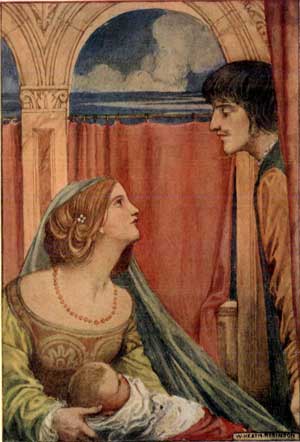
One evening Griselda was playing with her little child. The baby laughed in her arms and looked sweeter than ever. At that moment the curtain at the doorway was drawn aside and Lord Walter came into the room. His face was sad and drawn, and as Griselda looked up at him she feared that some great blow had fallen on him, or that some enemy had entered the country.
Lord Walter said to her:
"Griselda, thou hast not forgotten the day on which I brought thee from thy father's lowly cottage to this my castle. Although thou art most dear to me, thou art not dear to my nobles. They say that it is hard that they should serve one so lowly born as thou. Since thy daughter was born they have said this more and more, I doubt not. As thou knowest, my will is to live with my people in joy and peace. Therefore must I do to my child not as I wish myself, but as my nobles wish. Show then to me the obedience that thou didst promise to show when thou wert wed in the village street."
As Griselda heard these words she made no moan. Neither did she let the pain that caught at her heart be seen in her face. When she could speak, she said:
"Lord, we are thine! My child is thine. I also am thine. With thine own thou mayest ever do as pleaseth thee best."
The Marquis was full of joy because of the patience and humbleness of Griselda; but he appeared to be sad, and left her with a troubled face.
Soon after this, Griselda started as she heard a heavy footstep on the stairway. Then an evil-looking man walked into the quiet room.
"Madam," he said, "I must obey my lord's will. He bids me take this child. Thou knowest we must obey, although we may complain and mourn."
Then the soldier took the child so roughly that it seemed as if he would kill it before her. Griselda said:
"Pray, sir, do thou suffer me to kiss my child ere it die." He gave it back to her. Gently she gathered it in her arms. She blessed it, and lulled it, and kissed it. Then she said in her sweet voice: "Farewell, my child, I shall see thee never again. The blessing of Him who died on a cross of wood for us, rest on thee. To Him I give thy soul, my little one! To-night thou must die because of me."
To the rough soldier she said:
"Take again the child and obey my Lord. But if it please my Lord, then of thy kindness bury thou the little body where no cruel bird nor beast can harm it!"
But in silence the soldier carried away the child.
Then Lord Walter looked to see if Griselda would fret or be less kind to him. He watched, but could see no change in her. She was as busy and loving and cheerful as ever. Neither in earnest nor in play did she name her child.
After four years a son was born to Griselda. The people were very glad because there was now an heir to rule the land at the death of Lord Walter. Griselda too was happy, though her heart longed for the little maid who might have been playing with her brother.
When the boy was two years old, Lord Walter began to wish once more to try the patience of Griselda.
This time he said to her:
"Wife, I have told thee before how ill the people bear our marriage. Now that a son is born they are more wrathful than before. My heart is weary with the thought of their complaints. They say, 'When Lord Walter is gone, the grandson of Janicola shall rule us!' Therefore I shall do with my son as I did with his sister. Be patient, I pray thee."
"Thou art my Lord," said Griselda. "My will and my freedom lie in my father's cottage with the poor soiled clothes I left there on the day thou didst bring me hither. Could I know thy will before thou didst tell it to me, it would be done, though it were death to do it. Life cannot compare with thy love."
Lord Walter looked down to the ground. He could not look at his wife lest he should not have heart to do as he wished.
Again the rude soldier came to Griselda. He was even harsher than before, and carried off the child without a kind word to the patient mother.
When the little boy was gone, the people said very bitter things about Lord Walter. The love they had given him before was turned into hatred because he had treated his beautiful wife so unkindly, and because he had murdered his children.
Though Lord Walter saw this, he wished to try his wife once more. He knew that he could send away his wife and marry another if he got a letter from the Pope to say that he might. He sent a messenger to Rome, where the Pope lived. This messenger was told to bring back a letter, not from the Pope, but as like one of his as possible.
The letter came. It said that because of the anger of Lord Walter's people at the lowly birth of his wife Griselda, the Marquis might send her away and marry another.
The news of the letter spread throughout the land. Every one believed that it had really come from the Pope.
Griselda's heart was very sore when she heard of this letter. But she went on quietly with each day's work. She did not even speak of the letter to her husband.
At last Lord Walter spoke before all his court, and with no knightly gentleness.
"Griselda," he said, "there is no freedom in the life of one who rules. I may not act after my own wish as any laborer on my land may do. As thou knowest, my people hate thy presence, and demand of me that I wed another. The Pope's letter thou hast heard. Return then, swiftly and without complaint, to thy father's cottage, for already my bride cometh hither."
"My Lord, it is no new thought to me, that I am unworthy to be thy servant—far more unworthy to be thy wife. In this great house of which thou didst make me queen, I have not acted as mistress, but only as lowly handmaid to thee. For these years of thy kindness, I thank thee. Gladly do I go to my father's house. There he tended me when I was but a child. Now I will stay with him till death enters the cottage door. To thee and to thy bride be joy. To her I willingly yield the place where I have been so happy. Since thou, who once wert all my joy, wilt have me go, I go!"
Lord Walter turned away in sadness. He could scarcely speak for pity, but he held to his purpose.
Then Griselda drew her wedding-ring from her finger, and laid it down. Beside it she put the gems that Lord Walter had given her. Her beautiful robes she laid aside. In the simplest gown she could find, and with head and feet all bare, Griselda went down through the olive trees towards her father's house.
Many of Lord Walter's people followed her, weeping and bewailing the fickleness of fortune. Griselda did not turn to them, nor speak, nor weep. She quietly went on her way.
When the tidings reached her father, he wished that he had never been born, so sad was he in the sorrow of his beautiful daughter. He hastened out to meet her, and wrapped her tenderly in her old cloak, and led her home with tears.
Griselda spoke no word of complaint, nor did she speak of her former happiness. Once more she tended the sheep on the common. Once more she carried water from the well. Once more she thought first of her father.
After some weeks Lord Walter sent for Griselda. She went to the castle and greeted him humbly as of old. She showed no grudge because of his unkindness.
"Griselda," he said, "thou knowest, as doth no other, how all this castle should be ordered for my pleasure. Stay thou then, and have all in readiness for the fair young bride whom I shall wed to-morrow. It is my will that she be welcomed royally."
"My whole desire is to serve thee, my Lord. Neither weal nor woe shall ever make me cease to love thee with all my heart."
At once Griselda took control of all who worked in the castle. Of them all she was the neatest and the quickest. Soon every room in the tower was sweet and clean. The great hall was decked for the wedding-feast, and the table glittered with silver.
Early next morning many horsemen came to the castle. Among them was a beautiful girl dressed in a shimmering white robe. Near her rode a charming boy younger than the maiden. Round them were many nobles, and a guard of soldiers, who had brought them to Lord Walter's court.
The people crowded round the gates. So charmed were they with the fair young maid, that some of them forgot their love for Griselda, and were ready to welcome the bride whose coming caused her so much sorrow.
Still Griselda moved about the castle in her old worn clothes. She went to the gate to welcome the bride. Then she received the guests and greeted each of them according to his degree.
The stranger nobles wondered who Griselda could be. She was so wise and gentle, and yet so meanly dressed.
Before the feast began, Lord Walter called Griselda to him. Then he asked her, "What dost thou think of my wife? Is she beautiful?"
"Never have I seen a fairer," said Griselda. "Joy be with you both evermore! But oh! I beg of thee, torment not this child as thou didst me. She has been tenderly cared for. She could not bear what I have borne."
When Lord Walter saw her great patience, and thought of the pain he had caused her, his heart went out to her in great pity, and he cried, "It is enough, Griselda; fear no more, nor be thou longer sad. I have tried thy faith and thy sweetness, as faith and sweetness have never before been tried."
His arms were around her, and he kissed her. Griselda looked at him in wonder. She could not understand.
"Griselda," he said, "thou art my wife. I have no other. This is thy daughter; her brother is my heir. Thine are they both. Take them again, and dream not that thou art bereft of thy children."
When Griselda heard all this she fainted away in her great joy. When she woke again she called her children to her. Timidly they came, but soon they were caught close to her breast. While she fondled them, and kissed them, her hot tears of joy fell on their fair faces, and on their hair. Then she looked at Lord Walter, and said, "Death cannot harm me now, since thou lovest me still." Then she turned back to the children.
"Oh tender, oh dear, oh little ones, my children! Your sorrowful mother thought that cruel dogs or other fearsome beasts had torn you! but God has kept you safe."
Once again the ladies of the court dressed Griselda in royal robes. Once again they set a golden crown upon her head. Once again the wedding-ring slipped into its own place on her finger.
Ere she entered the hall of feasting again, swift messengers had brought her old father, Janicola, to the castle, never to leave it again.
Then Griselda sat with her children beside her husband. To her feet came lords and nobles, peasants and farmers, eager to kiss her hand and to show the joy they felt in her return.
Never had the walls of the castle reechoed the laughter of so glad a people. All day long till the stars shone in the cool clear sky the feasting went on.
For Griselda this was the first of many happy days, happier than she had known before.
In her home sounded the gay voices of happy children as they played with, and cared for, the old grandfather whom their mother loved so dearly. And ever as she moved about the castle she met the eyes of Lord Walter, that told her again and yet again that he trusted her utterly.
THE PILGRIM'S PROGRESS
By JOHN BUNYAN
ADAPTED BY MARY MACGREGOR
As I slept I dreamed a dream. I dreamed, and behold, I saw a man clothed with rags, standing in a certain place, with his face away from his own house, a book in his hand, and a great burden upon his back. I looked, and saw him open the book, and read therein, and as he read, he wept and trembled. His fear was so great that he brake out with a mournful cry, saying, "What shall I do?"
In this plight therefore he went home, and did all he could to hide his distress from his wife and children. But he could not be silent long, because his trouble increased. Wherefore at length he began to talk to his wife and children thus: "O my dear wife," said he, "and you my children, I am in despair by reason of a burden that lieth heavy on me. Moreover I am for certain told that this our city will be burned with fire from heaven, when both myself, with thee, my wife, and you, my sweet babes, shall be ruined, except some way of escape can be found." At this his wife and children were sore amazed, not because they believed that what he had said to them was true, but because they thought he must be ill to talk in so strange a way. Therefore, as it was evening, and they hoped sleep might soothe him, with all haste they got him to bed. But the night was as troublesome to him as the day, wherefore instead of sleeping he spent it in sighs and tears.
So when the morning was come, they asked him how he did. He told them, "Worse and worse," and began to talk to them again in the same strange manner, but they began to be careless of his words. They also thought to drive away his fancies by harsh and rough behavior to him. Sometimes they would mock, sometimes they would scold, and sometimes they would quite neglect him. Wherefore he began to stay in his room to pray for and pity them, and also to comfort his own misery. He would also walk alone in the fields, sometimes reading and sometimes praying, and thus for some days he spent his time.