Volume 3 — GULLIVER'S TRAVELS (continued 5)
Reading edition
Now I saw in my dream that when he was walking in the fields, he was reading his book and greatly distressed in mind. And as he read, he burst out crying, "What shall I do to be saved?" I saw also that he looked this way and that way, as if he would run. Yet he stood still, because, as I saw, he could not tell which way to go. I looked then, and saw a man, named Evangelist, coming to him, who asked, "Wherefore dost thou cry?"
He answered, "Sir, I see by the book in my hand that I am condemned to die, and after that to be judged. And I find I am not willing to die, nor able to be judged."
Then said Evangelist, "Why not willing to die, since in this life you are so unhappy?"
The man answered, "Because I fear this burden will sink me lower than the grave, and the thought of that makes me cry."
Then said Evangelist, "If this be thy fear, why standest thou still?"
He answered, "Because I know not whither to go."
So Evangelist gave him a parchment roll, and there was written within, "Fly from the wrath to come." The man therefore read it, and looking upon Evangelist very carefully, said, "Whither must I fly!"
Then said Evangelist, pointing with his finger over a very wide field, "Do you see yonder Wicket-gate?"
The man said, "No."
"Well," said the other, "do you see yonder shining light?"
He said, "I think I do."
Then said Evangelist, "Keep that light in thine eye, and go up directly thereto, so shalt thou see the gate. When thou knockest, it shall be told thee what thou shalt do."
So I saw in my dream that the man began to run. Now he had not run far from his own door when his wife and children, seeing it, began to cry after him to return. But the man put his fingers in his ears, and ran on, crying, "Life, life, eternal life!" So he looked not behind him, but fled towards the middle of the plain. The neighbors also came out to see him run. And as he ran some mocked, others threatened, and some cried after him to return. Among those that did so were two that were resolved to fetch him back by force. The name of the one was Obstinate, and the name of the other was Pliable. Now by this time the man was got a good distance from them, but they had made up their minds to follow him, which they did, and in a little time overtook him.
Then said the man, "Neighbors, wherefore are you come?"
They said, "To persuade you to go back with us."
But he said, "That can by no means be. You dwell in the City of Destruction, the place where I was born. Be content, good neighbors, and go along with me."
"What!" said Obstinate, "and leave our friends and our comforts behind us!"
"Yes," said Christian, for that was his name.
"What do you seek, since you leave all the world to find it?" said Obstinate.
"I seek a treasure that never fades away. It is laid up in heaven and is safe there," said Christian. "Read it so, if you will, in my book."
"Tush!" said Obstinate, "away with your book. Will you go back with us or no?"
"No, not I," said the other, "because I have just set out."
"Come then, Neighbor Pliable, let us turn again and go home without him."
Then said Pliable, "If what the good Christian says is true, the things he looks after are better than ours. My heart makes me wish to go with him. But, my good Christian, do you know the way you are going?"
"I am directed by a man, whose name is Evangelist, to speed me to a little gate that is before us, where we shall be told about the way."
"Come then, good neighbor," said Pliable, "let us be going." Then they went both together.
"And I will go back to my place," said Obstinate. "I will be no companion of such mistaken and foolish fellows."
Now I saw in my dream that when Obstinate was gone back, Christian and Pliable went talking over the plain. "I will tell you what my book says of the country to which we are going, and of the people we shall meet there," said Christian.
"But do you think the words of your book are certainly true?" said Pliable.
"Yes," said Christian, "for it was written by Him who cannot lie."
"Well," said Pliable, "tell me about this country."
"In this country," said Christian, "we shall live for ever. There are crowns of glory to be given us, and garments that will make us shine like the sun."
"This is excellent," said Pliable; "and what else?"
"There shall be no more crying nor sorrow, for He that is the Owner of the place will wipe all tears from our eyes," said Christian.
"And what companions shall we have there?" asked Pliable.
"There we shall be with those that will dazzle your eyes to look on. There also you shall meet with thousands and tens of thousands that have gone before us to that place. None of of them are hurtful, but loving and holy. In a word, there shall we see some with their golden crowns, there we shall see maidens with golden harps, there we shall see men that here were cut in pieces, burnt in flames, eaten by beasts, and drowned in the seas, all for the love they bare to the Lord of this place. Now they are all well, and clothed with beautiful garments."
And as Pliable heard of the excellence of the country and of the company to which they were going, he said, "Well, my good companion, glad I am to hear of these things. Come on, let us go with more speed."
"I cannot go as fast as I would by reason of this burden that is on my back," said Christian.
Now I saw in my dream that just as they ended their talk, they drew nigh to a bog that was in the midst of the plain, and they being heedless did both fall suddenly into it. The name of this bog was the Slough of Despond. Here therefore they struggled for a time, being grievously covered with dirt. And Christian, because of the burden that was on his back, began to sink in the mire. Then said Pliable, "Ah, Neighbor Christian, where are you now?"
"Truly," said Christian, "I do not know."
At this Pliable began to be offended, and said angrily, "Is this the happiness you have told me of all this while? If I get out again with my life, you shall possess the wonderful country alone."
And with that he gave a desperate struggle or two, and got out of the mire on that side of the bog which was next to his own house. So away he went, and Christian saw him no more. Wherefore Christian was left to tumble in the Slough of Despond alone. But still he tried to struggle to that side of the Slough that was further from his own house, and next to the Wicket-gate. But he could not get out because of the burden that was upon his back.
And I beheld in my dream that a man came to him, whose name was Help, and asked him what he did there. "Sir," said Christian, "I was bid to go this way by a man called Evangelist, who directed me also to yonder gate, and as I was going thither I fell in here."
"Why did you not look for the steps?" said Help.
"I was so full of fear," answered Christian, "that I fled the next way and fell in."
Then said Help, "Give me thy hand." So Christian gave him his hand, and he drew him out and set him upon sound ground, and bid him go on his way.
Now in my dream I stepped up to the man that plucked Christian out, and said:
"Sir, wherefore, since over this place is the way from the City of Destruction to the Wicket-gate, is it that this Slough is not mended, that poor travelers might go over in more safety?"
And he said to me, "This place cannot be mended, yet it is not the pleasure of the King that it should remain so bad. His laborers also have for more than sixteen hundred years been employed on this patch of ground, in the hope that it might perhaps be mended. There has been swallowed up here twenty thousand cartloads of the best material in the attempt to mend the place. But it is the Slough of Despond still; and still will be so, when they have done all they can. It is true that there are some good and strong steps even through the very midst of this mire. But men through the dizziness of their head miss the steps and so tumble into the mire, but the ground is good when they have once got in at the gate."
Then I saw in my dream that by this time Pliable was got home to his house. So his neighbors came to visit him, and some of them called him wise man for coming back, and some called him fool for going with Christian. Others again did mock at his cowardliness, saying, "Surely since you began to go, you need not have been so base as to have given out for a few difficulties." So Pliable sat like a coward among them.
Now as Christian was walking alone, he espied one afar off, come crossing over the field to meet him. The gentleman's name was Mr. Worldly Wiseman. He dwelt in a very great town, close by the one from which Christian came. This man, then, meeting with Christian, began thus to enter into some talk with him: "How now, good fellow, whither are you going in this burdened manner?"
"A burdened manner indeed," said Christian. "I am going, sir, to yonder Wicket-gate before me, for there, I am told, I shall be put into a way to be rid of my heavy burden."
"Hast thou a wife and children?" asked Mr. Worldly Wiseman.
"Yes, but I am so laden with this burden that I cannot take that pleasure in them as formerly."
"Will you hearken to me if I give thee counsel?"
"If it be good, I will, for I stand in need of good counsel."
"I would advise thee, then, that thou with all speed get thyself rid of thy burden, for thou wilt never be contented till then."
"That is what I seek for, even to be rid of this heavy burden, but get it off myself I cannot, nor is there any man living in our country who can take it off my shoulders. Therefore I am going this way, as I told you, that I may be rid of my burden."
"Who bid thee go this way to be rid of thy burden?"
"A man that appeared to me a very great and honorable person. His name, as I remember, is Evangelist."
"He has given thee foolish counsel. There is not a more dangerous and troublesome way in the world than is that unto which he hath directed thee. Thou hast met with some danger already, for I see the mud of the Slough of Despond is upon thee. Hear me, I am older than thou. Thou art likely to meet with, in the way which thou goest, painfulness, hunger, nakedness, sword, lions, dragons, darkness, and death."
"Why, sir, this burden upon my back is more terrible to me than all these things."
"But why wilt thou seek for ease this way, seeing so many dangers attend it? Hadst thou but patience to listen, I could direct thee how to get what thou desirest, without the danger that thou in this way wilt run thyself into."
"Sir, I pray that thou wilt tell me this secret."
"Why, in yonder village there dwells a gentleman, who is very wise, and who has skill to help men off with burdens like thine from their shoulders. To him thou mayest go to be helped at once. His house is not quite a mile from this place, and if thou dost not desire to go back to the City of Destruction, as indeed I would not wish thee, thou mayest send for thy wife and children to come to thee to this village. There are houses now standing empty, one of which thou mayest have without great cost. Food is there also, cheap and good, and what will make thy life the more happy is, that thou shalt live beside honest neighbors, in respect and comfort."
Now the Christian puzzled, but he thought, "If what Mr. Worldly Wiseman says is true, my wisest plan is to take his advice."
"Sir," said Christian, "which is my way to this honest man's house?"
"Do you see yonder high hill?"
"Yes, very well."
"By that hill you must go, and the first house you come to is his."
So Christian turned out of his way to go to the house for help. But behold, when he was now close to the hill, it seemed so steep, and also that side of it that was next the wayside did hang so much over, that Christian was afraid to venture farther, lest the hill should fall on his head. Wherefore he stood still, and knew not what to do. Also his burden now seemed heavier to him than while he was in his way. There came also flashes of fire out of the hill, that made Christian afraid that he should be burned. Here therefore he did quake for fear. And now he began to be sorry that he had taken Mr. Worldly Wiseman's counsel. Then he saw Evangelist coming to meet him, at the sight also of whom he began to blush for shame. So Evangelist drew nearer and nearer, and coming up to him, he looked upon him with a severe and dreadful countenance.
"What dost thou here, Christian?" said he. At which words Christian knew not what to answer, wherefore at first he stood speechless before him. Then said Evangelist, "Art not thou the man I found crying without the walls of the City of Destruction?"
"Yes," said Christian, "I am the man."
"Did I not direct thee the way to the little Wicket-gate?"
"Yes," said Christian.
"How is it, then, that thou art so quickly turned out of the way?"
"I met with a gentleman as soon as I had got over the Slough of Despond, who told me that in yonder village I might find a man who could take off my burden."
"What was he like?"
"He looked like a gentleman, and talked much to me, and got me at last to believe his words. So I came hither, but when I beheld this hill and how it hangs over the way, I suddenly stood still lest it should fall on my head."
"What said that gentleman to you?"
"Why, he asked me whither I was going, and if I had a wife and children, and he bid me make speed to get rid of my burden. And I said, 'I am going to yonder gate to be told how I may get rid of it.'
"So he said he would show me a better and a shorter way, and not so full of difficulties as the way that you directed me. But when I came to this place, I stopped for fear of danger, and now I know not what to do!" So Christian stood trembling before Evangelist.
Then said Evangelist, "Give heed to the things I shall tell thee. Mr. Worldly Wiseman sought to turn thee out of the way and to bring thee into danger. In yonder village has no man ever yet got rid of his burden, nor is he ever likely to lose it there. Therefore, Mr. Worldly Wiseman and his friend are deceivers, and cannot help thee."
After this there came words and fire out of the mountain under which Christian stood. Now Christian looked for nothing but death, and began to cry out, saying he would he had never met Mr. Worldly Wiseman or that he had never listened to him. Then he turned to Evangelist and said, "Sir, what do you think? Is there any hope? May I now go back and go up to the Wicket-gate? Or shall I be sent back from the gate ashamed? I am sorry I have listened to this man's counsel, but may my sins be forgiven?"
Evangelist said to him, "Thy sin is very great. Thou hast left the good way and walked in forbidden paths. Yet will the man at the gate receive thee, for he has good will for men. Only," said he, "take heed that thou turn not aside again."
Then did Christian prepare to go back. And Evangelist, after he had kissed him, gave him one smile, and bid him Godspeed. So Christian went on with haste, neither spake he to any man by the way. Even if any one spoke to him, he would not venture an answer. He walked like one that was all the while treading on forbidden ground, and could by no means think himself safe, till again he had got into the way which he had left to follow Mr. Worldly Wiseman's counsel. So in process of time Christian got up to the gate. Now over the gate there was written, "Knock, and it shall be opened unto you." He knocked therefore more than once or twice. At last there came a grave person to the gate, named Good-will. He asked who was there, and whence he came, and what he desired.
"I am a sinner," said Christian; "I come from the City of Destruction, but am going to Mount Zion. I am told that by this gate is the way thither, and I would know if you are willing to let me in."
"I am willing with all my heart," said Good-will, and he opened the gate. So when Christian was stepping in, the other gave him a pull.
"Why do you do that?" said Christian.
Then Good-will told him, "A little distance from this gate a strong castle has been built, of which Beelzebub is the captain. And he and those that are with him shoot arrows at those that come up to this gate, hoping they may die before they enter in."
So when Christian had come in, Good-will asked him who had directed him to the gate.
"Evangelist bid me come here and knock, as I did. And he said that you, sir, would tell me what I must do."
Then Good-will said, "Come a little way with me, good Christian, and I will teach thee about the way thou must go. Look before thee; dost thou see this narrow way? That is the way thou must go, and it is as straight as a rule can make it. This is the way thou must go."
"But," said Christian, "are there no turnings, nor windings, by which a stranger may lose his way?"
"Yes, there are many ways join this, but they are crooked and wide. Thou mayest know the right from the wrong way, for the right way is always strait and narrow."
Then I saw in my dream that Christian asked him if he could not help him off with his burden that was upon his back. For as yet he had not got rid of it, nor could he get it off without help. But Good-will said, "Thou must be content to bear it, until thou comest to a place where stands a Cross, for there it will fall from thy back of itself."
Then Christian began to get ready to continue his journey. So Good-will told him that when he had gone some distance from the gate, he would come to the house of the Interpreter, at whose door he should knock, and he would show him wonderful things. Then Christian took leave of his friend, and he again bid him Godspeed. Now Christian went on till he came to the house of the Interpreter, where he knocked over and over. At last one came to the door and asked who was there.
"Sir," said Christian, "I am a traveler who was told by Good-will to call here. I would therefore speak with the master of the house." So he called for the master of the house, who, after a little time, came to Christian and asked what he would have.
"Sir," said Christian, "I am a man that has come from the City of Destruction, and I am going to Mount Zion. I was told by the man that stands at the Wicket-gate that if I called here you would show me things that would help me on my journey."
Then said the Interpreter, "Come in, and I will show thee what will help thee." So he commanded his man to light the candle, and bid Christian follow him. Then he took him into a private room, and bid his man open a door. And Christian saw the picture of a very grave person hung up against the wall. He had eyes lifted up to heaven, the best of books in his hand, and a crown of gold did hang over his head.
Then said Christian, "What means this?"
"The man whose picture this is," answered the Interpreter, "is one of a thousand. He is the only man who may be thy guide in all difficult places thou mayest meet with in the way. Wherefore be very careful to remember whom thou hast seen."
Then the Interpreter led him into a very large parlor that was full of dust, because it was never swept, and after he had looked at it for a little while, the Interpreter called for a man to sweep. Now when he began to sweep, the dust began to fly about, so that Christian was almost choked. Then said the Interpreter to a damsel that stood near, "Bring hither the water and sprinkle the room." And when this was done the room was swept and cleansed.
Then said Christian, "What does this mean?"
The Interpreter answered, "This parlor is like the heart of an evil man. The dust is his sin, and the damsel that sprinkles the water is the Gospel."
I saw moreover in my dream, that the Interpreter took Christian by the hand and led him into a little room, where sat two little children, each one in his chair. The name of the eldest was Passion, and the name of the other Patience. Passion seemed to be very discontented, but Patience was very quiet.
Then Christian asked, "What is the reason of the discontent of Passion?"
The Interpreter answered, "The governor of the children would have them wait for their new toys, till the beginning of next year, but Passion wishes to have them all now, while Patience, is willing to wait." Then the Interpreter took Christian to a place where there was a fire burning against a wall, and one standing near it, always casting much water upon it to quench it, yet did the fire burn higher and hotter. But afterwards the Interpreter took him to the back of the wall, where he saw a man with a vessel of oil in his hand, and he poured the oil continually, but secretly, into the fire.
"What does this mean?" asked Christian.
The Interpreter answered, "The fire is a picture of the grace God puts into the heart. He that casts water on it to put it out is the Evil One. And the man who pours oil on the fire to keep it alight is Christ."
I saw also that the Interpreter took Christian again by the hand and led him into a place, where was builded a stately palace, beautiful to behold, at the sight of which Christian was greatly delighted. He saw also upon the top of the palace certain persons walking, and they were clothed all in gold.
Then said Christian, "May we go in here?" So the Interpreter took him and led him toward the door of the palace. Now before they came up to the door, they passed a man, sitting at a table, with a book and his inkhorn before him, to take down the name of any who should enter. And, behold, at the door stood a great company of men, who wished to go in, but did not dare to enter, for within the doorway stood many men in armor to guard it. Now, these men in armor were determined to do any who would enter as much harm and mischief as they could. Christian was amazed. At last, when every man started back for fear of the armed men, Christian saw a man with a very strong face come up to the man that sat at the table, saying:
"Set down my name, sir."
And when this was done, Christian saw the strong man draw his sword and put an helmet on his head, and rush toward the door upon the armed men. The armed men fought with great strength, but the man with the strong face was not at all discouraged, but fought most fiercely. So after he had received and given many wounds to those that tried to keep him out, he cut his way through them all, and pressed forward into the palace. Then there was a pleasant voice heard from those that walked upon the top of the palace, saying:
"Come in, come in; Eternal glory thou shalt win."
So he went in and was clothed in such garments as they.
"Now," said Christian, "let me go."
And the Interpreter said, "Hast thou understood these things?"
"Yes," said Christian, and he began to get ready to go on his journey.
Then said the Interpreter, "God be always with thee, good Christian, to guide thee in the way that leads to Mount Zion."
Now I saw in my dream that the highway up which Christian was to go was fenced on either side with a wall. Up this way therefore, did Christian run, but not without great difficulty, because of the load on his back. He ran thus till he came to a steeper place, and upon that place stood a Cross, and a little below, a Sepulcher. So I saw in my dream that just as Christian came up to the Cross his burden fell from off his back, and began to tumble till it came to the mouth of the Sepulcher, where it fell in and I saw it no more. Then was Christian glad and happy, and he stood for a while to look and wonder, for it was surprising to him to see that the Cross should make him lose his burden. Now as he stood looking, behold three Shining Ones came to him and greeted him.
The first said to him, "Thy sins be forgiven thee." The second took away all his rags and clothed him in new raiment. The third set a mark on his forehead and gave him a roll with a seal on it, which he should give in at the Celestial Gate. So they went their way.
Then Christian gave three leaps for joy and went on singing. I saw then in my dream that as he walked he saw two men come tumbling over the wall into the narrow way.
"Gentlemen, where do you come from and whither do you go?" said Christian.
They told him, "We were born in a land called Vainglory, and we are going to Mount Zion."
"Why came you not in at the gate?" said Christian.
They said that to go to the gate was too far, so they had taken a short cut and climbed over the wall.
"But," said Christian, "will the Lord of the City to which we are going be pleased that you should come into the way over the wall?"
But the men said he need not trouble his head about that, for what they did had been done many times before. It had been a custom for more than a thousand years. And besides, said they, "If we get into the way, what does it matter how we get in? You came in by the Wicket-gate, and are in the way, and we came tumbling over the wall and are in the way, so now we are all in the same condition."
"But," said Christian, "I walk by the Rule of my Master, and you walk just as you like best."
Then said they, "We see not how thou art different to us, except by the coat thou wearest, and that, we suppose, was given thee by some of thy neighbors, to hide thy rags."
"Well," said Christian, "the Lord of the City to which I go gave me this coat the day that he took away from me my rags. He will surely know me, since I have His coat on my back. I have also a mark in my forehead, which you may not have noticed, and this was given to me by one of my Lord's friends, on the day my burden fell off my shoulders. I will tell you too, that I had a roll given me, to comfort me by reading, as I go on the way. I am also to give in the roll at the Celestial Gate. All these things I think you are without, because you came not in at the gate."
To these things they gave him no answer, only they looked at each other and laughed. I beheld then, that they all went on without talking much together, till they came to the foot of the hill Difficulty, at the bottom of which was a spring. The narrow way lay right up the hill, but there were also two other ways here. One turned to the left hand and the other to the right at the bottom of the hill. Christian now went to the spring and drank to refresh himself, and then began to go up the narrow path that led to the top of the hill. The other two also came to the foot of the hill. But when they saw that the hill was steep and high, they made up their minds to go in the other paths that lay round the side of the hill. So one took the way that was called Danger, which led him into a great wood, and the other took the way called Destruction, which led him into a wide field, full of dark mountains, where he stumbled and fell and rose no more. I looked then to Christian to see him go up the hill, and then I saw that he had begun to clamber upon his hands and his knees, because of the steepness of the place. Now about midway to the top of the hill was a pleasant arbor, made by the Lord of the hill for the refreshing of weary travelers. When Christian got there he sat down to rest, then he pulled out his roll and read in it to comfort himself, and he began again to look at the garment that was given to him at the Cross. Thus he at last fell into a slumber, and then into a sound sleep, which kept him in that place, until it was almost night, and in his sleep his roll fell out of his hand. Now, as he was sleeping, there came one to him and awaked him. Then Christian suddenly started up and sped on his way till he came to the top of the hill.
When he was got to the top of the hill, there came two men running to meet him. The name of the one was Timorous, and the other Mistrust.
"Sirs," said Christian, "what is the matter? You run the wrong way."
Timorous answered that they were going to the City of Zion and had got up that difficult place. "But," said he, "the farther we go, the more danger we meet with, wherefore we turned and are going back again."
"Yes," said Mistrust; "for just before us lie a couple of lions in the way, whether sleeping or waking we know not, but we thought if we came within reach, they would pull us in pieces."
Then said Christian, "You make me afraid, but yet I will go forward." So Mistrust and Timorous ran down the hill, and Christian went on his way. And as he went he thought again of what he heard from the men. Then he felt for his roll, that he might read and be comforted, but he felt and found it not.
Now was Christian in great distress and knew not what to do. At last he bethought himself that he had slept in the arbor that was on the side of the hill, and then he went back to look for his roll. But all the way he went back, who can tell the sorrow of Christian's heart? Sometimes he sighed, sometimes he wept, and often he chid himself for being so foolish as to fall asleep. Thus therefore he went back, carefully looking on this side and on that all the way as he went. For he hoped to find the roll that had been his comfort so many times in his journey. He went back till he came again within sight of the arbor where he had sat and slept, but that sight renewed his sorrow again, by reminding him how eagerly he had slept there. And as he went towards the arbor, he sighed over his sleepiness, saying, "Oh, foolish man that I was, why did I sleep in the daytime? oh, that I had not slept."
Now, by the time he was come to the arbor again, for a while he sat down and wept, but, at last, looking sorrowfully down under the settle, he espied his roll, which with trembling haste he caught up. But who can tell how joyful Christian was when he had got his roll again, or with what joy and tears he began to go up the hill again. And, oh, how nimbly did he go up! Yet before he reached the top the sun went down. Now Christian remembered the story that Mistrust and Timorous had told him, how they were frightened with the sight of the lions. And he said to himself, "If these beasts meet me in the dark, how shall I escape being by them torn in pieces?"
But while he was in this fright, he lifted up his eyes, and behold, there was a very stately palace before him, the name of which was Beautiful, and it stood by the highway side. So I saw in my dream that he made haste, that if possible he might get lodging there. Now before he had gone far, he entered into a very narrow passage; and looking before him as he went, he espied two lions in the way. The lions were chained, but Christian did not see the chains. Then he was afraid and thought he would go back, but the porter at the lodge, whose name is Watchful, seeing Christian stop, as if he would go back, cried, "Fear not the lions, for they are chained."
Then I saw that Christian went on till he came and stood before the gate where the porter was. And Christian said to the porter, "Sir, what house is this? May I lodge here to-night?"
The porter answered, "This house was built by the Lord of the hill, for the safety of pilgrims."
So Watchful the porter rang a bell, at the sound of which a grave and beautiful damsel came out of the door. When she saw Christian she brought him into the Palace Beautiful, and she and her sisters talked with him until supper was ready. Now all their talk at table was about the Lord of the hill, and, by what they said, I knew that He had been a great Warrior, and that He had fought and slain Death, but not without great danger to Himself, which made me love Him the more. They talked together till late at night, and after they had committed themselves to their Lord for protection, they went to bed. The room in which the pilgrim slept had a window opening towards the sunrising, and the name of the room was Peace. In the morning they all got up, and after some more talk, they told him that they would take him to the armory before he left them. So they did, and when he came out, he was harnessed from head to foot, lest he should be attacked in the way. Then Christian walked with his friends to the gate, and there he asked the porter if he had seen any pilgrims pass.
The porter answered, "Yes, a pilgrim called Faithful has passed this way."
"Oh," said Christian, "I know him. He comes from the place where I was born. How far do you think he has got?"
"By this time he is below the hill," said the porter.
Then Christian began to go down the hill into the Valley of Humiliation, where it is difficult not to slip. He went down very warily, yet he slipped once or twice. Now in the valley Christian had a hard fight with a fiend called Apollyon. Apollyon was a monster and hideous to behold. He was clothed with scales like a fish, he had wings like a dragon, feet like a bear, and his mouth was as the mouth of a lion, and out of it came fire and smoke. When he came up to Christian he looked at him with rage in his face, and said, "Prepare thyself to die, for thou shalt go no farther." And he threw a flaming dart at him, but Christian had a shield in his hand, which caught the dart, so that it did him no harm. Then did Christian draw his sword, but Apollyon threw darts at him as thick as hail, and wounded him in his head, his hand, and foot. This great combat lasted half a day, till Christian was almost worn out.
then did christian draw his sword
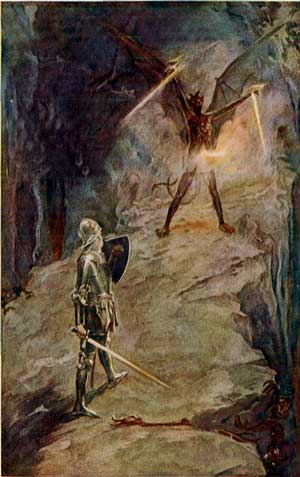
Then Apollyon came close to Christian, and wrestled with him and gave him a dreadful fall, and Christian's sword flew out of his hand.
"I am sure of thee now," said Apollyon. But while he was taking a last blow to kill this good man altogether, Christian nimbly stretched out his hand for his sword, and caught it. Then he gave Apollyon a deadly thrust, and Apollyon spread his wings and sped him away, so that Christian saw him no more. In this combat no man could imagine, unless he had seen and heard as I did, what yelling and roaring Apollyon made all the time of the fight. He spake like a dragon. On the other side, sighs and groans burst from Christian's heart. I never saw him give so much as a pleasant look, till he saw that he had wounded Apollyon with his two-edged sword. Then indeed he did smile and look upward, but it was the dreadfulest sight that ever I saw.
So when the battle was over, Christian said, "I will give thanks to Him that did help me against Apollyon."
He also sat down in that place to eat and drink, so being refreshed, he again began his journey, with his sword drawn in his hand, "For," said he, "I do not know if some other enemy may not be at hand."
Now at the end of this valley was another, called the Valley of the Shadow of Death. Through it Christian must go, because the way to the Celestial City lay through it. Now this valley is a very lonely place. It is like a wilderness or a desert full of pits. No man dwells in it, and no man but a Christian passeth through it. Here Christian had a worse time than even in his fight with Apollyon. I saw then in my dream that when Christian had reached the borders of this valley, there met him two men, making haste to go back.
Christian said to them, "Whither are you going?"
"Back, back," they cried, "as you will go, if you prize life or peace!"
"Why, what is the matter?" said Christian.
"Matter!" said they. "We were going the way you are going, and we went as far as we dared. But had we gone a little farther we had not been here to bring the news to thee."
"But what have you met with?" said Christian.
"Why, we were almost in the Valley of the Shadow of Death, but by good chance we looked before us and saw the danger before we came to it."
"But what have you seen?" said Christian.
"Seen!" said the men, "why, the valley itself was as dark as pitch. We also saw hobgoblins and dragons, and we heard a continual howling and yelling as of people in great misery. Death also doth always spread his wings over it. In a word, it is altogether dreadful, being utterly without order."
"But," said Christian, "this is the way to the Celestial City."
"Be it your way, then; we will not choose it for ours." So they parted. Christian went on his way, but still with his sword drawn in his hand, lest he should be attacked.
I saw then in my dream, that as far as this valley reached, there was on the right hand a very deep ditch. Again, behold, on the left hand, there was a very dangerous mire, into which if a man falls he finds no bottom for his foot to stand on. The pathway here was also exceeding narrow, and therefore Christian was the more distressed. For when he sought in the dark to shun the ditch on the one hand, he was ready to tumble over into the mire on the other, and when he sought to escape the mire, without great carefulness he would nearly fall into the ditch. Then he went on, and I heard him sigh bitterly. For besides these dangers, the pathway was here so dark, that when he lifted up his foot to go forward, he knew not where, nor upon what he should set it next. About the middle of this valley I saw the mouth of hell to be, and it stood close to the wayside.
"Now," thought Christian, "what shall I do?"
And ever and anon the flame and smoke came out in such abundance, with sparks and hideous noises, that he was forced to put away his sword and betake himself to another weapon, called All-prayer.
Then he cried out in my hearing, "O Lord, I beseech thee, deliver my soul." Thus he went on a great while, yet still the flames would be rushing towards him. Also he heard doleful voices and rushings to and fro, so that sometimes he thought he should be torn in pieces, or trodden down like mire in the streets.
This frightful sight was seen, and these dreadful noises were heard by him for several miles together. Then Christian came to a place where he thought he heard a company of fiends coming forward to meet him, and he stopped and began to think what it would be best for him to do. Sometimes he thought he would go back, but again he thought he might be half-way through the valley. So he resolved to go on, yet the fiends seemed to come nearer and nearer. But when they were come almost close to him, he cried out in a loud voice, "I will walk in the strength of the Lord God." Then the fiends went back and came no farther.
Now Christian thought he heard the voice of a man going before him, saying, "Though I walk through the Valley of the Shadow of Death, I will fear no evil, for Thou art with me." Then he was glad, for he thought that some one who feared God was in this valley, as well as himself, and he hoped to overtake him and have company by and by.
Now morning being come, he looked back to see by the light of day what dangers he had gone through in the night. So he saw more plainly the ditch that was on the one hand, and the mire that was on the other, also how narrow the way was that lay between them both. He saw, too, the hobgoblins and dragons, but all afar off, for after break of day they came not nigh.
About this time the sun was rising, and this was a great help to Christian, for you must know that though the first part of the Valley of the Shadow of Death was dangerous, yet this second part, through which he had to go, was, if possible, far more dangerous. For, from the place where he now stood, even to the end of the valley, the way was all along so full of snares, traps, and nets here, so full of pits, pitfalls, and deep holes down there, that if it had been dark, he would almost surely have been lost, but as I said just now, the sun was rising. In this light, therefore, he came to the end of the valley.
Now as Christian went on his way, he came to a little hill, and going up he looked forward and saw Faithful before him. Then said Christian, "Stay, and I will be your companion."
And when he overtook Faithful they went very lovingly on together, and talked of all that had happened to them in their pilgrimage. Then I saw in my dream that when they got out of the wilderness they saw a town before them, and the name of that town was Vanity, and at the town there was a fair kept, called Vanity Fair. It was kept all the year long.
At this fair there were sold houses, lands, trades, husbands, wives, children, silver, gold, pearls, and precious stones. And, moreover, at this fair, there were at all times cheats and jugglers and knaves and rogues.
Now the way to the Celestial City lay just through this town, so the pilgrims had to go through the fair.
The Prince of princes Himself, when here, went through this town to his own country, and that on a fair-day too. And, I think, it was Beelzebub the chief lord of this fair that invited the Prince to buy of his vanities. Beelzebub even said he would have made Him lord of the fair, if He would have done him reverence as He went through the town. Yea, because the Prince was so great a person, Beelzebub took Him from street to street and showed Him all his kingdoms, that he might, if possible, tempt the Prince to buy some of his vanities. But the Blessed One did not wish any of these vanities, and therefore left the town without spending so much as one farthing upon these vanities.
Now these pilgrims, Christian and Faithful, as I said, had to go through this fair.
Well, so they did, but behold, whenever they entered into the fair, it and the town itself were in a hubbub about them. For the pilgrims were clothed with raiment that was very different from the raiment of any that traded in that fair. The people gazed upon Christian and Faithful and called them outlandish men.
Then also, they wondered at the pilgrim's speech, as few could understand what they said, for they spoke the language of the Celestial City. But those that kept the fair spoke the language of the city of Vanity Fair, and they could not understand one another.
Now when these pilgrims would not buy their wares and would not even look at them, the sellers were angry and mocked these men, and some called on others to smite them. At last the master of the fair told his men to question the pilgrims. And when Christian and Faithful told the men that they were strangers in the world and were going to the Celestial City, the men thought they were mad. Therefore they took them and beat them and threw mud at them, and then they put them in a cage to be a show to the people at the fair. But when they were tired of mocking them, these two pilgrims were again examined and charged as guilty of the great disturbance in the fair. So they beat them pitilessly, and hanged irons upon them, and led them in chains up and down the fair. Then Christian and Faithful behaved so wisely and patiently, that the others were still more angry, and said they would put these men to death.
Therefore, after a trial, Faithful was brought out, to do with him according to their law. And first they scourged him, then they buffeted him, then they stoned him with stones, then they pricked him with their swords, and last of all they burned him to ashes at the stake. Now I saw behind the people a chariot and a couple of horses waiting for Faithful, who was taken by it through the clouds, the nearest way to the Celestial City. Then was Christian sent back to the prison, where he dwelt for a time, till he escaped and went again on his way. But he did not go alone, for there was one whose name was Hopeful, who left the town of Vanity, and was a companion to Christian in his pilgrimage. They went on their way till they came to a pleasant river. Now their way lay just along the bank of the river, and Christian and his companion walked there with great delight. They drank also of the river, and ate of the fruit that grew on the trees by its bank. On either side of the river was also a meadow, very beautiful with lilies, and it was green all the year long. In this meadow they lay down and slept, for here they might lie safely. Now I beheld in my dream that they had not journeyed far, when the river and the way parted, and at this they were very sorry, yet they dare not go out of the way.
A little before them was a meadow and a stile to go over into it. Then said Christian, "If this meadow lies along by our path, let us go over." He went to the stile to see, and behold, a path lay alongside of the way, on the other side of the fence.
"That is as I wish," said Christian. "Come, good Hopeful, and let us go over.
"But," said Hopeful, "what if this path should lead us out of the way?"
"That is not likely," said the other. "Look, it goes along by the wayside." So Hopeful, being persuaded by Christian, went after him over the stile. When they had gone over and had got into the path, they found it very easy for their feet. And as they looked before them they saw a man walking as they did, and his name was Vain-confidence. So they called after him, and asked where this way led.
He said, "To the Celestial City."
"Look," said Christian to Hopeful, "did I not tell you so? You see, we are right after all." So they followed Vain-confidence, and he went before them.
But behold, the night came on, and it was very dark, so that they that went behind lost sight of him that went before. Vain-confidence then went on, not seeing the way before him, and fell into a deep pit which was there. This pit was made by the Prince of those grounds on purpose, to catch such foolish men as Vain-confidence. He, then, fell into the pit and was dashed to pieces with his fall. Now Christian and Hopeful heard him fall, so they called to know what was the matter, but there was none to answer, only they heard a groaning.
Then said Hopeful, "Where are we now?" But Christian was silent, for he began to be afraid that he had led Hopeful out of the way.
Now it began to rain and thunder and lighten in a very dreadful manner, and the river flowed over the banks.
And Hopeful groaned, "Oh that I had kept on my way."
By this time the waters were greatly risen, so that to go back was very dangerous. Yet they tried to go back, but it was so dark, and the flood was so high, that as they went they were nearly drowned nine or ten times, and they could not reach the stile again that night. Wherefore at last, coming to a little shelter, they sat down, but being weary they fell asleep. Now there was, not far from the place where they lay, a castle, called Doubting Castle, and the owner of the castle was Giant Despair, and it was in his grounds the pilgrims were now sleeping. Wherefore the giant, getting up early, and walking up and down in his fields, caught Christian and Hopeful asleep. Then with a grim and surly voice he woke them, and asked them what they were doing in his grounds. They told him they were pilgrims and had lost their way.
The giant said, "You have trampled on my ground, and slept on it, and therefore you must go along with me." So they were forced to go, because he was stronger than they. Also they said very little, for they knew they had done wrong.
The giant therefore drove them before him, and put them into his castle, into a very dark dungeon. Here, then, they lay, from Wednesday morning till Saturday night, without one bit of bread or drop of drink, or light, or any one to speak to them. Now Giant Despair had a wife, and he told her he had taken a couple of men prisoners, because they were sleeping on his grounds. Then she told him that, when he arose in the morning, he should beat them without mercy.
So Giant Despair got a cudgel, and went down to the dungeon and beat Christian and Hopeful fearfully, so that they could not move. Then the giant left them, and they spent their time in sighs and bitter tears.
The next night Giant Despair again talked to his wife, and she said, "Tell your prisoners to kill themselves, for they will never escape from the dungeon."
So when morning came, the giant went to them in a surly manner, and seeing they still ached with the stripes he had given them, he told them to poison themselves, for they would never get away from him in any other way. But they asked the giant to let them go. That made him so angry that he rushed on them and would have killed them, but he fell into a fit and lost for a time the use of his hand, wherefore he withdrew and left them as before. Well, towards evening the giant went down again to the dungeon to see if his prisoners had followed his advice and poisoned themselves. He found them alive, but because of their wounds and for want of bread and water they could do little but breathe.
Now at night the giant's wife said: "Take the prisoners into the castle yard to-morrow, and show them the bones and skulls of those prisoners you have already killed. Tell them that in a week you will tear them to pieces, as you have torn your other prisoners."
When the morning was come, the giant went to them again and took them into the castle yard, and showed them all his wife had bidden him.
"These," said he, "were pilgrims once as you are, but they walked in my grounds as you have done. And when I thought fit, I tore them in pieces, and so within ten days I will do to you, Get you down to your den again," and he beat them all the way there.
That night, about midnight, Christian and Hopeful began to pray, and they prayed till dawn of day.
Now just at dawn Christian spoke in sudden amazement. "How foolish we are to lie here, when we might be free after all. I have a key in my pocket called Promise, that will, I am persuaded, open any lock in Doubting Castle."
Then said Hopeful, "That is good news, pull it out of your pocket and try."
Christian pulled it out and began to try the dungeon door, and the bolt, as he turned the key, yielded, and the door flew open, and Christian and Hopeful both came out. Then he went to the door that led to the castle yard, and with his key opened that door also. After that he went to the iron gate, for that must be opened too. That lock was terribly hard, yet the key did open it. Then they thrust open the gate to make their escape in haste, but, as it opened, that gate made such a creaking that it waked Giant Despair, who got up hastily to follow his prisoners, but he could not run after them, for again he took one of his fits. Then Christian and Hopeful went on till they came to the King's highway and so were safe, because they were out of the giant's grounds. Now when they had got over the stile, they began to wonder what they should do to keep other pilgrims from falling into the hands of Giant Despair. So they agreed to put up there a pillar, and to write on it this sentence: "Over this stile is the way to Doubting Castle, which is kept by Giant Despair, who despiseth the King of the Celestial Country and seeks to destroy His holy pilgrims."
Many pilgrims, that came after, read what was written and escaped Giant Despair. They then went on till they came to the Delectable Mountains. These mountains belonged to the Lord of the steep hill which Christian had climbed. So they went up these mountains to behold the gardens and orchards, the vineyards and fountains. There, too, they drank and washed themselves and ate the fruit of the vineyards. Now there were Shepherds on the mountains, who welcomed them lovingly and showed them many wonders. First they took them to the top of a hill which was very steep on one side, and bid them look down to the bottom. So Christian and Hopeful looked down, and saw at the bottom several men dashed all to pieces by a fall that they had had from the top.
"These," said the Shepherds, "are for an example to others to be careful not to clamber too high, or to come too near the brink of this mountain." The name of this mountain was Error.
Then the Shepherds took them to the top of another mountain, and the name of it was Caution, and the Shepherds bid them look afar off. When the pilgrims did this, they saw, as they thought, several men walking up and down among the tombs that were there. And they saw that the men were blind, because they stumbled sometimes upon the tombs, and because they could not get out from among them.
Then said Christian, "What means this?"
The Shepherds then answered, "Did you see a little below these mountains a stile that led into a meadow?"
They answered, "Yes."
"From that stile," said the Shepherds, "there goes a path that leads straight to Doubting Castle, which is kept by Giant Despair. These men," and the Shepherds pointed to those among the tombs, "came once on a pilgrimage as you do now. But when they came to the stile, because the right way was rough, they went over it into the meadow. Here they were taken by Giant Despair and cast into Doubting Castle. After they had been kept some time in the dungeon, he at last did put out their eyes. Then he led them among those tombs, and left them to wander there till this very day."
Then Christian and Hopeful thought of their escape from Doubting Castle, and they looked at one another with tears in their eyes. But yet they said nothing to the Shepherds. Now I saw in my dream that the Shepherds brought them to another place, where was a door in the side of a hill, and they opened the door and bid the pilgrims look in. They looked in therefore and saw that within it was very dark and smoky. They also thought that they heard there a rumbling noise as of fire, and a cry as of some in trouble.
Then said Christian, "What means this?"
The Shepherds said, "This is a byway to hell."
And the Shepherds said one to another, "Let us show the pilgrims the gates of the Celestial City, if they have skill to look through our glass."
So they took Christian and Hopeful to the top of another high hill, called Clear, and gave them the glass to look. They tried to look, but the remembrance of that last thing the Shepherds had showed them made their hands shake, so that they could not look steadily through the glass. Yet they thought they saw something like the gate, and also some of the beauty of the place. When they were about to depart, one of the Shepherds gave them a note of the way. Another of them bid them beware when they met the Flatterer. The third bid them take heed that they did not sleep upon the Enchanted Ground. And the fourth bid them "Godspeed." So I awoke from my dream.
And I slept and dreamed again, and I saw the same two pilgrims going down the mountains and along the highway. They went on then till they came to a place where they saw another path that seemed to be as straight as the way which they should go. And here they knew not which of the two to take, for both seemed straight before them, therefore here they stood still to think.
And as they were thinking about the way, behold, a man, black of flesh, but covered with a very light robe, came to them, and asked them why they stood there.
They answered they were going to the Celestial City, but knew not which of these ways to take.
"Follow me," said the man. "It is there I am going."
So they followed him in the path that had joined the way, and this path slowly turned, and at last turned them so far from the City that they wished to go to, that in a little time their faces were turned away from it. Yet they still followed him. But by and by before they knew what had happened, he led them both into a net, in which they were so entangled that they knew not what to do. Then the white robe fell off the black man's back, and they knew that he was the Flatterer and had brought them into his net. Wherefore there they lay, crying some time, for they could not get themselves out. And as they lay weeping in the net, they saw a Shining One coming toward them with a whip of small cord in his hand. When he was come to the place where they were, he asked them whence they came, and what they were doing there.
They told him that they were poor pilgrims going to Zion, but were led out of their way by a black man clothed in white. "He bid us," said they, "follow him, for he was going thither too."
Then said the Shining One, "It is a Flatterer that has clothed himself like an angel of light." So he rent the net and let the men out. And he said to the pilgrims, "Follow me," and he led them back to the way which they had left when they followed the Flatterer.
The one with the whip then asked them where they slept last night.
They said, "With the Shepherds on the Delectable Mountains."
He asked them if the Shepherds had not given them a note, telling them about the way. They answered, "Yes," but they had forgotten to read it. He asked them also if the Shepherds did not tell them to beware of the Flatterer. They answered, "Yes," but they did not think that this man who spoke so well could be he. Then I saw in my dream that the Shining One commanded them to lie down. And he took his whip, and when he had whipped them he said, "As many as I love I rebuke and punish, be careful therefore and repent."
This done, he bid them go on their way and take good heed to the other directions of the Shepherds. So they thanked the Shining One for all his kindness, and went gladly along the right way. Now I saw in my dream that when the pilgrims had got safely over the Enchanted Ground, they entered a beautiful country where the air was very sweet and pleasant. Every day they heard continually the singing of birds, and every day they saw the flowers appear in the earth. In this country the sun shineth night and day, and here they were within sight of the City to which they went. So I saw that as they went on, there met them two men in raiment that shone like gold, also their faces shone as the light. These men asked the pilgrims where they came from, and they told them. They also asked them where they had lodged, what difficulties and dangers, what comforts and pleasures they had met in the way, and they told them.
Then said the men that met them, "You have but two difficulties more to meet and then you are in the City." So they all walked together till they came in sight of the gate.
Now I saw that between them and the gate was a river, but there was no bridge to go over, and the river was deep. At the sight of the river Christian and Hopeful were stunned, but the men that went with them said, "You must go through, or you cannot come in at the gate."
The pilgrims then, especially Christian, began to be afraid, and looked this way and that way, but could find no way by which to escape the river. Then they entered the river, and Christian began to sink and to cry out to his friend Hopeful, saying, "I sink in deep waters, the billows go over my head."
But Hopeful cheered Christian, and said he felt the ground under his feet. Yet a great horror and darkness fell upon Christian, for he thought he should never reach the Celestial City, and Hopeful had much difficulty to keep his friend's head above water. Then I saw in my dream that at last Christian took courage, and soon he found ground to stand upon, and the rest of the river was shallow. Thus they got over. Now upon the bank of the river, on the other side, they saw the two shining men again, who waited there for them, and led them toward the gate.
The City stood upon a mighty hill, but the pilgrims went up that with ease, talking gladly to their shining companions, and thus they came up to the gate.
And over the gate there were written in letters of gold "Blessed are they that do the King's Commandments and may enter in through the gates into the City."
I saw in my dream that these two men went in at the gate, and lo! as they entered they were transfigured. And they had raiment put on that shone like gold. They had harps given to them to praise on, and crowns were given to them in token of honor.
Then I heard in my dream that all the bells in the City rang again for joy, and that it was said, "Enter ye into the joy of your Lord."
Now just as the gates were opened to let in the men, I looked in after them, and behold, the City shone like the sun, the streets also were paved with gold. And I heard many voices saying, "Holy, holy, holy is the Lord."
And after that they shut up the gates, and when I had seen this, I wished I myself were within. So I awoke, and behold it was a dream.
TALES FROM SHAKESPEARE
By CHARLES AND MARY LAMB
I
THE TEMPEST
There was a certain island in the sea, the only inhabitants of which were an old man, whose name was Prospero, and his daughter Miranda, a very beautiful young lady. She came to this island so young, that she had no memory of having seen any other human face than her father's.
They lived in a cave or cell, made out of a rock; it was divided into several apartments, one of which Prospero called his study; there he kept his books, which chiefly treated of magic, a study at that time much affected by all learned men: and the knowledge of this art he found very useful to him; for being thrown by a strange chance upon this island, which had been enchanted by a witch called Sycorax, who died there a short time before his arrival, Prospero, by virtue of his art, released many good spirits that Sycorax had imprisoned in the bodies of large trees, because they had refused to execute her wicked commands. These gentle spirits were ever after obedient to the will of Prospero. Of these Ariel was the chief.
The lively little sprite Ariel had nothing mischievous in his nature, except that he took rather too much pleasure in tormenting an ugly monster called Caliban, for he owed him a grudge because he was the son of his old enemy Sycorax. This Caliban, Prospero found in the woods, a strange misshapen thing, far less human in form than an ape: he took him home to his cell, and taught him to speak; and Prospero would have been very kind to him, but the bad nature which Caliban inherited from his mother Sycorax, would not let him learn anything good or useful: therefore he was employed like a slave, to fetch wood, and do the most laborious offices; and Ariel had the charge of compelling him to these services.
When Caliban was lazy and neglected his work, Ariel (who was invisible to all eyes but Prospero's) would come slily and pinch him, and sometimes tumble him down in the mire; and then Ariel, in the likeness of an ape, would make mouths at him. Then swiftly changing his shape, in the likeness of a hedgehog, he would lie tumbling in Caliban's way, who feared the hedgehog's sharp quills would prick his bare feet. With a variety of such-like vexatious tricks Ariel would often torment him, whenever Caliban neglected the work which Prospero commanded him to do.
miranda watching the storm
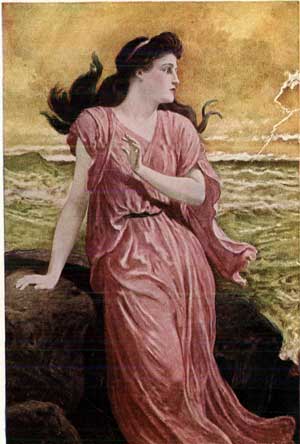
Having these powerful spirits obedient to his will, Prospero could by their means command the winds, and the waves of the sea. By his orders they raised a violent storm, in the midst of which, and struggling with the wild sea-waves that every moment threatened to swallow it up, he showed his daughter a fine large ship, which he told her was full of living beings like themselves. "O my dear father," said she, "if by your art you have raised this dreadful storm, have pity on their sad distress. See! the vessel will be dashed to pieces. Poor souls! they will all perish. If I had power, I would sink the sea beneath the earth, rather than the good ship should be destroyed, with all the precious souls within her."
"Be not so amazed, daughter Miranda," said Prospero; "there is no harm done. I have so ordered it, that no person in the ship shall receive any hurt. What I have done has been in care of you, my dear child. You are ignorant who you are, or where you came from, and you know no more of me, but that I am your father, and live in this poor cave. Can you remember a time before you came to this cell? I think you cannot, for you were not then three years of age."
"Certainly I can, sir," replied Miranda.
"By what?" asked Prospero; "by any other house or person? Tell me what you can remember, my child."
Miranda said, "It seems to me like the recollection of a dream. But had I not once four or five women who attended upon me?"
Prospero answered, "You had, and more. How is it that this still lives in your mind? Do you remember how you came here?"
"No, sir," said Miranda, "I remember nothing more."
"Twelve years ago, Miranda," continued Prospero, "I was duke of Milan, and you were a princess, and my only heir. I had a younger brother, whose name was Antonio, to whom I trusted everything; and as I was fond of retirement and deep study, I commonly left the management of my state affairs to your uncle, my false brother (for so indeed he proved). I, neglecting all worldly ends buried among my books, did dedicate my whole time to the bettering of my mind. My brother Antonio being thus in possession of my power, began to think himself the duke indeed. The opportunity I gave him of making himself popular among my subjects awakened in his bad nature a proud ambition to deprive me of my dukedom: this he soon effected with the aid of the king of Naples, a powerful prince, who was my enemy."
"Wherefore," said Miranda, "did they not that hour destroy us?"
"My child," answered her father, "they durst not, so dear was the love that my people bore me. Antonio carried us on board a ship, and when we were some leagues out at sea, he forced us into a small boat, without either tackle, sail, or mast: there he left us, as he thought, to perish. But a kind lord of my court, one Gonzalo, who loved me, had privately placed in the boat, water, provisions, apparel, and some books which I prize above my dukedom."
"O my father," said Miranda, "what a trouble must I have been to you then!"
"No, my love," said Prospero, "you were a little cherub that did preserve me. Your innocent smiles made me bear up against my misfortunes. Our food lasted till we landed on this desert island, since then my chief delight has been in teaching you, Miranda, and well have you profited by my instructions."
"Heaven thank you, my dear father," said Miranda. "Now pray tell me, sir, your reason for raising this sea-storm?"
"Know then," said her father, "that by means of this storm, my enemies, the king of Naples, and my cruel brother, are cast ashore upon this island."
Having so said, Prospero gently touched his daughter with his magic wand, and she fell fast asleep; for the spirit Ariel just then presented himself before his master, to give an account of the tempest, and how he had disposed of the ship's company, and though the spirits were always invisible to Miranda, Prospero did not choose she should hear him holding converse (as would seem to her) with the empty air.
"Well, my brave spirit," said Prospero to Ariel, "how have you performed your task?"
Ariel gave a lively description of the storm, and of the terrors of the mariners; and how the king's son, Ferdinand, was the first who leaped into the sea; and his father thought he saw his dear son swallowed up by the waves and lost. "But he is safe," said Ariel, "in a corner of the isle, sitting with his arms folded, sadly lamenting the loss of the king, his father, whom he concludes drowned. Not a hair of his head is injured, and his princely garments, though drenched in the sea-waves, look fresher than before."
"That's my delicate Ariel," said Prospero. "Bring him hither: my daughter must see this young prince. Where is the king, and my brother?"
"I left them," answered Ariel, "searching for Ferdinand, whom, they have little hopes of finding, thinking they saw him perish. Of the ship's crew not one is missing; though each one thinks himself the only one saved: and the ship, though invisible to them, is safe in the harbor."
"Ariel," said Prospero, "thy charge is faithfully performed: but there is more work yet."
"Is there more work?" said Ariel. "Let me remind you, master, you have promised me my liberty. I pray, remember, I have done you worthy service, told you no lies, made no mistakes, served you without grudge or grumbling."
"How now!" said Prospero. "You do not recollect what a torment I freed you from. Have you forgot the wicked witch Sycorax, who with age and envy was almost bent double? Where was she born? Speak; tell me."
"Sir, in Algiers," said Ariel.
"O, was she so?" said Prospero. "I must recount what you have been, which I find you do not remember. This bad witch, Sycorax, for her witchcrafts, too terrible to enter human hearing, was banished from Algiers, and here left by the sailors; and because you were a spirit too delicate to execute her wicked commands, she shut you up in a tree, where I found you howling. This torment, remember, I did free you from."
"Pardon me, dear master," said Ariel, ashamed to seem ungrateful; "I will obey your commands."
"Do so," said Prospero, "and I will set you free." He then gave orders what further he would have him do; and away went Ariel, first to where he had left Ferdinand, and found him still sitting on the grass in the same melancholy posture.
"O my young gentleman," said Ariel, when he saw him, "I will soon move you. You must be brought, I find, for the Lady Miranda to have a sight of your pretty person. Come, sir, follow me." He then began singing,
"Full fathom five thy father lies; Of his bones are coral made; Those are pearls that were his eyes: Nothing of him that doth fade But doth suffer a sea-change Into something rich and strange. Sea-nymphs hourly ring his knell: Hark! now I hear them—Ding-dong, bell."
This strange news of his lost father soon aroused the prince from the stupid fit into which he had fallen. He followed in amazement the sound of Ariel's voice, till it led him to Prospero and Miranda, who were sitting under the shade of a large tree. Now Miranda had never seen a man before, except her own father.
"Miranda," said Prospero, "tell me what you are looking at yonder."
"O father," said Miranda, in a strange surprise, "surely that is a spirit. How it looks about! Believe me, sir, it is a beautiful creature. Is it not a spirit?"
"No, girl," answered her father; "it eats, and sleeps, and has senses such as we have. This young man you see was in the ship. He is somewhat altered by grief, or you might call him a handsome person. He has lost his companions, and is wandering about to find them."
Miranda, who thought all men had grave faces and gray beards like her father, was delighted with the appearance of this beautiful young prince; and Ferdinand, seeing such a lovely lady in this desert place, and from the strange sounds he had heard, expecting nothing but wonders, thought he was upon an enchanted island, and that Miranda was the goddess of the place, and as such he began to address her.
She timidly answered, she was no goddess, but a simple maid, and was going to give him an account of herself, when Prospero interrupted her. He was well pleased to find they admired each other, for he plainly perceived they had (as we say) fallen in love at first sight: but to try Ferdinand's constancy, he resolved to throw some difficulties in their way: therefore advancing forward, he addressed the prince with a stern air, telling him, he came to the island as a spy, to take it from him who was the lord of it. "Follow me," said he, "I will tie you neck and feet together. You shall drink sea-water; shell-fish, withered roots, and husks of acorns shall be your food." "No," said Ferdinand, "I will resist such entertainment, till I see a more powerful enemy," and drew his sword; but Prospero, waving his magic wand, fixed him to the spot where he stood, so that he had no power to move.
Miranda hung upon her father, saying, "Why are you so ungentle? Have pity, sir; I will be his surety. This is the second man I ever saw, and to me he seems a true one."
"Silence," said the father: "one word more will make me chide you, girl! What! an advocate for an impostor! You think there are no more such fine men, having seen only him and Caliban. I tell you, foolish girl, most men as far excel this, as he does Caliban." This he said to prove his daughter's constancy; and she replied, "My affections are most humble. I have no wish to see a goodlier man."
"Come on, young man," said Prospero to the prince; "you have no power to disobey me."
"I have not indeed," answered Ferdinand; and not knowing that it was by magic he was deprived of all power of resistance, he was astonished to find himself so strangely compelled to follow Prospero: looking back on Miranda as long as he could see her, he said, as he went after Prospero into the cave, "My spirits are all bound up, as if I were in a dream: but this man's threats, and the weakness which I feel, would seem light to me if from my prison I might once a day behold this fair maid."
Prospero kept Ferdinand not long confined within the cell: he soon brought out his prisoner, and set him a severe task to perform, taking care to let his daughter know the hard labor he had imposed on him, and then pretending to go into his study, he secretly watched them both.
Prospero had commanded Ferdinand to pile up some heavy logs of wood. King's sons not being much used to laborious work, Miranda soon after found her lover almost dying with fatigue. "Alas!" said she, "do not work so hard; my father is at his studies, he is safe for these three hours; pray rest yourself."
"O my dear lady," said Ferdinand, "I dare not. I must finish my task before I take my rest."
"If you will sit down," said Miranda, "I will carry your logs the while." But this Ferdinand would by no means agree to. Instead of a help Miranda became a hindrance, for they began a long conversation, so that the business of log-carrying went on very slowly.
Prospero, who had enjoined Ferdinand this task merely as a trial of his love, was not at his books, as his daughter supposed, but was standing by them invisible, to overhear what they said.
Ferdinand inquired her name, which she told, saying it was against her father's express command she did so.
Prospero only smiled at this first instance of his daughter's disobedience, for having by his magic art caused his daughter to fall in love so suddenly, he was not angry that she showed her love by forgetting to obey his commands. And he listened well pleased to a long speech of Ferdinand's, in which he professed to love her above all the ladies he ever saw.
In answer to his praises of her beauty, which he said exceeded all the women in the world, she replied, "I do not remember the face of any woman, nor have I seen any more men than you, my good friend, and my dear father. How features are abroad, I know not; but, believe me, sir, I would not wish any companion in the world but you, nor can my imagination form any shape but yours that I could like. But, sir, I fear I talk to you too freely, and my father's precepts I forget."
At this Prospero smiled, and nodded his head, as much as to say, "This goes on exactly as I could wish; my girl will be queen of Naples."
And then Ferdinand, in another fine long speech (for young princes speak in courtly phrases), told the innocent Miranda he was heir to the crown of Naples, and that she should be his queen.
"Ah! sir," said she, "I am a fool to weep at what I am glad of. I will answer you in plain and holy innocence. I am your wife if you will marry me."
Prospero prevented Ferdinand's thanks by appearing visible before them.
"Fear nothing, my child," said he; "I have overheard, and approve of all you have said. And, Ferdinand, if I have too severely used you, I will make you rich amends, by giving you my daughter. All your vexations were but trials of your love, and you have nobly stood the test. Then as my gift, which your true love has worthily purchased, take my daughter, and do not smile that I boast she is above all praise." He then, telling them that he had business which required his presence, desired they would sit down and talk together till he returned; and this command Miranda seemed not at all disposed to disobey.
When Prospero left them, he called his spirit Ariel, who quickly appeared before him, eager to relate what he had done with Prospero's brother and the king of Naples. Ariel said he had left them almost out of their senses with fear, at the strange things he had caused them to see and hear. When fatigued with wandering about, and famished for want of food, he had suddenly set before them a delicious banquet, and then, just as they were going to eat, he appeared visible before them in the shape of a harpy, a voracious monster with wings, and the feast vanished away. Then, to their utter amazement, this seeming harpy spoke to them, reminding them of their cruelty in driving Prospero from his dukedom, and leaving him and his infant daughter to perish in the sea; saying, that for this cause these terrors were suffered to afflict them.
The king of Naples, and Antonio the false brother, repented the injustice they had done to Prospero: and Ariel told his master he was certain their penitence was sincere, and that he, though a spirit, could not but pity them.
"Then bring them hither, Ariel," said Prospero: "if you, who are but a spirit, feel for their distress, shall not I, who am a human being like themselves, have compassion on them? Bring them, quickly, my dainty Ariel."
Ariel soon returned with the king, Antonio, and old Gonzalo in their train, who had followed him, wondering at the wild music he played in the air to draw them on to his master's presence. This Gonzalo was the same who had so kindly provided Prospero formerly with books and provisions, when his wicked brother left him, as he thought, to perish in an open boat in the sea.
Grief and terror had so stupefied their senses, that they did not know Prospero. He first discovered himself to the good old Gonzalo, calling him the preserver of his life; and then his brother and the king knew that he was the injured Prospero.
Antonio with tears, and sad words of sorrow and true repentance, implored his brother's forgiveness, and the king expressed his sincere remorse for having assisted Antonio to depose his brother: and Prospero forgave them; and, upon their engaging to restore his dukedom, he said to the king of Naples, "I have a gift in store for you too;" and opening a door, showed him his son Ferdinand playing at chess with Miranda.
Nothing could exceed the joy of the father and the son at this unexpected meeting, for they each thought the other drowned in the storm.
"O wonder!" said Miranda, "what noble creatures these are! It must surely be a brave world that has such people in it."
The king of Naples was almost as much astonished at the beauty and excellent graces of the young Miranda, as his son had been. "Who is this maid?" said he; "she seems the goddess that has parted us, and brought us thus together." "No, sir," answered Ferdinand, smiling to find his father had fallen into the same mistake that he had done when he first saw Miranda, "she is a mortal, but by immortal Providence she is mine; I chose her when I could not ask you, my father, for your consent, not thinking you were alive. She is the daughter to this Prospero, who is the famous duke of Milan, of whose renown I have heard so much, but never saw him till now: of him I have received a new life: he has made himself to me a second father, giving me this dear lady."
"Then I must be her father," said the king; "but oh! how oddly will it sound, that I must ask my child forgiveness."
"No more of that," said Prospero: "let us not remember our troubles past, since they so happily have ended." And then Prospero embraced his brother, and again assured him of his forgiveness; and said that a wise overruling Providence had permitted that he should be driven from his poor dukedom of Milan, that his daughter might inherit the crown of Naples, for that by their meeting in this desert island, it had happened that the king's son had loved Miranda.
These kind words which Prospero spoke, meaning to comfort his brother, so filled Antonio with shame and remorse, that he wept and was unable to speak; and the kind old Gonzalo wept to see this joyful reconciliation, and prayed for blessings on the young couple.
Prospero now told them that their ship was safe in the harbor, and the sailors all on board her, and that he and his daughter would accompany them home the next morning. "In the meantime," says he, "partake of such refreshments as my poor cave affords; and for your evening's entertainment I will relate the history of my life from my first landing in this desert island." He then called for Caliban to prepare some food, and set the cave in order; and the company were astonished at the uncouth form and savage appearance of this ugly monster, who (Prospero said) was the only attendant he had to wait upon him.
Before Prospero left the island, he dismissed Ariel from his service, to the great joy of that lively little spirit; who, though he had been a faithful servant to his master, was always longing to enjoy his free liberty, to wander uncontrolled in the air, like a wild bird, under green trees, among pleasant fruits, and sweet-smelling flowers. "My quaint Ariel," said Prospero to the little sprite when he made him free, "I shall miss you; yet you shall have your freedom." "Thank you, my dear master," said Ariel; "but give me leave to attend your ship home with prosperous gales, before you bid farewell to the assistance of your faithful spirit; and then, master, when I am free, how merrily I shall live!" Here Ariel sung this pretty song:
"Where the bee sucks, there suck I; In a cowslip's bell I lie: There I crouch when owls do cry. On the bat's back I do fly After summer Merrily. Merrily, merrily shall I live now Under the blossom that hangs on the bough."
Prospero then buried deep in the earth his magical books and wand, for he was resolved never more to make use of the magic art. And having thus overcome his enemies, and being reconciled to his brother and the king of Naples, nothing now remained to complete his happiness, but to revisit his native land, to take possession of his dukedom, and to witness the happy nuptials of his daughter and Prince Ferdinand, which the king said should be instantly celebrated with great splendor on their return to Naples. At which place, under the safe convoy of the spirit Ariel, they, after a pleasant voyage, soon arrived.
II
A MIDSUMMER NIGHT'S DREAM
There was a law in the city of Athens which gave to its citizens the power of compelling their daughters to marry whomsoever they pleased; for upon a daughter's refusing to marry the man her father had chosen to be her husband, the father was empowered by this law to cause her to be put to death; but as fathers do not often desire the death of their own daughters, even though they do happen to prove a little refractory, this law was seldom or never put in execution, though perhaps the young ladies of that city were not unfrequently threatened by their parents with the terrors of it.
There was one instance, however, of an old man, whose name was Egeus, who actually did come before Theseus (at that time the reigning duke of Athens), to complain that his daughter Hermia, whom he had commanded to marry Demetrius, a young man of a noble Athenian family, refused to obey him, because she loved another young Athenian, named Lysander. Egeus demanded justice of Theseus, and desired that this cruel law might be put in force against his daughter.
Hermia pleaded in excuse for her disobedience, that Demetrius had formerly professed love for her dear friend Helena, and that Helena loved Demetrius to distraction; but this honorable reason, which Hermia gave for not obeying her father's command, moved not the stern Egeus.
Theseus, though a great and merciful prince, had no power to alter the laws of his country; therefore he could only give Hermia four days to consider of it: and at the end of that time, if she still refused to marry Demetrius, she was to be put to death.
When Hermia was dismissed from the presence of the duke, she went to her lover Lysander, and told him the peril she was in, and that she must either give him up and marry Demetrius, or lose her life in four days.
Lysander was in great affliction at hearing these evil tidings; but recollecting that he had an aunt who lived at some distance from Athens, and that at the place where she lived the cruel law could not be put in force against Hermia (this law not extending beyond the boundaries of the city), he proposed to Hermia that she should steal out of her father's house that night, and go with him to his aunt's house, where he would marry her. "I will meet you," said Lysander, "in the wood a few miles without the city; in that delightful wood where we have so often walked with Helena in the pleasant month of May."