Women in Modern Times.
Reading edition
113
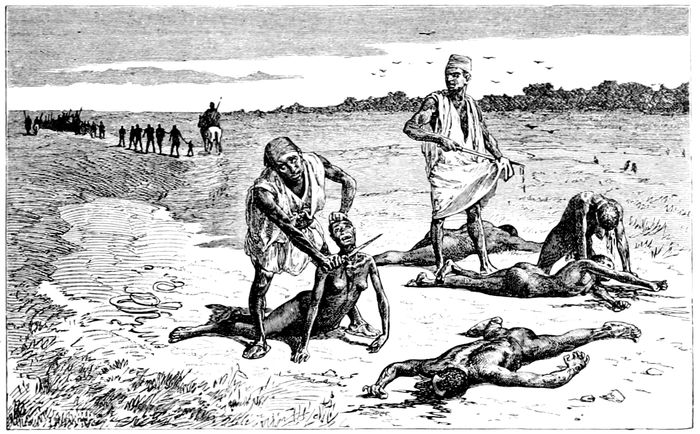
DISPOSING OF EXHAUSTED CAPTIVES.
WOMAN IN SLAVERY.
When our historians date the beginning of Modern Times from the discovery of America by Christopher Columbus, they are fully justified, as no other event has caused so many radical changes in the thoughts of men as well as in all commercial and social conditions. The earlier views about our terrestrial globe and its relation to the universe gave place to new and far greater conceptions. Almost every day brought new and astonishing disclosures in natural history, physics and other spheres of science.
The end of the 15th and the beginning of the 16th Century was also the time of the Renaissance as well as of the Reformation, of a revival of the wisdom of the classic past and of the rise and establishment of new sublime ideas about God and the destiny of man.
It could not fail that in this period of spiritual fermentation and inspiration the views about women, matrimony and woman’s rights likewise underwent considerable changes. But before these new conceptions found general acceptance many mediæval traditions, prejudices and customs had to be overcome and cleared away.
While the discovery of America brought incredible riches to various European nations, it caused nothing but misery and disaster to the aborigines of the New World. And to many million Africans as well.
It must not be forgotten that the conquest of Mexico, 114Peru and other rich parts of America inflamed the greed of inumerable adventurers, and that these men, in order to wring gold and other treasures from the natives, resorted to the most heartless cruelties. We also must call to mind, that in company with these conquerors went hosts of monks and priests of all orders, eager to convert the “heathen” to the “only true creed.” Ruthlessly invading the temples of the “infidels,” they turned the banner of the Cross, this beacon light of promise, into an awful oriflame of war, spreading destruction and disaster. The well known accounts, given by the Spanish bishop Las Casas, disclose among other horrible events the fact—heretofore unheard of in human history—that whole bands and tribes of American Indians, to evade the tyranny of their European oppressors, slaughtered their own children, and then committed suicide.
These Indians had been compelled not only to work in the gold mines and in the pearl fisheries, but to perform all other labor that white men were unable or unwilling to do. As under the cruel treatment of their oppressors the natives rapidly dwindled away and whole islands became depopulated the Portuguese as well as the Spaniards resorted to the importation of negro slaves, whom they captured in Africa and brought to America.
It was not long before the profits, derived from this trade, attracted the eyes of English adventurers. The first to become engaged in that new branch of business, was William Hawkins. It was he who undertook the first regular slave hunts to the coast of Guinea and opened that shameful traffic in which England was engaged for nearly three centuries. His son, John Hawkins, sailing under a charter of Queen Elizabeth, continued the lucrative business and grew rich.
That this men-hunter imagined himself under the special protection of the heavenly father appears from several entries in his log-book. When, invading a negro village near Sierra Leone, he almost fell into captivity himself and would have been exposed to the same fate that he inflicted, without compunction, upon thousands of other unfortunate men and women, he wrote: “God, who worketh all things for the best, would not have it so, and by Him all escaped without danger; His name be praised for it.” At another time, when his vessels were becalmed for a long time in midocean and great suffering ensued: “But Almighty God, who never suffereth His elect to perish, sent us the ordinarie Breeze, which is the northwest wind.”
To what extent the name of Christianity was abused, we see from the fact that Hawkins, when entering upon his greatest expedition with five ships in 1567 sacrilegiously named his flagship “Jesus Christ.”
115Because of the riches Hawkins brought to England, Queen Elizabeth knighted him and granted him a coat of arms, showing, on a black shield, a golden lion rampant over blue waves. Three golden doubloons above the lions represented the riches Hawkins had secured for England. To give due credit to the piety of this “nobleman,” there was in the upper quartering of the shield a pilgrim’s scallop-shell, flanked by two pilgrim’s staffs, indicating that Hawkins’ slave-hunts were genuine crusades, undertaken in the name of Christianity. For a crest this coat-of-arms shows the half-length figure of a negro, with golden armlets on his arms, but bound and captive.
In an article entitled “The American Slave,” published in “Pearson’s Magazine” for 1900, James S. Metcalf states that the slave trade quickly developed to tremendous extent and that from 1680 to 1786 there were carried from Africa to the British colonies in America 2,130,000 slaves, men as well as women. This does not include the number, vastly larger, taken to the Spanish and Portuguese colonies before, during and after the same period.
The same author states, that the traffic in human flesh was a recognized commerce at the London Exchange, and that, in 1771, the English alone sent to Africa 192 ships equipped for the trade and with a carrying capacity of 47,146 slaves per trip.
It was the tribal warfare among the aborigines of Africa that furnished the slave dealers with the greater part of their human merchandise. Small and unprotected villages were constantly in danger of being attacked by powerful roving bands. When in 1872 the famous explorer Nachtigal traveled through Central Africa, he witnessed a tragedy that happened at the shores of Chad Lake. Strong forces of Bagirmis made an assault on a negro village, to capture the inhabitants and carry them off for slaves. Alarmed by their guards, the negroes, terror-stricken, fled to some tree-huts, prepared for such emergency in a nearby forest. Here they considered themselves safe. But unfortunately the enemies were in possession of a few guns, with which they picked a number of the fugitives from the trees like birds. Falling from the dizzy heights, the wounded were hacked to pieces. After a while the cruel enemies succeeded in constructing some rough ladders, by which the trees were scaled. Unable to escape, many of the assaulted, preferring death to slavery, threw themselves upon the ground below, where they perished.
116
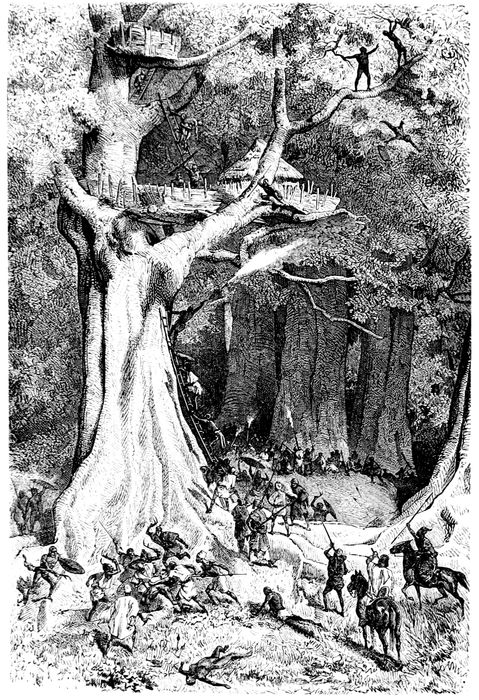
A RAID OF SLAVE-DEALERS IN CENTRAL AFRICA.
117
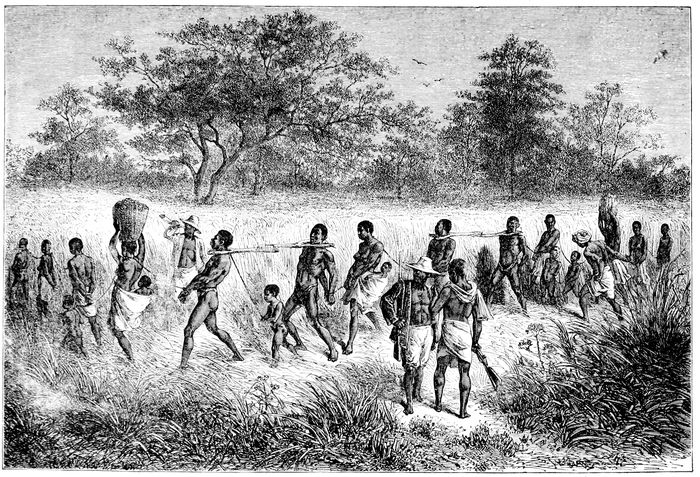
A SLAVE TRANSPORT IN CENTRAL AFRICA.
118The most desperate fight ensued for the tree-house of the chief. It took several hours, before the enemies succeeded in reaching the lower platform, where within a rude enclosure food, water, and even a few goats had been hidden. Unable to hold this place, the chief with his two wives and four children withdrew to the highest branches. From there he defended his family with such ability, that the foes, after having exhausted their supply in powder, were compelled to abandon the siege.—
The stronger portion of the captives made during such raids, were shackled hand and foot to prevent escape. The remainder often were killed and the flesh distributed among the victors, who, as a rule, after such a raid formed a small encampment, lighted their fires and gorged upon the human flesh. They then marched over to one of the numerous slave-markets on the rivers or the coasts, where they exchanged the captives with the slave-traders for beads, cloth, brass wire and other trinkets.
Woe to those who became sick or exhausted during the long march to the markets! If unable to stagger on any longer they were, to set an example for the others, either butchered on the spot, or left behind to perish by hunger and thirst, or to be torn by wild beasts.
In the further transportation of such kidnapped men and women no regard was paid to their comfort. In the best of slave-ships the height between decks in the quarters set aside for the living cargo was five feet and eight inches. Even in these not all the slaves had so much head room. Around the sides of the vessel, halfway up, ran a shelf, giving room for a double row of slaves, one above and one below. This was stowed with undersized negroes, including women, boys, and children. In the worst class of slavers the space between decks was no more than three feet, compelling the wretched occupants to make the entire journey in a sitting or crouching position, as they were oftentimes, in fact most of the times, so crowded together that lying down was an impossibility. In fact, the more ingenious traders often so figured out the available space that the slaves were packed in with their feet and legs across one another’s laps. To prevent revolt, the men were manacled in couples with leg irons and stowed below. The irons were fastened to the ceiling. As a rule the women were not handcuffed but crowded into compartments under grated hatches and locked doors. At sea there might be a faint possibility of a breath of air’s penetrating into those quarters, but under all circumstances the mortality among the slaves was frightful.
“In the literature of the slave trade,” says Metcalff, “the horrors of the path of commerce stand out as prominently as the persecutions of the Roman emperors in the history of Christianity. When the sea gives up its dead there will come from this highway of cruelty a prodigious army of martyrs to man’s inhumanity to man. The best authorities agree in 119estimating that of all the slaves taken from Africa at least one-eighth—some authorities say more than a quarter—died or were killed in transit. It staggers the imagination to think of how thickly the traffic in these helpless savages, continued through almost four centuries, must have strewn with corpses the lower depths of the Atlantic.
“Of course it was necessary, if any part of the cargo was to be delivered alive, that the negroes should occasionally be brought on deck and exercised. This was done with a few at a time, although their masters never went so far as to free even these from their irons. Often it was found when a couple was to be brought up that one of them had died and that his mate had spent hours, days even, in the stifling atmosphere of between-decks, manacled to and in constant contact with a corpse. It is small wonder that, as often happened, when the slaves were brought on deck they began jumping overboard in couples, sooner than return to the heat, thirst, stench, and filth of the hold, where the scalding perspiration of one ran to the body of another and where men were constantly dying in their full view. Sooner than endure these tortures even the savage Africans sought refuge in death by starvation. This was a contingency provided for in advance by the experienced trader, and if the gentle persuasion of the thumb-screw failed to cure the would-be suicide, the ships were always provided with a clever device to compel the human animal to take the nourishment which kept in him the life without which he ceased to possess any pecuniary value. This instrument consisted of a pair of iron compasses, the legs of which were driven into the mouth when closed and then forced open and held open by the action of a screw. Even the African negro, stoic to the pains incident to a life of savagery, would renounce the privilege of death by starvation to escape the immediate agony of forcibly distended jaws, especially when at the same time his thumbs were under the pressure of the screw with blood exuding from their ends.”
Branded like cattle, the negroes, after their arrival in the American harbor, were sold by auction. And now the slave was, as the Civil Code of Louisiana said, “subject to the power of his master in such a manner that the master may sell him, dispose of his person, and of his labor. He can do nothing, possess nothing, nor acquire anything but that may belong to his master.”
Of course this master had also the right to punish the slave for any neglect or wrong. To be sure, there were laws against excessive punishment, but as most of the plantations were far from the cities, such laws were practically ineffective against those who wished to violate them.
We quote once more J. S. Metcalff: “Almost every 120plantation had its whipping post, consisting of an upright set in the ground with a short crosspiece near the top. The thumbs or wrists of the negro to be whipped were securely tied together, and placed around the upright above the crosspiece, so that the toes barely touched the ground. Sometimes the offending slaves were sent to the nearest jail to be whipped by the jailor, who was an expert in his line of work, and provided with the right kind of whips as well as a strong arm and an accurate eye to make his blows inflict the most pain. In other cases, this official paid regular visits to the plantation, and inflicted the punishments accumulated since his preceding visit. Thus the terror of anticipation was often added to the agony of realization. These events were occasions on the plantations, and the other slaves were compelled to witness the punishments and sufferings of their fellows as a deterrent to wrongdoing on their own part. In the case of some offenders which seemed cardinal against the foundation principles of slavery, such as striking a master, engaging in a conspiracy with other slaves, or aiding a fugitive, the punishments were made extraordinarily severe, and slaves from surrounding plantations were obliged by their masters to gather to witness them.
“A case of this latter sort was the one of a negro and his wife, who had given their owner a severe beating. In spite of the fact that the first cause of the trouble was the rejection by the woman of the master’s advances, the offence was so flagrant that neighboring slave-owners feared to let it go by without severe and public punishment. At the time set the slaves from neighboring plantations were gathered, and the man and woman fastened to posts near each other. The man was to receive a hundred and fifty lashes and the woman a hundred. As the first strokes fell on the man’s back and loins he gave no sound, but the agony betrayed itself in the ashening of his dark skin, and in the involuntary contortion of his features. Meanwhile the woman encouraged him with crude expressions of pity and love. As the blows increased in number the torture became unbearable, and the sound of the regularly landing lash was punctuated with the shrieks of its agonized victim. Finally a blessed unconsciousness came to his relief, and he hung from the post a limp, unfeeling mass of bruised and bleeding flesh. While his back was being washed, the whipping of the woman began. The first blows brought shrieks of anguish from her lips, but as the whipping went on these subsided into a murmur of sobs, prayers, and appeals for mercy. With the exception of an occasional rest for the tired arm of the man wielding the whip, her punishment was carried to its end without her losing consciousness, although it was apparent that there had come some numbing 121influence to her faculties closely akin to insensibility. The man had now been restored to his senses and his punishment was resumed. When it was finished the wounds of both were washed with salt water, to intensify the effect of the blows, to prevent blood-poisoning and to heal the wounds more quickly, so that the slaves could resume their accustomed labor. This matter of the slave’s ability to work was always taken into account, and we have one instance of two economical lady slave-owners in Georgia who always inflicted their punishments Sunday mornings, so that by Monday the slaves would be able to go into the fields.”
As the slave-holders were absolute masters over the negroes, they made their dusky female slaves only too often the objects of their passions. The effects of this intermingling were soon seen in all slave-holding countries of America in the mixed character of the population, which, gradually extending itself as time wore on, resulted in the race of the mulattoes. From the intercourse of these again with the whites or among themselves, innumerable shades of color sprang up, giving rise to the distinctions of octoroons, quadroons, terceroons, quinteroons, etc. To all these people, regular or irregular in birth, light or dark in color, were given the various names of “people of color,” “sang melée,” or “mulattoes.” Notwithstanding the fact, that some of these quadroons and octoroons could hardly be distinguished from white people in appearance, their condition followed always that of their mothers, and they were therefore chattels to be bought or sold.
“On the plantations where negro children were brought up to be sold, it was,” as Metcalff states, “not an unheard-of thing for a master to sell his own son or daughter. In the break-up of family estates it sometimes happened that the heir was compelled to sell his own half-brother or half-sister. These relationships were seldom or never recognized.”
In the slave-markets of New Orleans and the other large cities the personal appearance of the younger women was a decided element in fixing their value. The languorous beauty of the Southern quadroon and octoroon is famous the world over, and on the auction block and at private sale they brought the highest prices.
The glory of having written the first formal protest against slavery and its countless cruelties, belongs to a small band of Mennonites from Germany, who arrived in Philadelphia in 1683, in the neighborhood of which city they started a settlement called Germantown.
Becoming aware that in the colonies slaves were sold without the disapproval of the Puritans and Quakers, who claimed to be defenders of human rights, the Mennonites drew up a protest against slavery on February 18th, 1688. It was 122the first written in any language. This remarkable document, still preserved in the archives of the “Society of Friends” in Philadelphia, was directed to the Quakers and reads as follows:
“This is to ye Monthly Meeting at Richard Warrel’s. These are the reasons why we are against the traffic of men Body, as followeth: Is there any that would be done or handled at this manner? to be sold or made a slave for all time of his life? How fearfull and fainthearted are many on sea when they see a strange vessel, being afraid it should be a Turk, and they should be taken and sold for slaves into Turkey. Now what is this better done as Turks do? Yea rather it is worse for them, which say they are Christians; for we hear that ye most part of such Negers are brought hither against their will and consent; and that many of them are stollen. Now, tho’ they are black, we cannot conceive there is more liberty to have them slaves, as it is to have other white ones. There is a saying, that we shall doe to all men, like as we will be done our selves; making no difference of what generation, descent or colour they are. And those who steal or robb men, and those who buy or purchase them, are they not alike? Here is liberty of conscience, which is right and reasonable; here ought to be likewise liberty of ye body, except of evil-doers, which is another case. But to bring men hither or to robb and sell them against their will, we stand against. In Europe there are many oppressed for conscience sake; and here there are those oppressed which are of a black colour. And we, who know that men must not commit adultery, some doe commit adultery in others, separating wifes from their husbands and giving them to others; and some sell the children of those poor creatures to other men. Oh! doe consider well this things, you who doe it, if you would be done at this manner, and if it is done according Christianity? You surpass Holland and Germany in this thing. This makes an ill report in all those countries of Europe, where they hear off, that ye Quakers doe here handel men like they handel there ye cattel. And for that reason some have no mind or inclination to come hither, and who shall maintain this your cause or plaid for it? Truly we can not do so, except you shall inform us better hereof, that Christians have liberty to practice this things. Pray! What thing on this world can be done worse towards us, then if men should robb or steal us away, and sell us for slaves to strange countries, separating husbands from their wifes and children. Being now this is not done at that manner, we will be done at, therefore we contradict and are against this traffick of menbody. And we who profess that it is not lawful to steal, must likewise avoid to purchase such things as are stollen, but rather help to stop this robbing and stealing if possible; and such men 123ought to be delivered out of ye hands of ye Robbers and sett free as well as in Europe. Then is Pennsylvania to have a good report, instead it hath now a bad one for this sake in other countries. Especially whereas ye Europeans are desirous to know in what manner ye Quackers doe rule in their Province; and most of them doe look upon us with an envious eye. But if this is done, well, what shall we say is done evil?
“If once these slaves (which they say are so wicked and stubborn men) should joint themselves, fight for their freedom and handel their masters and mastrisses as they did handel them before, will these masters and mastrisses tacke the sword at hand and warr against these poor slaves, like we are able to believe, some will not refuse to doe? Or have these Negers not as much right to fight for their freedom, as you have to keep them slaves?
“Now consider well this thing, if it is good or bad? and in case you find it to be good to handel these blacks at that manner, we desire and require you hereby lovingly, that you may inform us here in, which at this time never was done, that Christians have such a liberty to do so, to the end we shall be satisfied in this point, and satisfie likewise our good friends and acquaintances in our natif country, to whom it is a terrour or fairfull thing that men should be handeld so in Pennsylvania.
“This is from our Meeting at Germantown held ye 18. of the 2. month 1688. to be delivered to the monthly meeting at Richard Warrel’s.
“gerret hendericks
derick op de graeff
Francis Daniell Pastorius
Abraham op Den graeff.”
This document, set up by the humble inhabitants of Germantown, compelled the Quakers to think. Becoming aware that the traffic in human beings did not harmonize with the Christian religion, they introduced in 1711 an act to prevent the importation of negroes and Indians into Pennsylvania. Later on they also declared themselves against the slave trade. But as the Government found such laws inadmissible, the question dragged along, until 150 years later, by Lincoln’s Emancipation Proclamation, this black spot on the escutcheon of the United States was wiped out.
The Germans of Pennsylvania were also compelled to protest against other gross abuses, of which white men and women had become the victims. To review early immigration into America means to open one of the blackest pages of Colonial history. The constant wars, prevailing in Europe, 124the horrible persecutions to which the followers of certain religious sects were exposed, the frequent times of famine and pestilence led many thousands of unhappy beings to sail for the New World, where such sufferings would not be encountered. But the means of travel, then existing, did not meet the demands. Vessels, fit for the transportation of large numbers, were few and their accommodations extremely poor. Authorities took no interest in the proper treatment of the emigrants. Everything was left to the owners of the ships, who were responsible to nobody.
What sort of people were these shippers? Many were smugglers and pirates, always on the lookout for prey. Others were slave-dealers, making fortunes in trading negro-slaves. No doubt, the moral standard of these gentlemen was very low. Do we wonder that many of these unscrupulous men established also a regular trade in white slaves, for which the increasing exodus from Europe to America opened most alluring inducements. If smart enough, they would amass great wealth and would no longer have to make the perilous voyage to Guinea, to kidnap black people at the risk of their own lives. For the white slaves could be seduced by a bait that had a flavor of high-spirited benevolence.
Pretending willingness to help all persons without means, the ship-owners offered to give such persons credit for their passage across the ocean, on condition that they would work for it after their arrival in America, by hiring out as servants for a certain length of time to colonists, who would advance their wages by paying the passage money to the ship-owners. As the persons were redeeming themselves by performing this service, they were therefore called “Redemptioners.”
With this harmless-looking decoy many thousands of men and women were lured on to sign contracts, only to find out later that they had become victims of villainous knaves and had to pay for their inexperience with the best years of their lives.
The voyage across the ocean took as many weeks as it takes days at present. The ship-holds were in such horrible condition that words fail to describe them. And these dirty rooms were always packed beyond capacity. The food was poor and insufficient. Some captains kept their passengers on half rations from the day of the start, pretending that it was necessary to prevent famine. In consequence of the poor nourishment and the overcrowded quarters, all sorts of sickness prevailed and the mortality was terrific. For medical help and all other services excessive prices were charged. So it came that at the end of the journey almost all the passengers were deeply in debt. According to their amount and the physical condition of each immigrant the length of time was 125fixed for which he or she should serve any person, willing to pay the captain the amount of the immigrant’s debt. This servitude extended always from four to eight years, and sometimes to more. The captains had no difficulty in turning the bonds, signed by redemptioners, into cash. Cheaper labor could be obtained nowhere, and for this reason the colonists were always eager to secure the services of redemptioners. The offers were made through the newspapers or at the “Vendu,” the place where negroes were bought and sold. When applicants came, the redemptioner was not allowed to choose a master or to express wishes about the kind of work that would suit him. Members of the same family must not object to separation. So it happened frequently that a husband became parted from his wife or children, or children from their parents for many years or for life. As soon as the applicant paid the debt of a redemptioner, the latter was obliged to follow him. In case this master did not need his servant any longer, he could hire, transfer or sell him like chattel to someone else.
As in such a case the redemptioner received no duplicate of his contract, the poor creature depended entirely upon the good will of his new master, who had it in his power to keep him or her in servitude far beyond the expiration of the true contract time. If any dispute arose, a redemptioner enjoyed no greater protection than a negro, like whom he was treated in many respects. If found ten miles away from home without the written consent of his master, he would be regarded as a run-away and submitted to heavy physical punishment. Persons guilty of hiding or assisting such fugitives were fined 500 pounds of tobacco for each twenty-four hours such fugitive had remained under their roof. Who captured a run-away was entitled to a reward of 200 pounds of tobacco or 50 dollars. And to the run-away’s servitude ten days were added for every twenty-four hours absent, to say nothing of the severe whipping he was liable to get.
The redemptioners went through all sorts of experiences, according to the different tempers of their masters. Some were lucky enough to find good homes, where they were well treated. But many fell into the hands of heartless, selfish people, who in their eagerness to get as much as possible out of the redemptioners, literally worked them to death, to say nothing of providing insufficient food, scanty clothing and poor lodging. Many owners made use of the right to punish redemptioners so frequently and so cruelly, that a law became necessary whereby it was forbidden to apply to a servant more than ten lashes for each “fault.”
Female redemptioners were quite often exposed to lives of shame, which some of the laws seemed to invite. For 126instance in Maryland a law was passed in 1663 providing that any freeborn white woman, who married a colored slave, should together with her offspring become the property of the owner of that slave.
Originally this abominable law was intended to deter white women from intermarriage with colored men. But many depraved colonists misused this law purposely and compelled their white female servants by threat or deceit to marry colored slaves, as the master then would legally secure permanent possession of the white freeborn woman as well as the children she might bear. Though everybody knew that such devilish tricks were practiced extensively, this law remained in force until 1721, when a peculiar incident led to its repeal. When Lord Baltimore, the founder of Maryland, visited his province in 1681, he brought over an Irish girl, Nellie, who had agreed to redeem the cost of passage to America by doing service. Before her time ended, Lord Baltimore returned to England. Prior to his departure he sold the unexpired term of Nellie’s service to a resident of Maryland, who some weeks thereafter gave Nellie to one of his negroes, making her thereby, together with two children that were born, forever his slave. When Lord Baltimore heard of this, he caused the abolishment of the law of 1663. But all efforts to release his former servant and her children were in vain. The case dragged along for years, until the courts decided, that Nellie and her children must remain slaves, as the latter were born before the annulment of the law.
Incidents of similar character stirred the German citizens of Philadelphia to revolt against the unjust treatment to which their immigrant countrymen and women were subjected. At a meeting on Christmas Day of 1764, they formed “The German Society of Pennsylvania,” with the purpose of securing laws for the abolishment of all abuses which had grown out of the treatment of immigrants. Such a law was secured on May 18th of the following year.
The “German Society of Pennsylvania” became the model for many similar institutions in all parts of America. By uncovering evils and by vigorous persecutions of guilty persons, by continuously framing and recommending effective laws, these societies secured at last a better treatment of the immigrants on the ocean as well as after landing. With full justice these societies may be called the true originators of our modern immigration laws.—
They also established the “Legal Aid Societies,” to assist poor people in need of legal advice and help. As these institutions spread over hundreds of cities of America as well as of Europe, we see that since the Christmas meeting in Philadelphia in 1764 untold millions of people have profited 127by the earnest work, begun by that small band of Germans, who had the welfare of their poor countrymen at heart, and showed what genuine Christmas spirit can do for humanity, if it is only put to a proper purpose.
There existed yet another form of female slavery, the worst of all. With the development of the feudal system in mediæval Europe, which made the poor man, especially the peasant, dependent on the lord or owner of the land he cultivated, the lords appropriated in time unlimited sway over their vassals. Among other rights they claimed not only that to marry him or her to whomsoever the lord might chose, but also absolute control of the vassal’s newly wedded bride for the first three days and nights. This custom, known by a variety of names, as “jus primæ noctis, droit de cuissage,” “marchetta” or “marquette,” had the sanction of the state as well as of the church and compelled newly married women to the most dishonorable servitude. If the female serf pleased the lord he enjoyed her, and it was from this custom, that the eldest son of the serf was always held as the son of the lord, “as perchance it was he, who begot him.”
If it should happen that the young bride did not meet the fancy of the lord, he let her alone, but in such case the husband had to redeem her by paying the lord a certain amount of money, the name of which betrayed its nature.
Matilde Joslyn Gage in her able book “Woman, Church and State” has devoted a whole chapter to the history of marquette and says:
“The seigneural tenure of the feudal period was a law of Christian Europe more dishonorable than the worship of Astarte at Babylon. In order to fully comprehend the vileness of marquette we must remember that it did not originate in the pagan country many thousand years since; that it was not a heathen custom transplanted to Europe with many others adopted by the church, but that it arose in Christian countries a thousand years after the origin of that religion, continuing in existence until within the last century.”
She further states that in France even the Bishops of Amiens and the canons of the cathedral of Lyons possessed the right over the women of their vassals, and that in several counties of the Piccardy the curés imitated the bishops and took the right of cuissage, when the bishop had become too old to take his right. She also states, that “marquette began to be abolished in France toward the end of the 16th Century, but still existed in the 19th Century in the County of Auvergne, and that the lower orders of the clergy were very unwilling to relinquish this usage, vigorously protesting to their archbishops against the deprivation of this right, declaring they could not be dispossessed.
128“But finally the reproach and infamy connected with the ‘droit de cuissage’ became so great, and the peasants became so recalcitrant over this nefarious exaction, that ultimately both lords spiritual and lords temporal, fearing for their own safety, commenced to lessen their demands.”
From a letter, reproduced in the same book, it appears that instances of the survival of the feudal idea as to the right of the lord to the persons of his vassal woman occurred within the last decenniums of the Nineteenth Century. This letter, written by Mr. D. R. Locke, and dated December, 1891, reads: “One of the Landlords was shot a few years ago and a great ado was made about it. In this case as in most of the others it was not a question of rent. My Lord had visited his estates to see how much more money could be taken out of his tenants, and his lecherous eyes happened to rest upon a very beautiful girl, the eldest daughter of a widow with seven children. Now this girl was betrothed to a nice sort of boy, who, having been in America, knew a thing or two. My Lord, through his agent, who is always a pimp as well as a brigand, ordered Kitty to come to the castle. Kitty, knowing very well what that means, refused. “Very well,” says the agent, “yer mother is in arrear for rent, and you had better see My Lord, or I shall be compelled to evict her.”—Kitty knew what that meant also. It meant that her gray-haired mother, her six helpless brothers and sisters would be pitched out by the roadside to die of starvation and exposure, and so Kitty, without saying a word to her mother or anyone else, went to the castle and was kept there three days, till My Lord was tired of her, when she was permitted to go. She went to her lover, like an honest girl as she was, and told him she would not marry him, but refused to give any reason. Finally the truth was wrenched out of her, and Mike went and found a shot-gun that had escaped the eye of the royal constabulary, and he got powder and shot and old nails, and he lay behind a hedge under a tree for several days. Finally one day My Lord came riding by all so gay, and that gun went off. There was a hole, a blessed hole, clear through him, and he never was so good a man as before because there was less of him. Then Mike went out and told Kitty to be of good cheer and not to be cast down, that the little difference between him and My Lord had been settled, and that they would be married as soon as possible. And they were married, and I had the pleasure of taking in my hand the very hand that fired the blessed shot, and of seeing the wife, to avenge whose cruel wrongs the shot was fired.”
In the same work we read that another of these British lords in Ireland, Leitram, was noted for his attempts to dishonor the wives and daughters of the peasantry upon his vast 129estate. His character was equal to that of the worst feudal barons, and like these he used his power as magistrate and noble, in addition to that of landlord, to accomplish his purpose. After an assault upon a beautiful and intelligent girl, by a brutal retainer of his lordship, his tenantry finally declared it necessary to resort to the last means in their power to preserve the honor of their wives and daughters. Six men were chosen as the instruments of their crude justice. They took an oath to be true to the end, in life or death, purchased arms, and seeking a convenient opportunity shot the tyrant to death. Nor were those firing the fatal shots ever discovered.
130
THE DAWNING OF BRIGHTER DAYS.
As the Reformation aimed at the restitution of the purity and simplicity of the first Christian communities, the position of woman in the Church as well as in private life was of course also considered.
As has been shown in former chapters, the authorities of the mediæval Christian Church regarded the daughters of Eve not only as creatures inferior to man, but also as the medium preferred by Satan above all others to lead man astray. Seeing in woman nothing but a necessary evil, they claimed also that a nun is purer than a mother, just as a celibate monk is holier than a father. This prejudice of benighted theologians against woman had influenced the conduct of the State toward the woman and made her everywhere the victim of unjust laws. For a long time in certain countries to ask rights for women exposed one to the suspicion of infidelity.
Therefore it must be regarded as an event of greatest importance in the history of woman, when Martin Luther, the most prominent figure in the Reformation, decided to take a wife. He married Catherine von Bora, a lady twenty-four years of age, of a noble Saxon family.
She had left the convent of Nimbschen together with eight other nuns in order to worship Christ without being compelled to observe endless ceremonies, which gave neither light to the mind nor peace to the soul. Protected by pious citizens of Torgau, the former nuns had lived together in retirement. Luther married his betrothed on June 11, 1525, with Lucas Cranach and another friend as witnesses. The ceremony was performed by Melanchton.
The marriage, blessed with six children, was a very happy one. Catherine proved to be a congenial mate, of whom Luther always spoke as “his heartily beloved house-frau.” The great reformer himself was a tender husband, and the most loving of fathers. Nothing he liked better than to sit amidst his dear ones, enjoying a glass of wine and those beautiful folk-songs, in which German literature is so rich.
Many of these little poems breathe the sincere respect and high appreciation, in which woman was held by the Germans since time immemorial. There is for instance Simon Dach’s well known poem “Anne of Tharau.” Written in 1637, it reads:
131
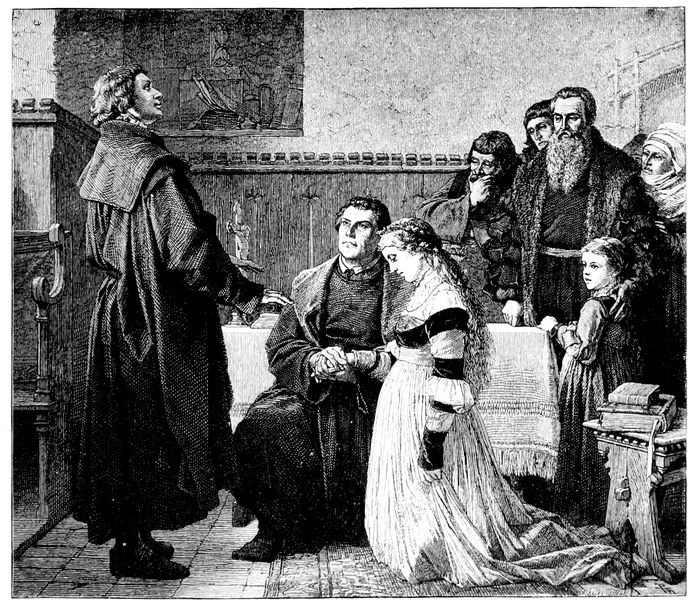
THE WEDDING OF MARTIN LUTHER TO CATHERINE VON BORA. After a painting by P. Thumann.
132“Aennchen von Tharau ist’s die mir gefällt,
Sie ist mein Leben, mein Gut und mein Geld;
Aennchen von Tharau hat wieder ihr Herz
Auf mich gerichtet in Lieb und in Schmerz.
Aennchen von Tharau, mein Reichtum, mein Gut,
Du meine Seele, mein Fleisch und mein Blut.
Würdest du gleich einmal von mir getrennt,
Lebtest dort, wo man die Sonne nicht kennt,
Ich will doch dir folgen durch Wälder und Meer,
Durch Schnee und Eis und durch feindliches Heer,
Aennchen von Tharau, mein Licht, meine Sonn’,
Mein Leben schliess ich um deines herum.—
Annie of Tharau, ’tis she that I love,
She is my life and all riches above;
Annie of Tharau has giv’n me her heart,
We shall be lovers till death us do part!
Annie of Tharau, my kingdom, my wealth,
Soul of my body, and blood of my health.
Say you should ever be parted from me,
Say that you dwelt where the sun they scarce see,
Where you go I go, o’er oceans and lands,
Prisons and fetters, and enemies’ hands.
Annie of Tharau, my sun and sunshine,
This life of mine will I throw around thine.”
And who would be able to pay to female virtues a higher tribute than did Paul Fleming in a poem, directed to his betrothed:
“Ein getreues Herz zu wissen
Ist des höchsten Schatzes Preis;
Der ist selig zu begrüssen
Der ein solches Kleinod weiss.
Mir ist wohl bei tiefstem Schmerz
Denn ich weiss ein treues Herz.
To call a faithful heart thine own
That’s life’s true and only pleasure,
And happy is the man alone
To whom was given such a treasure.
The deepest anguish does not smart
For I know a faithful heart.”
This poem was written at the time, when the tempests of the Thirty Years’ War swept over Germany, ruining that 133country beyond recognition. Hundreds of cities and villages were burned by Spanish, Italian, Hungarian, Dutch and Swedish soldiers, who made the unfortunate country their battleground. Of the seventeen million inhabitants thirteen millions were killed or swept away by starvation and the pest. Agriculture, commerce, industries and arts were annihilated. Of many villages nothing remained but their names. According to the chronicles of these times, one could wander for many miles without seeing a living creature except wolves and raven. All joy and happiness, in which the German people had been so rich, were extinguished. To women the cup of sorrow would never become empty, as hate, revenge, cruelty, and the lowest passions combined to fill their lives with endless mental and physical agonies.
During these dreadful times such social gatherings as had become the fashion among the refined people of Italy during the period of the Renaissance, were of course out of the question. Far happier in this respect was France, where the era of the “Salons” began, many of which became known throughout Europe, for the inspiration and refinement that spread out from them.
It was to the exceptional qualities of a young and noble-minded woman of Italian birth, that the first salon in France owed its origin and its distinctive character. This lady was Catherine Pisani, the daughter of Jean de Vivonne, Marquis of Pisani. Born at Rome in 1588, she married the French Marquis of Rambouillet, with whom she moved to Paris. Repelled by the gilded hollowness and license of the court of King Henry IV. she retired, about the year 1608, to her husband’s stately palace, which became famous as the “Hotel Rambouillet.” Its pride was a suite of salons or parlors, arranged for purposes of reception and so devised as to allow many visitors to move easily. With their draperies in blue and gold, their cozy corners, choice works of art, Venetian lamps, and crystal vases always filled with fragrant flowers, these rooms were indeed ideal places for social and literary gatherings.
As Amelia Gere Mason has described in a series of articles about the French Salons, written for the “Century Magazine” of 1890, Mm. de Rambouillet “sought to assemble here all that was most distinguished, whether for wit, beauty, talent, or birth, into an atmosphere of refinement and simple elegance which would tone down all discordant elements and raise life to the level of a fine art. There was a strongly intellectual flavor in the amusements, as well as in the discussions of this salon, and the place of honor was given to genius, learning, and good manners, rather than to rank. But the spirit was by no means purely literary. The exclusive 134spirit of the old aristocracy, with its hauteur and its lofty patronage, found itself face to face with fresh ideals. The position of the hostess enabled her to break the traditional barriers and form a society upon a new basis, but, in spite of the mingling of classes hitherto separated, the dominant life was that of the noblesse. Women of rank gave the tone and made the laws. Their code of etiquette was severe. They aimed to combine the graces of Italy with the chivalry of Spain. The model man must have a keen sense of honor and wit without pedantry; he must be brave, heroic, generous, gallant, but he must also possess good breeding and gentle courtesy. The coarse passions and depraved manners which had disgraced the gay court of Henry IV. were refined into subtle sentiments, and women were raised upon a pedestal to be respectfully and platonically adored. In this reaction from extreme license familiarity was forbidden, and language was subjected to a critical censorship.”
This definition of the salon of “the incomparable Arthenice”—an anagram for Mme. de Rambouillet, devised by two poets of renown—we find confirmed by the words of many distinguished men, who were fortunate enough to be admitted to this circle. Among them were Corneille, Descartes, and all the founders of the Académie Française.
“Do you remember,” so said the eminent Abbé Fléchier many years later, “the salons which are still regarded with so much veneration, where the spirit was purified, where virtue was revered under the name of the ‘incomparable Arthenice’; where people of merit and quality assembled who composed a select court, numerous without confusion, modest without constraint, learned without pride, polished without affectation?”—
The salon of Mme. de Rambouillet continued till the death of its mistress, the 27th of December, 1665, having been, as Saint-Simon writes, “a tribunal with which it was necessary to count, and whose decisions upon the conduct and reputation of people of the court and the world had great weight.”
There were other salons, modeled more or less after the present one. When the Hotel de Rambouillet was closed, Mademoiselle Madeleine de Scudéry held regular reunions by receiving her friends on Saturdays. Among this “Société du Samedi” were many authors and artists, who conversed upon all topics of the day, from fashion to politics, from literature and the arts to the last item of gossip. They read their works and vied with one another in improvising verses.
About the personality of Mlle. de Scudéry Abbé de Pure wrote: “One may call her the muse of our age and the prodigy of her sex. It is not only her goodness and her sweetness, 135but her intellect shines with so much modesty, her sentiments are expressed with so much reserve, she speaks with so much discretion, and all that she says is so fit and reasonable, that one cannot help both admiring and loving her. Comparing what one sees of her, and what one owes to her personally, with what she writes, one prefers, without hesitation, her conversation to her works. Although her mind is wonderfully great, her heart outweighs it. It is in the heart of this illustrious woman that one finds true and pure generosity, an immovable constancy, a sincere and solid friendship.”
Fearing to lose her liberty Mlle. de Scudéry never married. “I know,” she writes, “that there are many estimable men who merit all my esteem and who can retain a part of my friendship; but as soon as I regard them as husbands I regard them as masters, and so apt to become tyrants that I must hate them from that moment; and I thank the gods for giving me an inclination very much averse to marriage.”
Under the pseudonym of “Sappho” Mlle. de Scudéry was acknowledged as the first “blue-stocking” of France and of the world. Several of her novels, in which she aimed at universal accomplishments, were the delight of all Europe. Having studied mankind in her contemporaries, she knew how to analyze and describe their characters with fidelity and point.
Another noteworthy salon of the 17th Century was that of the beautiful and amiable Marquise de Sablé, one of the favorites of Mme. de Rambouillet. It was she who set the fashion, at that time, of condensing the thoughts and experiences of life into maxims and epigrams. While this was her special gift to literature, her influence became also felt through what she inspired others to do. A few of her maxims, as proven in Mrs. Mason’s articles about the French Salons, are worth copying, as they show the estimate Mme. De Sablé placed upon form and measure in the conduct of life.
“A bad manner spoils everything, even justice and reason. The how constitutes the best part of things; and the air which one gives thoughts, gilds, modifies and softens the most disagreeable.”—
“There is a certain command in the manner of speaking and acting which makes itself felt everywhere, and which gains, in advance, consideration and respect.”—
“Wherever it is, love is always the master. It seems truly that it is to the soul of the one who loves, what the soul is to the body it animates.”—
With the death of the Marquise de Sablé in 1678 the last salon of the brilliant era of the Renaissance was closed. With the approach of that period of affected and artificial life, known as the Rococo, new types of women came to 136the surface, gay, witty, piquant and amusing, but lax and without great moral sense or spiritual aspiration. The dangerous influence of the many mistresses of Louis XIV. and Louis XV., of Mesdames de Montespan, Maintenon and Pompadour pervaded the atmosphere, and turned the salons into headquarters of intrigue and political conspiracy. Especially at the time of the clever Mme. de Pompadour women were everywhere the power, without which no movement could be carried through successfully. “These women,” said the famous philosophical historian Montesquieu, “form a kind of republic, whose members, always active, aid and serve one another. It is a new state within the state; and whoever observes the action of those in power, if he does not know the women who govern them, is like a man who sees the action of a machine but does not know its secret springs.”
Montesquieu himself, when in Paris, made the salons of Madame de Tencin and Madame d’Aiguillon his favorite resorts.
Here he discussed with other brilliant thinkers of the time literary and political questions, and those theories, which he embodied in the most famous of his works: “Esprit des Lois” (the Spirit of the Laws). This book, dealing with law in general, with forms of government, military arrangements, taxation, economic matters, religion and individual liberty, was the first open attack on absolutism. Put on the Index by the Pope it was nevertheless eagerly read and discussed everywhere, and thus it became one of the factors leading to the French Revolution.—
Among the salons of the 18th Century, known for their influence on scientific and political life, the most remarkable was that of the Marquise de Lambert. Her magnificent apartments in the famous Palais Mazarin, decorated by artists like Watteau, were a rendezvous for the most eminent men and women, among them the best of the “Forty Immortals,” or members of the Académie Française. As candidates for vacant chairs in this body were often proposed here the Salon Lambert was called “the Antechamber to Immortality.”
The quality of the character and intellect of the hostess of this salon may be judged from a few of the bits of advice she wrote to her son. “I exhort you much more to cultivate your heart than to perfect your mind; the true greatness of the man is in the heart.”—“Let your studies flow into your manners, and your readings show themselves in your virtues.”—“It is merit which should separate you from the people, not dignity nor pride.”—“Too much modesty is a languor of the soul, which prevents it from taking flight and carrying itself rapidly towards glory.”—“Seek the society of your 137superiors, in order to accustom yourself to respect and politeness. With equals one grows negligent; the mind falls asleep.” She urged her daughter to treat servants with kindness. “One of the ancients says they should be regarded as unfortunate friends. Think that humanity and Christianity equalize all.”—
Up to the latter half of the 18th Century the salon had become the most characteristic feature of Parisian society. Having multiplied indefinitely, they catered to all tastes and thoughts. Besides the rallying points for philosophers, literateurs and femmes d’esprit, there were other salons, where sly maitresses and political adventurers met the corrupt officials of the Government. Still other salons served as meeting places of fiery spirits, who, disgusted with the debauchery and unrestrained immorality of the ruling classes, made the discussion of politics and the deliverance of the oppressed people their chief topic.
Like the French Renaissance so the English Renaissance received its first impulse from Italy. But less concerned with culture as such, it was more practical in England and distinguished itself chiefly by the greater attention given to education. While the sons and daughters of the nobility were carefully trained by tutors, the children of the middle class received an education in grammar schools founded during the reign of King Henry VIII.
This interest in education was greatly stimulated by the doctrines of the Reformation, which had spread from Germany to England, and which were favored by the king, as they served his political interests as well as his passion for the beautiful Anne Boleyn, one of the queen’s ladies-in-waiting. That he divorced his wife and married Anne Boleyn, and that she, on September 7th, 1533, gave birth to a girl, are facts familiar to everyone acquainted with English history.
This girl later on ascended the throne and as Queen Elizabeth became famous as one of the most remarkable and illustrious of all female sovereigns.
Most remarkable was her attitude toward Rome. When the “Virgin Queen” in her twenty-fifth year ascended the throne, it was not only as queen, but also as the head of the rebellious Church. Religious strife had already passed the point of reconciliation and Elizabeth’s position was extremely difficult, as the Catholic party was still very strong and was bent on maintaining the connection with Rome. Aware of this fact, the Pope, claiming England as a fief of the Holy See, refused to recognize Elizabeth’s title to the crown, and demanded that she should renounce all her pretensions so much the more since she was an illegitimate child. But whereas many monarchs would have cringed before the Pope, 138Elizabeth ignored his demands and answered the subsequent bull by Pope Pius V., by which all Catholics were released from their allegiance to the queen, by the famous Acts of Supremacy and Uniformity. Striking directly at the papal power, these acts compelled all clergymen and public functionaries to renounce the temporal and spiritual jurisdiction of every foreign prince and prelate; and all ministers, whether beneficed or not, were forbidden to use any but the established liturgy. These statutes were carried out with considerable severity, and many Catholics suffered death. Thus bending priests and prelates to her fiery will, the queen made England a bulwark of Protestantism.
That the long reign of Elizabeth, which lasted from 1558 to 1603, was also a period of brilliant prosperity and advancement, during which England put forth her brightest genius, valor, and enterprise, has been recorded by history. It is also a well-known fact that the learning of Elizabeth was considerable, even in that age of learned ladies. Horace Walpole has assigned her a place in his “Catalogue of Royal and Noble Authors,” and a list of thirteen literary productions, chiefly translations from the Greek, Latin, and French, are attached to her name.
There were quite a number of English ladies interested in literature and poetry. The most remarkable was Mary Astell, born in 1668 at Newcastle-on-Tyne. Having received a careful education by her uncle, a clergyman, she continued her studies in London. Here her attention and efforts were especially directed to the mental uplift of her own sex, and in 1697 she published a work entitled, “A Serious Proposal to the Ladies, Wherein a Method is Offered for the Improvement of Their Minds.” With the same end in view she elaborated a scheme for a ladies’ college, which was favorably entertained by Queen Anne, and would have been carried out had not Bishop Burnet interfered.
During the reign of Queen Elizabeth England was called “the Paradise of Women,” on account of the great liberty, granted to them in all social affairs. There exists an interesting account of a Dutch traveller, Van Meteren, who spent some time in England. With surprise he saw that here the members of the fair sex enjoyed considerable freedom. “They are,” so he says, “not shut up as in Spain and elsewhere, and yet the young girls are better behaved than in the Netherlands. Having fine complexions, they also do not paint like the Italians and others. They sit before their doors, decked in fine clothes, in order to see and be seen by the passers-by. In all banquets and feasts they are shown the greatest honor: they are placed at the upper end of the table where they are the first served. All the rest of their time they employ 139in walking and riding, in playing cards, or visiting their friends and keeping company, conversing with their equals and neighbors, and making merry with them at child-birth, christening, churchings and funerals. And all this with the permission and knowledge of their husbands.”
In strange contrast herewith was the legal position of women. It was, as D. Staars says in his interesting book “The English Woman,” “entirely detrimental. They were under the absolute authority of their husbands. In regard to property, husband and wife were considered by the law as forming one indivisible person. Therefore a husband could not make a deed of gift to his wife, or make a contract with her. The subordinate position of the married women was evident in the whole of her existence. The husband was his wife’s guardian, and if anyone carried her off he had a right to claim damages. He could also inflict corporal punishment on her sufficient to correct her. All the property which she might afterwards acquire, became by her marriage the common property of husband and wife, but only the husband had a right to the income, because he alone had control and administration of the property. Not only lands, but also funds, furniture, plate, and even the bed and ornaments of a woman, all became the husband’s property on the wedding day, and he could sell or dispose of it as he pleased. A married woman could not even make a will. Only when she became a widow, her clothes and personal possessions again became her own property, provided, however, that her husband had not otherwise disposed of them in his will. Furthermore, she had a right to the income of a third of all the husband’s property.”
These unsatisfactory conditions later on caused the English women to join their American sisters in the struggle for emancipation.

140
PIONEER WOMEN IN THE NEW WORLD.
At the same time that ladies and gentlemen of refinement discussed human rights and liberty in the elegant salons of Italy and France, a race of hardy men and women amid the wilderness of the New World was engaged in establishing crude settlements, from which later on the spirit of genuine freedom should radiate throughout the world.
When toward the end of the 16th Century European explorers arrived on the eastern coast of the North American continent, they found what later times demonstrated beyond dispute: the richest and finest land on the face of the globe. The unsurpassed beauty and grandeur of the scenery stirred their hearts with surprise and admiration. They became enthusiastic about everything, and in their reports described the newly discovered country as the most wonderful they had ever seen.
The more these explorers saw of America, the more their amazement increased. When Henry Hudson in 1609 discovered that noble river which now bears his name, its magnificent shores were a revelation to him, who was accustomed to the modest surroundings of the Netherlands.
The French, who entered North America by the way of the St. Lawrence River, met with still greater surprises. The Great Lakes, stretching like oceans toward the setting sun, thundering Niagara, the royal Ohio, the majestic Mississippi, and the beautiful forests girding these shores, made their hearts beat with wonder and delight and filled their imagination with dreams of vast empires full of wealth. Beyond the “Father of Waters” and the regions of forest, the explorers found the “Prairies,” boundless seas of fragrant grass and beautiful flowers. Beyond these plains rose majestic mountain-chains, with lovely valleys and parks, and snow-capped domes, towering above the clouds.
Such majestic nature must of necessity exert a most powerful influence on all who came in contact with it. Many of those immigrants who in their native countries had been restrained by narrow traditions and customs, and oppressed by despotic rulers, were here given the first chance to develop and prove their abilities. The unlimited freedom of the boundless forests, plains, and mountains stimulated their energy and imbued them with a spirit of enterprise, hitherto unknown.
New types of heroic men, such as never had lived in Europe, sprang into existence: the trappers, traders and “voyageurs,” who in the pursuit of the lucrative fur trade penetrated the vast continent in all directions, fighting their way through countless hardships and dangers.
141
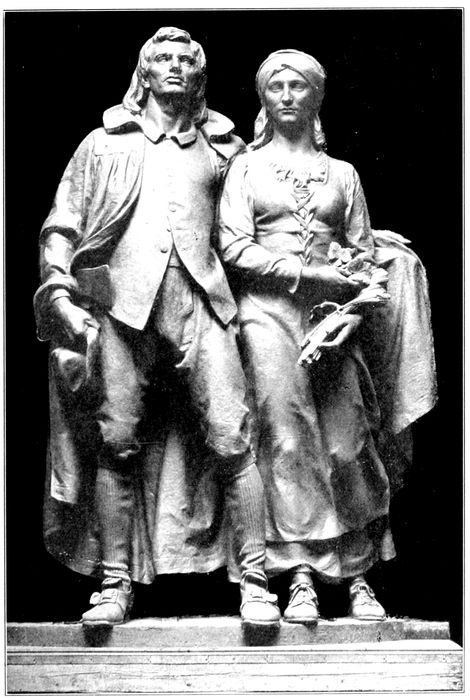
PIONEERS. Modeled by A. Jaegers.
142Later on these daring forerunners of civilization were followed by settlers, who, with their families, established the first permanent homes: single log houses and hamlets, like little islands in the vast ocean of the primeval forest.
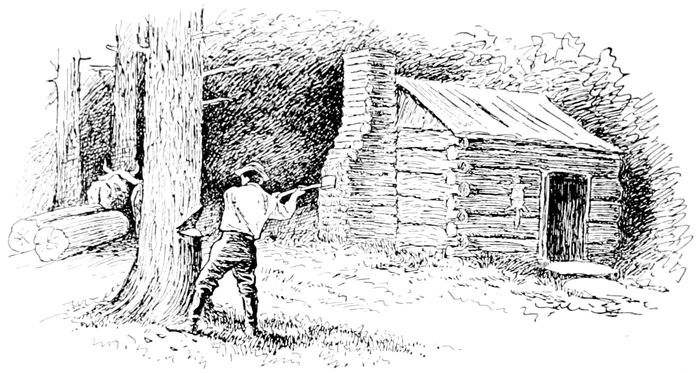
THE FIRST CABIN.
These “backwoodsmen,” completely isolated from the civilized world and compelled to wage constant battle with hostile nature as well as with ferocious savages and wild animals, have been justly glorified as heroes. They were at once explorers, carpenters, builders, woodmen, farmers, breeders, trappers, hunters and fighters,—in short, everything. But their wives and daughters, who accompanied them, certainly deserve to be honored too, as one can hardly conceive situations more trying than those which these courageous women had to face.
First of all there were the daily labors of the household and farm, the unceasing cares of motherhood, the toils and sufferings in times of drought or sickness. Because of the isolation of their homesteads, void of even the slightest comforts and improvements, these women had to toil from early morning till late in the night. They worked with their husbands, clearing the lands. They planted and raised the vegetables in the little kitchen gardens. They prepared the meals, baked the bread, did the washing and scrubbing, the milking, preserving, pickling, churning and brewing. They also broke and heckled the flax, from which they spun the linens. They sheared the sheep and transformed the wool into yarn and cloth, which they dyed, cut and turned into suits and dresses. They knitted the socks and underwear, made the candles and many of the furnishings, in short, they produced whatever the family needed and consumed, giving all and asking little. They even helped to defend the cabin and the settlement in times of danger.
143
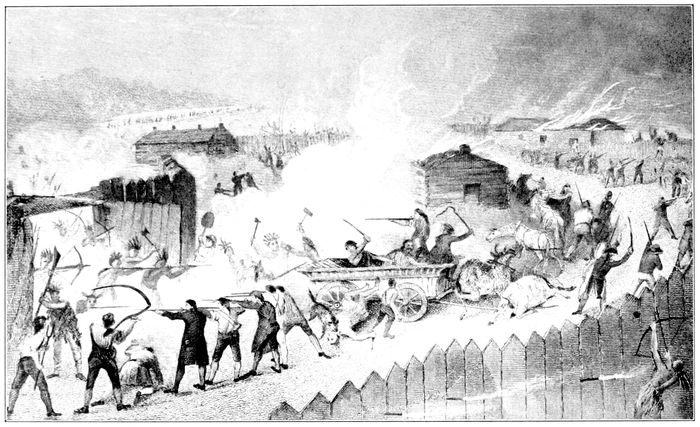
DEFENDING A SETTLEMENT. After an old engraving.
144In the days of the Indian wars and of the Revolution such danger was always imminent, particularly when the men were working in the fields, or out hunting to provide food for the family. Then the women, with loaded guns, stood guard to protect the home and children from lurking enemies.
The chronicles relating incidents of border warfare abound with stories of heroines who played conspicuous parts in the defense of single log houses, as well as of stations and forts. Moulding the bullets and loading the guns, they handed them to the men, who could consequently fire three times where they otherwise could have fired but once. If there happened to be a lull during the fight, the women carried water and food to the smoke-blackened fighters, tended the wounded, baked bread and cared for the children. In cases of emergency, they stood at the loop-holes, firing the rifles with all the skill and precision of men.
When, during the War of Independence, the Mohawk Valley became the scene of many horrible ravages by the Indians and Tories, Christian Schell, a Palatine, together with his wife and six sons, occupied a lonely log house. It was in the early hours of August 6, 1781, when 48 Indians and 16 Tories made a sudden raid upon this family. Schell and his sons were working in the field, but detected the enemy soon enough to make their escape to the house. All succeeded in reaching it, except the two youngest lads, who were captured by an Indian. The latter was shot by Schell, but it was impossible to free the boys, as they were hurried off by other Indians.
Then the battle commenced and an almost incessant firing was kept up until night, Mrs. Schell assisting her husband and sons in loading the guns. Several times the attacks of the enemy were repelled. But when darkness had set in, McDonald, the leader of the Tories, succeeded in reaching the door of the cabin and attempted to force an entrance by using a crowbar he had found in front of the house. Suddenly a shot from Schell hit him in the leg and brought him down. Quick as lightning the bold German unbarred the door, grasped the wounded man and dragged him in a prisoner, thus saving the house from being set fire to, for in such a case the leader of the attacking party within, would likewise have perished in the flames.
Enraged by the capture of their leader, the enemy made several furious assaults. Jumping close to the house, they thrust their guns through the loop-holes and began to fire into the building. But Mrs. Schell, cool and courageous, seized an axe and by well-directed blows spoiled every gun by destroying the barrels. As the men opened a terrific fire from above at the same time, the besiegers fell back in a hurry, 145and the following morning disappeared, having suffered a loss of twenty-three dead and wounded.
Another example of noble-spirited womanhood is that of Elizabeth Zane, a young girl of seventeen years, living near Fort Henry in West Virginia. When in November, 1782, the fort was besieged by several hundred Indians and the little garrison of forty-two men had been reduced to only twelve, the situation became extremely desperate, as the supply of powder was nearly exhausted.
There was a full keg of powder hidden in the cabin of the Zanes, but this hut stood some ninety yards from the gate of the fort and could be reached only by passing the whole distance under fire of the Indians, a feat which seemed altogether hopeless. But the perilous attempt had to be made. When the commander of the fort called for volunteers, several responded, among them, to the general surprise, Elizabeth Zane. She argued that the garrison of the fort was already too weak for the life of one of the soldiers to be risked. As her own life was of no importance, she claimed the privilege of attempting the dangerous task. Refusing to listen to any objection, Miss Zane slipped out of the gate and strolled leisurely to her home, as though there were no redskins in the whole world. The Indians, wondering what it meant, made no attempt to molest the girl.
Entering the cabin, she found the keg of powder, and a few minutes later reappeared with the keg concealed under a tablecloth. Not before the girl had gone some distance did the Indians realize the meaning of the girl’s mission and at once opened a brisk fire on her. But the girl sped with the fleetness of a fawn and reached the fort in safety amid a shower of bullets, several of which passed through her clothes. By this daring act the little garrison was so inspired and fought with such tenacity that the Indians despaired of capturing the fort and finally retreated.—
In 1787 John Merrill, a settler in Nelson County, Kentucky, was awakened one night by the furious barking of his dogs. Opening the door of his cabin to reconnoitre, he was shot by several Indians, but managed to bar the door, before sinking dead to the floor. His wife, a woman of great energy and strength, jumped out of bed, grasped a large axe and sprang forward to be prepared for the coming attack. Scarcely had she reached the door when the Indians began to chop it down with their tomahawks. But as soon as the savages sought to enter the breach, the woman, making a terrific effort, killed or badly wounded four of the enemy.
Foiled in their attempt to force the door, some of the redskins climbed onto the roof of the cabin and tried to enter by way of the chimney. But again the solitary woman confronted 146them. Snatching her featherbed and hastily ripping it open, she flung its contents upon the still glowing embers. At once a furious blaze and stifling smoke ascended the chimney, overcoming two of the Indians. Dazed, they fell down into the fire, where they were instantly dispatched with the axe. Then, with a quick side stroke, the woman inflicted a terrible gash in the cheek of the only remaining savage, whose head just appeared in the breach of the door. With a horrible yell the intruder withdrew, to be seen no more.
In Western Pennsylvania, in the year 1792, there stood some twenty-five miles from Pittsburgh the crude cabin of a settler, named Harbisson. One day, during his absence, the home was attacked by Indians, who, after ransacking the house, carried off the wife prisoner. But there were three children, two boys aged five and three respectively, and an infant. As the mother had no hand for the little fellow of three, one of the savages relieved her from this embarrassment by grasping the child, whirling it through the air and smashing his head against a tree. And when the older brother began to weep, his crying was stopped forever by cutting his throat. The mother fainted at the horrible sight, but the savages brought her back to consciousness again by giving her a few blows across the face. At night the poor woman noticed one of the savages busying himself with making two small hoops. The captive watched him with languid curiosity and saw that he had something in his hand. Then a flash of horror-struck recognition flickered in the woman’s eyes. She saw the bloody scalps of her children, which the savage was stretching on the hoops to dry. “Few mothers,” so the unfortunate woman said afterwards, “have been subjected to such dreadful trials. Those who did not see the scalps of their own children torn from their heads and handled in such a way, cannot imagine the horrible pain that tortured my heart!”
In the dark of the second night the poor mother managed to make her escape. It rained in torrents, but hugging the baby to her breast, she entered the endless forest and wandered the whole night and the next days, making her way to the settlements. She arrived there on the sixth day after incredible sufferings and almost starved. So changed was she by the many hardships, that her nearest neighbors failed to recognize her. The skin and flesh of her feet and legs was hanging in pieces, pierced by hundreds of thorns, some of which went through her feet and came out a long time afterwards at the top.—
147
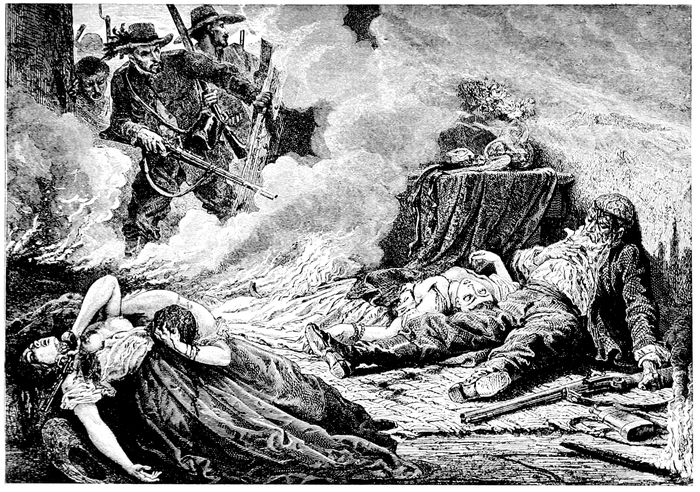
SLAUGHTERED. A scene during the Seminole Indian War.
148Such were the hardships and dangers the women of the settlers had to brave. But they endured their sufferings like heroines. In recognition of this fact it may justly be said that the establishment of the Republic of the United States of America, one of the grandest achievements in all history, would not have been possible without their aid. For it was among these hardy men and women that the spirit of American liberty was born. Their surroundings and manner of life compelled them to rely on themselves in everything. And while they assisted one another in all embarrassments and perils, they made their own regulations and selected their own officials, fully aware, that the laws of England would never suffice for the wilderness.
From those autonomous settlements the spirit of independence spread in time to all the towns and cities on the coast, inspiring many of their inhabitants with the same enthusiasm for liberty. In New York and other places the People’s Party was organized, which strongly opposed the insolence and encroachments of the Government and aristocrats. Among its members was Peter Zenger, the fearless printer, whose caustic articles in the “New York Weekly Journal” in 1735 led to that famous trial, whereby one of the highest privileges—the freedom of the press—became established in America. And when in complete disregard of this significant omen England continued in her selfish policies toward the colonies, curtailing all privileges which had been granted to them by their charters, the spirit of rebellion spread like wildfire, and the great struggle for independence began.
When a Declaration of Independence was considered, the men, selected to draw up such a document, were greatly influenced by two noble-minded women, whose names should not be omitted in a history of remarkable women: Mrs. Mercy Otis Warren, and Abigail Smith Adams. Mrs. Warren was a sister of James Otis, the famous lawyer, whose fiery words did so much to arouse the colonists against British aggression. She was one of the first persons who advocated separation, and she energetically impressed this view upon John Adams before the opening of the first Congress. With Abigail Smith Adams, the wife of John Adams, she shared the belief, that the declaration should not consider the freedom of man alone, but that of woman also.
How outspoken Mrs. Adams was in her views about this question, appears in a letter she wrote in March, 1776, to her husband, who was then attending the Continental Congress. In this letter she says: “I long to hear you have declared an independency; and, by the way, in the new code of laws which I suppose it will be necessary for you to make, I desire you would remember the ladies, and be more generous and favorable to them than your ancestors. Do not put such unlimited power into the hands of husbands. Remember, all men would be tyrants if they could. If particular care and attention are not paid to the ladies, we are determined to foment a rebellion, and will not hold ourselves bound to obey any laws in which we have no voice or representation.”—
149
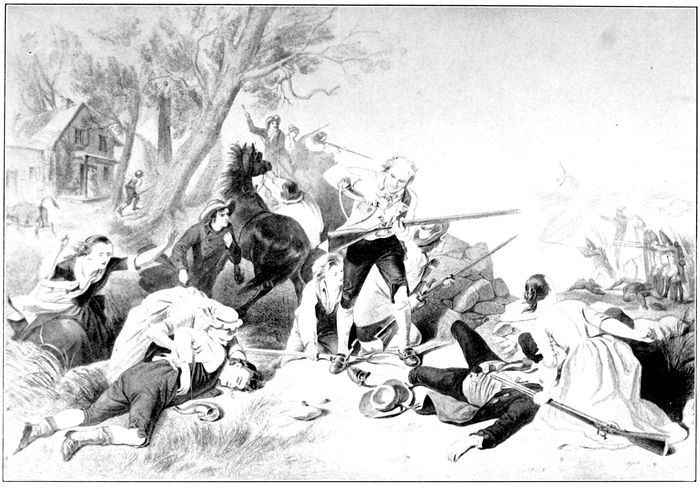
STRUGGLING FOR INDEPENDENCE.
150The Declaration of Independence, accepted on July 4th, 1776, in Philadelphia, by an assembly of delegates from all the colonies, is the greatest and most important political document that was ever set up and signed by men. Although the representatives knew that it would produce a long and terrific war against the most powerful and most inconsiderate government of the world, they solemnly agreed to choose liberty or death. Liberty to make their own laws and to elect their own officials, liberty of religion, liberty of speech and press, liberty of trade and commerce, liberty for man, woman and child.
The eminent significance of the declaration becomes apparent from the following sentences: “We hold these truths to be self-evident, that all men are created equal; that they are endowed by their Creator with certain inalienable rights; that among these are life, liberty and the pursuit of happiness. That, to secure these rights, governments are instituted among men, deriving their just powers from the consent of the governed. That, whenever any form of government becomes destructive of these ends, it is the right of the people to alter or to abolish it, and to institute new government, laying its foundation on such principles, and organizing its powers in such form, as to them shall seem most likely to effect their safety and happiness.”
While the Declaration of Independence is silent in regard to women, there are, however, positive proofs of the fact, that the men of 1776 regarded their faithful partners in all struggles and danger decidedly as their equals and entitled to the same rights and privileges. Two days before the signing of the Declaration of Independence, on July 2, 1776, the Provincial Assembly of New Jersey, when writing the constitution of that province, adopted the provision, that “all inhabitants of this colony, of full age, who are worth fifty pounds money clear estate in the same, and have resided within the county in which they claim to vote for twelve months immediately preceding the election, shall be entitled to vote for representatives in council and assembly, and also for all other public officers that shall be elected by the people of the county at large.”—
Under this provision, women and free colored men of property exercised the electoral franchise for thirty years, voting also in the Presidential election of 1804, when Thomas Jefferson was re-elected for a second term. The acts of the New Jersey Legislature of 1790 clearly recognized the women, voters, saying:
151“No person shall be entitled to vote in any other town-house or precinct than that in which he or she doth actually reside at the time of election.”
At first the law was construed to admit single women only, but afterward it was made to include females eighteen years old, married or single, without distinction of race. But as most of the women were on the side of the Federation and always delivered a heavy vote, a Democratic legislature, to defranchise Federalists, passed in 1807 an act defining the qualifications of electors, excluding women and free colored men by the use of the words “White male citizens.” This was a partisan piece of legislature, clearly in violation of the constitutional guarantee, and made under the pretext that male voters, by disguising themselves as women and negroes, had voted several times. It was on the strength of this pretext that the unconstitutional act was passed and upheld.
It is on record that in Virginia likewise women at an early day exercised the right of voting. But it is unknown, for what reason this right was not preserved.

152
WOMEN OF THE FRENCH REVOLUTION.
There are few events in history that created such world-wide interest as the triumphant success of the American War for Liberation. The deepest impression was made on the French nation, which for centuries had suffered under the tyranny and coercion of extravagant kings, corrupt officials, greedy clergy and feudal nobility. In sharp contrast to the prodigality and lasciviousness of the court and its armies of courtiers and courtesans, who all revelled in luxuries, there was among the people a general feeling of misery and despair. Finances were in a frightful condition; public scandals were every-day occurrences; famines were frequent; the old creeds had lost their power to arouse enthusiasm, while out-worn institutions and customs still encumbered the land, and with their dead weight pressed men down. The deep longing to be delivered from all these parasites and encumbrances, the urgent need of reforms and relief was evident everywhere. In the streets, in all cafés, clubs and salons the discussion of politics was the foremost topic.
The most conspicuous among such political salons were those of Théroigne de Méricourt, Marie Olympe de Gouges, and Madame Roland.
The first of these three ladies was a quick-witted, strikingly handsome woman, intensely passionate in temper, and commanding an almost volcanic power of eloquence. Her salon was the birth-place of the “Club des Amis de la Loi,” the most noteworthy members of which were Jerome Pétion, author of “Les Lois Civiles,” and Camille Desmoulins, author of “La France Libre.” Both writers were among the leaders of the revolution, and it was Desmoulins, who in July, 1789, inflamed the people by his violent speeches to take up arms and storm the Bastille. At the fall of this ill-reputed prison Théroigne de Méricourt came prominently into notice and it was she who proposed to erect a temple for the National Assembly on the site of the razed fortress.
With her friends she also had a hand in framing the “Déclaration des Droits de l’Homme,” which, together with the American Declaration of Independence, ranks among the greatest human documents of history. The most important points of this charter of the French Revolution are: that all men are born and continue free and equal in rights; that Society is an association of men to preserve the natural rights of men; that Sovereignty is vested in the nation; that all Authority, held by an individual or a body of men, comes expressly from the nation; that Liberty is the power of doing 153what we will, so long as it does not injure the same right of others; that the law can forbid only such actions as are mischievous to society; that Law is the expression of the general will; that all citizens have a right to take part, through their representatives, in the making of laws; that laws must be equal to all; that all citizens have equal rights to fulfill all offices in the state; that society has a right to demand from every public servant an account of his administration; that all men are free to hold what religious views they will, provided that they are not subversive of public order; that freedom of speech, of writing and printing is one of the most precious of the rights of man and that public force is needed to guarantee these rights; that property is an inviolable and sacred right, of which no one can be deprived, save when public necessity, legally established, evidently demands it, and then only with the condition of a just and previously determined indemnity.
With the adoption of this declaration by the national assembly, all hereditary distinctions, such as nobility and peerage, feudal regime, titles, and orders of chivalry were abolished, also venality or hereditary succession in offices, feudal privileges, religious vows or other engagements which might be at variance with natural rights or the constitution.—
Early in October, 1789, Théroigne de Méricourt also took a leading part in the march of the women to Versailles and it was she who by the violence of her speech won the royalist soldiers over to the revolution and so enforced the return of the royal family to Paris.
Being accused of dangerous conduct and of having been engaged in a plot against the life of the queen Marie Antoinette, the daughter of Empress Maria Theresia of Austria, during a visit to Liége she was seized by warrant of the Austrian Government and for some time interned at the fortress of Kufstein. After her release in January, 1792, she returned to Paris, where she was hailed as a martyr of liberty. Resuming her former role she again became very active in all public affairs. On June 20, 1792, she even commanded in person the 3d Corps of the so-called army of the Faubourges, and marched with them to the palace, where the king, wearing the red cap, met the revolutionists and assured them “that he would do whatever the constitution ordained that he should do.” But as soon afterwards the king’s secret connections with Austria and Prussia became public, the insurrection broke loose again, resulting in the massacre of the national guard on August 10th, in the Place Véndome. It was here, that Théroigne sprang at Suleau, a pamphleteer in royal service, and dragged him among the infuriated mob, where he was instantly killed.—
154It was a year before these incidents that Madame Roland opened a salon in Paris, whither her husband had been sent as the deputy from Lyons to the constituent assembly. Her salon had nothing in common with those frequented by people seeking recreation in conversation and belle esprit. Generally there were no women present except the hostess. But her salon was the rendezvous of such fiery spirits as Mirabeau, Brissot, Vergniaud, Robespierre and others, interested in the great movement, which was soon to reach its climax. It was in this salon that Madame Roland impressed her enthusiasm for a republic upon those men who likewise strove for progress and liberty. Here also she conceived the plan of a journal, entitled “The Republican,” which, however, was suppressed after its second issue. Here she penned that famous letter to the king, which, as it remained unanswered, was read aloud by her husband, the king’s appointed Minister of the Interior, in full council and in the king’s presence. Containing many terrible truths as to the royal refusal to sanction the decrees of the national assembly and as to the king’s position in the state, this letter initiated the dethronement of the king and the abolition of royalty.—
It was in these troubled times, also, that another remarkable woman attracted great attention by matching the “Declaration of the rights of man” with a “Declaration des Droits de la Femme,” a declaration of the rights of women. In this document she preached for the first time not only the principle of equality of both sexes but she also demanded the right of women to vote and to hold public offices. This document was published just at the time when the equality of both sexes before the law and the guillotine had become a recognized fact, when not only the head of the king but also that of the queen Marie Antoinette had rolled into the dust. Pointing to these events Olympe de Gouges closed her manifesto with the flaming words: “When women have the right to ascend the scaffold then they must have the right to mount the platform of the orator!”
When Olympe de Gouges wrote these lines, she hardly anticipated her own fate. Provoking in some way the anger of Robespierre, this rabid tyrant did send her also to the guillotine.—
Théroigne de Méricourt likewise fell a victim of the furious hostility, which in 1793 arose between the two leading parties, the Girondists and the Montagnards, the latter party led by those most extreme autocrats as Marat, Danton and Robespierre. When Théroigne, being aware that her own party, the Gironde, was in peril at the hands of these bloodthirsty men, one day urged the mob to moderate their courses, she was seized, stripped naked and flogged in the public garden of the Tuilleries. This infamous affront affected her so that she became a raving maniac, never recovering her reason.—
155
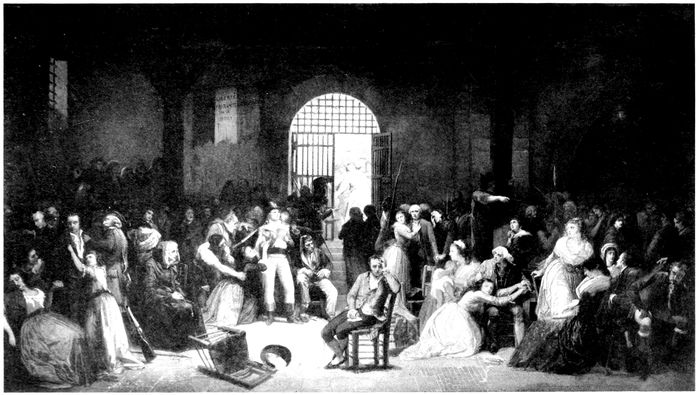
THE ROLL-CALL FOR THE GUILLOTINE. After the painting by C. L. Mueller.
156For Madame Roland and her husband too the day of darkness was soon to come. They found that they could no longer control those passions which they had helped to call forth. Repulsed by the incredible excesses, which were committed during the progress of the revolution, Mr. Roland sent in his resignation on January 22, 1793, the day after the execution of the king. But all his and his wife’s efforts to regulate and elevate the Revolution failed. Both became more and more the butt of calumny and the object of increasing dislike on the part of the ultra-revolutionists, whose leaders, Marat and Danton, heaped the foulest falsehoods upon them. At the instigation of these men Madame Roland was arrested early on the morning of the last of July, 1793, and thrown into the same prison cell, that had been occupied by Charlotte Corday a short time before. On November the 8th she was conveyed to the guillotine. Before yielding her head to the block, she bowed before the statue of Liberty, erected in the Place de la Revolution, uttering her famous apostrophe: “O Liberty! what crimes are committed in thy name!”—
After the elimination of the three leading spirits of woman’s emancipation all attempts to claim political rights for women were sternly repressed. The bold deed of Charlotte Corday, who on July 17th, 1793, killed Marat, the chief of the Mountain party, had given to his followers a warning of what resolute women were able to do. And so all female clubs and political meetings were forbidden by the Convention. Women were even excluded from the galleries of the hall where it sat, and Chaumette warned them that by entering into politics they would violate the law of nature and would be punished accordingly. French girls were also entirely excluded from all educational reforms that were instituted by the Convention and, later on, by Napoleon, who always maintained that female education should be of the most rudimentary description.
At the same time that Olympe de Gouges, Théroigne de Méricourt and Madame Roland took such a conspicuous part in the French Revolution, there appeared in England a most remarkable book, which might be called the first comprehensive attempt to establish the equality of the sexes. Its authoress was Mary Wollstonecraft, a woman of Irish extraction, born at Hoxton on April 27, 1759. Compelled to earn her own living, she, together with her sisters, had conducted a school for girls. Later on she held a position as governess in the family of Lord Kingsborough, in Ireland. Among her early 157publications are “Thoughts on the Education of Daughters” (1787) and “The Female Reader” (1789). That she followed the events of the French Revolution with the utmost interest, appears from her book: “An Historical and Moral View of the Origin and Progress of the French Revolution, and the Effects it has Produced in Europe.” It was intended to comprise several volumes, but after the first one had been published in 1790, the work remained unfinished. Two years later, in 1792, appeared the work with which the name of Mary Wollstonecraft is always associated, as from this book was born one of the grandest movements which exists in the world to-day—the Woman Suffrage Movement.
This book, entitled “A Vindication of the Rights of Woman,” was a sharp protest against the assumption that woman is only a plaything of man. It is also a demand on her to become his equal and his companion.
In the preface the authoress states the “main argument” of her work, “built on this simple principle that, if woman be not prepared by education to become the companion of man, she will stop the progress of knowledge, for truth must be common to all, or it will be inefficacious with respect to its influence or general practice.” In carrying out this argument she explains that woman can never be free until she is free economically; it makes no difference how poetic, romantic and chivalrous we become,—the fact is, there can be little equality between the sexes as long as the male partner has entire charge of the purse. Woman may be free socially; she may get rid of all sexual superstition, and she may crack and cast from her all theological trammels: but of what value is all this if she is still dependent upon man for food, raiment and shelter? What good does it do her to say “My body is my own, subject to the whims and lusts of no man,” if upon that very man depends her livelihood? Woman’s economic dependence is the root of that tree which nourishes the poisonous fruits of her subjection and abject slavery. Only when woman is on equal terms with man, can she be really virtuous and useful. But this result can only be obtained by rejecting the fallacious idea of weakness and refusing man’s help.
After that the authoress states, that woman by open air exercise can become healthy and strong. By study she can acquire a solid education and useful knowledge, and thus become fit to earn her own living. Marriage will then cease to be her sole hope of salvation. If she marries she must not expect infinite romantic love from her husband, that would be an endeavor to perpetuate what is transitory in its very essence. From her husband she should require esteem and friendship. But before she can ask for or inspire these sentiments 158she must have shown herself a lofty mind and a sincere, benevolent, and independent temper.
“But this ideal will remain a myth unless the system of education is entirely changed. It is the duty of the Government to organize schools and colleges, for boys and girls, both rich and poor, and of all ages.”
Mary Wollstonecraft recommends that boys and girls should study together. She does not regard as an evil the attachment which might result under these conditions. On the contrary, she is an advocate of early marriage, and believes that the physical and moral health of young people would be greatly benefited thereby. “Do not separate the sexes, but accustom them to each other from infancy!” she demands. “By this plan such a degree of equality should be established between the sexes as would break up gallantry and coquetry, yet allow friendship and love to temper the heart for the discharge of higher duties.”
Thus asking the widest opportunities of education for women, she demands also her participation in industry, political knowledge, and the rights of representation.
While Mary Wollstonecraft in this manner advanced progressive ideas, she also discussed several questions, dangerous and explosive at that time. In regard to marriage she recommended emancipation from the coercions and ceremonies imposed upon all Christians by the Church. And where love had ceased, divorce should be made easy. These points, together with her extraordinary plainness of speech and her denial of the eternity of the torments of hell, caused an outcry of all classes, to whom the dust of tradition was sacred, or who saw their assumed authority endangered. The air grew thick with insults and insinuations, hurled at the champion of such principles by churchmen feeding on their worn-out thistle-creeds. There were also the shrill, polished shrieks of society, whose antiquated dogmas Mary Wollstonecraft had repudiated. But the impulse, given by her, did not die. It became the heritage of later and more advanced generations, who have tried to realize the ideas of this most remarkable woman of the 18th Century.