Women in Modern Times. (continued 4)
Reading edition
The association employs an executive secretary who visits all the places where women are detained in the State or City of New York, keeps track of the housing conditions and studies the treatment of the prisoners. On the basis of this exact knowledge, the Association has proposed various reforms; for example the establishment of Bedford Reformatory was largely due to the efforts of this society, and the appointment of police matrons in the city station houses. Through the instrumentality of Mrs. Hopper Gibbons the “New York State Reformatory for Women and Girls” was established by the Legislature.
Through the efforts of Linda Gilbert various prisons throughout the country were provided with libraries. She also secured the incorporation of the “Gilbert Library and Prisoners’ Aid Society” under the laws of the State of New York. Furthermore she procured employment for thousands of ex-convicts, and aided others in establishing in business in a small way.—
To enumerate what women have contributed to culture as founders and patronesses of infant homes, foundling and orphan asylums, industrial schools and homes for boys and girls, of refuges for unfortunate women, invalids and the aged, of hospitals for destitute children and for people afflicted with tuberculosis, cancer, and incurable diseases, is a task impossible for the limited space of this book. Besides, all information is fragmentary and far too insufficient to give a true idea of the vast sums and immense amount of time, labor, and effort, devoted by women to these works of charity. Constantly on the lookout to alleviate sorrow and provide comfort, they have not forgotten even those lonely men, who do duty in remote light houses and life-saving stations. It was through the efforts of women that these involuntary hermits, who often do not come in touch with other human beings for several months, are regularly provided with interesting books and entertaining games.
244Mrs. Matilde Ziegler of New York has taken a special interest in the blind. Mrs. Ziegler, at an expense of $20,000 a year, founded a monthly magazine for the blind, which has a printing press of double the capacity of any printing plant for the blind in any other country. Blind girls do all the work connected with this magazine.
Georgia Trader in Cincinnati established school classes for the blind and a library with over 25,000 volumes, from which books in raised type are sent to the blind all over the country, free of any charge. She also founded a working-home for blind girls, where they are profitably employed in weaving rugs, and in various artistic work and handicraft.
Jane Addams in 1889 opened in Chicago a social settlement, known as “Hull House.” Wonderful work in sociology is done there. Many thousands of men, women and children are instructed in all kinds of handicraft, and directed to places, where they can make an honest and profitable living. They have also access to an excellent library, comfortable club rooms, lecture-halls, kindergarten, play-grounds and other institutions.
Miss Addams is to-day recognized as one of the foremost women in her line of work, and by her example as well as through her public lectures and able books, has probably done more than anybody else for the extension of practical sociology.
Women have also taken charge of thousands of tired working-girls and sent them to the country for a short rest during the summer, thus enabling them to take up their lives of toil with renewed vigor and courage.
Similar organizations have established vacation schools to save children from the demoralization of the long summer idleness, and to secure for them fresh air vacations.
Moved by a sincere desire to improve the conditions of the despised and maltreated American Indians, Helen Hunt Jackson, Alice Fletcher, and Mary L. Bonney succeeded after indefatigable efforts in awakening interest among the legislators in their work. Miss Fletcher, in her valuable book “Indian Civilization and Education,” gave such ample proof of her special qualifications that she was appointed by President Cleveland in 1887 as a special agent of the Government, to allot lands to various Indian tribes. Mary L. Bonney devoted herself principally to educational work and, in 1881, was foremost in the task of organizing the “Indian Treaty-Keeping and Protective Association” by which the many unlawful encroachments of white settlers, and the oppression of the Red Men by government agents were stopped.
In their efforts to alleviate the hard lot of negro slaves, Lucretia Mott, Sarah and Angelica Grimke, Harriet Beecher Stowe, and many others, braved criticism, insults and social ostracism.
245By organizing societies for the prevention of cruelty to children and animals, women have taken care of those who cannot speak for themselves. In many cities they have likewise provided drinking fountains for men and for animals.
All women members of the “National Association of the Audubon Societies,” that protect bird-life in America, bind themselves never to decorate their hats with plumes and feathers. They have also secured laws that forbid hunters to kill useful birds, and prevent milliners from buying or exhibiting feathers and stuffed skins of such birds.
As generous patronesses of education, science and art many women have set themselves lasting monuments.
Catherine L. Wolfe donated to the Metropolitan Museum of Art in New York not only her magnificent collection of paintings, but likewise a fund of $200,000 for its preservation and increase. A million dollars was also bequeathed by her to several educational institutions founded by her father and herself. She is also known as the founder of the New York Home for Incurables.
Mary Tileston Hemenway supported the so-called Hemenway Expeditions for the archæological exploration of certain regions of Arizona and New Mexico.
Jane Lathrop Stanford, wife of Leland Stanford, railway constructor, and U. S. Senator from California, founded in memory of her son the “Leland Stanford Jr. University” at Palo Alto, near San Francisco. At her own expense Mrs. Stanford established a museum, connected with the university, containing objects of art, and many things she had collected during her extensive travels. At her death the entire estate of the Stanfords, amounting to about $50,000,000, was left to endow this great university. Her San Francisco home, on Nob Hill, became an art gallery and museum.
Phœbe Hearst, wife of George Hearst, and mother of William Randolph Hearst, made large donations to the University of California. These included $800,000 for the erection and equipment of the Hearst Memorial Mining Building. She also made provision for twenty scholarships for women, and founded a number of free libraries in mining towns with which her husband had been associated. Mrs. Hearst was also actively interested in every kind of organization for the welfare of women. Furthermore she established and maintained two kindergarten schools in San Francisco, and three in Washington, one of which is for colored children. Her most important gift to the District of Columbia was the National Cathedral School for Girls, erected on a beautiful site on the outskirts of the city.
Margaret Olivia Sage, the widow of Russell Sage, donated between seventy-five and eighty million dollars for charitable 246and educational purposes. With ten millions she established in 1907 the “Sage Foundation for Social Betterment.” Its purpose is the improvement of social and living conditions in the United States. It does not attempt to relieve individual or family need, but tries to seek out and eliminate causes of this evil. It furthers education that more directly affects social and living conditions, such as industrial education, education in household arts, and the training of social workers. In the pursuit of these aims the Sage Foundation subsidized worthy activities and organizations; it has established investigational and propagandist departments of its own; invested its funds in activities with a social purpose; and published extensively books and pamphlets on social subjects. Since the work of the Russell Sage Foundation aids social advance for people of every nation, Mrs. Sage became one of the benefactors not only of this country, but of the world.
Among the many donations Mrs. Sage made to other institutions, were $600,000 to the Troy Female Seminary, which was one of the first schools in America for the higher education of girls; $1,600,000 to the Woman’s Hospital of New York; $1,600,000 to the Children’s Aid Society; $1,600,000 to the Metropolitan Museum of Art; $1,600,000 to the American Museum of Natural History; and $1,600,000 to Syracuse University.
The list here given mentions only a few of the innumerable philanthropic works of American women. Similar lists could be made for all other countries, but the material has never been properly collected. Besides, by far the greatest number of such benevolent acts have been performed without public knowledge. But wherever we go, we find women active, helpful, and persevering, always rejoicing in the accomplishment of good.

247
THE HUNDRED YEARS’ BATTLE FOR WOMAN SUFFRAGE.
“If particular care and attention are not paid to the ladies, we are determined to foment a rebellion, and will not hold ourselves bound to obey any laws in which we have no voice or representation.”—This was the warning directed by Mrs. John Adams in March, 1776, to her husband while he was attending the Continental Congress, assembled in Philadelphia to consider the Declaration of Independence.
When this document was framed and adopted without recognizing the rights of women, Mrs. Adams and a number of other women, deeply indignant, made good the threat of Mrs. Adams and opened that most remarkable warfare, which has lasted for more than a hundred years and may be called “Woman’s Battle for Suffrage.”
That they were deeply disappointed by the inattention of Congress, may be inferred from a letter by Hannah Lee, the sister of General Lee, in which she asks her brother to demand from Congress suffrage for women, as otherwise they would not pay any taxes. The same request was made by various other prominent women, who pointed to the fact that, while their husbands and sons had fought for the inherent rights of men, they had likewise fought for the rights of women. But as at that time American women were not organized their demands failed to make the necessary impression and remained unheeded. Besides, the majority of American women receiving only a very limited education, took little interest in the question, because of their ignorance of its importance. Thus, the subject of woman’s rights and suffrage dragged on until women had discovered, that there is strength in numbers, in federation, and that federation is the preliminary requirement to make victory possible.
The evolution of women’s clubs during the 19th Century is one of the most striking and most important phenomena in woman’s history. The movement began with the sewing or spinning circles of long ago, and made a great stride when the custom was initiated of some members reading while the others sewed. Later on these circles evolved into reading-clubs, which again developed into literary societies and associations for public improvement, aiming at the establishment of public schools and libraries, the erection of hospitals, orphan asylums, the sanitation of the streets, and other public works.
Such women’s clubs were not even afraid to tackle such 248most difficult problems as the abolition of slavery, which, at the end of the 18th and the beginning of the 19th Century, became the burning question of the time. The hot discussion of this problem split the population of the United States into two hostile factions, of which the South with its partisans in the North made desperate efforts to prevent the free expression of opinion respecting the institution of slavery. In the slave States even the Christian churches used their influence in favor of the maintenance of slavery.
Among the first and strongest advocates of abolition were Sarah and Angelina Grimke, the daughters of a family of Salzburgers, who during the 18th Century had immigrated into South Carolina and Georgia. Shocked by the inhuman treatment and cruelties inflicted upon the slaves all round, and suffering intensely from the stand taken by their own relatives, the sisters resolved to fight these abuses.
While visiting Philadelphia, Sarah came under the influence of the Quakers, and read the strong protest against slavery, which Pastorius and the settlers of Germantown in 1688 had directed to the Quaker meeting. Returning to her home, Sarah besought her relatives to free their slaves. Failing in this effort, she left her home, joined the Quaker society of the “Friends” in Philadelphia, and in 1835 directed an “Appeal to the Christian Women of the South,” imploring them to become active on behalf of the slaves. This pamphlet aroused such a profound sensation wherever it was read, that when some time afterward Miss Grimke expressed a desire to visit her former home, the mayor of Charleston called upon her mother and informed her that the police had been instructed to prevent her daughter’s landing when the steamer should come into port. He also would see to it that she might not communicate with any person, by letter or otherwise, and that, if she should elude the vigilance of the police and go ashore, she was to be arrested and imprisoned until the return of the vessel. As threats of personal violence were also made, Miss Grimke abandoned her visit, but published soon afterward “An Epistle to the Clergy of the Southern States,” and, at the same time, began to address meetings in Pennsylvania as well as in the New England States, in order to rouse the dormant moral sense of the hearers to protest against the colossal sin of the nation. She was assisted by her sister Angelina and such eloquent speakers as Lucretia Mott, Elizabeth Stanton, William Lloyd Garrison and others. These agitators finally created such a stir, that the conservatives and opponents of abolition decided that they must be silenced. Quite often their meetings were disturbed by mobs; halls were refused them, and violence was threatened. The General Association of Congregational Ministers of Massachusetts 249passed a resolution censuring the Grimke sisters, and issued a pastoral letter containing a tirade against “female preachers.” But in spite of all efforts, public sentiment in the North in favor of abolition steadily grew, until it became evident that the question could not be settled without an armed conflict.
At a gathering of abolitionists, held on July 19th, 1848, at the home of Mrs. Elizabeth Cady Stanton in Seneca, N.Y., the question of women’s rights was eagerly discussed. Mrs. Stanton, the daughter of a lawyer, had found by frequent visits to her father’s office that according to the then existing laws, which had been adopted from England, married women had no right of disposal over their own inherited property, their own income, or their own children, no matter how unfit, degraded, and cruel their husbands might be. There was even no redress for corporal punishment which the husbands might inflict on their wives.
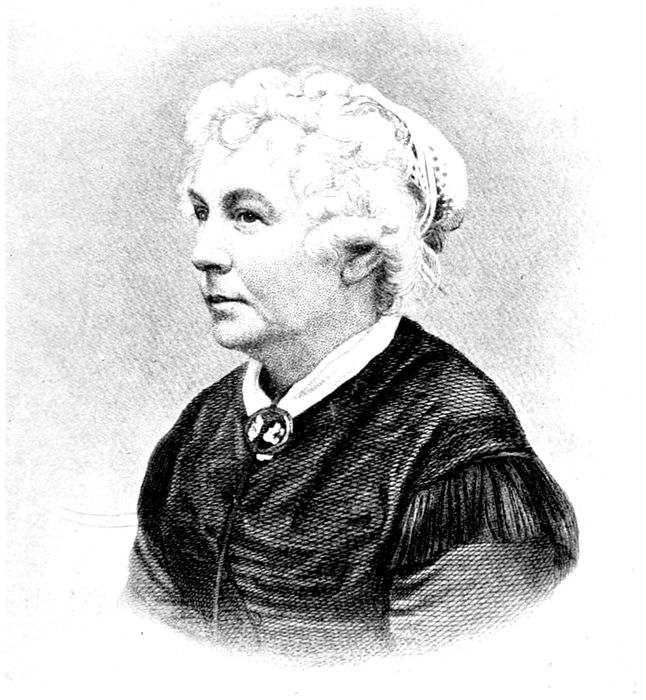
ELIZABETH CADY STANTON.
Another woman, present at the gathering, was Lucretia Mott, a Quaker teacher. It had been her experience, that 250female teachers, having paid for their education just as much as the males, obtained, when teaching, only half of the compensation granted to male teachers.
But the indignation of the two women over the inferior position of woman had been especially excited while attending the World’s Anti-Slavery Convention, held in 1840 at London. Both women, together with Mrs. Wendell Phillips, had been appointed delegates by the abolitionists of America, and as they were able speakers, much had been expected from their eloquence. But when the women submitted their credentials, they discovered that the English abolitionists had not reformed their antiquated views of male predominance and would not admit any woman as delegate nor on the platform. When the question was submitted to vote, the women were excluded by a large majority. This flat refusal to recognize woman’s right to an equal participation in all social, political, and religious affairs brought what is termed “the Woman Question” into greater prominence than ever before. The gathering in the Wesleyan chapel, at Seneca Falls, N.Y., Mrs. Stanton’s home, is known as the First Woman’s Rights Convention. Held on the 19th and 20th of July, 1848, it was attended by 68 women and 38 men. The simultaneous discussion of the subject of slavery and the natural rights of man had as their logical consequence, on the part of women, the demand of a privilege exercised in many cases by persons far below them in intelligence and education. They asserted that many of their number were taxpayers, that all were interested in good government, and that it would be unjust for women of intelligence to be deprived of a vote while ignorant negroes could have a voice in the government. Furthermore they asserted that the participation of women would have a purifying effect on politics.
At the close of the second day the convention adopted the following:
Declaration of Sentiments.
“The history of mankind is a history of repeated injuries and usurpations on the part of man toward woman, having in direct object the establishment of an absolute tyranny over her. To prove this, let facts be submitted to a candid world.
“He has never permitted her to exercise her inalienable right to the elective franchise.
“He has compelled her to submit to laws in the formation of which she had no voice.
“He has withheld from her rights which are given to the most ignorant and degraded men—both natives and foreigners.
“Having deprived her of this first right of a citizen, the 251elective franchise, thereby leaving her without representation in the halls of legislation, he has oppressed her on all sides.
“He has made her, if married, in the eye of the law, civilly dead.
“He has taken from her all right in property, even to the wages she earns.
“He has so framed the laws of divorce as to what shall be the proper causes, and, in case of separation, to whom the guardianship of the children shall be given, as to be wholly regardless of the happiness of women—the law in all cases going upon a false supposition of the supremacy of man, and giving all power into his hands.
“After depriving her of all rights as a married woman, if single and the owner of property, he has taxed her to support a government which recognizes her only when her property can be made profitable to it.
“He has monopolized nearly all the profitable employments, and from those she is permitted to follow she receives but a scanty remuneration. He closes against her all the avenues of wealth and distinction which he considers most honorable to himself. As a teacher of theology, medicine, or law, she is not known.
“He allows her in church, as well as state, but a subordinate position, claiming Apostolic authority for her exclusion from the ministry and, with some exceptions, from any public participation in the affairs of the church.
“He has created a false public sentiment by giving to the world a different code of morals for men and women, by which moral delinquencies which exclude women from society are not only tolerated but deemed of little account in man.
“He has usurped the prerogative of Jehovah himself, claiming it as his right to assign for her a sphere of action, when that belongs to her conscience and God.
“He has endeavored, in every way that he could, to destroy her confidence in her own powers, to lessen her self-respect, and to make her willing to lead a dependent and abject life.
“Now, in view of this disfranchisement of one-half the people of this country, their social and religious degradation; in view of the unjust laws mentioned, and because women do feel themselves aggrieved, oppressed and fraudulently deprived of their most sacred rights, we insist that they have immediate admission to all the rights and privileges which belong to them as citizens of the United States.”
Of course, this declaration, modeled after the immortal Declaration of 1776, did not fail to create a sensation everywhere. Other conventions were held in Rochester and Syracuse, N.Y., and in Salem, Ohio. They brought to the front 252a number of wonderful women, whose names were henceforth connected with this movement, first among them Susan B. Anthony, Lucy Stone, Paulina Wright Davis and Anna Howard Shaw. In October, 1850, the First National Woman’s Rights Convention was held at Worcester, Mass. Attended by delegates from nine states it was distinguished by addresses and papers of the highest character, which filled the audiences with enthusiasm. A National Committee was formed, under whose management conventions were held annually in various cities. An account of the convention, written by Mrs. John Stuart Mill, in the “Westminster Review,” London, marked the beginning of the movement for woman suffrage in Great Britain. But in spite of all efforts and agitation, progress was but slow. The first result was not gained before 1861, when Kansas granted school suffrage to women, a step that was not followed by other states for many years afterwards.
How averse the stronger sex was to grant women suffrage became evident, when in 1868 the 14th and 15th amendments to the Constitution of the United States were adopted. These amendments abolished slavery and gave the freed negroes of the South all privileges of citizenship, including the right to vote. Section 1 of the 15th amendment reads:
“The right of citizens to vote shall not be denied or abridged by the United States, or by any State, on account of race, color, or previous condition of servitude.”
As the advocates of woman suffrage were American citizens, they held themselves entitled to the same rights as granted to the negroes. But their demands to be registered as legal voters were denied by the registrars of elections. Now the women appealed to the courts, to see if their claim would be sustained by invoking the aid of those constitutional amendments above cited. But the uniform decision in each court was that these amendments had in no way changed or abridged the right of each State to restrict suffrage to males, and that they applied only to the men of color and to existing rights and privileges. An appeal to the Supreme Court resulted in the decision that this body was in accordance with the decisions of the State courts.
To test the application of the 14th and 15th amendments to the Constitution Susan B. Anthony,—who in 1860 with others had been successful in securing the passage of an Act of the New York Legislation, giving to married women the possession of their earnings, as well as the guardianship of their children,—cast in 1872 ballots at the State and Congressional elections in New York. Miss Anthony was indicted and in 1873 found guilty of criminal offense against the 253United States for knowingly voting for congressmen without having a lawful right to vote, which offense was punishable, under Act of Congress, by a heavy fine or imprisonment. Fined $100 for illegal voting, Miss Anthony declared that she would never pay the penalty, and in fact it has never been collected.
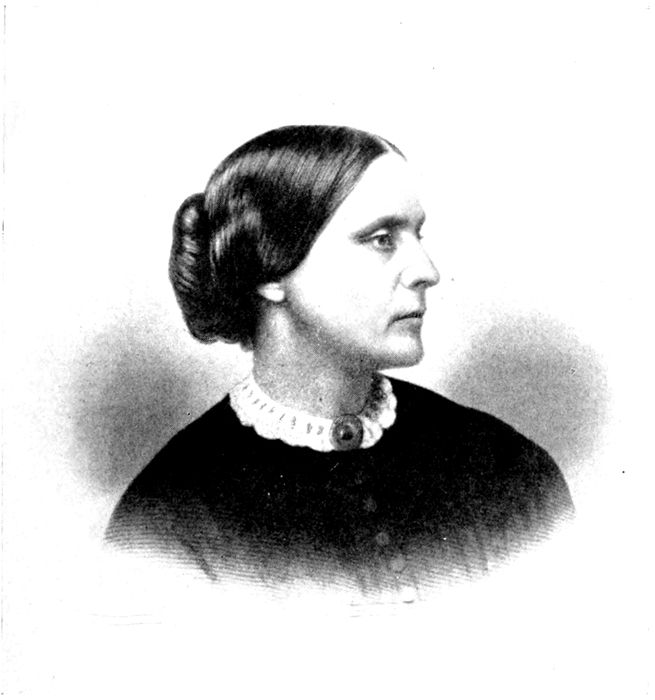
SUSAN B. ANTHONY.
Undaunted by the decision of the Court, Miss Anthony in 1875 proposed the following amendment to Article 1 of the Constitution:
“Section 1. The right of citizens of the United States to vote shall not be denied or abridged by the United States or by any State on account of sex.
“Section 2. Congress shall have power by appropriate legislation to enforce the provisions of this article.”
This resolution was introduced by Senator Sargent of California in 1878, but was rejected several times. In 1887 it secured in the Senate only 14 affirmative to 34 negative votes.
But several years before the indictment of Miss Anthony 254woman suffrage had already won its first victory, in the Territory of Wyoming. The Organic Act for the regulation of the Territorial governments provides that at the first election in any Territory male citizens of the age of twenty-one years shall vote, but
“at all subsequent elections the qualifications of voters and for holding office shall be such as may be prescribed by the legislative assembly of each Territory.”
Under this act the first legislative assembly of Wyoming, in 1869, granted women the right to vote and to hold office upon the same terms as men. An effort made in 1871, to repeal this statute, failed, and to the men of Wyoming belongs the honor, of having been first to recognize the rights of women.
A further gain was made when the Republican National Convention of 1872 and 1876 resolved that “the honest demands” of women for additional rights should be treated with respectful consideration.
Of still greater importance was the organization of two national Woman Suffrage Associations, the one with headquarters in New York, the other in Boston. A union of these two bodies was effected in 1890 under the title of “The National American Woman Suffrage Association.”
Mrs. Stanton was elected president of the new organization. When in 1892 she resigned from her office because of advancing age, she was followed by Miss Anthony, who in 1900 resigned at the age of 80. Her successors were Miss Anna Howard Shaw and Mrs. Carrie Chapman Catt.
Under the able leadership of these brilliant women victory was now followed by victory. Up to 1914 Colorado, Idaho, Washington, California, Arizona, Kansas, Oregon, Nevada, Utah and Montana had joined the ranks of Woman Suffrage States; also the Territory of Alaska.
To these Western regions the Eastern and Southern States formed a strange contrast, as so far the suffragists had been unable to conquer one of them. For this surprising fact I fail to find any other explanation but that the Western men are much more conscious of a great historical truth, which the men in the East and South seem to have almost forgotten, namely: that to the women the founding of real culture in America is due. Having heroically shared with their husbands all hardships and dangers, having gone with them on their hazardous journeys into the wilderness, even on their long voyages across the prairies and Rocky Mountains to far Oregon and California, the women provided the first permanent homes and filled them with comfort, sunshine and happiness. In recognition of these facts the Western men granted their partners only a well deserved tribute of gratitude.
255In many places the men expressed their respect for the gentler sex by electing women to important public offices, and in almost all cases these positions have been filled to the fullest satisfaction.
The steady progress of woman suffrage in the United States was followed by the women of other countries with intense interest, especially by those of Great Britain and Australia. Encouraged to like activity, they demonstrated with convincing clearness the injustice of the legislatures toward women and thus prepared the way for a similar movement in favor of woman suffrage. The result was that the English government in 1869 adopted the Municipal Reform Act, which permits women to vote in all municipal elections. An Act of 1870 gave them the school vote. The Act of 1888 made them voters for the county councils. An Act of 1894 abolished in all departments of local government the qualification of sex.
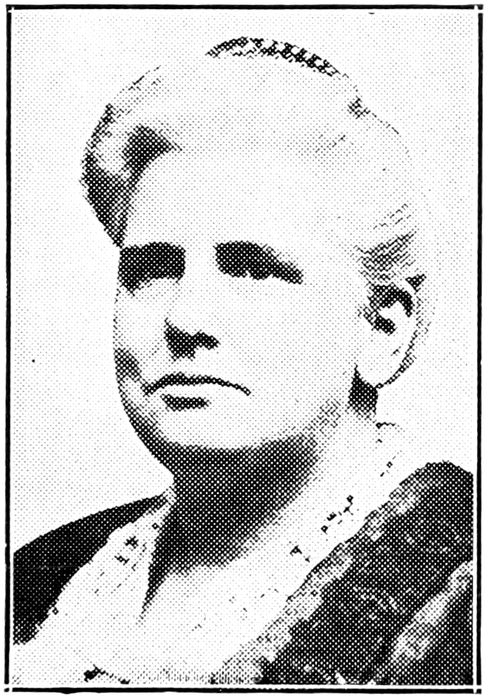
DR. ANNA HOWARD SHAW.
New Zealand, one of the most progressive of all countries, went even farther. The women there were granted suffrage in 1893 on the same basis with men. A similar step was taken in the following year by South Australia. And when in 1901 the Commonwealth of Australia was formed by the federation of the six provinces, or states, of New South Wales, 256Victoria, Queensland, South Australia, Western Australia and Tasmania, one of the first steps was to give all women full national suffrage.
In the countries of continental Europe the evolution of local women’s organizations to State- and National Unions had been the same as in the United States and in England. But the majority of these societies remained conservative in regard to woman suffrage. Germany since 1813 has had the “Vaterlaendische Frauenverein” (Patriotic Women’s League), a union of wonderful helpers for suffering humanity, both in peace and in war. Since 1865 a “General Association of German Women” tried to secure new rights for women, both along political and economic lines. A “Society for Woman Suffrage” was not formed before 1902. But only two years later the “International Suffrage Alliance” was formed in Berlin, with Mrs. Carrie Chapman Catt, of New York, as president. The progressive movement in Germany took largely the form of educational and industrial training. And the women shared the national belief that education precedes every good, and that for their legal and political protection from injustice they might rely upon their male relatives.
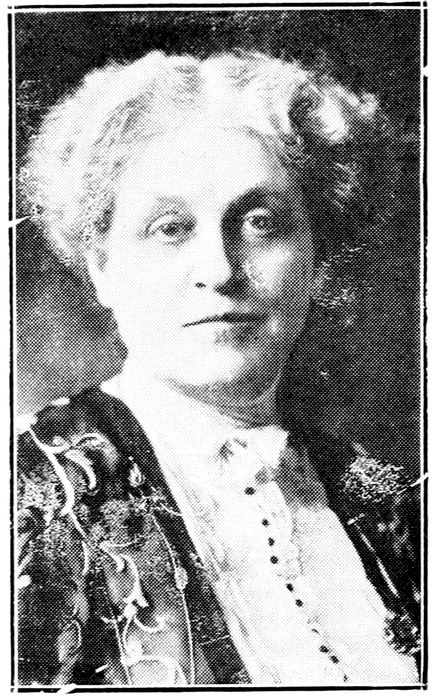
CARRIE CHAPMAN CATT.
In certain districts of Germany, Austria, Denmark, Hungary and Russia women who owned property, were permitted 257to cast their votes on various communal matters, either by proxy or in person. In Belgium, the Netherlands, France, Italy, Switzerland, Roumania and Bulgaria women had no political rights whatever, but were permitted to vote for certain state boards—educational, philanthropic, correctional and industrial. In France, women as a rule showed little sympathy with suffrage, retaining their racial instinct that they might accomplish more through social influence, personal suasion and the special charms of their sex than by working openly through the ballot.
In Switzerland few women had the courage to seek emancipation, as those who favored the movement were looked upon as disreputable persons without regard for social laws. In Portugal and Spain women remained absolutely indifferent. Sweden had given women the right to vote in all elections, except for representatives, while Finland and Norway in 1906 and 1907 granted full suffrage rights and eligibility to women upon exceedingly generous terms.
Since the beginning of the 20th Century the Modern Woman’s Rights Movement has also caused significant changes in the status of the women of the Balkan States, and of the countries of the Orient and the Far East. Restrictions and obstacles, placed on woman by tradition and religious rules, have been abolished. Many Mohammedan women for instance appear to-day on the streets without veils, a thing that no prominent woman could do formerly. The establishment of girls’ schools, woman’s colleges, universities, woman clubs and journals mark likewise the progress of the movement. And in Servia, Bulgaria, Greece, Turkey, Egypt and Japan exist federations of women’s clubs, which can be regarded as political organizations.
Thus, at the beginning of the memorable year of 1914 woman throughout the civilized world had gained various degrees of freedom in the exercise of her political rights.

258
WHY WOMEN WANT AND NEED THE VOTE.
Few questions have been so universally and intensely discussed as the right and expediency of Woman Suffrage. Its opponents assert that the true woman needs no governing authority conferred upon her by law. While discussing this question one “gentleman” said “that the highest evidence of respect that man could exhibit toward woman, and the noblest service he could perform for her, were to vote Nay to the proposition that would take from her the diadem of pearls, the talisman of faith, hope and love, by which all other requests are won from men, and substitute for it the iron crown of authority.”
The chief arguments brought forward against woman suffrage are: that the majority of the women never desired it, because they were already represented by their husbands, fathers and brothers; that there were already too many voters, and that by admitting women to suffrage the whole machinery and cost of voting would be doubled without changing the result; that women would not have time to perform their political duties without neglecting their higher duties at home; that women were too emotional and sentimental to be entrusted with the ballot; that women would cease to vote after the novelty had worn off; that the introduction of women into political life would increase its bitterness, and would abolish chivalry with its refining influence on men; that the franchise, in a large majority of instances, would be exercised under the influence of priests, parsons, and ministers, under the power of religious prejudice, and that religious feuds would affect political life much more than under present circumstances. And finally it has been asserted that woman suffrage would place a new and terrible strain upon family relations as the introduction of political disputes into domestic life would lead to quarrels and divorce.
These arguments were answered in an editorial of the “New York American” of October 6, 1912, as follows:
“The ballot is the weapon that men use in defending their rights. It is the voice with which men express their opinions, their wishes, as to law, in the more settled civilization where the ballot is the recognized power. Little by little the mass of the people—that is to say, of the men—have got the ballot. Originally there was no ballot. Savage tribes held disorganized meetings, and shouted their opinions. The loudest shouters won, and the man who could hit the hardest led the others. Little by little the big man formed his own opinions, alone reached his own decisions, and the others had 259nothing to say. The expression of opinion was confined to one, or to a few leaders, gathered under a chief, or, where religion ruled, opinion was controlled by the priests in the old temples making up their minds what would be good for them, and forcing their will on ignorant people. For many centuries the kings, the nobles and the priests ruled—and the people had nothing to say. Men and women alike were without the vote.
“Little by little, the men got the vote, and now, in civilized countries, universal suffrage became the rule, as regards men. The women were shut out because men always have had the idea that voting was in some way connected with fighting. Their thoughts went back to the old savage mob shouting its determination to attack and kill—leaving the women at home. And the ignoring of women persists, although little by little the voting power has been used, not to make war, but to prevent war.
“Now, in every country calling itself civilized, the chief use of the ballot is to express ideas of peace—justice. The ballot that was once the expression of man’s fighting quality is now the expression of his better nature, and for that reason it is time to give that ballot to the better half of the human race, to the women that have civilized it.
“Supporters of women suffrage are, and for many years have been, the best men in the country. Men that are unselfish, just, scorning ridicule, and proud to vindicate the rights of their own mothers and sisters, have long demanded votes for women. The women that have worked and fought for the suffrage have been, beyond all comparison, the best women of this and other countries. Humorists used to talk of “short-haired women and long-haired men” as the advocates of woman suffrage. That is a foolish and false division. The women with good foreheads, earnest, gentle and dignified faces have been the advocates of votes for women. The women with low foreheads, plastered with hair, the women with their faces painted, the women with a hundred thoughts for dress and no thought for anything else, have been the opponents of women suffrage. And the men, brutal, conceited, looking upon woman as a piece of property, created for man’s pleasure or for his service, have been the men that opposed suffrage. Another class opposed to woman suffrage is the most dangerous class of all. That is the class that would keep in ignorance women, and men, too, if it could. Those that prey upon the ignorance and superstition of women are anxious that women shall know as little as possible. They do not want the women to vote, for voting means thinking, and thinking means freedom. Wherever women have voted they have bettered conditions.”—
260Lecky in his valuable book “Democracy and Liberty” writes on page 547: “It has been gravely alleged that the whole character of the female sex would be revolutionized, or at least seriously impaired, if they were brought by the suffrage into public life. There is perhaps no subject in which exaggerations so enormous and so grotesque may be found in the writings of considerable men. Considered in itself, the process of voting is now merely that of marking once in several years a ballot-paper in a quiet room, and it may be easily accomplished in five minutes. And can it reasonably be said that the time or thought which an average male elector bestows on the formation of his political opinions is such as to interfere in any appreciable degree with the currents of his thoughts, with the tendencies of his character or life? Men wrote on this subject as if public life and interests formed the main occupation of an ordinary voter. It is said that domestic life should be the one sphere of woman. Very many women—especially those to whom the vote would be conceded—have no domestic, or but few domestic duties to attend to, and are compelled, if they are not wholly frivolous or wholly apathic, to seek spheres of useful activity beyond their homes. Even a full domestic life is scarcely more absorbing to a woman than professional life to a man. Scarcely any woman is so engrossed in it that she cannot bestow on public affairs an amount of time and intelligence equal to that which is bestowed on it by thousands of masculine voters. Nothing can be more fantastic than to argue as if electors were a select body, mainly occupied with political studies and public interests.
“Women form a great section of the community, and they have many special interests. The opening to them of employments, professions and endowments; the regulation of their labor; questions of women’s property and succession; the punishment of crimes against women; female education; laws relating to marriage, guardianship, and divorce, may all be cited; and in the great drink question they are even more interested than men, for though they are the more sober sex, they are also the sex which suffers most from the consequences of intemperance. With such a catalogue of special interests it is impossible to say that they have not a claim to representation.”—
Among the arguments in favor of woman suffrage the most important are the following: As women are citizens of a Government of the people, by the people, and for the people, and as women are people, who wish to do their civic duty, it is unfair that they should be governed by laws in the making of which they have no voice. As women are equally concerned with men in good and bad government, and equally 261responsible for civic righteousness, and as they must obey the laws just as men do, they should vote equally with men.
If it is true that “taxation without representation is tyranny” then tax-paying women who support the government by paying taxes, should have the right to vote to elect such representatives, who protect them against unjust taxation.
Working women need the ballot to regulate the conditions under which they work. Millions of women are wage-earners and their health is often endangered by bad working conditions and sweat-shop methods that can only be remedied by legislation.
Business women need the ballot to secure for themselves a fair opportunity in their business, and to protect themselves against adverse legislation.
Mothers and housekeepers need the vote to regulate the moral and sanitary conditions under which their families must live. Women are forever told that their place is in the home. But what do men expect of them in the home? Merely to stay there is not enough. They are a failure unless they do certain things for the home. They must minister, as far as their means allow, to the health and welfare, moral as well as physical, of their family, and especially of the children. They, more than anybody else, are held responsible for what becomes of the children. Women are responsible for the cleanliness of the house, for the wholesomeness of the food, for their children’s health and morals. But mothers cannot control these things, if the neighbors are allowed to live in filth, if dealers are permitted to sell poor or adulterated food, if the plumbing in the house is unsanitary, if garbage accumulates and the halls and stairs are left dirty. They can take every care to avoid fire, but if the house has been badly built, if the fire-escapes are insufficient or not fire-proof, they cannot guard their children from the horrors of being maimed or killed by fire. They can open the windows to give the children the air that we are told is so necessary. But if the air is laden with infection and contagious diseases, they cannot protect the children from this danger. They can send the children out for air and exercise, but if the conditions that surround them in the streets are immoral and degrading, they cannot protect them from these influences. Women alone cannot make these things right. But the City administration can do it. The administration is elected by the people, to protect the interests of the people. As men hold women responsible for the conditions under which the children live, the women should have something to say about the city’s housekeeping, even if they must introduce an occasional house-cleaning.
What enormous influence women are able to exert in vital questions has been demonstrated in the Temperance Movement; 262which originated in the United States. Since the beginning of the colonization of the Western Hemisphere Americans have been heavy consumers of rum, whiskey, and other intoxicating liquors. “Everybody drank, and on all occasions,” says a writer who has left us a pen picture of these bibulous days. Drunkenness and all the evils resulting from it increased with the gradual development of the “saloon” and the habit of “treating,” two institutions peculiar to America and almost unknown in Europe.
For generations the women were the greatest sufferers from the intemperance of the men, because many husbands came home besotted, their faculties benumbed to an unconsciousness of their own degradation, with wages gone, and employment forfeited. The purer and gentler the wife in such case, the more intense her suffering. So it was but natural, that when the first “Anti-Spirits Association” was formed in 1808 in Greenfield, Saratoga County, New York, several women should join it. The movement made rapid progress, and in 1826 the “American Temperance Society” was founded. In 1829 and 1830 similar associations were started in Ireland and England; and in 1846 the first “World’s Temperance Convention” was held at London. In 1873 women became a real force in the field when the women inhabitants of Hillsborough, a small town in Ohio, started what became known as “The Women’s Crusade.”
Frances E. Willard, one of its principal leaders, described the proceedings in the following graphic manner: “Usually the women came in a long procession from their rendezvous at some church, where they had held a morning prayer meeting. Marching two and two in a column, they entered the saloon with kind faces, and the sweet songs of church and home upon their lips, while some Madonna-like leader with the Gospel in her looks, took her stand beside the bar and gently asked if she might read God’s word and offer prayer. After that the ladies seated themselves, took their knitting or embroidery, and watched the men who patronized the saloons. While some of them cursed the women openly, and some quietly slunk out of sight, others began to sign the pledge these women brought with them. In the meantime one of the ladies pleaded with the proprietor to give up his business. Many of these liquor dealers surrendered and then followed stirring scenes, and amid songs and the ringing of the church bells the contents of barrels and bottles were gurgling into the gutter, while the whole town assembled to rejoice in this new fashion of exorcising the evil spirits.
“Not everywhere the ladies met with success. In Cincinnati such a procession of women, including the wives of leading pastors, were arrested and locked up in jail; at other 263places dogs were set on the crusaders, or they were smoked out, or had the hose turned on them.”
The movement, wholly emotional, and in many cases hysterical, spread throughout the country like a prairie fire. In 1874 it led to the organization of “The Woman’s Christian Temperance Union,” and, in 1883, to the founding of “The World’s Women’s Temperance Union,” the members of which wear a white ribbon and have the motto: “Woman will bless and brighten every place she enters, and she will enter every place.”
Since the founding of this world’s union the movement has extended over many countries and has branched out into a multitude of organizations. Their influence has been widely felt in legislatures, and in all elections in which laws have been voted upon for the regulation of the production and sale of liquors.—
Another question in which women are deeply concerned is that of Child-labor, the reckless exploitation of children in the interest of industry. Evidences that in England the dreadful abuses, committed by unscrupulous mine- and factory-owners, as described in a former chapter, have continued to the present times, were submitted to the International Women’s Congress, held in 1899 in London. It was reported that at that time 144,026 children below the age of 12 years were employed in workshops, mines, factories and warehouses. Of these children 131 had not yet reached the age of 7 years; 1120 were under 8; 4211 under 9; 11,027 under 10, and 122,131 under 11 years of age. Miss Montessori, the Italian delegate to the Congress, described the hard work of the children employed in the sulphur mines of Sicily. As they have to carry heavy loads on their shoulders through low gangways and over steep ladders and stairways, they are compelled to walk in a stooped position, and therefore in time become deformed and crippled.
In the United States the question of child-labor is likewise a matter of deep concern to men as well as to women. As every State has its own Legislature, there exists a varied assortment of child-labor laws. Ten or fifteen years ago several states had none whatever. Others prohibited the employment of children under ten years, while still others had an age limit of twelve or fourteen years. The same diversity prevailed in regard to the hours of labor. Some states had no legislation in this direction, while others forbade any child to work longer than ten hours daily.
During the year 1890 there was a total of 860,786 children between the ages of ten and fifteen years at work in various occupations in the United States. A report of the Bureau of Mines of Pennsylvania for 1901 stated 24,023 of 264the employees of the anthracite coal mines in Pennsylvania were children.
In 1918 investigators of the children’s bureau of the Department of Labor reported that the number of minors employed in factories, mines and quarries has increased at a rapid rate since the U. S. Supreme Court, on June 5th, 1918, nullified the child-labor act of 1916 as unconstitutional. Not only are a greatly increased number of children employed, but they are kept at work longer hours than before. Since the future of such children as well as the future of the country depend to a very great extent upon what legislators do in regard to children, it is obvious that women are deeply concerned in this question.—
The need of women’s participation in government and of an “occasional house-cleaning” in the Legislatures as well as in the Municipal Administrations becomes evident, when we realize that one of the most revolting crimes is committed daily in our communities, quite often with the silent protection of corrupt officials and politicians. We refer to the White Slave Trade. As few people have any definite idea of its extent and terrors, some authentic facts are here given, which, at the same time, demonstrate men’s indifference as well as the urgent need of woman’s interference for its suppression.
As everybody knows, the traffic in young girls for purposes of prostitution is as old as humanity. It has flourished in all ages and in all countries. But it was during the 19th Century that it found its systematic organization and its most extensive development.
With alarming frequency, the papers report that some young woman or girl is “missing,” having stepped out of her home on some household errand, and from this moment having vanished as though swallowed by the earth. Such was the case of Dorothy Arnold, who some years ago left her cosy home in New York, to do some shopping in a department store. She never returned and no trace of her was ever discovered. This particular case attracted wide attention all over the United States, as Miss Arnold, a beautiful girl of eighteen, was the daughter of wealthy parents, who spent a fortune in desperate but futile attempts to recover their child.—
Every year hundreds of similar cases occur in our country, some in San Francisco, some in New York, Baltimore, St. Louis, Chicago and elsewhere. If the exact number of such missing girls could be known, the public might well be shocked; and horrified if it would know the sad lot that befalls the majority of these unfortunate girls. Where efforts to ascertain their fate have met with success, it was found that in ninety out of a hundred cases such girls became victims of the most detestable fiends on earth, human ghouls, who make fortunes 265by luring innocent and inexperienced women into the most degrading slavery.
There were many events that favored the development of the white slave trade. The discovery of gold in California and the construction of many transcontinental railroads were followed by the opening of the rich mining- and lumber-districts in the northwestern and western parts of the United States, and in Canada. In more recent years came the opening of the gold and diamond fields in South Africa, of the gold grounds in Alaska, the construction of the Panama Canal and the great transcontinental railroads through Siberia and Africa. All these great undertakings attracted many thousands of men, who were ready to squander their earnings in gambling, drinking and any other kind of dissipation. Women, of course, stood at the head of things in demand. And as there are always people eager to profit by catering to such passions, the white slave trade assumed most threatening proportions.
To ensnare victims, the slave dealers insert enticing advertisements offering profitable positions to waitresses, chambermaids, servants, governesses, and other female help in hotels, boarding houses and private families. They send their “procurers” or agents to the dance-halls and cheap pleasure resorts, and to those industrial towns, where large numbers of poorly paid young girls toil in mills and factories. Here they approach their prey under all kinds of disguises and pretenses. One especially ingenious procurer of New York has been credited with gaining the acquaintance of young girls in the garb of a priest. And George Kibbe Turner in an article “The Daughters of the Poor” (published in 1910 in McClure’s Magazine) made the statement that a gang of such fiends worked under the name “The New York Independent Benevolent Association”!
However, the chief recruiting-grounds for the white slave trade are the miserable Jewish Ghettos of Poland, Russia, Galicia, Hungary, Austria and Roumania, where always numbers of degraded men can be found, ready to sell their own kindred for any price offered. With the help of such procurers four principal centers of the white slave trade were created: Lemberg, London, Paris and New York, with branches in all parts of America, Africa and Asia.
Of course such a villainous trade would not be possible without the silent protection of corrupt officials and political machines, who share in its enormous profits. Inside information on this subject was received through the disclosures, made during the latter parts of the last century about conditions in the mining and lumber regions of Michigan and Wisconsin. In January, 1887, Representative Breen appeared before the House Judiciary Committee of the legislature of Michigan 266and stated the existence of a regular trade in young and innocent girls for purposes of prostitution between Chicago, Duluth and other cities with the mining and lumber districts south of Lake Superior. As he said that the horrors of the camps into which these girls were lured beggared description, several newspapers, among them the “Chicago Herald” and “The New York World,” dispatched representatives, disguised as woodmen, to those regions to investigate the truth of these statements. They found that almost without exception the girls, kept in these camps, had been secured under promise of respectable employment. The houses, in which they were imprisoned, were surrounded by stockades twenty or thirty feet in height, the one door guarded night and day by a man with a rifle, while within were a number of bulldogs to prevent the girls from escaping. In the largest of such lumber camps dens from twenty to seventy-five girls were found.
On January 24, 1887, the “New York World” published the story of an unfortunate girl, who had been lured by an advertisement to work in a lumberman’s hotel in the North. Believing the position to be respectable, she went there, but after her arrival at the place she was taken to a rough two-story building surrounded by a slab fence twenty feet high, within which was a cordon of bulldogs, thirteen in number, chained to iron stakes driven into the ground. In this place she was compelled, like all the other girls, of which there were always from eleven to thirty, to drink and dance with the men of the mining and lumber camps. They were not permitted to refuse any request of those visitors. A complaint of any kind, even of sickness, meant a whipping, frequently with a rawhide upon the naked body, sometimes with the butt of a revolver. When the log drives were going on, there would be hundreds of men there night and day, not human beings, but fiends.
“Oh, it was awful, awful!” cried the girl after her release. “I would rather stay in prison until I die than go back there for one day. I tried to escape three times and was caught. They unchained the dogs and let them get so near me that I cried out in terror and begged them to take the dogs away and I would go back. Then, of course, I was beaten. I tried, too, to smuggle out notes to the Sheriff through visitors, but they would take them to the proprietor instead, and he would pay for them. Once I did get a note to the Deputy Sheriff at Florence, Wisconsin, and he came and inquired. But the proprietor gave him $50, and he went away. I was awfully beaten then. While I lived this life, from March until September, two inmates died, both from brutal treatment. They were as good as murdered. Nearly all the girls came without knowing the character of the house, and first implored to get 267away. The county officers came to the places to drink and dance with the girls. They are controlled by a rich man in Iron Mountain, who owns these houses and rents them for $100 a month.”
That the den keepers were always on good terms with the officials, appears also from the following report of the “Chicago Herald” of April 17, 1892, in which attention is called to the continuance of the horrible conditions in the mining- and lumber-camps. “Four years ago, when “The Herald” exposed the pinery dens, Marinette was known as the wickedest city in the country. It was the rendezvous of every species of bad men. Thugs, thieves and gamblers practically held possession of the town. Their influence was felt in all municipal affairs. Certain officers of the law seemed in active sympathy with them, and it was almost impossible to secure the arrest and conviction of men guilty of infamous crimes. Dives of the vilest character ran open on the outskirts of the town. Their inmates, recruited from all parts of the country by the subtle arts of well known procurers, were kept in a state of abject slavery. Iron balls and chains, suffocating cords and the whistling lash were used on refractory girls and women. Bodies of ill-starred victims were sometimes found in the woods, but the discovery was rarely followed by investigation. The dive keepers were wealthy and knew how to ease the conscience of any over-zealous officer.”
Another report states: “Many den-keepers wield a powerful influence in the local elections; one of the worst of such, after paying the constable $12 for the return of a girl who had tried to escape, beat her with a revolver until tired and was then only prevented by a woodman from turning loose a bulldog upon her; but such was his political influence that he was elected justice of the peace the following spring!”—
About the same time, at a session of the National Social Purity Congress held in Baltimore, the following statement was made: “Of the 230,000 erring girls in this country, over half have been snared or sold into their lives of shame. Their average life is five years. Forty-six thousand are carted out to Potters Field every year. Over one hundred American homes have to be desolated every day to recruit the ranks of shame. Isn’t it time for somebody to try to save these girls from falling into those dens of iniquity? Twenty million Christians can rescue 230,000 erring girls, or surely the religion of Jesus Christ is a failure.”
Terrible happenings, as for instance the murder of Ruth Cruger of New York in 1917, and similar cases in February and March, 1919, have disclosed that gangs of white slave traders still exist in America and do a flourishing business. 268The prices paid to agents depend upon the girl’s youth and beauty, ranging from $20 to $1000, and even more.
The enormous and thoroughly organized traffic in girl-children in England was exposed by the revelations of the “Pall Mall Gazette,” which roused the people to earnest efforts against this commerce and secured the formation of the “Society for the Prevention of Traffic in English Girls.” In giving details of this traffic the paper said:
“London, the great metropolis of Christian England, the largest city of ancient and modern times, is acknowledged by statisticians and sociologists to be the point where crime, vice, despair, and misery are found in their deepest depth and greatest diversity. Not Babylon of old, whose name is the synonym of all that is vile; not Rome, “Mother of Harlots,” not Corinth, in whose temple a thousand girls were kept for prostitution in service of God, not the most savage lands in all their barbarity have ever shown a thousandth part of the human woe to be found in the city of London, that culmination of modern Christian civilization. The nameless crimes of Sodom and Gomorrah, the vileness of ancient Greece, which garnered its most heroic men, its most profound philosophers, are but amusements among young men of the highest rank in England; West End, the home of rank and wealth, of university education, being the central hell of this extended radius of vice.”
As in many countries priests and police departments have failed to stop this heinous traffic in young girls, women must step in, and, by their votes, must place such legislators and police commissioners in office, that proper laws and their strict enforcement can be expected.
In Germany the “white slave trade” is practically unknown. For many years two women associations have existed,—a Protestant and a Catholic,—whose representatives, recognizable by distinct arm bands, patrol all important railway stations, in order to furnish correct information to incoming girls who are looking for positions, and to escort them to the homes of the associations, where they may stay till respectable places have been found for them.
It is obvious, that the problems connected with the temperance question, child-labor and the white slave trade are of vital importance to every woman and mother. Salvation must come through the woman’s ballot. They must defend themselves and their children as men have done: by co-operating in the elections, by controlling those that make the laws, and by controlling those who are appointed to enforce them.
A few words may be said in regard to the claim that woman would cease to vote “after the novelty of her new 269toy had worn off.” Statistics as well as the testimony of competent observers confute this claim. In all states where women enjoy full suffrage, they have shown themselves eager to vote. In Idaho the Chief Justice and all the justices of the State Supreme Court signed a statement that “the large vote cast by the women establishes the fact that they take a lively interest.” In Wyoming, Colorado and other full suffrage states it has been observed that 90 per cent. of the women vote.
In Australia, in 1903, at the first national election in which women took part, 359,315 women voted; in 1906, 431,033; in 1910, 601,946.
In New Zealand the number has increased at each triennial parliamentary election. In 1893 90,290 women voted; in 1896, 108,793; in 1899, 119,550; in 1902, 138,565; in 1905, 175,046; in 1908, 190,114; in 1911, 221,858.
The following is a testimonial from Sir Joseph Ward, Prime Minister of New Zealand, in regard to Woman Suffrage in practice:
Prime Minister’s Office,
Wellington, Oct. 17th, 1907.
Woman Suffrage exists in New Zealand because it dawned upon the minds of thinking men that they were daily wasting an almost unlimited supply of mental and moral force. From the time their baby hands had found support and safety by holding the folds of their mother’s gowns, they had trusted the happiness of their lives hourly to the common sense, the purity and the sympathy of women. Strange to say, in one department of life alone, and that perhaps the most important, viz.: the political, had they denied the right of speech and of direct influence to women. Men of different countries had for centuries preached and written of evils which deformed their systems of Government and even tainted the aspirations of statesmen for just laws within the state, and equitable relations abroad. Nevertheless these men neglected, or refused to avail themselves of the support and counsel of women’s hearts and women’s brains, which they accepted on other matters. Indeed, they were ready to listen to foolish arguments against the idea of women entering political life; such as: women would lose their grace, modesty, and love of home if they voted; since they could not be soldiers, they had no right to control questions of peace and war.
In New Zealand we have not found that making a “pencil mark on a voting paper” once in three years has resulted in any loss of grace or beauty among our women, or even in neglect of home duties. On the contrary the women’s vote has had a distinctly clarifying effect on the process of elections. The old evil memories of election day, the ribaldry, the fighting, have been succeeded by a decorous gravity befitting 270people exercising their highest national privilege. When the contention, that women should not be entitled to vote because they cannot bear arms, is used by one whose mother could only make his life and citizenship possible by passing through pain and danger greater than the average soldier has to face, it becomes inconsistently ridiculous. Besides, many men (clergymen, government officials, etc., etc.), are exempt from actual military service, and that fact has never been used to deprive them of a vote. The main argument, however, which weighed with us, was that of right, of abstract right. If the foundation of government is the consent of the governed, it appears monstrously unfair that one half of the population should not be represented or have any share in it. Therefore, after long and grave consideration, we gave our women an equal right with men in deciding on the qualifications of candidates to represent them in Parliament.
We have no reason to regret the decision. I feel confident that if any great crisis in national morals should arise, the women’s vote would press with irresistable weight in the direction of clean, honest and efficient legislation. New Zealand has not repented having abolished set disqualifications among those men and women who have unitedly helped to build the foundations of a nation. I write as one who advocated the extension of the franchise to women before my entry into Parliament twenty years ago. I have always supported it in Parliament, and, while closely watching its effect, have never seen any genuine cause for believing that it has not worked for the good of the Dominion.
Similar testimonials have been given by the governors of all Western States of the Union.
Governor Bryant B. Brooks of Wyoming said: “Nothing can be so far from the truth as the idea that Woman Suffrage has the slightest tendency to disrupt the home. Indeed it has the very opposite effect. As a result of it politics is talked freely in the family circle, and political questions are settled by intelligent discussion. This has a great and good influence on the growing generation. The children grow up in an atmosphere that encourages intelligent consideration and debate of public problems, and are thus better equipped to deal with public questions when they reach voting age.”
Governor Shafroth of Colorado said: “Our State has Woman Suffrage for many years, and has found it of inestimable benefit to her people,” and Governor James H. Brady of Idaho said: “Woman Suffrage has been an unqualified success, not only in Idaho, but in all Western States adopting the principle.”
271
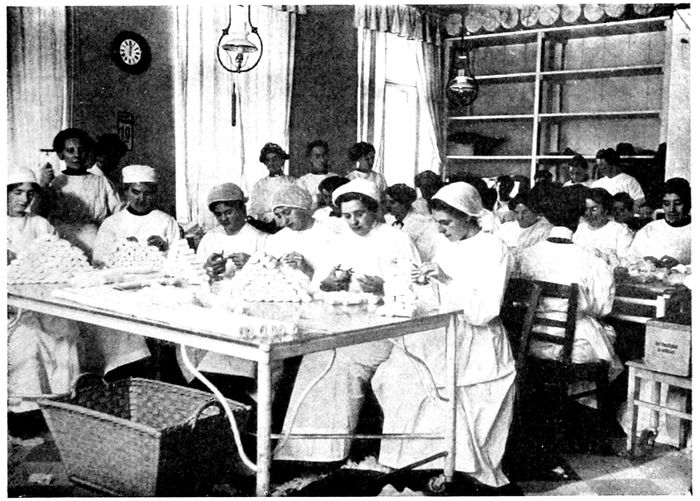
PREPARING BANDAGES.
WOMAN’S ACTIVITY DURING THE WORLD WAR.
When in August, 1914, the most dreadful disaster that ever befell humanity burst upon the European nations, women at first stood paralyzed with fear and terror, foreseeing the tremendous burden and sacrifices they would have to bear. But after every hope for a peaceful solution had vanished and nothing remained but to face the inevitable, they rallied and prepared to weather the coming hurricane.
The manner in which they met it during the long and terrible years of 1914, 1915, 1916, 1917 and 1918 was perhaps the greatest revelation the world has ever experienced. Never before have members of the “weaker sex” braved such a catastrophe more heroically and made such supreme sacrifices. In fact, woman’s activity during the World War has been a grand manifestation, which stands out in glorious colors from a black background of man’s hatred, revengefulness, slander, calumniation, treason, avarice, atrocities, and murder.
When the vast armies were mobilized it became necessary to close the innumerable gaps caused by the sudden drafting and departure of so many million men. To refill the positions they had occupied, was the most urgent necessity, as otherwise the whole machinery of national life would become disorganized, and that at the most critical time.
272At once immense numbers of women and girls responded to the call. They went into the tramway and railway service to act as ticket sellers and punchers, as conductors, brakemen and motormen. They replaced the letter carriers and chauffeurs; they climbed the lofty seats formerly occupied by cab-drivers and postilions. Mounting motor-cycles they delivered telegrams and performed other urgent errands. They formed street-cleaning and fire-brigades and took care of the sanitation and protection of the cities. In the offices and stores they assumed the duties of the bookkeeper and floor-walker; in the schools they substituted for male teachers who had followed the call of the war trumpet. They repaired telegraph-wires and installed telephones; they became blacksmiths and repaired the roofs of houses. They cleaned windows and chimneys, delivered newspapers and carried the coal from the wagon into the bins and bunkers. They acted as “ice-men” and collected the garbage and ashes. They tilled the fields and vegetable gardens, and brought in the crops and the harvests. They thrashed the wheat and served in the mills as well as in the bakeries. They furnished clothes, and made and mended shoes. They finished the public roads and other works that had been left uncompleted. They built houses and tore down others. In Berlin the excavation for a new underground railway, badly needed, was done by women, and half of the gangs that worked on the railroad tracks were made up of girls.
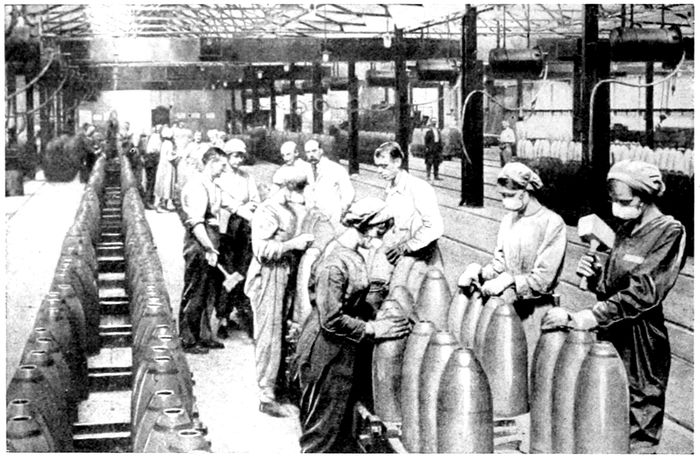
WOMEN FILLING SHELLS IN A BRITISH AMMUNITION FACTORY.
273In England as well as in France and Germany thousands of women could be seen in the ship-yards working side by side with men on the scaffolds, at bolting and riveting, forging and casting, as if they had always done this work. In fact, women did everything that heretofore had been regarded as “man’s work.”
But they did much more. Hundreds of thousands of women entered the gun- and ammunition factories in order that the armies might not lack ample means for the defense of the country.
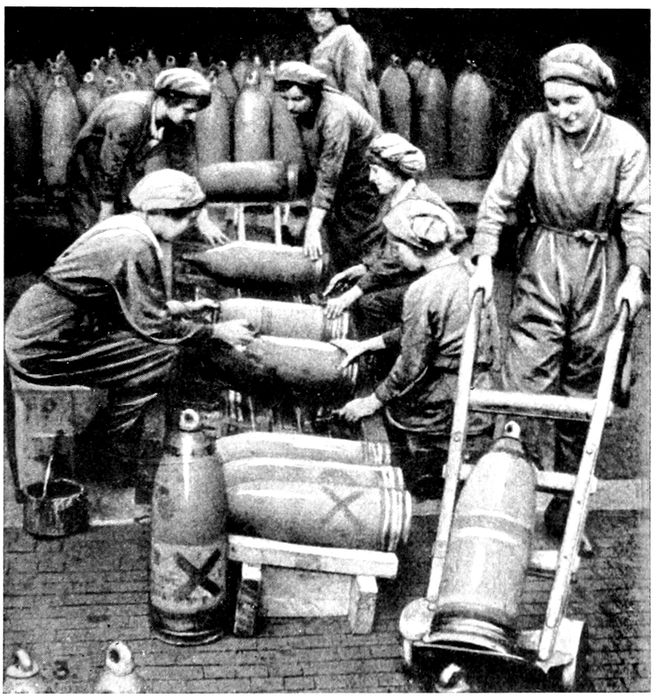
WOMEN IN A SHELL FACTORY.
Donning overalls, oil-cloth caps and gas masks they became engaged in the hazardous manufacture of high explosives, of filling and packing the deadly gas-shells and other projectiles. At the same time millions of busy hands prepared the bandages and other necessities for the treatment of the wounded. Whole brigades of Red Cross nurses were formed and went to the battlefields and hospitals, to attend those who in the grim conflict might lose their limbs, their eye-sight, or become sufferers from the effect of poisonous gases.
All too soon long trains and hospital-ships brought in 274such unfortunates, at first a few hundred, then in ever increasing numbers, by the thousands and by tens of thousands. Within a few months most of the countries engaged in the dreadful struggle were turned into immense hospitals, filled with moaning and suffering. What noble and indefatigable women did here to alleviate this misery and distress, can never be fully told and will never be forgotten. Whoever was witness of the self-control and perseverance shown year after year by many Red Cross nurses will always think of them with reverence.
There is not a single Army Medical Corps of the many nations engaged in the World War, which does not freely admit, that the immense amount of work could not have been done without the help of women. In a tribute to the Red Cross Major-General Merritte W. Ireland, Surgeon-General U. S. Army, said:
“Probably the greatest single service rendered by the Red Cross home forces was the supply of trained nurses it furnished our hospitals. The Army Medical Corps trains a few nurses, but could never hope to turn out the large number provided through Miss Delano’s department. If we needed a thousand nurses for a given work, we telegraphed the War Department. The War Department notified Miss Delano. And the nurses arrived on schedule.
“An especially notable service rendered by Red Cross nurses occurred during the early American campaign when our men were brigaded with French divisions. When wounded, they were, of course, taken to French hospitals. Unable to answer questions or tell their needs, they were in a very unhappy plight. Scores of Red Cross nurses speaking both French and English were immediately sent to these hospitals—and the problem was solved.
“The work of the Red Cross was often the theme of discussions at American General Headquarters at Chaumont. I remember that it was enlarged upon there in a conversation between General Pershing, Mr. H. P. Davison, the Chairman of the War Council of the American Red Cross, and myself. We were speaking of the value of the service rendered by the millions of our women and how they helped keep the influence of home about the boys at the front. And General Pershing said: “The women of the United States deserve a large share of the credit for the success of the American forces.”
“Our Army officers have often admired not only the spirit but the efficiency of the American Red Cross organization. It provided an inexhaustible store of supplies; it possessed a remarkable facility for adapting itself to any emergency, however unexpected; and its personnel always evinced the finest readiness for co-operation. The millions of surgical 275dressings, knitted articles, refugee garments, and other supplies it contributed—for these things alone it would have deserved the Army’s unstinted praise. All the splints used in all our hospitals in France, both of the Army and of the Red Cross, came from the Red Cross. It furnished more than a quarter of a billion surgical dressings. It sent over enough sweaters for every man in our overseas forces to possess one.”
Similar tributes have been freely extended to the nurses of all other Red Cross branches, which co-operated with the Medical Corps of the various powers engaged in the terrible war.
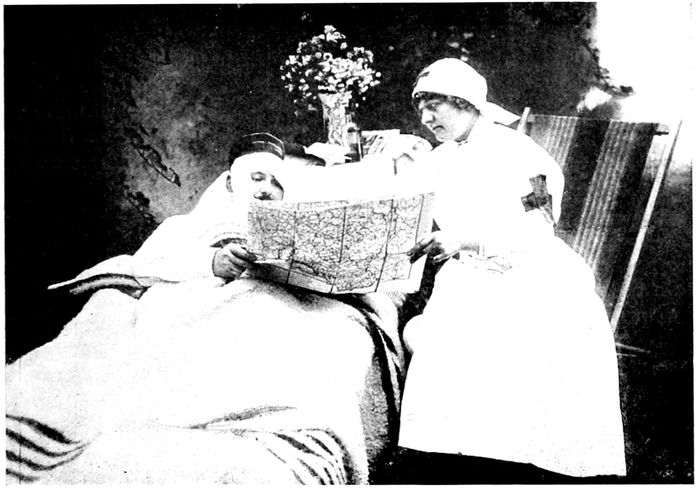
A GOOD SAMARITAN.
While performing their merciful work, many women had to bear the depressing anxiety caused by husbands, sons, or brothers, fighting in the trenches or on the ocean; or for those unfortunates who as prisoners had fallen into the hands of the enemy.
The women of the Central powers had to face many additional problems of the most perplexing nature. As the soil of Germany and Austria does not yield enough to support the whole population, and as all imports of foodstuffs were cut off by hostile fleets, provisions became more scarce and more expensive from day to day. There was not sufficient milk to keep the millions of babies alive; and not enough food to save adults from slow starvation. To stretch the scant supplies the most careful and rigid methods of administration 276had to be invented and applied. Public kitchens were established to reduce the cost of living to the lowest point possible. In Berlin twenty-three committees of the National Women’s Service with several thousand voluntary workers were running such charitable kitchens, from which tens of thousands regularly received their daily meals. The same organizations later on supervised the system of bread-, milk-, grocery- and butter-cards, when the increasing shortage of food forced the governments to the severest restrictions.
Among the many German relief organizations those of the Red Cross took the leading place. Originally divided into five main sections under the general control of a central committee and designed to combat of sickness and destitution in the civil population, it now was increased to twenty-three divisions. Their welfare work assumed such importance during the progress of the war that it had to be subdivided into three groups, the first of which became engaged in fighting tuberculosis and contagious diseases, the second in the protection of infancy and motherhood, the third in family welfare work in the narrower meaning of the term. In all these branches the organization of the Red Cross provided the framework within which the numerous national, state and local social activities of the country grouped themselves naturally in accordance with their separate functions.
The activity of the organizations during the years 1917, 1918, and 1919, the dreadful years of general distress and starvation, forms one of the most pathetic chapters in woman’s history. Not only the food, but the cotton, wool, leather, rubber, fat, oil, soap, and hundreds of other necessities gave out completely. People were compelled to live on substitutes. And as these became too scarce or too expensive, they lived on substitutes for these substitutes. Imagine the heartrending pain mothers were bearing when at the end of 1918 and in 1919 large numbers of mayors of German cities and numerous professors of medicine were compelled to send urgent appeals for help to all medical faculties of the world, stating that since the signing of the truce 800,000 people in Germany had died from starvation. “Many millions of human beings,” one of the appeals reads, “are living on only half or even less than half the quantity of food necessary to sustain life. Utterly exhausted they have lost all power of resistance and succumb to any kind of sickness that may befall them. The worst sufferers are the children and those mothers, who fast for the sake of their children. There are too the neurasthenics of all kinds, the numbers of which have, for four years, increased immensely. Furthermore, there are the overworked, and those who have become sick through the unheard-of monotony of food and from the absolute absence of every 277stimulant. Their existence becomes more unbearable from day to day. While the physicians of Germany are profoundly impressed with the terrible ravages caused by hunger, they have absolutely no means of combating them.”
While during these dreadful times millions of women devoted themselves to the noble work of healing the terrible wounds and sufferings, other groups eagerly tried to bring about a cessation of hostilities. Immediately after the first declaration of war, the “International Woman Suffrage Alliance” directed an urgent appeal to the British Foreign Office as well as to all Foreign Embassies in London, to leave untried no method of conciliation or arbitration to avert the threatening disaster. Numerous women’s societies in Holland, Sweden, Germany and Switzerland arose simultaneously and joined the good cause. Soon a great movement for peace began to sweep through the women of the entire world.
But women’s efforts to bring the conflict to a standstill lacked as yet the necessary strength. They were overpowered by the influence and machinations of those statesmen, financiers, publishers of newspapers and countless others, who wanted war. And so nothing remained for women but to repeat ever and again their protests against the madness of men.
When in December, 1914, suffering Christianity prepared to celebrate the natal day of the Messiah, the Prince of Peace, a noble-minded woman of London, Miss Emily Hobhouse, wrote the following letter:
“To American Women, Friends of Humanity and Peace!
“Friends:—May I appeal to you in the name of Humanity, on behalf of the children of Europe, before whom suffering or death has already taken place, and whose future is fraught with pain? In you lies our hope of help for them, for you are free to speak and act.
“Will you not come to our troubled world, unite with the women of other neutral lands and initiate a crusade—a real ‘holy’ war, fought with the swords of the Spirit?
“Appalling as is this massacre of the manhood of Europe, that is not the worst. As long as men adopt barbaric methods of settling disputes they must abide by the consequences; but for those innocent victims, the non-combatants—women, babes, old and sick—I crave your help. Their names and numbers will never be known. They are multiplying in Poland and Galicia, in Belgium and France, in East Prussia and Holland, and elsewhere. Ponder this vast host, voiceless, suffering, dying, crouching beside their blackened ruins or fleeing from the devastated areas both east and west. Think of disease let loose, of the horrors of cold and famine!
“I know it is not easy to visualize details of conditions 278so foreign to average experience. It needs a mental effort few can make. It is because I was daily witness of such things in the South African War that I dare not be silent. Disease, devastation, starvation and death were words I then learned as war interprets them. I saw a country burnt and devastated as large parts of Europe are to-day; I saw old and sick, women and children turned out of house and home; I saw them, half clad, starving, lying sick to death upon the bare earth; I saw babies that were born in open, crowded trucks; I saw haggard, endless sick, gaunt skeletons, hourly deaths. There in the Boer States death swept away non-combatants in the proportion of five to one of those who fell in the field.
“It is because I know the brunt of this war, too, is falling and must fall, heaviest upon the weak and young, that I appeal now on their behalf, not merely to those who love peace, but to the great body of women who love children. Little children, more sensitive to exposure, to extremes of heat and cold, to tainted food, to starvation, and to the stench, the poisonous stench of war, quickly fade, quickly die.
“Will you not arise and work for peace?—For peace alone can save the children. It would be, I well know, a struggle against powers of darkness and will need the whole armor of God. Yet every sentiment of pity and of civilization, leave alone Christianity, demands the effort. The victims cannot help themselves; succor must come from without.
“Relief, we know, you pour most generously, but relief cannot meet a want so colossal, neither can it touch the worst ills. Cut at the root of the evil—the war itself. A strong lead is needed. Myriads want peace; they never wanted war. In each country this is true; constant proofs reach us from Germany and France, as well as various parts of England. The press of each nation asserts that the people are unanimous for war. It is not so, but those who have the means of speaking, and who swim with their governmental streams, can speak the loudest and alone are heard. Many dare not, many cannot speak. Others make a truce and save thousands of human lives and receive the blessings of thousands of wives and mothers.
“A union of neutral women could investigate the facts of the sufferings amongst non-combatants, and founded upon acquired personal knowledge they could in the name of Humanity formulate demands persistent, cogent, irresistible, not in favor of any one party or nation, but simply for Peace.
“It seems futile to turn to statesmen, governments or prelates for aid. They are tied and bound by position, custom and mutual fear. They await propitious movements. Famine, disease and death do not wait.
“Women have this advantage: they are still unfettered 279by custom and expediency; they need consult only the dictates of humanity. If ever the world needed their intervention on a vast scale, it needs it now!
“Failure in such a task would have no fears for them; failure in a noble effort is often a measure to success! The greatest have seemed to fail. Judged by human standards, Christ’s life on earth was a failure. The effort in any case would leave its mark upon the thought and history of the world. Womanhood will have arisen in vindication of a higher humanity—to avenge desolated motherhood and protect martyred children; it will have asserted its right to shield the weak and young from the fatal results of the organized murder called war.”
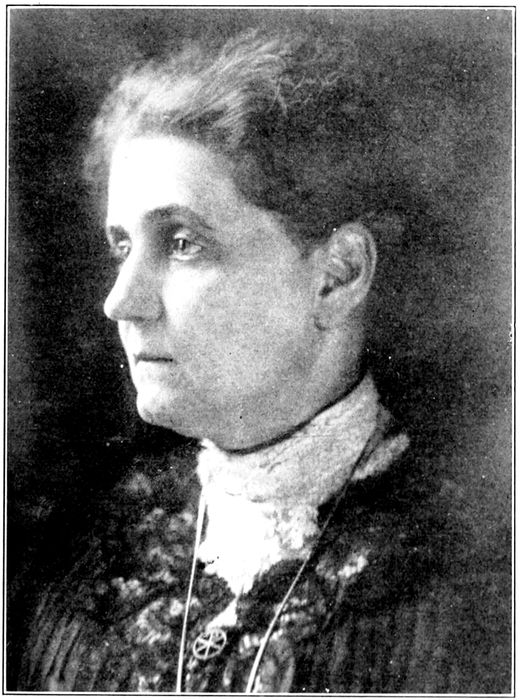
MISS JANE ADDAMS.
The appeal was not made in vain. The day after its receipt a number of prominent American women called a convention in Washington, D. C., on January 10th, 1915. Miss Jane Addams of Chicago acted as chairman. The result of 280this meeting was the organization of the “Woman’s Peace Party,” which adopted the following
Preamble and Platform.
“We women of the United States, assembled in behalf of World Peace, grateful for the security of our own country, but sorrowing for the misery of all involved in the present struggle among warring nations, do hereby band ourselves together to demand that war be abolished.
“Equally with men pacifists, we understand that planned-for, legalized, wholesale, human slaughter is to-day the sum of all villainies.
“As women, we feel a peculiar moral passion of revolt against both the cruelty and the waste of war. As women, we are especially the custodians of the life of the ages. We will not longer consent to its reckless destruction.
“As women, we are particularly charged with the future of childhood and with the care of the helpless and the unfortunate. We will not longer endure without protest that added burden of maimed and invalid men and poverty-stricken widows and orphans which war places upon us.
“As women, we have builded by the patient drudgery of the past the basic foundation of the home and of peaceful industry. We will not longer accept without a protest, that must be heard and heeded by men, that hoary evil which in an hour destroys the social structure that centuries of toil have reared.
“As women, we are called upon to start each generation onward toward a better humanity. We will not longer tolerate without determined opposition that denial of the sovereignty of reason and justice by which war and all that makes war to-day render impotent the idealism of the race.
“Therefore, as human beings and the mother half of humanity, we demand that our right to be consulted in the settlement of questions concerning not alone the life of individuals but of nations be recognized and respected.
“We demand that women be given a share in deciding between war and peace in all the courts of high debate—within the home, the school, the church, the industrial order, and the state.
“So protesting, and so demanding, we hereby form ourselves into a national organization to be called the Woman’s Peace Party.
“We hereby adopt the following as our platform of principles, some of the items of which have been accepted by a majority vote, and more of which have been the unanimous choice of those attending the conference that initiated 281the formation of this organization. We have sunk all differences of opinion on minor matters and given freedom of expression to a wide divergence of opinion in the details of our platform and in our statement of explanation and information, in a common desire to make our woman’s protest against war and all that makes for war, vocal, commanding and effective. We welcome to our membership all who are in substantial sympathy with that fundamental purpose of our organization, whether or not they can accept in full our detailed statement of principles.
Platform.
“The Purpose of this Organization is to enlist all American women in arousing the nations to respect the sacredness of human life and to abolish war. The following is adopted as our platform:
1.
The immediate calling of a convention of neutral nations in the interest of early peace.
2.
Limitation of armaments and the nationalization of their manufacture.
3.
Organized opposition to militarism in our own country.
4.
Education of youth in the ideals of peace.
5.
Democratic control of foreign policies.
6.
The further humanizing of governments by the extension of the franchise to women.
7.
“Concert of Nations” to supersede “Balance of Power.”
8.
Action toward the gradual organization of the world to substitute Law for War.
9.
The substitution of an international police for rival armies and navies.
10.
Removal of the economic causes of war.
11.
The appointment by our Government of a commission of men and women, with an adequate appropriation, to promote international peace.”
In the meantime women of other countries had not remained idle. Dr. Aletta H. Jacobs, President of the Dutch National Society for Woman Suffrage, directed a letter to the most prominent women societies of various nations, saying that it was of the greatest importance to bring those women, representing the women societies of the world, together in an international meeting in a neutral country, to show “that in these dreadful times, in which so much hate has been spread among the different nations, the women at least retained their solidarity and that they were able to maintain mutual friendship.” At the same time she suggested to hold this International Congress in Holland, and offered to make the necessary arrangements.
282While many women welcomed this first effort to renew international relations it was only natural that, especially in belligerent countries, a fierce criticism should be directed against this daring move. This criticism came even from some of the women’s organizations. “It was to be impossible to hold the Congress! No one would attend! Even if the Congress were held the nationalities would quarrel amongst themselves!” But those who had undertaken the work were not deterred by this criticism, but encouraged by many enthusiastic responses. The announcement that Miss Jane Addams had accepted the invitation to preside at the Congress gave courage to all who were working for it. And so the memorable “International Congress of Women for Permanent Peace” came to pass. It was held at the Hague from April 28 to May 1, 1915, and attended by 1136 delegates and a large number of visitors. The countries represented were Austria, Belgium, Canada, Denmark, Germany, Great Britain, Hungary, Italy, Netherlands, Norway, Sweden, and the United States of America.
In her address of Welcome, Dr. Aletta H. Jacobs, the President of the Executive Committee, said: “In arranging this International Congress we have naturally had to put aside all thoughts of a festive reception, we have simply endeavored to receive you in such a way that you may feel assured of our sympathy, our mutual sisterly feelings, our goodwill to link the nations together again in the bonds of fellowship and trustful co-operation.
“With mourning in our hearts we stand united here. We grieve for the many brave young men, who have lost their lives in barbaric fratricide before even attaining their full manhood; we mourn with the poor mothers bereft of their sons; with thousands and thousands of young widows and fatherless children; we will not endure in this Twentieth Century civilization, that governments shall longer tolerate brute force as the only method of solving their international disputes. The culture of centuries standing and the progress of science must no longer be recklessly employed to perfect the implements of modern warfare. The accumulated knowledge, handed down to us through the ages, must no longer be used to kill and to destroy and to annihilate the products of centuries of toil.
“Our cry of protest must be heard at last. Too long already has the mother-heart of woman suffered in silence. O, I know and feel most strongly, that it is impossible that a world-fire, such as has been blazing forth for the last nine months, can be extinguished, until the last bit of inflamable material has been reduced to ashes, but I also feel most strongly that we must raise our voices now, if the new era of civilization that will arise from these ashes is to rest upon a more substantial 283basis, a basis on which the women with their inherent conserving and pacific qualities shall have the opportunity to assist men in conducting the world’s affairs.
“We women judge war differently from men. Men consider in the first place its economic results. What it costs in money, its loss or its gain to national commerce and industries, the extension of power and so forth. But what is material loss to us women, in comparison to the number of fathers, brothers, husbands and sons who march out to war never to return. We women consider above all the damage to the race resulting from war, and the grief, the pain and misery it entails. We know only too well that whatever may be gained by a war, it is not worth the bloodshed and the tears, the cruel sufferings, the wasted lives, the agony and despair it has caused.
“Important as are the economic interests of a country, the interests of the race are more vital. And, since by virtue of our womanhood, these interests are to us of greater sanctity and value, women must have a voice in the governments of all countries.
“Not until women can bring direct influence to bear upon Governments, not until in the parliaments the voice of the women is heard mingling with that of the men, shall we have the power to prevent recurrence of such catastrophes.
“The Governments of the world, based on the insight of the half of humanity, have failed to find a right solution of how to settle international disputes. We therefore feel it more and more strongly, that it is the duty, the sacred duty of every woman, to stand up now and claim her share with men in the government of the world. Only when women are in the parliaments of all nations, only when women have a political voice and vote, will they have the power effectively to demand that international disputes shall be solved as they ought to be, by a court of arbitration or conciliation. Therefore on a programme of the conditions whereby wars in future may be avoided, the question of woman suffrage should not be lacking, on the contrary, it should have the foremost place.
“May this Congress be the dawn of a better world, a world in which each realizes that it is good to serve one’s own country, but that above the interests of one’s Country stand the interests of humanity, by serving which a still higher duty is fulfilled.”—
The business sessions, presided over by Miss Jane Addams, led to the adoption of the following resolutions:
284
I. WOMEN AND WAR.
1. Protest.
We women, in International Congress assembled, protest against the madness and the horror of war, involving as it does a reckless sacrifice of human life and the destruction of so much that humanity has labored through centuries to build up.
2. Women’s Sufferings in War.
This International Congress of Women opposes the assumption that women can be protected under the conditions of modern warfare. It protests vehemently against the odious wrongs of which women are the victims in time of war, and especially against the horrible violation of women which attends all war.
II. ACTION TOWARDS PEACE.
3. The Peace Settlement.
This International Congress of Women of different nations, classes, creeds and parties is united in expressing sympathy with the suffering of all, whatever their nationality, who are fighting for their country or laboring under the burden of war.
Since the mass of the people in each of the countries now at war believe themselves to be fighting, not as aggressors but in self-defence and for their national existence, there can be no irreconcilable differences between them, and their common ideals afford a basis upon which a magnanimous and honorable peace might be established. The Congress therefore urges the Governments of the world to put an end to this bloodshed, and to begin peace negotiations. It demands that the peace which follows shall be permanent and therefore based on principles of justice, including those laid down in the resolutions 5, 6, 7, 8 and 9 adopted by this Congress.
4. Continuous Mediation.
This International Congress of Women resolves to ask the neutral countries to take immediate steps to create a conference of neutral nations which shall without delay offer continuous mediation. The Conference shall invite suggestions for settlement from each of the belligerent nations and in any case shall submit to all of them simultaneously, reasonable proposals as a basis of peace.
III. PRINCIPLES OF A PERMANENT PEACE.
5. Respect for Nationality.
This International Congress of Women, recognizing the right of the people to self-government, affirms that there should be no transference of territory without the consent of 285the men and women residing therein, and urges that autonomy and a democratic parliament should not be refused to any people.
6. Arbitration and Conciliation.
This International Congress of Women, believing that war is the negation of progress and civilization, urges the governments of all nations to come to an agreement to refer future international disputes to arbitration and conciliation.
7. International Pressure.
This International Congress of Women urges the governments of all nations to come to an agreement to unite in bringing social, moral and economic pressure to bear upon any country, which resorts to arms instead of referring its case to arbitration or conciliation.