Women in Modern Times. (continued 3)
Reading edition
The first female astronomer of whom we have more intimate information, was Marie Cunitz, born in 1610 as the eldest daughter of a physician in Silesia. Commanding an extraordinary general culture, her principal study was mathematics and astronomy. Her tables, published under the title “Urania Propitia, sive Tabulæ Astronomicæ,” gained for her a great reputation, and the by-name “the Silesian Pallas.” Dedicated to the Emperor Ferdinand III. the book was published in Latin and in German in 1650 and 1651.
Another noted astronomer was Caroline Lucretia Herschel, born in 1750 at Hanover, Germany. In 1772 she accompanied her brother William to England, and when he accepted the office of astronomer-royal, she became his constant assistant in his observations. In this capacity she succeeded in discovering independently eight comets, five of which had not been observed before. Also she discovered many of the small stellar nebulæ which were included in her brother’s catalogue. For her many contributions to astronomy in 1835 she was presented by the Astronomical Society with their gold medal, and was also elected an honorary member.
When the memoirs of Miss Herschel were published, the editor, in describing her character, said: “Great men and great causes have always some helper of whom the outside world knows but little. These helpers and sustainers have the same quality in common—absolute devotion and unwavering faith in the individual or the cause. Seeking nothing for themselves, thinking nothing of themselves, they have all the intense power of sympathy, a noble love of giving themselves for the service of others. Of this noble company of unknown helpers Caroline Herschel was one.”—
This capacity of self-denial distinguished likewise a number of other women, whose names are known in the history of astronomy, as for instance Theresa and Madeline Manfredi, the daughters of Eustachio Manfredi, from 1674 to 1739 director of the observatory of Bologna. Further, Marie Margarethe Kirch, who assisted her husband, the astronomer Kirch, in the upper Lausatia; Madame Lepante, the wife of the famous clock-maker Jean Andre Lepante; and nearer our own time, there is Maria Mitchell, born 1818 at Nantucket, Mass., who at an early age became the assistant of her father. Carrying on a series of independent observations, she was in 1865 appointed professor of astronomy in Vassar College.
201Emilie de Bréteuil, Antonie C. Asher, Elizabeth von Matt, Wilhelmine Witte and Agnes Mary Clerke likewise distinguished themselves in astronomy. The last named lady published in 1885 a “History of Astronomy” and in 1890 “The System of the Stars.” These writings, conspicuous for a careful sifting and due assimilation of facts, with a happy diction that is at the same time both popular and scientific, place the author in the foremost rank of writers on astronomy.—
As an eminent mathematician, linguist and philosopher Maria Gaetana Agnesi is known to every student of science. Born 1718 at Milan, she gave early indication of extraordinary ability and devoted herself to the abstract sciences. In mathematics she attained such consummate skill, that, when her father, professor of mathematics at Bologna, died, the Pope allowed her to succeed him. In this capacity she wrote her famous work: “Instituzions Analitiche ad Uso Gioventu Italiana,” which was published at Milan in 1748. Its first volume treats of the analysis of finite quantities, and the second of the analysis of infinitesimals. The able mathematician John Colson, professor at the University of Cambridge, considered this work so excellent, that he studied Italian in order to translate it into English. Under the title “Analytical Institutions” this translation was published in 1801, to do honor to Maria Agnesi, and also to prove that women have minds capable of comprehending the most abstruse studies.
Another female mathematician, Sophie Germain, born in 1776 in Paris, won the grand prize, offered by the Institute of France for the best memoir giving the mathematical theory of elastic surfaces and comparing it with experience. This question had come up in 1808. Great mathematicians were not wanting in Paris at that time—Lagrange, Laplace, Poisson, Fourier, and others, but none of them were inclined to tackle the question. Lagrange, in fact, had said that it could not be solved by any of the then known mathematical methods. The offer was twice renewed by the Institute, and in 1816 the prize was conferred upon Sophie Germain, who in 1808 as well as in 1810 had made two unsuccessful attempts to solve the difficult question. The same woman distinguished herself by a number of other valuable papers and philosophical writings.
In more recent years Sonja Kowalewska, a Russian, who had studied mathematics at the universities of Berlin and Goettingen, became famous as the winner of the Prix Bordin, offered by the Academy of Paris. Later on, as a professor of mathematics in Stockholm, she wrote a number of excellent professional works, but died there in her fortieth year.
Among the British scientific writers of the 19th Century the most famous was Mary Somerville, whom Laplace called 202the most learned woman of her age and the only woman who understood his works. In translating his brilliant work “Mécanique Celeste,” she greatly popularized its form. Its publication in 1831 under the title of “The Mechanism of the Heavens” at once made her famous. Her own works: “Connections of Physical Science,” “Physical Geography” and “Molecular and Microscopic Science” have been declared masterworks, distinguished by a clear and crisp style, and the underlying enthusiasm for the subject.
In the history of chemistry the name of Marie Curie will be forever connected with the wonderful discovery of Radium and Radio-activity. Born on November 7, 1867, at Warsaw as Marja Sklodowska she came to Paris in 1888 and studied at the Faculté des Sciences. In 1895 she married Professor Pierre Curie and joined him in his chemical investigations. It was in 1898 that she published a most valuable work on metals in solution. Her investigations in collaboration with her husband led to the discovery of two new bodies: Polonium and Radium, which are found in certain minerals, especially in pitch blende in a state of extreme solution; as a matter of fact, to the extent only of a few decigrammes to the ton of mineral for Radium, and much less in the case of Polonium. The separation of these elements presented extreme difficulties.
Further investigations led to the observation of most interesting phenomena in connection with these bodies—chemical effects, luminous effects, effects of heating, etc. New realms of science were disclosed—the science of Radio-active phenomena. In recognition of these discoveries in 1903 the Nobel Prize was awarded to Professor Curie and his wife. And when Mrs. Curie, after the tragic death of her husband, accomplished the “isolation” of Radium and also determined its atomic weight, she was awarded the Nobel Prize for a second time in 1911. At present Mrs. Curie is Director of the Physico-Chemical Department of the University of Paris.
For valuable research work in bacteriology Dr. Rhoda Erdmann, a former assistant of the famous professor Robert Koch in Berlin, became most favorably known. Having published several excellent treatises on the amoeba and protozoa, she followed in 1913 a call to the Sheffield-Institute of Yale University.
In the wide fields of archæology and ethnology likewise several women have achieved remarkable results. Among those scientists who devoted themselves to the study of archæology and the ancient history of America the name of Zelia Nuttall is well known. She is the author of many interesting essays on the relics left by the Aztecs, Toltecs, and Mayas. Science is also indebted to her for the so-called “Codex Nuttall,” now preserved in the Peabody-Museum at Cambridge, Mass.
203Another noteworthy ethnologist was Erminnie Adele Smith, who, as compiler of the famous Iroquois-English Dictionary, was distinguished by being elected the first woman member of the New York Academy of Science.
Alice Cunningham Fletcher made most valuable investigations about the religious and social conditions of several Indian tribes of the Far West, especially of the Sioux, Omaha, and Pawnee Indians. Her very exhaustive studies have been published in the Annual Reports of the Bureau of American Ethnology.
The same reports contain highly interesting papers by Matilda Cox Stevenson and Tilly E. Stevenson about the mythology, esoteric societies and sociology of the Zuni Indians.
Miss Elsie Clews Parsons in New York has published valuable monographs about the folk-lore of the Pueblo Indians and the Negroes of the Bahama Islands. A. M. Czaplicka, Mary Kingsley, Barbara Freire-Marreco, Adele Breton, Mrs. Jochelson-Brodsky, and Maria Tubino are likewise most favorably known as writers on archæology and ethnology.
For a number of years Johanna Mestorf has held the position of director of the Museum of Antiquities of Schleswig-Holstein.
Cornelia Horsford, the learned daughter of the late Professor Eben Horsford of Cambridge, Mass., made great efforts to settle many questions in regard to the early voyages of discovery by the Norsemen to Greenland and Vinland. In the pursuit of these studies she sent several scientific expeditions to Iceland as well as to Greenland and published a number of valuable essays, among them “Graves of the Northmen”; “Dwellings of the Saga Time in Iceland, Greenland and Vinland”; “Vinland and its Ruins”; and “Ruins of the Saga-Times.”
Anne Pratt is known as an able botanist. And Eleanor Anne Ormerod has been hailed in England as “the Protector of Agriculture,” as she organized the valuable “Annual Series of Reports on Injurious Insects and Pests,” distributed by the Government.
Among the explorers of the Dark Continent a Dutch lady, Miss Alexandrine Tinné, created a sensation by her daring journeys in the upper Nile regions. During her first expedition, which lasted from 1861 to 1864, she penetrated great stretches of unknown territory, and was the first to enter the land of the Niam Niam. Several members of her expedition died from the terrible hardships that had to be overcome. After her return to Cairo Miss Tinné started in January, 1869, on a still more hazardous expedition, which was to proceed from Tripoli to Lake Tchad, and from there by way of Wadai, Darfur, and Kordofan to the Upper Nile. But while her 204caravan was on the route from Murzuk to Rhat, the daring explorer was murdered by her own escort.
An English lady, Florence Caroline Dixie, explored the wilderness of Central Patagonia. Isabelle Bishop became known for her extensive travels through Asia, and the masterful descriptions of those countries she had traversed. Her best work is “Korea and Her Neighbors.”
Therese, Princess of Bavaria, wrote several highly interesting works about her extensive travels in Colombia, Ecuador, Bolivia, Chile, and the tropical regions of Brazil. Cecilie Seler, the wife of the famous archæologist Eduard Seler, is the author of the valuable book “On Ancient Roads in Mexico and Guatemala.”
While these examples—which might be increased by many others—give ample proof of woman’s ability in regard to scientific work, it must be stated, that, up to the middle of the 19th Century, men did very little to encourage their struggling sisters in this line of activity. Indeed, there are not a few instances of strong disinclination on the part of statesmen as well as of scientists, to smooth woman’s road to higher education. Centuries passed before women succeeded in gaining the right to follow their studies in colleges and universities, a right they had enjoyed in Italy during the 10th and 11th Centuries as well as during the Renaissance.
The first institution of modern times, that admitted women on the same footing with men, was Oberlin College in Ohio, founded in 1833 and open to all irrespective of sex and color. The first woman who graduated here was Miss Zerniah Porter, who in 1838 received her diploma in the so-called literary course. The State universities of the West that were founded later on all followed the example set by Oberlin College and gradually the older ones adopted the same policy, so that all over the West and South, where the State university is a strong influence, these institutions are open to women. Throughout these regions women’s education is for this reason almost synonymous with co-education. In the Eastern part of the United States, however, the private college predominates, and there is a greater degree of separation. But even here the restrictions are gradually being removed, and most of the men’s colleges and universities admit women to some departments with some restrictions, or have an affiliated woman’s college.
America has also a number of independent colleges exclusively for women. The best known among them are Vassar College, at Poughkeepsie, New York, organized in 1861, with 1124 students and 144 teachers in 1918; Wellesley College in Massachusetts, organized in 1875, and with 1612 students and 138 teachers in 1918; Bryn Mawr in Pennsylvania 205organized in 1880, and with 489 students and 63 teachers in 1918; Smith College at Northampton, Mass.
France began to open its universities to women in 1858; England followed in 1864; Switzerland in 1866; Sweden in 1870; Denmark, Holland, Finland and India in 1875; Italy and Belgium in 1876; Australia in 1878; Norway in 1884; Iceland in 1886; Hungary in 1895; Austria in 1897; Prussia in 1899, and Germany in 1900.
To-day no one clings any longer to the old prejudices against the abilities of women. College education among women has become so common as to attract little or no attention. It is regarded as the essential training for intellectual, professional and business life, and it is no longer an effort to secure it, but rather to make it of the greatest possible value to the students and to the community. As women do a large proportion of the teaching in public schools as well as in colleges for both sexes, the education of the citizens of the 20th Century depends largely upon the opportunities available to women in the past, present and future.—
As educators as well as founders of learned institutions large numbers of women became most favorably known. There was for instance Jeanne Louise Henriette Campan. When the tempests of the French Revolution began to rage, she held a position at the royal court as reader to the young princesses. Thrown on her own resources after the dethronement and execution of the King and the Queen she established a school at Saint-Germain. The institution prospered, and was patronized by Mme. Beauharnais, whose influence led to the appointment of Mme. Campan as superintendent of the Academy founded by Napoleon at Ecouen, for the education of the daughters and sisters of members of the Legion of Honor. While in this position Mme. Campan wrote a treatise “De l’Education des Femmes.”
Emmy Hart Willard in 1823 founded Troy Female Seminary at Troy, N. Y., over which she presided until 1838. Mary Mason Lyon established in 1836 Mount Holyoke Female Seminary, of which she was president until her death in 1849.
Elizabeth Palmer Peabody in Boston was largely instrumental in introducing Froebel’s kindergarten system in the United States. She likewise wrote a number of educational works. In England Emily Anne Shireff was active as President of the Froebel Society of England. Barbara Leigh Smith Bodichon, who worked for the extension of university education to women, aided in 1868 in establishing Girton College, at Cambridge, England. Anne Jemima Clough founded in 1867 the North of England Council for Promoting the Higher Education of Women, and in 1875 the Newnham College for Women.
206The name of Sophie Smith is remembered as the founder of Smith College at Northampton, Mass., the first woman’s college in New England; the name of Annie N. Meyer as the founder of Barnard College, the woman’s department of Columbia University in New York.
Marie Montessori was the inventor of a new system of teaching.
207
NOTEWORTHY WOMEN IN WORLD LITERATURE.
Reviewing the countless contributions women have made to literature is a task that can be mastered only by devoting to this subject several ponderous volumes. Whether such an attempt has even been made we are unable to say. But the theme is so attractive that I hope that some competent woman author may be inspired to undertake this task. What more beautiful mission could she have than to study and analyze all the scattered evidences of brilliant intellect, rich in imagination, deep emotion, power of expression, soaring enthusiasm, scintillating wit, and profound sorrow, to be found in many of the books written by women since the days of Sappho and Erinna.
Only fragments remain of the beautiful odes, hymns and love-songs produced by the poetesses of the classic past. But that they inspired all Hellas and Rome we know from the testimony of the foremost authors and critics of their time. When Meleager of Gadara, the famous sophist and poet, selected the choicest poems of his predecessors and wove them into that delicious “Garland,” to be hung outside the gate of the Gardens of the Hesperides, he did not forget Sappho, because “though her flowers were few, they were all roses.” And a critic, writing five hundred years after Erinna’s death, speaks of still hearing her swan-note clear above the jangling chatter of the jays, and of still thinking those three hundred hexameter verses sung by this girl of nineteen in “The Distaff” as lovely as the loveliest of Homer. There is also a report, that Corinna, a native of Tanagra, in Bœotia, won five times in poetical contests the prize in competition with Pindar, the greatest lyric poet of Greece.
With greater kindness fate treated the works of Alphaizuli, a Moorish poetess, who lived in Seville during the 8th Century A. D. Of her, who was called “the Arabian Sappho,” two volumes of excellent verses are preserved in the library of the Escurial. Likewise Labana and Leela, two Moorish poetesses, were famous throughout beautiful Andalusia during the 10th and the 13th Century. Of Valada, the daughter of the Moorish King Almostakeph, of Corduba, her contemporaries report that she several times contended with scholars noted for their eloquence and knowledge, and quite often bore away the palm.
That such contests were held in great favor by learned ladies, appears from the institution of those famous poetical festivals known as “Jeux Floraux” or Floral Games. They are said to have been established in the 11th or the 12th 208Century by a gay company of French minstrels, called “the seven troubadours.” But in time they had become forgotten. It is due to Clemence Isaure, a poetess born in 1464 at Toulouse, that these festivals were renewed. Fixing the first of May as the day of these Floral Games, she invited all poets and poetesses to participate in peaceful contest, assigning as prizes for the victors five different flowers, wrought in gold and silver. There was an amaranth of gold for the best ode; a silver violet for a poem of from sixty to one hundred Alexandrine lines; a silver eglantine for the best prose composition; a silver marigold for an elegy, and a silver lily for a hymn.
These contests have been held in Toulouse through all the centuries. They were recognized by the French Government in 1694, and confirmed by letters-patent from the king. Some twenty-five years ago they were likewise introduced into Germany, and held first in Cologne.
The brilliant age of the Renaissance produced several women writers and poets, whose works are still read. The literary annals of Italy shine with such illustrious names as Cassandra Fidelis, the Venetian; Veronica Gambara, of Brescia; Lucia Bertana, of Bologna; Tarquenia Molza, of Modena; Gaspara Stampa, of Padua; and the great Vittoria Colonna, of Marino, whose sonnets as well as her beauty and virtues were extolled by all contemporaries.
In Spain Marianne de Carbajal and Maria de Zayas, during the 17th Century, the classic period of Spanish literature, became the pride of their country.
In France Marguerite d’Angouleme wrote a delightful book, “the Heptameron,” similar in plan to the famous “Decamerone” by Boccaccio. In the middle of the 16th Century Louise Labbé, known in French literature as “La belle cordière,” produced her “Debat de Folie et d’Amour,” a work full of wit, originality and beauty. Erasmus and La Fontaine were both indebted to it; the former for the idea of “The Praise of Folly,” and the latter for “L’Amour et la Folie.” In truth, La Fontaine’s poem is only a versification of the prose story of Louise Labbé.
Of the illustrious French women, who during the 16th, 17th and 18th Centuries made their “salons” the gathering-places for men and women of letters, several became widely known for their own poems and works of fiction. As for instance Madeline de Scudéry, Anne de Seguier, Claudine de Tencin, Madame de la Sabliére, Madeline de Souvré, and Anne Dacier, of whom Voltaire said, that no woman ever rendered greater services to literature.
209
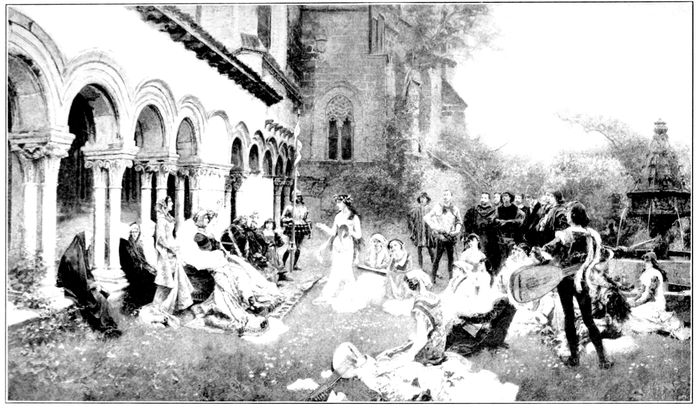
A FLORAL GAME DURING THE 14TH CENTURY. After a painting by F. Padilla.
210In the literature of the 19th Century Anne Louise Germaine Necker, Baroness de Stael-Holstein, held a singular position. Many of her contemporaries exalted her as “the founder of the romantic movement” who gave “ideas” to the world. To-day she is almost forgotten, and her novels and plays, among them “Corinne” and “Sophie and Jane Grey” lie undisturbed and dusty on the library shelves.
Perhaps her most remarkable contribution to literature was her book “L’Allemagne,” which was announced in 1810. It gave a most intelligent exposition of the science, literature, arts, philosophy, and other characteristics of the Germans, gathered from the author’s own observations. The work, written with a spirited independence, quite at variance with the deadening political influence of Napoleon, irritated the emperor to such a degree that he ordered the minister of police to seize and destroy the whole edition of 10,000 copies. Besides this he exiled the author from France. When, after the overthrow of Napoleon, she returned to Paris, she had her book printed again, and had the satisfaction of seeing it eagerly read by millions of Frenchmen.
Of all French authoresses of the 19th Century Armantine Lucile Aurore Dudevant, or “George Sand,” holds the supreme rank. In the long line of her thoughtful, concentrated and meditative novels “Valentine,” “Indiana,” “Lelia,” “Mauprat,” and “Le Meunier d’ Angibault” are real gems of fiction, whose influence can be traced in many later works by writers of France and other nations.
Of her contemporaries Louise Révoil Colet, Eugenie de Guérin, Pauline de la Ferronay Craven, and, above all, Delphine de Girardin must be mentioned, whose “Letters Parisiennes” as well as her poems, novels, dramas and comedies belong to the most excellent productions of the 19th Century. By her dramatic pieces “L’Ecole des Journalistes,” “Judith,” “Cleopatra,” “C’est la faute du mari,” “Lady Tartufe,” and others she reaped a wide popularity. In the literary society of her time she exercised no small personal influence. Balzac, Alfred de Musset, Gautier, and Victor Hugo were among the frequenters of her salon.
Among the British woman writers of the latter part of the 18th Century Jane Austen was the most distinguished. Her novels “Sense and Sensibility,” “Pride and Prejudice,” “Emma,” “Northanger Abbey” and “Persuasion” have been likened to the carefully-executed paintings of the Dutch masters for their charming pictures of quiet, natural life.
Ann Ward Radcliffe wrote three novels unsurpassed of their kind in English literature: “The Romance of the Forest,” “The Mysteries of Udolpho,” and “The Italian.” They are distinguished for originality, ingenuity of plot, fertility of incident, and skill in devising apparently supernatural occurrences 211capable of explanation by human agency and natural coincidence.
Mary Russell Mitford edited several volumes of sketches of rural character and scenery, delightful and finished in style, and unrivalled in her manner of description. It is by these sketches of English life that she obtained the greatest share of her popularity. She wrote also an opera called “Sadak and Kalasrade,” and four tragedies, “Julian,” “Foscari,” “Rienzi,” and “Charles the First.” All were successful; “Rienzi,” in particular, long continued a favorite.
Elizabeth Inchbald’s two novels “The Simple Story” and “Nature and Art,” have long ranked among standard works. Besides novels she wrote a number of dramas, some of which were very successful.
Maria Edgeworth published a new work almost every year from the beginning of the 19th Century to 1825. The novels “Castle Rackrent,” “Belinda,” “Vivian.” “Harrington and Ormond,” and many others followed each other rapidly, and all were welcomed and approved by the public. Her best and last work of fiction, “Helen,” appeared in 1834.
Mary Shelley, the wife of the famous poet Percy Shelley, is renowned as the author of the romances “Frankenstein,” “Valperga, or the Life and Adventures of Castruccio, Prince of Lucca”; “Falkner”; “Lodore,” and “The Fortunes of Perkin Warbeck.” A most peculiar work is “The Last Men,” a fiction of the final agonies of human society owing to the universal spread of pestilence.
Among the dramatists of the 19th Century Joanna Baillie was the foremost. In her “Plays of Passion” she illustrates each of the deepest and strongest passions of the human mind, such as Hate, Love, Jealousy, Fear, by a tragedy and a comedy. Other dramas were “The Family Legend”; “Henriquez”; “The Separation,” and other plays, which show remarkable power of analysis, and observation. They are all written in vigorous style.
Of the numerous novelists of the 19th Century Charlotte Bronté was received with universal delight. Her novels “Jane Eyre,” “Shirley” and “Villette” have all the vigor and individuality of poetic genius. She was “a star-like soul, whose genius followed no tradition and left no successors.”
Elizabeth Cleghorn Gaskell will be remembered for her intensely interesting books “Mary Barton,” “North and South,” the exquisitely humorous “Cranford,” and “Cousin Phyllis,” which has been fitly called an idyll in prose.
The prolific Catherine Grace Gore gives in the novels “The Banker’s Wife,” “Cecil, or the Adventures of a Coxcomb,” “Greville,” and “Ormington,” masterful pictures of the life and pursuits of the English upper classes.
212Caroline Elizabeth Norton, after having given in her novel “The Undying One” a version of the legend of the Wandering Jew, became in her book “A voice from the Factories” a most eloquent priestess of reforms. She condemned especially child labor, the darkest blot on the social conditions of England.
In the middle of the 19th Century Mary A. Evans became famous under her nom de plume “George Eliot.” Having translated in 1844 David Strauss’ brilliant work “Das Leben Jesu,” and Spinoza’s “Ethics,” she published in 1858 her novel “Adam Bede,” which placed her at once in the front rank of modern authors. Her later novels “The Mill on the Floss,” “Silas Marner,” “Romola” and “Felix Holt” proved so many contributions to her fame.
In recent times the works of Mary Edgeworth, Charlotte R. Lenox, Anne M. Fielding Hall, Mary Braddon, Elizabeth Sheppard, Louise de la Ramée (Ouida), Matilde Blind, Anna Seward and Charlotte M. Younge have won much appreciation.
Of the woman-authors born in Scotland, Margaret Oliphant wrote “Chronicles of Carlingford” and the charming novels “Merkland”; “The Quiet Heart”; “Zaidee,” all of which are exquisite delineations of Scottish life and character. Another Scottish woman-author deserving of mention is Mary Ferrier, whose novels “Marriage,” “The Inheritance,” and “Destiny” breathe much originality and humor.
Of the Irish novelists Julia Kavanagh and Margaret Hamilton Hungerford must be mentioned, the former for her volumes “French Women of Letters”; and “English Women of Letters,” as well as for her novels “Adele”; “The Pearl Fountain”; “Sibyl’s Second Love”; and “Daisy Burns.” Marg. Hungerford’s novel “Molly Brown” has been much admired.
Mary Augusta Ward, born in Tasmania, became favorably known through her principal novel “Robert Elsmere,” which delineates effectively the modern spiritual unrest and attempts to proclaim an ideal religion.
Another noteworthy author of Tasmania is Louisa Anne Meredith.
England has of course also a long roll of able poetesses, among them Sarah Flower Adams, who wrote the beautiful hymn “Nearer, My God, to Thee.” Alison Cockburn, Anne Barnard and Caroline Oliphant are the authors of many fine Scotch songs and ballads, among them the famous poems “Flowers of the Forest” and “Auld Robin Gray.”
In recognition of the grace and delicacy of her lyrics Elizabeth Barrett Browning has been called “the most distinguished poet of her sex that England ever produced,” but at the same time “the most unreadable.” Her fame rests 213chiefly on her “Drama of Exile,” the “Casa Guidi Windows,” and “Aurora Leigh.” The latter is a social epic, which contains many noble passages that give evidence of great originality and power.
Sarah Coleridge has been much admired for the gracefulness and the beautiful language of her poems “Phantasmion, a Fairy Tale”; “Sylvan Stay,” and “One Face Alone.”
The poems of Felicia Hemans have been the result of a fine imagination and temperament, and of a life spent in romantic seclusion. Many of them, as for instance “Homes of England,” “The Treasures of the Deep,” “The Better Land,” and “The Wreck” rank among the best ever produced.
Adelaide Ann Proctor, Catherine Fowler Philips, Christina Rosetti, Mary Blackford Tighe, and Caroline Oliphant have been the authoresses of many poems, still cherished for their beauty and nobility of thought.
The United Kingdom has also several woman historians, among them Catharine Macaulay, whose “History of England,” in six volumes, appeared in 1763.
The love and reverence she was taught from childhood to cherish for the queens of her country induced Miss Agnes Strickland, of Roydon Hall, Suffolk, to write her great work “The Lives of the Queens of England.” Its twelve volumes appeared at intervals from 1840 till 1848. In 1850 she began to publish a similar series about the “Lives of the Queens of Scotland,” completing it in eight volumes in 1859. Unresting in her industry, she wrote likewise “The Lives of the Last Four Stuart Princesses,” published in 1872.
Harriet Martineau too deserves an honorable place among English women of letters. Her series of tales designed as “Illustrations of Political Economy” and “Illustrations of Taxation” brought her at once into great prominence. Later on she produced an amazing quantity of works, relating to the laws of man’s nature and development, mesmerism, travel, and other subjects.
In American literature woman’s activity began with Anne Bradstreet, the daughter of Governor Bradstreet of Massachusetts. To him she dedicated the first volume of poetry published on the Western hemisphere. Printed in 1642, it had the somewhat verbose title: “Several Poems, compiled with great variety of wit and learning, full of delight; wherein especially is contained a complete discourse and description of the four elements, constitutions, ages of man, seasons of the year, together with an exact epitome of the three first monarchies, viz.: the Assyrian, Persian, Greecian, and Roman Commonwealth, from the beginning to the end of their last king, with divers other pleasant and serious poems. By a 214Gentlewoman of New England.” Three editions of this collection appeared.
Of several poems, directed to her husband, we give the following lines:
“If ever two were one, then surely we;
If ever man were loved by wife, then thee;
If ever wife were happy in a man,
Compare with me, ye women, if ye can!”
Hannah Adams, born in 1755, was the first American woman who made literature her profession. Interested in religious controversy she compiled a “View of Religions,” in three parts. After that she wrote “Evidences of Christianity,” a “History of the Jews,” and a “History of New England.” As far as pecuniary matters went, she was, however, singularly unsuccessful, probably from her want of knowledge of business, and ignorance in worldly matters. At the time when she was engaged in compiling her books, so rare were woman-writers in America, that she was looked upon as one of the wonders of her age.
In 1790 appeared a novel, “Charlotte Temple,” a story of love, betrayal, and desertion, by Mrs. Susanna Haswell Rowson, a book of which more than a hundred editions are known.
With the beginning of the 19th Century the number of American authoresses increased rapidly. Catharine and Susan Sedgwick wrote their “New England Tales,” which were received with such favor, that Catharine in 1824 published a novel in two volumes, entitled “Redwood,” a work which met with great success, was republished in England, and translated into French and Italian. It was followed by a large number of other novels, which were greatly appreciated for their purity of language and grace of style.
Somewhat later Lydia Maria Child developed as one of the first and foremost progressive writers. Having commenced her literary life with “Hobomok, a Story of the Pilgrims,” she later on devoted herself to the cause of woman and the abolition of slavery. She wrote a “History of Woman,” which was followed in 1833 by a strong “Appeal for that Class of Americans Called Africans,” the first anti-slavery work ever printed in book form in America. In 1841 she moved to New York and assisted her husband in editing “The National Anti-Slavery Standard.”
As is very generally known, her contemporary, Harriet Beecher Stowe, too, was interested in the question of abolition. In 1850 she wrote for the “National Era,” an anti-slavery paper, a serial entitled “Uncle Tom’s Cabin.” When this 215novel was republished in book form it met with tremendous success. In the United States between 300,000 and 400,000 copies were sold within three years, and the printing press had to run day in and out to meet the demand. In Europe the book was devoured with the same deep interest. There are thirty-five different editions in English, and translations in at least twenty different languages. As the novel was also dramatized in various forms, it became a great factor in the abolishment of slavery.
Of the later stories by Mrs. Stowe “The Minister’s Wooing,” a tale of New England life in the latter part of the 18th Century, has been pronounced to be her best. But her reputation, while it lasts, will rest chiefly upon “Uncle Tom’s Cabin.”
Sarah Margaret Fuller too belongs to those authors who espoused the cause of woman’s rights. In “The Dial,” a little quarterly journal, the organ of the transcendentalists and of the famous community at Brook Farm, she first published “The Great Lawsuit.” It formed the nucleus of a larger volume entitled “Woman in the Nineteenth Century.” Far in advance of the ideas of her times, it is with its noble sentiments and valuable hints a spirited plea for the rights of the female sex.
Elizabeth Ellet is favorably known for her valuable work “The Women of the American Revolution,” published in 1848 in three volumes. It was followed in 1850 by the “Domestic History of the American Revolution,” designed to give an inside view into the spirit of that period, and to describe the social and domestic conditions of the colonists and their feelings during the war.
Ann Sophia Stephens, and Emma D. Southworth were likewise immensely popular fiction writers during the first half of the 19th Century. So was Maria S. Cummins, who in “The Lamplighter” achieved a success comparable to that of Mrs. Stowe’s “Uncle Tom.”
The many short stories and novels of Mary Virginia Terhune, who wrote under the pseudonym of Marion Harland; the romances of Harriet Prescott Spofford, Miriam Coles Harris, Elizabeth Barstow Stoddard, and Adeline Whitney, are now almost forgotten. Also the novels of Lydia Sigourney of Norwich, Connecticut, who holds the record of being one of the most prolific female writers in America. She produced not less than fifty-seven volumes, among them “Letters to Mothers”; “Water-Drops,” a contribution to the temperance-cause; “Pleasant Memories in Pleasant Lands”; “Pocahontas”; and “Traits of the Aborigines of America,” a descriptive poem in five cantos.
Elizabeth Stuart Phelps enjoyed with her “Sunny Side” 216and other tales a phenomenal success. Her daughter, Elizabeth Stuart Phelps Ward, was in her time regarded as the greatest American woman novelist, who has most influenced the women of the United States. “The Silent Partner”; “Hedged In”; “Dr. Zay”; “The Story of Avis” as almost all other stories of the Phelps are laid in New England and exquisitely describe its nature, past, and present conditions.
Jane Goodwin Austin, Rose Terry Cooke, Annie Trumbull Slosson, Clara Louise Burnham, Alice Brown and Mary E. Wilkins Freeman belong also to the woman-authors whose works deal with colonial and present-day life in the New England States.
Of the woman-authors, who realized the possibilities of the romantic life and history of the early settlers and pioneers, Mary Johnston and Mary Hartwell Catherwood were the most successful. To the former we are indebted for the romances “Prisoners of Hope,” and “To Have and to Hold”; to the latter for the novels “The Lady of Fort St. John,” “The White Islander,” “Old Kaskaskia,” “Lazarre” and others.
Under the pen name of Charles Egbert Craddock Mary Noailles Murfree published a series of highly interesting short stories “In the Tennessee Mountains.” Displaying an intimate knowledge of the mountaineers of Eastern Tennessee, and full of life, these stories attracted at once wide attention. They were followed later on by a large number of other novels, of which “The Prophet of the Great Smoky Mountains,” “In the Clouds,” “The Frontiersmen” and “The Storm Centre” have secured to Miss Murfree a place of honor among present-day writers.
Alice French under her well-known pen name Octave Thanet sketched in her short stories life in Iowa and Arkansas; Ruth McEnery Stuart wrote amusing stories of negro life in Louisiana.
Gertrude Franklin Atherton achieved a wide reputation with her charming romances of early Californian life, among which “The Doomswoman” and “The Californians” are the most remarkable. Of her later novels “The Conqueror” and “A Whirl Asunder” need to be mentioned.
Mary Hallock Foote, having likewise studied the conditions of the Far West, in her admirable stories “The Led-Horse Claim,” “Cœur d’Alene,” and “The Chosen Valley” carries the reader into the romance of Western mining camps and of the virgin wilderness.
Helen Hunt Jackson, whose literary productions, over the signature “H. H.,” began to attract attention about 1870, offered a truly native flower to American literature in her poetic book “Ramona.” Intensely alive and involving the reader in its movement, it yet contains an idyl of singular 217loveliness. “Ramona,” says Helen J. Cone in an essay about American literature, “stands as the most finished, though not the most striking, example that what American women have done notably in literature they have done nobly.”
The various works of Constance Fenimore Woolson, a grand-niece of Fenimore Cooper, also enjoyed general approval. In her best known novels: “East Angels,” “Jupiter Lights,” and “Horace Chase” she attained a high standard of excellence.
Frances Hodgson Burnett created in her book “Through One Administration” a pathetic story of the intricate political life in Washington. Furthermore she gave in “Louisiana” and in “The Pretty Sister of José” charming pictures of Southern conditions.
Mrs. Burton N. Harrison and Edith Wharton delighted their many readers with highly interesting novels and short stories of New York City Life, full of local color. Of the former author’s works “The Anglomaniacs,” “Golden Rod,” and “The Circle of a Century” show her great skill in the dialogue. Of the many novels and short stories of Miss Wharton “The House of Mirth,”, “The Greater Inclination,” “Sanctuary,” and “Crucial Instances” are perhaps the best.
Among the American novelists of our present days Margaret Deland is without question one of the most popular. Her novels “John Ward,” “Sidney,” “Tommy Dove,” “Philip and His Wife,” “The Wisdom of Fools,” “Dr. Lavendar’s People,” and “The Awakening of Helen Richie” rank among the best in American fiction.
The literary work of Anna Katherine Green, Kate Douglas Wiggins, Molly Elliot Seawell, Ellen Glasgow, Mary Shipman Andrews, Leona Dalrymple, Margaret Sherwood, and many other woman authors, excellent as much as it is, can only be referred to summarily.
To enrol the names of those American women who since the days of Anne Bradstreet have expressed their thoughts and emotions in poetry, would be a task far exceeding the limits of this volume. Confining ourselves to the most noteworthy, we mention first the sisters Alice and Phœbe Cary. Among their many splendid poems and novels “Hualco, a Romance of the Golden Age of Tezcuco,” is founded upon adventures of a young Mexican chief, as related by several Spanish historians of the time of the conquest. Of Alice Cary exist several hymns, one of which is almost a classic in the purity of its sentiment.
The poetic spirit of Julia Ward Howe found expression in “Passion Flowers” (1854) and “Lyrics” (1866). Her most memorable poem is the “Battle Hymn of the Republic,” which breathes fervent patriotism and gives expression to the deep moral purpose of the Civil War.
218The poetry of Helen Jackson unquestionably takes rank above that of any American woman. Emerson rated it above that of almost all American men. Her works include simple poetry of domestic life as well as love-poems of extraordinary intensity and imaginative fullness, furthermore, verses showing most intimate sympathy with external nature; and lastly, a few poems of the highest dignity and melody in the nature of odes, such as “A Christmas Symphony” and “A Funeral March.”
The numerous lyrics of Elizabeth Oakes Smith, E. O. Kinney, Frances S. Osgood, Anne L. Botta, Sarah Helen Whitman, Maria Lowell, Harriet W. Sewall, Emily Judson and many other women poets of the last half century show a development corresponding to that traceable in the field of American fiction.
In recent times a large number of gifted women have contributed to the general chorus new notes of unusual strength and beauty. Many names deserve a place upon the honor roll; among them Margaret J. Preston, Elizabeth Allen, Julia Dorr, Mary E. Bradley, Nora Perry, Mary C. Hudson, Margaret Sangster, Charlotte Bates, May Riley Smith, Edna Dean Proctor, Elizabeth Stuart Phelps, Alice Wellington Rollins, Edith Thomas, Emma Lazarus, Kate Osgood, and Ella Wheeler Wilcox.
In other branches of literature, to which comparatively few women have chosen to devote themselves, as for instance in history, several American women have shown remarkable talent and thoroughness.
First among these historians stands Mrs. Mercy Otis Warren, the same who with Mrs. Abigail Smith Adams, the wife of President John Adams, shared the belief that the Declaration of Independence should consider not the freedom of man alone, but that of woman also. Having warmly entered the contest between England and America, Mrs. Warren had corresponded with many of the leading men of the time; these often consulted her, and acknowledged the soundness of her judgment on many of the important events before and after the war. The most valuable of her writings appeared in 1805, under the title “The History of the Rise, Progress, and Termination of the American Revolution, interspersed with Biographical, Political, and Moral Observations.” The three volumes of this work, dedicated to George Washington, are valuable as a true record of the events and feelings of those great times.
To Martha Lamb the citizens of the metropolis on the Hudson River are indebted for a comprehensive “History of New York City.” Agnes Laut penned a series of articles about the discovery of the farthest Northwest. Ellen Mackay 219Hutchinson compiled with Edmund Clarence Stedman “A Library of American Literature,” which in 1888 appeared in ten volumes; it shows excellent judgment, knowledge and care. Ida Tarbell produced among many other works a “Life of Abraham Lincoln” and an exceedingly interesting “History of the Standard Oil Company.” Katherine Coman published the “Industrial History of the United States.”
“A Century of Dishonor” is the title of a sensational book, written by Helen Hunt Jackson, and published in 1881. During her extensive travels in the Far West the author became deeply interested in the much maltreated Indians. Disgusted by the shameless robberies and lawless acts committed by many Indian Agents on the reservations, Mrs. Jackson wrote her book, which is one of the strongest indictments ever directed against the Government. Through this volume she succeeded in doing much to ameliorate the unfortunate conditions of the Red Race.
Mrs. John A. Logan compiled a valuable volume, entitled “The Part taken by Women in American History.”
Woman’s status in the laws of the forty-eight states belonging to the United States of America has been treated by Rose Falls Bres in the valuable book “The Law and the Woman,” published in 1917 at New York.
The great movement for Women Suffrage found of course likewise its historians. Four of the most prominent leaders and best authorities: Elizabeth Cady Stanton, Susan B. Anthony, Matilda Joslyn Gage, and Ida Husted Harper combined for the difficult task of collecting, sifting, and putting together the immense mass of material. Their “History of Woman Suffrage,” published in five huge volumes, is not only a noble record, but at the same time a magnificent monument to women’s courage, indefatigability and perseverance.
A considerable number of women have also contributed to the literature about suffrage, social culture, labor questions, and kindred subjects. Anna G. Spencer produced the book “Woman’s Share in Social Culture”; Charlotte P. Gilman devoted a volume to “Home” and a second volume to “Woman and Economics”; Alice M. Earle described “Childlife in Colonial Times”; Ellen Key gave a study of “Love and Marriage”; Mary Eastman published “Woman’s Work in America”; Olive Schreiner wrote “Woman and Labor,” and Elisabeth Butler “Woman in the Trades.” To Jane Addams the world is indebted for several well written works, among them: “Democracy and Social Ethics”; “The Spirit of Youth”; “An Ancient Evil and a New Conscience,” and “New Ideals of Peace.” She gave a record of her great settlement work in Chicago in her delightful book “Twenty Years at Hull House.”
220For many centuries the Germans have been known as great writers, poets and philosophers. Perhaps no other nation has contributed so much to the world’s literature. Before the unfortunate year of 1914 the annual output of Germany in works of science, art, philosophy, technics and fiction far surpassed that of any other country, even that of France, Great Britain and America combined.
In these contributions German women have a conspicuous share. Their great interest in this line of activity can be traced back to the early days of the Middle Ages, when nuns like Hroswitha glorified the deeds of great emperors, or, like the Abbess of Hohenburg, undertook the bold enterprise of compiling a cyclopædia of general knowledge.
Germany had also the first periodicals for women, the earliest dating back to 1644, much read and patronized by the members of the gentle sex. Its title “Frauenzimmer-Gesprächspiele” (“Playful discussion for ladies”) indicates that it was devoted exclusively to matters of the “eternal feminine.”
A similar periodical was “Die vernünftigen Tadlerinnen” (“The reasonable fault-finders”), edited by Johann Christoph Gottsched, professor of philosophy and poetry at the University at Leipzig. The most faithful of his assistants and collaborators was his wife, known in German literature as Louise Adelgunde Gottschedin. To the “Deutsche Schaubühne,” likewise published by her husband, she contributed several translations of French Dramas and five comedies of her own, which are still of interest as they illustrate the manners of the time, the middle of the 18th Century.
Meta Moller, the wife of the famous poet Klopstock, Friedericke C. Neuber, and Rahel Levin, the wife of the historian Varnhagen von Ense, made similar use of their great literary abilities. The salon of Mrs. Varnhagen in Berlin from 1814 to 1830 was the meeting place for the most celebrated intellects of Germany, among them Humboldt, Fichte, Schleiermacher, von Kleist, and Heinrich Heine.
The great poetess Annette von Droste-Hülshoff (1797–1848) wrote a most powerful novel, “Die Judenbuche”, which is based on the belief that murderers are forced by a mysterious power to return to the scene of their crimes.
The prolific but now almost forgotten writers Karoline Pichler, Henriette Paalzow, Otilie Wildermut, Countess Ida Hahn-Hahn, Fanny Lewald and Louise Mühlbach were followed in the second part of the 19th Century by Eugenie John, better known under her nom de plume Marlitt. Her novels “Das Geheimniss der alten Mamsell” (“Old Mamselle’s Secret”), “Heideprinzesschen” (“The Princess of the Moor”), “Gold Else” (“Gold Elsie”) and others met with tremendous 221success and have been in translations also enjoyed by many English and American readers.
With like enthusiasm the women of Germany read the novels of Wilhelmine Heimburg, Louise von Francois (“Die letzte Reckenburgerin”) and Marie von Ebner-Eschenbach. The latter is regarded as the greatest of all modern novelists of Germany, Paul Heyse not excepted. When the University in Vienna bestowed upon her the degree of Doctor phil. honoris causa, the enormous body of her readers heartily rejoiced. Her most famous novel is “Das Gemeindekind” (“The child of the Parish”). She also published a volume of “Aphorisms.”
Wilhelmine von Hillern’s once much read novel “Die Geierwally” has been surpassed by far more valuable works of Ilse Frapan, Ida Boy-Ed, Helene Pichler, Margarete von Bülow, Bianca Bobertag, Ossip Schubin, Helene Böhlau, Emma Vely, Emmy von Dinklage, Dora Dunker, Marie von Bunsen, Sophie Junghans, Louise Westkirch, Clara Blüthgen, Olga Wohlbrück, Carry Brachvogel and a number of other modern writers.
Among them Enrica von Handel-Mazetti and Ricarda Huch are distinguished by their great ability in drawing strong characters as well as deeply affecting situations. The first of the two authors transports her readers in the two novels “Meinrad Helmpergers denkwürdiges Jahr” and “Jesse und Maria” to the turbulent times of the 17th and 18th Centuries, when a superstitious world was upset by cruel warfare between Catholics and Protestants. Ricarda Huch created works of equal value in the novels “Erinnerungen von Ludolf Urslen dem Jüngeren” (“Reminiscences of Ludolf Urslen, Junior”), “Aus der Triumphgasse” (“From the Alley of Triumph”) and “The Verteidigung Roms” (“The Defense of Rome”).
Elizabeth von Heyking carried the reader to the more recent times of the Chinese Boxer War with her admirable novel “Briefe die ihn nicht erreichten” (“Letters he did not get”).
Clara Viebig belongs likewise to the great novelists of modern times. Having manifested in her first collection of short stories, “Kinder der Eifel” (“Children of the Eifel Plateau”), a most extraordinary gift of observation and description, she brought this talent to full development in her splendid novels “Rheinlandstoechter” (“Daughters of the Rhein”), “Das schlafende Heer” (“The sleeping army”) and “Absolve te.”
Gabriele Reuter treated in her novels “Aus guter Familie” (“Of good family”), “Frau Bürgelin und ihre Söhne,” “Ellen von der Weiden,” and “Liselotte von Reckling” various phases of the woman’s question. In the first book she protests against 222the injustice created by custom and tradition, which allows men to propose, while women are condemned to remain silent.
Finally we must mention the noble woman who, most intensely realizing the deep longing of mankind for peace, with her famous book “Die Waffen nieder!” (“Lay down your arms!”) exerted probably the greatest influence any author ever had through a single volume: the Austrian Bertha von Suttner. The powerful appeal of this great book, which was translated into more than twenty different languages, led Alfred B. Nobel, a rich Swedish scientist and the inventor of dynamite, to bequeath the annual interest of his great fortune to whoever has contributed most to the peaceful progress of mankind during the year immediately preceding. It was not more than just that the great merit of Madame von Suttner was acknowledged by awarding to her in 1905 the Nobel Prize for peace.
Having devoted her whole life to the cause of peace, Bertha von Suttner died in June, 1914, while engaged in preparations for an International Peace Congress to be held in September of that same year in Vienna. Fate spared her the bitter disappointment to see the outbreak of the most cruel and destructive war in history. But her call “Lay down your arms!” will live. It will remain the watchword and summons of all who with this high-priestess of peace believe that war is the most unreasonable and most criminal act men can commit.
Of course, German women have also contributed to the literature about the woman’s question. Perhaps the most valuable work in this line is Dr. Kaethe Schirmacher’s book “Die moderne Frauenbewegung,” giving a history of the woman’s rights movement in all countries of the world. As there has been no English book covering this broad subject, it was translated by C. C. Eckhardt and in 1912 published at New York under the title “The Modern Woman’s Rights Movement.”
Rich as German literature is in prose works of women writers, its poems and lyrics written by women are no less noteworthy. There can be no doubt that many of the beautiful folk songs of the Middle Ages were created by women. For instance the following was discovered in a collection of songs of the 13th Century, compiled by the nuns of a convent at Blaubeuren, Bavaria:
Kume, kum, geselle min,
ih enbite harte din,
ih enbite harte din,
kume, kum, geselle min!
223Süsser rosen-varmer munt,
kum und mache mich gesunt,
kum und mache mich gesunt,
süsser rosen-varmer munt!
That women took deep interest in folk-songs we know from the fact that several of the most valuable collections of mediæval songs came down to us through women like Clara Haetzler, a nun in Augsburg, and Katharine Zell. The latter states that these lovely poems were sung by workmen and vintages as well as by the mothers at the cradle, and by the servants while they were washing the dishes.
It is not before the 17th Century that women authors of poems begin to write under their names. Among them we find the countesses Anna Sophie von Hesse-Darmstadt (1638–1683) and Amalia Juliane von Schwarzburg-Rudolstadt. The latter was the author of about six hundred songs, of which the funeral-hymn “Wer weiss wie nahe mir mein Ende” is sung in all Protestant churches of Germany to-day.
The 18th Century produced a number of other women poets, among them Louise Adelgunde Gottsched, Dorothea, Countess von Zinzendorf, Anna Louise Karsch, Sidonie Zäunemann, and Christine Marianne von Ziegler. The last two enjoyed the special patronage of the Emperor, who bestowed upon them the title “Kayserlich gekrönte Poetinnen.”
With the beginning of the 19th Century appeared new groups of women poets, among them Bettina von Arnim, Karoline von Günderode, Elisabeth Kulmann, Louise Brachmann, Betty Paoli, Louise von Ploennies and Adelheid von Stolterfoth, the “Philomele of the Rhine,” so called for her lovely songs and tales in praise of that noble river. In 1797 one of the greatest female poets of all times was born: Annette von Droste-Hülshoff, a native of Westphalia. Compelled to lead a quiet, secluded life by the delicate state of her health, she devoted herself to study and literature, and wrote a number of masterful ballads of which “The Battle in Loenerbruch” has few equals in powerful and realistic description. Her poem “Die beschränkte Frau” is one of the gems of German poetry.
Among the large numbers of German poets of the latter part of the 19th and the beginning of the 20th Century Isolde Kurz, Lulu von Strauss, Margarete Beutler, Agnes Miegel, Tekla Lingen, Ricarda Huch, Frieda Schanz, Anna Ritter, Hedwig Dransfeld, Wilhelmine Wickenburg-Almasy, Hermione von Preuschen, Klara Müller-Jahnke, Hedda Sauer, Maria Eugenie delle Grazie, Angelika von Hörmann, Marie Janitschek, Ada Christen, Mia Holm, Alberta von Puttkammer, Anna Klie, are the names of a few of the many distinguished poets of our present days.
224Among American women of German descent we find likewise a number of gifted poets. The two anthologies “Deutsch in Amerika” (Chicago, 1892) and “Vom Lande des Sternenbanners” (Ellenville, N. Y., 1905) contain many contributions of Dorothea Boettcher, Elizabeth Mesch, Edna Fern, Amalie von Ende, Marianne Kuenhold, Maria Raible, Minna Kleeberg, Bella Fiebing, Henni Hubel, Martha Toeplitz, and others, distinguished in form as well as rich in imagination and powerful in expression. Several German-American women also became favorably known by valuable works in prose, as for instance Therese Albertine Louise Jacob, the wife of Professor Robinson, of New York. Under the name of Talvj, she wrote historical works about Captain John Smith and the colonization of New England, and a “Historical Review of the Language and Literature of the Slavic Nations, with a Sketch of their Popular Poetry.” Of her many poems and translations Goethe spoke with great admiration. Her novels are far superior to the average in style and interest.
In the Netherlands the novels of Elizabeth Bekker were extremely popular at the end of the 18th Century. She ranks high among Dutch authors. Her “Historie van William Levend,” the “Historie van Sara Burgerhart,” “Abraham Blankaart” and “Cornelia Wildshut” are her greatest works. The poems of Agathe Dekken are to this day esteemed masterpieces of Dutch poetry. During the 19th Century Mrs. Bosboom-Toussaint’s novels, and Helen Swarth’s poems “Passiebloemen” have been widely read.
The most eminent woman writer of Denmark was Thomasine Kristine Baroness Gyllembourg-Ehrensvärd, who introduced into Danish literature a novel vein of realism and domestic humor. Although she has had many imitators, she is still without a rival. Hadda Raonkilde has exerted a powerful influence upon Scandinavian literature.
The two most successful women-novelists of Norway are Anna Magdalene Thoresen and Jacobine Camilla Collet, author of the excellent novel “Amtmandens Döttre” (“The Governor’s Daughters”). In 1894 all Norway celebrated her eightieth birthday as a national holiday.
The most eminent Swedish novelist of the 19th Century was Frederika Bremer. Her “Sketches of Every Day Life” attracted immediate attention. But this success was far surpassed by the novels “The H—— Family” and “The Neighbors.” Both manifest the author’s purity, simplicity, and love of domestic life. These books as well as almost all of the author’s later works have been translated into English, German and French.
Another Swedish author of note was Anne Charlotte 225Edgren. Of Emily Carlen’s novels “The Rose of Thistle Island” and “The Magic Goblet” are most appreciated. Anna Maria Lenngren belongs likewise to the most popular Swedish writers. The Swedish Academy ordered a medal cast in her honor. And of the Swedish authors of the 20th Century Selma Lagerloef was in 1909 awarded the Nobel Prize for her beautiful modern saga “Goesta Berling.”
Finland and Poland too have noteworthy women-writers. Finland, “Country of the thousand lakes,” was the birth-place of Sarah Wacklin, Wilhelmina Nordström and Helen Westermark. The literature of Poland was enriched by the poems and novels of Elizabeth Jaraczewska, Lucya Rautenstrauss, Narcyza Zwichowska and Comtesse Mostowska.
Spain has produced in modern times several remarkable woman authors: Gertrudis de Avellaneda, Maria de Pinar-Sinues, and Angela Grassi. Italy has the excellent novelists Rosa Taddei, Francesca Lutti, Matilda Serao, Grazia Pierantoni-Mancini, Fanny Zampini-Salazar, and the Marchesa Vincenza de Felice-Lancellotti. Furthermore Ada Negri, one of the most powerful poets of all times.
Having glanced at woman’s part in world’s literature, a few words should be said about women journalists. During the middle of the last century the publishers of several leading newspapers of England and America, desiring to infuse new life into their papers, added a number of women to their staffs. The complete success of this experiment was confirmed by the rapid increase in the number of such women journalists. Whereas in 1845 England had only 15 of them, this number grew to more than 800 in 1891. In the United States the number increased from 350 in 1889 to 2193 in 1910. Many of these women journalists received careful training in the special schools of journalism at the universities of New York, Philadelphia, and elsewhere.
Jeannette Gilder, herself a journalist, writes about her profession: “Woman as a mere fashion writer is a thing of the past. To-day she expects to rank with the man writer. In the future she will expect to be his superior, for a woman is not stationary in her ambitions, she likes variety. A man is wedded to his old clothes. He sighs when he has to throw aside the old and comfortably fitting coat for a new one not so comfortably fitting. A woman sighs when she has to wear an old dress. She would like fashions to change every week instead of every three months, as they do now. This love for variety in personal matters is carried into her professional life. If she reports a Salvation Army meeting to-day she hails with glee an opportunity to report an automobile race to-morrow. With boundless ambition, with adaptability, energy and a 226pleasing style, there is nothing to keep women from monopolizing the journalistic profession if they put their minds to it. The only trouble is they are apt to marry and leave the ranks. But, then there are others standing ready to fill the vacant places. In the next hundred years why may we not see all newspapers owned by women, edited by women, written by women, with women compositors and women pressmen. Already there is one such in France.”
227
WOMEN IN MUSIC AND DRAMA.
The prejudice which excluded women for centuries from the realms of science, interfered likewise with their participation in music and art. Up to the midst of the 19th Century almost all European conservatories and art academies were closed to female students. Previous to 1876 no women students of the violin were allowed at the High School in London, and for a long time they could not compete for prizes or receive diplomas. When Elizabeth Sterling presented her beautiful CXXX Psalm for five voices and orchestra to the university at Oxford for the degree of Mus. Bac., the degree, although the work was accepted and its merits acknowledged, could not be given for want of power to confer this degree upon a woman!
As the views of publishers of music and of conductors of orchestras were influenced by similar prejudices, nobody should wonder that women’s work in music has shown comparatively unsatisfactory results.
Yet, in spite of all these obstacles, there have been a number of women composers, whose works were appreciated by all their contemporaries. During the glorious time of the Renaissance Francesca Caccini, born in 1581 at Florence, was the pride of her city because of her magnificent church music and madrigals. Compositions of Vittoria Aleotti, a native of Argenta, were likewise much admired, especially her great opus, which was published at Venice, in 1593, under the flowery title “Ghirlanda dei Madrigali a 4 voci.” Maddalena Casulana of Brescia, produced also a number of fine madrigals, which were issued in two volumes in 1568 and 1583. Cornelia Calegari, of Bergamo, Barbara Strozzi, of Venice, belong also to the Italian composers of the Renaissance. Maria Teresa Agnesi, born during the 18th Century, produced a number of cantatas, and three operas, “Sophonisbe,” “Ciro in Armenia,” and “Nitocri,” which were the delight of all Italy.
In Austria at the same time appeared Maria Teresa Paradies, born at Vienna in 1759. Notwithstanding her blindness, dating from her fourth year, she had become a most remarkable pianist and composer, dictating her cantatas and several operettas. In 1784 she set out on a concert tour through Germany and England, everywhere exciting admiration by her rare endowments. She often moved her audiences to tears by a cantata, the words of which were written by the blind poet Pfeffel, in which her own fate was depicted. During the later part of her life she presided over an excellent musical institute in Vienna.
228In another native of Vienna, Marianne Martinez, the qualities of many distinguished artists were combined. Not only did she sing beautifully, but she was likewise an excellent pianist; her compositions showed a vigor of conception together with extensive learning. She composed several cantatas, and a miserere, with orchestral accompaniment. Her oratorio “Isacca” was in 1788 produced by the Tonkuenstler Gesellschaft. Her salons, in which she gave weekly concerts, were the rendezvous of many musical celebrities.
Foremost among the women-composers of Germany was Clara Josephine Wieck-Schumann, the accomplished pianist and unexcelled interpreter of her husband’s, Robert Schumann’s, splendid works. She also produced a large number of songs of great merit, many of which have been published.
Francesca Lebrun, born 1756 at Mannheim, wrote several sonatas for piano, and trios for piano, violin and cello. Louise Reichard, of Berlin, Corona Schroeter, the famous artist of the 18th Century, Fanny Cecilia Hensel, born 1805 in Hamburg, and Josephine Lang, born 1815 in Munich, composed very beautiful songs. A “Suite for Pianoforte” (Op. 2) by Adele aus der Ohe has likewise received highest praise.
Among the women composers of France Elizabeth Claude Guerre, born at Paris in 1669; Edme Sophie Gail Garré, born in 1775, and Louise Bertin were the pioneers. Elizabeth Guerre’s opera “Cephale et Pœris” was performed at the Royal Academie. She also composed a Te Deum, and a number of cantatas.
The most successful composer of recent years was Cécile Louise Stephanie Chaminade, born at Paris in 1861. Her most ambitious compositions are “Les Amazones,” a lyric symphony with choruses; “La Sevillane”; “Callirhœ”; “Etude Symphonique,” and a large number of compositions for piano, many of which became very popular.
Of Augusta Mary Ann Holmes, likewise a native of Paris, the opera “Hero et Leandre” had great success.
Of the women composers of England M. Virginia Gabriel was very popular. She wrote the cantatas “Evangeline” and “Dreamland,” and the operettas “Grass Widows,” “Widows Bewitched” and “Who’s the Heir?” Leza Lehman was the author of the song cycle “In a Persian Garden,” and of “Nonsense Songs.” Clara Angela Macirone’s anthem “By the Waters of Babylon” has been sung in all the cathedrals of Great Britain.
Lady Helen Dufferin is known principally for her songs and ballads, which, both for comic humor and pathos, rank among the best in the English language. “The Irish Emigrant’s Lament” compares favorably with any English lyric. Charlotte Sainton Dolby, Elizabeth Mounsey and Harriet Abrams composed 229likewise numerous songs, and Kate Fanny Loder the operette “Fleur d’Epine.”
There exist also many splendid compositions by American women. When in 1893 the Woman’s Building at the World’s Columbian Exposition at Chicago was dedicated, Mrs. H. A. Beach’s “Jubilate” was received with greatest enthusiasm. Also her “Gaelic Symphony” was played by many famous orchestras.
The “Dramatic Overture” (Op. 12) of Miss Margaret Ruthven Lang has been frequently performed by the famous Boston Symphony Orchestra.
Of the innumerable virtuosos, who interpreted works of the above-named composers and others, the American violinists Arma Senkrah and Maud Powell, the Italian Teresina Tua, the German Maria Soldat, and the South-American pianists Terese Careno and Giomar Novaez, not to forget the Hungarian Sophie Menter and the Russian Annette Essipoff have been the most eminent.
“Dem Mimen flicht die Nachwelt keine Kränze,” the great German poet Schiller has said in one of his poems, pointing out that, while the painter, sculptor, composer and writer transmit their works to remote generations, the glory won by the actor and singer exhales with their disappearance from the stage as quickly as does the fragrance of a delicate flower. The record of the performer’s and singer’s gift remains only as a tradition, as a legend.
So it is. The majority of those actors and singers, who in bygone times held large audiences spellbound, are forgotten. There are only few exceptions which in the history of dramatic art and music will remain. So for instance with the history of the English stage of the latter part of the 17th Century the names of two great actresses are inseparably connected: Gwynn and Elizabeth Barry. The former especially was the darling of the people, and much favored by King Charles II. During the following century Anne Oldfield, Mary Porter, Elizabeth Billington, Anne Spranger Barry, Hannah Pritchard, Mary Robinson, Jane Pope, Susanne Cibber, Frances Abington and Margaret Woffington were celebrated for their talent, charm, and elegance. Of Sarah Siddons, called “the Incomparable,” it has been reported that by means of her excellent art as well as by her beauty, dignity and personal distinction she reduced her audiences to an awe-struck reverence. Edmund Gosse, in an article devoted to the memory of Sarah Siddons says: “Under the effect she produced, women as well as men lost all command over themselves, and sobbed, moaned, and even howled with emotion. Young ladies used 230suddenly to shriek; men were carried out, gibbering, in hysterics.”
Of the many excellent English actresses of the 19th Century and of our present days Louise Nisbett, Mary Stirling, Elizabeth O’Neill, Helen Faucit, Lillian Neilson, Deborah Lacy, Frances Kemble, Adelaide Kemble-Sartoris, Charlotte Dolby, Ellen Terry, Gertrude and Rose Coghlan have to be mentioned. Also we must remember the great triumphs of Nellie Melba, a native of Australia, but at home on the stages and in the concert halls of Europe as well as of America.
The United States produced likewise a number of brilliant actresses and opera stars. Among the former were Clara Fisher, Mary Vincent, Laura Keene, Anna Gilbert, Anna and Cora Ritshie, not to forget Mary Ann Dyke-Duff, whom the elder Booth declared to be “the greatest actress in the world.” Furthermore, there was the classic Mary Anderson, who was followed later on by such eminent performers as Ida Conquest, Adelaide Phillips, Julia Marlowe, Leslie Carter, Maud Adams, and Ethel Barrymore.
Our United States have been also the native land of the famous opera stars Minni Hauck, Lillian Nordica, Emma Eames, Olive Fremstadt, Florence Macbeth, Mary Garden, Anna Case and Geraldine Farrar.
Germany and Austria too have produced numbers of accomplished actresses and singers who stood high in public esteem and thrilled vast audiences by splendid revelations of their art. The name of Charlotte Wolter is forever connected with the famous Burgtheater in Vienna as the greatest tragedienne in the history of that famous institution. To the many actresses, whose fame is not limited to their native countries but has extended to America as well, belong the following stars of the 19th Century: Marie Seebach, Ottilie Genee, Kathie Schratt, Hedwig Niemann-Rabe, Fanny Janauschek, Magda Irschik, Anna Haverland, Marie Geistinger, Agnes Sorma, Helene Odilon, Francisca Ellmenreich, Fanny Eysolt, Irene Triebsch and Else Lehmann.
As stars in grand opera and concert singers the most famous of the former century have been Henriette Sontag, Pauline Lucca, Marie Schroeder-Hanfstängl, Teresa Tietiens, Etelka Gerster, Lilli Lehmann, Fanny Moran-Olden, Rosa Sucher, Amalie Materna, Marie Brema, Katharine Klaffsky and Marianne Brand. Our present generation has paid tribute to Milka Ternina, Marie Rappold, Alma Gluck, Elene Gerhard, Johanna Gadski, Julia Culp, Ernestine Schumann-Heink, Melanie Kurt, Margarete Ober, and Frida Hempel.
With the history of the French drama the names of the great tragediennes Elizabeth Rachel and Sarah Bernhardt are inseparably connected, while in opera Madeline Arnould, 231Magdalene Marie Desgarcins, Louise Françoise Contat, Marie Felicite Malibran, Louise Angelique Bertin, Sophie Cruvelli, Emma Calvé, Lucienne Breval, Felia Litvinne and Desiré Artot have been stars of the first order.
Italy gave birth to the famous actresses and singers Guilia Grisi, Marietta Alboni, Angelica Catalani, Adelaide Ristori, Eleonora Duse, L. Scalchi, Louisa Tetrazzina, and Amelia Galli-Curci.
Poland had her superb Helena Modjeska and Marcella Sembrich; Bohemia the marvelous Emmy Destinn.
Sweden treasures the memory of Jenny Lind and Christine Nilsson as superlative artists. Jenny Lind was called “the Swedish Nightingale,” and was famous for her great charm as well as for her musical gifts. Her splendid tour in America under the management of P. T. Barnum in 1849 was one of the greatest artistic and financial triumphs ever achieved by one single artist.
A somewhat international position has been held by the famous Adelina Patti, born in 1843 at Madrid, as the daughter of a Sicilian tenor and the Spanish Signora Barilli. Taught singing by the Moravian Maurice Strakosch, she commanded an unusually high soprano of rich bell-like tone and remarkable evenness, and was equally at home in the tenderness of deep passion and the sprightly vivacity of comedy, and in oratorio. For these reasons she has been regarded as one of the greatest singers of all times. That her reputation was founded on her rare qualities, is best shown by the testimony of two of her fellow-artists, Marcella Sembrich and Lilli Lehmann. The former expressed her admiration in the words: “When one speaks of Patti one speaks of something that occurred only once in the history of the world.” The latter, famous in a totally different school of her art, wrote the following lines: “In Adelaine Patti everything was united—the splendid voice, paired with great talent for singing. All was absolutely good, correct and flawless, the voice like a bell that you seemed to hear long after the singing had ceased.”
232
WHAT WOMEN HAVE ACCOMPLISHED IN ART.
As is familiar to every student of the classic past the Greeks and Romans hailed a female deity, Pallas Athene, or Minerva, as the protectress of their arts and industries. She was believed to have invented spinning, weaving, embroidering, painting, and every other handicraft that has brought mankind comfort and happiness.
Of course this goddess had many eager women disciples. There was hardly any Greek or Roman woman without a thorough command of the above named crafts. Since the days of Homer, who praised Penelope, the beautiful wife of Ulysses, for her skill in tapestry-weaving, all women devoted themselves to useful arts. In Ephesus Pliny admired a picture of Diana, painted by Timarata, the gifted daughter of an able artist. He also praises Laya for her excellent miniature portraits on ivory, which were held in great favor by the rich ladies of Rome. The names of several other female artists are known, but unfortunately none of their works have come down to us.
Enthusiastic authors of the Middle Ages glorify Agnes, Abbess of Quedlinburg, for her great skill in illuminating manuscripts with figures, beautiful initial letters and elaborate border ornaments, which she enriched with all the splendor of color and gilding.
It was only natural, that the magnificent works of art, produced by Raphael, Leonardo da Vinci, Titian, Correggio, Tintoretto and other great masters of the Italian Renaissance, inspired the women who came in daily contact with these men; especially their daughters, many of whom inherited their fathers’ enthusiasm for beauty and art. Constantly witnessing the origin and progress of the products of their fathers’ genius, it could not fail that such women likewise devoted themselves to art. As did Lavinia Fontana, the daughter of Prospero Fontana of Bologna, whom Michael Angelo recommended to Pope Julius III., in whose service he remained for many years. Lavinia was born in Rome in 1552. Inspired by her father’s art, she too won great fame. The old patrician palaces of Rome, Bologna, and other Italian cities still contain many portraits of beautiful women and illustrious men, who once were among her sitters. She likewise painted various other works which show great care and delicacy.
Among her most admired works are a Venus, now in the Museum at Berlin; the Virgin lifting a veil from the sleeping infant Christ, now in the Escurial; and the Queen of Sheba visiting Solomon. Her masterpiece, however, is her own portrait, which shows her in all her radiant beauty.
233Sofonisba Anguisciola, born in 1533 at Cremona, likewise ranks high among the foremost portrait painters of the 16th Century. On recommendation of the Duke of Alba, Philippe II., King of Spain, invited her to his court in Madrid, where she was received with extraordinary honors. Here she painted numerous portraits of the king as well as of the queen, the infantas and the members of the court. A few specimens of her art are still to be seen in the Escurial at Madrid and at Florence. Van Dyck acknowledged himself more benefited by her than by his study of all other masters.
Marietta Tintoretto, born in 1560, a daughter of the great Venetian artist Jacopo Robusti, commonly called Tintoretto, was one of the most appreciated portrait painters in the “Queen City of the Adriatic.” She was so favorably known for the beauty of her work and the exactness of resemblance that she was solicited by Emperor Maximilian as well as by Philippe II., King of Spain, to visit their courts. But her affectionate attachment to her father was so great that she declined these honors, and remained in Venice, where she died in 1590.
The 17th Century likewise produced a number of excellent women artists. Bologna, the birth-place of so many famous men and women, was also the native town of Elizabeth Sirani, who, born in 1638 to Gian Andrea Sirani, a painter of some reputation, attracted attention to her attempts at drawing when scarcely more than an infant. Her rare talents developed as she grew older. Before she had attained her eighteenth year, she had finished several paintings, which were greatly admired and given places of honor in various churches. Her most admired work, a Lord’s Supper, grand in conception, is in the church of the Certosini, and is considered one of the best examples of the Bolognesian School of art. Unfortunately this promising woman died suddenly when only twenty-seven years of age.
Rosalba Carriera, a Venetian, born in 1675, became famous over all Europe for her admirable miniature- and crayon- or pastel-portraits, which, through her, became the fashion of the 18th Century.
Among the Dutch artists of the 17th Century Maria van Osterwyck and Rachel Ruisch excelled in painting flowers and fruits. Elisabeth Cheron, a French woman, born in Paris in 1648, was famous for her miniatures and historical subjects.
England too had some fine women artists: Mary Beale, born 1632 in Suffolk, and Anne Killigrew, born in London. Both are known for excellent portraits of notable persons. The National Portrait Gallery in London contains for instance Mary Beale’s portraits of King Charles II., of the Duke of Norfolk, and of Cowley.
234
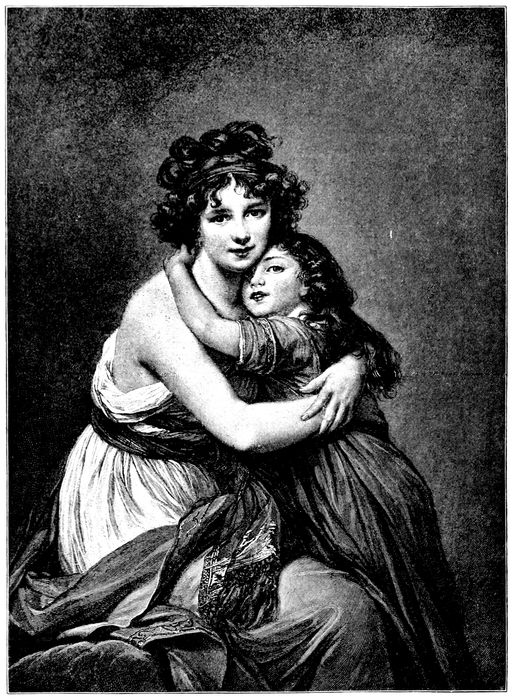
MARIE S. LeBRUN WITH HER DAUGHTER. After her own painting.
235The 18th Century produced two women artists, who were among the leaders of their time: Angelica Kauffmann and Marie LeBrun. Angelica Kauffmann, the daughter of an artist, was born in 1740 at Coire in Switzerland, from where she went later on to Italy, to study the great masters. In 1765 she came to London. Here she painted many excellent portraits as well as numerous classic and allegorical subjects. In 1781 she returned to Italy. Here she was always much feted and admired for her talents as well as for her personal charm. Goethe, who met Angelica Kauffmann in Rome, admired her works very much. “No living painter,” so he wrote in a letter, “excels her in dignity or in the delicate taste with which she handles the pencil.” And Raphael Mengs, one of the most brilliant artists of the Rococo, praised her in the following words: “As an artist Angelica Kauffmann is the pride of the female sex in all times and all nations. Nothing is wanting; composition, coloring, fancy, all are here.” When she died in November, 1807, she was honored by a splendid funeral under the direction of Canova. The entire Academy of St. Luke at Rome with numerous ecclesiastics and virtuosi followed her funeral train and, as at the burial of Raphael, two of her latest paintings were carried behind her coffin in the procession.
Of Madame LeBrun, who was born in 1755 in France, it has been said that “a more ideal artist never lived.” The well-known portrait of herself and her daughter has been termed “the tenderest of all pictures.” She also painted several portraits of the unfortunate Queen Marie Antoinette. The Louvre has one of her best paintings: “Peace bringing back Abundance.”
Madame LeBrun was one of the most prolific artists of all times. In her autobiography, entitled “Souvenirs,” she states that she finished six hundred and sixty-two portraits, fifteen large compositions, and two hundred landscapes, the latter sketched during her travels in Switzerland and England.
During the 18th Century Germany was the scene of the greatest activity of women artists. France held the second place and Italy the third, thus reversing the conditions of preceding centuries. Flanders and Antwerp too were famous for women artists, some of whom went to other countries where they were recognized for their talent and attainments.
The most famous woman artist of the 19th Century was Rosa Bonheur, born in 1832 at Bordeaux, the daughter of Raymond Bonheur, an artist of merit. From him she received her first instructions. In 1841 she began exhibiting in the Paris Salon, with several small animal paintings, indicating the direction in which she was to attain her future eminence. Her great success in painting animals was due to her conscientious study of living subjects. One of her masterpieces, “Plowing with Oxen,” ranks among the gems of the Luxembourg. Another excellent painting, “The Horse Fair,” was the chief attraction of the Paris Salon in 1853, and later on became the property of the New York Metropolitan Museum of Art. Of all animal paintings ever executed, this one is perhaps the most animated, and the best in composition as well as in color. Another canvass, “Horses Threshing Corn,” shows the same merits. Containing ten horses in full life size, it is the largest animal picture ever produced.
236
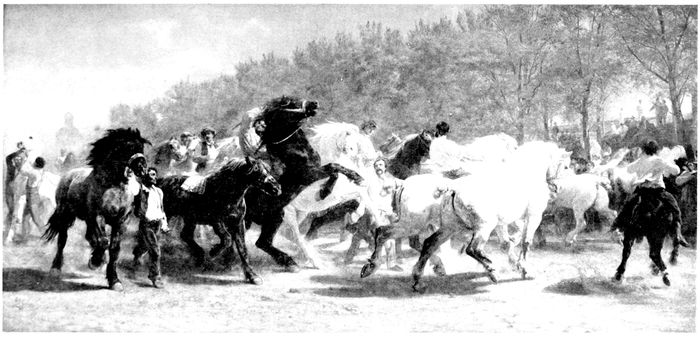
THE HORSE FAIR. After the painting by Rosa Bonheur in the New York Metropolitan Museum of Art.
237Another painting, “The Monarch of the Glen,” received much praise at the World’s Columbian Exposition.
In just appreciation of her genius Rosa Bonheur was proposed in 1853 for the Cross of the Legion of Honor, but because of her sex the decoration was withheld until 1865.—
One of the four daughters of an early German pioneer of California, who distinguished themselves in different lines of activity, Anne Elizabeth Klumpke followed in the footsteps of Rosa Bonheur, of whom she became a close friend, and who, in appreciation of her great talent, bequeathed to her her beautiful chateau as well as her entire fortune.
The second half of the 19th and the beginning of the 20th Century produced a surprising abundance of women artists, some of whom gained the most coveted prizes and medals offered by the great annual exhibitions in Paris, London, Berlin, Munich and other centers of art. Clara Erskine Clemens in her book “Women in the Fine Arts” has compiled notes about several hundred of them, without enumerating them all. To mention a few of the most excellent, we name of the German artists Louise Parmentier Begas, Tina Blau, Dora Hitz, Lucia von Gelder, Herminie von Janda, Countess Marie Kalckreuth, Minna Stock, Toni Stadler, Frieda Ritter, Margarethe von Schack, Vilma Parlaghy, and Margarethe Waldau.
Italy names among its best modern painters Alceste Campriani, Ada Negri, Juana Romani, Erminia de Sanctis, and Clelia Bompiani.
The French extol the genius of Louise Labé, Marceline Desbordes-Valmore and Louise Ackermann.
Belgium and Holland number among their women artists Therese Schwartze, Adele Kindt and Henriette Ronner; Spain points with pride to the works of Fernanda Frances y Arribas, Adele Gines and Antonia de Banuelos. Denmark’s famous artist, Elizabet Jerichau Baumann, is remembered especially for her magnificent painting “Christian Martyrs in the Catacombs”; Switzerland has two portraitists of the first order, Louise Catherine Breslau and Aimée Rapin, while Russia produced in Marie Bashkirttseff an artist of rare ability.
Perhaps in no other country is the number of female artists so large as in England. We will name only a few of them. Laura Alma Tadema was the gifted daughter of the famous artist Laurenz Alma Tadema. Margaret Sarah Carpenter 238won wide reputation as a gifted portrait painter. Ethel Wright’s beautiful painting “The Song of the Ages” belongs to the best examples of English art. Clara Montalba is favorably known for her splendid scenes of Venice, and landscapes of the Adriatic coasts. Elizabeth Thompson demonstrated by many excellent sketches and pictures that women are not afraid to make a specialty of battle scenes.
Ambitious American women are likewise hard at work gaining honor and laurels in the various fields of art. The morning promises fair, as there are already many shining names upon the scroll. To begin with one of the middle of the last century, we mention Cornelia Adele Facett, whose chief work, “The Election Commission in Open Session,” contains 258 portraits of men and women, prominent in the political, literary, scientific and social circles of their time. It adorns the Senate Chamber in the Capitol at Washington.
The most brilliant woman artist of the United States is without question Cecilia Beaux, a Philadelphian, who, as a portrait painter, compares with the very best of any nation. Her portrait of a “Girl in White,” owned by the Metropolitan Museum of Art in New York, verifies what a critic said about her: “Miss Beaux has approached the task of painting the society woman of to-day, not as one to whom this type is known only by exterior, but with a sympathy as complete as a similar tradition and artistic temperament will allow. Thus she starts with an advantage denied to all but a very few American portrait painters, and this explains the instinctive way in which she gives to her pictured subjects an air of natural ease and good breeding.”
Sadie Waters, born in St. Louis, produced a number of religious paintings, her best and largest showing the Madonna in a bower of roses.
Violet Oakley of New Jersey had a prominent part in decorating the new Capitol at Harrisburg, Pennsylvania, one of the most elaborate and costly public buildings in America. The mural painting “The Romance of the Founding of the State” in the Governor’s room is her work.
Anna Mary Richards excelled as a marine painter. Her large canvass “The Wild Horses of the Sea” has been especially admired.
Anny Shaw, Grace Hudson, Lucie Fairchild Fuller, Mary Cassatt, and Matilde Lotz are among the latest women artists of America, favorably known for many creditable works.
Although comparatively few women have devoted themselves to sculpture, there are several among them well worth mentioning.
The first female sculptor of whom anything is known, was Sabina von Steinbach, a daughter of Erwin von Steinbach, 239the famous architect of the magnificent cathedral at Strassburg, in Alsace. After the southern portal of this minster had been erected, Sabina adorned it with the statues of the apostles, one of which, that of John, held in his hands a scroll with the following inscription:
“Gratia divinæ pietatis adesto Savinæ,
De petra dura per quam sum facta figura.”
“The grace of God be with thee, O Sabina,
Whose hands from this hard stone have formed my image.”
Nothing further is known about this artist of the end of the 13th Century.
Properzia de Rossi was an Italian woman sculptor, born near the end of the 15th Century at Bologna or Modena. The first-named city cherishes still a number of her works, among them a fine marble statue of Count Guido de Pepoli, and several figures that adorn the three gates of the facade of St. Petroneus. Vasari in his biographies of celebrated artists calls her “a virtuous maiden, possessing every merit of her sex, together with science and learning all men may envy.” And when she died in 1530, the following epitaph was written in her praise:
Fero splendor di due begit occhi accrebbe
Gia marmi a marmi; e stupor nuovo e strano
Ruvidi marmi delicta mano
Fea dianzi vivi, ahi! morte invidia n’ebbe.
In modern Germany Anna von Kahle, Marie Schlafhorst, Dora Beer, Helene Quitmann, Henny Geyer Spiegel and Lilly Finzelberg have done much excellent work.
In France several statues by Jeanne Hasse, a Parisian, have been purchased by the government and presented to various provincial museums.
In England Mary Thornycroft, daughter and pupil of John Francis, the sculptor, has won the praise of the severest critics.
In America Annie Whitney’s statue of “Lady Godiva” as well as her “Africa” and “Roma” have been much praised.
Helen Farnworth Mears is well known for her “Fountain of Life.” Vinnie Ream Hoxie modelled a life-size statue of Lincoln, which stands in the rotunda of the Capitol at Washington. A statue of Farragut in Farragut Square is by the same artist.
Another American woman sculptor of renown was Harriet Hosmer, born in 1830 in Watertown, Mass. Having received her first instruction in Boston and St. Louis, she went to Rome in 1852 where she became a pupil of Gibson. Of her various works, the best known are “Beatrice Cenci in Her Cell”; “Willo’-the-Wisp”; 240“The Sleeping and the Waking Faun”; and a colossal statue of “Zenobia, Queen of Palmyra, in Chains.” She exhibited a statue of Queen Isabella of Spain at the World’s Columbian Exposition. A statue of “Puck” was so spirited and original, that it was ordered more than thirty times, is also her work.
Emma Stebbins (1815–1882) produced a statue of Horace Mann for Boston, and a large fountain for Central Park, New York, the subject being “The Angel of the Waters.”
The Metropolitan Museum of Art in New York has in its collections several works by Frances Grimes, Laura Gardin, Malvina Hoffman, and Evelyn Longman. Miss Hoffman’s best known work, “The Russian Bachanale,” showing two almost nude dancing figures in bronze, was in 1919 presented by an American connoisseur to the famous Gardens of the Luxembourg in Paris.
The United States of America produced also the first women architects. In 1881 Louise Bethune took the lead. Somewhat later the New York firm Hands & Gannon, both members of which were women, designed the plans for numerous schools, hospitals, and model homes for the working people. Elizabeth Holman in Philadelphia became favorably known for her excellent designs for theatres, hotels, and cottages. Mrs. Wagner in Pittsburgh made a specialty of university buildings, churches and chapels.
Miss Sophie G. Hayden of Boston, a graduate of the architectural school of the Massachusetts Institute of Technology, was the architect of the beautiful Women’s Pavilion at the World’s Columbian Exposition. The task of adorning this building with sculptures, emblematic of woman’s great work in the world, was after an extremely vigorous contest awarded to Miss Alice Rideout, of San Francisco. Women architects likewise designed the imposing woman’s palaces at the expositions in St. Louis, Atlanta, and San Francisco. Since then the number of women in this line of activity has steadily increased. According to the Census of 1910 the United States had in that year 1037 women architects, designers and draftsmen.
Thus we find woman hard at work in all the various realms of art. And since her joy in beauty is supreme, we may well expect that her expression of the highest beauty, the spiritual, will in time favorably compare with that of her brother-artists.
241
GREAT MONUMENTS OF WOMAN’S PHILANTHROPY.
Woman and philanthropy have always been inseparably connected, for charity has been regarded in all ages as one of the noblest virtues of the gentle sex.
There is scarcely any country which does not cherish the memory of some women for great works of charity. Germany, for instance, has the lovely story of Elizabeth, the wife of Ludwig IV., landgrave of Thuringia, who reigned during the first half of the 13th Century. Feeling an aversion to worldly pleasures, and making the early Christians her example, Elizabeth devoted herself to works of benevolence. In these she was so liberal, that her husband became uneasy, fearing she might impoverish his estate by her alms-giving. He accordingly bade her to give less to the poor. But secretly she spent just as much. One day, while she was carrying a heavy load of bread in her basket, she was stopped by her husband, who inquired what she was hiding. “Roses, my Lord, roses!” she said, hoping that he would not investigate. But when he insisted on seeing them, she was forced to open her basket and, oh wonder! all the loaves of bread had turned into the most beautiful roses.—
America remembers Dorothea Dix as one of the most distinguished women it ever has produced. Compelled by declining health to go to Europe from 1834 to 1837, she had ample opportunity to study in Liverpool and other cities of England the terrible conditions of the poor, especially of the inmates of poor-houses and insane-asylums. As at that time similar institutions in America were just as bad, she gave after her return to the United States all her time, strength and influence to ameliorate suffering, and to persuade the public to furnish suitable asylums, also to improve the moral discipline of prisons and penitentiaries. For this purpose she visited every State east of the Rocky Mountains, seeking out intelligent and benevolent people, and trying to kindle in their hearts the same enthusiasm that filled her own.
Fearless in lifting her voice against abuses, she was so persistent in reiterating her protests and in pleading needed reforms, that attention had to be given her. The founding of many state hospitals and insane-asylums in the United States as well as in Nova Scotia and Newfoundland is due to her indefatigable work.
A similar case is that of Margaret Fuller, the famous author. Warmly espousing the cause of reform in many directions and making herself the champion of truth and human rights at any cost, she visited prisons and charitable 242institutions and talked freely with the female inmates. It was on the common ground of womanhood that she approached these degraded of her own sex, true to her unalterable faith in awakening whatever divine spark might be there. She was surprised herself at the results—the touching traits and the possibilities that still survived in beings so forlorn and degraded. Many of them expressed a wish to see her alone, in order to confide to her the secrets of their ruined lives, and their ardent desire to enter a new course whereby they might regain respectability. Thus making herself the friend of the friendless, Margaret Fuller began what we call to-day “settlement work.”
In the matter of prison reform the name of Elizabeth Guerney Fry (1780–1845) will likewise be remembered as one of the first women promoters in this line of charity. An accidental visit to Newgate Prison in London disclosed to her the horrible conditions prevailing in this ill-reputed dungeon. Like most prisons at the time it was dark, damp, and cold in winter. The prisoners were usually half-starved, and clad in rags; often loaded with chains, and oftener yet pestered by vermin and rats. The ward, into which Miss Fry penetrated, although strongly dissuaded by the officials, was like a den of wild beasts. It was filled with a hundred and sixty women and children, gambling, fighting, swearing, yelling, dancing. It justly deserved its name of “hell above ground.” The general disorder and abject misery of the women confined there so impressed Miss Fry, that she took immediate and effectual means to relieve them. The first step in the great public work of her life was the forming of “The Association for the Improvement of the Female Prisoners in Newgate,” in April, 1817. Its aim was the establishment of what is now regarded as “prison discipline,” such as entire separation of the sexes, classification of criminals, female supervision for the women, and adequate provision for their religious and secular instruction, as also for their useful employment. Disregarding sarcastic critics, who protested against the “ultra-humanitarianism which sought to make jails too comfortable and tended to pamper criminals,” Miss Fry pursued her way and finally brought about the passing of Acts (1823–24), in which it was laid down that over and above safe custody it was essential to preserve health, improve morals, and enforce useful labor in all prisons. Not content with these results, Miss Fry likewise inspected during the time from 1818 to 1841 the principal prisons of Scotland, Ireland, France, Switzerland, Belgium, Holland, Southern Germany, and Denmark, everywhere conferring personally with the leading prison officials. By keeping up a constant correspondence with them she had the satisfaction of hearing from almost 243every quarter of Europe that the authorities were giving an ever increasing consideration to her suggestions.—
Following the example set by Miss Fry, women in many countries aided in forming societies for the improvement of prison-discipline. They also established reformatories for women and juvenile delinquents. For instance Mrs. Abbey Hopper Gibbons assisted in founding the “Women’s Prison Association of New York” in 1844 and the “Isaac T. Hopper Home.” Its objects were: “First, the improvement of the condition of the prisoners, whether detained on trial or finally convicted, or as witnesses; secondly, the support and encouragement of reformed convicts after their discharge, by affording them an opportunity of obtaining an honest livelihood, and sustaining them in their efforts to reform.”