Women in Modern Times. (continued 2)
Reading edition

159
WOMAN’S ENTRY INTO INDUSTRY.
Since the stirring years of the American War of Independence and of the French Revolution the question of woman’s rights and woman suffrage has remained constantly before the public. Its significance greatly increased when with the invention of steam-engines, with the rapid growth and extension of trade and commerce, and with the introduction of modern methods all conditions of industrial life likewise became revolutionized. Many of those industries in which women participated, were transferred from the homes to factories, where the workmen and women were placed at machines, producing within one day greater quantities of goods than the laborers formerly had manufactured within weeks or months.
With this industrial revolution came, however, also many evils. The laborers remained no longer masters of their own time and efforts. While hitherto they had been the owners of their little industry, now the factory owners and the great industries began to own them. They found themselves bound by strict rules, not of their own making, but prescribed and enforced by their employers, many of whom had not the slightest consideration for the people that worked for them. Just as soulless as their machines, and thinking only of gain, they abused their employees wherever possible, and in doing so often resorted to the meanest tricks.
Nowhere did such evils become so appalling as in England, where the politicians subordinated all other considerations to industry. It was here that in order to reduce the small wages of the workman cheap woman- and child-labor was first introduced on a large scale, and feeble, defenseless creatures, without experience and organization, were subjected to the most cruel oppression and exploitation.
At the end of the 18th and during the first half of the 19th Century large numbers of women and pauper children were shipped from the agricultural districts of Southern England to the northern districts to work in the factories which had been established there in consequence of the superior water-power.
Tender women and girls, and even children from six to ten years were placed in cotton mills, where they were compelled to work in overcrowded rooms thirteen to fourteen hours daily. Robert Mackenzie in his book “The Nineteenth Century,” p. 77, states, that the accommodations provided for these people were of the most wretched nature. “If such children became over-tired and fell asleep they were flogged. Sometimes through exhaustion they fell upon the machinery 160and were injured—possibly crushed,—an occurrence which caused little concern to any except the mothers, who had learned to bear their pangs in silence. These children, who were stunted in size and disposed to various acute diseases, were often scrofulous and consumptive.”
The Encyclopædia Britannica, in an article on Socialism, describes the conditions of the working people in England at that time as follows: “The English worker had no fixed interest in the soil. He had no voice either in local or national government. He had little education or none at all. His dwelling was wretched in the extreme. The right even of combination was denied him. The wages of the agricultural laborer were miserably low. The workman’s share in the benefits of the industrial revolution was doubtful. Great numbers of his class were reduced to utter poverty and ruin by the great changes consequent to the introduction of improved machinery; the tendency to readjustment was slow and continually disturbed by fresh change. The hours of work were mercilessly long. He had to compete against the labor of women, and of children brought frequently at the age of five or six from the workhouses. These children had to work the same long hours as the adults, and they were sometimes strapped by the overseers till the blood came. Destitute as they so often were of parental protection and oversight, with both sexes huddled together under immoral and unsanitary conditions, it was only natural that they should fall into the worst habits and that their offspring should to such a lamentable degree be vicious, improvident, and physically degenerate.”
A report, delivered at the “International Congress of Women,” held in July, 1899, at London, states that the weak legs of those children, which were not strong enough to support the body for hours, were sustained by boots of wood and lead, in which they were obliged to stand. Hence the high scale of mortality among the children.
Most revolting conditions prevailed in the English coal mines. Married women, girls and children worked here, harnessed to trucks and nearly naked, dragging on their hands and knees loads of coal through long low galleries to the pit mouth.
When some philanthropists made complaints about these conditions, Parliament instituted a commission to inquire into the state of working women in these mines and the wages paid them. From its official report we quote the following: “Betty Harris, one of the numerous persons examined, aged thirty-seven, drawer in the coal-pit, said: ‘I have a belt around my waist and a chain between my legs to the truck, and I go on my hands and feet. The road is very steep and we 161have to hold by a rope, and when there is no rope, by anything we can catch hold of. There are six women and about six boys and girls in the pit I work in; it is very wet, and the water comes over our clog-tops always, and I have seen it up to my thighs; my clothes are always wet.’—
“Margaret Hibbs, aged eighteen, said: ‘My employment after reaching the wall-face (the place where the coal is broken) is to fill my bagie or stype with two and a half or three hundred-weight of coal; I then hook it on to my chain and drag it through the seam, which is from twenty-six to twenty-eight inches high, till I get to the main road, a good distance, probably two hundred to four hundred yards. The pavement I drag over is wet, and I am obliged at all times to crawl on my hands and feet with my bagie hung to the chain and ropes. It is sad, sweating, sore and fatiguing work, and frequently maims the women.’
“Robert Bald, the government coal-viewer, stated: In surveying the workings of an extensive colliery underground a married woman came forward groaning under an excessive weight of coal, trembling in every nerve, and almost unable to keep her knees from sinking under her. On coming up she said in a plaintive and melancholy voice: ‘Oh sir, this is sore, sore, sore work!’
“And a sub-commissioner said: ‘It is almost incredible that human beings can submit to such employment—crawling on hands and knees, harnessed like horses, over soft, slushy floors, more difficult than dragging the same weight through our lowest sewers.’”—
Mackenzie, in his above mentioned book, states that “there was no machinery in these English coal-pits to drag the coal to the surface, and women climbed long wooden stairs with baskets of coal upon their backs. Children of six were habitually employed. Their hours of labor were fourteen to sixteen daily. The horrors among which they lived induced disease and early death. Law did not seem to reach to the depths of a coal-pit, and the hapless children were often mutilated and occasionally killed with perfect impunity by the brutalized miners among whom they labored.”
Other authorities state that the women were paid less than 20 cents per day! For the same kind of work men got three times as much pay; but the employers preferred girls and women to do the work “because of their lower wages and greater docility!” In the iron districts of the Midlands women earned for very hard work 4 to 5 shillings a week, (=$1.25) while the men received 14 shillings.
These small wages, which forced upon the laborers the most barren mode of living, were, however, taken away again from them through the meanest tricks, devised by the 162employers particularly through the so-called Truck System. Under this abominable system the employers, instead of paying the wages in cash, forced their employees to take checks or orders, redeemable in all kinds of necessities and goods, but valid only in those “truck stores” or “tommy shops” run by the employers, or in which they had an interest. By cheating the workmen with goods of inferior quality, by overcharging them at the same time, by pressing them to take goods far beyond their need and wages, and by making long intervals—often from 40 to 60 days—between the real pay days, they forced the laborers into debt and absolute slavery.
The situation of many thousands of those women who tried to make a living as seamstresses was also desperate. Always put off with wages far below the demands of a modest existence, they were real martyrs of labor. Thomas Hood, one of the foremost English poets of the first half of the 19th Century, gave in his famous “Song of the Shirt” a most touching picture of such woman’s toil and misery, of woman in her wasted life and in her hurried death. His poem reads:
With fingers weary and worn,
With eyelids heavy and red,
A woman sat, in unwomanly rags,
Plying her needle and thread—
Stitch! stitch! stitch!
In poverty, hunger and dirt,
And still with a voice of dolorous pitch,
She sang the “Song of the Shirt!”
“Work! work! work!
While the cock is crowing aloof!
And work—work—work,
Till the stars shine through the roof!
It’s Oh! to be a slave
Along with the barbarous Turk,
Where woman has never a soul to save,
If this is Christian work!
“Work—work—work
Till the brain begins to swim;
Work—work—work
Till the eyes are heavy and dim!
Seam, and gusset, and band,
Band, and gusset, and seam,
Till over the button I fall asleep,
And sew them on in a dream!
163“Oh, Men, with Sisters dear!
Oh, Men, with Mothers and Wives!
It is not linen you’re wearing out,
But human creatures’ lives!
Stitch—stitch—stitch,
In poverty, hunger, and dirt,
Sewing at once, with a double thread,
A Shroud as well as a Shirt.
“But why do I talk of Death?
That Phantom of grisly bone,
I hardly fear his terrible shape,
It seems so like my own,
Because of the fasts I keep;
Oh, God! that bread be so dear,
And flesh and blood so cheap!
“Work—work—work!
My labor never flags;
And what are its wages? A bed of straw,
A crust of bread—and rags.
That shatter’d roof—and this naked floor—
A table—a broken chair—
And a wall so blank, my shadow I thank
For sometimes falling there!
“Work—work—work!
From weary chime to chime,
Work—work—work—
As prisoners work for crime!
Band, and gusset, and seam,
Seam, and gusset, and band,
Till the heart is sick, and the brain benumb’d
As well as the weary hand.
“Work—work—work,
In the dull December light,
And work—work—work,
When the weather is warm and bright—
While underneath the eaves
The brooding swallows cling,
As if to show me the sunny backs
And twit me with the spring.
“Oh! but to breathe the breath
Of the cowslip and primrose sweet—
With the sky above my head,
And the grass beneath my feet,
For only one short hour
To feel as I used to feel,
Before I knew the woes of want
And the walk that costs a meal.
164“Oh! but for one short hour!
A respite however brief!
No blessed leisure for Love or Hope,
But only time for Grief!
A little weeping would ease my heart,
But in their briny bed
My tears must stop, for every drop
Hinders needle and thread!”
With fingers weary and worn,
With eyelids heavy and red,
A woman sat in unwomanly rags,
Plying her needle and thread thread—
Stitch! stitch! stitch!
In poverty, hunger, and dirt,
And still with a voice of dolorous pitch,
Would that its tone could reach the Rich!
She sang the “Song of the Shirt!”
Constantly struggling with want and poverty and seeing health menaced by the machines, the working classes of England were filled with bitterness, when they found that their complaints brought no relief, while the law-makers, sitting in Parliament, favored any demands of the employers and of the big interests. To forget for a few hours their hopeless existence, large numbers of men and women resorted to liquor, hereby hastening their final collapse and ruin.
Such was the life led by English laborers during the greater part of the Nineteenth Century. Feeble attempts to improve these deplorable conditions were made through a series of “Factory Acts,” the immediate cause for which was the fearful spread of epidemic diseases which wrought dreadful havoc among the laborers, especially among the women and children. If we glance over these factory acts, as they are sketched in the Encyclopædia Britannica, we find that even under these acts children below the age of nine were permitted in silk factories, and that they were required to work twelve hours a day, exclusive of an hour and a half for meal times. An act of 1833 provided that young persons from thirteen to eighteen and women were restricted to 68 hours a week. Ten years later a mining act was passed which prohibited underground work for children under ten and for women. In 1867 the Workshop Regulation Act fixed the working day for children from 6 a. m. to 8 p. m. = 14 hours, and for young persons and women from 5 a. m. to 9 p. m. = 16 hours! After having made such sad disclosures, the Encyclopædia Britannica dared to say: “By these various enactments the state has emphatically taken under its protection 165the whole class of children and young persons employed in manufacturing industries. It has done this in the name of the moral and physical health of the community.”
The despicable methods employed by the British mine and factory owners in their dealings with the working classes spread to the Continent as well as to America. In France, Germany and Austria they led to those desperate struggles between capital and labor, out of which was born that most remarkable movement of the 19th Century called “Socialism.”
In the United States soon enough attempts were made to imitate the detestable methods of the British mine and factory owners. But as the character of the population was quite different, the abuse of the working men and women never became so appalling as in Great Britain.
The first industry to be established in factories was the weaving of cotton in the New England States, where a number of rapid streams, among them the Merrimac, the Connecticut and the Housatonic, furnished excellent water-power. And as during the pioneer and colonial times the housewives and daughters had spun and woven all the cloth and linen for family use, there was an ample number of expert workers at hand. After the first weaving machines were brought over from Europe, in 1814, Dover, Lowell, Waltham, Great Falls and Newmarket became the principal centers of the cotton industry.
Here the daughters of the farmers and settlers did the work that formerly their mothers had done at home. Only they did it faster, by tending the machines all day long. At first the girls did not know that the employers might try to make the people in the factories work longer hours without any rest and adequate pay. Soon enough they found this out. But as the girls had inherited the independent spirit of their fathers and grandfathers, trouble began to brew. In December, 1828, four hundred girls in Dover, New Hampshire, formed a procession and marched out of the factory, in order to show their indignation at the growing oppression by their employers. They clad their complaints in verses, one of which ran:
“Who among the Dover girls could ever bear
The shocking fate of slaves to share!”
Unorganized as they were at that time, they did not succeed in gaining all they desired. But five years later they walked out again, eight hundred strong, adopting resolutions stating that they had not been treated as “daughters of freemen” by their employers and the unfriendly newspapers. At the same time in Lowell, Mass., at a signal given by a Dover 166girl, two thousand girls, who had formed a “Factory Girls’ Association,” joined in a sympathy strike, marched around town and issued the following proclamation:
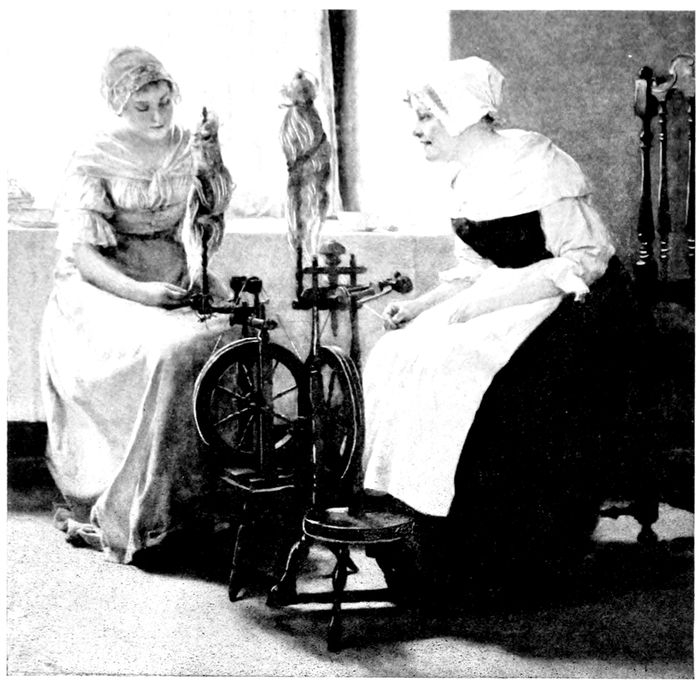
SPINNERS IN THE COLONIAL TIMES. After a painting by Carl Marr, now in the Metropolitan Museum of Art, New York.
“Union Is Power.”
“Our present object is to have union and exertion, and we remain in possession of our own unquestionable rights. We circulate this paper, wishing to obtain the names of all who imbibe the spirit of our patriotic ancestors, who preferred privation to bondage and parted with all that renders life desirable—and even life itself—to produce independence for their children. The oppressing hand of avarice would enslave us, and to gain their object they very gravely tell us of the pressure of the times; this we are already sensible of and deplore it. If any are in want of assistance, the ladies will be compassionate and assist them, but we prefer to have the disposing of our charities in our own hands, and, as we 167are free, we would remain in possession of what kind Providence has bestowed upon us, and remain daughters of freemen still.
“All who patronize this effort we wish to have discontinue their labor until terms of reconciliation are made.
“Resolved. That we will not go back into the mills to work unless our wages are continued to us as they have been.
“Resolved, That none of us will go back unless they receive us all as one.
“Resolved, That if any have not money enough to carry them home they shall be supplied.
“Let oppression shrug her shoulders,
And a haughty tyrant frown,
And little upstart Ignorance
In mockery look down.
Yet I value not the feeble threats,
Of Tories in disguise,
While the flag of independence,
O’er our noble nation flies.”
In 1843 the girls in the cotton mills of Pittsburg, Pa., whose working hours had been from five o’clock in the morning till a quarter of seven in the evening, rebelled also, when their employers attempted to increase the time one hour each day without extra pay. Two years later they co-operated with the factory girls of New England, concurring in the proposal to “declare their independence of the oppressive manufacturing power” unless the work day was limited to ten hours.
The policy of these fighters for better conditions is outlined in the constitution of the “Lowell Female Labor Reform Association,” which had been organized in 1845. Article IX says:
“The members of this association disapprove of all hostile measures, strikes and turn-outs until all pacific measures prove abortive, and then that it is the imperious duty of everyone to assert and maintain that independence which our brave ancestors bequeathed to us and sealed with their blood.”
The spirit of these working women is likewise shown in the preamble adopted at the annual meeting of the association in January, 1846. It reads:
“It now only remains for us to throw off the shackles which are binding us in ignorance and servitude and which prevent us from rising to that scale of being for which God designed us. With the present system of labor it is impossible. There must be reasonable hours for manual labor and a just portion of time allowed for the cultivation of the mental and moral faculties, and no other way can the great work be 168accomplished. It is evident that with the present system of labor the minds of the mass must remain uncultivated, their morals unimproved. Shall we, operatives of America, the land where democracy claims to be the principle by which we live and by which we are governed, see the evil daily increasing which separates more widely and more effectually the favored few and the unfortunate many without one exertion to stay the progress? God forbid! Let the daughters of New England kindle the spark of Philanthropy in every heart till its brightness shall fill the whole earth.”
Not satisfied with securing thousands of signatures of factory operatives, who petitioned the legislature for a ten-hour day, prominent members of the union went before the Massachusetts legislative committee early in 1845 and testified as to the conditions in textile mills. This was the first American governmental investigation of labor conditions, and it was due almost solely to the petitions of the working women. About the same time the union appointed a committee to investigate and expose false statements published in newspapers concerning the factory operatives. Nor was this all. In their work of publicity they did not hesitate to call public men to account for assailing or ignoring their movement.
The chairman of the legislative committee, before whom the working girls had testified, was the representative from the Lowell district, and should, therefore, have shown special interest in the complaints of the girls. Instead, he had treated them in a high-handed manner, withholding at the same time from the Legislature some of the most important facts presented by the Lowell girls. The latter expressed their just indignation in the following resolution, which was circulated before the elections of that year:
“Resolved, That the Female Labor Reform Labor Association deeply deplore the lack of independence, honesty and humanity in the committee to whom were referred sundry petitions relative to the hours of labor, especially in the chairman of that committee; and as he is merely a corporation machine, or tool, we will use our best endeavors and influence to keep him in the “City of Spindles,” where he belongs, and not trouble Boston folks with him.”
That the “endeavors” of the girls met with full success is evident from a second resolution published after election day:
“Resolved, That the members of this association tender their grateful acknowledgments to the voters of Lowell for consigning William Schouler to the obscurity he so justly deserves for treating so ungentlemanly the defense made by the delegates of this association before the special committee of the legislature, to whom was referred petitions for the 169reduction of the hours of labor, of which he was chairman.”
The result of all this agitation against long hours of work was that in 1847, 1848, and 1851 the first ten-hour laws were passed in New Hampshire, Pennsylvania and New Jersey.
The success, won by the textile workers, inspired women workers in the tailoring and sewing trade, in the manufacture of shoes, cigars, and other necessities to similar efforts. In the tailoring and sewing trade wages were extremely low, as sweat-shop conditions existed from the beginning, and the trade was overcrowded.
In 1845 New York City alone had over 10,000 sewing women, the majority of whom worked from twelve to sixteen hours a day to earn only from two to three dollars a week!
As similar conditions prevailed in other occupations, the number of poorly paid women wage-earners in New York City in 1865 was between 50,000 to 70,000, of whom 20,000 were in a constant fight with starvation, and of whom 7,000 lived in cellars. Their situation grew from bad to worse, as at the same time that they were falling into a state of physical and mental deterioration, the improvements in many machines made greater and greater demands on the capability of those who were operating them.
Thus the situation became such as was sketched by W. I. Thomas in an article written some fifteen years ago for the “American Magazine,” in which he said:
“The machine is a wonderful expression of man’s ingenuity, of his effort to create an artificial workman, to whom no wages have to be paid, but it falls just short of human intelligence. It has no discriminative judgment, no control of the work as a whole. It can only finish the work handed out to it, but it does this with superhuman energy. The manufacturer has, then, to purchase enough intelligence to supplement the machine, and he secures as low a grade of this as the nature of the machine will permit. The child, the woman and the immigrant are frequently adequate to furnish that oversight and judgment necessary to supplement the activity of the machine, and the more ignorant and necessitous the human being the more the profit to the industry. But now comes the ironical and pitiful part. The machine which was invented to save human energy, and which is so great a boon when the individual controls it, is a terrible thing when it controls the individual. Power-driven, it has almost no limit to its speed, and no limit whatever to its endurance, and it has no nerves. When, therefore, under the pressure of business competition the machine is speeded up and the girl operating it is speeded up to its pace, we have finally a situation in which the machine destroys the worker.”
170The rapidly increasing misery among such exhausted women workers aroused public attention and led to the formation of a number of woman’s organizations with the purpose to investigate abuses among such women workers, to teach them the value of trade unions, to agitate equal pay for equal work, to shorten the number of working hours, and to abolish child labor and prison work. The first national women’s trade union, formed in the United States, was that of the “Daughters of St. Crispin.” It held its first convention on July 28, 1869, at Lynn, Massachusetts. The delegates represented not only the local lodges of that state, but also lodges of Maine, New York, Pennsylvania, Illinois, and California.
With the organization of the “Knights of Labor” in 1869, and the “American Federation of Labor” the position of woman in the American labor movement became more firmly established, as both federations made it one of their principal objects “to secure for both sexes equal pay for equal work.” They also appointed special committees to investigate the conditions of working women, and to organize them for concerted action.
Other potent factors arising in this line were the “National Consumers’ League” and the “Women’s Trade Union League.” The founding of the first federation was due to efforts to better the conditions of women in department stores. In 1890 a group of saleswomen of New York City pointed to the fact that girls in fashionable department stores were receiving wages too low to allow them a decent living. They also complained that these girls were forced to stand from ten to fourteen hours a day, and that sanitary conditions in the cloak and lunch rooms were such as to endanger health and life. While the plan of these saleswomen, to unite all women clerks of the city into a labor union, failed, their complaints, however, attracted the attention of a number of influential ladies interested in philanthropic efforts. They investigated the charges against the department stores, and what they discovered made them resolve that conditions demanded radical changes. In May, 1890, they called a mass meeting of prominent women and proposed a constructive plan for raising the standard in shop conditions, not by blacklisting any firm guilty of bad conduct, but by white-listing those firms which treated their employees humanely. “We can make and publish,” so the presiding lady said, “a list of all the shops where employees receive fair treatment, and we can agree to patronize only those shops. By acting openly, and publishing our White List we shall be able to create an immense public opinion in favor of just employers.” In other words, it was by the spirit of praise rather than condemnation 171that these ladies sought to stimulate stores to raise their standards.
Adopting the name “Consumers’ League of New York,” the society organized on January 1, 1891, and published its first White List. It was a disappointingly small one, as it contained the names of only eight firms. Still more disappointing was the indifference of the many hundred other firms toward this reform movement. But soon enough these firms found that the League had also introduced into the New York Assembly a bill which became known as the “Mercantile Employers Bill.” It aimed to regulate the employment of women and children in all mercantile establishments, and to place all retail stores, from the smallest to the largest, under the inspection of the State Factory Department.
Of course the merchants took prompt steps to defeat this obnoxious bill, and they were most complacent when their representatives in the Assembly succeeded in strangling it. But the bill appeared again and again, finally resulting in the appointment of a State Commission for the investigation of the conditions. As Reta Childe Dorr in her book “What Eight Million Women Want” graphically relates, “The findings of this Commission were sensational enough. Merchants reluctantly testified to employing grown women at a salary of thirty-three cents a day. They confessed to employing little girls of eleven and twelve years, in defiance of the child-labor law. They declared that pasteboard and wooden stock boxes were good enough seats for saleswomen; that they should not expect to sit down in business hours, anyhow. They defended, on what they called economic grounds, their long hours and uncompensated overtime. They defended their system of fines, which sometimes took away from a girl almost the entire amount of her weekly salary. They threatened, if a ten-hour law for women under twenty-one years old were passed, to employ older women. Thus thousands of young and helpless girls would be thrown out of employment, and forced to appeal to charity.”
The Senate heard the report of the Commission, and in spite of the merchants’ protests, the women’s bill was passed without a dissenting vote. Its most important provision was the ten-hour limit which it placed on the work of women under twenty-one. The bill also provided seats for saleswomen, and specified the number of seats, one to every three clerks. It forbade the employment of children, except those holding working-certificates from the authorities.
But soon it was found that the smart representatives of the merchants had succeeded in attaching to the bill a so-called “joker,” by which the inspection of the stores was entrusted to the local boards of health. As the officials of 172these boards, supposedly experts, proved, in fact, ignorant of industrial conditions and their relation to health and sanitation, the true objects of the bill could not be enforced. So the Consumers’ League was compelled to wage another tedious war, until it finally succeeded in convincing the Legislature that the inspection of all department and retail stores should be turned over to the State Factory Department. When this was done, there were reported in the first three months of the enforcement of the Mercantile Law over 1200 violations in Greater New York. At the same time 923 under-age children were taken out of their positions as cash girls, stock girls, and wrappers, and sent back to school.
It was natural that the good results and the purely benevolent motives of the Consumers’ League attracted wide attention. Similar Associations were formed in many other cities and states. The movement spread so rapidly, that in 1899 it was possible to organize “The National Consumers’ League,” with branches in twenty-two states.
Encouraged by such success, the league now began to study the working conditions of girls employed in restaurants. It was found that in many cases these conditions were even worse than in the department stores. Girls of twenty years were found working as cooks from 6:30 in the morning to 11:30 at night, with no time off on Sundays or holidays! This meant 119 hours a week, more than twice the time the law permits for factory employees. Other girls, employed as waitresses, were serving every day from 7:30 a. m. to 10:30 p. m., or 105 hours each week! In going back and forth, they walked several miles a day, carrying heavy trays at the same time. In rush hours they worked at a constant nervous tension, for speed is one of their requirements. And they must not only remember a dizzying list of orders, but must fill them quickly and keep their temper under the exactions of the most rasping customer.
Based on such findings, the Consumers’ League of New York caused the framing of a bill by which the hours of women in restaurants were limited to 54 hours weekly, which gave the girls one day of rest in seven, and prohibited their working between 10 p. m. and 6 a. m. In October, 1917, this bill became a law. In a number of other states minimum wage laws have also been secured.
The Consumers’ League of Philadelphia took pains to investigate conditions in the silk mills of Pennsylvania. It was found that besides overwork and underpay there were often other evils, due to an erring as well as inhuman policy on the part of the employers. Like the owners of the department stores many of these men were possessed by the idea that the right to sit down would encourage slow work and 173laziness. Accordingly the girls in these mills were forced to stand from early morning till late at night, day after day, and month after month.
The secretary of the Consumers’ League, who, under an assumed name, worked for some time in various mills, in order to study conditions, wrote:
“The harmful effect of continuous standing, upon young and growing girls, is too well established a fact to require any elaboration. In addition to the permanent ill effects, much immediate and unnecessary suffering, especially in hot weather, is inflicted by the prohibition of sitting. I could always detect the existence of this rule by a glance at the stocking-feet of the workers, and at the rows of discarded shoes beneath the frames. For after a few hours the strain upon the swollen feet becomes intolerable, and one girl after another discards her shoes.”—
Another harsh and very common practice of employers is to cover the lower sashes of the windows with paint, and to fasten them so that they cannot be raised in hot weather. This is done “so that the girls don’t waste time looking out.”
The cruelty of these unnecessary rules is often aggravated by a most amazing lack of the common decencies and necessities of cleanliness.
One of the most difficult tasks of the Consumers’ League was to overcome the absolute unwillingness of storekeepers to compensate their saleswomen for overtime. If it would be possible to compute the amount of such unpaid labor performed after the regular hours in many stores as well as in the bookkeeping and auditing departments, especially during the Christmas season, the sum would be startling indeed. A circular issued by the Women’s Trade Union League of Chicago some years ago stated that the 3000 clerks in only one department store of that city had been required to work during the holiday season overtime to the total amount of 96,000 hours, without receiving any compensation. At the rate of only ten cents an hour these clerks suffered a loss of $9,600, at the rate of 25 cents an hour a loss of $24,000.
The first “Women’s Trade Union League” was organized in 1875 by Mrs. Emma Paterson, the wife of an English trade unionist. While travelling in America, she had observed that women workers of various trades had formed unions, among which the “Umbrella Makers’ Union,” the “Women’s Typographical Union” and the “Women’s Protective Union” were the most prominent. Convinced that the utility of such combinations could be still more increased, Mrs. Paterson, after her return to England, organized a federation of such women’s unions, the “British Women’s Trade Union League,” which 174later on became the model for a similar organization in America. It was founded on November 14th, 1903, for the one main purpose to organize all women workers into trade unions, in order to protect them from exploitation, to help them raise their wages, shorten their hours, and improve sanitary conditions of the work shops. Becoming affiliated with the “American Federation of Labor,” the league gained a splendid victory during the years 1909 to 1911, when a series of huge strikes in the sewing trades spread over the East and the Middle West. Also an agreement was arrived at, that the principle of preference to unionists, first enforced in Australia, should be acknowledged. Under this plan manufacturers, when hiring help, must give to union workers of the necessary qualifications and degree of skill precedence over non-union workers.
At all times ready to express the sentiments and voice the aspirations of those who toil, the “Women s Trade Union League” represents to-day over 100,000 working women. While it has had a wonderful effect in improving standards of wages, hours and sanitary conditions in what was originally an underpaid and unhealthy industry, it also has become the pioneer in another direction, that of education in the labor movement. At the initiative of a group of girls an educational movement was started which has extended into organizations including some half a million workers, men as well as women. In public schools of New York, Philadelphia, Boston, Chicago, Los Angeles, and other cities educators of national reputation are co-operating with teachers and delegates from labor unions in giving lecture courses for adults on such subjects as social interpretation of literature, evolution of the labor movement, problems of reconstruction, social problems, trade unionism and co-operation, etc. At the same time a movement for co-operative housing has been developing. “The New York Ladies’ Waist and Dressmaker’s Union” for instance has bought in 1919 at a cost of several hundred thousand dollars a magnificent summer home for the exclusive use of its members. This “Unity House” at Forest Park, Pennsylvania, has accommodations for 500 guests. Situated at a beautiful lake, surrounded by shady forests and green lawns, provided with tennis courts, a library and reading rooms, it is an ideal recreation ground of first order. The money for this estate was brought up by the 30,000 members of the union, each contributing one day’s wages.
In New York City also a co-operative “Unity House” has been established with quarters for fifty girls. A great extension of this movement in the city is planned. The Philadelphia group of the same union is following these examples and has acquired a fine estate worth $40,000.
175At present the various woman’s organizations of the United States as well as of other countries aim at the following issues:
1.
To limit the working day for women to eight hours.
2.
To demand for women equal pay with men for equal work.
3.
To establish for all the various occupations minimum wage scales, sufficient to grant all women workers an adequate living.
4.
To secure safe and sanitary working conditions, and clinics for the treatment of diseases resulting from certain industrial occupations.
5.
To secure industrial insurance laws.
6.
To secure for all women full citizenship with the right to vote in all municipal and national elections.
As woman’s future position will depend on the realization of these demands, their discussion is of utmost importance.
THE MOVEMENT FOR AN EIGHT-HOUR DAY.
As has been shown in a former chapter, innumerable valuable lives of workmen, women and, in former years, children have been sacrificed through the unreasonable exploitation by employers, who in their greed for profits had lost all consideration for the welfare of their fellow-men. Hundreds of thousands of laborers have been slowly worked to death as no sufficient amount of time for recuperation was granted them.
The only possible excuse for such incredible waste of human lives is that neither the employers nor the law-makers of those bygone days realized that the physical and mental abilities of the large laboring classes belong to the resources of a nation just as truly as do the water-power, the soil, the mineral deposits, the forests, and other natural means. Moreover, nobody was aware of the fact that it is one of the supreme duties of a wise government to guard these resources, so fundamentally necessary to the prosperity of a nation, from unscrupulous exploitation and possible destruction.
The danger of the reckless exploitation of laborers, especially of women workers, has increased considerably with the improvement of many machines, the greater speed and output of which demand far greater attention and strain than before on the part of the men or women operating them.
This is what Newton D. Baker, Secretary of War, said in 1917 at the annual meeting of the National Consumers’ League:
“Machinery has given us one great delusion. People 176have imagined that when a machine was operated by a steam engine or by an electric motor, the steam engine or the electric motor actually did all the work, and the people who were attending it while it operated were more or less negligible. As a consequence, we indulged in the very unfortunate and often fatal belief that unlimited hours of labor were possible because it was the machines which were doing the work. We overlooked the fact, which we have lately begun to appreciate, that the person who tends the power-driven machine is far more susceptible to exhaustion, is far more open to fatigue and to the poisons that affect the system and that come from over-exertion than ever before.”
Mrs. Florence Kelley, the able General Secretary of the National Consumers’ League, who studied woman’s occupation in the sewing trade, states that of late years the speed of the sewing machines has been increased so that girls using these improved machines are now responsible for twenty times as many stitches as twenty years ago, and that many girls and women, not capable of the sustained speed involved in this improvement, are no longer eligible for this occupation. Those who continue in the trade are required to feed twice as many garments to the machine as were required five years ago. The strain upon their eyes is, however, far more than twice what it was before the improvement. In the case of machines carrying multiple needles this is obvious; but it is true of the single needle machines as well.
When a girl cannot keep the pace she is thrown out. A comment frequently made by the girls about such an unfortunate comrade is: “She got too slow. She couldn’t keep up with her machine any longer.” It amounts to this, that the girl can earn a living wage, if she is unusually gifted, until she is worn out.
The nerve strain caused by innumerable rapid-working machines of the present day has become obvious in many cases. As the compressed air-hammer has shattered the nerves of many robust men, so the latest machines used in the sewing and other trades have impaired the health of many women. “Such nerve strain,” says Rheta Childe Dorr, “cannot be regulated. It is a Gordian knot that cannot be untied. The only thing to do is to cut it. The only solution of it is a shortened work-day. This is true for men as well as for women, but, in all probability, not to the same degree. Nerve strain affects men, certainly, and it demands, even in their case, a progressively shortened work-day as an alternative to a progressively shortened work-life. But with women the case becomes infinitely more urgent, infinitely more tragic, in exact proportion as woman’s nervous system is more unstable than man’s and more easily shaken from its equilibrium.”
177The advantages of an eight-hour day with rest at night for women and children have been summed up as follows:
1.—Where the working day is short, the workers are less predisposed to diseases arising from fatigue. They are correspondingly less in danger of being out of work, for sickness is in turn one of the great causes of unemployment.
2.—Accidents have diminished conspicuously wherever working hours have been reduced.
3.—The workers have better opportunity for continuing their education out of working hours. Where they do this intelligently they become more valuable and are correspondingly less likely to become victims of unemployment.
4.—A short working day established by law tends automatically to regularize work. The interest of the employer is to have all hands continuously active, and no one sitting idly waiting for needles, or thread, or materials, or for machines to be repaired. Every effort is bent towards having work ready for every hour of every working day in the year. In unregulated industry, on the contrary, there are cruel alternations of idleness and overwork.
5.—For married women wage-earners it is especially necessary to have the working day short and work regular. For when they leave their workplace it is to cook, sew, and clean at home, sometimes even to care for the sick.—
In the movement for an eight-hour day for the women workers its advocates have already succeeded in Australia, Great Britain, Germany, Denmark, Porto Rico, and Mexico. The eight-hour day has also been secured for all employees of the U. S. Government and for the women and workmen of a large number of the states.
EQUAL PAY FOR EQUAL WORK.
That women are entitled to equal pay with men for equal work, was recognized by the ancient Babylonians five or six thousand years ago. The justice of this demand is so self-evident, that it would hardly seem to need any discussion. Notwithstanding all labor organizations have been compelled to place it on their program, as many factory owners employed the cheaper woman- and child-labor only in order to underbid and reduce the wages of the male laborers. As female laborers have been much more poorly organized than men, they have been less capable of maintaining their claims.
The first equal opportunity and equal pay laws were passed in the State of Washington. In 1890 a section was added to her Labor Laws reading as follows: “Hereafter in this state every avenue of employment shall be open to 178women; and any business, vocation, profession, and calling followed and pursued by men may be followed and pursued by women, and no person shall be disqualified from engaging in or pursuing any business, vocation, profession, calling or employment on account of sex.”
Section 5 of Industrial Welfare Commission of the State of Washington, Order of September 10, 1918, is the first general equal pay law: “That women doing equal work with men in any occupation, trade, or industry in this state shall receive the same compensation therefor as men during work of the same character and of like quantity and quality, the determination of what constitutes equal work to rest with the Industrial Welfare Commission.”
THE MEANING OF THE MINIMUM WAGE.
The interests of every community demand that all workers, male as well as female, shall receive a fair living wage, to save them from pernicious effects upon their health and morals. The dangers to the health of women have been found to be twofold: lack of adequate nourishment and lack of medical care in sickness. Careful investigations as well as statistics have proven that with insufficient wages food is necessarily cut down below the requirements of subsistence, and health inevitably suffers. In order to meet unavoidable expenses for lodging and clothing, workingwomen reduce their diet to the lowest possible point.
On the moral side, authorities agree in the opinion that, while underpayment and the consequent struggle to live may not be the primary cause for entering upon an immoral life, it is inevitably a highly important factor. When wages are too low to supply nourishment and other human needs, temptation is more readily yielded to.
The discovery that inadequate wages menace the morals of women and through them the interests and the good name of the community in which they work, has had much to do with the adoption of minimum-wage laws in America as well as in other parts of the world.
In the United States the first minimum-wage orders were those of the Oregon Industrial Commission, which fixed $8.64 as the legal weekly minimum for manufacturing establishments, and $9.25 for mercantile establishments, in the City of Portland. These rates were based upon the testimony of workers and employers gathered by the Oregon Consumers’ League. The testimony had shown that the prevailing wage for beginners in department stores was $3.00 a week; that nearly half of these girls and women employed were receiving less than $9.00, and that female clerks never received above $10.00 179a week, no matter how long the term of their service.
After learning from the employers what wages were actually paid, the Oregon investigators sought to determine the amount necessary to protect the health and morals of the women workers through an examination of market prices and a careful study of the actual expenditures of the workers. One hundred and sixteen department-store workers furnished the information for the following table of averages:
Living at Home Adrift
Rent $315.51 $118.00
Board 196.25
Carfare 31.20 23.42
Clothing 161.36 139.63
Laundry 24.28 16.27
Doctor and Dentist 29.23 23.82
Lodge and Church 12.19 9.72
Recreation 21.48 36.62
Books, etc. 10.11 6.69
Total Expenses $605.36 $570.42
The total wages received in the average:
Total Wages $459.50 $480.57
Deficit $145.86 $89.85
These figures show that a majority of these women actually received less than it cost them to live.
Investigations carried on in order to find how these women met the difference, disclosed that many of them, whether living at home or boarding, did extra chores in the morning before going to work and after work-hours in the evening. Others went into debt. And still others became “charity girls”—that is, they kept company with “gentlemen friends,” who came up for the balance, sometimes under promise of marriage when these “friends” should feel able to set up a household. That such promises are not always kept and that the girls quite often sink to lower levels, are facts well known.
The first law embodying the principle of the minimum wage was enacted in New Zealand 25 years ago. From there it spread gradually to the other Australian States. In 1896 Victoria, the largest industrial State of Australia, passed the first act providing for special boards to fix minimum wages in different trades. Beginning with a few sweat-shop industries, the movement has grown by successive special acts, until, in 1916, there were about 150 trades or occupations in which minimum wages were set by special wage boards.
180The same general plan was followed by Great Britain in the trade boards act of 1909. This bill, introduced in Parliament by delegates of the English Anti-sweating League and of the National Consumers’ League in January, 1909, was passed and signed in time to take effect at New Years, 1910.
In the United States, up to the end of 1918, minimum-wage laws had been enacted in Arizona, Arkansas, California, Colorado, Kansas, Massachusetts, Minnesota, Nebraska, Oregon, Utah, Washington, Wisconsin and in the District of Columbia, guaranteeing a living wage to women workers, especially in unorganized trades.
EFFORTS TO SECURE SAFE AND SANITARY WORKING CONDITIONS AND CLINICS FOR THE TREATMENT OF DISEASES RESULTING FROM INDUSTRIAL OCCUPATIONS.
When in the industries human power began to be supplanted by steam-driven machines, when competition grew fierce and fiercer, it was found that with the ever increasing speed of the whirling wheels the dangers that threatened the workmen increased enormously. The use of almost every machine has brought with it some peculiar peril, this one crushing a finger or cutting a limb of the person in charge; that one tearing out an arm or killing the operator if for a fraction of a second his thoughts strayed from his work, or if he became drowsy after long hours of work.
It was also found that many persons, engaged in certain occupations, became afflicted by peculiar diseases, unknown before and strictly confined to the persons doing that special work.
According to conservative estimates, of the 38,000,000 wage earners of the United States, in every year 30,000 to 33,000 are killed by industrial accidents. In addition, there are approximately 2,000,000 non-fatal accidents.
Imagine a plain strewn with 35,000 corpses and two million men and women crying out under the pain of severe lacerations, burns, cuts, bruises, dislocations and fractures! Imagine the horrible sight of so many human beings with limbs torn into shreds, with faces having empty eye-holes, with breasts heaving from the effect of poisonous gases! If such numbers of men and women were killed and wounded in one day at one place, the whole world would be terrified, and register the day as the most dreadful in history. But as these losses extend over a whole year and a large territory, our nation takes only slight notice of them, hardly thinking of the fact, that these immense losses and sufferings are terrible 181realities, which affect the economic wealth of our nation as a whole in a very serious way.
These conditions are the more deplorable as the majority of such accidents could be avoided by intelligent and rational methods, as is done in other civilized countries, where the possibilities for successful prevention of accidents have been clearly demonstrated.
Granting that many of such industrial accidents are the result of ignorance, reckless indifference or carelessness, the fact remains that much that could be done in our country for the protection of working people is neglected.
When in Europe with the increase of industries the number of accidents and “professional diseases” swelled in proportion, some philanthropists and economists, interested in the welfare of their fellow-citizens and convinced that every life saved is a national asset, became alarmed and searched for means to prevent such calamities. When in 1855 the first World’s Exposition was held at Paris, it had a special department in which were exhibited inventions for the safety of working people. Later on a permanent “Musée social” was established.
Since then similar institutions have been opened in Berlin, Munich, Vienna, Amsterdam, Brussels, Zurich, Copenhagen, Stockholm, Budapest, Milan, Moscow, and several other places. These museums contain the latest and most select inventions for the restriction of accidents and in the interest of industrial hygiene. And as all exhibits are arranged in separate groups according to the various professions, every manufacturer and every working man and woman can inform himself without loss of time about all new inventions relating to his special trade.
Perhaps the most comprehensive and most scientific of these museums is that of Charlottenburg, a suburb of Berlin. Its wonderfully interesting character is evident from the moment one enters the magnificent building, which occupies a whole city block. There are long rows of figures equipped with the various types of masks and helmets used by miners, divers, fire-fighters, and laborers, working in rooms filled with poisonous gases, dust, or irrespirable smoke. There are all the implements and attachments for the protection of persons working on men-killing machines.
There are casts in plaster and reproductions in wax illustrating all the dreadful skin diseases and deformities of the limbs, by which the laborers engaged in certain industries become afflicted. Other exhibits illustrate what measures should be taken for the improvement of the conditions of the working classes; how to furnish the best nourishment at the lowest cost; how to settle laborers in pleasant colonies, 182and how to treat those, who have become sick or afflicted with industrial diseases.
Among the most important exhibits are the statistics of three institutions provided for all persons employed in workshops and factories.
Germany was first among the nations to recognize the need of reforms in the social conditions of the working classes. Before 1870 wages had been low, and many of the evils that developed in other industrial countries had spread to Germany. Believing that the working classes have a right to be considered by the State the Government in 1881 initiated the era of “State social politics,” which brought about an enormous change in the condition of the working classes. Besides many reforms in regard to the length of the working hours and to women’s and children’s labor, this State socialism provided for three important institutions: first, a compulsory insurance against sickness; second, a compulsory insurance against accidents; third, a compulsory insurance against invalidity and old age.
To the funds of the first class all laborers earning less than 2000 marks a year must pay two-thirds, and the employer one-third of the weekly premiums. In case of sickness, the insured person receives half the amount for twenty-six weeks. Doctors, hospitals and medicines are free. In 1913 14,555,609 laborers, men and women, were protected in this way. Many poor mothers were supported for several weeks before and after confinement. To prevent sickness, especially tuberculosis, the institution supported numbers of sanitariums and recreation homes, where thousands of people, who would otherwise have perished, regained their health.
The insurance fees against accidents had to be paid entirely by the employer. In case of an accident, it was not the employer in whose factory it had happened who was held responsible, but the whole group of employers in the same branch of industry. Every group was compelled to establish an insurance company. In 1913 there were 25,800,000 men and women thus protected. An injured laborer received, during the time of his disability, two-thirds of his wages, also free medical treatment. In case of his death the family received at once fifteen per cent. of his annual wages and an annual support of sixty per cent. As the employers naturally wish to keep the amount of expenses as low as possible, this kind of compulsory insurance greatly stimulated the invention and institution of measures by which accidents may be prevented.
The premiums for the insurance against invalidity and old age were paid half by the employees and half by the employer. Support was given to invalids without regard to age, and to persons above seventy years. To every lawful 183pension the Government contributed 50 marks. In 1914 16,551,500 people were protected by this insurance. In the one year of 1913, the amount distributed among needy people by these three branches of insurance was 775,000,000 marks. The miners of Germany were protected by similar institutions. The splendid results of such compulsory insurance induced the Government to prepare a special insurance for widows and orphans. It may be mentioned that the management of these insurance companies was entirely in the hands of the working classes and the employers.
All in all, the “Permanent Expositions for the Welfare of the Working Classes,” as they exist in Berlin and in other European capitals, demonstrate what intelligent nations can do for the protection and the welfare of their laborers. How many millions of useful lives have been saved by the inventions brought here to the knowledge of the public, and what vast amounts of suffering, sorrow and tears have been averted, we can only guess.
In view of these facts it must be stated that our United States, which of all countries is the greatest in industry and suffers most heavily through industrial accidents and diseases, is among the most backward in regard to social legislation as well as in the effort to interest employers and employees in these welfare institutions which are of such vital value for both parties.
Yes, there was in 1910 a “Museum of Safety” established in New York, but so far it has remained the only one in the entire western hemisphere. And, as it is housed in the lower floors of an insignificant building in 24th Street, it has failed to attract the attention and the support of the masses.
In my opinion, every state should have a permanent museum which brings to public knowledge all inventions relating to the special industries and trades followed by its population. The agricultural states may confine themselves to exhibits by which accidents connected with the pursuit of agriculture can be prevented. The mining states may give preference to everything that increases safety in the mines. The states bordering our oceans and great lakes should collect all devices that make navigation safer; our industrial states must direct their efforts to collect such inventions as may restrict accidents in workshops and factories. If this should be done, and if our governments, legislators and factory inspectors would demand the installation of such inventions, the terrific number of victims that perish every year upon our industrial battlefields would most assuredly be greatly diminished. It is to these aims that our statesmen as well as our male and female workers should direct their utmost endeavors.
184
WOMEN AS MINISTERS OF THE GOSPEL.
Perhaps in no other field of human activity has the disinclination of Christian men to make any concessions to women been so strong as in all matters regarding the church. While women were permitted to sit on thrones and rule vast empires, theological prejudice would not allow them to officiate at the altar or to occupy the pulpit. This vehement opposition was due to mediæval traditions and customs. The saying of the Apostle Paul: “I suffer not a woman to teach, nor to usurp authority over the man, but to be in silence,” had been an inviolable law to all Catholic and Protestant dignitaries of the church. And so during the whole Middle Ages the idea was prevalent that a masculine priesthood alone was acceptable to God.
The first attempt to overthrow these views was made in 1634 by Anne Hutchinson, who came from Lincolnshire to Boston. Joining a church there she found that the male members used to meet every week to discuss the sermon they had heard the preceding Sunday. Believing that the power of the Holy Ghost dwells in every believer, and that the inward revelations of the spirit, the conscious judgment of the mind, are a paramount authority. Mrs. Hutchinson established similar meetings for the women. Soon she had large audiences, in which she set forth sentiments of her own. But disputes arose among her followers and their opponents, which grew so hot, that the continued existence of the two opposing parties was considered inconsistent with public peace. A convention of ministers, the first synod in America, was called in 1637, which condemned the opinions of Mrs. Hutchinson, and caused her to be summoned before the General Court. After a trial of two days, she was convicted of censuring the ministers and advancing errors, and sentenced to banishment from Massachusetts. She found refuge in Rhode Island, but moved later on to the Dutch settlements, where she as well as her children were killed by Indians.
In 1774 another English woman, Anne Lee, immigrated to New York. Professing to have received a special persuasion, she organized at Watervliet, N. Y., the first community of Shakers, to which she promulgated a doctrine of celibacy. Their previous training had led members of this sect to expect that the second coming of Christ would be in the form of a woman; as Eve was the mother of all living, so in their new leader the Shakers recognized “the first mother or spiritual parent in the line of the female.” These Shakers gave their women an equal share with men in the service and government of their society.
With the history of the “Salvation Army” likewise the 185names of several women are closely connected. This religious body was organized in 1865 on military lines by Rev. William Booth. In his revival and mission work among the lower classes of England he found in his wife Catherine a perfect helpmate. Together they conquered with their revivals first London, then the province, then the United Kingdom, and afterwards country after country in every part of the world.
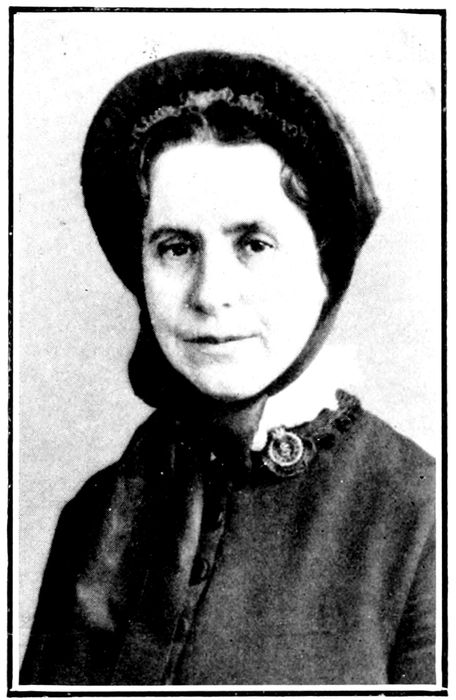
CATHERINE BOOTH, THE “MOTHER OF THE SALVATION ARMY.”
In England Mrs. Booth was the first woman preacher, and if she had done nothing else but vindicate the right of woman to speak in public and preach the Gospel, she would have done great work. But she did far more than this. By making her whole life, and every thought and action subservient to the cause of the Salvation Army, she brought comfort and happiness to many thousands of poor souls.
The work of this “Mother of the Army” was continued by her daughter, Evangeline Booth, known in the history of the organization as “The Commander”; by Emma Booth-Tucker, known as “The Consul”; by Mrs. W. Branwell Booth, “The General,” and by Elizabeth Swift Brengle, known as “The Colonel.”
The first woman in the Christian world to be ecclesiastically ordained was Antoinette Brown Blackwell, an American 186woman who had graduated from Oberlin, Ohio. She was ordained in 1852 in South Butler, N. Y., by a council called by the First Congregational Church. Rev. Olympia Brown was the next woman ordained ten years later. In December, 1863, the Rev. Augusta J. Chapin was the first woman to receive the title of Doctor of Divinity.
Since the ordination of these women the number of female “clergymen” in the various denominations has increased rapidly. According to the Census of 1910 their number within the United States was 7395 in that year. The success of woman in the pulpit is no longer a question but an affirmation. This is what Rev. Phebe A. Hanford said on the subject:
“Other things being equal, why may not a woman preach and pray and perform pastoral duty as well as a man? Why should she not preside at the Lord’s table, consecrate in baptism the child whose parents would dedicate their choicest possessions to God, or the adult who would thus express his faith in Christ and his determination that “whatever others may do he will serve the Lord”? When two loving hearts desire to join hands and walk the earthly pathway side by side, why should not a woman minister pronounce the sacred formula and convey the sanction of the Law and the Gospel to their matrimonial purpose? And when the voice of consolation is sorely needed, and the solemn words are to be spoken which consign the silent dust to its last resting-place, why should not a womanly woman officiate as well as any tender-hearted and eloquent man? Surely woman is proverbially compassionate; and that she is often eloquent with voice and pen, and with poetic expression and the fervor of truth which can reach the heart, who can deny?”

187
WOMAN IN THE MEDICAL PROFESSION.
It is hard to realize in these days of professional equality between the sexes that only half a century ago a woman who desired to study medicine was considered such a phenomenon that her morality and the purity of her motives were questioned. And yet this desire is only natural, as the life of every woman has moments when she has to call for medical help. There are especially the transition to womanhood, all the experiences of motherhood, and the many ailments peculiar to women. To be compelled to consult in these cases a male physician, is for many bashful girls and women such a repellant thought, that they quite often postpone it from week to week, until too late.
No doubt such were the reasons and experiences which caused Agnodice, an Athenian girl, born about 300 B. C., to disguise her sex in order that she might study medicine. Like Dr. Mary Walker in the 19th Century, she donned male attire and became a disciple of Herophilus, an eminent physician and anatomist of the Alexandrian School. Her specialty was midwifery and women’s diseases, and when she started to practice herself, she met with such great success that her male colleagues became jealous and tried to prevent her from practicing by accusing her of corruption before the Areopagus. But the result of the proceedings was quite contrary to their expectations, as a law was immediately passed allowing all freeborn women to learn midwifery.
Since then female physicians practiced in Hellas as well as in Alexandria and in Rome. And when in the 9th Century after Christ the famous Schola Salernitana was established at Salerno, a department for women’s diseases was included, with a number of female professors as teachers. The names of several of these professors are still known; the most noted was the celebrated Tortula, who lived in the 11th Century. Abella, Constanza, Calendas, and Hildegarde too have been praised for their great ability.
This eminent position held by women in the medical profession declined slowly after the 12th Century, and practically disappeared after the 16th Century. The cause for this relapse was undoubtedly the increasing hostility of the Christian Church toward any occupation of women with sciences. This prejudice remained alive up to modern times. It was dominant in 1845 when a young American woman, Elizabeth Blackwell, decided to study medicine. The same motives as had moved the Athenian Agnodice and the loss of a dear woman friend caused the young American to write to various physicians asking as to the wisdom and possibility of a woman becoming a doctor. The answers she received 188were unanimously to the effect that while the idea was a valuable one it was impossible of accomplishment for many reasons. This verdict only served to intensify her determination to accomplish her purpose. After two years of private study she went to Philadelphia, which in those days, 1847, was considered the seat of medical learning in this country, and made application to the four medical colleges for admission as a regular student. But such a revolutionary idea was not to be entertained, and all the doors remained closed to her. One kindly Quaker adviser said to her: “Elizabeth, it is of no use trying. Thee cannot gain admission to these schools. Thee must go to Paris and don masculine attire to gain the necessary knowledge.”
It had now become a moral crusade with Miss Blackwell, and the justice and common sense of her undertaking seemed so supreme that she determined to push the warfare to the farthest limit. After similarly unsuccessful attempts in New York, she obtained a complete list of all the smaller institutions of the Northern States, examined their prospectuses, and sent applications for admission to twelve of the most promising. After long delay an answer came from the medical department of the small university at Geneva, in the western part of New York State. It seems that the faculty had submitted Miss Blackwell’s letter to the medical class, who adopted the following resolutions:
“Resolved—That one of the radical principles of a republican government is the universal education of both sexes; that to every branch of scientific education the door should be open equally to all; that the application of Elizabeth Blackwell to become a member of our class meets our entire approbation; and in extending our unanimous invitation we pledge ourselves that no conduct of ours shall cause her to regret her attendance at this institution.”
Their gallantry won the day, the faculty cordially opened the doors of the institution, and she began her studies there at once.
Being the first female student in the small place her appearance of course gave rise to many comments. Many people looked at this new woman in wonder; some even inclined to regard her as a lunatic, or a disorderly person. But her behavior and seriousness compelled respect, and when in 1849 she received her degree, the public press very generally commented upon the event in favorable terms and even in Europe some notice of it was taken. She found fewer obstacles in her path in her studies abroad, especially in Paris. After her return to America she began practice in New York City, and here again she had to do pioneer work. The medical fraternity stood aloof, refusing to consult with her, and society 189in general somewhat distrusted the innovation. But in time her work received just recognition and the status of women in the profession became fully established. In 1868 Dr. Blackwell founded the “Woman’s Medical College of New York.” The later years of her life were spent in England, where she also did much in moulding public opinion along the lines of philanthropy, especially in opening hospitals and dispensaries for women and children.
A few years after Miss Blackwell had received her diploma, another remarkable woman, Florence Nightingale, aroused world-wide admiration by her noble service during the Crimean war of 1853–56. Intensely devoted to the alleviation of suffering, she had since 1849 paid great attention to the sanitary conditions of civilian as well as military hospitals, which in many cases she found rather poor. In 1851 she went into training as a nurse, and when in 1853 war was declared with Russia, and the hospitals on the Bosphorus were soon crowded with the sick and wounded, she offered the English Government to go out and organize a nursing department at Scutari. Starting with a unit of thirty-seven nurses, she arrived at Constantinople when the mortality in the hospitals had become appalling. Seeing clearly the cause for this frightful state in the bad sanitary arrangements of the hospitals, Miss Nightingale devoted incessant labor to the removal of these causes, as well as to the mitigation of their effects, with such success, that in the English army the death-rate fell from 22¼% to only 2¼%.
After her return to England, in 1856, the Government as well as Queen Victoria and the public were not slow to acknowledge her splendid services. While the Queen presented her with a cross set with diamonds, the people subscribed a fund of several hundred thousand dollars for the purpose of enabling her to found an institution for the training of a superior order of nurses in connection with the St. Thomas’s and King’s College Hospitals. Miss Nightingale also enriched the medical literature by two valuable books, “Notes on Nursing” and “Notes on Hospitals,” in which she gave the results of her lifelong observations.
The example of Miss Nightingale had much to do with calling forth the exertions of American women during the Civil War. As soon as there were wounded soldiers to heal, and military hospitals to serve, the patriotic and benevolent women of America remembered the great work of Florence Nightingale, and hastened to the front. As A. W. Calhoun states in his “Social History of the American Family,” by 1864 there were busy in the North 250 women physicians. Women planned and organized also the “U. S. Sanitary Commission,” for the alleviation of the sufferings of the battlefield. Its pre-eminent 190utility was universally recognized. It caused likewise several great charity fairs, the last two of which were held in New York and Philadelphia and yielded $1,000,000 and $1,200,000 respectively.
Among the female physicians, who did service during the Civil War, the most noteworthy was Dr. Mary E. Walker. Having studied medicine at the Medical College in Syracuse, N. Y., she was the first woman commissioned to serve on the surgical staff of any army in time of war. On assuming her duties as surgeon in the war, she found hospital efficiency and hoopskirts incompatible; so she sacrificed the skirt and donned a man’s coat and trousers. In recognition of her able services Congress not only awarded her a Medal of Honor, but also allowed her—the only instance in history—by a special act to continue to wear male attire. Dr. Walker declared many times that her sole reason for advocating dress reform for women were hygienic ones. A real pioneer in her profession, she also maintained for many years a farm for sufferers from tuberculosis and carried on a school for prevention of that disease modelled after a plan of her own.
Among the women, whose names appear in the history of the Civil War, one of the most brilliant was Miss Clara Barton. Devoting herself to the care of the wounded soldiers, she won for herself as superintendent of the hospitals in the army of the James the surname “the Florence Nightingale of America.” During the Franco-Prussian War of 1870–71 she joined the German branch of the Red Cross Society, that noble institution, which in 1859 had been founded by Henry Durant, a citizen of Geneva, Switzerland.
Inspired by the example of Miss Nightingale, and horrified by the ghastly scenes of the Italian battlefields, he resolved to work for the proper treatment and nursing of wounded soldiers, while still on the ground. At his strong appeal the Swiss Federal Council invited all European nations to a convention in order to discuss proper steps to be taken in this direction. Attended by delegates from Baden, Belgium, Denmark, France, the Netherlands, Prussia, Switzerland and Wurtemberg, the convention met on August 22, 1864, in Geneva, and decided, that henceforth not only all places where wounded soldiers are treated, but also all persons, engaged in this samaritan service, should be regarded as neutrals and distinguished by white flags or white bands showing a red cross. Such places must not be attacked, but protected by the soldiers of all combating armies.
In the further history and evolution of this international Society of the Red Cross women have played a most prominent part. Miss Barton established during the Franco-Prussian War several military hospitals and, by conducting them, 191distinguished herself so that she was decorated with the Iron Cross. After her return to the United States she organized in 1882 the “American Red Cross Society,” of which she became the first president. The work of Miss Barton and the Red Cross in the Spanish-American War and the great help given to the sufferers after the great tidal wave in Galveston, Texas, caused the United States Senate and the Texas Legislature to adopt resolutions of thanks.
All these great efforts of women could not fail to create a most favorable impression toward woman’s activity in medicine. In England an act of 1868 for the first time opened the study of pharmacy to women; and after a long struggle they obtained their footing as physicians. In 1874 a special medical school was opened for women in London. In 1876 an act authorized every recognized medical body to open its doors to women. In 1878 a supplemental charter enabled the University of London to grant degrees to women in all its faculties, including medicine. As a result up to the close of 1895 264 women had been placed on the British register as duly qualified medical practitioners.
In the United States similar progress was made.
According to the census of 1910, there were 7399 women physicians and surgeons in the United States.
Whereas fifty years ago there was great objection to admitting women to the medical societies, now the men of the profession welcome women physicians to the societies and to their discussions, and are more than willing to consult with them. The advantage of employing women physicians has been recognized likewise by many hospitals, sanitariums and insane asylums; the courts too recognize the justice of women’s preferring women in the physical examination required by law. There can be no doubt, that the 20th Century opens to women physicians undreamed-of possibilities in science and in the art of healing.

192
WOMAN IN THE PROFESSION OF THE LAW.
When in the year of our Lord 1869 American papers reported that in Iowa a woman had been admitted to the bar, most readers were inclined to regard this “bit of news” as one of the many jokes, sprung occasionally upon credulous people in order to warn them what the “new woman” might be able to do. But in this case the “joke” turned out to be a fact. And if people had been somewhat better acquainted with their Bibles, they would have known that the woman lawyer of Iowa was only another confirmation of Rabbi Ben Akiba’s famous saying: “There is nothing new under the sun!”
Open your Bible and read in Chapter 4 of the Judges IV about Deborah, the Joan of Arc of the Hebrews. Of this most extraordinary woman recorded in Jewish history it is stated that she was a prophetess as well as a judge, “to whom the children of Israel came for judgment.”
The Greeks and Romans too had female lawyers. From writers of the classic past we know that Aspasia pleaded causes in the Athenian forum, and Amenia Sentia and Hortensia in the Roman forum. And Valerius Maximus (Hist. lib. VIII, Chapter 3) states that the right of Roman women to follow the profession of advocate was taken away in consequence of the obnoxious conduct of Caliphurnia, who, from “excess of boldness” and “by reason of making the tribunals resound with howlings uncommon in the forum,” was forbidden to plead. The law, made to meet the especial case of Caliphurnia, ultimately “under the influence of the anti-feministic tendencies” of the period, was converted into a general one. In its wording the law sets forth that the original reason for woman’s exclusion “rested solely on the doings of said person.”
The “howlings of Caliphurnia” furnished the legislators of all later periods with a welcome pretext to exclude women from practice of the law, and it was not till 1869 that a woman again obtained admission to the bar. This pioneer was Miss Arabella A. Mansfield of Mount Pleasant, Iowa, who was admitted to the Iowa bar in 1869, under the statute providing only for admission of “white male citizens.”
The next female lawyer was Mrs. Belva Ann Lockwood, a graduate of the Law School of the National University at Washington, D. C. Having been admitted in 1873 to practice before the Supreme Court of the District of Columbia, she applied in October, 1876, for admission as practitioner of the Supreme Court of the United States, but was rejected under the following decision: “By the uniform practice of the Court from its organization to the present time, and by the fair construction of its rules, none but men are admitted to practice before it as attorneys and counselors. This is in 193accordance with immemorial usage in England, and the law and practice in all the States, until within a recent period; and the Court does not feel called upon to make a change until such a change is required by statute or a more extended practice in the highest courts of the States.”
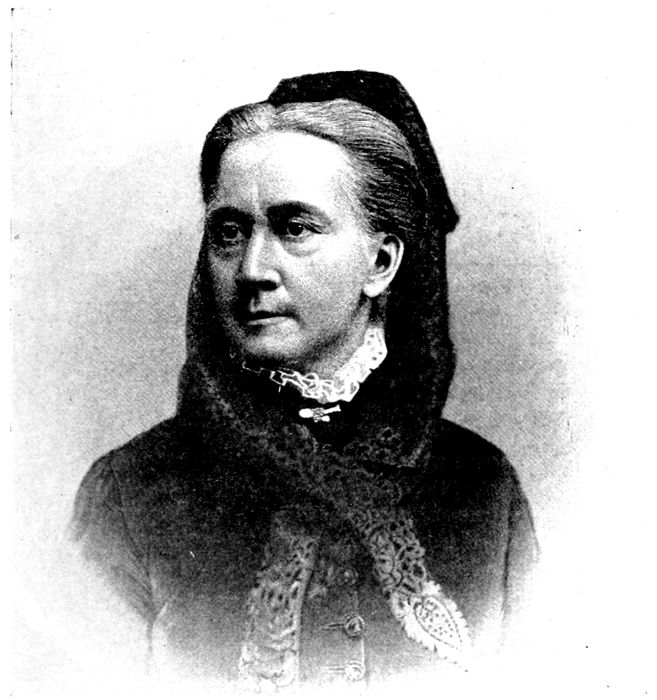
BELVA A. LOCKWOOD.
But if the members of the Supreme Court had entertained the hope of scaring away women once and for all, they soon enough found that they were mistaken. Mrs. Lockwood drafted a bill and secured its passage in Congress, providing “that any woman who shall have been a member of the bar of the highest court of any State or Territory, or of the Supreme Court of the District of Columbia, for the space of three years, and shall have maintained a good standing before such court, and who shall be a person of good moral character, shall, on motion, and the production of such record, be admitted to practice before the Supreme Court of the United States.” This bill was approved on February 15th, 1879. Since then Mrs. Lockwood as well as a 194number of other female lawyers have been admitted under this law to practice before the highest court of the United States.
A “Woman’s International Bar Association” was organized in 1888, for the purpose of establishing law schools for women and of promoting the interests of female lawyers as well as of securing better legal conditions for women.
According to the Census of 1910 there were 1010 woman lawyers in the United States.
“Having taken up the law,” so said Miss Edith J. Griswold, herself a counsellor-at-law, “woman will not rest until she stands on a level with man, and the end of the Twentieth Century will probably find an equilibrium in the United States Government that can only be obtained (as in the home government) by the equal balancing of the different propensities of male and female mind in the making and enforcing of laws. The prophecy that the time is coming when woman will govern seems ludicrous, and yet it is no more ludicrous than the present lopsided arrangement whereby man has the exclusive power of government. With the rapid advance of woman conditions are being manifested that require woman’s judgment, and to obtain true justice in matters relating to both sexes an equal number of men and women should compose both the court and the jury. By the end of the Twentieth Century, I believe, a woman’s judgment will carry as much weight as a man’s, and the opinions handed down from our higher courts will have to be concurred in by an equal number of male and female judges.”

195
WOMEN AS INVENTORS.
Sometimes, when the merits of the woman movement were discussed, its opponents made it their trump that the female sex is without any inventive spirit and that this want should be regarded as a convincing evidence for the inferiority of woman s mind. That this assertion was never true at all, but made in absolute ignorance of the real facts, becomes evident, when we recall, that primeval and aboriginal women have been the inventors of our most important industries, of agriculture, weaving, basketry, pottery, tannery, brewing, and many other peaceful arts. And there is not the slightest doubt, that during the times of Antiquity and the Middle Ages women have been the greatest factor in the evolution of these industries, in which they remained constantly busy.
Among the few instances of which records have been preserved, is that of Barbara Uttmann, a German woman of Annaberg, Saxony, who in 1561 invented the Cluny-lace. Herewith she opened, for the extremely poor people of the Erzgebirge, at the most critical time, a new and well paying industry, in which in 1800 about 35,000 girls and women were busy.
Another important invention was made in 1792 in America by the widow of General Nathaniel Green. It was the so-called cotton gin by which the difficult work to separate the seed from the lint was greatly simplified. To pick the seed from one pound of cotton had been formerly considered a good day’s work. With the aid of the cotton gin, which consists of a series of saws revolving between the interstices of an iron bed upon which the cotton is placed so as to be drawn through whilst the seeds are left behind, several hundred pounds of cotton can be cleaned in the same time. This invention stimulated enormously the cultivation of cotton and the manufacture of cotton goods in America. In the South, where so far cotton had been produced only in small quantities, it now became the main product. While in 1792 the quantity exported from the United States was 138,324 pounds, it increased by the year 1800 to nearly 18,000,000 pounds. In the North it led to the establishment of cotton mills and factories on a large scale.
As only few countries have taken the trouble to prepare statistics about inventions made by women it is impossible to give reliable facts about what women have contributed to human culture in this line.
Their most intensive activity has been observed in the 196United States, especially since with the founding of woman’s colleges and the opening of the universities, the education of the female sex became a more careful and broader one.
The U. S. Patent Office at Washington, D. C., has published “Lists of Women Inventors,” in three volumes, covering the period from 1790 to March 1, 1895. From these lists it appears that till 1849 only 32 inventions by women have been registered at the Patent Office. This number increased to 290 during the period from 1850 to 1870; during 1870–1890 to 2568, and up to 1910 to 7942. These numbers prove that with the increase of woman’s knowledge and with the closer contact with modern industrial life her inventive spirit has likewise developed. Also the inventions became more manifold. While prior to 1850 they were almost exclusively confined to dress and household, they now cover all fields of human activity.
This fact became most evident during the terrible years of the World War. Some time ago the “Women Lawyer Journal” reported that of all the many inventions registered since 1914, fifty per cent. have been entered by women. Among these inventions have been such for the better protection of soldiers and aeronauts as well as for the greater comfort of the wounded and crippled. Other inventions meant improvement in wireless telegraphy, gas masks, submarine boats and hundreds of other objects.

197
EMINENT FEMALE SCIENTISTS.
Just as hostile as had been the clergy to the admission of women to ecclesiastical office, so unwilling were many prejudiced scholars to admit women into the sacred realms of science. By hundreds of arguments they tried to prove the inability of women to do any deeply scientific work. They explained that the hard study would impair their health, their chances of marriage, and their true destination as mothers. Higher education would make women unfit for domestic life, and, besides, they would hardly produce anything of real scientific value.
If these learned gentlemen would have taken the trouble to make themselves somewhat more acquainted with the history of science they would have found the names of numerous women on record, who, at their time, were among the leaders in the most abstruse sciences. Several centuries before Christ Hellas as well as Rome had a number of brilliant female philosophers, among them Damo, the daughter of Pythagoras, who lived about 580–500 B. C. She was one of his favorite disciples, and to her the great savant entrusted all his writings, enjoining her not to make public all the secrets of his philosophy. This command she strictly obeyed, though tempted by large offers while she was struggling with poverty.
Socrates, the great philosopher, declares that he learned of a woman, Diotima, the “divine philosophy,” how to find from corporeal beauty the beauty of the soul, the angelical mind. Diotima lived in Greece, about 468 B. C.
Arete is known as the daughter of Aristippus of Cyrene, the founder of the Cyrenaic system of philosophy, who flourished about 380 B. C. She was carefully instructed by her father, and after his death taught his system with great success. Leontium, living about 350 B. C., was a disciple of Epicure, and wrote in defense of his philosophy. Tymicha, a Lacedaemonian, was the most celebrated female philosopher of the Pythagorean school. When she, in 330 B. C., was brought before Dionysius, the tyrant of Syracuse, as a prisoner, he made her very advantageous offers, if she would reveal the mysteries of Pythagorean science; but she rejected them all with scorn and contempt. And when he threatened her with torture, she instantly bit off her tongue, and spat it in the tyrant’s face, to show him that no pain could make her violate the pledge of secrecy.
Of Hipparchia, a lady of Thrace, who lived about 328 B. C., it is known that her attachment to learning was so great, 198that having attended several lectures of Crates, the cynic, she resolved to marry him though he was old, ugly, and deformed. She accompanied him everywhere to public entertainments and other places, which was not customary with Greecian women. She also wrote several philosophical theses, and reasonings and questions proposed to Theodorus, the atheist; but none of her writings are extant.
Ancient Rome too had a number of female philosophers, among them Cornelia, “the mother of the Gracchi.” She frequently gave public lectures and was more fortunate with her disciples than with her sons. It was Cicero, who said of her that, had she not been a woman, she would have deserved the first place among philosophers. In what esteem she was held is shown by the fact that a statue was erected to her with the inscription, “Cornelia, Mater Gracchorum.” She died about 230 B. C.
The most renowned female philosopher of the classic times was Hypatia, the lovely daughter of Theon, the head of the famous Alexandrian School in Alexandria, Egypt. Born in 370 A. D., Hypatia was taught by her father and acquired such extensive knowledge and learning, that the Bycantine Church historian Socrates, as well as Nicephorus placed her far above all the philosophers of her time. Several other learned contemporaries praise her in similar terms. Sinesius, bishop of Ptolemais, never mentions her without the profoundest respect, and in terms of affection little short of adoration. In a letter to his brother Euoptius he writes: “Salute the most honored and the most beloved of God, the Philosopher Hypatia, and that happy society, which enjoys the blessing of her divine voice.” And in a long epistle he sends her with the manuscript of a book, he asks her opinion and states his resolution not to publish the book without her approbation.
Hypatia succeeded her father in the government of the Alexandrian School, teaching from the chair where Ammonius, Hieracles, and other celebrated philosophers had taught; and this at a time, when men of immense learning abounded in Alexandria and in other parts of the Roman empire. In fact her renown was so universally acknowledged, that she had always a crowded auditorium. What a subject for an able artist, to present this beautiful woman in her chair, with the flower of all the youth of Africa, Asia and Europe sitting at her feet, eagerly imbibing knowledge from this oracle of wisdom.
Socrates states that she was consulted by the magistrates of Alexandria in all important cases. This frequently brought her among the greatest assemblages of men without causing the least censure of her manners. “Considering the confidence 199and authority which she had acquired by her learning,” says Socrates, “she sometimes came to the judges with singular modesty. Nor was she anything abashed to appear thus among a crowd of men; for all persons, by reason of her extraordinary discretion, did at the same time both reverence and admire her.”
Unfortunately this wonderful woman was to become a martyr of science. The population of Alexandria was split into three hostile groups—the Pagans, the Jews, and the Christians. The latter, under the leadership of the patriarch Cyril, assailed in violent zeal Jews as well as pagans, and heretics or supposed heretics alike, driving them by thousands from the city, destroying their synagogues and temples, and pillaging their houses. It was during one of these riots, that the illustrious Hypatia was attacked by a mob of vicious monks, torn from her carriage, dragged into a church, stripped naked and clubbed to death. Then the murderers in fanatic frenzy tore the body to pieces, carried the limbs to a public square and burnt them to ashes. This happened in Lent 415.
All the writings of Hypatia, among them her treatise “On the Astronomical Canon of Diophantus” and another “On the Conics of Apollonius” are lost. Most probably they too were destroyed by the fanatic Christian mobs, who, after the murder of Hypatia, extinguished the Greek School of philosophers and scientists at Alexandria.—
Astronomy, probably the most ancient of the sciences, has since early days exerted a singular attraction on women.
Herman Davis, in his essay “Women Astronomers,” published in the reports of Columbia University, New York, gives the names of a large number of women astronomers, beginning with several of classic times. Of the Egyptians he mentions Aganice, Athyrta, Berenice, Hipparchia and Occelo, who were connected with the Alexandrian School. Of the Greeks he names Aristocle and Athenais, and of Thessaly Aglaonice. But nothing definite is known about their achievement.
Davis likewise gives an account of Hildegarde, abbess of the monastery on Mount St. Rupert near Bingen on the Rhine. This learned woman, who lived from 1099 to 1180, wrote a book in Latin, in which some marvelous statements are claimed to have been made: 1. that the Sun is in the midst of the firmament retaining by its force the stars which move around it; 2. that when it is cold in the Northern hemisphere it is warm in the Southern, that the celestial temperature may thus be in equilibrium; 3. that the stars not only shine with unequal brilliancy but are themselves really unequal in magnitude; 4. that as blood moves in the veins and makes them pulsate, so do the stars move and send forth 200pulsations of light. “If even one-half of these marvelous statements are found in Hildegarde’s writings as early as the 12th Century,” says Davis, “then this woman may well be classed with the great forerunners of modern astronomy, with Copernicus, Galileo and Newton, for she was three centuries earlier than the first of them.”