Women During the Middle Ages.
Reading edition
81
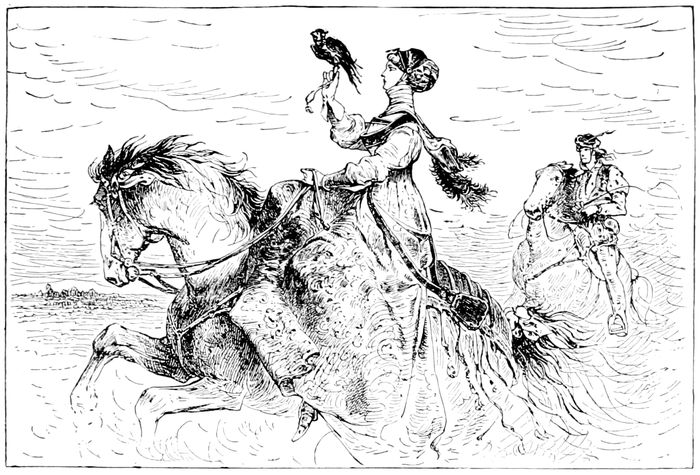
A NOBLEWOMAN OF THE 16TH CENTURY.
WOMEN DURING THE MIDDLE AGES.
From the accounts, given by Tertullian and other writers about the life of the early Christians, it appears that their conceptions in regard to women gave promise for a better future. But during the Middle Ages, which extend from the downfall of Rome to the discovery of America, Christianity unfortunately failed to realize these promises.
First of all the ancient Oriental prejudice against women again took hold of the minds of many Christian leaders. Instead of making themselves champions of women’s rights and interests, they curtailed women’s influence in order to subject them to the dominion of their husbands. In these efforts the “Christian Fathers” complied with those commands that Paul the Apostle had given in several of his epistles to the Corinthians, Philippians, and to Timothy. They read as follows:
“The head of every man is Christ, and the head of every woman is the man, and the head of Christ is God. For the man is not of the woman but the woman of the man. Neither was the man created for the woman but the woman for the man.”—
“Let your women keep silence in the churches, for it is not permitted unto them to speak but they are commanded to be under obedience. And if they would learn anything 82let them ask their husbands at home.”
“Let the woman learn in silence with all subjection. But I suffer not a woman to teach, nor to usurp authority over the man, but to be in silence.”—
These narrow views destroyed the beneficial influence of woman in Christian lands and retarded her emancipation for more than eighteen hundred years. Approving of Paul’s commands, Ambrose, one of the eminent lights of the Church in the Fourth Century, said, to demonstrate the inferiority of woman: “Remember that God took a rib out of Adam’s body, not a part of his soul, to make her!” Another of these leaders made the name “Eve” synonymous with “deceiver,” accusing woman of having been the cause of men’s expulsion from Paradise. St. John Chrysostom wrote: “Woman is the source of evil, the author of sin, the gate of the tomb, the entrance to hell, the cause of all our misfortunes.” And St. John of Damascus told the world, that “woman is an evil animal, a hideous worm which makes its home in the heart of man.” Other teachers agreed with Paul that woman must veil her head because she is not, as is man, in God’s image!
In face of such vicious promulgations we must not be surprised that among the discussions of the early “Fathers” none was more important than that, “has woman a soul?” This question was argued in the Sixth Century at the Council of Macon. It is also recorded that a few of these pious leaders entertained the opinion that because of the great power and goodness of the Almighty “women may possibly be permitted to rise as men at the resurrection.” And the Council of Auxerre, held in the Sixth Century, decided that women should wear gloves before they touched the holy sacrament.
As at the same time ascetic thinkers impressed the minds of the Christians with an inordinate estimate of the virtue of celibacy, conceptions of matrimony also changed considerably. While marriage was not condemned, it was, however, regarded as an inferior state, and it was held, that persons who had not married, but remained pure, were nobler and more exalted beings than those who had married. With the advance of such ascetic ideas a large family came to be regarded almost as a disgrace, as a proof of lasciviousness.—
All these doctrines of woman’s inferiority in time corroded the ideas of the Christian nations about woman to such a degree that her position in the religious service as well as in law and in all the customs of the early Middle Ages sank to a very low level.
Another reason for the failure of Christianity in regard to woman’s emancipation was that the minds of the leaders of the Church became occupied by aims which to realize seemed to them of far greater value and importance.
83The early Christian communities had been simple associations of believers in a common faith. They had no settled form of doctrine or rules of discipline. They even had no body of magistrates. But the moment these associations began to advance and became a corporation, they started to mould a form of doctrine. At the same time the elders, who taught and preached, and morally governed the congregation, became priests, while those, who did service as overseers or inspectors, became bishops.
Among the latter the bishops of Rome adopted not only the title of Pontiff or High-Priest, but also assumed dictatorship over the bishops of all other dioceses. Professing to be of divine appointment and the representative of Christ they claimed in his name authority over all things, both temporal and spiritual. Accordingly they made the propagation of the Christian faith throughout the world their chief mission and organized for this purpose an army of clerical dignitaries, who held themselves responsible to no other authority but the Pontiff or Pope, to whom they were bound by the strongest vows. Also numerous orders of monks and nuns were established, who assisted greatly in the extension and strengthening of the Church.
The influence on human progress and culture of these vast religious armies has always been greatly overrated. No doubt, under the management of the monasteries and nunneries large tracts of virgin soil and forests were cultivated, and that architecture and art, as long as they served the interests of the Church, were patronized. But it is equally true that the Church tried to prevent its followers from thinking independently, that great masses of people, particularly those of the rural districts, were held in strict servitude and mental bondage, and that education and science were grossly neglected. Any attempts to question the authority of the Church or the truth of the Scriptures, were cursed as heresy and punished with death.
Among the first who had to suffer the wrath of the Popes, were the Waldenses, Albigenses, Stedingers, and several other Christian sects, which during the 9th, 10th and 11th Centuries had formed in various parts of Europe for no other object than the re-establishment of the simplicity and sincerity of the early Christian communities. As these sects were found at variance with the rules of the Church, they were decried as heretical, and almost extinguished.
Intolerant against all other creeds, the Popes also opened a series of wars against the Mohammedans, professedly for the purpose of delivering the “Holy Land” from the dominion of the “Infidels.” Aside from these “Crusades” a similar war was directed against the most western branch of the Mohammedans, 84the Moors, who had occupied a large part of the Iberian Peninsula. These struggles ended in 1492 with the fall of Granada and the surrender of the famous fortress Alhambra. While in the treaty of peace certain stipulated privileges had been granted to the conquered, one of which provided for free exercise of their religion, this liberty of worship was treacherously withdrawn in 1499 and the Moors either killed, expelled, or made Christians by forcible baptism. Those who survived by intermingling with the Spaniards produced a new race, the Andalusians, famous for their graceful women. The Spaniards adopted many of the Moorish manners and institutions, among them certain restrictions in the intercourse of the two sexes. Writers of the 15th Century state, that in these times the Spanish women used to sit in Oriental fashion, with legs crossed, on carpets and cushions, spending their time with embroideries and gossip, or telling the beads of the rosary. The husbands seldom sought their company, and even preferred to take their meals alone. Married ladies were not allowed to receive male visitors, and if their husbands brought friends along, they hardly dared to lift their eyes. The only breaks in this monotonous life were occasional calls by women friends, who were received with the greatest possible display of dress and jewelry. This unnatural segregation of the sexes still prevails in Spain to some extent and is chiefly due to the jealousy of men. Well aware of their own unfaithfulness and great inclination for love-adventures, they have no confidence in their wives either, but always watch them with suspicion.
We find similar conditions in many other parts of Southern Europe. But as restrictions are always apt to breed intrigues we hear everywhere of plots and love-affairs, such as Boccaccio has related in his “Decamerone.” The stories of this famous book, which was written between 1344 and 1350, without question are based on actual events, frequently among the fashionable ladies and gentlemen of the age.
Far higher than in Southern Europe was the status of women in those countries occupied by nations of Germanic stock.
At the time of Tacitus the Germans had no settlements, but lived in isolated dwellings on the river banks or clearings in the majestic forests. With the migration of the nations, however, caused by the enormous pressure of vast Mongolian hordes upon the tribes of Eastern and Central Europe, the Germans were compelled to abandon this mode of life. For security’s sake they gathered together in villages and cities. These they surrounded with heavy walls and towers, and 85protected them by castles, erected on steep cliffs and mountains.
The custody of these strongholds was entrusted to the most efficient warriors, who in time formed a separate class, the nobility, from which the heads of the whole nation, the princes, kings and emperors were chosen. The inhabitants of the cities formed the class of burghers, who devoted themselves to the trades and handicrafts. There was a third class, made up of the people remaining in the rural districts, the peasants.
Of course the positions of the women of these various classes differed widely. While the women of the peasants and craftsmen were busy with the functions of their every day’s work, the women-folk of the rich merchants and the nobility had ample time to cultivate everything that makes life worth while. With blissful hearts they took part in all pleasures and festivals. And with the same feeling they accepted the tokens of respect and admiration, extended to them by the knights as well as by the many minstrels and troubadours, who travelled throughout the country to entertain with their songs of love, adventure and heroism all who liked to listen.
Many songs of the 12th and the 13th Century express the high esteem of their authors for women. They also prove that the so-called “Minnedienst” of the German and French knights was to a great extent an ideal tribute and consisted chiefly in a restrained longing of the heart, in a pure remembrance of the beloved one.
One of the best known rhymes dates from 1120 and reads as follows:
Du bist min, ih bin din:
des solt du gewis sin.
du bist beslozzen
in minem herzen;
verlorn ist das sluzzelin:
du musst immer darinne sin.
Thou art mine, I am thine!
Pray, what could be just as fine?
Thou art enclosed
Within my heart;
The key is lost, so, as it were—
Thou must now stay forever there.
86
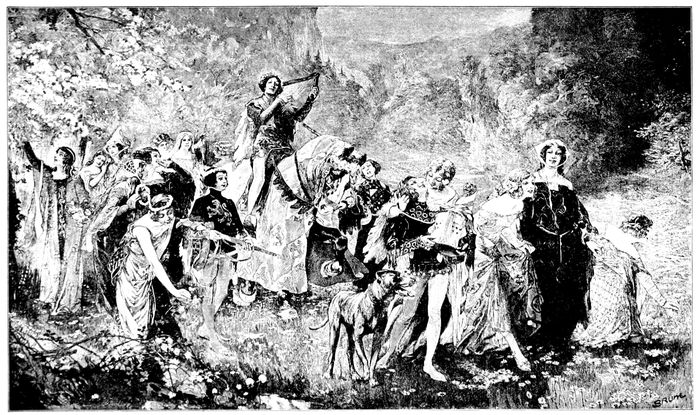
THE WELCOME TO A TROUBADOUR. After a painting by B. Bruene.
87Among the most beautiful poems, written in praise of women, we also find the “May-song” of Walter von der Vogelweide. In modern German it reads as follows:
“Wenn die Blumen aus dem Grase dringen,
Gleich als lachten sie hinauf zur Sonne
Des Morgens früh an einem Maientag,
Und die kleinen Vöglein lieblich singen
Ihre schönsten Weisen, welche Wonne
Böt’ wohl die Welt, die mehr ergötzen mag,
Ist’s doch wie im Himmelreiche.
Fragt ihr, was sich dem vergleiche,
So sag’ ich was viel wohler noch
Des öftern meinen Augen tat,
Und immer tut, erschau ich’s noch:
Denkt ein edles schönes Fräulein schreite
Wohlgekleidet und bekränzt hernieder
Unter Leuten froh sich zu ergehen,
Hochgemut im höfischen Geleite.
Züchtig um sich blickend und durch Anmut glänzend,
Wie Sonne unter Sternen anzusehen.
Welche Wonne käme gleich
Solchen Weibes Huldgestalt?
Der Mai mit allen Wundergaben
Kann doch nichts so wonnigliches haben
Als ihren minniglichen Leib.
Wir lassen alle Blumen steh’n
Und blicken nach dem werten Weib.”
When from the sod the flowerets spring,
And smile to meet the sun’s bright ray,
When birds their sweetest carols sing,
In all the morning pride of May,
What lovelier than the prospects there?
Can earth boast anything more fair?
To me it seems an almost heaven,
So beauteous to my eyes that vision bright is given.
But when a lady chaste and fair,
Noble, and clad in rich attire,
Walks through the throng with gracious air,
As sun that bids the stars retire,—
Then where are all thy boastings, May?
What hast thou beautiful and gay,
Compared with that supreme delight?
We leave the loveliest flowers, and watch that lady bright.
88
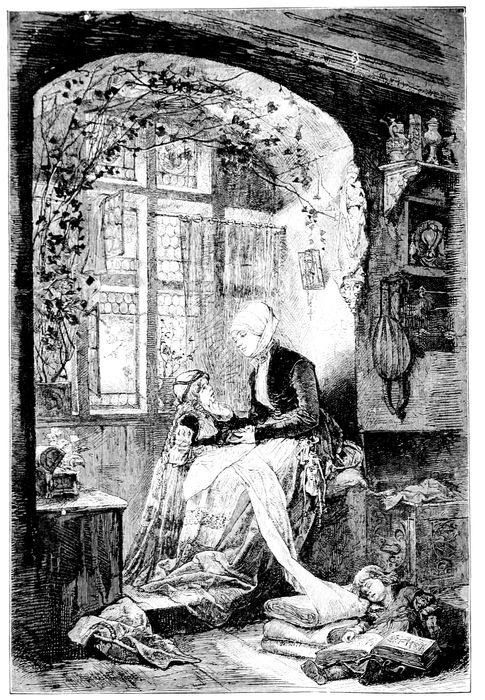
A LADY’S ROOM DURING THE MIDDLE AGES. After a drawing by F. A. Kaulbach.
89Another German poet of the 13th Century was Heinrich von Meissen, better known under the name “Frauenlob.” This sobriquet he received because he sang much in praise of women, as for instance:
“O Frau, du selten reicher Hort,
Dass ich zu dir hie sprech’ aus reinem Munde.
Ich lob’ sie in des Himmels Pfort’;
Ihr Lob zu End’ ich nimmer bringen kunnte.
Dess lob’ ich hier die Frauen zart mit Rechten,
Und wo im Land ich immer fahr’
Muss stets mein Herz für holde Frauen fechten.”
And at another time he sings:
“Ich lob’ die Frau für des Spiegel’s Wonne:
Dem Manne bringt sie grosse Freud’;
Recht als die klare Sonne
Durchleucht’ den Tag zu dieser Zeit,
Also erfreut die Frau des Mann’s Gemüte”—
When in 1318 he died, in Mayence, the women of that city, in appreciation of his devotion to their cause, carried his coffin solemnly to the cathedral, in the cloisters of which he was buried.
One of the most beautiful love-songs ever written dates from 1350. Having outlasted the centuries it is still sung and appreciated to-day wherever German is spoken.
Ach wie ist’s möglich dann
Dass ich dich lassen kann,
Hab dich von Herzen lieb,
Das glaube mir.
Du hast die Seele mein
So ganz genommen ein
Dass ich kein’ and’re lieb’
Als dich allein.
Blau blüht ein Blümelein,
Das heisst Vergiss-nicht-mein;
Dies Blümlein leg’ an’s Herz
Und denk’ an mich.
Wär ich ein Vögelein,
Bald wollt’ ich bei dir sein;
Fürcht’ Falk’ und Habicht nicht,
Flög’ gleich zu dir.
90Schöss’ mich ein Jäger tot,
Fiel ich in deinen Schoss;
Sähst du mich traurig an,
Gern stürb’ ich dann.
How can I leave thee so?
How can I bear to go?
That thou hast all my heart:
Trust me, mine own!
Thou hast this heart of mine
So closely bound to thine
None other can I love
But thee alone.
Blue is a floweret,
’Tis called Forget-me-not,
Wear it upon thy heart
And think of me!
Flower and hope may die,
Rich, dear, are you and I,
Our love can’t pass away,
Sweetest, believe.
If I a bird could be,
Soon would I speed to thee,
Falcon nor hawk I’d fear
Flying to thee.
When by the fowler slain
I in thy lap should lie,
Thou sadly shouldst complain,
Gladly I’d die.
How deep-seated the respect for woman was among the German people in those times is also shown by the reception extended to Isabella, the sister of King Henry II. of England. When in 1235 she arrived at Cologne, to become the bride of Emperor Frederick II. ten thousand citizens, headed by all the clergy in full ornate, went out to greet her with joyful songs. While all the bells were ringing, children and young girls bestrewed the bride’s path with flowers.
From Cologne the bride went by boat up the River Rhine to Castle Stolzenfels. Here she was met by the Emperor, who received his betrothed on bended knee. From there both went to Worms, where the wedding was celebrated with extraordinary splendor.—
91
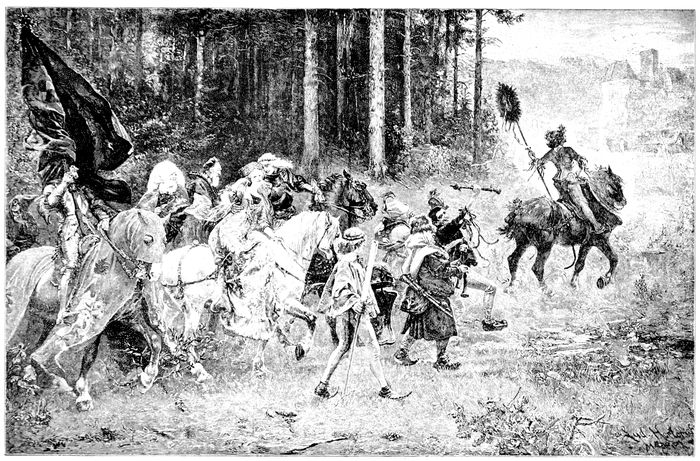
A BRIDAL PARTY. After a painting by L. Herterich.
92Among the nobility as well as among the patricians weddings were great feasts, which extended over weeks and to which all relatives and friends from near and far were invited. After the priest had given his blessing to the young couple, the servants prepared the banquet table. Bridegroom and bride, occupying the place of honor, sat side by side on the beautiful bridal chair, eating and drinking from the same plate and the same goblet, to indicate, that now they regarded themselves as one soul and one body.
If the young couple belonged to the nobility, the bridegroom led his bride to his castle in a pompous cavalcade. A number of shield-bearers, bedecked with flowers and ribbons, rode ahead, followed by a band of musicians and singers. Then came the bridal pair on horseback, as well as the parents of the bride, and the attendants. Such a cavalcade was hailed everywhere, especially in those villages which belonged to the dominion of the young nobleman. At the gate of the castle, however, the parents of the bridegroom and all the other inhabitants of the castle were waiting to welcome the new mistress with all honor.
It must be said emphatically, that the great respect paid to their women by the Germans was indeed well deserved. For the majority of the German women were not merely good housekeepers, affectionate wives and loving mothers, but at the same time patronesses of everything that is beautiful. It was for them, that the homes became comfortable and artistic, as most of those exquisitely carved chests, buffets, tables, chairs and beds, which are now the show-pieces of our museums, were ordered by rich women fond of art. They adorned the cupboards of their cozy and paneled rooms with costly vessels of crystal and silver; they covered the floors with fine rugs and hung the walls with tapestries, etchings and paintings of famous masters.
This taste for the beautiful would not allow the exterior of the houses to be neglected. Carvings, paintings and flowers were seen everywhere; even the most insignificant objects, such as the weather-vanes on the roof, and the brass-knockers on the doors were ornamented.

93
THE GLORIOUS TIME OF THE RENAISSANCE.
The close contact which, during the middle ages, existed between Germany and Italy also secured better conditions for the women of the latter country. The most remarkable change came, however, during the 14th and the 15th centuries, with that remarkable intellectual revolution known as the Renaissance.
This movement, one of the most significant in the evolution of woman, originated in Italy at a time when the whole country was suffering from ecclesiastic and feudal despotism. It was then that men and women of high standing, striving for greater spiritual freedom, became attracted by the almost forgotten works of Plato, Aristotle, Socrates, Seneca, Cicero, and other authors of the classic past. It is to the glory of Dante, Petrarch, Boccaccio, and other poets of Italy to have revived interest in these literary treasures. Eager to unlock these rich stores of beauty and wisdom, they collected the precious manuscripts and established libraries and museums for their preservation.
Many noblemen, patricians and merchant-princes, inspired by this sacred thirst for learning, and being aware that this effort was made in behalf of the emancipation of enslaved intelligence, aided the movement by their wealth. The art of printing with movable types, invented in 1450 by Johannes Gutenberg in Mayence, and introduced into Italy, France and Spain by German printers, made it possible to reproduce what the collectors had recovered. So learning remained no longer the pursuit of monks and recluses only, but became fashionable and pervaded all classes. Professors of classic literature and of humanism began to journey from city to city, opening schools and lecture-rooms, or taking engagements as tutors in the families of the princes, noblemen, and wealthy merchants.
The universities, founded at Bologna, Padua, Salerno and various other places, gave special attention to classical education and humanism. And, strange to say, all these schools and universities admitted women on equal terms with men. The number of women, who availed themselves of this privilege, may have been small, but evidently the way was clear. There were even several ladies, who acquired the degrees of doctor and professor of Greek language and literature, or of civil and canon law. Among these learned women were Britisia Gozzadina, who held a chair in the university of Bologna; and Olympia Morata, who, with her German husband, came to Heidelberg, where the chair for Greek at the university was offered to her.
94It was this revival of antique learning, art and science, and its application to the literature of the 16th Century, that shattered the narrow mental barriers imposed by mediæval orthodoxy.
The stimulating movement met with full success, when a number of Italian princesses, in sincere enthusiasm, took the leadership. Among these ladies were Elisabeth Gonzaga, Duchess of Urbino; Isabella d’Este, Marchioness of Mantua; Caterina Sforza, Countess of Forli; Veronica Gambara, Countess of Corregio; Lucrezia Borgia, Duchess of Ferrara; the poetess Lucrezia Tornabuoni of Florence, and Cassandra Fidelis, “the pride and glory of Venice.” But above all stood the famous Vittoria Colonna, Marchioness Pescara, one of the most wonderful women of these great times.
Ariosto said of her: “She has more eloquence and breathes more sweetness than all other women, and gives such force to her lofty words that she adorns the heavens in our day with another sun. She has not only made herself immortal by her beautiful poems and style, than which I have heard none better, but she can raise from the tomb those of whom she speaks or writes, and make them live forever.”
Michael Angelo, to whom she was a close friend as well as an inspiration, and a polar star, wrote: “By her genius I was raised toward the skies; in her soul my thought was born; without wings, I flew with her wings.”
Such exceptional women made their courts and drawing rooms the gathering places of the most refined and beautiful ladies of the time, of great artists like Raphael Sanzio, Leonardo da Vinci, Michael Angelo, Titian, Corregio and Bellini, of famous authors, poets and philosophers like Tasso, Ariosto, Bembo, and of distinguished statesmen, dignitaries and men of the world. They met here to listen to interesting debates about Humanism, the new doctrine, that man must endeavor to reconstitute himself as a free being, and throw off the shackles, that held him the thrall of theological despotism. They also read the classic philosophers, enjoyed the inspiring works of composers, or harkened to the wonderful accounts of daring discoverers, just returned from adventurous expeditions to India and the New World.
Most attractive affairs were the festivals of the Roses, held in spring. Then poets and poetesses contested with their latest songs, rondos and sonnets, to be awarded laurel-wreaths or roses of gold and silver.
It was at such gatherings that intimate friends united sweet discourses and platonic adoration, as shown in the following charming poem, written in those idyllic times:
95“Donne e donzelle e giovanette accorte
rallegrando si vanno a le gran feste
d’amor si punte e deste
che par ciascuna che d’amar appaghi
e l’altre a punto in gonnellette corte
ginocano a l’ombra delle gran foreste,
tanto leggiadre e preste,
quai solean ninfe stare appresso i laghi
e in giovanetti vaghi
veggio seguire e donnear costoro
e talora danzare a mano a mano.”
Translated these rhymes mean: “I behold lovely women and maidens as they joyfully hurry to the great feast. Struck and awakened by love they flourish with sweet desire. I see them at play in the shadows of the forest, and running with flowing garments, agile and graceful like nymphs at the border of the lakes. Bright young men follow these sweet women to amorous play. Here and there some of these happy couples disappear, wandering hand in hand.”
It is difficult for us, to realize the great changes brought about by this movement in social manners as well as in the position of women. “To be a gentleman,” so J. A. Symonds says in his book “Renaissance in Italy,” “meant at this epoch to be a man acquainted with the rudiments at least of scholarship, refined in diction, capable of corresponding or of speaking in choice phrases, open to the beauty of the arts, intelligently interested in archæology, taking for his models of conduct the great men of antiquity rather than the saints of the church. He was also expected to prove himself an adept in physical exercises and in the courteous observances which survived from chivalry.”
What was expected of a lady of rank we learn from a very interesting booklet, written in 1514 by Count Baldassare Castiglione, entitled “Libro del Cortegiano.” According to this “Manual for Courtiers” a lady should not be inferior to her husband in intellectual accomplishment and be able to read and write Latin. In classic literature as well as in music and arts she should be versed to such an extent as to have a correct judgment of her own; while she should possess individuality, her behavior should be easy but graceful and blameless. It was also expected that she should cultivate her personal merits and beauty. “Beauty,” so the manual says, “is of far greater importance to a lady than to a gentleman, because it is a divine gift which loses its charm when connected with an unworthy person. In her whole appearance, in her words, actions and attitude a lady must remain different from man. While virility should distinguish him, a lady should never try to copy him and be masculine. By nature woman is not inferior to man, therefore she should not imitate him. Both sexes are created to enjoy equal rights, but each sex has its own and individual right.”—
96
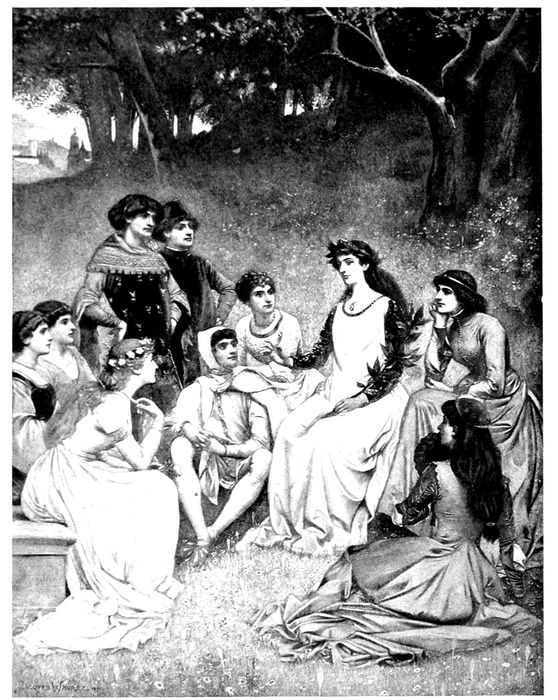
IN ITALY DURING THE TIME OF THE RENAISSANCE. After a painting by Jacques Wagrez.
97From Italy the Revival of Learning with its new conceptions of philosophy and religion spread to France, Germany, the Netherlands, and England, stimulating everywhere great intellectual life and achievements.
In France it was ushered in by Christine de Pisan, the first French lady of the 14th Century who, at least in prose, gave evidence of a finished literary perception. In her works, which were often copied, she tried to rouse the self-respect of women by informing them about their sphere and duties. By her work “Cité des Dames” she made them acquainted with the character of famous women of the past, and endeavored to inspire their minds in order that they might join in the ethical efforts of the time.
Christine de Pisan was perhaps also the first woman, who opened a sharp protest against the narrow views many men of her time had in regard to woman’s abilities and position. Defying the prejudice of woman’s inferiority, she gained a complete victory in her literary skirmishes over several clergymen of high standing.
In Germany the cities of Nuremberg, Augsburg, Strassburg and Basel became the centers of learned societies, who gathered around scholars like Schedel, Pirckheimer, Agricola, Peutinger, Reuchlin and Brant. Here also Dürer, Holbein, Cranach, Schongauer and Vischer enriched the world with works of art that rank among the greatest of the Middle Ages. But most important of all, in Germany that great religious movement started which was in truth the Teutonic Renaissance: the Reformation, in which Luther, Melanchton, Hutten and Erasmus were the leading spirits.
Kindred movements were started in Switzerland by Zwingli, in France by Lefevre d’Estaples, Berquin and Calvin; in England by Wycliffe, Bilney, Cranmer and Cromwell.
While so numerous men and women strove for greater physical and intellectual liberty, ecclesiastic despotism, to prevent anybody from thinking independently, denounced all free thinkers as heretics who must be exterminated by fire and sword. The life of many brilliant men and women ended at the stake or on the scaffold. But far greater numbers perished through obscure superstition, for the spread of which the Church was in the first place responsible.

98
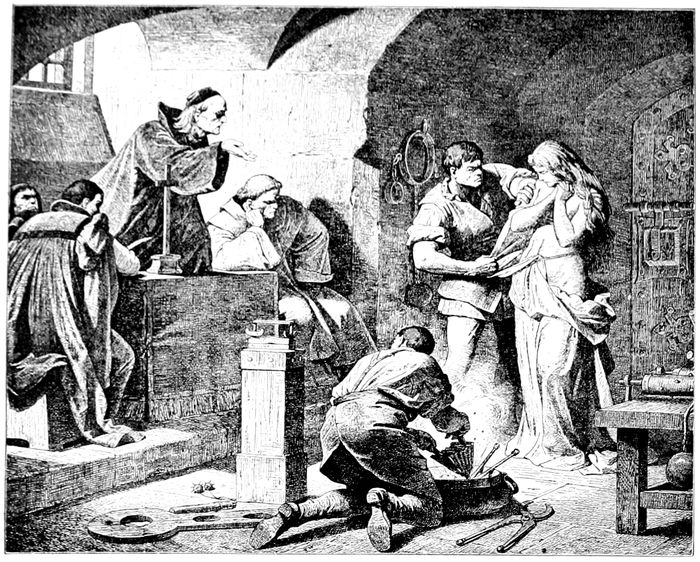
ACCUSED OF WITCHCRAFT. After a painting by F. Piloty.