Front matter (continued 8)
Reading edition
Lord Methuen was entering the tent as Yorke went out, and the latter thanked him warmly for his kindness in recommending him to the commander-in-chief.
"It is to General Pole-Carew that you are chiefly indebted," the general said; "he has seen much more of you than I have. I heard from him the full story of your adventures, and it was a pleasure to me to report your conduct to Lord Roberts. Pole-Carew told me that he was sorry he could not have your services in future—first, as his staff is complete, and in the second place, as he will remain here with his brigade, with the force under my command."
Yorke then went off with Captain Watermeyer. "I remember your face well, Mr. Harberton," the latter said; "I know Major Mackintosh, who obtained a commission for you in his corps. I was not a member of it, for I was in the Cape Town Highlanders. I saw you several times at the hotel where you were then stopping."
"I remember you perfectly now, sir; but the khaki and helmet make such a difference that until you spoke I did not recognize you."
"Well, we have both got on since then; it had certainly never occurred to either of us that we should both be here as members of the commander-in-chief's staff."
"No, indeed," Yorke replied, "nothing could have been more unlikely—at any rate, as far as I was concerned."
"Well, as for the tenting, you may as well share mine, as I am alone at present and shall be glad of company."
Matters were quickly arranged with Colonel Pretyman, the head-quarters commandant. Captain Watermeyer's offer obviated all difficulty with regard to tentage, and Yorke would, of course, mess with other officers of the staff.
"I am afraid, Mr. Harberton," the officer said, "that you will not draw any extra pay as assistant aide-de-camp, though, possibly, with the addition of the word 'interpreter' in general orders, an allowance will be obtainable."
"That is a matter of comparative indifference to me, I have resources of my own that will enable me for at least some time to defray the extra expenses of the mess."
"That will not be very heavy," Colonel Pretyman said with a smile; "certainly as long as we are on the march you will find but few luxuries, though, when we are in towns, we indulge a little. As a whole, I should say that we live no better than the infantry messes, certainly not so well as the cavalry do now, though they too will have to leave the best part of their stores behind them when we once move."
"And about my servant, sir, who is now a trooper in my regiment?"
"He will draw rations and mess with the orderlies. There will be no difficulty about your Kaffir groom, several of us have Cape boys in the same capacity, and of course, he will go in with them."
As two or three officers had come in while they were talking, Yorke, knowing how busy the colonel was, at once left and rode back to the camp of the Lancers, and after getting his things together returned to the head-quarter camp with Hans and Peter. On the following morning Lord Roberts and his staff moved to Ramdam, while the cavalry went on to the Riet River, easily drove off small parties of Boers at two drifts, and reconnoitred beyond it. General Tucker's troops moved forward to one of the drifts, and their place at Ramdam was taken by Kelly-Kenny's division.
"You will go on with the cavalry to-morrow morning, Mr. Harberton," the deputy adjutant-general, said to Yorke on the evening of their arrival at head-quarters at Ramdam. "They will push on ahead, and it is eminently important that the general should be informed of the progress they have made. The other aides-de-camp will be fully occupied in seeing that the movements of the infantry columns are proceeding without a hitch. The cavalry will push on to the Modder River to-morrow and seize one of the drifts. It is intended to reinforce them early the next morning, and they will then push on for Kimberley. You will remain with them until they have passed the point at which they are likely to meet with any serious opposition. Immediately they have done so you will bring the news to head-quarters, which will probably have then arrived at Jacobsdal, as the movements of the troops must be largely influenced by the success or failure of the cavalry expedition."
"Very well, sir."
Just before Yorke was about to leave the mess-room he was summoned to Lord Roberts's tent.
"Oh, Mr. Harberton, I only sent for you to tell you that I am going to ride myself to-morrow morning to see the cavalry make their start. I shall mount at five o'clock. You will ride with me."
It was a splendid sight when the commander-in-chief rode across Dekiel's Drift. There were gathered some five thousand horsemen, consisting of the Carbineers, the New South Wales Lancers, the Inniskillings, the regiment of Household Cavalry, the 10th Hussars, the 9th, 12th, and 16th Lancers, the Scots Grey, Rimington's Guides, two brigades of mounted infantry, seven batteries of artillery, and the pontoon train of Royal Engineers. Although the whole had not passed the river until midnight they were all ready for the start, and the appearance of the commander-in-chief excited the greatest enthusiasm among them.
No time was lost in a formal inspection. After a few words with General French, who, hearing that Yorke was to accompany them, begged him to ride with him, Lord Roberts drew back and watched the great column of horse sweep past him, acknowledging the salutes of men and officers, and waving his hand in encouragement and farewell. The troops had every confidence in their commander, who had already given them sterling proofs of his ability. Had his advice been followed by General White at Ladysmith, four regiments of British cavalry would have been added to Buller's force, and would have gone far to protect Natal from Boer marauders, instead of remaining pent up in the besieged town until their horses were either dead or unfit for service. Recalled to take charge of the cavalry in the west, and to arrest the Boer advance into Cape Colony, he had effectually checked their progress, defeated them near Colesberg, and had by his activity confined them within a comparatively small district. Now he was leading them on the expedition with which his name will ever be associated.
It was a long march of thirty miles; the sun blazed down pitilessly, and there would be no water until they reached the Modder River. The general's staff was fully occupied in riding up and down the line seeing that all went well. The general kept Yorke by him throughout the march. He began the conversation by saying: "Lord Roberts tells me that you have already been into Kimberley and out again, and that you have been prisoner at Pretoria and have escaped. Let me hear about the Kimberley business first, it will pass the time away, if you do not mind."
Yorke was glad to remain at the head of the column with the general, for the dust raised as squadron followed squadron was stifling.
"You have certainly had your full share of adventures, Mr. Harberton," the general said, when he had by close questioning extracted a pretty full account of his adventures from him. "Now, from what you have seen of the Boers, do you think that their resistance is likely to be an obstinate one?"
"I must say that I think so. Owing to the lies circulated by the Africander Bond, and by Kruger and the authorities at Pretoria, they have come to entertain a deep and passionate hatred of us, and although I feel sure that they will not be able to stand against us in open fight, I believe that they will maintain a desperate resistance of a guerrilla kind for a long time. They believe firmly that half the powers of Europe are coming to their assistance, and that in the long run England will be obliged to evacuate the Cape altogether. They have even been told that Russia, and France, and Germany have already declared war against us, and certainly no word of the truth will ever be allowed to be published among them. In an irregular war they would have an immense advantage in the great extent of the country, and the long lines of railway by which our communications would be kept up, and by the fact that they will be well informed of everything that we are doing by their friends, while we shall be entirely in the dark as to their movements. Lastly, their hopes will be sustained by their absolute conviction that the Dutch throughout the whole of Cape Colony will join them. From what I saw at the farm near Richmond, I should say that this view would be justified if they should gain but a single success that would give them encouragement. The fall either at Ladysmith, or Kimberley, or even Mafeking would, I think, be followed by a great rising."
"I am afraid that you are right, Mr. Harberton. Certainly I found the Dutch population in the Colesberg and Stormberg district disloyal almost to a man, although individually none of them had any complaint to make against us. And, indeed, with an Africander parliament passing what laws they choose, and an absolute equality in all respects with the British colonists, it is hard to see what they could possibly gain by our expulsion from South Africa."
From time to time small parties of mounted Boers could be seen in the distance, and solitary scouts on the hills that skirted the plain over which they were travelling. Occasionally shots were fired from distant hills, but to these the column paid no attention. Herds of deer were seen galloping across the plain, scared at the great moving dust-cloud. The column was in open order. The regiments moved two abreast with the 9th Lancers ahead. The heat was trying indeed to the horsemen, but more so to the horses. Several of the artillery animals dropped dead, and all were terribly exhausted by the time that the willows fringing the Modder were seen ahead. Major Rimington who acted as guide, performed that duty well, and brought the column to the exact point at which he had aimed—the Klip Drift. Fortunately the Boer force stationed here was but a small one, and on seeing the great force approaching they abandoned their tents and waggons and fled hastily.
Now was seen the advantage that had been gained by the demonstration at Koodoosberg. The fear of being outflanked in that direction had caused the Boers to gather there, and they had little thought of the assault being delivered fifty miles away on their extreme left. Had they had the time and the knowledge, a few hundred men with guns could have made so desperate a resistance that help might have come up before our force was established on the north bank. As it was they had passed across without a shot being fired. The horses drank their fill, the men bathed in the river, and by nightfall all were ready for action. A halt had to be made the next day to enable Kelly-Kenny to come up with his division, and at five o'clock the following morning this arrived, the men having made a tremendous night march to cross the veldt. At eight o'clock the cavalry prepared for a final advance.
The Boers had utilized the time that the halt had allowed them, and during the preceding day considerable numbers had arrived and taken up a position on hills some four miles from the river. The distance from Klip Drift to Kimberley was forty miles, a distance that might, under other circumstances, have been traversed without much difficulty, but the horses had not yet recovered from the fatigue of their previous marches, and the heat of the sun was again terrible. However, the goal was Kimberley, and they believed, with reason, that once past the new position occupied by the Boers, they would meet with no further resistance, as they would pass far to the east of the Magersfontein position, from which Cronje could not afford to send a large force while Methuen was facing him on the Modder.
The Boer position was upon two hills connected by a long, low neck, and as the force approached, a brisk fire of musketry, aided by some light guns, burst out.
A short halt was made, and the guns of the batteries that were not going on unlimbered and opened a heavy fire on the hills. As soon as this began to take effect the cavalry continued their advance, and in open order swept forward over the low neck regardless of the fire from the hills. A few men and horses dropped, but without drawing rein squadron after squadron swept along, and then at a more leisurely pace continued their journey. The rate of travel soon became slow, many of the troopers dismounted and walked by the side of their horses, some even carrying on their shoulders their valises in order to relieve the exhausted animals. It was late in the afternoon before, without meeting another foe, they entered Kimberley amid the enthusiasm of the population.
Yorke had ridden with the cavalry until they crossed the neck, and then turned his horse and galloped back to the Klip Drift with the news that the obstacles had been passed. Crossing the river, he rode for Jacobsdal. He heard firing as he approached the town, and when he arrived there, found that the place had been captured by Wavell's Brigade of the 7th Division, which had already joined Kelly-Kenny's at the Klip Drift. Learning that General Roberts would not arrive until the following morning, he started south and met the division with head-quarters on the way, and reported that the cavalry had already ridden through the Boer position and was on its way to Kimberley.
"By this time they will be there, then," Roberts said. "How were their horses?"
"I am afraid a great many will be lost before they reach Kimberley, sir. Owing to the heat yesterday, they had not time to recover from their previous marches."
"You have done very well to bring me the news so speedily," the general said. "I expected to find you at Jacobsdal to-morrow, but I hardly hoped that you would have reached me this evening. You have had as long a ride as French."
The next morning the head-quarters reached Jacobsdal, and here received the news that one of the convoys of waggons had been attacked by the Boers at Waterval Drift, but were defending themselves. A battery of artillery with mounted infantry were sent off at once to their assistance, and with this aid the Boers were driven off. The native drivers of the waggons, however, had deserted during the fight; and as Lord Roberts had received news that Cronje and his whole force had left Magersfontein, he ordered the waggons to be abandoned, as everything depended upon speed to carry out successfully the operation upon which he was bent, namely, to cut off Cronje's retreat to Bloemfontein.
Cronje had sent a portion of his force with the greater part of his guns north. A good many of the Orange Free State men had deserted and gone back to their farms, but with the rest of his guns, six thousand mounted men, and a huge train of waggons, he had hurried along through the interval between French's horse and the force at Klip Drift. The vedettes of that force saw a huge cloud of dust in the distance and carried the news to Lord Kitchener, who assumed the general command. That energetic commander at once despatched his mounted infantry in pursuit, and sent Knox's Brigade along the northern bank of the river to harass the right flank of the flying Boers, and to bring them to action if possible.
There were three drifts by which Cronje could cross the river on his way to Bloemfontein, and unless all these were held he might get across. He knew this as well as his pursuers, and all day kept back the pursuit of Knox and the mounted infantry by occupying every hill and kopje with a strong rear-guard, which had to be attacked and driven off, only to take up a position farther on. But with night approaching even Cronje felt that there must be a halt. He had marched twenty-four hours; the horses and the animals of the baggage waggons were alike utterly worn out; and, ignorant of the force that was pressing forward on the south bank, he believed that he would next morning be able to cross the river.
But he had not reckoned on the energy of the British commanders and on the endurance of their men. The mounted infantry had, when the fighting ceased, galloped back to Klip Drift, crossed there, and, keeping along on the south side, seized the drift at Klip Kraal. Thither came Stevenson's Brigade; Colvile's Division, and the mounted infantry on their arrival went forward again and seized Paardeberg. Cronje moved early in the morning, and Knox marched along the northern bank to Klip Kraal. Cronje's scouts soon learned that the two drifts were in our possession, and made for the third, named Koodoosrand. But the exhausted animals were only equal to a short march, and Cronje, feeling confident that this drift was open to him, again halted before he reached it.
The delay was fatal to him. Kitchener, as soon as he learned that Cronje was flying, had sent word to French, ordering him to move with all speed to endeavour to cut off the Boer retreat. The message arrived in the afternoon. The cavalry, in spite of the fatigue of the night before, had all been out with the town force endeavouring to drive the Boers from a strong position they held at Dronfield. The Boers, however, had stuck to it tenaciously, for by their occupation of the post they were enabling the force from Magersfontein with the guns to move round Kimberley and make for the north. They were, late in the afternoon, however, shelled out of their positions, and the weary troops returned to the town just as the messenger from Lord Kitchener arrived.
Not a moment's time was lost. An inspection of the horses was ordered, and it was found that of the five thousand that started from Klip Drift the morning before, two thousand at the utmost were in any way fit for further work. With this force, then, French started, after allowing a few hours' rest, before the long night ride. Utterly weary as the men were, they were inspired with fresh energy when they learned that they were going to cut off the retreat of Cronje. All through the night the march continued. Many horses fell dead, but there was no pause in the advance. The stars were shining brilliantly. Cronje's exact position was not known, and could only be guessed at, and Rimington, acting as guide, aimed for the Koodoosrand Drift. Morning found them still some distance away, for they had travelled slowly, most of the men marching all night in order to relieve their horses. An hour's halt, and then they moved on again. It was a terrible race, but it was won. About midday they reached Koodoosrand Drift just as Cronje's advance guard were arriving on the top of the hills commanding it. The wearied horses were allowed a drink, and were then led away to a point where a dip would shelter them from rifle-fire, and the men took up their station to dispute the passage to the last.
It was plain that with these two thousand determined men the passage could not be forced, and Cronje's scouts brought him the news that the passage to Bloemfontein was barred. It was still open to him to abandon the waggons and guns and to ride north, but, believing that reinforcements would assuredly be sent to him, Cronje determined upon fighting. He had already abandoned seventy-four waggons, whose oxen could no longer draw them, at his last halting-place, and he now turned and marched to a flat plain between Paardeberg Drift and another lower down the river, still hoping to force his way across. It was only at the drifts that the passage was possible; the banks were high, and stood like walls on either side. Men on foot might have made their way down to the water, and might have climbed up the other side, but for mounted men, and still more for waggons, the river was absolutely impassable save at the drifts.
On all sides foes were gathering closely. The British infantry had accomplished marvellous marches. The Highland Brigade had marched from Jacobsdal to Klip Drift over soft sand, but, exhausted as they were, when called upon to continue their journey another twelve miles, no murmur was heard. They had a terrible disaster to retrieve, and their longing to be engaged with the men who had mowed them down in the dark nerved them to further exertion. Behind them came Smith-Dorrien's Brigade, a splendid body of troops, the Shropshires, Cornwalls, and Canadians. These pushed across the river and took up their position on the north bank; Kelly-Kenny's Division was also there, and by morning Cronje had no longer the option of escape. He was fairly trapped. His position was, however, a strong one. The bushes along the river bank provided excellent cover for riflemen; while to the west, north, and east he was surrounded by a level plain some fifteen hundred yards in width, upon which the enemy would be exposed to a terrible fire from his men in and under the waggons that formed the laager.
CHAPTER XVIII
PAARDEBERG
Had Lord Kitchener witnessed the battles of the Modder and Magersfontein, it is morally certain that he would not have attacked Cronje in his lair. But hitherto he had been engaged only with barbarous tribes, who, although magnificently brave, were either altogether without firearms, or were armed only with muskets of obsolete pattern. He was unable to form an idea of the tremendous effect of such rifles as those in the hands of the Boers, a race of marksmen. Nothing could have been gained by such an attack, even if successful, as the Boers must sooner or later have surrendered. Escape was impossible, and the troops could be trusted to give a good account of any force advancing to aid Cronje. Doubtless he was to some extent influenced by the burning desire on the part of his men and officers—who, with the exception of those of the Highland Brigade, had not as yet been engaged with the Boers—to get at the enemy.
However, on the following morning Knox's, Stevenson's, Smith-Dorrien's, and the Highland Brigades all advanced against the position. When within a thousand yards, a semicircle of fire flashed out from the waggons, as it had done from the bushes on the Modder. The effect was terrible, and men went down by the score before the hail of bullets, and the troops were forced, as the Guards had been on the Modder, to throw themselves down before it. It would have been well if, as on that occasion, the impossibility of success had been recognized, and the troops had been ordered to remain in the same position throughout the day, contenting themselves with returning the Boer fire. But no such order was given, and companies got up and made short rushes, each regiment burning to be the first to enter the Boer camp. Some little relief was afforded by four batteries of artillery, which kept up an incessant shell fire, distracting the Boers' attention, preventing their taking aim, and shaking their nerve.
At twelve o'clock one of French's horse-artillery batteries came up and joined the others at the work. Splendid were the efforts made by many of the regiments to get to close quarters. The Canadians and Cornwalls—Smith-Dorrien's Brigade—on the one side swept almost up to the river bank, and the Welsh, Yorkshire, and Essex regiments did as well on the opposite side of the semicircle, both forcing the Boers to contract their lines, and limiting the space occupied by them.
The Highlanders did magnificently, burning to retrieve their defeat at Magersfontein, and showed that they had entirely recovered from the effects of that disaster. Their conduct was all the more worthy of admiration, inasmuch as they had marched over thirty miles, and only arrived on the scene just as the advance began. From the south side of the river a heavy rifle fire was maintained by the troops on that bank; and it is probable that some, at least, among the casualties on our side were inflicted by their bullets, which passed over the Boer camp. All day the fight continued, and all that had been effected was to contract the Boer position along the river bank from three miles to barely two. When evening fell, our troops were still in the positions they had won during the day. But the cost was out of all proportion to the advantage gained. They had suffered eleven hundred casualties. The Seaforths headed the list with one hundred and twenty, the Black Watch came next with ninety-six; ninety Yorkshires, the same number of West Riding Regiment, eighty among the Canadians, seventy-six Argyle and Sutherlands, fifty-six of the Cornwalls, forty-six of the Shropshires, and thirty-one of the Oxfordshires, showed how every regiment had taken its share in the fighting.
On the following day Cronje asked for twenty-four hours' armistice to enable him to bury his dead. Lord Kitchener assented, but as the morning wore on Lord Roberts arrived with Tucker's Division from Jacobsdal, and with three more field-batteries, and five naval guns. The Commander-in-Chief disapproved altogether of the armistice, which was evidently a mere pretext to gain time; and he accordingly sent word to Cronje that the armistice was at an end, but that any women and children in the laager might come out, and would receive good treatment. This offer was declined by Cronje. His refusal was the signal for the guns to open, and all day a hail of fire was poured into the Boer laager. Smith-Dorrien's Brigade was left on the ground that it had won, near the river-bank to the west; while one of Tucker's Brigades, commanded by Chermside, occupied the same position to the east. The remainder of the troops were drawn off and posted so as to prevent any portion of the beleaguered host from making their escape.
De Wet, with the force that had attacked and finally captured the train of waggons at Waterval Drift, had come round and surprised and captured a party of thirty men and four officers of Kitchener's Horse, who were posted on a kopje two miles away from the laager. The loss of this position was serious, because it opened the road to any Boer force marching to relieve Cronje. That such a force was approaching was known. Cronje had, when he found the passage at Koodoosrand blocked, flashed signals asking for aid, and not only would the local forces answer the appeal, but these would be largely reinforced by Orange Free State commandos coming with all haste from Natal by rail. Accordingly, five regiments of cavalry with four batteries were sent against the kopje, the force being divided into two parties of equal strength, and passing one on each side of the hill. A force of Boers they encountered were easily defeated, while the artillery drove off the defenders of the kopje, of whom some fifty were killed and as many taken prisoners.
Two days later another party approached. They attacked a kopje held by the Yorkshires but failed to capture it, and then tried to carry another hill held by the Buffs and were again defeated. In all eighty were taken prisoners. Every night Boers crept out from their laager and gave themselves up as prisoners, and by the end of the week we had six hundred captives. All this time the guns had thundered almost without cessation. From a balloon overhead signals were made as to the point at which the fire should be directed. Nothing could withstand this hail of iron. Scores of waggons were smashed up, oxen and horses killed by the hundred, but few Boers were visible. Holes and tunnels had been driven into the side of the numerous dongas that intersected the laager. Here the women and children were sheltered, and here the men crouched in readiness to sally out and defend the laager if again attacked, and whenever our outposts were pushed forward, the fire from their trenches was as heavy as ever.
At the extremity of the base of the semicircle Smith-Dorrien and Chermside's men had been steadily pushing forward trenches. On the night of Monday, February 26th, it was determined that the former should make an advance. The Canadians were to lead it, the Gordons to be in support, and the Shropshires to move to the left to protect the force from any attempt of the Boers to take them in flank. Two companies of the Canadians led the advance. The moon had not yet risen, and to keep their position each man grasped the sleeve of the man next to him. The rear rank carried spades and had their rifles slung behind them. The 7th Company of the Royal Engineers followed them carrying sacks full of earth. The distance to be traversed was eight hundred yards.
Never did men undertake more nervous work, for at any moment they might be swept by a storm of bullets such as had smitten the Highlanders at Magersfontein. Not a sound was heard until they were within fifty yards of the Boer trenches, and then the front rank struck against a wire on which empty meat-cans were stretched. A rifle-shot was fired as the clang rose, and the Canadians at once threw themselves on their faces. Scarcely had they done so when a roar of fire from a line six hundred yards long broke out. To move forward was impossible; the moon was on the point of rising, and its light would enable the Boers to pick them off unerringly. Accordingly the companies out on the plain were ordered to fall back in very open order, and this was effected with a comparatively small number of casualties.
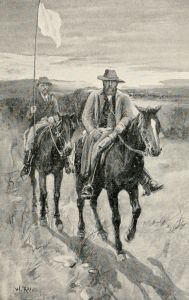
CRONJE RIDES OUT TO SURRENDER.
The Canadians, however, now felt the benefit of the sacks of earth carried by the Engineers with them. These sacks were thrown down the instant the first shot was fired, and behind these the two companies of Canadians and the Engineers lay in comparative shelter. This protection was soon increased by the work of the men with shovels, and before day broke they were firmly established, and from their position were able to open a flanking fire upon the greater portion of the Boer trenches on that side. The other companies of the Canadians had similarly entrenched themselves a short distance farther back, and all felt that the end of the ten days' investment was close at hand. The Boers also saw that to continue the struggle would result in their entire destruction, and at six in the morning a white flag was raised and Cronje himself rode out. He was met by General Pretyman and conducted by him to the head-quarters camp, where he met Lord Roberts, who shook hands with him. Cronje then said that he had come in to surrender. The general replied that the surrender must be unconditional. Cronje felt that in the desperate position in which he was placed he could not stand out for any conditions, but merely asked that his wife, grandson, secretary, and adjutant should, with his servants, be allowed to accompany him. This was granted, and he and those with him were the same afternoon sent down with the other prisoners, about four thousand in number, under a strong escort to the railway, by which they were taken down to Cape Town.
Only a hundred and fifty wounded were found in the camp, and, taking the usual proportion of killed and wounded, only some thirty or forty could have fallen victims to the tremendous bombardment to which they had been exposed for ten days, including those who fell during the attack on the 18th. The aspect of the prisoners was miserable to the last degree as, pallid, unwashed, unkempt, and ragged, they staggered up from the holes in which they had been lying, worn out by the terrible strain, sickened by the horrible odours that speedily drove back the soldiers who entered the camp, and must have been well-nigh insupportable even to nostrils accustomed to insanitary surroundings. Some were sullen and downcast, but among the majority the predominant feeling was evidently one of satisfaction at the end of their sufferings, and the fact that, as far as they were concerned, the fighting was over.
The scene in the camp was indeed terrible. Carcasses of dead animals lay everywhere, the greater part, owing to the heat of the sun, being in a state of decomposition. Waggons overturned, and sometimes smashed to pieces by the explosion of our shells, showed the destruction modern artillery can effect against material of all kinds, though it is comparatively harmless against troops when not in solid formation.
If the Boer prisoners had expected—as would assuredly have been the case had they been the victors—that the vanquished would be received with exultation and triumphant jeers, they were agreeably surprised. They had been brought up in the belief that the British soldier was at once contemptible as a fighter and full of every evil quality. They had already learned that he could fight; now they learned that he was a generous enemy, and that his imagined hatred of the Boer had no existence whatever. The patient endurance with which the besieged had supported the tremendous fire to which they had been subjected, had filled the soldiers with admiration and pity for men forced by the iron will of their commander to maintain a resistance when there was no possibility of escape, and they crowded round the captives, offering them little kindnesses, helping the feeble, giving them tobacco and other little comforts from their own scanty stores, carrying the children, and assisting the women. There was no sign of exultation. They were justly proud of the success they had gained, but no show of this feeling was visible. As much honour was due to the British soldier for his bearing at the moment of victory as for the desperate courage and steadfast endurance he had displayed in trying to achieve it.
Yorke Harberton had been kept at work almost night and day from the time he reached Jacobsdal, carrying orders to the different columns and bringing back news of their position and progress. He would alternately ride his own horse and that which Mr. Chambers had given him, and when these required rest would use animals captured when Jacobsdal was taken. Although the excitement had kept him up, he was completely worn out when he arrived at head-quarters at Paardeberg. The other aides-de-camp were in a similar position, and Lord Roberts with his usual kindness told them that they must for a day or two consider themselves relieved from further duty, and that their work would be carried on by officers drawn from the cavalry. In spite of the thunder of the guns Yorke slept for nearly eighteen hours without waking, then, after a hearty meal, he rode round the line of investment, in order to ascertain the exact position of the various regiments and brigades, in case he should have to carry orders to them. But although after two days' rest he returned to duty, there was little for him to do, as the position remained unchanged until the final advance of Smith-Dorrien's men.
The joy of the troops at the capture of Cronje and his host—who had left Magersfontein six thousand strong, and of whom only one thousand who had slunk away to their farms retained their liberty—was heightened by the fact that his surrender occurred on Majuba Day. This feeling was especially strong among the Colonial troops, who had hitherto been obliged to put up with the triumphant celebrations of that event by the Boers. This feeling was still further heightened by the receipt of the news that a day later Buller's army had relieved Ladysmith.
Not until March 6th, a week after the surrender, was there any movement. This pause had been absolutely necessary to rest the horses of the cavalry, which had been half starved as well as terribly overworked. Accustomed to be fed at regular hours, these were unable to eke out the scanty rations served to them by cropping the dried-up and scanty grass on the veldt, and even at the end of the week were still scarcely fit for service. Thus no effort could be made to disperse the large force consisting of local levies, commandos from Colesberg and other places south of the Orange River, and those that had hurried up from Natal, now all commanded by De Wet.
But in the meantime reinforcements had arrived—the Guards from Klip Drift, the Australians and the Burmese Mounted Infantry, a detachment of horse from Ceylon, the Imperial Yeomanry, and the City Imperial Volunteers, who had distinguished themselves in the attack on Jacobsdal, and were for all purposes of such warfare the equals of any of the line regiments. Indeed, the South African troops, the contingents from our colonies, and the volunteer companies which came out attached to the various line regiments, shattered to atoms the long-cherished belief of military men that civilians would be of no real service in warfare. In point of bravery, readiness to submit to discipline, and of cheerful endurance of fatigue and hardship, they proved themselves equal to their comrades of the regular army, and showed that enemies of Britain must not, in making an estimate of her strength, omit from consideration the militia and volunteers, the mounted corps that would spring into existence, and the aid of her great colonies in case of need.
The position taken up by De Wet was a very strong one. In its centre was a farmhouse called Poplars Grove. On both flanks rose hills connected by scattered kopjes. Guns were placed on all the hills, and along the front ran trenches, rifle-pits, and barbed wire; and a direct attack would probably have proved at least as costly as Magersfontein. But Lord Roberts possessed what Lord Methuen had not—three brigades of mounted men and a strong force of horse-artillery. He had a number of guns greatly superior in weight of metal to those of the enemy, and an army of over thirty thousand men. But even with such a force he was not a man to throw away a single life unnecessarily, and therefore determined to turn the Boers' position. The cavalry were sent off before morning broke on March 7th to make a wide sweep, and come down upon the Boer line of retreat. Tucker's Division were to follow and support them. Kelly-Kenny was to push straight along the southern bank of the river, but he was not intended to attack until the cavalry and Tucker were in their appointed places. The Highland Brigade were on the north side of the river with the Naval Brigade, and these were to make a turning movement.
Had the plan been carried out as intended, the whole of the Boer force would probably have been annihilated and captured, and the war might have come to an abrupt end, for both Kruger and Steyn were with De Wet, and with the capture of the two originators of the war, all further resistance might have ceased at once. But for once in his brilliant career French failed. Thus, instead of sweeping quite clear of the Boer line, he ran against the extreme left of their position. Daylight broke before the cavalry were perceived, and the instant the Boer leaders saw that they were in danger of being outflanked, and their retreat cut off, they abandoned the position they had so laboriously fortified and retired hastily. But there was still ample time for the cavalry to have overtaken the guns and waggons, even if they could not have caught the flying horsemen. They allowed themselves, however, to be held in check by a handful of skirmishers, some fifty in number, who first held a farmhouse, and when, driven from this, kept up a stinging fire from a low kopje, until, knowing that the guns and waggons were out of reach, and that the two presidents must have escaped, they retired.
Thus, for an hour this great body of cavalry and mounted men suffered themselves to be detained on their all-important journey by half a company of infantry. Such was not the method by which French had relieved Kimberley. Then he had disregarded the rifle and artillery fire of a vastly larger body of men, and had galloped straight on. His mission was to the full as important now, and yet he allowed himself to be detained for a precious hour, by which time the finest opportunity of the whole war was lost. General Roberts remarked when he heard of the utter failure of his plans, "In war you cannot expect everything to come out right. General French can afford to lose one leaf from his laurel wreath." Tucker's infantry had never fired a shot, and De Wet's little band had inflicted some fifty casualties among our cavalry.
Had a portion of the mounted infantry been sent forward on foot against them as soon as they opened fire, the matter would have been over in five minutes, and the loss would probably have been much smaller. The Boers, unmolested in their retreat, speedily rallied and took up a fresh position at Driefontein; and on the 9th, Lord Roberts again advanced. As before, De Wet had chosen his position well. It was some seven miles in length. The northern flank was protected by the river, the southern by a steep hill extending back for a long distance. The general's plan was the same as in the previous fight, namely, to outflank the enemy and cut off their retreat. For this purpose Tucker's Division, with a portion of the cavalry, were to make a wide circuit. The river prevented any flanking movement being attempted on that side.
General French was in command. The left wing was composed of Kelly-Kenny's Division, the 1st Cavalry Brigade, and a regiment of Mounted Infantry. He was to keep in touch with the centre, and not to push his attack home until Tucker had worked round to the rear of the position. But movements in the dark are always uncertain, and French, in endeavouring to keep touch with the centre, moved his men more and more to the right, unknowing in the darkness that he was already ahead of that body. Thus, when he approached the Boer position, he was absolutely between it and the main body. Morning was breaking now, and Kelly-Kenny learned from a Boer farmer, who had doubtless been ordered by De Wet to give false information, that the hill in front had been abandoned. Therefore, he advanced until a storm of fire showed that he had been deceived.
The Welsh, who were the leading regiment, were staggered by the rain of bullets, and the Buffs passed them. So heavy was the fire to which they were exposed that every officer was hit, and, throwing themselves down, the men joined the Welsh in returning the fire of their unseen assailants. The men of the Essex regiment, who were next in order, pushed on, supported by the Yorkshires, and these with a cheer surged over the crest and fell upon its defenders, who were the Johannesburg Police, considered the best corps in the Boer army. It was composed of men of every nationality. They had been the terror and scourge of the town where they were supposed to keep order, and were, for the most part, unmitigated ruffians. They possessed, however, that fighting instinct that was absent among the Boers, a readiness to stand an attack, and they here suffered heavily for it.
The Essex men were among them with the bayonet, and drove them like chaff before the wind, leaving a hundred dead behind them. The moment the position was carried, the Boers quitted their whole line of defences and fled hastily. In point of the number of casualties the action was an insignificant one. Kelly-Kenny's Brigade had lost four hundred in killed and wounded, but they alone had been engaged. The turning movement had failed altogether, from some miscalculation in distance. The attack had begun long before Tucker and the cavalry had reached their appointed place, and, as before, the Boers were able to draw off their waggons and guns. Nevertheless, the consequences were of immense importance. The road to Bloemfontein was again open, and the Boers had learned that, however strong their position, they could not hope to oppose the British advance. From this time until the army marched into Pretoria they never again attempted to make an enduring stand, but abandoned one after the other, without an attempt to defend them, the positions they had prepared, or rather had forced the Kaffirs to prepare for them with immense labour.
There was no delay after this success; the army swept forward, and on the 12th they were within striking distance of Bloemfontein. The cavalry pushed forward to the railway south of the town and cut it, while Major Hunter-Weston, with a handful of Mounted Infantry, started to cut the lines to the north of the town. The feat was a bold and difficult one. The night was extremely dark, but they succeeded in finding the railway and in blowing up a culvert, and returning in safety after having fought their way through a Boer force they encountered. This action was of immense service, as it prevented the escape of twenty-eight railway-engines, two hundred and fifty trucks, and a thousand tons of coal, which were all standing in readiness to start as soon as the British were seen advancing against the town. It is not too much to say, that had these trains escaped, Lord Roberts would have found it next to impossible to supply his army with provisions.
As the troops marched through Bloemfontein to the spot selected for their encampment, a mile or two outside the town, they were received with enthusiasm by the British portion of the population. Union-jacks waved from the windows, caps were thrown up, and women sobbed in their joy at their release from the long strain of nearly six months of Boer insolence and oppression. The general was met by a deputation headed by the mayor, the landdrost, and Mr. Fraser—the last-named being a Scotchman who had long been settled there, and had adopted the nationality of the Orange Free State. He had won the esteem of the Dutch population as well as that of the British, and had been run against Steyn for the presidentship. Had he succeeded, the Free State would never have thrown in its lot with the Transvaal, and would have been spared enormous sacrifices and financial ruin. He was thoroughly loyal to the country of his birth, and was appointed by Lord Roberts chief magistrate of Bloemfontein, while General Pretyman was named as its governor.
It was evident to all that there must be a long pause before the army could renew its advance. The single line of railway, by which alone it must depend for getting up provisions and stores, was threatened along its whole length from the Orange River by the Boers, and indeed was at present almost completely in their hands. The bridges by which it crossed the Orange River at Norval's Pont, on the branch to Port Elizabeth, and at Bethulie on the branch to East London, were known to have been blown up by De Wet when he was summoned to hasten to Cronje's assistance. Even when these had been repaired, and the Boers driven back from Springfontein and other points held by them, it was liable to be interrupted at any moment by small parties of the enemy, who would have the aid and shelter of farmhouses near the line.
The army was now cut off entirely from its base at De Aar, and it would be necessary not only to pass up supplies sufficient for its daily consumption, but to collect great magazines for its supply when it started on its march north. It was necessary, too, to fill up the gaps caused among the horses of the cavalry and the mules of the transport. No fewer than ten thousand had died or become utterly unfit for service during the month that had elapsed since the advance began from the Modder River, and even of those that remained, few would be able for some time to perform hard work. Considering the enormous difficulties in the way, it is wonderful that six weeks sufficed to complete the preparations for an advance.
Yorke's first step when the force arrived at Bloemfontein was to call upon Mr. von Rensburg. The latter expressed great satisfaction at seeing him again.
"I had every hope that you had got through safely, Mr. Harberton. For if you had not done so, we should certainly have heard of it here. Moreover, there came a story that three Boers had been strangely overpowered, and left tied up in a stable by two others, aided by a Kaffir. The two men had been recognized as spies by one of the party assaulted. The incident was considered as an extraordinary one, as taking place in the heart of a town occupied by the Boers, without any alarm being given. So far as was known their assailants had escaped. It was certain that the two spies had ridden quietly out of the town, and had been accompanied by the Kaffir. A hundred men started in pursuit along all the roads leading west, but without success. I felt no doubt that you were the men engaged in the matter, and I heartily congratulate you."
"It was entirely due to you that we succeeded; your getting us that ride in the train down to Colesberg, and the permit were of the greatest service to us, and we could hardly have crossed the river without them. Even as it was, it was a close thing, and it was the greatest piece of good fortune that we were able to get out of the town after the affair you speak of."
He then related how Dirck Jansen and his companions had been overcome and silenced.
"You Englishmen are quicker of thought and action than our people," von Rensburg said. "I am not astonished that in a sudden struggle like that, when both parties were equally surprised, you had the advantage. I shall be glad, if your duties permit, if you will take up your quarters here. I have no doubt that the Dutch rule in this place is at an end, and I shall be running no risk whatever in showing that I for one am well content that it should be so. The behaviour of your men as they marched through the town to-day was beyond all praise. They must have had a terrible time of it, for they all looked worn and haggard, and had evidently been doing desperately hard work on the smallest amount of food."
"Yes, it has been hard work, and our loss in horses and baggage animals has been enormous; still, we are all well satisfied. In a month from starting we have relieved Kimberley, captured Cronje and some five thousand of his men, driven De Wet out of two strong positions, and now occupy this town."
"I do not think you will have much more hard fighting, Mr. Harberton. The men who came in here yesterday, after being driven from the last position, were completely disheartened. They said they had been told that the Rooineks were cowards, but that there was no stopping them, and that your soldiers marched through a storm of bullets as if these had merely been hailstones."
As the Government House, of which Lord Roberts had taken possession, was close to Mr. von Rensburg's, Yorke had no difficulty in obtaining permission to stay there. The time passed pleasantly for him; he had just enough work to do in riding out to the camps with orders, and in questioning farmers who had come in to take advantage of the proclamation, that all who gave up their arms and took the oath of neutrality would be permitted to return to their farms and remain there unmolested. He had his friends of the 9th Lancers, and was always welcomed in the camps of the cavalry brigades. He was introduced by Mr. von Rensburg to several of the leading Dutch families, and passed many pleasant evenings among them. As the shops were still fairly supplied, the head-quarter mess was now comparatively luxurious, and altogether he was far less impatient than most of the other officers for the advance to commence.
Preparations for it had begun some time before, when Tucker's Division had captured Karee siding, some twenty miles north of the town; but not without considerable loss, for, as upon previous occasions, the infantry attacked before the cavalry had completed their turning movement. But on the 3rd of May all was ready for the advance. The troops were glad indeed, for while they were stationed at Bloemfontein, a terrible foe had made its appearance among them. Enteric fever had broken out, the hospitals were filled to overflowing with sick men, and the accommodation was altogether insufficient to meet the emergency. For this no one could be blamed. The medical staff that had accompanied the movement from the Modder River was sufficient to cope with and care for any amount of wounded that were likely to be thrown on to their hands; but it was not capable of meeting such an emergency, even with the assistance of the hospitals that had been furnished and sent out by private subscription from home. All that could be done was done; but the first necessity was to provide for the wants of the fighting men, to accumulate the stores on which they would have to depend during their advance; and although many Red Cross trains came up, there was, for a considerable time, a grievous deficiency of hospital accommodation and hospital necessaries, doctors, and nurses.
In one hospital, where there were five hundred beds, there were seventeen hundred sick. Upwards of a thousand men died, but there were some seven thousand cases, and those who recovered were so debilitated by the effects of the disease that they were unfit for further service, and had to be sent down to the Cape or Port Elizabeth, and then to England. The seeds of this terrible scourge had been sown by the polluted waters drunk at Paardeberg. By some grievous oversight the War Office had neglected the advice of those who urged upon it the necessity of sending out a special corps to attend to sanitary points. Had this recommendation been attended to, the lives of some four thousand or five thousand men, and of over twenty thousand sent home incapacitated for work, would have been saved.
Gatacre's force were able after De Wet's departure to move up to the Orange River, repairing the railway as they advanced. On arriving at Bethulie Bridge, the general found that, although that magnificent railway viaduct had been destroyed, the road bridge was still intact. It was known, however, to be mined, and there was a strong Boer force on the other side ready to blow it up the instant the British ventured upon it. It was saved, however, by the daring action of Lieutenant Popham, of the Derbyshire Regiment, and of Captain Grant, of the Sappers. The former, with two men, crept along the bridge at night and removed the detonators, took away the dynamite from under the farther span, and carried it off under a heavy fire, opened by the Boers as soon as they found that the mines were being tampered with. But there still remained heavy charges in the piers, and although the Boers could not explode these in the ordinary way, as they were commanded by our rifle-fire, they might have effected it by directing a shell-fire against them. Captain Grant, therefore, completed Popham's work by going across, removing the charges, and dropping them into the river. As the reconstruction of the railway-bridge was a work that would occupy months rather than weeks, the preservation of the road-bridge was a matter of vital importance. Gatacre's force marched across it after the enemy had been shelled out from their position on the other side, and advanced along the line of railway. The cavalry pushed forward to Springfontein, and there met two battalions of Guards sent down by train from Bloemfontein—and thus the whole line of railway was in our possession.
Clements, advancing from Colesberg, had thrown a pontoon bridge across the river close to the ruined Norval's Pont, and thus, when a temporary deviation of the line had been effected, this branch of the railway was also available. Farther to the east, General Brabant, with a force of Colonial Volunteers, the Royal Scots, and three guns of field-artillery, advanced to Dordrecht, won a victory there, and pushed on so rapidly towards Aliwal, that he occupied the bridge there before it could be blown up, and then proceeded to stamp out the rebellion in that part of Cape Colony. To the east of the line of railway, from Bethulie to Bloemfontein, strong bodies of the enemy continued to wander about doing considerable damage. But Lord Roberts was not to be tempted to move any considerable forces to suppress them. His great object was to march to Pretoria, his great work to collect stores that would enable him to do so, and to do this he contented himself with holding fast to the line of railway. Rails were often removed and culverts blown up, but a few hours' work always sufficed to repair the damage.
Two serious reverses, however, happened. A cavalry force had been threatened by a strong Boer commando at the water-works that supplied Bloemfontein. They were twenty-four miles from the town. The Boers opened fire with heavy guns from a hill that commanded the British position. Colonel Broadwood, who was in command, could not, with a force composed only of mounted men, attempt to storm the hill, and as the guns of the two batteries of horse-artillery with him were altogether inferior to those of the Boers, he decided to retire upon Bloemfontein. He knew that a messenger he had sent the night before to ask for reinforcements had arrived there, and he received a reply that Colvile's Division would be sent out before daybreak to meet him. Believing, therefore, that there was no danger in front, he remained at the rear of the column, which had been shelled by the enemy.
The waggons were at the head of the retiring column, which, as it crossed the plain, had to go through a deep donga. Here the Boers were in hiding. Each waggon as it descended was silently seized. A Boer took the place of the driver, and it ascended the opposite side without any alarm being given. So the whole convoy would have fallen into the hands of the hidden enemy had not one of the troopers with it drawn his pistol and fired. A volley of shots rang out, and the brave fellow paid for his courage with his life. The nine waggons which had not reached the donga halted. The two batteries were close behind them, and, knowing further concealment to be useless, the Boers sprang to their feet and opened a terrible fire on them. Men and horses went down in numbers. The confusion was terrible. The men struggled to get the fallen horses out of the traces, but were mown down by the continuous rain of bullets. The rearmost gun of the leading battery alone was able to get off, and galloped furiously back. Two guns of the second battery were overturned by the struggling horses and had to be abandoned. As soon as the others reached a distance of seven or eight hundred yards from the edge of the donga, they turned and opened fire.
Roberts's Horse had been abreast of the guns and suffered heavily also; but they, the New Zealanders, and the Burmese Horse dismounted when they had retired a sufficient distance, and, throwing themselves down, returned the fire of the Boers. Parties of cavalry were sent off to discover some other point at which the donga could be crossed, and one was found two miles to the south by an officer of Rimington's Scouts, and towards this the force moved off. The artillery nobly covered the retreat. But they had suffered terribly. Two of the guns had but two men left to work them, and another was loaded and fired by an officer single-handed; and when at last the order came to fall back, but ten men remained on their legs, and several of these were wounded. The Colonial corps covered the withdrawal by turns, and in two hours the rear of the column had crossed the donga. Some thirty officers and three hundred men were killed, wounded, or missing. A hundred waggons, with seven guns, were lost. Only one officer and the sergeant-major of the leading battery escaped.
The other disaster, which was equally serious, occurred four days later, when a detachment of five companies of infantry posted at Reddersburg were surrounded on their march from an advanced position, and took post on a kopje. For twenty-four hours they defended themselves gallantly. But they were without water, the hoped-for relief did not arrive, and they surrendered the next morning.
CHAPTER XIX
MAFEKING
On the 20th of April, Yorke was sent for by Lord Roberts. "I suppose you are almost tired of remaining quiet, Mr. Harberton," he said with a smile.
"I shall certainly be glad when we are off, sir. But I am by no means sorry for a rest after being on horseback for six months. But I am perfectly ready to go anywhere if I can be of service."
"What do you say to a ride to Kimberley?"
"I am quite ready to go, sir; though I hope to be back with you when you advance."
Lord Roberts shook his head. "I hope to be away before you get back. I have some despatches for you to carry. The wires are so frequently cut by the Boers that I cannot trust to them in a matter of importance. They relate to an expedition that is being prepared for the relief of Mafeking. Lord Methuen is confronted by so strong a force of Boers—doubtless a portion of Cronje's force, which moved north with the guns—that he cannot go forward. Colonel Plumer in the north has not a sufficient force to fight his way in. Therefore profound secrecy is necessary with regard to the route of a force with which Lord Methuen and I hope to relieve the town. It is for this reason that I dare not trust to the wire. You have done good service, Mr. Harberton, and if you like I will attach you to the force, which will start in ten days or so. And if all goes well, you will be at Mafeking, and will have time to rejoin me, say at Johannesburg, before I advance on Pretoria. I cannot expect my progress to be very rapid, for although I do not anticipate any serious resistance on the part of the Boers, I shall have to make halts to enable the supplies to come up. And as the party you will go with will travel fast, I do not think that, if all goes well, you will be many days behind me at Johannesburg."
"Thank you very much, sir! If I cannot be with you, I should above all things like to be at the relief of Mafeking."
"The despatches will be ready for you this evening," the general said. "You can start with them as early as you like. I hope that your usual good luck will again attend you."
Yorke bowed and retired. He had no doubt that Lord Roberts would, as before, turn the Boers out of their positions by flanking movements, and that if a great battle were fought, it would be close to Pretoria, and he felt delighted at the thought of being with an expedition which the general evidently believed was likely to effect the relief of Mafeking.
That town had, since the day of the declaration of war by the Boers, been a cause of no little anxiety. As time went on, and the garrison continued to defend themselves heroically, the feeling at home heightened, until every scrap of news that came through was regarded with as much interest as the more important operations of the army.
Mafeking was a small town, and was chiefly known in Britain as the place from which the Jameson raid had started. It was the nearest point of the western railway to Pretoria, and was within a few miles of the Transvaal frontier. Unlike Kimberley, it contained no garrison of regular troops, the force consisting only of three hundred and forty men of the Protectorate Regiment, one hundred and seventy Police, and two hundred Volunteers. But fortunately, early in July, the military authorities at Cape Town had appointed Colonel Baden-Powell to organize a force of irregulars, both for the purpose of preventing any native rising in case of war, and as far as possible to defend the eastern border. The difficulty of such a task, owing to the extreme length of the frontier, had been recognized at once; and a better man could not have been chosen for the task. Baden-Powell had, a year before, taken a conspicuous part in the campaign against the Matabele; and before the outbreak began, had organized the Protectorate Regiment; while, under his orders, Colonel Plumer had raised a regiment in Rhodesia.
He saw that Mafeking was certain to be the first point of attack. It was but a hundred and fifty miles from Pretoria, and was the route through which the Boers would naturally pour into the colony, where the population was largely Dutch. He had chosen as his chief of staff Major Lord Edward Cecil, who arrived at the town on October 1, 1899, and set to work to prepare the town for defence, with Captain Williams and Captain Fitz-Clarence, Lord Charles Bentinck, and other officers.
The military authorities had sent up a certain amount of stores. These were quite inadequate for the purpose, and Baden-Powell and Lord Cecil took upon themselves the responsibility of ordering far larger supplies to be forwarded. They might have failed in obtaining these had it not been for the patriotism of Messrs. Weil & Co., one of the largest firms in South Africa. These accepted the order, although quite aware that the prices of all goods were advancing enormously, and furnished the supplies asked for. And thus the store of provisions was accumulated that enabled Mafeking to hold out for so many months.
But the requisitions for guns was not so promptly complied with. The Africander government of Cape Colony, whose sympathies were wholly with the Transvaal, pretended to doubt that there was any probability of war, and refused to send up the guns, and when at the last moment half a dozen small pieces of artillery were forwarded, they arrived too late and were unable to enter the place.
On Baden-Powell's arrival he organized the town guard, consisting of all white inhabitants capable of carrying guns, and even boys of from fourteen to sixteen were formed into a cadet corps for orderly duty. An armoured train was constructed and armed with a Maxim and Nordenfeldt, and mines were laid in a circle round the town.
Already several large commandos of Boers had appeared on the frontier, and whatever might be the opinion elsewhere, at Mafeking there was no question whatever that these men were only waiting for the declaration of war by Kruger to attack the town. On the day after the expiration of the time named in Kruger's ultimatum the railway was torn up forty miles south of the town, and an armoured train, bringing two seven-pounders for Mafeking, was thrown off the rails, and an artillery fire opened upon it. The officer who, with twenty men, was escorting the train, defended himself valiantly for five hours, but was then obliged to surrender. This was the first blood shed in the war.
The Boers had doubtless expected to enter the town with scarce any resistance. They were five thousand in number, and knew from their sympathizers in the place that, including the town guard, its defenders amounted to only nine hundred men, with two seven-pounder guns and six machine-guns. The difficulties of the besieged lay chiefly in the fact that Mafeking, though but a small town, was scattered over a very large area, and that the defences were naturally erected some distance outside the circuit. These defences were planned by Colonel Vyvyan and Major Panzera.
Two days after the declaration of war the Boers appeared before Mafeking, and drove in the pickets round the town. The armoured train and a squadron of the Protectorate Regiment went out and drove back the Boers. Great numbers of the enemy hurried up and cut off the party, but another squadron and a seven-pounder went out and opened a passage into the town. The loss was about two killed and fourteen wounded, while the Boers suffered much more heavily. Two days later the Boers opened fire on the town with two twelve-pounder guns, and in another four days Cronje sent in a messenger with the summons: "Surrender to avoid bloodshed"; to which Powell replied, "When is bloodshed going to begin?" Two or three days later the Boers brought up a ninety-six-pounder, and the bombardment began in earnest.
On the 27th a sortie was made; one of the Boer trenches was carried, the Boers were driven out with a loss of a hundred men, while we had six killed and eleven wounded. About half the Boers who fell were killed by the bayonet, and consequently this weapon was throughout the siege regarded with a wholesome dread by the besiegers. There were now, in addition to the ninety-six-pounder, five seven-pounders, one ten-pounder, and two twelve-pounders playing on the town, and yet the damage done was so slight that on the day after the sortie there was a concert at the hotel, the officers all attending in fighting costume, in readiness to rush out in case the Boers attacked.
Bomb-proof shelters were dug, everyone kept in good spirits, and Baden-Powell sent out the cheerful message, "All well. Four hours' bombardment; one dog killed." Another summons to surrender was answered with the message, "Tell General Cronje that I will let him know when we have had enough."
Two assaults were made, but they were both repulsed with loss, although one of them was pushed with great energy against an old fort which was the key to our position. It was held by Colonel Walford and men of the South African Police. The attack was covered by the fire of four guns and the ninety-six-pounder. The Boers fought well, and pushed up to within three hundred yards of the little fort, but were repulsed with heavy loss. We had two officers, Captain the Hon. D.H. Marshall and Captain Pechell, among the six killed. Various skirmishes followed, but the siege languished until, on the 18th of November, Cronje left to take command of the force assembling to oppose the advance of Lord Methuen. Commandant Snyman succeeded to his post.
Things went on quietly until a great sortie was made on 26th December. The object was to attack a post called Game Tree Fort. The storming-party was composed of eighty men and six officers. Captain Vernon of the Protectorate Regiment was in command. Supported by a considerable force and by guns playing on the enemy to distract their attention, the storming-party dashed forward. Many fell as they advanced, but they pushed forward till they reached the fort, which was composed of sand-bags. These stood up like a wall, and no efforts of the men sufficed to enable them to scale it, whereas from loopholes left between the bags a murderous fire was maintained. Captains Vernon, Sandford, and Paton were killed, Captain Fitz-Clarence wounded, and Lieutenants Swinburne and Bridges alone escaped the deadly fire and led back the survivors of the little storming-party. Twenty-one had fallen, and four of those carried off were found to be mortally wounded.
After this there was a long period of inaction. The bombardment was continued, Snyman, in spite of the protests of Baden-Powell, continuing to throw shells into the nunnery and the women's laager, until the colonel ordered a number of the Boer prisoners to be also confined there. Occasionally a message was got through, and, carefully as the provisions were doled out, the gallant commander at last informed General Roberts that by the 20th of May the stock would absolutely come to an end, and that he could not hold out beyond that date.
On 17th April, seeing that the force from Rhodesia under Colonel Plumer was not sufficiently strong to fight its way through, and that the expedition that had been sent there by way of Beira could hardly, in spite of the tremendous exertions that were being made, be depended upon to join Plumer in time, Lord Roberts ordered that a flying column of mounted troops, under the command of Colonel Mahon of the 8th Hussars, should start from Kimberley not later than the 4th of May.
Yorke, after leaving Lord Roberts, at once returned to his quarters and told his host that he was going to Kimberley, and should probably not return to Bloemfontein, but should rejoin the army on its way up the country.
"Are you going to take your man with you?"
"No, sir, I shall have to travel fast, and may have to ride for my life. I shall take my best horse. If you will kindly allow me to leave the other in your stable, my man can bring him on when the army moves."
"That I will gladly do, but you must let me lend you a better mount than the one you are taking. I have two in my stable of which you can take your choice. I think either of them is as good as any in the state—or, I should say, in the colony, as, since your general's proclamation, we are all British subjects."
"I could not think of accepting your kind offer, sir."
"But I insist upon it, Mr. Harberton. Indeed you will be doing me a service, for since the war began I have had no use for my horses at all, and they sadly want exercise. A month's hard work will be of real benefit to the animal; and I should benefit too, for time was when I did not mind how fiery a horse was, but now that I am getting on in life I am not fond of having to fight with my mount."
"I am extremely obliged to you, sir; but I do not see how I shall be able to send it back again to you."
"When you get to Johannesburg you can leave it with Mr. Chambers, he and I will arrange how it is to be returned. In fact, as soon as matters are settled down I shall certainly go there myself. Do not let that trouble you in any way."
Yorke gratefully accepted the offer. Both of his own horses had felt the hard work to which they had been subjected, that which Hans rode more than his own; for the latter had been kept hard at work since their arrival at Bloemfontein, and was certainly not fit to start on a journey of many hundred miles. Both horses could, without difficulty, go on at the rate the army was likely to advance, especially after having another ten days' rest at Bloemfontein.
Hans and Peter were both disappointed when they heard that they were not to accompany Yorke. But Hans himself, who throughout had taken great care of the horses, admitted that these were not fit to start on so long a journey. Accordingly the next morning at daybreak Yorke started alone on the horse that had been lent to him. The distance between Bloemfontein and Kimberley was somewhat under a hundred miles, and this was traversed in two days, Yorke riding only forty miles the first day, as he felt that it would not do to push the animal too hard immediately after being so long without work. He did not hesitate to complete the remaining part of the journey on the second day, as he knew that the horse would have at least a week's rest before starting again. It was a splendid animal, superior even to that which had been killed at the time when he was taken prisoner on his way to Belmont, and as it stretched out in a gallop under him he felt that he could ride anywhere across country without fear of being overtaken by any party of Boers he might meet.
On his arrival at Kimberley he handed his despatches to Colonel Mahon, to whom he was instructed to deliver them if Lord Methuen was still at Boshof.
"I have brought despatches for you, sir," he said as he entered that officer's head-quarters. "Lord Roberts informed me that if, as he supposed, Lord Methuen was still at Boshof, I was to hand them to you, as they relate entirely to the force you are preparing. I have the honour to be one of the commander-in-chief's extra aides-de-camp. My name is Harberton."
"We have all heard of you, Mr. Harberton," the colonel said as he opened the despatches. "Your journey to Kimberley, and your adventurous escape from Pretoria, have made your name familiar to us all."
When he glanced through the despatches he said: "I am glad to see that you are to accompany me till we get to Mafeking. Our arrangements are going on most satisfactorily, and I have no doubt that we shall be in a position to start on the day named. Now, you must be famishing after your ride, though, I suppose, as an old hand, you did not leave Bloemfontein without some provision for the journey. I will tell my orderly to put your horse up at once. Dinner will be ready downstairs in half an hour; they always keep a table for me and my officers."
The dinner at the hotel bore few signs of the long siege. Supplies had been got up, and some of the principal inhabitants had returned, and though at Bloemfontein things had been well managed and comfortable, the style in which meals were served was very inferior to that which had already been attained at Kimberley. Some ten or twelve officers joined Colonel Mahon's party. No allusion whatever was made to the intended expedition, which was kept a profound secret, as even at Kimberley there were many Boer sympathizers, and it was all-important that no rumour of the approaching departure of a large body of horse should be known to them. It was to consist of the Imperial Light Horse, which had arrived from Natal, the Kimberley mounted corps, the Diamond Field Horse, a party of Imperial Yeomanry, and a detachment of the Cape Police, a horse artillery battery with four guns and two machine-guns, a hundred men of the Fusiliers to guard the waggons, fifty-two waggons with ten mules each, and a number of spare horses to take the place of any that might break down. The force amounted in all to twelve hundred men. Not even to the officers who commanded the different corps was their destination made known until the morning of the 4th of May, when the force had ridden out from Kimberley.
Yorke had placed himself altogether under Colonel Mahon's orders, and had looked after many of the details connected with the waggons and provisions. The store of food carried was quite enough to last fourteen days, this being the outside limit of the time that the march was likely to occupy. Once off there was no delay. The mules and the waggons did their work well, and the force moved round to the west of the position of a large body of Boers, who were opposing Methuen's advance by the line of railway, and on the 9th marched into Vryburg, having done a hundred and twenty miles in five days. They halted here for a day to rest the animals, and on the 11th they started again. Hitherto not a shot had been fired. From this point they were watched by the enemy, as their arrival at Vryburg had been at once notified to the Boers, and at Koodoosrand a force was found posted in a strong position in front of them.
Mahon, whose object was not to fight but to relieve Mafeking, moved off to the westward; but here the country was found to be thickly covered with bush, which greatly impeded the progress of the waggons, and presently the enemy, leaving their position, threw themselves across his path. There was a sharp but short encounter, and the Boers were soon in flight. The casualties in killed and wounded on our side were only thirty.
On the 15th the relieving column arrived at a village twenty miles to the west of Mafeking, where, within an hour of their entry, they were joined by Plumer's force, which had just been strengthened by the arrival of four twelve-pounder guns of the Canadian artillery, and a party of Queenslanders.
These troops had performed a marvellous march. On their arrival from Canada and Queensland respectively they had been brought round by ship to Beira, carried by train to the plateau of Rhodesia, from there in vehicles a hundred miles to Buluwayo, then by train over four hundred miles to Ootsi, and had then pushed on on foot for four days over terribly bad roads at the rate of twenty-five miles a day, and had been with Plumer only a few hours.
There was no fear now that they would fail to gain the success they had striven for, as their united force was stronger than that with which Snyman could oppose them. The Boer commander, however, would not retire without one last effort, and he planted his force on a hill which commanded the water supply; but after he had held his ground for an hour, his guns were silenced, and he retired past Mafeking to the trenches on the eastern side. Here, however, the Boers had no rest, for Baden-Powell sallied out with his garrison, and Mahon's guns opened upon them, so that ere long they withdrew and retreated eastward.
Mafeking was free at last! Only six days before, fearing doubtless that relief would come ere long, and possibly hearing that a large cavalry force was nearing Vryburg, the Boers made the most determined attempt to capture Mafeking that had occurred during the siege. Early on the morning of the 12th three hundred volunteers, under the command of Eloff, a grandson of Kruger, crept up to the west of the besiegers' line and reached the native quarters, to which they at once set fire. The barracks of the Protectorate Regiment were held by Hore and some twenty of his men. These, after a stout defence, were compelled to surrender. Two other positions within the line were captured, and had Snyman sent up his support at once, affairs might have ended badly; but this failed to arrive. The telephone and telegraph wires called up the defenders from all parts of the town. These gradually surrounded the positions the Boers had taken, and prevented any reinforcements from reaching them. Knowing that unless aided they must surrender in time, Baden-Powell refused to allow the loss of life that must ensue if the Boers were attacked, and contented himself with preventing them from being reinforced, and at seven in the evening Eloff, finding his position desperate, surrendered.
The defence of Mafeking ranks with that of Ladysmith in the stubbornness of the resistance which it, an open town, made against a powerful enemy, and is the more remarkable inasmuch as the garrison consisted entirely of irregulars, with but two or three guns of the smallest calibre, while the enemy had far more numerous and powerful artillery. For six months the little garrison had maintained an unflinching defence, during which time their spirits, and it may be said their gaiety, never flagged under any privation, hardship, or work.
The service they rendered the country is beyond computation; for they had detained throughout the early months of the siege five thousand men, who would otherwise have been carrying fire and sword throughout the Colony, and causing a general rising among the Dutch population, who were only waiting for the fall of Mafeking and the arrival of their friends to take up arms. Pressed as the garrison had been, they were in better condition than the inhabitants of Ladysmith when that town was relieved. The arrangements had all been admirable. Horse-flesh and horse-soup had been served out regularly. Oats had largely entered into the rations. A certain allowance of oat flour was served out, and porridge was made from bran, by mixing the sifting of the husks with water, letting this stand for twenty-four hours until it became slightly sour, then boiling it for an hour and leaving it to cool. The natives, who had an objection to the horse-flesh and horse-soup, were in the latter days of the siege fed wholly on this porridge.
Mafeking was relieved on the 18th of May. On the 20th, Snyman had informed the government at Pretoria that he had retired from before Mafeking on the arrival of a superior force. Thence it was telegraphed through Lorenço Marques to the Cape, thence flashed both to Lord Roberts at Kroonstad, and home, and in a few hours the English-speaking people throughout the whole of the British Empire joined in rejoicing at the safety of the heroic garrison.
Yorke that evening received from Baden-Powell a despatch giving an account of the incidents of the siege, and the capture of Commandant Eloff and his party. With this, and the despatches of Colonels Mahon and Plumer, he started at daybreak on the following morning. Uncertain as to the position of Lord Roberts, he kept close to the line by which the force had advanced, and on the afternoon of the fifth day rode into Boshof. He had taken with him provisions for the journey, a bag of oats for the horse, and a canvas bag of water. He was twice seen and chased by small parties of Boers, but, thanks to the excellence of his horse, he left them behind without difficulty. He travelled from daylight up till eleven o'clock, halted during the heat of the day, and at four started again and rode till dark, and by this means his horse was able to carry him without great effort.
He found that Lord Methuen, with the greater part of his force, had on the 12th moved forward, and that he had reached Hoopstad on the 17th. Kroonstad had been occupied by Lord Roberts on the 12th, and the force still at Boshof heard that a halt had been made there until the day before Yorke himself arrived at Boshof. The commander-in-chief had effected the passage of the Rhenoster River without fighting, the Boers having abandoned the strong position they had prepared, owing to their being threatened by the cavalry, who had crossed the river higher up.
After a rest of eighteen hours, Yorke started for Kroonstad. He scarcely saw a person during his long ride. The advance of Methuen to Hoopstad, and Roberts to Kroonstad, so alarmed the Boers that they had for the most part abandoned their farms and trekked north. The majority, however, of the men capable of bearing arms were with the commandos, and a few women only remained in the farmhouses. On the third day after leaving Boshof he arrived at Kroonstad. Here his work was practically over, and he was not sorry for it; for, excellent as his horse was, it was beginning to feel the terrible strain of the journey, having accomplished over four hundred miles in nine days, a performance that showed the strength and endurance of the horses of the lofty plateau of the Free State and the Transvaal.
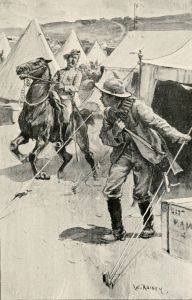
YORKE RECEIVES A DESPATCH FROM BADEN-POWELL.
A strong force was stationed at Kroonstad, which was now the base of the advancing army. Going at once to Lord Methuen, who had arrived there from Hoopstad two days before, Yorke obtained an order from him for carriage for himself and horse in a train that would start at midnight. He spent an hour relating to the general the adventures he had passed through since he had last seen him on the Modder.
"You must be well mounted indeed to have got down from Mafeking in nine days, Mr. Harberton. Of course, you might have done it in a great deal shorter time had you ridden direct from Mafeking here, though I quite understand that, knowing nothing of the commander-in-chief's movements, you could not well have attempted that, for you would have had to pass through a country we have not touched yet."
"Yes, sir, it would have been only about half the distance—probably, I should say, even less than that."
"Yes, much less. We only reckon it to be a hundred and fifty miles from here to Mafeking in a direct line. But, of course, carrying despatches you could not have risked that, especially as you would have had to cross the Vaal, and you may be sure that every drift on that river will be strongly guarded."
"I don't think I should have come much quicker, sir. For, according to my map, the country is a great deal rougher than that through which I have travelled; and as the Boers have not been disturbed, I dared not have ridden by day, and could hardly have found my way by night; and there was no road marked, leading south-east from Mafeking, which is about the line that I must have followed. I knew, too, that Lord Roberts would have heard the news of the relief of Mafeking via Pretoria. Had it been otherwise, I should have risked the attempt, knowing the intense anxiety throughout the army and at home as to the safety of the garrison. As I was only carrying the details, two or three days' difference did not seem to me to be of importance. Had I travelled by that line, I could only have hoped to succeed by coming in disguise. I knew that Lord Roberts hoped to move from Bloemfontein two days after I left him, but there might have been fresh misfortunes like that at Sanna's Post. The line might have been cut in several places, and he might have been so delayed that he would not have been at Kroonstad by the time I arrived there. May I ask how far the general has got?"
"He crossed the Vaal to-day and bivouacked at Vereeniging. Generals French and Hutton, I believe, have moved on to Rietfontein, and General Ian Hamilton to Rietkuil."
"Then he has crossed the Vaal without opposition, sir?"
"Yes, the cavalry outflanked the enemy. False news had been spread as to the drifts by which they would cross, and the route they took completely surprised the Boers, who had all cleared off before the main army reached the river."
At twelve o'clock, Yorke took his place with his horse on a cattle truck, and the next day came up to the head-quarters, which had that morning arrived at the Klip River Station, little over ten miles from Johannesburg. There he delivered his despatches to Lord Roberts, who, on hearing the route he had followed, complimented him warmly upon the rapidity with which he had made his journey.
"We have only heard the bare fact that Mafeking has been relieved. Were they at their last gasp?"
"It did not look like it, sir. I do not know what stores they had remaining, but I heard that they were pretty nearly out of everything except oats and horse-flesh. The men certainly looked somewhat thin and worn, but by all accounts they had kept up their spirits wonderfully, and confidently relied upon succour arriving by the time we named."
"Did Mahon succeed in capturing any considerable force?"
"No, sir. There was a fight outside the town, but our guns were too strong for them, and they fell back to their entrenchments on the other side of the town. Colonel Baden-Powell attacked them there, but I think they only made a stand to get their big gun away. This they succeeded in doing, and only one small gun was captured. If the horses had been fresher, no doubt a heavy blow might have been dealt them, but they had had a very heavy march. Certainly the four Canadian guns could not have pursued them with any chance of coming up with them, especially as they had abandoned their waggons and stores; and Colonel Baden-Powell believes that they sent off the big gun the day before, and only fought their battle with us to give it time to get a long way on the road."
"It is a sort of conjuring trick," Lord Roberts said, with a smile. "Heigh-ho, presto! and the gun is gone. We have out-man[oe]uvred them many times, but never once have we caught one of their big guns. Such cannon until the present war have been considered as simply guns of position and wholly out of the question in military operations in the field. I am sure I am much obliged to you for the zeal and activity that you have displayed, and shall have pleasure in mentioning your name most favourably in my despatches."
On leaving the general's tent, Yorke, to his great satisfaction, saw Hans standing near. "I saw you ride in, master, and glad I was, for one never knows what may happen."
"I am also glad to see you, Hans. I suppose Peter is here too?"
"Yes, sir, he is with the two horses; they are quite right again now. I didn't ride either of them coming up, so that they should be as fit as possible for work by the time you wanted them."
"I am glad to hear that, Hans, for this horse, good as it is, wants a fortnight's rest after the tremendously hard work it has done since I left you."
CHAPTER XX
JOHANNESBURG
The difficulties of the advance were now past, the country was almost level beyond the drift station, and in the distance was a low line of hills on which tall chimneys could be made out, the chimneys of the mines, which had brought such wealth, not only to those who worked them, but to the Transvaal, and which, owing to the greed and avarice of Kruger and his associates, had finally brought ruin upon the country. So far the resistance of the Boers had been feeble in the extreme. From one point after another, carefully prepared in every way, they had retreated with scarce a show of resistance, and although they might nerve themselves to fight one battle in defence of their capital, it was certain that Johannesburg, a far more important town, would fall into the hands of the invaders without an effort.