Front matter (continued 2)
Reading edition
"I am sorry this has happened, sir," the leading Boer said to Mr. Allnutt. "Dirck has been wrong altogether. He was the aggressor, and was fairly beaten by your lad, who is certainly a marvellous shot. He has been more thoroughly beaten now. If his rifle had been charged, he would have shot his opponent, so he richly deserved the punishment he has got. You had better take your lad away now; we will see to Dirck." Then he turned, and, as Yorke walked off with the colonist, assisted the others to raise Dirck, who was half-stunned by the blow, on to his feet.
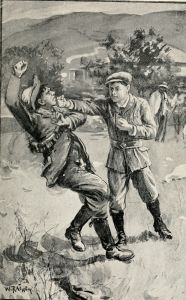
YORKE PROVES HIS METAL.
"You have behaved shamefully, Dirck Jansen," he said sternly when he found that the young man could understand him. "You have brought discredit upon yourself and us. You have been beaten at shooting by a mere boy, and instead of taking it fairly and in a good spirit, you first accuse him of playing a trick upon you, and then try to murder him. And now, big as you are, he has knocked you silly. We are ashamed of you. Hans, go and fetch Mr. Jansen's pony. Now, Dirck, you will mount and ride off at once, and I will tell Mrs. Allnutt that you will not come to the farm again for some time, and why."
There was a murmur of approval from the others, and Dirck stood sulkily until Hans arrived with his horse; then he picked up his rifle, slung it over his shoulder, mounted, and rode off without a word. The others walked to the house.
"I am sorry to tell you, Mrs. Allnutt, that Dirck Jansen has behaved scandalously. He had a fair trial of skill with your husband's young cousin, and the lad beat him hollow. Then he falsely accused him of an unworthy trick, levelled his rifle, and pulled the trigger. It would have been murder had not, happily, the rifle been unloaded. Then he rushed to seize the lad, and was knocked senseless by him. I have apologized, and my friends here join me in the apology, to the young fellow, for the gross conduct of Dirck Jansen, and we trust that you will not receive Dirck in your house so long as the lad remains here."
"It seems hardly possible, Mr. Van Laun, that Dirck should have behaved so. He must have been grossly insulted to begin with. I hear that the shooting arose out of a quarrel."
"It was not exactly a quarrel, though both were angry. Dirck began by saying rough things to your lad, who was not to be blamed because he spoke up for his countrymen, just as I should have done, or any other Dutchman would have done, had an Englishman spoken so of our people."
"I am sorry to hear what you say, Mr. Van Laun," Mrs. Allnutt said somewhat stiffly. "I cannot but think that Dirck must have had great provocation."
"Dirck is a hot-headed young fool, cousin, and though I am as nearly related to him as you are, I say so without hesitation; and for my part, I am not altogether sorry that this young English lad should have given him a lesson. The fact that he is perhaps the best shot round here has cocked him up altogether unduly. He had it in his heart to commit murder to-day, for it would have been murder if there had been a cartridge in his gun; and though it would have been hard to testify against one of my own blood, I must have said so in open court had he been tried for the act. However, I hope we shall hear no more of it, and that the lads will not meet again till Dirck has come to his senses. He will hear the truth from all of us who were present at the affair, and may be all the better for finding that he is not such a fine fellow as he thought he was."
Mrs. Allnutt did not reply. It was evident that her sympathies were entirely with Dirck. The farmers did not stop, but, mounting their horses, rode off. Mr. Allnutt went out into the yard, and, as he expected, found Yorke talking in the stables to Hans. The latter was in high glee, for he hated Dirck Jansen, who had sworn at him many a time when he did not bring his horse round as quickly as he had expected, and was once on the point of laying his whip about his shoulders when Mr. Allnutt, coming out of the house, and seeing what was about to happen, had arrested the blow by saying sternly, "Drop that, Dirck, you are not master here yet. Hans is my servant and not yours; neither you nor anyone else shall touch him."
Yorke and he were still talking when Mr. Allnutt entered and motioned to Hans to go outside.
"This is an unfortunate affair, Yorke, very unfortunate. I do not consider that you were in any way to blame, but that hardly makes it less unfortunate. Here you have beaten a fellow was proud of his skill with the rifle; your shooting certainly astonished me, for although I knew that you had used a tremendous lot of cartridges in the past six months, I had no idea that you had done it to such good purpose. In the next place, you have floored him as neatly as I ever saw a man knocked down, and have done it with half a dozen of his own friends looking on. In the third place, you have brought him into disgrace with them, and as the story will soon get about, it will be a terrible blow to his pride.
"Now, I have never liked Dirck. He is a very bad type of the Dutchman in these parts, though, I have no doubt, he would pass muster in the Transvaal. He is rude and overbearing; and although a man may be all that, and yet at bottom a good fellow, I don't think Dirck is so. He will never forgive you, and unless I am greatly mistaken, he will try in some way to get even with you, and will not care what steps he takes to do so. Now, you know, lad, you have been talking for some little time past of going down to Cape Town, and joining a corps newly got up there, when the war breaks out, which I am afraid it will do very shortly. I tell you frankly that, sorry as I am to say so, I think it will be better for you to do this speedily. I don't mean to-morrow or next day, but shortly. I am also sorry to say that this affair will not make matters more comfortable at home. You know my wife is very fond of Dirck, and it will take a great deal to make her believe that he could be wrong in anything. Van Laun spoke out straight to her, and said that the fellow was altogether to blame; but I could see that her sympathies were nevertheless with him, and she believes that you were at fault in the matter."
"I would go to-morrow, uncle," Yorke said; "but it would look like running away. I will stay at home for another week, and then I will go. I don't mind whether aunt is displeased with me or not. I am conscious of having done no wrong, and if she shows me that I am no longer welcome I shall tell her quietly that she will only have to put up with me for another week. It may be unpleasant, but I am not going to disappear as if I were a culprit, and afraid of Dirck Jansen."
"All right, Yorke! I can quite understand your feelings. I am heartily sorry, but I feel that you could not hope to be comfortable if you stayed here. I am sorry now that I asked you out here, but at the time I did not foresee that this ill-feeling on the part of the Dutch would become so deep and bitter. Had I done so, I would not have asked you, knowing that my wife is as prejudiced as her neighbours."
"You need not be sorry, uncle, that you invited me here. I have had a pleasant time and I have learned a great deal. If I had not been out here I should be slaving at Greek and mathematics at home, whereas now, if war breaks out, which seems almost certain, I shall have a most exciting time of it, and when it is over I may see some way of making a start for myself."
Mrs. Allnutt did not appear at supper.
"Will you tell her, uncle," Yorke said, after talking the matter over for some time, "that I shall leave this day week, and that if my presence is obnoxious to her I will take my meals apart. I am awfully sorry that my presence here should inconvenience her, but I really cannot go away as if I had been sent off in disgrace, or were afraid to meet Dirck Jansen again."
"Quite right, lad! I hope that your aunt will be in a better state of mind to-morrow morning; but when once she takes a thing into her head she is, between ourselves, as obstinate as a mule. Well, whatever she may think of this quarrel, angry as she may be at it, she cannot but feel, after what Van Laun said, that Dirck brought it upon himself. She is a fair-minded woman when she is cool, and I have no doubt, before you go, she will be really sorry; for although I acknowledge that her affections are very strongly devoted to Dirck, she has certainly during the time you have been here taken to you a good deal, and she has several times said it was wonderful how little trouble you were in the house."
"She has always been very kind, and I am really very sorry that, however innocently, I have incurred her displeasure. You know that this is so, uncle, and if there were any place near which I could go to without seeming to run away, I would leave at once rather than stop here where I am not welcome."
"Don't trouble about it, Yorke. I invited you here, and I ask you to stay. If my wife, in the teeth of what her own friends tell her, chooses to consider you to have been in the wrong, I can't help it, and no one else can. I shall not attempt to argue the matter with her. I know that presently she will see that she has acted very unfairly towards you, and I hope that she will even in time recognize that Dirck Jansen is by no means what she thinks him. It matters not to me whom she leaves the farm to, but I should not like to see it go to him."
"But would you not have it, uncle?"
"No. It was a curious arrangement. The old man left his farm to her, and her children after her if she should have any; if not, she had the power of leaving it at her death to any of the descendants of his married sisters whom she might choose. But it was at her death to be valued, and should it under my management have increased in value, the increase was to be estimated by a firm of Dutch valuers whom he named, in Cape Town, and I was to receive either in cash, or as a mortgage upon the farm, the sum which they fixed as the increase in its value. The old man saw that I had good ideas and that I should improve the place, and he said to me a short time before his death, 'I should not like myself to see all these changes that you tell me you wish to make, but I have no doubt that they will increase its value. It is fair that, if my daughter dies before you, you should have the benefit of the work that you have done, so I have had the farm valued, and it will be valued again by the same firm if she dies before you, and you will receive the difference. Does that seem to you to be fair?'
"'Quite fair,' I said.
"'It will be the same thing during her lifetime. I have set down what the farm has brought me in for the past twenty years. She is to receive the average rental and to be its mistress. As I warned you before you married her, I will have no Englishman master here; but you may have the use of one-third of the income to be laid out in improvements. It is to be as a loan to you, and to be repaid from the extra profits of the place.'
"I thought the arrangement, although curious, was very fair. I need hardly say that the income is now four times as great as it was when the old man died. The money I used for improvements has long since been paid off, and I have laid by a very considerable sum. My wife and I never talk about money matters. She has the amount that was annually made by her father, with which she runs the house, and spends as she likes. She neither asks what the farm now brings in, nor interferes with me in any way, so that we get on very well together. If she dies before me, I shall, in addition to what I have laid by, have a heavy mortgage on the farm; and between ourselves, it is morally certain that Dirck Jansen, if she leaves it to him, will never be able to pay the interest, for he will work on the old grooves, so far as he works at all, and in a couple of years after he takes possession I shall foreclose and have the farm put up to auction, in which case I hope that some Englishman will buy it. I should certainly not remain in the colony after her death.
"These are the plans I had formed for myself, Yorke, and when I was in England, and invited you to come up, it was with a vague idea that some day you might possibly succeed me here. The mortgage which I shall hold over the property is larger than anyone would be likely to bid for the farm, and I thought that I might therefore purchase it in your name. But since you have been here, I have seen that this would not do. In the first place, you would never be contented to settle down here, you have too much energy to take to the life of a farmer; and this quarrel with Dirck would alone render that plan impossible. There is an enmity already established; and if he, after coming into possession of the farm, were turned out by you, he would become your deadly enemy, and would assuredly have the sympathy of his relations, and, indeed, of all the Boers around. Therefore I shall not particularly care who buys the farm and pays off my mortgage.
"I have been very much pleased with you ever since you came here, and what was two years ago only a vague idea is now my fixed intention, and you will be my heir at my death. I have no nearer relation, and I have not felt attracted towards anyone whom I have met, except your family. Of course, I may die before my wife. In that case, my claim to the estate for the improvements I have effected will drop, though, of course, the sum I have laid by will not be affected. My opinion was asked on this subject when the old man made his will, and I willingly agreed to it, because it seemed to me a fair one; and besides, there was no one at that time whom I cared particularly to benefit after my death."
Yorke, who was greatly surprised at what Mr. Allnutt said, began to thank him for the kindness of his intentions towards him, but the latter said: "There is no occasion at all for that. I must leave my money to someone, and as I like you better than any of my other relations it is only natural that you should be my heir. It may be a good many years before you benefit largely by it. I am only some three or four and twenty years older than you are. I live a healthy outdoor life, and I may, for aught I know, go on till I am eighty. However, now that I regard you as my heir, of course I shall give you a helping hand when you need it, and when these troubles are over, and you have learned the ways of the country, and are able to start a business with a good chance of success, I shall be ready to give you a thousand pounds to set you up in it. Or, if you decide that you would like to return home and settle in England, you will have that sum to pay your expenses at college, and such further sum as may be required to maintain you until you are in a position to keep yourself. There, do not let us say anything more about it now, my boy. I should advise you not to go outside the farm until you leave. The Boers seldom forgive an injury. Certainly Dirck Jansen will not be an exception to the rule, and, if he has a chance, will attempt to do you harm. For example, he might pick a quarrel with you, which might come to a shooting affray, and although you may be a better shot than he is, he would not hesitate to fire first. We had an example of that to-day, so you must keep out of his way till you go. He certainly will not come here for the next week, after what Van Laun, who may be considered the head of his family, said. Now, lad, I feel tired after this unusual excitement, so we may as well go off to bed."
Yorke did not get to sleep for some time. He was naturally excited as well as surprised at the news of his cousin's intentions towards him, and felt that it would make an immense difference to him. In the most favourable circumstances, he could not have hoped to save a sum that would enable him to start for himself, or to obtain a share in any established business. Now, his cousin's generous offer would enable him to begin to climb the ladder as soon as he was qualified to do so. As to the alternative of returning to England and going to the University, he set it aside at once. He liked the life in South Africa, and would not have cared to take up that of a student again, with the prospect of becoming a hard-working curate in a poor neighbourhood, or years of waiting for briefs as a young barrister. With a business out there, he might soon be able to help them at home, to supply his sisters with pocket-money, and, most pleasant of all, to be able to present his mother with a carriage, and a pair of horses, such as they used to drive before. With such pleasant thoughts in his mind he at last fell off to sleep, and in the morning, after as usual partaking of a bowl of milk and bread, started for his ride round the farm with Hans in attendance.
Three days passed quietly. Mrs. Allnutt had so far relaxed as to come down to meals, and although she spoke as little as possible to Yorke, she was at least civil. On the fourth morning he took his rifle and went up the valley to practise for the first time since his contest with Dirck. Hans was some little distance behind him. As he was on the point of dismounting, he caught the gleam of a rifle-barrel behind a rock two hundred yards away. He did not hesitate for an instant, but threw himself from his horse. The action saved his life, for, as he did so, a shot was fired, and the ball went through his hat, slightly grazing his head. As his feet touched the ground he fell with his face towards the rock, unslinging his rifle as he did so and letting it fall in front of him, still grasping it close to the trigger.
With an almost imperceptible movement he brought the butt to his shoulder, and then lay perfectly still. His face was downward, and from a short distance seemed to be on the ground, but in reality he was able to look under the brim of his hat. For two or three minutes he lay thus, then he saw Dirck Jansen cautiously look out from behind the rock. For a minute he did not move, then he slowly rose and pointed his rifle at some object behind Yorke. The latter did not doubt that he was taking aim at Hans. The moment the thought struck him, he fired, and Dirck dropped his rifle, which exploded as it touched the ground, and fell forwards. A few seconds later Hans galloped up.
"Are you hurt, master?" he exclaimed. "I heard the shot, and thought that you had not waited for me, until I saw you lying there. I then caught sight of Dirck, and saw him point his rifle at me. I thought I was dead; for although you beat Dirck, he is a fine shot, and at three hundred yards could not have missed me. Then I saw your rifle flash."
"It is a bad business, Hans. He tried to take my life, and thought that he had succeeded. It was a near shave, as you see; the bullet went through my hat. But I was in the act of dismounting, and he fired an inch or two too high." He put his hand on the top of his head. When he looked at it it was covered with blood.
"It is just as well," he said, as Hans uttered an exclamation of alarm. "It is only a graze. If he had missed me altogether, my story might not have been believed. Now, let us go and see what has happened to him. I hope I have not killed him. If I had had time I should have aimed at his shoulder, but I knew that in another instant he would have fired at you, and I just sighted him and pulled the trigger."
They went over to where Dirck was lying. He had been hit high up in the chest. "Three inches farther up and I should only have broken his collar-bone," Yorke said regretfully. "Even as it is, I hope that he may recover. These Mauser bullets do comparatively little damage if they do not hit a vital point. It is certainly so with game. Now, Hans, lay him down as before. I will ride back to the farm and send back help to bring him in."
Yorke returned to his horse, mounted it, and rode back at full speed. Mr. Allnutt had just risen and come out into the yard.
"What is it, Yorke?" he asked in alarm on seeing the lad's pale face and a small stream of blood running down his face.
Yorke related what had happened.
"The young scoundrel!" the colonist exclaimed indignantly. "Well, at any rate you are not to blame, Yorke; but it is a desperately bad business. Fortunately you have Hans to prove that your account of the attempt at assassination is true, and you were perfectly justified in shooting; but still, it will make the feud worse than ever. I trust sincerely that his wound will not prove mortal. I will send off a mounted man at once to Richmond for a surgeon, and will go out with four Kaffirs to bring the unfortunate young fellow in. Then I will ride over with you and Hans to Van Laun's; he is a justice of the peace. You can make your deposition before him, and I will give my guarantee to produce you if Dirck should die. Having done this, you had better start at once for Cape Town, and when you get there telegraph your address to me, so that I can send for you if necessary."
"Very well, uncle, that will certainly be the best way. I could not stop here now. I trust most earnestly that he will recover. If I had had time to take aim I would only have disabled him, but I knew that if I did not fire instantly he would have shot Hans."
"No doubt he thought that he had shot you through the head, and intended to rid himself of the only witness. I do not pity him one bit, whatever happens to him. He was a murderer in intention, and if he has failed, it is not his fault. I think that even my wife will have her eyes opened now as to his real character. That he should have aimed his rifle at you before in the heat of passion was to some extent excusable; but this was an attempt at premeditated murder, and if he recovers he ought to have a few years in prison. However, that will be for you to decide."
"If I were coming back to live here I would certainly prosecute him, for he might make another attempt with better success; but, as it is, I shall not move in the matter. I will go out with you and the Kaffirs now. I could not be hanging about here doing nothing until he is brought in."
On arriving at the spot they found that Dirck was still alive, though unconscious. He was carefully placed on the hurdle that a Kaffir had brought with him, and was taken back to the house, Mr. Allnutt going on before to tell his wife what had happened. He came out of the door as Yorke arrived with the bearers, saw Dirck carried upstairs, and then came down again.
"I will leave him there in her care," he said; "she will see after him. She did not make any remark when I told her what had happened, beyond saying, 'Is there any proof as to the truth of this story?' 'There is this for proof,' I said. 'Hans heard one shot, and one shot only, fired as he rode up, then he saw Dirck rise and take aim at him. Then, as Yorke fired he saw him fall. The first shot that was fired was fired by Dirck, and the proof is that the ball went through Yorke's hat, and the lad is bleeding from a scalp wound there. As the affair happened on our farm there could have been no quarrel between the two lads, for Hans was but a short distance behind when the first shot was fired; and as Dirck fell nearly three hundred yards from the spot where Yorke was lying they could not have been near enough for them to have had words. What is more, he saw Dirck rise from behind the rock where he had been lying hid, and when he pointed that out to me I found the empty cartridge lying there.' She then only said, 'Bring him up here; he is my cousin.' Now we will ride over to Van Laun's. We shall have time to do so before the doctor arrives; it is only a quarter of an hour's gallop."
Ordering Hans to follow him he mounted and galloped off with Yorke. Mr. Van Laun looked very grave when he heard the story.
"Unfortunate lad," he said; "this is the result of his unrestrained passions. Now, Mr. Harberton, will you please write down your account of the affair, and I will swear you to it. Then I will get you to retire, and will have Hans in."
When the two statements had been sworn to he called Yorke in again.
"Of course," he said, "If Dirck dies there must be an enquiry into this. In any case, there must be an enquiry, if you insist upon it. Mr. Allnutt will give us his surety that you will appear if he dies."
"I should be well content to drop the matter, sir, if Dirck lives, as I sincerely hope he will. It is a most unfortunate affair, and greatly to be regretted. However, related as he is to Mrs. Allnutt, I certainly have no wish to press the matter against him. I am going away from here, and am not likely to return unless I am obliged to do so. And for my aunt's sake, if for no other reason, I should regret extremely to bring so heavy a charge against one to whom she is so attached."
"I thank you, sir. I am the unhappy fellow's uncle, and for my own part and that of the family I feel deeply indebted to you for your forbearance. I am glad, however, that you are about to leave, for the ties of blood here count for a great deal. Although we older men see his fault in the gravest light, there are hot spirits among the young men who might, in spite of the fact that he had been utterly in the wrong, take up his quarrel. I will now ride back with you and hear the surgeon's report."
This turned out to be favourable rather than otherwise. Without being able to give any decided opinion, the surgeon said that if all went well, and no fever set in, Dirck might recover. "The ball," he said, "has gone right through, and has undoubtedly passed through the upper part of the lung; but the wound is so small that it will probably heal up without leaving any after effects. If, however, fever sets in, I do not disguise from you that the result may be fatal, although I regard the probabilities as being altogether the other way. As the bullet has passed through there is little for me to do. He must be kept very quiet, and given cooling drinks for some days. I shall ride over and see him to-morrow. If he is going on well, he will be able to take a little nourishment in the way of soup in the course of two or three days."
The news was an immense relief to Yorke. He felt that had the affair happened again he could not have acted otherwise; but the thought that he might have taken life was very painful. If it had been done in the course of a battle he would have thought comparatively little of it, but this was altogether different; and although Dirck had been exceptionally rude and discourteous to him, and he would have liked to give him a good thrashing, he would have given much rather than be the cause of his death. When the surgeon had left, and Mr. Van Laun, after a few words with Mrs. Allnutt, had also ridden off, the colonist said:
"Now, Yorke, the sooner you are off the better. You will, of course, take Bob. He is the best horse on the farm, and I don't think you will get any better in the colony. And in the work you will have to do, your life may depend upon the speed of your horse."
"Will you let me take Hans with me?"
"He has been speaking to me about it. He is most anxious to go with you. Of course, he is free to go whether I like it or not; but indeed I shall be glad to know that he is with you. He has brightened up wonderfully since you came, and there can be no doubt that he is devoted to you."
"Thank you! Of course I cannot say whether I shall be able to keep him; that will depend on what corps I join. If I enlist in the line, I should hardly think they would take Hans; but if I join a Colonial corps, they may do so, for loyal Dutchmen would naturally be accepted. At any rate, I shall do all I can to keep him with me."
"And now, as to your traps, Yorke. First, I suppose you will ride down?"
"It would certainly be most pleasant; besides, if I went by train there would be a bother about getting a horse-box."
"Quite so. Well, I will pack up all your things to-morrow, and send them to Cape Town in a day or two, marked 'To be left till called for,' so that you will find them at the goods station when you arrive there. You may as well leave the rifle here. It would be all very well carrying it as you go through the country districts, but it would hardly do to ride with it into Cape Town. I have another of the same kind, and will put it in for Hans. I have a long box that will hold them very well, and can pack with them some of the clothes you have bought since you have been here, and which will certainly not go into the portmanteau you brought with you."
Hans was delighted when he heard that he was to accompany Yorke. No time was needed for his preparations.
"You are to take the horse I usually ride, Hans," Mr. Allnutt said; "he may need a spare horse for his work, and it is as well that while you are with him you should be well mounted, so as to be able to go at the same pace as he. Put the saddle on at once; it is nearly twelve o'clock, and you have a long ride to Victoria West, where, of course, you will sleep to-night. Come in with me, Yorke, I will put that cold meat on the table and you can sit down and eat something. All these things have put breakfast out of our heads, and you have had nothing since you rode off at six o'clock."
"I don't feel hungry, uncle."
"Oh, nonsense! You must eat."
As soon as he had helped Yorke he cut off a large chunk of meat and a slice of bread and carried them out to Hans.
"That is right, lad," he said, when Yorke had made a good meal, for he had found his appetite when he once began to eat. "Now, put this cheque into your pocket, it is for one hundred pounds; you may want to get uniform, and may in any case have to wait some little time before you can arrange matters. Here are twenty pounds for your expenses on the road. In the envelope with the cheque is a note to the manager of the bank, authorizing him to allow you to draw on me up to another hundred pounds should you require it. There, I don't want any thanks, lad. You know how we stand now, and the sooner you are off the better."
"Do you think my aunt would like me to say good-bye to her? I should certainly like to do so. She has been very kind while I have been here."
"I will ask her, Yorke, but I don't think she will. However, it is just as well to make the offer."
Rather to Yorke's surprise, Mrs. Allnutt came into the room a minute later. "Good-bye, Yorke!" she said gravely. "I cannot say, after what has happened, that I am sorry that you are going, but I am very sorry for the circumstances that have caused you to go. You have been very nice in the house since you came. I had thought, before you arrived, that I should not like it, but it has made things pleasant, and I came to like you. Good-bye! I hope you will do well. Some day, perhaps, I may see you again, if not here, perhaps at Cape Town."
"Good-bye, aunt! I am very much obliged to you for the kindness you have shown me since I have been here. I cannot say how sorry I am that things should have turned out as they have. No one can possibly regret it more than I."
Five minutes later Yorke and Hans mounted and started on their journey.
CHAPTER IV
THE ULTIMATUM
"Now, Hans," Yorke said as they dismounted in front of the hotel at which he had stopped when he came through Cape Town, "the first thing after you have put the horses in the stable, given them a good rub down, and seen that they have had their feed, will be to go to some little barber's shop and have your hair trimmed. Have it cut short like mine. When you have done that, have a thorough good wash. You are more particular in that respect than you used to be when I first knew you, but there is room for a lot of improvement; and as you have made up your mind to follow my fortune whatever it may be, it is as well, at any rate when you join, to look clean. Here are five pounds, go to an outfitter's and get a decent suit of clothes—clothes that will fit you, you know, and not look as if they were made for a man fifty inches round the waist. Look about you as you go through the streets. You will see plenty of young Dutchmen who have come in from farms, and you will find they wear very different-looking clothes from those you were accustomed to. Get things of the same sort. Or—no; I think that it would be better for you to come to me after you have got yourself tidy, and I will go with you."
"That will be better, Master Yorke; I should never be able to choose for myself."
"Very well, give me the money, then, less five shillings. Be sure you tell the man to cut your hair quite short; it won't hold the dust so much then, and will give you quite a different appearance. Don't come back again for three or four hours. I want to learn what is doing here, and see what openings there are. Get yourself a good meal somewhere."
The hotel was almost full, but Yorke was able to obtain a room. He changed the clothes that he had worn and put on a suit of tweeds he had kept for special occasions, and then went down to the dining-hall. As he ate he listened to the conversation at the tables round him. He learned that large numbers of British officers had been quietly arriving, but that they were as yet in ignorance of the work they had been sent out to perform.
At present the greater portion were waiting for orders, but it was believed that most of them would be employed in the work of superintending the transport on the railway, and that if war really broke out, many would be placed in command of the bodies of volunteers to act as scouts, which would doubtless be raised in the colonies.
Everything was still doubtful, and Yorke heard fears expressed that Kruger would back down at the last moment. He made up his mind that he would do nothing hurriedly; he had money enough to keep him for a considerable time, and it was better not to make a choice that he might afterwards regret. There were sure to be opportunities directly the matter came to a crisis.
Among the officers were many civilians, men who had come down from Johannesburg, and these he found were almost unanimous in their opinion that Kruger and his advisers were all bent on war. These occupied several tables, and the ladies with them were dressed in the latest styles of fashion, and wore an extravagant amount of jewellery. He guessed the husbands to be mining potentates and speculators, men whose fortunes were already assured, and who could afford to contemplate the worst that could happen without anxiety.
After he had finished his meal he went out, and stood on the steps of the hotel until Hans came up. He would hardly have known him, for he looked, for the first time in Yorke's experience, thoroughly clean, and the change made by this, and the loss of the long unkempt hair that had fallen to his shoulders, was almost startling. In spite of his loose, ill-fitting clothes, he looked bright and alert, although somewhat shamefaced at his altered appearance.
"I have done as you told me, Master Yorke, but I feel so queer that I hardly know myself."
"That will soon pass off, Hans; and you look a hundred per cent better. Now, let us go off to one of the stores."
Here he found no difficulty in obtaining a suit that fairly fitted his follower. It consisted of a corded velveteen shooting jacket, and breeches of the same material; brown stockings of a colour to match; a waistcoat to be put on when the evening's cold set in; four flannel shirts, and a couple of dark-blue silk neck-ties. From the same store he procured two pairs of strong laced boots. A wide-awake of the ordinary size completed the attire. Hans had already, at Yorke's orders hired a room for himself, and his new purchases having been put in a bag, he carried them off to it. Yorke remained outside for a quarter of an hour, and Hans then rejoined him in his new clothes.
"I am quite sure, Hans, you might ride up to the house, and neither your master nor mistress would know you, but would take you for some young farmer stopping on his way down country to ask for a night's hospitality."
"I don't know how I look, Master Yorke, but I don't feel comfortable at all. There doesn't seem room for me to move in these clothes."
"Nonsense, Hans! They are loose everywhere, though not so baggy as the others. By the way, you had better keep the others; you would be less likely to be noticed in them if you entered a strange place than you would be now."
"I don't care about being noticed," Hans said. "I would have as much right to be there as anyone else."
Yorke laughed. "Well, Hans, as you have agreed to go with me—and you know very well that my intention is, if possible, to get some job with our army—I can see that there might be plenty of occasions when you might be going into places with me where we should not wish to be noticed."
A day or two after his arrival, as Yorke stood on the doorsteps hesitating which way he should go, a young officer who was entering stopped and looked hard at him. "Hulloa!" he said, "you are Harberton, are you not?"
"Yes, and you are Parkinson."
"What in the world brings you out here? Why, you were quite a youngster when I left the old school to enter Sandhurst two years ago, and now you are nearly as tall as I am!"
"I have been out here six months."
"What have you been doing?"
"I have been at a farm up-country belonging to a cousin of my father. As to what I have been doing, I can only say I have been riding, and shooting, and learning to speak Dutch."
"And have you learnt to speak it?"
"Yes, I can speak it well enough to pass as a Boer in a short conversation."
"Well, come and sit down in the garden behind the hotel and tell me all about it. I suppose you are wanting to get up to the front—wherever that may be—and as I came out with a good many men who will be employed in organizing and transport, and other jobs of the sort, I may be able to help you, if I know something about what you have been doing out here."
Yorke told his old school-fellow why he had left Rugby and come out, his life at the farm, and the events which had led to his leaving it suddenly.
"You have done awfully well," Parkinson said when Yorke had finished his story, "and you deserve to get on. Anyhow, if I can help you, I will."
Three weeks passed quietly; as yet nothing was settled. Kruger's replies to Mr. Chamberlain's despatches were more and more unsatisfactory; still, the general feeling at the Cape was that he would back down at the last moment and grant the terms of suffrage for which the colonial secretary was pressing. The refugees from Johannesburg were not of this opinion. "We believe he means to fight," said one of a group gathered in the billiard-room, "and I hope with all my heart that he will now do so. What does it matter to us whether he gives the suffrage to men after a five years' or seven years' residence. In the first place, he has always broken his engagements, and if he were to agree to a five years' suffrage, he would devise some means for cheating us out of it afterwards; besides, not one in twenty of the Uitlanders would take the trouble to claim it. In the first place, they would know that the members they might return for the few towns where they are in a majority would be swamped by the representatives of the country districts; and in the next place, they know that if they took the oath to the Transvaal Government, they would forfeit the right of complaining to England of any ill-treatment, and, whatever their position, might be commandeered and sent off to fight Swazis, or any other savages, at a moment's notice. No, no; the thing is begun now, and it had best be carried through, whatever it costs. It will have to be settled some day or other, and the sooner the better."
There was a general chorus of assent.
"I only hope," another said, "that there will soon be an end of all this talk. It has been going on for nearly a year now, and we are not one day nearer to a conclusion. Trade is at a stand-still, and the Boers are not fools enough to buy goods when they expect to be able to grab them without payment, as they will do directly the war begins."
Hans had during his rides and talks with Yorke completely imbibed the latter's opinions. As a farm servant he had previously heard little or nothing on the subject, and was therefore quite ready to accept his companion's views as to the dispute, especially as he was serving under an English master against whom he had no cause of complaint. At Cape Town he found nothing to alter his opinions. The loyal part of the population, which formed the large majority there, were far more outspoken than the Africanders, and the sight of the soldiers in the streets, of the flags waving on the public buildings and on the ships of war—the same flag as he had seen hoisted on the farm on holidays—confirmed his feeling of loyalty, and he was prepared to follow Yorke in whatever service he might engage.
One morning when Yorke came down to breakfast he saw that something unusual had happened. Instead of sitting down to the meal, the residents were standing in groups, talking excitedly. He went up to Parkinson, who was looking delighted, and asked: "What is the news?"
"Splendid, Harberton! Kruger has sent in the most insolent ultimatum that ever was drawn up, demanding an entire surrender of our claims and the withdrawal of our troops, and giving only forty-eight hours for an answer. Of course that means war. The old fox has been fooling us until he was absolutely ready to begin. I expect he will be crossing the frontier at once, and certainly we have no troops that can stop him out here. There are enough in Natal to make a fight of it; but he will have it all his own way in Cape Colony until we get troops out from England. By that time they will have raiding parties all over the country; and there is no doubt that they will be joined by thousands of Dutch farmers. This ultimatum is a glorious thing. No one can say that we forced the war upon them. It puts a stop to all these negotiations and settles the question. It has got to be fought out now; and, thank God, we have not got a government that will permit another Majuba surrender. I expect we shall have hard fighting for a time."
"What would you advise me to do, Parkinson? I don't care in what capacity I go up. I should not like to enlist in the infantry, because I should lose the advantage that I have in being a good rider and being able to speak Dutch. But I would enlist in any capacity in which Dutch would be useful."
"I have no idea what any of us are going to do yet. No doubt some general orders will come from home to-day, and I expect that most of us will be at once sent up the line to see about forming depots, to guard the bridges, and things of that sort. At any rate, there is not much chance of your getting to know anything definite for a few days. Butler and all the heads of the departments will be too busy to go into details. Certainly one of the first steps will be to organize a transport train; without that we should be tied to the railway."
The news had already spread through the town, and the excitement in the streets was great. Most people believed that war must come sooner or later, but the sudden outbreak was altogether unexpected.
There was, however, a feeling of relief that matters had come to a head at last, and that Kruger had placed himself so hopelessly in the wrong by his insolent defiance. Still, there was an uneasy impression that the course he had taken was, in his own interests, a wise one. England had been caught altogether unawares. It was true that a few thousand officers and men had been quietly sent out during the past few months; still, there was no force that could hope to withstand the fifty or sixty thousand mounted men with whom the Boers could at once invade Cape Colony and Natal. No doubt was entertained that the Orange Free State would join the Transvaal. Steyn was known to be a most ambitious man, and to be in the closest communication with Kruger, and among those staying in the hotel who had come down from Kimberley, or who had connections there, it was regarded as certain that one of the first movements attempted by the Boers of the Free State would be to try to capture Kimberley, which lay close to their frontier line.
In the evening Yorke again met Parkinson. "A party of Engineers are going up to De Aar, a big depot is about to be formed there. They take with them a lot of Kaffirs, to mark out the ground and clear it. I am glad to hear that there are a biggish lot of stores already collected here. Only one train a day will be open to the public, and I expect that will soon be stopped. I tell you what I will do, Harberton. I will take you to Colonel Pinkerton. I believe he will be going up to-morrow to inspect the line, and probably will for the present take command all along it. He came over in the same ship with me, and is a very good fellow. I will tell him who you are, what you can do, and what you want to do. At any rate, his advice will be worth having."
"Thank you very much!"
Parkinson moved away towards a party of officers talking together, waited till they broke up, and then went up to one of them. They talked for two or three minutes, then he turned and motioned to Yorke to come up.
"So you are a school-fellow of Parkinson's?" the officer said.
"Yes, sir; we were at Rugby together, but he was very much my senior."
"So you want to do scouting business, to carry despatches, and generally make yourself useful. He says that you are a good rider and an excellent shot, and that you talk Dutch well."
"Fairly well, sir; well enough, I think, to pass as a Boer in any short conversation."
"And you have a Dutch lad with you upon whom you can rely?"
"Yes, sir, I can rely upon him absolutely."
"There is no doubt that you would be very useful. You know a good deal about the sentiments of the Dutch?"
"Yes, sir, at least of the Dutch for twenty miles round Richmond and Brakpoort; they are almost to a man hostile, and I fancy from what I heard it is the same in most districts."
"I will think the matter over; there is no hurry for a few days. If the Boers advance to-morrow, when the time they have given us is up, and push straight on, which would certainly seem to be their best policy, we cannot move forward, but shall have to stand wholly on the defensive till reinforcements arrive from home; and to take stores up-country will simply mean their falling into the hands of the Boers. If I go up I shall certainly be glad to take you with me. Your boy would be invaluable in the way of obtaining information, if he is as sharp as you say he is trustworthy, but I see a difficulty in employing you both as civilians."
There was great satisfaction in Cape Town when the news came that government had announced in the House that arrangements had already been made for the instant transport of seven thousand men from India. Two days later Yorke received an invitation to breakfast with the colonel. He found a third person at the small table that the officer had secured.
"This is Mr. Harberton," the latter said, "the young gentleman of whom I was speaking to you, Major Mackintosh. Major Mackintosh is in command of one of the local volunteer corps here, and at my request, Mr. Harberton, he has arranged to give you a commission in his corps, and to allow you to be seconded for service as one of my assistants. I think that will meet all difficulties. While on service you will, of course, receive the pay of your rank, and an allowance for horse and forage. Your boy must also enlist in the corps, and will similarly obtain leave to go as your servant; he will, while on duty, draw the pay and rations of a private."
"Thank you indeed, sir," Yorke said gratefully; "and thank you also, Major Mackintosh; this is more than I had ever ventured to hope for."
"I had the more pleasure in granting the colonel's request," the officer said, "inasmuch as I am myself a public-school boy. I am an Etonian, and can quite understand your eagerness to take part in this business. I have large numbers of applications for enlistment, and I have no doubt that as matters progress several fresh corps will be raised. My staff of officers is nearly made up, but I have no difficulty in granting you a commission, as when you are seconded for other duties it will leave a vacancy, so that it is a mere matter of arrangement. I will send in your name to-day to Sir William Butler. You had better attend at once at the orderly room, with your Dutch servant, to be sworn in, and then get your uniforms. I dare say you know what they are."
"Yes, sir; I saw the corps march through the streets the other day."
"Of course you will not want a full-dress uniform, Mr. Harberton," the colonel said; "and you will take up your civilian clothes, both those you stand in and the dress of a Dutch farmer; and your servant will do the same, and will, of course, dress as a farm hand when he is away on any scouting expedition."
"Certainly, sir. I suppose I can bring my rifle with me?"
"Yes; what rifle is it?"
"A Lee-Metford, sir."
"That is right; it would be of no use taking up one that would not carry government ammunition."
"How long have you been in the colony, Mr. Harberton?" the major asked.
"Six months, sir."
"You have done well to learn the language so quickly."
"The cousin with whom I was staying, sir, married a Dutch lady, and as he had been out here twenty years, Dutch was generally spoken in the house. I spent my whole time in riding and practising shooting, and I always had this Dutch boy with me. He talks English, but we talked when together in Dutch, as I was anxious to learn it."
"I suppose you were accustomed to ride before you came out here?"
"Yes, my father kept three horses, and bred them so that I learned to ride as far back as I can remember."
"You left school early, for you cannot be past seventeen yet?"
"Yes, sir. My father is a clergyman, and had a good private income, but the Birmingham and Coventry Bank, in which his money was all invested, went to smash, and as the living was by no means a rich one, I had to leave school. I had been invited here by my cousin, when he was in England a year before, and it was thought that I could not do better than to come out to him, and after being with him for a time, try to make my own way."
"And so you left him because you thought war was coming on?"
Yorke smiled. "Not exactly, sir, though I had made up my mind to do so if there was war; but I really left him because of a row with a Dutch cousin of my cousin's wife. I think it was partly jealousy at my being established at the farm, but the actual quarrel was about shooting. He was very proud of his marksmanship, and I beat him in a trial of skill. Two days afterwards he shot at me when I was out riding. He put a ball through my hat, and made sure he had killed me; but I returned the fire, and hit him. I was afraid at first that I had killed him, but he was not dead when I came away. Fortunately, Hans, my boy, was with me, and was able to prove that he fired the first shot; but my cousin said that I had better leave at once, for the affair would create an ill-feeling among his friends, and my life would not be safe. So off I came. My cousin provided me well with money, so I thought that, before deciding upon what to do, I would wait and see if war really broke out; but in any case I thought of enlisting in a cavalry regiment. I might get a commission some day, and if I didn't, a few years in the ranks would perhaps do me good. I could buy myself out when I was able to see some other way to earn a living."
"That was as wise a determination as you could have taken under the circumstances," the colonel said. "A few years in the army does no man any harm, if he is steady and well-conducted; and if well educated, as you are, he is certain to get his stripes in a couple of years. The life of a non-commissioned officer is by no means an unpleasant one; and there is always a chance of getting a commission, though this is not a very bright one, as so many young fellows who, having failed to pass, enter the ranks with the hope of getting one some day."
Then the talk turned to the probable course of the war. The two officers agreed that if the Boers contented themselves with holding the passes into Natal, and threw their force, which was estimated at fifty thousand, in five divisions, each ten thousand strong, into Cape Colony, they could sweep the whole country up to Cape Town before any force could arrive from England to arrest their progress, and that in their advance their numbers would probably be doubled by recruits from the discontented portion of the Dutch population.
"I am in great hopes that they will besiege Kimberley," the colonel said. "Our having of the diamond mines there has always been a sore point with the Free State, and one of their reasons for joining the Transvaal undoubtedly is to obtain possession, which I feel sure they will not do. Then possibly a considerable force of the Transvaal men may knock their heads against Mafeking. It is the nearest point to Pretoria, and it was from there that the Jameson Raid started. They may take that. Baden-Powell, who is a first-rate man, went up to take the command there ten days ago. He is sure to defend the place till the last, but even if he does but hold out for a fortnight, the time gained will be invaluable to us. Time is everything. But in any case, I fear that it is going to be a very big job, certainly a great deal bigger than anything we have had since the mutiny.
"If we could but get all the Boers together, fifty thousand men might do it. As it is, we may want double that number, though I do not think the home government has any idea that such a force will be requisite. We made the usual hideous mistake of not being ready, and the still greater one of allowing the Boers to obtain enormous quantities of rifles and ammunition. When our government were first warned of what was going on, they should have put their foot down, and told Kruger bluntly that, as he could be arming in this tremendous manner only for war with us, we should not allow the importation of arms into the colony."
"They could have got them up through Lourenço Marques," the major said.
"Well, then, government should have gone a step further. They should have told Portugal that, although we did not wish to quarrel with her, we insisted upon her refusing to allow arms to be landed at Lourenço Marques, that we should send a military officer as our consul there to inspect all imports, and that we should station a ship of war there to support him, as it would be impossible for us to allow the port to be used as a centre through which military munitions, intended to be some day used against us, might be passed up-country."
"But if Portugal refused, as she no doubt would, to submit to such a high-handed action, she would probably have been supported by several European nations—certainly by France in her present mood, possibly by both Russia and Germany."
"In that case," the colonel said, "we should have had two alternatives: either to fight the lot of them with our fleet, which we could do; or else to send five thousand men up into the Transvaal to Komati Poort, and so to prevent the arms entering from the Portuguese frontier. The Boers were then comparatively unarmed, and if, as is likely, they had chosen to fight, we should have had a fairly easy job. The Queen has sovereign rights there, and it is no great stretch of sovereign rights to quarter troops in the country. However, I have no doubt they would have fought; after our surrender at Majuba, they thought, and still think, themselves invincible. But the affair would have been mere child's play to what it will be at present. It was a difficult problem, no doubt, for a British ministry to face, but it ought to have been faced. It was a question of grasping the nettle. With such a majority as they have got behind them, stronger men would not have hesitated to do so. A fire can be put out easily enough when it once starts, but if it is left alone till it has got a big hold, there is no saying what may happen when there is a strong wind blowing."
"Now, Hans," Yorke said, after having told the news to his follower, "you have to do credit to yourself and me, to try and look smart when you are in uniform, to keep those long arms of yours from swinging about, to hold your head up, and to walk briskly and smartly."
"I will do my best, Master Yorke," Hans said with a grin; "but I don't think I shall ever look like those soldiers I have seen walking about the street, especially those chaps with trousers that look so tight. I can't make out how they can sit down."
"Those are the cavalry, Hans; you won't be expected to look like them. I fancy the corps here wear white in summer; but that is certainly not a good colour for campaigning, and the major said that there was some talk of dyeing them a sort of light brown, that wouldn't show the dirt, and would not want so much washing, and, above all, would not make such a conspicuous mark for an enemy. It is the same sort of colour as the regular troops wear here in summer, and I expect that in a short time they will all take to it instead of scarlet."
"Well, I don't care much how they dress me, so long as they let me go with you, Master Yorke."
After going to the head-quarters of the corps, and being sworn in, Yorke went to the tailor who had the contract for the uniforms. He found that Major Mackintosh had just come in, and had ordered that no more uniforms should be made for members of the corps until they heard again from him, which would be the next morning, as he had summoned a council of the officers. Yorke and Hans were, however, measured and the tailor promised to put their uniforms in hand directly he received the major's instructions to go on.
Yorke had been invited by the adjutant to attend the meeting of the officers. He listened to the discussion, and, was glad to learn that khaki drill was generally approved of as the material for the uniforms of the corps, to be used with brown belts and accoutrements, and wide-brimmed felt hats of the same colour as the coats. He was introduced to the other officers by Major Mackintosh, who laughingly told them that they must make the most of him, as Colonel Pinkerton had requisitioned him for service.
The following morning Hans was set to work drilling with a batch of other recruits. This was not necessary in Yorke's case, as he had for two years been a member of the Rugby Cadet corps, and therefore knew as much of drill as most of the officers. Thus, when in the cool of the evening the whole corps turned out, he was able to play his new part satisfactorily. Colonel Pinkerton had strolled down to witness the drill. The gathering was a very motley one, for the men were not in uniform, and all classes were represented.
"I was glad to see you knew your work," the colonel said to him on his return. "You did not tell me that you knew anything of soldiering."
"I do not know very much, sir; but I was a member of the school corps for two years, and we flattered ourselves we were pretty smart. Of course many of the fellows were meant for the army, and were very keen about it. But I think we all took a good deal of pride in drilling well, and though I was not an officer, of course I knew where the officers should be placed in each movement."
"Well, you will not want it much while you are with me; but when you are among soldiers it is as well to be able to show that you know the work of an officer. At present there is no idea whatever of the volunteers going to the front; but there is no saying what may take place in the course of a few weeks, if the Boers are sharp enough to take advantage of the situation."
Three days later Yorke and Hans started with the colonel up the line. He had two young Engineer officers with him. The colonel's two horses and Yorke's were taken in a truck under the charge of Hans and the colonel's soldier servant. Trains of provisions and stores for Kimberley and Mafeking were being sent up rapidly, and depots formed at several points along the line. It had not been deemed prudent to send them very far until the plans of the Boers were apparent. The horse-box and the carriage in which the officers travelled were detached from the train at points that were considered important. Here they remained for a few hours, and were then attached to another train. While the colonel and his assistants examined the culverts and bridges, and made notes of their relative importance, Yorke made enquiries from British farmers as to the disposition of the Dutch population, and Hans resumed the clothes in which he had left the farm, and, under pretext of looking for a situation, entered into conversation with men of his own class.
The reports naturally varied a good deal. The opinion of the English colonists was that although the Dutch sympathies might be strongly with the Transvaal Boers, few of them were likely to take any active steps to join them, unless they invaded the Colony in great force. Many of the young men, however, were missing, and it was generally believed that they had started to join their kinsmen in the Transvaal. Many of the better class of farmers who had been often at Cape Town, where not a few of them had received their education, were much better acquainted with the military power of Great Britain than were the mass of the Dutch population; and these, whatever their sympathies might be, were of opinion that in the long run her strength must over-power that of the Boers, and that an enormous amount of suffering and damage would result. They admitted that they themselves had nothing whatever to grumble at under the British flag, and acknowledged that the government of the Transvaal treated the Uitlander population there in a very different manner, and that had that government been ready to grant the same treatment to them as the Dutch of Cape Colony enjoyed, there would never have been any trouble.
"I think it all means," the colonel said one day when they were discussing the reports brought in, "that if we thrash the Boers the Colony will remain quiet; if they gain any big success, the greater portion of the Dutch here will join them. But no doubt there will be trouble in getting the trains through; it is impossible to guard such an enormous length of line. The utmost that can be done will be to have detachments posted at all the bridges whose destruction would cause serious delay. We can hardly doubt that rails will be pulled up and culverts destroyed, for this can be done by two or three men working at night. But of course each train going up will carry a few rails and a couple of balks of timber, tools, and three or four railway men, and the repairs can be executed with only a very short delay."
Four days after starting the party arrived at De Aar, which had been selected as the most favourable position as a base. At this place a line of railway from Port Elizabeth joined that from Cape Town. Seventy or eighty miles down the Port Elizabeth line were junctions at Naauwpoort and Middelburg Road, the former with the main line running up through the Orange Free State to Pretoria and Pietersburg, the latter joining the line from East London at Stormberg, north of which was a branch to Aliwal North, and another crossing the Orange River at Bethulie, and joining the main Orange Free State line at Springfontein. Whatever might be the intention of the Dutch later on, so far there had been no attempts whatever to meddle with the railway. The waggon trains loaded with stores went up in rapid succession, and on their way met almost as many crowded with refugees from the Transvaal, the Free State, and Kimberley.
Miners and store-keepers, millionaires and mechanics, were closely packed, with little distinction of rank, and Yorke and his fellow-officers frequently expressed their disgust that so many able-bodied men should be flying, when on crossing the frontier they might well have gone to Kimberley, Colesberg, and other places to take part in the defence of the towns. The first blow had been struck. An armour-plated train going up to Mafeking had on the 12th been fired at with guns and derailed. Lieutenant Nesbit and the soldiers with him had defended themselves gallantly, but had at last been obliged to surrender. From Natal the telegrams were of a still more exciting nature. The invasion of that colony began a few hours before the ultimatum expired, and it was expected that the force under General Penn Symons would be attacked in the course of a day or two.
The Loyal North Lancashires had passed them the day after they started. Four companies had gone on to Kimberley, the rest had encamped at Orange River station.
Many mules and trek oxen had been sent up, and large numbers of Kaffirs, and the station at De Aar presented a busy scene. Wooden sheds had already been erected by the Engineers, and these were being filled with the more perishable articles, such as sugar and tea; stacks of bags of flour and mealies, and of cases of tinned meat, were rising in the open, while everywhere were piles of stores of all kinds lying just where they had been thrown from the trucks on the sidings. An hour after Yorke's arrival the colonel was occupied in fixing on a site for a battery. This was selected on the top of a rising mound near the station, and from this the guns, when placed in position, would sweep the surrounding country. Tents were pitched for the party, and in these they speedily settled down.
"Now, Mr. Harberton," the colonel said that evening, "it does not seem to me that at present I have any occasion for your services here. We shall trace the lines of the fort to-morrow morning; a train with four hundred Kaffirs will arrive this evening, and we shall get to work by breakfast time. Then one officer and a couple of the sappers will be sufficient to look after them, while we shall attend to getting things in readiness for the arrival of more troops. So far the railway between this and Kimberley is still open, but it is certain that it will not be so for long. I think you can be most usefully employed in riding through Philipstown and Petrusville, and scouting between Zoutpans Drift and thence to Hondeblafs River and Colesberg Bridge.
"Between these places there is, so far as I know, no ford, and we may assume that if the Free State men cross in any strength it will be at one or other of these points; but small parties may possibly swim the river and attempt to cut the line north. At any rate, it is well that we should learn what is going on, and get early information of the movements of any of the enemy's parties. I am in hopes that no combined advance on their part will take place till we have got our guns mounted, for at present we are certainly not in a position to offer any serious resistance to an attacking force. Fortunately the Free State men are not as well prepared for a contest as the Transvaalers, and we know by the fugitives who have come down that very many of them are altogether opposed to Steyn's policy. Moreover, it is probable that they will direct their first effort against Kimberley; but it is as well to be forewarned.
"You can, of course, if you think proper, cross the Orange River in your Dutch disguise and gather news there. We can get very little reliable information from the fugitives, they seem to have swallowed every wild report in circulation; and if we were to credit their accounts we should believe that at least a hundred thousand Free Staters—that is to say, pretty nearly every adult male—were already under arms and on the march for the frontier. I have no faith whatever in such reports. I believe it far more likely that, as fast as they can be organized, a portion will march on Kimberley, but that their main force will go down through the passes in the Drakenberg to join the Transvaal force in Natal. That, I think, is the point upon which they are concentrating their attention at present, and they intend to sweep us out of that colony before they undertake any serious operations on this side. I think you may as well start in the morning."
CHAPTER V
SCOUTING
"I suppose you are feeling more comfortable, Hans," Yorke said as they cantered away from the camp on the following morning.
"I don't know, Master Yorke; I was getting accustomed to the uniform, and these things feel a bit loose, as if I could shake myself out of them."
"I feel a good deal the same, Hans."
"And so you propose going to the Free State, master? I think it is just as well that Dirck Jansen is laid up with that wound you gave him; if he hadn't been, I am sure he would have mounted and ridden to join Steyn's men directly war was declared, and it would have been very bad if you had run against him."
"Very bad indeed, though I did not think of him at all. Yes, it is unfortunate now that I am known to so many of the Dutch farmers round Richmond and Brakpoort. I should say a good many of them will have joined the enemy. I don't suppose they ever noticed me very particularly, for I always kept out of the way as much as possible when they came, as I could not put up with their abuse of the English; still, some of them might recognize me. There is one thing, I always wore the shooting suits that I brought out from home; and these Dutch clothes I bought at Cape Town, when I knew the work I might have to do, have altered my appearance a good deal. I wish now that I had thought of buying three or four of those wisps of long hair that one sees in the hairdressers' shops there; if I had fastened them inside my hat, so as to fall down all round on to my shoulders, it would have altered my appearance, just as cutting your hair short has changed you. I should have looked like a rough young Dutch farmer from one of the country districts."
They rode on a little farther without speaking, and then he went on suddenly:
"I have an idea, Hans—our horses' tails are about the same colour. We might very well cut off about nine inches; that would give plenty of hair for our purpose. The only trouble would be fastening it into one's hat. We will stop at farmhouses as we go along, and when we get to an English settler's I will borrow a needle and thread from his wife. I will take out the inside lining of the hat, sew the hair in all round, except just in front, and then sew the lining on to it. That will keep it all tight."
Hans laughed.
"It will make you look very much like what I was before I visited the barber. No one would recognize you."
The third house at which they stopped they found to be an English settler's. As they rode to the door, they were in the usual hospitable way asked to come in and have something to eat.
"I am English like yourself," Yorke said, "and am serving as an officer with the force at De Aar, and I am going scouting to gather news of any movement on the other side of the Orange River. I may cross and go farther, but as I have been living for some time near Richmond, I may run against some of the rebel Dutch who have gone to join them, so I want to disguise myself."
"Come in, sir; we will do anything we can. When I saw you riding up, I certainly took you both at first for Dutchmen, but I see now that you are far more clean and fresh-looking than they generally are."
"Have many Dutch joined them from the colony?"
"Not so many about here; but farther on they say a good many have gone from Colesberg and that district. But most of them are waiting for the Boer advance, then I think the greater portion of them will join; from all I hear, it is an arranged thing, and the Boers reckon confidently on being joined everywhere by their own people. I am going to start to-morrow for De Aar, and shall sell all my cattle there, for if the Boers come, they will be sure to carry them all off. I hear the commissariat are buying them up for the use of the troops, and are giving fair prices for them, so I shall be no loser by it; and I shall sell my horses to them also. I have not got many sheep, but what I have I shall get rid of, then we will shut up the house, put the best part of our belongings into a waggon, and travel down quietly to Port Elizabeth, and wait there till the business is over, and if we find it likely to last, we shall go home for a holiday. It is fifteen years since we came out here, and we have been talking of going to see the old folk for some time, so if I get a fair price for the animals, it would suit us very well."
They were now in the house, and after taking a cup of coffee and some cold meat and bread, Yorke explained what he wanted. The colonist's wife was much amused at the idea, and undertook at once to do the sewing. Armed with a large pair of scissors, Yorke cut off about ten inches of the horses' tails. While he had been doing this, the woman had cut the lining out from the hat. The horse-hair was then distributed equally round it, and she was about to begin sewing it in when her husband said: "Wait a bit, Jenny; I will put my glue-pot on the fire. The glue will hold the hair better than any amount of sewing, and if a bit happened to work out, it would look very awkward."
"That would be capital," Yorke said. "I had my doubts whether sewing would be sufficient, but there is no fear that glue will fail to hold."
Accordingly the glue was heated, and a band of it two inches wide laid on round the inside of the hat. Then the hair was pressed into this, and the lining sewn in its place again. Yorke put on his hat, and, looking in a glass, joined in the hearty laughter of Hans and the colonist. The appearance of the hair was perfectly natural, as it fell on to the collar of his coat in thick masses.
"It is capital," the man said. "I am sure no one would suspect that it was not real, except that, if they looked into it, they might think it was coarser than usual; but it is just the way many of the Boers wear their hair, and it certainly changes your appearance altogether. Your face might be all the better for being a little more dirty, but it is sunburnt, and will pass very well; only, you will have to bear in mind never to take off your hat."
"I think I shall remember that," Yorke replied. "The Dutch farmers seldom do take off their hats even indoors."
"I don't think that even Dirck Jansen would recognize you, Master Yorke," Hans said, "after always seeing you in what you call your Norfolk jacket and short gray breeches and stockings. He would not know even your figure. You used to look slim, but in that rough coat, fitting so loosely, your big trousers, and high boots, you look different altogether. I am sure that if I had met you, without knowing that you had disguised yourself, I should not have recognized you."
"You would look all the better for having your eyebrows darkened a little," the woman said. "Your hair is much darker, and that would help to change your expression."
The farmer found a cork, and after burning it, darkened Yorke's eyebrows and eyelashes, thereby greatly altering the expression of his face.
"I will put that in my pocket," Yorke said, taking the cork, "then I can touch my eyebrows up from time to time as it wears off."
After many thanks to his host and hostess, he again mounted with Hans, and rode off, feeling confident now that he could mix with the Boers without fear of detection. Two days were spent in following the river on the line that he had been directed to take, and questioning the Kaffirs, of whom several bands were found living in little huts on its banks. They had seen no parties of men, nor, although news travelled fast among the natives, had they heard of any large gathering. On arriving at Zoutpans Drift they saw four Boers on the other side, evidently placed there as patrols. Yorke did not hesitate, but went boldly across.
"Where do you come from?" one of the men asked in Dutch, entertaining no doubt whatever that he was a young Boer farmer come to join.
"Our farm is a few miles from Richmond. I hope we are in time for the fighting. Has it begun yet?"
"Not here, though there have been a few shots fired round Kimberley. But a big force is going down by Van Reenans Pass to help Joubert drive the Rooineks into the sea."
"That is just the job I should like to join in."
"Well, I expect you will be in time. By now, no doubt, they will have finished with the Rooineks at Dundee. Then they will wipe out those at Ladysmith, and after that it will be an easy job, for there are no soldiers to speak of at Maritzburg. We shall make an end of them all this time, and it will be Africa for the Africanders, and no English allowed here. Another party will be crossing at Bethulie in a day or two. All our people in that district are ready to join as soon as they do so; but there won't be any fighting there, for there are very few troops at Port Elizabeth, and I expect they will embark in their ships directly they hear that we are coming. What are they doing out your side?"
"Not much at present. I hear a talk that more troops are coming out; but it is a long way off, three weeks' voyage, I heard."
"As much as that?" the other said in surprise; "I thought England was close to the Cape. I am sorry to hear that, for I had made up my mind that after we had driven them out from here, we should go and take their country, just as they have tried to take ours; there would be good pickings for us all."
"Grand pickings," Yorke agreed.
"Well," the other went on, "I suppose we can get ships. France and Russia and Germany are all going to join us, and will be glad enough to arrange with us to send ships if we undertake to do the fighting."
"No doubt they will be glad to do so," Yorke said, "Though I am ready to fight, I do not think I should care for the voyage. They say that people who go on board ships for the first time are always ill."
"Well, we shall manage it somehow," the other answered.
"No doubt; but I must be riding on. I shall go on to Bloemfontein, and I fancy I shall join the Natal force rather than the Colesberg one. I am reckoned a good shot in my district, and it is no use having a rifle and bandolier if one is not going to use them."
So saying he touched his horse with his heel and rode off. Hans had been talking with the others.
"Why have you cut your hair off?" one asked.
"Because it will save trouble," Hans replied, "and besides it is cooler, and we shall have it hotter down in Natal than it is here; my hat, too, was rather tight, and it makes a lot of difference getting rid of your hair. If we had gone through Richmond, I might have got a bigger hat there, and let my hair stay on. As it was, it was easier to cut it off and have done with it."
Yorke had told Hans to talk as much as possible, while he himself said no more than was necessary. No one could doubts for a moment that his follower was what he looked, and his being so would divert any suspicion from himself. They slept that night at Fauresmith. The little town was crowded with men who had come in in obedience to orders. After some difficulty they secured a room and then went out and mingled in the throng. It was easy to see that there was considerable difference of opinion among the men. Some were noisy and boastful, but the majority were undoubtedly there against their will, and when these gathered quietly together angry words were spoken against Steyn, who had, without the consent of the great body of burghers, plunged the country into war and caused them to be dragged from their homes and families.
THE LITTLE TOWN WAS CROWDED WITH MEN.
"We have no quarrel whatever with Britain," one said, "and she has never interfered with us in the slightest. Englishmen have always been welcome among us. We have nothing to do with the Transvaal quarrel. Why shouldn't the Uitlanders have a vote, as our people have in Natal and Cape Colony? Kruger has been working for it for years, and if—as he says, and those fellows who are shouting over there think—we can drive all the British out, it is the Transvaal people who will have all the power. We know how Kruger's gang has piled up money by monopolies. If the British go, it is we who will have to pay the taxes, and if there is to be any change, I would rather a thousand times come under British rule than under the Transvaal."
"You are right, Friedrich," another said. "If they had not said I should be shot if I did not come with them I should not be here to-day. They have taken my son as well as me, and who is to look after the farm while I am away?"
"Besides," another put in, "if we drive the British out, who is going to keep stores? Where are we going to buy what we want? There is scarce a place that is not kept by an Uitlander. What do we know of such matters? Where are we going to buy the goods to fill the shops? Besides, it is not in our way. We are farmers and not shopkeepers. I consider it a bad business altogether, and there are many of us who would rather put a bullet into Steyn than into these Englishmen, who have done us no harm."
Yorke found that the commando was going on to Edenburg, then by train across the Orange River at Bethulie into Cape Colony, where, they were told, every Dutchman would join them, for, except in Colesberg and some other towns, there were very few English in the district. He gathered that all the other commandos in the district were to move in the same direction, while those on the north and west were to go to Kimberley. There was no talk whatever of any large body going west. As darkness came on, the streets began to empty, some of the men going into houses where they had obtained lodging, but the majority, wrapping themselves up, law down by the side of their horses. Hans went into a store and bought some bread and cheese, for they had finished the things they had brought with them before they had crossed the river that morning.
"We will go back to-morrow the first thing," Yorke said when they had finished their meal in their room. "It is quite evident that they have no idea at present of any attack in force on De Aar. It will not do for us to cross at Zoutpans Drift; there would be no inventing a probable tale to account for our movements; and it will be a great waste of time to go down to Bethulie. There is the bridge near Colesberg, but that is a good bit out of our way, and very likely that will be guarded too. I was wrong not to have brought with me my English clothes, then I could have said that I was an English refugee from Bloemfontein, and there would have been no hindrance to our passing. As it is, I think we must make up our minds to swim the Orange River. As we came along the banks there were several places where the land sloped gradually down to the water's edge on both sides. It was the case two or three miles below the drift, and we will make for that point. We can follow the road for some distance without much risk of meeting anyone, for it is evident that the greater portion of the men have been commandeered, and the few who remain will have plenty to do on the farms. If we should have the bad luck to fall in with some small party, I can give out that I am carrying orders from the field cornet for the men at the drift to be very watchful, and if a British force is seen on the other side they are to ride off at once and bring the news here, and then telegraph it to Bloemfontein. I do not know, by the way, whether that story would not pass us across the drift. I could say that the field cornet, whose name we luckily heard, said that we could do better service at present by crossing the drift and scouting on the other side than in going on, as there was not likely to be any fighting at present, especially as the train would certainly be so full at Edenburg that he would not be able to carry on his whole commando."