Front matter (continued 3)
Reading edition
Hans nodded. "All right, Master Yorke, I would rather do that than swim the river, for I never swam a stroke in my life. I am told you can cross rivers like that by holding on by saddles or horses' tails, but I have no wish to try it."
"Well, we will start the first thing in the morning, before the Boers are about. They have not a very long march before them and are not to start till eight. We will be off at daylight."
Going downstairs he told the woman of the house that he would pay her at once as he had to be off early. The horses had been fastened up in a little yard at the back of the inn, and there would be no difficulty in getting them out. Matters turned out as Yorke had hoped. The town was still asleep when they started, and although they met two or three Boers riding at full gallop to join the commando on the march, these paid no attention to them. Fortunately, at the drift, the men who had spoken to them the evening before had been relieved by others.
"Who are you, and where are you going?" one of the men asked.
Hans as usual acted as spokesman. "We are going scouting on the other side. Field Cornet Hatjens said that the train from Edenburg would not be able to carry all his commando, and that some will stop at Fauresmith for another day or two. As we said we wanted to be doing something, he ordered us to ride here and scout towards the railway, and see if any trains with Rooineks were going north, and especially if guards are stationed along the line. I don't suppose we shall find out much, but it will be something to do, and we shall have time, I expect, to join the others before they start. If we get any news it will be telegraphed from Fauresmith to Bloemfontein." Then, as if no further parley was necessary, they rode on into the water and were soon on the other side.
It was a long day's ride to De Aar, but they got there late in the evening, and Yorke went at once to the colonel's tent to report.
"Can I come in, sir?" he said as he reached the opening of the tent.
"Certainly, Harberton. Hullo!" he broke off as the light fell upon Yorke's face. "Why, what have you been doing to yourself? I recognized your voice at once, but if you had not spoken I certainly should not have known you."
Yorke took off his hat.
"A wig!" the colonel exclaimed. "Where on earth did you get hold of it?"
"It is horse-hair, sir," Yorke replied, handing him the hat to be examined. "I thought it possible that I might be recognized by some of the Dutch who knew me when I was at the farm, so I cut a good bit of hair off both of the horses' tails, and got an English colonist's wife to make the hat up as you see."
"An excellent plan," the colonel said, examining it. "Naturally, it is coarser than it ought to be, but many of the Boers have very coarse hair, and the difference would not be observed in a casual inspection. It would certainly pass excellently after dark."
"It passed well yesterday at Fauresmith."
"At Fauresmith!" the officer repeated in surprise.
"Yes, sir. Finding that I could obtain no intelligence of any kind this side of the river, we crossed at Zoutpans Drift and went into Fauresmith, which was full of Dutch, a commando having assembled there. We mingled with them two or three hours and no one paid the slightest attention to us."
"You have done well indeed; but before you tell me what news you have gathered, I will point out to you that no doubt these men were all bent on discussing the work upon which they were going to be engaged, and would scarce give a casual glance at a stranger, and that although your hair might pass unnoticed there among them, it would hardly be so were you entering any place where you might be observed with suspicious attention. I think that the idea of a wig is an excellent one, and I should advise you to write down at once to Major Mackintosh, and ask him to go to the cleverest hairdresser in Cape Town and get him to make a wig imitating the long hair worn by the Dutch. Say that it is of the utmost importance that it should be as indistinguishable from the real thing as possible, as your life might depend upon its being undetected. He had best send it up directed to me, as you might be away."
"I will do so, sir. I should not generally wear it, for most of the men I saw at Fauresmith had their hair quite as short as mine; many of them had almost a close crop. As we get farther north the chances of my meeting any of the men from round Richmond would grow smaller, so there would be no occasion to alter my appearance; and there would always be some danger of the wig going wrong. Still, I will certainly get one; it could be wrapped up very small, and if I should get into a mess, and they were hunting for me, it would change my appearance altogether if I could slip it on."
"It certainly would do so; but I do not think that you will be called upon to go in disguise when we once move on. We shall, of course, then have scouting parties ahead, and we shall get information from the Kaffirs, and sometimes, perhaps, from well-disposed colonists. And now, please tell me all about your journey, and what you have discovered.
"That is most satisfactory news—most satisfactory. This is the most important point at present. There can be no doubt that in a day or two all communication with Kimberley will be cut off, and this place will become the base of our advance for its relief. An immense amount of stores must be collected here before we can move forward. No doubt small bodies of Boers will be hovering about, but they are not likely to make an attack; and indeed I doubt if any force could do so successfully. Still, it is a great thing not to be obliged to spend half our strength on erecting strong earth-works, and to feel that we can work in security. At the same time, I am sorry that they are evidently going to invade the colony south of the Orange River. From what I have heard, the Dutch population round Colesberg, Steynsburg, and Stormberg are likely to join them almost to a man. The country is mountainous, and it will be difficult to drive them out of it.
"Round Aliwal North a considerable portion of the population is British. They may be able to hold their own; but if they cannot do so, they are sure to suffer heavily at the hands of the Boers, who will certainly combine plunder with patriotism. Among them there are a considerable number of Irish and American Irish, Germans, French, and Hollanders, adventurers of the worst kind, whom high pay and the hope of plunder have attracted, together with a miscellaneous riff-raff of the lowest class from the mining centres. The country Boers will be rough and vindictive enough, you may be sure, but this foreign scum will be infinitely worse; still, I have no doubt some of the troops as they arrive will be sent on to Port Elizabeth, and will, we may hope, be able to make head against them.
"By the way, we had news yesterday that Penn Symons had defeated them at Dundee, though with heavy loss on our side; he himself is mortally wounded. General White doubts whether that force will be able to maintain itself, as the Boers are closing in all round him, and the line of railway from Ladysmith is already cut. The Boers have a tremendous advantage in being all mounted men, and, living as they will do on the country they pass through, they will be unencumbered by supply trains, and will move three feet to our one. The more I see of it, the more I feel that we have a troublesome and difficult job on hand."
The letter to Major Mackintosh was at once written and sent off by the train starting that evening, together with one from the colonel, stating the information that he had gained—thanks to the daring and enterprise of Mr. Harberton, who had in disguise entered the Orange Free State and gathered the intelligence he now sent from the men of the Boer commando at Fauresmith.
Although Yorke had been absent but a few days, the changes at De Aar were wonderful. Never even in the days of the gold fever in California was so great a transformation effected in so short a time. De Aar had grown from a little village of some forty houses, two or three shops, a church and school, with a little camp, into a great military centre. Captain Mackenzie of the Royal Artillery was in charge of a separate camp, which grew daily. Here in a large kraal he had upwards of a thousand mules and as many horses, all of which had been broken in and trained for military service.
Not far away was the Army Service camp. Here were men capable of every kind of work that could be demanded—carpenters, wheelwrights, railway men, painters, plasterers, saddlers, and artificers of all sorts. Aided by Kaffirs working under their direction, camps and sheds were erected as if by magic, and in a couple of days a street of corrugated iron stores would spring into existence on the veldt. There was already a medical camp, with its Red Cross flag. The Yorkshire regiment had come up, and was under canvas on the other side of the railway. The Kaffir camp was also a canvas town, and here natives of many tribes, Basutos, blacks from Cape Town, mule-drivers and transport men, were clothed and fed. Breastworks had been erected by the troops and Kaffirs upon the hills around, and redoubts thrown up on the plains.
On the morning after Yorke's return the colonel said to him: "I do not see any work to which I can put you here, Mr. Harberton. After what you have done I think you will be far more useful in scouting than in any other way. I have been thinking the matter over, and have come to the conclusion that you cannot do better than get some Kaffirs to act under you. I will give you an order on the head of their department to hand over a score of them to you. You can pick your men. They must, of course, be active and intelligent fellows; and although you speak a little of their language, it would be better to pick out some at any rate who understand English or Dutch. Your friend Grimstone, whose wife made your wig, has just come into camp with three or four hundred cattle and a number of horses and ponies. He is at present in the supply camp arranging the sale of his cattle. Some of his horses are too light for transport purposes, but they are, like the Basuto ponies, rough and hardy.
"Captain Mackenzie will no doubt buy all the animals suitable for his purpose, and I will walk across with you to his camp and get him to buy twenty ponies for your men. In this way you will be able to cover a considerable extent of ground, and give notice of any party of Boers who may ford the Orange River—for I hear that the water is sinking fast, and no doubt it can soon be crossed at many points besides the ordinary drifts. You would always be able to buy a sheep for the men, for although the English colonists are rapidly coming in, of course the Dutch are remaining. The men must carry ten pounds of flour apiece; and if they have plenty of mutton it will last them for a week."
Yorke was delighted with the offer, indeed nothing could have suited him better; and after going with the colonel and arranging for the Kaffirs and ponies, he went to have a chat with his friend the colonist.
"I am glad to see that you got back safely," the latter said. "Did your disguise pass you all right?"
"Admirably. I went straight into the middle of a commando at Fauresmith, and learnt all that there was to learn without exciting the slightest suspicion. I hope you are doing well with your cattle."
"Excellently. I am getting a much better price for them than I could have obtained a month ago—more, indeed, than at the best of times; and I am told that all my heavy horses will be bought on good terms as remounts, but that the smaller ones are too light for this sort of work. I shall try and sell them to one of the Dutch farmers, but I can't expect to get much from them; in fact, I expect I shall almost have to give them away."
"Colonel Pinkerton has just made an arrangement by which you will get a fair price for twenty of them, if you have as many, for use by a score of Kaffirs who are at work under me as scouts. I don't suppose he will give you a high price for them; but at any rate he will pay you more than you would get from the Boers, who would know that you must take anything that they chose to offer."
"That is good news indeed. I am sure that I should not have got more than a pound a head for them, and they are worth from seven to ten pounds. If they will give me seven apiece all round I shall be delighted."
This was, indeed, the price that Yorke heard later in the day was paid for them.
On leaving Mr. Grimstone, Yorke went among the Kaffirs and picked out twenty active men, all of whom spoke Dutch. They had all been clothed in blue frocks and trousers, and when they had been handed over to him he was well pleased with their serviceable appearance; in the afternoon he obtained the ponies from the remount department. The Kaffirs were in the highest glee at exchanging hard labour for work of a kind most congenial to them. Saddles were not necessary, nor were there any to spare, but Yorke obtained a couple of hides from the commissariat and the natives cut them into strips, folded up their blankets and placed them on the ponies' backs, using bands of raw hide as saddle-girths. With other strips they manufactured loops to act as stirrups, rough bridles, and reins.
"Now, Hans, I shall promote you to the position of sergeant," Yorke said that evening. "Your only duty will be to look after the fellows generally, to bargain with the farmers for food, and to see that the blacks obey orders when we are camping."
"Very well, Master Yorke, I will do my best. I shall be glad to be right away from this camp; the dust here is awful. And, having nothing to do while everyone else is at work, I quite long to be a Kaffir and do something."
"I did not know you were so fond of work, Hans."
"I didn't know that I was either," Hans said with a grin.
"But one could always sleep at the farm when there was nothing else to do; it is too hot in these canvas tents for that. And when everyone else is at work I do not like to be loitering about all day. Already three or four officers have asked me who I was and what duty I was employed on, and seemed to think that I had no right to be here, and that I was of no use."
"Well, we shall have plenty to do for the next month, and, I hope, beyond that."
The heat and dust were indeed terrible at De Aar. The weather was trying and changeable, the sun was intensely hot, and a bitterly cold wind often blew. Sometimes a dust-storm would burst over the camp, covering everything with a thick coat of red dust. This would be succeeded by a heavy thunder-shower.
The men drew their rations of flour the first thing in the morning, together with some bags of forage for the horses, and at seven o'clock Yorke and Hans mounted, and after ordering them to follow him four abreast, left the camp.
The Kaffirs needed no instruction from him in the art of scouting, it was born in their blood, and they had been taught as boys among their tribes, before they drifted away South as drivers of bullock-carts or in other capacities. Once there, and liking the life of loafing vagabondage, with just enough work to keep them from starving, they had remained until high wages were offered, and their instinctive love of warfare tempted them to take service with the army. Two miles away they were halted, and Yorke, who had bought Baden-Powell's book on scouting at Cape Town and had studied it diligently, told them that they were now to separate, and were to practise scouting among the low hills in front.
"You must bear in mind," he said, "that the great object is to discover the presence and strength of an enemy and the direction in which they are approaching, without letting them know that they are observed. You must never show yourselves against the line on the top of the hill, as, were you to stand up with the sky behind you, you could be seen for a very long distance. Half of you will go to the right and half to the left. I shall stop here for an hour and watch you at work; then I shall move straight forward. When you see me do so you will descend from the hills and join me as I pass between them. Some of you may be too far off to meet me there, but you will see our tracks and will follow us till you overtake us. You had better remain here with me, Hans, and watch them at work."
"I take it," Hans said, when the natives had started, "that scouting for an enemy is the same sort of thing as crawling up to a herd of deer, except that the deer are a good deal sharper than the men; you can approach men from either side, while with deer you have not much chance to get near them unless the wind blows from them towards you."
"That is so, Hans. The Boers' eyesight is sharp enough, but they have not the power of smell. But if you were stalking them it would be best always to try to come up against the wind, for although they could not smell us, their horses might do so and show signs of uneasiness. Well, we have stalked a good many deer together, and I fancy it will help us a good deal with our work here."
Dismounting, he went with Hans on to an eminence and stood watching the Kaffirs through his field-glass. He saw that, as they passed the first small eminence, one man separated himself from the rest, rode up some distance, and then leaving the horse, ran up until nearly at the top, when he threw himself down and crawled forward with a zigzag movement, taking advantage of the cover of rocks and sage-bushes. The next hill was wider and longer, and two or three men turned off; beyond that he could not perceive their movements. The same thing was going on on the other flank.
"They will do splendidly," Yorke said, turning to Hans. "But when they start scouting in earnest, and want to get up anywhere near the Boers, they will have to take off those blue clothes of theirs; their own skin won't show as much on the sand and rocks as those clothes will."
After waiting for an hour they mounted and rode slowly forward. They were joined as they passed through a dip in the sand-hills by five men from one flank and four from the other; there was not time for those who had gone farther to get back. The party rode on slowly, and were gradually overtaken by the others. All reported that they saw no signs of the enemy. They were again sent forward to search hills to the front, those who had before gone to the farther hills this time taking those nearer. So the work continued all day, and in the afternoon they halted at a deserted farmhouse, where they passed the night, four Kaffirs being thrown out as patrols. Yorke had no fear of being surprised, but thought it as well to accustom the men to behave as if an enemy were near. For a week the work continued, being now carried on more in earnest, as they were near the river. As the colonel had suggested, their scouting was farther south than Yorke had before been.
"You know," he had said, "that there is no idea at present of their crossing the Orange River between Zoutpans Drift and Philippolis, so you had better watch the line between Seacow River at its junction with the Orange to Hanover, as it is across this line that bands that had crossed at Bethulie Bridge or Norvals Pont into Cape Colony might advance west to cut the railway between De Aar and Richmond Road station."
The country was very hilly here, and the Kaffirs were divided into parties of two, each having his appointed station. One was always to remain at the look-out, the second to scout down to the river, and when required, to fetch provisions from the farmhouse, which served as Yorke's head-quarters.
CHAPTER VI
THE ADVANCE
The work was carried on steadily. The Kaffirs used their ponies only to carry them to the point at which they commenced work. Here they would be left while the natives proceeded on foot, scouted all day, returning to their mounts late in the afternoon, and generally arriving at the farm as the evening was closing in. For this work they had entirely given up the clothes with which they had been furnished, and went about in the scanty attire worn by Kaffir boys on a farm, or in the ragged garments in which they had been engaged. Thus they were able to obtain information from the Kaffirs at the farms, pretending either to have come from the little native communities settled on the river bank, or to have left the Orange Free State because of the troubles, and to be on the look-out for work.
All that could be learned, however, was that the Boers who had crossed the Orange River were either making south through the mountainous district near Stormberg and Steynsburg, or were moving towards Aliwal North. They were being largely joined by Dutch sympathizers, and the farms of the British settlers were being everywhere looted.
After a fortnight of this work, Yorke was recalled to De Aar. The troops from England had been pouring through. The first skirmish had taken place. The mounted infantry of the Royal Munster Fusiliers, the Northumberland Fusiliers, and the North Lancashire, with the 9th Lancers, seven hundred in all, had gone some twenty miles along the railway to the Orange River Station, and come in contact with a strong Boer commando. There was a skirmish, two officers were killed, and two others and two privates wounded.
Already guns, waggons, the soldiers' belts, and even their guns had been painted khaki to match the uniforms. The officers, too, were in khaki, but the emblems of their rank, and above all, their swords, had marked them out, and the Boer sharp-shooters directed their attention specially to them.
"You are to go up at once to Orange River station," the colonel said. "I spoke about you and your little corps of Kaffir scouts to Lord Methuen as he passed through here yesterday. He has already a body of two hundred mounted colonials for scouting work; but on my pointing out to him that your Kaffirs could pass anywhere, and obtain information from their countrymen in the heart of the enemy's country without exciting suspicion, he said the idea was an excellent one, and ordered me to send you on at once. You will report yourself to him personally on your arrival at Orange River. You must go by road; the railway is entirely occupied by the troops going up."
Delighted at the order, Yorke, after an hour's halt to rest the ponies and draw rations, started, and rode as far as Hout Kraal siding. There he halted for the night, and the third day rode into Orange River Station at twelve o'clock. He had no difficulty in finding Lord Methuen's quarters. The general, a handsome soldierly man, was standing at the door speaking to an officer, and when the conversation ended, Yorke moved up and saluted.
"My name is Harberton, sir. On arriving at De Aar yesterday, Colonel Pinkerton ordered me to come on here and report myself to you."
"Ah, you are the officer in command of a party of Kaffir scouts. He spoke highly of you, and said that you had crossed the Orange River in disguise and obtained valuable information from a Boer commando you mixed with. It certainly seemed to me that you and your men might do valuable service. Our scouts can only tell us what they see, whereas your Kaffirs can go anywhere and obtain information from the natives, while your speaking Dutch will enable you to pass as a Boer. You yourself know something of Kaffir also?"
"Yes, sir."
"They have horses?"
"Yes, sir; but they only use them till they get to a point where they really begin to scout. Then they knee-halter them and start on foot, and are absent perhaps many hours before they return. The ponies enable them to cover a much larger extent of ground than they could were they to start in the first place on foot."
The general nodded. "We shall not start for another three or four days, Mr. Harberton, but I shall be glad if you will be off to-morrow morning on a reconnaissance. The other day the Boers were not met with on this side of Belmont; I wish to ascertain whether the country is still completely clear of them to that point, and if possible, what force they have at Belmont. You will report yourself now to the quartermaster-general, who will assign you a tent and a spot where your Kaffirs can picket their ponies. They had better not take them with them to-morrow, as they would be much more conspicuous to the Boer scouts than if the men went on foot. You may as well, by the way, take four horses on to the point where you yourself decide to stop. Your men will, of course, return to you every evening, and you will send one off each day with your report of what you have learned. A week's rations will be issued to you. Oh, here is Major Rimington!
"Major," he said, as the officer came up, "this is Mr. Harberton, who commands a small body of Kaffir scouts, who will be more useful in obtaining information than your men can be, as they can pass anywhere and pick up news from the local Kaffirs. He will be generally away, but as he is quite alone, I shall be glad if you will allow him to be attached to your corps while he is with us. He has already made one dangerous expedition in disguise. He is, I hear, an old Rugby boy, but has been out here long enough to speak Dutch fairly and to talk a little Kaffir."
"With pleasure, sir. We will make him at home and look after him. If you will wait a few minutes, sir, while I speak to the general, I will take you off with me."
Saluting Lord Methuen, Yorke walked away a short distance greatly pleased with his reception. He was soon joined by Major Rimington.
"Now, have you anywhere to go before you come to our camp?" the latter asked.
"I have to go to the quartermaster-general's to get him to assign a spot where the ponies of my men can be picketed, and to obtain an order for them and myself for a week's rations, as we start out to-morrow, and also to get a tent."
"It will be of no use your getting that till you come back; we are not very closely packed. Anyhow, you can have a shake-down for the night. When we once move forward there will be no coming back here, and it would be absurd to have all the trouble of getting a tent and putting it up, and taking it down and handing it over the next morning. Have you a servant?"
"Yes, sir. I have a Dutch lad, a very good fellow, who acts as my servant and sergeant."
"Then he had better draw his rations and yours, and look after you. I shall be glad if you will share my tent for to-night."
The arrangements were soon made, and the quartermaster-general also gave an order on the officer looking after the native labourers, to tell off two Kaffirs to take care of the horses of the party until they returned. Then Yorke went with Major Rimington to the camp of his regiment, and was introduced to his officers. Two or three of these were already acquainted with Yorke, having lived at the same hotel at Cape Town.
"You are just in time for lunch," the major said. "I do not expect we shall get any more regular meals for some time."
They sat down in the open air at a rough table constructed of planks placed on empty barrels, and boxes, the latter being also used for seats. The meal was a pleasant one; everyone was in high spirits at the thought that the period of inaction was nearly over, and that in a few days they would be advancing to the relief of Kimberley. There was no stint of food, as, in addition to the ordinary rations, they had brought up with them two or three cases of preserved meats and wine, and as these could be taken on no farther there was no motive for being saving with them. The officers were a fine set of young men. All were colonials of good family, and the men were all strong and hardy young fellows. They were to act not only as scouts, but as guides to the army, and there was scarcely a square mile in the colony but was known to one or other of them. Unlike the regulars, the officers had already done away with everything that would distinguish them at a distance from privates, their belts were khaki colour, and they carried carbines instead of swords, in addition to their revolvers.
After the meal was over, the party broke up, the officers going to look after the men and horses. The major said: "Come into my tent, Harberton, and tell me how you come to speak Dutch so well, and how you got up this corps of yours."
The major lit his pipe and seated himself on a box, which—with the exception of a bed on the ground, two other boxes which served as a writing-table, and another kept for a visitor—constituted the sole furniture of the tent. Yorke took the spare box, and gave a sketch of his history and doings to the major.
"You have done well indeed," the latter said when he had finished. "It was a thousand times better to come out here and fight your way, than to be hanging about waiting for something to turn up at home, and you have certainly made the best of your time. Many men would be years in the colony before learning to speak Dutch thoroughly. Your expedition to Fauresmith shows that you have plenty of intelligence as well as pluck, though, looking at you now, I can hardly fancy you would be able to disguise yourself to pass as a Boer."
"I shall start in that character to-morrow morning, Major, so you will have an opportunity of judging for yourself. I have no idea of stopping idle all day while the Kaffirs are at work."
"Don't be too rash, you know," the major said. "Remember that a man may do a thing half a dozen times in safety, but at the seventh some accident may occur that will betray him."
That afternoon Yorke saw a party of troopers ride in with six Boers; they had been captured in a skirmish. Two of these were men of a better class, with well-made clothes, silk neck-ties, and polished boots; the others were rough fellows, probably, he thought, men employed on some of the farms belonging to the others. He noticed that these had all cut their hair, so that it stood up rough and bristly.
"That is good," he said to himself. "I shall be able to do without that wig that the colonel handed to me when I returned to De Aar. I don't say that it might not come in useful if I had to change my disguise quickly, but it would always be dangerous. Hat and wig might both blow off in one of the thunder-storms, or get knocked off in a scuffle. Still, I am afraid I shall look too English without it. Of course there are boys of my age among them. We know that all over sixteen have to go on commando. However, I will first go into the major's tent and slip into my Boer clothes, and put on my wig and blacken my eyebrows, and see if he recognizes me, then I will ask his opinion how I could alter myself a bit if I gave up the wig."
He returned to the camp of Rimington's Tigers, as they were generally called—from the fact that they wore a strip of raccoon skin as a band round their slouch hats. When he had put on his disguise, he waited till he heard Major Rimington ride up and call to his orderly to take his horse, then he stepped out.
"Hullo! Who the deuce are you?" the major exclaimed, "and how dare you enter my tent when I am away? What are you doing in the camp, sir? Show me your permit."
"I did not know anything about a permit," Yorke said in Dutch, disguising his voice as much as possible.
"How was it the sentry let you enter the camp?" the major said angrily.
"Hi, there!" he called to two of his men a little distance away. "Hi, hand this man over to the guard, and tell the sentry to keep a sharp eye upon him. I expect he is a spy, and by his going into my tent possibly a thief."
"You needn't do that, major," Yorke said as he answered him in English with a laugh. "You see I have been able to pass as a Boer, and even you, seeing me come out of your tent, did not recognize me."
The major broke into a laugh, telling the soldiers who were running up that it was all right, and they need not trouble themselves. Then, as he alighted, he took another good look at Yorke. "No, I certainly should not have known you. It is a wonderfully good get-up. That long hair changes your appearance completely, and those loose slovenly clothes quite alter your figure. You will be able to pass anywhere like that. Come in; let me see what you have done to your face. Even that seems changed somehow."
"It is only that I have darkened my eyebrows, sir."
"Where did you get that wig from?" he went on as Yorke, on entering, took off his hat.
"I sent down from De Aar, and had it specially made."
"It is a capital one, and that sort of rough curl on the forehead completely hides the edge of the parting."
Yorke spent a pleasant evening with the officers of the Tigers, and started soon after daybreak next morning, wearing his uniform, the bundle containing his other clothes being carried on one of the four horses ridden by the Kaffirs.
They attracted no notice whatever in passing through the camp, but at the bridge Yorke had to show the pass he had received from the quartermaster-general on the previous day, ordering that he should at all times be allowed to leave or enter the camp, and enjoining all officers of patrols and detached parties to render him any assistance in their power. Once across the bridge he rode on at a trot, the unmounted natives keeping up without difficulty. He did not follow the line of the railway, but struck off to the right, as any Boers who might be on look-out on the top of the kopjes would be watching the line, which was frequently patrolled for some miles from the camp, in order to prevent it from being torn up or injured. The country on this side of the river was greener and less arid-looking than on the plain south of it.
Riding east for three or four miles across undulating and broken ground, Yorke felt that he had probably got beyond the hills where watchers were likely to be stationed. He and Hans now dismounted, took off their uniforms, and dressed themselves in Boer attire. The Kaffirs were told to scatter, and made their way as much as possible over rocky ground, keeping the mounted party in sight. Half a dozen of them went ahead, ascending every elevation whence they could get a view of the country round and discover any Boers on watch. They were now travelling parallel with the railway, and continued that course until, as Yorke judged, they must be nearly abreast of Belmont. A spot was chosen in a narrow valley between the two kopjes. It was thickly strewn with great boulders and rocks of all sizes. Here the Kaffirs at once set to work to build up a rough wall where a huge overhanging mass of rock formed a natural roof. The six horses were given a good feed, and were then allowed to wander about and nibble the grass and the leaves of the bushes growing thickly between the rocks.
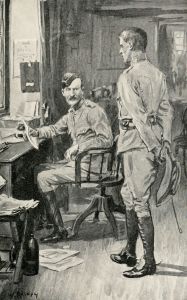
YORKE SURPRISES THE MAJOR.
Yorke and Hans took possession of the rough shelter, and rations were served out. With the tinned meat and a handful or two of mealies the Kaffirs were well content, and as the clouds were banking up for a thunder-storm, soon found shelter for themselves among the boulders. The storm came up rapidly; the thunder was incessant for half an hour, then the sky cleared up and the stars shone out. Yorke had procured a stock of bread for himself and Hans, extra water-bottles had been brought, and as Major Rimington had insisted upon his taking two bottles of wine before starting, they made a comfortable meal.
"I thought you did not drink anything but tea and coffee, Master Yorke," Hans said, when the latter poured a little wine into the water in a tin mug.
"I do not as a general thing, Hans, but I cannot get tea or coffee at present, and the water of the Orange River is scarcely a fluid that it is desirable to drink alone. Spirits I never touch, but a spoonful or two of wine takes away the muddy flavour and helps one to get down this bread and tinned meat. Using it like this, the wine will last for a week, and I expect before that time we shall join the troops at Belmont. Hans, you must mind you have your story perfect. We are Dutch from Cape Colony. We crossed the river at Colesberg Bridge, and decided to come north to join Cronje outside Kimberley. Of course we must be very careful as to where we say we live. It is pretty certain that a good many of the Dutch from round Richmond will have come to aid the Free Staters. I know by sight those who used to come to the farm; no doubt you know more. They won't recognize us in our changed dress, but they would know the names of all the farmers for many miles round, and it would never do to say that we came from that part of the country.
"We had better say that we came from near Pearston. It is a good-sized place in the East Somerset district, about half-way between the two lines going up from the coast to Middelburg. It is very unlikely that any of the Dutch from that neighbourhood would come up here; they will be waiting for the Boers to come down across the Orange River through Steynsburg and Molteno, before they take up arms, so that there will be very little fear of our falling in with any who would question us very closely as to the farm we came from or of the people we knew. But I do not propose to go in among the enemy at Belmont. It is almost certain that, although they may fight there, and perhaps at some of the kopjes farther on, it is at the crossing of the Modder river that the big fight will be.
"Every time we went into their camp the risk would increase. Some of the men who saw us at one place and heard our story would be sure to recognize us at the next. Of course if we remained with them all the time, shared in the fighting and retreat, it would be all right; but I have not the least idea of being shot by our own men or cut down in the pursuit, for there would be no time to explain to a Lancer coming right at you that you were an Englishman holding an authorization from Lord Methuen. So I shall content myself this time with telling off four of the Kaffirs. They are to make their way separately to Belmont, to get into conversation with Kaffir drivers, teamsters, and so on, and to endeavour to find out about how many Boers are assembled there, what guns they have with them, whether there is any talk of their being joined by a larger force, and whether they know of any place farther on where they intend fighting.
"If they are questioned at Belmont they can tell any story they like. They can say that they were working for English settlers, and that as these have left, they are out of employment and want a job. They must arrange among themselves where to meet at night, then, after comparing notes as to what they have learned, one of them must steal away and make his way back here. The other three, if they have been hired to look after ponies, had better remain there, and retire with the Boers if they retreat. The next day I will send off another to act exactly in the same way, so that every night I shall get a messenger back. The men not engaged in this work will scout all the country round, visiting farms and asking for work, and finding out whether any more men are coming from the east through Fauresmith, and if there are any bands about who are likely to be making down to cut the line this side of Belmont. You and I will scout along this line of hills, there may be some parties lurking among them with the intention of damaging the line."
The next morning at daybreak Yorke informed the Kaffirs of the work they were to do, and chose four of them as the first to carry out his plan, and explained fully to them the manner in which they should proceed and the story they were to tell.
"You had better draw lots at once," he said, "which of you is to bring me the news that you have gathered. Don't all tell the same story. Two of you can go in together and can pretend you have come from a deserted farm, the other two had better say they have come from one of the little native collections of huts by the river. Where there are Boers there are sure to be waggons, and it is probable that some of the native drivers will have deserted, and the Boers will be glad to take on fresh hands. It is not at all probable that any of you will be exposed to fire, the waggons are sure to be sent off as soon as the troops are seen to be advancing."
In a few minutes the whole party had scattered with the exception of three men left to look after the horses. Yorke and Hans spent the day in hard work, climbing up to the summit of the highest kopje, whence they commanded a view over the lower hills near the line of railway. The closest examination through a field-glass failed to show that there was any force stationed on them, though on several, single figures could be made out, evidently posted there as scouts. At dusk, all save the four who had gone into Belmont had returned. They brought no news of importance. The Kaffirs they had fallen in with, when questioned, had heard nothing of any further commandos coming in from the east. They stated that it was believed that great numbers had assembled behind the Modder, and that they were digging trenches and throwing up breast-works on their side of the river, and the general talk was that they would annihilate the English army when it arrived there.
The Boers were disappointed that Kimberley had not already been captured. Everywhere the feeling of the Kaffirs was in favour of the British, but all believed that these had no chance whatever against the Boers. Yorke had brought candles and writing materials with him, and at once sat down and wrote his report of the news.
Three hours later one of the men returned from Belmont. His report was that many of the Boers had been there for upwards of a month, that the kopjes had all been fortified by walls of rough stones round the summits, and that these had been continuously occupied by the lower class of Boer labourers and cattlemen. The Kaffirs are not good at figures, but by careful cross-examination, Yorke gained the information that there were more men there than would make two of the regiments they had seen at Orange River. They said that more would move up from behind when the British advance began, and that the leaders and the richer Boers would then arrive in their Cape carts or on horseback. The Boers felt confident that the British would never be able to storm their kopjes.
These kopjes were isolated hills, apparently composed of rough boulders, the rock from which they were formed rising sharply above them. About Belmont they were seldom more than five hundred feet high, but in many cases they rose fully three times that height, and it was up two of these lofty crests that Yorke and Hans that day laboriously climbed.
As soon as Yorke had written down the information he had gathered, he dispatched one of the men with the horses to ride back with it to Orange River. Yorke instructed the man that when challenged he was to reply, "A friend with despatches;" then he was to stand still till the sentry called to a sergeant, who would send forward two men to conduct him to the proper authorities, who would pass him on to head-quarters.
Three days were passed at the same work, then one of the messengers brought back an order for Yorke to join the troops on the following evening at Fincham's Farm, half-way to Belmont. The troops would halt there for the night, and advance to the attack on the following morning. It was from Fincham's Farm that Yorke had obtained water for the men and horses. Five of the Kaffirs had been down there every day, in charge of Hans, with the horses, to give the animals a good drink and fill the men's water-bottles, there being no water to be had nearer. Yorke was glad to receive the order, for after the first day the news from Belmont had varied but little. Some fresh parties of Boers had arrived, but not in any great number; and although it was believed that a stand could be successfully made at Belmont, it was intended that the great, and, as expected, final blow was to be struck at Magersfontein.
The party started early, and reconnoitred all the hills on the way down. Late in the afternoon a cloud of dust was seen out on the plain. No moving figures could be made out. It might have been a sand-storm, such as sprang up nearly every afternoon, but Yorke had no doubt that it was the army, with its waggons and baggage. When he rode into Fincham's Farm he found Rimington's Guides and the Lancers already there, and half an hour later the head of the column marched in. Their figures could scarcely be made out until they were within a few hundred yards of the place, so completely did the universal khaki disappear in the cloud of dust they raised on the arid plain over which they were marching. Yorke and Hans had resumed their uniforms, and the former received a hearty greeting from Rimington and his officers.
"How have you got on, Harberton?" the major asked cheerily.
"It's been hard work, and by no means exciting, sir. I am afraid that such news as I have sent in has been of no great use to the general."
"Yes, I think it has been useful. I saw the quartermaster-general yesterday, and he said that your scouts were doing very well, better than he anticipated. Thank goodness, work is going to begin at last! And so you think there will be no stand made by the Boers until we get to Belmont?"
"I am convinced of that. The Kaffirs have searched every kopje up to that point. Beyond a vedette or two on some of the hills, they have no force whatever along the line of railway this side of Belmont; but they have a strong body there—from two thousand to two thousand five hundred. As far as I can make out they have a few guns also. I got near enough to make out with my glasses that they were at work on three hills from four to five miles east of the station. Their guns are on the two hills farthest east."
"And what is the ground like behind! Will it give us any chance of acting on their line of retreat?"
"The ground is very rough and broken behind the centre, and there is a big range of hills—not kopjes—still farther behind. To their right is some flat ground where the cavalry could act, but they would have to pass through a line of smaller kopjes forming a continuation of the three principal ones. There were no men on these when I was watching them yesterday; but if they should retreat across the plain, a small body of them placed there could check the advance, if not stop it altogether."
"Then, if I understand you, Harberton," the major said, examining the leaf of the pocket-book on which Yorke had roughly dotted down the positions, "we could move along the line of railway without the Boers being able to trouble us from the position they occupy?"
"Certainly, major; but of course they would be able to come down behind us directly we pass, and attack the baggage-train. Being all mounted men, they could move very fast."
"Yes, I see that they might give us a lot of trouble, and I should think Lord Methuen would clear them out before we go farther."
Yorke reported himself to the quartermaster-general, and he was told to wait, as the general might wish to question him further; indeed, five minutes later he was sent for. The general had only dismounted a few minutes before, and was now in a room in the farmhouse. He had before him the rough sketch of the Boer position that Yorke had sent in on the previous evening.
"The information you have gathered is valuable, Mr. Harberton, and, rough as the sketch is, it has given us a better idea of the Boer position than we had previously been able to gather from the maps. Do I understand you to say that if the Boers were prevented from making off across this level ground to the right rear of the position, they would be thrown back across this line of high hills which is marked in my map as Mont Blanc?"
"Yes, sir. I went up to the highest point of those hills, and so far as I could see they would have to go by a road that runs round the foot of the mountain to the south-east. That road might be cut by a cavalry force making its way round to the south of the three kopjes from Witputs Station."
"And what is the length of front along these three kopjes at present held by them?"
"I should say from five to six miles, sir. It is about as far from the right-hand kopje to Belmont Station; the left or southern kopje is a good deal farther from the line of railway."
"They have erected breast-works on the hill?"
"Yes, sir; rough barricades of rocks and boulders. Their horses are gathered on the low ground behind the kopjes."
"You do not think they will fall back at our approach?"
"I should not think they would, sir. My Kaffirs say that they all think it absolutely impossible for the troops to scale the hills in the teeth of their rifle fire."
"Thank you, sir. You are attached for the present to Rimington's Guides, are you not? You had better continue with them until your Kaffirs can get to work again. You still have some among the Boers, have you not?"
"Yes, six have obtained employment with them. My instructions were that they were to retire with them, and that every night one or other should make off and bring in news of what they were doing. I said they were to come in the first place to Major Rimington, as I should probably be there."
The general nodded. "Thank you, Mr. Harberton! your arrangements have been very good."
The next morning the column advanced to a farm on the road on the western side of the railway two miles from Belmont. The movements for an attack on the following day were at once begun. The Ninth Brigade—consisting of the Northampton Regiment, the 1st Northumberland Fusiliers, the 2nd Yorkshire Light Infantry, four companies of the Loyal North Lancashire, and two companies of the 1st Royal Munsters—passed the station, and took up their position to the north of it. The three regiments of Guards halted at a house known as the White House, some four miles short of the station. The Naval Brigade had just come up after a tremendous march. A portion of the cavalry went on to the town of Belmont—it was nearly three miles beyond the station—while a portion remained at Witputs Station.
Unfortunately in this arm the force was extremely weak, the cavalry consisting only of some two hundred and fifty 9th Lancers and Rimington's Guides. It had with it the 18th and 75th Batteries of Field Artillery, and numbered, in all, ten thousand infantry and artillery, and five hundred sailors.
Orders were issued for the troops to be under arms and ready to move at three in the morning. From a gun visible on the crest of the third kopje this was called Gun Hill, the northern was christened Table Hill, and the southern was locally known as Kaffir Kop. The Guards were to march against Gun Hill. The Naval Brigade were to cover the right of the Guards from any attack by the Boer force from Kaffir Kop. The Northumberlands and Northamptons were to attack Table Hill, while the other regiments of the brigade were to form a connecting link between them and the Guards. It was clear from these instructions that, as Kaffir Kop was not to be attacked, Lord Methuen's plan was to throw back the Boer right, and force it in its retreat to move by the road south of Mont Blanc, and so sever it altogether from the Boer forces farther north. That complete success did not attend the operation was due to the difficulty of moving in the dark across an unknown country.
CHAPTER VII
BELMONT, GRASPAN, AND THE MODDER
It was a bright moonlight night when the men set out on their march. Orders had been issued that absolute silence was to prevail, that no matches were to be struck, that orders were to be delivered by signs and not by word of command, and that at each halt the men were to kneel down. The ground was undulating, and wherever it was possible the column took advantage of the shadows thrown by the rising ground. The sight of these bodies of men moving almost without sound across the sandy soil, on which their feet fell noiselessly, was almost weird. Occasionally there came a deep rumble of wheels as the guns passed over a piece of rocky ground, and a murmur of annoyance could be heard in the column, for all knew how important it was that they should get as near as possible to the Boer position unheard.
The Grenadiers led the way in the right column, the Scots Guards were on their left rear, the two battalions of Coldstreams were in reserve. Unfortunately these positions were not maintained. The Scots Guards came up abreast of the Grenadiers, but some distance to their left; the Grenadiers, instead of maintaining their direction, bore to the left and marched against Kaffir Kop; the Coldstreams diverged still further to the left; thus, instead of being concentrated for the attack on the central kopje, the brigade were scattered over a front of two miles. No doubt the efforts of the various battalions to find out each others' position delayed the advance, and they did not arrive until day had broken. The sun was just rising over the eastern hills when the Grenadiers came within three hundred yards of the foot of Kaffir Kop. Suddenly some guns placed on an eminence to its right opened fire, and at once a roar of musketry came from the top of the hill, while a heavy flanking fire also opened from Gun Hill, and a storm of bullets swept the line, many men falling at once, while the dust rose thickly around them as the Mauser bullets pattered fast on the sand. The order had been given that the troops were not to fire, but were to carry the hill at the point of the bayonet.
The pause was a short one. Joined by some of the Northamptons, who apparently had also missed their way, the Grenadiers fought their way up the hill. The Boers here, as at Talana, on the other side, lost heart as soon as they found to their astonishment that, in spite of their tremendous fire, the troops whom they had despised still pressed up the hill. They did not await their arrival at the crest, but fled precipitately down into the valley behind it, and took up a fresh position on another hill there. While the Grenadiers had been engaged in this short but desperate conflict, the Scots Guards on their left had effected the capture of the central kopje. They rushed to the attack as bravely as their brothers-in-arms. The Boers on the summit had opened as hot a fire upon their assailants as had the defenders of Kaffir Kop, but the troops were not exposed to such a terrible cross-fire, and the consequence was, their loss was comparatively small.
On the left the fighting had been sharp. The enemy had thrown out outposts towards the railway from Table Hill, and the Northamptons were soon engaged in driving them in. At the foot of the hill, however, the Boers made a stand. They had thrown up some stone breast-works, and held them until the Northamptons pushed forward to the right and so took the defenders of the sangars in flank, and forced them to quit their position and retire to the hill. The two regiments then advanced to storm the position. The defence of the Boers here was more feeble and half-hearted than that offered at Gun Hill and Kaffir Kop. On gaining the summit the infantry halted until the guns came up and opened fire on the next range of hills, where the Boers, driven from their first line of defences, had now ensconced themselves, keeping up a continuous fire from among the rocks. Two regiments advanced and seized a ridge to the south, from which the Boers had been maintaining a flanking fire; but they could advance no farther, for the Yorkshires and Munsters, who should have been their supports, had been withdrawn.
This was an unfortunate tactical error. Had they been with their brigade, and had this been strengthened by one of the Coldstream battalions, our left could have pressed steadily on and have driven the Boers by the south-east route, where they would have been harassed as they passed by the fire of the Guards Brigade, and cut up by the little body of cavalry that had arrived there from Witputs. The Coldstreams came late into action, but they attacked and carried the hill called Mont Blanc, while they aided the Scots Guards to capture another eminence to the south of that hill. They were aided by the artillery and by the guns of the Naval Brigade, which now, after tremendous efforts by the marines and sailors, had been brought up.
The enemy, disheartened at the manner in which they had been driven from position after position, now gave way altogether. Their only means of retreat was to cross the level ground to the north-east, and had there been a strong force of cavalry, with a battery or two of horse-artillery, under Lord Methuen's orders, their defeat would have been converted into a disastrous rout. But half of the little force were on the other flank, there was no horse-artillery, and although the little party of Lancers and Rimington's Guides attempted to perform the work assigned to them, they were unable to do so. The broken ground running north from Table Hill was held by a strong body of Boers, who covered the retreat of their waggons and guns. In no case could they have overtaken the flying horsemen, for their chargers were worn out by the heavy work of scouting they had carried on. Water, too, had been short since they had left the Orange River, and after suffering a good many casualties they fell back. The battle was virtually over by six o'clock, having lasted about two hours.
Yorke had ridden with Rimington's Guides from Belmont, and, as they were on the extreme left of the fighting-line, had seen little indeed of the combat. That the British were gaining ground was evident from the direction from which the roar of battle reached them, and when at length the order came for them to advance, they had ridden forward eagerly until checked by the heavy fire opened from the low line of rocky eminences facing them. To have pressed on against riflemen hidden among rocks would have been to incur certain and heavy loss, and might have deprived the army of its already utterly insufficient cavalry force; consequently Colonel Gough, who was in command, reluctantly gave the order for them to retire. Yorke had the evening before handed over his Kaffirs to the medical department as stretcher-bearers, and as soon as firing ceased and it was evident that the battle was over, he rode across the country to give what aid he could in the work.
He found that the greater part of the British wounded had already been carried off by the troops, some in the ambulance waggons, some on stretchers. By half-past ten the infantry were already in camp, and by one all the wounded were being attended to in the hospitals. The loss of the Grenadiers, 117 men killed or wounded and 10 officers, exceeded that suffered by the whole of the rest of the division. The Northumberlands and Northamptons had over 60 casualties among the men and 6 among their officers; of these the Northumberlands had by far the larger share. Yorke, after seeing the last of the wounded, Briton and Boer, placed on ambulances, was now free, and fastening his horse to a sagebush, he and Hans ascended the hill the Grenadiers had won.
On reaching the summit he saw that it had been carefully prepared for defence, and had evidently been occupied for a long time. The wall was not, as it had appeared, continuous, but was broken up into little enclosures or forts, each sufficiently large for two or three men to live and sleep in; straw, old sacking, and brushwood formed the beds. In each were generally to be seen the ashes of a fire, a cooking pot, meat tins, fragments of bread, and other signs of continued occupation.
Empty cartridge-cases littered the ground everywhere, while many still loaded showed how hasty had been the flight of the Boers. Several dead bodies lay in these little forts; they were for the most part of men of the lower class, farm-servants and others, with rough ill-fitting clothes and closely-cropped heads. Among them, however, were a few of a very much superior class, clean and carefully dressed, but these were quite the exception; and Yorke afterwards heard from the prisoners that men of that class generally sent on their best horses, and rode in on spare animals or in light carriages and carts, and as soon as they saw that the fight was going against them, ran down the hill, jumped on to their fresh horses, and rode off, leaving the unmounted men to fight and die. Eighty-three Boers were found dead, but it was certain that the bodies of many of the better-class Boers had been carried off when they fell. More than fifty prisoners were taken, and twenty wounded; sixty-four waggons and a considerable number of horses were captured.
The next day all the wounded were sent down by train. That afternoon the troops moved forward again, knowing that another Boer force was collected at Graspan, some seven miles to the North. The Ninth Brigade and the Naval Brigade started in the afternoon for Swingspan, while the Guards moved on somewhat later with the Naval guns, armoured train, and baggage. Lord Methuen's intention was this time to attack the left of the Boer position, which was planted along a low range of hills, the highest and most commanding of which lay on their left.
The Ninth Brigade, with Rimington's horse and the Lancers, bivouacked at Swingspan, a deep depression in a valley surrounded on all sides by hills of volcanic origin. The march had been an uneventful one. The cavalry had scouted the ground in front of them, but beyond beating up a herd of springbok, and startling an occasional covey of partridges, scaring up the little birds called dikkopfs, and sending the lizards hurrying to their shelters, they saw no signs of life. The effect of the previous day's fight was evident from the fact, that although the line of march was everywhere commanded by low hills, no shot was fired. It was difficult for the troops gathered round the pool to believe that the smooth circle of hills around them was ages ago a number of active volcanoes, and that the pool might itself have been a crater; but the fact has been well ascertained. Fires were lighted, but these soon burnt down, for the men were glad to stretch themselves on the sands and fall to sleep as soon as the kettles were boiled and their bread had been eaten. Pickets went up to the surrounding hills, and one of these found in a sangar a field-glass and walking-stick, showing that the Boers had occupied it but a short time before.
At three in the morning the troops were in motion again, and marched for five miles towards a line of kopjes some three miles from the railway-station. The station bore the two names of Enslin and Graspan, by both of which the battle was afterwards called. The Lancers scouted ahead, while Rimington's Guides watched the hills on the right. At last the enemy's entrenchments were seen extending along a series of kopjes. Their right was on two hills, one lying on each side of the railway, the left upon a high conical hill three miles to the east of it. On the ridges between were several guns, and through field-glasses the Boers could be seen hurrying towards the eastern kopje, against which they already perceived our main attack would be delivered. One of the field-batteries at once advanced and opened fire against this hill.
The armour-plated train had moved to Graspan station, and the sailors got out two of their twelve-pounder guns, leaving the others in the waggons, as there were not hands enough to work them. Presently these were joined by two batteries of artillery, and at half-past six all opened fire. Two companies of the Northumberlands acted as a covering party, and the rest were to line a low crest to the right and keep touch with the other battalions of the brigade posted there to oppose any movement that might be made from the Boer centre. Of such a movement, however, there was but little probability, as the Boers from that point were galloping with all haste to reinforce the defenders of the hill which was about to be assailed.
For two hours the fight was purely an artillery duel, the Naval guns and those of the two batteries being answered by six guns, a Hotchkiss, and a Maxim. These were well hidden from sight behind the crest line, and it was only by the light smoke that rose above them that our gunners were enabled to direct their fire. The Guards were in rear, and were held in reserve to take part in the fight wherever their services might be most required. The Naval Brigade were upon the extreme right, and it was upon them that the honour of the assault was to fall. Entrenchments had been thrown up by the enemy along the whole range of kopjes. It was evident that the Boers were in no way discouraged by their defeat two days before, for a very large body of mounted men were seen far out on our flank, in readiness to swoop down if we recoiled in confusion after failing to carry their position. Rimington's Guides were detached to watch and keep in check this force. At eight o'clock the two batteries of Royal Artillery moved away to the right to concentrate their fire on the kopje about to be attacked, and the Naval guns were ordered to withdraw, as the Boers had now accurately obtained their distance and were keeping up a tremendous fire with shrapnel upon them.
The enemy's fire, however, was so incessant and well-directed, that the officer in command, feeling that to attempt to withdraw the guns would lead to the annihilation of the men engaged in the work, maintained his position, the men throwing themselves on the ground at each flash of the enemy's guns and then leaping up and working their own pieces. So well were these served and directed that the guns opposed to them were gradually silenced.
The Naval Brigade, composed of two hundred marines and forty blue-jackets, at last advanced in skirmishing order, and pushed round to the right of the kopje. Although they were within nine hundred yards of it not a rifle was fired, and it seemed as if the fire of the two batteries had completely cleared out its defenders. The Lancers had moved still farther to the right, to prevent any body of Boers coming down through a break in the hills there to take the Naval Brigade in flank.
The ground over which they were moving was completely exposed. Having gained the desired position, the Naval Brigade now moved direct for the kopje, closing up somewhat as they converged upon its base. When within six hundred yards from the summit, from every rock and boulder a storm of fire flashed out, and a hail of bullets swept the line. The men lay down and returned the fire, but that of the hidden foe, enormously superior in numbers, was not to be checked. The North Lancashires who were following the Naval men completely lost sight of them, so great was the cloud of dust raised by the bullets ploughing up the sand. It was evident that to remain inactive was to court annihilation, and Captain Prothero, R.N., gave the word for the advance at the double, and the men leaping to their feet rushed to within four hundred yards of the base. Then a terrific fire was opened from a projecting spur.
The men fell fast, but again made a rush to within two hundred yards of the base of the hill. Prothero had fallen wounded; Ethelston, the second in command, was killed, Major Plumbe of the marines called upon his men, who nobly responded; he himself was shot dead before he had gone ten yards, and Lieutenant Saunders of the Powerful now rushed to the front. The Maxim gun that had accompanied them remained immovable, every one of the men who worked it having fallen. They reached the base of the kopje and there threw themselves down to breathe. They had left half their comrades and nearly all their officers behind them. The din was appalling, the two British batteries maintaining a continuous fire on the face and summit of the hill. The Yorkshire Light Infantry, followed by the North Lancashires, came rushing forward to the support of the naval men, and in open order with bayonets fixed they and the marines began to make their way up.
The Boers did not await the onslaught, but deserted their entrenchments and rocks and fled, the greater portion making their way along a valley through which ran a road to the north, only a few joining their friends along the line of hills. In the centre of the position a handful of desperate men defended the rocks to the last, and were bayoneted there. Seeing that the position they had deemed impregnable had been captured the Boers began to retreat, drawing off their guns with them. Again the weakness in cavalry prevented pursuit; and indeed both the Lancers and Rimington's Guides were too far away to be brought up in time for a successful pursuit of the mounted men, who formed the majority of the enemy's force. As to those unprovided with ponies, they had but to scatter over the hills where cavalry could not follow them, lie hidden among the boulders, and make off after nightfall.
The loss had been heavy. Of the Naval Brigade six officers and ninety-nine men were killed or wounded; the Yorkshires had fifty-three casualties, and the North Lancashires twenty. The Guards' Brigade were not engaged; they closed up at the end of the action, but were not called upon to fire a shot.
All but two of Yorke's Kaffirs who had been away came into camp after the battle was over. They had left the waggons while the fight was going on, and had hidden among the rocks until night fell. None had gained any information as to the Boer position on the Modder. None of the Boers whom they had heard conversing had been there. They had been told that the British would never get across the river, and even if they did so they would assuredly never be able to break through the strong position at Magersfontein, where Cronje intended to arrest their further advance. They had heard that no natives had been allowed to accompany the Boers who were posted on the Modder River, and that all new-comers had been directed to Graspan, a step which Yorke concluded was designed to prevent spies or well-wishers to the British from seeing the preparations that were made. He reported as usual to the quartermaster-general.
"It is a pity that we can't get some news as to what they are doing, Mr. Harberton, but certainly you have done all that is possible that way."
"I will try and go in disguise, sir, if you will give me leave."
"I do not think there is any chance whatever that your attempt would be successful. It is evident that Cronje is determined that his plans shall be kept secret. I have no doubt that you could, as you have already done, join any commando you wished, with a fair chance of a plausible story being believed. But the fact that all the new arrivals were sent on here, and that even Kaffir drivers are not allowed to approach the river, shows that no ordinary story would pass muster for a moment. You would simply be going to your death."
"It has been tougher work than we expected, Harberton," one of the officers of the Tigers said to Yorke the next day. "Of course we thrashed them, but the loss has been heavy, and as these kopjes are scattered all over the country, we may have to fight any number of battles like this. You see, the beggars only have to ride off on their ponies and take up a fresh position; necessarily we are kept at a distance out of fire; and before we can take up the pursuit and cross the hills they have been defending, they have got a couple of miles start of us. Besides, their horses are ever so much fresher than ours, so they could go on at that game for a very long time, and there can be no doubt their losses are much lighter than ours as we are always fighting in the open, while they are so hidden behind rocks that we don't get sight of them until they begin to bolt. However, we shall be stronger to-morrow, for I hear that the Argyle and Sutherlands will be up. That will a good deal more than fill up the vacancies caused by our casualties at Belmont and here."
The next day was passed in quiet, but on the 27th, after the wounded had been sent off by train, the force moved forward to the pools of Honeynest, eight miles south of the Modder. The march had been short, for the heat was great, and after halting the troops revelled in the luxury of a bath, the fact that the water was thick and muddy scarcely detracting from their enjoyment. The next morning one of Rimington's Guides came in and reported that he had been fired at from an apparently empty house near the river, and half an hour later another of Yorke's Kaffirs came in and told Yorke that the Boers with whom he had been, had made a long detour after the battle and had arrived at the Spytfontein kopjes. He found that there were very strong works there, but that they were not strongly occupied; and he had learned that a part of the force had some days before moved towards the Modder, but that no communication was allowed between them and Spytfontein.
Yorke at once went and reported the news. "That is important," the officer said. "I shall be glad if you will come with me at once to Lord Methuen, and you may as well bring your native with you, the general may wish to question him further."
The general indeed considered the information of such importance that he sent at once for one of Rimington's Guides, who spoke Kaffir perfectly, and through him asked the native many questions. There can be no doubt that the news that the main body of the Boers had at any rate moved forward towards the Modder influenced him in deciding upon the course he adopted. It had before been open to him to leave a battalion to hold the railway bridge, to prevent any Boers who might be there from crossing, and so cover the line of communication, while with the rest of his force he made a detour through Jacobsdal, and, making a wide sweep, as French's cavalry did later on, come down upon Kimberley from the north; but the fact that a large main Boer army was massed, if not at the Modder, at some place near, altered the situation. The river was fordable at many points, and were he to move away Cronje might throw his whole force across, crush the detached battalion, and take possession of the railway. It was, therefore, imperative that the direct advance upon Kimberley should be adopted.
A quarter of an hour afterwards the general, with two staff officers, rode down to within a short distance of the Modder, but all appeared still there. The banks were fringed with bushes; a few horses, doubtless belonging to a party of Boer scouts, grazed quietly near these. A mile away to the right were the hotels and gardens of the village; far beyond them were the hills of Spytfontein and Magersfontein. There was high ground two or three thousand yards behind the river. To the right of the railway the Riet River joined the Modder. No signs of any large body of the enemy, no earth-works or other preparations for defence, could be perceived. Although he and his staff were within easy range of the river-bank not a shot was fired, and Lord Methuen came to the conclusion that the passage would be opposed at most by a comparatively small body of the Boers, and that not until he had advanced some distance would he come upon a position where Cronje was prepared to give battle. Accordingly he decided to lose no time.
Yorke had ridden out with a party of Rimington's men and ascended a low hill, from which they obtained an excellent view of the country. The Riet came down at a sharp angle to the point of its junction with the Modder. It was fringed on both sides with willows, and an enemy lying along this line would take in flank a force advancing towards the broken railway bridge. But even with their field-glasses they could see no sign of life near its banks. Albrecht, Cronje's engineer officer, knew his work, and had done it well. A very large body of Boers had been at work night and day for a fortnight, and within the line of willows and bushes deep trenches had been dug from which the Boers could fire with scarcely any danger to themselves. Gun emplacements had been formed on the northern bank both of the Riet and Modder, and had been so arranged that the guns could be easily shifted from one point to another whenever our gunners discovered their exact position and got the range. The houses and walls had all been loopholed. On the hills behind some very heavy guns had been placed, batteries had been erected on the rising ground near the village, and trenches dug everywhere close to the farther side of the rivers. Nearly ten thousand men were lying down in absolute stillness, eagerly awaiting the moment when their unsuspecting enemies should fall into the trap so carefully prepared for them. The Transvaal commandos held the line from the railway bridge, and far up the bank of the Riet, while west of the bridge to the village the Free State men were posted.
"It looks all right," one of the officers with the party said. "I cannot make out a single soul stirring."
"I think it almost too still," another one said. "There must anyhow be some Boers about, and we should see them moving if there was not an imperative order for them not to show themselves. It is impossible to believe that they will allow us to cross the river without firing a shot, or that, as they have known for some time past that we were coming, they should have made no preparations for defence."
"Perhaps only a few hundred of them are there," another said. "They may have got such a strong position farther on that they prefer to fight us there. If they were to keep us from crossing, they would not have gained much; but if they were to defeat us somewhere on the other side of the river, the disaster might be a terrible one, for a force could come down behind us and cut off our retreat."
"But they can never defeat us," the first speaker said.
"No, we may feel pretty sure of that; but the Boers are so confident in their own fighting powers that they may very well believe that they will do so, and, of course, their dispositions will be in accordance with their belief and not with ours. There is the general with his two staff officers riding back. You see, not a shot has been fired at them."
"It certainly looks as if they did not intend to dispute the passage of the river," another officer said; "though they may have left a few hundred men as a rear-guard when the force retired. It is evident that the Boers prefer hill-fighting."
At four o'clock the next morning the troops moved forward, the infantry leading the way, followed by the cavalry and artillery. When they reached the level plain sloping gradually towards the river, and some three miles across, the advanced guard were fired upon by the Boers at the extremity of their position on the Riet. The Lancers galloped forward in that direction, two batteries following them, and at seven o'clock opened fire, and drove the Boers from their advanced posts. The cavalry then threatened to cross the river, but were forced to retire before a heavy rifle-fire, and took up their position further back in order to cover the right flank should the Boers take the offensive. Three Boer guns now began to exchange shots with our batteries, but one of them was effectually silenced, and the others fired only occasionally.
In the meantime the infantry had been advancing in open order. To the right of the railway were the 2nd Coldstreams, the Grenadiers, the Scots Fusiliers, and a wing of the 1st Coldstreams. On the left of the line were the North Lancashires, the Yorkshires, Northumberlands, the Argyle and Sutherland Highlanders, with half a battalion of the 1st Coldstreams in reserve. On that side was one battery of artillery; the naval guns took up their position close to the line. So far Lord Methuen had no reason to suppose that he was opposed by a larger force than that which had established itself on the further bank of the Riet. Accordingly there was no check to the advance. The noise of battle there had ceased, and parties of the enemy could be seen in retreat.
Cronje's plan had so far succeeded admirably. He had led his enemy to believe that they had but a small force opposed to them, and that this was already in retreat, and therefore, tempted them on to the plain, where they would be exposed to a murderous fire along their whole front, and which would be swept also by the strong force on the Riet. Not a shot was fired until the leading companies of the Guards were within a thousand yards of the river, when from the screen of trees and bush a line of fire burst out, and a hail of bullets swept the plain. Though many fell, no confusion was caused by this terrible surprise. The Guards, at once lay down and steadily returned the fire of their invisible foes. There was no shelter to be taken, no favouring rock or bush. The plain was perfectly even and bare. Some were fortunate enough to find an ant-hill between them and their foe, others some scrub eight or ten inches only in height, but most of them lay on the bare sand.
It was well for them that they had marched that day without their greatcoats, for these would have shown up clearly upon the light sand, whereas at a thousand yards the khaki-clad figures could scarcely be made out by the keenest-sighted Boer. The scream of the bullets overhead was unceasing; the dust was knocked up as if by a hail-storm driven by a mighty wind; and even above the rattle of the musketry and the roar of cannon, the quick thud of the machine-guns firing one-pound shells—afterwards called by the men pom-poms—added a new horror to warfare.
The Scots Guards had suffered most from this outburst of fire, because they were nearest to the Riet, and therefore more exposed to the flanking fire of the Transvaalers there than were the battalions to their left. Their Maxim was almost immediately disabled by the pom-pom, and most of the men serving it killed. To remain in the position meant annihilation, and they fell back a few hundred yards to an old reservoir.
The Grenadiers and the 2nd Coldstreams were fortunate in finding some little protection under a very slight rise in the ground. All through the day the Guardsmen lay prone in the positions in which they had first halted. To retreat under that ceaseless hail of fire would have been as dangerous as to advance. There was nothing to do but to lie still and suffer. The sun beat down upon them with withering heat. Most of them lay with their rifles under them, for the breaches and barrels were too hot to handle. They were parched by a terrible thirst, and many were wounded, but neither water nor stretcher could be carried to them through the hail of bullets. The streams of balls from the pom-poms tried them even more than the bullets. At times there was a slight lull in the firing, but the slightest movement caught the eyes of the watchful foe, and then it broke out again with renewed fury. It was clear from the first that nothing could be done on this side of the railway, and that the coming of darkness could alone bring relief.
Happily, however, things were going better to the left of the railway. The two batteries of artillery had galloped across to that side, and pushing on with extreme bravery, had opened a heavy fire upon the village and the Boer entrenchments. They were exposed not only to a continuous musketry fire, but to a cannonade from the Boer guns on the heights, more numerous and of heavier metal than their own; but they maintained their ground, aided by the four 12-pounders of the naval men. At half-past eleven, however, one of the batteries had to fall back, having lost heavily, and having nearly exhausted its ammunition. Twenty-five horses were killed as they dragged the guns back, and the officers' chargers had to be harnessed in their places.
It was due chiefly to the artillery that the day was finally won. Not only did they keep down the fire of the Boer marksmen by a hail of shrapnel, and shake the courage of the Free State men, but our men, lying themselves helpless, were cheered by the knowledge that our guns might yet be preparing a way for them to advance and to come within striking distance of their lurking foes.
Until two o'clock but little progress had been made on the left by the sorely-tried troops. The advance had been brought to a stand-still when it reached a point abreast of that obtained by the Guards. The frontal fire was as heavy, but they were not, like their comrades, scourged by a flanking fire, for although a party of Boers had pressed some distance round the extreme left, where there was rough ground that afforded some shelter, these were kept in check by the fire of the North Lancashires.
At two o'clock relief was furnished to the gunners by the arrival of another battery, which had made a tremendous march from Belmont, and had now come up in time to take part in the desperate struggle. They at once came into action, and aided in sweeping the Boer position with shrapnel. Lord Methuen moved as many troops as could be spared from the right to aid in the left attack, where alone success seemed possible. The fire of the newly-arrived battery speedily drove the Boers established on our extreme left across the river, and the fire from the Free Staters, in their trenches among the willows on the south side, began to slacken, affording ground for the belief that here also they were becoming demoralized by the fire to which they were exposed, and were crossing the stream. The Yorkshires, Northumberlands, and Highlanders sprang to their feet, and with a rush charged a farmhouse strongly held which had covered the approach to the drift. The Boers here fled at once, and the troops, without halting, dashed forward, cheering loudly, delighted that at last they had become the assailants. Closely following the Boers, they reached the weir, erected across the river to deepen the water above, and made their way across holding by an iron bar above it.
The feat was performed under a tremendous fire. Though man after man fell, those behind crept forward until four hundred men had crossed and established themselves on the northern bank. Two hundred of the Lancashires followed them. It was a great success, and decided the fortune of the day, although for a time this still hung in the balance. General Pole-Carew, who was in command of the brigade, led them along the bank, pressing on towards the Boer centre. Cronje, however, drew supports from his left, and after winning their way for three-quarters of a mile, the pressure brought to bear against the British was too great to be withstood. Opposed by a greatly superior force in front, and suffering from a flanking fire from the entrenched slopes above them, the troops fell slowly back again, but maintained themselves near the dam against all the efforts of the Boers to drive them across it.
So the fight went on until darkness fell and the fire ceased. The troops could do no more. They had been at work since four in the morning, without breakfast; they had suffered tortures from heat and thirst during their long hours of inactivity, they had throughout the day been exposed to a terrible fire, which they had been unable to return effectually; and General Colville, who had succeeded to the command at half-past five, when Lord Methuen had been wounded, felt that he could ask no more of them, and contented himself with making preparations for passing the whole force early next morning across the dam Pole-Carew had won. But in the morning the Boers had gone. With his right turned, and the Free Staters utterly demoralized, Cronje felt that he could not hope to prevent the main body of the British from crossing, in which case they would be placed between him and Kimberley, and it would be impossible for him to regain the position he had so carefully prepared. The Boers, therefore, silently left the entrenchments they had occupied and marched away to Spytfontein.