Front matter (continued 7)
Reading edition
CHAPTER XV
DOWN COUNTRY
"This is Mr. Harberton, to whom we all owe our lives," Mr. Chambers said as his wife, followed by her two daughters, girls of sixteen and eighteen, entered the room.
"I do not know how to thank you, sir," Mrs. Chambers said as she shook hands with Yorke, "for assuredly we should all have been murdered had it not been for your warning and assistance."
"It is rather to my man than to myself you are indebted, Mrs. Chambers, for it is he who overheard the conversation this afternoon at which the affair was finally arranged. He showed greater sharpness than I should have given him credit for. As an ordinary thing he would merely have taken a glass of liquor and left the place; but the fact that the men in the saloon stopped speaking when he went in, and asked him whether he spoke English, and were not satisfied that he could not, but went into another room to talk, excited his curiosity, and, sitting with his ear against the partition, he was able to make out what they were saying."
"That was very sharp of him," Mrs. Chambers said; "but it is pretty certain he would have taken no steps in the matter had it not been for your leading, especially as he was himself, as I understand from my husband, instrumental in aiding your escape from prison, and so dared not attract attention.
"Do not, I beg of you, try to minimize the service you have rendered us, for you certainly will not lessen the obligation that we are under to you. I shudder to think of the great danger we have escaped. I know it is not likely that another attack will be made yet, but I shall never feel comfortable here after this, and my husband has promised to take us into our town house to-morrow morning, to stop till the war is over. We hope you will go with us."
"Mr. Harberton says that he must be off at once, my dear. He wants to get back to the fighting again."
"I am sorry indeed for that. It seems unnatural, after what he has done for us, that we should let him go away so soon. Now, do tell us something about yourself—but first, where have you put those men, John?"
"One is locked up in the cellar, another in the stables, and the third in the wood-house, so that they cannot aid each other to get away."
"At any rate," she went on, "none of us will feel inclined for much sleep to-night; and we want to know all about Mr. Harberton and how his Dutch servant came to be at Pretoria, and all about what he has been doing since he landed, and the truth about the battles that have been fought. But before he begins, will you go into the kitchen, girls, and help Jane get some tea in the dining-room, with whatever there is in the house. It will do us all good, and we won't ask Mr. Harberton to tell his story till we have had what we may call supper."
"While they are away," Mr. Chambers said, "I may as well ask you as to whether you have any plans for getting down to the Modder?"
"No, I have no distinct plans, except that, as you see, I am dressed as a young Boer farmer, and as I talk the language sufficiently to pass muster, I can support the character well enough."
"But how is it that you talk Dutch, or rather I suppose I should say Taal, Mr. Harberton?"
"That I will tell you presently," Yorke laughed, "or I shall have to go over the same thing twice. My man Hans is my regimental servant, and has learnt to speak English very fairly, and of course knows Dutch. My Kaffir speaks Dutch and a little English, and as I speak a little Kaffir we get on very well together. He has just put up my horse in your stable. I had no time to lose when I first came here, and fastened him up behind the house, where he was not likely to be observed if any of those fellows went round there. As for getting to the Modder, it appeared to me that as a Dutch farmer, with one of his farm hands and a Kaffir labourer, I might get through without exciting much suspicion."
"You might, and you might not," Mr. Chambers said. "You see, almost all the able-bodied men are away with the commandos, and you would be likely to be closely questioned as to why you were not in the field. If you were going the other way it would be more easy, for you might then say that you were coming from Cape Colony, as thousands of others have done, to join the Boers. But even in that case it would seem strange that you were going away from the fighting instead of joining a commando at once; but it would be still more strange that you should have come up to Johannesburg. What did you say at the inn? what excuse did you make for enquiring where I lived?"
"I pretended that my people had all gone on commando, leaving me to look after the farm, and that I was going over to see you about some cattle that you wanted for the men still working on the mine. The man was a German, and did not, I think, see anything unlikely in my story."
"Yes, but though that might do very well here, it would hardly do elsewhere. Besides, these Boers are all related or connected with each other, and, ignorant as they are on other matters, can give the name of almost every family within fifty or sixty miles of where they live, and know more or less the name of every farmer in the Transvaal. The landdrosts of all the towns will have been warned to look out for a young English officer and a young Dutchman, who will no doubt be making for the frontier, and two of you at least answer to the personal description; your dress would not go for much, as they would be sure that the man who aided your escape would also procure a disguise for you. However, we must put our heads together to-morrow and see if we can hit on some plan."
After the meal was finished, Mr. Chambers asked Yorke to tell them something about himself and what he had seen of the war.
"It is of yourself that we principally want to know," he said. "After the services you have rendered us, we should like to know as much as possible about you and your people at home, and in fact anything that you may choose to tell us, especially, as to your prospects in the future. The longer you make your story, the better we shall be pleased. Certainly I shall not go to bed to-night, and I don't think either my wife or daughters will be anxious to do so for some time."
There was a general murmur of agreement.
Yorke accordingly told of his life at home, the reason why he had come out, how he had learnt Dutch and a little Kaffir on his cousin's farm, how his resolve to enlist in the war had been quickened by the quarrel with Dirck Jansen, and how, after scouting for a short time with twenty Kaffirs under his command, he had witnessed the four battles, and had gained a commission in the Lancers by carrying a message into Kimberley and back to the Modder. Then he told of his capture, how Hans had, with the Kaffir, journeyed up to Pretoria to rescue him, and how they had finally succeeded.
"Well, you have certainly managed to crowd a great deal of adventure into little more than a year, Mr. Harberton, and have done well all through, and deserved the commission you have won. So you say you saw Rhodes in Kimberley? Did you have much talk with him?"
"Yes, sir, he asked me a great many questions, and I told him, though not so fully, what I have told you. He asked if I intended to stop in the army after the war was over. I said that I had no idea of doing so, as I had come out with the intention of making money. He was good enough to speak flatteringly of my having learned to speak Dutch so soon, and said that if, when things were settled, I would go to him, he would have a berth for me and push me forward."
"You could not have a better patron. He is the biggest man out here by far, and is virtually king of Rhodesia. But you will please remember that I must have some say in the matter, and a very considerable one. None of us four would be alive now had it not been for you. And though I don't think those scoundrels would have got at the gold, they might have done so, for they would have had plenty of time; as, if any of the engineers had wanted to know anything, one of my servants would only have had to say that I was ill, or away for a few days, and before a week they might very well have found out how the strong-room was filled with water, cut off the supply, and then emptied it out far enough to allow them to work at the safe. I cannot assert that the gold is absolutely safe yet; there is no saying what may happen before the troops arrive here. The greed of Kruger and his gang is insatiable, and they may search every house belonging to the bank managers from top to bottom, and demand to inspect the safes."
"Why not bury some of it, sir, in one of the mine tips, just as they have hidden the bodies?"
"Because, although I have every reason to believe that the twelve white men who are still at work are all honest fellows, there is a point at which temptation may be too great, and I might find, when I came to examine the horde, that it was all gone. They are not aware of the existence of my store here, and it is well they should not be. One has heard before now of ships laden with treasure being seized by their crews, who, until the temptation came in their way, may have been all honest fellows. No, I will take the chances. I shall tell the two head engineers to come down and take up their quarters here, and bring two good men out of each shift with them. In that way there will always be three men in the house. As for the police here, they are, as a whole, the biggest rogues in the place. I would rather shut up the house and leave it empty than have any of them here. Now, it is two o'clock, and, if we cannot sleep, I have no doubt you can. I will show you up to a bedroom. I had a mattress taken down to the kitchen, where you told me your men would keep watch by turns. The girls both look half-asleep, and you and I will wheel the two sofas up near the fire, and bring the one in the dining-room here for my wife. I dare say I shall get a nap in the arm-chair presently. We will say nine o'clock breakfast."
"Very well, sir, I will be here by that time. I shall ride over to the town early, pay my visit to the hotel, and then be back again to breakfast."
The events of the evening did not keep Yorke awake long. "I do think I am the luckiest fellow going," he said to himself as he turned into bed. "In the first place, I get a commission in the army; in the second, I obtain Mr. Rhodes's good-will; and now Mr. Chambers, one of the richest men in Johannesburg, is going to take me up, and all from a series of accidents. It began, certainly, by my learning Dutch, which enabled me to get through to Kimberley and get a commission, thanks to the accident of Peter getting away and sticking to me. Then there was my being captured. That did not seem a piece of good fortune, but, thanks to Hans's sharpness, it has turned out the best piece of luck of all, if I can but get safely back to the Modder. There is an old saying that luck is better than riches. I did not believe this formerly, but it has turned out so in my case. Had not my father lost his money I should be grinding away at Rugby, and should have thought myself lucky four or five years hence to get a curacy of one hundred and twenty pounds a year."
Yorke was up at seven, and started at once on horseback for the town, taking Peter with him, but leaving Hans behind in charge of the prisoners.
"Where have you been all night?" the innkeeper asked. "I could not get to see Mr. Chambers till late, and after we had made our bargain, he gave me some supper, and then said I might as well stop there for the night. He put a mattress down by the kitchen fire, and I slept as well as I should have done here. I am off now, so if you will give me my bill I will pay it."
"Will you want breakfast?"
"No, I shall be off at once; last night's supper will do till I get back."
"Then, here is your bill," the German said, taking a piece of paper from his pocket. "I made it out last night, thinking you might be starting early. There it is; I added it up, you see, and should have put on the cost of breakfast had you taken it."
Yorke paid the bill without question, though it was as large as it would have been had he stopped at a first-class hotel in London. Then he rode back again to the mine.
"I have been thinking over matters," Mr. Chambers said, as they were sitting down to breakfast, "and it seems to me that to begin with, you would travel more satisfactorily and more safely in a Cape cart than you would on horseback. I have got one that is used for sending messages into the town and fetching things out. It has been a good cart in its time, and is so still, except that it wants repainting and so on. I can let you have a horse to go with yours; it is a good serviceable animal. I should be delighted to give you a pair of my own, but they would be sure to attract attention, for I rather pride myself on my stud. I have got double harness for the cart, though when I go longer journeys I follow the Boer fashion and drive four horses."
"My own horse is used to being driven; my cousin generally had it out when he went in to Richmond. I am very much obliged to you for your offer. We should certainly attract less attention in a cart than if we all rode. I shall myself drive, as I enjoy it. I know that as a rule the Boers generally let the Kaffirs drive, and I should be content to do so myself; but a good many Boers do drive."
"There will be nothing unusual in that; indeed, about here most of the Boers drive, as they see the Uitlanders do it. I will put another saddle in the cart, for when you get near the frontier you will certainly find it easier to get through on horseback.
"I should advise you to take the direct road south to Bloemfontein. I have a friend there; he is a Dutchman, but a thorough believer in English rule, though, of course, at present he has to keep his opinions to himself. He broke his leg some years ago and has been lame ever since, and so has escaped being obliged to go on commando. I will write a letter to him after breakfast strongly recommending you to him. I shall not say who you are, or that you are an Englishman, because it is just possible that you may be searched. Anyway, it will be as well for you to conceal the letter in your clothes. I will write a second letter to him, saying that you have been employed at this mine, which is correct enough, and that, as I have no further occasion for your work, you are now going down to take your share in the fighting. I will also get you a pass from the head of the police, whom, as you know, I am going over to interview directly after breakfast with reference to our prisoners. I will get it made out in the name of Gert Meyring, of the Orange Free State. It is natural enough that you should be taking down with you a young Dutchman who has also been employed at the mine, and who is going with you to the front, and that you should have a Kaffir with you also. The only fear is that your description might tally so closely with the warning that has been sent, that you may be suspected."
"I can get over that, sir; I had a wig made for me to wear as a disguise, if necessary. It is sewn up in the lining of this coat, and being so soft it altogether escaped attention when I was first searched. I am sure to have been described as having closely-cropped hair, whereas the wig comes down to my shoulders and entirely alters my appearance. I have never worn it yet, as I went into Kimberley, as I told you, in uniform, and in fact up till now have never given the thing a thought from the day when I sewed it up. That, and darkening my eyebrows to match, would so alter my appearance that I do not think that even those who know me well would recognize me."
"That is capital; I have been worrying over the point all morning. I wish we had one for your man too, for I know he also was described in the telegram yesterday as having closely-cropped hair."
"I extemporized a wig for myself once before, sir, and can do one for Hans, if you will allow me to cut some hair from two of your horses' tails."
"Certainly you can do that. Is there anything else you will want?"
"A needle and thread, sir, and if you have such a thing as a glue-pot in the house it will be all the better."
"Yes, I think I have one somewhere, I daresay the girl can tell you where it is."
"We will do any sewing that is necessary, Mr. Harberton," the elder of the two girls said. "I am afraid that we are useless in most respects, but at least we can both sew."
Mr. Chambers went out with Yorke to the stables and showed him the horses that he was willing to have despoiled of a portion of their tails, and this, with a pair of scissors that the girls had lent him, Yorke speedily accomplished. They then saddled Mr. Chambers's favourite horse, and he at once started. He was away an hour and a half, by which time, amid a good deal of laughter and merriment, the hair had been sewn and glued into Hans's straw-hat. Yorke had also got out his wig and put it on, and even Mrs. Chambers, shaken as she still was by the incidents of the night before, joined in her daughters' hearty laughter at the changed appearance of her two guests.
"The police will be here at twelve, Mr. Harberton, therefore, if you have now made up your mind to start to-day, it would be as well that you should be away before they arrive. You know I should be delighted if you would stop a few days, but as you said that you would very much rather be off this morning, I shall not try to persuade you to do so."
Half an hour later all was ready for the start. Mr. Chambers had taken Hans aside. "You have done me a great service," he said. "The present is not a time when it is safe to be travelling about with much money in your possession, especially when you are wanted by the authorities, and if you were searched, and found to have a sum of money that did not accord with your apparent position, you would not only lose the money, but your liberty as well. Therefore, I do not propose to make you a gift at the present time, but I engage myself to pay to you the sum of five hundred pounds whenever you may wish to buy a farm or otherwise settle down after the conclusion of the war."
Hans's eyes opened with surprise. "I only did what my master told me, sir."
"You did more. Your astuteness in listening to the conversation of the rascals who were talking in that drinking-shop was no doubt at first a mere matter of curiosity, but the fact that you communicated it at once to Mr. Harberton enabled him to take the steps which defeated the plot; and you bore your share in the fight itself. My name is well known, I think, throughout South Africa, and, as I may be away from the country when you wish to draw the money, here is a promissory note, undated, undertaking to pay three months after presentation the sum of five hundred pounds on the duly certified signature of Hans Bernard; and with it is this letter, saying that I have handed you this bill in consideration of the very great service that you rendered me in discovering and thwarting an attempt on my life. That letter can do you no harm if found upon you. When the war is over you can, at any time, hand that note to the bank here, or to any of its branches in Natal, or to its agents. They will require the signature of Mr. Harberton, or some other person known to them, and will then place the money at your disposal as soon as they have communicated with the bank here."
Without waiting for any thanks from Hans, who was too overwhelmed to find words for the purpose, he went across to the stables, where Peter was harnessing the horses. "Peter," he said, "your master tells me that you have been very faithful to him, and you have now rendered me a service by helping him to defeat the men who attacked this place last night. It would not be safe to give you money now, as you may be searched going down country, but I shall give him authority to pay you two hundred pounds for me at the end of the war. Don't spend it in folly at the Cape; go back to your own people, build a kraal, buy cattle, and settle down there."
Then he walked away, and in a few words told Yorke what he had done. "They have both proved themselves good men by their devotion to you," he said, "it will give them both a good start in life."
"Thank you most heartily, Mr. Chambers, I am certain that both of them will do justice to your kindness. I am sure of Hans being steady; and, as I have already persuaded the Kaffir to swear off liquor, he will, I feel certain, take your advice, which is indeed almost the same as I gave him when getting him to promise not to spend his earnings in drink. These native labourers with the army are all paid very high, indeed ridiculously high wages. He has promised to hand over his pay, when he gets it, to me, and I have undertaken if he does so to keep him in tobacco, so he will, if the war lasts for a year, have over fifty pounds laid by, which will add to his sense of responsibility. I will not draw upon you for the money until he is ready to go straight away directly he gets it. Of course, I do not know what I shall be doing myself; if I can, I shall certainly accompany him and see him settled. As to Hans, I have no fear as to his doing well; he certainly was not a hard worker until I went to my cousin's farm, but since then he has quite woke up. He saw the advantage of irrigation there, and I shall strongly advise him not to go in for keeping cattle, but to take a small piece of good land near this town, or Kimberley, where water can be obtained at no great depth, and to go in for growing vegetables for sale in the town. I am convinced that it would pay splendidly."
"He certainly could not do better. The prices of vegetables are extravagantly high, and he can dispose of any quantity at rates that would pay him well. Well, there is the Kaffir with the cart. You had better come in and say good-bye to my wife and daughters."
Five minutes later they started, with strongly-expressed hopes that in two or three months they might meet again when the British army came up.
"You are sure to find me here," Mr. Chambers said, "unless, when it is found you are approaching, the Boers get mad and order all Uitlanders away. However, even then I fancy that the usual bribe will avail to purchase me an exemption, but if I do have to go I shall come back again directly you capture the place."
A basket containing wine, a ham, and a variety of eatables had been placed under the seat.
"What shall I do with the trap and horse, sir?"
"You can either sell the trap for what it will fetch and keep the horse, or, in fact, do as you like with it! Good-bye! and take care of yourself. Which he won't do," Mr. Chambers added as, with a wave of the hand, Yorke drove off.
With two good horses and a light load, they drove rapidly along. Mr. Chambers had before he started asked Yorke whether he had ample funds for the journey, and the latter was glad to be able to say that Hans had, before leaving the camp, drawn sufficient from the paymaster for anything that could be required.
"Whatever you do, Hans, keep your hat on. There is no fear of anyone who saw you in the prison recognizing you as you are; but if your hat should blow off, and anyone happened to be looking on at the time, the game would be up."
"I don't think it could blow off, master. The hair and the glue under the lining have made it so much smaller that I had to press it quite hard to get it on my head."
"Well, when we are once clear away from the town, you can lift it a bit, for if it blows off then it will not matter.
"It is two hundred and fifty miles to Bloemfontein. I suppose it will take us about a week. We shall see how the horses stand it, they both start fresh. I was looking at the map this morning, and it is evident that there is no good road by the direct line, I mean the route followed by the railway. So I am taking the main road that goes down through Potchefstroom. There is no place of any size before that. It is about sixty miles. We will camp out to-night ten miles before we get there. Then we can drive through the town without stopping, and get on as far as Reitzburg. We can settle to-morrow whether we will put up at the town, or camp just across the Vaal, about a mile this side of the place. From there it is a little over forty miles to Kroonstad.
"I think when we get as far as that, we shall be beyond the farthest points where there will be danger. They will be looking for us chiefly on the road to Mafeking, which is, of course, the nearest point to the border; or else on that leading through Komati Poort, down to Delagoa Bay; and they will also, no doubt, search every train going south. In any case, they can have no idea that we are travelling by road at this pace, and if we were on foot we could not arrive at Kroonstad within two or three days of the time we shall get there. Besides, we have got the police pass; and certainly the description telegraphed on will in no way tally with our present appearance. So I do not think we shall be troubled, though it is as well to take every precaution."
They experienced, indeed, no difficulties whatever, and camped that night by a dam half a mile off the road, five miles out of Potchefstroom. As they had several water-bottles hung under the cart, and a bag of mealies, the horses fared as well as their masters. One of the first questions that Hans had asked after they started was, whether Mr. Chambers had actually promised him five hundred pounds.
"It seems impossible," he said, "but that is what I understood him to say."
"That is what he intends to give you, Hans."
"But it is too much; only for sitting and listening for half an hour, and firing five shots with a rifle."
"That is all that it was to you, Hans, but to him it meant saving his life, and the lives of the ladies of his family. As to the gold, he told me how it was concealed, and that the robbers could never have got at it. Still, he values his life and those of the ladies at a large sum; and as he is a very rich man, he does not think it out of the way to make you a handsome present. I told him that I should advise you to carry out what we were saying the other day would be the best-paying thing for a man of small capital—to buy a piece of land near Johannesburg or Kimberley, to sink a deep well, and to put up horse-gear and irrigate the land; and to employ half a dozen Kaffirs to grow vegetables and plant fruit-trees, just as my cousin did. Only, you would do a great deal better than Mr. Allnutt, because the Boer farmers would not pay much for their vegetables or fruit, while you would get splendid prices in either of these towns. The vegetables would begin to pay three months after you started, but of course you would have to wait a couple of years before you got any return for the fruit-trees."
Hans was silent for three or four minutes, lost in the contemplation of himself as the owner of such a place.
"We shall have plenty of time to talk it over before then, Hans," Yorke went on, after a long pause, "but I should advise you not to spend any money on building a house for yourself at first—any sort of a hut will do; and though five hundred pounds seems a very large sum to you, you will want it all for your work; the well and horse-gear will cost a good bit. Then you will have your water-courses to make, and your ground to irrigate, say five acres to begin with; and it is always a good plan to keep some money in hand in case of accidents, such as your well failing and your having to go deeper, or of your Kaffirs running away. Besides, you must have a horse and cart to take your goods to market. At any rate, Hans, if you want to get on you will have to bestir yourself. You know that young English gentlemen who come out don't think themselves above taking off their coats and working, and at first you will have to do the same. After a bit you will, as you extend your cultivated ground and carry the work further, take on more Kaffirs, and you will have to see that they do their work. That was how Mr. Allnutt did, and it is only in that way that you will get work out of them."
"It will be grand," Hans murmured; "but," he broke off suddenly, "you will not be with me, Master Yorke, and I had hoped that, whatever you were doing, you would always keep me with you."
"So I should like to do, Hans, but it would not be good for you; it is always better that a man should depend upon himself, and not upon another. Some day you will want to marry, and then you will see how much better it is to have a nice home and a business than to be merely working for wages. It was just the same way with myself. I did not like leaving my father and mother, and going to start in a strange country. But I hoped that I might some day make a home for myself here, and do well; whereas, I had no chance of earning much in England."
"Well, Master Yorke, it was a lucky day for me when you came to Mr. Allnutt's, and took me to go out riding and shooting with you."
"It has turned out quite as fortunate for me, Hans."
Peter, who was not given to speaking unless addressed, said but little. Occasionally, as he looked at Yorke and Hans, he shook with silent laughter at their changed appearance, and indeed the transformation effected by their long hair was striking to one accustomed to their closely-cropped heads. By the way, however, he went about his work—taking the horses out of the cart, supplying them with their water and grain, and rubbing them down—it was evident that he already, in imagination, considered himself to be a far more important person than he was before, and that he was preparing himself for the change from the humble position of a casual labourer in some small town to that of a man of position and influence among his tribe. Occasionally he would break into bursts of apparently unprovoked laughter, as if the change appeared to himself ludicrous in the extreme.
They were on the move at the first sign of daylight, and Potchefstroom was still asleep when they drove through. At eight o'clock they crossed the Vaal and drove into Reitzburg. A couple of Boers came up and asked them where they came from, but were quite satisfied with the answer, "From Potchefstroom," as they considered that if they had been allowed to pass through there, their journey must be a legitimate one.
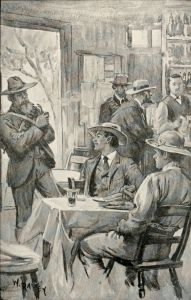
ONE OF THE BOERS THEY HAD SPOKEN TO SAUNTERED IN.
"We have a pass from the chief of the police at Johannesburg, if you would like to see it."
"No," one of the men replied. "If it is good enough for them in the Transvaal, it is good enough for us. I suppose you are going down to the army?"
"Yes, we want to do our share of the fighting."
"Quite right. You must lose no time or you will be too late."
"So I suppose, by all they say," Yorke replied.
They thought it as well to wait for an hour to feed the horses and take a meal. Leaving Peter to look after the horses, and see that nobody touched the guns and other articles in the cart, they went into a small inn. While they were eating their meal one of the Boers they had spoken to sauntered in.
"Was there any news at Johannesburg?"
"No, not particular. Things are very quiet there."
"You did not hear, did you, of any escaped prisoners being caught?"
"We did hear that one of the English officers had got away from the jail."
"Yes, that is what I mean. They telegraphed to us here from Pretoria; but of course he would never come down this way. Still, we had to obey orders and keep a sharp look-out. If he had come this way he would have been caught. I expect, however, he went east; but he could not get far. They say he was quite a young chap, with close-cropped hair."
"Well, their young officers cannot have learned to talk Dutch, so there ought to be no difficulty in catching him," Yorke said.
"But he has got a Dutchman with him, and I suppose he himself won't open his lips, but the Dutchman will do his talking for him."
"Hans, you had better say something," Yorke laughed, "or possibly you may be taken for this British officer."
"I don't look much like a British officer with a cropped head," Hans said, "and I talk my own language better than I do English by a long way."
"Oh! I knew you could not be the man," the Boer said. "Still, I am glad to see that you are Dutch as well as your master. There might be questions asked, and now I can swear that you are both Africanders. It will satisfy anyone questioning me as to who has been along. I don't see myself what occasion there is for making a fuss about one officer getting away when we shall soon have all their army prisoners. It gives everyone a lot of trouble."
"Will you have a glass of spirits?" Yorke asked.
As it was with the hope of obtaining an invitation that the Boer had come in, he assented willingly, and remained talking until Yorke said it was time for them to be going on. They slept that night at Winkel Drift, on the Rhenoster River, and drove next day to Kroonstad. Here no questions were asked. They put up at an inn, and Yorke mentioned casually that they were intending to stay with a friend for a day of two at Bloemfontein, and then going to the front. They had avoided entering the town until it was dusk; and as many Boers were constantly passing down to join the commandos, no one thought of enquiring minutely into their affairs. Three more days took them to Bloemfontein. There Yorke noticed, as they drove in, that many stores with British names over them were still open, for the wholesale expulsion of English from the Transvaal had not extended to the Orange Free State, where, till the outbreak of the war, a good feeling had existed between the two peoples. At Bloemfontein especially a considerable portion of the trading class had been British, and these, considering that if they left, their stores would probably be looted, thought it better to remain, and, although their position was not a pleasant one, they had received fair treatment at the hands of the Boers.
CHAPTER XVI
AN OLD ENEMY
Arriving at Bloemfontein in the evening, they first went to an hotel, and having engaged rooms, and seen their horses put up, Yorke proceeded to the house of the Dutch gentleman to whom the letters Mr. Chambers had given him were addressed. On sending one in he was shown into the sitting-room, where Mr. von Rensburg presently joined him.
"You are the bearer of this letter, Mr. Meyring, from my friend, Mr. Chambers?"
"Yes, sir, and of this also, which I did not care to give into any hands but your own."
Mr. von Rensburg took it a little surprised. The first had been so simple and matter-of-fact that he had not suspected for a moment that Yorke was not, as it stated, an employé at the mine. He looked scrutinizingly at Yorke when he had read the second letter.
"I will not ask who you are, Mr. Meyring, or whether that is your real name. It is just as well not to know more than I can help. I understand you want to cross into Cape Colony, and may be glad of my advice as to the best road to take. In the first place, may I ask how you came here—by rail?"
"No, sir, we drove. I have a friend with me, and it is open to us either to drive from this point, or, as we have two horses, to ride, or to go on foot, though naturally we would rather not adopt the last plan if it could be helped."
"That I can well understand," the other said with a smile; "and indeed it would be the worst method; it would be far more natural for you to be driving or riding than going on foot. Now, tell me exactly how you stand. You, I see, are dressed as a young farmer in comfortable circumstances. How about your friend?"
"He is dressed as a farm-hand, sir; and I have also a Kaffir with me to look after the horses."
"Is your companion Dutch?"
"Yes, sir."
"You are not, I think. You speak Taal very well, but I fancy I can detect that it is not your own language."
"That is so," Yorke agreed; "but I am glad to say that you are the first person who has noticed it."
"I am not surprised at that, for you really speak it very well; it is more the tone of your voice than anything wrong in the language—or I may call it the dialect—that is noticeable."
"I have learned it partly from books, sir, but chiefly from conversing in it almost entirely for six months."
"You must have the knack of learning languages if you have picked it up so well in so short a time. You have only arrived here to-day, I suppose?"
"Yes, sir, half an hour ago."
"From Johannesburg?"
Yorke made a gesture of assent.
"You were, I suppose, intimate with Mr. Chambers?"
"I can scarcely say that I was intimate with him, but my man—for he is my servant as well as my friend—happened to overhear a plot to murder Mr. Chambers and loot his house, and he, with my Kaffir, Mr. Chambers and myself, gave the ruffians so warm a reception that there is not likely to be a repetition of the attempt."
"Were they a strong party?"
"There were twelve of them, and only two got away alive. The really dangerous part of the affair was that the three men in the house were also in the plot; but we had tied them up before the others arrived."
"That was a very thorough piece of business indeed," Mr. von Rensburg said, more warmly than he had spoken before; "and I can well understand now that my friend Chambers should be anxious to aid you in any way. Will you tell me a little more about it? You are not, I suppose, pressed for time."
"Not at all, sir;" and Yorke related more fully the incidents connected with the affair.
"It was a fortunate escape for Mr. Chambers. No doubt those scoundrels thought that he had money in the house. They would hardly have gone in such numbers if it had only been a question of ordinary robbery. And was your employment at the mine confined to this exploit?"
"Entirely, sir; but as the house stands on the mine property, Mr. Chambers said when he wrote the letter that he could say with a good conscience that I had been employed there."
"I have one question to ask: Are you personally known to anyone here? I mean, is there anyone whom you would be likely to meet who would recognize you?"
"No, sir, I don't think there is anyone here likely to have seen me before. And if there should be anyone, I am sure he would not know me in my present disguise."
"I asked the question," Mr. von Rensburg went on, "as in that case there is no occasion for me to make any instant decision as to the route you had better take. If there had been any danger of your being recognized I should say you had better start to-morrow morning early, but as it is, we can take our time about it."
"I am in no very pressing hurry, though I should be glad to be on the other side of the Orange River as soon as I can. I have already been away nearly seven weeks."
"I can guess pretty well who you are, Mr. Meyring," the other said with a smile, "though I don't want to know. I should certainly be glad if you would take up your residence here while you remain, but I think it is better that you should not. I am not very popular here at present, because I opposed the Free State taking part with the Transvaal. I can call upon you at your hotel very well; because then, should there be any question, I can simply show the letter you first sent me in, and say that I know nothing more than that. I don't think it at all likely that any question will arise, and my coming to see you will be an advantage to you rather than otherwise, for it will show that you are not altogether an unknown person. I will this evening think over what people I know on the different roads, where parties of our men are stationed, and how you had best proceed."
"Thank you very much, sir. At what hour are you likely to call?"
"We will say ten o'clock. I will bring a good map I have with me—or, no, I had better merely call and ask for you, and then bring you here. It would look strange if you were to ask for a private room, and we certainly cannot talk that over in the public room. They will not know that you have been here to-night, and you had better send your man with this letter again in the morning. Tell him before the landlord, or anyone else, that he is to take the letter to me, and say that you have arrived, and will call upon me at any hour that is convenient in reference to the business."
This programme was carried out, and at ten o'clock Yorke was standing at the door of the hotel when Mr. von Rensburg came up. He went into the hotel without noticing Yorke, and said to the landlord: "You have a Mr. Meyring staying here, have you not?"
"Yes, sir; he was outside just now." He went to the door. "There he is, sir," he said, pointing to Yorke.
Mr. von Rensburg went up to him. "My name is von Rensburg, Mr. Meyring. I did not know when I should be disengaged, so did not send an answer to the letter you brought, but I am free now, and if you will come with me to my house, we will talk over the business you mentioned, and see which commando you had better join."
"Thank you, sir! I am naturally anxious to lose no time. I should certainly prefer joining the force which is likely to be engaged soonest." The innkeeper and two other men lounging near heard what he said, and paid no further attention to them as they walked off.
Once in Mr. von Rensburg's parlour the latter said: "It will not be an easy matter to get through. The drifts are all guarded, both on the Orange River and the Riet. Of course the nearest way is through Petrusburg and Jacobsdal, but I put that out of the question. Then there is the road through Fauresmith and across the Orange at Zoutpans Drift, but that also is a long way round. I believe that as good a way as any would be to take the Boshof road across the Modder at Truters Drift. From there a road keeps along for three miles north of the Modder, and leads finally to Kimberley; it cuts the road from Boshof to Jacobsdal. But at that point there are strong forces to prevent the British from trying to make a detour that way. These are the names of the various commandos there, and at Jacobsdal, and at the drifts across the Orange.
"The safest way, though longer in miles, would be to go south to Bethulie, as if you were going to join the commando at Steynsburg, or better still, Colesberg. Once past Colesberg you would find no difficulty in making your way to De Aar. I could help you more that way than any other, because I could get a pass for you, and your horses, your servant, and the Kaffir, direct by rail to Colesberg; so that really you would not lose so much time as you might think, for from Colesberg to De Aar is not much more than half the distance that it is from here to Jacobsdal. The Philippolis commando is there."
"I know the country on the other side of the Seacow River," Yorke said, "and once past Colesberg could make my way easily enough. I would much rather choose that line. Once at De Aar I should not have much more than a hundred miles to ride to the Modder, even if I could not get up by train."
"Then I will see the officer in charge of the railway arrangements, and find out when a train is going down to Colesberg with ammunition and supplies, and if he is not taking any horses down, will get him to put on a truck for your animals. What do you mean to do with your cart?"
"Mr. Chambers said I could do anything I liked with it. It would only be in my way now, for the tracks beyond Colesberg west are as much as horses can manage. Besides, I should find it more difficult to get away from the town in a vehicle than on horseback."
"Well, if I were you I would speak to the innkeeper; he would be likely to know someone who would want to buy it. If not, you had better leave it with him, and tell him that you are so anxious to get to the front that you do not care about wasting time here looking about for a purchaser; and ask him to sell it for you, and to keep the money until you return for it. You must appear careful about it, for no Dutch farmer, however well off, would throw away the value of a good cart. You had therefore better ask him to write to you at the post-office, Colesberg, telling you what sum he has sold it for."
"As he knows that I have come here, sir, I might ask him to hand the money over to you, as you have kindly offered to remit it to me."
"Yes, it would be as well to seem as anxious as possible. When I come round this afternoon to tell you the result of my enquiries about the trains, I will look at the cart."
"It is a very good one, sir, of Cape Colony make, and it only wants repainting to appear quite new."
"In that case I will tell the innkeeper that if he does not know of anyone who will buy it at once, I will give you the sum he and I may value it at, and if at the end of a week he doesn't find a purchaser at that price, I will take it myself. A cart more or less makes but little difference, and you may as well have the money as let the innkeeper put it in his pocket."
"But the money ought to go back to Mr. Chambers, sir."
"It will be much more useful in your pocket than in his. He gave you the thing to do as you liked with, and certainly will not expect to be paid for it, and would be hurt rather than pleased at the money being sent to him. No doubt you will find uses for it."
The innkeeper, however, knew of a trader in the town who wanted a good cart, and the matter was arranged in a few minutes. There was a train going that evening, and with an order signed by the military secretary at Bloemfontein for Gert Meyring and Hans Bernard, both going to join the Philippolis commando at Colesberg, accompanied by a Kaffir boy, to travel by military train, they started that evening. It was an open truck, but as they had brought blankets and horse-rugs in the cart, for sleeping on the veldt, they preferred the night journey to being exposed to the scorching rays of the sun all day. It took some fifteen hours to cover the distance between Bloemfontein and Colesberg. After getting the horses out of the truck, they saddled them, slung their rifles and bandoliers over their shoulders, strapped the blankets behind the saddles, and then rode into the town, which was little more than a long single street extending along the bottom of a very narrow valley.
Peter had been most reluctant to leave his rifle behind him at Bloemfontein, and had been allowed to bring it, saying that if he were questioned he could say that it was a spare rifle belonging to Yorke. As it was notorious that in the battles of Graspan and Belmont many of the richer Boers had been attended by servants, who loaded spare rifles, and so enabled them to keep up a steady fire, Yorke had consented, as at the worst it could but be taken away for the use of some Boer with an inferior weapon, and he felt that the time might come when it would be well that Peter should be able to give efficient aid. A good many armed men were in the street, but they paid no attention to the new-comers. Yorke avoided the principal inn, where the field cornet of the commando would probably have taken up his quarters, and alighted at another of less pretension.
"Have you a room disengaged?" he asked the landlord on entering.
The landlord looked doubtful.
"I don't want to commandeer a room," Yorke went on; "I pay for what I have."
The landlord's face brightened. "Yes, I have a double-bedded room vacant."
"That will do, though I should have liked two single ones. My native boy will of course sleep in the stable with the horses. If you will show me my room he will carry up my spare rifle and blankets there. We shall want a meal at once, for we have but just arrived by train from Bloemfontein."
The meal was a good one, and after it was eaten Yorke went to the bar; the landlord was standing behind it. "I will pay for our meals as we have them," Yorke said, "and for the room for to-night. I don't know when I may be off, and I may be sent suddenly away, so that it is as well to keep things squared up. So please add the charge for the stable and food for the horses."
The landlord made out the bill, and when he had paid it Yorke said, "I should like to have a talk with you. It is difficult to get news at Bloemfontein as to what is going on down here, and as I have only just arrived, I am altogether ignorant as to the situation."
"If you will come into my parlour behind the bar I will tell you what I know."
"I dare say you have some good cigars?" Yorke asked when they were seated.
"Yes, but I don't sell many of them at present."
He took a box out of a cupboard, where it was hidden under some corks and dusters. Yorke took out two, handed one to the landlord and lighted the other himself.
"You are English, I see."
"Yes, we are mostly English here—worse luck just at present."
"I am English too," Yorke said, speaking for the first time in his own language.
The landlord looked at him in astonishment. "I should never have thought it," he said. "You speak Dutch ever so much better than I do, and you look like a Boer all over."
"Yes, I am disguised. I have made my way down from Johannesburg, and I want to get through the Boer lines. That is what I want to talk to you about. Where are they now? First, tell me what has been done here."
"Well, on the 1st of November the Boers came in here, and had their own way for two months. Then on the 1st of January General French came up and surrounded the place, and there was fighting in the hills for two or three days; but the Boers captured a company of the Suffolks who attacked a hill outside the town, and they were afterwards reinforced so strongly that, after repulsing one attack, French retired, and things have been quiet since. The English hold Molteno. A good many men have gone down that way."
"Do you know what commandos are here now?"
"They are principally Colonial rebels, some from the west and some from the south."
"You have the Philippolis commando here, have you not?"
"We had till yesterday, and then they were summoned to go to Steynsburg, for they say that one of our columns is advancing against Dordrecht."
"That is lucky, for my railway pass says that I am going to join that commando. Now that I find they are gone I cannot report myself, and therefore escape questioning. How many Boers are there in and around here?"
"From a thousand to twelve hundred."
"How have they been behaving?"
The landlord shrugged his shoulders. "They take pretty well what they want, and give bits of paper which they say will be paid when the war is over; they mean, out of the money they expect to get from our government as an indemnity. Of course we don't look at it in that light, and only keep them in the hope that they will be a proof of the losses that we have suffered, and that our government will take them up when they finally thrash the Boers."
"And where are these twelve hundred men?"
"There are three or four hundred of them on the hills round the town. They have got some guns there, to keep us in order, as they say. Most of the others are wandering about in bands, and plundering the farms of the loyal settlers. I fancy they have some small parties out towards the west, keeping a sharp look-out lest a force should come this way from De Aar; but I think they trust chiefly to their getting news from the Dutch farmers between Hanover and the railway there."
"Then my best way, undoubtedly, would be to cross the Seacow River either by the road leading north-west to Hopetown, or from that to Philipstown, or by the third road to Hanover. The north road is least likely to be watched, as any force from De Aar would certainly come either through Philipstown or through Hanover."
"You seem to know the country well," the landlord said in surprise.
"I do not know it on this side of the river; I know it pretty well on the other; and once across, I have little fear of being captured. Who is the field cornet in command?"
"Moens; he is in command of the party on the hills, and, I believe, generally of them all."
"It is as well to know, though I don't want to see him; but when I once get outside the circle of hills I can tell any Boers that I may fall in with that I am ordered by him to watch the banks of the river."
"How long do you mean to stay?" the landlord asked.
"It is two o'clock now," Yorke said; "I would rather not go till to-morrow. I should like to see a little of the country, and the horses have only had a day's rest after eight days' hard travelling, so I will go out into the town and see where the road I intend to go by leaves it. I shall want to buy some things for the journey, for I cannot reckon upon getting to De Aar in much less than three days."
"I will get you anything you want," the landlord said. "I have plenty of bread and meat in the house, and could put a couple of bottles of good wine into your saddle-bag."
"Thank you; that would be best, especially as I shall want the meat cooked. There are three of us, and as we sha'n't have much else, we can do with at least two pounds a day each, and about the same quantity of bread. We shall want a bag of mealies for the horses, they wouldn't pick up much on the veldt. I have got six water-bottles, which it will be as well to fill before we start, for we may cross the river in a hurry, and there is not much chance of finding water in any of the spruits. We have got tin mugs, and the only other thing we require is some tobacco; I forgot to lay in a supply at Bloemfontein. Can you pick up a pony for my Kaffir?"
Yorke now went out and joined Hans, who was waiting for him in the street. Looking carelessly at the shops as they went along, they made their way out of the town, and, having been directed by the innkeeper, struck off by the road they intended to follow without having to ask any questions. They went about half a mile and then returned, as it would have seemed unnatural for them to be seen walking farther.
"I think we know as much as we need about it now," Yorke said. "We may as well go back to the inn. It is quite evident that we are not likely to be asked any questions here, nor, indeed, as far as I can see, anywhere, unless we come upon an outpost."
They loitered about the streets for an hour. No one spoke to them, for the Boer force there was composed of men from various parts of the Colony, as well as from the Free State, and as they were to a great extent unknown to each other, a fresh face excited no attention. Yorke on their return found the landlord had bought a stout pony for Peter. Half an hour later Peter ran into their room.
"Baas," he exclaimed, "there are three Boers looking at our horses. They say that one of them is stolen."
Yorke and Hans caught up their rifles and bandoliers and ran downstairs.
"I was rubbing them down, baas, in the yard when they came in, and one of them pointed to the brand on the horse you ride and said he knew it. Then they asked who was my master, and I said, 'Mr. Meyring'; and he said, 'I have reason to believe that this horse is stolen from a friend of mine. If he is in the inn tell him to come here.'"
The yard was at the back of the house, with a gate opening into a lane behind it. As they entered it Yorke started involuntarily, for he recognized in one of the men who was standing by his horse his old enemy Dirck Jansen; it had never occurred to him that, as Richmond lay but some eighty miles from Colesberg, this was the point Dirck would be most likely to make for as soon as it was seized by the men of the Free State. Fortunately Dirck's back was towards him and he did not notice the momentary pause.
"Where did you get this horse, sir?" Dirck asked authoritatively.
"I am not accustomed to be questioned in that tone," Yorke said quietly. "I have had the horse for some months. I had it at Pretoria."
"It has been stolen," Dirck said angrily. "It belonged to a neighbour of mine near Richmond. I have seen him riding it, and I know well that he would never have sold it. I don't say that you stole it, I simply say that it was stolen; and unless you can prove to me that you came by it honestly, I shall take it."
"I am not in the habit of carrying receipts about me for months," Yorke said; "nor do I show them to the first stranger who rudely asks for them. My man here can confirm what I say, that I have had the animal for more than six months."
The calmness with which Yorke answered him still further excited the passionate young Boer, and he turned suddenly upon Hans, on whose face there was a broad grin of amusement.
"You insolent young lout," he exclaimed, "how dare you laugh when your betters are talking!" and he brought down his heavy whip upon his head, knocking off his hat, and almost striking him to the ground. "Ah!" he exclaimed, as he saw his face plainly, "I know you now. You are the fellow who ran away from Allnutt's farm. Now I understand it. This no doubt is—" and he turned towards Yorke. But before the name was out of his lips, Yorke sprung at him, and with the same blow that had once before proved so effective, knocked him off his feet, his head striking heavily on the pavement of the yard.
His two companions raised a shout, and would have thrown themselves upon Yorke, but Peter, who had scarcely taken in the purport of the conversation, sprang upon one of them and grasped him by the throat. Hans had, as he recovered from the blow he had received, snatched his rifle from his shoulder, and grasping it by the muzzle, met the other Boer with a sweeping stroke, which caught him on the temple, and prostrated him apparently lifeless on the ground.
"Hold that fellow tight, Peter," Yorke said sharply; "choke him if he struggles.
"Hans, fetch one of the picket ropes from the stable. Now, tie Dirck up, hand and foot, tightly, and shove my handkerchief into his mouth. That will do for the present; we will fasten him more securely afterwards. Now, help me to carry him into the stable. That is right. Drop him down in this empty stall. Now another rope, and then we will tie the fellow Peter has hold of. Peter, slacken your hold a little, he is black in the face. Now, round his legs first, Hans. That will do. Now, Peter, we will drag him into the stable; there is no fear of his shouting for a minute or two. Now, Hans, for your man; I rather fancy you have killed him. We can't help it whether you have or not. Now you can tie them more securely, and gag Dirck and Peter's man effectually. We need not trouble about the third; if he does come round, it won't be for a long time. Now we will drag them to the farthest stall, so that if anyone happens to look into the stable, he won't notice them unless he enters. Now, Hans, run upstairs and fetch down the blankets and things. You saddle the horses; I will look in and pay for the horse and other things the landlord has bought for us."
"You have got the things for which I asked you, landlord?"
"Yes, they are all in this basket."
"Thanks, I will pack them in my saddle-bags at once. I am off in a hurry. I have just been recognized by one of these Boers, and haven't a minute to lose. Let me know what I owe you altogether. I will pack these things while you are making out the account. Where is your Kaffir boy? he is not in the yard."
"I have sent him into the town on an errand."
"Well, when he returns, will you manage to send him somewhere else that will keep him from going to the stables for the next hour. I have a particular reason for wishing that no one shall enter them for at least that time. It is just as well that I should not tell you why."
The landlord nodded. "The best thing you can do, sir, is to lock the door and bring me the key, in case any Boers ride up and want to put their horses there. I may mislay it for a quarter of an hour. If they are only staying for a short time, they will probably content themselves with leaving the horses in the yard when they find they cannot get into the stables."
"Thank you very much. I think an hour will give us a fair start, for at any rate we could not be overtaken before it gets dark."
Five minutes later Yorke and Hans rode out into the yard, followed by Peter, and were soon clear of the town. They now put their horses into a trot, the native keeping eight or ten lengths behind. They slackened their pace a little as they passed between two hills, on which parties of Boers were posted. There was nothing unusual in their riding out to join the scouting parties, and no attention was paid to them. When well beyond this point, they again quickened their pace.
"It is a pity you did not kill Dirck, Master Yorke," Hans said; "he will always be a trouble."
"I could not kill him in cold blood, Hans; though, if it had been a fight, I should have done so without hesitation. He has tried to kill me twice, and I should feel myself perfectly justified in taking his life. However, we can congratulate ourselves on having got out of that scrape so easily. If the alarm had been given, nothing could have saved us. You and I would have been denounced as spies, and shot without the semblance of a trial. We will endeavour to cross the river to-night, if we can get down to the bank without interruption. If we were to meet any party now, our story that we have just joined the commando, and have been sent by Moens on outpost duty to begin with, would do as long as we are posted on the river. But this would hardly be good enough if we cross, especially as we do not know whether any parties are beyond it; and as we may have a lot of them out in pursuit of us in half an hour, we cannot risk being detained. Besides, it will be quite dark by the time we get there, and naturally we should wait till morning before crossing the river. So we will go on till we believe we are about a mile from it, and then turn off, strike the river, and if it is too dark then to choose a place for crossing, wait till morning. But if we don't find the banks too steep, we will swim the horses over. I sha'n't be comfortable until we are on the other side.
"We need not worry ourselves, but will let the horses go at their own pace, so as to be fresh if we are chased. Besides, if we are going at a leisurely pace, we shall not attract any particular attention should we be seen by the scouts on the neighbouring hills."
They went at a fast canter now.
"I am afraid that it is too light to go on," Yorke said, when he guessed that they were within three miles of the river. "We will turn off to the left, and when we get to a place where we cannot be seen from any of the hills, we will halt till it is nearly dark, then we will turn back, recross the road, and keep along on the north side of it. If anyone in search of us comes along and questions the Boer outposts, if they get any information at all, it will be that we were seen to turn off to the left of the road, and they will think that we intend to cross either by the Hanover Road, or that of Philipstown, or to swim the river between them. Of course that would be our natural line to De Aar, and it is at these points their scouts will be most vigilant, for any hostile movement would come from De Aar, and not from the north road through Petrusville. This is so evident, that I have great doubts whether they would even place a guard at that crossing."
This plan was carried out. Recrossing the road after dark, they kept close to it, pausing and listening occasionally for the sound of horsemen.
"They have gone by other roads," Yorke said. "Now, Peter," he went on, "you have better ears than any of us, and your footsteps will not be heard. We will keep half a mile behind you, and will lead the horses. When you get near the river, you must go very cautiously, and find out whether there are any men on guard there. When you have discovered that, run back with the news. Of course, if no one is there, we shall come straight on and cross. If there is a guard, we will turn to the right and strike the river a mile higher up, and cross if we can."
Peter at once set off at a run, the others following at a leisurely walk. In half an hour he rejoined them.
"No one is there, baas, and the water is low, and we can cross the drift easily enough."
"That is good. We will push on at once, then, for if those fellows in the stables were discovered soon after we left, we may have a party in pursuit of us along this road, as well as the others, even now."
They mounted and went on at a trot to the river. It was of some width, but it was not too deep for the horses to ford. They had gone a quarter of a mile on the other side, when Peter said, "Listen, master, horses coming." They drew rein, and sat listening for two or three minutes. They could hear nothing. Then there was a low sound, which rapidly increased in volume until it came to an abrupt halt. Then on the still night air they could hear a volley of execrations.
"They have reached the river. We only had ten minutes to spare," Yorke said. "I don't think they will pursue us any farther, as they cannot be sure that we have come by this road, though they must have learned from the men on the hills that we started for it; but we might easily have crossed to the Philippolis side after we got out of sight. At any rate, they know that they would have no chance of catching us to-night, as we should only have to move two or three hundred yards off the road to be well out of sight. Now, Peter, tear up one of the blankets and muffle the horses' feet; they could hear us a long way off in the stillness."
"I will do that, baas; but they too angry and talk too much to hear us."
"That is likely enough, Peter; but there is nothing like being on the safe side."
Five minutes sufficed to muffle the feet of the horses, and then they continued their journey, keeping on the road, sometimes going at a trot, and sometimes walking, until they had covered, they calculated, some twenty miles from the river. Then they moved off a few hundred yards, opened the saddle-bags, and had a good meal, gave the horses a feed of mealies, and lay down for the night. They were on the move again at daybreak. Yorke had decided to go on as far as the little stream called the Hondebloss, where they could give the horses a drink and fill up the water-bottles, which they had not had time to do before leaving, though fortunately they had watered their horses at the small stream that runs through Colesberg. It was possible that there might be a Boer force at Petrusville, and therefore he determined to strike due west from the river for Potfontein Siding. The distance was too far to be traversed in a day, without the risk of knocking up the horses. Consequently they camped out on the veldt that night, and arrived at the little railway-station the next morning.
Here they found a company of militia, whose officer at first regarded them with some suspicion. Yorke had, however, that morning stowed away his wig as before, and Hans had cut off the long fringe of hair under his straw-hat, and on stripping off his coat and flannel shirt, Yorke showed the khaki uniform underneath, with shoulder-strap with the badges showing the number of his corps. The story, too, that he had escaped from Pretoria was recognized to be true.
"You will have to ride up to the Modder, there is no getting into a train here. Troops are passing up every day. I suppose you know that Lord Roberts has now arrived to take the command. He reached Cape Town on the 10th of January. Lord Kitchener came with him as chief of his staff. We expect them to come through in a few days. Our troops have been pouring up fast. No doubt there will be a forward movement directly he arrives. It is a frightful nuisance being stuck down here guarding the line. So you have come down from Pretoria? How did you manage to get away?"
"It is a long story," Yorke replied. "I shall have time to give it to you at full length presently. As Lord Roberts has not yet come up, I shall give my horses a couple of days' rest. They have made a tremendous journey. We drove from Pretoria to Bloemfontein, averaging nearly fifty miles a day, got a lift in the train down to Colesberg, and have come from there in two days."
"They certainly deserve a rest then before going ninety miles from here to the Modder."
"I wish I could get a lift in a train. Our horses have done very heavy work lately. We should have three days' ride of thirty miles each to the Modder; it would be much pleasanter for us to be able to go by train than have to ride all the way."
"I am afraid I cannot manage that," the officer said. "Quantities of stores are going up, and lots of Kaffirs accompany them to help handle them and do heavy work. If you had been on foot, of course you could have gone, but we have no empty trucks we could put on for the horses. And now I suppose you are hungry. We have nothing but bully beef to offer you. There is no getting up stores at present, and we have none but our rations."
"Thank you. I breakfasted before starting. I have some five or six pounds of excellent cold beef, which I hope you will join me in eating. I have also a couple of bottles of wine and a tin of biscuits."
"That is reversing the usual order of things," the officer laughed. "However, we are not men to stand on ceremony. At any rate, we will add your fare to ours."
An hour later Yorke sat down to a meal with the three officers of the detachment; and he then related the story of his escape from Pretoria, and, without alluding to the treasure, told how Hans had overheard the plot to attack the house of the English president of one of the mines, and how they had defeated it.
"You may well say that your man is a good fellow, and that native of yours also. Your servant is eating his supper now with the non-commissioned officers, and by the laughter, I have no doubt he is giving them his account of his adventures."
The next two days were spent quietly in resting the horses, and with good feeding they were again fit for travel. On the following morning they mounted early and rode to Orange River Station. Yorke was hospitably entertained by one of the officers of a regiment stationed there, while Hans and Peter were equally well looked after. Two days afterwards they rode into the camp on the Modder River.
CHAPTER XVII
THE RELIEF OF KIMBERLEY
The camp had grown vastly in size during the eight weeks Yorke had been away. He went at once to the camp now occupied by General Pole-Carew's brigade. On his sending in his name, the general himself came to the door of his tent.
"Well, Mr. Harberton," he exclaimed, "how on earth have you got back so soon? We heard from a telegram through Lorenzo Marques that you had escaped, but that was little more than a fortnight since, and I did not expect that you could have joined us again for another three weeks at least. You are just in time. We expect Lord Roberts to-morrow, and you may be sure that he will not lose a day when he arrives. By the way, Lucas has returned, and I am sorry to say that I have no vacancy on my staff; but I shall be seeing Lord Methuen this afternoon, and I will ask him, if he has an opportunity, to mention you to Lord Roberts, saying how you got into Kimberley and out again, and now have made your escape from Pretoria, and that your knowledge of Dutch makes you a most valuable staff-officer. Possibly the chief may like to have you on his staff as interpreter and so on, for these Boers all make a point of pretending that they do not understand English, although there is no doubt that almost all of them in the Free State, and a considerable portion of the Transvaal men, do so. I suppose you would rather be on the staff than join your regiment?"
"I certainly would rather be with Lord Roberts, sir. I should be sure to see what is going on then, while I might not be so lucky if I were with the cavalry."
"I will speak to Lord Methuen about it. I have an hour to spare just at the present time, so you might tell me how you escaped from Pretoria. Of course, I know how you were taken."
Yorke gave an account of his adventures.
"Well, you are a lucky fellow in having two such followers as the Dutchman and the Kaffir. The last got you out of the hands of the Boers at Boshof, and now the Dutchman has got you out of Pretoria. You remind me of the Three Musketeers. I suppose you have read that story?"
"Yes, sir, and I always thought it ought to be called the Four Musketeers."
The general smiled. "That escape of yours at Colesberg was an exceptionally narrow thing," he said, "and I must really congratulate you on the way you managed it. Well, I suppose you will go to your regiment now. Give my compliments to the colonel, and say that I wish you to remain in camp for a few days, in case Lord Roberts may desire to hear from you something about the state of the prisons at Pretoria and what you saw as you came down."
"It is a good thing to have a fellow like you in the regiment, Harberton," the colonel said that evening after mess was over. "Your stories give us something fresh to think about, and anything that keeps us from talking of the eternal subject of what Lord Roberts is likely to do when he gets here is an unmixed pleasure. Besides, gentlemen, there is no saying what the fortunes of war may bring forth, and some of us may see the inside of a Boer prison before it is all over. Now we know how Mr. Harberton got away, we may get some hints that may be useful to us—for instance, how he got through those wire fences."
"Yes, colonel," the major said; "but as we cannot any of us speak Dutch his example of the manner in which he made his way down would not be of any use whatever to us. A prisoner can think of a dozen ways of getting out of a prison; he might throttle a warder, dress himself up in his clothes, and march out. But what could he do after he was out? He couldn't buy as much as a crust of bread and cheese or a glass of beer, and the first time he opened his lips he would be seized."
"There would be difficulties, no doubt; but you know two or three officers have got away, and I am pretty sure none of them spoke Dutch. Now, if any of you gentlemen had taken such pains as Mr. Harberton to acquire the language you might have distinguished yourself as he has done. The regiment was out here before he landed, and there is not one of you who can put a sentence together in Dutch."
"Come, colonel, don't be too hard on us," one of the captains said. "We had no occasion to speak a word of Dutch at the Cape, and certainly we have had no opportunity since we left it."
"That is true enough," the colonel agreed; "but"—and he went on more gravely—"it has been evident for many months that war was probable, and it would have been well—I speak for myself as well as for you—if we had devoted an hour or two a day to getting up the language, for we should have known that it was sure to be useful in case of a campaign, and we have all frequently felt the difficulty of obtaining information from the farmers when scouting. We have missed a good opportunity, and very often time has hung heavy on our hands in spite of polo and other amusements. One does not expect to find many studious men in a cavalry regiment, still, I do wonder that none of us saw what an advantage it would be to speak Dutch. Look at Mr. Harberton and see what he has gained by his industry. He has been employed on dangerous service, he succeeds in getting into Kimberley, he obtains a commission thereby, and now it has carried him safely through the Transvaal and Orange Free State, and will probably cause him to be selected for other special work."
"There is no credit due to me, sir," Yorke said. "I certainly did work at Dutch on the voyage out, but afterwards, being on a Dutch farm and scarcely hearing English spoken, I had to learn the language, and had continual opportunities of mastering it."
"That is all very well," the colonel said, "but there are many fellows who, had they been in your position, would not have learned much. You tell me that your cousin is English, and certainly your man Hans speaks our language, and thus you could, had you chosen, have got on very fairly without Dutch, and though you may disclaim any credit, that does not in any way alter the fact."
"I thought I heard firing as we came along this morning. Has there been any, sir?" Yorke asked, in order to change the conversation.
"Yes, the fighting began again on the 3rd. Macdonald with the Highland Brigade, two squadrons of ours, a field-battery, and some engineers, moved down to Koodoosberg Drift seventeen miles away. On the 6th the engineers began to erect a fort, but the Boers soon mustered very strongly, and the position was commanded by a kopje to the north. Skirmishing went on all day, and yesterday two batteries of horse artillery and a brigade of cavalry reinforced Macdonald. The fighting has gone on all day, but our guns have, we hear, gradually driven the Boers back. I expect the force will be recalled when Lord Roberts arrives to-morrow. I imagine it was only intended to keep the Boers' attention occupied in that direction and lead them to believe that the intention was to turn their position on their right flank, and so relieve Kimberley without having to again attack their position at Magersfontein. Of course none of us know what Lord Roberts's plans are, but I hardly think that, if he had intended to carry out that line of attack, he would have called the Boers' attention to the fact until he was perfectly ready to begin."
"There must be a very large force here now, colonel, judging from the size of the camp."
"Yes, in addition to the division that fought their way here, there are now, counting those at the stations between this and De Aar, three others—some twenty-five thousand infantry; and we have now ninety-eight guns altogether. Counting our cavalry, which now musters nearly five thousand sabres, there must be over forty thousand men between Orange River Station and this place—a very different force from that with which Methuen attempted to relieve Kimberley in the first place. Cronje will have all his work cut out for him to keep his grip on the town."
The next morning Lord Roberts, with Lord Kitchener and his staff, reached the Modder River. Their arrival created immense enthusiasm among the troops. Lord Roberts had long been the popular hero of the British army. Not only had he accomplished all that he had undertaken—and his name been associated with the long series of successes in India—but his care for the comfort of the soldiers, his kindness of heart and cheeriness of manner, had won their affection, and every soldier felt that under "Bobs"—the name by which he was universally known among the rank and file—they would speedily turn the tables on the Boers. The arrival of Lord Kitchener on the scene was of scarcely less importance than was that of the commander-in-chief. He had in Egypt shown not only the qualifications necessary for a leader of men, but an extraordinary power of organization, and since his arrival at the Cape a month previously he had effected wonders.
When he landed there was practically no transport, and the consequence was that the army had to depend entirely upon the railway, and could not have moved more than two or three days' march away from it. Now an immense train had been organized, and the army could, if necessary, cut itself loose from the railway, and depend for ten days or a fortnight upon its own supplies. His position as chief on Lord Roberts's staff went far to ensure that no mistake would occur, that every movement would be effected as perfectly as human fore-thought could arrange it, and that every detail would be seen to, every contingency prepared for. In character, however, the two great leaders differed greatly. With every faculty concentrated upon his work Lord Kitchener never spared himself, and he expected an equal devotion to duty from all under his command, officers and men alike. He was a man of iron, one who could make but small allowance for the weakness of others, would admit of no carelessness, and had no sympathy with the love of amusement and the easy-going manner of doing work that were characteristic of no inconsiderable proportion of the younger officers of the army.
He was admired and respected, but he had not Lord Roberts's knack of making himself loved by all with whom he came in contact. The twenty years of scouting, campaigning, and working in Egypt had given him something of the nature of the Arabs and natives with whom he had been associated. His face afforded no index to his thoughts. He spoke but little, but it was always to the point; his eyes had the faraway look of one constantly scanning the distance for the approach of an enemy; his anger expressed itself only in a few quiet words that cut like whips. His appearance in camp was at once the sign for additional activity, sharper discipline, and an increased attention to duties of all kinds. No better right hand could have been chosen by Lord Roberts for the work to be done, and wherever things went a little wrong it needed but Kitchener's presence to set them right again.
Not a day was lost. Lord Roberts arrived on the morning of the 8th, and the next evening the force from Koodoosberg returned to camp, and a series of orders were that day quietly issued. On the 11th the cavalry division under General French, with seven batteries of horse artillery, and two field-batteries, left the Modder River camp for Ramdam, a large pool near the Riet River, five miles south of the village of Koffyfontein; and General Tucker, with the 7th Infantry division, marched to the same point from the railway-station of Enslin and Graspan; the other divisions were ordered to hold themselves in readiness to move. That morning one of Lord Roberts's aides-de-camp rode into the camp of the 9th Lancers and asked for Lieutenant Harberton, to accompany him at once to head-quarters, as Lord Roberts wished to speak to him.
Yorke congratulated himself now that he had, two days after Magersfontein, bought the entire kit of an officer who had been killed there, and this included a tunic, breeches, and gaiters that had never been worn. In these he hurriedly attired himself for the first time and then mounted his horse, which had been standing ready saddled in case he should receive any order, and accompanied the aide-de-camp. On reaching the head-quarter camp they dismounted, an orderly took their horses, and the officer, entering the tent of the commander-in-chief, returned at once telling Yorke that he was to enter.
"Lord Methuen has given me an outline of your services, Mr. Harberton," Lord Roberts said kindly. "The story is really a remarkable one, and shows a singular amount of enterprise, courage, and coolness on the part of so young an officer. What is even more to the point at the present moment is, you have shown you can speak Dutch well—at any rate, well enough to pass as a Boer, and that you can also converse to some extent to Kaffirs in their own tongue. Captain Watermeyer is the only member of my staff who can speak Dutch well, and I am sure he will be glad of your assistance in examining prisoners, farmers, or natives; therefore, I have much pleasure in appointing you as an extra aide-de-camp."
"Thank you, sir, I feel it is a high honour indeed that you have conferred upon me."
"It is a well-deserved one; and as you made the journey to Kimberley, and also, as I hear, have followed the road down from Pretoria through Johannesburg to Bloemfontein, you will be valuable for other purposes besides those of an interpreter, and I consider myself fortunate in obtaining your services. Colonel Chamberlain, will you tell Captain Watermeyer that I wish to see him?"
On the arrival of that officer Lord Roberts said: "Captain Watermeyer, I have appointed Lieutenant Harberton an extra aide-de-camp. He speaks Dutch well, and you will, I am sure, find him of great assistance when you have to question prisoners or other Dutch who may be brought into camp. When not required for such work he will perform the usual duties of an aide-de-camp. Will you kindly introduce him to the other members of my staff, and request Colonel Pretyman to arrange for his tenting and other accommodation? I hear, by the way, Mr. Harberton, that you have a Dutch servant who has proved himself a most faithful and valuable man, and also a Kaffir groom who went with you into Kimberley, and aided in effecting your escape from Pretoria. You will, of course, bring them with you in the same capacity here."