Front matter (continued 6)
Reading edition
"Why don't your soldiers give it up?" one of them asked him. "They must see by this time that they are no good against us. We would allow them to go down to the coast and embark on board ship without molesting them."
"There is an old saying with us," Yorke replied, "that a British soldier never knows when he is beaten; and though certainly we have been unfortunate lately, I can assure you that the idea that we are beaten for good has not occurred to any of us. We are angry at our defeats, but in no way disheartened. We consider that the war has only just begun yet, and have no doubt that twice as many men as are in South Africa now, will be sent out as soon as the ships can be got ready for them."
"Poor fellows!" the Boer said. "We hear that they have to be made drunk to get them on board ship, and those that won't drink have to be ironed."
"I am afraid," Yorke said, "that you hear a great many lies, and you may be quite sure that that is one of them. I can tell you the last news we had was that the Militia regiments, which are only raised for home service, and some even of the Volunteers, have sent in applications asking to be allowed to come out on service."
"Ah! they don't know what is before them, poor lads! Either death, or, if they escape that, imprisonment till the war is over and we allow them to go away. I do not say that your soldiers are not brave. They astonished us at Belmont and Graspan. But those were mere skirmishes."
"But we crossed the Modder in your teeth."
"Yes," the Boer admitted reluctantly, "it looked like it; but we did not want to stop you altogether there, only to encourage you to march against our real position at Spytfontein. We knew you had no chance there, and intended to annihilate you."
"Yes, but you did not do it," Yorke said with a smile. "We suffered heavily from blundering up against your trenches, of whose existence we knew nothing; but there was no annihilation about it. It is the opinion of many that if we had pushed forward all along the line in the afternoon, we should have won the position; at any rate, your men were very careful not to make a counter attack."
"We are only waiting for Ladysmith and Kimberley to fall," the Boer said; "then we shall all advance into Cape Colony, break up the railways, and, joined by the whole of the Dutch people, sweep all before us to Cape Town."
"It is a good programme," Yorke agreed; "but neither Ladysmith nor Kimberley have fallen yet."
"They cannot hold out much longer," the man replied. "When the people of Kimberley learn that help has failed to come to them, they will not be fools enough to starve any longer. As for Ladysmith, it is as good as taken; the garrison cannot hold out many days longer. Then Joubert will advance with his whole army, and drive Buller down to the ships at Durban."
"Well, we shall see," Yorke said. "We are not likely to convince each other. Where do you send your prisoners to?"
"To Pretoria. A good many of them are already there—seven or eight hundred from Natal, six hundred from Stormberg—and this is only the beginning. We have a few others we picked up here; I expect you will all be sent off in a day or two. I don't think you will be badly off at first; but when we get Buller's men and the men here, safely stowed away, you will hardly be as well off, for I should say that there will be a difficulty in getting provisions for twenty thousand men or so. But perhaps there won't be so many, for I hear that we have killed over twenty thousand, and we have only lost twenty or thirty men."
"But I should think that at least you here cannot believe the last item," Yorke said. "Something like a hundred bodies have been fished out of the Modder, and there is no doubt that a still greater number were carried off the field. I don't say that you lost as heavily as we did; but when I say that you had two hundred killed, without counting Magersfontein, I feel sure that I am under the mark."
"Oh! there may be some mistake about the thirty," the Boer said with a grim smile. "Still, you have certainly lost a great many more than we have; even at Belmont and Graspan, though you did turn us out of our kopjes, you lost at least five to our one."
"That may be true enough. But a force attacking across the open must always lose more than men who shoot them down from behind rocks, and who have their horses close by on which they can gallop away as soon as they find that they are getting the worst of it. If we ever get you in the open I fancy that your losses will be as heavy as ours."
"We should be fools if we let you," the Boer said. "We are too slim for that. We fight on our own ground."
"Yes; but if you invade Cape Colony, as you talk about, we shall be fighting on ground of our choosing, and you will find out the difference then."
Three days later Yorke started, with some fifteen other prisoners, one of whom was an officer, for Bloemfontein. They were placed in light carts and guarded by twenty Boers on horseback. The officer, who had been captured a fortnight before, said to Yorke after they had introduced themselves to each other:
"I am glad to meet someone who can give me a true account of what has taken place since I was captured. Of course I did not believe the Boer reports, but they were serious enough to make me feel very uneasy, for if there were any truth in them, even allowing for exaggeration, it certainly seemed that we must have been awfully cut up."
"The casualties have been heavy, but certainly not greater than would be expected, considering that the Boers held very strong positions, from which we turned them out three times. The fourth time, however, our attack failed. I can't tell you exactly the number of casualties, but I do not think altogether they exceeded one thousand six hundred, and of these nearly a thousand occurred in the last fight."
He then gave a full account of each battle.
"Thank you. It is bad enough that we have been stopped, and shall not be able to move again until reinforcements come up; still, it is not so bad as I feared. We certainly underrated the fighting power of the Boers; and the foreign engineer, who directs the making of their entrenchments, must be a very clever fellow, for that plan of making the trench well out in the plain in front of their kopjes was a capital one, and as far as I know quite new."
"Yes, there never was a more complete surprise; and although poor Wauchope fell into the trap, he can hardly be blamed for not taking precautions against an entirely new plan of defence. If it hadn't been for that I believe we should have captured the position without heavy loss, for once among the boulders on the hillside our troops could have fought their way up under partial shelter; and, as far as we have seen, the Boers do not attempt to make a stand when once we get near them."
"I am afraid Kimberley must fall," the officer, whose name was D'Arcy, said.
"I do not think that there is any fear of that. They have provisions enough to last them, if pushed to it, for three months."
"That is good news. But are you sure?"
"Quite, for I was there myself ten days ago."
"You were there? How on earth did you manage to get out?"
"I will tell you that to-night," Yorke laughed. "I have been talking steadily for the past two hours, and what with the heat and dust I don't feel in form to begin again now. I suppose we shall get to Bloemfontein the day after to-morrow; it is about eighty miles, I think."
"Somewhere about that, I suppose. From there we shall be sent up by train to Pretoria. It will be a pleasant change, for what with these carts and the Boers' horses we might as well be living in the middle of a dust-storm, except that we can keep our hats on our heads."
They were indeed heartily glad when they arrived at Bloemfontein. They were taken direct to the railway-station where a number of the prisoners captured at Stormberg were confined, and on the following morning the whole party started by train to Pretoria. There were several officers, and these were all placed in a carriage by themselves. They had been permitted to buy tobacco at Bloemfontein. Having now recovered to some extent from their disgust at being made prisoners, they were disposed to view things in a more cheerful light. As Yorke was the only one among them who had been with Methuen's column, all were anxious to hear his account of what had happened on that side, and he had again to repeat his story of the fights and of his journey to Kimberley.
"You were in the action at Magersfontein?" one said. "I suppose that as you were on the staff you did not see very much of it."
"Not much. But I was sent with a message to Lord Airlie, and when he ordered the two squadrons of the 12th Lancers to go forward to cover the flank of the Highland Brigade I followed them for some distance, and remained near until the Horse Artillery came up to the support, and the Coldstreams and Grenadiers took up the line between the Highlanders and the river. I afterwards carried messages twice to the Highland Brigade. Still, of course, I saw nothing of the early fighting, if it can be called fighting, for the Scotchmen were all lying down, and but few shots were returned on their part to the storm of bullets which passed over their heads, for every shot was sure to be answered by a dozen rifles from the Boer trenches. My escape was a miracle. My horse was grazed twice, my saddle was struck, and I had two bullet-holes through my clothes, and one through my helmet. I did not remain long, you may be sure. I saw that the Highlanders were showing no signs of giving way, and that the Boers seemed equally unwilling to advance. That was the principal object of my mission. As for finding out who was the officer in command, it was impossible. No man knew anything of what was passing ten yards from him. Some said they believed all the officers were killed. This, of course, was not so; but, as I afterwards learned, no fewer than forty-six officers fell, for the most part in the first terrible outburst of fire. Now, will you tell me about Stormberg?"
"There is very little to tell," the other officer said bitterly. "The fact that we were going to make a night attack was known in the camp the night before, and of course the Boers heard of it; and when we arrived at daybreak—after wandering about completely worn out and exhausted by what was really a five or six hours' march, but seemed like a month—a tremendous fire was poured in upon us. Some of us dashed up the hill on one side, some up the other. The place, however, was inaccessible, and we were being shot down without any power to retaliate. The order came to retreat. A great many of us were lying under the shelter of a perpendicular rock, which we could not leave without being exposed to the fire of the Boers above us and those on the opposite side. If the men had been fresh, the effort would have been made, but they were too worn-out and dispirited, and so we were captured. The guns and the Irish Rifles covered the retreat of the rest. But if the Boers had been as enterprising as they were crafty they might have cut the whole off, and not a man would have returned to Molteno to tell the story.
"It was a sickening business altogether; we made blunder upon blunder. The order for the march should not have been issued until we were paraded. The troops should have rested all day and taken food with them. The trucks should have been ready for us to entrain when we marched down to the railway. We ought to have had better guides. There ought to have been an advance-guard a quarter of a mile ahead. It was known that the Boer position was strong, and that the enemy were at least as numerous as we were, so we should have been brought up to fight fresh and in good condition, instead of being exhausted, fagged out, and dispirited by a tedious night march. Altogether our business seems to have been very much like yours at Magersfontein, where you were surprised just as we were, and where the men were already exhausted from want of food, a night spent in the pouring rain and a dispiriting night march. I hope to Heaven when the next fight takes place that there will be no more of this night marching, but that the troops will have a chance of going into action fresh, well fed, and in good condition. Even in a flat country, without obstacles, a night march is always a very ticklish business, as you found at Belmont, where, as you say, the regiments lost their bearing and attacked the wrong hills. But in a hilly country, with bad maps and guides of doubtful honesty, it is almost certain to lead to disaster."
After twenty-four hours of tedious travelling the train arrived at Pretoria, and the officers were marched off to one prison and the men to another. The building was a small one, but some huts had been erected in the yard. The prison already contained the officers who had been captured at Nicholson's Nek in Natal, and the first batch of those taken at Stormberg, and hearty greetings were exchanged by their companions in misfortune, who pressed eagerly round asking for news. It took some time to exhaust the budget, and although the news was far from good, they were well satisfied, for they too had heard the most exaggerated reports of the Boer victories from their guards.
"Now," the new-comers asked, "how do you get on here?"
"We are fairly well fed, but a good deal crowded; but they are talking of sending us to the race-course. Our great difficulty is to pass the time. We have bought a few balls and play at fives. We play cards, but as no one has more than a few shillings in his pocket, we don't play for money, and that takes away a good deal of the interest. You see, we don't want to lose what little we have got, or to win anyone else's. If more prisoners come in, and the provisions begin to run short in the town—which they are likely enough to do, for there is no one to work on the fields now or to get in the crops—the money will come in very handy. Some of us were stripped altogether of our cash, but in most cases the Boers, although they took our gold or left us at most a sovereign, let us keep the silver. I suppose their theory was, that in the first place gold was better in their pockets than in ours; and in the second, that it was safer to deprive us of the means of bribing any of our warders. They were wise there, for, judging by their appearance, the majority of the guards are unmitigated ruffians, the Irish and German scum of the place—the sort of men who would do anything for a ten-pound note."
Yorke, for the first time, regretted when he heard this, that he had as usual left his money with the paymaster. There had been nothing to buy since he had left De Aar, and he felt sure that, if suspected when scouting, the fact of his having money about him would add to the suspicion that he was not what he seemed. He therefore handed over his money to the officer who acted as paymaster to Rimington's Scouts, and had only two days before drawn it from him and handed it to the paymaster at head-quarters, retaining only some five or six shillings; as his messing account would come in only once a week, and he could then draw sufficient to pay it. He had congratulated himself on this when he was captured, but he now wished that he had made a point of concealing a few pounds somewhere about him. It would not have been a very serious loss if it had been taken from him, and if he now had it, it would be invaluable if he could find any opportunity of making his escape.
"Have there been any attempts at escape?" he asked.
"Yes. Winston Churchill managed it, but not from this prison. Two of our fellows got away, but the result is that we are looked after a good deal sharper than we were. We are all locked up in our rooms at nine o'clock; there are four fellows always on guard in the yard night and day; I believe there are others round the wall. Besides, you see, even if one could get away, one's difficulties would only then begin. A disguise would have to be got, and that cannot be bought without money. In the next place, there is not a soul among us who can speak their beastly language, and, as we should have to buy food, we should be detected at once."
"I shall escape if I can," Yorke said; "for I speak Taal well enough to pass anywhere, and once outside I could make my way across the country, even if I had to steal a Dutchman's coat. Still, after what you say, I see that an escape can hardly be managed without money to bribe some of the warders."
"Go by all means, if you can," the officer said. "You won't injure us, for our case is hopeless now, and until we hear our bugles blowing there is not a shadow of a chance of out getting away."
CHAPTER XIII
FRIENDS
A week later the jails in the town were emptied, and the prisoners taken to the race-course. Some rough wooden huts had been erected for the men, and the officers were to use the grand-stand.
"At least we shall have a good view from the top," one of the officers laughed. "We shall see our fellows coming a long way off, and the bombardment of the forts, which will, I expect, be the first thing done. I hope that if the Boers fight they will make their last stand well away from the town. It would be maddening if there were to be a battle going on before our eyes and we not able to help."
The strictness of the watch was in no way relaxed. Men constantly paraded the enclosure, which was formed of strong palisades. Others kept watch outside, where several ranges of barbed wire, to which empty tins were attached in such a way as to make a clatter at the slightest motion, seemed to render it impossible to get out without giving the alarm, even if the palisade were scaled. The time passed heavily, in spite of the efforts of the officers to amuse themselves. With make-shift stumps, bats, and balls they played cricket, and the men in their part of the grounds did the same. They ran races, had high and wide jumps, played rounders, and did their best to keep up their spirits, but it was heavy work. The subject of the war was avoided as much as possible. It was maddening to know that fierce battles might be going on while they had lost all opportunity of sharing in them, and that when their friends, on their return, asked what share they had taken in the fighting, they could only reply that they were captured in one of the first fights and had seen nothing of the war afterwards.
Ten days after they had been moved, one of the guards, as he sauntered past Yorke, coughed, not in a natural way, but as if to call his attention. Yorke looked round with apparent carelessness, as other guards might have their eye upon him. The man passed on without looking at him, but Yorke had difficulty in restraining a shout of delight when he recognized Hans. At first he could scarcely believe his eyes, but as the man lounged away, he recognized the figure beyond the shadow of doubt. He sat down upon the ground, took out his pipe and filled it, and when Hans again came past he asked him for a light.
"Where is your room, Master Yorke?" Hans asked, as he fumbled in his pocket.
"It is at the other side of the house—the door nearest to the right-hand corner looking at it from here."
"I shall want time to think it out, Master Yorke. I only got taken on to-day. I will speak to you again to-morrow." So, striking a match and handing it to Yorke, Hans went away.
Yorke felt that great caution must be used in speaking to Hans for as a new hand he might be watched for a time to see that he did not communicate with the prisoners. He lay back on the ground, pulled his hat forward as if to shade his face, and tried to think things over. Even now he could scarcely believe it possible that Hans could have travelled all the way from the Modder to Pretoria. He knew how warmly the faithful fellow was attached to him, but not for a moment, while thinking over every conceivable way of escape, had it occurred to him that Hans would have come to his relief. Hans was a slow thinker, and he should not have given him credit for his undertaking such an enterprise; and even now that he had succeeded in making the journey and in getting himself engaged as a guard, he felt sure that he could not have the slightest idea as to what his next step should be. Getting up after a time, he went back to the room where he and eight officers slept.
It had formerly been an office of some sort, and the outside door opened directly into it. Hitherto he had not examined the lock, for the palisade and the wire fences beyond it offered such impregnable obstacles, that the mere question of getting in and out of the room was of secondary importance. He now saw that there would be no great difficulty in shooting the bolt of the lock on the inside, but there were strong staples with a bar and padlock outside. These had evidently been put on only when it was decided to transform the grand-stand into a prison. His pocket-book had not been taken from him; it had a pencil attached, and he now wrote:
I was delighted to see you. Even with your help it will be very difficult for me to make an escape. Of course, nothing whatever can be done before you happen to be on night guard and be posted near my door. I can force the bolt of the lock inside. There is a padlock outside, and you will either require a file to cut through the staple, or a strong steel bar with which you could wrench it off; but the file would be the easier. With a short rope I could climb the palisade, but the difficulty is the barbed wire outside. I will think over what can best be done with that, and will let you know. Of course I shall want a disguise to put on if I escape; it must be a very dark night when we attempt it. I have no money; have you any?
Having torn out the leaf and folded it up small, he went out again, strolled down to the palisade, and looked through it at the wires with their pendent tins. "It would be an awful job to get over them even without the tins, but with them it seems altogether impossible to do it without noise," he thought to himself. "I am very much afraid Hans has made his journey in vain." He opened the little bit of paper and added:
I shall need a little bottle of oil so as to shoot the bolt without making a noise, and you will want one to help you to file through the staple.
Hans came on duty again at twelve o'clock. Yorke did not go near him for an hour, then he repeated the performance of the previous day, and as Hans held out his matchbox to him he slipped the tiny folded paper into his hand, and presently sauntered back to his companions and joined in a game of rounders.
That evening when they were locked in their rooms he told the others: "It must seem to you madness, but I have made up my mind to try and escape. I know that I may be shot in doing so, but I mean to try."
"But the thing is impossible, Harberton," one of them said. "It will simply be throwing away your life."
"I am perfectly aware that it is very dangerous, but I have made up my mind to risk it. Why I tell you is that I don't wish to do anything that would cause greater precautions to be taken, and so make it still harder for anyone else to escape."
"It could not be harder than it is," one of them said; "so if you can hit upon any plan of escape, by all means try it. You can speak Dutch well, and might get off. But if you could take us all out with you I would not try, for the betting against one's making one's way across the frontier unless speaking the language is at least a thousand to one. They might not make any extraordinary fuss about one fellow getting off, but if eight of us were to do so they would scour the country everywhere and telegraph all over the place."
"I think it is, as you say, a piece of madness," another said. "Of course, if you are willing to try, we don't want to prevent you; but you may be assured that, even should you by a miracle succeed, none of us would care to take the chances of getting out of the country. Of course Mafeking is the nearest point, but there are Boers all round it. While I regard it as impossible that you should get out, I consider it would be still more impossible for any of us to make our way across the frontier if we escaped with you."
"Thank you!" Yorke said quietly. "Certainly I mean to try, but I did not wish you to regard me as a cad for going away and not giving you a chance to escape with me. If you had expressed your opinion that my escape, if effected, would in any way make things more unpleasant for the others, I should have given up my idea at once."
There was a murmur of approval among his hearers. "It is a very proper spirit, Harberton," the senior of the party said. "I know it has always been considered that a prisoner of war has a right to make his escape if he can, although such an escape may render the watch over the others more rigorous. Still, I think myself that it is a selfish and ungenerous action for any man to take, unless he is sure that others will not suffer for it. However, in the present case the watch is so close, and the obstacles to be overcome are so great, both in getting out and in making one's way across the country, that in no way could the escape of one officer add to the rigour of the imprisonment of the rest. Frankly, as far as I can see, bribery is the only possible means of escape, and unless you have a secret store, and that an abundant one, you can hardly hope to succeed with any of these fellows, for there is no question that they hate us bitterly."
"I am not thinking of that method. My resources at present are represented by four shillings, which would not be sufficient, I think, to tempt any warder to give me his assistance. I am by no means sure that I shall get away, but if I do, it will be with the assistance of a friend in the town. I do not wish to say more, because after I am gone—that is, if I do go—questions may be asked, and it would be best that, instead of refusing to answer them, you should be able to say that you knew nothing of the manner in which I had escaped, nor who had assisted me."
Yorke again strolled down to the palisade and stood looking through it thoughtfully for some time. The fences outside were certainly as awkward obstacles as could be imagined. The posts were six feet high; the wires were about eight inches apart, and the barbs a little more than six inches. On each wire were hung three tin cans between each post. There were three lines of fencing. The lowest wire was four inches above the ground, differing from the others only in having no tins attached to it, there not being depth enough for them to hang. Suddenly the puzzled look on Yorke's face was succeeded by one of satisfaction.
"It is as good as done!" he exclaimed. "With a strong pair of nippers the bottom wire can be cut, and that will leave a sufficient space to crawl under. There will be about a foot clear between the ground and the next wire. After deducting an inch for the barb, there are still eleven inches, and lying perfectly flat one ought to be able to crawl under that, taking care to avoid the tins."
That day and the two days following Yorke did not go near Hans. One of the other guards might notice the latter talking two or three days in succession to the same prisoner. On the third day he again placed himself in his way and handed him a note.
Get a strong pair of wire-nippers. Let the rope be about eighteen feet long. There is nothing else I shall want to enable us to get away. If you can get another rifle and ammunition, and hide them some little distance from the prison, all the better. I shall save some food—enough, I hope, to last for two or three days. You had better bring some in your pocket too. There will be no moon on Monday next, and if you are on guard that night near my door we had better try then. At eleven o'clock I shall be listening for the sound of your file. If I do not hear it by half-past eleven I shall suppose that you are posted somewhere else, but I shall listen three or four nights before, and every night after that, at the same hour. I shall not write again. It is better that we should not be noticed speaking to each other, so pay no attention to me unless you have something particular to say.
As he gave the paper to Hans, the latter slipped into his hand a small tin oil-can, one of those used for oiling sewing-machines and bicycles, and also a paper of tobacco. "If I am asked why I was speaking to you," Hans muttered, "I can say you asked me to buy you a quarter of a pound of tobacco."
It was well the precaution had been taken, for a minute later one of the other guards came up and asked roughly, "What did that man give you?"
Yorke assumed a look of surprise, put his hand in his pocket, and took out the little parcel.
"There it is," he said. "It is a quarter of a pound of tobacco. I asked him to get the best he could buy. I hope that he has done so, but I have not tried it."
He opened it carelessly, and the guard glanced at it, and then went away satisfied with the explanation.
"It is just as well," Yorke said to himself, "that I told Hans not to come near me again. Evidently that fellow had some sort of suspicion, and must have seen him speak to me before, for there is nothing unusual in the guard fetching us little things we want. There is certainly nothing suspicious about Hans' appearance. He has evidently not washed his face for days, and looks as dirty as any of them."
The time passed as usual till three days before the date appointed. For four days Yorke had not seen Hans, who had been put on night guard. Each evening he had gone to the door at eleven, and listened for half an hour without hearing any sound. He had hidden away one of the table-knives. On the Monday evening he heard, to his delight, a low grating sound, and knocked gently three times to let Hans know that he heard him. In half an hour he heard the bar cautiously removed, and with his knife at once shot back the bolt and opened the door.
The night was pitch-dark, and after silently grasping his follower's hand, Yorke went on to his hands and knees, and began to crawl down the slope towards the palisade.
"Where are the sentries, Hans?" he asked, when they had nearly reached it.
"There is one at each corner of the stand, and one on each side."
"I meant outside the wires."
"There are six or eight of them, and they keep on marching round and round. When one of the field-cornets visited the sentries the other night, he found three asleep. So the orders were that no one should sit down or stand still, but keep on going round and round, keeping as nearly as they could the same distance apart. But I don't see how we are to get through the wires."
"I see my way as to that, Hans. Have you got the nippers?"
"Yes, Master Yorke, here they are."
"Now, don't say another word till we are outside, but just do as I tell you."
Hans was well content with the order, for he had several times surveyed the fencing, and could see no possibility of getting over without not only being torn by the barbs, but also giving the alarm. He had, however, not troubled himself very much about it, having implicit confidence in Yorke. They came down upon the palisade about half-way between two corners.
"Give me the rope, Hans," the latter whispered. He cut it in half, and made a slip-knot at one end of each piece. Both had taken off their boots before starting.
"Now," Yorke went on, when the two pieces of rope were ready, "do you climb on to my shoulder and put these two loops round the top of one of the stakes. Let one hang down on this side, and the other outside. When you have fixed them, climb up and lower yourself by the rope to the ground. Be sure you do not make any noise. As soon as you are over, I will follow. You had better lie down as soon as you touch the ground."
As Hans was able to reach the top of the palisade from Yorke's shoulders, he could carry out the order without noise. Yorke himself then climbed up by the rope. He had rather doubted whether Hans would be able to accomplish this, as, though strong, he was unaccustomed to anything like athletic exercise. To Yorke, however, the matter was easy. When he reached the other side, he lay down.
"Lie quiet till I tell you, Hans."
The nearest fence was six feet from the palisade. Finding one of the posts, Yorke cut the lowest wire close to it. Then he cut it again some four feet away from the post, and carefully dragged the severed portions further along. He had thought that this would be the best plan, as, if he tried to coil the wire up, it might spring back again and strike one of the tins on the line above. These tins were for the most part hung half-way between posts, as the vibration there would be greatest.
When he had this done, he whispered to Hans: "There is room enough to crawl under the wire now, but you must lie perfectly flat, or you will be caught by the barbs. Push your hat through in front of you first. If you should catch, don't try to move; you would set the tins ringing. I will come and free you. But if you are careful, you ought to have no trouble. I can get through easily enough."
The next line was five yards outside the inner one, and as soon as Hans was through the first fence, Yorke proceeded to cut the lower wire as before.
"Lie where you are till I have cleared the way through the outside fence," he whispered to Hans. "Dark as it is, they might see us if there were two of us together."
While the work was going on, the sentries had passed frequently. They followed each other, however, at somewhat long intervals. As they sauntered along slowly, smoking their pipes, and occasionally humming a hymn tune, they kept some fifteen or twenty yards outside the boundary fence, so as to be sure that in the dark they should not run against it, and not only tear their clothes, but by shaking the tins give a false alarm. To facilitate this, lanterns had been placed at this distance away from each corner, so that as soon as they passed one they could see the gleam of another and walk straight for it. Yorke waited till two of the guard were about equally distant from where he was lying before cutting the last wire, and was very careful in using a steady pressure on the pliers, so as to prevent their closing in with a click. This time, instead of risking the second cut, he crawled along some little distance with the end, then he gave a low hiss, and Hans was soon beside him.
"Now, Hans, we will go together. They certainly cannot see us here, so we will crawl under this last wire, and then lie still till the next guard passes. Wait till he has gone twenty yards, then stand up and make a dash. Run as lightly as you can; but even if he hears us, we shall be out of sight before he can unsling his rifle and fire."
Crawling under the wire, they remained as flat as possible on the ground until the next sentry passed. They could scarcely make out the outline of his figure. They waited till he had quite disappeared, then Yorke pressed his follower's hand. They rose to their feet and quietly made off. Their footsteps were almost inaudible, even to themselves, on the sandy soil. As soon as they were past the line the sentries were following they quickened their steps, and after going fifty yards broke into a run. They were free now. There had been no challenge by the guards on either side of them, no pause in the slow dull tread of their heavy boots. They had run a hundred yards when Yorke said: "Now, which way, Hans? Have you got a rifle for me?"
"Yes, master, I got two from a lot that were standing against the wall of a drinking-shop while their owners were inside."
"What did you get two for, Hans? You brought your own out with you, didn't you?"
"Yes, but Peter wanted one too."
"Peter!" Yorke repeated in surprise. "What Peter?"
"Long Peter, master."
"What! has he come with you?"
"Yes, it was he who came to me and said, 'You know the baas has been taken prisoner?' I said, 'Yes, I heard it this morning.' 'Then,' he said, 'we must go and get him out of the hands of the Boers.' I had not thought of such a thing then; but, of course, I said I was ready. So I went in and told the colonel I wanted to go, and he gave me leave. Then I put on my farm clothes, and got yours from your room. Peter had said that I had better ride, so I mounted my horse and came off."
"Where is he now, Hans?"
"He is at that little house about a quarter of a mile from the other side of the race-course. It is empty, and he is there with your clothes and the horse and some food. We must take a turn and go round there."
"It won't be easy to find it on such a dark night," Yorke said.
"We shall find it easily enough," Hans replied confidently. "Peter pointed out to me that from the door the two lanterns on this side were just in a line, so that when we came round, we should only have to keep them so, and we should come straight to the house."
"The Kaffir is a sharp fellow as well as a faithful one," Yorke said. "It is well we have a guide to the house, for otherwise we might have searched about till daybreak. A horse would not matter so much, but without the disguise I could not hope to get away."
In a few minutes they arrived at the house. A native was standing at the door holding a horse.
"You are a first-rate fellow, Peter," Yorke said as he shook him warmly by the hand, "a downright brick, to have made this long journey, and run no end of risk to get me out. I am lucky indeed to have two such friends as you and Hans."
"We could not stop there, baas, and know that you were in prison," the native said simply. "Not very difficult to get here, for we travel always at night. Which way shall we go now?"
"I have been thinking it over, and have decided that we had better go down to Johannesburg. It is a large town, and people are sure to be there from all parts, and we shall be less noticed. What do you think, Hans?"
"That is what I have been thinking too, Master Yorke."
"Do you know how the road lies from here, Peter?"
"Yes, baas; we sweep round the town three or four miles, then come on the road."
"Do you think you could find your way all right?"
"Quite sure to find it, baas; cloud clearing off, soon have stars come out."
"Then we will start at once; we are not likely to meet anyone on the road. If we keep on we shall be half-way there by daylight, we can then decide what we shall do. Now, where are the things?"
"In this bundle, baas. I have them ready, because if I had heard shots fired I should have run with the horse in that direction so as to meet you."
Yorke did not wait to take off his uniform, but slipped the Boer clothes over it.
"Now, where are the provisions?" he asked.
"In the bag behind the saddle," the Kaffir said. "Four blankets tied in front, one for each of us and one for horse."
"That is right. We had better lead the horse for the next half-mile, for on a still night like this they might hear the sound if we were to trot. I don't say that they would give the alarm, as they could not say who it was: but if they were to discover that we had gone they might remember that they heard a horse, and so guess the line we had taken."
They went quietly along for a quarter of an hour, then Yorke said: "We are far enough off now. I will mount here. When you are tired, Hans, you can take my place and I will walk." But Hans laughed, "I can keep on any time," he said, "but I will let you know if I am tired."
They proceeded slowly for the next half-hour, when, as the Kaffir had predicted, the clouds cleared off and the stars came out.
"Now, we can go on fast, baas."
"Then you had better get up behind me, Hans, the horse must have had little to do lately, and he can carry double very well; we shall thus gain a lot of time, and he will have another rest at Johannesburg."
The Kaffir ran on lightly ahead, and at a trot the horse followed. In half an hour they came on the road south, and maintaining the pace, and breaking occasionally into a walk for a short distance, they kept on till morning broke. It was half-past twelve when they started, and by four they had done twenty-five miles and were within ten miles of Johannesburg.
"I think we may as well push on to the town," Yorke said. "If we were to leave the road and take to the veldt, people might notice us from the farmhouses and wonder what we were doing there."
"I think so too, Master Yorke. I travelled by night coming here, because the horse is too good for a rough Boer to be riding. I will get off now and walk beside it, that will look natural enough. You are a young Boer farmer and I am one of the farm hands, and you are going to Johannesburg to buy things you want, and have brought one of your Kaffirs to carry it back; no one would think twice about it."
"That will certainly be best, Hans; they cannot know yet that anything is wrong at the prison, and the fact that the lower wires are cut will not be noticed for some time later. I pulled up the rope inside the inclosure and dropped it outside before I slid down, so the alarm is not likely to be given until they go to open the door of my room. We put the bar in its place when we closed it. At any rate, we may calculate that it will be fully seven o'clock before the alarm is given outside the prison. Even if they telegraph direct to Johannesburg to keep a look-out for me, we should be in the town before the message arrives. They will no doubt suspect that you were with me, for they will see that the staple has been filed through on the outside, and as you will be missing when they relieve the guard at six o'clock, probably your description will be sent out with mine. When we get to the town I will go in with Peter only; you had better not follow the road, but go round and enter the town at some other point."
Hans agreed that that would be the best plan, and, dismounting and taking hold of Yorke's stirrup-leather, trotted alongside. When within two miles of Johannesburg they saw two mounted Boers coming along in the distance, and at once broke into a walk. When they met the Boers the latter were engaged in conversation, and paid no attention to the party beyond returning Yorke's salutation. They met no one else until within a quarter of a mile of the town. Hans here left the others. Peter, who had hidden his rifle in his clothes since they had first seen the two Boers approach them, now concealed it in a bush twenty yards from the road. It would have been out of character altogether for a native to carry arms in the Transvaal. Yorke rode on as soon as this had been done. He found the principal streets comparatively deserted. The greater portion of the stores were closed; many of these had their doors open and broken, showing that forcible entry had been made and their contents carried away. Some of the hotels were closed, others were open; but the uncleaned windows and the general appearance of untidiness showed that there were but few people staying there, and that their owners kept them open as a matter of policy rather than of gain. Yorke dismounted before a second-rate looking establishment, Peter took the reins and led the horse into the yard. A Kaffir boy came out from the stables.
"Put the horse in," Yorke, who followed, said, "I may be staying here for a day or two."
After seeing this done he went into the house. "I want some breakfast," he said in Dutch to an untidy-looking German who sauntered into the hall. "I shall want a bed to-night."
"All right!" the man said; "you can go upstairs and choose any room you like, they are all empty. I suppose bacon and eggs will do for breakfast? I have nothing else except canned meat."
"Bacon and eggs will do very well."
"They will be ready in a quarter of an hour," the man said.
"I have put my horse in the stable," Yorke went on. "Is there any news?"
"Yes, we have beaten Buller again. I suppose you have heard that?"
"No, our farm is out of the way of news. When was it?"
"On the 27th, at least that was the last of it. We were fighting for a week, and they say that pretty near half of them were killed. They took a strong hill called Spion Kop, but we drove them out again. Buller has recrossed the Tugela, and I expect now that they will give up in Ladysmith, as we know that they are starving, and there is no longer any chance of Buller getting in. He must know that himself by this time. It will be our turn next, and when Ladysmith surrenders we shall chase Buller down to Durban."
By the tone in which the man spoke Yorke could see that he did not put any very great faith in the story he was telling.
"That is good news," he said heartily. "I am sorry I was not down there when the others went; I could not be spared at home. My mother is not strong, and could not look after the Kaffirs and the cattle."
"You are out of luck," the man said.
"Well, I might have got shot, you know, if I had been there."
"Not much risk of that," the man replied, "for they say that the Rooineks cannot shoot, and that we kill a hundred of them to every one they hit."
"They must shoot badly indeed if that is the case."
"Well, I don't say it is so, but that is what they tell us; and as Kruger says so, and the newspapers say so, of course we must believe it. I don't trouble about it one way or the other. My boss went down to Bloemfontein a month ago and left me here in charge. It is little enough I have to do, for your people are not given much to pay for liquor, especially when they can get as much as they like by breaking open the door of a store, and it ain't once a week that a bed is wanted. Still, if the place had been shut up, it would have been looted like the rest of the empty houses. It is dull work enough, for there is only myself and the Kaffir woman who cooks. Well, I had better go and see about your breakfast."
While Yorke ate his breakfast the German, who was evidently glad to have someone to talk to, sat down on a table and smoked.
"I suppose," he said, "you have come from somewhere near Heidelberg?"
"No," Yorke replied, "I have come from the south. I don't know whether you know the country between the Klip River and Blesbok Spruit?"
"No, I have never been there."
"Ah, then, you would not know the farm! It is not very far from where the two rivers fall into the Vaal, twenty miles or so below Heidelberg."
"I suppose your people are with the Heidelberg commando?"
Yorke nodded.
"Well, I don't know much about war," the German said, "for I slipped away from home before my time came to join the army, and I am not likely to return; but it certainly seems to me queer that, though it is more than three months since the business began, you have not taken either Ladysmith, Kimberley, or Mafeking yet; and yet your people made sure that by this time they would be at Durban on one side, and Cape Town on the other. It has been badly managed."
"Very badly managed," Yorke agreed. "If it had been left to Joubert to do as he liked, things would have gone differently, but he was interfered with by Kruger, and Steyn, and all Kruger's people here. I was very sorry at first that I could not go with the others to Natal, but I begin to think I am better off at home than they are. Besides, after all it does not matter to me whether we drive the Rooineks out or not. As far as I can see they have done no harm; we get a lot more for our cattle now than we did before they came, and if they were all to go, prices would fall again."
"You are right," the German said; "hotel-keeping would not be a paying game with us if all the Uitlanders were driven out. So far, I reckon that, what with the hotels and stores being closed and most of the mines shut down, and almost all the men with money gone, this town is millions of pounds poorer than it was last year. You seem a sensible young fellow, but most of your people are so unreasonable that there is no talking with them. They know very little themselves, and believe everything that is told them. Of course we who live here are obliged to seem to agree with them, but we don't at heart believe that things are going to turn out as they fancy. They know nothing about England, and we do. When I first left Germany I went there and learned my business as a waiter in a hotel in London, and I know something about them, and how they put down that great mutiny in India. I fancy it will be the same thing here."
By this time Yorke had finished his breakfast, and, saying that he might as well have a look round and see about getting the stores he wanted, he took his hat, and telling the German that he would be in about one o'clock to dinner, went out.
CHAPTER XIV
A BAND OF SCOUNDRELS
On sallying out Yorke was joined by Peter, as had been arranged. The native kept a short distance behind him, carrying a large basket which he had, at Yorke's orders, brought. Fortunately, they had no difficulty about cash, as Hans, who had not drawn any money from the time of his first enlistment, had obtained three months' pay before starting. Walking up the main street, which was comparatively deserted, they saw a group of people before one of the Government offices, and going up Yorke read a telegram from Pretoria, stating that a British officer had, during the night, effected his escape from prison, and that he had been aided by one of the prison guards, who was also missing. All were enjoined to keep a look-out for them, and to arrest them when discovered. A description was given of their appearance.
"They will not get far," a Boer standing next to Yorke said; "the Rooinek is young, and certainly will not be able to speak our language."
"There can be no doubt about that," Yorke agreed. "He must be a sharp fellow, though, to have escaped, for, from what I heard from one who had seen the prison, it would be next to impossible for anyone to get away, as there were sentries night and day, and three lines of barbed-wire fencing outside the palisade."
"He will be caught, sure enough," another said. "No doubt they will shoot him. If I had had the management of things I would have shot them all as soon as they were taken."
"I don't know about that," Yorke replied. "They have not taken many of ours at present, but they may do, and if we shoot prisoners, they would do the same."
"They will never take any prisoners," the man said scornfully; "none of our men would ever surrender. Besides, as we always beat them, they would have no chance of taking prisoners."
"That is so," Yorke agreed; "still, I don't know that I agree with you that we should shoot prisoners. You see, the soldiers have to fight as they are told, and they are not to be blamed because their government makes them fight against us."
Yorke now edged out of the little crowd and joined Peter. He walked about the town for some hours, and at one went back and had dinner. He then went out again, and on leaving the hotel, saw Hans standing a short distance away, but paid no attention to him, as it had been agreed that they should not recognize each other as long as they were in Johannesburg. Hans, however, rather to his surprise and annoyance, followed him at a short distance down the street. After proceeding a little further, Yorke turned off from the main street and walked some distance towards the outskirts of the town. As Hans still followed, Yorke stopped at a quiet spot where no one was in sight.
"What is it, Hans?" he asked when the other came up. "I thought we had agreed that we were not to recognize each other so long as we stayed here."
"I understood that, Master Yorke, but there is something I wanted to tell you."
"Well, what is it, Hans?"
"You know there are a good many rough fellows here, chiefly Irishmen and Germans, who have managed under some excuse or other to avoid having to go to fight."
Yorke nodded.
"Well, as you told me, I went to a small drinking-shop. There were four or five fellows of this sort there. They stopped talking when I went in, and as soon as I sat down one of them came over to me and said in Dutch, 'Do you understand English?' I thought it best to shake my head, and he went back to the others and said in English, 'The fellow talks nothing but Taal, so we needn't disturb ourselves about him.' 'All right,' another said, 'he looks as stupid as most of these Dutchmen do; I suppose he has come in from some country farm. Still, we may as well make ourselves safe,' and he called to the landlord. 'We will go to that room behind,' he said; 'we have got some business that we want to talk over;' and getting up they left the room. The house was built of wood, and I heard their entry into the room behind me almost as plainly as if I had been there, and taking off my hat, and holding it in readiness if I should hear the landlord returning, I placed my ear against the partition, and listened intently. Relying alike upon my ignorance of English, my being half-drunk, and their being in another room, the men did not lower their voices, and I was able to catch nearly all they said. I don't know why I troubled about it, it was no business of mine; but they were a rough lot, and the fact that they were so anxious that I should not hear them made me want to do so, and I think it is lucky I did. What I heard was this:—
"'Well, Grunstein, go on with what you were saying.'
"'I was telling you about Chambers, the president of the Parfontein mine. I learned from one of my countrymen who was working there, that the last month before war began they pushed the mine for all it was worth—took men off the levels they were driving, and put every hand on to get the stuff down in the rich places, and kept all the stamps working on their best stuff. One of the men who works in the place where they run the gold into blocks told me that they must have got at least a quarter of a million pounds' worth of gold. It was taken up as usual every night to the president's house, but he declares that it was never sent to the bank, and that he is sure the whole, or at any rate by far the greater part of it, is there still. Chambers himself has not left. I suppose he bribed Kruger to let him stop without being interfered with. He has his wife and two daughters there, and three servants, two of them Germans and one an Irishman. We have already got at them, it was better to do so, although we could easily settle them. Anyhow, my plan is to get a score of men we can rely upon, and attack the house. It is near the mine, and far enough away from the town to prevent any firing being heard.
"'Anyhow, we need not bother about that, as Muller has squared the three men-servants. He has promised them an equal share in the plunder; and it is a good thing that it was arranged so, because we shall be able to carry out the affair, I hope, without a gun being fired. We are to be there at nine o'clock, and they have arranged to seize Chambers and tie him up; or, if he resists, to knock him on the head directly they hear our whistle. Besides, there is no doubt the gold is stored in some secret vault. We might have a difficulty in finding it, and even if we do find it, we may have to use powder to blow it open.'
"'Why get twenty?' another asked, 'when we four and Muller would be enough. The fewer the better.
"'No, Driscoll; we had better take a good force. I would rather take forty than twenty. A quarter of a million weighs a tremendous lot, I make it out roughly about two tons and a half. A man could not carry off more than fifty pounds weight—that is, he could not hide more than fifty pounds weight about him—so that it would take a hundred men to carry off that lot.'
"'Well, then, we must get some carts. There is John Blake, he has a cart, and picks up fares in the town, we could rely upon him; and Pat Maloney, he lets his cart out. Between them they could bring in two tons easily enough; and then we could get two others—all boys we could trust. Then, if there were twenty of us, we could take fifty pounds apiece, as you say.'
"'Yes,' the other said doubtfully, 'but there would be a big row over it. It would be guessed that the job had been done to get at gold, and Kruger's people would consider that they had been robbed of their rights, and there would be a big search.'
"'They can only guess,' the Irishman replied; 'you may be sure we shall leave no one in the house to blab about it.'
"They talked for some time and went through a lot of names, and then agreed that they would only take a dozen altogether, as they were not sure that they could trust any of the others they had named. And they were of opinion that each of them could carry a hundredweight, and perhaps even a hundredweight and a half. 'A man can carry a mighty lot of gold,' one of them said, 'and it takes up such a little space that it would not make much of a lump.' It was agreed that on leaving the house they should separate, all going different ways, each choosing such hiding-place as he liked for his gold. Then they would meet at the houses of the two men who were to take the carts, and bury the gold they had carried off in the yards.
"That is about what I have heard, Master Yorke. There were bits that I did not hear, for sometimes they talked so low that I could not catch the words. Then they called the wine-shop keeper to pay for what they had had, and went out in a body. I didn't move for half an hour. I thought that perhaps one of them might be watching me from outside the window, and if I had woke up too soon, they might suspect that I had not been really asleep, in which case I should not have gone far before I got a knife between my shoulders. But luckily the landlord came in, and after speaking to me twice, seized me by the collar and shook me. 'Now,' he said, 'you can't be sleeping here any longer. Wake up! You have a shilling to pay for what you have drunk.'
"I pretended to fumble about for some time trying to find the money, and then stumbled out of the room. Then I came along in hopes of finding you or Peter to tell you about it."
"You have done quite right, Hans. We must join in the game. In the first place, we must find out where the place is. It is seven o'clock now, and there is no time to be lost. Peter, you had better go and get your rifle at once; hide it under your clothes if you can, for it will be daylight for another half hour, and it would never do for you to walk through the streets with a rifle on your shoulder. Be as quick as you can and come back here. I will find out where the place is from the German at my hotel. You come back in half an hour, Hans; it will take Peter that time to get his rifle and return."
Then he walked back to his hotel, while the Kaffir went off at a run.
"Where about is the Parfontein mine? I forgot I had to go there to see how many cattle he will want next week."
"I thought that the mine was shut down," the German said.
"No, not altogether. At any rate, he wants some cattle. I forgot all about it until now. But if it is not too far I will walk over."
"It is about three miles."
"Then I had better take my horse."
"It is Chambers's house that you want, I suppose?"
"Yes."
"Well, you cannot go very far wrong. Go out by the western road, and walk straight on about two miles. You will see a shaft and some tips half a mile away to the left. The house stands a quarter of a mile from there. You can hardly mistake it; it is a large house with a big garden round it. Chambers keeps it watered by a pipe from the engine that pumps the mine."
Hans was, as arranged, waiting a short distance away; it had been settled that he had better get a straw-hat instead of the one he was wearing, and walk on alone for a bit.
"Go straight along the road to the west, Hans. I shall overtake you before you reach the turning to the mine; and if I don't, wait where the road turns off to the left, two miles and a half away. The mine lies half a mile to the left. Of course, as you go along you will get your rifle and bandolier. You had better load them before you start. I don't think any of those fellows would know you again, for that hat quite changes your appearance. But I think it would be as well for you to go into the first store that is open, and buy a light-coloured coat. You would be quite safe from detection then. But if you should be attacked before I join you, you will, of course, shoot. Do you understand?"
"Quite."
Yorke went up to his room, slung his rifle and bandolier over his shoulder, and then went down and put the saddle on his horse. He would rather have walked, but he knew that no Boer would have dreamt of making a journey of three miles on foot, and to do so would have strongly excited suspicion in the mind of the German, that he was not what he said. He did not bring the horse out until Peter came up.
"Take the road to the west, Peter; you can't walk fast with that gun down your leg. I shall join you as soon as you are out of the town—you are not likely to meet anyone after that—and I will carry your rifle as well as mine. It would be more natural for me to have two guns than for you to have one—I might have left the second one in the town to be repaired the last time I was here, and be now taking it home."
Yorke waited ten minutes, and then took the horse out and mounted. It was now a quarter to eight, and there was no time to be lost. He overtook Peter half a mile outside the town, and the Kaffir at once handed him his rifle.
"Now, you must trot," he said, "or Hans will be there before us."
They went at a brisk trot, but did not overtake Hans on the road. They found him, however, sitting at the point where the other road turned off.
"Have you seen any of your friends, Hans?"
"No. At least, I did see two of them in the town, but they were talking together and did not notice me."
"Now I shall go up to the door and knock. Directly it is opened, I shall point my rifle at the man's head, and tell him he is a dead man if he utters a word. Then you will run in and bind him. I have brought the horses' picket ropes with me. You will take charge of him, Peter, while I go in with Hans. I don't want to alarm the family till I have got the other two fellows tied up. We will find out the way to the kitchen. There is no fear of their making any resistance when they see a couple of guns pointed at them. You will take charge of them, Hans, while I go in and explain matters to Mr. Chambers."
It was quite dark when they arrived at the house. Yorke dismounted at the gate, and told Peter to take the horse round to the other side of the house and fasten it up at some quiet spot, and then to rejoin him. On his return Hans and Peter took up their places one on each side of the door, and Yorke went up the steps and knocked. It was some little time before he was answered. He thought it likely that the men would be consulting together as to whether they would let the visitor in or not. At last the door opened.
"Mr. Chambers is not in," the man said. "Whatever your business, you must come to-morrow."
"My business will not wait," Yorke said, and raised the gun which he held in his hand.
The man started back.
"You are before your time," he said. "Nine o'clock is the hour."
"This is your hour and minute, for if you make the slightest sound I will put a bullet through your brain. Neither speak nor move."
The man stood paralysed, altogether unable to understand the situation.
"Come in," Yorke said to his followers. "Tie this man up, and if he opens his lips put a knife into him."
In a minute the fellow was laid on the ground, and securely tied hand and foot.
"Don't take your eye off him, Peter. Put your knife into him if he moves. Now then, Hans."
Yorke moved along the hall to a door standing open leading to the kitchen. There was a passage with an open door at the other end.
"Who is the visitor, Mike?" a man's voice asked as he came along, Hans treading lightly behind him. "Of course you sent him away?"
"Not exactly," Yorke replied, as he and Hans walked into the kitchen with their rifles ready for action.
A girl gave a slight scream of alarm, while the men leapt to their feet, and then stood immovable as the rifles were pointed at their heads.
"You are my prisoners," Yorke said sternly to them, "and if either of you moves, he is a dead man. Hans, take the fellow on the right; put your rifle by my side."
"Turn round," he said to the man, "and put your hands behind you."
The fellow did as he was told, and after both were securely tied up, Yorke said:
"Now, take your rifle again, Hans, and shoot either of them if they try to unloose their ropes.
"Do not be afraid," he went on to the girl; "we are friends of your master. Which room is he in?"
"The drawing-room, sir."
"Then show me into another room, and go in and tell him that an English gentleman wishes to speak to him."
The girl obeyed the order tremblingly. She thought that Yorke would treat her master as he had treated the two men, but she dared not disobey. The room was in darkness, and Yorke handed her a matchbox, saying:
"Go and light the lamp or candles, whichever you have. I shall stand at the door while you deliver the message. Come out directly you have given it. I do not wish to alarm the ladies."
The terrified girl struck three or four matches before she could obtain a light. Then she went to a door opposite.
"An English gentleman wants to speak to you, sir."
"Show him into the dining-room."
Thinking it was one of the other Englishmen who had, like himself, stayed at the mines, Mr. Chambers came out. He started with a sudden exclamation as his eyes fell upon Peter, standing with a rifle in his hand by the side of his servant.
"If you will step inside, Mr. Chambers, I will explain matters," Yorke said, stepping forward. "There is no occasion for the slightest uneasiness, and I have taken the steps you see not to alarm the ladies of your family."
Mr. Chambers was still further surprised at this address by a stranger, who, in spite of his attire as a Dutch farmer, was evidently English.
"Who are you, sir?" he asked, "and what is the meaning of this extraordinary conduct?"
"My name is Harberton. I am a lieutenant in the 9th Lancers, and was, when I was captured by the Boers, acting as one of General Pole-Carew's aides-de-camp. You have, no doubt, heard to-day of my escape last night from one of the prisons at Pretoria. I think that is sufficient introduction."
"Quite," Mr. Chambers said, holding out his hand and shaking that of Yorke; "I congratulate you on your escape. And now, will you explain to me why you have thus fallen upon my servant?"
He walked into the dining-room and shut the door.
"Before you answer my question, Mr. Harberton, I must ask if you are in need of refreshments?"
"Not at all, sir. I will now give you an account of this business."
And he related how Hans had overheard the plot to capture the treasure with the aid of Mr. Chambers's own servants, and how they were at that moment already gathering round the house.
"Fools!" Mr. Chambers said. "They would have, no doubt, taken my life, and murdered my wife and daughters, but the gold they would never have got. I will explain that afterwards. You have indeed rendered me an inestimable service, and I thank you with all my heart, in my own name and in that of my family. So you have all these rascals of mine tied up safely?"
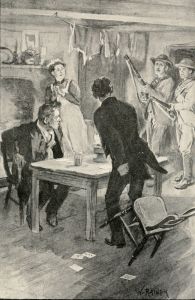
"YOU ARE MY PRISONERS," YORKE SAID STERNLY.
"I think so, sir; but it would be as well to see to them a little more closely, for I shall want my two men when these fellows arrive. In the first place, can they enter at any other point than at the front door?"
"No, I have iron shutters to all the windows. They are not closed at the present moment, for on such a hot evening one wants air. However, that will be the first step. I will turn this light out, and then we can shut the windows and close the shutters without being noticed outside. I will then go round with you to the other rooms and shut them up too, and bolt and bar the back door, which is lined with iron. In the drawing-room, I will ask one of the girls to shut the windows and draw down the blinds—even if the scoundrels are watching, that will seem a natural act—I will then shut the shutters there, and tell the ladies that there is a little trouble ahead, but that they need not fear or be in the slightest way uneasy, as I have plenty of assistance, and can easily dispose of some ruffians who have an idea of breaking in; I had better request them to go upstairs until the matter is over."
In a quarter of an hour all the preparations were made. The three servants had been more carefully bound, and were beyond any possibility of loosing their ropes unless by very prolonged exertions. They had just finished all the preparations when a whistle was heard outside.
"That was the signal for us to be seized," Mr. Chambers said grimly. "I suppose they will give their accomplices five minutes to carry that out. How had we better post ourselves, Mr. Harberton?"
"I should say two in each doorway. We shall all have our rifles ready, and I would let them get well into the hall; then we can step out when I say 'Now!' and let drive at them. Our three Mausers will give us fifteen shots, and you have one with your rifle and five with your revolver. As they will be taken wholly by surprise, it is hardly likely that they will be able to fire a single shot, and we ought to be able to account for almost all of them. I think we had better turn out the lights in the drawing-room and lower the lamp in the hall, so that they will have an indistinct view of me as I open the door."
This was done. Two minutes later there was a light tapping on the door outside. Yorke stepped forward, and opened it a short distance.
"Is it you?" he asked.
"Of course it is. Is it all right?"
"Yes, everything is ready for you," and he quickly stepped back until level with the others.
The door was thrown open, and a number of men poured in.
"Turn up the light!" one said, with an oath. "What have you turned it down for? There, shut that door behind you; one of the women may have got a revolver, and we don't want the sound heard. Now, where are—"
"Here," Yorke replied.
He turned up the light, the other three instantly stepped out, and four rifles were fired almost simultaneously. Shrieks, oaths of fury, and heavy falls were heard as Yorke and his companions emptied the magazines of their rifles into the group, and the cracks of Mr. Chambers's revolver joined in the din. Not a shot was fired in return. When the last cartridge had been fired, most of the assailants lay dead in the hall; the men who had last entered, panic-stricken at the sudden outburst of fire, had tried to open the door they had just closed, but the backward rush of the others prevented them from doing so, and it was not until ten had fallen that the other two were able to open the door and fly. Hastily recharging the magazines, Yorke and his two followers ran out, but a moment later they heard the sounds of galloping horses and cracking whips, and knew that pursuit would be futile. However, as they had the names of the owners of the carts, this mattered little, and they returned to the house. Mr. Chambers had at once gone upstairs to assure the ladies that the affair was over, and that none of those in the house had been hurt.
Examining the bodies, they found that most of them had two bullet-wounds and some three, the Mauser bullets having at that short range passed through two or even more bodies. Several were hit in the head, but most of them in the chest.
"That is just as well," Yorke said, when he had ascertained that none of them were breathing. "It will save all further trouble."
At this moment there was a sound of steps outside, and a loud, continuous knocking at the door. Mr. Chambers threw open the window upstairs.
"Who are you?" he asked.
"We have just run down from the mine, sir; we heard the sound of firing here."
"Thank you, lads; it is all over now, but you may be of use," and he ran down and opened the door.
Six men were there all armed with guns.
"You see there has been a hard fight here, lads," he said, as an exclamation of surprise broke from the men at the scene in the hall. "Fortunately I had been warned just in time, and with the aid of this gentleman and his friends have, as you see, killed ten of them; only two got away. Now, I do not want any talk about it. Lend a hand, will you, to get the bodies outside; then I want a hole dug deep enough to hold them. Put it a hundred yards away from the house. It will be a heavy job, but I will put that right with you on Saturday."
"Shall we get the other five men up from below, sir?"
"No; I don't want the matter talked about, and the fewer that know of it the less chance there is of its getting about. I trust that you will all keep a silent tongue about the affair."
"You can trust us for that, sir. None of you are hurt, I hope?"
"Not in the slightest. There was not a shot fired on their side, we took them completely by surprise."
"I should say, sir, the best place to bury them would be to make a hole in the foot of one of the pit-heaps, then we can shovel the loose stuff down from above. It would be a much shorter job than digging a hole, and there is no chance of their ever being disturbed there."
"A very good plan, Simmonds. It will be an unpleasant job, anyhow. Wait a minute."
On going to the dining-room he returned with two bottles of whisky. Hans and Peter assisted in carrying the bodies outside, and then offered to bring pails of water and remove the blood-stains in the hall, and after that to assist in carrying the bodies away.
By this time the servant had come down and relighted the lamps in the drawing-room, and Yorke and Mr. Chambers went in there.
"I wonder, sir," Yorke said, "that you were not afraid to keep so large a sum in your house."
"I do not generally do so. As the gold is melted down, it is brought here for safety, and once a week it is sent to the bank, so that the amount seldom exceeds two thousand ounces. But this time it has been altogether different. When I saw that Kruger was bent upon war, I put all hands on to get the richest stuff in our reserves. The consequence was that the weekly output was five times as large as usual. I sent the ordinary amount to the bank, keeping the other by me, and intended to send it all down at once by rail in boxes with false marks on them, or if I could not do that, to keep it here till the war was over. Kruger's sudden ultimatum took me, as well as everyone else, by surprise. I was certain then that I could not get it down, and that if I sent it to the bank, Kruger and his people would lay hands upon it, as, in fact, they did with what I had sent in.
"It was only a few of the officials in the smelting-room who had any idea of the output, and even these could hardly have told what amount I sent into the bank. It is clear, however, that one of them must have carelessly mentioned it, and that these fellows who made this attack must have discovered, perhaps from my servants who used to help to load the van, or from one of the guards who had accompanied it to unload it at the bank, that as the amount sent in was about the same as usual, there must remain a very large sum indeed hidden. I had really very little fear of the house being broken into, but in order to prevent any suspicion of there being money here, I discharged the men who always kept watch round the house at night at the same time that I paid off all the other hands, except the engineers who kept the pumping-engine at work to keep down the water in the mines. Then I relied upon the fact that burglars getting into the house would have difficulty in finding the safe, and still more difficulty in opening it.
"I had no doubt as to the honesty of my servants, who alone knew its position; but they did not know the manner in which it was protected. It is situated under my study, which is at the back of this room. The safe is an extremely strong one, of alternate sheets of steel and iron, and was made specially for me. It opens at the top, and you get at it by taking up the carpet in the study and lifting a trap-door. The vault in which the safe stands is two feet each way wider than the safe, and as this stands in the centre, there is a foot of vacant space on each side of it. Round the upper part of the safe there is a sliding apparatus by which a stout steel case, like a bottomless box, can be drawn up to the level of the trap-door. This, however, is only done when the safe is to be opened.
"In the next place, I have a communication from what I may call the strong-room both with the pipe which brings water for the garden and with a large cistern upstairs. Thus, the strong-room is kept filled with water, and the safe is therefore surrounded above as well as on its four sides with water. When I want to open the safe, I go into the study by myself, lift the heavy trap-door, which is cased with an inch of steel, but is easily moved by means of a counter-poise, and then, with the aid of a lever in a secret closet, push up this box until it is level with the floor. I may say that the safe is three inches wider each way than the trap-door. The door of the safe itself being one inch narrower each way than the trap-door, opens through it.
"Having got this box, which is perfectly water-tight, into its place, I work another handle in a secret cupboard and pump out the water in the frame above the safe, and then open the door of the safe, and it is now ready for the men to come in and store the gold away. When they have left I close the door of the safe, lower the frame to its place, and the safe is at once covered with a foot of water. Thus, you see, burglars would have a succession of difficulties. They would, in the first place, be obliged to cut through the steel of the trap-door, then they would find, to their surprise, water immediately underneath them, and until this was removed it would be impossible for them to blow in the door of the safe. They would naturally try to bucket it out, but as it would come in again as fast as they did so, they would gain nothing by it. They might try to blow in the safe with waterproof cartridges, but I doubt whether they would succeed.
"The lid is of immense strength. If they did succeed in bursting it there is another equally strong a foot lower, and this also would have to be destroyed. Even then the holes made would not be sufficient to let them through, and the only way they could possibly get the gold out would be to try and fish out the boxes with a hook at the end of a pole—again an almost impossible task, as the boxes are square, very heavy, and packed tightly together, so that there would be nothing to get hold of. I may say that I got the idea from reading, in the time of the Commune of Paris, how the bank was able to protect the specie in its vaults by filling them with water from the mains. I worked out the details myself, and I think I improved on the original, though that was good enough—for it baffled all the efforts of the mechanics and engineers of the Commune to get at the money."
"That is a splendid plan certainly, sir," Yorke said.
"Yes, but though it would have saved the gold, it would not have saved our lives; and had I thought that the amount there is in the safe was known to anyone now in Johannesburg, I think I should have shut up the house and moved to the one I have in the town, contenting myself with keeping a couple of watchmen in this house, and seeing that all was right every day when I came to see that the men at the pumping-engine were doing their duty. That is what I shall most likely do now. Not that I think there is any probability of a renewal of the attempt; the lesson has been altogether too severe."
"What do you mean to do, sir, with your three rascals?"
"I shall go to-morrow to the head of the police and tell him that they had tried to rob the house, and ask him to send down half a dozen men to take them by the next train to Komati Poort. I could do nothing with them here, for your man Hans is the only witness against them, and he could not, of course, appear. Fortunately they do not know that, and I shall tell them that if I were to hand them over to the police and charge them with this crime they would certainly be hanged. However, I am willing to allow for the temptation they had, and shall only charge them with dishonesty, and have them then sent out of the Transvaal. As no doubt at present they expect nothing short of hanging, they will be glad enough to be let off so lightly."
"They certainly ought to be," Yorke said warmly, "for they are a great deal worse than the others. Whatever discharged men and the ruffians of the town might have done, your servants, who I have no doubt were well treated by you, ought to have been faithful."
"I quite agree with you, Mr. Harberton; but you see that it is of the greatest importance to me not to have the matter talked about. If there were an enquiry, it would of course come out that there is a large sum of money in the house, and you may be quite sure that Kruger would commandeer it. As it is, a bribe of a couple of hundred-pounds to the head of the police will ensure these fellows being sent out of the country without an opportunity being given them of saying a word to anyone. And you may be sure that I shall impress upon them that if they ever set foot in the Transvaal again I will have them arrested at once on this charge. In that way I have every hope that the affair will be kept altogether dark. You don't know, of course, whether the two men who brought the carts were included in the twelve?"
"I do not, sir, but I should think it very likely; they did not want to have to divide the spoil into more portions than necessary. I should think it most probable that they left their carts outside and came in with the others. Whether they were among those who were killed or not, of course I cannot say."
"Yes, I should think they would be sure to come in with the others," Mr. Chambers said; "and in that case there are only two men who know anything about this matter, and you may be sure that they will keep their mouths closed. Well, we have talked more than enough of my affairs. Now about yourself. If you and your two followers like to stay here, I think you might certainly do so with safety. I need not say how heartily welcome you would be."
"Thank you, sir. But though I will gladly stay till morning, I must then be off. I am anxious to get back as quickly as possible to rejoin Lord Methuen's force. I have now been nearly a month away. Then, too, I must put in an appearance at the hotel where I have been staying, for I was obliged to enquire the way to your house. The landlord will be expecting me back to-night, and I shall have to make some excuse for my absence. And if I do not appear in the morning, he might suspect that something was wrong, and give information, with a description of my appearance, to the authorities."
"That I could arrange," Mr. Chambers said. "I could look in there myself in the morning, and say that as it was so late and the night dark I had asked you to stay at my house till morning, and that you had gone off without returning to the town. Ah, there are my wife and daughters!"