"With Rifle and Bayonet" (continued 7)
Reading edition
Kruger’s ultimatum was delivered, hostilities commenced, and mother and son scanned the newspapers and the long list of casualties with expectant feelings. Judge of their disappointment, then, when, instead of wounded, killed, or missing, Jack’s name appeared in large type, and beneath it a long article describing the adventures of a young Englishman, by name Jack Somerton, of a good old family at home, who had ridden from Kimberley to Johannesburg to aid the refugees, and had afterwards brought news to the beleaguered town, after having accomplished a gallant deed on the way.
No sooner had this appeared than another telegram announced his successful dash for Mafeking, and his subsequent daring ride to the north.
Then came silence. There was no news of him. Messages from Tuli and Mafeking stated that nothing further had been heard of him, and it was feared that he had been captured. But advices from Pretoria failed to mention his name amongst the lists of prisoners, and the master and mistress of Frampton Grange felt their hopes rise high.
But later, after more than a month of silence, the busy flash-light from Ladysmith explained how Jack Somerton had come nobly to the fore again.
Dr Hanly was beside himself with pride and pleasure, and no sooner had he read the news than he darted off to the Grange and congratulated Mrs Somerton. He was an observant man, was this little doctor; given to thinking charitably of everyone; but when he saw the little enthusiasm his intelligence caused he was astounded and disgusted, and at once left the house with the firm intention of never going there again till Jack returned.
Dr Hanly was not the only neighbour who showed his appreciation of our hero’s services to his country. From far and near people called to offer their congratulations, and letters poured in in shoals. So much so, indeed, that Mrs Somerton and her son gradually began to look upon the other side. They were not altogether bad or selfish, and in time they too, feeling a kind of reflected glory, began to think more kindly of the homeless lad they had treated so harshly. In this satisfactory condition we will leave them, and while Jack Somerton lies in his bed in that field hospital in the invested camp at Ladysmith we will return to the British troops in other parts of South Africa.
It will be remembered that on the receipt of Kruger’s ultimatum England had despatched a large army over the 6000 miles of water which cut her off from South Africa, and this force had arrived at its destination in due course, armed and ready for war, and accompanied by supplies. In addition, local colonial forces were rapidly enlisted, for it was apparent to all that no one could approach so close to the Boers in slimness and astuteness in fighting as these hardy young sons of the old country, who, finding themselves crowded out by the more fortunate ones, had betaken themselves to this fair land of South Africa to set up new homes. And with them, to do all and every arm of the service justice, must be classed the gallant volunteers from Australia, Canada, and New Zealand. For the most part used to a rough life in the bush, they proved most valuable scouts, and were as fine a body of men as could be met with.
Thus it will be seen that we had a large army in the field, and when it is recollected that some 10,000 troops were hemmed in at Ladysmith, while others kept the foe at bay in Cape Colony, Kimberley, and Mafeking, it will be realised that England was well represented.
A glance at the map of South Africa will show the four railway systems leading into or close by the two republics in arms against us. Those who know the country through which they run believed that General Buller, the able leader of the British forces, would invade the Orange Free State by way of the Orange River, and thus draw off the investing forces from Ladysmith and the other besieged towns.
But a little consideration will show that such a task was all too formidable for the army we had accumulated. To begin with, the Boers far outnumbered us—not that that damped the spirits of our men, but it was a fact to be seriously reckoned with. Then Cape Colony was seething with sedition, and a revolt was to be feared unless troops were there to keep the rebels in check. But perhaps the greatest difficulty was that this necessity for troops in all parts of the country, and along the railway to the Orange River, the absolute importance of keeping the communications open from the advancing army right away to the sea, and above all the large force required to keep the Boers in check in Natal and south of Kimberley, capped the strength of our army corps to such an extent that when all demands had been supplied its numbers had dwindled so alarmingly that the idea of an invasion had to be promptly abandoned.
The urgent necessity for the timely relief of the three beleaguered towns now became obvious, for the fall of any one of them, but particularly of Ladysmith, would have been a heavy blow to our prestige in the country, and would have increased the already growing sedition.
Accordingly Lord Methuen was despatched with a force of some 10,000 men to Kimberley, while the remaining troops were sent via Durban into Natal. A few others were placed under General Gatacre’s command, and, having sailed to East London, took train for Queenstown, while another force, under General French, went via Port Elizabeth towards Naauwpoort.
To detail the regiments or the exact numbers in each column would be to tax the patience of the most generous of readers, as would also a full description of the various skirmishes which each had with the enemy. They started from the sea base by railway, and as they reached the invaded country they followed the rails, and repaired the parts which had been torn up by the Boers. Thus, their communications being assured, they had abundant supplies of ammunition and of food, and could pass their wounded down the line a few hours after the injuries were received.
But though this means of transport saved a vast deal of labour, and for the moment allowed our generals to dispense with wagons and mules, it had one decidedly important disadvantage, for, inasmuch as we were tied to it, the Boers knew weeks beforehand what part they would have to defend, and made preparations accordingly. And this was particularly the case on the west and in Natal.
In the case of the former, a large force of Boers, under Commandant Cronje, opposed Methuen’s advance just above Hope Town. Heights had been selected at Belmont, and these had been carefully entrenched. But the Guards, the Marines, and the others who composed the force dashed at them, and captured them at the point of the bayonet.
A few miles farther north, at Graspan, another position had been taken by the Boers, and once again we drove them out of it.
But there was sterner work before this truly gallant column, for, though they had driven the enemy before them on each occasion, the lack of a really large mobile arm, in the shape of a cavalry force, hampered them seriously, and allowed the Boers to retire where otherwise they might have been routed. Consequently they were far from beaten, and when the column reached the banks of the Modder River it was to find a long line of ridges entrenched on the other side, and the bridge blown down. In addition, the knowledge that the British must pass on in this direction had allowed the Boers full scope in the way of artillery, a most important arm, and instead of the field-guns which we were forced for the most part to make use of, they had mounted long-range weapons of position, against which only our naval 4.7 cannon could effectively fight.
The battle of Modder River was a murderous affair, but once again, in spite of severe losses, we damaged the enemy to such an extent that, though not driven from his entrenchments, he deserted them overnight, and under cover of darkness retired on the long ridges of Spytfontein and Magersfontein, only a few miles south of Kimberley.
It was an exceedingly formidable and well-chosen position. In spite of the most complete reconnaissances the trenches remained hidden, and the Boers held their fire, refusing to be drawn into showing their exact whereabouts till an attack was made in force.
It was a crafty and exceedingly wise proceeding on their part, for when, in the grey of dawn, our Highland Brigade advanced, they stumbled, in close order, upon the first line of trenches before they were aware of it. And the Boers, who were almost taken by surprise, poured murderous volleys into their ranks as they marched in quarter column, and almost decimated them. It was a most unfortunate affair, and though we covered the retirement of the brigade, and indeed killed and wounded large numbers of the Boers, we failed to turn them out of their trenches, and retired on our camp, checked for the first time in a memorable march, in which in seven days we had fought no fewer than three successful engagements.
It was a check, not a reverse, though the disaster to the Highlanders was a serious affair. But it created a sensation, and formed one of those irritating pin-pricks which roused the British lion to do his utmost, and caused us to pour into Africa an army larger than had ever before been transported across the sea. How those troops were raised, how the patriotic spirit of the nation showed itself, will be described in due course. For the moment we shall leave Methuen’s column safely entrenched in front of the Boers, waiting for reinforcements from oversea ere they made a second attempt at an almost impossible task, and will mention the fate in store for Gatacre’s force. This small column, with its base at Queenstown, had a disastrous beginning. A night march to Stormberg, where the enemy was in force, was attempted. A miscalculation brought the troops into an extremely dangerous position, and a large number were taken prisoners, the remainder retiring in good order.
What happened to the other column in Natal is of so much importance that it must be described in fuller detail.
Chapter Sixteen.
The Attempt upon the Guns.
It was in the early days of September that Jack and his friend reached the beleaguered camp of Ladysmith, and found safety there after their adventurous flight from Pretoria. The former, as has been shown, knew little about the troops or the movements of the enemy, for he had been struck down by a serious wound. But he was a strong and healthy lad, and, once he got over his fever, made rapid progress; so much so that when Christmas-day came round he was sufficiently well to recline outside the tent and look on at the camp. The sunlight and the air did him a vast amount of good, and when the New-Year arrived he was able to walk with comfort, and was almost himself again.
“Jack, how would you like a drive?” cried Guy on this festive day, entering the small bell-tent which had now been allotted to his friend. “I’ve got the loan of a light cart and a couple of horses, and if you care to dodge an occasional shell we’ll make a tour round the camp and have a look at the boys. A real good time they are having too, and there is to be a big football-match this afternoon between the Highlanders and the Rifles, which will be well worth looking at.”
“Just what I should like,” Jack answered. “When shall we start?”
“Oh, in half an hour! I’ll get the cart at once.”
Accordingly, when Guy drove up in a comfortable Cape cart, Jack climbed into it, and accompanied him round the camp. It proved to be highly interesting. The huts and houses and the long lines of tents in various parts were still much the same as when he was last in Ladysmith, but what was different was the stretch of trenches which had since been dug, and near which the soldiers lived, ready at any moment to man them and keep back the enemy.
Ladysmith was for all the world like Aldershot. It was the big camp of South Africa, and probably for that reason had been garrisoned and held, when the southern bank of the River Tugela would have been a more favourable position. For health and the collection of a large body of men it was certainly not to be beaten. There was ample room for camp and town, and a wide plain over which cavalry could manoeuvre, and field-days be practised by the foot regiments. In addition, it was high land and supplied with excellent water.
But it had obvious disadvantages when held against a besieging force. With trenches and redoubts the encircling hills could be held, but beyond these there was a second outer circle, from which a fierce bombardment could be kept up by the Boers. Guy and Jack drove round the defences, and noticed that the chief position was to the south of the camp, at Wagon Hill and Caesar’s Camp, and it was near the latter that Jack’s field hospital lay.
Outside, the Boers had mounted big Creuzot guns on several hills, and from these, ever since the camp was surrounded on October 30th, they had kept up a more or less severe bombardment, throwing immense numbers of shells into the town. But the results were not very creditable. Football and cricket matches were played in full view of the gunners, while the officers played polo. Occasionally a shell would plump in their midst and send them all flying, but very little damage was done.
As Guy and Jack drove across towards the northern part a huge shell pitched just in front of their horses, and, burying itself deep in the ground, exploded, throwing dirt all over them.
“Shall we go on, Jack?” asked Guy. “Those Boer fellows have spotted us, I expect. Perhaps you don’t feel quite up to it just now that you are weak after your wound.”
“Humbug!” was Jack’s answer. “Get ahead, Guy; it’s only a chance shot that will hit us.”
“Ah, I thought you’d say that!” Guy continued; “and the majority of fellows who have been hurt say that had they been out in the open they could have easily run away. But a few shells have burst in houses and tents, and some people have been killed. Of course the Boers have pounded the town, and have even sent a few shots through the big hospital. At any rate it has been hot work in there, and now all non-combatants and the women and children live over on the neutral ground at Intombi Spruit. The troops have nicknamed their camp Funkemburg.”
At this moment someone called out to Guy to pull up, and Rawlings, the officer who had conducted the sortie which had helped Jack and his friends back into Ladysmith, came up to the cart.
“Hallo, Jack Somerton!” he cried heartily, shaking him by the hand. “When are you going to turn out of that hospital and join Guy in our mess. He tells us you have lots of yarns to give, and he says something about a girl near Kimberley. When are you coming, old boy? We’d like awfully to hear all about that little affair.”
“Well, I hope to be out in a few days now,” Jack replied with a laugh. “But shut up about that Kimberley business! Guy, what have you been telling these fellows?”
There was a loud laugh at Jack’s expense, and then Rawlings climbed into the cart and accompanied the two young fellows on their drive.
“I can tell you, Jack,” he said, “that you had better hurry up and get your strength back, for those beggars outside are getting restless again. Just fancy, they have been firing away at us, and looking into the camp, for two months now, and, much as they long to take it, they have only made one feeble assault. We beat them back then, and if they try the game again I expect we shall give them a better hiding. You chaps haven’t had all the fun to yourselves. We may be shut in here, but we’ve drawn a few of old Krugers teeth. We’ve played that game of blowing up his guns twice, in addition to that time when we three had the pleasure of meeting. And we’ve also upset him a bit by sending out the cavalry. If it had been a British force investing Boers in Ladysmith, I’m open to bet a new hat that we’d have turned them out of it long ago. Just fancy looking on for two whole months! Well, I expect they will wake up again soon, especially now that Buller has been checked at Colenso and cannot release us at present. I can tell you, chaps, it’s a beast of a position. You see these hills round here? Well, the main Boer army, under Joubert, blocks the country between this and the River Tugela, and that country is choke-full of rocky hills and kopjes. To reach this camp and set us free the British troops have first to cross the river, and then they have to fight their way foot by foot past all those hills, every one of which will have guns mounted on the summit, and be entrenched from the base up to the guns. It is a difficult undertaking, and Buller and his troops, in spite of the greatest bravery, failed in the first step—the crossing of the river—on December 15th. The heliograph has told us the whole story, and now we know that the Boers had entrenched the whole of the north bank of the river for miles on either side of Colenso. You’ve seen our trenches here, and can guess how difficult it is to locate them from a distance.
“The Boers, with their usual cunning, had concealed theirs perfectly, and the heaviest artillery fire failed to make them disclose them. There was nothing else for it but an assault over an open stretch of country, just the kind of work that our men are fitted for, but work which is terribly trying.
“With splendid dash, General Hart’s brigade moved forward on the left to the drift across the river, supported by General Hildyard’s brigade, guns accompanying both. But the drift, which is usually fordable, was now too deep, for the Boers had dammed the river. Added to that, all those who crossed were under a terrific rifle fire. Still, our lads did it, and got to the other side, only to find the position untenable. It was altogether terribly hot work, and it was soon seen that a frontal attack could not succeed. Buller recognised it early, and skilfully withdrew his men.
“But one unfortunate affair happened. The guns galloped forward to support the infantry, but got so close to the masked trenches of the Boers that all the horses were shot down immediately, and nearly all the gunners. They made a gallant fight of it, but they had fallen into an ambush, and in spite of the desperate efforts made to get the guns away, only two were saved, the others being captured by the enemy.
“During the battle Colenso was occupied by our troops, but later on was evacuated. In the evening, after having sustained severe losses in men and guns, our army retired to its camp. The Boers, too, suffered very heavily in spite of rocks and boulders.
“It was a check, and a severe check, but our boys went back that night not a bit disheartened; and now, by all accounts, they are itching to make another attempt. Meanwhile, here we are, poor little Ladysmith, surrounded on every side, garrisoned by some 9000 men on half-rations, with no luxuries, and with typhoid fever and dysentery raging amongst us.
“It’s enough to dispirit anyone, but we are hopeful still; and I guarantee, if you come to our footer match this afternoon, you will watch as good a game as you could see at home.
“But mark my words, you chaps. The Boers are getting restless. Reinforcements are being hurried up-country to Buller, besides extra guns, and they know very well that he is only getting everything ready before making another—and let us hope this time successful—attempt. Their aim and object is to capture this camp before he comes. They are getting desperate, for to fail to take us will make them the laughing-stock of the world. But an assault is distasteful to the Boer. Nothing goes so much against his grain, unless perhaps it is a British bayonet. But he will try it, and when he does we shall have our work cut out. There, now you know all about it, and if you hurry up and get strong, Jack, you’ll be able to take a hand in the affair.”
“Well, I feel almost fit for a tussle now,” Jack laughed, “and if the camp is assaulted you may be sure I shall get hold of a rifle somehow and join in the fun.”
“I’m sure you will,” Rawlings answered heartily. “Such a fire-eater as you are would be certain to be somewhere in it. But come along to our mess and lunch. They can spare you from the hospital for once, and I don’t suppose it matters much what you eat, now that you are up and about.”
Jack accepted the invitation, and much enjoyed it, for it was the first time he had had a repast out of hospital since he came to Ladysmith. After lunch he was given a big chair and a large cigar, and ordered to tell the story of the defence of the farmhouse near Kimberley.
He obeyed the order, and had to put up with a good deal of good-natured chaff. Then he drove off with Guy and Rawlings to the football ground.
It was an exciting and fast game, and was closely contested, there being little to choose between the smart riflemen and the brawny Highlanders. The whole camp was there to look on, and evidently the Boers were also watching through their field-glasses, for in the midst of a severe tussle, and when the two sides were grouped close together, there was a screaming noise overhead, and a huge Creuzot shell plunged into the middle of them, narrowly missing one man’s head, and buried itself deep in the ground.
Instantly the umpire’s whistle sounded, and he shouted: “Half-time, boys!”
A roar of laughter followed, and all the players decamped hastily and threw themselves on the ground. A second later there was a muffled roar, sand and earth were driven in all directions, and a large fragment of shell whizzed across the ground, passed close to Jack’s head, and tore a huge rent in a galvanised-iron shed behind him.
Then the umpire’s whistle sounded again, and the game was proceeded with, one and all treating the matter as a joke.
That evening when Jack got back to his tent he was tired out, but by the dim light from a lantern he perused, with many a chuckle, the pages of one of the two papers published in the camp. It was The Lyre, and purported to contain nothing but untruths.
On the evening of January 5th, as Jack was reclining on his chair looking round the camp with his field-glasses, he noticed that amongst the men passing to Ladysmith from Intombi Spruit, or “Funkemburg”, were three whose movements were suspicious. They were dressed like colonial volunteers, and carried rifles. Passing separately across the open ground, they pushed forward without hesitation, and, once inside the camp of Ladysmith, walked in the direction of Wagon Hill, where each in turn disappeared into a hut which had been almost smashed to pieces by one of the enemy’s shells.
Jack watched them, curiously at first, wondering why they did not come across from the neutral ground together, and what business they had to be out of the camp; and then suspiciously, for their movements were peculiar. They looked about them cautiously, and one by one dived into the hut. Here they remained, and though he fixed his glasses in that direction for half an hour there was no sign of them, and they did not even appear when the bugle sounded the “Fall in!” all over the camp, and the garrison turned out of their tents and formed up for the evening inspection.
“That is queer!” he muttered suspiciously. “Who can they be? Not civilians, I am sure, for they have no business over in this direction. I don’t like the look of things, and I’ll keep my eyes upon those beggars.”
A few minutes later, as Sir George White and his staff rode on to the nearest parade-ground and the guard there presented arms to their commanding-officer, a man slipped out from the back of the hut, and, having peered in all directions, struck the wall with his rifle. Jack fixed his glasses upon him and waited. Almost immediately two men emerged, and having looked about them suspiciously, fell in, and, shouldering their weapons, marched off towards the heights of Caesar’s Camp, with the one who had first left the hut walking by their side.
“Well, that’s rummy!” exclaimed Jack aloud. “What can they be doing? I suppose they are going to relieve the pickets, or the guards over the guns. But it is an unusual time. Of course I know that the colonials take their turn, but they are generally marched up to change guard just before the evening parade. I’ll just watch, and at the same time keep out of sight, for they will pass close by me.”
He promptly entered his tent, and, lying full-length on the ground, lifted the flap, and again watched the volunteers through his field-glasses. Soon they were close at hand, and though it was already getting dusk, something about the figure of the officer caught his notice, and that, combined with the peculiar manner in which he threw out his feet, set Jack wondering who he was.
“I’m sure I’ve had something to do with that fellow before,” he muttered. “Who can he be?”
Jack puzzled his brains, but could not solve the problem, and was on the point of giving it up in disgust when the merest chance disclosed it to him. There was a sentry standing in front of an iron hut used as the paymaster’s office, and as the volunteers got opposite him, and just in front of Jack, the watchful man hailed them and shouted: “Halt! who goes there?” saluting the party at the same moment by shouldering his rifle.
He was evidently a young soldier, and eager to be considered wide-awake, or else he would have remembered that it was already dusk and no salute was required. Still it served Jack’s purpose, for a second later “Eyes right!” and “Gun picket!” was shouted out in a voice which made him tingle from head to foot and tremble with excitement, for the voice and the figure together told him that it was none other than Piet Maartens, his old enemy, who had so nearly proved the death of him in the Transvaal magazine.
“Good heavens!” Jack exclaimed in astonishment. “What does it mean? Can he have come over to our side to fight against the Boers? No, that’s impossible. He must be a spy, and, by George! those other men with him must belong to the enemy too.”
Jack sprang to his feet and gazed after the squad of volunteers. Then he thought for a few moments, and, having determined what to do, he dived into the tent again, and, snatching up his rifle, ran across to call Guy Richardson.
“Quick, Guy!” he said, pushing his head into the hut in which Guy and Mr Hunter lived. “Come out here! I want you both! Bring your rifles!”
An instant later all were walking rapidly towards the heights of Caesar’s Camp, the southern boundary of the defences of Ladysmith, and a position of the most vital importance to the garrison, for with the Boers in possession of it their guns would have forced our troops to surrender.
“There’s some treachery going on!” Jack whispered as they walked along side by side. Then he explained what he had seen, and told them how Piet Maartens, and two men dressed presumably as colonial volunteers, were marching towards Caesar’s Camp.
“There is certainly something wrong,” Mr Hunter replied hurriedly. “Now what had we better do! Ah, I know! You two follow them, and I will go to the quarters of the officer in command of the pickets to-night and warn him. What can those spies want! Keep your eyes open, lads. It looks as though our friends were about to make an attempt to take Ladysmith.”
A moment later Mr Hunter was gone, and Jack and Guy hurried on till they were within sight of the men they were following. It was now almost dark, and having ascertained the direction in which they were marching, the two took to their heels, and, making a wide détour, ran up to the trenches at the top of the hill.
“Wait here, Guy, while I go over and speak to the officer on duty,” said Jack. “I’ll be back directly.”
Slipping across the turf, he was soon challenged by a sentry and brought to a sudden stop with the man’s bayonet at his chest. Then he was taken to the officer.
“I’ve some important news to give you,” he said. “Can I see you alone!”
“Certainly! Come in here,” was the answer; and Jack was led into a trench.
“There’s something going on to-night,” Jack whispered. “A Boer I knew in Johannesburg is marching up here with two men, all dressed as volunteers. They are all spies, I believe, and I have come to warn you!”
“Spies! By Jove, we’ll get hold of them immediately they appear!” exclaimed the officer.
“Don’t you think it would be well to let them do whatever they are coming for,” said Jack thoughtfully. “You might set a watch on them, and as soon as you have found out their game arrest them. I should warn your sergeants and a few of the older men, so as to be ready. Mr Hunter thinks it looks as though the Boers were about to make a rush.”
“By George, they’d better not!” the officer exclaimed. “But I’ll do as you suggest, and what is more, I’ll send a man over to warn the fellows on Wagon Hill.”
“Very well! I’ll slip back, and follow Piet Maartens and his friends up,” said Jack; and, stepping from the trench, he nodded to the young officer and ran across to Guy.
A few minutes later the Boer spies appeared marching stealthily up the hill, and as soon as they had passed by, Jack and Guy fell in behind them. They kept steadily on, halting for a few seconds now and again to listen and glance cautiously round them. Soon they were at the top of the heights, when they turned to the left, and after proceeding some two hundred yards came to a stop directly behind a battery of field-guns placed in a most commanding position to rake the flats below. They stood unguarded and unattended, save that below them, on the farther side of the hill and some distance away on either hand, pickets were posted.
“Looks as though they were going to play some game with the guns,” whispered Guy. “What do you think, Jack? It would suit their purpose well to destroy our cannon and then assault us.”
“I think you are right, Guy. Let us hide up here and watch. At present I do not think they will do much, for it is too light, but in another hour perhaps they will make a move. By that time they will be surrounded.”
At this moment Piet Maartens rose to his knees from the hollow in which he and his two companions had thrown themselves, and, not seeing anyone, all three stole forward about fifty paces, and again lay prone upon the ground, where they remained without a move, save that now and again one of them raised his head and attempted to pierce the gloom. But the night had already fallen, and it would have required more than the unaided eye to distinguish any but a very close object.
Meanwhile Jack and Guy had crept into a good position near at hand, and feeling sure that the officer in charge of the trenches had taken due precautions to surround the Boer spies, they sat down in silence and waited to see what would happen.
“Stay here a moment,” said Jack, seeing that at present nothing was likely to happen, “I’ll go and get that officer, and then there will be official evidence against those fellows. It looks as though we should have them beautifully.”
Leaving Guy crouching behind a mound of earth, Jack slipped back, and, having reached the trenches, was soon in conversation with the officer.
“I wonder what their game is,” said the latter. “At any rate we shall nab them all, for I have put a circle of men all round the guns.”
“I believe they are going to damage the weapons in some way or other,” Jack answered, “and in that case they will certainly use explosives. I came over to ask you to join us at a spot where we can see everything. The sentries on the guns show well up against the sky-line, so that when these fellows get on their feet we can see at once when they move. By the way, it would be wise to warn the gunners to be careful when the time comes for using their weapons.”
“Yes, I’ll do that,” exclaimed the officer. “Who knows! these spies may fix a charge of dynamite. Wait here a moment while I give the order.”
A few minutes later he joined Jack once more, and both crept to Guy’s side and then moved forward, for Piet Maartens and his companions had crawled closer to the guns. Raising their heads cautiously, they peeped over a bank and saw the guns, only a few yards in front of them, standing dimly defined against the star-lit sky, while close beside them crouched the Boer spies.
Piet Maartens lay a few yards in front upon the edge of the hill, and as Jack and his friends watched him they saw him lift his head and look steadily in either direction, and then turn round as if to make sure that he was unobserved.
Instantly all three sank flat on the ground, but a minute later, when they peered over the bank again, he was facing down the hill, and as they looked, he stood up and produced what was evidently a pair of field-glasses and applied them to his eyes.
“He’s trying to make out where the pickets are,” whispered Jack. “Keep down, you fellows, he’s turning this way now.”
“He can look as long as he likes,” chuckled the young officer, “but he won’t see a single man beyond the regular outposts. I ordered all my fellows to lie flat and remain without a move till they hear me shout.”
“That’s good,” muttered Jack. “Halloa! what’s that?”
As Jack spoke, one of the Boer spies gave a low warning hiss between his teeth, and a second later a corporal and two men swung by in the darkness on their way to relieve an outlying picket. They had approached so silently that Piet Maartens was taken by surprise, and was instantly perceived. But his coolness did not desert him. He instantly replaced his glasses and challenged.
“Relieving picket,” shouted the corporal, and passed on without a halt.
“Pass, relieving picket. All’s well,” Piet Maartens answered, and, having waited a minute, again produced his glasses.
Five minutes later the corporal and the men he had relieved returned, and silence settled down upon the hilltop.
It was a trying time for Jack and his friends. Crouching behind the mound of earth, with their eyes glued upon the Boer spies in front, they expected them to make some attempt upon the guns at any moment. But an hour dragged slowly past, and then another, and the officer was on the point of shouting to his men to close in, when Piet Maartens was again seen to make use of his glasses.
“Wait a moment,” Jack whispered, placing his hand upon the young officer’s arm to restrain him. “They are moving now, and the fun will begin.”
An instant later, having satisfied himself that there was no one about, Piet Maartens slipped stealthily to the side of one of his fellow-spies, and, extracting something from his haversack, approached one of the guns. There was a faint click, then a few seconds of silence, which was followed by a metallic “clang”. Once more he returned to his comrade, and approached another gun. And all the while Jack and his friends looked on in breathless silence. In all, there were twelve weapons belonging to the Field-Artillery, and each in turn Piet Maartens visited. Then he returned to his former position, and, having looked round in all directions, gave a soft whistle. At the signal the other spies joined him, and immediately disappeared over the brow of the hill and climbed down the opposite side. Instantly the young officer rushed up to the guns, accompanied by Jack and Guy, and, drawing his revolver, shouted “Look out, men!”
The next moment a ring of soldiers leapt to their feet, and with fixed bayonets faced the party of Boer spies.
“Lay down your arms, Piet Maartens. It’s all up, and if you lift a hand you will all be shot like dogs!” Jack shouted, rushing forward at the same time and presenting his rifle at his old enemy’s head.
A snarl of rage escaped from the Boer’s lips, and he made a frantic effort to unsling his rifle; but long before he could get it free the circle of soldiers rushed in and knocked all three to the ground. A minute later they were being marched towards the town, surrounded by a strong party in charge of a subaltern.
“Now we’ll have a look at the guns,” exclaimed the officer. “Sergeant, bring along a lantern and a couple of men, and don’t attempt to touch the guns till I have inspected them. Come and help me, Somerton. I expect that beggar has placed a charge of dynamite in the breech.”
A few moments later a lantern was produced, and, followed by Jack and Guy, the officer looked closely at the breeches of the guns. At first there was nothing to be seen. But a close inspection revealed a thin piece of wire attached to the handle of the breech, passing from there into the inside of the weapon.
“Don’t open it, whatever you do,” cried Jack in a warning voice. “It is a regular trap for the gunners, and the opening of the breech would fire the charge inside. Snip the wires, and then you will be able to learn all about it.”
A wire nipper was now produced, and the piece attached to the handle having been cautiously snipped, the breech was opened and disclosed a charge of gun-cotton inside arranged so that the mere opening of the handle would pull the wire and explode the charge, and so destroy the gun immediately.
“Ah, I told you there was a plot on hand!” exclaimed Jack with satisfaction. “They know that we have guns here, and they sent those spies in to arrange matters, so that when the rush comes and they attack the hill, we should be left without a single weapon to fire at them as they cross the ground below. Well, I fancy we shall be able to open their eyes. It’s getting on for midnight now, and we can expect them very soon.”
“Right you are, Somerton,” the officer replied. “There’s no mistake about it. They are going to have a real good try to take us, and, thanks to you, we shall be ready for them. I’ll go off and report the matter, and meanwhile I’ll have all the guns loaded with shrapnel. By the way, what are you going to do?”
“Oh, Guy and I will give a hand, if we may!” answered Jack.
“My dear chap, every man of us will be wanted, and the more we can get the better. Come into my trench, if you like. It’s certain to be a hot corner, being so close to the guns.”
Jack and his friend eagerly accepted the invitation, and accompanied the officer back to the trench. Here they were joined by Mr Hunter, and a few minutes after his arrival some Highlanders and Riflemen put in an appearance. Then all lay down, while the gunners trained their weapons upon the flats below, and loaded them with shrapnel. Outposts were doubled, and every man waited in dead silence for the assault, prepared to hurl back the attacking Boers at the point of the bayonet.
Chapter Seventeen.
The Grand Assault.
For almost three complete months had the Boers surrounded Ladysmith on every side, and shelled it persistently, and yet here were the British troops, seemingly as steadfast as during the early days of the siege.
But wounds and disease had slowly thinned their ranks, and against the 20,000 or more of the enemy there were scarcely 8000 to man a huge circle of trenches. What could they do against the odds opposed to them? It was almost an impossible feat that was expected of them, but for all that, each and every one of our sturdy lads, as he sat in the trenches that night, listening intently and vainly endeavouring to pierce the gloom, swore solemnly to himself that the task should be accomplished. For many weeks they had laughed at and kept a horde of Boers at bay, and now, when they were in a tight corner and in difficulties, they would teach the enemy that they yet had teeth to show, and good strength to use them.
And down beyond the flats stretching away from the heights of Caesar’s Camp, and in all the laagers surrounding the beleaguered garrison, bands of stern, resolute Boers collected together in absolute silence in the darkness. There was no need for words. Their plans had long since been arranged. They were the pick of all the forces from the Transvaal and the sister republic, and for the most part they had volunteered to attack and capture the camp, or die in the attempt. Rough, bearded men of middle age, they numbered amongst their ranks commandants, field-cornets, and officers of the Boer army. At a peremptory order from Pretoria, and because they could no longer put up with the humiliation of thus being laughed at by a handful of men, they had set themselves the dangerous task of a grand assault. It would be warfare after a method hateful to them one and all, for the comfortable shelter of a big boulder was more to their liking. But a desperate position called for stern measures, and, like the brave men they were, they prepared for the work, determined to do or die in the attempt. Collecting together in silence, they for the most part removed their boots, and just before the darkness lifted they set out across the grassy plain, and without so much as a sound commenced to scale the heights of Wagon Hill and Caesar’s Camp. Without firing a shot those at the western end of the heights clambered up till they were almost upon the trenches, when they were discovered by an outpost of the Manchesters, who gave the alarm. Instantly a hail of lead was poured into the night, and the guns opened fire, tearing the elopes and the flats below with bursting shrapnel.
But the darkness aided the Boers, and in a few moments they were upon our men.
They had got so far, but they were not to make another step forward, for by now the Gordon Highlanders and the Rifle Brigade had arrived, and, rushing forward with fixed bayonets, they dashed pell-mell at the enemy, and after a fierce and bloody conflict broke them, and hurled them shattered and bleeding down the steep hillside.
It was desperate work. As the night lifted, and the grey haze of dawn lay upon the grassy slopes of Caesar’s Camp, Briton and Boer stood face to face and fought for supremacy. Every man of ours had need of all his courage and strength, and not one failed to do his duty to his queen. Magnificently the brave fellows kept up the reputation of the army, and in spite of the havoc wrought by Mauser bullets, pressed the enemy still closer, and when they fled sent a taunting cheer after them, and stood ready and willing to meet them again.
Jack and Guy took a full share in the work. Deafened by the reports of the field-artillery and the incessant tat, tat of the rifles, they stood shoulder to shoulder in the trench, and when their comrades charged, rushed forward with them and helped to hurl back the Boers. But that was the least difficult part of the task. Some minutes before the much-needed reinforcements arrived they were closely pressed, and barely held their own. The Boers swarmed up the hill, and now that the alarm was given, opened a hot fire upon them. Then they rushed at them, and surrounded the small party of defenders.
Standing back to back, Jack and his friend, with Mr Hunter, beat off a determined assault, but a second which followed parted them, and the two young fellows found themselves alone and cut off from their friends, while Mr Hunter had been forced back amongst the Highlanders.
Side by side Jack and Guy thrust fiercely at the Boers, parrying the swinging blows aimed at them, and escaping the flying bullets by a miracle.
“Surrender, and lay down your arms!” shouted a big, bearded man, presenting his rifle at Jack’s head. “You are surrounded and cut off from your friends.”
“Never!” cried Jack, hoarsely. “Come and take us it you can!”
“Very well, then,” the Boer answered roughly, and at once pulled his trigger, falling himself in a heap upon the ground at the same moment and rolling down the hill, his head almost smashed in by a shell which had struck him. But his bullet took effect. Swishing close by Jack, it hit Guy with a dull thud in the thigh, causing him to stumble and crash down upon the grass.
“All right, old boy!” cried Jack immediately, standing across his body and plunging his bayonet deep into the chest of a young Boer.
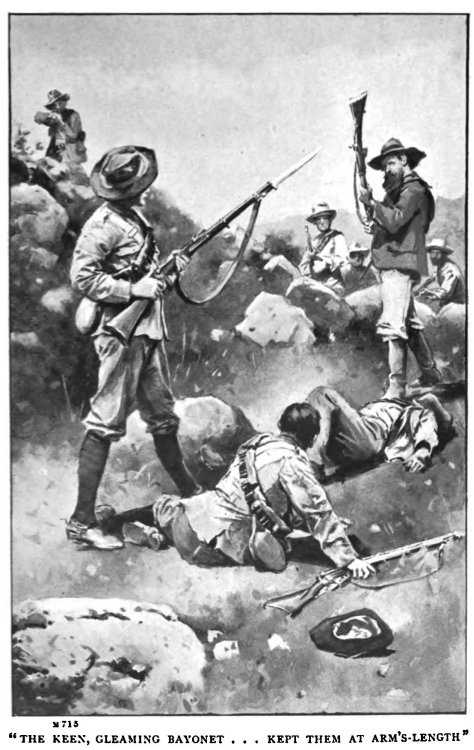
“That’s it, Jack. Keep them off!” Guy answered weakly; “I’m hit in the leg, but can fire my rifle.”
Next second both were hotly engaged, for the enemy, who had drawn back for the moment, rushed upon them again, and while some fired their rifles, others swung theirs over their heads and bit with all their strength. But the keen, gleaming bayonet, darting angrily here and there, kept them at arm’s-length, and not content with that, Jack gave a defiant shout, and, springing forward, threw himself upon them, transfixing one with his murderous blade, and knocking a second senseless with the butt of his rifle.
Meanwhile Guy had calmly opened his magazine, and as the burghers returned to the attack he picked them off one by one. But it was an uneven contest, and another minute would have seen both of them killed or captured, when there was a roaring cheer from behind, and down the hill, careless of the pelting bullets, swept the brawny, kilted sons of Scotland and the fearless and lithe little riflemen, their bayonets at the charge and the light of battle in their gleaming eyes.
At the sight the Boers drew back for one brief moment, and Jack and Guy regained their friends, the latter forgetting the agony of his wound in the excitement of the moment. Then, plucking up their courage and remembering their desperate resolve, the burghers turned to face the oncoming line of bayonets with a bravery which none of their fellows had ever shown before. With one fierce shout they ranged themselves together, poured in a volley, and rushed like a tide up the hill to meet the avalanche of terrible steel now pouring down it. A minute later the two forces met with a crash, but the result was never for a moment doubtful. The British onrush was not even checked. There was a fierce lunging of rifles, a succession of awful groans, and the Boers were gone, all swept to the ground, save a few who were now racing away for their lives. And after them the gallant English troops sent a scathing volley, and then stood watching them, shouting hoarsely to them, and more than half-longing that they would return again ere the flush of victory had died down in their hearts. But one such bitter experience was sufficient for the moment. The Boers hastily rejoined their friends, and, diving into cover, opened up a galling fire upon the heights of Caesar’s Camp.
Meanwhile other parts of the town had been attacked, to draw off attention from the heights to the south, the position which was of such vital importance. But the main strength of the enemy was directed against Caesar’s Camp, and while to the west of it one commando of staunch men had been hurled backward down the slopes, another had advanced on Wagon Hill, and had occupied it before the three detachments of the Imperial Light Horse stationed near were aware of it. The Boers, however, were raked by a murderous fire of Lee-Metford bullets, for the gallant colonists stuck to their posts with dogged persistence.
As the day dawned and it was seen that the enemy had possession of the hill, the Highlanders, Devons, and 60th Rifles charged them in company with the Imperial Light Horse. There was no denying this old and supremely British method of settling a conflict. One crash, one murderous flash of fire, and the hearts of the Boers were inspired with terror, and they fled precipitately to cover, whence they kept up a sullen fusillade.
For many long hours the Boers poured a storm of bullets upon the heights of Caesar’s Camp from a long ridge of which they had taken possession, and then, at noon, they made a second desperate onslaught, only to be shattered by the field-artillery and mown down by our riflemen.
Late that memorable afternoon, in the midst of a blinding storm of sleet and rain which only Natal could produce, a third and last attempt was made, but proved a signal failure, for by now the artillery, which had already done such excellent service, had ranged their guns to rake the open ground, and those of the enemy who escaped retired to their laagers to rest and recover from the terrors of an awful day. They were a sad gathering, for they had many comrades to mourn, and in addition their dearest hope had been frustrated. From behind a barrier of rock, and concealed in carefully-prepared trenches on the ridges north of the Tugela, they and their long-range guns had proved too formidable for Buller’s army, despite a stubborn and gallant attack. But here, when the position had been reversed, when a handful of British manned a trench on the summit of a hill which sloped easily and was not too steep to be assailed, they, in spite of their superior number, had been shattered and defeated.
It was humiliating, bitterly humiliating; but that desperate conflict served, if it did nothing else, to banish the mistaken ideas which each side had for the other. England now knew that she was fighting valiant men, who would be perfect as enemies, and equally chivalrous as her own soldiers, did not many of their number sully a good name by dastardly acts, such as firing upon the red cross and the wounded and making a scandalous use of the white flag. And on the Boer side, where previously scorn and worse for the bravery of the “Rooineks” had been shown, ungrudging praise for their dauntless courage was now given; while those who had stood to face the desperate charge upon the heighs of Caesar’s Camp shivered, and swore silently to themselves that nothing, not even their cherished independence and the longing for a Dutch South Africa, should prevail upon them to commit such an act of madness again.
On the heights of Caesar’s Camp, when the tide of battle had been turned back and the dusk of evening was beginning to fall, there were many poor fellows sleeping their last long sleep upon the grass. They had chosen a soldier’s life, and their reward had been to die for the sacred cause of their country. It was a sad and heart-rending scene, and Jack, as he looked on and endeavoured to help the wounded, fully realised the misery of it all. At his feet lay Guy Richardson, roughly bandaged and waiting to be carried off, while close at hand was the lifeless body of a little rifleman, the face turned upward to the sky, and smiling as though death had laid its hand upon him painlessly.
It was a gruesome scene, but he had little time to brood upon it, for at that moment he caught sight of a familiar figure a few yards away, and, running across the grass, knelt down by the side of Rawlings, the brave and jovial Highlander who had led the assault upon the Boer gun.
“Hallo, Jack!” he panted cheerfully; “not hit, I see. Prop me up, like a good fellow.”
Jack lifted him gently, and propped him up with his knee. Then he unslung his water-bottle and gave the poor fellow a drink.
“Thanks, old man!” the wounded officer said in a weaker voice. “Those beggars have done for me! I’m shot through the chest.”
“Not done for, Rawlings!” Jack answered hopefully. “You’ve many a year to live. You’ll pull through, old chap, never fear.”
“No, I’m going home, Jack,” was the whispered reply. “I can feel the life running out of me. Hold me tight and stay by me, will you? It’s lonely work to die without a friend.”
Jack’s eyes filled with tears, for from the very first he had feared that his poor friend was mortally hit and upon the point of death. He propped him up still higher, and having moistened his lips again, put his arms round him and held him firmly.
There was a long and painful pause, and then the young Highlander spoke again, this time in a stronger voice:
“Jack,” he said earnestly, “I’d have given more than I possess to live to the end of this struggle; but we shall win. Mark the words of a dying man—England shall come out victorious. The cause of freedom and justice shall triumph above all others, and Victoria, God bless her! shall rule this continent.”
He was silent again for a few moments, and then continued in a voice which was scarcely as loud as a whisper:
“Bend down, old chap,” he said. “I’m off to the other land. Remember me, Jack, when I’ve gone, and when you get back to dear old England again, look the people up and tell them that Angus met the end like a soldier and a man. They’ll be sorry. Yes, Mother and Father and the boys and girls will miss me. But they’ll he proud, too, that I died like this—Put your hand in mine, Jack. Ah, now I know you’re there! Good-bye! God bless everyone! My love to you, Dad and Mother! Good—”
There was a deep sigh, and the head of the gallant young officer fell back upon Jack’s shoulder, and the tears which were streaming down the latter’s cheeks fell upon the pale face of as brave a man as Britain had ever known.
Jack laid him gently on the grass, and, rising sorrowfully to his feet, looked for the last time upon this stalwart young Highlander. He beckoned to some Highlanders who had looked on tearfully all the while, and who now approached and carried their officer away. Then he joined Mr Hunter, and all night long helped to gather the wounded.
When morning dawned again—the morning of the Sabbath—the awful havoc wrought by our shell was for the first time seen. Down the slopes of the hill, and away across the flats, Boer and Briton lay cold and motionless, separately and in groups; sometimes huddled together as if still engaged in a deadly tussle, and sometimes side by side in seeming friendship. Farther away, near the long ridge which the enemy had held, scores of mangled bodies were found, and at once handed over to the Boers, while the poor wounded wretches were tended to by our surgeons.
Then, when human skill and care had done all that was possible for the living, the troops formed up and in long lines carried their dead to the cemetery. The rifles rang out the regulation volleys, the bugles wailed the “Last Post”, and all was over, save that each and every soldier bore away with him from that scene a lasting memory of those brave comrades who but a few hours before had been full of life and energy.
After that they thronged into the church, and joined earnestly in the prayer of thanksgiving offered up for their glorious victory.
At the close of the service the men joined with such a will in singing the National Anthem—a loyal ceremony never neglected in a garrison church—that the strains were heard far away by the lonely pickets and patrols, and set each one of them singing blithely as he trudged up and down on his beat.
Jack Somerton sat amongst the officers in the church, and when the service was over he walked across to the hospital marquees and enquired for Guy Richardson. Even now, though the wounded had all been collected, the surgeons had their hands more than full, for typhoid fever and dysentery, those scourges which ever dog the footsteps of an army, had claimed many victims, and these required the most careful attention.
“Well, Jack, old boy,” said Guy cheerfully, “tell me all about Saturday’s affair. Of course I saw that part of the fighting which occurred at Caesar’s Camp; but elsewhere our fellows were hard pressed, they tell me.”
Jack told his friend all that he knew of the engagement, and mentioned the names of the gallant officers who had fallen.
“What are you going to do now, Jack?” his friend asked, after they had chatted for some minutes. “The surgeon who is looking after me says we are likely to be cooped up here for some time longer, and I am sure that will not suit you.”
“No, I don’t think I care much about sticking in Ladysmith while the siege continues,” mused Jack. “You see, the Boers, by all accounts, have entrenched all the hills between this and the Tugela, and with the heavy guns of position which they have been able to bring down by rail from the Transvaal, have practically made their lines impregnable. An officer told me that it would require an army of more than 100,000 to break through them and relieve us, and that even then the job would not be accomplished without frightful loss of life.
“I believe we shall have to wait. Buller and his forces will keep the enemy busy while another army is massing in Cape Colony ready to invade the Orange Free State. That would probably lead to the relief of Kimberley and Mafeking, and possibly Ladysmith. But to get the army in motion and prepare the commissariat is a gigantic undertaking, and will require weeks yet. There will not be another assault here, at least not for many a long day to come, as we have just given the burghers such a smashing, but elsewhere there will be lots of fun. They tell me that despatch-riders are being asked for, and I shall send in my name and risk it. It would be fine to feel that one had been able to creep through to Chieveley in spite of all those Boers.”
“By Jove, Jack,” Guy exclaimed, raising himself upon his elbows and flushing with excitement, “you are the most adventurous beggar I have ever come across! First of all, you have excitement sufficient to suit most fellows for a year up there at Talana Hill; then you fight your way through to Kimberley and Mafeking; and finally, through sheer daring and pluck, save me from that beast of a lion. Then, of course, it was mainly through you that we rescued Father and Mr Hunter, not to mention that poor little woman whose husband had been commandeered. No wonder the camp is ringing with your name. By now I expect the news of Piet Maartens and the spies, and the manner in which you checkmated them, has been heliographed across to Buller’s signallers, and I dare say London is reading the news, and every man in England rejoicing over it as he drinks his breakfast coffee. Well, old man, go on a little further. Many of our countrymen will make a name before this war is over, but if Jack Somerton doesn’t top the list—well—I’m a Transvaal burgher, which is the very last thing I shall care to be.”
“Oh, shut up, Guy!” Jack cried warmly, colouring with embarrassment. “It’s all been luck—sheer luck from beginning to end.”
“Luck! Bosh, my dear old chap; bosh!” exclaimed Guy with a merry laugh. “You’re the only fellow who will ever say such a thing.”
“Well, I think so,” Jack answered. “But you’ve talked enough already, Guy. The surgeon expressly told me that you were to keep silent, and here you are chattering away as though there was nothing the matter with you. I shall send in my name as a despatch-rider, and let you know what happens. Now I’ll say good-bye for the present. To-morrow I have to give evidence against Piet Maartens, and after that I expect I shall clear out of Ladysmith. So long, old chap, and mind you keep quiet, as you have been told, or something will go wrong with your wound.”
Pressing Guy’s hand, Jack took his leave, after exchanging a few words with the other wounded soldiers lying in the tent.
On the following morning he attended the court-martial upon the Boer prisoners and gave formal evidence. It went much against his wishes, but the stern necessities of war demanded that spies should be summarily dealt with.
There was no doubt about their guilt. All had been caught red-handed, and in a deathly silence sentence was passed upon them that at dawn on the following morning they should be shot for their offence, in sight of all the troops.
Piet Maartens was a pitiable sight. Unarmed and a prisoner, he was a very different individual from the bumptious Boer who had been taught a lesson by Jack only a few months before. At the reading of the death penalty he turned white with terror, his limbs shook, and perspiration rolled from his forehead. With a shriek of fear he fell upon his knees and begged the president of the court to reconsider his decision. Then, finding him obdurate, he turned to Jack and besought him to say something for him.
Of very different moulding were his companions. Stern, sunburnt young men, they held their heads erect and heard their doom like men, and even harshly remonstrated with Piet Maartens for his cowardice.
Just as the sun rose on the following morning, and one of the loveliest of lovely African days dawned, a dozen rifles cracked, and Piet Maartens and his companions had paid the last penalty of all spies.
Chapter Eighteen.
Out of the Trap.
On the following day a mounted orderly dashed up to the tent in which Jack was living with Mr Hunter and Mr Richardson, and handed him a note. It was brief and terse, and asked him to call at once at a certain house in the town, close to General White’s quarters, where a proposition would be made to him. Jack at once jammed his hat on his head, and, slinging his rifle and bandolier over his shoulder, set out to keep the appointment.
“Ah, good-day, Somerton!” said a young officer of the staff who was standing outside the door of the house. “I waited for you here, and now that you have come we will both go in. My business is the same as yours, and I believe I may say I am about the luckiest beggar in the camp to be chosen for this job.”
“Why, what is the job?” Jack asked in some surprise. “Oh, you’ll hear all about that in a moment, old chap!” laughed the officer, whose name was Poynter. “Come along in; they’re waiting for us.”
A second later Jack was ushered into a large room, with wide-open windows, through which he could see the helmet and bayonet of a sentry who was marching up and down just out of ear-shot. In the middle was a table, on which were many large plans of Ladysmith and the neighbourhood, while behind it, seated in cane chairs, and in their shirtsleeves, for the heat was oppressive, were three more officers of the staff.
“Good-day, Somerton!” said the central one, evidently the senior. “Sit down there for a moment while I just finish this matter, and then we will have a chat.”
Jack shook hands with all of them, for he had met them many times before, and then he and Poynter took their seats on a long form close to the window, and waited while the officer finished a document upon which he was engaged.
“Now,” he said at last, throwing down his pen, “I am ready. We want you to do something for us, Somerton, and we have sent for you particularly, because the matter is one of some delicacy and of great consequence. Shortly put, it is this. It is of vital importance that certain facts and plans shall be conveyed to General Buller at Chieveley. Of course we could employ one of our native runners, but they are not to be relied upon in every case, and as this matter is of the utmost importance we have decided to send Poynter and another. Will you be that other, my lad? We have all heard about your despatch-carrying over at Kimberley and at Mafeking; and here, too, we have learnt something about you. I am sure you could get through the enemy’s lines if anyone could, and could guide Poynter. What do you say about it?”
“Just what I’d like, sir!” exclaimed Jack, springing to his feet in his excitement. “I was on the point of volunteering my services as a despatch-carrier when your orderly galloped up. I’ll undertake the matter with pleasure, and will do my best to steer Poynter clear with me.”
“That’s good, Somerton,” answered the officer with satisfaction, “but it is just the answer I expected of you. Now, each of you will be provided with the facts which General White wishes to convey to General Buller, and we want you to commit them to memory. Then there will be no despatches or papers to fall into Joubert’s hands should you be captured, and if only one of you happens to get through, he will still be able to tell Buller what we mean to do. Come over here and sit down by my side, and I will tell you all about it.”
Half an hour later Jack and his young friend Poynter were fully primed with official secrets of the greatest importance, and had committed them so well to memory that there was no chance of their forgetting.
“Now, I think you have heard all the facts,” exclaimed the officer, “and I leave it to yourselves to arrange how you are to get through the enemy’s lines. I need not tell you how difficult the task is. The knowledge will make you all the more determined. You must go just as you are, so that the harshest of the Boers could not call you spies should they capture you; and, Poynter, you will be well advised to place yourself in Jack Somerton’s hands. People say that he is as ‘slim’ as Kruger himself, and I know,” added the staff-officer with a kindly smile, “that he has any amount of pluck to back it up. Remember, both of you, that this is a service of great danger, for which, if successful, your queen and country will not fail to reward you.”
The officer shook hands cordially with Jack and his friend, who stood for one brief moment stiffly at attention, and saluted. Then they hurried away to Poynter’s tent, and, stretched full-length in comfortable lounge chairs, discussed the situation.
“I shall do just as the colonel suggested,” said the latter. “You’ve run the gauntlet of these Boers before, and I shall place myself unreservedly in your hands. When shall we start, and what route shall we take? It’s all one to me, so long as we get through.”
“We shall start to-night, of course,” answered Jack after a long pause. “We have been told that it is important that our despatches should get through as early as possible, and by setting out as soon as darkness falls we ought to be at the Tugela by to-morrow night. Then, as regards the road. I was chatting with ‘Israel’, the native runner, a few days ago, and he told me that patrols of Boers were scouring the country everywhere, particularly to east and west, on either side of their lines of trenches. It seems to me that, that being the case, a bold course will be the safest. We could walk over to the neutral camp at Intombi Spruit this evening, to visit the hospitals, and then cut across for Nelthorpe. We shall be within twelve miles of the river, and with luck might even cross it before morning. If not, there must be plenty of dongas in which we could hide up for the day and keep out of sight of the Boers.”
“By Jove, I like that idea!” exclaimed Poynter with a gay laugh, “and we’ll have a shot at getting through to-night. What shall we carry with us?”
“Our rifles and bayonets, and some provisions; enough to last three days,” Jack answered. “I think we’ve settled everything now, so I’ll go across to my friends. Expect me back at five o’clock, and we’ll stroll over to Intombi Spruit. Take my advice, Poynter, have the magazine of your rifle filled in readiness for a tussle.”
“Trust me!” answered Poynter. “Well, so long, Jack! I’ll see you at five.”
Jack left him sitting in the shade of the tent inspecting his rifle, with which every officer was now armed in place of a sword, the latter having by its conspicuousness led to the death of many a poor fellow who had been deliberately picked off by the Boer sharpshooters. Then he walked across to Guy Richardson, who was progressing well, and afterwards sat down and had a long chat with Mr Hunter.
“Good-bye, Jack, lad!” said the latter as the time arrived for his young friend to keep his appointment with Poynter. “You’re the most venturesome young fellow I have ever come across, and if all goes well, as I feel sure it will, we shall meet again before long. Give my love to the wife when you get through, and tell all the boys that when we’ve eaten all our horses we’ll take to chewing grass before we hand over Ladysmith and ourselves to the Boers. Wasn’t I right, old boy, when I told you long ago up in Johnny’s Burg that Kruger and his pleasant friends had a surprise in store for us. Ha, ha! they were going to drive us into the sea, and eat fish dinners in Durban! And they had got all the guns and men ready close to the frontier too! Remember that. We’ve just checked them now, that’s all, and both sides are sitting still, watching one another. But, bless you! that won’t win this grand country for the Boers. They should be up and doing; instead of that, they act on the defensive alone, save here and at Kimberley and Mafeking, where we’ve pinched their tails pretty sharply for them whenever they have attacked. And all the while our reinforcements are pouring into the country. Mark my words, Jack. We’ve had a troublous time, and we’ve lost many gallant lives, and shall lose more yet; but the tide is on the turn, and soon it will be sweeping in full flood, not towards the coast, but across the Orange Free State to Pretoria.”
“Yes, I feel sure it will all come right in the end,” answered Jack, “and you may be certain of this, when that tide does turn I shall be somewhere near the front, and on my way to renew my acquaintance with his honour the President of the Transvaal Republic.”
Jack shook hands cordially with Mr Hunter, promised to remember his messages, and departed to join young Poynter. He found him burning with impatience, and longing to set out.
Half an hour later they were sauntering across to Intombi Spruit, and here they remained till darkness fell. Then they set out as if to return to Ladysmith, for there was no saying that a spy might not be watching them, and, slipping amongst a pile of boulders, they waited for some moments to make sure that they were not followed. Ten minutes later they had cut across to the left, and were tramping silently over the veldt in the direction of Nelthorpe. For two hours they kept on steadily, Jack carefully selecting a path which took them clear of boulders and rocky ground. Then suddenly, as they climbed to the summit of a long incline, they came in sight of an extended line of fires flickering in front of them, and stretching on either hand as far as they could see.
“The road is over to our left,” whispered Jack, “and our best plan will be to cut down to it boldly, and endeavour to slip through the lines. We shall have to be very cautious, for there must be sentries posted.”
After another glance at the twinkling dots of fire, Jack and his friend pushed forward, but with renewed caution, and nearly an hour later struck the main wagon-road leading through Nelthorpe and Pieters to Colenso. Then, walking along on the turf which skirted the beaten track, they slowly approached the lines in which the Boers were camped. Soon a large collection of tents away on their left attracted their attention, while the nickering embers now and again showed up a solitary canvas shelter, or a tented wagon, in which no doubt those of the burghers who were not on duty were asleep.
Suddenly the clatter of hoofs sounded behind them, and a few moments later a pony cantered past, bearing a man upon its back.
Jack and his friend lay flat on the ground as the rider passed, and were on the point of rising to their feet again when the pony was pulled up almost in front of them, and a voice called out a little farther on, in execrable English, which had a highly flavoured foreign accent: “Stop there! Who is that? Advance and give the pass-word.”
“Going rounds,” was the answer. Then the rider walked his pony a few feet towards the sentry, who could now be seen in the centre of the road.
“Ha, you are wide-awake, I see!” the former exclaimed in a loud tone. “It is only right that you and your friends from the Free State should do something to help us. Be ready to pass a convoy of wagons. We are sending down stores and ammunition to Colenso, besides a few boxes of special shells for the big guns. Remember, ‘Kruger’ is the pass-word. Shoot anyone who does not know it.” A moment later the Boer had ridden away, and the sentry retired into the darkness at the farther side of the road.
“Come back here, Poynter,” whispered Jack, pulling him gently by the sleeve.
Rising to their feet, they stepped noiselessly across the turf, and retired some hundred yards from the road.
“Look here, Poynter, are you ready to try a risky game?” exclaimed Jack shortly, when they were well out of ear-shot of the sentry. “If so, I believe I have got hold of an idea which will get us safely through the Boer lines.”
“Of course I am,” the young officer replied, with a gay laugh. “I place myself altogether in your hands, and will back you up through thick and thin. So heave ahead, and tell me all about it.”
“To creep through those lines ahead of us will be next door to impossible,” said Jack, “for in the dark we might stumble right up against a sentry, and if the alarm was once given we should have to make a dash back towards Intombi Spruit. Now, it occurred to me that we might get a lift amongst the wagons of this convoy. Each one will be driven by a Kafir, who most likely will be walking alongside his team. Let us select a covered cart and slip into it. There ought to be little difficulty about it this dark night, and if we are lucky we might even get into one drawn by a mule team, and afterwards make use of the animals.”
“By George, Jack, what a thing to think of!” exclaimed Poynter in delight. “Why, it’s about the biggest bit of cheek I ever heard of. Still, it is just the kind of dodge to end successfully, and we’ll do as you say.”
“Ah! I am glad you approve,” Jack answered quietly; “and now all we have to do is to sit down and wait for the convoy to turn up. By the way, to avoid confusion I will pull your sleeve when the right wagon comes along, and then, while you jump in behind, I will slip in in front. Look out in case someone happens to be inside. It would be a bit of bad luck, and if we failed to silence him, there would be nothing for it but to bolt back to Ladysmith as fast as our legs would take us.”
Poynter gave a low grunt to show that he understood, and a minute later, having arranged all their plans, the two young fellows crept down to the edge of the road once more, and hid up in an old and deserted Kafir hut which stood some hundreds of yards from the sentry. They had scarcely settled down when the low rumble of wheels in the distance attracted their attention, and looking back towards Ladysmith, they saw a couple of lanterns suddenly appear within a short distance of them. There was a hoarse shout and a gruff reply as the driver answered the challenge, while at the same moment the rays from the lanterns flashed upon a low, tented wagon, drawn by a long team of mules, at whose head the figure of a Kafir was for one brief second silhouetted against the light, to be swallowed up in the darkness immediately after. Then another wagon came into view, to be followed by another and another, each one of the long string which composed the convoy being inspected by the men who carried the lanterns.
“The first one that comes along is the one for us,” whispered Jack. “The driver is on this side of his team, so we will skip over to the other side of the road. Wait till the wagon is directly in front, and then hop in as quickly as you can.”
“Right! I understand,” was Poynter’s answer.
By this time the convoy of stores was close at hand, creeping slowly along the road, for many of the teams were composed of oxen, and were consequently incapable of covering much more than two miles in an hour. There were a few minutes of suspense, and then the mules which were leading filed past Jack and his friend like so many ghosts, followed by a lumbering, creaking wagon which groaned and rattled at every inequality in the road.
Jack pressed Poynter’s arm, and instantly both rose from the ground and darted towards the vehicle. With a spring Jack landed upon the driving-board, and, diving beneath the apron of the tent, crawled on to the top of a pile of mealie bags. Suddenly his hand fell upon the face of someone who was lying stretched fast asleep on top of the bags, and set his heart thumping heavily with the shock. A second later he had clapped his other hand over the sleeper’s mouth, and called gently to his comrade to help him. But long before Poynter had grasped the awkward situation, Jack and the stranger were engaged in a desperate struggle, the former with both hands clasped across the man’s mouth, and the Boer—for such he proved to be—endeavouring to clutch Jack by the throat. A moment later Poynter had come to the rescue, and long before the line of the enemy’s fires was reached the sleepy burgher was bound hand and foot with cords taken from the mealie bags, while Jack’s handkerchief was secured in his mouth. Then he was lifted to one side, with Poynter in attendance, while Jack stretched himself full-length upon the bags, and peeped out through the opening in the tent.
It seemed an age before the sentry was reached, but suddenly the same foreign voice as before called out: “Who goes there?”
Jack waited a moment, and as the Kafir driver in charge of the team of mules did not answer, he guessed that the Boer he had discovered asleep upon the mealies was intended to give the pass-word.
“Convoy for Colenso!” he called out in a sleepy voice. “Give the pass-word!” replied the sentry, lifting a lantern and flashing the light upon the wagon.
“‘Kruger’,” Jack called out in a still more sleepy voice, and as if he were just stifling a yawn.
“Pass, convoy; all’s well!” the sentry exclaimed, and a minute later the wagon rumbled by him, and the man in charge of the next was heard giving the pass-word.
“Thank goodness that’s over!” whispered Jack, slipping back to Poynter’s side. “Now, we have nothing more to do but to keep this fellow quiet and wait.”
“And what then!” asked Poynter, with a chuckle. “What are we going to do?”
“You said you’d stick by me through thick and thin,” Jack replied, “and by Jove, I’m not only going to get through to Buller with General White’s despatches, but I’ll take this wagon with me. Are you ready for the job?”
“Ready?” asked Poynter, scarcely able to repress a shout of excitement. “Try me and you’ll see soon enough. It would be grand. We should create quite a stir in the camp!”
“Then it’s settled!” answered Jack shortly. “But get your gun ready in case of accidents, and whatever you do, keep an eye on that fellow’s gag.”
Poynter gave another chuckle expressive of intense enjoyment, and, unslinging his rifle, sat down close to his captive, while Jack once more crawled to the front of the wagon.
An hour later the convoy passed through Pieters, being challenged by the Boer sentries, and coming to a halt close to the railway-station. But no one came near them. The Kafir drivers left their teams standing, and, taking buckets from beneath the axles of the wagons, went to a stream and procured water, which they gave to their thirsty animals.
Jack kept his eye upon the tall Zulu in charge of the mules, and watched him watering them. Then, as the man jumped on the driving-board, he stretched himself full-length on the mealie bags and snored loudly as if fast asleep. A moment later the Zulu put his head into the tent, and pulling him by the coat asked him whether he should push on, in a language composed of English, Dutch, and Zulu. Jack sat up and yawned in the most natural manner, and growled out an unintelligible answer. Then he pushed the man off the wagon, as if angry with him for waking him, and lay down once more. And all the time the young staff-officer sat beside his unwilling captive, with his hand over his mouth so as to make sure that he could not give an alarm.
It was touch and go, but no doubt the Kaffir driver had experienced the ill-temper of his Boer master before, and taking the gruff answer as an order, he sent the lash of his sjambok over the heads of the mules, with a crack as sharp as the report of a rifle, and started them along the road to Colenso.
Three hours later there was another halt, and, peering out through the back of the wagon, Jack noticed that all but the leading dozen wagons had turned aside, and their teams were being outspanned upon the veldt. Soon a horseman carrying a lantern rode up and gave a gruff order, and once more the wagons were set in motion.
Just as the dawn was beginning to break they reached the road bridge over the River Tugela, and having trundled across it, pushed on towards Colenso.
“Now we shall have to look lively, Poynter,” whispered Jack calmly. “Which part of the job will you take? Will you drive the team, or act as rearguard?”
“I fancy I had better do the driving,” answered Poynter. “I never was much of a hand with a rifle, while with the ribbons I fancy I take some beating. Tell me what to do, and you can rely upon my carrying it out.”
“Very well,” replied Jack; “as soon as we are well in the Boer camp at Colenso I will call the Kafir, and when he puts his head in the tent I will ask him for his whip. The sight of my rifle will persuade him to part with it, I have no doubt. Then I will tell him to clear off, and at the same moment you will pick up the reins, which you will find hooked up above, and will set the team going for all they are worth. You can leave the rest to me.”
“Right!” exclaimed Poynter jovially. “I’m to keep these mules going, and if anyone or anything gets in the way I am to drive clean over or through them, while you pick off any of the beggars who may be following. Jack, I’ll wager a pair of boots that we pull this business off.”
“Can’t take you,” answered Jack shortly. “We’re going to get this wagon through at all costs!”
By now the presence of a number of Boer horsemen galloping about, and a collection of houses, showed that the outskirts of Colenso had been reached, but the wagon still kept on. Then a large open space was reached, evidently in the centre of the town, and a burgher was seen galloping towards them, evidently with orders for them to halt alongside the others already collected there.
“Now is our time,” whispered Jack. Then he tapped on the woodwork and gave a hoarse shout. Almost instantly they heard the Kafir driver jump on the plank in front, and a second later he pulled the curtain of the tent aside and thrust his head in. Poynter at once grasped his whip, while Jack presented his rifle at his head.
For a moment the Zulu’s eyes nearly started out of his head, and he was speechless with astonishment. Then, with a yell of fear he started back and tumbled off the wagon. Poynter at once stepped out, and, picking up the reins, shook them in a manner that showed he was a practised hand, and with a crack of his whip set the team trotting down the road. Another crack above their heads and they were cantering, and at this pace he kept them, knowing that he could still expect more of them, and that, however fast he drove, he could never keep ahead of the Boer horsemen.
Meanwhile Jack had thrown himself upon the mealie bags, and, lifting the flap of the tent behind, peered out in readiness to act should they be followed. At first little notice was taken of them, but the Kafir driver had taken to his heels, shouting that his wagon was stolen, and soon there were loud shouts, followed by the crack of rifles and the whistling of bullets through the tent above his head.
“Sit as low as you can, Poynter!” Jack shouted, and his friend, who had also heard the sound of the bullets, crouched down on the driving-board, and, touching up his leaders with his whip, set the team of six mules galloping towards the British camp at their fastest pace.
A second later Jack’s rifle spoke out, and was followed by another volley from the Boers, more than thirty of whom had now joined in the chase, while others, hearing the shouts and firing, hurriedly threw themselves into their saddles and came tearing after the lumbering wagon, rising in their stirrups every now and again to discharge their rifles at it.
From Colenso to Chieveley the road stretches across five miles of open veldt, and long before Jack and his friend had driven across half of it a large troop of Boers was pursuing them. But Jack’s rifle was already hard at work, and few of his shots went amiss; while in the distance two sudden jets of smoke spurted up into the morning air, and a couple of shrapnel shells hurtled over the roof of the flying wagon, and bursting in their flight, scattered bullets amongst the horsemen. Once more the smoke from the field-guns shot up, one of the missiles striking the tent of the wagon and ripping it to pieces, while the other landed in the middle of the pursuing Boers. Then a column of dust rose from the far-off camp, and before Poynter could quite make out what was happening, two squadrons of irregular horse came spurring towards them.
At the sight the Boers with one accord turned back, while Poynter pulled in his panting steeds and walked them towards the British camp. Soon they were surrounded by friends. There were hurried questions and explanations, and as soon as it was known that two of the plucky garrison of Ladysmith had escaped, actually bringing a prisoner with them, cheer after cheer rent the air. Then a horseman was sent forward, and when Jack and his friend drove calmly into General Buller’s camp the road on either side was lined by soldiers and blue-jackets all shouting a welcome.
Some refreshment was provided, and afterwards Poynter hurried off to the general’s quarters, while Jack was offered a bed in an officer’s tent, and at once turned in, as he had been awake all night.
On the following morning they were the lions of the camp. Their names were published in the orders for the day as having performed a service of signal danger and great merit, and before the sun had risen an hour they were besieged by an army of correspondents, all eager to hear news of Ladysmith and the narrative of their own escape.
Jack and Poynter held quite an informal reception, for officers flocked to have a chat with them, and for the greater part of the day their attentions were busily engaged in answering the hundreds of questions put to them. As for Jack, just when he believed that he had secured peace at last, and could enjoy the luxury of an hour’s quiet before dinner, he was suddenly attacked by a world-famous war-correspondent, who had waited till all his friends were satisfied and till he could get the adventurous despatch-rider to himself. Seated in front of our hero, pen and note-book in hand, this genial man, who had seen perhaps far more of war than the oldest veteran in our forces, skilfully extracted all his news, and by dint of careful questioning even managed to get from the bashful and retiring Jack an account of his early escapade in front of Kimberley.
“Ah, when I was a youngster like you,” he exclaimed, with some animation, “that despatch-riding was just the kind of work that would have suited me! Mind you, Mr Somerton, I don’t forget for one moment that it is really most risky work and requires a deal of pluck, but that is just where the fascination of it all comes in. I suppose, now that you have done so well, you will be given a commission, and that should suit your tastes, being, as you are, the son of an old officer!”
“Yes, I hope some day to have a commission in the service,” Jack answered thoughtfully, “but I fancy I should prefer it after the war is over. You see, if I were made a subaltern now I should no doubt see lots of fighting, but I should be tied and hampered to a great extent. I cannot forget that I left friends in Kimberley whom I promised to call upon again, and now that I am safely out of Ladysmith, with nothing in particular to do, I feel all the more inclined to turn my face that way.”
“Ha, ha, ha! Excuse me,” laughed the genial correspondent. “Of course I had not forgotten that you have friends on the Western border, and no doubt you are anxious to meet one of them at least again. Don’t mind my chaff, Somerton. It’s the sign of true friendship when one’s friends remember one. As to your leaving for Kimberley, I certainly advise you to do so, for you are not likely to see much fun hero; and besides, anyone not belonging to the regulars or volunteers is to be rigorously excluded from General Buller’s camp. Ladysmith is a precious tough nut to crack, and to be honest and perfectly candid, I do not believe we shall break our way through the Boers till we have distracted their attention to other quarters, and caused them to weaken their forces here. We are playing a big game, and while we keep Joubert and the Boer army before us by feints and attacks in deadly earnest, we are anxiously awaiting reinforcements to drive them out of Cape Colony, and if possible invade their own territory.”
“In that case,” answered Jack, “I shall leave as early as possible and join the troops under Lord Methuen; they are twelve miles south of Kimberley, and barred from reaching the town by General Cronje and the impregnable heights of Magersfontein and Spytfontein. Perhaps a despatch-carrier will be wanted, for Mafeking if not for Kimberley, and I shall offer my services.”