"With Rifle and Bayonet" (continued 5)
Reading edition
Both at once took a steady aim and fired, and a second later Jack seized his glasses and saw one of the horses in the gun team rear up and fall backwards.
Another and another shot followed, one of the gunners and a second horse being hit. Then the gun was hurriedly limbered up again and galloped back out of rifle fire. Ten minutes later there was a puff of smoke, followed in about half a minute by a sharp report, and by the ominous hum of a shell overhead.
“Ha, ha!” Jack chuckled coolly; “they’ll want to do a deal better than that to turn us out of this. Look out, here comes another!”
As he spoke there was a second puff, and this was followed by a deafening thud overhead and by a loud explosion behind the house.
“Not a bad shot that,” Jack remarked serenely. “It touched the roof, ricochetted off, and burst away behind.”
The next shot proved almost more alarming, for it was a shrapnel shell, and exploded some hundred yards in front of the farmhouse, sending a hail of bullets spattering in all directions.
“They’ve got the range now, and I think we had better get below,” said Jack. “We shall be quite safe from a rush, for the Boers cannot come close while their friends are shelling us. I expect they will continue firing till they have smashed the place to pieces, and then they will gallop up full-tilt. That will be our time. We will lie low, and make them think that the shelling has killed or wounded all of us. We will hold our fire till they are at the railings, and then we will blaze into them. I fancy we shall be safe enough till nightfall, but then, if help does not reach us, it will go hard with us. Tim must have slipped into the town by this, so we can hope for the best.”
“I will play something for you, if you like,” said Eileen Russel at this moment. “You don’t want any cheering up, but just to show you that I feel quite safe in your hands, and have no fear of the Boers, you shall have some music. What shall it be?”
“Let us have ‘God Save the Queen!’ Miss Russel,” Wilfred cried. “It will make us feel all the better.”
Accordingly the brave girl stood up at one end of the cellar, and in that curious place, and with shell and bullets plunging through the walls of the house above, and occasionally exploding with a deafening noise which drowned the music for the moment, made the air throb with those strains which no Englishman worthy of the proud name can listen to unmoved. It was indeed a strange proceeding, and to the Boer horseman who galloped up just then, during a lull in the firing, and approached the farmhouse within fifty yards, it was totally inexplicable. Here were a few mad Englishmen listening to the strains of their national anthem with bullets flying all about them. “Surely they are a strange people!” he thought. And plucky too, for that violin he heard was played by a young girl’s hands.
Eileen played right through the anthem, and was heartily applauded by the men, who sat round her, rifle in hand, their faces dimly lit by the rays from the oil-lamp which had been placed upon the floor.
By this time the farmhouse had been drilled through and through with shell, most of which, however, had passed out without exploding. A few had struck directly upon the stone slabs above the cellar, but all save one had merely fizzled angrily and poured out a quantity of smoke. But one burst, and blew part of the roof of the house away, also shattering two of the stone slabs.
“Volunteers to replace the damaged stone roof!” sang out Jack, pushing his head up through the trap and inspecting the havoc. “Two of the slabs above us have been blown to pieces and must be replaced at once, or else an unlucky shell will pitch through the boards and come in here on top of us.”
Wilfred at once rose to his feet, and the two darted up the ladder and into the kitchen. Here they found that a brick wall, built to carry the cooking range, stood between the Boer fire and the ponies, so that the hail of Mauser bullets had for the most part failed to reach them. But one had entered through the wall at the back and had killed a pony, while a shell burst through the thin layer of brick just as Jack and Wilfred entered, and, throwing a shower of dust and débris in all directions, inflicted a fearful wound upon another of the captured ponies and flew out through the other wall.
“Poor beast!” exclaimed Jack with a shudder. “I will put it out of its agony. They will not hear my Mauser from such a distance.”
Stepping up to the wounded animal, he placed his pistol close against its chest and pulled the trigger. The bullet passed through its heart and killed the suffering animal instantly.
“Now for the stones!” he said quietly. “I’ll lever them up, and then help you to put them in position. Hurry up! I see those fellows are getting the other gun into place, and preparing to fire it.”
Jack took a hasty view through one of the loopholes with his glasses, and then proceeded to prise up the slabs from the kitchen floor. Five minutes sufficed to complete the work, and just as they were preparing to descend into the bomb-proof chamber once more, a loud and incessant rat, tat, tat sounded in the distance, followed an instant later by a continuous hum overhead, and then, as the range was found, by a stream of one-pounder shells which hurtled through the farmhouse, smashing walls, chairs, and everything in their way into matchwood.
“Come down, lads!” cried Frank Russel anxiously. “That’s a quick-firing Vickers-Maxim barking. They’ll give us a long dose of that while the mounted men ride closer, and then there’ll be a rush. Get your guns ready, and immediately the firing ceases climb out of this and man the walls. I expect they’ll come mostly from the front, for they don’t know of this cellar, and will fancy we are all wiped out. Well, we’ll teach them something, that’s all.”
“Then it is agreed we hold our fire till they are within a few yards of the railings,” said Jack. “A volley to start with will be the thing, and then when they reach the garden we will use our magazines.”
“That’s it, lad!” Frank Russel answered. “We all understand, and we’ll hold our fire till you give the word. George! they are pouring it in this time!”
There was good cause for this last remark, for above their heads there was a perfect pandemonium, in which the loud rip, rip, and scream of a flow of shells predominated, while now and again a dull, heavy thud, as one struck the slabs above, caused all to start nervously.
But they were well protected, and although the position was not exactly pleasant, or devoid of danger, they bore the bombardment with a serenity which was wonderful. At any moment one of the iron missiles might find its way into the cellar, and deal a sudden and awful death to all. Indeed Jack began to wonder what would be the best course to adopt supposing one of the bombs did happen by ill-luck to find an entry, and lie in front of them fizzling and spluttering ere it shattered itself and its immediate surroundings to pieces. He had seen that some of them did no more than splutter and smoke, and he at once determined in his own quiet dogged way that he would take immediate action and remove it to the slabs above. If it burst in his hand—well—neither he nor his friends would ever know much about it. But if the fuse were not expended he might be able to remove it in time, and so save all their lives.
But he was never called upon to take such a desperate risk, and instead sat silently in his corner, smoking furiously, and watching the smoke which Frank Russel and Wilfred blew out from their lips. It was quite fascinating to see it curling slowly up from the dark cellar into the bright light overhead, and then suddenly cut in twain by a rushing shell. Even Eileen was interested in it, and, catching Jack’s gaze fixed in the same direction, smiled at him just to show how steady she felt. “Look out, lads!” exclaimed Frank Russel a few minutes later. “They’ve done pumping those shells into us, and we had better get back to our posts.”
All four at once scrambled up the ladder, and, darting across the floor, looked out over the sunlit veldt. In front it was covered by a number of galloping ponies, with wild-looking Boers upon their backs.
Jack at once rushed to the other side of the house and gazed in that direction, but there was no one to be seen.
“They are all in front,” he cried. “All the better for us! Each of you lie full-length on the floor and push your rifle a few inches only through the wall. That’s it! Now wait till I give the word.”
Lying flat on their faces the gallant little band held their fire, and waited in dead silence while the horsemen galloped towards them. Soon, as they got within 200 yards, one of them gave a shout and threw his hand in the air. All at once drew rein and walked their ponies forward, laughing and shouting joyfully to one another; for the fact that no sharp reports had greeted their rush seemed to show that the shells they had poured into the farmhouse had been effective, and that all the defenders had been killed.
Laughing, therefore, and smoking their pipes, they rode slowly towards the farm, gradually drawing close together as they directed their ponies towards the entrance to the garden.
“Get your magazines ready!” whispered Jack. “We scarcely hoped for such luck. Wait till they reach the opening, and then fire into them as fast as you can.”
His companions obeyed him silently, and then waited grimly for the word which would send a death-dealing stream of lead into the Boers.
It seemed an hour before it was given, but Jack was not the lad to be flurried, or to allow excitement to get the better of his judgment. He waited calmly till some of the enemy had ridden through the opening, while the remainder were in a close body outside.
Then he shouted, “Fire!” and instantly the four rifles spoke out, spouting forth a continuous stream of bullets and angry puffs of flame. Then they stopped as suddenly, as the magazines emptied.
“Now volley-firing!” shouted Jack; and each, slipping in a cartridge, waited till he gave the word. Four times in rapid succession they emptied their rifles, but on the last occasion only into flying men, for the Boer slimness had for once been dormant, and neglect of ordinary precautions had led them into a trap which proved a bitter lesson to them. At such close quarters, and grouped together as they were, the long Lee-Metford bullets, with their tremendous velocity and penetrating power, had drilled through and through the mass, and had almost annihilated the band. Had a Maxim been turned upon them for a minute the slaughter could scarcely have been greater, and as it was, a pile of dead and wounded Boers blocked the entrance to the homely English flower-garden, while injured ponies struggled and lashed out madly with their heels, adding to the ghastly picture.
It had been a sudden and terrible blow, and those of the enemy who yet lived turned their animals, and, extricating themselves from the heap of fallen comrades, galloped madly away in the desperate desire to escape from the murderous rifles of the few dauntless “Rooineks” whom they had hoped to find dead and mangled beneath the ruins of the farmhouse.
“That will teach them something, my lads!” exclaimed Frank Russel hoarsely. “It’s awful to have to kill so many of them, but it’s their lives or ours, and besides, we’ve a glorious cause to fight for.”
“It is truly awful,” murmured Eileen, sitting down on the floor and suddenly turning deadly pale. “Oh, I cannot bear to hear their groans!”
“She’s done up, and no wonder, poor girl!” cried Frank. “Slip below, Jack, and fetch up a glass of brandy. There, that’s it, Eileen dear! pull yourself together, and remember it is all for our queen and country.”
Jack at once dived into the cellar and reappeared with some brandy and water, some of which was poured between Eileen’s lips. But she was now in a dead faint, and it was some minutes before she regained consciousness again. Naturally a somewhat timid and gentle-mannered girl, to be called upon to use a rifle in earnest and deal mortal wounds was a sore trial to her. The need for strength, and the stern struggle in which she had so bravely borne a part, had, however, braced her for the work. But now, when it was all over, or rather when the hostilities had ceased for a time, and she saw the wounded and heard their groans, the terrible sight and the unusual sounds unnerved her, and she was prostrate in a moment.
A little later she had recovered, and, stimulated by the brandy and soothed by her father’s kind words, was soon herself again and able to stand up.
Meanwhile Wilfred and Jack had dragged a table from a corner in the kitchen, and having placed it beneath the gap in the iron roof, and lifted a chair upon it, the latter jumped up, and, standing on tiptoe, waved a handkerchief. It was answered from a distance, and as soon as one of the enemy had galloped up, Jack informed him that for an hour they were at liberty to send a party of fifteen men to remove the killed and wounded.
The permission was again accepted with grateful thanks, and while the gruesome work was going on, the little garrison once more took advantage of the time to snatch a hasty meal. When all the Boers who lay in front of the house had been removed, a man with a grey beard and wrinkled face rode forward alone and asked for a parley.
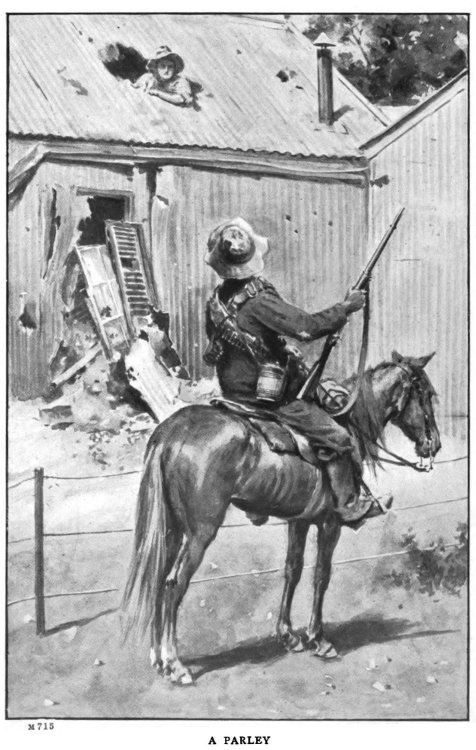
From his post in the roof Jack beckoned to him to advance, and asked him what he wanted.
“Elof Visser is dead,” he began sadly, “and so are many more of my poor comrades; but, for all the loss we have suffered, we are none the less determined. We will capture you if we have to smash the house to pieces. But you are brave men, and I again offer you terms, and if you refuse them, beg that you will send out the girl. She shall be taken and handed over to the English pickets outside Kimberley. Think well of what I say. Frank Russel shall not be injured if he is with you. That is all; but I will remind you that they are honourable terms, which men such as you are might well accept.”
“Thank you,” replied Jack courteously. “I will discuss your terms with my comrades. Draw off as far as the railing and wait till I call you.”
“Now, what shall we do?” he asked, jumping from the table. “Whatever happens, I think Eileen had better trust herself to these men. The Boer outside looks an honest sort, and I am sure he will do exactly as he promised.”
“I refuse to leave you!” exclaimed Eileen indignantly. “If you are not going to surrender, I shall certainly not say ‘good-bye’ now. My rifle has proved of some help to you, and will be wanted badly later on. You can settle the point as to surrender or not, Jack, but I am mistress of my own actions, and shall throw in my lot with you.”
“George! then I expect there’s only one answer to be made!” cried Frank. “We’ve shown them that this is a precious tough nut to crack, and we’re no worse off now than we were early this morning. Let us stick to it, I say, and trust to the boys from Kimberley reaching us by nightfall.”
“And I think the same,” exclaimed Wilfred excitedly. “We’ve got the cellar to hide in, and since it has already stood a long bombardment, it will serve our purpose for a few hours longer. We’ve plenty of ammunition and food and water. Yes, I quite agree. ‘Stick to it!’ is our motto.”
“Very well, then,” said Jack, with a grim chuckle, “I’ll let this fellow know.”
Jumping up on the table he called to the Boer, and as soon as he bad approached near enough told him the decision of the little garrison.
“We are much obliged for your kindness and for the terms you offer,” he called out, “and are only sorry we cannot accept them. We are willing to retire from this house to Kimberley, if you will promise to let us go unmolested, but we will not surrender. Miss Russel, too, refuses to leave us. Now let me advise you again to leave us alone. We have already shown you that we are determined not to be taken, and we mean it more now than we did before. Grant us a free and safe passage into Kimberley and end the matter. If you refuse, then you must take the consequences, for my men are fully prepared to fight till they are killed.”
“How many of you are there?” asked the Boer craftily.
“Ah!” replied Jack with a knowing smile, “there are just as many here as there were last night. Promise us a safe pass into the town and I will give you our numbers.”
“It is impossible,” was the curt answer. “I have done all that man can do. My comrades and I admire your bravery, and therefore have offered you these terms. You refuse for the second time. Very well, I am sorry, my young friend, for you compel us to kill you. It is a pity your wisdom does not match your bravery. I shall return now, and when I reach our lines the guns will commence again.”
The Boer nodded and cantered away, and five minutes later the storm of shell had once more commenced to plunge through the farmhouse.
First plugged shells were used, that is, shells without explosive contents and devoid of fuses; and these for the most part rushed through the walls, merely increasing the havoc already wrought. Then the one-pounder, quick-firing gun, familiarly known as the pom-pom, a terrible weapon against troops exposed in the open, joined in the awful din, and sent murderous projectiles hurtling through the house. But by some lucky chance the majority of the shells failed to explode (probably because the foreign contractors had filled a large proportion of them with saw-dust), and merely burst their way through the shattered house without doing much damage. For an hour the cannonade continued, and just before it finished it was increased by the firing of a Maxim, which had been galloped up to closer quarters.
By this time Frank Russel’s farm was a ruin; doors, windows, and walls were in pieces, and the roof was gashed in all directions. Only the kitchen seemed by some chance to have escaped. And down below it all, in the bomb-proof cellar, Jack and his friends sat waiting for another rush, Eileen quietly boiling a kettle over a spirit-stove and preparing to make some tea, while the men smoked on serenely, laughing and chatting when a momentary lull allowed them to do so, and ready at any moment to hurry upstairs and man their posts again.
“That is the last burst!” exclaimed Frank Russel, with an easy laugh as the distinctive rat, tat, tat, tat of the Maxim reached their ears. “Get ready, lads! they’ll be coming soon. When they find we’re still alive and kicking, they will be wondering whether we are ordinary men or not. It was a splendid idea of yours, Jack, to make use of this cellar. Tim and I, with another of the Kaffir boys, dug it out and bricked it round some years ago. It’s a good storehouse for cartridges, but I never thought it would mean the saving of our lives. Ah, that is the very last!” he added as a one-pounder shell burst overhead and carried away a good portion of the roof.
Jack immediately pushed his head up through the trap, and as the Maxim had stopped, crawled across the floor, clearing a path through the scattered woodwork and débris. Then he peered through a small aperture made by a shell, and looked earnestly across the veldt. As he had expected, the Boers were advancing, bringing their guns with them.
“They are pushing forward,” he cried, “but I fancy they do not mean to rush us. It looks as though they would shell us again. If they do we must still keep quiet, for if they attack at close quarters and in force, a surprise will help us more than anything.”
By this time the horsemen were within 600 yards, and here the guns halted, while the Boers spread out and advanced towards the front of the little farmhouse. Almost immediately the Hotchkiss opened fire, and soon after the rattle of the Maxim and the continuous rip, rip of the bullets overhead told the defenders that it was as yet unsafe to venture up from their cellar. Jack had already slipped down there, but now, rifle in hand, with bayonet fixed, he stood close to the ladder, ready to rush up as soon as the time arrived. A glance at him was sufficient to show that this young Englishman had firmly made up his mind not to give in till the last drop of his blood had been shed; and Frank Russel and Wilfred were evidently determined to back him up through thick and thin. They were without doubt in a tight corner, and might expect to be rushed at any moment; but for all that, the dangers they had already passed through seemed only to have increased their doggedness.
Dressed in corduroy riding-breeches, gaiters, and spurs, and with the sleeves of his shirt turned up over his elbow, Jack looked fit for any work. A pipe was in his mouth, and his thin lips encircled the stem closely with what was next door to a smile, showing that, however young and inexperienced he might be, Jack was certainly by no means dismayed at the thought of the coming struggle.
“This is going to be the hottest and stiffest fight of all,” he cried, so that all could hear; “and mind you, it will not do for any one of us to show so much as a finger. They are coming from the front, and we three will look after them there, opening fire when they are about sixty yards away. Some of them who have the pluck will get close up to the house, and will try to force their way in through the broken walls. If we fail to shoot them down Eileen will be able to stop them, for she will take her post half-way up this ladder, so as to be out of the fire.”
“But, Jack,” Eileen began to expostulate.
“You will do as I say, or else we will show the white flag at once,” exclaimed Jack earnestly.
“The lad’s right, Eileen,” Frank chimed in. “It’s going to be hot work up above, and you can help us far more by doing as Jack says than by taking a place by our sides. But—look out, lads! It’s time we hopped up again.”
All three instantly scrambled out of the cellar and took their places, while Eileen climbed a few rungs of the ladder and stood there, rifle in hand, and with her head just below the level of the floor.
Meanwhile Jack had darted to the back, and then to either side of the house, and having made sure that none of the Boers were in that direction, rejoined his comrades. Looking out through an aperture, he saw that about forty men had dismounted and were creeping forward in extended order, while in the centre was the Maxim, which had just stopped work for fear of injuring its own side.
“Mark that Maxim!” said Jack sharply. “If we drive off these fellows we can easily make it next door to impossible for them to remove it, for at this distance we could shoot down any man who approaches it. But our duty now is to look after these fellows. Frank, you take those of the left. I’ll look after those directly in front of me, and Wilfred will manage those on the right. Let them get within sixty yards, and then fire fast and steady. Keep the magazine for closer quarters.”
Lying full-length on the ground, they pushed the muzzles of their rifles a few inches through the loopholes and waited.
“Now I think we can begin,” said Jack, when the Boers were well within the distance he had named. “Are you ready? Then fire!”
Taking a careful aim, the three pulled their triggers, and as many of the Boers threw up their hands and fell forward upon their faces. The remainder at once dropped full-length upon the grass and wriggled forward, firing after going a few feet, for they were still ignorant of the force opposed to them behind the shattered walls of the house, and therefore abstained from rushing. Had they done so, there is little doubt that they would quickly have overwhelmed the little garrison; but the average Boer dislikes nothing more intensely than to fight in the open and attack a position in which the enemy lurks in complete concealment. But to take the house there was absolute need for this, and believing that after all there were not many opposed to them, they ventured to approach.
And now the superiority of khaki clothing was fully sustained, for instead of being barely visible, each one of the Boers formed a black bull’s-eye against the waving veldt, and was an easy target for the rifles of Jack and his friends.
Loading and firing rapidly and steadily, they picked off one recumbent figure after another, and after five minutes’ work, when their rifles were becoming so hot that they could scarcely hold them, the enemy stopped and hesitated, and then fled in confusion, pursued still by the merciless bullets. When they reached the Maxim they stopped, and three of their number commenced to place it in position so as to rake the farmhouse.
But Jack and his two friends, helped now by Eileen, concentrated their fire upon it, and picked off the Boers. More at once rushed pluckily forward to take their places, but suffered the same fate, and soon, stung by the bullets which still spattered amongst them and struck puffs of dust from the ground, the enemy bolted out of range, leaving their Maxim behind them.
“By Jove, if we only possessed a few more rifles,” exclaimed Wilfred impetuously, “we would go out and bring in that gun. But it’s impossible as things are, and I expect we shall have something else to think of shortly.”
But, contrary to their expectations, nothing occurred, on shells flew overhead, and the Boers seemed to have disappeared from sight Jack climbed up on to the table and mounted on the chair. Then he searched all round with his glasses, and made out a number of men riding off in the distance towards Kimberley. He climbed up the iron sheets on to the top, and looked out behind. Here, too, all seemed deserted, but the sight of a half-hidden figure behind one of the low houses a mile away told him that they were still watched by the enemy.
“They’ve left us alone for a little,” he said, “but there are men all round us. The guns have gone, and I expect our friends have ridden back for reinforcements. You may be certain, though, that they have left sufficient behind to make it impossible for us to approach that Maxim. Well, I suppose we have nothing to do but wait. To-night, if we can last out so long, the garrison in Kimberley will make a sortie, but I think we are too far out for them to reach us.”
“That is so, Jack,” Frank Russel said. “We cannot expect direct help from them, but by making a sortie they will draw away some of these fellows who are watching us.”
“Then I vote we make a bolt for it!” Wilfred cried excitedly. “It will be our only chance, and if we don’t take advantage of it we shall never get any.”
“Yes, we must make a rush,” Jack agreed, “and by striking out here at the back, and away round to the left, we ought to manage it. To go straight ahead to meet a sortie party would mean that we should be surrounded.”
“You’re right, lad, perfectly right!” Frank Russel cried. “We’re playing a move with men who are as slim as slim can be, and to get away we must beat them at their own game. Put yourself in their shoes for a moment. It is just what any ordinary set of fellows would do if they were in a close fix like this. They’d rush towards the comrades who were coming out to help them. Our friends the Boers will expect us to do that, and we’ll disappoint them.”
“Then it is agreed we make a rush,” said Jack. “Let us have a look at the ponies.”
Going into the kitchen, they found that Prince and one of the Boer ponies alone remained alive, Vic and the others having been struck down by the shell.
Jack stepped up to the body of the little animal which had proved a true friend to him, and patted her gently on the neck. Then he climbed on to the table again and out on to the roof.
For three hours nothing happened, and then a large force of Boers appeared, and having reached their old position, out of range of the defenders’ rifles, they pulled up and put two big guns in position.
For an hour they poured a perfect torrent of shell at the house, smashing it to pieces and bringing that part over the cellar down with a crash upon the ground.
But though it was sufficiently terrifying to Jack and his friends below, it did not damp their ardour. Carefully popping up their heads, they ascertained that there were yet many posts in which they could kneel and fire and still not be exposed to the enemy. And if the worst were to happen, the cellar itself would form a last site for defence, from which they could hope to keep the Boers away for a considerable time.
It was now getting dark, and after a short pause, probably to fetch up more ammunition and cool the guns, the bombardment again commenced, one of the shells setting fire to the wreckage above the bomb-proof chamber. In an instant big tongues of flame burst forth, and a dense volume of choking smoke eddied into the cellar.
The sight filled the Boers with pleasure, as a faint cheer showed, and almost immediately afterwards they started forward, in open order, and rushed for the house.
“Out with the fire!” Jack cried sharply. “Those fellows cannot reach us for some minutes yet. Quick! Pass up those buckets to me!”
Standing on the top rung of the ladder, with the smoke blowing in his face and almost smothering him, he stretched down his hands, grasped the buckets passed up to him, and dashed the contents over the blazing timber. Two were sufficient, and in a minute the fire was subdued, and he had kicked out the surviving embers with his feet.
Then all four took the best places they could find, and, waiting till the Boers were close enough to make their aim fairly certain, opened fire upon them. But the dusk was already almost turning into night, and, undeterred by the bullets, the enemy was rapidly closing in upon them. Things looked very black, and common sense would have suggested an honourable surrender. But the excitement of the struggle had taken fast hold of Jack and his friends, and their blood was thoroughly roused. They had defended the house for many hours, and now, just at the moment when help and rescue were expected, they were not going to give up the unequal struggle till the very last moment had arrived. Even Eileen was firmly determined upon this point. Encouraged by the resolute pluck of her father and these two young Englishmen, she seemed to have forgotten her sex for the time being, and now, crouched behind a tumbled portion of the iron roof, her rifle spoke out repeatedly and truly, and sent many a Boer to his last account, or limping from the field.
But the impossible could not be expected. In spite of a gallant defence, the host of Boers were now close at hand, and a hail of bullets was directed at the house and at the four spitting points of flame which showed where the muzzles of the rifles were hidden.
“It’s all up, lads,” shouted Frank Russel. “Shall I shout to them to cease their fire?”
“Wait, what is that?” Eileen cried, clutching her father by the arm. “Guns in the distance, Father, and rifle fire. It is the sortie!”
Pausing for a moment, the defenders crouched behind their shelter and listened eagerly and with beating hearts. Shouts and volley-firing reached their ears, together with the well-known rattle of a Maxim, and almost instantly the Boers who were attacking them called anxiously to one another, and, leaping to their feet, rushed in the direction of the sounds at their fastest pace.
“Thank God, lads!” exclaimed Frank Russel earnestly. “It was a close shave, but He saw us safely through it.”
“Amen!” muttered Jack and Wilfred in husky voices, while Eileen threw herself in her father’s arms and embraced him affectionately.
“There’s no time to be lost,” Jack cried out hurriedly. “Wilfred, give me a hand with the ponies. Frank, you take Eileen outside and wait in front.”
Hastening to the kitchen, they searched about for the ponies, but found to their grief and disappointment that all had been killed.
“Well, it cannot be helped,” said Jack. “Come along, Wilfred. Let us get out of this.”
Picking their way across the tumbled beams and roof, they were soon out in the garden, and, waiting for a moment to make sure that no one was about, they hurried off across the veldt, leaving the sounds of the conflict on their right. It was an adventurous escape, and more than once they were on the point of discovery. But they had the fortune to pass by the few Boers who were still hurrying up to help their comrades, and two hours later they approached a huge bank of débris and earth which had been removed from the mines, and which formed one of the outlying positions of the garrison.
“Halt, who goes there!” was shouted. Then the dazzling beams of a search-light played upon their faces, and the same voice cried out in delighted tones, “Hooray, boys, it’s our friends right enough!”
Such a welcome the soldiers gave them. On every side they pressed forward to shake them by the hand, till the officer in charge of the works advanced and rescued them from the enthusiastic “Tommies.”
“We’re awfully glad to see you safe in our lines,” he exclaimed heartily. “Come into my tent and have some tea. We thought you would probably strike over for this spot, and so I had everything prepared. When you’ve had some refreshment I’ll pass you on to the commanding-officer. He has got quarters ready for you.”
Jack thanked the officer for his thoughtful kindness, and all four having partaken of a much-needed cup of tea, they prepared to walk across to the centre of the town. On their arrival there, the electric light was once more switched upon them, and every man who could be spared, and was not on duty, turned out to look at the four strangers who had so gallantly kept the Boers at bay and taught them such a lesson. When it was seen that one of them was only a girl, and that she carried a rifle, hearty cheers burst forth, and the enemy outside, when they heard them, ground their teeth and muttered things beneath their breath. Nor were their tempers improved when, on the following day, a bearer was sent out with a note describing exactly how many of the English had been hidden in the cellar of the farmhouse.
The commanding officer, the world-famous Cecil Rhodes, who had so pluckily stayed behind to take a part in the siege, and a score of officers of the garrison, all stepped forward and shook them by the hand. Tom Salter, too, was there, as well as Tim, and as soon as the excitement had abated the former led them away to quarters which had been allotted to them.
“Now, Jack,” he said, sitting down on an empty case, “light up and give me the yarn. Things here are very old and stale, and a little news is always welcome. Pass along that bottle, Frank, and make yourselves comfortable all of you.”
When Jack had given him the incidents of the attack upon the house, Tom’s face was a study, and the absolute amazement and wonder depicted upon it set the others in a roar.
“Well, I’m blowed!” he stuttered hoarsely. “Who’d have thought it! It just makes a fellow proud to be an Englishman. Jack, I knew all along that you were a plucky young beggar, but this beats all! Your friend, too, has got some grit about him, and so has Frank; but the girl—well, I never did hear of such downright bravery;” and Tom passed his fingers through his hair and gulped down a pannikin of rum and water with a distracted air which seemed to say that the news had been altogether too much for him.
Chapter Eleven.
Tracked by the Enemy.
It was in the last few days of October, when the hot season and the rains of South Africa were about to set in, that Jack Somerton and his friends at length found safety in the beleaguered town of Kimberley, after their stubborn and protracted fight in the farmhouse of the Russels. By this time the war had been many days in progress, for President Kruger’s ultimatum was despatched on October 9th, and hostilities had commenced on the afternoon of the 11th by an invasion of British territory.
We have seen that to meet that invasion and to stem the flow of the jubilant Boers there were only some 20,000 English regulars in South Africa at the time; and to these the feat of rolling back the overwhelming forces of the burghers in Natal, the protection of our northern towns in Cape Colony, and the garrisoning of Mafeking and Kimberley was a practical impossibility. Yet, with the dogged pluck and determination for which their predecessors had ever been known, that small army had done wonders already.
By October 6th, when war seemed so inevitable, 10,000 additional troops were ordered to be despatched forthwith to South Africa; and since the case was an urgent one, the regiments in India, which are always kept on a war footing, were mainly drawn upon.
But to transport men, guns, horses, and ammunition from India to Africa, or across the 6000 miles of heaving water which intervene between England and Cape Colony, is no small matter. Indeed it is a gigantic undertaking. Transports have to be chartered and specially prepared; food, forage for the horses, arms, medicines, tents, clothing, and a thousand-and-one more items, all of great importance, have to be conveyed, and cannot be prepared in a minute. But in spite of all difficulties the 10,000 troops were soon afloat and en route for the scene of the war.
Contrast for a moment these almost insurmountable difficulties with those of the Boer nation with whom we were contending. For them the only items which called for special transport were guns and ammunition. For the burghers a train journey of some twenty hours, or a long march on horseback of, at the most, 200 miles, brought them to the borders, and all need, for the time being, of a commissariat train was obviated by the fact that each and every man carried on his own person, or attached to his saddle, sufficient ammunition and food to last him several days.
But the fact that the Orange Free State had thrown in its lot with the Transvaal Republic called for bigger forces, and on October 7th, the day following the order for the above 10,000 troops, the Home Government gave instructions for the calling up of 25,000 of our Reserves, and the mobilisation of an army corps and of one cavalry division. Parliament was also summoned specially to meet on October 17th.
Ten days were given for the Reserves to present themselves, and these ten days may be easily described as a time of intense anxiety to the nation.
The old days of lifelong service in the army had disappeared, and now young men who joined the ranks did so for a few years only, after which they were in a condition of thorough military training, and were at liberty to go back to civil life as reserves. In this capacity they were paid a certain sum per diem for a limited number of years, and were liable during that time to be called back to don the queen’s uniform and carry a rifle should their country have need of their services. It was an experiment, and one for which England will never have cause to blame herself.
The revival of the Boer trouble, the memory of Amajuba and Laing’s Nek, together with the fact that this present war was forced upon us against our wishes, sent a thrill of patriotic fervour through the length and breadth of the land.
Almost 100 per cent of the Reserves answered the call, and the few absentees were for the most part at sea in merchant vessels. Nor was this all. When England found herself face to face with a gigantic struggle, that generosity for which all her people have been noted was shown on every hand. If the manhood of the country could respond so nobly to the call to arms, then they should be rewarded for it, and those who were left behind would make it their duty to care for the helpless wife and child.
Everywhere employers showed their patriotic spirit by declaring that those of their servants who left for the war should find their places waiting for them when they returned. And not only that, a large proportion at once arranged to pay half wages to the wife or dependants of the reservist, thus lifting a load of anxious care from the brave fellows’ minds.
Thousands of pounds were subscribed for the maintenance of the homeless refugees from Johannesburg and other places, and later on large funds were raised, so that the widows and orphans of all the gallant men of the army or navy who gave their lives for their country might never know what it was to want. Money privately subscribed provided hospital ships and beds, and in this manner our American cousins showed their friendship, for they equipped and despatched The Maine for the treatment of our wounded.
To even mention each and every one of the incidents which showed the fervid patriotism of the people, and their intense loyalty to and love for their beloved queen, would be impossible.
But no description of our preparations for this war is complete without a reference to the splendid patriotism of our colonies and of our home volunteers. Unasked, they clamoured loudly to participate in the struggle, and while for the time being our own citizen soldiers were not accepted, contingents of splendid men were welcomed from Canada, Australia, and New Zealand.
Thus it will be seen that England prepared for war, a war which it was confidently expected would be of short duration. An army corps was mobilised, and those who, by family ties or by reason of their civil duties, were compelled to stay at home, saw to their particular part of the patriotic work.
And then, when all was ready, they first of all despatched Sir Redvers Buller, one of our finest veterans, to take command of the accumulating army in South Africa, and afterwards, for many days in succession, accompanied the soldiers in shouting, cheering thousands to Waterloo Station, and sent them off on the first stage of their long journey with many a “God-speed!” and with hoarse cheers which showed how truly their good wishes went with them.
And who amongst us who formed one of that crowd did not feel a strange rising in the throat and an inability to say exactly all we wished to those who were leaving England—perhaps for the last time? We longed to join the gallant fellows, and when we saw one of them turn aside for the moment, just to brush away the tears that would come, and get his lips steady again ere he bade a long farewell to his weeping wife and, most likely, to the infant in her arms, our hearts prompted us to step forward and wring his hand, just to show him that we thought all the more of him for his feeling.
Those were stirring scones indeed, and that great lady and the country for whom all our gallant troops were about to sail over the sea will never, never forget them. What happened to those brave men and officers we despatched will be described in due course. The surprising strength of the enemy, their careful and long-thought-out preparations, and their modern and overpowering armaments will be spoken of, as will the painful events which led to England’s awakening. For the present we shall leave her with the eyes of all her people at home and in the colonies turned hopefully and anxiously to that far-off field of battle, while we return to Jack Somerton and his friends in Kimberley.
On the morning after their safe arrival in the town, Tom Salter took Wilfred and Jack to the conning-tower erected in the De Beers compound and pointed out the various points in the defences. It was a remarkable scene. In all directions were huge mounds of débris removed from the diamond mines, and these, with the help of ample native labour, had been converted into fortresses, while outside all was an entanglement of barbed wire completely surrounding the town. From their elevated position they could look down on every post, and to Jack, who had been in the town many times before, and indeed to anyone, it was most strange to see the townsmen and regulars manning the defences or scouting outside, while down below them 10,000 natives laboured in the huge compound, delving for the diamonds which after all might fall into the Boers hands.
“Just shows what we think of those fellows,” laughed Tom Salter, jerking his thumb in the direction of the Boer laagers. “They have been round us since the 14th of this month, and they’ve done nothing but look on all the time. If we were in their places I expect we should just make one big rush to take the town; but your Boer hates that kind of work, and so is content to look on while guns are coming from Pretoria. Then, I expect, they will make us jump a little.”
“How many men have you here?” asked Jack.
“About 3000 all told,” answered Tom. “We are under the command of Colonel Kekewich, and Cecil Rhodes is here to keep us company. A good number of our force are colonial troopers and volunteers, but we have the 1st Battalion of the Loyal North Lancashire Regiment here, besides a few gunners and engineers. I can tell you, my boy, we shall be a pretty tough lot to conquer. Why, only a few days ago we made a sortie towards Macfarlane’s Farm in the north, and bagged a number of the Boers, including Commandant Botha. We had 3 killed and 21 wounded—not a great loss when you consider the work we did. It was grand fun, and I’ve no doubt, now that Cronje has given Mafeking up as hopeless and come down here, we shall give them another taste. Now tell me all the outside news. How did you get across to Johnny’s Burg, and what have you been doing since? Last night you spoke of Glencoe and Ladysmith. ’Pon my word, Jack, you are just like the proverbial bad penny. You seem to turn up all over the place.”
Jack laughed heartily at Tom Salter’s remark, and then proceeded to tell him about his adventures since leaving Kimberley. Then Tom in turn told him all that had happened during his absence.
It seemed that Kimberley was by no means unprepared. Both Government and the De Beers Company had poured supplies and arms into the town, and there was sufficient to last for many weeks. The water-supply had been cut off, but there was plenty to be obtained in the town, and there was therefore no fear on that point. Altogether the inhabitants were faring better than might have been expected. All food was to be had at standard prices, and they were protected by a force which, if not too ample, at any rate made up for their lack of numbers by a dauntless determination to hold the town.
No one was allowed to leave the neighbourhood of the defences or to enter the town without a signed permit, and this was strongly adhered to, for, as in Mafeking, and indeed in our camps in any part of South Africa, spies swarmed everywhere.
But if the garrison were determined to hold the town, they were equally prepared to make the time pass easily. Mr Cecil Rhodes, the administrator of Rhodesia and at once a brilliantly clever and most popular man, dispensed hospitality on every side. He gave dinners and dances to enliven the people, and at one of them, which occurred on the night after their arrival, Jack was present with the Russels, and waltzed with Eileen to the strains of inspiriting music. Then they slipped out, and, climbing on a mound near by, stared across the veldt at the Boer laagers and then back at the defences of Kimberley, all easily distinguishable under the rays of a glorious moon.
“How lovely it all looks in this light!” said Eileen gently. “What a pity that there should be such a thing as war! But I can see it is necessary, for if the English troops did not fight they would be driven out of the country, and then none of us would be safe. I am sorry about the old home too. I loved it and the flower-garden; but it was far better to defend it as we did than give in to the Boers. Jack, do you know I have never really thanked you for all you did, and for saving me from that brutal man. Only last night Father said that we owed our lives to you. I am proud of you, Jack! Shake hands!”
Jack was astonished. He stuttered, grew confused, and then dropped Eileen’s hand as though it were a hot coal, for he was a bashful lad, and in a terrible fright all the time that Eileen would burst into tears or throw herself in his arms in the excitement of the moment.
“Oh, never mind what I did, Eileen!” he blurted out. “I’d have done it for anyone else; and Wilfred deserves your thanks as much as I do. Now let us go in.”
Eileen obeyed, feeling glad that she had at last thanked her preserver. She had met Jack many times, and had come to know that he was a plucky, good-looking young Englishman. That he had taken her thanks so brusquely did not jar her feelings. She understood him, and knew that though he did not show it he was really gratified. Therefore, taking his arm again, she returned to the dancing-room, and five minutes later she was watching her stalwart hero waltzing round, with a light in her dark eyes which, had he seen it, would have set his heart beating. But Jack had other matters to think about, and on the following morning approached Tom Salter on the matter.
“I came up here to act as a despatch-rider,” he said, “and I want you to help me. I know the country all round as well as anyone, and ought to be able to get through. Whom ought I to apply to?”
“No need to apply to anyone,” answered Tom. “I saw one of the officers last night, and told him all about you. News came in three days ago from the south, and you also brought information when you came. What we want to know is how Mafeking is getting on, and I expect you will be asked to ride in that direction. It will be ticklish work, my boy, but it seems to me that you are specially suited for it, for you have already ridden more than once in the enemy’s country. Come with me now to head-quarters and I will send in your name.”
Jack followed him through the town, and a few minutes later was shown into the commanding-officer’s rooms. Here he was cordially greeted, and before anything was said about the ride to Mafeking he was urged to tell the officers present all about the defence of Mr Russel’s house. Then he was asked whether he was willing to ride to the north with despatches.
Jack answered that he was, and promised to be ready to set out that evening.
“Very well,” said one of the officers, “we will have the despatches ready for you. Come here at dusk and you will find a good horse waiting to carry you. Above all, do not let anyone know that you are to start. There are spies everywhere.”
Jack promised to observe this precaution, and without even dropping so much as a hint to Wilfred, who joined him a few minutes later, walked all round the defences of the town.
Late in the afternoon he filled his bandolier, saw that the magazines of his rifle and pistol were prepared, and then walked into the room where the Russels, Tom Salter, and Wilfred were. There was now no reason for keeping his mission a secret, and as he joined the party in a cup of afternoon-tea he told them that he was about to set out for Mafeking.
Wilfred’s face at once showed his disappointment, for he would have gladly accompanied his friend; while Eileen went suddenly pale to the lips, and almost dropped her cup. But she recovered herself quickly, and said good-bye cheerfully.
“Good-bye, Jack!” she murmured earnestly. “Take care of yourself, for we should all be sorry if you were captured.”
“By Jove, old chap,” Wilfred broke in impetuously, “I wish I were going with you! It will be awfully flat here without you to liven us up. I only hope we shall have plenty of fighting while you are away. Good-bye, and if you meet any of the Boers just give them fits! You’re well able to.”
Frank Russel and Tom Salter slapped him heartily on the back and wished him luck, and in another moment he was striding up the street, with clanking spurs, looking a typical young colonist, and one, moreover, well able to take care of himself.
Arrived at the head-quarter office, he was shown in, and accosted by the same officer as before.
“Here are your despatches,” he said, producing a thin piece of tissue-paper very finely written upon, “and now we must decide where to hide them. It is an important document, and if it fell into the Boers’ hands would do us a large amount of harm. What do you think of the puggaree round your hat for a hiding-place?”
“Well, it seems to me,” replied Jack, “that that is just the kind of thing they would search. I have been thinking about it as I came along, and believe that a far safer place will be in the case of my Mauser pistol. Here it is, under my arm, and it has already escaped detection.”
“Splendid! Of course that will be far and away the best place,” exclaimed the officer. “And now, in case the Boers should capture you, here is a letter stating that you are a despatch-rider acting for the British. Without that they would probably shoot you as a spy. Now you can start as soon as you like. If you reach Mafeking in safety, tell the boys there that all goes swimmingly with us, and we hope it is the same with them. Well, good-bye, Somerton, and the best of luck go with you!”
They shook hands, and Jack clattered downstairs and into the street, where he found a shaggy-looking horse waiting for him. In a moment he had vaulted lightly into the saddle, and was riding away towards the nearest gate which lay to the east. He had chosen this purposely, for had the Boers obtained an inkling of the direction in which he was to ride, the telegraph wire which was at their service between the two beleaguered towns would have warned all the burghers to look out for him. At the gate he was challenged, and on giving a special pass-word, which he had been instructed to use, a lamp was flashed for a moment on his face, and he was allowed to proceed.
“Good luck to yer, mate!” said the sentry who had received the countersign. “Give our best respects to the chaps up north, and tell them we’re having a fine time down this way. Ta, ta, old horse! Mind the palings as you go out; they are a bit inclined to scratch yer.”
“So long, Joey!” laughed Jack cheerfully, recognising the sentry as one of the volunteers he had met the night before.
Cantering on he carefully avoided the high fence of barbed wire, and, riding through an opening in it, was almost immediately challenged by a picket, and was compelled to pull up suddenly, to find a couple of bayonets pointed at his chest.
“Gently, boys!” he called out in a low voice. “You’ll be sticking those things through me next time. I’m Jack Somerton, and ‘Buller’ is the pass-word.”
“Right; ‘Buller’ it is,” was the answer. “Pass on, Jack, and go easy when you get half a mile away; there’s a lot of our dear Boer friends prowling about over there.”
Jack thanked the man for his advice, and cantered on again. Then he pulled up, dismounted, and led his pony along over the grass, pausing every now and again to listen and search the darkness in all directions. At this moment the search-light from the town was suddenly turned on, and passing well above his head was flashed across the veldt in front of him, and then all round till it fell upon the same spot again.
Jack stopped where he was and followed it carefully with his eyes. Again it flashed round the town, and then was suddenly cut off, leaving everything in absolute darkness. Springing on his pony, Jack touched it with his spurs and galloped ahead, and did not draw rein again till he had ridden a good five miles. Then he dismounted for a few minutes, and having allowed the animal sufficient time to rest, jogged on at a gentle canter, the most comfortable pace at which to cover a long distance. There was no difficulty about keeping in the right direction, for his rides with Tom Salter had taught him how to make use of the stars as guides, so that he went on for several hours with a short halt here and there, and by three in the morning found himself well on the way to Vryburg, and only a few miles to the west of the railway.
By this time the clouds on his left hand were already beginning to lighten, warning him that ere long dawn would sweep over the wide range of veldt, and that unless he wished to be discovered by the enemy he had better set about finding some hiding-place. Fortunately there was no difficulty in this, for he was now well in the bush country which stretches in a wide belt north and south of Vryburg. Up to this he had ridden by the side of it, but now he turned to the left, and, jumping to the ground, led his pony on amongst the bushes. Threading his way carefully between the clumps of mimosa and cactus, and the still more painful wait-a-bit thorns, he at length came to a small and precipitous kopje, covered with rugged boulders and bush, and clambered up to the top.
Here he found a small hollow almost surrounded with boulders, and with sufficient grass to give his pony a good feed, and still allow room for himself to lie down. It was just the place for a secret camp, and five minutes later he had taken possession of it. Vic—as he had called the pony in memory of his favourite—was soon knee-haltered and busily picking at the herbage, and Jack was equally busy devouring some bread and meat he had brought in his haversack.
By the time he had satisfied his hunger and lit a pipe there was bright daylight, and, crawling to the edge of the kopje, he squeezed his body between two of the boulders, and with the help of his glasses made a thorough survey of his surroundings. About six miles on his right the snakelike track of the giant railway from Cape Town via Kimberley and Mafeking to Buluwayo, met his eye, while away in the distance was Vryburg, looking like a white blotch against the green bush which almost surrounded it.
But nowhere was there a Boer to be seen, and, satisfied that for the present he ran no chance of discovery, Jack lay down on his mackintosh sheet, wrapped himself in his blanket, and with his head resting on his saddle was soon fast asleep.
Shortly after noon he woke again, and there being no one in sight he saddled up, and, leading his horse to the foot of the kopje, pushed forward on the long ride to Mafeking. But though all seemed quiet, he was not to reach his destination without some startling adventures. Had he but known it, three roughly-dressed Boers had caught sight of his figure as he left his hiding-place, and, following him cautiously through the bush, had soon surrounded him. Wide-awake as Jack generally was, it was only when a horseman mounted on a snaggy pony suddenly appeared in front of him that he became aware that there was a Boer within miles of him. To halt and glance all round was the work of an instant only, and showed him the figures of two other horsemen hemming him in on every side. Next moment he had slipped to the ground and had unslung his rifle. Fortunately he happened to be riding through a thick part of the bush, so that, lying flat on the ground, he was completely invisible to the advancing Boers. When within three hundred yards of him all three halted and shouted to him to surrender. By this time, in spite of the sharp spikes and thorns, Jack had crawled a little way into the bush and was some feet from his pony. Then, gently kneeling up, he lifted his head inch by inch and looked about. Immediately surrounding him was a thick clump of mimosa bush which completely hid him, while the Boers, seated upon their animals, were well above the top of it.
“I’ll wait a moment where I am,” thought Jack, “and if they fire I will pick one of them off and crawl away to another position at once. Then I’ll fire at another. There are three of them, but after all I am in a good position, and unless they gallop in and finish me, I ought to get safely away.”
Once more one of the Boers shouted to him to surrender, and as Jack kept silent, all three fired at the bush close to his pony, one of the bullets killing the poor animal instantly, while another passed through the top of Jack’s hat, as he happened to be just in the line of fire.
In no way put out by the occurrence, though his hat leapt from his head, Jack hastily replaced it, and, lifting his rifle, fired at the man whose bullet had so nearly been the means of ending his career. At such a short range it was not a difficult shot, and the Boer threw up his arms and fell backwards over the quarters of his pony with a bullet through his chest.
Next moment there were two sharp reports, and the ominous swish, swish of Mauser projectiles flying close above him. But Jack escaped unhurt, and though the Boers emptied their magazines into that part of the bush they did not touch him, for a second after firing he had again dropped on all-fours and crawled away to the left. Once more he lifted his head, to find the two remaining horsemen, rifle in hand, standing up in their stirrups and searching the thick mimosa shrubs in front of them, ready to open fire the instant he showed himself.
Jack crawled on a little farther till he came to a spot where, still lying prone on the ground, it was possible to get a good sight of the enemy. Taking a careful aim, he once more fired, and had the satisfaction of seeing another of the Boers fall, while the third hastily discharged his rifle and galloped away, Jack sending a bullet whizzing after him.
Then he rose to his feet and strode over to the man who had just tumbled from his pony. He was quite dead, and as Jack had no means of burying him he left him there in the bush, and, taking his pony, which had, like all well-trained animals, remained close by his master’s side, he walked across to look at the other Boer. He found the poor fellow in the centre of a dense thorn bush, groaning feebly, while a thin stream of blood ran from his lips.
But a minute before he had been an enemy, and had, indeed, very nearly been the death of Jack; but for all that he was now a fellow-being in distress, and Jack determined to do what he could for him. He was a big, bearded man of thirty-five, and no light weight to lift. But Jack’s strong arms soon carried him on to an open patch of grass. Then he gave him a drink from his water-bottle, and proceeded to look to his wound. There was little to be seen, merely a small puncture in front of the chest and a slightly larger one behind. Searching in the man’s pocket, Jack produced a scarf and tied it tightly round the chest. Then he gave him another drink, and five minutes later had the satisfaction of finding him stronger and able to speak. “Where are your friends?” he asked. “If they are near, and you will promise that I shall not be taken prisoner, I will carry you to them.”
“They are at Vryburg,” the wounded man answered in a whisper; “but I cannot promise that they would not take you prisoner. Elof Vuurren is no lover of the English. It would be better for you to leave me to die alone.”
Jack thought the matter over for a few moments. If he left the poor fellow in the bush he knew that his fate was sealed, for he would never be found. Why should he not risk it, and show these Boers that the English could be kind and good to them, and not, as the field-cornets and leaders were always telling the burghers, cowards and brutes. Jack looked again at the wounded man, and the sight of his helpless and pitiable condition at once decided him. Unwinding the puggaree from the Boer’s hat, he brought one of the ponies close alongside him, and putting out all his strength, lifted him into the saddle. Then he lashed his ankles together beneath the pony’s body, and, leading the spare animal by the reins, set off for Vryburg through the bush.
It was a long and tedious march, but in three hours’ time he was opposite the town, and, leaving the belt of scrub in which he had been walking, he turned into the open. A mile farther on thirty Boers came cantering towards them, and, taking a hurried farewell of the wounded man, Jack vaulted on to the other pony and cantered off.
A few minutes later the wounded Boer was amongst his comrades, and, looking back, Jack saw him feebly moving his arms as though explaining the manner in which the Englishman had brought him in, and begging them not to follow him. But the sight of one of the hated Rooineks proved too much for the Boers, and with a shout they left their comrade, and, putting their animals into a mad gallop, came thundering after Jack.
In a moment he had dug his spurs into the wiry little animal upon whose back he rode, and, turning towards the bush again, galloped directly towards it at his fastest pace. When within 300 yards of the mimosa scrub another body of horsemen appeared directly in front of him, riding amongst the thorn bushes, and as soon as they caught sight of him, and of the men who were pursuing him, they scattered to right and left and rode off, leaping the rocks and bushes in their way, and evidently intending to surround him.
It was a desperate predicament, but Jack’s coolness never deserted him, and he instantly decided how to act. Turning sharply to the right, he galloped on at the same headlong pace parallel to the belt of bush, but drawing closer to it. Suddenly he turned to the left again, and, applying his spurs, set his pony straight for the centre of the Boers who had appeared in front of him.
It was a smart manoeuvre, for the horsemen had already separated, so that by the time Jack reached the line of bush there were only two in front of him. His rifle was already in his hand and his bayonet fixed. Holding the weapon ready to strike, he charged straight at the two Boers, who levelled their rifles at him and fired. One of the bullets flew close by his head, and the other actually struck and severed his stirrup leather without touching him. In an instant Jack dropped his reins and raising his rifle, took a hasty aim, and pulled the trigger. It was a lucky shot, for one of the ponies pitched forward, throwing its rider violently over its head.
The other man boldly stood his ground, and, rising in his stirrup, took a deliberate aim and sent a bullet swishing so close past Jack’s head that it cut his ear. Before he could repeat the shot Jack was on him, and had thrust his bayonet through him and swept him off his saddle.
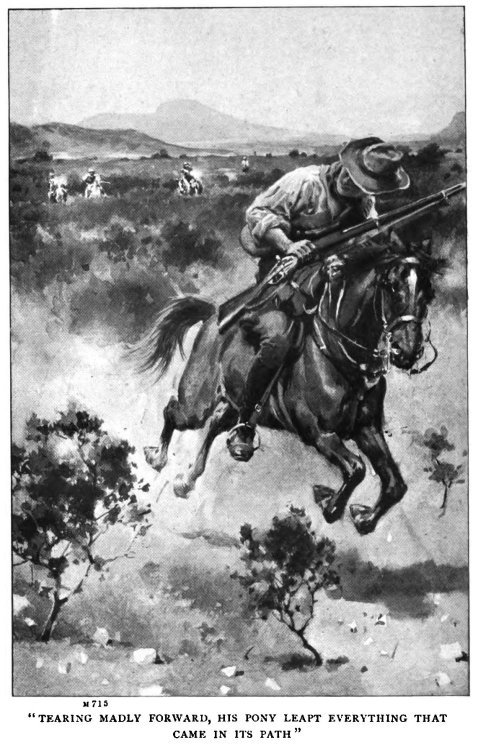
After that there was a quarter of an hour of the wildest excitement. Tearing madly forward, his pony leapt everything that came in its path and soon outdistanced the pursuers, who had halted at the fringe of bush and were now sending volleys after him. But horse and rider seemed to bear a charmed life, till an unlucky bullet struck the plucky little animal and caused it to fall. Jack went flying some yards ahead into a thick mimosa bush, which broke his fall, and, extricating himself and picking up his rifle, darted off. Showers of bullets followed him, but by bending low he escaped them all, and an hour later was in the heart of the bush and safe from the pursuing Boers. By that time he was thoroughly exhausted. He threw himself panting on the ground and remained motionless for a long time. Then he rose to his feet once more and set off in the direction of Mafeking.
All that night he trudged on, and spent the following day beneath the shade of a friendly thorn bush. Then he started again, and reached his destination just as the next day was dawning. Footsore and weary, he staggered up to one of the pickets, and, hastily answering his hail of “Who goes there?” with “Friend”, snatched at the man’s water-bottle and greedily gulped down the contents. Then, feeling stronger and more refreshed, he limped on into the town and handed his despatches to the redoubtable Baden-Powell, who welcomed him heartily.
Chapter Twelve.
Gallant Mafeking!
Had he been the bearer of the most eagerly-looked-for news, Jack could not have received a more enthusiastic welcome than he obtained from the gallant little garrison of Mafeking. As he staggered into the town, hot, dusty, and dishevelled, and worn out with his long tramp, a horn was sounded, and hosts of men flocked towards him, and, gathering in a circle round him, listened while Colonel Baden-Powell—affectionately known as B.-P. by his men—questioned him.
A stiff glass of brandy made him feel quite fresh again, and, sitting down on a box at the colonel’s invitation, Jack detailed his news and delivered his despatch. That done, he was hurried off by a number of the town volunteers to an underground cell built close behind a parapet of sand-bags, and there given a couple of blankets to lie on. He was tired out by his long march, and in a few moments was asleep.
When he woke again the afternoon was far advanced. Rising from his bed, he crawled out of the cell and found a young fellow busily tending some pans suspended over a blazing fire.
“Oh, there you are at last!” the latter exclaimed cheerfully. “We’ve been dying to hear all your news, but have had to wait patiently for you to wake up. Can I do anything for you?”
“Yes, if you could tell me where I can obtain a bucket of water and a makeshift for a towel I should be obliged,” answered Jack cheerfully. “I haven’t had a wash for three days.”
“Oh, that’s nothing!” the other answered, with a gay laugh. “It’s nearly three weeks since I had a shave, and when I got a look at myself in a bit of glass yesterday I nearly had a fit. Such a fright I look with this beard! But we’re all the same, that’s one comfort. But you want some water! You’ll find some behind that house over there. Keep your eyes open as you go, and if you hear the horn sound make a bolt for this bomb-proof cell. We always keep a fellow on watch, and as soon as he sees the smoke from the Boers’ guns he sounds his horn and we all run for shelter. It generally gives us plenty of time to get under cover. But sometimes some poor chap is caught.”
Jack thanked the volunteer for his information, and strolled across to the house. There was a pump and trough behind it, and, stripping off his coat and shirt, he enjoyed a thorough rinse. He had already borrowed a towel, and on returning he obtained a small piece of comb and the corner of a splintered looking-glass, and made his hair tidy. Then he stood outside the cell and chatted with the volunteer who had first spoken to him, and asked him to tell him what had occurred at Mafeking.
“Oh, we’ve had pretty lively times, I can tell you, Somerton!” the young fellow exclaimed jovially. “Of course you know that B.-P. turned up here some weeks ago, and started at once to enlist a colonial mounted corps. There wasn’t much difficulty about it either, for we knew something about him, and rushed to put in our names. Then old Kruger despatched his ultimatum, and we sent most of our women and children south with Nesbit, who, as I dare say you have already heard, was captured on the return journey. By October 14th we were surrounded, but B.-P. didn’t let the grass grow much before he was at them. For instance, on the 13th he sent out a couple of trucks of dynamite, which were a positive danger to us in the town. They were attached to an engine, and backed a mile or more up the line. The Boers spotted them, and galloped forward when they saw the engine uncouple and steam back without them. I suppose they thought they were armoured trucks filled with men, and when they were within close range blazed away at them. There was a terrific explosion, and it is reported that a hundred were killed. Then on the 14th we made a sortie and drew our friends into an ambush, in which they suffered still more heavily.
“Since that time there has not been much doing, though I expect we shall beat them again soon. A few days ago they started bombarding us at a range of two and a half miles with three Krupp guns, but now they have got some heavier metal about five miles away, and the shells are by no means pleasant. Still, we have come off well up to this. Now, Somerton, the fellows will not be back for half an hour, so give me some of the outside news.”
Jack told him all he knew about Glencoe and the campaign in Natal, and wound up with his ride to Kimberley and on to Mafeking.
“’Pon my word, I believe you have seen more of the war than anyone!” exclaimed his friend enviously. “But I suppose I ought not to grumble. Here we are, volunteers, and a detachment of the Munster Fusiliers, and townsmen, about 1200 all told, and if things turn out as is expected we shall have precious tough work to hold the place against the enemy.”
“From what you have told me of B.-P. I have no doubt you will see plenty of fighting before the siege is over,” answered Jack. “For my part, this despatch work is more fascinating than any. It gives one a splendid outdoor life, with plenty of adventure, and the dangers are not really more than those you incur here. You never know when these shells may drop on your head, so that, however carefully you keep below the sand-bag parapet, you may be struck down at any moment.”
A few minutes later ten men came hurrying along the street, and joined Jack and the volunteer. They had just been relieved of picket duty, and tackled the meal which had been preparing for them with the greatest gusto. A stalwart, sunburnt set of young Englishmen they were. Dressed in the usual riding kit and shirt, with sleeves rolled up to the elbow and slouch hat upon their heads, they looked capable of the toughest fighting. Nearly every one of these young fellows was the younger son of gentlefolks in England. Restless young spirits, full of pluck and go, who had failed in their examinations at home, or could not settle down to the humdrum life of an office in London. One could easily imagine that only a few years before every one of them was the pride and joy of some particular public school in old England—the kind of boy who captained the football or cricket teams, and with the roar of his schoolfellows’ cheers behind him carried the leather to the back of the goal-posts of some opposing team; or perhaps the calm, big-limbed, young hero, dressed in white flannels and shirt, who stood fast at the wickets and saved the day for his comrades, sending the strongest balls delivered to him away to the boundary. That is the kind of lad that most of these had been, and now, under vastly altered circumstances, they showed the same sort of spirit. Throwing themselves upon the ground in the shade, they ate their meals with a good appetite. Then, pulling out their pipes, they made a circle, and listened eagerly to Jack’s news.
In the middle of a glowing description of Glencoe and the storming of the heights of Talana Hill a horn sounded in the distance, and instantly all scuttled into the bomb-proof shelter. They were not a moment too soon. Less than five seconds later a huge shell shrieked just above their heads, and, striking the house opposite, exploded with a terrific flash and roar, shattering the walls to pieces.
“That’s bad luck!” one of the volunteers snouted; “it has smashed up our sleeping quarters, and has set them on fire. Tumble up, you fellows, and set to work to put the flames out!”
Jack joined the others, and helped to fling water on the flaring timbers. The fire was soon put out, and they returned once more to continue the yarn.
“Well, you’ve seen a good deal of service already, Somerton,” said one of the young fellows, “but if you have nothing to do to-morrow, and care for a new experience, I will take you out to snipe the enemy. It’s a slow game, but has its excitements. We shall have to crawl out in the dark about three o’clock, take up our quarters outside, and wait there till the following night. Perhaps we shall not get a shot all day. But on the other hand we may bag a few of the Boers who show themselves. Will you come?”
Jack willingly assented, and next morning, when it was still dark, followed the young volunteer outside the defences. Each carried a rifle and plenty of ammunition, field-glasses, water and food sufficient to last the day.
“Now the thing is to get hold of a spot where there is some shade to be had,” said the young volunteer, whose name was Francis. “I know a splendid place, where we shall be able to get out of the rays of the sun. We can lie there together and chat. It is much better than being by one’s self.”
Picking their way carefully amongst the boulders, Jack and Francis soon reached a mass of rock which had been specially prepared for sniping. It was really a gigantic boulder, which had at some time split, the two portions rolling a few feet apart. In the gap between, a little wall of boulders and sand-bags had been made. Francis stretched a blanket from one piece of the rock to the other, and kept it in position by means of stones.
“That’s all right,” he said, with satisfaction. “However hot the sun is we shall be sheltered from it. Now we’ll get our rifles ready, and have a snooze till the dawn breaks.”
Placing their weapons against the wall in front, they rolled themselves in their blankets and soon dozed off. An hour later the sun was up, and both prepared for action.
“You’ve been under fire before, at Glencoe, Somerton,” said Francis, “but I fancy you will find this rather different. The Boers hate us fellows who come out here to take potshots at them worse than all the rest. It makes it impossible for them to show themselves for long. Every shot we fire will be answered by a dozen rifles or more, and sometimes they will let off a shell at us. It gets pretty warm work at times. But I dare say you’ll get used to it.”
“I fancy I have had a share of it already,” replied Jack coolly. “You see, before I got out of Glencoe I had some experience of it, and just outside Kimberley a force of Boers bombarded the house in which some friends and I had sheltered, and riddled it with bullets.”
“By Jove! Really!” Francis exclaimed in surprise; for, had the truth been known, he was almost wishing he had not brought this young despatch-rider out with him on such a trying expedition till he had learnt how he conducted himself under fire. “Really!” he repeated, lifting his eyebrows with astonishment. “You did not tell us anything about it last night when all the fellows were asking you for news. Let me know all about it at once, there’s a good chap! It will help to pass the time, and we can keep a sharp look-out all the same.”
“Oh, it was only a small matter, and of little interest!” said Jack in reply; “but if you would really care to hear it I will start right away.”
Accordingly, lying prone behind the breastwork of boulders, Jack commenced his yarn, and modestly told his companion how he had saved a comrade at Talana Hill, and how some days later he had rescued Eileen Russel from the hands of the Boers.
Meanwhile they had kept their eyes open, and had broken off the narrative to fire a couple of shots apiece, one of which evidently found its mark. In response a storm of Mauser bullets was hurled at them on each occasion, and once a shell tore through the air above their heads, and swept the blanket away. In an instant Jack was on his feet, and, running across to the spot to which the blanket had been carried, picked it up, and with the utmost coolness and nonchalance replaced it over their sniping ground.
It was a bold if somewhat foolhardy act, for bullets swished past him all the while, and even threw up the dust between his feet without striking him. But it was just one of those daring deeds for which our countrymen are noted, not performed in the hope of obtaining praise, but merely out of cool bravado, and to show the enemy that pluck is still a feature of the race.
When Jack threw himself down again behind the shelter and commenced to fill his pipe, the remarkable calmness, not to say absolute carelessness of danger, of this new comrade filled the garrison, who happened to be looking on, with wild enthusiasm, and they cheered loudly.
As for Francis, himself by no means a coward, he was quite upset. “Well, I’m jiggered!” he exclaimed, shaking Jack warmly by the hand. “Here are you walking about under fire as cool as an icicle, and only an hour ago I was wondering whether, after all, I had been wise to ask you to come out here, and whether you would funk a bit when the bullets began to fly. I can tell you this is one of the warmest jobs to be found, as you can see for yourself, and I’ve known fellows who were good at a sortie, and always did their fair share in a fight, who couldn’t stand this kind of work. It’s too cold-blooded for them. Let them get their monkey up and they are fit for any job; but to lie down here in the open, and never know when a shell may knock you to pieces, is too trying for them. Somerton, you’re a perfect wonder. Just fancy your arriving in time to save that girl! She was an old friend of yours, wasn’t she? Dear me, can I congratulate you, old chap? Any engagement?”
“Oh, humbug; of course not!” Jack exclaimed warmly, flushing up to the roots of his hair. “Both Eileen Russel and I are far too young to be thinking of marriage; besides, I’ve only met her a few times. What rot you talk, Francis! Look out, there’s a Boer showing up over there!”
Jack got quite wrathful, and, taking up his rifle, fired at the man who had just appeared, and had the satisfaction of seeing him go limping away.
That appeased him, and he once more chatted in a friendly manner with Francis. But in spite of himself, Eileen’s pretty face would appear before him in fancy as he lay there puffing at his pipe, and he could not help wondering with some anxiety how she was, and whether a safe place had been found for her in Kimberley, where she would be out of harm’s way.
That night, when they slipped back within the defences, they received quite an ovation, and Jack was compelled to repeat the story of his adventures. In return for doing so he was offered the very last bottle of beer to be obtained in the town.
“You’re a plucky young beggar,” exclaimed one of the garrison, “and as a mark of our appreciation we offer you this. Take it at once and drink it, or else the others will repent and want it back. We’ve run clean out of beer, worse luck, for in this hot weather something else besides water is wanted. And a fellow begins to long for a change, too, especially when he’s been used to taking it. Why, only two days ago one of the officers who was at school with me happened to pass, and I offered him one of our precious bottles. He nearly fainted, it was such a treat, for the poor beggars are worse off than ourselves in that respect.”
Jack laughed heartily at the anecdote, and, pouring out the beer, drank to the health of all present. Then someone started a song, and for two hours the party kept the town awake. Then they wrapped themselves in their blankets and all became quiet, and nothing disturbed the silence save an occasional challenge from a picket as the officer made his rounds.
The next day was Sunday, and by mutual agreement a day of peace for Boers and British alike. In the enemy’s camp solemn services were held in the open air, while in solitary little Mafeking all who could flocked to the church. In the afternoon everyone gathered in the market square where the band played, and before they parted for the night stood stiffly at attention, hat in hand, or at the salute, while the National Anthem was played.
And outside, lying in their cheerless trenches, the Boers heard it, and forgot to jeer as formerly; for this little town, far away from all help, with its indomitable commander and plucky garrison, had already taught them in the space of less than a month more respect for the British than they had learnt in their whole lives before. They listened to the strains in silence, and a chill went through many of their frames, for it was beginning now to dawn upon them that England’s day was still to come; and in their heart of hearts the majority of these sturdy peasants believed that that day was getting close at hand, and that when it came they too would acknowledge England as their ruler just as their forefathers had done years before. It was a bitter thought to these misguided men, to whom independence was so dear, and damped their spirits so effectually that they preserved a sullen silence and listened to the distant strains of the band despondently.
On the following day Jack received a message from one of the officers who acted for Colonel Baden-Powell, and on entering the bomb-proof fort in which the latter lived, was asked if he was willing to ride out of the town again.
“We are naturally anxious to know how Colonel Plumer and the Rhodesian forces are doing at Tuli,” the officer said, “and also whether we can receive relief from them. Will you undertake to find out, and return with whatever information you can get? We can supply you with a good horse, and I have also a map and a compass which will help you on the way.”
Jack jumped at the offer, for it was just the kind of adventurous work that suited him.
“I will do my best,” he answered, “and I think I stand a good chance of getting through, for I have already prospected up some way north of this, though not so far as Tuli. I shall be ready to start to-night, and with luck shall be back here in three weeks’ time.”
A few minutes sufficed to make all arrangements, and that night, after a farewell supper with Francis and his friends, Jack shook hands cordially with them all and said good-bye. Then, mounting the animal which had been sent down for him, he shook the reins and trotted off into the darkness. Turning to the left, he was soon out in the open veldt, and in half an hour was well away from the beleaguered town and the investing forces without having been challenged by anyone.
Riding by night at first, and then during the day, he had covered a considerable number of miles at the end of three days. On the third evening he rode into a deserted native kraal, and having knee-haltered his pony, stretched his blankets on the floor of one of the huts and was soon asleep. Some hours later he was awakened by the creak of wagon wheels, and, springing to his feet and peering out through the doorway, found that a force of some thirty Boers had laagered within the walls of the kraal. It was still night, but the moon was up, and in its light Jack watched the figures flitting about in the open space amongst the huts. The wagon had been left in one corner and the oxen outspanned, and a Kafir servant was in the act of setting all the wearied beasts free to graze outside, when there was a bellowing roar, which seemed to shake the huts, and a huge animal landed in the centre of the kraal and stood crouching there, one forepaw poised in the air, while his tail lashed angrily from side to side.
It was an immense African lion, rendered bold and reckless by hunger; a terrifying sight as it stood there roaring loudly, and crouching lower, ready to spring upon the nearest object.
As the beast landed in the kraal the Boers were on the point of making a fire and cooking a meal. Now they turned and bolted at headlong speed, but not so rapidly as to escape the dreaded lion. With a deafening roar it leapt high in the air, and landing on the shoulders of one of the burghers, beat in his skull like an egg-shell. Then it stood defiantly over the body and growled ominously.
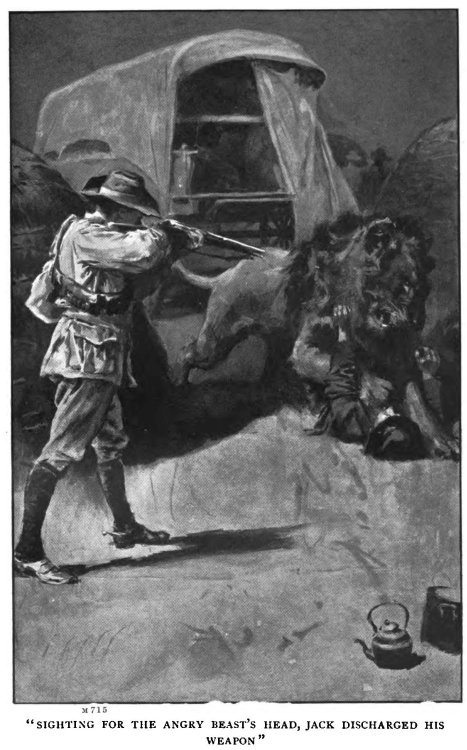
But it was not to carry off the body without interference, for one of the Boers had gallantly remained behind, and, stepping forward and lifting his rifle to his shoulder, he fired point-blank at the lion’s head.
Jack watched for the result with breathless excitement, and the next moment ran out of the hut towards the scene of the struggle; for, stung to madness by the bullet, the fierce animal had left its first victim, and with a spring which carried it at least six feet in the air, dashed the plucky burgher to the ground. Jack slipped his thumb on to the magazine catch and opened it; then, taking a steady aim, he pulled the trigger, and sent a bullet crashing through the lion’s body. It failed to touch a vital spot, and once more sighting for the angry beast’s head, Jack discharged his weapon. But again the small bullet failed to kill, and, roused to madness by his wounds, the lion roared savagely and sprang at him.