"With Rifle and Bayonet" (continued 3)
Reading edition
“They do not realise this in England. They think that a few thousand troops will be sufficient should the emergency arise. But they will not be. Of that I am certain, for we are face to face with the biggest and most dangerous conspiracy that we have ever been called upon to meet. It will be a struggle for supremacy in Africa, and England will have to put out all her strength. Should she fail—and I trust and firmly believe that she will not—it will be the first step down on the ladder, which in the end will mean the dismemberment and the downfall of the most glorious empire that the world has ever seen.
“But we shall see. If we suffer reverses at first we shall learn by them, and I prophesy that this coming war will bring out England’s manhood and unanimity. Her sons will flock from the remotest corners of the world, her colonies will vie with one another to help her, and from every shore, from every spot which harbours an Englishman all eyes will be turned towards the great white mother.
“My lads, I am not romancing. I am telling you this in sober earnest. We are a slow and unemotional race, but we are true, and we are dogged, even more so than the Boers, and if real danger confronts the nation, woe to those who have attacked her. We shall want a lot of beating, and we’ve yet to find the ones who can do it.”
Chapter Six.
Face to Face with President Kruger.
More than five minutes of unbroken silence elapsed after Mr Hunter had finished that portion of his narrative which dealt with the troubles of the Uitlanders. He had summed the whole position up, discussed every point, and had finally shown that the dispute between the Transvaal Government and its alien population was approaching vast proportions, which threatened to involve the English Government, who were now supporting the claims of their distant subjects. That a great conspiracy existed he had proved almost beyond a doubt, and now, like the patriotic man he was, he had prophesied how the sons of the great White Queen would meet their troubles, and how on every side and from every colony they would stretch forth their hands and join them in a cordial union, swearing that nothing should part them but death, till the country they loved had regained her paramountry.
Then, with flushed face and quickened breathing he had sprung from his chair, and was now striding up and down the verandah with a stem, determined look upon his face, while his cigar was firmly gripped between his teeth and his hands were thrust deeply into his trouser pockets.
Against the shady wall, lounging full-length in big cane chairs, Jack and Wilfred stared thoughtfully over the verandah rail, and away over the rolling veldt which stretched between Mr Hunter’s house and his neighbour’s. They had both listened without an interruption to the details of the rise and origin of the Boers, and of their subsequent fortunes, and now they sat moodily wondering whether the conspiracy spoken of could really be a fact, or whether, after all, it was not some delusion with which Mr Hunter was frightening himself.
“Don’t imagine I am romancing or inventing a tale with which to alarm you,” repeated Mr Hunter at this moment, with marked emphasis, stopping suddenly in front of the two lads, and fixing them with his eyes as though he had guessed their thoughts and was replying to them. “What I have said is strictly true. A day of trial and tribulation is fast coming for the British Empire, and you will see that her sons will answer the call ‘To arms!’ with the enthusiasm that I have predicted.
“Very soon, I fear, the Transvaal will be an unsafe country for Englishmen, and if we, together with the foreigners of all nationalities who make up the Uitlander population, are compelled to fly over the borders, it will mean ruin for us all. Take my own case, for example. When I had served my time with the British army I determined to settle out here, having heard rumours of the hidden wealth of the country. First I obtained employment at Kimberley. Then, when I had saved a little pile, I came up here and invested the money in an old shanty, built for the most part of biscuit-boxes, with a presentable plank here and there to hold them together. Fortunately I had a friend in Durban, a cousin as a matter of fact, and from him I obtained consignments of useful articles, food and other matters, of which spades and picks of best English manufacture formed a large proportion. There was a growing demand for all sorts of things. Prices ruled high, and in the first year I had more business to transact than I could manage single-handed, and had a large sum in hand after paying off all my accounts at Durban and the cost of transporting the goods. Next year my wife became my partner and helper in more ways than one. We carried on the store between us, and from that date we have prospered beyond our wildest hopes. I have built this house and the large buildings of the store. There are funds of mine invested in the diamond mines at Kimberley, not to mention the gold diggings here, and every year almost I and my partners in the mines industry buy up mining rights in other parts.
“Thus you will see that a war will mean practical ruin for all, unless, of course, we beat these Boers and annex their country. Even then we cannot fail to be heavy losers.
“If it does come to blows I shall stay here as long as possible, and then I shall enlist in some of the volunteer corps of Colonials, which are certain to be called for. Possibly I shall obtain a commission, and in any case, my boys, I can promise you you shall get some post which will give you a share in the campaign.
“And now to return to you, Jack. I strongly advise you to leave for England. Unfortunately you have quarrelled with Piet Maartens, who is a dangerous young fellow; and now, by no fault of your own, you have become a marked man. I tell you your life will be in real danger from this moment, and I strongly advise you to get away.”
“Yes, I realise that I shall be no special favourite of the Boers after this,” Jack replied quietly; “but, whatever happens, I am not going to clear out of the country for Piet Maartens or any of his class. There is a deep game being played, and I think the information I can give ought to be passed on to the British consul here, and so to the Government. Also, there is likely to be some kind of a row pretty soon, and by what you have told me, Mr Hunter, I expect it is going to be a precious big one. At any rate there is likely to be some kind of excitement, and I am going to stay to see the fun. Johnny’s Burg is likely to be too hot for me, and since I am not particularly anxious to get a bullet between my ribs, I think I will slip away at once for Kimberley, where I am certain to be safe.”
“Do so, Jack, and at once too,” said Mr Hunter earnestly. “Take my advice and go immediately. Call on Tom Salter when you reach the diamond mines, and he will give you something to do. If there is trouble here I will write you, and arrange where you are to meet us. As to the magazine, I will see that the consul hears all about it. Now let us go into the dining-room and have something to eat. There is a train for Bloemfontein in two hours’ time. It will be dark then, and you can easily slip away. When you arrive you must procure a pony and ride to Kimberley.”
Accordingly they left the verandah and joined Mrs Hunter in the dining-room, where dinner was already laid. About half an hour later, as they were in the middle of an animated conversation as to whether Paul Kruger would or would not grant concessions to the Uitlanders, Tom Thumb, the Kafir boy, entered the room hurriedly, and cried in a low voice, “Baas, de Zarps outside, and that angry man, Piet Maartens, him knock at door. De Zarps all round de house. I know ’cos I look through de window.”
“Then they are after you, Jack,” exclaimed Mr Hunter. “Go on eating for a moment, lads, while I think how we can escape those fellows.”
“I’ll tell you, Mr Hunter,” said Jack calmly. “They know you dine about this time. Go on with your dinner, and let Tom Thumb remove my glass and seat at once, and make it appear as though I was not here. I’ll slip out and get away somehow. When he comes you will not know where I am, and can honestly say so. Good-bye all! We shall meet again soon. Don’t forget to send my things on to Kimberley, Mr Hunter.”
A moment later he had slipped out of the room, and Tom Thumb had swept away his glass and plate, and had made it appear that he had never been there. Meanwhile there was loud knocking at the door.
Jack darted through the hall, seized a broad-brimmed and somewhat shabby hat which Mr Hunter sometimes wore about the country, so as to make himself look less like a foreigner, and ran up the stairs. As he got to the top the front door was flung open by another Kafir, just as Tom Thumb walked across from the kitchen to the dining-room with a steaming dish in his hand.
“Mr Hunter in?” asked Piet Maartens roughly, stepping into the hall and rudely staring into the dining-room. “Tell him I want him.”
“Baas at dinner; finish in half-hour,” said Tom Thumb, standing in his way.
At this moment Mr Hunter called out to the “boy” to show Piet in, and a moment later the latter had entered the dining-room.
“I’ve a warrant here for the expulsion of John Somerton, who has been living with you,” he said with a malicious smile. “Where is he? I call upon you to hand him over!”
Piet Maartens stared round rudely, and strutted up and down the room as he spoke, as if the house were his and not Mr Hunter’s.
“John Somerton?” asked Mr Hunter quietly. “Why, what can he have been doing? Surely there is some mistake?”
“Mistake or not, I have a warrant here,” repeated Piet, still with the same malicious smile, “and I call upon you once more to tell me where he is.”
“I don’t know where he is. You can see for yourself that he is not dining with us,” said Mr Hunter quietly.
“He was seen to enter this house three hours ago, and he is here now, and you know it too!” exclaimed Piet angrily. “Now, where is he?”
“I have told you he is not here. If you do not believe me, and still think he is in the house, go and find him,” said Mr Hunter calmly. “Tom Thumb will take you round. Perhaps, then, you will have no objection to our going on with the meal which you have so rudely interrupted?”
Piet Maartens was evidently put out, but he knew Mr Hunter to be a man who was not to be trifled with, and with a muttered oath he turned on his heel and strode out into the hall. Then he went to the door and gave a shrill whistle. Two Boer policemen, who are locally known as “Zarps”, joined him immediately, and at once commenced to search every corner of the house. Meanwhile Jack had not been idle. Once upstairs he had darted into Mr Hunter’s room and obtained possession of an old tweed suit and a muffler resembling in appearance those usually worn by the Boers. Then he hurried out and along a passage till he came to a ladder leading up through a trap-door into a large loft where the cisterns for the supply of water were kept, much as they are in England. A moment later he had scrambled up, passed into the loft, and dragged the ladder after him. As he did so he heard steps running upstairs, and lowered the trap gently just as Piet Maartens and one of the Zarps arrived at the end of the passage.
There was a moment’s silence, and then he heard an exclamation of vexation and a rapid conversation, in which he recognised a word here and there which showed him that his pursuers had already guessed his whereabouts.
But Jack was not to be so easily caught. Above his head there was a small glass skylight, and this he pushed open with the end of his ladder, and was quickly out on the roof. Mr Hunter’s house was irregular in shape, and the roof was consequently not one of those sloping ones on which there is no cover. Where Jack was he was in a small hollow, with tiles rising steeply on either side of him; and here he determined to remain as long as possible. It was already dusk, and in a few moments it would be quite dark, so that his figure would not be seen as he climbed over the top of the roof.
Placing his ladder against the steeply-sloping tiles, in readiness for a hurried escape, Jack hastily dragged Mr Hunter’s old suit on over the clothes he was already wearing. There was no difficulty about it, for though Jack was somewhat taller than his friend, the latter was stouter and broader. Soon his rough disguise was completed, and with the slouch hat on his head he looked precisely like hundreds of Boers who were to be found in and around Johannesburg.
By now it was pitch dark, and he cautiously climbed up the ladder and stared down into the garden which surrounded the house. It was illuminated in patches where the lights from the windows fell upon it, and here the figures of half a dozen Zarps stood out prominently. Elsewhere all was darkness, but by watching carefully, Jack saw first one and then as many as four other widely-separated dots of fire, which now and again disappeared, to become more prominent a moment later, clearly showing them to be the glowing ashes of the pipes which Boers one and all indulge in from morning till night, whether acting as policemen or not.
There was at least ten yards between them, and Jack at once made up his mind to attempt to reach the ground and slip away. Sitting astride the top of the roof, he lifted his ladder with the greatest caution, and lowered it again on the other side till it rested in the gutter. Then he gently pressed upon it, and finding it secure put all his weight upon it and descended. Arrived at the bottom he fixed his heels in the iron gutter, and once more lifted his ladder and passed it down till it rested upon the roof of the verandah. This, like the one upon which he was sitting, was composed of corrugated iron, and at the slightest blow gave out a sound like a drum. But fear of capture, and what that might mean, made Jack cautious. His wits were sharply alert, and he handled the light ladder with such care that once more he managed to fix it in the gutter which edged the verandah, without so much as a sound.
Seated on the roof, he waited for a few moments, watching the little glowing spots below, and noticing that they had not moved. Then he heard shouts from inside the house, a loud bang, and the trampling of feet just beneath him, which told him that Piet Maartens and his companions had secured another ladder and were already in the loft.
There was not a moment to be lost. He scrambled on to the ladder and down to the verandah roof. Then he shifted his ladder and clambered down it to the ground, and was on the point of moving off when a rough hand forced something into his mouth, preventing him from crying out, a sack was thrown over his head, and he was carried away swiftly and bundled into a four-wheeled cart, which was driven off at a rapid pace.
For the moment Jack was bewildered. But he quickly realised that after all his caution the slim Boer had been too clever for him. One of the Zarps must have seen him climbing down the roof, and now he was in their hands, a prisoner, and with what fate before him? On his wrists a pair of handcuffs had been slipped, and at either side of him sat an armed Zarp. He could tell that, for each held him by the arm as though afraid that he would still contrive to get away, while one of them clicked the lock of his revolver in a very suggestive manner close to Jack’s head.
“Well, I suppose I had better sit still and wait,” he thought. “I must try to remember the various turnings, so that I shall know where they are taking me and how to return.”
But this proved unnecessary. The cart rattled along through the streets and then out into the veldt. About half a mile outside the town it slowed down, the sack was removed, and Jack found he was close to the railway.
A few minutes later there was the shriek of an engine, and a locomotive and one carriage steamed up and stopped close by them.
Jack was bundled unceremoniously and with many a brutal jeer out of the cart and into the train, which at once went ahead, carrying him in the direction of Pretoria with three rough-looking, shaggy Boers, one of whom was the identical man who had acted as sentry in the magazine when Jack made his escape. About a mile farther on they pulled up again, and this time Piet Maartens climbed in and joined them. Then they proceeded, and were soon racing along at a fast pace.
“We’ve got you at last, my fine, brave young Englishman, have we?” jeered Piet Maartens. “Let me give you some good advice. Make the most of the next few minutes, as they are the last you are ever likely to see. You will have to reckon with Oom Paul now. You will not find him so soft-hearted as that fool Oom Schalk, and even if you do, there is myself, not to mention fat Hans Schloss, who have to be considered. Altogether, you had best prepare for the end, and perhaps, now that you find we are in real earnest, you will not be quite so brave or cock-a-whoop as you were down in the magazine.”
Jack made no answer, for to do so would only have been to wrangle, and he felt as though he would like to think in peace, for even without Piet’s malicious advice it was sufficiently certain that he could expect little mercy from the rough men into whose hands he had fallen.
Instead, therefore, of replying, he smiled disdainfully and remained silent, watching the lights which now and again flew past the window.
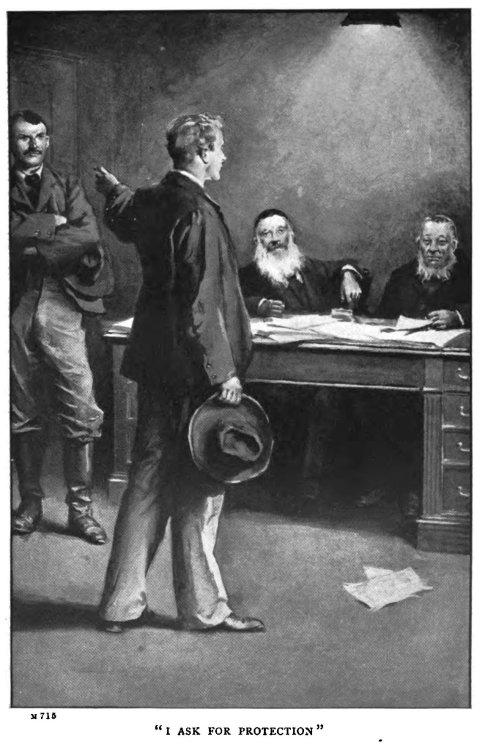
Half an hour later, the train drew up on the open veldt, and he was bundled out and into another cart drawn by a couple of horses, which at once set off at a gallop. Jack was placed on a seat between his two guards, and in this position was driven through Pretoria and up to the Government Buildings, his slouch hat and general appearance attracting no attention. He was now forced to descend and enter the building, where he was ushered into a small room, unlighted save for one electric lamp, which swung from the ceiling just above a leather-covered desk, littered with maps and papers, and behind which, leaning back in an arm-chair, sat President Kruger himself, seemingly half-asleep, and with his fat hands clasped together in his lap.
On one side of the president sat a big, burly man with a rugged, white-bearded, and not unpleasing face, whom Jack at once recognised as General Joubert, commandant of all the Boer forces, and, next to the president, the most powerful man in the Transvaal. Jack was placed in front of the table and remained silent, glaring defiantly and boldly at the man who, if report spoke true, was at once the most artful diplomat and the most consummate conspirator in the world.
There was some conversation in the Boer tongue, which Jack could not follow, as he had only picked up a few words as yet. Then Joubert addressed him in English, acting as interpreter between him and Paul Kruger, as the latter had such an intense dislike for anything British that he even pretended to be ignorant of the language.
“The president desires to know who you are, and for whom you were acting as spy two nights ago,” he said courteously. “Who employed you? Was it the British Government?”
“No one employed me,” answered Jack, looking Joubert straight in the face. “It was purely by accident that I discovered the magazine down by Volksrust, and since the men there were positive that I was a spy and talked of shooting me, I was forced to escape for my life. That is all I know about the matter; and now I will ask you by what right I am removed in this manner from Johannesburg and brought here as a prisoner. I am a British subject, come here for my health, and if I have done anything wrong I am willing to stand my trial in the courts.”
“Tush, boy!” Joubert replied harshly. “What do we care about subjects of England here? You have acted as a spy, and that is why you are a prisoner.”
“Ask him on his honour whether he was a spy and whether he is telling the truth,” President Kruger broke in at this moment, using the English tongue in his eagerness to put the question. “Ask him on his honour,” he repeated. “All of his country pride themselves on that, and when they are put upon it they will tell the truth.”
“I am no spy,” Jack said calmly. “I have told you the truth, and will swear to it on my honour.”
“Will you make use of the secret you have obtained, if I let you go and send you outside the Transvaal?” asked the president, now fully awake, leaning forward and favouring Jack with a piercing gaze.
“I cannot promise not to,” replied Jack, after a moment’s pause. “If that magazine is a menace to England, as seems most probable, it will be my duty to inform the Governor of Cape Colony of it, and I shall do so.”
“Ah, you will!” growled Oom Paul angrily. Then he turned to General Joubert, and the two conversed volubly for a few minutes, the president hammering on the table with his hand in the most emphatic manner, and evidently laying down the law.
“Bah!” he exclaimed at last. “What does it matter? It would do more harm to us to injure this lad than for our secret to be known. The British are already aware that we are purchasing arms. Let them know it all. It will not harm us; though to act so as to cause the prisoner’s friends to make active enquiries for him might precipitate matters. Let him go! Release him! He is a brave lad, which is unusual amongst these hated Rooineks, and he deserves to go free as a reward for his boldness. See to it, Joubert!”
Jack was overjoyed, for he had quite expected that the rash avowal of his intention to divulge his secret would make matters even more unpleasant. And now he was free. He was on the point of thanking the president and of retiring when his eyes lit upon Piet Maarten’s angry scowling face, and he at once remembered the young Boer’s threat that he and Hans Schloss together would have to be reckoned with.
“Your honour,” he said, facing Oom Paul again, “I have a request to make. You have commanded that I shall have my liberty. I ask for protection. That man there, together with a German whom I had the misfortune to wound when escaping from the magazine, have threatened to deal with me should I receive my freedom at your hands. I ask you now to grant me some kind of an escort to the frontier.”
“Have I not ordered that you shall have your freedom?” answered Paul Kruger brusquely. “That is enough. Should anyone attempt to molest you he shall account for it.”
Satisfied with his answer, Jack murmured his thanks and retired. He was at once placed in charge of two Boers whom he had never seen before, and was driven off into the veldt again. About an hour later an engine and a single carriage steamed up and he was told to get in. Then they were whirled away to Johannesburg just in time to catch a train starting on the long run to Port Elizabeth.
One of the guards remained behind, but the other stayed on with Jack, making himself most pleasant, and chatting with him constantly.
Many hours later he shook hands with him, and wished him good-bye.
“Don’t come back to us,” he said shortly, as the train ran into Norval’s Pont, the southern border of the Orange Free State. “You have escaped with your life, but you would not do so a second time. Here is money which the president told me to hand to you. It is just sufficient to pay for your journey and comfort to Port Elizabeth, and here also is your ticket.”
Jack thanked him, pressed his hand, and then watched him depart. A few moments later the train was in motion again. At Naauwpoort, the next stopping point, there is a junction, with a connecting line running westward to De Aar to join the Cape Town line to Kimberley and Mafeking, and here Jack left the carriage and boarded another train. Late the next evening he had reached the diamond city, and had called on Tom Salter, an old friend of Mr Hunter’s.
“Hallo, Jack!” exclaimed the latter, who had met him before. “What brings you here? Your place should be alongside of the Hunters, for they are likely to want every man they can lay hands on soon.”
“Yes, I’ve heard that,” Jack answered, “but unfortunately I have got into hot water in Johnny’s Burg, and have consequently come here for the good of my health.”
“Ha, ha! That’s queer, my lad,” laughed Tom Salter, a typical, red-faced, and robust-looking colonist. “You’ve been punching that fellow’s head again, I suppose? What’s his name? Piet Maartens, or something of that sort, isn’t it? Ah, it’s you quiet, harmless-looking lads who are always getting into a warm corner!”
“Well, no, it’s not quite that,” Jack replied, with a smile. “Piet Maartens, though, had a hand in it all the same. I’ll tell you all about it if you like. Mr Hunter told me to come here, and said you would be able to give me something to do.”
“Of course I will, Jack,” said Tom Salter heartily. “And you will take up your quarters with me. There’s plenty of room in the house, and the wife will be glad to see you. Now tell me the yarn.”
“That was a close shave, old boy,” he said, when he had heard Jack’s adventures. “Phew! You were within an ace of being shot by those fellows in the magazine. Ah, they are rough customers, and we’re going to have an ugly trouble with them! That’s why we here and our boys up at Mafeking are getting ready. Special-service officers have come to us from England, and though you’d scarcely think it, ammunition and stores are quietly pouring in. Ah! we’ve one of them here as slim as old Oom Paul himself, and another lad up at Mafeking, by name Baden-Powell, who would even give that old crafty schemer a start, and lick him easily. Well, we shall see, but if there is to be a row I’m going to be in it.”
“Everything seems to point to war; at least so I have gathered from Mr Hunter,” remarked Jack, “and I, too, mean to take a share in it.”
“Well done! You’re the right sort of lad!” exclaimed Tom Salter, slapping him on the back. “And mind you, if you want to be in the thick of it, you must stay over here. Kimberley and Mafeking will be besieged, and there will be stirring times. There will be work, too, for everyone. Every lad here will give a hand; all the civilians will join in with our soldiers, and will show our friends the Boers that we mean business.”
“If there is trouble, and the Uitlanders have to leave the Transvaal, I shall return to Johnny’s Burg, Tom. I arranged it all with Wilfred before I left; in fact, weeks ago. You see, Mr Hunter means to stay on and look after his property, so someone will be wanted to take Mrs Hunter down to the frontier, for, by all accounts, once the Boers are let loose there are likely to be unpleasant times for the refugees. After that I shall come over here and lend a hand if I can, though I don’t know about staying for good. There will be little fun if the siege lasts for months, as seems likely by the amount of stores which you say are coming in.”
“Ah, I never thought of that, Jack! My property and money are here, and naturally I shall stick by it and defend it as long as I can; but for you it is a different matter. But there will be lots of despatches to be carried south, for our telegraph wires and communications are certain to be cut. You could volunteer after a little while as a messenger. It would be rough and dangerous work, but I dare say all the more to your taste, and after the few weeks you will work here with me you will have the advantage of knowing the country. You have arrived just in time to join me in a prospecting tour. Mr Hunter and I, with two others, have been in partnership for many years, and just now we have agents travelling from place to place searching for possible gold reefs. They report their finds to me, and I ride or drive over and inspect. Then, if it is likely to prove of any value, we buy the property and secure the mining rights.
“I intend starting north to-morrow, and expect to be away for a month. You may come if you care, and I need not say I shall be glad to have you.”
Jack gladly jumped at the offer, and next morning, after a visit to a local store, where he purchased some clothing, he set out with Tom Salter, looking every inch a young colonist, dressed in riding-breeches and gaiters and a dark-blue shirt. On his head he wore a slouch hat, and over his shoulder was a bandolier filled with cartridges which fitted the Lee-Metford rifle which Tom had lent him. At his hip he carried his Mauser pistol, now no longer concealed, and thus equipped he and Tom rode out, and turning north-west, made for a country which was noted for its wildness.
More than six weeks passed, and during that time he and Tom Salter made many expeditions, sometimes to the west into an almost unknown country, and at other times into the Orange Free State or the Transvaal. After each one they would return to Kimberley, and Tom would write reports on the properties he approved of, and leave Mr Hunter and the other partners to purchase them and secure the rights. In this way Jack quickly became hardened to the saddle, acclimatised and weather-beaten, and moreover was a rider who by constant practice could have held his own now in an American ranche out west by the Rockies. He was, as even Piet Maartens would have been compelled to admit, a strapping, well-set-up young fellow, whose laughing lips and open face almost belied the bull-dog squareness of his chin, and the daring, unflinching look in his eyes. The sun had tanned his cheeks and arms, and as he sat his native pony, his left hand well down, while his right grasped his rifle and leant the butt against his thigh, the natural, upright pose of his body and set of his head, together with a certain jauntiness, don’t-care-who-comes-along sort of style, imparted by an artful bend in the brim of his hat, made Jack Somerton look just what he really was, a plucky young Englishman, who had come out to rough it in this far-away country, and had done exactly what he had intended.
But Jack was not only a fine-looking young fellow. His rough life and his contact with the Boer had made him quick and slim. He looked even-tempered and easy-going, and appeared to take little heed of what he heard or saw; but he was wide-awake, very wide-awake. He missed nothing, and he put all he saw away to be remembered. Thus his various rides had not only made him acquainted with many people, but by now he knew the surrounding country, and could have found his way over it in the darkest of nights.
In addition, he had had many opportunities of practising with his weapon.
“You’ve got a gun there, Jack, my lad,” Tom Salter had said when they first started out prospecting, “and it’s not for appearances only. You want to learn to use it. I never miss a chance even now, and I’m a pretty good shot, I can tell you, without the slightest wish to boast. Still, I am always practising, because I know there is nothing one gets out of so easily. You must be at it constantly to be a good shot. If you’ve got good eyes, and can spare the time to shoot, you’re bound to turn out a marksman. Look at the Boers! Every one of them living outside the towns is a crack shot, simply because he starts when he’s young and sticks to it. Now what you want to do is to take a pot shot at any likely object we come across out in some of these deserted places. The trunk of a tree, a white stone on the side of a distant kopje, or even a vulture, of which there are numbers hereabouts. They are brutes, and the more you hit the better. You’ve got a Mauser pistol too, and had better make use of it. If this war comes, you’ll find your time has not been wasted.”
Jack followed this advice. During their long, and generally lonely, rides, he would often fire as many as twenty cartridges in an afternoon, galloping up to the object afterwards to see what success he had had. As a rule, he fired from the saddle, but sometimes he would jump to the ground and aim whilst standing; at other times, at Tom’s suggestion, he would slip from his saddle, scuttle hurriedly across a piece of open ground, taking advantage of every boulder or ant-hill, and firing at an imaginary enemy from behind each one. Then, when he had reached a ridge, or a piece of better cover, a glance from his trained eye would pick out the best spot to fire from, and he would lie prone on the ground, without so much as the brim of his hat showing, while the muzzle of his rifle projected between two boulders and hurled forth a stream of bullets as he used the magazine.
“That’s it, my lad,” Tom would say encouragingly. “That’s just how our Boer friends fight, and it’s the only method nowadays, when bullets carry so far, and everyone is armed with a modern weapon of precision. It’ll be ticklish work, I can tell you, if our fellows have to attack from the open, and that’s what it will have to come to, for you won’t find these Dutchmen exposing themselves if they can help it. They’ll sit tight behind their boulders, and we shall have to turn them out at the point of the bayonet. Yes, it will be ticklish work, and will require real grit, but I’ll bet anything our boys will tackle it. There’s another thing too. Every youngster armed with one of these magazine rifles is inclined to blaze off all his ammunition at the first alarm. It’s wasting cartridges, which cannot always be spared; and what is more, it is apt to demoralise the others. That’s what you must guard against. Never use the magazine unless there are lots of beggars coming pell-mell at you. If there’s a rush, then is the time to pump in the lead as fast as you possibly can.
“Then, too, you must learn to train your pony, and whilst I’m teaching you to use your rifle, I may as well instruct you in the other matter also.”
Jack was naturally only too willing to learn. Riding all day long across the open veldt was somewhat monotonous at times, and his rifle practice and other manoeuvres helped to make the journeys pass more pleasantly.
Thanks to the allowance which his father had left him, and which was regularly transmitted from England, he was always supplied with an ample sum, and this, when supplemented with the wages paid him at Johannesburg, had given him sufficient for all his wants. Something to ride was one of the most pressing of them, and with Tom’s help he had, soon after his arrival at Kimberley, become possessed of two Basuto ponies, noted for their hardiness and agility. They were about the size of an English cob, mouse-coloured, and somewhat scraggy looking. But for all that they were wiry little animals, with plenty of spirit, but not vicious. Jack named one Victoria and the other Prince, and had no need to complain of his purchases. They turned out to be fast and sturdy little animals, who could easily thrive on the veldt when stable-fed horses would have starved. In addition, they were absolutely sure-footed, so that one could trust them to gallop down the side of a rough kopje, with the reins on their neck, without fear of an accident, for they were used to the work, and could be left to themselves to leap the boulders which came in their path, and steer clear of the ant-bear holes and nullahs which cut up the ground in every direction.
A few weeks’ training was sufficient, and before the prospecting tour came to an end they would stand stock-still while Jack fired above their heads, or at a touch from his heel would canter on, and turn swiftly with the merest pressure of a knee. A jerk of the reins across their necks, and down they would drop on the ground, the rider standing in his stirrups and easily freeing himself, and there they would lie while Jack fired his rifle over them. Sometimes, too, he would knee-halter them and leave them to graze unattended. This knee-haltering was rapidly effected. A long thong of untanned hide was passed over the neck, close up to the head, and one end put through a slit in the other. The free end was then taken round the leg just above the knee and secured with a clove hitch. The animal could then hobble about over a limited area in search of grass, but could not get far, and the halter could be thrown off at a moment’s notice.
But by this time other and more important matters began to engage his attention. There was an ominous cloud of unrest hovering over South Africa. It affected all, and filled them with anxious thoughts, for none knew when it would burst and let loose the thunder and lightning of a terrible war.
Already negotiations between the Boers and the British Government were at a deadlock. Both sides were arming, the former with the absolute certainty and wish for war, and the latter slowly and with evident sorrow. Suspicion was in the air, and hatred between the two races unconcealed. A conference at Bloemfontein had been held between Sir Alfred Milner, the Governor of Cape Colony, and President Kruger, but had led to no result, save a further deadlock. Kruger would make no satisfactory proposals. He was firmly determined that the Transvaal should be for Boers alone, and that no Englishman should have a voice in the country. England asked for equal rights, and was laughed at—defied. Yes, this small state, with a history which could only record some two hundred years of peasant existence, and a total population less than that of one of our big northern towns, had as good as cast down the glove at the British Lion’s feet. And the Lion still sat half-crouched, silently waiting, and hoping that matters might be arranged for peace.
Opposed to England’s forces was a minor state, which was snapping its fingers at her and practically daring her to retaliate. Once before the Transvaal had acted in a similar manner, and then, because there was some doubt as to the justice of our cause, and because we have ever been magnanimous, we made peace with her.
But, like a little dog, the South African Republic had continued yapping at us, distracting our attention while she grew and thrived, and armed herself to the teeth. And now that she had attained to full proportions, the conceit of youth and the impetuous desire to play with her new guns had led her to seek a quarrel, the result of which she hoped would for ever free her from the hated British suzerainty, and give her that independence for which she longed.
And on every side the world looked on and laughed in its sleeve at our difficulties, while it openly upbraided us for having ulterior designs on so small a state.
Matters could not remain as they were. Business was at a standstill, and crowds of refugees were fleeing from the Transvaal. Then the Orange Free State intimated that in the event of hostilities it would cast in its lot with the Transvaal, while there was open disloyalty amongst a portion of the Dutch Cape Colonists, which proved the existence of a wide-spread conspiracy.
England awoke sorrowfully to the fact that hostilities were not to be put off, and, calmly making the best of a bad matter, set to work to prepare for the struggle. Already she had despatched special officers for the defence of certain parts, and now she sent sufficient men to raise the garrisons of Cape Colony and Natal to 20,000, and that done, set to work to mobilise a complete army corps and call up 25,000 of her reserves.
The Boers, too, showed that they meant business. Every male of a certain age was bound to serve, and by October let had been called upon. From Pretoria and Bloemfontein the call to arms was passed on by the telegraph wire, and then by the field-cornets, or local magistrates, and within a few hours, bringing their rifles, horses, food, and ammunition with them, the burghers mustered to their several commandoes. The Orange Free State men manned the passes in the Drakenberg range of mountains looking into Natal, and also sent other commandoes (a large force of men) to watch the southern border along the Orange River, and the Basuto border, where trouble from their old enemies might be expected.
The Transvaallers for the most part went south by train through Volksrust to Laing’s Nek, the scene of the former struggle, while others went north to Komati Poort, where the railway from Delagoa Bay entered the country, and to the northern border near Tuli. A large commando was also despatched to threaten Mafeking, and another marched south towards Kimberley.
Thus, armed to the teeth, the Boers awaited the coming war, and now that they were fully prepared, with all their burghers on the borders and within striking distance, they despatched an ultimatum to the British Government, the more audacity of which set the world agasp, and made our countrymen shut their teeth with rage. It was addressed by President Kruger on October 9th, and declared that forty-eight hours’ grace would be allowed for our forces to be withdrawn from the Cape, our war preparations to be suspended, and our grievances submitted to arbitration. If we refused to do as demanded, war should commence on October the 11th, in the afternoon.
Never before had such an audacious message been addressed to us. There was no answer to be made. Its despatch made war unavoidable. We were forced into it, and accepted the inevitable with a sigh. But had we known all that was in store for us, had we as a nation realised that this was no tribal war, such as we were accustomed to, but a stern struggle against a race of born soldiers armed to the teeth, and favoured by a rough country suited to their tactics, that sigh would have been replaced by a start and by an anxious foreboding which would have led us to throw all our available forces into Africa without a moment’s delay.
But to return to Jack Somerton.
Early in October he and Tom Salter found themselves back in Kimberley again discussing the news, and on the 9th of the month, the very date upon which President Kruger despatched his ultimatum, a letter reached Jack from Mr Hunter, earnestly begging him to come to his help, and aid Wilfred in escorting Mrs Hunter to the frontier.
I know it is asking a lot of you, he wrote, for it would be awkward if you were found in the Transvaal after the warning you have had. But I know you and Tom have often been prospecting in this country during the past few weeks, and really, my boy, I should be grateful if you could come. Wilfred is a good lad, but scarcely capable of the work which will be required, for I can tell you the refugees are likely to meet with trying times.
Jack naturally determined to go at once, and communicated his intentions to Tom. “I’ll risk it,” he said. “An old tweed suit and a slouch hat ought to disguise me, and if I carry a rifle all the better. I shall ride through on Vic and Prince. It would take longer by rail, and all the stations are certain to be watched. I know the way, and ought to get through in about three days.”
Accordingly he saddled up his ponies, jumped into the old suit in which he had left Mr Hunter’s house, and with a hearty shake of the hand from Tom and his wife, set out towards the north, carrying sufficient water and provisions with him to last for a week.
“Good-bye, old boy!” Tom shouted after him. “We shall expect to see you here in a week or so, but we shall be closely shut up, and you will have to find a way in. Ta, ta! you’ll manage it, I’m sure.”
Jack waved his hand, shouted back that they might expect him in about a fortnight, and, shaking up his ponies, cantered away out of sight.
Chapter Seven.
Refugees.
It was shortly after noon when Jack set out from Kimberley on his long ride to Johannesburg, and as he could not expect to get there before the afternoon of 11th October, when the ultimatum addressed by President Kruger to the British Government expired, he determined to ride at a moderate pace, for he knew that Wilfred would wait for his arrival. But there was another matter to be considered. An Englishman would now be a marked man in the Transvaal or the Orange Free State, so that if he wished to get through undetected, he must choose the darkest hours for travelling, and lie up during the day.
About five miles out from Kimberley he pulled up, knee-haltered his ponies, and sat down on a boulder, with a map of the two republics spread out before him.
“Let me see!” he thought; “I must pick out a route which will be little frequented just now. The Transvaallers, I know, are rushing west and north to Mafeking and the northern border, and east and south towards Natal. The other fellows in the southern state are making down this way to Kimberley with some of the Transvaallers, and they are certain to combine at Bloemfontein, coming across country by train. The remainder go east to Natal. That leaves the Vaal River deserted, and that ought to be my direction. I will wait here till dusk, and then cut straight to the right into the Orange Free State, and make for the road to Hoopstad. From there I must manage to get to the neighbourhood of Reitzburg, cross the river, and trust to luck to get through the remaining distance. It will be touch and go, but, dressed as I am, I ought to have a chance.”
And, indeed, looking at Jack anyone might have admitted the same. Clad in Mr Hunter’s old tweed suit, which was a size or two too big for him across the shoulders and round the waist, but all too short at wrists and ankles, he looked for all the world like the average Boer. Beneath his trousers he wore a pair of high riding-boots, round his neck was a blue woollen scarf, and on his head a dilapidated and weather-beaten felt hat. Over his left shoulder was a bandolier filled with cartridges, and hitched over the other, and drawn tight against his back so that the butt swung well free of his saddle, was his Lee-Metford rifle. In addition he carried a water-bottle, a mackintosh sheet, with a hole in the middle through which he could put his head, and his Mauser pistol, which was comfortably hidden away in its old position.
Extra shoes, or implements for putting them on to his ponies, were not wanted, for in addition to their many other good points, these shaggy, unkempt-looking Basuto animals, though never shod, were nevertheless equally fast over grass or stony ground.
It was still early in the day, and after riding on a few miles, Jack pulled up again and off-saddled, so as to rest his ponies. Whilst they set about foraging for themselves, he sat under a large eucalyptus-tree, pulled out his pipe and lit it, and proceeded to clean his rifle. A few hours later the shadow in which he sat had lengthened considerably, and he turned round towards the west to see the sun, which had been streaming down upon him all the day, just declining behind a far-distant range of mountains. It was a sight which set Jack moralising, for here, before his eyes, was a gorgeous scene, a fit subject for any artist. The sun was sinking in a splendour of gold and purple lights, and the heavens above it were decked with beautifully red and silver-streaked blue clouds, against which the jagged broken peaks of the mountains stood up boldly, while their rugged and boulder-strewn slopes, and the stretch of rolling veldt below, were already clouded with the shades of coming night. It was a peaceful scene, and why, thought Jack, should not all the beings dwelling within reach of it, or, for the matter of that, dwelling in a country capable of displaying such a prospect as lay before him, live in peace and good brotherhood with one another and enjoy it? South Africa was a vast country, so sparsely populated that one could ride for miles and miles without sighting so much as a roof or habitation, let alone a man. And yet no one thought of the beauties of the country. Other and deeper matters vexed their minds, and because they could not agree they were on the brink of a sanguinary war which would mean an awful loss of life, and—what then?
“Mr Hunter says it’s a case of British supremacy,” he murmured. “Yes, that’s what it is, and that is what it shall be when the war is over.” And straightway Jack forgot all about the declining sun, and the peaceful landscape, and with a curious feeling of elation, which the thought of coming excitement had given him, knocked the ashes out of his pipe, jumped briskly to his feet, and set about saddling his ponies.
Half an hour later it was dark, save for a small moon which just gave sufficient light to show the road. Jack vaulted into his saddle, hitched his rifle over his shoulder, shook the reins, and cantered off across the main road running north, and then on over the rolling veldt, which was just beginning to send forth a few blades of fresh green grass.
Alternately cantering and walking, and changing from one pony to the other, he kept steadily on, the unshod hoofs of his animals making no sound, so that Jack had the advantage of being able to hear anyone approaching. Five hours later he stumbled upon the road from Kimberley to Hoopstad, and at once off-saddled to rest himself and his ponies for an hour.
During that time no one passed, and having eaten a good meal of biscuit and hard-boiled eggs, he started again, riding along just by the side of the road, and turning on to it now and again, when the veldt was so strewn with boulders or cut up by nullahs and deep water-courses as to make it difficult for him to pick his way.
About half an hour later he heard a low, murmuring sound in the distance, and in a few moments could plainly distinguish galloping hoofs. Instantly he turned on to the veldt, and made for a steep kopje a hundred yards off, amongst the boulders of which he quickly hid both himself and the animals.
He was not a moment too soon, for just as he got Vic and Prince prone on the ground, and had seated himself on the quarters of one of them, a couple of horsemen came spurring up alongside the road, while three more at that moment galloped round from the farther side of the kopje on which he was hiding, looking ghostly and white in the faint rays of the moon. They all pulled up within a few yards of Jack, and one of them, whom he recognised at once as Hans Schloss, the fat and vindictive little German, turning in his saddle pointed to the top of the hill, and cried out: “Ha, my friends, there is the flag, and here we shall all gather before riding on to kill those pigs of Englishmen in Kimberley!”
“That’s so,” another voice broke in. “That’s the flag kopje, and your friends the Transvaal burghers will be joining us at midnight. They are coming through from Bloemhof, and should be here in good time. Then, Hans, my boy, we shall ride for Kimberley, but as for killing the Rooineks, that is another matter. We shall not catch them napping. They are ready, but if the good Lord will give us strength we shall drive them out. Then, Hans, you shall kill them, and they shall be filled with fear at the sight of you. Ha, ha! you will frighten them out of their lives, my brave comrade!”
The Boer chuckled audibly, and Hans Schloss, whose self-conceit and density were almost as pronounced as his fatness, failed to see the thinly-veiled sarcasm, and joined in heartily, dropping one hand upon his thigh and assuming such an attitude of importance that his companions roared at the sight.
“Two days more, and we shall be over the border,” another of the Boers cried, when the laughter had died down, “and then there will be good work for all of us. For years we have waited, and now our dreams are to be realised. Even now most of the Uitlanders will have left us, and those who have not gone are hurrying as fast as possible to the frontiers. Well, they had better do so, for after 11th October it will be an evil day for any of them should we catch them. Only a few who have permits signed are to be allowed to stay, and those we will set to work at native labour. It will be more fitted for them.”
“Yes,” chimed in another with a hoarse chuckle, “they shall be set to work at our trenches, and if an English bullet should pick them out, then all the better. But softly, Carl! In two days’ time we shall be rid of the Rooineks, ’tis true, but they are a stubborn nation, and these boys they send against us are filled with pluck. Our leaders have asked us to believe otherwise, but we, who have lived in the towns, know that it is not always so. They will fight us, and to the death. But we shall beat them, and then what a prospect there will be before us! Ourselves one of the big Dutch states of Africa, we shall have ships upon the sea, while here the natives will slave to dig out the gold and diamonds. Independence is a great thing, but for us who have seen something of the world besides a lonely farm, wealth and riches in abundance are more to be desired. And we shall get them by the help of these Kafirs, while we live the same old peaceful life. Then we shall sail over to London—if England still exists—and our old enemies will be glad to welcome the Boer millionaires who have come to visit them and help them with their gold.”
What other wild dreams this bearded young man would have spoken of is difficult to guess, for at this moment a commando of Boer horsemen trotted up on the road. Within five minutes all had halted, and were seated upon the ground or boulders lying thickly everywhere, smoking their pipes and conversing in loud tones while they waited for the arrival of their friends who were following them, and for the burghers from the Transvaal who were to join with them in attacking Kimberley.
All this time Jack had remained silently amongst the huge splintered rocks tumbled haphazard on the kopje, listening with all his ears, and ready at a moment’s notice to slip away and gallop for his life. He was in a precarious position, even more so than when a prisoner in the magazine near Volksrust. For here he was surrounded by a band of men armed to the teeth and ready for war, and only too willing to wreak their vengeance on the hated English. Glancing up at the top of the kopje, he noticed now what he had failed to see before, a broad flag, the vierkleur, flying from a post wedged between the rocks. A few seconds’ consideration showed him that his best course was to lie quietly where he was, without attempting to move, unless some Boer happened to discover him. His ponies lay as if dead upon the ground, and were not likely to betray him except by snorting or answering the neighs of other animals, and to guard against this he rapidly passed the thong employed in knee-haltering them round their muzzles, effectively preventing them from making a sound.
Minutes passed, dragging terribly slowly for Jack, but at last there was a distant shout, and a few moments later a commando, about five hundred strong, rode silently across the veldt and pulled up on the road. Almost at the same instant a large force of men and wagons came up on the road from Hoopstad, and after all bad exchanged greetings, and a brief prayer had been recited by one of them, who was evidently in command, they scrambled into their saddles and set off at a walk.
Jack watched them file past, in threes and fours, and in any kind of order. Then came the wagons, drawn by long spans of patient, toiling oxen, showing clearly in the white moonlight, so that several large pieces of cannon were visible. More wagons followed, heaped high with shell and cases of ammunition, while others contained sacks of flour and mealies, and a few Boer women who had cast in their lot with their men folk, and had come to act as cooks. There were also a few Kafir servants and drivers; while in rear of all rode a small body of bearded men, joking and laughing uproariously, and evidently in the highest spirits at the prospects before them. Jack gave them half an hour to get well away, and to make sure that there were no stragglers following. Then he cast off the thongs from the muzzles of Vic and Prince, and was soon cantering along by the side of the road as before in the direction of Hoopstad. By four in the morning, when the clouds in the east were beginning to brighten, he had ridden some sixty miles, and was within fifteen of Hoopstad. He now searched about for a secure hiding-place, and presently came across an isolated farm standing a few miles back from the road. Leaving his ponies hidden upon the side of another convenient kopje, he stole forward, and soon reached the building. There was no one about, not even a dog, and he at once boldly walked up to the door. It was locked, but a window he tried was unlatched, and Jack at once squeezed through it and drew up the blind. The farmhouse consisted of two large rooms, a kitchen and a bedroom, and both were empty.
“Ah, all gone to the war!” thought Jack. “This place will suit me perfectly. It’s well away from the road, so that no one is likely to come near, and if anyone does, he will find the door locked, and will probably go away at once.”
Unlocking the door, he went out and fetched his ponies, leading them into the farmhouse, and stabling them in the kitchen. Then he searched about in the few outhouses, and having discovered some straw and oats, came back and made his animals quite comfortable. Another journey procured water for them, and then, locking the door once more and pulling down the blind, Jack first indulged in a much-needed meal, and then lay down in a bed in the sleeping-room.
When he awoke the sun was already more than half-way overhead, and as soon as it was dark he set out again, and by early morning had reached the neighbourhood of Reitzburg. Here he was forced to camp in the open, in a thick belt of scrub composed of acacias and mimosa shrubs, for there was no comfortable farmhouse available. But it was much the same to Jack. He enjoyed a good meal, watered Vic and Prince, knee-haltered them, and once more lay down to sleep.
Early on the following morning, as day was beginning to break, he rode round to the back of Johannesburg and pulled up at Mr Hunter’s house. No one was to be seen, so he stabled his ponies, and then knocked loudly at the door.
“Who’s that?” Mr Hunter shouted from above; and then, when Jack had made himself known and had been admitted, cried in astonishment: “Good heavens, my boy! I did not expect you for two days at least, and perhaps not then, for I asked you to do an almost impossible thing. However have you managed to get here? My letter can only have reached you on the 9th at the earliest, and here you are at dawn on the 12th. But come in, my lad; you must be tired out, and will want a good sleep.”
“Yes, I am a little done up,” Jack admitted. “I have been riding ever since dusk yesterday, and did the same for two whole nights before that. I have ridden every inch of the way from Kimberley, through Hoopstad and Reitzburg, and my legs and back are so stiff that I can scarcely move them. I think I’ll have a hot bath if I can get one, and then get Tom Thumb to rub me down with oil. A good tuck-in and a small nip of brandy will set me up again, and after a few hours’ sleep I shall be fit to start for the border.”
Accordingly Jack jumped into a hot bath, and was well rubbed with oil. After that he partook of a good meal and at once turned in between beautifully-clean sheets, to which, down Kimberley way, he had been a total stranger, except when he and Tom returned from one of their expeditions.
Almost before his head was on the pillow he was fast asleep, and when he woke again, feeling wonderfully refreshed, it was already getting dusk.
“Ah, there you are!” cried Mr Hunter with satisfaction, when he made his appearance in the dining-room. “Now I will tell you what has happened since the ultimatum, and indeed since war became a certainty. On October let the governments at Pretoria and Bloemfontein called up their burghers, and since then our streets have been filled with men, all on their way to the front, armed and supplied with ammunition, and trusting to an iniquitous system of commandeering to obtain other necessaries. No one’s property has been safe, and we in Johannesburg have suffered, I believe, more heavily than any others. My store has been practically denuded of its contents, so that I now congratulate myself on having cancelled all expected consignments of goods from Durban for the past three months, and having cleared all goods remaining here as rapidly as possible. Some of my friends have not been so fortunate, and have lost everything valuable to men about to embark in a campaign. Horses have been seized everywhere, and there again I have been wise in time. Two weeks ago I sent over the four-wheeled cart and four good horses to Ted Ellison’s farm, ten miles out from here. They will be perfectly safe there, for Ted married a Boer girl five years ago, and she is a good little woman, who would gladly see all this trouble over and a British government here, with the usual peace and good order.
“At the present moment my stables are cleared of everything save your two ponies, and they will be safe till you start, for the Boers have twice paid me a visit, and have commandeered every saddle and horse I had left.”
“I’m glad to hear about the team and cart,” said Jack thoughtfully. “But why not take the train down to the border. Surely Kruger and his friends will grant all refugees a safe-conduct?”
“Safe-conduct! A precious fine conduct they are giving us! Thousands of poor creatures are clamouring to be taken down, and have been doing so for these past three days. But what can you expect, Jack? It is a single line to Natal, and every inch of it is occupied in passing down trains laden with burghers. The refugees are quite a secondary matter, and by all accounts are experiencing cruel times. All available carriages are packed with Boers, and our poor country-people have to do as best they can in open cattle trucks or coal wagons.
“Then every station is crammed with armed and excited Transvaallers, who have committed all sorts of detestable acts. I know this is the case, for Joe Pearson, who works on the railway in ordinary times, watched train after train of refugees passing through one of the stations. The older Boers are quiet and well conducted, but it is the younger men who have committed these excesses. Threatening to shoot helpless passengers is the least of them. They have actually kept the poor people in the sidings for as many as twenty-four hours, absolutely preventing their leaving the trucks to obtain food or water. It is really terrible. The unhappy women and children, who form a good proportion of the refugees, have been exposed to the weather for three days between here and Laing’s Nek, and you can imagine what that has meant, for you yourself experienced the heavy rain last night. I hear one or two of the children died on the way down.
“It is dreadfully sad, terribly sad. But there is one consolation, England will demand a just retribution when the time comes.
“That is why I have decided to send Mrs Hunter down by road, rather than let her run the risks of the journey by train. The horses are good ones, and ought to get you to Volksrust quicker than the rail; that is, of course, if they are not commandeered. If that were to happen, I suppose you would have to get to the nearest station. But I can leave that to you, Jack. You have an old head upon those broad shoulders of yours.”
“I’ll do my best, never fear, Mr Hunter,” Jack exclaimed. “And now about starting. I suppose we had better do so at once. Mrs Hunter can ride Vic, and Wilfred and I will take it in turns to get on Prince’s back.”
“Yes, I think you had better go at once, my lad. Mrs Hunter is ready, and Tom Thumb carried over a hamper of provisions to Ted Ellison’s last night. All I shall ask you to carry is this bag of notes and gold-dust. Wilfred has another, and Mrs Hunter a third. I shall stay here to look after the house and property, and to keep an eye on the mines. I have already asked for a permit, and ought to get it, as I am one of the oldest residents here.”
“By the way, Mr Hunter,” said Jack suddenly, “this is the 12th. Has the war begun yet? I suppose it has, as these Boer fellows seem to have been in readiness long ago.
“Yes, it has already opened with a sharp affair with an armoured train below Mafeking, and I am sorry to say our boys, under Captain Nesbit, V.C., were taken prisoners. The news has only just reached us, but it appears they made a gallant stand before they were taken, and accounted for a few of the Boers. They were running up from Kimberley to Mafeking, and suddenly came upon a part where the rails had been broken up. It was a regular trap, for the enemy had their guns already laid for it, and used them freely. Well, it is just the opening incident of a long campaign, that is all.”
By now it was quite dark, and after a tender farewell from her husband, Mrs Hunter and the two lads, Jack and Wilfred, slipped round to the stables.
A few minutes later the door was opened silently, and they issued out on to the veldt, Mrs Hunter and Wilfred mounted respectively upon Vic and Prince, while Jack walked alongside.
An hour and a half later Ted Ellison’s farm was reached. The heavy spring-cart was already standing in the yard, with the hamper stowed inside, and it took very little time to put the team in and hook up the traces.
“Now, Wilfred,” said Jack, who had all this time been thinking how best to arrange matters so as to ensure their safe arrival in Natal, “you hop up there and take the reins. When you get into the road, keep the team at a steady trot, and if anyone shouts to you in Dutch, answer them, and keep rattling on. You know their lingo, and that should be a great advantage. I am going to keep some way ahead of you, and shall scout on one side of the road first and then on the other. If you hear a whistle like this”—and Jack gave a low but peculiarly piercing and long-drawn-out whistle, which he had learnt from Tom Salter—“pull up at once, and wait till I tell you the road is clear. If I whistle twice, turn on to the veldt, and whip up till you are well away from the road.”
Having given his directions, Jack vaulted on to Prince’s back, and, leading Vic, turned away from the farm, after thanking Ted Ellison and his wife, who heartily wished them a safe journey.
For three miles they went at a slow pace, Jack riding close beside the cart. Then they struck across the main wagon-road to Natal, and Jack at once cantered ahead on the veldt. To all appearances he was a young Boer burgher bound for the wars, so that even if he did happen to run across anyone, he was not likely to be recognised in the darkness as an Englishman. Beneath his coat he still wore his bandolier, and his pistol under his waistcoat, while his rifle was firmly strapped to the side of the empty saddle on Vic’s back.
Mile after mile passed by without a single Boer appearing. Then the sky, which had been open up to this, became banked up with clouds, and very soon a heavy storm broke, thunder roared, and large, jagged forks of lightning flickered everywhere, lighting up the lonely road running across the veldt. Then the rain began to pour down in a heavy deluge.
Wilfred and Mrs Hunter were well provided with waterproofs, and Jack by this time was enveloped in his large mackintosh, only his head and his broad-brimmed hat being exposed, while the ends of the rubber sheet fell over his pony’s neck and quarters, and completely protected his legs.
Suddenly, as he was cantering silently along on the veldt, the only sounds being the noise of the thunder and the squish, squish of the ponies’ feet, a brilliant flash of lightning seemed to pierce the ground some yards behind him, and almost instantly a hoarse voice cried out: “Wie gaat daar?”
He cantered on, and a moment after heard Wilfred answer the hail, for it was evident that Jack himself had escaped discovery, while the team and cart, trotting along on the open road, had been shown up by the flash. Then there was a second hoarse hail, and an order for the cart to pull up. But Wilfred paid no heed, and instead whipped up his horses, and sent them flying down the road.
Jack meanwhile had turned to the left and then ridden back, well away from the road, till he was on a level with the cart. Then he turned towards it and pulled up. As he did so a second flash showed Wilfred standing up and using his whip freely, while two mounted Boers were galloping along on either side of the leaders, vainly endeavouring to pull them up. At last, however, finding themselves unsuccessful, and stung to madness by Wilfred’s whip, one of them lifted his rifle and fired at the near leader, bringing the animal to the ground like a stone. The others stopped at once, almost throwing Mrs Hunter and Wilfred out of the cart.
Seeing that there was likely to be trouble, Jack at once reached over and unstrapped his rifle. Then he galloped up to the cart, to find that Mrs Hunter had been roughly dragged on to the road, while the second Boer was hastily lashing Wilfred to the wheel of the cart. What his intentions were was evident, for at that moment he completed the lashing, strode away a few paces, and lifted his rifle to his shoulder.
“Stop that!” shouted Jack, pulling up close to him. “We are refugees and deserve fair treatment!”
In an instant the Boer, who was a fierce young fellow, swung round and fired point-blank at him, the bullet cutting a streak from the brim of his hat.
Jack’s answer was even more rapid. His rifle spoke out, and the Boer dropped prone on the road. Then he swung round just in time to duck and escape a second bullet from the other Boer, and before the latter could load again, Jack’s Mauser pistol had safely reached his hand beneath the mackintosh, and the muzzle of it just showed at the edge in front, directed straight for the man’s head.
“Drop your rifle!” he said sternly. “That’s it! Now take off your cartridge-belt! That will do! Stand over there in the road! Now, Wilfred,” he said, turning to his friend, “as soon as Mrs Hunter has set you loose, back the cart away from the leader and cut the harness. Then drive on, and I will catch you up.”
“Move on up the road in front of me,” he continued, addressing the Boer, “and if you attempt any tricks I’ll put a bullet through you!”
The young Boer evidently understood every word, for with a downcast air he set out along the road in the direction of Johannesburg, with Jack a couple of yards behind him. A mile farther on, when the storm seemed to have reached its height, and the thunder was roaring overhead in long, continuous claps, Jack quietly pulled up, turned on to the veldt, and galloped back, leaving his prisoner still marching on in blissful ignorance.
When he arrived at the scene of the recent conflict he dismounted, picked up both of the Boer rifles and bandoliers, and, mounting again, galloped away into the veldt, where he smashed the butts against a boulder.
“That fellow is safe to return as soon as he finds I have slipped away,” he thought, “and if I left the rifles the chances are he would follow and stalk me. That will settle him at any rate.”
Once more he cantered on, and caught up the cart about two miles along the road. Wilfred at once pulled up, and the two young fellows held a consultation.
“It was a piece of bad luck all through,” said Jack, with an exclamation of disgust. “If there had been light enough I should have seen those fellows, and could have warned you so as to avoid them. That flash of lightning just spoilt our chances. If it hadn’t been for that we should have got through. One thing is certain too, that if we had given in to them, and pulled up when they ordered us to do so, we should have had our cart and horses commandeered, and then we should have been in a nice pickle.”
“That’s just what I thought,” answered Wilfred. “I knew it meant that we were prisoners, or that the cart and team would go, so I held on and gave them a taste of the whip when they came alongside. My word, though, it was a precious near shave for us! I very nearly went flying on to the horses’ backs. But as it is, neither of us is hurt, thanks to you, Jack, old boy!”
“Well, it was a near shave,” agreed Jack. “That Boer’s bullet has cut a long slice out of my hat. I was sorry to shoot the poor fellow, but he brought it on himself, and certainly deserved it, for he meant to kill you. But now, about the other man. I took him up the road, and on the way back broke the rifles. I noticed, too, that both their horses had scampered away on to the veldt. For all that he is now on his way to the nearest station, and before two hours have passed the news will have been telegraphed down the road to Yolksrust, and the Boers will be on the look-out for us. What are we to do? We are sure to run our heads into a trap if we go on in this direction.”
“Why not bear to the right and strike into the road for Villiersdorp in the Orange Free State, and from there to Harrismith?” asked Mrs Hunter. “I have driven along it more than once. We can cross the Vaal by the drift (ford), and by taking that route shall put the Boers off the scent.”
“That’s a capital plan, Mrs Hunter!” cried Jack. “What do you think, Wilfred?”
“Yes, I quite agree with Mother,” Wilfred answered. “The Villiersdorp road will be the one for us, and once we get into the other state we shall be comparatively safe from molestation, for the burghers there are not nearly so bitter against us as are these Transvaallers.”
Accordingly the cart was driven off the road to the right, and then across the veldt in a south-westerly direction. Soon they bumped across the railway, and before dawn were on the other road. Driving along it a little way they came to a part which was covered with kopjes, and here, within easy distance of the road, they made a halt, pulling the cart into a deep donga (big water-course), where it was completely hidden. Alongside it they stretched out their mackintoshes on the sodden ground, and having waited till the day had broken, and satisfied themselves that no one was about, they lay down and fell asleep.
Three nights later they were in the neighbourhood of Harrismith without having met with any adventure of note upon the way, and on the following night they drove past Albertina, where they discarded the cart, leaving it for the first comer to appropriate, and pushed forward to Van Reenen’s Pass in the Drakenberg mountains. This they knew was already watched by a force of Free Stater Boers, but they were looking more for an invasion from Natal than for refugees endeavouring to slip through from their own country.
Jack scouted ahead, and having found the pass free of men, went back and informed his companions. Then they pushed on again, Wilfred leading one of the three horses and riding another, while Mrs Hunter boldly clung to the back of the third. A pitch-black darkness and heavy rain again favoured them, and they slipped through the pass and down to the plain below unchallenged.
Two hours later the welcome hail “Who goes there?” in healthy English, greeted them, and having shouted back “Friends”, they halted and waited for the cavalry patrol to give them permission to go on.
Soon afterwards they were in Ladysmith, and had found rooms at the hotel, where their arrival after their long and adventurous drive caused quite a sensation. But all three were too tired to do much talking. They snatched a hasty meal, and retired to bed, where they were soon sleeping the sleep of exhaustion.
There was no need for them to rise at dusk and set out again, for they were now in the British camp and in British territory, so that when Jack did wake, late in the afternoon, he rolled over again and dozed off for more than two hours longer. Then he turned out, shook Wilfred, who was asleep in a bed in the same room, and, accompanied by him, crossed the camp and indulged in a swim in a large pool of water where many of the soldiers were bathing.
“Now, what is the order?” cried Jack, when they had returned to the hotel and had sat down to dinner with Mrs Hunter, in a room in which many of the officers were dining. “I suppose you will go down to Pietermaritzburg or Durban, Mrs Hunter, and if Wilfred will escort you there, I will stay here for a day or two, and then make across to Kimberley. There may be something going on here during the next few days, and if so I should like to be in it.”
“Yes, that is what I shall do, Jack,” Mrs Hunter replied. “I have friends at ’Maritzburg, and will join them to-morrow. Probably any wounded there may be—and I fear there will be many of them, poor fellows, before long—will be sent down there to the hospitals, and if so I shall occupy myself in nursing them. I have had some experience, and I dare say everyone willing to act the good Samaritan will be welcomed.”
“Then I will take you down there, Mother,” said Wilfred, “and after that will go with Jack if I may. Father told me it was more than probable that he would be ejected from the Transvaal before long, for he has no direct connection with the mines. In that case he will come south, and I shall wait here on the chance of his doing so. We shall hear from him before long, and if he is able to remain in Johannesburg I shall go across to Kimberley and join Jack.”
“Very well, then, I shall expect you some day, but I think you will have to wait for the relieving force,” Jack said. “Kimberley is already closely invested, I have no doubt, and you would have no chance of getting in, for you do not know the country. I do, however, and now that I have had such practice at long-distance riding, I shall slip in if I can, and then volunteer to carry despatches either south to De Aar, or north to Mafeking. Later on, if the town is not relieved—and a long siege seems to be expected,—I shall get out again, and see whether I cannot join one or other of the relieving-forces which are certain to be sent. For the present I shall rest here a little while.”
Accordingly Jack made himself at home, and on the following day, when Wilfred and Mrs Hunter had departed, he turned out into the camp, and was not long in making friends with a number of young officers, and with some of the soldiers.
Ladysmith he found was much like other towns in the district. Its most prominent building was the Town Hall, round which there were clusters of stores and verandahed houses, mostly with tin roofs, which reflected the rays of the sun like a number of large mirrors. In and about the houses, and around the town, was a more or less treeless, open plain, while surrounding it on every side were ridges and mountains which had a most imposing effect.
Jack was soon in conversation with a young captain of the gunners, and with him he made a tour of the camps, thoroughly enjoying the sight of all the tents, wagons, and guns, and the hundreds of khaki-clothed soldiers bustling about in their shirt sleeves preparing the mid-day meal All seemed to be in the very cheeriest of spirits, and as Jack and his new friend passed amongst them he heard many a laughing allusion to “Old Crujer” and the Boers.
In one corner of the camp a game of football was going on, and the combatants, selected from two of the British regiments, were playing in their shirt sleeves with as much keenness and energy as they would have displayed at home before a crowd of onlookers. Here, however, there were only a few officers watching the game, and a sprinkling of other “Tommies”, smart, healthy-looking men, smoking their pipes and cigarettes, and making the most of the few days of ease which remained before a sterner struggle would demand all their strength and courage.
“Fine boys, aren’t they!” remarked the captain. “They are never so happy as when they are kicking a football, or joining in some sort of sport. I dare say if we have to stay here very long we shall hold a gymkhana, a kind of athletic meeting on a large scale, and then Tommy is in his element. Ah, they are jolly good fellows, and it’s a real pleasure to serve with them!”
Soon after this Jack said “Good-bye!” and returned to his hotel, where, after luncheon, he again turned in for a sleep, for he had ridden some four hundred miles in little more than a week, and still felt the effect of the fatigue.
Chapter Eight.
The Battle of Glencoe.
When Jack came down to breakfast on the morning following the departure of Mrs Hunter and Wilfred for Pietermaritzburg, there was only one vacant place in the cramped little dining-room of the hotel, and on taking his seat he found himself face to face with a young fellow some three years older than himself, who was dressed in civilian riding-costume which closely resembled the khaki uniform worn by officers.
He was a jovial-looking fellow, with clean-shaven face, laughing eyes, and a head which was covered with closely-cropped red hair.
“Good morning!” he said, as Jack sat down. “It’s not much of a breakfast this morning; but then what can you expect with so many of these lusty officers about. They’ve eaten us out of house and home. Well, they’ll fight all the better. By the way, what are you? Volunteer, Natal carbineer, or civilian? Excuse my asking, but I am a stranger here, and am anxious to get information.”
“Then you have come to the wrong man this time,” Jack answered with a smile. “I only arrived a day ago, and know simply nothing.”
“In that case I dare say I shall be able to teach you then. My name’s O’Farnel, Lord Edward O’Farnel, commonly known as ‘Farney’. If we’re both strangers we had better look round together.”
“Delighted, I’m sure!” Jack exclaimed. “I was wondering what I should do with myself. I only came through from Johnny’s Burg a few days ago, and before that I had ridden over from Kimberley; so you can understand I am a perfect stranger here.”
“That was a long ride,” said Lord O’Farnel. “Tell me about it, and what kind of an experience you had coming down. By all accounts some of the refugees had a terrible time of it.”
Jack at once complied, and before the meal was over found himself on most friendly terms with the young lord who sat opposite him.
“Now tell me something about yourself,” he said, when he had told O’Farnel how he had come down from Johannesburg, and how he had spent his time since arriving in Africa.
“Something about myself, is it?” replied his companion. “Well, there’s very little. I’m twenty-two or thereabouts, Irish, and have no profession. Away back in good old Ireland I’ve a castle and a mansion, and any amount of acres which bring me in about twopence halfpenny a year. Ah, it’s a fine place, and very good to look at, but ruination to keep up! I said ‘Good-bye’ to it three years ago, and since then I have been travelling round. Last year I went home for a week, thinking they’d be pleased to see me; but, bless your life, the old caretaker in the mansion was the only one who cared a jot. The others thought I had come for the rent, so the very next morning they had dug a grave in front of the hall-door and put an old black coffin near it with a notice on top, written in the best of Irish, advising me to clear out at once. Pleasant fellows! They’ve quaint ways about them, but they are good-hearted all the same.
“I took their advice and left at once, and then came out here to see what I could do at the mines. But Kruger and his friends had upset everything, so I went south to Durban for a time, and when there was a talk of fun up here I took the train and came on the chance of seeing it. But how to do it is the next thing. What do you think, Somerton?”
“I am going back to Kimberley very soon,” said Jack; “but if there is to be a struggle in this direction I shall stay for a time and join in if I can. I was told yesterday that volunteers are badly wanted, and that anyone could be taken for the Imperial Light Horse. But that would be more or less of a tie. I really don’t see why we should not take part in all the fun as simple volunteers. Have you a rifle and a mount?”
“Yes, I have a good pony and the usual rifle,” O’Farnel answered; “and what is more, my kit makes me practically the same as any of the volunteers. I have been here for the last week, and so can put you in the way of things. I know one of the officers in a regiment stationed here. Let us look him up. I dare say he could get whatever you want, and I should advise you to buy a suit of khaki and a pair of putties. Then we will see whether we cannot go along with the troops.”
Accordingly Jack and O’Farnel strolled across to one of the camps and were fortunate enough to find the officer of whom the latter had spoken.
“Hallo, Farney!” he exclaimed, as they stopped opposite his tent. “So you’ve come up here! I thought you were going to stay at Durban.”
“No, I’ve got a restless fit on, Roper, and have come to see what is doing here. This is Jack Somerton, a friend of mine. By the way, he wants to get some kit. Can you help him?”
“I may be able to,” answered Roper. “Come over to the quartermaster and we will see what he has to say.” When they reached the quartermaster’s stores, which were temporarily in a large tin house, they found that he had a complete kit to sell, one of the men having been killed on the way up to Ladysmith in a railway accident.
The clothes were just the right size for Jack, and he quickly became possessed of them.
“There,” said Roper, as he handed them to Jack, “it’s not exactly correct, you know. These should be sold by auction in the regiment. But no one wants them, and you have paid more than they would have fetched at a sale.”
“Now we want to know whether you can help us to see some of the fun,” said O’Farnel. “We will volunteer for anything so long as it does not tie us down.”
“Then I should advise your going farther north,” said Roper. “Here you are not likely to come in for much, for the Free Staters compel us to keep on the watch. But General Symons is at Dundee, up towards the north of Natal, about thirty miles away, and if you go up there you are certain to see some fighting. He has 4000 men, and he will strike the first big blow. Look here, Farney, I’ll give you a note to a fellow I know in the Hussars up there, and if there’s to be a battle, he will see that you both have a share in it.”
“Thanks, that will suit us capitally!” said Lord O’Farnel. “We’ll start as soon as you can give me the note, for it would be an awful disappointment to arrive too late.”
A few moments afterwards they returned to their hotel, where Jack discarded his shabby tweed suit and donned the khaki.
“There you are now,” said Farney, looking quizzically at him. “You look just like the ordinary ‘Tommy’, and will do. My word, though, I thought what a quiet-looking fellow you were before; but now, what with the rifle and bayonet and that broad-brimmed hat, you look a regular mountebank! But come along. There is nothing to keep us, and we may as well start north at once.”