"With Rifle and Bayonet" (continued 2)
Reading edition
But there was really no need for the cutting down of prices. A store in such a populous town was a valuable property, and Mr Hunter’s had a reputation which ensured the various departments brisk business all day long. All who patronised it seemed to be in a prosperous way, and indeed only grumbled that all their energies and business prospects were smothered by the continual opposition and stupid action of President Kruger and the Boers.
To say that Jack enjoyed the life he was now leading was to describe his feelings rightly. He took the deepest interest in his work, and after his hours in the shop were done, generally went for a gallop with one or more of the many young fellows he knew. Christmas came and went, and by the early months of the New-Year, the eventful and never-to-be-forgotten year of 1899, he was quite himself again, a rosy-cheeked and manly-looking young fellow whom everyone but Piet Maartens and his Boer sympathisers liked.
So well did Jack’s life agree with him that he was within an ace of deciding to forego his commission in the army and remain for good in Africa. But Mr Hunter dissuaded him.
“You are too young to settle down as yet,” he said. “And besides, it was your father’s wish that you should follow his footsteps and enter the army. Of course we should prefer you to stay, but under the circumstances I hope you will return and go up for that examination. Later on, perhaps, when you have knocked about the world a little more, you may wish to resign your commission, and then if you join us here all the better! You will be older and more ready to settle down, and your family ties in England are not likely to prevent your emigrating if you wish to do so.”
Jack recognised the wisdom of doing as Mr Hunter suggested, and accordingly made all preparations to leave Africa in the following August.
But the old proverb that “Man proposes and God disposes” was exemplified in his case. Events proved too strong for him, and he remained in the country, shoulder to shoulder with his English friends, to face the storm of passion which was soon to burst over their heads, and to take his part in the bitter struggle which was to be fought out between the Boers and their allies, and the sons of our mighty empire.
Chapter Four.
A Startling Adventure.
“Jack, how would you like to carry out a little piece of business for me?” asked Mr Hunter one morning, extracting a letter from a big bundle which he held in his hand.
“I have just had this offer of leather goods from the agents in Durban, with whom I am in the habit of dealing. In spite of war scares, and the fear that we should have to leave the country suddenly, shoals of new-comers constantly reach us, and such articles as bags and trunks are always in demand by those who are forced to travel from town to town. Saddlery, bits, and reins are also easily disposed of. This would be a good opportunity for you to make a run down to Durban. You have never been there, and you could inspect these goods between the hours when you will be looking round the town.
“There is a list of the articles that have just been shipped over from England, and you will notice that against the prices quoted I have ticked down the amount usually asked for here. If the goods are of first-rate quality, you may close with the agents at once.”
“Thanks! It’s very good of you, and I’d like to go immensely, Mr Hunter,” Jack answered. “How many of each of these items am I to buy? I see you have not stated that.”
“Well, I imagine it is a big consignment, Jack, and I believe by buying now I shall be able to sell all at a large profit, for I think there is likely to be an unprecedented demand very shortly. So I shall leave it to your discretion to buy as many as you think reasonable. Here is a signed cheque. Of course you will get something taken off for a large order, and the terms I shall also leave to you. You have already shown you possess a business head, and I can therefore rely upon your carrying the arrangements out satisfactorily. Fill in the cheque and hand it over when you have settled the matter. To-day is Saturday. You had better start on Monday morning, and I shall expect you back on the Thursday or Friday following.”
Jack was delighted at the confidence placed in him, and set off on the Monday morning in the highest spirits. He purchased a return ticket, shook hands with Wilfred—who would have liked to accompany him, but had to remain behind, as his father was going to Kimberley for a few days,—and jumped into a luxuriously-furnished carriage.
It was a long and monotonous journey to Durban. Many of the towns they passed through, however, bore names which only a few months later were to be in the mouths of all Englishmen, in fact of the whole of the civilised world.
Running south towards the Orange Free State border, the railway curved towards the south-east, passing in succession Heidelberg, Standerton, and Volksrust. Then, with a loud and piercing shriek from the engine whistle, the train dived into a long, dark tunnel in the Drakenberg range of mountains, and emerged into Natal, one of England’s most loyal colonies. Sweeping past Laing’s Nek and Majuba Hill, names which will ever cause our countrymen to grit their teeth with vexation and regret, the train passed through a mountainous and extremely rugged country, and finally pulled up at Newcastle, one of the towns where the opening scenes of the second Boer war were to be laid. Then, after a ten-minute wait, the guard’s whistle sounded, and they steamed on past Glencoe and Dundee, and, swerving to the right away from the neighbourhood of Rorke’s Drift (that little mission station on the banks of the deep, swift-flowing Buffalo River, where a mere handful of English soldiers kept at bay the flower of Cetewayo’s army of fierce Zulus), they ran through Elands Laagte and Reitfontein, and drew up once more, at Ladysmith. On proceeding, the train ran down to the river Tugela, skirted its western bank, and thundered across the bridge, and on past Chieveley and Frere to Estcourt, stopping only when it had run into the station at Pietermaritzburg. From there to Durban was only a short spin, and very soon Jack had arrived, and had been whirled to his hotel on a “rickshaw” drawn by a strapping Kafir.
On the following day he called on the agents, and inspected the leather goods he had been commissioned to buy; and having decided how many to take, and offered a certain sum down for the articles he required, he left the warehouses, promising to call at the same hour next day and hear whether they would accept it or not.
Then he took a “rickshaw” a little way out of the town, and called upon a young fellow who had sailed out from England with him.
“What! Somerton! The fellow with a groggy leg whom the ladies on board took so much care of!” the latter exclaimed, shaking Jack cordially by the hand, and forcing him into a chair on the shady verandah on which the two lads had met.
“Boy! Joko! Do you hear?” he shouted. “Look lively! I’m on the verandah.”
“Coming, Baas! coming!” sounded away from the opposite side of the house, from which a Kafir appeared a moment later, in a desperate hurry to obey his master.
“Now, Somerton,” said Jack’s jovial friend, whose name was Turner, “join me in a lemon-squash and a cigarette. It’s a funny combination, but I find it agrees with me, and I’m sure it’s far better for one than drinking spirits as many fellows do.”
Jack gladly agreed to do so, and soon they were lolling back out of the heat of the sun, puffing their cigarettes, for that was a habit which Jack had already learnt to appreciate, and chatting about their respective doings for the past few months.
“So you’re up in the Transvaal with Mr Hunter, and under the eyes of the Boers, are you?” said Turner, when he had heard how Jack had been employing his time. “Well, I dare say you fellows up there know more about affairs than we do here; but there are going to be ructions, awful ructions, I feel sure, and if I were you I should get ready to leave at a moment’s notice.”
“Yes, everyone says the same, Turner,” replied Jack, “and from what I can understand, trouble is certain to follow. Some say it will lead to war, and others say it is likely to be merely a kind of storm in a tea-cup. Whatever happens, though, I expect I shall stick to Johannesburg till the Hunters clear out I’ve thrown in my lot with theirs, and I couldn’t very well leave them, you know. Besides, I am not anxious to do so.
“If matters come to a head before August, then I shall stay in the country and see the trouble through; if not, why, I suppose I shall have to go back to England and begin to cram for the army, a grind which I don’t fancy at all.”
“Then the chances are you will be in the thick of it, Somerton, for by August there will either be war, or old Kruger will have knuckled under. I can tell you this, at any rate: the Boers have been arming for years, and if I were in your shoes I should certainly smuggle in some weapon, a revolver for choice. And mark my words, you’ll have need of it before long or I’m a Dutchman! Now what do you say to a spin round the town or down to the quays?
“Joko! We want a couple of ‘rickshaws’. Bustle up and fetch them!”
Jack and his friend were soon bowling along through the streets of Durban, and spent a pleasant afternoon together.
On the following day Jack called on the agents again, and having come to an agreement with them, and arranged that the goods should be despatched by the train which left for Johannesburg the next morning, he sauntered through the town in the direction of his hotel.
“I wonder whether Turner was right about that revolver!” he suddenly thought, a window full of sporting guns and rifles having caught his eye, and caused him to remember the conversation of the previous day. “If all these Boers are really arming it might come in very handy some day. Yes, I will buy one, with plenty of ammunition, and see whether I cannot hide it away where a pretty close search would not discover it.”
To make up his mind was to act, and within a few minutes Jack was in the gun-shop.
“I want a revolver of some sort,” he said. “Something which would be useful, and at the same time not too big and heavy.”
“Then you couldn’t do better than take one of these Mausers,” the owner of the shop, an Englishman, replied. “They lie much flatter than a revolver, are not given to jamming, and fire ten shots in rapid succession. Come in here, sir, and try one. I have a range specially fitted up.”
Jack followed the man into a big shed behind, and here, for an hour, he practised with various pistole, finally deciding upon a Mauser.
“There will be a run on that weapon soon, sir,” remarked the shopman knowingly, “and if all is true that one hears, or indeed only half one hears, the Boers have been buying a heap of them.”
“Yes, I’ve heard that too,” replied Jack, “and also that they take precious good care that none of the Uitlanders get hold of any.”
“That’s so, sir; but still, I dare say there are many of our countrymen who have managed to smuggle in arms. That Mauser you’ve bought could be easily managed if fixed with a good deal of padding beneath the arm.”
“Ah, I dare say!” Jack answered casually, and then left the shop.
“That was a good idea,” he thought, as he walked back to the hotel, “and I’ll just see how I can manage it.”
Arrived at the hotel, he first begged a reel of cotton, a needle, and a small piece of dark serge from the manageress, and then retired to his room. He was wearing a navy-blue suit at the time, and whipping the coat off, he first fitted the Mauser pistol beneath the waistcoat, pushing the muzzle up till it rested in the right armpit.
“Now, all I have to do is to open the seams down each side and let them out,” he murmured. “Then I will sew on a kind of inner pocket, and as soon as it is finished I must pad the waistcoat all round with cotton-wool. It will make it awfully hot, and I dare say I shall make rather a muddle of it, as I never was very grand at sewing. Still, it’s got to be done, and after all, what does it matter how neat the stitching is?”
It took a good two hours to let out the seams and add the pocket, but at last that part was completed, and he sallied out to buy some cotton-wool.
Then he placed the wooden holster of the Mauser in the pocket, and arranged the wool on either side of it and between it and the waistcoat, securing it by cross stitches. An hour later the other side was similarly padded, and he tried the waistcoat on.
The cotton-wool he found had certainly made all the difference. Both sides beneath his arms were well rounded off, and it would require a good deal more than a casual glance to detect that matters were not as they were meant to be. Then he put on the coat, buttoned it up, and, standing in front of the glass, practised drawing the weapon.
It was wonderful how quickly he could change himself from an unarmed English youth to one with a deadly Mauser, with ten bullets between himself and disaster. To thrust his hand beneath his coat, touch the spring, and unbutton the flap of his hidden pocket was the work of only a moment, and an instant later the pistol had by its own weight slipped out, and the butt was in his grasp, while the holster remained in its old position ready to conceal the weapon again.
Jack practised diligently with and then without the glass, and finally, feeling satisfied that he was now prepared in case of accidents, donned his hat and went out for a walk.
No one suspected him, or looked after him as though they had noticed that he was carrying hidden arms, and even Turner, when he accidentally ran across him, not only failed to perceive that Jack had something beneath his arm, but once more dilated on the possibilities of trouble in the future, and urged him to buy some weapon before returning to Johannesburg.
“You’d better do as I say, old chap,” he said persuasively. “Those Boers are bad ’uns to deal with at any time, but when they are armed and you are not—and they know it too—well, it’s apt to go hard with the poor Uitlander.”
“Ah, well, I fancy I’ll take my chance, or perhaps get a revolver next time I come south to Durban!” answered Jack with a quiet smile. “You see, from all accounts they are awfully suspicious fellows, and no one can pass into the Transvaal with so much as a cartridge; at least, that’s what I have been told.”
“Yes, Somerton, there is that difficulty about it,” Turner answered, wrinkling his forehead. “Well, I shouldn’t think that any Boer would be ass enough to search you. You don’t look the sort of fellow to smuggle arms; in fact, if you’ll excuse my saying it, old chap, you’re about the most innocent-looking and harmless young Englishman of my acquaintance. But I must be going now. So long, old horse, and mind you, if you think of that revolver, or want anything sent up to Johnny’s Burg, drop me a line, and I’ll get it forwarded to you somehow or other.”
The two young fellows shook hands, nodded, and went their different ways, Jack to various shops to carry out sundry small commissions with which Mrs Hunter had entrusted him, and Fred Turner to his office.
On the following morning Jack was whirled to the station on a rickshaw, and, leaping to the ground, paid the Zulu “boy”, who, as a matter of fact, was a fine, big, strapping man of about thirty-five, with a long scar down the side of his face, evidently the result of some old assagai stab, but which, curiously enough, served only to make a naturally jovial expression all the more pronounced.
Then he carried his bag, which contained all his purchases, to the train, and placed it on the seat he intended to occupy.
He had arrived a good ten minutes before the time announced for the departure of the Pretoria and Johannesburg express, and employed it in walking up to the engine, which he admired as a very fine specimen of machinery. Then he strolled back along the platform, dodging the passengers, who had now commenced to arrive in large numbers, and finally reached the end of the train. It was rather longer than usual, he noticed, and curiously enough, tacked on to the back of the guard’s van there were six trucks open and one closed, five of the former filled with an assortment of wooden cases labelled “Sugar”, while the sixth was loaded with a consignment of finely-broken coal.
Having satisfied his curiosity, he returned to his carriage, first ascertaining that the leather goods he had bought for Mr Hunter were on board the train and duly labelled.
Soon the last of the passengers came tearing across to the train, ticket in mouth and a heavy bag in each hand, and he had barely flung open a door and sprung in before the engine gave a loud grunt and they were off.
It was a long run up to the tip of Natal, and the latter part of it somewhat slow and tedious, in spite of occasional snatches of lovely scenery; but at last they reached Newcastle, and pulled up in the station.
“Twenty minutes’ wait here, sir,” said the guard, putting his head in through the window. “You can get something to eat on the platform if you like.”
Jack jumped out at once, bought a bag of buns, and drank a glass of milk. Then he walked out of the station and into the town, thinking he would like to have a glimpse of it. But it was getting dusk, and lights were already appearing. Still, he went for some distance, forgetful of the fact that the minutes were rapidly flying, and that the moment for the departure of his train was getting very close.
Suddenly he looked at his watch, and found with a start that in three minutes it would leave. Darting through the street, he ran towards the station at his fastest pace, only to find, when he reached it, that the outside door was closed and to hear the guard’s whistle sounding.
It was an awkward dilemma, but Jack was not to be beaten. Running along towards the front part of the platform, he climbed some rails, crossed a siding full of coal wagons, between which he dived, and rushed up the incline on to the platform only to see the train steaming off. More than half the carriages had already passed him, and the first of the trucks at the tail of the train was abreast of him.
Jack determined not to be beaten, and, calmly judging the time, he grasped the hand-rail in the centre of the last van of all, and swung himself on to the narrow step which was secured along the side. Next moment he was carried on into the darkness without a soul having seen him join the train.
“Well, I caught it after all!” he murmured to himself with an exclamation of satisfaction; “but I shall never be able to hold on here for long. Besides, there’s no saying when I may be jerked off, or smashed against a signal-post. There’s a door along there, and I’ll see whether I cannot open it and get into the van.”
Climbing along the footboard, with his body held as close against the van as possible, he was not long in reaching the door and in wrenching it open. The rest was easy, and in a few moments he was safely inside, with the door closed.
To his surprise he found that there was a dim oil-lamp burning at the end, not that he could see it very well, for a wall of small cases was built between him and it. But, by climbing on to this and peeping over, he was able to see that it was a small lantern slung from the roof, and swinging backwards and forwards and from side to side as the van jerked.
But what was, perhaps, more surprising than all, was to find four men seated on as many boxes in the space that was walled off, playing a game of cards. They were typical Boers; that is to say, three of them were big, bearded men dressed in rough suits and felt hats, whilst the fourth was none other than Piet Maartens, more carefully clothed than his companions, and with a clean-shaven and evil-looking face. Close beside each man was a Mauser rifle and a bandolier full of cartridges.
“Whew!” whistled Jack under his breath, climbing stealthily down. “What are those men doing here, and armed too! What does it mean, I wonder?”
For a few moments he sat on the floor puzzling his brains, and then a suspicion that he had accidentally made a discovery dawned upon him.
“They’re up to no good, those fellows,” he said to himself, “and it looks very much as though they were in charge of this van-load of boxes. I wonder what’s inside them! Let me see. They’re labelled ‘Grapes—to be kept cool’, and are addressed to President Kruger himself.”
Having inspected the outside of the cases, Jack’s suspicions led him to test the weight of one of them, for, like every other Uitlander, he had heard that quantities of ammunition and arms were being secretly imported by the Boers.
“Phew!” he muttered, hurriedly putting it back in its place. “Not grapes, but Mauser cartridges, I’ll be bound. It’s twenty times as heavy as a case of grapes would be.”
There was no doubt now that Jack had hit upon something more than curious, and, having discovered a van loaded presumably with grapes but undoubtedly with Mauser cartridges, and in charge of a party of Boers whilst still in an English colony, his curiosity led him to persevere and probe the matter thoroughly.
“I’ll just see what is at this end now,” he thought, “and if I find the same I shall certainly get out of this as soon as possible. Those fellows would have no hesitation in shooting me to ensure my keeping a silent tongue; and Piet Maartens would certainly help them to get rid of me.”
Jack now crept across the narrow space which had been left opposite the doors of the van, and inspected the end nearest the engine. It, too, was apparently full of cases of grapes, but on climbing along on the top—for the boxes were here several tiers in thickness—he came to another large space left in the centre of them, and on lowering himself into it and feeling about with his hands, discovered no fewer than three Maxim guns jammed close together, whilst beneath them, packed loosely in straw, were piles on piles of rifles, undoubtedly of the Mauser pattern, as he could tell to a certainty by the shape of the breech-lock. Here was a position for a young lad to find himself in! By the merest accident he had managed to get into an extremely dangerous situation, and common sense advised him to quit it at once.
Stealthily climbing out of the hiding-place again, he waited till a sudden roar, as the train ran over a small culvert, gave him an opportunity to open the door and slip out of the van.
Clinging to the rail, he made his way along the footboard, stretched across to the truck in front, and soon had the satisfaction of finding himself sitting on top of a truck-load of fine coal.
But Jack’s surprises were not ended by any means, for as he went on all-fours to creep into a safer position, there was a sudden tearing sound, and one leg went deep down through the coal, to be followed instantly by the other. Next moment he was standing on the wooden flooring of the truck, with a layer of coal round his middle, while, strangely enough, his legs were quite free to move about.
Jack was as sharp as most lads of his age, and though he could not exactly see through a brick wall, he could certainly, now that suspicion had sharpened his wits, get to the bottom of this new discovery.
With the greatest care he swept the coal aside till he came to a tarpaulin some five inches beneath it, which was evidently stretched across the truck. Through this he had already forced a hole, and he had soon completely disappeared beneath it, and, nothing daunted by the novelty or danger of the situation, had begun to grope about in the dark. From end to end of the truck he crawled, going over every inch of the space, and when his inspection was finished he had counted two more big guns of some description, besides a vast number of Mauser rifles.
“Ah, this is really serious!” he muttered gravely to himself. “A van-load of grapes, which are really cartridges, for President Kruger, and a truck-load of coal, hiding no end of guns, not to mention those hidden by the cases of grapes. And I suppose the other trucks in front are just the same. I wonder now where they are going to! I’d very much like to find out; but just now, if I want to see the Hunters again, I had better get back to my own carriage.”
Jack popped up through the hole again, and was on the point of moving along the top of the coal when, with a shriek and a deafening roar the train dived into the long tunnel which connects Natal and the Transvaal. To attempt to move now would have been to run the chance of having his brains knocked out against the arch above, for the coal-van was one with sides of sheet-iron, built very much higher than those usually seen on our English railways. He therefore lay down flat upon the thin layer of coal, taking good care to spread his weight over as much surface as possible. Five minutes later the train emerged from the tunnel and rushed out into the open. Once more Jack crawled to the side of the truck, and having worked his way to the foremost end of it, clambered over on to the buffer, and from there on to the next truck.
“Now I shall be able to get along far more quickly,” he thought. “But first of all I will try the weight of one of these cases labelled ‘Sugar’. Ah, I thought as much! this one is so heavy that I can scarcely lift it.”
Stumbling along on top of the cases, he tried first one and then another, till he was convinced that here again he had hit upon a large consignment of war material of some sort. For if it was not ammunition, or something of that nature, what could it be? And why should the cases be labelled ‘Sugar’? Obviously it was extremely likely that all the trucks were loaded with war material, for otherwise why the secrecy and incorrect labelling?
Satisfied that he had discovered a secret of the Boers, Jack scrambled from truck to truck on his way back to his carriage.
It was by no means easy work, for the train was now rushing along at a rapid pace, swaying from side to side and necessitating great caution, especially when he was stretching across the space which separated the trucks.
However, by dint of due caution he at last reached the foremost truck, and was on the point of lowering himself on to the buffers when his hand struck against a cord which seemed to run from end to end over the middle of the wooden cases. He ran his fingers along it, and was wondering what it could be, when the flash of a light from the open veldt at the side of the line caught his eye. A second later it had been left behind, but the rope in his hand jerked and then stretched tight, as though the flash had been a signal and someone were pulling.
At that moment the train was rushing downhill, and the brakes were applied to steady it. The grinding roar, and the sparks as they gripped the wheels, attracted Jack’s attention, while the tension on the cord in his hand became instantly greater. Then there was a succession of loud bangs and heavy jolts as the buffers of the carriages and trucks came together. Before Jack could so much as guess at the meaning of it all, the cord became suddenly slack, the brakes were clapped on to the wheels of the trucks, almost throwing him over the front with the jerk they caused, and the Johannesburg express was racing away from him into the darkness. For five minutes the trucks followed in the wake of the express, their pace getting every moment less. Then there was a clank and a jar, and they swerved from the main track through a siding behind a station, which was totally unlighted, and on beneath some overhanging trees, and out on to the veldt once more. A couple of hundred yards farther on a big hill loomed up directly in front of them, a large shed appeared in sight, and within five minutes the trucks had run beneath it and on a little way into the hill. Then the brakes bit the steel rims harder, and the whole came to a stop.
Jack had not wasted his time meanwhile. Feeling sure that he had accidentally got into a very dangerous corner, he crouched low upon the cases, and the instant the trucks pulled up, jumped over the side and darted underneath.
“Wie gaat daar?” (who goes there?) he heard someone exclaim, and a big Boer, with an iron-grey beard, appeared, carrying a lantern.
“We are Uitlanders and have brought you a present,” a voice shouted, and then there was a loud chorus of laughter.
Jack thrust his head out from beneath the truck and looked round. As far as he could ascertain from a hasty glance the trucks had come to a standstill in a large vaulted stone chamber, along the sides of which numerous guns of all sizes were packed, while behind them was a solid wall of boxes, similar to those in the truck above his head labelled “Sugar.”
As he looked out, the four men, including Piet Maartens, who had ridden in the van from Durban, stepped down to the ground, and it was one of these, a short stumpy little German, whom he knew well by sight, having seen him frequently in the streets of Johannesburg, who had made the brilliant joke at which his comrades had laughed. Evidently he was more proficient in the English tongue than in the difficult and uncouth language of which the Boer boasts, and as most of the latter who live in the Transvaal towns can speak English more or less perfectly, the conversation which followed was carried on so as to be perfectly intelligible to Jack.
“Well, Hans,” the big man who had first spoken said, addressing the German, “so you have brought Oom Paul’s groceries through quite safely, and without raising the suspicions of those English fools. Ha, ha! ‘Grapes, to be kept cool.’ Tis a fine idea. But it would never do if others than our own men handled them. They are too heavy, my friends, too heavy by far, and so also is the sugar of which his honour is buying such a large amount. It just shows what fools there are in the world, and what money, liberally spent, can do.”
“True, Oom Schalk,” the German answered, with a chuckle, “there are some fools indeed, as you say, and also there are wise men. Oom Paul is the wise man of this land, and he is slim—ah! so slim that no one has yet got the better of him. It was by his order that all this stuff here came through openly, and labelled as it is. It is just the fact that we make no attempt to hide it that ensures its reaching us in safety. Ah, those English! Well, a time is coming, Oom, when we shall teach them something. Bah! How I hate them! The very sight of one makes me ill.”
“Well, well,” Oom Schalk said with a smile, “you shall have a chance to pay them out, my friend. But now, let us see that all the trucks are right, and then we can leave them till the morning.”
Holding the lantern well above his head, and followed by his four comrades, the big Boer looked into the covered van, and then walked along by the side of the trucks, climbing up and inspecting the contents of each.
Now was Jack’s chance to get away, and he took it at once. Scrambling along on the concrete with which the vault was paved, he slowly passed beneath the trucks till he reached the end of the van. Peeping out to make sure that there was no one about, he stole along in the darkness, and soon was out of the vault and in a large shed built against the opening.
There seemed to be no one near, and the only sound was the grating of the feet of those behind him and the faint hum of their voices.
Standing up, he listened for a few moments, and, hearing nothing suspicious, ran across the shed towards the door. It was standing wide open, and at the sight he almost gave a cry of joy. In a moment he was close to it, and was on the point of rushing through when a strong arm clutched him by the collar, while the cold muzzle of a weapon was thrust into his ear.
It was a terrible shock, and set Jack’s heart throbbing fiercely. But he had the presence of mind to keep perfectly still, for that cold touch at his ear told him better than so many words that the slightest movement would mean his certain death.
A moment later someone else had grasped him on the other side, and he was marched back into the vault, and dragged before Oom Schalk and his companions.
“What is the matter?” the Boer demanded, placing his lantern close to Jack’s face, and scrutinising his features closely. “Why, he is not one of ours! He is a spy!”
“I cannot say who he is or how he came here, Oom,” the man who had captured Jack replied; “but as I stood by the door with Van Zyl and watched you as you walked along the trucks, I suddenly caught sight of someone creeping across the vault. His head passed between me and your lantern, and I saw at once that he was not one of you. So we waited here silently in the dark, and caught him as he was about to run through the door.”
“Who are you, boy?” Oom Schalk demanded fiercely, staring at Jack’s face.
“He’s English. He’s one of the hated Uitlanders!” shouted Piet Maartens, recognising Jack at this moment. “His name is Somerton, and I tell you, Oom, young though he is, he is as much our enemy as any. He is a spy, and has been sent by Hunter, or probably by the British consul, to watch our movements, so that news may be sent to the English Government.”
“A spy, a spy!” shrieked Hans, his fat face becoming livid with fear and rage. “He has seen all, and will betray us, this hated Englishman! Shoot him, Oom, shoot him! No one will know.”
“I am not a spy, and I came here because I could not help myself,” Jack answered defiantly. “I was late for the train at Newcastle, and only just managed to climb on one of these trucks. Before I could get back to the carnages they were gone, and I was being carried down here. Then, when I found none of my own countrymen with you I naturally tried to get away without being seen.”
“And you were not sent by anyone to spy on us?” asked Oom Schalk a little less sternly. “Answer me truly, for if you tell me a lie, as there is a heaven above I will shoot you, so that no one shall ever know what has become of you.”
“I am telling you the truth,” Jack answered stubbornly. “I can say no more. If you shoot me, you will be committing a foul murder, and will some day regret it bitterly.”
“Don’t believe him, Oom! Don’t believe the dog!” cried Piet Maartens savagely, scowling angrily at Jack. “He lies. I can see it on his face. He is a spy, and we must shoot him.”
“Yes, shoot him, shoot him!” chimed in the German. “What does it matter one proud Englishman more or less?”
“Softly, softly, Hans Schloss and Piet Maartens,” exclaimed Oom Schalk. “We need not hurry about this matter. The lad is young—no older than my own son—and I will not kill him yet. Wait till to-morrow, and we will learn more about him. All Englishmen are hateful, but I will not take the life of a single one of them unless there be good cause. Remember, my friends, there is but one God above us, and He will judge us for our acts. If this lad is guilty of spying he shall die, but in proper form, for I will not have him murdered. But he has a truthful face, and I am inclined to believe his story, for who would be such a fool, even amongst these Uitlanders, as to spy upon us here? No, no. It is unlikely, and we will wait till to-morrow to learn more about him, and sift the matter properly.”
“Bah! You have too soft a heart, Oom Schalk,” Hans Schloss shouted. “I say, let us end his spying at once, for if you wait he will manage to escape from us.”
“Wait, wait!” exclaimed Oom Schalk, with some show of temper. “You would not be so ready for me to carry out the sentence if you were in his place. To-morrow we will see about the matter, and meanwhile I place the prisoner in your hands. You will be responsible for him, and see that no harm comes to him, or I will show you that Oom Schalk has a stony heart at times.”
The big Boer nodded to Jack, and stalked out of the vault.
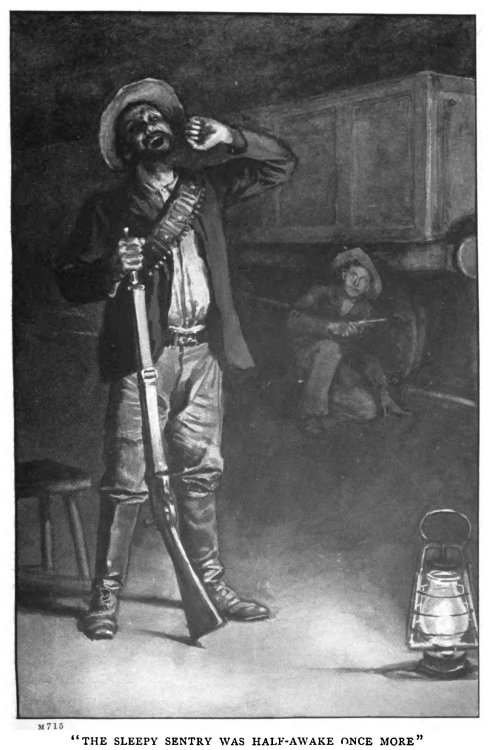
For a few moments Jack faced unflinchingly the six men who remained, wondering whether, now that their commandant had gone, they would shoot him or injure him in any way. But with a few muttered oaths and sneering remarks as to what would happen to him on the morrow, they turned away, Piet Maartens giving orders that he should be bound with a rope.
Five minutes later Jack was tied hand and foot, and placed upon the concrete flooring with his back resting against a wheel of one of the trucks. From here he watched his captors, who had retired into the shed. Placing their lanterns on the ground, they wrapped themselves in blankets, and, leaving one of their number seated on a stool, threw themselves down to sleep.
“I’m in a nasty hole,” thought Jack, “a very awkward fix indeed. If it had not been for Oom Schalk those brutes would certainly have shot me; and I’m not at all sure that they won’t do so after all, for there is no one to prove that I am telling the truth. Even if they don’t harm me, they are bound to get rid of me, for they can never allow me to remain in the Transvaal after this. Well, I must get away somehow.”
For half an hour he sat quietly thinking, with his eyes fixed upon the lanterns and upon the figure sitting close to them. The Boer had lit his pipe, but it constantly went out, and he as constantly lifted a lantern to get a light again. Then he put it on the ground, folded his arms, and stared about him. Soon his head drooped, and nodded gently, then his chin went down on his chest with a jerk, and he sat upright again, shrugged his burly shoulders, yawned, and looked about him. Jack watched him with deep interest, and soon saw that he had fallen asleep.
Now was his time, and noiselessly bringing his heels close beneath him, he gave his body a jerk forward by pressing against the truck with the back of his head, and in another moment was standing on his feet.
He was still helpless, for he was firmly bound, with his hands behind his back. But he had not been racking his brains all this time for nothing. He remembered that at Durban he had noticed that the corners of the iron trucks were not turned over, but bolted to angle-irons inside, leaving a more or less rough surface at the edge. It was a small matter, but he had noticed it just as one does take note of trivial points, and he now determined to put it to a good purpose. Inch by inch he shuffled along till he reached the corner of the truck against which he had been placed, then he leant against it, and commenced to rub the cords which bound his wrists up and down the roughened edge.
It was difficult work, but he clenched his teeth and put all his strength into it. After more than half an hour’s nibbing the cord was cut through and his hands were free. To release his legs was now a simple matter, and in a few minutes he was standing close to the truck, with his boots off, and slung across his shoulders by the laces. Then he undid his secret pocket, pressed the spring, and gripped the butt of his Mauser pistol.
At this moment there was a sound from the shed, and on looking in that direction Jack noticed that the sleepy sentry was half-awake once more, and was making a desperate effort to stand upon his feet. He yawned several times, shook himself, rubbed his eyes, and then suddenly turned and looked towards the trucks.
But Jack had expected such a movement, and when the sentry turned, the dim light showed him the prisoner still seated in the same position. Once more his head nodded, and within a few minutes he had dozed off again.
In a moment Jack was on his feet, and was darting across the concrete. A few seconds took him into the hut, and in another moment he was at the door. There was no lock, but it was bolted top and bottom.
He at once commenced to draw the bolts back, and had almost succeeded in opening the door when the sentry woke at the noise, saw his prisoner escaping, and shouted at the top of his voice.
“Stand!” cried Jack sternly, pointing his pistol at the man, as he was in the act of leaning over to reach his rifle.
Quick as lightning he pulled back the last bolt and flung the door open, covering the six men in front of him all the time. Three of these still lay on the ground in their blankets, half-sitting up on their elbows, and as yet scarcely understanding what had happened. Piet Maartens, however, and Hans Schloss the German, had at once jumped to their feet, and as Jack was turning to fly the latter stooped and picked up his rifle. Before he could bring it to his shoulder there was a sharp report, Jack’s weapon flashed vengefully, and the fat little German fell with a scream on the floor, with a Mauser bullet through the calf of his leg. Next moment Jack had darted through the doorway, banged the door to, and hurled a wheel-barrow, which happened to be just outside, across it. Then he turned sharp to the right and ran round the corner of the shed, for common sense told him that to attempt an escape across the open veldt which stretched away in front would be to run the almost certain risk of capture.
As it was, he crouched round the corner of the shed, and, Mauser in hand, watched to see what would happen next.
From the inside he could still hear a succession of piercing shrieks uttered by Hans Schloss, but these were quickly drowned by angry shouts and oaths. There was a loud shuffling of feet, and a moment later the door through which he had just escaped was flung open with a bang, and all the Boers rushed out pell-mell, leaving the German to his own devices.
But the wheel-barrow was yet to be a lesson to them, to teach them that even an English lad must be reckoned with at times. They were all men who had been used to sneering at the “Rooineks” (English) from the time when they were boys, when their fathers had detailed to them how some thousands of Boers had lain in ambush behind the stones on Laing’s Nek, and had destroyed a handful of British soldiers exposed out in the open. But here was a mere lad who had dared to spy upon their movements, and who, after capture, had listened bravely and calmly to the speedy death proposed for him. He had not even whined, or begged for mercy, but had as good as defied them. And now, to add to it all, he had in some manner, totally inexplicable to themselves, severed his bonds and escaped from the vault, wounding one of their number in the process; and had laid, as a kind of parting shot, a trap for them all, which brought the five men suddenly and with a violent crash to the ground, sending their rifles flying in all directions.
It was a bitter lesson, and goaded them to madness. With muttered curses and fierce shouts of rage they leapt to their feet, and, without pausing to think, rushed out into the open veldt, where the sharp reports from their rifles showed that they were firing at imaginary objects which they took to be the fugitive.
Had Jack wished it he could have planted more than one of the bullets from his pistol in the bodies of the Boers as they lay on the ground in the full glare of the lamps from the inside of the shed, but as yet he was by no means proficient with his weapon, and besides, he had no wish to take the life of any one of them, or to injure them in the slightest. All he aimed at was to make good his escape, and no sooner were they out of sight than he darted back towards the steep kopje in the side of which the vault was evidently constructed, and climbed up it, taking care to stoop low, and dodge from boulder to boulder. Soon he was at the top, and here, sheltered behind a breastwork of rock, he stopped and listened.
He could still hear shouting down on the veldt below, and an occasional rifle shot, but these soon ceased, and about half an hour later the five Boers returned and entered the shed, the light from the lamps throwing their figures into strong relief.
“Ah, now I can make a move!” thought Jack, “and the sooner I get away from here the better. After what has happened those fellows would shoot me if they got hold of me.”
At this moment he suddenly remembered that at Newcastle he had stowed his bag of buns away in his pocket. Pulling it out, he finished what was left, for he had an excellent appetite which no amount of adventure could disturb. Then, feeling better, he picked his way down the opposite side of the hill, and, having made a wide détour, turned towards the railway, and walked on till he came to it. Then he trudged along by the side of the metals, and in due course reached a small station midway between Volksrust and Standerton.
There was no one about, but the night was beautifully warm, and Jack therefore lay down on the veldt outside the station. Early next morning he walked on to the platform and knocked at the station-master’s door.
“Hallo! Who are you?” the latter asked in sleepy surprise, appearing in a half-dressed state, which showed that he had only just got out of bed.
“Oh, I’m one of the English from Johnny’s Burg!” Jack answered easily. “I’ve been staying with some people this way, and started last night to catch the train. But you people don’t trouble about sign-posts in these parts, and so I lost my way. Instead of finding my road to Standerton I got out of my reckoning and came down here, where I’ve spent the last few hours asleep on the veldt. Can you give me something to eat?”
“It’s a precious funny story,” the station-master, who was a Cape Dutchman, grumbled in reply. “But, then, you Englishmen, fresh from home, do all manner of strange things. Come in, and we’ll see what the Tanta has for you. But mind, I can’t afford to give you a meal; you must pay for it.”
Jack readily agreed, and ate ravenously when at last a dish of smoking biltong was placed before him, for his long march across the veldt had given him a keen appetite again, which his sleep in the open had in no way diminished. Big cups of smoking coffee were also provided, so that altogether he fared very well.
Then he lit a cigarette, paid the amount demanded, and went outside on to the platform, where he and the Dutch station-master walked up and down in friendly converse till the train for Johannesburg arrived.
Four and a half hours later he stepped on to the platform at the big mining city, the Golden City of South Africa, and walked to Mr Hunter’s store.
“Back again, Jack! Why, we did not expect you till to-morrow morning!” exclaimed Mr Hunter, shaking him by the hand. “Your bag and the leather goods turned up early this morning, and as you didn’t arrive we naturally thought you had decided to stay a day longer and would return by to-night’s mail.”
“No; I ought to have been back early this morning with the baggage, Mr Hunter,” Jack answered; “but as it was, I was delayed just on this side of the Transvaal border, and have had to come on by a local train. I’m afraid it’s likely to be rather a serious matter, and as soon as possible I should like you to give me some advice.”
“My dear Jack, whatever are you talking about?” exclaimed Mr Hunter in astonishment. “Was there an accident at Volksrust? But no, I know there was not, for I went to meet the train this morning. Whatever made you break your journey? You have no friends in that part of the country that I have heard of.”
“I’ll tell you all about it if you’ll come out on the verandah, Mr Hunter,” Jack answered. “I’ve been on my legs, tramping over the veldt, all night, and I’m feeling a bit done-up and tired. Let us get a couple of chairs out there, and then you can hear all I’ve got to tell.”
A few minutes later Wilfred joined them, and the three settled themselves comfortably on the verandah, where Tom Thumb, Mr Hunter’s Zulu “boy”, who was the biggest native ever seen in Johannesburg, supplied them with long glasses of deliciously cold lemon-squash.
Chapter Five.
Rise of the Boer Power.
“And so you’ve discovered a secret magazine of our friend Paul Kruger, have you, Jack?” exclaimed Mr Hunter when the adventure of the previous night had been narrated to him. “Well, the existence of arms in that part of the country is more than I or any one of us had guessed. That ammunition and guns of all description are pouring into the Transvaal, and have been pouring in for the past three years, there is no doubt. They come openly from Delagoa Bay, and from the south under cover of some other name. Yes, we all know what is going on; but now the fact of there being a big magazine close to the Natal border opens my eyes. I have often heard it said that the Boers are ready to fight for their independence, but would not attack their neighbours till they were compelled to do so. Then I have heard it rumoured, and very often too, that the government at Pretoria has bigger schemes in view.
“Cecil Rhodes has, as is well-known, a strong desire to see a United South Africa under the British flag; and if I make no mistake, Kruger and his underlings are scheming to trample that spotless banner under foot and replace it with the vierkleur. In my opinion they are capable of anything, and I feel positive that a United South Africa under the Boers, with Kruger president of all, and with a population solely composed of Dutch, is aimed at. To oust the British is what they have in view, and for that purpose they are hatching a gigantic conspiracy, the result of which will be a terrible war.”
“But surely, Mr Hunter, they would not dare to attack the English,” Jack interposed. “We are the strongest nation on the face of the earth; so strong, indeed, that no other European race would declare war upon us if an honourable settlement were possible.”
“Ah, Jack! you have learnt a deal since you came to Johnny’s Burg, but not enough yet of Boer ambitions and Boer cunning to be able to say exactly what they would be capable of. For my own part, I believe what I have said. England is face to face with a vast and dangerous conspiracy, and these hardy and resolute Boers will yet prove a thorn in her side. But to return to your adventure. You have certainly escaped from a difficult position, and I congratulate you, my lad, on the pluck and coolness you evidently showed. Had they put you against a wall and shot you immediately you were discovered it would have been only what might have been expected, for you undoubtedly possess a secret of theirs which they have been jealously guarding. Supposing my theory of a war with England is correct, that huge accumulation of war material close to the border would enable them to despatch a force of Boers by train, and post them and the guns on the passes, and upon the mountains which separate us from Natal, within a few hours of the declaration of hostilities. We could not possibly be ready, and instead of our manning every rock and stone, and so preventing their passage into the country, they would pour through the passes in their thousands, and the colony of Natal would be invaded and in the hands of the enemy before our countrymen had had time to recover from the surprise.
“Yes, it is a most important secret, and I fear you will be a marked man. You have already made an enemy of Piet Maartens, and Hans Schloss bears no better reputation than he. And you have wounded him, a fact which he will never forget. But there are the others too. They will have a score against you. Altogether, Jack, I think you will be wise to leave us and get back to England as quickly as you can.”
“You say there will be trouble soon, Mr Hunter?” Jack asked, after a few moments’ silence, during which he considered what he should do in the circumstances.
“Yes, I firmly believe there will be an awful struggle between England and the Boers before many weeks are past,” replied Mr Hunter earnestly.
“Then, if that is the case,” said Jack decisively, “we are likely to get the worst of it for a time, and every man in South Africa will be wanted.”
“That is precisely what I think, Jack. Some, no doubt, would scoff at me as a pessimist. But I speak from some experience and many years’ knowledge of the Boers. England, it is my firm belief, will be aghast at the huge armaments and the large force opposed to her, and she will require every man that can be found able and willing to shoulder a rifle.”
“Then I shall stay, Mr Hunter,” Jack said quietly. “I’ve no great wish to get back to a crammer’s at present. A few months later will do just as well, so I shall wait and see what happens. There is nothing I should like better than to take part in a campaign. Not necessarily against the Boers, for some of them seem good fellows, but in some war alongside of British troops. Meanwhile, if the Transvaal has become too dangerous a place for me to stay in, I can easily run down to Kimberley. A few weeks amongst the mines would be excellent fun.”
“Well, Jack, you must do just as you wish,” answered Mr Hunter. “If you stay in the country, you will do well to go to Kimberley, or one dark night you will be having a bullet flying after you, for the Boers are not apt to stick at trifles. They are men whom it is not well to play with, and the code of honour is not so high amongst them as to prevent their murdering one who possesses a secret likely to endanger their future plans.”
“I should think not, indeed, Father,” chimed in Wilfred. “Look at the mean tricks they played in the last war—firing on white flags and ambulances, and saving their own skins by running away. You have often told me how they treated our soldiers, and everyone here knows how they bully the natives.”
“They are a curious and, I believe, unique race,” replied Mr Hunter; “and if you two lads care to listen I will tell you what little I know about them, and what are the precise difficulties which have led to such friction here between the Boer Government and the Uitlander population.”
“Do, by all means!” both lads cried.
“Well, I will; but first we’ll have another glass of this cool stuff. Tom Thumb!” he shouted. “Here, I want you.”
A moment later the big Zulu appeared, clad in light check trousers and a striped flannel shirt.
“Bring more ‘squashes’ and a cigar,” said Mr Hunter.
“Alright, Baas! I bring him plenty quick,” Tom Thumb replied, turning on his bare heels, and striding noiselessly into the pantry close by, where soon the sound of popping soda-water-bottles told that he was carrying out his master’s orders.
A few minutes later the drink was placed on the arm of each chair, Mr Hunter had lit his cigar, and was leaning back, puffing clouds of smoke from his lips, and staring thoughtfully at the ceiling.
“Light up, boys!” he said at last. “It’s a bit of a yarn, and wants to be followed closely. Now, to start the ball rolling, as it were, I must tell you who and what our neighbours are, and from what race they derive their origin. You must know that the first whites to visit this vast continent of Africa in its southern parts were of Dutch nationality. They were servants of the Dutch East India Company, who placed a colony of their countrymen at Table Bay to form a depot, where vessels could put in and replenish their provisions and water with some degree of safety. They were joined many years after by a band of French Protestants who had been driven from their own country.
“In 1795 the Colony was taken over by the British by request of the Stadtholder of Holland, who had been dethroned. But in seven years’ time we handed the country back again.
“Later on, however, our forces returned once more and ousted the Dutch, setting up a government on the site which is now occupied by Cape Town. Naturally, many of the Dutch and French immigrants had become possessed of property, and had commenced to farm the land; and these stayed on under the new rule. In process of time they intermarried, and by the commencement of this century numbered about 75,000 souls all told. That is the origin of the present Boer nation. They are sprung from the union between Dutch and French settlers, who were the pioneers of Africa.
“Then the British immigrant arrived and sat down by the side of the Boers, and together, in perfect unity and good fellowship, they pushed farther into the country, fighting one long continuous fight against hordes of natives and against lions and other savage beasts. Every step they advanced had to be fought for; for, just as the Bed Indians in America have persistently resisted the onflow of strangers into their hunting-grounds, so have the natives of South Africa fought to resist the onward progress and invasion of the white settlers into the land which they considered theirs by right of birth.
“But now—to hark back for one moment to that time when England stepped in and took possession of the colony—a factor arose to upset the peace and general agreement of Boer and Briton. The fact that they had been handed over by their own government to the British, like so many sheep, had roused the fiercest anger amongst the Boers. And now this resentment was inflamed by the restraining hand which our government laid upon them with regard to the natives.
“Years before, the Boer settlers had become accustomed to slave labour, and as they pushed on into the country, natives were pressed into their service. And these they had punished as each man considered the case deserved. Probably because there was a plentiful supply of Kafirs and Hottentots our Boer friends had not stopped at whipping the poor fellows. They treated them with absolute brutality, even going to the length of taking their lives.
“Such barbarous doings awoke in England a storm of anger, for, thank God, our country has long been opposed to slavery. Freedom and equality has been our motto for many years, and we have sustained it at no small cost to ourselves.
“When the tales of Boer brutality became known to the folks at home, the indignation it caused resulted in the emancipation of all slaves, and from that date the ‘Baas’, as the master is called, and the native ‘boy’ had equal rights; and to injure one of them was a crime punishable by the same laws as hold good in England.
“You can imagine, my lads, what rage this new arrangement caused in the hearts of the Boers. For years they had been free to do as they chose, and now their slaves were theirs no longer, and the natives, who had been in their masters’ eyes like mere cattle, were now their equals in point of law, and were not to be ill-treated with impunity.
“This was too much for the Dutchmen. The very sight of an Englishman roused their anger and hate, and rather than be forced to live side by side with them and be governed by their laws, they struck out a line for themselves and trekked away north into the unexplored wilds. Taking their wives and children with them, and driving their flocks, they set out for the unknown, seeking isolation from the British, and a country they could call their own.
“Thousands joined in what is known as the ‘Great Trek of 1837’. Some of the more daring of them pushed on as far as the Vaal River, which, of course you know, is the southern boundary of the Transvaal, or South African Republic, as it is called nowadays. They paid dearly for their temerity, for the Zulus came down in swarms against them and massacred every one of them. But the staunch Boer, with his dogged pluck, in which he much resembles our countrymen, was not the man to be deterred by first failures. He pressed on, but in greater numbers and with more caution, and when the Zulus attacked again, beat them off and drove them out of the neighbouring country.
“Others of the Trekkers settled on the Zand River, in what is now the Orange Free State, while others pushed across the veldt, and finally crossed the passes of the Drakenberg Mountains and came to a halt in Natal.
“But these last were also to meet with trouble from the Zulus, for whilst their leaders were bargaining with Dingaan, the chief of that fierce native tribe, they were fallen upon with barbarous ferocity and slaughtered to a man.
“Well, you have often heard it said that when the black man sees blood, no power on earth can keep him in check. That was what happened now. The fierce Zulu warriors had dipped their assagais in the blood of their white foes, and they were not to be held back. Like a wave they burst over the smiling landscape of Natal, and when the tide had ebbed hundreds of hapless men and women had been sent to their last account.
“That was the commencement of all the bitter hate which the Boer of the present day has for the native race.
“I think you have seen, my lads,” proceeded Mr Hunter, “that dogged stubbornness of purpose and undoubted pluck were characteristics of that old Boer people. They never knew when they were beaten, and no amount of danger and hardship would prevent them from pushing on for that promised land which was to be theirs alone, and where they might live in freedom and solitude, with no thought for to-morrow, and with no cares to upset the calm and peace of the life for which they longed.
“They banded themselves together and marched against the treacherous Dingaan, only to be beaten. But again they gathered their forces under the leadership of Andries Pretorius, and on December 16th, 1838, gave the Zulus a tremendous thrashing, killing three thousand of them.
“Then, having settled the natives, they built their farms and appointed from their number certain men who were to form the Volksraad or parliament of their new possessions. But again the British stepped in and intimated that they would not allow an independent state to be formed in the colony. The Boers resisted, and hoisted their flag, but reinforcements were sent up-country, and in May, 1842, the whole of Natal was taken over as a British colony.
“Now, had these hardy pioneers cared to live under British rule, they were free to stay on their farms in Natal. But hatred of all things English was as prominent in their hearts as their enmity for the natives. Britons should not rule them, they swore; nothing but absolute independence would suit them, and so once more they trekked away and joined their brothers on the Zand River.
“One really admires the persistence and pluck of those brave fellows. To an Englishman freedom and independence is a birthright for which he is ever ready to give his life, and to these uneducated Boers interference of any sort was detestable. Brought up in a strictly religious way, the Bible was the only book they ever cared to read. They had no ambition, no wish to rise in the world, and no desire for riches. Give each one a wife and children and a farm right away on the lonely veldt, where he could ride for miles on miles with his gun across his shoulder and never see a house or man, then he was happy. He was independent, could go and come as he liked, and had no cares and worries to destroy his happiness. It was not much to ask for, and had he but acted as our countrymen have always done, his simple, pastoral existence would never have been disturbed. But again ill-treatment of the natives roused the ire of the British Government, and the Queen’s authority was asserted over the whole of the Orange Free State.
“It always strikes me as remarkable that men so devoutly inclined, whose honour and integrity were in those days characteristic of them, and whose private lives were almost always so upright and correct, should still forget that after all a native is but one of God’s creatures, placed in this world to live in happiness. But they could not realise it. The Bible spoke of slavery, and that was good enough for them.
“Well, my boys, we now come to the last trek. England took over the Orange Free State, and the Boers only gave it up after a stern conflict at Boomplaats, in which they were beaten. With Pretorius, their leader, they took their wagons and horses, and pushed on in a northerly direction till they were beyond the 25th degree south latitude. Here they settled once more, and those hardy pioneers, amongst whom I believe was President Kruger, are the oldest white inhabitants of this the South African Republic. At last they were in a country all their own. They chose the members of their Volksraad, and promptly scattered to lay out their farms, and commence that life of simple ease for which their hearts had longed.
“At the same time, too, the English Government handed over the Orange Free State to the settlers there, and the two young Republics started into being, the one with Mr Boshof as president, and the other with Pretorius.
“There you have the history of our neighbours. But before passing on to tell you about the first Boer war, in which I myself took a part, I must mention that the Basutos, who have their country wedged as it were into the Free State, had constant conflicts with the Boers. They are now happy and contented under our own rule, but they bear an undying hatred for their neighbours which at any time may lead to further troubles.
“And now, my boys, to get to more recent times, that is to say, the past twenty years or so. We have, as I have endeavoured to show you, two Boer republics adjacent to one another, and only sparsely populated. South of them are Cape Colony and Natal, also populated by Dutchmen and blood relations of the Boers, while amongst them are many British settlers.
“I have told you how our neighbours dealt with their native servants. Now that they had been given their independence they were free to do as they liked, save that slavery would not have been permitted. But, to the Boer, native labour is everything. His one aim and object in life is to live at peace with all the world, to possess vast stretches of country which shall be all his own, and in the heart of which he may bury himself away from the world, troubling only to till by means of native servants sufficient land to supply his wants, and devoting himself to the rearing of cattle. His daily routine of life since independence was assured was to rise with the lark, and ride round his lands counting his herds of cattle. That done he was at leisure all the rest of the day. His life was simplicity itself; the gaieties and amusements of cities, and social intercourse with other men, never upset the serenity of his existence. His soul longed to be free of them all. He was at last, and determined to be to his dying day, king of the stretches of plain he owned. No one should oust him from them, and for his happiness it only sufficed that he should live alone with his own family, sit the livelong day upon the stoep (step) of his farmhouse, drinking coffee and smoking incessantly, while he gazed listlessly across the waving grass and veldt, and busied himself with thoughts the nature and depth of which could not be great.
“Dressed in rough cloth coat and trousers, and with a dilapidated slouch hat upon his head, he never troubled to discard his clothing. His beard and hair were seldom trimmed, and his toilet was a matter of which he never thought.
“But all the while, though nothing seemed to stir him from his lazy life, the mere suspicion that his dearly-cherished independence was in danger brought him to tear himself away from his peaceful farm, and, rifle in hand, to place himself shoulder to shoulder with his brother Boer to fight for the Republic.
“For twenty years the Boers maintained a constant succession of disputes as regards the frontiers of the Transvaal. Now it was with the Orange Free State, and at another time with the English. But at last they picked a quarrel with Sekukuni, whose country lies to the northeast of us, and this led to open warfare.
“Now, all along I have given our neighbours credit for staunch and dogged pluck, though I am bound to confess that their constant association with the natives has taught them dishonest and treacherous habits. But to be really brave our friends must lie behind the rocks. It is against their nature to fight when exposed in the open. True guerilla warfare is their motto; to shoot down the enemy unawares, and without showing so much as a finger.
“For defence these tactics are excellent, but for attack quite useless. Sekukuni and his followers proved too much for the Boers. Hidden in caves from which nothing but a frontal attack and absolute disregard of danger could dislodge them, they laughed at our neighbours, who were far too careful of their own safety to make a rush.
“The Boers were forced to retire, but only to face more troubles. To live in idleness and ease is not to make the wherewithal with which to support a government. Their public money ran out, their coffers were empty, and hordes of natives pressed upon their borders.
“In this predicament, when only 12 shillings 6 pence remained to their credit, the British Government stepped in again, for we could not afford to allow the Zulus to become possessed of land close to our colonies, and on April 12th, 1877, Sir Theophilus Shepstone annexed the Transvaal. Troops were despatched against Sekukuni, and he was beaten; and to follow it up, we entered upon hostilities with the Zulus, the hereditary foe of the Boers, and after some terribly trying work, broke the power of the notorious Cetewayo. Rorke’s Drift and Ulundi are names which will never be forgotten at home, and Isandhlwana will for ever be spoken of with bated breath.
“After annexing the country we garrisoned the different towns, and all went well for a time. But, though the better-educated Boers had looked kindly at our government, the ignorant, narrow-minded, and pig-headed peasants thought only of their independence. Once the much-feared Zulus had been crushed, their debts paid, and their finances put in order, they forgot their gratitude to us, and longed to be free again. And, mind you, my boys, they did not shout or brawl about it. They worked sullenly and in secret, as a result of which they determined upon revolt against their English masters.
“They elected a provisional Boer Government, with Kruger, Joubert, and Pretorius at the head, and opened their rebellion by attacking a convoy and escort of our soldiers from Lydenburg to Pretoria at Bronkers Spruit.
“It was a detestable affair. They ordered Colonel Anstruther, who was in command, to halt and turn back. He persisted in obeying his orders, and in a moment, from the hills around, the Boers poured in a terrific fusilade, picking off officers first and men last like so many sheep. The remainder they took prisoners, compelling them to take the places of the slaughtered oxen and drag the wagons to Pretoria.
“To cap all this they foully murdered Captain Elliot, one of two officers to whom they had given permission to leave the country, and whom they drove into the river Vaal when in flood, pouring volleys into them as they struggled in the water.
“And now to tell you of my own part in the affair,” said Mr Hunter. “But first of all, pass me another cigar, Jack, and shout to Tom Thumb for some more of this stuff. It’s rather dry work giving you a yarn of this length.”
Tossing away the stump of his old cigar, Mr Hunter carefully selected another, and having lit it and gulped down a few mouthfuls of lemon-squash, he placed his feet on the rail of the verandah, leant back in his comfortable chair, and proceeded with his narrative.
“Wilfred knows all about it, of course,” he commenced, “but I dare say you’ll be surprised to hear, Jack, that I was once a soldier of the Queen. That is to say, I was a gunner with my battery in Africa when the Boer troubles first began. I look comfortable and fat enough now, I think you’ll agree, and I’m doing as well in the world as I could wish; but the fact remains that I was once a soldier. I had been a reckless and restless lad at home in England, and rather than settle down in trade as a grocer’s assistant, I donned the queen’s uniform. And let me tell you, my boys, the army is by far the best place for all such youngsters as I was. It’s a kind of big school where those who like can climb up the rungs of the ladder, and find themselves, when they go back to civil life, in far better positions than they might otherwise have occupied. It does not matter who or what you were before you ’listed; it’s each for himself, and it is the smart, sober lad, who is respectful and knows his work, who gets promotion to the non-commissioned rank.
“But I’m talking of the Boer War. Well, my battery of six guns was sent up into Natal, with about 870 men, mostly of the 58th Regiment and the 60th Rifles, with a few of the 2nd Scots Fusiliers and a Naval Brigade, all under Sir George Pomeroy Colley. We joined hands at Newcastle, some thirty miles south of Laing’s Nek, and marched up there on January 26th, forming camp at Mount Prospect, three miles from the slopes of the Drakenberg range, where the Boers were known to be in force.
“Now I am not going to tell you every incident of the engagements we fought. The memory of three successive defeats is too painful, but to make matters clear to you I will just mention each in turn.
“Laing’s Nek was the first, and on that fatal day we marched out of camp and up the rugged and zigzag road which leads to the pass of that name. On either side of us some 1500 Boers were posted, and we attacked those on the right. Our gallant boys of the 60th Rifles and the 58th Regiment marched directly against them, whilst we with the guns and the ‘tars’ with their rockets were posted in the rear. It was a one-sided conflict. We had only stones to fire at, while our poor lads, many of them, like myself, mere youngsters, were out in the open, without cover of any kind, and wearing white helmets, which were simply a series of bull’s-eyes for the enemy.
“I shall never forget that morning. The sun came up over the mountain peaks, making them look like golden pinnacles. Then, passing down the green elopes of the hills, it lit up the valley, with its dusty road, and its little farmhouse nestling on the left at the foot of the steep incline. And there, moving across the grass in regular order, and with the rays flashing from their helmets and rifle-barrels, were our brave fellows, many of them marching to their death.
“Well, well, such things must be, I suppose! England has not done all the glorious acts for which she is famous without a deal of suffering and much loss of life.
“When our troops started up the slopes a perfect hail of lead was poured into their ranks, and every bullet, mind you, was directed by an unseen hand, and by a hand which, backed up by a steady eye, never failed, even from the back of a galloping horse, to bring down the swiftest deer that ever ran.
“But though many of our gallant lads fell, the remainder reached a ridge, fixed bayonets, and prepared to charge. They were met by a murderous fire, which almost decimated them, and the same fate befell a squadron of the 1st Dragoon Guards, who charged the enemy’s flank.
“The Boers pressed forward immediately, and we were forced to retire.
“That was the end of that engagement. We sent in a flag of truce in order that we might gather our wounded, who were unmolested by the Boers, save in one instance, when a cowardly ruffian was caught in the act of shooting a helpless soldier, and was promptly bayoneted by one of the injured man’s comrades.
“We were now in a pretty tight hole. Surrounded on all sides by the Boers, our supplies were cut off completely. But on February 8th we moved out of camp back towards Newcastle, from which town a convoy was to set out to join us. It never started, but we were ignorant of that, and, pushing forward, crossed the Ingogo River, which runs transversely across that portion of Natal. The guns remained on the other side, and were at once at it hammer and tongs, throwing shrapnel at the Boers, who were strongly posted opposite to us.
“It was the same old tale again. There wasn’t so much as a hat to be seen, but every tuft of grass, every mimosa bush and stone sheltered a keen-eyed and stout-hearted marksman. Yes, my lads, I will give them their full due. They were roused to desperation in a struggle for independence, and they were in their element. Themselves in shelter, save from our shrapnel fire, which searched their hiding-places, they aimed steadily and coolly at our boys, with fatal results. For six long hours we stuck to it, and then retired, dragging the guns with us, for most of the horses had been killed.
“It was our second reverse, and we returned to camp dispirited, drenched with rain, which had been falling since the afternoon, and thoroughly exhausted, leaving our wounded under the red-cross flag in charge of the army surgeons. Our infantry behaved nobly in the face of insurmountable difficulties, and it was no fault of theirs that they were beaten. Opposed to us were a host of men, wholly undrilled and unused to modern warfare. Yet they showed the greatest foresight and cunning in the selection of their trenches, and no one, not even the most experienced veteran, could have improved upon their tactics.
“It was a hot day for us at the guns. We were well within rifle range, and long before the action was over every one of us had been shot. I had a bullet through my shoulder, but was able to get away with the others, though most of my comrades were killed. But to show you the pluck of our brave fellows, when all the gunners were helpless, some of the infantry manned and served the guns in spite of the heavy losses they sustained.
“It was a nasty reverse, but not the worst we were to suffer. In a fatal moment our brave general decided to make a night march and occupy the crest of Amajuba Hill. With 545 men he set out at nine o’clock, reaching his destination only as the dawn was breaking. When the Boers saw our fellows there, they were on the point of bolting, but they rallied, and, dashing across the open ground on their wonderful little ponies, were hidden out of sight at the base of the hill long before we could punish them. Then commenced a conflict for which there was but one ending. Our poor fellows were too much exhausted by their long march and arduous climb to entrench themselves, and the slopes below the summit were not occupied by skirmishers, for whom there was ample cover. Instead, we manned the edge of a shallow depression which formed the summit of the hill, and every man of ours was sharply defined against the sky. Below, seated behind the rocks, the Boers picked them off one by one, and soon the whole hill was surrounded. Foot by foot they pushed upwards, and at last with one final rush carried the position.
“That was a bad day for all the poor Englishmen out there, and ever since it has been an evil day for all our countrymen. It is a smudge, my lads, upon a slate which has seldom known one before. Our poor fellows behaved nobly, but they were helpless; the position which, if entrenched and manned by a sufficient force, should have been impregnable, was untenable, and those of the troops who survived the last onslaught ran for their lives as Englishmen have seldom been known to do.
“But there! The mention of it sickens me. We were beaten after a gallant fight, so I will make an end of the matter.
“By this time General Sir Evelyn Wood, who had conducted a share of the operations in Zululand with such great distinction, had reached Newcastle with a relieving force, and hoped to have it substantially increased in the course of a few days. Meanwhile an armistice was agreed upon for eight days.
“At the termination of that period there is little doubt that this able leader would have outflanked the Boers and gained a signal success, but he never had the opportunity.
“All the Dutchmen in Africa were hotly incensed at England’s action in attacking this small state, and in Holland there was the same feeling. The Orange Free Staters, too, were ready to join with their brothers, and indeed had already helped to a large extent with men and money. After a short extension of the armistice, a peace was made, one of the terms being that England should hold suzerain power over the Transvaal and control its foreign affairs, and another, that Boers and British should have equal rights.
“Meanwhile I must tell you that our garrisons in the Transvaal had been invested by the enemy and had gallantly resisted. And it was at these attacks that the most outrageous use of the white flag was made. Our men were lured on by its demonstration, and shot down mercilessly when they showed themselves.
“When the war was over, our troops were withdrawn, leaving the Boer and British settlers face to face, distrustful of one another, and holding themselves apart.
“Hosts of our countrymen, attracted by the wealth of the Transvaal, had settled there and invested their money, and these were specially bitter at the manner in which they had been left to the tender mercies of the Boers.
“There is no doubt about it that had we marshalled our forces and crushed the enemy then and there, we should have removed a dangerous thorn from our side. But we were too magnanimous, and we shall have to pay for it.
“And now to tell you, in as few words as possible, what has happened since.
“In 1885 gold was discovered in this country, and as with the goldfields of America, thousands flocked to participate in the wealth to be obtained. Towns sprang up in every direction, and Johannesburg became a golden city, the heart of the mining industry. Here, at the present day there are some 100,000 of us more or less, and in the whole of the Transvaal there are quite 180,000 Uitlanders, or outsiders, as we are called. We found the mines, we have opened them, and it is our money which has worked them and erected the splendid stamps with which to crush the ore.
“I may tell you that we are a cosmopolitan lot, for amongst us are all nationalities; and in addition we are a strictly business class of men. We have come here to make money, and we invest it in the mines or in the country, for the Transvaal teems with natural riches. Here beneath our feet we have the gold-bearing quartz, and close at hand there are excellent coal-mines. There is iron ore in abundance, with coal alongside it to work it with. Lead, copper, and other metals are to be found in plenty, and if that were not all, the land has not a rival for grazing purposes. It is the best corn-producing country known, and in addition it is blessed with a wonderful climate, which at this altitude makes it a splendid health resort.
“But do you think our friends the Boers recognise all these things? Certainly not. They always were and always will be, in the main, ignorant and illiterate farmers, stubbornly opposed to progress. Even the best amongst them have, till quite recently, been unable to write an ordinary letter, and all the public appointments, save the president’s chair and the seats in the all-powerful Volksraad, are filled by salaried clerks recruited from the Afrikanders of Dutch stock, or from the Dutchmen of Holland itself.
“These men are under the president and his autocratic government, and I will, if I can, explain exactly what has happened to cause all the bad blood between us and our Boer masters.
“Ever since that fatal peace of 1881 the Boer has shown an open contempt of the Englishman. His arrogance has passed the bounds of belief, especially in the case of the younger generation, in whom the same ideas have been instilled.
“We have never got on well together. There has been no sympathy between us, and while we see them leading indolent lives and spending money recklessly, we know that that same money comes from our own pockets, that we, the workers, pay through the nose for the privilege of staying here and managing the mines, while they look on and live in ease and luxury.
“The Republic has an income of some five-and-a-half millions per annum. Think of it! Five-and-a-half millions, when only twenty years ago there was but 12 shillings 6 pence in their coffers. And of this vast sum five millions are paid by us, the Uitlander population, while the 70,000 Boers contribute only half a million.
“We should not mind the amount so much, though everything we eat or drink, or require for the working of our mines, is taxed to the highest; but what we do grumble at, and what is fast helping to hurry on a disruption between us, is the fact that we have no voice in its expenditure. We slave and pay, and they loaf and spend the money recklessly, investing huge sums in arms and ammunition and defensive works, and in keeping up a staff of foreigners with which to train their gunners.
“There is no Government here. It is a corrupt oligarchy, with such autocratic powers and under such a stubborn and autocratic president that even the judgments of the courts can be tampered with.
“‘Why should you expect citizen rights and representatives in our Volksraad?’ Kruger says when approached on the subject of our grievances. ‘You, who came here unbidden to disturb our peace, and come only with the object of making fortunes and returning home.’
“For years now we have striven for an amicable settlement. It is a vital question with all of us, for we do not forsake the country after making money; we invest our wealth here, and we have solid interests for which we have good cause to fight.
“We even organised a Reform Committee and smuggled in arms. But all our hopes were dashed by the Jameson raid. That was a fatal mistake. We wished to press our claims for voting-powers, but not by force. Our weapons were only for defensive purposes. A few, however, were for upsetting the present Government by a show of arms, and for this purpose invited the gallant but reckless doctor to come in with his forces to their aid, promising to meet him.
“Of course you know he came too soon, riding right away from the Rhodesian border. We were not even agreed to meet him, and he and his force suffered defeat at the hands of the Boers. It was a gallant but an extremely foolhardy movement.
“Since then our grievances have increased. Numbers of necessaries are monopolies, for which we have to pay a tremendous price, and on top of all two new laws have been passed. One, the Press Law, makes it impossible for us to air our grievances in the papers; and the other, the Alien Expulsion Law, decrees that any foreigner who by word or deed disturbs the peace of the country shall be expelled without appeal to the courts.
“It is monstrous! In no other place in the whole of the civilised world are Englishmen treated so shamefully. We have done all that is possible, and now we have appealed to our Government, who are carrying on negotiations with Pretoria.
“And meanwhile the Boer population is becoming more and more openly hostile. They evince it in every possible action, and they do not hesitate to show that they are armed to the teeth, while we are completely without weapons. But do you think all this agitation will end in peace? Do you think that autocratic, pig-headed Kruger will give in in the slightest? No, my lads, he will not, I am assured. He cares nothing for us. Our needs, our grievances, are little to him, and only serve as a pretext for a rupture with England. He is as sly as a fox, and has more ambition than any single individual in this world. For many long years he has waited for a day when the British Lion shall be engaged in some European war, and then, and only then, has he been prepared to drive us out, and throw off the suzerain power of England, that hated power which destroys his sense of independence. But he does not stop there. A united Africa, a vast republic with Paul Kruger as its first president or king, is what he aims at; and to bring that about he is on the eve of defying the might of our great empire. He has the guns and ammunition, the money lies in abundance beneath our feet, and the men he will obtain by harping on that independence for which all are sworn to lay down their lives. Once the fire is kindled, a gigantic and terrible blaze will sweep over the land, Englishmen who have married Boer wives and settled here will find themselves opposed to their own country, throughout Africa there will be treachery, the bad blood of the Dutch population will be roused, and many of Her Majesty’s subjects will go over to the Boers.