"With Rifle and Bayonet" (continued 4)
Reading edition
Having paid their bills, Jack and his new friend, Farney, saddled up their ponies and took the road for Glencoe.
It was a long ride, but the road passed through some wonderful bits of rugged scenery, and about half-way up they fell in with an ammunition column, with a small escort, and an officer who proved a perfect mine of information.
“Oh, yes!” he said, when Farney asked him, “there’s going to be a big battle up this way within a very short time. We are stationed at Dundee to check the invasion. We cannot stop it, for I suppose there must be thirty to forty thousand Boers marching south, besides others threatening our communications with Ladysmith. But we are bound to make a stand somewhere, just to show the beggars that they cannot have things all their own way.
“I hear all the enemy came over the border on the evening of 11th October, and on Saturday they were at Newcastle. Since then they have been pushing slowly south, while hundreds of wagons have followed them. They mean business, do those Boers, and we shall have a pretty hard job to turn them out of Natal when reinforcements reach us.”
“Then you think we shall have to retire?” said Jack.
“I’m sure,” replied the officer. “Joubert is as cunning as a fox, and a clever soldier. He is marching in three columns. One came through Botha’s Pass, close below Majuba. The centre one has passed through Newcastle, and the third, on our right, is marching down the eastern border, and will no doubt make a dash to cut our communications. They are too many for us. We shall have a go at them, hammer them, and then retire to Ladysmith, where we shall entrench ourselves and wait for reinforcements, which will take some weeks to reach us.
“I suppose you fellows are going up as volunteers? There are lots more like you. If you have never been under fire, you will have that experience before long. It’s not so bad after all. Keep cool, and take, advantage of every scrap of cover. Keep an eye overhead, too, if you can. It is possible to dodge a shell, and the farther you can get away from it the better.”
It was late on the evening of 19th October when Jack and Farney reached the British tents at Craigside Camp, between Dundee and Glencoe, and close against Talana Hill, which was to be the scene of the next day’s battle.
A few enquiries soon brought them to the Hussar quarters, and having introduced themselves to Roper’s friend, by means of his note, they were both able to get a shake-down in a tent near by for the night, as well as a good meal.
They had had a long and tiring ride, and were soon asleep, wrapped in the blankets which each one had carried strapped behind his saddle.
Just as daylight dawned on the following morning they were startled from their sleep by a succession of loud reports, followed in a few seconds by the screaming of several shells overhead and by an explosion close at hand.
“By Jove, they’ve started already, so we’re in the nick of time!” exclaimed Jack, jumping up and rushing outside the tent, where he was joined by Farney. “What has happened?” he asked an officer, who was passing at that moment.
“Lucas Meyer has occupied Talana Hill,” was the reply, “and he is shelling us with six guns. Wait a few minutes! Our batteries are galloping out, and you will see how soon they will polish those beggars off!”
Hastily slinging their belts across their shoulders and picking up their rifles and blankets, Jack and his friend saddled their ponies, which had spent the night close by, and cantered out of the camp after the British guns, which had already taken up a position.
“That was a close one,” exclaimed Jack calmly a moment later, as a shell whizzed just above his head and plunged into the ground behind, where it failed to explode. “A foot lower and it would have knocked my head to pieces!”
“Ah, there’s many a slip!” laughed Farney light-heartedly. “Look at our fellows! They are giving our friends over there a good peppering.”
Jack turned to watch the British guns, of which there were twelve, and then directed the field-glasses which he had purchased in Ladysmith at the heights of the Talana Hill. There he could see six cannon belching forth sharp spirts of flame, but no smoke, for the latest ammunition was being used.
As he looked, the British batteries spoke out, and the reports were followed by a succession of blinding flashes close by the Boer guns.
For twenty minutes the storm of shell continued to fall, and by that time the enemy had ceased to fire, and their guns stood unattended.
By now the troops had poured out of the camp, and while some remained behind in case of an attack, the King’s Royal Rifles, a gallant corps commonly known as the 60th, the Dublin Fusiliers, and the Royal Irish Fusiliers, both regiments composed of stalwart, dashing Irishmen, fell in on the bugle-call, and formed up for the attack. Smart, bold fellows they all looked too, clad in their khaki uniforms, with belts, helmets, and buttons all of the same mud-colour. And true heroes they were soon to prove themselves, for the bugles now rang out the “Advance”, and in open order they set off for Talana Hill across a wide, sweeping plain, almost completely devoid of cover, and shortly to be swept by a murderous hail of Mauser bullets directed by unseen hands.
At this moment another Boer commando was reported advancing from the left, and the Leicester Regiment and a battery of guns was sent against them.
“By George, it looks as though we meant to clear that hill!” exclaimed Farney excitedly. “What shall we do, Somerton? Leave our horses and follow them, or stay where we are for a time?”
“Let us ask Preston,” said Jack, nodding to the Hussar officer who had befriended them on the previous night, and who galloped up at that moment.
“Look here, Preston,” Farney called out. “Somerton and I want to have a hand in this battle. What shall we do?”
“If you will take my advice,” Preston answered, “you will join us. The chances are you would be in the way over there with the regulars, and your ponies would certainly be picked off. We are going to form over by the shoulder of the hill, and when our boys have set the beggars running, we will gallop round and break them up. There will be some fun in it, and you may both of you just as well have a share.”
Accordingly Jack and Lord O’Farnel joined the Hussars and a body of mounted infantry supplied by the Rifle Regiments and by the Dublin Fusiliers.
Jack was mounted on Prince, and had left Vic behind, as it was unlikely that he would require two mounts.
They rode forward close in rear of the advancing regiments until the bullets began to whistle past them, while now and again some poor fellow tumbled forward on the ground. But undeterred, with never a backward glance or a thought of flinching, the three British regiments pushed forward, the nonchalance and absolute coolness of the men being superb. They acted just as if on a big field-day at home in the Long Valley, and as if sure that, within a certain time, and after firing so many rounds and marching a given number of miles, they would return to camp, and to a comfortable dinner which would await them.
Many of the men smoked pipes and cigarettes, and joked and called to one another as they advanced, but for all that, beneath all their dogged pluck and coolness, there was a certain restlessness, a nervous grasp of the rifle, and a keen look in their eyes which told that they had braced themselves for a determined effort, and that nothing, not even thoughts of sweethearts and wives and children at home, or even death, should deter them from mounting the slopes of the hill in front of them and putting the Boers to flight.
“By Jove, it’s fine to see them!” Farney cried, with a ring of pride in his voice. “Look at them now! They have opened out, and the foremost lines have reached the edge of the hill. Ah, now they are giving it to them! Volley-firing, regular and well delivered. Look at them now, Jack; they are pushing up the hill, and more of the poor fellows are dropping! Ah! who would now dare to say that my countrymen are disloyal? I know some of them have acted as blackguards at home, but they are the scum of Irishmen, while these soldiers are real, brave boys!”
By this time the three advancing regiments had commenced to climb the hill, and the batteries had galloped up to closer range, and were now pouring in a hail of shrapnel at the puffs of flame which told where the Boer marksmen were. On our side, too, the men were cunningly taking advantage of every stone and boulder, or bravely facing the hail where no cover existed, and from their rifles a steady discharge of bullets was kept up at the heights above.
And behind them, and right up in the firing line, with no time to think of cover, the army surgeons and the bearers of the Army Medical Corps were at work picking up the wounded, applying dressings, and carrying the poor fellows away with a coolness and bravery which matched that of the other soldiers.
But our lads were gradually creeping up the hill, and were now within 300 yards of the summit, where they lay down, and poured in murderous volleys at the Boers, while a few feet overhead a succession of screaming shells flew by, to plunge amongst the boulders a few moments later, and burst with an appalling roar, scattering death-dealing bullets on every side.
Gallantly did our brave fellows fight, and gallantly too did the Boer marksmen prove their devotion to their country. Struck down on every side, they still stuck to their posts, and in those last few minutes added numbers to our list of dead and wounded.
But British pluck, whether bred in England, Ireland, Scotland, or Wales, or indeed in any of our colonies, was not to be gainsaid. With a roaring cheer and the shrill notes of the “charge” sounding along the hill, the British fixed bayonets, sprang to their feet, and made one rush for the summit of Talana, never pausing to fire, but trusting to reach the enemy and apply cold steel, the most terrifying death of all. But the Boers did not wait for them. Those that had held so stubbornly to the crest of the hill had performed their allotted task, for they had enabled their comrades to withdraw the guns and retreat in order; and now, springing from behind the boulders, they darted down the other side, a mark for the bullets of our soldiers.
Meanwhile the two hundred cavalry with whom Jack and Farney had thrown in their lot had been quietly walking their horses round the shoulder of the hill. As the infantry lay down for the last time before the charge, Colonel Moller, who was in command, gave the order to trot, and the little column swept round the shoulder, a Maxim gun on a galloping carriage trundling along in the centre. Arrived in sight of the reverse side of the hill, they halted for a few moments and waited for the flight of the Boers. Already they were retiring in ones and twos, but a minute later they came in a swarm.
“Draw swords! Trot! Charge! At them, my lads!” came in quick, sharp tones, and in a second the horsemen had opened out, and were going pell-mell across the open space.
Jack was close to Farney, and as, like the mounted infantry, neither possessed a sword, they had fixed their bayonets on their rifles, and holding the latter close to the lock, with the bayonet well advanced, prepared to use them as lances.
A moment later they were amongst the flying enemy, bullets singing about their heads and knocking men out of their saddles. But all the time the sabres were flashing fiercely in the sunlight, and Jack and his friend were using their bayonets to advantage. It was a wild ten minutes, and what happened during that time Jack never knew. Almost before he had expected it, Boers rose up in front of him and fired point-blank in his face. One bullet actually grazed his forehead and sent his hat flying, while another smashed his water-bottle to pieces. But he knew nothing about it at the time. Gripping Prince firmly with his knees, and keeping him well in hand, he leant forward in the saddle prepared to act at any moment. Suddenly a huge, bearded Boer stood in his way, half-hidden by a boulder, and, waiting till Jack was almost on him, pulled his trigger. What happened to the bullet Jack never knew; probably it went beneath his arm, for he found a slit in the sleeve after the fight was over, but the concussion and flash of light almost blinded him. Next moment with a hitch at the reins and a touch with his leg, given almost unconsciously, he was round the boulder and had plunged his bayonet into the Boer’s body.
Then he dashed on and set his pony full-tilt at three of the enemy who were standing close together and emptying their magazines into the troopers. One he despatched with his bayonet, a second was knocked senseless by Prince’s shoulder, and the third was cut down a second later by a man galloping along close behind Jack.
But many of the Boers had managed to reach their ponies, and were galloping away to join their friends; and after them the gallant little body of horsemen spurred, determined to teach them a lesson if they could only reach them. A mile farther on, as they were passing some rocky ground, a line of fire spurted out from some bushes, and Lord O’Farnel, who had kept close to Jack, was thrown senseless to the ground, a bullet having killed his pony. Jack at once pulled up and dismounted, to find his friend huddled upon the ground with one leg twisted suspiciously beneath him.
A glance told Jack that it was broken, and that it would be impossible to move his friend until something had been done. As a preliminary he straightened the limb out, and then turned Farney on his back and opened his collar. That done, he sprinkled some water on his face, obtaining it from his friend’s bottle, and looked round to see what had become of the column with whom they had charged.
They were out of sight, and it looked as though the two young fellows were alone, but the phit, phit of two bullets flying past his head, and the loud thuds and spurts of dust which followed, told him that some of the Boers were still in the neighbourhood and were firing at him. But he could see no one, though he searched all round. He and his friend lay in a wide hollow about half a mile across, and close to an isolated patch of boulders which cropped up in the centre.
“There are some Boers over there,” thought Jack, “and if I am not precious careful they will bag me. But I’m not going to get hit or taken if I can help it.”
Determined to make a fight for it, and protect his unconscious friend, he took Farney by the shoulders and dragged him across the ground as gently as possible till he was in a spot with an almost complete barrier of boulders round him. Then he called Prince and ordered him to lie down, which the obedient animal did at once.
A few moments later Jack himself was hidden behind the rocks, and was busied in loading his own and Farney’s rifle, and in laying cartridges close at hand. “That’s all right,” he muttered. “Both magazines are full, so I ought to give a good account of myself. Now I’ll pile up a few more boulders, or I shall be getting some of those bullets flying closer to my head than I like.”
Keeping his body sheltered as much as possible, he rapidly piled up pieces of rock till there was a complete breastwork round himself and Farney. Then he sprinkled more water on the latter’s face, and finding that he was recovering consciousness, repeated it till his companion opened his eyes, looked about him in bewilderment, and then smiled serenely at Jack.
“That you, Jack?” he asked. “What’s wrong with my leg? It feels quite dead; and where are the other fellows?”
“Oh, the others have gone on, Farney!” Jack replied, “and as far as I can make out your right leg is broken somewhere above the knee. We’re here alone, old chap, and about a dozen Boers are sitting down firing at us. But they can keep that up all day without doing us any harm. We are in a regular fort here.”
“Then you’ll have to defend it alone,” replied Farney, with a groan. “I’m just like a log. Half a minute though! Lend me that Mauser of yours. If they try to rush us, I shall be able to use that to some purpose.”
Jack, who was lying flat on the ground all this time, handed his pistol to his friend, and then raised his head carefully and looked round. As he did so he saw a white flag flying from a rifle barrel some hundreds of yards away at the edge of the hollow. He at once tied his own handkerchief to his rifle and waved it. Then he stood up and advanced to meet the Boer who had first shown the white flag.
“You are surrounded,” the latter said, “and so are all your comrades. Lay down your arms and surrender at once, or we will not be responsible for your life.”
“Surrender!” said Jack in reply. “I shall certainly not do that yet. You have been firing at me for a good half-hour without touching me. Let me advise you to clear off, or else you will find yourselves prisoners long before you take me. The English are close at hand and will be here soon. You had better get away as quick as you can.”
“Ah! we will see to that,” the Boer answered calmly. “I will give you five minutes longer, and if at the end of that time you have not agreed to surrender I shall give my men orders to shoot you like a dog.”
“Very well,” said Jack coolly; “but I should advise you to leave me alone and get away while you can.”
The Boer gave an impatient stamp with his foot and turned round brusquely, while Jack made his way back to his friend.
“They have called upon me to surrender,” he said, “and I have refused, and advised them to clear off whilst they can. They are to give me five minutes, and if I haven’t raised the white flag by then they will attack.”
“Well, what are you going to do?” asked Lord O’Farnel anxiously. “Don’t throw your life away, old boy. Mount your pony and make a dash for it! I’ll take care of myself.”
“Oh no, you won’t!” exclaimed Jack sharply. “You’re hurt, and I’m going to get you safely back to friends. I’ve two rifles and plenty of ammunition. These Boers will have to shoot pretty well to touch us here, and if they want to get closer they will have to cross the open ground. If they try that game I think I can promise to stop every one of them before they reach me. But when it gets dark I suppose the game will be up. If your leg wasn’t broken I’d make a dash for it.”
“Why not pack me up now?” asked Farney. “One rifle will be ample for you, for the magazine holds ten cartridges. Pull the lock out of the other, and tie my leg to it. I was shown how to make a gun splint by an army doctor and will put you up to the trick. Now open the lock, old boy. That’s it! Put the butt up under my arm and buckle it there with my belt. Now tie the leg to the barrel with my handkerchief and bandolier. That’s it! you’re a splendid surgeon, Jack. If you tie my other leg to the damaged one, you can do what you like without hurting me.”
Jack did as he was directed. Placing the butt of the rifle beneath the arm he secured it there with Farney’s belt. Then he made the injured leg fast to the barrel, and with his own handkerchief and belt lashed both legs together.
By this time more than five minutes had passed, and bullets had again begun to patter against the stones. But by dint of lifting a few more boulders into position Jack succeeded in constructing a few apertures through which he could see every part of the plain surrounding him. To reply to the shots directed against him was useless, for there was nothing but a series of faint puffs of flame to aim at. Still, he occasionally let off his rifle, to show the enemy that he was on the alert.
Lying flat on the ground, he crawled from side to side of the fort, keeping a particularly sharp watch in the direction in which the white flag had been shown. Suddenly he saw the flag lifted again, but this time it was waved rapidly to and fro, and then lowered. A moment later about a dozen dark figures burst from various parts of the ridge surrounding the hollow, and commenced to run towards him.
Leaning his rifle on a boulder, Jack took a steady aim and fired, the leader, who still carried the white flag attached to his weapon, falling forward on his face at once. Then he loaded again and picked off another of the attackers.
Within a minute he had discharged five more cartridges, his aim proving true on every occasion, so that as many as four Boers now lay motionless upon the ground, while three more were limping slowly away.
Then Jack made use of his magazine, and within as many seconds had shot two more of the Boers who happened to be close together.
The slaughter proved too much for the men who were attacking. At no time fond of exposing themselves in the open, they had dared it now knowing that only one rifle was opposed to them. But that rifle in Jack’s hands was a deadly one, and, astonished and dismayed at the accurate shooting and at the loss they had already suffered, the remaining Boers turned and fled for their lives, Jack sending a few parting shots after them.
“They will let us alone for a little while after that,” he exclaimed with a grunt of satisfaction. “Well, in a couple of hours it will be dark, and if they haven’t taken me by then, I shall make a bolt for it. Will you be ready, Farney?”
“Ready, old chap!” answered Lord O’Farnel with a gay laugh. “Of course I shall be! I dare say it will hurt a bit, but I don’t want to become a Boer prisoner any more than you do. But how are you going to manage? I shall be awfully in the way. Why not leave me, and when you have reached the camp, come back for me with a few others to help you, and a stretcher?”
Jack glared at his friend.
“Did I not say I was going to get you out of this?” he said brusquely. “I’m going to do it, and if you say another word I shall think you are afraid I shall hurt you!”
“Ha, ha, ha!” laughed Farney. “Don’t get annoyed. ’Pon my word, for a quiet inoffensive young chap, you are quite the boldest I have ever met. Have a try at getting me out and you will not hear a groan from me. But I wish I could help you. It’s hateful to have to lie here and never fire a shot, whilst those fellows are sending showers of bullets at us.”
“Very well,” replied Jack in a softer tone, “wait till it is dark and we will get out of this. Half a minute, though. I think I shall be able to put these Boers off the scent.”
Giving a sharp look round to see that a second rush was not being made, Jack slipped out of the fort, and, opening his knife, commenced cutting a big armful of grass and weed which grew beneath many of the boulders. Then, still hidden from the Boers, he hacked at a small tree which stood near at hand, and crawled back to the fort dragging it after him. Bundling the reeds and grass into as close compass as possible, he bound them round with others. Then he cut the branches off the tree and thrust the slim pole it left up through the centre of his bundle. With his friend’s hat on top his dummy was completed, and a few moments later he had arranged a heap of stones with which to prop it up.
“There,” he said, surveying the reeds with satisfaction, “as soon as it gets dusk we will put that up. That will make them think I am still here, and when night really falls I shall lift you as well as I can, get on Prince, and ride away in the direction in which we were galloping. If they look for us anywhere, it will be towards the camp, so that by going the opposite way, and leaving our dummy up, we shall put them completely off the scent.”
“Well, you are a ’cute one!” chuckled Farney. “Put them off the scent! I should think it would! But you’ll find me an awful weight, old chap. Still, I’ve no doubt you’ll manage it. You’ve stuck to this business like a brick, and as you’ve said you’ll get me back to the camp I believe you’ll do it.”
It was already late in the afternoon, and the sun had sunk behind the sharp ridge of the Drakenberg range. But there was still sufficient light to see across the open ground to the circumference of the hollow, and since Jack had nothing more to do than to keep a good lookout, he opened his haversack and made a hearty meal of biscuits and a piece of cheese. Lord O’Farnel wouldn’t touch a mouthful. Poor fellow! though evidently suffering acute agony from his broken leg, he never allowed so much as a groan to escape him. But his knitted forehead and the perspiration on his face showed that he was in pain, which was so severe that, though he had not touched a morsel since the previous night, he refused even to nibble a biscuit. But he drank all that remained in his water-bottle, and seemed much refreshed.
“Now, I think it is about time to stick our dummy up,” said Jack, when it became so dark that the edges of the hollow were indistinct.
Slowly lifting the bundle, he perched it above the rocks, and wedged the stake between the stones; as he did so, a volley fired from some twenty rifles, showing that reinforcements had reached the Boers, was discharged at the figure, and a dozen or more bullets passed through it.
For ten minutes the firing continued and then slackened off, till it ceased altogether. By this time it was almost pitch dark, so that Jack determined to set off.
Prince was already on his feet, and having placed him close to a boulder which he could use as a mounting-block, he went across to Lord O’Farnel, slung his rifle across his shoulder, grasped his pistol in his right hand, after having slipped one arm under his friend’s legs, and, passing the other beneath his shoulders, lifted him gently from the ground.
“Put your arms round my neck,” he whispered. “Now hold on as tight as you can.”
Stepping across the fort, Jack mounted the boulder and seated himself on Prince’s back.
A touch with his heel sent the pony ahead, and soon they were out in the open, heading away from the camp.
About five minutes later Jack managed to hook his fingers in the reins and pull up, for the sound of approaching footsteps fell on his ear. Then two dusky figures slipped by in the darkness, and having given them time to pass on, Jack once more set his animal going. When he had ridden about a mile, and was well clear of the hollow, there was a sudden burst of firing behind him followed by fierce shouts, changing almost immediately to angry cries, which reached him distinctly in the still night air.
“Ah!” he thought, “the Boers have been fairly taken in, and have rushed the fort, only to find a dummy there. I expect they are mad with rage.”
Turning to the left, he now made a wide détour, and about two hours later rode into Craigside camp, utterly worn out with his exertions.
He was at once greeted with anxious questions as to the safety and whereabouts of the column with whom he and Lord O’Farnel had ridden. But his first duty was to his friend, whom he carried towards the hospital tent. Here he found all the surgeons who were not out on the elopes of Talana Hill searching for the killed and wounded, hard at work treating the cases that had been brought in. But they had time to look to Lord O’Farnel.
“What’s happened?” asked one of them, coming out of the tent and helping Jack to dismount with his burden. “Broken thigh? You’ve got that splint put on very nicely. Let us carry him in and look at him.”
A minute later Farney was lying on a stretcher, and the splint was being taken off.
But the poor fellow knew nothing about it. Up to that he had borne the jolting, as he was being carried in Jack’s arms, without a murmur, but when they reached the camp, his arms, which had been round his friend’s neck, relaxed, and he went off into a dead faint. Jack waited long enough to see his clothes removed and the limb set. Then he went out of the tent and strolled back towards the quarters he had occupied on the previous night, leading Prince with him.
“Hi! Somerton!” someone shouted at this moment, “where are you?”
Jack walked towards the sound, and was met by a young officer carrying a lantern, and at once recognised him as one he had met in the Hussar mess on the previous night, and who was pointed out to him as being on the staff.
“I’ve been sent after you,” the officer said, “to ask what has become of Moller’s horse. You and O’Farnel rode out with them, I know, but none of them has returned up to this, though we heard firing in their direction. It begins to look nasty. Do you think they have been trapped?”
“I should not be at all surprised if they have been,” Jack answered. “O’Farnel and I were cut off and surrounded about a mile beyond the shoulder of the hill, and the remainder of our fellows rode on still farther. Towards evening I also heard firing right away behind, and there was more than one gun at work. I fear they have been taken. The Boer flight was a ruse. They certainly, bolted from the top of Talana Hill, but once they reached their friends with the guns they must have rallied. I know we were surrounded by about twenty of them.”
“Then they have been taken,” exclaimed the young staff-officer with conviction. “It’s bad luck, and just spoils our victory. It was just like the plucky beggars to ride on when they must have known that hosts of Boers were near them. But how did you manage to get away, Somerton? Our friends didn’t let you go, I’m sure, and twenty to two, and one of those two wounded, is precious long odds to fight against.”
“Oh, they did their best to bag us!” answered Jack quietly. “But we played their own particular game. O’Farnel was knocked over and badly hurt, so I stopped to help him. Then, when the Boers began to fire, I dragged him behind the stones, built up a kind of fort round us, and banged at them in return. They told me to surrender, and I advised them to clear off. Then they made a rush, but that didn’t help them, for I was able to bowl several of them over long before they reached the fort. After that they got under cover again, and as soon as it was dark we slipped away, leaving a dummy stuck up on a stick to make them believe we were there. They made a splendid rush in the dark and captured it, and weren’t they wild when they found we had gone!”
“By Jove! do you mean to say you kept a lot of them at bay, and got clean away, bringing a badly-injured man with you?” exclaimed the officer. “Well, you’re a plucky beggar, and I shall tell our general. By the way, have you heard that poor General Symons was badly hit, and is now in hospital?”
“I haven’t heard anything,” Jack answered. “Tell me how many men we have lost.”
“Ah, it’s a big list!” answered the staff-officer with a sigh. “Ten officers killed and 22 wounded; 30 men killed and 150 wounded. It’s a big bill to pay for our success, but I suppose no bigger than one might have expected. I dare say there will be one or two more to add to it when the search parties have come in. They have been out a long time now, and the Boer prisoners we took are helping like bricks. They can fight, can those fellows, and our engagement to-day will teach both sides a lesson. We shall respect them more, and follow their tactics of taking cover; while they will have learnt that Rooineks are lads filled with any amount of pluck. By Jove! it was grand to see the way in which the 60th and the Irishmen went up that hill. They have covered themselves with glory, and to-morrow the whole world will be singing their praises.”
“Yes, they are fine fellows,” agreed Jack. “I thought it hardly possible that men could advance in the teeth of such a storm of bullets. But tell me what losses the Boers suffered, and what our movements are likely to be after this.”
“The Boers lost heavily. They must have done so,” answered the officer; “but exactly how many were killed and wounded it is impossible to state. They make it a rule to carry as many as they can away with them, and the list will never be published. Even in Pretoria they will never know. As to our future movements, I believe we shall retire on Ladysmith very shortly. In fact I expect it will be as much as we can do to get there at all. Even now our communications may have been cut, and we shall have to fight our way through. When we reach the base camp I hear we shall make a stand and entrench ourselves. If you are anxious to be cooped up there for a few weeks you had better join some of the Natal volunteers. If not, I advise you to get away as quickly as you can. Well, good-night, Somerton! I’m glad you showed your metal and brought O’Farnel out.”
“Good-night!” answered Jack, and then walked across to the tent, and having tethered his pony and brought him some water, snatched a meagre repast and lay down to sleep. Early next morning he went to see how O’Farnel was getting on.
As he reached the tent the surgeon in charge of the hospital emerged, and, recognising him, shook him cordially by the hand.
“My dear fellow,” he said enthusiastically, “O’Farnel has told us all about your gallant action. Let me congratulate you. It was splendid, and you have shown our enemies what one plucky youngster can do against a crowd of them. Your friend is doing nicely, and I fancy is longing to see you. He’s at the end. Take care not to lean upon the stretcher or you may disturb the splints.”
Jack thanked the surgeon for his congratulations, modestly disclaiming any praise for what he had done. Then he lifted the flap of the tent and entered.
“Hallo, Jack!” Farney sang out cheerfully from the farther end; “come here, my preserver, and let me thank you.”
“Oh, never mind that, Farney!” Jack replied shortly. “Tell me how you feel.”
“But I do mind, old chap!” persisted O’Farnel earnestly. “Jack, you are a real plucky fellow, and if you did not exactly save my life, you certainly kept me from becoming a Boer prisoner. It was fine the way you kept all those fellows away from our fort, and it was noble of you to stick by me. There, I know you don’t like my saying anything about it. Shake hands, old boy; but you’ll not forget that Farney is deeply in your debt, and will not be happy till he has repaid you.
“Now, I hear our fellows are about to retire. That means we shall be left here under the red-cross flag. What will you do? Go with them, I suppose?”
“Yes; I think I shall slip away now,” replied Jack. “They tell me all the troops are likely to be shut up in Ladysmith, and as I promised to go to Kimberley, I shall set out at once. Good-bye, Farney! You’ll get on well, I hope, and soon be about again.”
The two bade one another farewell, and, issuing from the tent, Jack returned to his own quarters and saddled up his ponies. Late that evening he arrived once more at Ladysmith, and took up his quarters at the hotel. Here he learnt that another big battle had been fought during that afternoon at Elandslaagte, and that a large number had fallen on both sides. Tired though he was, he at once rode back along the road to Dundee, and arrived at the scene of the day’s battle after covering some fifteen miles.
Then he joined a search-party, and all that night and on into the following morning he helped to bring in the poor fellows who had been wounded. Boers and British were picked up just as they were found, and treated with equal kindness. And all the while, as the searchers toiled amongst the boulders on the hill, thunder roared above them, and forked lightning lit up the scene, while a bitterly cold rain fell in torrents, soaking everyone to the skin, and increasing the troubles of the wounded.
The battle of Elandslaagte proved to have been almost similar to that of Talana Mill, and as stubbornly fought. Commencing as a mere reconnaissance under General French, it had developed into a pitched battle. As usual the Boers were hidden amongst the boulders of a huge kopje with two guns at the summit; and up the slopes of this, with shell from our own batteries pounding overhead, and a hail of bullets pouring down at them, the Manchesters, the Devons, and the Gordon Highlanders, assisted by the Imperial Light Horse, rushed with dauntless courage, capturing the position, and bayoneting those of the Boers who had not fled. Many of the enemy were thrust through and through by the lances of our troopers and by the sabres of the 5th Dragoon Guards, for our men were not likely to spare anyone when just before they had seen many of their own comrades shot down on the side of the kopje by a party of Boers bearing the white flag.
And all the time, while shells were screaming, and bursting to form a huge red blotch against the dark hillside, while men were gallantly forcing their way up to the summit, and others were shooting them down, a violent storm was raging, and sheets of water were almost hiding the combatants from one another.
And now, as Jack helped to find the killed and wounded, the thunder of the guns and the rattle of the rifles had ceased for good, and only fierce gusts of ice-cold wind and rain whistled across the ground and moaned and shrieked mournfully round the boulders. Late on the following day the list of killed and wounded was complete, and on our side included 4 officers killed and 31 wounded; a total which, with direct evidence from prisoners, went far to prove that the Boers purposely picked off our gallant leaders. Of rank and file we lost 37 killed and 175 wounded; while on the enemy’s side numbers were again uncertain, though more than 100 dead bodies were found, and amongst these that of their commanding officer. Many prisoners were taken, and one of them proved to be Colonel Schiel, an ex-German officer who had trained the Transvaal artillerists in the use of cannon.
Two days after the battle of Elandslaagte, Jack was back at Ladysmith, and having rested his ponies, he managed to secure places in a railway truck for them, and was rapidly conveyed to Durban. Here he engaged a passage in a steamer sailing in less than a week for Port Elizabeth, and, having stabled his ponies, took the train back to ’Maritzburg, where he called upon the Hunters, and took up his quarters with them for the short time which intervened before the ship was to sail.
Later on, full particulars from northern Natal reached him, and he learned with a thrill of pride that despite the numbers of the enemy who were endeavouring to cut off the troops at Glencoe, the latter had retired, under the leadership of General Yule, to Ladysmith, making use of the Helpmakaar road. It had been a dangerous and exceedingly trying march, and to make it possible all the wounded, including the gallant General Symons, who subsequently succumbed to his injury, had been left behind under the red-cross flag and in charge of our own army surgeons. And the Boers had shown that flag all due respect, and had indeed been most kind and humane to all our poor fellows.
To aid the retirement, General White had marched from Ladysmith and had fought an engagement at Reitfontein. Once the forces had joined hands they fell back on Ladysmith. A series of fiercely—contested engagements was then fought out, the British troops slowly retiring upon their camp before the advancing hordes of Boers. An unfortunate accident during this retirement resulted in the capture, after a gallant stand, of some thousand of our brave fellows. They lost their way in the dark, and the mules stampeded with their guns. Still, they occupied Nicholson’s Nek and fought to the bitter end, when, their ammunition having failed, they were compelled to surrender. On our side many were killed and wounded, and on the enemy’s, the losses were reported to have been exceptionally severe. But the Boers pressed on, and at length, after a few days of skirmishing and fighting, closely invested Ladysmith, and then marched on as far as Colenso and the River Tugela.
Then for days and days little was heard of the besieged garrison, save that they were continually bombarded by heavy guns, fired some five miles away, and to which the naval twelve-pounders and 4.7-inch guns replied, the latter having arrived with a naval brigade 500 strong just in the nick of time.
Once the Boers attempted an assault, during which they lost heavily. They were repulsed, and from that date, for many long weeks, they kept up a desultory bombardment, but never returned to the assault. And inside the camp the troops played football and polo, now and again varying the monotony of the siege by a gallant sortie, in which they destroyed more than one of the enemy’s guns. And thus we will leave them for a time, boldly holding their own, while we return to Jack Somerton.
Chapter Nine.
A Dash for Kimberley.
“Well, Jack, what do you think of doing now?” asked Mrs Hunter, as soon as the incidents of Talana Hill and Elandslaagte had been narrated. “Do you intend to do as you had arranged, or will you stay here? I have already put my name down as a nurse, and Wilfred is longing to accompany you to Kimberley, or wherever you decide to go. A letter reached us yesterday from Mr Hunter, in which he says he is to be allowed to remain for the present at Johannesburg, but for how long he cannot tell. Wilfred is to do as he likes, he writes, and since every loyal man in the colony is needed, I will not attempt to dissuade him from joining the troops. England is fighting for freedom and peace, but also for the Uitlander population, and in my opinion every one of those capable of bearing arms should help in the good work.”
“I am going straight up to Kimberley, Mrs Hunter,” Jack replied, “and have already taken a passage to Port Elizabeth, whence I shall go by train as far as De Aar, if that is possible. Once I reach that place I shall ride during the night, and endeavour to slip into the town. Of course the Boers are all round it by now, but others I have no doubt will be able to slip in and out, and I mean to do the same, and once there I shall volunteer as a despatch-rider. It will be exciting work, and suited to my tastes, and the fact that I know the country well all round, and between Kimberley and Mafeking, will help me considerably. If Wilfred likes to come, we will make the attempt at slipping in together, but after that he will have to stay in the town till it is relieved.”
“That will suit me, Jack, old chap,” Wilfred replied eagerly. “The garrison is not likely to sit down and do nothing. There will certainly be exciting times, sorties and so on, and I should like to join in it all. When shall we start?”
“The ship sails in three days, Wilfred. We will telegraph down for a berth for you. By the way, you will want a good mount. One pony will be sufficient.”
“Then I am already set up,” said Wilfred. “Our friends here told me they could let me have a reliable pony whenever I liked to ask for him. Since coming down here I have obtained a complete campaigning kit and a Lee-Metford rifle and bayonet. So I am ready to set off just whenever you like.”
Three days later, therefore, the two lads—or rather, young fellows they should be called, for both stood well above five feet nine inches in their boots, and were broad-shouldered and muscular in proportion—set out for Durban, and having embarked there, arrived in due course at Port Elizabeth, having had a pleasant sail.
An hour after landing they were in the train, and after many long stops and tedious delays arrived at De Aar, a town where there was a small force of troops, and which was likely before long to be a station of some importance, for it was filled with vast military stores, and truck-loads were still arriving.
Here they learned that the Boers had already crossed the Orange River and were invading Cape Colony.
Jack and Wilfred took up their quarters for the night at a small hotel, and having washed, and enjoyed a hearty meal, they lit up their pipes and strolled through the town.
Then they returned, and were chatting with the owner of the hotel when a stranger, to all appearance an English colonist, entered, and without invitation joined in the conversation.
“Warm evening, landlord!” he exclaimed. “The kind of evening that makes one thirsty! Let me have a bottle of something good, and perhaps these gentlemen will join me. All Englishmen are comrades in these times.”
Jack and his friend were naturally surprised, but they had already experienced that sense of brotherhood in the colony now that war had commenced, and rather than offend the stranger they consented to join him, with an expression of their thanks. A moment later the landlord returned with the liquor, and as he placed it on the table and prepared to draw the cork of the bottle which contained it, deliberately nudged Jack, and nodded significantly at the stranger, whose back happened to be turned. Jack was puzzled, but passed on the nudge to Wilfred; then the three sat down and chatted. For half an hour the stranger plied his two guests with all sorts of seemingly careless questions, casually asking them where they were going, and whether they belonged to the volunteers. But the nudge the landlord had given had warned Jack and his friend to be on the alert, and to all the questions they gave incomplete or totally incorrect answers. Then the stranger left, and the landlord came from behind his counter and explained the mystery.
“I don’t know what you two are here for, or where you are going,” he said, “and if you will take my advice you will keep everyone you meet in the same ignorance. That fine chap is a Boer spy, paid with Pretoria gold, and I can tell you this whole colony holds heaps more like him. So my advice is, keep all your own affaire to yourself. Supposing you two wanted to get into Kimberley, and had told him so, thinking him to be a colonist, as he certainly looks, he’d have set the Boers on your trail, and you’d find yourselves prisoners before you could look round.”
Jack and Wilfred took the warning to heart. They had heard that spies were to be found everywhere, even in England itself, so lavishly had the Transvaallers spent their money, and so carefully had they prepared their plans. But they had never met one before, and to find him in the guise of a loyal colonist was a surprise, though, if they had only given the matter a thought, they would have seen that that was the most probable appearance he would assume.
On the following morning Jack and his friend paid their bill and rode off from the hotel.
“I vote we go in the opposite direction from Kimberley, and take the road for Hanover,” said the former as they trotted out of the yard. “That spy may be somewhere about. Yes, there he is! Good-day to you!” he shouted. “We’re off. See you to-night, perhaps.”
The stranger shouted back “Good-day!” and watched them ride out of the town.
“Now he’ll sneak off to the hotel and ask the landlord whether we are coming back,” laughed Wilfred, “and I’ll be bound our friend will answer that we are. Well, we ought to get away from him easily enough. Look, Jack! there are two other fellows riding ahead of us. Let us slip into this farm and hide up in an outhouse. If he really is a spy he will follow before long, and we will let him pass and slip off in the opposite direction.”
Accordingly they turned into the farm, and having entered a cattle kraal which was close to the road, they glued their eyes to the chinks between the boulders of the wall, and waited to see what would happen. Five minutes later there was a sound of galloping hoofs, and to the intense delight of Jack and Wilfred, their host of the previous evening clattered past, with his gaze fixed on the two distant horsemen, who were now almost out of sight.
A little later they emerged from the kraal, and, crossing the road, cantered off across the veldt in the direction of Kimberley. For ten miles they kept on without a halt. Then they drew aside from the road to Hope Town, which they had lately followed, and bivouacked in a dense copse of eucalyptus-trees.
“Now, Wilfred,” said Jack, “out with that piece of beef we brought with us. I’ll get a fire alight, and we’ll have a good meal. Probably it is the last good one we shall be able to eat for some time, and cooking it will help to pass the hours between this and nightfall. We’ll push on then, and we shall have to go carefully, for there are numbers of Boers hereabouts.”
Wilfred at once opened his haversack, while Jack gathered a few twigs and lit a fire between some boulders. Slices of beef were cut, and having been toasted in front of the blaze, were placed on pieces of bread and eaten with great relish. Then they lit up their pipes and smoked, one or other of them occasionally getting up to have a good look round.
Late in the afternoon Jack sighted some horsemen, and as these might be a party of the enemy, the fire was trampled out, and the two crawled to the edge of the trees and looked out. The road ran within twenty feet of them, and very soon ten men, who were undoubtedly Boers, passed by them, laughing, and evidently quite unconscious of the presence of two of the hated Rooineks. And in the centre of the group of horsemen was the English colonist who had made himself so agreeable to them the night before.
“Ah! there is no doubt about his being a scoundrel,” whispered Jack. “Well, we shall know what to do if we meet him in an English town after this; and if I happen to ride this way with despatches I shall certainly call at De Aar and warn them there. Now I think we may as well take it in turns to have a sleep. We’ll start again at nightfall and cover about fifty miles. Then we’ll lie up in a quiet spot I know of, and the following night we ought to get through to Kimberley.”
“All right, Jack! you turn in, and I’ll take the first watch,” answered Wilfred jovially. “I’ll wake you in a couple of hours.”
Accordingly Jack lay down, and, like a hardened campaigner, fell asleep at once. Two hours afterwards Wilfred took his turn, and after a short nap was awakened. Then, saddling their ponies, they turned out of the eucalyptus-trees and started on their long ride.
Before dawn they were securely hidden in a donga, in the midst of a group of small but steep boulder-strewn kopjes, and there, feeling secure from observation, they lay down in their blankets beneath the shade of a huge rock and fell asleep.
When darkness fell again they proceeded on their journey, and a few hours later swam their ponies across the Modder River. It was risky work, but to have attempted to cross by the railway-bridge or at the drift (ford) would have led to certain discovery, for both places were closely watched by the Boers. Instead of that, they had made a wide détour, and crossed at a bend in the river where the stream ran very slowly. Then they turned their faces towards Kimberley, and pressed forward, hoping to reach the beleaguered town an hour or more before daylight.
They were now in a country overrun by Boers, and they therefore rode in silence, with their bayonets fixed and the magazines of their rifles filled, but without a cartridge in the breech, for the accidental pressure on a trigger might easily have betrayed them. Five miles farther on, the flash of the search-light caught their eyes as it slowly swept a broad beam across the veldt surrounding the town.
“Turn to the left—quick!” whispered Jack. “Now get in under this boulder. It would never do to stand out in the open. That light would show us up at once.”
A minute or two later the electric beam had passed by, and they pushed on once more.
“That is Frank Russel’s farm over there,” said Jack, a quarter of an hour later, as a house loomed up on their left. “He is evidently standing by his property, and trusting to the Boers to leave him alone, for you can see the lights in his windows—Hold on a moment, Wilfred! What was that? I thought I heard shouts.”
“Sounds to me like a concert or something of the sort going on,” answered Wilfred, pulling up alongside Jack and listening intently. “Yes, I’m sure of it; there are a lot of fellows singing together.”
“Then they must be Boers, Wilfred! Frank Russel is an oldish man, steady and quiet, and he would never think of entertaining a party of rowdies, especially if they belonged to the enemy. He held a good position at home, but something caused him to come out here with his wife, where he has lived for about twenty years, cattle-ranching and farming. Tom Salter and I have had a cup of tea with him many a time. His wife is dead, and he has a rather pretty daughter, who runs the home for him. I wonder what is going on over there? Frank is loyal to the backbone, and would never think of harbouring one of England’s enemies.”
“Ho, ho! There’s a girl there, and a pretty one too, is there, Jack?” Wilfred chuckled. “Well, if you think that something is happening to them we may as well go over and investigate.”
“Just what I think, Wilfred. I don’t like the look of things. Either Frank has changed his mind and gone into Kimberley with Eileen, or the Boers are ill-treating them. Keep close beside me, and we’ll see what’s up. I know every foot of the ground round here, and will see that we do not fall into a trap.”
Jack at once touched his pony with his heel, and in absolute silence the two moved forward towards the farmhouse. It consisted of one small building, surrounded by a neat English flower-garden, and lying isolated in the middle of the veldt, the outhouses and sheds for cattle being at least a mile away.
As they rode up to it on the soft noiseless turf, the sound of uproarious singing became louder, and was interrupted by bursts of hoarse laughter.
“Hold on to my ponies,” whispered Jack, when they had reached the edge of the garden. “I’ll be back as soon as I’ve seen what is going on.”
Slipping to the ground, he passed the reins to Wilfred, and, climbing the iron railing which fringed the garden, stole across the beds towards the house. At the door a number of ponies were standing, knee-haltered, and picking the grass from the borders of the garden. Jack got close up to them and made sure that they were animate belonging to the Boers. Then he crept up to one of the windows, and peered in beneath the blind, which was only partly drawn.
The sight which met his eyes caused him to give a start, while an exclamation of anger escaped his lips, for Jack was a kind-hearted lad, and to see anyone wantonly inflicting pain upon a fellow-being, or indeed upon any dumb animal, was hateful to him, and doubly so when, as in this case, it was a helpless girl who was being tormented.
As he looked into the room, which was lit by a hanging lamp, he saw Eileen Russel standing, violin in hand, in the opposite corner, the very picture of terror, grief, and despair, playing an air which had been popular in Johannesburg a few months before; while, seated round a table, in all sorts of attitudes, were ten men, shouting the chorus in a mixture of Dutch and English which grated on his ear.
Jack watched them closely, and recognised with another start that the man in the centre, leaning back in his chair, with his legs upon the table, was none other than the dapper English colonist who had questioned them so closely at De Aar.
Satisfied with his inspection, he slipped back again, and a moment or two later stood by Wilfred’s side.
“We’re going to stop here for a little while,” he said shortly. “There’s a bit of bullying going on over there. Bring the ponies round into the garden, and we’ll tie them up at the back of the house.”
Wilfred looked searchingly at his friend, but recognising from the resolute tone that Jack meant every word he said, he sent the ponies ahead, and soon had them at the back of the farmhouse.
“Look here, Wilfred,” said Jack brusquely, as soon as the animals were fastened to the rails, “there’s a scandalous piece of business going on in there. That spy fellow from De Aar is chief of the gang of Boers, who are ill-treating Eileen Russel. She and her father have shown me many a kindness, and I am going to repay it. There are ten of them altogether. If you don’t like the job you can slip outside and wait till I’ve done with them.”
“Of course I like it,” Wilfred whispered back indignantly. “Shut up, Jack! If there’s a row on, of course I shall help you!”
“Then, come along, but don’t do anything till I give the word.”
Stealing across to the window, they raised their heads and looked in, to find the Boers in much the same position, except that most of them were drinking the contents of long tumblers of whisky and water, which “Tim”, a faithful Zulu servant of the Russels, had just placed in front of them. Eileen had stopped her playing, and stood in her corner looking like a hunted animal, while tears trickled down her cheeks.
“Here, you black animal! Go and fetch me some more drink,” shouted the Boer leader at this moment. “Do you hear? Get away with you! Now, Miss—what’s your name, play ‘God Save the Queen!’ You’ll not have many opportunities of doing so after this, for England’s going to the wall, and that old tune will soon be forgotten. Now then, strike up, and let it be sharp and merry.”
The spy gave vent to a coarse laugh, shouted once more at the trembling girl, and gulped down a glass of spirit which “Tim” placed close to his hand at that moment.
But, like her father, this delicate English girl was loyal-hearted and true to her beloved queen and country. Her head, which had drooped before this, was now held proudly erect in the air; she faced her tormentors steadily, and in a voice which scarcely quivered, refused to play any more for them.
“No,” she said firmly, “I will not play our national anthem for you. You would only jeer at it, like the cowards you are. One of these days you and all your countrymen shall be proud to call yourselves subjects of our queen, and will sing in all earnestness that sacred song you now ask me to play!”
“None of your threats! Do as you’re told!” snarled the Boer leader angrily. “It will be many a long year before your queen claims a single one of us as a subject; but let me tell you, miss, it will be only a very few minutes before this ugly-looking thing does you a mischief, if you refuse to play ‘God Save the Queen’!”
As he spoke the villain snatched a Mauser pistol from his belt and held it pointed at Eileen’s head.
Jack’s teeth ground together, and, quickly slipping a cartridge into his rifle, he covered the Boer leader, and was on the point of pressing the trigger when Tim, the gallant Zulu boy, his eyes glaring with rage, rushed at the man and struck him from his chair. He was seized at once, and held in front of the villain who had dared to threaten Eileen, who again lifted his Mauser, placed the muzzle against the poor fellow’s head, and held it there a moment, so as to prolong the agony of fear, ere he pressed the trigger and sent Tim to his last account.
That pause proved the latter’s salvation, while to the Boer it meant a sudden death. Jack, who had kept him covered, thrust the end of his rifle through the glass and fired, dropping the villain in his tracks. Then shouting: “Give it to them, boys!” he opened his magazine and poured a hail of shot into the house, taking care to miss Tim and Eileen Russel.
Startled by the shot and alarmed by Jack’s shout, which seemed to show that there were many there besides himself, the Boers started to their feet and rushed through the door. A minute later they were flying away across the veldt, leaving four of their number lying dead upon the floor of the farmhouse.
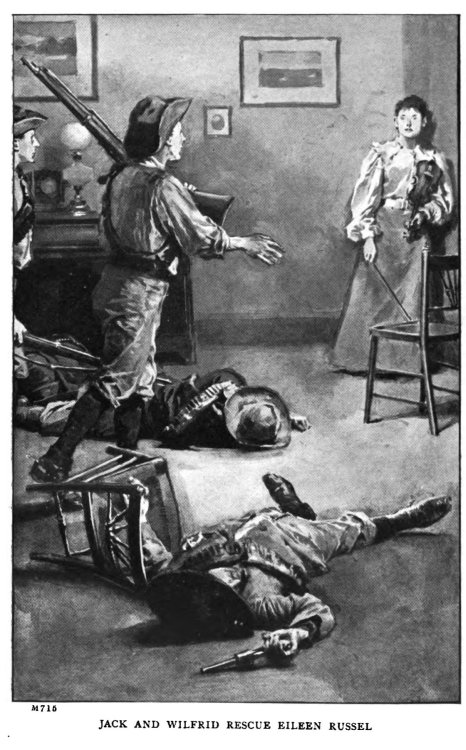
Jack and Wilfred at once ran round to the door, which stood wide open, and stepped in.
“Don’t be frightened, Eileen,” said the former soothingly. “Those cowards have bolted, and you are safe for a time at least. What has happened to your father?”
“Ah! is that you, Jack Somerton?” the poor girl asked in a dreamy way, as if she were not quite certain that her eyes had told her correctly—“Jack Somerton, the young Englishman who used to come here with our old friend Tom Salter?”
“Yes, it’s Jack all right, Eileen,” he replied. “Now tell me how those villains happened to find you here alone.”
Eileen Russel stepped forward from her corner, and, grasping Jack by the hand, gazed searchingly into his face, as though she was still uncertain of his identity. Then she suddenly sat down in a chair, and, hiding her face in her hands, sobbed as if her heart would break. But it was merely the reaction after the terrible hour of torment she had suffered, and, cheered by a gentle pat on the back from Jack’s strong hand, she soon regained her composure and dried her eyes.
“Father is here, Jack,” she exclaimed eagerly. “He is down below in the cellar, where Tim and I hid him. He is wounded—badly, I fear. Those Boer cowards rode up here just before daylight, and ordered Father to come out and be taken before their leader. Father asked what they wanted with him, and they shouted back that this part of English territory had been annexed by the Boers, and that as an old inhabitant he was bound to fight for them now that he was no longer a subject of the queen.”
“‘Get away from here at once,’ Father shouted back, as soon as he had heard what they had to say. ‘I am a British subject, and shall be to the end. None of your republics or presidents for me! Clear off, all of you; and if one of you dares to attempt to come in I will shoot!’
“The Boers laughed at his threat, and attempted to beat in the door, but Father was as good as his word, and shot one of them at once. The others poured a volley into the house, and one of the bullets passed through the wall and wounded Father in the shoulder. Then the Boers made a rush, and began to force the door open, and as we knew that they would have little mercy for Father, Tim and I hid him away in a cellar down below, which he had constructed to keep stores and ammunition in. Then we lowered the trap-door and placed the table over it.
“They broke in a few minutes later, but, failing to find him, thought he had escaped through the window. Then they forced me to play my violin, and just as I thought they would shoot Tim or myself, the leader fell dead and the others ran for their lives.”
“Well, you are safe for the present at least,” answered Jack. “Sit down there, Eileen, and rest yourself. We will get your father up again. Those fellows will not be coming back yet awhile, so that we need not fear a surprise. Now, Wilfred and Tim, lend a hand and pull up this trap.”
A minute later the table had been removed to one side, and Jack was clambering down into the cellar, Tim lowering the lamp after him. On the boarded floor he found Frank Russel lying upon his back, and making feeble efforts to rise, for the reports of Jack’s rifle had roused him from unconsciousness.
“Where am I? What has happened?” he asked. “Hallo! is that you, Jack! Where’s Tom Salter?”
Then he suddenly remembered the Boers and sat up with a jerk.
“Ah! what has become of those brutes?” he demanded, clutching at the rifle which had been placed beside him, while his face flushed red with rage.
“Now don’t worry about them,” said Jack kindly. “They’ve bolted, and Wilfred and I arrived here just in the nick of time. Let us get you up on top and look at the wound. When that is seen to, we will discuss the situation.”
Frank Russel was still too much dazed to offer any resistance, and was soon carried up the ladder and laid on a bed. Then Jack opened up the seams of his jacket, and cut away the shirt over his left shoulder. A close inspection showed two little blue wounds, the size of a pea, one in front, and one behind where the Mauser bullet had made its exit. There had been scarcely any loss of blood, and luckily no bones broken. Eileen meanwhile had produced a basin of cold water and a soft towel, and with this they dressed the wound and bandaged the shoulder. A stiff glass of spirits pulled Frank Russel round, and now that he was over the first shock, he very quickly became himself again, for he was as hard as iron, and accustomed to the rough life of a colonist. Ten minutes later he was standing up lighting a big pipe, and even using his left hand, so little pain did his wound give him.
“Now tell me all about it, Jack Somerton,” he said, puffing big clouds of smoke into the air with the greatest satisfaction.
As soon as the brutal action of the Boer spy and his friends had been narrated, and followed by a description of their flight, Frank Russel sprang to his feet and shook Jack and Wilfred heartily by the hand.
“My lads,” he said in a husky, trembling voice, “you’ve won the deep gratitude of old Frank Russel. I’d sooner see every Boer in Africa dead than hear that one of them had ill-treated my darling child. Ah! she’s all I have left since the wife went to her home above, and a good, dutiful, and loving girl she is! Come here, Eileen dear, and kiss your father. You’ve had a close shave, and but for these brave Englishmen that brute would have murdered you. And Tim, too, has proved a faithful boy. Well, he shall not regret it, for from this day he shall never have a fear for his old age. I will give him sufficient to ensure his independence.
“But now we have other things to think about. Kimberley is closely besieged, and though we are only five miles away we are surrounded by hosts of Boers. They will be back here soon, and then it will be all up with us.”
“Why not ride off at once?” asked Wilfred. “There are four of the Boer ponies outside, and Jack and I have our own.”
“It would be useless,” replied Frank Russel, with a vigorous shake of his head. “Those fellows have already warned the whole district, and by this time we are closely surrounded. Look away over there. That small light is their signal, and it is flashing a message in the darkness which every Boer can read. No, I fear it is all up with us. I’m sorry, lads; you two would have got in safely if you hadn’t come along in this direction and helped us in our trouble. If there was a chance of your succeeding now, I’d say go at once and leave us. But there isn’t, not the slightest, and it’s only fair to say so.”
“We must make the best of matters as they are,” remarked Jack coolly. “A week ago I was in a fix which was every bit as awkward. I’m not going to be shot or taken prisoner yet awhile if I can help it, and if you all feel the same I propose we make a fight for it.”
“Ah, I’d fight if I had a chance!” growled Frank Russel. “But it’s no use here. They would be a hundred to one against us.”
“Wait a minute, Mr Russel,” exclaimed Wilfred, who had an unbounded faith in his friend’s sagacity. “Let us hear what Jack has to say. I’m like him, and don’t mean to fall into the Boers’ hands without a struggle.”
“Ah, well! what is it, Jack?” answered Frank. “But you’d best be quick about it, for those fellows will be getting close to us by this.”
“I’ve said I am going to make a fight for it,” exclaimed Jack, “and I mean to do so, for from what I have seen and heard, our enemies have the greatest dislike to attacking in the open. It is too risky for them, and is apt to lead to fatal consequences, as I have already been compelled to show them. Now this house stands clear out on the veldt. There is not even a boulder within half a mile of us, and therefore no cover. It is true that at close quarters a Mauser bullet will pierce these walls, but at long range it will not come through. Let us make a stand here. But, first, have you plenty of cartridges, Frank?”
“Heaps, lad, heaps! ’Pon my word, I like this idea of yours! But where is it going to end? We’ve a pump and water in the house, and plenty of food and ammunition; but we cannot hope to keep them out for long, and they are certain to rush us in the darkness.”
“Yes, they will do that,” Jack agreed, “but they have got to get inside the house before they can hurt us, and we shall have something to say to that. Now before talking about the means of defence, let us send Tim off to Kimberley. He is the only one who could possibly get through. That will be our only hope. We are in the direction of the railway, and not too far from the town for a sortie to reach us. Now, Tim, will you go?”
Tim at once signified his willingness.
“Then off you go!” exclaimed Jack. “Quick! There is not a moment to be lost! When you get into the town ask for Tom Salter, and get him to take you to the ‘Baas’. Tell him what trouble we are in, and ask for help to be sent us.”
The plucky Zulu boy at once stepped to a corner of the room, snatched up an assagai with an enormous blade, and, shaking a farewell with it, darted out through the doorway.
“Jack, you’re one of the right sort!” exclaimed Frank Russel when Tim had disappeared. “I’ve looked at this idea of yours from every side. If they take us now or later on it won’t make much odds to me, for they will treat me as a rebel; while you two and Eileen will just be prisoners. We’ve a chance of beating them off till help reaches us, and so sure as I’m a true Englishman we’ll have a try at it.
“You’ve settled the matter up to this, so go on with it. I’m an older man, and perhaps more used to these fellows, but I’m sure you could beat me in slimness. Now out with it, lad, or those Boers will be on us before we are ready.”
“Very well, then,” Jack replied, “let us set to work. We must break up some of this furniture. We want a couple of hammers, a saw, and some big nails. Have you got them?”
“Yes, close handy, Jack. Eileen, fetch the bag, like a good girl, and bring the axe along.”
“Now break up the table and nail the boards across the window, Wilfred,” continued Jack. “Frank and I will see to the door. It must be firmly closed. Wait a minute, though, our ponies may be of some use to us. I will slip out and bring them in.”
Jack opened the door and ran round to the back of the house. A minute later he returned and led in the three ponies, taking them to a small kitchen. Then he brought in two of the Boer ponies, and drove the others out of the garden on to the veldt. That done, he shut the door, bolted it, and nailed two heavy uprights against it. A quarter of an hour later all the windows were firmly barricaded, a niche about three inches wide having been left between the planks through which the rifles could be pushed. Then with an auger he drilled a number of holes through the walls all round the house, driving three of them so as to form a triangle, the sides of which he completed with a chisel, thus forming apertures about five inches high and as much in breadth, which would give them a good view across the veldt.
“Now we’re ready,” he said, when all was at last completed, “and I expect we shall have the Boers here soon. Eileen, you had better go down into the cellar, I think, so as to be out of danger.”
“Thank you, Jack!” she answered calmly. “This house will require every rifle we have to defend it. I have used one many a time, and I shall stay up here and help you.”
“Brave girl, and it’s like you, dear!” exclaimed Frank Russel. “Stay if you wish, for we’ll not deny that three is a small number to garrison this place. I suppose we had better take our posts now. One at each wall will be the thing. Remember, it’s steady, quiet shooting we want, and only use the magazine when they make a rush. That will be our trouble. It wants more than three hours before we shall get daylight, and until then we shall have to trust to our ears to tell when the Boers get close to us.”
“Have you got a bell here?” Wilfred suddenly asked.
“Yes, there is one in the kitchen,” Eileen answered, “and the handle is just outside the door. We are the only colonists hereabouts who possess such a thing.”
“Then we’ll beat them yet!” cried Wilfred. “They are certain to ride into the garden through the opening in the rails. Open the door, Jack; and give me a long piece of string, someone. I’ll slip outside and run it from the bell-handle to the rails and across the opening. Then the first man who rides in will jerk it, and the bell will give us a warning.”
“Good, lad, good!” exclaimed Frank Russel with a grunt of satisfaction. “That will just save us. Set about it as quick as you can.”
Five minutes later Wilfred had carried out his plan, and not content with running a cord from the bell-handle across the opening into the garden, he passed others completely round the railings, so that anyone attempting to climb them, or pass through them, would almost certainly come in contact with one or other of the strings and warn those inside the house. Then he joined his friends again, and the door was safely nailed up as before.
About half an hour later, when the night had lifted a little, there was a faint tinkling of the bell, and Jack, who had chosen a position commanding the front of the house, caught sight of a dusky figure at the opening to the garden. His rifle spoke out instantly, and with a shriek of pain the man disappeared.
After that there was silence for many minutes, and then the bell jerked feebly once or twice, and afterwards pealed loudly.
“There are a crowd of them in front of me,” whispered Jack. “Give me a hand here, Wilfred, and leave Frank and Eileen to watch the rest.”
Wilfred at once darted across the floor, and, peering through a loophole, saw a number of dusky figures hurrying into the garden through the opening, while others suddenly appeared against the sky-line, and then became almost invisible as they climbed over the railings and jumped amongst the flowers.
“Let them have it with the magazine,” Jack whispered again, and waiting a moment for Wilfred to prepare, he aimed at a bunch of the enemy pouring into the garden, and discharged shot after shot amongst them. Meanwhile, Wilfred fired at the figures climbing the railings, while sharp reports from the side and back of the house told that Frank and Eileen were also engaged.
Once their magazines were empty, it took only a few moments to replenish them, and again they poured a stream of bullets through the loopholes.
But the Boers had already had sufficient. With shouts and shrill cries of fear they disappeared in the darkness, leaving many of their number dead or wounded in the garden.
“That will make them more careful next time,” muttered Jack. “I wonder what their next move will be!”
He had not long to wait, for almost before he had finished speaking there was a roar of musketry all round, and a hail of bullets flew through the house, piercing the walls as if they were merely composed of paper, and sending splinters flying in all directions. It was decidedly unpleasant, but all escaped by the greatest luck, the only injury sustained being a flesh wound by Jack. The bullet had passed through the calf of his leg, but so unimportant was it that a handkerchief tied round it was amply sufficient to staunch the blood which flowed, while the pain was so little that he scarcely felt it then, though later on he suffered considerably.
“Lie down, all of you!” shouted Frank at this moment. “They will be giving us another volley.”
All threw themselves on the ground close to their loopholes, through which they stared out at the veldt, which was now becoming more visible every moment.
A second later another storm of bullets tore through the house, while others struck the iron roof above, giving rise to an alarming noise. For five minutes the fusilade continued, and then suddenly ceased.
“To your posts!” cried Jack. “They will hope to have killed or wounded all of us, and will make a rush.”
Sure enough, a host of Boers now appeared in the growing light, running towards the house, and into them all four rifles poured a stream of lead, each shot of which, though hastily fired, was carefully aimed. At such close quarters it proved disastrous, and though a few of the bolder spirits amongst the enemy did manage to reach the house, the majority were either struck down or retired precipitately. For those who were attempting to kick in the door Jack’s Mauser pistol still remained, and he emptied it amongst them without pity.
At any other time the fact that he was taking human life, and sending fellow-beings to a last and sudden account, would have shocked him and filled him with lasting remorse. But now it was different. He had seen a crew of powerful men injuring and threatening a helpless girl. For that alone they deserved punishment, part of which had been summarily meted out to them. But the remainder had escaped, to return with other comrades, all enemies of the queen. They would not hesitate to take the lives of those who so gallantly defended the farmhouse, and he in turn would not spare a single one of them. Jack hardened his heart, and calmly loaded the magazines of his weapons again, in preparation for the next assault.
But they had read the Boers a severe lesson, and those of them who had escaped the hail of bullets fled from the neighbourhood of the little farmhouse, and, flinging themselves upon their ponies, galloped away across the veldt till well out of range of fire. Then they pulled up and collected together, solemnly swearing that, come what might, they would subdue those few English opposed to them, and wreak a fearful vengeance on their heads. The pluck and dauntless determination of the little band they fully recognised and admired; but they had already killed or wounded some forty or more of their brothers, and a price must be exacted for those lives.
With sullen and determined looks they parted to surround the house, while a few were despatched for reinforcements, and for guns with which to splinter the walls behind which the defenders lay.
Meanwhile Jack and his friends stood grimly at their posts, thankful for the breathing-space allowed them, and for the daylight which was fast stealing across the veldt. At last the day broke completely, leaving the plain in front of them partially obscured in a thin grey mist. But a few minutes later a golden glow lit up the eastern sky, and in course of time first a rim and then the whole of the morning sun rose above the steep spires and pinnacles of the range of mountains beyond the Vaal River, and poured a flood of warmth across the lonely veldt. Instantly the mist cleared away, and a glorious day had dawned.
“Now our first duty is to give the enemy permission to remove their dead and wounded,” exclaimed Frank. “Let us pull down one of these boards and shout to them.”
Accordingly a plank was wrenched from one of the windows, and a white flag waved through the opening. A Boer horseman at once galloped up, and, riding into the garden, reined in opposite the window.
“You can remove your dead and wounded,” said Jack, who had agreed to act as spokesman, so that Frank Russel should not appear. “Only ten of you must come for them, and on no account must anyone be armed. We will give you an hour to do the work. After that we shall fire on anyone who approaches.”
The Boer courteously expressed his thanks, and at once rode away.
Five minutes later a wagon was driven up to the railings, and the party who had come to pick up the dead and wounded entered the garden.
Those inside the house sat down at their loopholes and kept a close watch, for they had heard before of Boer treachery and slimness, and more than one incident of the abuse of the white flag had been clearly exposed during the opening days in Natal. As they watched they hastily ate a meal, and having finished looked to their rifles.
All this while the unhappy men who had been wounded were being gently conveyed to the wagons, and Jack and his friends pitied them, and admired them for their fortitude. Scarcely a groan did they utter. They bore their sufferings patiently and in silence, and won the unstinted sympathy and praise of those who, by the fortune of war, had been the cause of their trouble.
At last all were removed, the search-party retired, and the young Boer who had at first replied to the white flag trotted up to the window and once more expressed his thanks. Then he turned his horse and galloped away, leaving the four inmates of the farmhouse to resume the desperate and one-sided struggle.
Chapter Ten.
Desperate Odds.
The sun had climbed some way into the heavens, and the day had already advanced three hours on its course before Jack and his staunch little following saw a horseman galloping across the veldt towards the farmhouse.
He was a big, handsome man, well-dressed for a Boer, and wore a long tawny beard. Attached to a stick which he held in his hand was a white flag, and having ridden to within two hundred yards of the house he waved it vigorously, and shouted to attract the attention of those within. A moment later a handkerchief was fluttering from the window, and Jack was waiting there in readiness to hold a parley.
“Good morning!” said the Boer in excellent English as he pulled up alongside the window. “It’s a grand day, and far too fine to be spoilt by fighting. I’ve come from the commandant to offer you terms—liberal terms. We believe Frank Russel is with you after all, and if so, as a rebel he shall be shot. For the others, honourable captivity is offered, and the girl shall be in my special charge. I have known her for many years, and she shall be safe with my mother.”
“Don’t trust him, Jack,” whispered Eileen, who had crept close up against the window, where she looked through one of the rifle apertures and listened intently to all that was said. “I know him well. He is an Africander, and a British subject. His farm lies ten miles to the north, and Father will tell you why he is anxious for me to be given over to his care.”
“Yes, it’s true,” growled Frank Russel, joining in at this moment. “He is a rebel, and not to be trusted. He’s been pestering round here for many a day, and asking Eileen to become his wife. But she hates the sight of him, and for my part, though I’ve no doubt he’s smitten with her, it’s this farm and the fat acres attached to it he is more interested in obtaining. Don’t trust him, Jack; send him about his business!”
“And what if we refuse these liberal terms of your commandant?” Jack asked coolly. “How will he guarantee all he promises? Words are not sufficient. Let him put it in writing, and we will consider it; but understand, we will not accept captivity, nor will we give up Miss Russel. As to Frank Russel, you did not find him here, and how can we have done so?”
“Surely the word of Elof Visser is sufficient!” exclaimed the Boer. “You have heard the terms, and they are the only ones I have to propose. We will give you half an hour to discuss them, and then, if the white flag is not waving from this window, we shall open fire. Only, if you should foolishly still decide to resist us, I ask you to pass out the girl. We do not wish to war with her sex. Hand her over to me, and I swear, by the God who made us all, that she shall be safe from harm.”
“We will consider your proposal,” answered Jack, “and if you do not see the flag at the termination of the time you mention, you are free to fire on us again. But I warn you we are well prepared, and you would do far better to leave us alone.”
“Tush, boy, don’t lecture me!” exclaimed the Boer angrily. “Discuss the terms, and if you refuse, we will knock this house about your heads like a pack of cards, and shoot every one of you.”
Giving an impatient jerk at his reins, he pulled his animal round and cantered away.
“Well, what answer shall we give?” asked Jack, turning to his companions.
“What answer!” retorted Frank Russel grimly. “Lads, if you’re ready and willing to stand by me and my child, as I believe you are, I say let us stand fast. The Boer promises aren’t worth the breath that’s wasted on them, and that fellow Elof Visser has his own ends in view.”
“Then we’ll face it out,” exclaimed Jack, “and after all, things are not so very desperate. Last night was our worst time, and if we could beat them back then we ought to be able to do the same during daylight. We’ve lots of ammunition, food, and water. The only thing I don’t like the thought of is the shell which will soon be thrown at us, but the Boer gunners are not such good marksmen as to be able to strike us every time, and when the shell do strike, if they are like those used in Natal and do not burst, they will go clean through these walls and do no further damage. When they fire we shall have to take to the cellar, and it seems to me that the sooner we make it bomb-proof the better. It won’t be difficult. The kitchen is paved with big slabs of stone, and by forcing them up and placing them here on the floor, and half over the trap, we shall have a secure place to hide in. The ponies must take their chance, though I expect most of the poor beasts will be killed as soon as the bombardment commences.”
“George! The very thing!” cried Frank Russel, smacking Jack on the back. “Now all hands to the job! There are plenty of tools to work with in the kitchen, and I fancy a good strong poker will be the best to use.”
All at once went into the kitchen and set to work as only men can whose lives depend upon their exertions. Once the first slab was raised the rest was easy, and while Eileen kept watch the others laboured at the work, Frank Russel levering up the stones, while Jack and Wilfred carried them into the room and laid them over the cellar.
“One will be sufficient to keep watch above, so the others had better go below,” cried Jack, as soon as the flooring was completed. “There is no saying when a shell may pitch into the house. Light the lamp and make all comfortable. Perhaps it will be a good plan to pass a few buckets of water down also, in case they make it too hot for us to come up and fetch it.”
This was quickly done, and Eileen and her father climbed down the ladder into the cellar, while Jack and Wilfred remained on top to watch for the next attack by the enemy. The half-hour had already passed, and indeed double that period had gone by, but still there was no movement. Then Wilfred cried out that he saw a force of Boers approaching, and looking through his field-glasses Jack made out a body of about sixty men following a couple of guns. One of these was smaller than the other and had no limber attached. The larger one, which was drawn by six horses, galloped forward till within less than 1200 yards of the house and commenced to unlimber.
“We’ll just teach those fellows to keep at a more respectful distance,” muttered Jack. “Put up your sights, Wilfred, and have a shot at them. There is a good big lump to fire at, and with a little luck we might pick a few of them off.”