“WHERE THE YOUNG CHILD WAS”
Reading edition
“AIN’T some folks lucky?” Mahany spoke to Captain Austin Hoban, tramping up and down the desolate junction platform, and waved a huge mittened paw toward the private car glowing with warm light through the snowy dusk. “Look at them! Nothin’ on earth to trouble ’em. They ain’t jackrabbited from pillar to Post for heaven knows why,” grumbled the grizzled old sergeant bitterly. “They ain’t got to dry-nurse a lot of kid rookies that ought to be home hangin’ up stockin’s for their poppas an’ mommas to fill on the sly, ’stead of bein’ took out on a Christmas Eve for to be makin’ soldiers of, which I misdoubt heaven ever meant the likes of such for.”
He was taking an offensively raw and youthful draft out to a Northwest Post; Hoban, returning to that same Post after leave of absence, had fallen in with him at this transfer point. They were waiting with such patience as they possessed for the made-up train—engine, box-car, coach of foreign miners, extra car for the soldiers, and now this superfine private car, “Andrassah”—to start. Still grumbling, for it was piercingly cold, Mahany went back to his charges.
Two furry shapes came out of the private car. Hoban paused idly, and the arc-light shone full upon him. Whereupon one of the shapes, bounding upon the platform, hurled himself into the captain’s arms.
“Hoban! What a bully surprise! What are you doing here—coming or going? Come over and see Sally; we’re going to spend Christmas with Buckleigh at the Two Bar B,” shouted Lieutenant Darrell Compton; and, laying forcible hands upon his old friend, he dragged him forward.
Hoban, who would have fled from such a meeting as from the wrath to come, found himself being presented to Buckleigh, who, for reasons of his own, most greatly desired to find favor in the eyes of Lieutenant Compton just then. A few questions, and he took the situation in hand; hardly knowing whether to shrug or to swear, Hoban found himself, despite protests, literally captured bag and baggage.
Five minutes later Buckleigh was presenting his chance guest to the other members of his party—Trenton, the Pittsburgh man, he who makes money ruthlessly and builds great hospitals; McLachlin, the New York magnate; Dr. Edgar Bristow, the specialist, and his wife, a woman as beautiful as an idol and, one suspected, costing quite as much to keep properly panoplied; and Sally Compton, for whom alone Hoban really had eyes and ears. She had been the toast of every post since she wore pigtails and a sunbonnet and raced around the compound on her own calico pony. It is a favorite army tradition that she winked at the doctor when she was one hour old; and that, ere she had reached the riper age of two years, the chaplain, the surgeon, two fat majors, and a bald-headed general had proposed to her. For Sally Compton is, of all heart-snatchers, the most alluringly, adorably, distractingly pretty.
Inwardly disturbed and raging, outwardly starry-eyed and sparkling, Sally gave him her hand coolly enough; but the irony of the situation was not lost upon her; the color deepened vividly in her cheeks. Fate, she thought wrathfully, was certainly playing her a scurvy trick!
Sally knew only too well that this trip in the gorgeous “Andrassah” to the Two Bar B Ranch, that most bepraised and advertised of all big money-making places, was really only the last of the calculated moves of Buckleigh’s game: a game by which, mesh after mesh, his net had been closing upon her. Consummately had Buckleigh played it—with lavish attentions, motors, yacht, private car, great ranch, casual-deliberate hints betraying his ownership of this railroad, that mine, a bank or so; ever impressing upon the army girl’s consciousness the sheer enormous power of money—his money. Even the guests here to-night were part of that scheme—millionaire, magnate, great specialist, famous beauty, all summoned before her by a wave of Buckleigh’s magic hand.
Stout, baldish, suave, a hint of tigerishness underlying his slow smile and lurking in his heavy-lidded eyes, Buckleigh bargained for youth and beauty and charm. A man who left nothing to chance, she surmised that he had planned even to the last detail just when and where and how the final scene in this pleasant comedy should be staged; she meant to say “Yes.”
And now, just when she was beginning to think she might school a rebellious heart into a sensible mind’s acceptance of a thing so altogether desirable as this great match, here had fate thrust upon her the one man in all the world who made that decision taste of the bitterness of death; dragged him in whom of all men she wished not to see just then.
The car wheels presently began to grind out a diabolical rhythm: “Buckleigh’s buying Sally Compton! Buckleigh’s buying Sally Compton!”
Out of the corner of her eye she glanced at Hoban’s handsome profile, bent toward Adele Bristow. No, she reflected drearily, he had never cared; that had been left for her. Darrell was lamenting that he must part from Hoban in the morning, when Buckleigh’s car was to be picked up by the regular express at a station farther on. Buckleigh, too, was suavely sorry Captain Hoban couldn’t stop over at the ranch for Christmas: he had planned a few festivities, he added.
Glancing at the over-magnificence of his car, Hoban had a pretty accurate idea of what Buckleigh would make that Christmas at the Two Bar B. “He’ll jolly well cram the earth into a gilt-paper cornucopia and hand it over to Sally, with a sprig of holly and a fat smile,” thought the soldier, who hadn’t anything but his name, his sword, and his heart to offer her. “She’ll take it, of course. Who wouldn’t? It’s too big a temptation for any mortal woman to withstand, I suppose.” He knew that Buckleigh was “the millionaire Sally Compton’s dangling around these days,” as a too-faithful friend had written. He wished that he could honestly find it in his heart to like the man; but he couldn’t.
Then the car wheels began to grind out a soothing tune for Hoban, too, car wheels being the most totally depraved of all inanimate objects when given half a chance to show what they can do: “Sally’s going to marry Buckleigh! Sally’s going to marry Buckleigh!”
And all the while the night lowered and lowered, and the storm outside gathered and gathered. All day it had been snowing—more heavily when they had left the junction and plunged into the Wyoming hills; now the storehouse of the snows opened doors and windows, and poured out its garnered hoards.
In the rattling day-coach a Slovak miner was singing an endless melancholy song, which rose and fell with the monotony of gray waves on a desert shore. In the other coach the soldiers amused themselves as best they might. But in the “Andrassah,” having concluded a veritable triumph of a Christmas Eve dinner, they were somnolently content. Better the stalled ox than the dinner of herbs; if you doubt it, ask the ox.
“I remember,” said McLachlin, stretching himself lazily, “somebody—seems to me it was Pliny, but I wouldn’t swear to it—saying something about being able to enjoy a tempest on the sea more when one happened to be on land. I’ve muddled it of course,” he added good-humoredly; “but if you’ll look at that snow against those windows you’ll gather my meaning.” For some time the train had been moving more and more slowly; now, with a long scrunching of brakes, it stopped.
A worried conductor appeared. “Stalled freight ahead. Snow. Wired for help. Have to wait a bit, gentlemen.”
“How long?” A frown darkened on Buckleigh’s forehead.
“Depends on how soon the plow gets here,” said the conductor.
“Do you mean to say,” exploded Buckleigh, “that I’m to be held up indefinitely for a dashed freight?”
“We can wire for a plow and have the freight pulled out, Mr. Buckleigh,” said the conductor, dryly; “but even you can’t give orders to the Almighty to quit snowin’ when He feels like snowin’, and have your orders obeyed.” He went out, grimly smiling.
“Quite so, Buckleigh, quite so!” said the Pittsburgh man, briskly. “Job, thirty-eight, verse twenty-two.” He was a religious man, and outside of business hours greatly respected the power of Providence.
“I do not seem, at any rate,” said Buckleigh, “to lack Job’s comforters.” One might have thought he snarled.
Sally Compton laughed in his face. “Why, I thought you were too wise,” she mocked him gently, “to kick against the pricks of the inevitable, Mr. Buckleigh. Besides, we’re deliciously ‘comfy,’ and there’s no immediate danger of our starving or freezing, is there?”
She felt that she had been given a respite, and that the inevitable had been, at least for a little while, deferred. Her spirits rose soaringly. But Buckleigh was displeased. He hated to have his plans upset, and every detail of to-morrow had been prearranged, even as scenes in a well-set play. Now, as things were, he doubted if they reached the ranch before to-morrow night, even if then.
They were preparing to retire when the conductor came in hurriedly. “Say, ain’t one of you gentlemen a doctor?”
“I am a physician,” said Bristow, suddenly alert.
The conductor whispered into the doctor’s ear. Bristow started, whistled, scrambled into his fur coat, jammed his cap down over his eyes, and the two hurried out.
Ten minutes later Bristow was back. Big, commanding, forceful, to the finger-tips the able physician at work, he gave crisp orders. “Hot water,” he directed Buckleigh; “gallons of hot water. Get busy, please. Blankets, and two or three pillows. Adele, I shall need you. There’s a girl out in that box-car—and her hour is upon her.”
Adele stared. “Why, Edgar, you know very well I’m without my maid; she would go home—just as we were starting, too. Horribly provoking, and I’m what you might call helpless. If she were here you’d be welcome to her services, of course.”
“I said I needed you,” said Bristow, curtly.
“Edgar! Good heavens, you must be mad! In a box-car? A strange woman? No! I won’t! I can’t.”
“You will. You can. You’ve got to,” said he. “You’ll be useful for once, whether you like it or not. I need you; and you’ll do what I say this night, or I’ll know why.” He towered above her, eyes gleaming, jaws set; almost his streaked gray mane bristled. He looked magnificent; like, say, a thoroughly roused old lion.
His wife stared, and a most curious light flickered into her astonished eyes. She rose, gracefully ignoring the shocked and startled faces. “I’ll save you the trouble of taking me by the hair, Edgar,” she said lightly. “You look quite capable of it. Just tell me what I’m to do.”
“Exactly what I tell you. Remember: If you scream I’ll box your ears, and if you faint I’ll chuck you neck and crop into the snow. Get your wraps. Where’s my black case, you, Jim, or whatever your name is? A bundle of towels, Miss Compton, please. Buckleigh, look after that hot water. Captain Hoban, you and Mr. Compton get those fellows in the cars ahead quiet, and keep ’em quiet. That girl’s in a bad way.”
Sally helped Mrs. Bristow on with cloak and hood. Porters, loaded with blankets and pillows, followed them. Hoban and Compton had already gone through the cars ahead and the shouts and singing had suddenly ceased.
Trenton, with a very sober face, came over and sat down by Sally. “Oh, my, my, my!” said he, nervously. “Poor thing, poor thing! Natural of course; but—in a box-car—dreadful, dreadful!”
“All by herself!” Sally added.
Trenton drew a little closer.
“It—sort of comes upon me—unaware,” he whispered. “My wife died—like that. Very young, poor thing! I was too. Not rich then. Poor—very; but, my heaven, how happy! She was so pretty, my wife!” he added wistfully. “I loved her a great deal, Miss Compton. But—she died, and the baby with her. And that’s why,” he finished mildly, “I—build hospitals.”
The little, cold, dry, moneyed man took on a new aspect. The girl reached over impulsively and squeezed his bony hand, a swift, warm, reassuring human pressure. “To thank you,” she whispered, “for the women and the children your hospitals have helped and saved, because of one sweet woman, Mr. Trenton.”
“I—loved her,” said he, simply. “And when all’s said and done, my dear, that’s the biggest, greatest, most glorious thing in the world!” A musing and remembering smile crept into his tired old eyes.
“From what I gathered from our sententious friend, the conductor,” McLachlin was saying a little later, “the girl’s the wife of one of your foreign miners, Buckleigh, going out to the Big Bend. He had to come for a job, poor chap! and he couldn’t leave her behind; she has no people in this country at all. So the railroad men, seeing how things were with her, made her as comfortable as they could in the box-car—and dashed decent of them, too, say I! They thought she’d be able to reach the mine safely. The thing worries me; upon my word it does! I can’t help thinking of the night my daughter’s little girl was born, and how I sat in the library and hung on to my wife like a scared kid. I got ten years older in that one night.” He got up abruptly and began to tramp up and down, his hands under his coat tails. “I wish she were over it!” he muttered.
Buckleigh watched him with cold scorn. He was disgusted and furiously angry. It was bad enough, he considered, to be stalled here on the edge of nowhere, with all his prearranged plans going awry. But that an unknown and poverty-stricken woman should actually disrupt his party, render distracted his exclusive guests, making them forget their own exalted station, and behave as if they were of her common clay, struck him as savoring of stark anarchy. Bristow, whose fees were enormous, who was consulted by foreign royalty, had rushed out into the night like the veriest country doctor, dragging, too, his wife with him; Buckleigh hoped Adele would divorce him for it. Moreover, Bristow had, without so much as a by-your-leave, coolly confiscated especially woven blankets, down pillows, monogrammed linen, as if the woman’s need had made them hers by simple right! He, Buckleigh himself, had been suddenly pushed aside as one of no consequence, merely because the most ordinary of human events was occurring to the most ordinary of human beings.
Porters, bearing buckets of boiling water swathed in blankets to preserve the heat, came and went. Sally Compton refused either to entertain or be entertained; she sat silent; at times a slight tremor passed over her; for Sally felt that the angels of life and death walked abroad almost visibly that night.
Later Hoban came in, his shoulders thickly powdered. “Bristow says she’s doing as well as can be expected,” he told them. “But—she’s nothing but a slip of a girl, I understand. I was helping one of the porters up with a bucket of hot water—and I heard—” He shook his head.
McLachlin nodded sympathetically. “I know. I remember when—my girl—” He blew his nose violently.
Buckleigh grunted.
“My wife,” said Trenton, wistfully, “was a slip of a girl, too, and—so pretty! Poor thing, poor thing!”
Buckleigh stared coldly.
Sally looked from one man to the other curiously. It struck her that, stripped of a sudden of convention, each appeared as he was, with a sort of elemental clarity and simplicity.
“You’ve no idea,” said Hoban, “the effect on those foreigners in the front car. One of the Italians that can speak a little English told me it was ‘like the Holy Night.’ Do you know what those chaps are doing? They’re praying!”
McLachlin nodded; Trenton smiled understandingly; Buckleigh sneered.
Hoban’s face twisted oddly; he grinned and his eyes twinkled. “And the sergeant,” he said, “has sent every man jack of his boys to bed without undressing, and is sitting there with a pistol in each hand to make sure they keep quiet.”
The hours crawled. An immense and waiting silence hung, it seemed to Sally, over the whole snow-wrapped universe, knowing that something very wonderful was about to occur. Buckleigh alone sat cold, impassive, unmoved; so far as she could see he had not shown one slightest touch of human sympathy. She watched him stealthily, with a growing fear. She meant to marry Buckleigh of course; and one couldn’t expect everything; but—
Released, at Hoban’s request, from the sergeant’s too-strict surveillance, the soldiers had cleared a space under the trees outside and, utilizing what they could find of dead timber, had built a fire, which sputtered and hissed as the snow from the branches above melted and ran down into it. Weirdly the flames lit up the towering hillsides, the trees bent under their weight of snow, the half-buried trains and the little frozen river beside which the track ran.
Sally, gazing out at the window, could distinguish Darrell, and then Hoban’s taller figure. The very sight of Hoban gave her an odd sensation of strength and comfort.
A cold gray light was beginning to grow when Bristow appeared in the box-car door, collarless and with bared arms. He put up a great forearm and rubbed it across his forehead. “As fine a little rascal,” said he, “as I’ve ever seen.”
“Boy?” asked Hoban.
“Sure. Ten pounds. Lungs like a blacksmith’s bellows; ribs like a dray, and a fist like a prizefighter’s! Some boy, believe me!” He sighed with relief. “I had to haul his fool father away by the scruff or he’d be crying over the girl’s feet yet. What!” he said, abruptly, to the pale, boyish husband who approached him supplicatingly, “are you here again? No, you cannot come blubbering over that girl just now! She’s all right, I tell you, but I can’t have you disturbing her. Go away! Well, you can come back in half an hour, then. Take him away, somebody.” He looked after the handsome fellow, whom the sergeant dutifully led away as one under tentative arrest, and his eyes twinkled; but his smile was kind.
Later Sally begged, and was allowed, to visit the new arrival. In a cleared space at one end of the car, lighted by an oil lamp and warmed by a bucket brazier, on a cot covered with straw which showed under the blankets and pillows, lay a Madonna-like Italian girl. Her beautiful black hair, meekly parted on a pale brow, fell in two long braids over her shoulders. She was pearly white, and her childish mouth sagged somewhat. But out of the pale and weary face shone a pair of eyes so sweet, so pure, so starlike, that Sally’s heart gave an upward bound at sight of them.
The girl made a little, fluttering, welcoming motion of the hands, smiling ever so faintly. They looked at each other steadily, the girl who was going to marry Buckleigh, and the girl who was the wife of one of Buckleigh’s miners. The sweet, shining eyes were telling Sally something—that same something Trenton had told her while they waited: that love is, after all, the greatest thing in the world. The girl turned her head and spoke in a soft whisper. “She wants you to hold the baby,” said Adele Bristow.
Mrs. Bristow’s Parisian gown, which she hadn’t had time to change, was rumpled, and her magnificent red hair hung heavily down. There were dark circles under her eyes, and she, too, was very pale. But, as one who holds a hard-won treasure, she clasped the newly born against the laces at her breast, smiling upon the downy black head. Even as she smiled the baby nuzzled and whimpered. Bristow, over her shoulder, laughed.
His wife, thrusting the baby hurriedly into Sally’s arms, turned upon him like one at bay. A fiery color leaped into her cheeks, then faded, leaving her paler than before. “Oh! You—you big, blind, blundering brute!” she gasped. And she began to weep uncontrollably.
Sally thrust the baby into his mother’s waiting arms and stared at the scene before her.
Adele had sunk to the floor, but Bristow, despite her struggles, had lifted her and was holding her in his mighty grip. “There, there, honey!” He tried to soothe her. “I guess I was pretty awful to you at first, wasn’t I? But you stood by me like a brick, Adele, and I’m proud of you. You’ll get your new limousine for last night’s work, my girl. I tell you, I’m proud of you; you can be a real woman—when you like.”
“If you had ever really loved me,” she said stormily, “you’d know I always wanted to be real.”
He looked down at her, his brows wrinkling in pained astonishment. “Ever really loved you? Woman, I’m crazy over you!” he said fiercely. “Haven’t I shown it plainly enough? Love you? Adele, I have loved you so greatly that I haven’t even asked or expected you to love me in return.”
“But that’s just the trouble!” she wailed. “For I do! You think I care only for other things; and I have let you think so. But when the child—turned to me—like that—and you—and you—oh, Edgar, Edgar!”
“I am twenty years older than you,” he reminded her. “I look like a bear and—act like one sometimes, I’m afraid, Adele.”
His voice was so humble that Adele laughed and cried together. “All that,” she agreed, “is quite true. Those are some of the reasons why I—why I—fell in love with you; why I’m—why I’m—still in love with you—Edgar—” for at that the big man had swung her clear off her feet. “N-no, I don’t think you’re a bit too rough.—All right, you can buy me another frock if you want to.—N-no, it’s not; your beard’s perfectly beautiful, Edgar!”
The door slid open noiselessly and a black curly head looked in. Seeing the coast clear, a lithe body followed; then the boyish husband was on his knees beside the cot. Such a look as passed between the two young creatures over their baby’s fuzzy poll!
Sally’s eyes stung with sudden uncontrollable tears. Love was, indeed, the greatest thing in the world, only—she hadn’t got it. She was to have, instead, all that the terrible power of money can summon up for such as have the key of gold—splendid things, perfectly palpable things, such as one can put one’s hands on. As if she had weighed and tasted them, and found them wanting—dust and ashes—her living spirit rose up within her at that moment and rejected them, crying aloud for its larger and diviner heritage. She knew that Buckleigh had no part in that heritage; the thought of him affected her like a nightmare; sheer panic terror came upon her.
“No! I can’t! I can’t! Not for the whole world!” she thought. “Oh, what’s happening to me, what’s the matter with me? I’m—I’m being pushed outside of everything. I can’t take the money—and I can’t get the love!”
For the first time in her pleasant life there had come to her a moment wherein the spirit experienced its aloneness in the universe—saw all the petty barriers it had built against that solitude crumble, because they had not been fashioned of the one imperishable stuff.
Bristow and his wife had forgotten her presence, forgotten everything save that they had found each other. The young Italian had eyes only for his own; the little mother thought only of the sweet miracle which exalted her above the earth. No, there was no place here for Sally. She crept away.
The thought of meeting Buckleigh’s eyes just then was unbearable. She couldn’t go back to the car. Everybody seemed to have retired. It was very still. Down the track she could see the flare of the deserted fire, and to this she made her way, grateful for the warmth and solitude.
Over in the east the cold, gray light grew slowly. Indescribable desolation weighed upon her. Oh, where was that Sally Compton who had found life so pleasant such a little while ago, a girl whom every one had seemed to care for? Gone, and all her gay careless surface brightness gone with her! She huddled down on a log dragged into the radius of the fire, pulled her furs farther up about her face, and wept heartbrokenly.
“Sally Compton!” exclaimed a horrified voice. “What are you doing out here? Trying to freeze? Who’s looking after you anyhow?” Hoban glared at her indignantly.
“Nin-nobody,” gulped Sally, summoning her pride to her rescue and trying not to sniff too audibly. “I’m qui-quite capable of ta-taking care of myself, thank you!”
“You look like it!” said he scornfully. “Darrell’s just turned in—thought you were in bed of course. Where’s Buckleigh? Why isn’t he looking after you, I’d like to know?” Jealousy lent his pleasant voice an acrid note new to it.
Sally looked up at him listlessly. “If you’re going to be disagreeable,” she suggested, “you can go away.”
Hoban hesitated. “Look here!” said he painfully, “I’d like you to understand that my being here isn’t exactly my own fault. Darrell didn’t know you’d be annoyed—and I couldn’t tell him, could I? And then again, I couldn’t very well refuse to come without appearing churlish and running the risk of hurting his feelings.”
“No,” agreed Sally lifelessly, “I don’t suppose you could.”
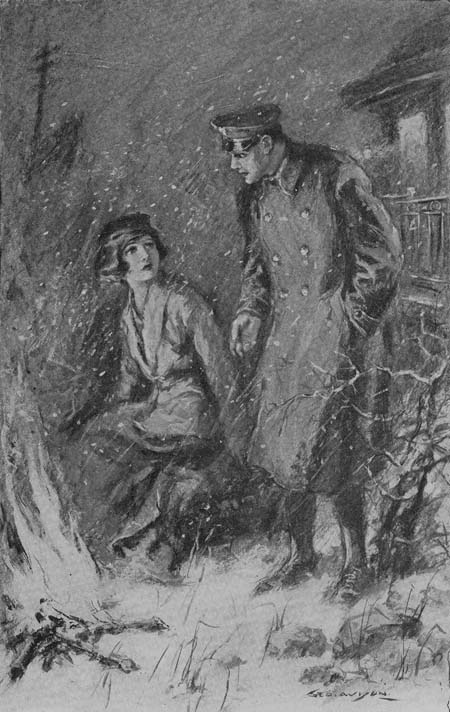
“What are you doing out here? Trying to freeze?”
“Sally,” said he, flushing, “you have never given me a chance to ask you why you seemed to suddenly dislike me—after we’d been—well, say, friends. But I’ve wondered at times if you might have thought I was chump enough to think you cared for me, when you didn’t. I never blamed you for not caring; how could I? But what hurt was that you should use such methods to prove it to me. I do not believe you ever acted like that to any human being save only myself; why? For I am sure that a sincere and honest affection, such as mine has always been for you, could never be considered an insult. Yet you seemed to think so.” He looked at her steadily, and there was that in his fine face which carried conviction of truth. “I did believe for a time that you might care. I hoped it with all my heart, because I cared so much myself. I do not think that belief and that hope dishonored either you or myself,” he ended with simple and manly dignity.
Something of her dumb and stricken misery came to him. His eyes grew troubled. He drew a little nearer.
“Sally,” said he earnestly, “my love for you gives me the right to say what I’m going to say: If you aren’t quite sure of the step before you, hold back. Don’t imperil your happiness. I don’t say this because I have any hope for myself, for I haven’t. But because I want more than anything on earth to see you happy. And you needn’t be sorry for me, when you come to think of it, Sally. I’m proud of loving you. I shall be the better man for it.”
Sally sat bolt upright. His words went whirling through her head. Because of idle rumors to which her own jealous fancy lent weight, she had let him go. She had misjudged and misunderstood. He a flirt with a waiting list! He vain and light! He sure that every girl he chose to beckon to would come at his nod! Terrified that she might be only one of many, she had indeed spared no pains to make him understand she wished none of him; that had been the only solace to a smarting pride, a wounded love. Hurt and indignant, he had gone.... And then Buckleigh had come. She remembered Buckleigh’s cold, hard face, his eyes of granite, when all others had been touched to a tender and human emotion.
Far, far away, from over the intervening hills, came a long faint screech. The relief was coming. In a few hours, parting company at the station farther on, Buckleigh’s car would be flying farther and farther from Hoban, and nearer and inevitably nearer to the Two Bar B ranch and those Christmas festivities so cleverly arranged for her benefit. The two stared at each other.
“I hate to go away, never expecting to see you again, and not part friends, Sally. It’s just a little hard on me, isn’t it? Won’t you be friends at least?” pleaded the soldier.
Then Sally Compton spoke: “What I most wonder at,” said she severely, “is the vast, immeasurable, terrifying, monumental stupidity of men!”
Hoban stared, as well as he might.
“The sheer, unbelievable, incredible stupidity,” Sally repeated firmly, “of men. They just take things for granted—and they go away—and leave things like that—and they haven’t even sense enough to come back and find out if there isn’t some mistake—on their own part of course. Under such circumstances and in the face of such stupidity,” she demanded tragically, “what is a poor, bewildered girl to do?”
“Huh! I shouldn’t waste my good sympathy,” said Hoban dryly, “on the poor, bewildered girl, if I were you. The poor, bewildered girl, as you call her—” he fixed her with a stern, accusing eye—“usually sends the man to Coventry—she and heaven alone know why; and when she’s got him there safe and fast, why, she—marries a millionaire! Sensible, isn’t she?”
“Oh! Does she though? Only when she’s perfectly sure and certain that the right man—I mean the other man—went to Coventry on his own hook, Captain Austin Hoban, and stays there because he chooses to stay there. Because he never cared. Sensible, wasn’t he?”
“A fat lot she knows about it,” said he derisively, “if that’s all she knows! I hate to think any girl could be so downright dyed-in-the-wool silly.”
“Do you?” said she tartly. “Well, she’s dyed-in-the-wool silly—to match him, if you like!” Her temper was rising.
“Oh, what’s the difference, if only they’re happy fools together?” said he wearily. “Sally,” his eyes pleaded for him, “I haven’t the ghost of a right to ask you, of course, but—are you really going to marry that fellow Buckleigh?” He couldn’t keep some of his pain from creeping into his voice.
“You have no right in this world to ask me, of course,” she said with asperity; “but, as you have asked me, why—I don’t mind telling you that I haven’t been asked—yet.”
He considered that soothing “yet.” “Are you going to marry him?” he demanded bluntly.
Sally’s temper flared. “I wonder,” said she spiritedly, “how you’d like a little gentle cross-examination yourself? Let’s see: Are you going to marry Colonel Arkwright’s daughter, Captain Hoban, or are you only flirting? Aren’t you generally—flirting? People have told me so. And you did flirt with me, you know!”
“Whoever told you that,” said he hotly, “told you a thumping lie! And I was not flirting with you! You’ve had experience enough, I should think, to be able to tell the false from the real. But that’s neither here nor there. You haven’t answered my question: Are you going to marry Buckleigh?”
“I told you he hadn’t asked me.”
“Are you going to marry Buckleigh?”
“How can I unless—”
“Are you going to marry Buckleigh?” inexorably.
“Well, then, no, if you will know!”
“Are you sure?”
“Yes! There!” furiously.
“Well, then, are you going to marry me?”
“Why,” said she, scandalized, “you haven’t asked me.”
“If I do ask you, will you?”
“But you haven’t asked me!”
“Well, I do now,” said he with vast patience. “Sally, I have always loved you; I shall always love you. I thought once—and now something bids me hope again—that you might care for me. Sally, if that hope is true, will you marry me?”
“This,” murmured Sally wickedly, “is so sudden!” She glanced up at him ensnaringly. “You must give me time to—”
“—waste on some other old bald-headed duffer of a millionaire while I’m on tenterhooks?” said he grimly. “Nothing doing! Guess again!”
“I reckon,” said Sally meditatively, “that I’d better guess of course, hadn’t I?”
“You mean you will?” His tone was incredulous.
“I mean,” said Sally bravely, “that I’d never, never be happy in this world, or maybe in the next one either—if I couldn’t!” And then: “Austin! For heaven’s sake, Austin! Somebody’ll see!”
“Let ’em!”
“Austin,” said she, against his cheek—“Austin, you mustn’t think too much of me, really. I did believe all sorts of things against you; I did behave abominably to you; I did intend to—to take what Mr. Buckleigh offered. I thought you didn’t care and that I might as well take all I could get—for myself. But—I heard Adele Bristow—say some things to the doctor a while ago, and I saw that dear little Italian girl looking at her husband over the baby’s head, and—I knew right then I couldn’t. No, I just couldn’t. You understand?”
He held her closer. “We’ll have a Christmas party for that blessed baby after a while, but just at present you’re going to be sent to bed.” Then he bundled her up and carried her back to the car; and in the shadow of the platform he kissed her again.
The porter, knocking at her door, awoke her some hours later. She found everybody finishing a very late breakfast. A subdued joyousness radiated from every face except Buckleigh’s.
“Everybody visits the Christmas baby!” said the doctor, buttoning his greatcoat. “My wife’s already christened him ‘Noel,’ and his mother’s made it ‘Noello.’ And, say, every man jack on the trams has chipped in on his Christmas present. You three wise men from the east United States want to chip in too?”
Buckleigh wrote a check perfunctorily. “To be saved up against the time they’ll be striking in the mine,” said he cynically.
“The hair of the dog,” Bristow minded him, “is good for the bite. You other Magi in on this?”
They were—so boyishly, so whole-heartedly that Sally’s heart was lifted. After all, she reflected happily, it’s a good place, this world, and people, when they forget things and remember they’re all just folks together, come near being what God wants them to be.
“I owe that baby a good-sized bill, myself,” said the doctor, smiling at his wife, who smiled back and slipped her hand in the crook of his big arm.
Miners, soldiers, railroad men, fell into line behind the doctor and his party. They massed around the sliding-doors, which the doctor pushed aside.
And when they were come ... they saw the young child with Mary his mother, and fell down, and worshipped him: and when they had opened their treasures, they presented unto him gifts; gold, and frankincense, and myrrh.
One saw in the lamplighted interior, as in a cave’s mouth, outlined by the glittering whiteness without, the straw-covered cot; beside it a handsome, foreign, shepherd-looking man; on it a pale, pretty girl, holding to her bosom a baby. At sight of all those eyes she flinched a little, but, seeing them all so good and friendly and reverent, she smiled, Madonna-wise, and spoke to her man.
Awkwardly, but with tender carefulness, he lifted the rosy child. “Noel!” said the Italian softly, and held him high for all to see.
“Noel! Noel! Noel!” echoed the men outside, uncovered in the snow.
Bristow, blinking suspiciously, gave the Christmas offering, to which all had contributed; and the little mother, with sweet wisdom, took again her baby and laid his small hand upon the gift; then she held up the wee fist, and the tiny fingers of a sudden outspread wide; one might think they blessed. At that, in spite of the doctor, they cheered him heartily.
Pushed forward by his mates, an Italian with a sweet and ringing barytone began to sing for him the old, old, lovely Christmas hymn:
“Adeste, Fideles, Laeti, triumphantes! Venite, venite, in Bethlehem!”
Adele crept closer to the big doctor’s side, to be encircled in his arm. McLachlin, beaming, patted a soldier on the shoulder brotherly. The Pittsburgh millionaire, with uplifted head, smiled dreamily, being for a happy moment back again with the little lost wife of his youth. And Sally Compton, her eyes full of exquisitely happy tears, put her hand openly into Hoban’s, careless of who saw. How had she ever, ever thought she could so trust it to any other?
“You see?” she whispered, looking up at him adoringly.
“I see,” he whispered back, and closed his hand upon her fingers loverlike.
Up and up and up, cleaving the dark skies, soaring, like the lark at heaven’s gate:
Gloria! Gloria! In excelsis Deo! Venite, adoremus! Venite, adoremus! Venite, adoremus, Dominum!