“THAT MAKES THE WORLD GO ’ROUND”
Reading edition
“THAT MAKES THE WORLD GO ’ROUND”
IF I hadn’t loved Willy more than any girl had ever loved any man before, I should never, never, never have had the wild courage to marry him, on account of my mother; and if Willy hadn’t adored me to distraction, he would never, never, never have had the temerity to marry me, on account of his father. Not that there was anything in the least objectionable about Willy’s father, or about my mother, who are about as dear, delightful angels as one shall find this side of Elysium. But—divided, they stood; united, they simply fell upon each other, tooth and claw!
When Willy passed the little millinery shop in West 127th Street, with the big “Valleau et Cie.” above the door, and glancing in saw the “Cie.”—who was only little me—sitting with head bent over the bunch of red roses which was to adorn a stunning hat, he stopped dead short and stared with all his blue, honest, German eyes,—the very nicest eyes that ever were. And I looked up and stared back with my French black ones. From that moment neither of us had the faintest doubt but that the good God had meant us for each other. It was just like that! One minute before, and I had had no thought but of making a fine hat, and Willy had had no thought but of hurrying on to his luncheon; and the next moment the eternal, beautiful miracle had happened, snatching us out of every-day ordinary 127th Street and plumping us into Paradise, an Adam and Eve who didn’t know each other’s name.
After that my days were divided into the hours of waiting for a tall, fair young man to pass and fix me with his fine eyes, and the hours in which I reflected upon that glance. And then one day he marched in, very straightforward and serious, and told Maman and me who he was and all about himself, in a direct and manly way that won her respect at once. When we knew more of him Maman agreed that he was a very charming young man,—irreproachable, a desirable parti for a dowerless demoiselle like me. Only, in our dear, splendid America one does not have to have a dot to make a fine marriage.
When we were betrothed Willy had at once brought his father to see us. Willy looks up to his father as one does to Providence. He considers this old man with the big bald head and the white beard and the twinkling blue eyes quite perfect. When he says “My father” it is with an air of pride and affection that makes one’s heart glow. One cannot but smile tenderly to see these two looking upon each other with such naïve delight, and to hear with what happiness this father says “My son.”
The old Herr Roeder is organist and choirmaster in the Lutheran Church, where Willy himself plays the violin and sings in a pleasing counter-tenor. Willy is a bank clerk, and as good an American as one shall find in a week’s march. But his father is what Maman at once said was “effusively, emphatically, offensively Teutonic.” Maman said that if Willy’s father had been present upon the day when le bon Dieu finished making the heavens and the earth, he would have stamped upon both “Made in Germany”—as a guarantee of worth.
You see, Maman’s father and grandfather had been Lorraine soldiers in 1870. Indeed, her grandfather had fallen fighting. And when Lorraine had been taken away from France, her father’s French heart couldn’t beat happily under German rule. So presently he picked up himself and his motherless young daughter—who was Maman—and came over to New York. He was a mender and maker of clocks and watches,—a mild, amiable, fiery man with stooped shoulders upon which his white hair fell. I used to sit in his shop and hear his endless stories of bloody and bitter fighting in the streets and houses of Alsatian mountain towns, and of sorties and surprises and reprisals in the pleasant country of Lorraine. The big clocks upon the wall would go “tick, tick, tick,” solemnly; and Maman would hold her sewing in her lap and murmur, “Une crime! Une crime!” remembering what her childish eyes had seen.
My dear gay artist father died when I was very little, and, like most artists, he left us nothing but his cherished memory. So Maman and I lived with my grandfather, and were very happy until he, too, died. Then Maman opened the millinery parlor in the shop where the clocks and watches used to tick. Although she is astonishingly clever and our shop had “Imported French Hats” on its sign, we didn’t make much more than our living. But we were grateful and happy, putting our love of beauty and our joy in life and work into folds of ribbon and chiffon and clusters of flowers which were to make other women look pretty.
Maman is really more like a sister than a mother, she is so gay and charming. Her hair framing her rosy face is of that cottony, shining whiteness which is so rare and lovely, and her eyes are the brown, sparkling, animated eyes of a girl. She stands about five feet high in her shoes; and I am sure she would be enchanting and ensnaring if she lived to be a thousand, she has so much sheer power of personality. But—she is very temperamental. And she remembered cruel things she had seen and heard, even as Willy’s father remembered. Although Willy’s lovableness had disarmed her, and she loved him, Maman simply detested Germans in general. And although Herr Roeder had at once taken me into his big, warm, kind heart, he loathed French people as a rule. Maman shrugged her shoulders, and Willy’s father wrinkled his nose. One wouldn’t dream what immense and baleful powers of insult lie in shoulder and nose, until they had witnessed a performance by Maman and Willy’s father. They disliked and distrusted each other with a fire and fury which threatened to consume our happiness. I think Maman was jealous that I should care so much for Willy’s father, too; and Willy’s father disliked the thought that his son should so greatly admire my charming Maman.
I shall never forget the night Willy made in their rooms a little feast in honor of our betrothal. Maman was silent and depressed. She would have been perfectly horrified at the bare thought of my remaining unmarried, but she was averse to having me go out of her life just yet and into Willy’s—and his father’s.
Her eyes, roving critically about the stiff, bare, clean dining-room, met of a sudden the insulting stare of Prince Bismarck, looking forbiddingly out of a big oak frame,—grim, military, formidable. She gave an involuntary shudder of distaste and aversion. But Willy’s father, with a proud and sweeping gesture, and in a voice one might use to name Deity, said reverently:
“Bismarck!!”
“Brute!” said Maman. “Despoiler of France! Ah, mon Dieu! How I abhor that ill-favored visage of adamant!”
Herr Roeder stroked his beard tolerantly. “Ach, well!” he admitted soothingly, “one cannot blame you so greatly: he was one to trounce you thoroughly, the great Chancellor!”
I could almost see Maman’s hair rise, and I trembled. Echoes of old songs, of old tales, firelighted memories, floated through my mind.
“I forgive him,” said Maman, gently, “for the evils he helped to inflict upon my stricken country. Besides,” she added piously, “one should even be sorry for him, now that he is undoubtedly in hell, thank God!”
It was turn for Willy’s father’s hair to rise, and I am sure that if he had had any it would have stood on end. Only, he is bald. His face grew purple, as if he were threatened with apoplexy.
“He is in the bosom of God!” he said with violence. “In hell! A man like that!”
“A man like that!” repeated Maman. “Hein!” and she and Herr Roeder locked eyes like horns.
“Madame!” stammered Willy, imploringly. “Dear Madame! Will you not—Madame, I beg of you to take a slice of seed-cake! Father, let me beg of you to offer our honored guest a slice of seed-cake. Do! It is such fine seed-cake!”
“Do, dear Maman!” I besought. She shrugged her shoulders, but a smile dimpled her lips and her eyes danced.
“Very well, my dears: I will have a slice of this fine seed-cake,” she agreed. It was really very good indeed, and she said so, graciously.
“It is good German cake,” said Willy’s father, complacently. “For other peoples the messy cooking, yes; but for the good, plain, sensible, satisfying, body-building cooking, always it is the German which is the best. Ach! The gosling-stew of Germany! With dumplings!” He looked up at the ceiling ecstatically, as one who sees a beatific vision.
“Do not, I beseech you, forget the soup!” said Maman, gravely. “The fine water, with a thimble-ful of vegetable-parings floating upon the surface. Ah! The soup of Germany! Without seasoning!” She, too, looked up at the ceiling, with a droll naughtiness to make one giggle.
Willy had never been separated from his father, any more than I from Maman, and to break that tender intimacy, which a lifetime’s love and service had built up, seemed to us intolerable. We could not bear the thought of leaving them alone. We had, in truth, so much love that it spread out and embraced everything and everybody, and we thought that our parents’ great affection for us would in time make them more tolerant of each other.
And so Willy and I were married, in St. Agatha’s parsonage, with Maman and Herr Roeder looking on. Maman had made my frock herself, not allowing any one else to put a hand to it, and it was a dress to dream over and put away and cherish. When Father Bazin had read the service which united us, Willy’s father put his arms around us both: he kissed Willy. “For your mother, my son, my dear, dear son!” said he, tenderly. “Ach! If she were only here to welcome our sweet new daughter! Always she longed for a daughter! But I will love you for myself and for her, too, my pretty Leontine!” He kissed me then, so fatherly that a great wave of affection flowed over my heart for him. But Maman only wept.
We all settled down together in a new bright apartment, up in the 120’s. Maman had sublet the rooms over our shop, which she still retained; and as our new home was only a few blocks away from our old one, she wasn’t much inconvenienced going to and fro. It is true that the new rooms were small, and that Father’s piano and music racks and arm-chair took up most of the sitting-room, just as Bismarck and Von Moltke took up most of the wall space in the dining-room, which they seemed to dominate. I was so glad to make Willy’s father happy that I’d have welcomed those pictures if both had been twins. It was delightful to me to see him at his piano, singing lieder sentimentally, or roaring out a drinking chorus at the top of his voice. He had, too, a pipe some two or three feet long, with a little ridiculous china bowl on the end of it, to which he was particularly devoted. Because I kept his jar full of his pet tobacco, and never meddled with his music, he praised me as an angel, pulling my ears, rumpling my hair, and kissing me smackingly on both my cheeks, while Willy looked on, pleased and happy.
But the pipe gave Maman a headache; she couldn’t, she said, abide the German fare I was learning to make, from Willy’s mother’s cherished recipe book, given me as a treasure upon a state occasion. She hated lieder. She said they were jellyfishy squishysquashy things, all sentiment and bereft of sense. She accepted the big pictures in the dining-room with a bad grace. She said their ungracious visages spoiled her appetite and gave her indigestion. And then she bought a fine new record of the “Marseillaise” for her victrola, as an offset to “Die Wacht am Rhein,” which Father liked occasionally to sing in the evening, in a lusty voice that carried a full block.
“Lieb’ Vaterland, magst ruhig sein, Fest steht und treu die Wacht, die Wacht am Rhein!”
shouted Father.
“Aux armes, citoyens! formez vos bataillons! Marchons, marchons! Qu’un sang impur abreuve nos sillons!”
shrieked the victrola belligerently, upon the heels of it.
That was the real beginning of overt and covert hostilities. Father felt himself affronted upon his most vulnerable points—his music and his affections. The most jovial and kindly of men, he couldn’t forgive that; he brought heavy artillery to bear upon his nimble antagonist, who skirmished lightly about and around him, attacking him upon all sides at once, until he was forced to retreat in raging disorder. Willy and I had to stand by, distressed and helpless.
“If only my mother would even try to appreciate your father!” I wept upon Willy’s shoulder.
“If only my father would be his true agreeable self to your mother!” Willy lamented to me. We were both exquisitely unhappy, because there lowered above the little home a heavy storm-cloud, liable at any moment to burst forth into thunders and lightnings of wrathful remarks and exploding retorts discourteous. If Willy had been less angelic, he would have been horribly cross; but he was strong and good enough to be patient as Job and meek as Moses.
“We will bear with them both,” I told Willy. “It may be that some day you or I may be alone, like them, in a child’s house, and we shall need love and patience then, too, my dearest. So let us now give both to these two people who are so dear to us.”
I am sure we tried to. But Maman complained bitterly and with tears that I loved “that ruffianly old German” better than I loved her; and Father said Willy had forgotten his own sainted mother and loved in her stead a saucy French jade knee-high to a duck and with the temper to shame the devil’s mother-in-law.
Willy and I were caught between the upper and the nether millstones. It wasn’t that they didn’t love us; they did, passionately. I am sure Father would have died for me, a thousand times; I am sure Maman loved Willy as her own son. She said his mother had evidently been an angel, as, despite his horrible old father, she had been able to endow him with her perfect disposition. And when I at first ventured to speak up timidly in behalf of the hot-tempered, kind-hearted old man, Maman made a thin red line of her pretty mouth, shrugged her shoulders up to her ears, flashed at me a glance of flaming disdain, and marched off to her own room, locking me out.
“I have but one favor, one last favor, to ask of you, my child,” she said, before shutting the door upon me. “Let me be dead before you give to me grandchildren that resemble little dressed Christmas pigs—and named Karl Johann. I could not support that indignity.”
I went back to the kitchen to look after the pot-roast with herbs which simmered upon the back of the range, and I reflected sorrowfully that we should have all been so much happier for only a little reasonable kindness! I suppose I cried a little over the stove about the Christmas pigs named Karl Johann. Oh, Maman, how could you! I said not a word to Willy, however; and when Maman wouldn’t come to table, complaining that she simply couldn’t endure the fumes of Father’s pipe to-night, Willy himself carried her in a tray, with a rose laid upon it which he had brought home. She thanked him somewhat shamefacedly.
“Willy,” said she, “I’m very, very glad my child had the good sense to love you and the good fortune to marry you. And I’m still gladder, Willy, that it is I, and not the good little Leontine who has the bad, bad, bad temper.” She kissed him and gently pushed him out of the room.
“Ah!” said Willy to me, regretfully, “such a kind heart, with so much love! If only we could make her happy!” I am sure my own heart crowded up into my eyes then to look out at Willy; and I dropped the basting-spoon and flung my arms around him in a passion of gratitude. Willy held me for a long minute.
“So!” said Father, entering on tiptoes, and putting his arms about us both. “So! Son! Daughter. I—” His voice broke. He kissed us quickly and ran out.
I think they honestly tried to avoid quarrels; but they possessed to an unusual degree the power of arousing each other’s antagonism and anger; and so they did little else than quarrel. Maman’s merry chatter, her lighthearted insouciance, left her. She wore a dissatisfied face, and she took to staying longer at the shop, coming home I hate to think how unwillingly. Father’s loud laughter was a thing of the past; he looked bewildered, as one who expects and dreads rebuffs. He no longer roared out drinking-songs, and the piano was too often closed.
I had taken a severe cold and had to remain in bed, and so Maman left the shop in charge of her assistant and remained at home with me. I required very little attention; and she took this opportunity to give our apartment a particularly thorough cleaning, which, indeed, it didn’t need. But Maman had the French passion for dustlessness.
She really doesn’t make the nerve-racking uproar most superclean people raise when they clean and polish and shine what is already clean and polished and shining. Not she! In cap and dust-apron she whisks from one thing to another, giving everything an extra touch; and the light sound of her little feet is pleasant to hear, as a child’s footsteps about one’s house. So I lay back in satisfied half-consciousness, until she came to the dining-room. When she was polishing Bismarck’s picture she broke into irrepressible speech:
“Ja! Ach! Ich! So! Gewiss!” she mocked, in an irresistibly funny imitation. “Kolossal!” Then: “Iron-faced animal!” said she, viciously. “Cruel, cold, arrogant Prussian! It is your overbearing spirit which animates this unhappy house and blights my one child’s affection for me!” The cake of scouring-soap came down with a resounding crack, followed by a still more ominous crack. Maman had brought more force to bear than she intended, and the cake went right through the glass and came down on the Chancellor’s broad nose. Maman gave a little scream, and just at that inopportune moment Father stalked in.
“Infamous!” he roared. “Miserable Frenchwoman! You should be locked up in jail for such an outrage!” He stamped with his feet so violently that the broken glass fell out of the frame with a loud shivering crash. Maman jumped aside.
“Assassin!” said she, passionately. “Do you deliberately try to murder me? Ah! You would like to, brute of a German!”
“Little anarchist! To wreck my picture—my fine, noble picture!” stormed Father. “It is dastardly!”
“I did not deliberately break it; it was an accident—”
“To drive her revengeful fist upon his honored countenance!” gritted Father. “Demoniac!”
“Beast!” hissed Maman, quivering with rage. “Is it not enough for you to steal from me my only child’s affection but you must also insult me with brutal doubts upon my truthfulness, and then try to murder me with broken glass?”
“Horrible woman! You estrange from me my son, my only son, prevent your daughter from loving me, wreck my home and my peace of mind, and then smash my beautiful picture!”
“Oh! This German is insufferable!” exclaimed Maman, in a suffocating voice. “Frightful old man! It is you, you, who blight this house!”
“Madame! I love my children. You, Madame, love nothing but your own way. You have the devil’s own temper, Madame. It is you, you, who make us all wretched.”
I got out of bed then, and in my dressing-gown, trembling, sick at heart, came and stood between them.
“Father! Maman! Allow me to love you both without making you and Willy and myself frightfully unhappy. Ah! You are killing me!” I sank into a chair and wept uncontrollably. They watched me in stricken silence.
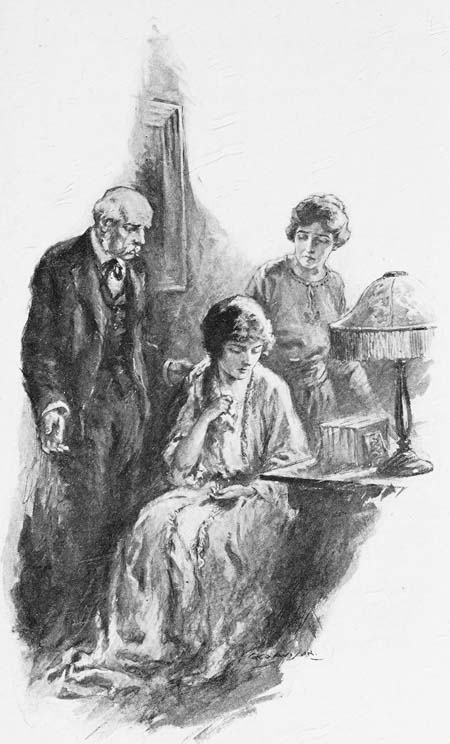
“Such scenes shall not be repeated”
“Monsieur,” said Maman in a subdued voice, after a long and painful pause, “it is not you, not I alone, but both of us, who make our beloved children weep. We must remedy this.” She patted me on the shoulder and then assisted me to rise. “Calm yourself before Willy comes home and is troubled, my child,” said she quietly, though she was very pale. “There! Go back to bed. Such scenes as this shall not be repeated, I promise you.”
I went over to Father, who had sunk dejectedly into a chair, with his arms hanging down lifelessly, and kissed him timidly upon the cheek. He looked at me unhappily, but said not a word. Ah, le bon Dieu! Why do we make one another thus miserable, when at the best and longest we have such a little, little while to stay!
That night, when Father had gone out, Maman came into my room, where Willy was sitting beside my bed.
“My children, I have a thing to say to you,” she said seriously. “I am going to leave your house. No! Do not protest. Do not do me or yourselves the injury to wish me to remain. My mind is made up, irrevocably. You know the tenants of my flat above the shop are leaving the city. I shall at once move back into my own house, which I should never have left. It was a grievous thing for me to come to you, my dears, for no one should be a useless fifth wheel upon another’s domestic coach. You should have your chance to be happy—alone. Forgive me, forgive me, for having made you unhappy! You see, Leontine is my only child, and her father—” She turned her head aside for a moment. But Willy leaned over and took her hand, consolingly.
“You are quite right, little Mother,” he said, truthfully. “It would be as great a wrong to you as to us to wish you to remain, when you are not happy with us. But do you realize why you are unhappy here, Mamanchen? It is because you are too young and too pretty to play second fiddle in anybody else’s house, even Leontine’s.”
Maman laughed through her tears. “Willy!” she cried, “you might have been a Frenchman!”
When Father was told, he nodded his head. “I, too, go,” he said bluntly. “She is right for once, that odious woman. For there is no room in the new nest for the old birds; they crowd the youngsters, and for themselves they make starvation. Sing and fly by yourselves, my children. That will make me happy. Only—do not fly too far away from thy old father, Willy!”
So Maman went back to the rooms over the shop and was too busy to allow herself to be unhappy, even if she were inclined to be; and Father took two pleasant rooms near us, and went right on with his music lessons. Maman was to come on Tuesdays and Fridays, and Father on Mondays and Thursdays, with an alternate Sunday for each; thus they would escape the unpleasantness of meeting each other in our house.
It was pleasant to have such a darling little place as Maman’s flat to visit. Now that she was alone she gave full rein to her own individual taste, and never did any little place look daintier, more homelike and simple and charming than Maman’s rooms. And Maman herself! Under our astonished and delighted eyes Maman grew younger. She arranged her thick white hair ravishingly, with fleecy curls about the ears; she manufactured for herself enchanting little hats with hints of lilac in them, and she evolved frocks of a chic to make one gasp. She was witty as only a Frenchwoman can be; she was pretty as only an American is. Then she began to skip her evenings with us; she began to visit us, not as a pleasure only to herself, but as a pleasure and a privilege to us.
As for Father, the change in him was of a longer growth, but it was none the less certain and sure. He began to do without us. He looked brushed and groomed and well-fed and prosperous and jovial. He developed a taste in ties that made us marvel. His ragged beard had been Vandyked into a trimness which clipped ten years off his age, and his clothes were modern and dignified.
It was our turn now to suffer a little wholesome neglect, for our parents were neglecting us. They were seeking—and, what is more, finding—other objects of absorbing interest outside of our dear selves that loved them so much; they were living their own lives in their own fashion, without so much as a by-your-leave from either of us.
When our dear adored baby was born they behaved as distractedly as any well-brought-up grandparents could, however. They were extravagantly delighted. Never was there so exquisite a baby! Maman said that I had been an adorable baby myself, but that I simply wasn’t to be compared with this angel. Father remembered that Willy had been a very nice baby, too, but not to compare to our baby, who, judging from the magnificent formation of his head, would undoubtedly grow up to be a statesman. Poor, dear, red, wrinkled little statesman, with no language at his command save a squeal, and never a hair to his precious head!
The baby had come to us at Thanksgiving—that good, beautiful American holiday of ours that I so greatly love—so it was almost Christmas before I was able to take him out, myself. Willy and I had decided that his first visit should be to his grandmother; we would take him to see her on Christmas Eve, all snugly wrapped up. And we would then go to Father on Christmas morning. It was to be a beautiful surprise.
To tell the truth, for the last week or ten days we had seen very little of Maman or of Father, either. They were so busy with their own affairs.
We knew that Maman had intended to dismiss her assistants early, close the shop, and spend Christmas Eve at home; she could afford to be so independent, for those charming hats of hers were beginning to sell for good prices. At dusk, then, we wrapped our little baby up snugly and tucked him among his carriage cushions, took our presents, and started out. We were both in a glow of pride and happiness when we reached Maman’s. Her windows were lighted, so we knew she was at home.
She met us at the door with a cry of pleasure; then she ushered us into her living-room, calling in a gay, glad voice:
“See who’s here! See who’s here!”
A big man in a brand-new smoking-jacket got up out of the new Morris chair in which he had been making himself comfortable.
“Ha! Our children!” said Willy’s father gaily, and fell upon us.
We could only gasp, and stare. The room was lovely with Christmas greens, and Maman herself was a vision in a red gown, with red satin slippers on her little feet and a vivid Poinsettia in her beautiful white hair. On a new mahogany stand was a powerful bust of—who but the Chancellor himself, a gay holly wreath adorning his beetling brows!
“Father!” gurgled Willy. “Maman!” I echoed weakly, and almost fell into a chair.
Willy’s father shifted his small grandson very tenderly to his shoulder, and beckoned to Maman, who came and stood beside him, slipped her small hands about his big arm, and laughed at our bewilderment.
“My surprise for you, my children!” said she.
“It is like this,” said Father, gravely. “I came one night to Madame, forced by loneliness and repentance, to beg her pardon for driving her out of her child’s home. I found her sad and lonely, even as I was; but how good the little home she had made for herself looked to me, who had none! And we consoled each other. She loved my son and I adored her daughter, and thus we fell into kind talk and discovered that each was better than the other had thought. And how heavenly a meal she set before me, seasoned with such wit! It is true that there are no cooks and no wits on earth like the French!
“Afterward I came again—and yet again. And we discovered that we were not so very old—not too old to be young—and that there was much, very much, in life, for both of us. We decided to share, to help each other. I taught her much of German, she explained to me much of French, and the great immortal ones of our countries healed us with their divine art.”
He paused to rub his cheek softly against the baby’s bald head. “Ach! She is a wonderful woman—wonderful!” he said, with a vast pride. “Dear little child, if thou wilt but take after thy wise, beautiful, witty, perfect, ever-to-be-adored grandmother, thou wilt be the greatest of men!” he told the baby.
Maman laughed like a girl. “What I most admire about the best Germans,” she said thoughtfully, “is their fine domestic sentiment. They have such tender hearts, which they are at times wise enough to show. Ah, Willy, how I rejoice, for my dear child’s sake, that you so greatly resemble your good father!”
“And so,” continued Father, comfortably, “our love for our children having made us hate each other, their love for each other and for us made us love each other. I found I was unhappy away from Madame. Madame discovered that she was happy only in my company. Do you think the young alone are capable of love? No, no! While there is life there is love. So Madame and I propose to make for ourselves a home, a fireside, where we shall sit, loving each other and our children, until our good Herr Gott removes us to a better Home. Your mother, Leontine,” he added to me, “is a remarkable woman, a perfectly marvelous woman! Wonderful, my child, wonderful! It is not to be told how I adore this angel of a woman!”
“You are going to be married?” Willy’s voice was all but hysterical.
“We were married,” said Maman calmly, “three days ago. Your father,” she told Willy, “is a very masterful man. He would have it so, without fuss and without explanations; and I was glad to please him.”
Father pointed to the holly-wreathed bust.
“My dear wife’s first Christmas present to me!” he said happily.
“Yes,” said Maman, with unabashed serenity, “Johann has labored to explain his real character to me. Johann loves and respects him, so there must be something to be said for the man, although I of course deplore the fact that he thought he had to be harsh to my dear country. But we are both good Americans. This is our country. Remembering that, why should we waste our time quarreling about foreign statesmen?”
“Now you shall hear my little gift to my dear wife,” said Father, proudly. Still holding the baby, who seemed perfectly content to snuggle on his shoulder, he marched over to a magnificent graphanola and slipped in a fine new record. Under the Chancellor’s mighty nose rose the soul-stirring, martial magic of the “Marseillaise.” We listened with delight, until it ceased. Then Maman, with a glance of affection and gratitude at Father, put in another record. Flooding the little Christmas-decked room came a beautiful blending of men’s and women’s and children’s voices, singing the old, old, lovely, holy Christmas hymn.
“Oh, come ye, oh, come ye, to Bethlehem!”
We all drew closer together, feeling our hearts in unison; and remembering the Holiest Baby of all, we looked down upon our own little baby very tenderly.
“My dearest children,” said Maman, with her hands clasped around Father’s arm, “I have to beg of you a favor, a great favor: for my best Christmas gift, promise me to name my little adored grandson Karl Johann!”