THE YOUNGEST OFFICER
Reading edition
THE YOUNGEST OFFICER
JUNIOR’S consciousness of himself as an individual seems to have begun upon the day when the major’s wife came out of his mother’s room, and, finding him sitting lonesomely upon the stairs, sat down beside him and gathered him into a tight embrace.
“Kindy,” said he, kindly but insistently pressing a fat forefinger against her cheek, “you’re k’yin’. What you k’yin’ ’bout, Kindy?”
“Oh, precious little man!” murmured Mrs. Kennedy gulpingly. “And she so young—and so beautiful—and so loved—and with you and the captain—”
The three-year-old wriggled his sturdy little body out of her embrace and got on his feet. His small shoulders straightened, a trick he had from his father. His clear and questioning eyes refused to be evaded. “Vey said,” he whispered, “’at she was goin’ ’way, Kindy. Is she goin’ ’way?”
“Junior,” began the major’s wife miserably, “Junior—”
“Is she goin’ ’way, Kindy?”
The major’s wife began to weep then because she couldn’t help it. And somehow Junior understood. His gaze widened. “Is she ’fwaid to go, Kindy?” he wondered.
“She—she—We haven’t told her, Junior,” quavered Mrs. Kennedy. She beat her hands together softly, palm to palm. “We—we can’t tell her! She—oh, my God!”
Junior pondered. It was characteristic of him that he usually knew what to do—and did it. Before Mrs. Kennedy could seize upon him again he had reached his mother’s room, where his father stood with clenched hands and a face stony with agony. The colonel’s wife, a stout old lady, sat in a chair, all in a pale heap. A doctor, compassionately professional, conferred in a low voice with a nurse who held a hypodermic syringe. The chaplain, with his face in his cupped hands, prayed in a trembling whisper.
Junior paid no attention to these, but trotted up to the bed and took his young mother’s limp hand in his own warm moist fingers. “Poo’ Muzzer,” he cooed. “Darlin’ Muzzer, ’peak to Duny.”
The great tragic eyes opened. Wanly she tried to smile.
Junior’s warm pressure tightened comfortingly. “Mustn’t be ’fwaid,” he told her sweetly, while the helpless grown-ups watched him. “Booful Muzzer, mustn’t be ’fwaid to go ’way.”
“Am I—going away?” she murmured.
Junior kept his steady baby glance on hers and nodded.
For a moment a spasm quivered across her face, and her eyes sought help piteously; for she was very, very young. Then her eyes came back to Junior’s, and, as if they had found what they sought, stayed there.
“Nothin’ to be ’fwaid of, sweetie Muzzer. Nothin’ to be ’fwaid of,” said he, repeating in her hour of stress the lessons her simple faith had taught him. “Dust teep tight hol’ on my han’ an’ go sleepy. It’ll be all light then.”
She smiled again, more faintly but without a trace of fear. And so, clinging to her baby’s hand, she went to sleep. It was “all light then.”
The major’s wife took the little hand gently away from Junior’s. To his mind his mother had simply gone to the “lovely country”; she had told him so herself. So she stayed in his memory, becoming in time shadowy but very real and vital. And she left him, as a legacy, her love for his father.
The post mothered Junior, from the woman who washed his rompers to the colonel’s wife, who did her best to spoil him. And every man in the regiment was his sworn blood brother, whom he knew from the soul to the shoe straps. He, as it were, embodied in his gallant little person the esprit de corps of the army.
An education like Junior’s affects one very materially. When you know that your great-grandfather fell at Malvern Hill and your grandfather at El Caney, that your own, ownest daddy bears scars from San Juan—and all in the service, in the same old regiment—why, you get a sense of personal responsibility. The service looms very largely upon your perspective. You learn to carry your head up, your eyes level, your chin out, your back straight; to fight fair and to hit hard, and to look every man in the eye. And you must never, never, never forget that always and in all circumstances you’re an officer and a gentleman. You’ve got to live up to yourself and the service.
Life was immensely interesting and livable. Junior didn’t know that the word “unhappiness” existed until orders came for the regiment to go into exile. In construing the word “unhappiness,” however, one learns to estimate the value of its twin-sister word “duty.”
“Orders,” said the captain, looking very hard at Junior, “are to be obeyed, without whimpering.”
Junior brought his hand to his forehead, sat stiffly erect, and used all his endeavor to keep his chin from quivering. He did wink and he did gulp a little, but on the whole his behavior was a credit to the regimental system of instruction for a small boy who is going to be a soldier himself some day—and he knew it. This helped further to stiffen his backbone.
“Yes, sir,” he agreed gravely.
“My orders,” said the captain, “mean that I must leave you, Junior. Your orders are to stay at home and be a credit to us. You’re the youngest officer, you know, and you’ve got to represent us older fellows. That’s a man-sized job; but I think you can hold it down, don’t you?”
Junior considered. “I can try mighty hard to, sir,” said he, still more erect.
The big captain reached out a long arm and caught up the little son. He spoke with his face against the soft light hair: “You see, I’d have to be sending you away from me pretty soon anyhow, Junior. You shouldn’t be tagging around from post to post, half the time thick as thieves with rookies. The women—God bless ’em!—have been so good that you haven’t fared badly. But you ought to have a regular home. I know it. Only—since your mother left us—I couldn’t bear to part with you. I couldn’t bear to make you do without me, either. We’re all we’ve got, you know, old chap.”
The little boy’s arm tightened about his father’s neck.
“I’d like to send you to my old school, to put you in training for the Point. But I can’t do it yet, son. That’ll come later. Just now I’d rather you’d be at home with somebody that’s kin to you. So I’ve written your Great-Aunt Lydia, and she’ll come for you. I think she’ll be glad to have you. I think she’s going to love you a lot as soon as she knows you. You’re pretty decent, Youngest Officer,—thank God! Anybody’d love you, let alone my good old aunt. And now—I’m going to give you something, little son.”
He took from his breast pocket a light, fine gold chain from which swung a little flat locket. When you pressed a spring it was as if a tiny golden door opened to reveal an angel—so lovely, so pure, so tender the face within. The captain kissed it with reverence, then he pulled back Junior’s collar and clasped the little chain about his neck.
“You’re to wear this locket and chain,” said his father, “day and night. It’s your talisman. You’re to remember that she’s with you; proud and happy when you win out, Junior, sad and sorry when you fail. Why, boy, you’re her son! You’ve got to live up to her and the regiment. Don’t you ever forget that, my son. And—just hold on to me tight for a while, old chap, won’t you?”
In the days that followed it seemed to Junior that his pleasant world was disintegrating. Faces that were as his landmarks vanished. Always sad and tired, his father’s eyes were now heavy with the pain of parting. Somehow as he clung silently to the big brown hand the little boy’s mind went straight back to that day when another hand—a small cold hand—had been taken from his clinging fingers. But he hadn’t been trained militarily for nothing. He kept his chin up and he didn’t cry—at least not until after lights were out.
A tall, thin, stately old woman came presently. Daddy called her “Aunt Lydia” and kissed her withered cheek with real affection and respect. He, too, had lived at her house when he was a little boy. She held Junior firmly by the hand when the train pulled out and took the Youngest Officer away from his regiment and his captain.
Now when you’ve been raised on a gun barrel, as it were, and your rising up and your lying down have been at the bugle’s call, and everybody from your colonel down calls you “Son” and loves you like one, why, it’s rather like pulling you up by the roots—without water—to plump you of a sudden in a calm, still, old New England town with a calm, still, old New England lady who hasn’t been used to a little boy for perfect ages, and the nearest soldiers those in the grass-grown cemetery.
Aunt Lydia was painfully just and kind. You saw her see her duty and do it. She had a way of fixing her eyes upon you and drawing her lips together and saying in a missionary-to-the-heathen voice: “Good Heavens! This child’s been allowed to run perfectly wild! Those awful men! Oh, this must be seen to at once!” And it was.
Junior learned to close doors with terrifying gentleness, because it seemed to Aunt Lydia a heinous thing to have them shut with the slightest healthy slam. No; properly raised children open and shut doors gingerly, as if, say, the doorknobs were loaded and might go off; and they enter a room with becoming meekness of demeanor. Junior also learned never, never to rush into the house. He wasn’t really inclined to rush into the house, anyhow. When he had done so it was only half-heartedly, just to pretend that there was something to rush to. He learned to slide punctually into his place at table at one minute to six, dinner being served on the stroke, and to sit through the meal silently, being as silently served. This at first brought poignant comparisons of gay riots with Mrs. Lieutenant’s frolicsome four, and allowance of dessert with Mr. Lieutenant—sometimes with the chaplain, sometimes with the fat, jolly major, always with Daddy. In time, however, one becomes accustomed to everything, even to silence at table. Aunt Lydia wrote to Daddy, cautiously admitting that the boy was well-behaved, truthful, and hardly any trouble at all. Which is praise indeed from a maiden lady.
Next to his father’s letters Junior’s greatest solace, friend, and help was old McAndrews, who lived in two fascinating rooms over the stable and managed Miss Lydia’s comfortable estate—and Miss Lydia. There existed between these two a curious friendship. McAndrews, Junior thought, was the oldest person alive. When Miss Lydia’s bedtime chapter had been fifth Genesis Junior had glanced rather uneasily at McAndrews, who seemed to him actually to visualize those long-lived gentlemen whose many years Aunt Lydia was sonorously enumerating.
All of a ripe eighty, with a hale, ruddy face framed in a New England snow of beard, McAndrews had known every Palmer born for three quarters of a century. What tales of them he told Junior! Some of them sailors, some of them soldiers, all of them men of action. Junior’s Daddy was in his memory as a little boy, a youngster fresh from West Point, a big brown fellow home from Cuba. And oh, more wonderful than all, he had known Junior’s mamma, for she had lived within a few miles of this self-same little town! She was, he said, the most beautiful girl in the world. Even yet his voice broke a little when he talked about her.
He used to take Junior by the hand and go trudging over the country-side in heavenliest rambles. Every house called for a history in detail, until once they passed a fine old place set back from the road, embowered among many elms, and McAndrews, pausing, glowered at it silently. He hadn’t intended to take Junior by the Holcomb house, and he was angry with himself.
“What a beautiful, beautiful, beautiful place!” said Junior, attracted by the old mansion and its magnificent trees.
“Aye!” snarled McAndrews.
“I wish,” said Junior, “that I could climb up in those trees, McAndrews, or roll in the grass beneath them. I like how this place looks. Whose house is it?”
“That,” said the old man after a pause, “is the Holcomb house. And,” he added, shaking his stick at it, “if it hadn’t belonged to an old devil it might have sheltered a young angel. That door’s closed to you and your father, boy; it was closed against your mother.”
McAndrews trudged along in grim silence for a while, and Junior, too, had no words. His heart was beating fast. His mother had lived there in that place! But why had those doors been closed against her and him and Daddy? Junior couldn’t understand. Nobody at the post had ever told him anything about her, save that she was very young and very, very lovely. But of a sudden, as if he thought the little boy should know, McAndrews began to tell him more.
She had been a great heiress, McAndrews said—that is, very, very rich. Her papa and mamma had been very vain and proud of her, and they had planned that she was to make what is called a great marriage: that is, they wanted her to marry a man they knew who wished to marry her—a man who had millions of dollars. But she had laughed and shaken her head.
Then came the Captain from El Caney, with a wounded leg and a great grief upon him because of the gallant old father he had left behind. Everybody had been nice to him and had been proud of the handsome young man; but the nicest and proudest of all had been the most beautiful girl in the world.
“Because,” said McAndrews, “those two just were made to love each other. They couldn’t help it.”
But when the captain went to Aaron Holcomb to ask for the most beautiful girl there had been a terrible to-do. They said he shouldn’t have her; they said he wasn’t anything but a poor soldier with nothing but his pay; they said she’d have to choose between nothing but a soldier and them; and that she would have to marry another man, anyhow. Then she had put her hand in the captain’s and chosen him. Neither her father nor her mother had ever looked upon her face again, nor named her name, nor given any sign when she wrote to tell them about the little boy that presently came to live with her and the captain. They hadn’t even given a sign when they were told that she had left the little boy and the soldier. So the little boy really hadn’t any grandparents, you understand. In the place that should have been his they had put a little great-grand-niece, who was to get all that was theirs.
“Ah!” said McAndrews angrily, “how could anybody think of casting out an angel, and a soldier, and a little chap that was an honor to their blood?” Moved out of himself, he dove into his pocket and gave Junior his own treasured clasp-knife—for keeps!
That night when Junior opened the little locket he kissed with a deeper tenderness her girlish face. And somehow, as if she had gently whispered it into his soul, he began to be sorry for that sad, bad old man and woman who had turned away from her and couldn’t ever call her back again.
Junior couldn’t say that he was actually unhappy at Miss Lydia’s; she was too really just and kind to make anybody truly unhappy. But he was horribly lonely at times. He missed, as little boys do so acutely, just lovingness. He couldn’t actually put it into words, you know; but he wanted people to do things for him because they loved him and wanted to, not because it was their duty.
There were many lessons and much studying to catch up, for Miss Lydia said the child’s education had been, to say the least, peculiar and irregular. Miss Lydia only knew some of the things Junior didn’t know; she couldn’t guess the many fine and tender and beautiful lessons the regiment had taught him, because she was a reticent old lady and Junior a shy little boy.
With the first snows and the red sled McAndrews had bought for him things picked up. He was getting along fairly well in the mazes of modern learning. He hadn’t done anything that the regiment would blush for. He had had, too, a few good gallant fights, in which he had borne himself like a man of his hands, thereby winning the enthusiastic friendship of those whom he had “licked.” Also just outside of the small town was a particular hill high enough and breakneck enough to satisfy even the most ardent little boy’s desire for thrills, and a pond big enough to hold a whole townful of skaters. Junior began to think that life, even outside of the post, may be pleasant enough—in spots.
It was on the rather lonesome road leading to the pond that Junior fell in with the Fairy at the close of a particularly freezing day. The Fairy was obviously out of her element, but was just as obviously delighted with the fact. Floundering waist-deep in drifts had draggled her line furbelows; for she was most gorgeously “got up,” as a fairy should be. One mitten had gone, leaving bare a little hand turned purple from the cold. Under her furred cap her eyes were dancingly, gaily blue,—almost as bravely, steadily blue as Junior’s. Escaped in many an ensnaring curl, her hair was of an indescribably bright gold. At sight of Junior and his sled she gave a squeak of delight, holding out both hands.
Her name, she said, was Ga’sie. His? Oh, just Junior. Junior was really hungry to have somebody call him that again. Aunt Lydia wouldn’t. She disapproved of it. She said it wasn’t a name, it was a sort of appellation. But Junior thought it brought the post and the colonel and the major and the rookies and Daddy a little nearer. Somehow it made him feel as if it were not himself, but some other little boy, when people addressed him as “Bruce Palmer.” The Fairy, however, accepted “Junior” beamingly. Only, as he himself had once done, she called it “Duny.” Duny began to adore her right then.
He knew that the proper thing was to put her on his sled and haul her home; but this she brought to naught by not knowing where home might be. Junior at her bidding put her on his sled and hauled her about the pond, wrapping her bare little hand in his own larger mitten. They had a beautiful time, for never was a fairy more graciously delightful to a little boy hungry for one.
Junior was sorry when a giant in livery dashed, panting, out of the growing gloom and swooped upon the Fairy with exclamations of joy and reproach. Not a word of gratitude was bestowed upon Junior; nothing but a growling threat against bad boys that helped runaways.
“Duny finded me, nas’y man!” shrieked the Fairy, kicking with all the force of her short legs. “I tummin’ ’den, Duny! Doo’-by! Doo’-by!”
Junior went home rather unwillingly. There wasn’t anybody there to play with nor to snuggle against. Under the bleak gray sky, in the fading light, Miss Lydia’s square brick house looked squarer and brickier than ever; it didn’t look a bit warm and welcoming, but rather as if it thrust out angular elbows to push one away. And the Fairy had been so like Mrs. Lieutenant’s youngest that it made Junior’s eyes smart. If crying weren’t “cowardy custardy” he could have cried copiously; but the regiment discourages sniffling.
As it was he was a full seven minutes late for dinner, which waited coldly for him, Miss Lydia rigidly resigned in her high-backed chair. She didn’t say one word; she just looked at the clock and then at Junior. And the clock spoke up for her: “Sev-en min-utes late for din-ner! Sev-en min-utes late for din-ner!” The little boy’s ears burned.
He didn’t mention the Fairy. He had never even mentioned the pond itself. Miss Lydia had a fashion of worriedly wrinkling her brows, pursing her lips, and asking aloud: “Should that child be allowed to run about so much by himself? Is that pond”—or that hill, or that road, or that anything else—“perfectly safe? Perhaps, Bruce, you would better stay within calling distance of the house to-day.”
Within calling distance of the house was out of calling distance of any reasonable diversion. Junior didn’t want to stay away from the pond. She hadn’t said he couldn’t go, but then she might, after the unaccountable fashion of grown-ups. Junior wisely held his peace.
For instance, he had been forbidden by McAndrews to go down the big road curving by the Holcomb house. So although he desired above all things to see the place where his mother had played as a little girl, he didn’t go.
He had, too, an almost fearful curiosity to see those two who had lost her. In his short experience everybody had been kind, so he couldn’t believe that unkind and naughty folks can look just like ordinary people. No, indeed. You can always tell the witch by her long nose and her curved chin and her fierce eyes; and the ogre usually has sharp and bloody teeth, hasn’t he?
His mother became to his mind like one of those beautiful and charming princesses who are detained by a wicked king and queen, but who escape and ride away on the crupper of the prince’s big black steed. And, despite his fear of the old king and queen whom she had left, Junior wanted to see that house in which she had grown up.
The place, he learned later, was open. The old king and queen were staying there that winter, after an absence of years. Distant cousins, nephews, nieces, and their wives and husbands and children filled up the many big rooms, for they were to spend Christmas there. Preparations for that great event were already under way on a huge scale. Sleighs full of noisy, laughing folks dashed by Miss Lydia’s house; wagons loaded with crates and bales and bundles went to and fro. But the little boy who was the lost princess’s son flattened his small nose against Miss Lydia’s diamond-paned windows, watched them wistfully and had no place in their thoughts, their merrymakings or their hearts. His very existence was quite as effectually ignored as it had always been. But, somehow, keeping faith with his mother’s sweetness, Junior didn’t feel ill treated or resentful; he only felt sorry.
“Poor things!” he said to her at night, “they haven’t got you any more; and Daddy and I have.”
Because of a slight cold he had been strictly kept indoors of late, and it palled upon him who was by nature free. If there had been any small folks to keep him company he wouldn’t have minded so much, but there wasn’t anybody. And oh, how he wanted to go out and find that fairy again!
Aunt Lydia, as she said herself, wasn’t much of a hand for visiting. She sent you fine clear jellies and flaky bread and cake and spicy pickles and steaming broths by way of neighborliness, but she never seemed to give you herself. So she wasn’t what you’d call really sociable. People didn’t drop in to see Aunt Lydia and bring the children and stay for tea. Good gracious, no! When they called they sat stately on the horsehair parlor sofa, and pretended to be thawed out by the frosty fire which had just been kindled, and talked about church work, district visitin’ and the Woman’s Auxiliary. Junior thought at first that this latter was something to wear; later he decided that it was something akin to the rheumatism which stiffened Aunt Lydia’s fingers, or the everlasting cold which made Mrs. Pepper’s voice like a crow’s. It was uninteresting, however, anyway you looked at it. Junior usually managed by polite degrees to slide out of the room. Once when he had closed the door gently upon half an hour of Auxiliary he had met the cat in the hall and promptly kicked her. This was one act for which Junior afterward blushed. The cat got sleek on tidbits covertly fed to her by way of expiation.
Just before Christmas, the weather being then mild, Aunt Lydia pronounced Junior’s cold cured and set him free. She was very busy with Christmas cakes herself just then.
Junior made straight for the pond. Because of the thaw, the ice, although not actually dangerous, was pretty thin in spots, and Junior avoided these spots carefully. He knew that recklessness isn’t bravery. When it comes down to risking your life—for other people’s safety—why, you’ve just got to take it in your ten fingers and risk it, that’s all. That’s the code. Otherwise you keep yourself in trust and you are careful.
Over on the farther shore, under the shadow of the trees, the ice was still thick and firm, and Junior flew up and down this shore until his blood tingled joyously. The rapid flight made him almost forget for a few minutes how horribly he wanted his Daddy, to hear him speak, to hold his hand. Christmas had always been so gay at the post; this year he was away from the regiment, and it came bitterly hard.
After a while he sat down, and, chin in hand, wondered about his captain ’way over in the Philippines. Oh, wasn’t he missing Junior, just as Junior was aching for him? And wasn’t he, too, feeling “all by himself”? A big, big lump grew and grew and grew in the little boy’s throat. You do miss people terribly just about Christmas-time, you know. Despite pride and the regiment’s scorn of a cry-baby a full half-dozen extra-sized tears ran bitingly down his cold cheeks.
And just then there fell upon his shoulder a small, light, friendly hand.
“What you k’yin’ ’bout, Duny?” demanded the Fairy, thrusting the little hand comfortingly into his. “Darlin’ Duny, don’t you k’y!” Of her own accord she put up her rosy mouth and kissed him roundly. Junior didn’t say a word. He couldn’t. But he put his arms about her warm little body and snuggled her. She felt like a plaster upon his sore heart.
“Wanted to see you, Duny,” she said placidly, stroking his cheek. “Ga’sie love Duny. ’Nen I yunned and yunned and yunned. Dot nas’y Fräulein!” And she fetched a great sigh as if from a deeply afflicted bosom; but her expression was so impish that Junior laughed aloud and hugged her again.
A stout young woman broke through the screen of bushes behind them, panting and indignant.
“Ach, thou naughty one! Himmel, but I have this day run!” she gurgled. “Leave the boy and come away instantly.”
The Fairy turned into the Fury. Down came the small foot, stamping; the mittened hands doubled, the face grew raging.
“I tummed to fin’ Duny. I want Duny. Duny take me home. You go ’way!”
But the Fräulein advanced, stretching out a determined hand.
“Shall thy mother and thy rich uncle ask for thee, naughty one, and I answer that I left thee in the forest with a strange wild one of these parts?” she demanded.
The Fairy backed off warily. In a second she was in full flight, flying toward those danger signals in the center of the pond—signals which meant nothing to her. And Junior, with an eagle swoop, flew after her; but the Fairy was like one of her own elfin race and evaded his clutching fingers, ignored his warning cries.
Just beyond the second pole she slipped, slid forward a few feet, the thin ice crackling under her. Then the ice tipped and her bright head disappeared. Junior found himself staring horror-stricken into the black hole which had swallowed her. He waited for her to reappear, but there wasn’t even a ripple on the surface of the black water which hid her.
Sheer panic came upon him and by the very newness and terror of the sensation he realized that for the first time in his life he was scared, just plain scared. He was but nine. He wasn’t a particularly good swimmer; even if he had been, one can’t swim under ice. There wasn’t a rope nor any help near save the German woman screeching to Heaven in her own tongue.
And then Junior remembered the regiment. Why, he held the honor of the old regiment in the hollow of his hand! It was just as if he’d heard his captain’s voice: “... the Youngest Officer ... representing us older fellows....” And the face in his locket! His heart fell to beating naturally. Off came skates, cap, shoes, jacket. Junior, with his eyes wide open, disappeared after the Fairy.
One wouldn’t think that water could be so cold—so alive, as it were. It seemed to Junior as he went under, groping for the child, that the water had gripping fingers that caught at him, trying to hold him down.
There wasn’t much trouble in getting the Fairy, who had stayed down. The only trouble was to get her back to the opening—and the ice was so thin just there—and the water was above his head—
A million years marched over Junior’s head before he got it above water, dragging the limp child up with him. With one hand he held her, chin just above the surface; with the other he tried to hold on to the edge of the ice. His choking cry was answered by a longer, louder, shriller scream from the governess, a piercing cry that brought a flying sleigh to a standstill a hundred yards down the road and sent its two men occupants running toward the sound.
The Fairy was unconscious then, and heavier than lead in Junior’s numbing grip. He barely managed to hold on. He doesn’t remember how they pulled him out of those icy fingers which seemed to hold him. He heard shouts; saw, as it were, a flash of fire before his eyes; felt himself go, and then darkness came upon him.
Along with the Fairy he was bundled into the sleigh and rushed to a house, whither doctors were wildly summoned, and a great hush fell upon joyous Christmas preparations.
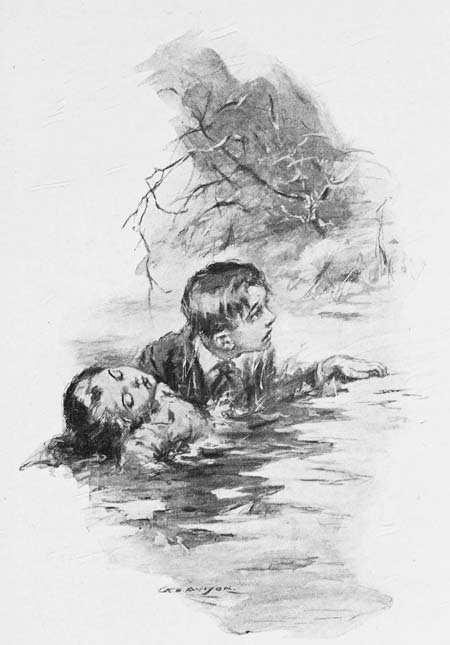
He tried to hold on
Not a soul in his mother’s house knew him who should have been best known and loved of all. They only knew that this strange child had at the risk of his life saved little Grace’s, and a sense of gratitude sent Mrs. Holcomb herself to the room where he had been brought. She helped to remove his soaked and icy garments. She noticed then the locket at his sturdy throat, and later, while the others were working upon him, she took off the locket to see if by chance it might inform her who he was.
Just as she smiled at Junior nightly, when he kissed her before he went to sleep, so the little lost Princess smiled now, tenderly, exquisitely, in her mother’s face.
The woman staggered; but she was a proud old woman, so she didn’t scream aloud. Only, in a bound she was back by the bed, and all pale and trembling looked down at her child’s child, and wondered why she hadn’t known him at once. Oh, great and terrible link of Love, that Time and Death might weaken but could not break! She knew him for blood of her blood; she wanted to snatch up his beautiful unconscious body in her arms, as if through him she might touch once more that other one. It was as if God had drawn back a curtain and let her see the result of her own pride and folly; as if his lost mother’s shadowy shape stood beside him and looked at her and reproached her for what had befallen him.
She gave a great cry at that and ran out of the room, with Junior’s “talisman” in her hand. With a stirred and pale face she came up to her husband, who, seated in the hall, waited for news of little Grace.
“Is Grace—” he began, alarmed at sight of her pallor. But she shook her head impatiently. Grace was—Grace—dear and beloved of course, but the other child was hers.
“The little boy!” she gasped. “Aaron, Aaron—the little boy! Come, come at once!” And she dragged him to his feet.
Wondering if her mind were shaken he followed.
Junior was just giving faint signs of life under the doctor’s hand. His thick light hair fluffed about his forehead in the curls he hated, and his black lashes showed the marble of his cheek. But the brave little face was one which a whole fighting regiment adored.
“Coming around now. But he’s had a tussle for it, the brave little chap! Must have the grit of a man to hold out as long as he did,” mumbled the doctor.
But the old lady paid no attention to the doctor. She just dropped on her knees by the bed and took Junior’s hand in hers and kissed it. She had ten years’ tears to shed, and they burst over the child in a terrible flood.
The old man sank into a chair, his knees giving way beneath him. He didn’t need to look into the locket thrust into his hand; he knew too well whose unforgotten face looked out of its small gold door. So he looked instead at the face on the pillow, a face to make any father glad and proud. Presently the slow and awful tears of an old man who has done wrong, and suffers for it, crawled into his eyes.
He and his wife were still with Junior when McAndrews, stern and bitter, and Miss Lydia, in tears, came to demand the captain’s son. Even the grief and remorse that met him couldn’t quite soften McAndrews.
“Give us the boy and let us go,” said McAndrews.
But the old lady kneeling beside Junior tightened her clasp. “Take him away from us? Now?” she asked.
“And why not now when he’s naught to you?” asked McAndrews. For he was touched to the heart about the lad, and angry and sore against these people. “This roof,” he said stoutly, “is no place for the captain’s son to bide under. He’s needin’ no care from them that never had aught to give him, not even Christian kindness. Sir and Ma’am, keep you your gold and your pride, and her you’ve put in his place and that he’s given back to you. You’re welcome to them all. Miss Lydia and I, that love him, will take and keep our little lad.”
The old man sitting sorrowfully beside the bed lifted his face and met Miss Lydia’s gaze. All the pride and hardness had gone, leaving him what he was in reality—a sad and sorry old man, lonely in his age and his gray hairs.
“I am glad—that you have at least seen him; that he has been able to render you so great a service,” said Miss Lydia, proudly. “Oh, such a good, brave, gallant little soldier! It may ease your burden to know him as he is—a credit to his father’s name—and to his mother’s memory.”
McAndrews blew his nose fiercely then to conceal his feelings, and said grumpily: “Let us take the child and go.”
But the doctor wouldn’t have it. He said McAndrews was a crazy old man who talked as if he wanted to kill the child outright, after all the trouble they’d had to pull him through.
When Junior woke up a brand-new, sun-bright, glittering day was getting the earth ready for Christmas. But never in his life had Junior felt so weak and tired as he did that morning. If it hadn’t been that a strange new room caught his attention at once—and he a most curious and observant little boy, bound to investigate everything new—he’d have snuggled under the covers and gone right back to sleep.
Miss Lydia, however, had seen his eyes open and she spoke to him. Her face wore a brand-new, sun-bright look too—a sort of unlocked, doors-open look. She kissed him as if she’d been waiting to do it a long time and was glad to have the chance, and she called him “Junior” in a tone that widened his eyes.
Over Miss Lydia’s shoulder came two other faces: both old, both gray, both sad and loving and entreating; both begging with their eyes for Junior to look at them and be friends. They seemed nice old people, he thought. The old man now—there was something in that old man’s hungry, grim, stern, loving face that called to something just like it ’way down deep in Junior.
“Why, he’s better, thank God! He’s all right! He’s all right!” said the old man, and his eyes went right on claiming Junior.
But Junior was just then remembering things. Then came his first words—the words of a youngest officer. “Is—is the Fairy all right?” he asked anxiously.
“I suppose,” said the old man, smiling, “that you mean our little Gracie. Oh, yes, she’s all right this morning, thanks to you.”
Junior’s hand went right up to the locket that had been replaced about his throat. He gave a sigh of satisfaction; he knew that she’d understand and be pleased.
“Oh, darling child!” said the old lady. “You have been so brave.”
Junior blushed a little, remembering that he had been frightened.
“Why, you have to,” he said simply. “You’re scared, you know; but you mustn’t stop for that. She’d feel pretty bad; and—there’s the regiment.”
“The regiment?” The old man’s brows bunched, but he looked at the little man with a great and growing pride; the pride, say, of an old lion for a particularly promising cub.
“Ours,” explained the youngest officer and gentleman in it. “My grandfather’s, who died at El Caney; my father’s and mine.”
“I see,” said the old man, thoughtfully. “I’d like, sir,” he added respectfully, “to shake hands with you. For the regiment, you know.”
Junior got it the other way about. His mother’s own sunshiny smile broke over his face and he put out a frank hand. But he couldn’t understand why this old man should hold his hand so long and so tight, nor why Aunt Lydia and the other old lady should turn aside their heads, nor why tears should run down the old man’s cheeks. Also he wished they’d tell him where he was and how he got there, and who they were that seemed to claim him.
“My head,” he explained, “got sort of twirly and I can’t remember just how I came here. Would you mind telling me, sir?”
“This,” said the old man, and his eyes seemed to bore right through Junior, “is the Holcomb house. My name is Aaron Holcomb, and that lady there is my wife.” And he drew her forward to stand beside him.
Astonishment and open disbelief struggled in Junior’s face. Why, this was a nice old man; and one might very, very easily love this old lady. It simply couldn’t be these people who had driven “her” away!
“Aren’t there,” he wanted to know hopefully, “two Aaron Holcombs? Isn’t there another one—not like you?”
The old man winced, for he couldn’t help reading in the child’s face the meaning of that question. “No,” said he gravely, “there is just one—myself.”
“Oh, no!” protested Junior. “Not you! You—you don’t look like that!—either of you!”
So they stared at each other. And presently the child nodded, reaching right down to the secretest bottom of that proud old heart. “I think,” he said sweetly, “that you must have been awfully sorry and sad and ashamed after you’d let her go. Because, you know, you couldn’t get her back ever any more.”
Aaron Holcomb flung out his hands with a groaning cry. “I was!” he whispered. “I am! I am!” But his old wife came and took his arm.
“Don’t you think,” she said to Junior, “that you’d like to stay with us, little grandson? We want you so much; and maybe—after a while, dear—you’d even grow to love us.”
Junior considered. He liked these two old people already; they weren’t in the least ogreish, but on the contrary very, very pleasant to look at. He wanted to stay in his mother’s old home; he rather thought she’d like him to stay there. But if he left Miss Lydia and McAndrews, who had been so kind to him, wouldn’t the regiment think he’d flunked? Would the regiment approve?
Miss Lydia herself settled the matter out of hand. “I have a piece of Christmas news for you, Junior,” she said, with a very tender smile. “Your father’s coming home on leave of absence—soon. And until he comes I think you’d better stay right here and get acquainted with your grandparents. Then you can both stay with me.”
“All right!” said Junior, rather sleepily.
“He’s going to stay, Aaron. We can have him!” said his grandmother, and she bestowed upon Miss Lydia a look full of gratitude.
“And play with the Fairy. I love the Fairy,” said Junior, more drowsily. His eyelids couldn’t stay open; he went to sleep.
With immense pride and tenderness his grandfather bent over him. Delicately he moved the fair head on the pillow and touched the ruffled hair. Then he laid his hand on his wife’s shoulder and kissed her as he hadn’t kissed her since the Princess went away.
“Bone of our bone, Jenny, flesh of our flesh,” he said. “My grandson—my little grandson!” He bent over and kissed Junior, and his wife and Miss Lydia knew he was kissing Junior’s mother then too.
Even McAndrews, who had come to see his lad, hadn’t a word to say.
“Give me his father’s address, Miss Lydia,” the grandfather said presently. “I’m going to cable my son to come home to us. And now you women clear out. Jenny, you’re to fix—her room for my grandson. Miss Lydia, won’t you please help us to get his Christmas tree ready? Sit down in the library and write out a list of the things you think he might like—you help her, McAndrews, please. We’re to have the big-best Christmas ever, Miss Lydia. Why, I want the whole town to come here Christmas night and welcome my boy home.” He sat down and waved his stick at them to leave him.
As they went out McAndrews grudgingly held forth his hand. “I loved him before you ever clapped an eye upon him,” he said, surlily.
But Aaron Holcomb only shook his head. “That’s why I have to sit here and get acquainted with him,” he said. “You see, he was born nine years old to me. Besides, he might wake up and want something, and I’ve got to pray, McAndrews, that that something’ll be me.”