THE LITTLE BROWN HOUSE
Reading edition
THE LITTLE BROWN HOUSE
THE senator’s wife was returning from the very smartest of afternoon affairs; her white-haired and fresh-colored loveliness had charmed and delighted the most famous and fastidious of diplomats, and the Chinese minister had expressed frank amaze at the magical youthfulness of the American Grandmother; as she stepped into her car the magically youthful rose still blew in her cheeks.
To avoid a crush, her chauffeur had made a detour, swung down two or three residential streets, slipped through the region of fashionable boarding-houses, and turned into a side street, quiet, tree-shaded, peaceful, as if, like the birds, it were going to bed with the sun. On a corner, with a hedge between it and another small house next door, stood the Little Brown House.
The chauffeur wasn’t speeding then, so the senator’s wife had a chance really to see the place. It was quite as if the Little Brown House had seen her first, and called out friendlily, as one may to one’s own.
She came out of her pleasant self-satisfaction with a start; as usual she had been telling herself that she hadn’t failed him; that step by step she had kept the pace set by his boundless ambition. An international figure now, the West had hammered him out of her giant forge—one of those wonderful Americans about whom, some day in the far future, not the Great American Novel alone, but the greatest epic of the entire race is going to be written. Not the least of his successes was the fact that for forty years he had retained the single love and adoration of his wife; she was proud of him with an almost terrible pride.
There had been times when she had wanted to pause, and catch breath, and rest; but always he had been marching upward, and she had gone with him. Once she had thought that afterward—when, say, the children had grown up and settled—they two might grow peacefully and gently old together, in the evening of their day. But that dream had been foregone; she had but grown old youthfully, wonderfully, with a ripening beauty. Now it was only at times, when, disrobed and massaged, she was at last alone, that she admitted she was—tired.
Her social secretary—and she knew her social centers like the palm of her hand—said that the senator’s new house was the one perfect house in all America, and those affairs at which his wife presided the most delightful outside of Vienna. She never knew that, deep down in the other woman’s soul weariness, a longing for simpler things, stung at times like a nettle.
But when her car rolled slowly by the Little Brown House something broke in her breast; something became alive and fluttered as with wings. Why, it was just such a little house as she had dreamed of, always, in her secretest dreams! It was a pity, she thought, that a great “For Sale” sign was nailed on the front porch, and that all the windows were closed. Little brown houses should never, never be spoiled by “For Sale” signs, and their windows should always be open.
She was going to dine at the White House that night, in a Paris gown, wearing the pearls that the senator had lately given her. And—she would come home weary. She wished that for just one night out of these gold-and-glory public nights they two might linger over a small table whose simple meal was lighted by the lamp of home. Oh, just for once to be only a gray-haired man and his gray-haired wife, in life’s calm closing day, looking steadfastly out into the fading sky, in whose deepening twilight would presently shine, like a beacon, the evening star! No light save that, and the bedtime candle; no noise, no glitter; no great orchestra, only the dear every-day music of the tea-kettle, and the cricket, and the settling log.
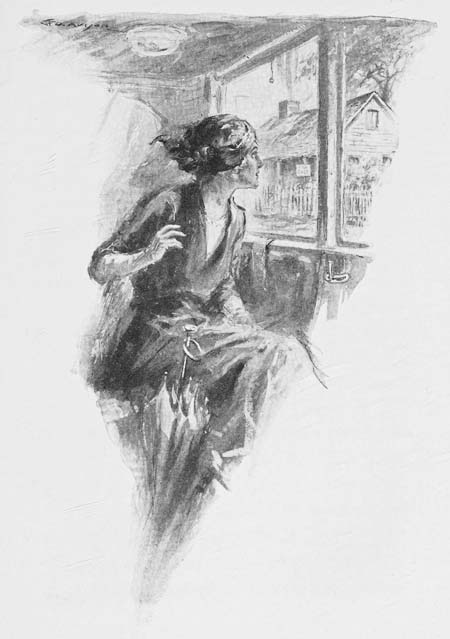
Why, it was just such a little house as she had dreamed of!
The car swung around a corner; the Little Brown House was left behind. She had left behind so much, she thought. Old neighbors, old faiths, old friends, old simplicities. She had advanced, but to what? What, of all the great essentials, had she gained? In all this success, what was hers—to keep?
At dinner she met her youngest daughter, married to a title incidental to a big blond Englishman of unimpeachable morals and a goodly rent-roll. The other daughter, Milly, had married the millions of Kilian van Cuypt. Dick, the only son, had married a virtually penniless Virginian, but Dick’s wife brought connections. The children had all done well: she was satisfied with things as they were; but at dawn she admitted again that she was tired, too tired to sleep.
The Little Brown House crept into her mind soothingly. In the room shaded by that one great tree the lights would long since have been out. That would be a very simple room; the toilet articles wouldn’t be of crystal and of hammered gold, for instance; there would be no inlaid and priceless furniture: it would be just dear and clean and cozy; after a quiet day one might pass there a quieter night.
She wondered what it would be like, living in a little brown house. Whimsically she lay awake and furnished it, room by room. At first she failed to note the significance of her omissions, the curious sense of rest and freedom which the mere thought of eliminating a great retinue of servants gave her. Little brown houses haven’t room for retinues; one had perhaps a little maid whom one really knew, and in whose affairs one was interested. It occurred to her that she knew just about as much of the lives of her servants as she knew about the man in the moon. But in little brown houses one might come into pleasant human contact with one’s few necessary helpers. She surmised that this was the right way, the good way, the Galilean Carpenter’s way.
The Carpenter!
Her thoughts drifted back to her girlhood’s churchgoing, the churchgoing of people in little homes, who have sometimes not enough, sometimes just enough, but never, oh never, too much. Of a sudden she remembered her mother’s sweet untrained soprano, her father’s stern bass:
“Abide with me; fast falls the eventide; The darkness deepens; Lord, with me abide!”
And her mother had had but one best cashmere; her father a sacred suit, religiously laid out on the bed of a Sunday morning!
There had been Wednesday-night prayer-meetings; she had gone, a little, little girl, holding tight to the hired girl’s hard, kind hand. She wondered, with a tightening of the heart, what had become of Martha. Perhaps she was some gray-haired grandmother to-night; perhaps Martha too slept under the stars and the night wind and the grass, in a corner of that old cemetery wherein, lying very close together, her own father and mother rested.
How calm and serene those two time-worn faces had been! The simplicity of their lives and their faith seemed to make a deeper gulf between her and them than death or years. As in a dream she remembered the quavering voice of their oldest friend reading over them:
“The grace of our Lord Jesus Christ, ... the love of God, ... the fellowship of the Holy Ghost....”
Ah, but to them these things had been the real and the essential—“the substance of things hoped for, the evidence of things not seen.” To her they had been for many a year but empty echoes, to which one listened, if one listened at all, with polite inattention and unemotion.
And then she thought with astonishment, “Why, perhaps they succeeded, who held fast to things they were never to lose; perhaps it is we who fail—we who have only the things we can touch with our hands.” In her carved and lace-hung bed, which had cost more than all the furniture in her father’s house, she began to weep softly; but as if those tears had cleared her vision she saw what she might do.
The senator was more than scrupulous about his wife’s more than liberal allowance; if was a very easy matter for her to purchase the Little Brown House. Never, she thought, had the mere possession of any one thing given her so much pure pleasure.
It wasn’t, however, the sort of house you can furnish by a wholesale order at the nearest furniture store. No, indeed; you have to hunt carefully for things to put into little brown houses. Piece by piece the senator’s wife found her belongings: here an old dresser, there an old chair or an older table; all good and solid and beautiful, with the beauty of being lived with.
She was tired of the pitiless bright glare of electricity; so on her dining-table stood a softly shaded family lamp. The sort of lamp you used to sit beside once, long ago, while your brother and your sister studied their lessons near by, and your mother, a stocking of yours on her hand, looked up, smiling, from time to time to answer your many questions; and your father twinkled over his glasses and his paper at all of you. You remember now, don’t you? You wouldn’t take anything life might offer, for just that memory, would you? And isn’t it strange that, looking back at them now that they’ve gone, just these simplest memories seem somehow the holiest?
Upstairs the bedrooms, all in freshest dimity, and smelling of lavender and rosemary, begged you to come in and lie down and rest a while. And you didn’t need to look at the Unrevised Version on a stand by the bed to know that they were rooms you could pray in. On the wall in the front room hung, in a blackened frame, a sampler, a nice moral sampler, with an edging of painfully prim flowers, “Work’d by Anne Alice Hardy, Aged 12 Yrs.” Anne Alice was the senator’s wife’s mother; and the sampler had lain for years at the bottom of a trunk, because, among the notable pictures on the walls of the great new house, there wasn’t room for anything so crude.
When with loving exactitude the Little Brown House of dreams had been wrought into reality the senator’s wife drew a long breath of relief. She said with a smile and a sigh:
“Now I need flowers, and a cat, and a canary, and a friend.”
Getting flowers, and a cat, and a canary do not present difficulties; getting a friend does. The senator’s wife knew exactly what she wanted; she knew that the Little Brown House must spell happiness, and home, and hope to any who were to dwell therein.
Face after face flitted through her mind, to be dismissed. The social secretary? She despised little brown houses! The senator’s wife began to wonder if, perhaps, people do not build great houses more to please social secretaries, and visitors, and butlers, and footmen, and maids, than to live and be happy in themselves!
Apply to the pastor of her church? But he too was one for whom the bigger houses are built. Her friends? Fashionable friends are—acquaintances. They would smile to one another, with lifted eyebrows, over their bridge-tables, if they knew.
Her husband? Never, never, never he: he was with all his heart and soul a man of his times; never was he to know that the high place he had coveted and won for her wasn’t her ideal realized.
The Little Brown House remained closed, and dark at night when a friendly light should have streamed through its windows. Every time she walked through its homy rooms—rooms which seemed to be complaining of not being allowed to be home—the Little Brown House asked reproachfully:
“You who have so much, haven’t you one, just one real friend you can share my simple secret with? Why, those you regard as utter failures can call in friend and neighbor to share their joys and sorrows! Do you know why? Because Just-Enough, and more often Not-Enough, draw folks together brotherlily; but Too-Much cuts you off from your kind.
“Why do you come, senator’s wife, to me, who am only a little brown house, and keep me empty? You must share me—or leave me!”
Among her charities were several Homes for women—women that haven’t any homes of their own, and that nobody on earth wants in theirs. Her name figured on their lists of patronesses and on their many boards. And while the social secretary attended to all the mere business details, and she had but to sign the necessary checks, she made it a rule to appear at each annual function, exquisitely gowned, smiling, affable, a being from another sphere almost.
The price that one insensibly pays for Too-Much is that one insensibly forgets one is just folks; the whole great toiling wonderful terrible race becomes to one—the common people. Just as if all that has been created in our common universe hadn’t been made by our common God for His common people!
The senator’s wife, naturally enough, had drifted into this common error. It wasn’t that she didn’t feel kindly; why, she wished to help—with checks. But she simply couldn’t imagine that people who had nothing at all could be just like herself. So she had never looked at any one face among all these faces to know it from its fellows: these were just the faces of old women in Homes.
It was only because the Little Brown House was so insistent in its demands, making her thoughtful, that she found herself watching at one of these sad receptions the strong, serene face of Anne O’Driscoll. Moved by a sudden impulse, she approached the middle-aged woman, who was looking about her with the merry courage of Irish eyes.
“I hope,” she began, “that you’re happy here?”
Anne O’Driscoll’s voice hadn’t the usual complacent sureness of the grateful reply.
“My two eyes,” said she, after a pause, “went back on me last winter, an’ I could sew no more. I’m too old to find payin’ work, though I’m too young, I’m thinkin’, for this. But I’m grateful for the shelter, ma’am, for I’d been alone and sick.”
“Alone and sick!” The sheltered and beloved woman shuddered slightly. “I’m sorry, Mrs.—Mrs.—”
“Thank you kindly, ma’am, but I’m used to it—the being alone—for a good many years. An’ I’m no Mrs., but just Anne O’Driscoll.”
“You aren’t unhappy here, at least?”
“I’d be less so, ma’am, if I’d the hopes of gettin’ work, an’ my cat Blinkie back. I minded losin’ Blinkie most of all, I think. Ah, he was a fine cat, an’ more knowin’ than most folks, Blinkie was!”
“And you couldn’t bring him here? Why, the very idea, wanting and not being able to keep—just a cat!”
“Why, ma’am,” said Anne gently, “you couldn’t expect the Home to take you an’ your cat too. Just think now, if we’d all be allowed to bring what we liked with us—this one a cat, and t’other one a dog, and another one a parrot, might be! Oh, no ma’am, it wasn’t to be expected; so I let Blinkie go to the grocer on the corner’s wife, that’d always wanted him. If you’re to keep things yourself you must have a home that’s yours to keep them in.” There wasn’t the faintest trace of bitterness in her voice.
An old woman, plain, unlettered; an old cat that she couldn’t keep: could anything be more banal? But Anne looked something like her own old aunt, her father’s sister, dead these many years.
“May I,” said the senator’s wife, “call you Anne?”
“Why, of course, ma’am, if you like.” Anne was neither flustered nor flattered by the great lady’s notice, just simply and pleasantly responsive.
“Anne,” said the lady after a pause, “Anne, don’t you think you’d like a really, truly home, where you’d grow old gently and in peace and surety, with enough work to make things worth while, and not enough money to spoil things, and a cushion in the sun for Blinkie, and flowers in the windows—and—somebody else to help, Anne?” Her voice was a bit breathless.
“There’s women,” said Anne softly, “that’s born to ache for a home all their days, an’ never do they find nor keep it. I’m one of ’em.”
The senator’s wife wondered a little at herself. She had known Anne but a few minutes; Anne was a plain woman, a woman in a Home, and she knew that she was going to tell Anne all about the Little Brown House; and Anne would understand!
“Will you come with me to-morrow, Anne, to see a little brown house that needs somebody—and I think that somebody’s you—to take care of it?”
Over Anne’s face fell an autumn fairness of emotion. She lifted humid eyes.
“To-morrow, then!” said the senator’s wife, delicate finger on lip. “And remember, it’s a secret, Anne.”
She came for Anne in her big new car, and together they went over the Little Brown House. Anne fingered the table-cloths and towels and bed-linen lingeringly, and laid her hand on the shining tables with a loving touch.
“You like it, then?” asked the senator’s wife. Anne began to cry for answer. And after the senator’s wife, seated beside her on the chintz-hung sofa, had explained things, Anne took the white hand in her brown one.
“Dear heart! To think you were like that all along, underneath, an’ me thinkin’ you weren’t anything but just a fine lady!” she wondered. “I’m thinkin’ it’s a grand thing, now, to be a fine lady, because women’s women; that’s all they be—thank God!” She lifted her head, and the other woman saw, not admiration nor flattery nor envy, but love, real love, look at her out of the eyes of a friend.
As they shut the door of the Little Brown House after them, they heard through the open windows of the house next door the painfully measured splashing of “Silvery Waves” spilled over a piano by childish fingers.
“Why, we’ve got neighbors!” said the senator’s wife gaily. “I’d forgotten that. And we’re neighbors too, aren’t we? Anne, after a while you must send things over on a tray, and we hope they’ll be neighborly and just drop in when they can. Isn’t it nice, Anne? And after they’ve called on you, you must tell me all about them. I hope they’ve got little children. We’ll give their little girl a doll, and their boy a train of cars, won’t we? My little grandson dotes so on trains of cars!”
When she could come, between whiles, she found herself in the midst of a pleasant neighborhood life; and all about her were the soft noises and sights and smells of home. Anne’s pride in the place was almost piteous. How clean and sweet it was; how everything was polished, and how it shone and twinkled; but nothing was fussy and not-to-be-used! The neighbors whom she began to meet knew and accepted her as the Lady Who Came to See Anne. They didn’t wonder she liked to come to see Anne: they liked to come too.
Next door was a mother of six. They had all come over to see Anne, and Blinkie had purred over the baby. Anne had given all of them little cakes that bound them to her forever. She was going to have the whole noisy, hungry, beautiful brood of them once a week to tea. Anne reveled in their company.
“You know,” she told the senator’s wife, “I’d never much of a home at best, Miss Barbara, me bein’ out all day, workin’. So I’d no chance of knowin’ little children, except I’d see them on the street, an’ have to take out my love o’ them in passin’. Why, I’ve known me to be happy for a whole long day because a little thing in its carriage waved its hand an’ gave me a smile, passin’ by. Now, thanks be to God an’ you, I’ve got a real home, an’ a chance to have them about me a bit, though they’re none o’ my own. I look forward all week to the time they’ll come, an’ the noise they’ll make, an’ the joy o’ them, an’ the way they’ll look, an’ talk, an’ laugh. Miss Barbara, I’m thinkin’ this is the kind of a house that likes to have children under its roof; and there’ll be more an’ more o’ them comin’ by an’ by. An’—you wouldn’t be mindin’ if I called in, one or two at a time, the old women that’s got to stay on in the Home, Miss Barbara? They’re tired, sometimes, of just havin’ to keep alive, an’ a day here’d hearten them, maybe. I’d like to share.”
The senator’s wife looked about her. It was the sort of house that likes to shelter the young and call in the old and the poor for warmth and kindliness.
“Have them all, Anne. And tell me all about it afterward. You dear, dear woman, you!”
“I’d most forgotten to tell you about the Westerner, hadn’t I? The lady next door brought him first, Miss Barbara, him bein’ a great friend o’ the children’s. An’ he’s the clearest-eyed, softest-spoken, brownest-faced man ever I clapped my two eyes on. Right around the corner from us he is, him keepin’ house by himself, except for the passel o’ men that’s always comin’ to set with him. I ain’t one for praisin’ up men-folks’ housekeepin’, Miss Barbara; so one day I upped an’ sent him a tray—a big heavy one at that, jest to show him! He brought it back himself, him havin’ no servant, an’ he was that kind an’ sociable I took to him like the children do. I like Westerners—they’re so just themselves, ain’t they? He’s real glad we’re neighbors, he says, an’ him an’ his friends’ll be glad to be of any service to us. I told him us bein’ women-folks an’ the best cooks, they’d better come over an’ neighbor with us holidays. The nicest man ever I knew, Miss Barbara—it’s him fixed our kitchen-window shelves.”
The senator’s wife smiled appreciatively, then went up-stairs for her usual half-hour of quiet thought and rest by that shaded window. Outside the day was rather dark, and the tree was bare now to the autumn winds. She sat with her hands in her lap, thoughtfully. The senator hadn’t been so well of late. He looked, she thought, more gray and old.
“Why, it’s getting so we just see each other going up and down stairs!” she thought indignantly and sorrowfully. “We’re getting old too, Hugh and I are. Oh, it isn’t fair, it isn’t fair. We aren’t even sharing any more—I can’t share his work, and he won’t share my house!”
That was perhaps the most strenuous winter either of them had known. They crossed each other’s orbits frenziedly. At her affairs he showed his fine worn face for a few dutiful minutes, then disappeared. And when at times they did go out together, the usual tactful hostess, following immemorial custom, separated them.
In the midst of this mad swirl Christmas drew near. To the senator’s wife Christmas had come to mean merely a long list of gifts, dutifully checked over with her secretary: you gave just as you received; you had to. You knew that from the housekeeper down every one in the house must be remembered; the secretary saw to it that they were. There was no planning; no hiding of things half done when somebody came into the room; no mysterious hints nor smiles; no air of subdued eagerness; no tender sacrifices that make gifts doubly precious.
But at the Little Brown House things were different. Anne had made with her own skilful hands something for everybody: for the little Maid Who Helped; for the Mother of Six and her brood; for the old women from the Home; for the Man around the Corner, who was so glad to be neighborly; and for the senator’s wife. Anne even had a tree; and they were all to come for a while on Christmas eve, except, perhaps, Miss Barbara.
“I wish,” said Anne, looking up from the cake she was whisking together, “that you’d put on your plainest frock. Miss Barbara, and come. It’d make Christmas more like Christmas as it ought to be for me.” Her eyes implored the senator’s wife with so much of love and longing that the heart in her warmed anew to Anne.
“The senator and I have simply got to attend our daughter’s Christmas Eve reception, but I think, by close management, I might get here—from half-past six until nearly nine, say. And I could drive home and dress, and nobody be the wiser for my pleasantest Christmas secret!” She thought for a moment, and laughed like a girl: “Anne, I’m coming!”
The senator was to accompany her to their daughter’s. She knew that until then she wouldn’t see him; she knew, too, that some beautiful and costly gift, chosen with exquisite care, would be lying by her plate on Christmas morning. No, he wasn’t forgetful, nor neglectful, any more than she herself; he was only—too busy.
It was quite half-past seven when she reached the Little Brown House on Christmas Eve. When she opened the door she knew that Christmas itself had arrived before her; for the house was alive with young children, as all self-respecting houses would be if they had the chance. You heard the children’s shouts, and their mothers’ worried admonitions, and Anne’s cheerful, “There, there, let ’em be! It’s Christmas Eve, an’ Christmas Eve’s children’s eve. Ay, my dearies, laugh, do! An’ when Miss Barbara comes we’ll open that settin’-room door; an’ then you’ll see what you’ll see—bless you!”
“Miss Barbara” came in to be swallowed in a warm sea of joyous welcomings. She wore what she considered a plain dress; but the Mother of Six, and the women with her, looked upon its lustrous folds almost with awe; only the baby disregarded it, and sat upon it, and kicked his feet against it unconcernedly.
The sitting-room door had been opened; they were in the midst of gift-giving, and receiving, and exclamations when the doorbell rang.
“That,” said Anne, pausing, with the Baby’s jumping-jack in her hand, “will be that Westerner from ’round the corner. I’ll let him in, Miss Barbara; he’ll want to stay with the children here for a while, I know.”
The senator’s wife heard the front door open and close, and men’s feet in the hall, and the Westerner saying in his pleasant out-of-doors voice full of the burr of R’s:
“Here’s a bunch of real holly, and some real mistletoe to hang up; and here’s my oldest friend along with me—he’s an old friend of those kids, too. We’ve brought you a few things to add to the tree for ’em. Say, now, it sure makes us two old chaps feel right good and Christmassy to get in here with you women and kids to-night!”
Anne and the Westerner came in together. The other man followed more slowly, looking about him with merry eyes. He was a very, very big man, and he seemed to fill the whole doorway in which he stood. Then the children saw him, and shouted rapturous welcomings; and he returned these with somewhat of a tender wistfulness in his smile.
From her sofa the senator’s wife looked up; their eyes met, incredulously. She rose to her feet, putting down the baby.
But Anne had advanced to him, holding out a friendly hand.
“I know you’re the Big Man That Plays with the Children!” she said cordially. “I’m sure glad to meet you at last, Neighbor; welcome, an’ a Merry, Merry Christmas to you!”
He returned her greeting cordially; then the senator’s wife came forward. Her eyes were large.
“You!” said she faintly. “You—neighbor—playing with children. You here!”
“You!” said the senator. “Here to-night—why, Barbara, my dear!”
“I come—when I can find time—Anne keeps house—” she began.
He nodded. “I go around to Jack’s—when I can find time. One’s got to have a few friends one can visit, don’t you think?”
The baby set up a great wail, because he was a baby, and he had had enough of presents, and play, and grown-ups; and he wanted to go home and be put to bed. The Mother of Six picked him up, and her friends gathered the rest of the brood and their belongings together and carried them off, with many Christmas wishes tossed back and forth.
Anne beckoned the Westerner into the dining-room and pointed to the table.
“No real gentlemen,” said she, “will refuse to fall to an’ help eat up a lady’s pie that she’s made with her own hands for Christmas.”
“I am,” said the Westerner, “a long-fanged wolf on pie. An’ if you’ll cut yours in just halves, I’ll be everlasting grateful to you, ma’am.” And he sat down, turning his back upon the sitting-room door.
The senator and his wife came to each other slowly, he looking down upon her whimsically, she looking up at him with eyes of pure wonder.
“Why, Barbie, is there ever any reading a woman? I’d never guess that you’d come visiting a little house like this—”
“This little house,” said she, “is mine: I bought it. I’ve wanted just this little house all my life, and I wasn’t honest or brave enough to tell you so.”
“I thought,” said the senator, “that it was the other sort of house you wanted, Barbie. That’s why I built it—for you.”
“I did want it and I do want it—for you,” said his wife. “That’s why I let you build it. But I want this for me—to get rested in, to be folksy in.”
A slow twinkle grew in the senator’s eyes.
“Barbara,” he said, “you ought to see Jack’s house, around the corner! A mighty nice little house. I’ve been going there for a long time. Didn’t you ever guess I might like to be just folksy too, Barbie? There’s no tiresome bunch of servants tagging at your heels at Jack’s. You can sit down in your shirt-sleeves and smoke a cuddy, if you want to; you can wait on yourself without shame and reproach—think of that! Do you know what Jack had for supper to-night? Fish-chowder, and pan-bread, and coffee that’d make your hair curl! Gee, it was good!
“You see,” he went on thoughtfully, nodding his head, “I like to go to Jack’s because I get rested there—he’s a man. I can quarrel with him, even! Now you know I’ve loved you, and you alone, all my life, Barbie; it’s for you I wanted—the top-notch. But I—get tired at times. I want to loaf a little, and be folksy too. And you, Barbie—you?”
“I also,” said the senator’s wife with a girl’s laugh. She put her arms about his neck and clung to him. “Oh, Hugh, my dear, don’t you see, we’ve come together again! Hugh, we’ve come together, close! It wasn’t the big house, nor the too-muchness: it was that we didn’t know, Hugh, and we couldn’t take time to find out! All these years—and I didn’t know the real You until to-night; all these years, and you had to stumble by chance into the Little Brown House, on Christmas Eve, and find the real me.”
He kissed her with a young delight that shook his years from him, and straightened his shoulders, and kindled his face; so, for a while, they held each other.
“I wonder,” he said presently—“Barbie, I wonder if you or any other woman can keep a secret?”
She waved her hand about the room by way of reply.
“Why, of course you can, all of you!” said the senator. “There’s no end to the wonder of women! Well, now, Barbie, here’s the secret: I’m to take a two weeks’ rest after New Year’s, and dodge everybody. I’d thought of running out West—but, say, let’s just cone right here to this little house of yours, and get acquainted all over again, Barbie. I feel as if I didn’t half know you, anyhow. Will you come, dearest dear?”
“I’ll come,” she said with shining eyes. “Hugh, Hugh, I’m beginning to fall in love with you all over again—and I fifty-seven and a grandmother!”
The senator took out his watch. “There’s the girl’s reception, Barbie—we’ve got to fly,” he said regretfully. “Is the car to come for you?”
“Oh, let’s tell Anne to send it back, and we’ll walk home,—as we used to—remember?—when a callow fledgling of a country lawyer courted and married a penniless district school-teacher?”
He nodded, wrapping her carefully in her sables. Anne and the Westerner asked no questions, expressed no surprise, made no comments: they were just such friends as that! They shook hands with a warm and loving pressure, and wished a million Merry Christmases with all their heart. And the Little Brown House breathed after them a message of peace and of understanding; and overhead the sky was thick with stars—one, larger and brighter than the others, dominating a great clear space.
They walked along together, hand in hand. The great holiday crowd jostled them, and they, being afoot, knew themselves a part of it and caught its spirit, and were glad. After a while the senator glanced up and called her attention to the biggest star.
“The same old star!” said he softly.
“And we together under it!” she answered happily.
“Why come to think of it, so is everybody else!” said the senator with a hint of reverence.
“So is everybody else!” she repeated. “And that,” she added, “is just what makes Christmas Christmas!”