THE SPIRIT OF THE HOUSE
Reading edition
THE SPIRIT OF THE HOUSE
TRESCOTT had planned a Christmas in Munich, an Easter in Rome. The war changed that. Europe gone back to barbarism filled him with a horror bordering upon physical nausea; he felt that he never wanted to see Europe again.
He decided, instead, to go South. The Trescotts sprang from Carolina stock, and there were certain old records, family traditions, which he had long desired to trace to their fountainhead.
Famous at thirty-five, Trescott had yet remained a curiously aloof and rather austere figure. Some far-off Irish foremother had lent his dark face its delicate imprint of expectancy and dowered him with that strain which gave to all his work, along with a dewy and delightful freshness, a flavor of rose-scented and unforgotten yesterdays.
To this undercurrent of melancholy the Carolina landscape powerfully appealed. This land of lonesome wide marsh margins, of dim desolate forsaken fields, of broodings and moss-hung woods, appeared to him as might a half-hidden face which has haunted one’s dreams. He wandered over the coast country with an ever increasing delight.
The day before Christmas caught him upon one of these solitary and endless tramps, glad enough to escape what he considered wearisome festivities. It was past noon when he reached his destination—one of those deserted old Carolina churches in whose grass-grown yards the proudly named dead sleep forgotten. In a far corner he had paused before a name which struck his keen eye pleasantly—Lydia King. For this, he realized at once, was the very name the girl in his next book must bear!
Even while he pictured what she should be, brown-haired, brown-eyed, slim and gracious, the creative power came upon him. Furiously, working at frenzied pressure, he got such as he could into his note-book, dreading to lose the thread and praying for the failing light to hold.
The still gray afternoon rushed suddenly into dusk, as happens in that land of little twilight, and with the dusk began a disconsolate drizzle. Before him stretched strange roads, bordered by abandoned rice-fields, eerily empty in the deepening dark. Where two weedy by-paths crossed he stopped perforce; and as he hesitated, a little faint light twinkled at the far end of the expanse upon his right.
Trescott sighed with relief; in Carolina one has only to stop at the first house, generally, to be sure of a shelter for the night. For what seemed an interminable distance the little byway led him, to stop abruptly at a pair of iron gates, wide open between tall brick pillars. A thick belt of cedars, swaying somberly in a rising wind, lay between him and the great black bulk of the house beyond. Like the garden gate, the house door stood open. The light which had led him came from a room to the right of an enormous hall.
His hand was upon the iron knocker when a girl came out of the lighted room, her trailing dress undulating about her slim body. As she neared him her face grew out of the dark, oval-shaped, cream-colored as a magnolia. With a gracious and welcoming gesture she beckoned him inside.
The great room, lighted only by unshaded wax candles in tall silver sticks upon the high mantel, had the shadow as of a Rembrandt, suggestive of rich depths. Out of it flickered the red glow of copper, the brighter gleam of brass, a hint of the deep blue of old Delft; outlines of old portraits appeared on the paneled walls; one divined the satiny sheen, the majestic mahogany of old carved furniture.
Ruefully aware of his muddy shoes, his stained garments, so out of keeping with this stately orderliness, he wished to explain, to apologize, and looked up to meet glance to glance her intense and luminous regard. All in brown she was, save for a lace-edged scarf, and a white flower at her throat. The deep wilful dimple which marked her chin matched her child’s mouth, rosy, arch, and virginal; but in the shining eyes under the fine brow one glimpsed the spirit, proud, flame-pure, indomitable.
She leaned toward him: “It took you such a long, long time to come!” she sighed, and her clear eyes reproached him. Bewildered, stung with a swift inexplicable pain, yet conscious of a mounting exaltation, sweet and heady, he stammered:
“But I didn’t know you were here! Don’t you see? I couldn’t know?”
“Ah, but you did!” she insisted, with soft triumph. “That is why you are here! I remembered—and you saw the light!” With a slim finger against her lip, she looked up at him with smiling and mischievous eyes.
Gesture and glance stirred Trescott curiously; his mind went groping after remembrance of both. Then, as in a lightning flash, he knew. She who was the true spirit of all his effort, that Somebody who had so long eluded him, was face to face with him at last! He knew, and, meeting her steady and waiting glance he realized, with a great upward surge of heart, that she also knew.
Full of a joyous wonder, he stammered:
“It is you! Why—why—it is you!” Then panic seized him and he trembled:
“And I might have missed that light!” he gasped. “Why—I saw it by the merest accident!”
She shook her head. “No, you couldn’t. Don’t you remember, Anthony, that this is Christmas Eve? Beautiful things happen at Christmas-time, Anthony!”
Uplifted above wonder, that she should know and call him by name did not in the very least surprise him; beautiful things, of course, have to happen at Christmas-time!
“I knew,” said he, rapt and elate, “that you simply had to be somewhere, Heart’s Delight! I knew that when my great hour struck, I should find you. And oh, I have found you! I have found you!”
“The wonder of it!” Her voice was flute-like. “Oh, the great, beautiful wonder of it, Anthony! How was it I ever, ever doubted? I shall never, never doubt again!”
“I am not dreaming,” whispered Trescott, pale with emotion. “No, nothing else ever has been, ever could be real for me save this, that you are you. I have been looking for you, I have been loving you, all my life. For you know, of course, that I must love you?”
“I knew it this long time since—while poor you went a-hunting it,” said she, airily. “But say it again, Anthony; say, ‘Lydia, I love you!’”
He laughed whole-heartedly. “You Christmas miracle! What need to tell you, when you know?” said he, fervently. “Lydia, Lydia, indeed I love you!”
“If I had even for one moment doubted that,” she said gravely, “I should not be listening to you to-night; perhaps you might not know yourself!” Her eyes, shadowed, grew very old and wise. “But there have been times when I—despaired, Anthony. Oh, the days, the nights, the slow, slow empty years! And poor I so alone!” An immense weariness enveloped her, sitting grotesquely upon her young sweetness. She shivered; before his eyes her face grew pinched and sharp, and upon the smooth brow came a pucker of pain. She drew away; and in an instant an impassable barrier, delicate as moonlight, strong as adamant, seemed to arise between them. He had the prescience as of a thing inevitable.
“Anthony!” said she, “I—I can’t explain even to myself just how I am here to-night, no, nor how you came to me. But I do know it had to happen. You will not forget?”
“How in God’s name could I?” he wondered. “Nor is there need of explanation. Why, we love each other! How could I forget what I’ve been trying to remember ever since I was born?”
“You will remember—always, Anthony? Oh, my dearest dear, be sure!”
“I am sure.”
“Then—never doubt—about to-night, Anthony—and me,” she said.
Shaken out of himself, he got to his feet and held out his arms.
“Who talks of doubt and of forgetting?” he cried. “We two belong. Ah, don’t you see how great my need of you is? I want you, I love you! Lydia, come; come now!” His outstretched arms pleaded for him.
“Do not touch me!” her gesture was almost repellent.
“Lydia!”
“I—I cannot!” she gasped again. Her voice trailed into a sobbing whisper. “I remember—I had to find you—and that you had to come. But beyond that—I never thought.”
“Well, think beyond that now, my child,” he insisted, conquering his pained amazement. He added, with a gleam of playfulness, “Finding’s keeping, Lydia.”
“Finding’s keeping—when one makes it so,” she said, still out of his reach. “But now that you have found me, you must go. I cannot stay longer. See, the rain has ceased, the moon is out.”
“Now? I am to leave you here—alone?”
“You are to leave me here—alone.”
“There is no word for me, no—no surety? What am I to think?”
“You must come,” she said, “here to King House, to-morrow, and take what you find. See, where I put my finger in the heart of this middle rose in the wreath just over the mantel? Come to-morrow and touch that spot, Anthony, and take my gift. And—stand so, for one last minute, Anthony, so that I may see your eyes and your lips and your black hair. Then tell me good night and good-by.”
With a noble patience, without further question, he obeyed. In his heart he knew he should never lose her: and was he not coming back, to-morrow, for a gift from her?
Outside, in the wan light of a watery moon, the gaunt house among the black cedars showed with tragic bleakness. The girl stood a slim glimmering shape, in the dark doorway.
“Good-by!” she whispered, and it seemed to him he felt her touch him once, lightly, before the darkness swallowed her. When he reached the gate the light flickered out.
But unshaken and serene, as if he trod upon air, he walked through the withered wet grasses, his forehead bare to the salt wind. The night deepened; wider and wider grew the clear spaces in the sky, and light upon shining light the cohorts of the stars swung into their ordered and eternal places. Over in the east one glowed with a softer, larger luster. Trescott smiled up at it.
“I know you now!” he said, “you’re the Star of Beautiful Things that happen at Christmas!”
It had been to him rather a fable, hitherto, that old story of the star; but to-night something of its hidden, tender meaning was clear to him: along with the shepherds who had seen it shining upon Judean fields, along with the Wise Men who had sought it, bearing in their hands gifts of gold and myrrh and frankincense, the writer of books felt himself following it, and knew himself nearer the Everlasting; for that had come to him which made him understand, that which alone is real, and permanent, and abiding, beyond doubt, above fear, stronger than death: Love.
Set me as a seal upon thy heart, as a seal upon thine arm: for love is strong as death.... Many waters cannot quench love; neither can the floods drown it....
Oh, surely when the morning stars sing together it is thus they sing before His face!
Odorous of wet woods, dappled with sunlight, the Christmas morning broke, and Trescott, looking out at his window, saw a new heaven and a new earth. An earth, too, which held a Christmas gift from her! So he went forth to claim it.
The gate was still open; rusting upon broken hinges it hung upon the ruined wall. He pushed his way through withered fennel, waist-high grasses, thorny smilax, till King House lay before him. With the tides of his blood freezing about his heart, Trescott opened the door and tremblingly made his way to the mantel and groped for the carved rose upon which—no, he had seen it with his eyes, he had not dreamed it—a girl’s slim fingers had pressed.
In the heart of the rose a tiny knob moved, a little panel slid back and within the small recess thus revealed lay a package in a velvet case whose moldering string broke at his touch.
He found himself, presently, leaning weakly against one of the great porch pillars. He was trembling violently; his mind whirled drunkenly; but mechanically he clutched his Christmas present. When he could command his senses again, he examined his gift—a small leather-covered book, upon whose yellowed pages appeared delicate and tendrillar writing. In the Christmas sunlight he sat down to read it.
18th Decembr., 1775—You being a Birthday Present, and I eighteen this day, and so much of joyous Import crowding upon me, I do make you my most sweet Intimate secret, little Book; and what I may tell none else I shall set down within you. Haply some day I shall show you to Him, saying, “Such and such you did and said, Sir, on such and such a Day, when we two were young and first you knew you loved me! See, herein I did set the record for you that be nearer to me than mine own heart’s beating is!”
These be grievous & troublous Times, like as, my Grandfather saith, were prophesied of old by Jeremy the Jew. In despite of which I cannot but be happy, for that Anthony loves me! O God, how good Thou art, that lettest Anthony love me!
Yestreen I met with him in the green lane behind our House. I wore my brown stuff, for I bethought me he had said he ever liked russet upon a white-skinned maid. And the heels of my new silken shoon are red, and I thanked God I had had patience to crisp my hair.
He was wondrous smart, in claret colour, being indeed but newly returned from London. God never made a likelier man, nor one so proper shaped. When in Holy Writ I read how that Jesse’s lad was ruddy and of a beautiful countenance, how that Saul was comelier and by the head and shoulders above all Israel, then thought I, these be like Anthony!
He dismounted and walk’d beside me, leading of his horse; and before we turned out of the lane he had told me. Now what he said is printed upon my heart. Nor could I set it elsewhere, not even to your pages, little Book. I greatly Wish’d but Fear’d to say that ever had I lov’d him, yea, even when I was but a child in pinafores. That will keep.
Beside our Gate he kiss’d me, and this will I remember even when I am old to heaven. Never shall I forget, not even if I be grown familiar with the glory before the face of our God.
24th Decmbr.—Christmas Eve, and we Crowd’d to the Rafters, & much merrymaking. Anthony supp’d with us, and afterward drew my dear Father aside and spoke with him of me. My Father cry’d ’twas but yesterday I was a child a-learning of her horn-book at his knee; we might be betroth’d; but must e’en bide a while before wedding, for that the times are evil and War upon us. Then gather’d all the company about us & much kissing of me, and teasing, but my dear mother weeping.
The men talk ever of War & how the land must be swept with a besom ere ever Freedom come. But I bethink me how God is above all War; and that Anthony loves me!
5th Jany., 1776—To Aunt Chatty’s to sup. No tea, but elegant plumb-cake. I greatly fear Eliza is a Jealous Thing, for she sniff’d most odious and catty & hop’d my fine gentleman, fresh from Lunnon, trifl’d not “with thy young affections, child.” I recall now that never did I love Eliza. An her husband—though I much doubt she comes by one—ever beats her soundly, I shall die in the firm faith she deserved it. Back in the tilbury with Anthony. Sure ’tis a beautiful world, in spite of some Elizas in it.
3rd Febry.—He is gone, he & my Father. War has taken them. I saw him ride away from me and all my hope go with him; sure my soul itself did follow him a-whimpering. He waved his hat for a last farewell, and the sunlight was upon his beautiful countenance and his black hair.
I wish my father had allowed us to wed. O God, I am afraid! I am afraid!
1st March, 1777—No word this many, many weeks.
O God, remember me because of these nights! Weigh me in the balance with these black hours and see if all the errours of a thousand years could weigh equal with this, my misery!
17th Octbr.—They have fallen. Both together. Marion hath sent a letter full of kind words and praise. To my poor mother came my lov’d and honour’d father’s last words, but for me only mine own little likeness taken from Anthony’s breast. I know not if he had time to send one last thought to meward.
It has rain’d and rain’d and rain’d. And ever before me I see him lying and the cold rain drenching his hair.
Oh, what is left to me, what? My gentle Mother shames me with her meek patience: she saw her children cradled in my father’s arms. But I—what of me?
Midsummer, 1780—They ever bid me remember, Anthony, that I am still young and that many find me fair. They tell me ’tis not seemly for Youth to cherish Grief so fondly, that I must e’en look up and see in other eyes what once I saw in yours. They know me not, O my love!
Mayday, 1782—To-day have I sat up for the first time, after my long, long illness. Black Matty brought me at my bidding my litle mirrour, blubbering, poor wench! For indeed I am greatly changed.
It pains me, I being so sadly altered, to look upon those pictured faces that are so smiling and so young. I am minded to lay those pretty semblances of what once we were in the little recess above the mantel, in that room which saw us Betroth’d. There shall they lie, with this little Book I was minded once to show you, in coming years! Alas, my heart!
Octbr., 1782—My own sweet love, in what I do know now to be these my last few days, a something grows within me of presage and of peace. I know that I shall find you, “For Love is strong as Death.... Many Waters cannot quench Love, neither can the floods drown it.” I do hold fast to that as to an anchor, and I am comforted. For still shall I be I, and you, you. So O my own love, so greatly lov’d, for a little space, good-bye!
There was no further entry. Trescott laid aside the yellowed pages, and opened the other half of the package. The girl herself smiled up at him, brown-haired, brown-eyed, rose-lipped, a wilful cleft marking her little chin. One saw on the blackened gold true lover’s knot, which formed the loop of the picture, her initials—L. K. From the other frame, most gallantly attired, young, clear-eyed, very grave and beautiful, another Anthony Trescott looked hopefully.
The hush that fell upon Trescott seemed to communicate itself to the day itself. The very wind seemed to stand still in the cedars. Time itself passed. Then, out of the heart of the holy silence, a girl stepped, a girl all in brown, a motor bonnet swinging on her arm and the sunlight full upon her shining hair. At sight of him sitting there so sunk in revery, she stopped short.
“Anthony Trescott!” she breathed. And he looked up of a sudden and met, glance to glance, her intense and luminous regard.
“Lydia—Why—Lydia!” he mumbled. Blackness swooped upon him as his overwrought nerves snapped.
He came to, to find his head upon the girl’s supporting arm. She was fanning him with a brown motor bonnet—a perfectly enchanting, expensive, ultra-modern motor bonnet. But Trescott had no eyes for anything save the rose-lipped face. He stared at her unblinkingly.
“Lydia,” said he, gravely. “I found it, dear, your Christmas present.”
“I wish to gracious I’d brought Aunt’s smelling salts!” said she, anxiously, and fell to fanning him more vigorously.
“I thought,” said Trescott, sitting up, “that your message was all I could expect. Lydia, I didn’t even dare to dream you would come. Oh, you were right—beautiful things do happen at Christmas-time. For you are here! Lydia, the wonder of it!”
“But the wonderful thing isn’t that I’m here, but that I should really and truly find you here, Mr. Trescott!” said she, puzzled. “I’m awfully sorry I startled you so; you wouldn’t hear me coming, of course, with all this dead grass about, and I was right upon you before you saw me or I saw you, either. Then you called my name, almost as if you’d expected me, Mr. Trescott!” she finished shyly.
“How have you come, and why have you come, here of all places under heaven, and to-day of all days in the year?” he wondered.
A dimple danced into her cheek, and her eyes danced with it.
“Why—I came, really and truly I came—on your account, Mr. Anthony Trescott!” she said gaily. “Why do you look at me so strangely? It’s very simple. Don’t you remember how in your own ‘The House of Their Fathers’ you made Regina visit, on a holy day, the house of her ancestors, just to let the poor old faithful place know that she cherished it? I thought it such a perfectly beautiful thing for Regina to do, and I made up my mind I’d pay just such a visit to King House one of these days. I’m one of the blood, you see: I was named for a girl who used to live here.
“It just happened that my aunt decided to motor over in her new car for a Christmas dinner with her favorite nephew and his wife and their brand-new baby that we haven’t seen yet. She made me promise to come along. Poor dear, she has such a horror of motor cars I wonder she ever trusts herself in one. We stop ever so often, because she has nerves if a chicken runs across the road, or there’s a curve; or anything. She insisted we must stop for lunch at the very hotel you’re putting up at. They boasted of it, of course. You’ve no idea how I felt! Why, I’d been thinking for days and days and days of visiting this old place; I dreamed of it last night, and I woke up thinking of it this morning. But I never dreamed I’d be lucky enough to run across you! It’s really wonderful to find you here, now, isn’t it?”
“Yes,” said Trescott, readily, “it is really wonderful, when one comes to think about it.”
“I knew you at sight, of course,” she said, thrilled and kindling. “You see, I’ve read every sin-gle sol-i-ta-ry thing you’ve ev-er written! And I’ve got a full dozen or more of your pictures, all cut out of magazines and newspapers. Of course I know you! But oh, however did you happen to be here, right now? It—it seems like a lovely, happy miracle!”
“Miracles,” Trescott informed her oracularly, “happen at Christmas-time, which is exactly when they should happen. I may say truthfully I came expecting to find you here too. And—here you are, you see! And now will you please look at me directly and tell me, in all truth, just exactly how Anthony Trescott appears to the eyes of Lydia King?”
The rose in her cheek deepened vividly. Flame leaped into her glance. “Why, Mr. Trescott, I think you are marvelous—quite the most wonderful person in the whole world!” she blurted out naïvely, then blushed more deeply because of her own words. Nevertheless she kept his eyes bravely.
“I remember,” she said, “the first day I ever read one of your books and how it was like a voice I knew talking to me. And I remember the first time I saw your picture. It—it jumped out of the page, and I shut my eyes and counted ten before I could look at it again. Somehow I’d known you were going to be like that, Mr. Trescott. Wasn’t it curious? And I eat and drink your books and live with them, and dream with them. I don’t very well see, then, how I could help thinking you’re the most wonderful person alive—everybody else thinks so too—or they should think so!”
Praise, fulsome and flattering, praise critical, had been showered upon Trescott in his time, but this clean glowing living understanding was as deep calling unto deep.
“We will dismiss ‘everybody else,’” he decided, “and consider only you and me. Now sit down here beside me, for I have something to show you,” and he laid the little book in her hand.
She read, and the radiance died from her; the eyes she lifted to his were too old and sad and wise for her young mouth, her child’s dimple.
“I can hardly bear it!” she said in a stifled voice.
Trescott smiled consolingly. “All over and done with, Lydia. For you are here—and I also,” he reminded her, and put the two pictures, so fresh and smiling, in her palm.
She turned pearly white. “Why,—they’re us!” she gasped. They looked at each other mutely. Then, in a low voice, he told her.
“We seem to have been caring and waiting and hoping a long, long time, don’t we, Lydia?”
She sat very, very still, staring straight in front of her. And again the wind ceased to move in the cedars, and over all the shining day hung a waiting hush. Then, timidly, she put out her hand, and the man’s closed upon it.
“Anthony!” her voice broke a little. “Anthony, are you—quite sure?”
“And you?”
“I want you,” she said, “to take back my picture. And to give me yours once more. That’s how sure I am!” She turned to him a face sweet with trust, bright with faith.
After a while, she roused herself from the dream into which, side by side, both had fallen.
“Hadn’t we better go?” she ventured.
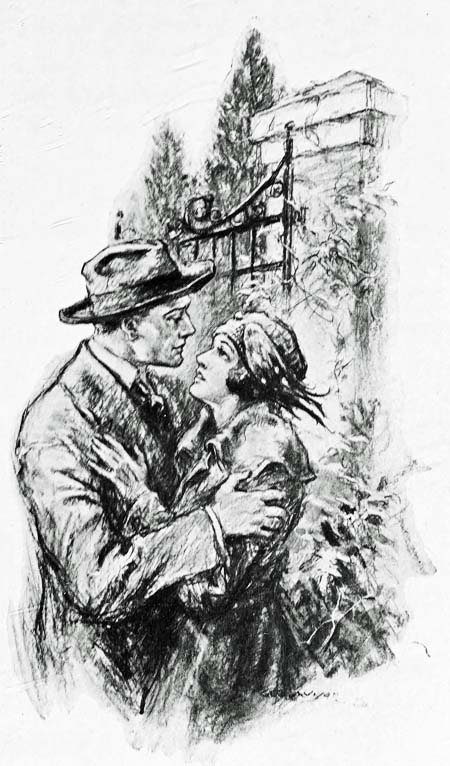
“I think it must have been just here that Anthony Trescott kissed Lydia King”
“My aunt is getting ready for another fit of nerves, right now, I know it! Come on, the car’s waiting down the road, and we can make the hotel in half an hour.”
They walked slowly, hand in hand; at the broken gate they stopped for a moment.
“I think it must have been just here,” he said, “that—that Anthony Trescott—kissed Lydia King.” And he looked down at her.
For a moment she hesitated; then youth, sheer dazzling joyous beautiful youth, flashed into fire within her and swept her free of every vestige of grief; a rosy finger flew to her lip and her eyes full of innocent mischief smiled at him enchantingly. And, as his arms closed upon her, “It’s—it’s a long, long time between kisses!” said Lydia King.