RAINY-DAY GAMES
Reading edition
This is a chapter written to meet the needs of several children shut up together in bad weather. The chapter on "Indoor Occupation and Things to Make" gives suggestions for a single child, but here are a few suggestions for several occupations for a group of children, which do not mean the destruction of the furniture.
Any one of the games given in the chapter "In the Train" is suitable for rainy days.
There are of course many games treated elsewhere in this book which can be played on rainy days indoors. Many of the parlor and outdoor games are equally suitable for indoors. All the card games and back-gammon, checkers, etc., are invaluable resorts in case of a long dreary day, but there are a few other recreations which, in some families are saved for such occasions.
Bean-Bags
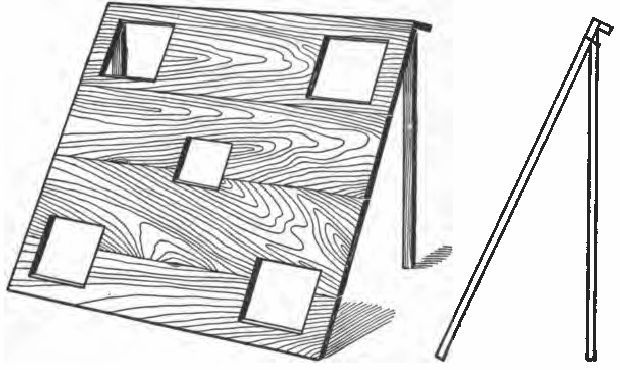
One of these is the old fashioned game of bean-bag. One rainy morning can be spent in making the outfit. The girls can be occupied in making the cloth bags, from six to ten inches square, partly filled with beans: and the boys in making the board which is shown in the illustration.
It should be about three feet square of any sort of boards and propped up at one side so that it forms an inclined plane. Five holes are cut in it, about seven inches square, all but the centre one which is only five inches square. The players stand off from six to twelve feet according as their skill increases with practice and try to throw the bags through the holes. There are various rules for playing the game which you can arrange to suit yourself, or to make a change. One way is have the bags in sets of six, each six being of one color, different from the others. The players stand in a line and all throw at once, trying to get their six bags in the holes as soon as possible. When they have thrown their bags they rush up to the board, gather up those which have gone wild and run back to the firing line. The one who gets his six bags in first wins the game. A bag thrown through the small centre hole counts as two.
Bean-bag Board
Another way to play it is to throw in turn, each throwing all his six bags one after another. The one who gets most in is the winner.
Ring-Toss
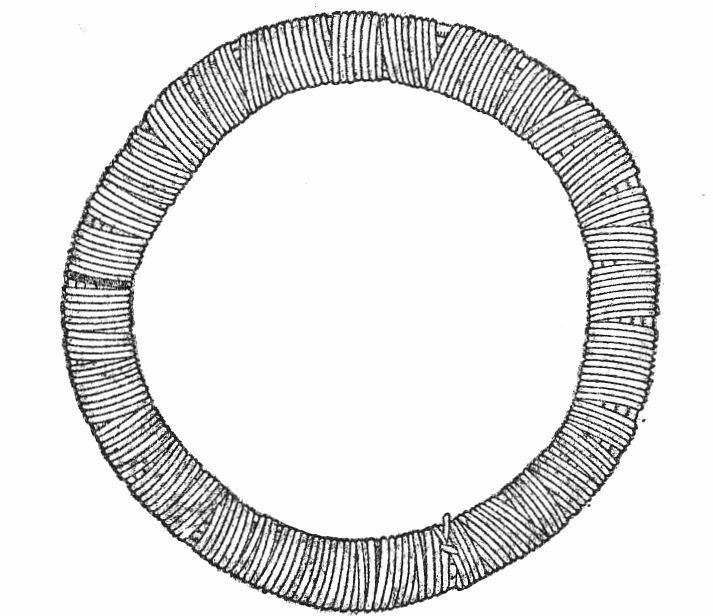
Ring-toss is another game in which skill can be acquired only through practice and it is very good for rainy-days. It is really indoor quoits, and is a favorite game for shipboard. Any one with a little patience and care can make the rings which are of rope fastened together with slanting seam, wound with string so that there is no bulging, overlapping hump at one side.
Rope Ring
A stake is nailed upright to a board (the stake can be a section of an old broom handle, or a smooth, small, straight peeled branch of a tree) and the outfit for the game is complete. It is played with the same rules as quoits (see "Outdoor Games for Boys"), and a very considerable degree of skill can be obtained by practice. As in pitching quoits, the rings should be thrown with a little level twist to make them whirl about.
Ring-the-Nail
A variation of this can be played with common large nails and brass curtain rings. Eight nails are driven into a board in a circle, leaving about an inch sticking up. In the centre, one is driven, standing about three inches tall. Small rings, curtain rings, for instance, are thrown toward this. Each time they encircle one of the lower nails is counted five, and the centre nail ten.
Soap-Bubbles
A soap-bubble race is easy to arrange and very good fun. An old shawl or blanket is laid on a table or the floor, goals are made at each end of it with piles of books, leaving an opening between, and each person is provided with a pipe for blowing bubbles. One bowl of soap-bubbles is enough for the company (see page 279 on the best way to make lasting soap-bubbles). The game is to see who can most quickly blow a bubble, deposit it on the woolen cloth at one end and blow it through the goal at the other. Of course you try to direct your puffs so that you will not only blow your own bubble along but will force your opponent's back.
Another way is to stretch a cord across the room and divide into two sides, standing three feet from the cord. At a given signal dip your pipes in the bowl of soap-suds, blow a bubble, and try to blow it over the cord. The side which succeeds in landing most bubbles in the enemy's territory wins.
Jack-Stones
A game which is good, quiet fun for a rainy day is Jack-stones. Although not played much nowadays it is very interesting and is to indoors what "mumble-the-peg" is to outdoors. It is played usually with small pieces of iron with six little feet: but it can also be played with small pebbles all of a size. All kinds of exercises can be used, many of which you can invent yourself but a few of the commonest are given below. 1. The five stones are thrown up and caught on the back of the hand. 2. Four of the stones are held in the hand while one is thrown up. They must then be laid on the table, or floor, in time to catch the stone before it comes down. It is then thrown up again, and the four stones are picked up either one at a time or all together, and the stone caught again.
Nearly all the exercises are variations of this. One stone is thrown up and different things must be done quickly with the others before it falls again.
Tying Knots
Another occupation for rainy days that will interest several children (as well as one) is puzzling out the construction of some of the simplest sailor's knots. This is a useful and a very desirable accomplishment. Often several together can solve a difficult knot better than one, and after some proficiency is acquired it is interesting to have a competition to see who can tie them most quickly and perfectly. Every one is supplied with a piece of clothes-line (the best rope for this purpose) and some one calls out "Running Noose," or "Figure of Eight." Every one must then make this as quickly as possible.
It is impossible to give directions in words about tying knots. The best way is to get clear illustrations and then work over them until you have mastered the intricacies. A few simple knots are shown here, but there are many books which give an almost endless variety.
Fig. 1. Overhand Knot
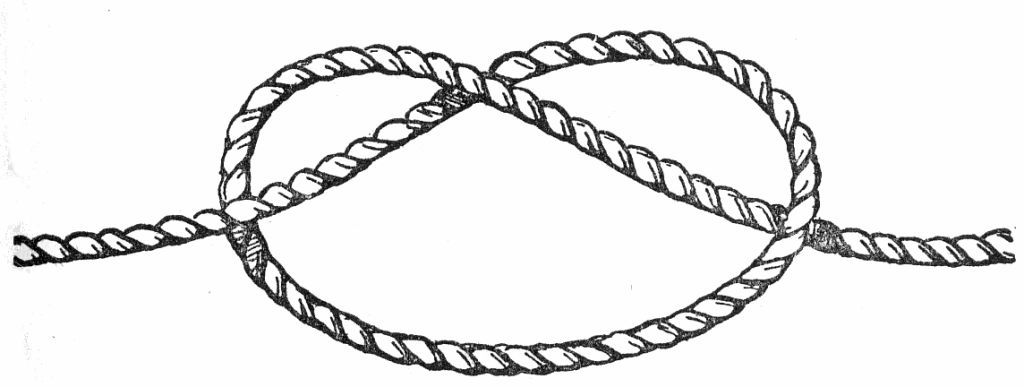
Fig. 2. Half-hitch
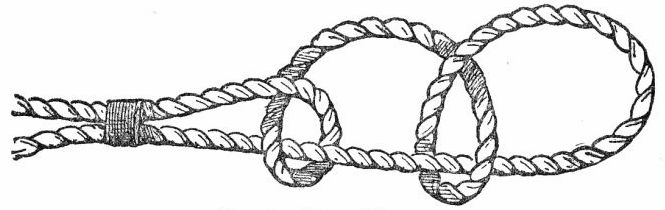
Fig. 3. Figure of Eight
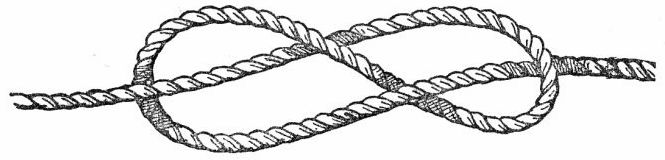
Fig. 4. Common Bend
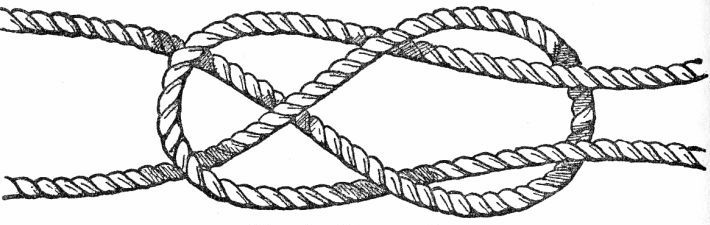
Fig. 5. Sailor's Knot
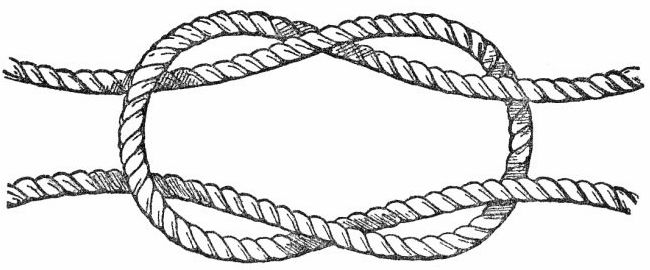
Fig. 6. Running Noose
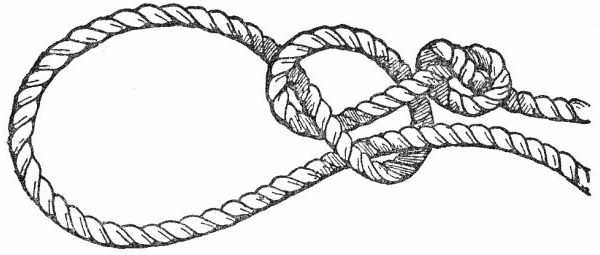
Fig. 7. Crossed Running Noose
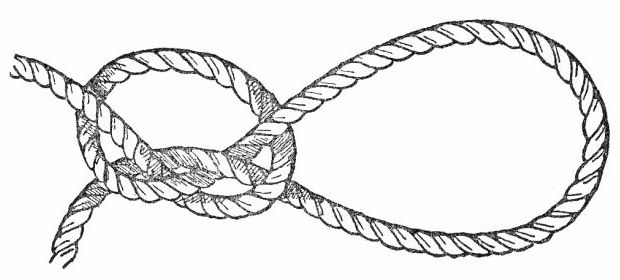
Fig. 8. Bowline Knot
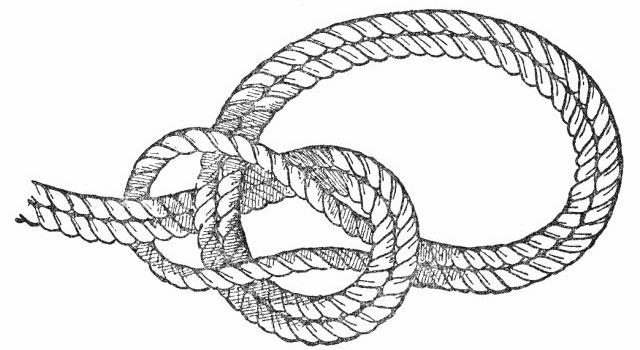
Fig. 9. Dogshank
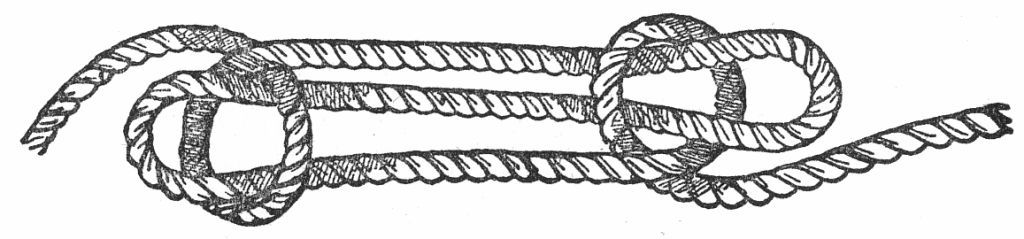
Illustrating
A competitive game which is easy to manage is hit-or-miss illustrating. Any old magazine (the more the better) will furnish the material. Figures, furniture, landscape, machines—anything and everything—is cut out from the advertisement or illustrations, and put in a box or basket in the middle of the table. Every one is given a piece of paper and a proverb is selected for illustrating. Twenty minutes is allowed to choose suitable pictures, to paste them on to sheets of paper and to add, with pencil, accessories that are necessary: and then results are compared. The variety and excellence of these patchwork pictures are surprising. This can be played during convalescence. It is not necessary to select a proverb for illustrating. Any suggestive title will do. A few that have been found fruitful of varied and spirited pictures are given here.
A trying moment. Companions in misery. This is my busy day. "I didn't know it was loaded." His proudest moment. The unhappy experimenter. The best of friends. A great scare. Fine weather for ducks. "Won't you have some?" "Don't we make a pretty picture?" Too busy to stop. No harm done. "I didn't mean to do it." Stage-struck. A great success. "See you later." A temporary quarrel. A narrow escape. A happy family. The peace-maker. A happy mother.
Shuffle-Board
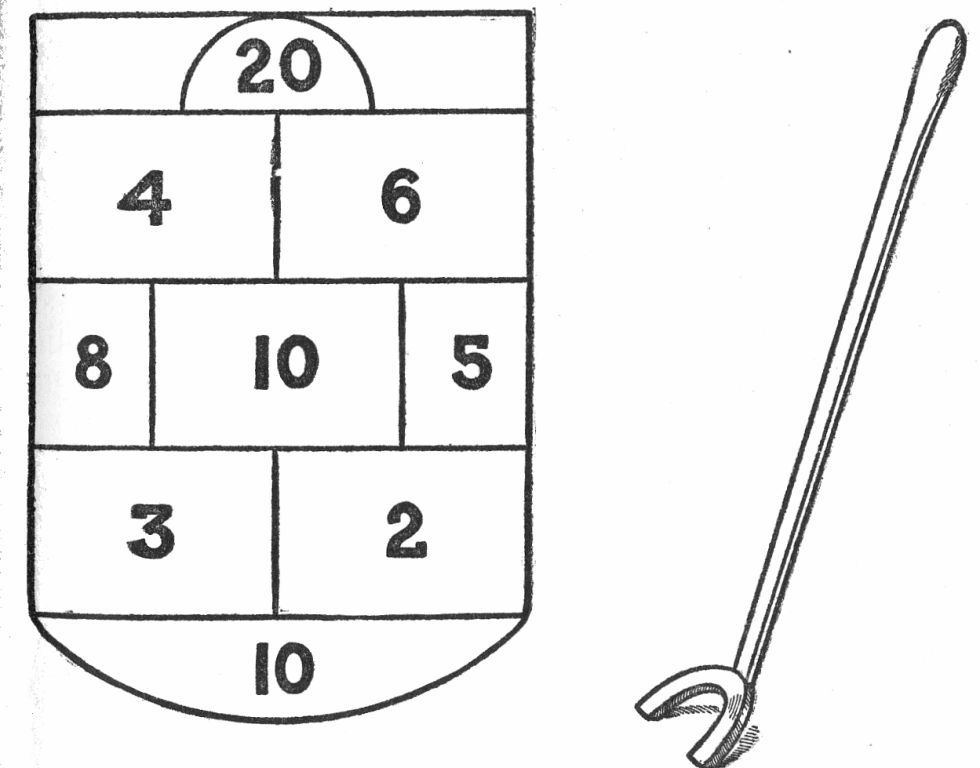
A game which is often played on shipboard can be modified for an indoor, rainy day game very easily. This is shuffle-board, all the outfit for which you can easily make yourself. If you can have a long table that scratching will not injure your board is all ready, but you can easily procure a common, smooth-finished piece of plank, two feet wide, if possible, and four feet long. On one end mark a diagram like the preceding, about ten inches by eight inches. Mark a line at the other end of the board about four inches from the edge, put your counters on the line and you are ready to play. The counters may be checkers (or any round pieces of wood) or twenty-five cent pieces, or large flat buttons, although discs of lead are the best because the heaviest. Your pusher should be a little tool made especially, like the illustration, about a foot long, and anybody with a jack-knife can whittle a satisfactory "shovel" as it is called.
But if an impromptu game is desired, your counters may be pushed off with a common ruler, with a long lead-pencil, or even snapped with the finger nail, though this is apt to hurt. Each player has six counters which he plays by three's, thus one person begins by shoving off three of his counters toward the board on the end, trying to make them fall on the places that count the highest. The next player then shoots three of his counters, trying not only to place his own men well but to dislodge his adversary's men if they are in good places. After all have played in turn, the first player shoots his other three counters and so on till all have played again. At the close of each round the board is inspected and each person is credited with the sum of the numbers on which his men rest. The game is continued thus, until some one has reached the limit set, which may be a hundred, or fifty, or any other number according to the skill of the players.
The counters of each player may be distinguished from the others by any distinctive sign marked on them. They must not be pushed along but struck a sharp blow with your shovel. The head of your shovel must not pass the line marked for the counters. Counters which rest on, or touch a line do not count. A very considerable degree of skill can be attained in this game and it is a never failing resource on dull days.
A rainy day is a good time to practice various tricks and puzzles so as to perfect yourself in performing them.
Balancing Tricks
There are a number of balancing tricks which are easy and ingenious. The secret of most such tricks is in keeping the centre of gravity low, and when this idea is once mastered you can invent tricks to suit yourself. For instance a tea-cup can be balanced on the point of a pencil thus: put a cork through the handle of the cup (it should be just large enough to be pushed in firmly) and stick a fork into it, with two prongs on each side of the handle, and with the handle under the bottom of the cup. (Fig. 1.) The centre of gravity is thus made low, and if you experiment a little and have a little skill, and a steady hand you can balance the whole on a pencil's point.
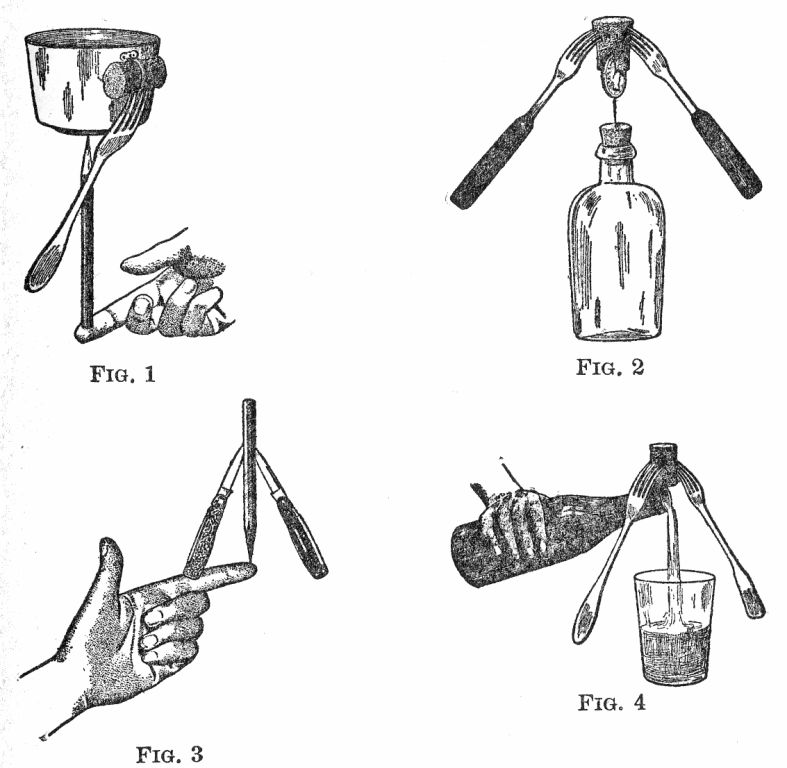
Or you can balance a coin edgeway on a needle's point. The needle is stuck firmly into the cork of a bottle, and the coin is fixed in a slit cut in a cork, in which two forks are stuck. (Fig. 2.)
The simplest of these tricks is to balance a pencil on the tip of your finger by sticking two pen-knives in it, one on each side. (Fig. 3.)
A cork with two forks stuck in it can be made to balance almost anywhere—on the neck of a bottle from which the contents are being poured for instance. (See fig. 4.)
Amusing toys can be constructed on this principle. Tumbling dolls are made of light wood or cork, glued to the flat side of a half bullet. No matter how often they are knocked flat, they rise again at once.
The Dancing Egg
Another good trick that needs a little practice is to make an egg dance. Boil an egg hard, keeping it in an upright position (between cups set in the water or in some other way). Then turn a plate bottom side up and put the egg on it. Turn the plate around, more and more quickly, always holding it flat and level, and the egg will rise on its end and stand quite straight while it spins about.
The Dancing Pea
A pea can be made to dance on a column of air as you sometimes see a rubber ball rising and falling in a fountain of water. Take a piece of a clay pipe about three inches long, and make one end into a little rounded cup, by cutting the clay carefully with a knife or file. Then run two small pins cross-wise through a big, round pea, put the end of one pin in the pipe and hold the pipe in an upright position over your mouth. Blow gently through the pipe and the pea will dance up and down.
The Glass-Maker
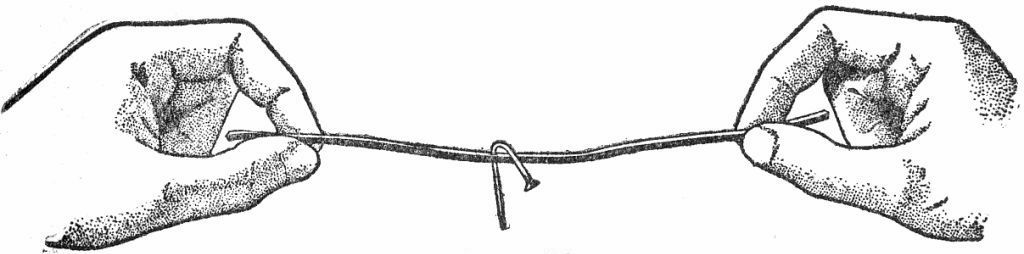
Another trick to play with pins is the glass-making pin. Cut an ordinary rubber band in two, and stick a bent pin through the middle of this. Now hold an end of the elastic in each hand and whirl it rapidly around, stretching it a little. The revolving pin will at once assume the appearance of a tiny glass vase, or tumbler, and the shape can be varied at will. It is best to have a strong ray of light on the pin and the rest of the room darkened.
The Glass-Maker
Electricity
Various tricks can be played by means of the electricity in paper. Ordinary sealing wax, rubbed briskly on a coat-sleeve until it is warm will attract bits of tissue paper, or any other soft paper. A variation on jack-straws can be played by means of this trick. Tiny scraps of tissue paper, each numbered, are piled in the centre of the table and each player by means of a piece of sealing wax tries to draw out the greatest number in the shortest time. This is a fascinating game and arranged impromptu in a very short time. The pieces of paper need not be of tissue paper, as any very thin paper will do. They should be about a quarter of an inch wide by an inch long and numbered up to twenty. They must be removed from the centre pile and put in piles before the players without touching with the fingers. It will be found that shaking them off the sealing wax is often harder than making them stick to it. Of course an effort should be made to secure those pieces of paper which have the largest numbers on them, as a few of these count more than many of the others.
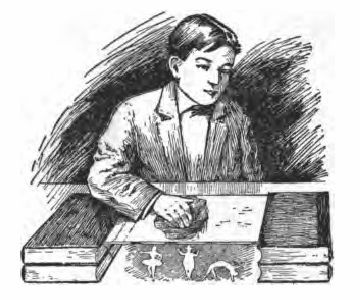
Electric dancers are easy to make. Cut little figures out of tissue paper and lay them on the table. Put on each side of them two books and lay a sheet of glass over them about an inch and a half above them. Rub the glass briskly with a flannel cloth and they will jump up and down.
Electric Dancers
A rubber comb rubbed with a silk handkerchief will attract small bits of paper, feathers or wool. Various games and tricks can be devised by this means, such as "bringing the dead to life," i. e., raising paper figures to an upright position from a grave made of books, or a box.