DOLLS' HOUSES
Reading edition
The most magnificent ready-made dolls' house in the world, with gables and windows, stairs, front garden, and the best furniture, cannot quite make up to its owner for all the delight she has missed by not making it herself. Of course some things, such as cups and saucers, glasses and bottles, saucepans and kitchen utensils, must be bought; but almost all the really necessary things for house-keeping can be made at home.
Dolls' Gardens
One advantage of making the dolls' house yourself is that you can arrange for it to have a garden, a provision rarely made by toy-shops. Grass plots can be made of green baize or other cloth of the right color; garden paths of sand sprinkled over glue, or of strips of sand-paper; flower-beds of brown paper, and the flowers of tissue-paper and wire. A summer-house, and a dog-kennel to hold a china dog, might also be added (see p. 241), and, if you have room, stables.
Garden Chairs and Tables
Garden seats and tables can be made of cardboard and cork. For a seat, take a card two or three inches long and not quite as broad. Mark it right across, lengthwise, in the middle with a sharp knife, and then half fold it. This will make the back and seat. Glue the seat to four slender corks for legs and paint the whole green. To make a table, glue four cork legs to a strong piece of cardboard.
The House
A dolls' house can be made of almost any kind of box. For the simplest and smallest kind cigar boxes can be used and the furniture made of cork, for which directions are given later; or a couple of low shelves in a bookcase or cupboard will do. Much better, however, is a large well-made packing-case divided by wooden and strong cardboard partitions into two, four, or six rooms, according to its size. A specially made box is, of course, best of all; this should be divided into four or six rooms, and should have a sloping roof to give attic room for boxes and odd furniture. The house can be stained outside or papered a plain dark color. One or two windows should be cut out of the walls of each room by the carpenter who made the box, and there must be doors between the rooms. A piece of thin glass cut to the right size can be fixed on the windows at home. But before this is done the house must be papered. The best kind of paper is that used by bookbinders for the insides of the covers, because the patterns used are so dainty and small; but this is not always easy to get. Any small-patterned paper will do, or what is called lining paper, which can be got in every color. The paper must be very smoothly put on with paste. Always start at the top when pressing it to the wall, and smooth it downward gently. Dadoes or friezes can be divided off with the tiny beading which frame-makers use, or with a painted line, which must be straight and evenly done.
Fireplaces
Fireplaces, which can be bought or made at home, should be put in next. To make one yourself, take a strong cardboard-box lid about four inches long and two wide (though the size must depend on the size of the room). Very neatly cut off a quarter of it. This smaller part, covered with gold or silver paper, will make the fender. Then cut off both sides of the remaining piece, leaving the strip at the top to form the mantelpiece. Glue the back of the cover to the wall, hang little curtains from the shelf, put some ornaments on it, arrange the fender in front, and the fireplace is complete. A grate can be imitated in cardboard painted black and red.
A Furnishing Game
A splendid game of shop can be played while the furnishing is going on: in fact, from the moment you have the bare house a board or sign with "To Let or For Sale" will quickly attract house-hunting dolls, and when a couple have taken it they will have their days full of shopping before it is ready for them. You will, of course, yourself be the manufacturers and shopkeepers. It is well to make out careful bills for everything sold, and the more things you can display in your show-rooms the better. All house-hunting dolls require plenty of money.
Curtains
Windows have been mentioned, but they are not by any means a necessity. Yet even if you cannot have windows, you should put up curtains, for they make the rooms prettier. Shades can be made of linen, edged at the bottom with a piece of lace, and nailed on the wall just above the window. During the day these are rolled up and tied. White curtains should be bordered with lace and run on a piece of tape, which can be nailed or pinned on both sides of the window. They will then draw. The heavy inside curtains can be hung on a pencil (which may be gilded or left its own color) supported by two picture screws. Fasten these curtains back with narrow ribbons. Some dolls' houses, of course, are fitted with real doors. But if you do not have these, it is perhaps well to hang the doorway with curtains, also on pencils.
Floors
The floors can be stained or painted either all over or round the edges. Carpets are better not made of ordinary carpet, for it is much too thick, but of colored canvas, or chintz, or thin felt, or serge. A rug made of a plain colored material with a cross-stitch or embroidered pattern around it is very pretty. Fine matting can also be used, and oil-cloth is excellent for the kitchen.
General Remarks on Furnishing
In another place in this book (pp. 228-233) will be found instructions for making furniture for very small and simple dolls' houses; but for a good dolls' house with several good-sized rooms you would probably prefer, for the most part, to use bought things. Square tables are of course easy to make (a cardboard-box lid on four legs is practically the whole thing), and there are other articles which, if you see your way to devise, are better made at home, instructions for which will be found as you read on; but chairs and round tables and so forth are perhaps most satisfactory when they come from the toy-shop. Both in buying furniture and in making it, it is necessary always to remember the size of the rooms and of the dolls, and the size of whatever furniture you may already have, so as to keep everything in proportion.
Beds
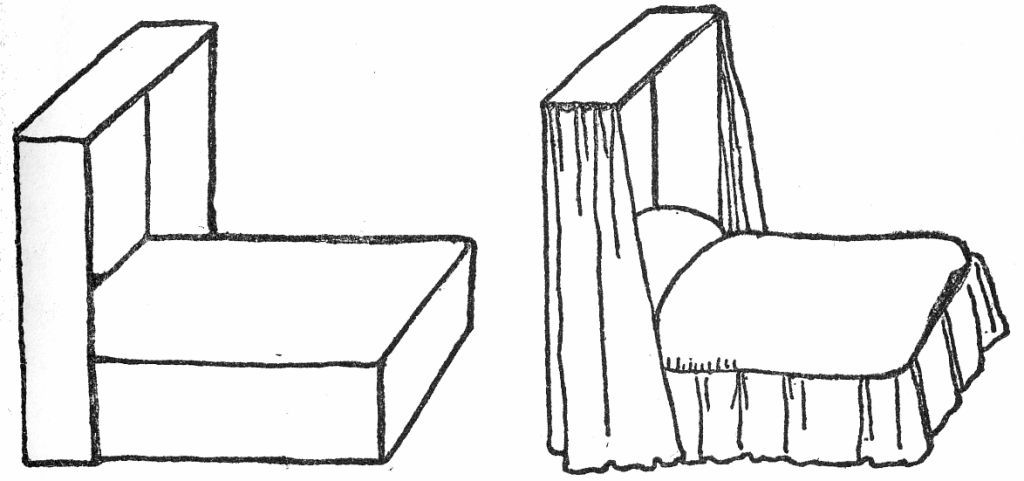
Beds can be made of cardboard-boxes of different sizes. The box turned upside down makes the bed itself, and the cover should be fixed upright behind it for curtains to hang from. These curtains and the frill round the bed should be made of any thin material, such as muslin. The mattress, bolster, and pillows are best made of cotton-wool covered with muslin or calico. Sheets may be made also out of muslin; pillow-cases should be edged with lace; for blankets you use flannel, button-hole-stitched round with colored silk or wool, and the quilt will look best if made of a dainty piece of silk, or muslin over a colored sateen to match the curtains. A tiny nightdress case should not be forgotten. Beds for doll children can be made in the same way out of match-boxes; and for cozy little cots for babies there are walnut shells.
Cardboard Box Beds
Bead Furniture
Bead Chair
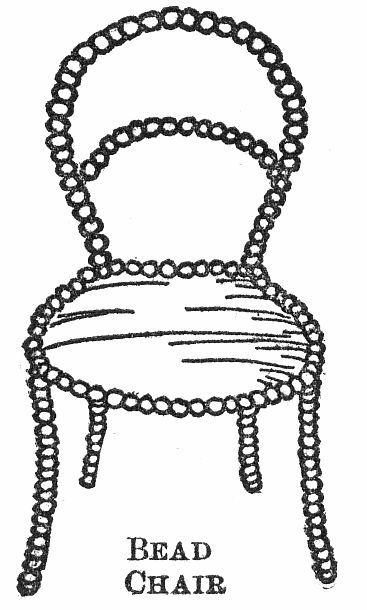
Chairs can be made with wire, beads, a little silk or cotton material, some cardboard and cotton-wool. To make a chair in this way, cut a piece of cardboard the size that you want the seat to be. Lay a good wad of cotton-wool over it, and then cover it neatly. On a piece of strong wire thread enough beads to go round the seat of the chair. Sew this firmly to the seat. Then thread beads on four pieces of wire the right length for the legs, and leave a little piece of wire with which to fasten them to the wire round the seat. Then make the back from a longer piece of wire, bent into shape and attached to the seat in the same way, and put a short row of beads across the middle. You will need a pair of tweezers to cut the wire and to finish the fastening securely.
Pictures
Pictures for the walls can be made very easily. The picture itself will be a scrap or tiny photograph. This is pasted on a piece of cardboard larger than itself, and round the edge of that you place a strip of whatever colored paper you want for the frame. The picture cord, a piece of cotton, can be glued on the back. More elaborate frames are cut out of cardboard and bound round with colored silk and covered with gold paint. The picture is then stuck into it.
Bookshelves and Books
The simplest bookshelves are those that hang from a nail on the wall. They are made by cutting two or three strips of cardboard of the size of the shelves and boring holes at the corners of each. These are then threaded one by one on four lengths of silk or fine string, knots being tied to keep the shelves the right distance apart. Care has to be taken to get the knots exactly even, or the shelf will be crooked.
Books can be made by sewing together a number of tiny sheets of paper, with a colored cover and a real or invented title. Sometimes these books contain real stories.
Other Articles
A dolls' house ought to be as complete as possible, and though this will take a long time it is absorbingly interesting work from start to finish. It should be the ambition of the mistress of a dolls' house to have it as well furnished as the house of a grown-up person, and if she looks round the rooms in her own home carefully she will see how many things can be copied. There will be cushions to make, fancy table-cloths for different tables, toilet-covers and towels for the bedroom, splashers to go behind wash-stands, mats in front of them, and roll-towels and kitchen cloths for the kitchen.
Everything should be made of the thinnest and finest material, cut with the greatest care and sewn with the tiniest stitches. Light and dainty colors are best for a dolls' house. If you have several rooms, it is a good plan to have a pink room, a blue room, a yellow room, and in each room to have everything of different shades of that color and white. Perhaps no material is so useful to the owner of a dolls' house as art muslin. It is soft, cheap, and very pretty.
Coming to other furniture which can be made at home, we find screens (made of cardboard and scraps), music for the piano, walking-sticks, flowers (made of colored tissue-paper and wire), flower-pots (made of corks covered with red paper), cupboards to keep linen and glass in (made out of small cardboard boxes, fitted with shelves), and many other little things which, if you look round your own home carefully, will be suggested to you. Even bicycles can be imitated in cardboard and placed in the hall.
The Inhabitants
As to dolls, the more the merrier. They are so cheap and can be dressed so easily that it seems a great pity not to have a large family and a larger circle of friends who will occasionally visit them. There must be a father and a mother, a baby and some children, servants (in stiff print dresses with caps and aprons), and certainly a bride, who, if her dress can not be changed for an ordinary one, ought to be kept carefully hidden, except when there is a wedding.
Dressing Dolls
It is rather difficult to dress these tiny dolls so that their clothes will take off and on, but it is much better to do so if possible. In any case they can have capes and hats which take off. The thinnest materials make the best underclothes, but stiff material for dresses makes it possible to stand the dolls up. Glove buttons, and the narrowest ribbons, tapes, and laces, are useful things to have when you are dressing dolls'-house dolls.
Dolls' Dinner Parties
Dolls occasionally require parties. The food may be real or imitation. If real,—such as currants and raisins, sugar and candied peel,—it is more amusing at the moment; but if imitation, you have a longer time of interest in making it. Get a little flour, and mix it with salt and water into a stiff paste, like clay. Then mould it to resemble a round of beef, a chicken, a leg of mutton, potatoes, pies, or whatever you want, and stand it in front of the fire to dry. When dry, paint (in water-color) to resemble these things still more. If there is clay in the garden, you can make all these things from that, and many others too.
Dolls' Flats
Just as people live not only in houses but in flats, so may there be dolls' flats as well as dolls' houses. A dolls' flat consists of a board on which the outline of the rooms is made with single bricks. For example, a four-roomed flat might be arranged like this—
A Doll's Apartments
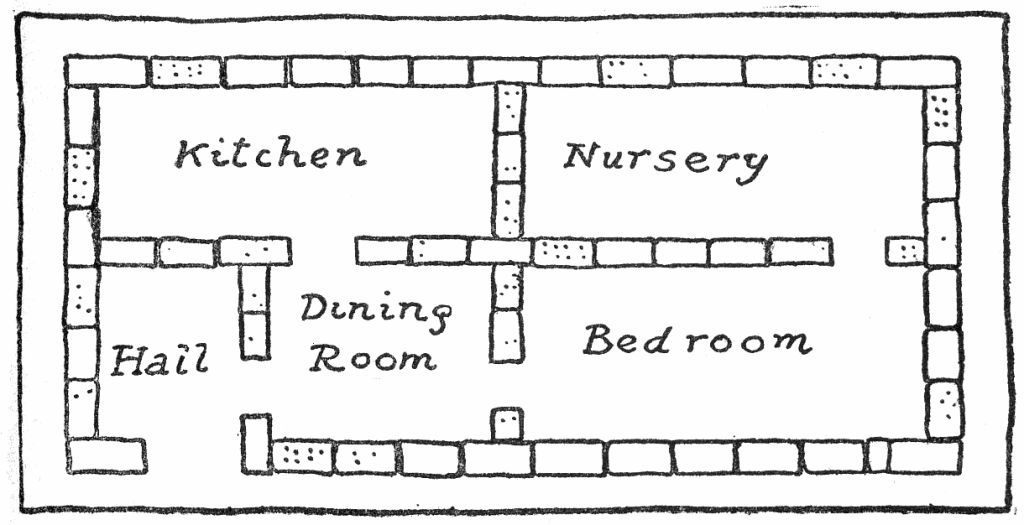
To lay the bricks on a board is not necessary. They can be laid on the floor equally well, except that when you have done playing you will have then to put them away again, whereas if placed on a board they can be left till next time. Nor is there any reason why the walls should not be higher than a single brick; that is merely a matter of taste. Once the walls are ready the furniture and dolls can be put in in the ordinary way.
Smaller Dolls' Houses
So far we have been considering larger dolls' houses. But there are also smaller ones, which naturally require much smaller furniture. These dolls' houses can be made of cardboard (as described on p. 237 and on), or they can be merely small boxes—even cigar boxes; and the dolls and furniture in them can be, if you like, all paper, or made of materials in ways that are now suggested.
Cork and Match-box Furniture
This furniture, if very neatly made, can be very successful, and it costs almost nothing. Plain pins will do quite well, although the fancy ones are much prettier. Velvet or thin cloth is best for the dining-room furniture; silk for the drawing room; and some light-colored cotton material for the bedrooms.
Materials
You will need—
Several good-sized corks, or pickle corks, for the larger things. Some pieces of fancy silk or velvet. A number of strong pins of different sizes. (The fancy pins with large white, black, and colored heads are best.) Some wool, silk, or tinsel which will go well with the silk or velvet. A strong needle and a spool of cotton.
Chairs
Cork Arm-Chair
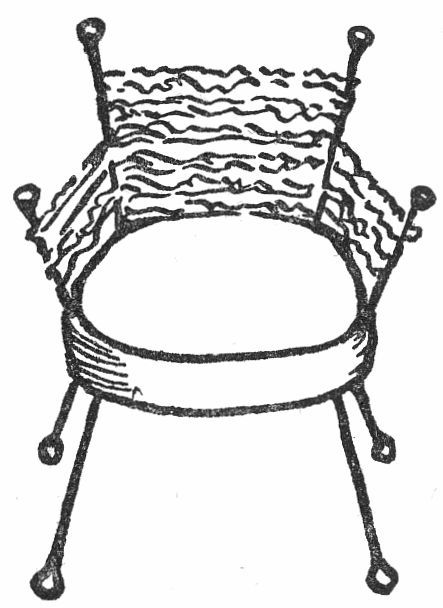
Cut a round or square piece of cork about quarter of an inch thick and one inch across. Cover it with a piece of silk or velvet, making all the stitches on that side of the cork which will be the under side of the seat. For the legs put a pin firmly into each corner. Wind a little wool or silk firmly round each leg, finishing it off as neatly as possible. The back of the seat is made by sticking four pins rather closely together and winding the wool or silk in and out of them. Fasten the wool with a tiny knot both when you begin winding and when you finish. Armchairs are made in the same way, except that they are rather larger, and arms—made of small pins—are added.
Chestnut Chairs
Chestnut Chair
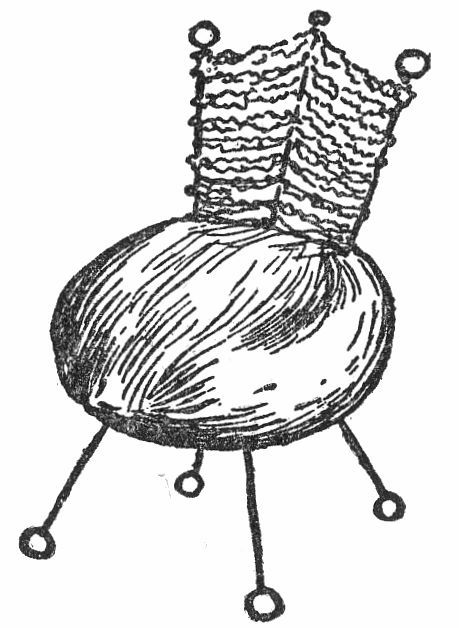
Very good dining-room chairs can be made of chestnuts. The flatter side of the nut is the seat, and in this are stuck pins for the back (and arms if necessary), which may be bound together with gold or silver tinsel. Other pins are stuck in underneath for legs.
Sofas
For a sofa a piece of cork about two inches long and half an inch thick is needed. This must be covered, and then quite short pins stuck in for legs. Put a row of short pins along one side and the two ends, and wind the wool neatly in and out of them.
Tables
Fancy Table
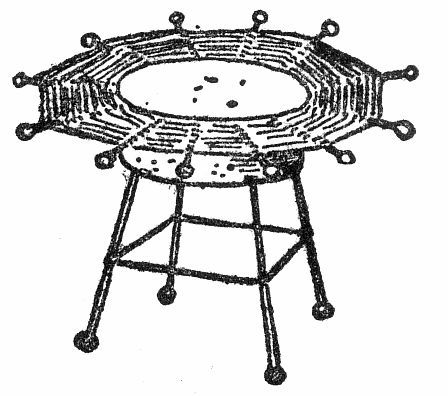
Round tables can be made best of different-sized pieces of cork, with very strong pins for legs; and square ones of the outside of a wooden match-box, with four little medicine-bottle corks glued under it for legs. In either case it is most important to have the legs well fixed on and of exactly the same length. It is not necessary to cover a table, but a table-cloth of silk, either fringed, or hemmed with tiny stitches, and a white table-cloth for meals, should be made.
Fancy tables can be made by taking a flat round cork and sticking pins into it at regular intervals all round. Weave silk or tinsel in and out of the pins until they are covered. (See above.)
Foot-Stools
Several small pieces of cork may be covered to make foot-stools.
Standard Lamp
A serviceable standard lamp can be made by taking a small empty cotton spool, gilding or painting it, and fixing the wooden part of a thin penholder firmly into it. On the top of it glue a round piece of cork, on which a lamp-shade, made of one of the little red paper caps that chemists put on bottles, can be placed.
Bedroom Furniture—Materials
You will need—
Two large wooden match-boxes. Several corks of different sizes. Some pieces of chintz, of cotton material, flannel, linen, oil-cloth, and a little cotton-wool. An empty walnut shell. Several wooden matches with the heads taken off. Pins of different sizes. Wool, silk or tinsel, for the backs of the chairs. A tube of glue.
Beds
Match-Box Bedstead
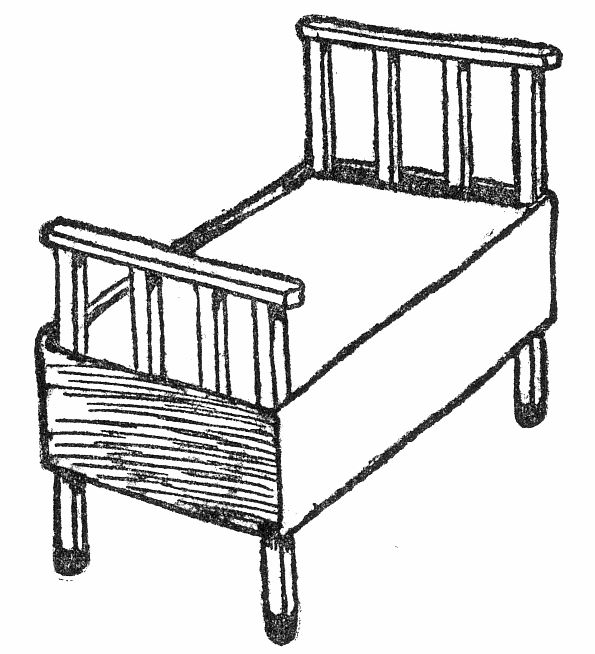
To make a bed, take the inside of a match-box and cut away the bottom of it. Then take two matches and glue them to the two corners at the head of the bed so that a portion sticks out below the bed for legs and above the bed for a railing. Cut two more matches to the same length as these others, less the part of them that serves for legs, and fasten these at equal distances from each other and from the two others already glued in position. Along the top of these place another match for a rail, and the head of the bed is done. For the foot of the bed repeat these operations exactly, except that all the upright matches must be a little shorter. Then cut off one end of the bottom of the box and fit it in to form the part of the bed that takes the mattress. The bedstead, when made, should be like the one in the accompanying picture. A little mattress must now be made to fit the bed exactly; it can be stuffed with cotton-wool or bran. A pillow, blankets, sheets, and a fancy coverlet may also be made, and a very thin and tiny frill should be put right round the bed to hide the box.
A very pretty baby's cradle can be made out of half a walnut shell. It should be lined, and curtains should be hung from a match fastened upright at one end of the shell.
Dressing-Tables
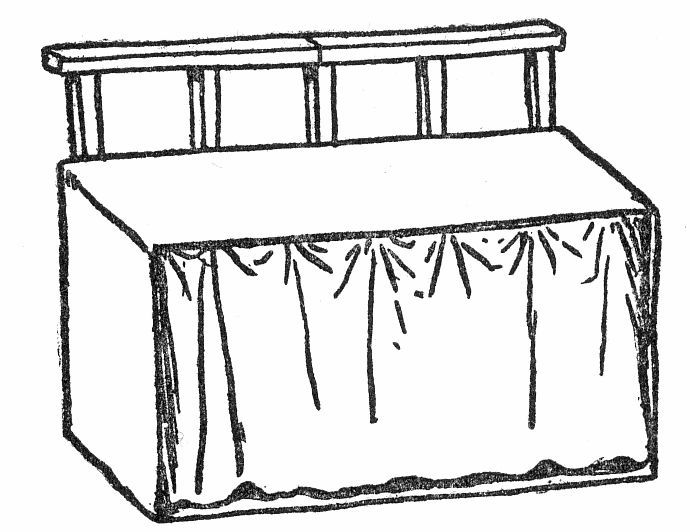
The outside of the same match-box that was used for the bed will make a dressing-table. Stand it up on either side of its striking sides, and glue or sew a piece of light-colored thin material all round it, and then over this put a muslin frill. Make a little white cloth to lay on the top of the table. The looking-glass is made by fixing a square of silver paper in a cardboard frame.
Washstands
Take the inside of another match-box and stand it up on one of its sides. Then take five or six matches and cut them to that length which, when they are glued in an upright row at equal distances apart to the back of the match-box, will cause them to stand up above the top of it about a third of an inch. On the tops of them then lay another match to make a little railing. Cover the box as you did the dressing-table. Put a little mat of oil-cloth on the top of the box, and make another large one to lay in front of it. Proper jugs and basins will, of course, have to be bought, but an acorn cup or small shell makes a very good toy basin.
Match-Box Washstand
Wardrobes
The wardrobe is made by standing the inside of a match-box on end, fixing inside several little pegs made of small pieces of match stuck in with glue, and hanging two little curtains in front of it. If, when done, it seems too low, it may be raised on four little corks.
Towel-Rack
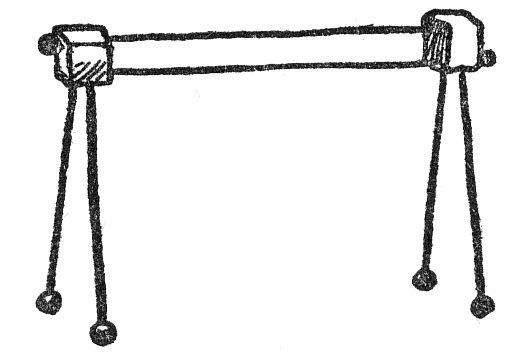
A towel-horse can easily be made with six long pins and two small pieces of cork.
Towel Rack
Clothes-Basket
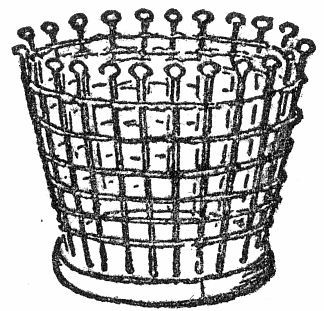
To make a clothes-basket, take a round piece of cork about a quarter of an inch thick and stick pins closely together all round it, as in the above picture. Then weave wool in and out of them.
Clothes Basket