PICNIC GAMES
Reading edition
A picnic may be either a complicated affair which has occupied you all the day before, or the most impromptu expedition which you arrange on the spur of the minute; and the last kind are often more fun. Any place out of doors will answer for a picnic, but if possible it should be near water. Anything will answer for a picnic lunch, but it is pleasant, if older people are with you, if you are allowed to have fires to do some outdoor cooking. This is always easier than it sounds and adds infinitely to the fun of the lunch. Bacon is one of the easiest things to cook outdoors, all that is needed being a forked stick which you can cut for yourselves. The strip of bacon is impaled on the forks and toasted over the fire, each person cooking his own slice and eating it on bread. Or with two larger forked sticks a steak can be deliciously broiled for the whole company, or chops can be cooked. It is the easiest and most delightful task to arrange a sort of cooking-hole of stones over which the coffee pot may be set and potatoes may be boiled over another similar hole. You will find that it is far better to have a number of very tiny little fires entirely separated from each other, than one big bonfire which is almost sure to grow unmanageable. It will be seen that it is far easier to take a big piece of bacon (to be sliced after reaching the picnic grounds) a loaf or two of bread and raw potatoes than to spend hours in making sandwiches and packing cake. Beside the things cooked out of doors always taste so much better. Great care should be taken to put out every spark of fire before going home, and to leave no scraps of paper, or egg-shells lying about. These should be burned or buried.
It, Touch Last, or Tag
For a short time "It" is a good warming game. It is the simplest of all games. The "It" runs after the others until he touches one. The one touched then becomes "It."
Touchwood
The name explains the game, which is played as "It" is played, except that you can be caught only when you are not touching wood. It is a good game where there are trees. It is, of course, not fair to carry a piece of wood.
Cross Tag
This is the ordinary "Tag," save that if, while the "It" is chasing one player, another runs across the trail between him and the pursued, the "It" has to abandon the player he was at first after and give chase to the one who has crossed.
A good variety of tag is "French Tag." The first one caught must join hands with the "It," the next one with him, etc., and so on in a long line all running together. Any one can catch an opponent, but the original "It" must touch him before he can take his place in the line.
The Little Dog
The players form a ring, leaving one outside, who passes round it singing, "I have a little dog and he won't bite you," and as he does so, touching each player in turn with a knotted pocket-handkerchief. "And he won't bite you," "And he won't bite you," he calls to one after the other, and then suddenly changes this to "But he will bite you." The player touched when this is said has to run after the toucher with all his might. When caught they change places.
Hunt the Squirrel
All the players except one join a ring. This one, with a knotted handkerchief in his hand, walks round the outside of the ring for a while, and then, dropping the handkerchief behind one of the players, runs off crying—
Hunt the squirrel through the wood. Now I've lost him—now I've found him! Hunt the squirrel through the wood.
The player behind whom the handkerchief was dropped must catch the squirrel before he can take up the empty place in the ring left by the pursuer. It is more fun if, in dropping the handkerchief, it can be done without the player discovering it for a little while.
The way in which old-fashioned country children play this game (called usually "Drop the handkerchief"), is a little different. As the one with the handkerchief walks around and around the outside of the ring all join in singing,
"A tisket! A tasket! A green and yellow basket! I sent a letter to my love And now I find I've lost it. I've lost it! I've lost it! And where do you think I found it? Up in the sky, ever so high With angels gathered 'round it."
As the words "I've lost it!" are repeated, the player outside must drop the handkerchief, but no one must look behind him until the verse is ended. Then the one who finds the handkerchief behind him must try to catch the first one, who in turn tries to slip into the empty place.
Gaps
The players form a ring: all except one, who is "It." This one runs round the ring and touches one of the players in the circle. They both set off running immediately in opposite directions, the object of each being to get first to the gap made in the circle by the player who was touched. The one who gets to the gap first remains in the circle, while the other becomes "It."
Twos and Threes, or Terza
A very good picnic game. All the players except two form a large ring, standing in twos, one behind another. Of the two who are over, one is the pursuer and the other the pursued; and the game is begun by the pursued taking up his position (if he can do so before the pursuer catches him) in front of one of the couples in the ring, thus making three. Directly he does this he is safe, and the last player in the little group at the back of him has to run. Whoever is caught becomes the pursuer, while the one that caught him becomes the pursued until, by standing in front of one of the couples, he transfers that office to another.
Hide and Seek
"Hide and Seek," which is perhaps the best out-of-door game without implements, needs no explanation. It is usual to give the player who hides a start of as much time as it takes the others to count a hundred in. Some boys, instead of counting from one to a hundred, divide the sum into ten tens, which are counted thus: 1, 2, 3, 1, 2, 3, 1, 2, 3, 1; 1, 2, 3, 1, 2, 3, 1, 2, 3, 1; and so on. These can be rattled through so quickly that your 100 is done and you have started out before, in the ordinary way, seventy would have been reached.
A customary arrangement to avoid taking the hiders too much by surprise is for the boy who stays at the base and counts a hundred to call out when he finishes
"Bushel of wheat! Bushel of rye! All that aren't ready call out 'I'!"
or simply
"One! Two! Three! Look out for me!"
I Spy
"I Spy" combines "Hide and Seek" and "Tag." One player stays in the base, covers his eyes and counts a hundred, while the others run off and hide. On finishing the hundred the player shouts "Coming!" and runs out to look for the others. Directly he catches sight of one of them (and they are not hidden so carefully as in "Hide and Seek"), he calls out his name and the place where he has seen him; as, for instance, "Harry! behind the summer-house!" If there is no mistake and the name is right (it is very often wrong, in which case the player does not move), Harry has to run out and try and catch the other before he reaches the base.
Another way is for as many players to seek as to hide. In this case it is agreed beforehand as to how many of the seekers must be caught by the hiders for the game to be won. If the number is given at four and four are caught, the same side have the privilege of hiding again; but if only three or a smaller number, then the seekers have won and it is they who hide next time.
Chevy, or Prisoner's Base
There is no better running game than this. You first pick sides and then mark off the two camps and take up your station there. The field is arranged thus:—
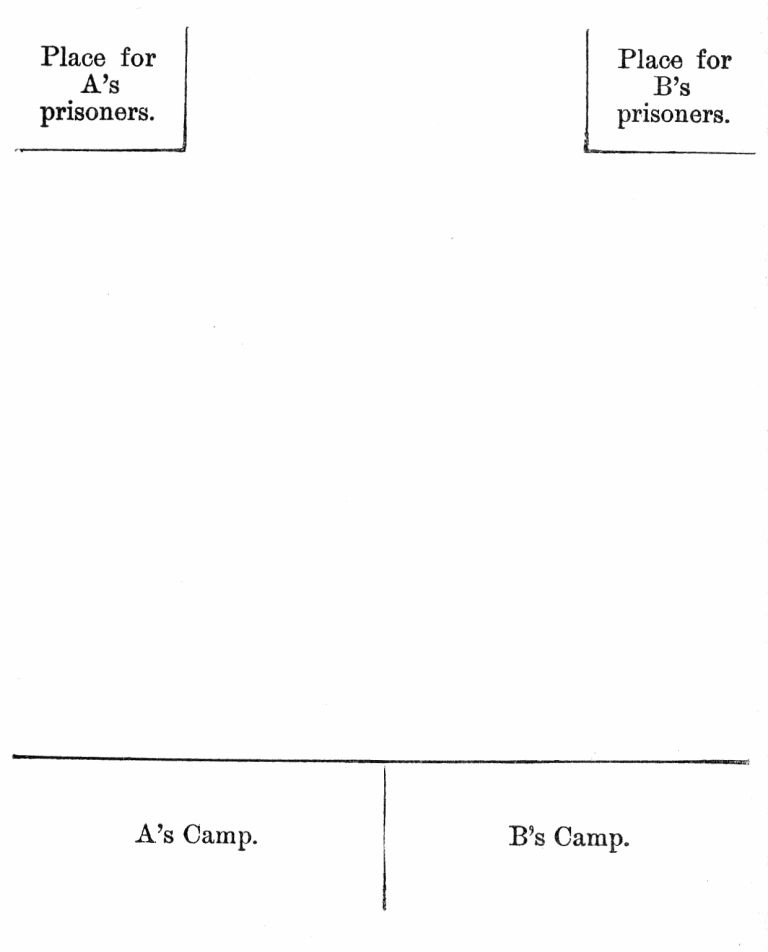
The game is opened by several of the A side running out to some point immediately in front of the two camps. When ready they call "Chevy." As many of the B side then start out to pursue them, each calling his particular quarry by name. The object of each A man is either to get back before the B man who is after him can catch him, or to tempt the B man into ground so near the A camp that he may be caught. In this aim he is helped by the fact that directly his B pursuer called his name and started out another A man probably called out the name of the B man and started to cut him off. No one is allowed to be pursued by two players at once.
If caught, the A man has to go to the place reserved for B's prisoners. Directly he gets there he calls "Rescue"; an A man will then call "Prisoner," and rush out to relieve him; while a B runner is all ready to intercept this A rescuer if he can.
The game is good both for runners who can keep it up a long time and for those who can make short, sharp dashes. The first named decoy the enemy out in pursuit, and the others hold themselves ready to dash across in front of the enemy's camp and cut off any one who is across the line. The rule as to shouting the name of the man you have marked down should be kept.
If there is more than one prisoner they stand just touching hands, in a line which reaches as far as possible toward their own camp, so that the distance between the first prisoner and the rescuer may be shortened. Each new prisoner takes up his place at the back of this line, farthest from the camp. A prisoner is rescued by being touched.
If one side is much weaker than the other a time comes when it is nearly all taken prisoner, with none to rescue except by leaving the camp undefended. Directly a camp is left undefended one of the enemy steps in and "crowns" it and claims the game. More often than not, however, a game of "Chevy" is left undecided. It does not matter in the least, for in this game the fun is more in playing than in winning.
French and English
For this game the ground must be divided by a path or line into two territories—French and English. At the further side of each territory a number of flags—handkerchiefs will do—must be placed at intervals. The players are then divided into the two nations, and the game consists in each side trying to get the flags from the other side, to guard its own, and to catch the enemy when he is off his own ground. Once a player sets foot upon the enemy's territory he must go on, but he cannot be caught if he has a flag in his hands. If he is caught he becomes a prisoner (as in Chevy), and is only released by being touched by one of his own party. A player cannot redeem a prisoner and take a flag at the same time. The game ends when all the flags of one side have been taken.
Black Man
This is rather rough. A line is drawn at each end of the playing place and one player is told off to stand between these lines. The object of the others is to run across, from base to base, without being caught by him: being caught meaning not merely being touched, as in "It," but being really held and stopped. Each one that is caught has to stay in the middle to help catch the others, until no one is left to run across at all.
The player in the middle calls out to the crowd of players, "What'll you do when the black man comes?" and they answer,
"Run right through And never mind you."
This is the signal to begin each rush across from one line to the other.
Stagarino
"Stagarino" is similar to "Black Man," except that all the players who are caught, and whose business it is to catch the others, join hands. Those that run across have therefore to avoid them or to try and break through the wall of arms.
Red Rover
"Red Rover" is also similar to "Black Man," except that instead of all running at the same time, the "Rover" calls out:—
"Red Rover! Red Rover! Let (mentioning name) come over!"
at which the one named has to run from one base to the other. If he is caught, he must assist the "Rover" in catching the others.
Hop, Step, and Jump
This is a change from ordinary racing. The competitors, instead of running against each other, see which can cover the most distance in a hop, a step, and a jump, or, say, three hops, three steps, and three jumps. It needs an umpire to watch very carefully that the step begins exactly where the hop left off and the jump where the step finished.
Follow-My-Leader
This needs no explaining. It is nearly always good fun for a while, and particularly so if the leader has original ideas.