DRAWING GAMES
Reading edition
Many persons, when a drawing game is suggested, ask to be excused on the ground of an inability to draw. But in none of the games that are described in this chapter is any real drawing power necessary. The object of each game being not to produce good drawings but to produce good fun, a bad drawing is much more likely to lead to laughter than a good one.
Five Dots
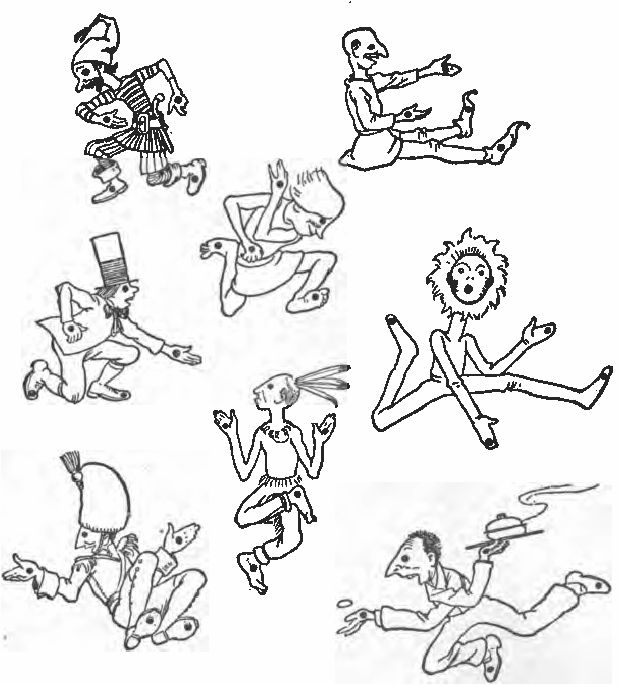
All children who like drawing like this game; but it is particularly good to play with a real artist, if you have one among your friends. You take a piece of paper and make five dots on it, wherever you like—scattered about far apart, close together (but not too close), or even in a straight line. The other player's task is to fit in a drawing of a person with one of these dots at his head, two at his hands, and two at his feet, as in the examples on page 48.
Outlines or Wiggles
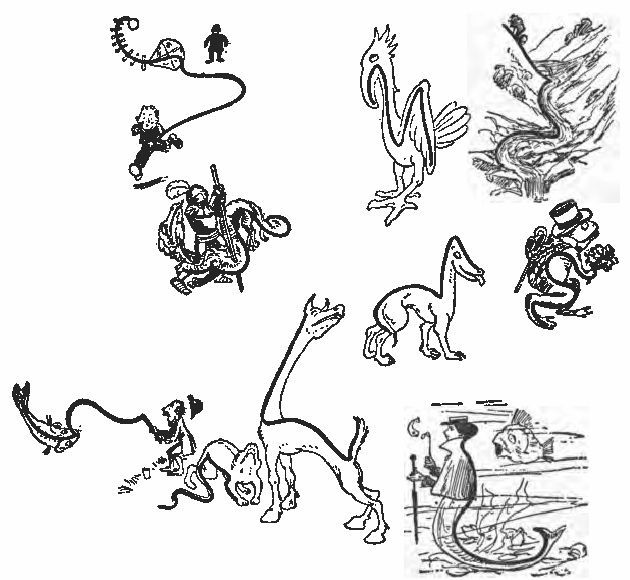
Another form of "Five Dots" is "Outlines." Instead of dots a line, straight, zigzag, or curved, is made at random on the paper. Papers are then exchanged and this line must be fitted naturally into a picture, as in the examples on page 49.
A good way to play Wiggles when there are a number of people to play, is to mark the same line for all the players, either by pressing down very hard with a hard pencil so that the line can be traced from one piece of paper to another, or with carbon copy paper between the sheets. Thus each person has the same line, and the one who uses his in the most fantastic and unexpected way is the winner. The only rule about making the line is that a circle shall not be made. The two ends must be left ready to add the rest of the design. It is well sometimes to limit the pictures to human faces, as this makes the grotesque unlikeness of the drawings all the more absurd.
Five Dots
Outlines
Eyes-Shut Drawings
The usual thing to draw with shut eyes is a pig, but any animal will do as well (or almost as well, for perhaps the pig's curly tail just puts him in the first place). Why it should be so funny a game it is difficult quite to explain, but people laugh more loudly over it than over anything else. There is one lady at least who keeps a visitor's book in which every one that stays at her house has to draw an eyes-shut pig. The drawings are signed, and the date is added. Such a guest book is now manufactured, bound in pig skin, or in cloth.
"Ghosts of My Friends"
While on the subject of novel albums the "Ghost of My Friends" might be mentioned. The "ghost" is the effect produced by writing one's signature with plenty of ink, and while the ink is still very wet, folding the paper down the middle of the name, lengthwise, and pressing the two sides firmly together. The result is a curious symmetrically-shaped figure. Some people prefer "ghosts" to ordinary signatures in a visitors' book.
The "Book of Butterflies" is on the same order. With the book come four tubes of paint. The paint is squeezed on the page, which is doubled and flattened. The effects are very beautiful, and surprisingly lifelike.
Another guest book is the "Hand-o-graph," in which the outline of the hand of each guest is kept. The "Thumb-o-graph" is on the same principle, except that in this case the imprint of the guest's thumb is preserved, made from an ink pad supplied with the book.
A remarkable collection can be made of ink-blot pictures. A drop of ink, either round as it naturally falls, or slightly lengthened with a pen, is dropped on paper which is then folded smartly together and rubbed flat. The most surprising designs are the result, some of which, aided a little by the pen, look like landscapes, figures and complicated geometric designs.
Drawing Tricks
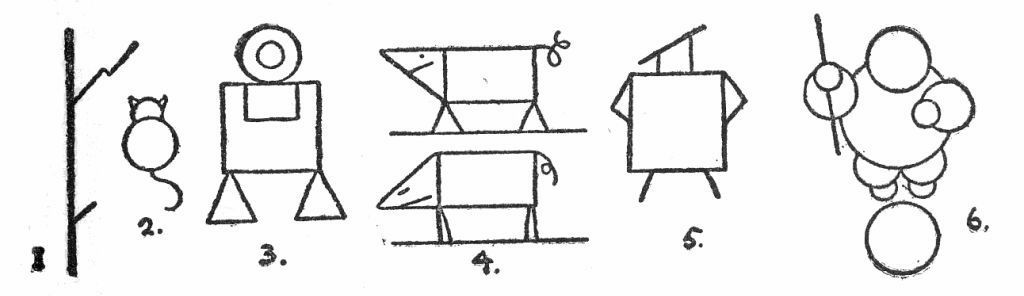
Six drawing tricks are illustrated on this page. One (1) is the picture of a soldier and a dog leaving a room, drawn with three strokes of the pencil. Another (3) is a sailor, drawn with two squares, two circles, and two triangles. Another (5), Henry VIII, drawn with a square and nine straight lines. Another (6), invented for this book, an Esquimaux waiting to harpoon a seal, drawn with eleven circles and a straight line. The remaining figures are a cheerful pig and a despondent pig (4), and a cat (2), drawn with the utmost possible simplicity.
Drawing Tricks
Composite Animals
In this game the first player writes the name of an animal at the top of the paper and folds it over. The next writes another, and so on until you have four, or even five. You then unfold the papers and draw animals containing some feature of each of those named.
Invented Animals
A variation of this game is for the players to draw and describe a new creature. On one occasion when this game was played every one went for names to the commoner advertisements. The best animal produced was the Hairy Coco, the description of which stated, among other things, that it was fourteen feet long and had fourteen long feet.
A good guessing contest is to supply every person with a slip of paper on which is written the name of an animal. He draws a picture of it and these pictures are all exhibited signed with the artist's name. The person who guesses correctly the subjects of the greatest number of them wins.
Heads, Bodies, and Tails
For this game sheets of paper are handed round and each player draws at the top of his sheet a head. It does not matter in the least whether it is a human being's or a fish's head, a quadruped's, a bird's, or an insect's. The paper is then turned down, two little marks are made to show where the neck and body should join, and the paper is passed on for the body to be supplied. Here again it does not matter what kind of body is chosen. The paper is then folded again, marks are made to show where the legs (or tail) ought to begin, and the paper is passed on again. After the legs are drawn the picture is finished.
Pictures to Order
Each player sits, pencil in hand, before a blank sheet of paper, his object being to make a picture containing things chosen by the company in turn. The first player then names the thing that he wants in the picture. Perhaps it is a tree. He therefore says, "Draw a tree," when all the players, himself included, draw a tree. Perhaps the next says, "Draw a boy climbing the tree"; the next, "Draw a balloon caught in the top branches"; the next, "Draw two little girls looking up at the balloon"; and so on, until the picture is full enough. The chief interest of this game resides in the difficulty of finding a place for everything that has to be put in the picture. A comparison of the drawings afterward is usually amusing.
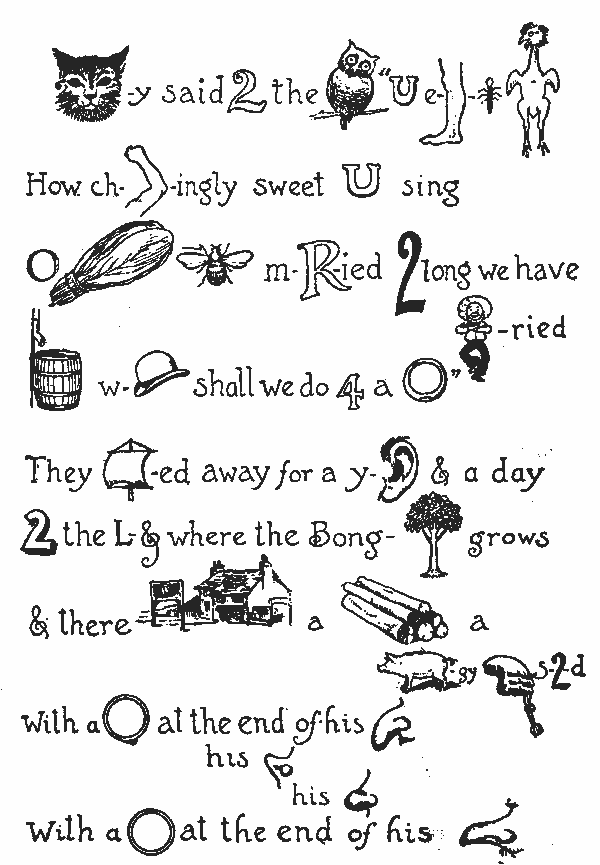
Hieroglyphics, or Picture-Writing
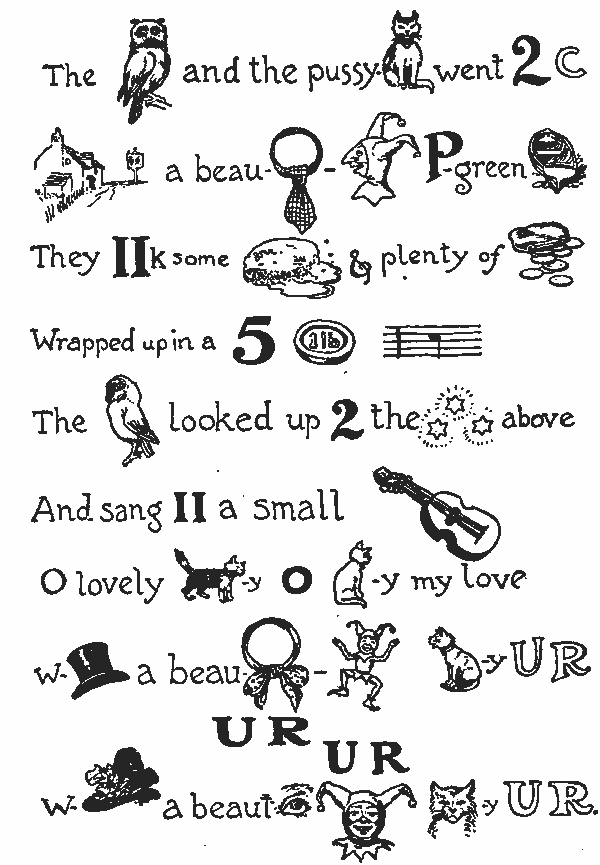
As a change from ordinary letter-writing, "Hieroglyphics" are amusing and interesting to make. The best explanation is an example, such as is given on pages 52 and 53, the subject being two verses from a favorite nursery song.
Pictures and Titles
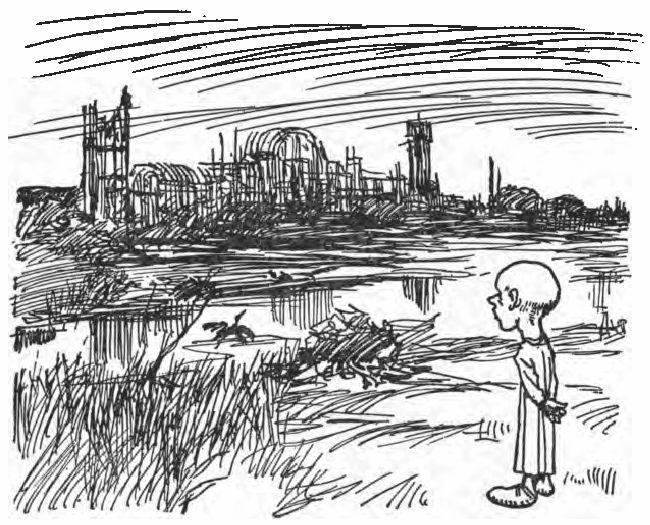
Each player draws on the upper half of the paper an historical scene, whether from history proper or from family history, and appends the title, writing it along the bottom of the paper and folding it over. The drawings are then passed on and each player writes above the artist's fold (or on another sheet of paper) what he thinks they are meant to represent, and folds the paper over what he has written. In the accompanying example the title at the bottom of the paper is what the draughtsman himself wrote; the others are the other players' guesses.
Various Descriptions by the Players
The Abbot of Christchurch, near Bournemouth, surveys the scaffolding of the abbey.
The end of the Paris Exhibition.
An old man coming back to the home of his childhood, looks across the river, where a duck is swimming, to the dilapidated cathedral and town which represent the stately piles he remembered.
The building of the Ark.
The Artist's Description
The Last Man surveying the ruins of the Crystal Palace.