IV SPILL-WAY
Reading edition
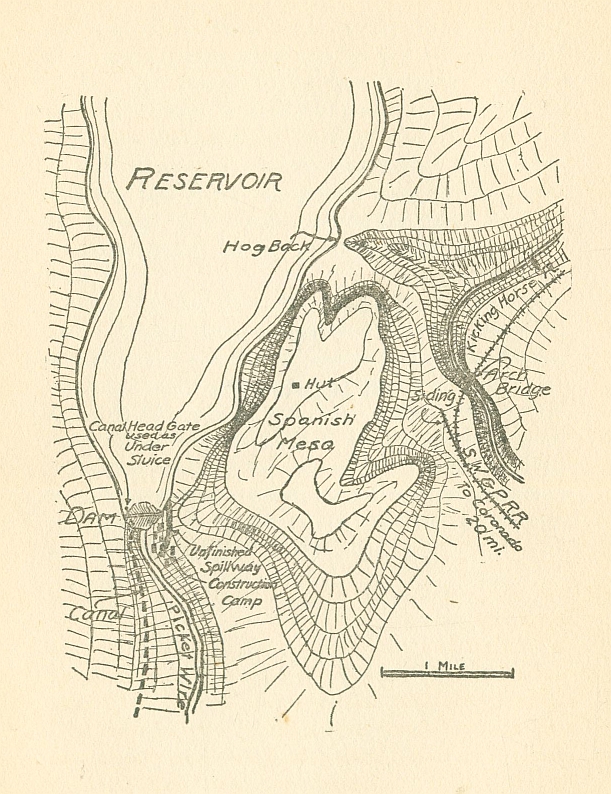
(diagram of reservoir and surrounding terrain)
XXV THE ANCIENT ART OF FASCINATION
And much of the last wild hurricane of work took place under the observation of a woman!
From the top of the big mesa there was a clear view of the new reservoir, from the dam on one side far back into the hills on the other. In spite of the tremendous downpour and the fierce gale Helen Illingworth stood exposed to both attacks, and, indeed, indifferent to them,—albeit protected by slicker and boots and sou'wester—fascinated by the titanic struggle between nature and man of which she was a witness. How she came to be there herself is another chapter and how the two men who stood by her came to be with her is now to be related.
The general investigation by Rodney and Miss Illingworth had produced no results. A careful study by each of the members of the new alliance of Rodney's accurately reported, graphically set forth notes upon the subject had only served the more thoroughly to convince each of them of the correctness of their conclusions. Analyzed and expanded, iterated and reiterated, scrutinized and emphasized by each of them separately and then together in many long discussions, they only made them more and more confident that Meade was blameless. But the most assiduous effort with the heartiest will in the world and the promptings of devotion and affection could not make a case out of these suggestions and their inferences that would hold water. They could not establish their contention beyond peradventure in the face of Meade's direct admission and Shurtliff's corroboration. They could not establish it in the public mind by any evidence at all if Meade and Shurtliff remained silent.
If either one or the other of the two conspirators could be brought to tell the truth, Meade could be restored, at least sufficiently so for the purpose of argument; the argument that Helen Illingworth sooner or later must make to her father. It was that to which she gave the most thought, it was for that she planned and longed.
Two people cannot resolve even by mutual consent to dismiss from their daily thought and conversation any subject whatsoever without introducing in place of it a certain constraint. It is as futile to attempt to dismiss anything absolutely from the human mind as is the oft suggested cure for rheumatism—doing certain things without thinking of the disease sought to be cured!
Colonel Illingworth had dismissed Meade from his mind because he hated him. Helen Illingworth refrained from talking about him to her father because she loved him. So they were never in each other's presence without thinking of the man. This was a source of great irritation to the father. On occasion he almost found himself at the point of shouting at his daughter to talk about him. And that she so carefully avoided the subject and as the avoidance was so obviously in accordance with his own wish, the restraint irritated him the more. The fact that they both sought so carefully to maintain the old relationship made it the more impossible. For relationships which are primarily founded on love cannot be maintained by constraint without the weakening of the great force upon which their tenure had previously depended. There is nothing like concealment to impair and weaken a tie unless it be a ban! Prohibitions rarely prohibit. Still there remained a deep and abiding affection between father and daughter and they managed somehow to get along outwardly much as before. Indeed Colonel Illingworth was more kind and considerate than ever to his daughter, and she repaid him with more than usual care and devotion. The very fact that she seemed to have accepted the situation and obeyed the law he had laid down gave him some compunctions of conscience. On that account perhaps he had been the more willing to accede to her request to take Shurtliff into his employ. In no way was Shurtliff responsible for the failure of the bridge or for any mistake in the calculations of the Meades, and Shurtliff was an invaluable man, not only for an engineer but for the president of the Martlet Bridge Company.
He was familiar with the subjects that Colonel Illingworth discussed and wrote about. He was intelligent and reliable to the last degree, his reputation for steadiness and discretion unquestioned, and he was marvelously efficient in his subordinate position. The Colonel, having first tried him out, had advanced him rapidly after learning his worth. He was now his private secretary. Shurtliff being an old bachelor without kith or kin and not originally fond of women, found himself suddenly in touch with one of the sweetest and kindest, as well as the youngest and most beautiful of a sex about which he knew nothing.
His new position naturally brought him into close touch with the Colonel. The old man transacted a good deal of his business in his own house. Shurtliff was frequently there. Under other circumstances Helen Illingworth would have treated him with that fine and gracious courtesy which she extended to everyone with whom she came in contact, but she would not have especially interested herself in him. She would not have made him the object of the delicate attention and given him the careful consideration which would have completely turned the head of a younger and more susceptible man.
There had been a prejudice in Shurtliff's mind against women in general, and Helen Illingworth in particular. He had quickly realized that she above all persons had the greatest interest in disproving Meade's statement and his own and in laying the blame for the failure of the bridge where it belonged, on the shoulders of the patron, to love whom had been the habit of his life. Therefore, the old secretary was constantly on his guard lest he be entrapped into admissions or actions which might be used to discredit the older Meade and convict the two conspirators.
But Helen Illingworth was far too clever to allow any inkling of such a design to appear. Not the remotest hint of such a purpose did she betray. She deliberately set about to win the old man's regard and respect and perhaps eventually his affection. She had the ordering of her father's household, of course. That was a matter in which the Colonel concerned himself not at all so long as things went smoothly, as they always did. He was a little astonished at her treatment of Shurtliff, but the old secretary was at heart a gentleman and there was no reason why, if Helen chose to include him among her friends and invite him to dinner and otherwise make him welcome in the house, she should not do so. And in his dry, precise way Shurtliff was rather likable. He was touched and flattered by her kindness and in spite of his suspicions, which gradually grew less, by the way, he exerted himself to show his appreciation and to bear himself seemingly in his new life.
Colonel Illingworth had no suspicions whatsoever that there had been any conspiracy to suppress the truth and shift the blame. True his daughter had protested on that fatal day that she did not believe Meade and Shurtliff, but that was in the excitement of the moment and understandable in view of her plighted troth. Helen had never discussed that with him; even the very name of the engineer being banned, she was silent. She was wise enough not to try to worry or bother her father with arguments on that point, to which, of course, he would not have listened in any event.
Accordingly the conferences with Rodney had never been brought to his notice. There was no use stirring up trouble and strife. There was no necessity even to discuss it with her father until she had found more proof. So he at least had no suspicions as to her treatment of Shurtliff. He could not see any end to be gained and therefore he jumped to the conclusion that there was none.
In course of time, as Miss Illingworth never referred to Meade in the secretary's presence, all his mistrust disappeared. Finally he even brought up the subject of Meade's whereabouts of his own motion. Although the girl was fairly wild to talk and ask questions she had wit and resolution enough to change the subject when it had been first broached and for many times thereafter.
Helen Illingworth was fighting for the reputation of the man she loved and for her own happiness, and she was resolved to neglect no point in the game. She partook in a large measure of her father's capacity, but she added to his somewhat blunt and military way of doing things the infinite tact of woman, stimulated by a growing, overwhelming devotion to her absent lover. She cherished that feeling for him in any event and would have done so but the whole situation was so charged with mystery and surcharged with romance that it made the most powerful and stimulating appeal to her.
She lived to vindicate Meade and she bent every effort toward that end. She did not overdo it, either. Finally, as he himself continued to press the subject upon her, she made no secret to Shurtliff of her devotion to the younger Meade, her sorrow that he had made such a declaration, and her determination to wait for him. She was always careful to end every conversation by saying that she knew her outlook was perfectly hopeless and that she could expect nothing except sorrow until the younger Meade was rehabilitated. She so contrived matters, while constantly affirming her feeling for Meade, as to let Shurtliff infer that she was convinced that he had been telling the truth in what he had said.
After a time she deftly appealed to him to know if he could not help her discover the truth which she tactfully maintained even in face of the evidence that Shurtliff had given. And she did this in such an adroit way that Shurtliff became convinced that she did not connect him with any willful deception, and that she believed that he was deluded himself and occupied the position of an innocent abettor. And Shurtliff, in his strange, old, self-contained way, finally grew to like Helen Illingworth exceedingly. Indeed he started in his work with natural antagonism to Colonel Illingworth, and when he sensed, as he very soon did, the difference that had arisen between father and daughter, he espoused the cause of the latter. He was the kind of a man who had to devote himself to somebody. He began to wonder if there was any way to secure the girl's happiness without betraying the elder Meade.
She compassed the secretary, who was, of course, old enough to be her father, with sweet observances and he found it increasingly hard to keep true to his falsehood. Now she was capable of fascinating bigger personalities than Shurtliff, although she cared little for that power and rarely exercised it. The old man actually got to thinking of her as a daughter. Sometimes when they had an hour together he found himself seconding her arguments for the innocence of the younger Meade, for she had progressed that far by now, with little details which his knowledge and experience of the two men could supply. Trifling in themselves as were these contributions, as Rodney pointed out when she repeated them to him, they nevertheless added something to the cumulative force of the argument so laboriously built up by the friend and woman. And they were decidedly indicative of a growing mental condition on the part of Shurtliff from which much might be hoped and expected.
But Shurtliff could not bring himself to come out boldly and confess, and his failure to do that made him more and more miserable. At first his conscience had been entirely clear. He had viewed his conduct in the light of a noble sacrifice for the great man. Now he began to question: Was it right to blast the future of the living for the sake of the fame of the dead? Probably he would have questioned that eventually without regard to Helen Illingworth, but when he began to grow fond of the woman and when he realized, as she unmistakably disclosed it to him, that her own happiness was engaged and that he was not only ruining the career of a man but wrecking the life and crushing the heart of an entirely innocent woman, he had a constant battle royal with himself to pursue his course and to keep silent.
Yet such is the character of a temperament like that of Shurtliff, narrowed and contracted by a single passion in a life and lacking the breadth which comes from intercourse with men and women, that his compunctions of conscience only made him the more resolved. The lonely, heartbroken old man swore that he would never tell. The young man could go his own gait and work out his own salvation, or be damned, if he must. The woman's heart might break, pitiful as that would be, but he would never tell. He was as unhappy in that determination as any other man fighting against his conscience must inevitably be.
Sometimes looking at the misery in the old man's face (for on his countenance his heart wrote his secret), Helen Illingworth experienced compunctions of conscience of her own, which she told to Rodney in default of other confessor. That fine young man appreciated fully the woman's feelings and understood her keen sensibilities, and his comprehension was a great comfort to her. He encouraged her to persevere. Since it was only through Shurtliff that the truth could be established, she must not falter nor reject any fair and reasonable means to gain his whole confidence and make him speak. It was, after all, simply a question of whether the game was worth the candle. How best could they expose or fight a deceit? And that the deception was for a noble purpose and to serve a laudable end in the minds of the deceivers did not alter that fact.
"You are doing nothing in the least degree dishonorable, Miss Illingworth," said Rodney, reassuringly. "Woman's wiles have been her weapons since the Stone Age."
"But I do feel compunctions of conscience occasionally."
"Personally I think you are abundantly justified," urged Rodney.
"Yes, to establish the truth, to give the man I love his good name would justify more than this," she replied, "and yet"—she smiled faintly—"my conscience does hurt me a little. The old man is beginning to love me."
"That's the reason it hurts you," said Rodney. "When he loves you enough he will do anything you want, as I would——"
The young man stopped, looked long at her, and then turned away with a little gesture of—was it appeal or renunciation? He was too loyal to his friend to speak, but he could not control everything. The tone of his voice, the look in his eyes, his quick avoidance of her, told the woman a little story. They had been very closely associated, these two. Rodney also had not had much advantage of woman's society, certainly not of a woman like Helen Illingworth. She had given him her full confidence in the intimacy. He was a man. He loved like others. She was too fond of him, too great, too true a woman to pretend.
"Mr. Rodney," said the girl, laying her hand on his arm, "that way madness lies."
"Miss Illingworth," said Rodney, turning and facing her, his lips firmly compressed, his eyes shining, "I'm devoted to Bert Meade and to you"—he lifted her hand from his arm and kissed it—"and I'm going to do everything for your happiness."
Brave words and he said them bravely.
"I understand," said the woman, "and I honor you for your loyalty to your friend and your devotion to me. Loyalty is not always the easiest thing on earth, I know."
"You make it easy for me because you understand."
So the fall and winter were filled with interest to Helen Illingworth and there was in her days no lack of hope. Every Saturday the flowers that Meade had arranged for spoke words of love to her and bade her not forget, although that was admonition she did not need.
That was the only message that she received from her lover. He had dropped out of sight completely. They caused search to be made for him, sought tidings of him in every possible way, but in vain. Her heart almost broke sometimes at the separation. She had confidence enough in her power over him, and in her woman's wit, to feel that if she had only another opportunity she might learn the truth, force it from him, constrain him to tell it, because she loved him!
XXVI ONCE MORE UNTO THE WORK
The Martlet Bridge Company had finally weathered the storm, although it was, of course, not intrusted with the new International Bridge which was about to be commenced. When Bertram Meade read of the new undertaking, it cut him to the heart. This time there would be no mistake. In the necessity of recouping its fortunes, the Martlet Bridge Company entered upon an even wider career. The directors took contracts which they had hitherto disdained because they were comparatively unimportant, and they bid on operations which they had hitherto left to competitors. They cut the prices down to the lowest limit to get work, to demonstrate that the company was still a force to be reckoned with, a power to be considered in the engineering problems of the world.
They were building the great steel viaduct by the town of Coronado below the dam, and they had already built the splendid steel arch that spanned the ravine, here almost a gorge, in the valley of the Kicking Horse to the eastward of the big mesa.
After Christmas, Colonel Illingworth decided to make another of his tours of inspection, and as Helen was not looking particularly well from the strain under which she was laboring, he offered to take her with him, especially as he was going to the far Southwest, where the weather would be mild and pleasant, to inspect the growing viaduct and the completed arch. She gladly availed herself of the permission. There was always a possibility, albeit a most remote one, that she might hear of Meade if she got in touch with engineering works, and here was not one project but three! Accordingly, feeling the value of his presence, she suggested to her father, in view of the wide extent of the trip and the important interest of engineering circles in the viaduct and dam and irrigation project, that it might be well to invite a representative of The Engineering News, to wit, Rodney, to accompany them, so that the really splendid work the Martlet Company was doing to regain its former high position might be made widely known. The party consisted of the father and daughter, Curtiss, the chief engineer, Dr. Severance, the vice-president and financial man, and Rodney.
Now Helen Illingworth had not the least reason in the world to suspect that Bertram Meade was in any way connected with this engineering project, but Rodney had pointed out and had imbued her with his own belief that sooner or later when Meade was found, he would be found engaged in engineering in some capacity.
"It's in his blood," said Rodney. "He can no more keep away from it than he can stop breathing. He can't do anything else. Somewhere he's at the old job. It might be in America, and it might be out there at Coronado, or it might be in South America, Europe, Asia, or——"
"I wonder if we can't find out all the engineering work that is being done in the world and send representatives to seek him," said Helen Illingworth.
Rodney laughed.
"To hunt that way would be like hunting a needle in a haystack. I cannot bid you hope that he is there; in fact I think it is most unlikely that he would be any place near where the Martlet people are operating, but there's a chance, even if only the faintest one."
Well, women's hearts can build a great deal on a faint chance. They are calculated for the forlorn hope. And so Helen Illingworth stood on the steps of the private car as it rolled across the mile-long temporary bridge at Coronado, and scanned the workmen grouped on one side of the track, their work suspended for a moment that the train might pass on the wooden trestling, in hope that she could see in one of them the man she loved and sought. And Rodney stood by her side, equally interested, searching the crowd with his glance, also.
There was nothing in the town to attract Helen Illingworth out of the car. She had visited West and Southwest many times. Colonel Illingworth, with Rodney and Severence, there left the train. They had, of course, business connected with the bridge which Rodney wanted to see and report upon. Miss Illingworth decided to go into the hills and get away from the arid and heated plains. A siding had been built near the steel arch under the slope of the hill from which the huge mesa arose. It would be pleasanter and quieter to side-track the car there. The siding was within two miles of the dam and the mesa was something to look at and something to climb. The Kicking Horse ravine and the Picket Wire valley presented rather attractive possibilities for exploration and adventure in their pine-clad hills and the car was to be placed there. The men left behind would use the private car of the division superintendent of the railroad when they had ended their several tasks.
It had been raining dismally during the afternoon and when the car was detached and switched to the siding and left up in the hills some twenty miles from the town, it was too wet and uncomfortable to leave it. Disregarding the downpour, however, Curtiss, who had come up with it, made a very careful investigation of the completed steel arch bridge, which more than surpassed his expectations in its appearance of sturdy grace, as well as in the evidences of careful workmanship in its erection.
That evening the special engine pushed the other private car up from the valley, bringing the people who had inspected the bridge. A few more weeks would complete the great viaduct. Everything was proceeding in the most satisfactory way and Colonel Illingworth was very much elated over the situation.
"Who would have thought," he said as they sat down to dinner in the brightly lighted observation room, "that it would rain in this country at this season of the year?"
"It will probably be over by tomorrow morning," observed Rodney.
"If it continued long enough and rained hard enough that dam would have to be looked after. We'll go over and see it tomorrow," said the Colonel cheerfully.
"What would happen if it gave way?" asked his daughter.
"It would flood the valley, sweep away the town, and——" he paused.
"Well, father?"
"Ruin the bridge."
"We can't afford to have another failure after the International," said Severence.
Now there was a newcomer at the table, a big rancher named Winters, whom Rodney had met in the town and had introduced to Colonel Illingworth. The latter had invited him to dinner and to stay the night in the extra sleeper, and Winters, who had particular reasons for wanting to talk with Rodney and to meet Miss Illingworth, had accepted.
"You can count on its stopping," he said at last. "My ranch is a hundred miles to the north of here. I heard Rodney was with your party and as he was an old classmate of mine, in fact my best friend at Harvard along with Bert Meade"—and the mention of the forbidden name caused quick glances to be passed around the table, but raised no comment—"the chance of seeing him brought me down here. I know the weather along this whole section of the country, it's the driest place on earth, and I would almost offer to swallow all the rain that will fall after this storm spends itself."
"Well, that's good," said Curtiss, "because I've heard that the dam lacks a very little of completion but that the spill-way has been delayed."
"You'll find that the storm has broken in the morning," said Winters confidently.
After dinner Colonel Illingworth, desirous of talking business, called the men of the party, except Rodney and Winters, back into the observation room of the other car, leaving the two men with Helen.
"Mr. Shurtliff," said Helen, as the men stepped out on the platform, the secretary following, since his employer had intimated his services might be needed, "if you can, I wish you would come back here as soon as possible."
"Certainly, Miss Illingworth," said the secretary, "immediately, if your father finds that he does not need me."
"Rod," said Winters when they were alone, "I'd go a long way to see you, but I might as well be frank. I did not come down these hundred miles, leaving my ranch in the dead of winter with all its possibilities of mishap to the cattle, simply to see you, or even Miss Illingworth here, although she's worth it," he went on with the frank bluntness of a Western man.
"Of course, you didn't," said Rodney, smiling. "I know I'm not a sufficient attraction."
"I came to talk about Meade."
"Mr. Winters," said Helen, clasping her hands over her knees and leaning forward, "if you know anything about him, where he is, what he is doing, how he fares, is he well, does he think of—I beg you to tell me."
"Miss Illingworth, there is nothing I would refuse to tell you if it rested with me."
"I don't mind confessing to you, you are such old friends, you and Mr. Rodney, and so devoted to Bert, that I am worrying——"
"You need say nothing more, Miss Illingworth. I know all about the situation. Rodney wrote me and——"
"Well then, you understand my anxiety, my reason for asking?"
"I do."
"And you will tell us?"
"I wish to God I could."
"Can't you tell us anything?"
"Well, yes, I can."
"What?"
"It may be a breach of confidence."
"I'd take the risk," said the girl, her bosom heaving. Was she at last about to hear from her lover?
"Know where he is, old man?" asked Rodney.
"I think so, not sure, but——"
"Where?" from the woman, breathlessly.
"I didn't agree to tell you that."
"What then?"
"All I can say is that after the death of his father he turned up at my ranch one day some five months ago and told me his story."
"What!" exclaimed Rodney. "Did he tell you he was innocent?"
"Not at first. He told me he was guilty."
"But you didn't believe him, did you?" asked the woman impulsively.
"I certainly did not."
"Why not?"
"Well, I don't know why. I just didn't, that's all. I know Meade. I know him well. I know his makeup. We get accustomed to sizing up a man's actions out West here and it didn't take me longer than it took him to tell the story to know that it wasn't true."
"Oh, thank you for that," said the woman.
"But our beliefs are not evidence, Dick," interposed Rodney.
"We can't prove it and that's the point, I told him," continued Winters, "that it was a da—darned lie—I beg your pardon, Miss Illingworth. I mean I told him that it was not true and that he was a fool for sticking to it, and—er—he—admitted—I—er," floundered Winters, suddenly realizing that he was on the eve of a breach of confidence and checking himself just in time. "In fact the subject was painful to him and I let him alone, which is what we generally do to a man who doesn't want his affairs inquired into too closely," Winters ended lamely, realizing how near he had come to betraying his friend's confidence and telling of Meade's own admission that he had said what he had to save the fame and honor of the father.
"Well, what next?" asked Rodney, understanding as did Helen Illingworth herself the ranchman's hesitation and respecting it, although the unavoidable inference gave her great joy.
"He hung around the ranch for a month or six weeks to get his balance. He was pretty badly broken up. I'm a bachelor myself and don't know much about those things, but I can say that he loved you, Miss Illingworth, more than life itself."
"But not more than the reputation of his father," she said with a little tinge of bitterness.
"Well, I take it he looked at that as a matter of honor. You know a man's got to keep his ideals of honor."
"Even at the expense of a woman's heart?" said the girl.
"It sounds hard, but I guess we've got to admit that. But that's neither here nor there," he continued, gliding over the subject, "the point is I found that he had to fight it out himself and I mainly let him alone. I gave him a horse and gun and turned him loose in the wilds. Best place on earth for a man in his condition, Miss Illingworth. You can go out into the wilderness and get nearer to God there than any place I know of. He came back finally, turned in his gun, borrowed the horse, bade me good-bye and said he was going out to make a new start."
"Where did he go? Which way?"
"He was headed south when I saw him last, and all this lay in his way."
"You mean——?" cried the woman.
"He may be here?" said Rodney.
Winters nodded.
"I have thought so. It's only a guess, of course, and probably a poor one. But when I read in the papers that Colonel Illingworth was coming out here and that you were along, and Miss Illingworth, I thought I'd just take a run down here and see what could be done."
"Oh, I'm so glad you have come."
"He's not working on the bridge," said Rodney.
"How do you know, Rod?"
"I examined all the payrolls and none of them bears his name."
"He wouldn't work under his own name in the Martlet Bridge Company," said the woman.
"Certainly not. That was only my first step. I went around among the workmen, too, and I got a look at every one of them. I'm sure he's not there."
"He wouldn't be a common workman, would he?" asked the girl, more disappointed than she could express.
"Certainly not. He'd be keeping track of material, or running a transit, or acting as a gang foreman. Most of the workmen are foreigners, although the bridge erectors are Americans."
"You're sure that he's not there?"
"Absolutely."
"There's the dam," said Winters. "We'll try that in the morning."
"What good is it going to do us, Dick?" asked Rodney a little irritably. "Even if we do find him, we can't make him speak."
"I don't know," answered the woman slowly. "But if I could just see him once again, Mr. Rodney"—she spoke without hesitation or reserve and both men felt deeply for her—"if I could just speak to him, if he would only——"
"I believe you can persuade him," said Winters.
"Yes, perhaps, but I want Shurtliff to speak first, then we can approach our friend himself with more confidence," said Rodney.
XXVII BRUTE FORCE OR FINESSE
"What do you want me to say, Mr. Rodney?" asked Shurtliff, coming through the door, having caught Rodney's use of his name.
"Oh, Shurtliff——" began Rodney, somewhat embarrassed at having been overheard.
"What do you want me to speak about?" continued the old man suspiciously, not giving the younger man time to finish. "And what friend can you then approach, sir?"
"I'll tell you what I want," said Rodney.
He quickly came to a decision. Standing up and facing the old man, he staked everything on one bold throw. Grasping the situation, Helen Illingworth held her breath. Winters moved to take his own part in the game at the proper time.
"What is it, sir?" asked the secretary.
"Shut the door and come in," was the answer.
Rodney spoke sharply and it was a sort of indication, characteristic of the difference in station between an independent young man and a subservient old man.
"Here I am, sir," answered Shurtliff, closing the door and standing before it.
He shot a quick glance at the young woman. He observed her tense position. He saw the emotions that filled her soul in her face and bearing. All his old suspicions rose like a flood. For the moment he no longer cared for her. He almost hated her. He looked from her to the dark-faced, determined Rodney, to big, powerful, quiet Winters. Was this a trap? Were they going to try to force him to speak? He was a brave man, old Shurtliff, but his heart beat a little faster as he faced them. He was quite master of himself, though, cool, watchful, determined; in their eyes rather admirable than otherwise.
"The time has come for you to tell us the truth," began Rodney emphatically. "You know that the whole blame and responsibility for the failure of the International Bridge is loaded on the wrong man. You know that you permitted, and even made possible, the sacrifice of the reputation of the son for the sake of the fame of the father. You know that this girl here is breaking her heart, that Meade's life is ruined, and you're to blame. Now the time has come for you to speak. We know as well as you that young Meade is innocent. Here's our evidence."
He drew a handful of papers from his breast pocket and shook them in the face of the old man, who had shrunk back against the side of the car and stood staring, white-faced, thin-lipped, close-mouthed, inexorably resolved still.
"Read them," continued Rodney. "I'll admit to you that the whole thing would not be worth the paper it's written on in a court of law or even in a newspaper report, but it's convincing to us and you can make it convincing to everybody. You've got to speak."
"Do you think, sir, that there's any power in your stretched out arm or in your rude voice or in your threatening gesture to make me speak?"
"By the Lord," exclaimed Winters, suddenly whipping out a Colt's forty-five from the holster at his belt—he was dressed just as he had been when he rode away from the ranch—"out West we've got ways for persuading men to speak and this is one of them."
Winters was a bigger man than Rodney. His life had been wild and rough and his manner when he wanted was according. He would fain add physical compulsion under threat of death to Rodney's mental insistence.
"And do you think, sir, that I'm afraid of any lethal weapon you can produce or even use, any more than I am of Mr. Rodney's words?" The old man's eyes flashed and his knees shook, but he had all the spirit of a soldier as he looked into Winters' stern face, full of threat and menace. His thin voice took on a certain quality of courage. It even rang a little. His courage was mainly moral, but there was some accompanying physical hardihood, that was undoubted. "You can beat me, you can even kill me, if you wish, but you can't make me say a word I don't want to say of my own free will," he cried out at last, his voice strangely rising.
"Gentlemen, gentlemen," said Helen Illingworth, rising and swiftly interposing between the secretary and the two angry men. She realized that the affair had gone far enough and that she must intervene. They had certainly failed lamentably, almost ludicrously. "You are wrong to threaten Mr. Shurtliff. He is old enough to be the father of either of you. Drop your arm, Mr. Rodney. Put up that pistol, Mr. Winters. Mr. Shurtliff," said the girl quickly, "as I am in a certain sense your hostess and as you are in a certain sense my guest here, I apologize to you for the improper and impulsive conduct of these young men. They love Bertram Meade dearly as I do. Let that be their excuse. Meanwhile, they will apologize to you here and now, I am sure."
There was a moment of silence. Rodney and Winters stared at each other and both looked at the girl, confronting them so confidently in her superb and beautiful way. Winters smiled a little shamefacedly as he shoved his gun back into its holster. His had indeed been the greater offense.
"Mr. Winters, Mr. Rodney," said the girl insistently.
"Oh, I apologize. I suppose it was wrong to threaten him," said Rodney disgustedly.
"Hang it," said Winters, now utterly forgetful of conventions, "it wasn't the thing to do to draw a gun on a little, old man and I'm sorry I did it."
"And now that we've apologized you'll tell us the truth, won't you?" asked Rodney swiftly, with no appreciable change of manner.
"Yes, we beg it now, humbly," chimed in Winters, with anything but an humble air or voice.
"I won't have Mr. Shurtliff even appealed to now," said Miss Illingworth. "You have threatened him and you have apologized. Whether he forgives you or not is for him to decide, but he shall not be worried, or questioned, or insulted any more."
"Thank you, Miss Illingworth. I came for that book on the desk; your father wants it," said Shurtliff grimly, bowing slightly to her.
He stepped a little tremblingly—the scene had been unnerving—past the young men, picked up the book, bowed again formally and unmistakably to Miss Illingworth alone, and went out of the car. The honors of the encounter were certainly his.
"Well, Miss Illingworth," said Winters, "I don't know whether you made a mistake or not. I think I could have scared it out of him with this little persuader of mine——" He tapped the butt of the pistol.
"You couldn't have done it if you had killed him," said the woman, who had read the old secretary correctly. "He isn't what I call a daring man, but he has courage that would take him to the stake rather than make him give way, the courage of endurance rather than of action. When he speaks, if he ever does, it will be of his own free will."
"Or because you may persuade him," said Rodney. "By Jove, when I think it over it was the finest thing you ever did."
"Bert Meade's a lucky fellow," said Winters. "You're the kind of a girl that ought to marry out West, where we try to breed men that will match up."
Helen Illingworth laughed a little, although she felt no inclination to merriment.
"That's a fine compliment," she said. "Well, this has rather shaken me and I'm going to ask you gentlemen to excuse me."
"We'll see if he is working on the dam tomorrow."
"You will stay all night, Mr. Winters?"
"Your father invited me to take a bunk in his car and to be perfectly frank with you I'd sleep out in the open rain rather than miss a chance of being in on the end of a game like this."
The girl bowed and left them.
"Dick," said Rodney slowly at last as the two sat smoking together in the silence of complete understanding and good comradeship, which requires no expression in talk, "you're not the only man who thinks that girl would be a good wife to a man."
"Ah," said Winters, "sits the wind in that quarter, Rod?"
"Yes," answered the other, "but I'm fighting this thing through for Meade."
"Well, by George," said the big ranchman, "you're as good a man as Meade any day, fine fellow as he is. I wish I had some chance to get in on this game and make myself worthy of the two of you, let alone the lady."
It was a rare confidence that Rodney had vouchsafed to his friend, and like every other Anglo-Saxon, having said his say he did not wish to discuss it further.
"Do you know," he began, changing the subject abruptly, "I think things have turned out pretty well in spite of our foolishness a while ago. I believe if there's a spark of human gratitude in Shurtliff's heart the girl's interposition when you and I were threatening him, and her refusal to allow him to be questioned later, will fan it into a flame. And I have an idea that when he thinks it over he'll be about ready to tell."
"Are you sure he has anything to tell?"
"Certain."
"Well, I guess you're right. It sort of consoles me for having drawn my gun, without using it, too. And if he tells in the morning and we find Meade everything will be lovely."
"For everybody but me," said Rodney.
"I'll tell you what, old man, when this thing's over you're coming out to spend the rest of the winter with me on the ranch. It's the greatest place on earth for a man to buck up. There's no woman within fifty miles."
Rodney laughed a little grimly.
"I'll go you," he said.
XXVIII THE BATTLE FROM ABOVE
The rain had stopped by morning, to the great relief of Colonel Illingworth, Severence and Curtiss, and the satisfaction of Helen Illingworth. There was little sun to dry the big, red sandstone mesa, its sides seamed into fantastic shapes, which rose grandly between the valley of the Picket Wire and the ravine of the Kicking Horse, and which the young woman intended to cross in her walk toward the dam with Rodney and Winters. The siding near the steel arch bridge was close to the rock wall of the ravine, which here had been so scoured out of the rocky side of the mesa by torrents of other days that it could fairly be called a gorge. Consequently the bank of clouds above the horizon to the northwest was hid behind the big butte from the occupants of the two private cars. Although the day did not promise to be fair, they had no idea of the further threat of storm presaged by the black masses to the northwest.
In sandy, porous soils such as here prevailed the rain is absorbed quickly. They could traverse the trails carpeted with the needles of centuries that ran through the dripping pines without getting muddy and with nothing more to fear than a wetting. Colonel Illingworth, Severence, and Curtiss announced their intention of going back to the town to continue their consultations and observations concerning the progress of work on the bridge. Shurtliff, who went about his business gravely reserved, frigidly cold and self-contained, had work to do at his desk. The woman and the two young men were for the dam.
After an early breakfast, therefore, the second car was uncoupled and the engine backed it down around the mesa toward the viaduct twenty miles below. Rodney and Winters prepared to go with Miss Illingworth across the wooded island, with its cresting of stone, so to speak, that lay between the ravine and the valley. The conductor of the train, a local employee of the railroad, told them that the shortest way was directly over the mesa. The sandstone of which this huge mound was mainly composed had been broken and disintegrated on all sides by centuries of erosion and weathering and there were practicable ascents and descents at both ends. The nearest ascent was at the side of the big tableland directly opposite which the car was placed.
The trails through the pines which covered the hill up to the very foot of the big butte were unfrequented and in bad repair, but practicable if the traveler was prepared for a wetting. The shortest and on the whole the easiest way to the dam would be to make their way to the foot of the mesa, climb it through the big ravine and cross it to the lower end, less than two miles away, where there was an easy descent to the dam.
"And if you get caught in the rain," said the conductor, "which ain't likely, for it's already rained more in the last twenty-four hours than in the last twenty-four years, it seems to me, there's a hut, half stone and half timber, up on the mesa that campers sometimes make use of when they want to see the sun rise, which is a mighty fine sight from there. It was in pretty fair shape when I visited it last year and you can find shelter there. It's at the highest point on the mesa. You can see a long way up the gulch there, and a longer way down and up the Picket Wire valley. Above the dam it used to show a level, fertile stretch between the hills, but it's all a lake now."
Shurtliff, of course, declined Miss Illingworth's invitation to accompany the party on plea of urgent duties and important papers to prepare. He had spoken no words to Rodney or Winters, and those gentlemen made no effort to engage him in conversation. They were, in truth, a little ashamed of their actions of the night before. They were exceedingly anxious as to whether their theories as to the possible effect of Miss Illingworth's action would be justified, so they carefully avoided the secretary, letting the leaven work if it would. To their disappointment it gave no sign of life or action.
Of the four most interested in Meade, Winters was the only one who had slept soundly that night. Rodney was too much in love with the woman ever to sleep soundly again, he thought, certainly not until her future had been settled and her relations to Meade finally determined. Shurtliff's feelings were painful in the extreme. Torn between the old habit of affection for the dead, his new habit of affection for the woman, his oft recurring compunction of conscience, his immediate resentment of the treatment of the two men, his acknowledgment of the splendid action of the woman, his suspicions, his uncertainty, as to how the younger Meade would take it if he told the truth, he slept not at all.
Into Helen Illingworth's mind also had come, although to her credit be it said not until she had retired and had thought over her action in the light of the hints given, that perhaps her generous interposition in behalf of Shurtliff might move his gratitude and that he might at last vouchsafe her the help which she felt more certain than ever he alone could give. She was glad when the thought came to her that she could look herself squarely in the face and declare to her conscience that it had not been back of her action, which had been purely spontaneous.
The possibility, although a faint one, that Meade might be working on the dam and that she might see him on the morrow would have sufficed to give her a wakeful night, Rodney was a more careful observer than Winters, but even the cattleman noticed that she looked worn and strained as he helped her out of the car for their tramp across the mesa to the dam.
"You know," he said, with rough and ready sympathy, "we haven't the least assurance that Meade is there. It's only a chance, and probably a long one."
"I shall never rest until it is decided absolutely one way or the other," said the woman.
"Well, I'm not much of a walker," said the cattleman. "I generally prefer to get over the ground astride of a broncho, but I guess I can keep up with the party for two miles, if that's the distance."
It was dark and damp and wet under the pines. As the conductor had said, the trail was an execrable one. Although the two men cleared the way for her, holding branches back and shaking the water off the drooping boughs, it was well Helen Illingworth was protected from the wet. She had tramped hills and mountains many a time, camp and forest were familiar to her. She wore a short-skirted dress, stout boots and leggings, and a yellow western slicker.
The exertion of the upward climb, stumbling over broken branches and uprooted logs and floundering through boggy places on the trail, brought a touch of color to her face, and though damp, the air sweet and fragrant, clean and pure, refreshed and pleased her greatly; the men, too. It was a hard pull and she was out of breath when she reached the broken coulee, or ravine, which led to the top of the big red sandstone plateau.
"I'm terribly out of practice," she said to the two men, "but I don't believe I'm in any worse state than you are, Mr. Winters."
"I told you I wasn't any good on foot," said Winters, who was blowing like a grampus.
Rodney laughed at the two of them.
"Look at me," he said. "I'm as fresh as when I began."
"Well, you're used to walking," returned Winters. "It's this plugging along this broken trail that has knocked us out. The rich, they ride on—bronchos, you know."
"When we get on top of the mesa we will find it easier going," said Rodney encouragingly.
"Let us start," said the girl, suddenly serious, as she thought what might be at the end of the journey.
"Before we go any further," said Winters, staring up the ravine at the sky which showed above it, "just take a look at that."
He pointed to the black clouds rapidly rising, apparently against the wind, which swayed rather violently the tops of the tallest pines, although they were protected and in comparative quiet where they stood in the ravine.
"It looks as if there were more rain there," said Rodney.
"It's incredible," answered Winters, "after what we've had."
"But it certainly is coming down again and if I'm any judge it will be another cloudburst."
"Perhaps we'd better go back," suggested Winters to Miss Illingworth.
"Go back!" exclaimed the girl. "When I'm as near as this?"
"But it's only a possibility, you know."
"Possibility or not it would take a deluge in my path to stop me. Come."
She stepped toward the broken ravine. Rodney sprang before her. Winters brought up the rear. It was an entirely practicable climb, but rather a hard one on the wet, crumbling rocks. It did not take the three young people long to surmount the difficulties, however, and after a few minutes they stood on top of the mesa. It was bare of vegetation, save in scattered little earth pockets, grass-covered, where dwarfed pines grew, stunted trees centuries old. Its general surface was level, but the upturned expanse was seamed and guttered in every direction like the wrinkles in a face that had confronted the sky for how many thousand years no one knew, for the rock was the early old red sandstone of the triassic period.
Near at hand was the hut of which the conductor had spoken. It stood upon a little rise above the general level and from it one could obviously see far in every direction. There ran valley and gorge, there extended the high waters of the new-made lake, already dark under the clouds. Before them rose hill on hill, each overtowering the others until they merged into the high-land of the great rampart-like range, its serrated peaks showing whiter their crowns of snow against the blackness of the heavens. Between the hills and over the lower crest of Baldwin's Knob they could even see dimly the far-off plains, a little sickly yellow light still lingering there before the advance of the storm.
The hut was made of stone and logs. The doors and windows had long since vanished and the broad eaves overhanging the walls were rotting away, but the inside they found upon inspection was fairly dry. They had not any more than reached it before the storm began. Claps of thunder, flashes of lightning under which the army on the dam were fighting, were heard and seen with tenfold clearness by the little group on the huge upland.
It was a sight to awe the very soul of humanity. Miles and miles down the mountain side and among the hills the whirling battalions of clouds rolled and tumbled and tossed and clashed like aerial armies. The lightning, while it was not in sheets, was practically continuous, flash succeeding flash in uncountable and blinding succession. Again they noticed the strange coruscating, bursting effect as bolt after bolt apparently struck some granite ledge and was then thrown back in splinters of fire. The heavy awful roll of the thunder was continuous and terrific.
They stood staring through door and windows in silence, Meade and their quest forgot in the appalling tempest by all except the woman. It was she who recalled them.
"Let us hasten on," she said, and she had almost to scream to make herself heard in the wild tumult. "It's magnificent, wonderful, but——"
As a matter of fact all the manifestations of nature at its grandest would not have sufficed to turn her head away from her lover's face if she could have seen him.
"You can't go now," said Winters decisively, "the rain's bad enough as it is and that cloud will burst in a minute. Old Noah's flood won't be a circumstance to it."
"I'm protected from the rain," she answered.
Winters shook his head.
"The weight of it would almost beat you down, Miss Illingworth."
"I haven't had any experience with it, but I think Winters is right," said Rodney.
"I'll go on alone, then," said the girl passionately, stepping out of the house, "if you gentlemen don't care to come."
The next moment, with a culminating scream like the shriek of all the lost souls of creation heard above the furious detonating roll of the thunder, the wind added its quota to the demonstration of natural force, and now the rain fairly dropped upon them in apparently solid sheets. Of course clouds do not burst. Such a thing is scientifically and meteorologically impossible, but anyone who has ever experienced the suddenness and fury and weight of a western deluge in a normally dry land will understand the term. The wind swept over the plateau where it had free course like a hurricane; the rain came down in masses apparently. Until their eyes became accustomed to it, the falling water blotted out the landscape.
The woman was hurled against the side of the house by the sudden and violent assault of the hurricane. The two men half dragged, half carried her around to the lee side of the cabin. The roof of the hut had given way here and there, and within it was soon flooded. Where they stood, however, by chance happened to be the solidest part of the overhang of the roof and they were in some degree protected, that is from the direct violence of the downpour. They were, of course, drenched in a few minutes in spite of their raincoats. With one man on either side of her to give her as much protection as possible, the woman leaned against the stone wall and stared through the rain down the valley, seeking to see the dam, perhaps a mile and a half away. Of course the maximum of the downpour could not last any more than the maximum of the gale, but the deluge was succeeded by a heavy driving rain still swept on by a strong wind.
Below the mesa the lake was whipped into foam by the beat of the rain and rolled into waves by the assault of the wind. All three of them knew what this deluge portended. The downpour would raise the level of the lake so that it would overflow the dam, which would be swept away, the valley would be inundated by a flood, like a tidal wave, the incompleted viaduct would be ruined, the town would be overwhelmed, the loss of life and property would be appalling.
"The spill-way ought to take it," shouted Winters, knowing what was in the minds of the other two by what was in his own.
"It's not finished," roared Rodney.
Winters threw up his hands.
"Will the dam hold it?" cried the woman, understanding.
"Until the water rises above it. Just as soon as it begins to wash over it will go, and the quicker for these waves," answered Rodney at the top of his voice.
"And the bridge and the town," screamed the woman.
"They, too."
"And father?"
"He'll be all right, they've had warning. The engineers on the dam must know the danger now. They're working like mad."
He had brought a small six-power field glass with him and he was straining his eyes through it. The violence of rain and wind had sensibly abated, although it was still coming down in torrents. With his knowledge of what would probably be attempted, Rodney was able to see through his glass something of what was being done even at that distance.
"They're building palisades on top of the dam and backing it with an earth mound. See, they are dropping sand bags over," he stated, handing the glass to the other man.
"By heaven," shouted Winters, "they're making a magnificent fight."
In his excitement he left the shelter of the hut and stalked through the rain toward the edge of the mesa, where he could have a better and nearer view. In spite of Rodney's remonstrances, even though backed by his outstretched arm, the woman followed. Presently all three, indifferent to the beat of the rain and the assault of the wind, stood watching the battle on the dam. It was abating still more, fortunately, or else they could scarcely have sustained the attack of that wind and rain, nor could they have seen at all, even with that glass.
Staring down at the dam after a moment Helen Illingworth took the glass from Rodney. She focused it rapidly and looked steadily through it. She knew what she was seeking as she stood steadying herself with splendid nerve and resolution and swept the length of the dam back and forth.
"I don't see him. He's not there," she said at last, handing the glass back to its owner.
"If he were there, you'd see him all right," said Winters enthusiastically, "because he'd be in the thick of the fight."
"I doubt if you can recognize anyone even through the glass, at such a distance," said Rodney, after he had focused it and taken a look himself. "Yet if he were there he certainly would be in the thick of it. He's that kind. You look, Dick."
"I can't see him," said Winters in turn. "But what a fight they are making to save that dam."
"Will it hold?" asked the woman.
"Impossible," said Rodney.
"I give it one hour," said Winters, handing over the glass.
"Not more than that," assented the other, after another look. "See for yourself, Miss Illingworth."
From where they stood high up on the roof of the world they were spectators of a great battle, witnesses of a terrible contest, in which herculean effort, desperate courage, human will, all exerted to the limit, finally degenerated into blind, mechanical habit of continuous and frenzied endeavor. The spirit of reckless continuance had got into them and moved them to the impossible. As men in a battle-charge go on even with wounds enough to kill them in ordinary circumstances, as soldiers at Winchester, though shot in the heart, actually struggled after Sheridan until they fell, or even as a common horse may so be imbued with blind intensity of determination that he gallops on until he drops dead, so these men gave their all in unmatchable persistence.
"They'd better get off that dam," said Rodney. "When it once fails it'll go with a rush and then it'll be too late."
"Look at them. They're not going to get off," said Winters. "They're going down with it. Damned fools, God bless 'em!" he shouted, throwing up his arms in exultation over manhood and courage and determination.
"Perhaps you had better go back, Miss Illingworth," said Rodney, thinking of the horror she might witness at any moment.
"I wouldn't be elsewhere for the world," said the brave girl, white but with firm lips—she was made of the same stuff as the fighting men, it seemed—"Even if he were there, fighting that great battle, I should wait to see the end."
"We're not the only people in this wilderness. Look yonder!" cried Winters.
He pointed down through the ceaseless rain toward the lower edge of the mesa. There far below him were three sodden figures. The water in the lake had risen so that it had overflowed the lowlands, it had flooded the slope of the hill and on that side it was lapping the base of the cliff. The trail had, of course, been covered and there was no way of progress except by taking advantage of the broken rock at the foot of the cliff, which here and there still stood above the water. It was a place apparently where men could only pass by carefully choosing their way and calculating the distance of the next point toward which to leap.
These three were moving like madmen, splashing through the water, hurling themselves from rock to rock, falling against the wall, clutching a tree or shrub, slipping into the lake, saving themselves from drowning apparently only by the caprice of complacent fortune, which they were trying to the utmost limit. They had raincoats on; two of them, however, had lost their hats, the light slicker of the last one was torn to rags; the first stopped a moment, jerked off his coat, and went on without it as if the stiff and sodden garment impeded his action.
One man carried a miner's pick, a spade and a surveyor's range pole, the other another spade and two long stakes which looked like the separate legs of a tripod. The bareheaded man, who had thrown his rubber coat down in the reddish-yellow water, carried a good-sized oilskin bag. He was the most hurried of the three. He ran some distance in front of the others. They noticed how carefully he sought to protect the bag. When he slipped or seemed about to fall he always thrust it frantically away from the rock with outstretched arm.
What the three men would be at of course no one knew. It was obvious that they were in a desperate hurry and that the thing in the bag must be carefully carried. Naturally the watchers connected the men with the dam builders. They were dressed as the men engaged in such labor would be dressed. The pick, the spades, and the pole and stakes bore out that conclusion.
"What's in the bag?" asked the woman.
"He carries it as though it might be gold or diamonds," said Winters.
Rodney shook his head. Suddenly he divined the reason for the extreme care with which the bag was carried. The men were immediately below the three watchers now. He could make out pretty well what was the size and shape of the objects that bulged the waterproof bag.
"I have it," he shouted. "Dynamite."
"What for?"
Rodney shook his head again. The man in front was in plain view. He was a tall figure, his face was heavily bearded. From the angle at which they saw him it was impossible for them to recognize him, nor was he in his frantic progress assuming the usual attitude and bearing of a man under ordinary conditions which sometimes betray him to those who know him well. Nor could Helen Illingworth with her trembling hands focus the glass, which she took from Rodney before the struggling adventurers had passed; and yet there was something in the figure below that made her heart beat faster.
She pressed her hand to the wet garments over her heart and stared. Suddenly Rodney raised his voice and shouted at the very top of it. Winters joined in and even Helen Illingworth found herself screaming. The three men below were not more than five or six hundred feet away, but evidently they could not possibly hear in that tumult of nature. No voices would carry through any such rain and wind. They were too intent on their paths and on what they had to do to look upward. They rounded the shoulder of the mesa and disappeared in the pines at its feet.
The three on the top looked at each other.
"The dam still holds," said Rodney, quite unsuspecting what was in the woman's heart.
Even as he spoke Helen Illingworth turned away. She ran heavily in her sodden garments along the broken mesa top past the house to the upper edge. There below her were the three men just emerging from the fringe of trees. Rounding the end of the mesa they had at last struck firmer ground. Helen Illingworth could see them through the pines on the old trail. The going was bad enough, but it was nothing compared to what they had passed over and presently they burst out of the woods and ran along the greasy, well-rounded hog-back that divided the valley from the ravine.
The woman had no idea what was toward, what was their purpose. She could only stare and stare at the rapidly moving far-off figure indomitably in the lead and the others following after. There Winters joined her.
"Rodney sent me to look after you; he feels that he must stay back and watch the dam for his paper."
"Look," said Helen, pointing far down. The men halted at the very narrowest part of the hog-back. They were clustered together. The bag lay on the ground behind them. One man bent over it, evidently opening it. Another man swung the shovel viciously, the third grabbed the pick. Winters had been too far removed from engineering even yet to figure out what was toward. They could only watch and wonder.
XXIX THE VICTORS
Meade knew that they were fighting a losing battle. Every one of the higher grade men knew it also. The spill-way was entirely inadequate, but it suddenly flashed into his mind, with that consciousness of the hopelessness of the struggle, that perhaps there was another way to discharge the flood. The same idea might have come to any other of the more intelligent of the men from Vandeventer down if they had taken a moment for reflection. If they had not been so frantically, so frightfully engrossed in their present puny but gallant efforts to save the dam they certainly would have remembered. That the possibility came to Meade rather than to any of the others was perhaps due to the fact that he had noted the situation later and had studied the conditions more recently. Those solitary rambles of his, those careful inspections of the terrain of the valley, had been made long after the original surveys and the results of his observations were still fresh in his mind.
The water was rising so rapidly since the cloudburst and he saw the inevitableness of the failure so clearly that he did not dare to waste time to look up Vandeventer, tell him his plan and get his permission. Every second was of the utmost value. When the thought came he acted instantly. He was in the position of the commander of a small force to whom is suddenly presented the bare possibility of wresting victory from defeat by some splendidly daring and unforeseen undertaking. And he was the man to seize such a possibility and make the most of it.
It was well that he had endeared himself to some of the men and that the respect in which he was held by Vandeventer was shared by the others. Indeed perhaps the men under a man are quicker to estimate his character and worth than those over him. Therefore when Meade called two of the most capable of the workmen, a big, burly Irishman and a stout little Italian, to follow him they did it without a moment's hesitation.
"The rest of you keep on here," he shouted as he left the gang. "Murphy and Funaro, come with me. Keep it up; I think I know a way to help," he yelled back through the rain as he scrambled off the dam up the rocks to the spill-way. It was not his fault that they could not hear and could not understand.
The water was rushing through the spill-way about knee deep and the three men plunging forward through it had difficulty in keeping their footing on the broken, rocky bottom. When they reached the other side, Meade shouted above the storm:
"Murphy, bring your pick and shovel; take that iron range pole, too. Here, Funaro, you take your shovel and these."
As he spoke he ran into the office shack and wrecked a transit tripod, ruthlessly separating the legs from one another by main force and pitching two of them into the little Italian's outstretched arms.
Without a question both men complied with his direction. In a huge crevice, almost a small cave, in the spur of the mesa which overhung the east end of the dam the explosives were stored. The dynamite was kept in oilskin bags, the detonating caps in waterproof boxes. There were sixteen sticks or cartridges in each bag. Each stick was an inch and a half in diameter and eight inches long. One bagful should be ample. Indeed if that did not do the work the attempt would fail.
The men waited while Meade selected a bag of dynamite, a box of detonators, and a package of fuses. It was a cardinal rule that dynamite cartridges and detonating caps should never be carried by the same person, because the combination so greatly increased the risk of premature explosion. The fulminate of mercury in the detonators was very volatile, highly explosive and immensely destructive considering its size. One such cap could blow off a man's hand or even his head and in its explosion might detonate the dynamite. Hence the separation when being carried.
Meade decided to take that risk. He knew how perilous was the undertaking, how liable he was in his hurry to fall against the rocks, slippery and half submerged in that pouring rain. He knew what the consequences of such a fall would be. He would center all risks in himself. He thrust the box of detonators in his pocket, the package of fuses inside his flannel shirt, and carried the dynamite bag in his hand. He would need his free hand to protect himself, so all the tools were carried by the other men.
The little Italian shook his head as he noted these preparations. He happened to be one of the explosive force, those whose duty it was to do the blasting. In his practical way he knew a great deal about the properties and possibilities of usefulness of the dynamite. Meade's purpose was obvious even to Murphy, who was only a laborer, though where he proposed to work neither man had any idea at all.
"Dynamita no work in zis weather," said Funaro impressively.
"Probably not," answered Meade, hurrying his preparations, "but it's our only chance."
"Give me ze caps," urged the Italian gallantly.
"No, I'll take both."
"It ees danger."
"Yes, but come on."
Meade, wasting no more words, sprang at what was left of the trail and the two men gallantly followed him. The hog-back at which he was aiming was perhaps a little more than two miles from the dam. On the ordinary trail and prepared for the run he could have managed it in fifteen minutes; as it was they made it in thirty. The extreme possibility of the life of the dam seemed to Meade not much greater. He went in the lead and by his direction the others kept some distance behind him.
"If I fall and explode this dynamite there's no need of all three of us being blown up," he had said, and it was no reflection on their courage that they complied with his direction.
Indeed a stern command was necessary to keep the two men back. They had caught something of the gallant spirit of the engineer and the big Irishman and the little Italian were as eager as he. Helped by a few hasty words as they ran, they had both of them learned what he would be at. They both realized that they were the forlorn hope, that if they could not save the dam nobody and nothing could. And there was a trace of the age-long rivalry between the Celt and the Roman. The scion of the legionary and the son of the barbarian who had fought together in the dawn of history vied with each other then. Again and again Meade had to order them back. He was keenly sensible of his danger. He knew that if he fell, if the dynamite struck the ground violently, it might explode. He knew that the unstable fulminate of mercury in the detonators might go off at any time—perhaps that was the greater danger—but he never checked his pace or hesitated in a leap or sought an easy way for a second. His soul was rising and his heart was beating as they had never risen or beaten in his life. And the hearts of his men beat with his own.
He knew, of course, if the dam went out the railroad, the bridge, the town, the citizens, the women and children, and everything and everybody would go. If he could save them his act might be set off against the loss of the International. But whether that were true or not, whatever the consequences to him, he was bound to save them. The weight of every man, the weight of every woman, the weight of every child in the valley, the weight of all the business enterprises of the town, the weight of the great viaduct of steel, the weight of the huge dam itself, was on his shoulders as he ran. He carried the burden lightly, as Atlas might have upborne the world with laughter. For despite his determination and haste he had in his heart the great joy that comes when men attempt grandly and dare greatly for their fellow-men. If he could only by and by see his hopes justified by success his happiness would be complete.
And there were thoughts personal as well as general. If he died, whether successful or not, men would tell about his endeavor. She would hear. It came to him afterward, when he learned how she had looked down upon him as he ran, that he had somehow felt her presence, not a presence impelling him to look up, but a presence driving him on. He lost his hat, he tore off his long coat and threw it aside as he plunged on with his precious bag in his hand. He did not dare to look at his watch, he did not stop for anything, but it seemed that he must have spent hours in that mad scramble over the water-covered rocks. He heaved a deep breath of relief when he rounded the mesa and struck the trail. Bad as was the going, it was nothing to what they had passed over.
Presently he broke out into the open slope and there before him was the rounded curve of the hog-back, to gain which he had risked so much. Were they in time? Yes, the water in the lake was not flowing, it was only rising. Evidently the dam still held. He ran along it till he reached the narrowest part of it, twenty feet wide between water-covered valley and sharply descending ravine. The shortest separation between Picket Wire and the Kicking Horse! The water in the lake was within three feet of the crest. The rain was coming down steadily. He could realize by the water level where he stood that it must be lapping the top of the dam now, or a little above it. He had five minutes, ten at most. He was still in time. The thoughts came to him as he ran. And as he saw the place again he made his instant plan.
He laid the dynamite down just as Murphy and Funaro reached him and stood panting, their heavy breathing, the sweat mingling with the rain in their wet faces, evidencing their exhaustion. From Murphy, who had been the faster, Meade took the two tripod legs, stout oak staves about an inch and a half thick with sharp metal points. He jammed them down into the ground about five feet from the edge of the Kicking Horse ravine and about fifteen feet apart.
"Holes, there," he shouted, "deep enough for five cartridges."
Funaro nodded. He knew exactly what to do. Murphy had often seen the explosive gang at work. He was quick-witted and he had only to follow the Italian's actions. The work was simple. Seizing their spades the two men cut into the sod, using the pick to dislodge small bowlders and break up the earth. The soil was light and porous and it had been well soaked by the rain. After they had made an excavation about two feet deep they laid aside their shovels and with the iron range pole as a starter and the bigger tripod stakes to follow they made two deep holes in the ground, forcing the pole and then the stake into the earth, which the continuing rain tended to soften more and more. They made these holes about four feet deep below the excavation, driving in and twisting and churning the stakes by main strength.
They could by no means have accomplished this save for the softening assistance of the rain and the furious energy they applied. They had been working since four in the morning at the dam, they had made that difficult run at headlong speed, yet they labored like men possessed. They even wasted breath to call challengingly and provokingly and to set forth their progress each to the other. In almost less time than it takes to tell it they had completed the holes and so informed the engineer triumphantly.
Meade, as usual, had reserved to himself the more dangerous, if less arduous task. Covering himself with big Murphy's discarded slicker, which fell over him like a shelter tent as he knelt down, he opened the box of detonators, selected one and attached the fuse in position carefully. Then he unfolded the paper about one of the cartridges and placed the detonator, wrapping the paper around it thereafter. He prepared two cartridges this way with the greatest care.
The holes now being ready, the men rapidly but carefully cut slits in the covering of the cartridges and lowered four cartridges down each hole, forcing them gently into place with the butt ends of the tripod stakes and compressing them so that they filled the holes completely. Then Meade placed his two prepared sticks with the detonators on top of the other four. He cut the fuse to the proper length in each case and, keeping it carefully covered with the raincoat, he held it while the others filled in the holes and the excavations and carefully tamped down the earth. All that remained was the lighting of the fuse. And then? Would the dynamite go off? With fuses it was uncertain in its action at best, and although these fuses were supposed to be so prepared as to be independent of weather conditions, more often than not rain spoiled a blast. If this blast failed it was good-by dam—good-by everything.
Meade drew out from the pocket of his flannel shirt a box of matches. He had to light the farther cartridge fuse, then run fifteen feet and light the nearer one, and then make his escape. He had made the nearer fuse a little shorter so as to secure a simultaneous explosion if possible.
Tony Funaro now interposed gallantly.
"Giva me da light," he demanded, extending his hand.
"G'wan wid ye," shouted the big Irishman eagerly; "lemme do it, sor."
"Stand back, both of you," cried Meade, succeeding after some trouble in striking a match.
He had cut off a short length fuse for a torch, the better to carry the fire from one blast to another. As it sputtered into flame he touched the first fuse, then the second and turned and ran for his life after Murphy and Funaro. They had just got a safe distance away when with a muffled roar the two blasts went off nearly together. When they ran back they saw that two-thirds of the hillock on that side of the ravine had gone. A wall of earth through which water was already trickling rose between the great gap they had blown out and the lake, the upper level of which was much higher than the bottom of the great crater they had opened.
"Hurrah," yelled Meade, the others joining in his triumphant shout. "Now, men, another hole right there," he pointed to the foot of the bank. "Drive it in slanting and it will do the job."
"Will the dam be after holdin' yit, sor?" asked Mike Murphy, seizing his pick.
"I hope so, but for God's sake, hurry."
With two men working the last hole was completed before Meade was ready. Funaro, indeed, came to his assistance in preparing the cartridge. Presently all was completed. Rejecting the pleas of both men, Meade struck the match and this time, since there was but one blast to be fired, he touched it directly to the fuse and waited a second to see that it had caught and ran as before.
At a safe distance they drew back and waited. Nothing happened. A few seconds dragged on. They saw no sign of life in the fuse, no light. In spite of the care they had taken it had got wet. It would not work. The precious moments were flying. They stared agonizingly at the fuse through the rain.
"I'll have to take a look at it," said Meade desperately.
Funaro and Murphy caught him by the arms. They all knew the tremendous risk in a nearer approach. The fuse might be alight still. At any second the flame might flash to the detonator and then—— Yet Meade had to go. That charge had to be exploded if he detonated it by hand, he thought desperately, and he had not come so far and worked so hard to fail now.
"Don't go," cried Murphy.
"It ees danger," shouted Funaro.
But Meade shook them off and bade them keep back. What was his danger compared to the issue involved? That last charge had to be exploded. He stepped quickly toward it and as he did so he threw his eyes up toward the gray, rain-filled heaven in one last appeal.
Did he hear the blind roar, did he see the upbursting masses of sodden earth, was he conscious of the fact that the whole side of the hillock had been blown away, that the last explosion had completed the shattering work of the first, that they had succeeded? Did he mark the whirling water, driven backward at first by the violence of the explosion, returning and rolling in vast mass through the great opening, did he see it plunging down the slope, through the trees and bushes, and pour thunderously into the bed of the ravine? Did he see the tremendous rush of the water from the great lake that man had created tear earth from earth and ever widen and deepen the opening as it crashed in a foaming, terrible, red cataract through the outlet, striking down great trees, roaring, boiling wildly to the bottom of the gorge far below?
No, he saw nothing. Broken, beaten down by a huge bowlder that had been thrown upward by the explosion and had struck him on the breast, and lying battered under a rain of smaller stones and earth, he was as one dead.
"By God," cried Winters in great excitement on the crest of the hill, "he's done it. He's saved the dam; that's a man."
"Don't you know him?" screamed Miss Illingworth in his ear.
"No."
"Meade!"
Winters caught her by the arm.
"He's dead," she cried high and shrill, "but he saved the dam and the bridge and the town. He's made atonement."
"Yes, yes, don't faint," cried Winters.
"Faint! I'm going to him."
"How?"
"The nearest way," screamed the woman, letting herself down over the cliff wall to the broken rocks, by which only the hardy could reach the lower level.
* * * *
What of the dam below in the valley?
"Hold it, men, hold it; for God's sake, hold it," shouted Vandeventer, rising from his crouching position against the palisade to resume it instantly he had spoken. "Keep it up. If it goes down let's go down with it. Damn it to hell, hang on—hang on! We'll hold it. We aren't beat yet."
Broken words, oaths, protestations, curses, cheers, expletives in strange languages from the polyglot mob of men burst forth. Even cowards had been turned into heroes because they had fought by the side of men. Here and there a man not weaker physically perhaps, but less resolute, less spiritually consecrated, less divinely obsessed, dropped out of the rank that pitted itself in furious, futile, but sublime fury against the wavering wall. Some of them fell backward and lay still. Some had fainted and some of them were half dead. A few here and there sank down on the trampled, muddy embankment and buried their heads in their hands, sobbing hysterically. But most still blind, mad, sublime, held on. And the palisade did not fall. It did not bend back any further.
The throb that told of the tremendous pressure of the waves, the quiver that experience could feel the prelude to failure, began to die away, to stop. What did it mean? The thunder grew still, the rain diminished, it ceased, the clouds broke. Some great hand, as of God, swiftly tore the black vault of the heavens apart. Faint light began to glow over the sodden land. Through the rift they saw dimly one great peak of mighty range. What had happened?
"Here," said Vandeventer.
How white he looked, how haggard, streaks of gray in his black hair that had not been there before, but his eyes were blazing. He was still the indomitable chief of the Spartan band. The nearest men gave him a hand. He clambered up to his former vantage point on top of the highest log of the stockade and stared down. The rise of the water had stopped! He could not believe it, yet it was true. The rain had ceased again, but by every natural law the drainage from the hills would continue for some time in full volume. Yes, by all rights the dam was doomed. The water still trickled through the palisades in many small streams. That had been a gallant effort they had made, even if a vain one.
For ten minutes he stood silent, exhausted. Then he saw. The water was not rising. No, it was falling; only a trifle, but enough. Presently it had stopped filtering through the revetment. He looked back. Not a drop ran on the other side of the palisade. Vandeventer knew that the water must be discharging somewhere. The lake must have broken through somewhere. He only needed that hint to recall the hog-back and then Meade. He saw it all now.
"We've won, the dam's saved," he cried greatly to the men who stood back of the palisade staring at him. "Roberts has blown up the hog-back. The water's falling. See for yourselves."
Every man sprang up the palisade. Some one laughed and then some one raised a cheer and those mud-covered, sodden, wornout men, who had been about to die, saluted in heroic acclaim him who had led them to victory and by implication him who had made that triumph possible.
XXX THE TESTIMONY OF THE DEAD
Just as Helen Illingworth and Winters reached the lower level at the foot of the mesa they were joined by Rodney.
"What has happened?" cried the engineer.
Winters answered as the three hurried along without stopping:
"Meade blew up the hog-back."
"Was that he?"
"Yes."
"I thought there was something familiar about him, but I did not dare——"
"I recognized him instantly," said Helen Illingworth.
"That atones for the International," continued Rodney.
"What does?" asked his friend.
"The dam is safe; the water has stopped rising. I believe it's beginning to fall a little. I saw someone jump up on the palisade and wave his hand and then I saw them all gather around, evidently cheering."
"I should think the water would be lowered," said Winters; "it's pouring out of a hole in the hog-back as big as a church."
"It was a fine thing in Meade. Let's hurry and tell him so," answered Rodney.
"I'm afraid it's too late," said Winters.
"Oh, don't say that," cried the girl.
"Why, what's happened?"
"The second blast was slow in going off," said Winters; "he went back to look at it and got knocked over. It looked pretty bad from the top of the mesa."
Rodney would not have been human if he had not felt a leap in his breast at the possibility, but he was too loyal a friend and too genuinely fond of Meade for more than a passing emotion, for which he was more than a little ashamed.
"Let us press on," he urged.
In a few moments they stopped by the three men. Meade was still unconscious. The big Irishman sat on the grass with the engineer's head on his knee. The deft-fingered little Italian was trying to wash the blood away from the unconscious man's forehead with a sodden, ragged piece of cloth. Meade was unconscious, he was breathing heavily. There was a catch in his respiration. His breath came at irregular intervals and was labored as if painful.
A huge rock had struck him in the breast. The two men had torn open his shirt and undershirt. The engineer's chest was bruised and bloody. Evidently bones had been broken and probably serious internal injuries had resulted. Every breath was an apparent agony and that the exquisite pain did not arouse him to consciousness was evidence of the terrible nature of the injury. A smaller, sharper rock had cut him across the forehead and cheek, just missing his right eye, and they found out afterward that he had been struck by several other pieces dislodged by the explosion, and that his body was covered with bruises.
But there was nothing, not even in the cut on the forehead, to cause any great alarm had it not been for the crushed chest. Winters and Rodney were both men of action, accustomed to quick thinking and prompt decision in emergencies; while Helen Illingworth could only stand with clenched hands staring in mental anguish that paralleled the physical suffering of the man she loved, the engineer and the rancher immediately made preparations to get the wounded man to the car.
Murphy wore in his belt a short woodman's axe. With it they cut down two young saplings, trimmed them and thrusting them through the sleeves of their raincoats they made a fairly practicable litter. Using the utmost care, they laid the unconscious man upon it and Winters and Murphy, the two biggest men, took the handles at either end. Helen Illingworth, praying as she had never prayed before, sought to support the unconscious man's head. The Italian gathered up the tools and went ahead to open up the path. Rodney followed after.
Their progress was slow of necessity. They had to handle Meade with great care. Winters and Rodney, after the brief inspection they had made, could not see a chance on earth for him. Neither could Helen Illingworth. They went along without conversation, naturally, except for an outburst of admiration from Winters.
"I tell you," he said, "it was a magnificent thing for him to do. He risked his life a hundred times in that mad rush with the dynamite in his hands and the detonators in his pocket. Yet if he had only stayed back he would have been safe."
"It was his anxiety for the dam and the people that brought him down," said Helen Illingworth. "He can't die," she murmured. "God surely will not let him die. I love him so. And yet if he does and I have lost him, innocent or guilty, he has redeemed his fame."
"He saved others," quoted Rodney under his breath, "himself he could not save."
It was a work of great difficulty to get the wounded engineer into the car, but they finally managed it. By the woman's direction they laid him on her bed in her own private stateroom.
"One of us must go for a doctor at once," said Rodney, "and that will be my job."
"It's twenty miles to the town," said the conductor, who had helped to receive them. "If one of you could telegraph we could tap a wire."
None of them could.
"It's all down-grade and there's a good roadbed and I was some sprinter in my college days," said Rodney.
"And there was never greater need for haste than now," said Winters. "I wish I had a horse here."
"Don't give up, Miss Illingworth," continued Rodney, as he started toward the door. "He's alive yet."
Just then, opportunely enough, rounding the last curve before the arch bridge, they saw the end of the other car rapidly approaching them. Had they not been so excited they could have heard the furious puffing of the engine as it drove the car at great speed up the heavy grade.
"Wait," said the conductor, "we can send the engine down for the doctor. That'll be the Colonel's car."
In a few minutes the car stopped on the siding. Out of it came Colonel Illingworth, Dr. Severence, Curtiss, and some of the officials of the Bridge Company in town. They were all greatly excited. The Colonel did not stop to put on his hat. He ran to the other car and climbed aboard.
"The dam's going," he shouted. "The bridge and the town will be flooded. We got word an hour ago by a messenger galloping down. The telephone wires are down. I ran the car up here as the quickest way to get over to the reservoir and the dam. Some of you who know the way come with me."
By this time the observation room of the car was filled with men.
"You need not worry about the dam," said Rodney.
"What do you mean?"
"A man blew up the hog-back, made a spill-way, the water rushed out through it into this ravine, you can see it below there, relieving the pressure on the dam at once. Since it has held up till now it will hold for good."