III DAM
Reading edition
(sketch of dam area)
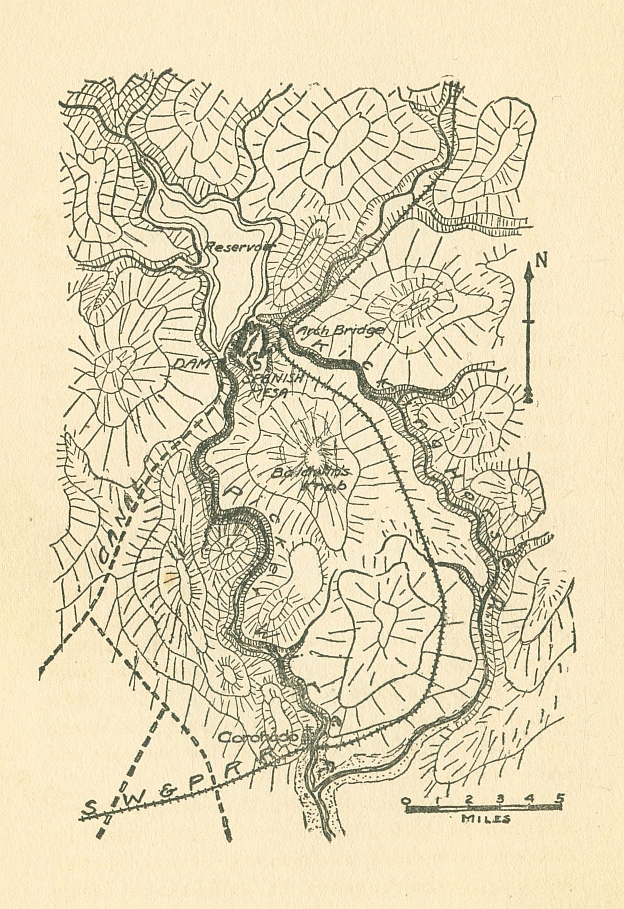
XVIII PICKET WIRE AND KICKING HORSE
There are no more beautiful valleys anywhere than those cut by the waters of primeval floods through the foothills of the great snow-covered Rocky Mountains. The erosions and washings of untold centuries have flung out in front of the granite ramparts a succession of lower elevations like the bastions of a fortress. At first scarcely to be distinguished from the main range in height and ruggedness these ravelins and escarpments gradually decrease in altitude and size until they turn into a series of more or less disconnected, softly rounded hills, like outflung earthworks, finally merging themselves by gradual slopes into the distant plains overlooked by the great peaks of the mountains.
The monotony of these pine-clad, wind-swept slopes is broken even in the low hills by out-thrustings of stone, sometimes the hard igneous rock, the granite of the mountains, more frequently the softer red sandstone of a period later, yet ineffably old. These cliffs, buttes, hills, and mesas have been weathered into strange and fantastic shapes which diversify the landscape and add charm to the country.
The narrow cañons in which the snow-fed streams take their rise gradually widen as the water follows its tortuous course down the mountains through the subsiding ranges and out among the foothills to the sandy, arid, windy plains beyond. At the entrance of one of the loveliest of these broad and verdant valleys, a short distance above its confluence with a narrower, more rugged ravine through the hills, lay the thriving little town of Coronado.
Some twenty miles back from the town at a place where the valley was narrowed to a quarter of a mile, and separating it from the paralleling ravine, rose a huge sandstone rock called Spanish Mesa. Its top, some hundreds of feet higher than the tree-clad base of the hills, was mainly level. From its high elevation the country could be seen for many miles, mountains on one hand, plains on the other. It stood like an island in a sea of verdure. Little spurs and ridges ran from it. Toward the range it descended and contracted into a narrow saddle, vulgarly known as a "Hog-back," where the granite of the mountains was hidden under a deep covering of grass-grown earth, which formed the only division between the valley and the gorge or ravine, before the land, widening, rose into the next hill.
And people came from miles away to see that interesting and curious mesa, much more striking in its appearance than Baldwin's Knob, the last foothill below it. Transcontinental travelers even broke journey to visit it. The town prospered accordingly, especially as it was admirably situated as a place of departure for hunters, explorers, prospectors, and adventurers, who sought what they craved in the wild hills. There were one or two good hotels for tourists, unusually extensive general stores of the better class, where hunting and prospecting parties could be outfitted, and the high-living, extravagant cattle ranchers could get what they demanded. Besides all these there were the modest homes of the lovers of the rough but exhilarating and health-giving life of the Rocky Mountains. Of course there were numerous saloons and gambling halls, and the town was the haunt of cowboys, hunters, miners, Indians—the old frontier with a few touches of civilization added!
What was left of the river, which had made the valley—and during the infrequent periods of rain too brief to be known as the rainy season, it really lived up to the name of river—flowed merrily through the town, when it flowed at all, under the name of Picket Wire. Singular lack of ability to bestow a poetic nomenclature upon nature might at first seem to be exhibited by the pioneer in this nondescript title. Not so the truth.
The pioneer was a poet unconsciously and filled with a spirit of romance. No man adventures, unless under the pressure of some inexorable necessity, into unknown lands as the pioneers did, without imagination, romance; vision, if you will. Plain though he may appear, the pioneer is the real dreamer of dreams. In the bleak and arid present, rough, wild, and unpromising, he can see the future, his the eyes of the seer and prophet. But when he tries to translate what he feels and sees, even in the simplest ways by exercising the privilege of Adam in naming the places he passes or stays by, he seems to lack expression to fit his soul.
For instance one of the most beautiful and romantic mountain streams, ever fresh and clear, ever dashing madly through one of the most stupendous cañons of Colorado, is known as the Big Thompson! Shades of Poseidon! What has water ever done to be so called? Another example is a great swelling peak, which strives to hold up its head when people point out that it is called Mount Bill Williams! Bill it might have stood, or Williams, but the combination!
Well, there were romance and appositeness about the silver stream that came dashing down from the snow-line, and in the springtime it might fairly be said to dash, called the Picket Wire. Into that very valley and at the base of that mesa in which the four centuries since had effected so little change had come, in the following of Coronado, for whom the town was named, a little party of Spanish explorers. Why they ascended the valley over which the mesa stood sentry and why they camped there rather than on the other side is not told in the tradition which alone sets forth their fate. That does not enter into this story. Suffice it, therefore, to say that a cloudburst in the hills, a thing which seems to have been as old as the hills themselves, wiped them out entirely. All unprepared, unblest, unshriven, they were swept away. Battered bodies, torn garments below the mesa told the story to those that hunted for tidings afterward. The valley was a place of horror. The river of lost souls, "Rio de las Animas," the Spaniards named it.
Somehow or other the name stuck to it until a restless French "coureur-de-bois," ranging far southward from the Great Lakes, came upon it and its name. Promptly identifying lost soul with purgatory he called it in turn "La Rivière-de-la-Purgatoire," the river of purgatory, as if to say, "All hope abandon, ye who enter here." In turn the name supplanted the other and abided.
When the cowboy followed the pioneer, knowing neither French nor Spanish, he onomatopoetized the last appellation into "The Picket Wire," which was as near as he could come to the pronunciation of Purgatoire. The Spanish passed, the French disappeared, the cowboy and his like remained. Picket Wire it became and Picket Wire it will remain to the end of the chapter. There is no natural descent from lost souls to Picket Wire, though many lost souls may have been lost because of picket wires, but that is how it came to be. And the original disaster was not entirely forgotten either. It was perpetuated in the butte which became "Spanish Mesa." France, alas, coming between, had no memorial.
Well, not being a purgatorial Styx, after a time the valley and the ravine were both explored. The hills were tapped in fruitless search for precious metals, which were not found, and then it was abandoned to the hunter. When the railroad came the Picket Wire had been first studied in the hope of finding a practicable way over the mountains, but the ravine on the other side of the mesa had been found to offer a shorter and more practicable route. And, by the way, this ravine, taking its name from the little brook far down in its narrows, was known as the "Kicking Horse"; so named, no one knew why, by the Indians and freely translated by the white men. At any rate there was at least some association between Picket Wire and Kicking Horse, as the experienced know!
So the railroad ran up the ravine and the Picket Wire was left still virgin to the assaults of man. But the day came when it was despoiled of its hitherto long standing, unravished innocence. Axes were laid to the roots of the trees, drills were driven into the rocks of the hills. Crashed down were the pines of the centuries, crushed were paleocosmic rocks with new and strange fires. Scarred and gashed and torn and ripped were the grass-covered hills. Huge expanses of yellow clay were revealed beneath the richer deposits whereon the sod had flourished.
Shouts of men, cracking of whips, trampling of horses, groaning of wheels, wordless but vocal protests of beasts of burden mingled with the ringing of axes, the detonations of dynamite. The whistle of engines and the roar of steam filled the valley. Under the direction of engineers, a huge mound of earth arose across its narrowest part, nearest a shoulder, or spur, of the mesa reaching westward. No more should the silver Picket Wire flow unvexed on its way to the sea. It was to be dammed.
All that the huge, hot inferno of baked plain, where sage brush and buffalo grass alone grow, needed to make it burgeon with wheat and corn was water. The little Picket Wire, which had meandered and sparkled and chattered on at its own sweet will was now to be held until it filled a great lake-like reservoir in the hills back of the new earth dam. Then through skillfully located irrigation ditches the water was to be given to the millions of hungry little wheatlets and cornlets, which would clamor for a drink. The fierce sun was no longer to work its unthwarted will in burning up the prairie.
The sage brush and buffalo grass were to go like the Indian before the march of civilization. Nature is more refined than man. The liquid that settled the Indian was accurately known as "firewater." Incidentally, the same compound took a great many whites, not all the baser sort either. But that which was to sweep away the greasy sage brush and the coarse, rank grass, there being no longer any buffalo, was the water of life which came down from heaven. At least the snow caps of the range whence the Picket Wire flowed, and the great clouds that once in a long time swept over the peaks and dropped their burden on the bluff shoulders of the mountains, were as near heaven as it is possible to get on this earth.
With the promise of water on the plain beyond, Coronado sprang into sudden recrudescence of newer and more vigorous life. In the language of the West it "boomed." The railroad had been a forlorn branch running up into the mountains and ending nowhere. Its first builders had been daunted by difficulties and lack of money, but as soon as the great dam was projected, which would open several hundred thousand acres for cultivation and serve as an inspiration in its practical results to other similar attempts, people came swarming into the country buying up the land, the price for acreage steadily mounting. The railroad accordingly found it worth while to take up the long-abandoned construction work of mounting the range and crossing it. Men suddenly observed that it was the shortest distance between two cardinal points, and one of the great transcontinental railways bought it and began improving it to replace its original rather unsatisfactory line.
The long wooden trestle which crossed the broad, sandy depression in front of the town, the bed of the ancient river, through which the Picket Wire and further down its affluent, the Kicking Horse, flowed humbly and modestly, was being replaced by a great viaduct of steel. Far up the gorge past the other side of the Spanish Mesa another higher trestle had already been replaced by a splendid steel arch. A siding had been built near the ravine, a path made to the foot of the mesa, and arrangements were being made to run a local train up from the town when all was completed to give the people an opportunity to ride up the gorge and see the great pile of rock, on which enterprise was already planning the desecration of a summer hotel, the blasphemy of an amusement park!
XIX THE NEW RODMAN
Up the valley of the Picket Wire one morning in early fall came a young man roughly dressed like the average cow-puncher from the ranches further north. He rode well, not with the carelessness and security and mastery of the cowboy, yet with a certain attention to detail and a niceness that betrayed him to the real rough-rider of the range. Just as the clothes he wore, although they had been bought at the same general store where the ordinary cattleman's outfit was purchased, were worn in a little different way that again betrayed him. One look into the face of the man, albeit his mustache and beard hid the revealing outlines of mouth and chin, sufficed to show that here was no ordinary cow-puncher.
He rode boldly enough among the rocks of the trail and along the rough road, which had been made by the wheels of the wagons and hoofs of the horses. Yet a close observer would have seen a certain hesitancy in his approach. He checked his horse from time to time and looked back. A bold man determined on a course does not check his horse and look back, yet no one who knew him could accuse this horseman of timidity. There was about him some of the quiet confidence begot of achievement, some of the power which knowledge brings and which success emphasizes, yet there were uncertainty and hesitation, too, as if all had not been plain sailing on his course.
To be the resident engineer charged with the construction of a great earth dam like that across the Picket Wire, requires knowledge of a great many things beside the technicalities of the profession, chief among them being a knowledge of men. As the newcomer threw his leg over the saddle-horn, stepped lightly to the ground, dropping the reins of his pony to the soil at the same time, Vandeventer, the engineer in question, looked at him with approval. Some subtle recognition of the man's quality came into his mind. Here was one who seemed distinctly worth while, one who stood out above the ordinary applicant for jobs who came in contact with Vandeventer, as the big mesa rose above the foothill. However, the chief kept these things to himself as he stood looking and waiting for the other man to begin:
"Are you the resident engineer?" asked the newcomer quietly, yet there was a certain nervous note in his voice, which the alert and observant engineer found himself wondering at, such a strain as might come when a man is about to enter upon a course of action, to take a strange or perilous step, such a little shiver in his speech as a naked man might feel in his body before he plunged into the icy waters of the wintry sea.
"I am."
"I'd like a job."
"We have no use for cow-punchers on this dam."
"I'm not exactly a cow-puncher, sir."
"What are you?"
"Look here," said the man, smiling a little, "I've been out in this country long enough to learn that all that it is necessary to know about a man is 'Will he make good?' Let us say that I am nothing and let it go at that."
"Out of nothing, nothing comes," laughed the engineer, genuinely amused.
Some men would have been angry, but Vandeventer rather enjoyed this.
"I didn't say I was good for nothing," answered the other man, smiling in turn, though he was evidently serious enough in his application.
"Well, what can you do? Are you an engineer?"
"We'll pass over the last question, too, if you please. I think I could carry a rod if I had a chance and there was a vacancy."
"Umph," said Vandeventer, "you think you could?"
"Yes, sir. Give me a trial."
"All right, take that rod over there and go out on the edge of the dam where that stake shows, and I'll take a sight on it."
Now there are two ways—a hundred perhaps—of holding a rod; one right way and all the others wrong. A newcomer invariably grasps it tightly in his fist and jams it down, conceiving that the only way to get it plumb and hold it steady. The experienced man strives to balance it erect on its own base and holds it with the tips of his fingers on either side in an upright position, swaying it very slightly backward and forward. He does it unconsciously, too.
Vandeventer had been standing by a level already set up when the newcomer arrived and the rod was lying on the ground beside it. The latter picked it up without a word, walked rapidly to the stake, loosened the target, and balanced the rod upon the stake. As soon as Vandeventer observed that his new seeker after work held the rod in the right way, he did not trouble to take the sight. He threw his head backward and raised his hand, beckoningly.
"It so happens," he began, "that I can give you a job. The rodman next in the line of promotion has been given the level. One of the men went East last night. You can have the job, which is——"
"I don't care anything about the details," said the man quickly and gladly. "It's the work I want."
"Well, you'll get what the rest do," said Vandeventer. "Now, as you justly remarked, I have found that it is not considered polite out here to inquire too closely into a man's antecedents and I have learned to respect local customs, but we must have some name by which to identify you, make out your pay check, and——"
"Do you pay in checks?"
"No, but you have to sign a check."
"Well, call me Smith."
Vandeventer threw back his head and laughed. The other man turned a little red. The chief engineer observed the glint in his new friend's eye.
"I'm not exactly laughing at you," he explained, "but at the singular lack of inventiveness of the American. We have at least thirty Smiths out of two hundred men on our pay-roll, and it is a bit confusing. Would you mind selecting some other name?"
"If it's all the same to you," announced the newcomer amusedly—the chief's laughter was infectious—"I'm agreeable to Jones, or Brown, or——"
"We have numbers of all of those, too."
"Really," said the man hesitatingly, "I haven't given the subject any thought."
"What about some of your family names?"
"That gives me an idea," said the newcomer, who decided to use his mother's name, "you can call me Roberts."
"And I suppose John for the prefix?"
"John will do as well as any, I am sure."
"We have about fifty Johns. Every Smith appears to have been born John."
"How did you arrange it?" asked the other with daring freedom, for a rodman does not enter conversation on terms of equality with the chief engineer.
"I got a little pocket dictionary down at the town with a list of names and I went through that list with the Smiths, dealing them out in order. Well, that will do for your name," he said, making a memorandum in the little book he pulled out of his flannel shirt pocket. He turned to a man who had come up to the level. "Smith," he said—"by the way this is Mr. Claude Smith, Mr. Roberts—here's your new rodman. You know your job, Roberts. Get to work."
And that is how Bertram Meade, a few months after the failure of the great bridge, once again entered the ranks of engineers, beginning, as was necessary and inevitable, very low down in the scale.
XX THE VALLEY OF DECISION
Much water had run under the bridges of the world and incidentally over the wreck of the International, since that bitter farewell between Bertram Meade and Helen Illingworth over the grave of the old engineer. Life had seemed to hold absolutely nothing for Meade as he knelt by that low mound and watched the woman walk slowly away with many a backward glance, with many a pause, obviously reluctant. He realized that the lifting of a hand would have called her back. How hard it was for him to remain quiet; and, finally, before she disappeared and before she took her last look at him, to turn his back resolutely as if to mark the termination of the situation.
Father, fame, reputation, love, taken away at one and the same moment! A weaker man might have sent life to follow. In the troubled days after the fall of the bridge, his father's death, the inquests, his testimony and evidence freely given, and that parting, something like despair had filled the young engineer's heart. Life held nothing. He debated with himself whether it would not be better to end it than to live it. He envied his father his broken heart. Singularly enough, the thing that made life of least value was the thing that kept him from throwing it away—the woman.
Striving to analyze the complex emotions that centered about his losses he was forced to admit, although it seemed a sign of weakness, that love of woman was greater than love of fame, that in the balance one girl outweighed bridge and father. That the romance was ended was what made life insupportable. Yet the faint, vague possibility that it might be resumed if he could find some way to show his worthiness was what made him cling to it.
Of course he could have showed without much difficulty and beyond peradventure at the inquest over Abbott and the investigation into the cause of the failure of the bridge—unfortunate but too obvious—that the frightful and fatal error in the design was not his and that he had protested against the accepted plan, if only he had found the letter addressed to his father. But that he would never do and the letter had not been discovered anyway. He did not even regret the bold falsehood he had uttered or the practical subornation of perjury of which he had been guilty in drawing out and accepting and emphasizing Shurtliff's testimony.
There had been no inquest over his father's death. The autopsy had showed clearly heart failure. He had not been compelled to go on the witness stand and under oath as to that. Although, if that had been demanded, he must needs have gone through with it. Indeed so prompt and public had been his avowals of responsibility that he had not been seriously questioned thereon. He had left nothing uncertain. There was nothing concealed.
He had inherited a competence from his father. It was indeed much more than he or anyone had expected. He had realized enough ready money from the sale of certain securities for his present needs. The remainder he placed in Shurtliff's care and a few days after the funeral, having settled everything possible, he took a train for the West.
The whole world was before him, and he was measurably familiar with many portions of it. He could have buried himself in out-of-the-way corners of far countries, in strange continents. These possibilities did not attract him. He wanted to get away from, out of touch with, the life he had led. He wished to go to some place where he could be practically alone, where he could have time to recover his poise, to think things out, to plan his future, to try to devise a means for rehabilitation, if it were possible. He could do that just as well, perhaps better, in America than in any place else. And there was another reason that held him to his native land. He would still tread the same soil, breathe the same air, with the woman. He did not desire to put seas between them.
He swore to himself that the freedom he had offered her, that he had indeed forced upon her unwilling and rejecting it, should be no empty thing so far as he was concerned. He would leave her absolutely untrammeled. He would not write to her or communicate with her in any way. He would not even seek to hear about her and of course as she would not know whither he had gone or where he was she could not communicate with him. The silence that had fallen between them should not be broken even forever unless and until—— Ah, yes, he could not see any way to complete that "unless and until" at first, but perhaps after a while he might.
He knew exactly where he would go. Dick Winters, another classmate and devoted friend at Cambridge, had gone out West shortly after graduation. He had a big cattle ranch miles from a railroad in a young southwestern state. Winters, like the other member of the youthful triumvirate, Rodney, was a bachelor. He could be absolutely depended upon. He had often begged Meade to visit him. The engineer would do it now. He knew Winters would respect his moods, that he would let him severely alone, that he could get on a horse and ride into the hills and do what he pleased, think out his thoughts undisturbed.
To Winters, therefore, he had gone. He had an idea that his future would be outside of engineering. Indeed he had put all thought of his chosen profession out of his mind and heart, at least so he fancied. Yet, spending an idle forenoon in Chicago waiting for the departure of the western train, he found himself irresistibly drawn to the great steel-framed structures, the sky-scrapers rising gaunt and rigid above the other buildings of the city. He remembered that Chicago was the home of the tall building, that in it the first great constructions that were to make American engineering famous had astonished the world, and he took deep interest in comparing the older buildings with the newer. Again the train was delayed and held up for half an hour just as it reached the Mississippi River. He left his seat in the dining-car, his dinner uneaten on the table, to go out and inspect the bridge during the half-hour that the "Limited" lay idle. The next day some enormous irrigation works in western Nebraska so engrossed his attention and aroused his interest that in spite of himself he stopped over between trains to see them. And these actions were typical.
Yet after every one of these excursions back into his own field, his conscience smote him. Was he never to get away from this engineering? Was there nothing else for him but brick and stone, steel and concrete, designs and plans and undertaking and accomplishment in the world? Because it was the thing that he must abandon and put out of his mind, engineering seemed the only thing he cared for. There would be no engineering on that ranch on the slopes of the range. He could settle the question there.
Winters was glad to see him. He and Rodney and Meade had been the warmest of friends. Of course Meade could not tell Rodney the truth on account of his newspaper connections, but he decided finally that he could and would tell Winters under assurance of absolute secrecy. For one thing the big cattleman had bluntly refused to credit his friend's first statements; and, when he at last heard the truth, he blamed him roundly while he appreciated fully the nobleness of his self-sacrifice. The clear-headed, practical Winters put it this way: Meade was capable of doing splendid service to humanity as an engineer and bade fair to be even greater than his father, yet for the sake of the fame of a dead man, to whom after all it would matter little, he had thrown away that splendid opportunity!
This was a new thought to Meade and a disturbing one. Unfortunately, as even Winters was forced to acknowledge, the suggestion came too late. The course had been entered upon. It would be cowardly to try to change it now. Indeed it would have been impossible with the disappearance of the written protests and notes. Even if Shurtliff had been willing, no one would have believed a delayed retraction and explanation, and Shurtliff would not have been willing Meade well knew. Neither for that matter was Meade himself. He was glad that the affair had been settled and would not change it now even though Winters' rough-and-ready presentation of the situation disquieted him.
Winters, who saw how greatly overwrought and unstrung his friend was, contented himself with the assertion. He did not press the point or argue it with him. He rested quietly confident that matters would right themselves some way in the long run. He treated Meade exactly right. He left him to his own devices. He did not force his company upon him. Sometimes the engineer would mount a horse—-and all at the ranch were at his disposal—and would ride away into the woods and mountains with a camping outfit. Sometimes he would be gone for several days, coming back white and haggard and exhausted but victor in some hard battle fought out alone.
Before Meade had left New York he had deposited a sufficient sum of money with one of the leading florists there and on every Saturday a box of the rarest and most beautiful flowers was delivered namelessly to Helen Illingworth. She knew the florist from whom they came but never questioned him. She divined that they came from Meade in the absence of any card. She did not make the slightest effort, however, to confirm that conclusion or find out how or why they were sent so regularly. She just took the flowers to her heart, wept over them, kissed them, and loved them; and every time they came she held her head higher.
One day there came to the ranch a letter to Winters from Rodney, full of friendly chat and pleasant reminiscence.
"Meade has disappeared absolutely," wrote Rodney in closing. "Even Miss Illingworth, to whom he was reported engaged and upon whom I have called occasionally, says she does not know his whereabouts, although she confided to me, knowing my friendship for him, that a New York florist sends her flowers every week, which she knows could come only from him. Of course you saw in the papers his connection with the tragedy and failure of the International? I happened to be the man to whom he made the admission of the error in his calculations. Although his frank statement was corroborated by that of the older Meade's private secretary, I have never been able to believe it, neither does Miss Illingworth. I know Bert, and so does she. We can't accept even his own testimony. We have been working together to establish the truth, but with very faint prospects of success so far. There's some tremendous mystery about it. I have thought that maybe Meade might have come to you. If he has show him this letter and beg him to tell us the truth at any rate."
Winters passed the letter over to Meade without comment. The engineer read it with passionate eagerness. He was hungry for any news of Helen Illingworth. The flowers were being received. She had divined whence they came. That was something. And Rodney was calling upon her. A sharp pang of jealousy shot through him at that, although he knew there was no reason. Dear old Rodney! He could see his grave face, his disapproving manner, his air of unbelief, as he had taken down Meade's words in the office that tragic day.
Of course, Helen Illingworth was not a recluse as he was. She mingled in society. She took up life with its demands. She entered into its pleasures and fulfilled its duties. He was jealous of everyone who might come in contact with her, but he knew the names of none except Rodney.
And they were suspicious of his avowal! That was balm to his soul. Of course Helen Illingworth was suspicious, but why should Rodney doubt his assumption of the blame? And they were working to establish his innocence. The thought disquieted him lest they should discover the truth in some way. And it gave him joy also. They would work despite any remonstrance from him. He thought of that protest to his father always with uneasiness. If he could only have found it and destroyed it himself he would have been happier. Could it be in existence somewhere? Would it turn up? Would they unearth it? Well, he had done his best for his father, yet he was glad those two disbelieved and were working for him.
Meade had been the most brilliant, Winters the most indifferent, Rodney the most persevering, of the trio at college. He remembered that well. His first thought was to forbid Rodney to do anything further, although how far his friend would respect his wishes he could not tell. Anyway, he did not have to decide that matter, because he could not say a word to him. To have allowed Winters to write would have betrayed his whereabouts. He was living with Winters under an assumed name of course. He had had his hair cut differently and had grown a beard and mustache. He thought it would have taken a keen eye indeed to have recognized him with these changes.
In the end he handed the letter back to Winters, only charging him that if he wrote to Rodney he must not betray the fact that Meade was with him. He had plenty of time to think over the situation. He decided finally that so long as he had been born an engineer and trained and educated as an engineer and had worked as an engineer that an engineer he would have to be until the end of the chapter. He would go out and seek work, not such work as his ability and experience and education had entitled him to undertake, but under some assumed name he would begin at the very beginning, at the foot of the ladder as a rodman, if he could; and then he would work on quietly, faithfully, obscurely, praying for his chance. If it came he would strive to be equal to the opportunity; if it did not at least he would be engaged in honest work in an honest way.
It was a very humble programme, not at all promising or heroic or romantic, just a beginning. He would work on and wait. They say that all things come to him who waits. That is only half true. Some things come to him who waits sometimes. That is more nearly accurate. Well, he could think of no better plan. So he bade Winters good-by, swearing him again to secrecy until he should lift the ban against speech, and rode away. When he got to the little village on the Picket Wire below the dam he stopped a long time gazing at the long bridge, or viaduct, of steel that was replacing the old wooden trestle and carrying the railroad from the hills to the eastward over the river.
It was not such an undertaking as the lost International, still it was interesting engineering construction. It was work that would be intensely congenial, to which he was drawn almost irresistibly, yet he managed to hold himself aloof. The Martlet people were building this steel bridge and they had just finished the arch up under the mesa. A well-known construction company was building the great earth dam across the Picket Wire in the valley.
Meade's engineering life had been spent mainly out of the United States. He had never been connected with the Martlet and its employees until he had been associated with his father on the International. He could have gone among them with little danger of immediate discovery, since most of the men he had known had gone down with the bridge, but he decided not to do so. The work on the dam would be simpler and he would have less opportunity to betray himself and it would give him more chance to work up in a plausible and reasonable way. Besides, if Colonel Illingworth came on to inspect his bridge, as he would probably do, Meade would have to leave before his arrival. The dam would be safer. No one would ever think of looking for him there. And no one would ever recognize in the rough-bearded workman the clear-cut, smooth-faced young engineer of other days.
The dam was twenty miles up the valley. Yes, he would be less apt to be observed working there than on the bridge. Yet as he recalled that private car and that it might come there, he realized that she might be on it. His heart leaped even as it had leaped at the sight of the viaduct then building, as it had quivered to the familiar rat-tat-tat of the pneumatic riveters and the clang and the clash of the structural steel. But what was the use? He would not dare trust himself to look at her even from a distance. No, it was the dam that best suited his purpose, so he turned away from the bridge and rode up the valley. There he was fortunate in falling into a position, as has been set forth.
XXI MARSHALING THE EVIDENCE
For all her sweetness and light, Helen Illingworth was dowered with intense energy and a powerful will. What she began she finished, and she was not deterred from beginning things by fears of consequences. When she had so powerful an incentive as the rehabilitation of her lover, the resumption of their engagement, and their prospective marriage there was nothing that could stop her. She supplemented a man's analytical powers with a woman's intuition in her work.
She was convinced that Meade had not told the truth in that famous declaration in his father's office. She respected him for his desire to shield his father's name and fame even at the expense of his veracity, albeit she would not have been a woman if she had not resented the fact that in so doing he had sacrificed her happiness as well as his own. Indeed, perhaps, she could not have borne that separation and delay had it not been for the consciousness that in any event her father's hatred of the very name of Meade would have forced her to choose between the two men, and womanlike, she shrank from the necessity of such a decision. Time would be her ally. She was the more content to wait, therefore.
The question whether Meade, Junior, was the more responsible or even responsible at all was more or less academic to Illingworth. He would have had nothing further to do with either of them if both were living, and certainly not with the younger survivor. Really from the point of view of wealth and station a marriage between his daughter and Meade might have been considered a condescension on her part, in her father's eyes at least. Nothing could have justified such an alliance from a worldly standpoint but Meade's continued and unequivocal success.
Rightly had the old man made the match dependent upon the successful completion of the bridge. He congratulated himself on that wise decision. He tried to believe that if it had come to a final choice the daughter, in spite of the fact that such is the habit of women in the experience of life, would not have given up age and her father for youth and her lover. Indeed she was too genuinely devoted to her father to do that except as a last resort. She cherished the hope first, that Meade could re-establish himself—she had too sweeping a confidence in his character and capacity to doubt that—and second, that it could be shown that he had not been responsible for the failure of the bridge. She was more and more convinced that his assumption of the blame had been dictated by the highest of motives and instead of being a fit subject for censure and condemnation he merited admiration and applause. She hoped with her woman's wit to prove this eventually, perhaps in spite of her lover, and to this end she applied herself assiduously to solve the problem.
To her, at her request, came Rodney. Now the reporters had dealt very gently with Helen Illingworth. They had made no announcement of the engagement or of its breaking at her father's earnest request. There was no necessity of bringing her into the bridge story, although it would have added a dramatic touch to their narratives. They had held a brief conference before they separated and at Rodney's suggestion they had agreed to leave her out of it. There was enough without her. None of the yellow journals had suspected the broken engagement since it had never been announced, and the loyal young fellows kept their compact religiously as they had cheerfully promised themselves they would do.
Not that Helen was in the least ashamed of the engagement. Her inclination when she found it had not been referred to in any of the reports or discussions of the catastrophe had been to avow it. But upon reflection she saw it would only have caused further talk, it would have annoyed her father beyond expression, it would not have helped Meade any, and it might hamper her in her work. She realized that she had Rodney to thank for this omission and after she had time to collect herself she asked him to call upon her. He was very glad to come.
"I sent for you, Mr. Rodney, on account of Mr. Bertram Meade," she began, after thanking him for his courtesy toward her the day the older Meade died and thereafter.
"I divined as much, Miss Illingworth."
"I want you to help me."
"I shall be delighted to do so for three reasons."
"And those are?"
"First, for your own sake. I know, you will pardon me, how deeply interested you are in Meade's rehabilitation. Second, because I believe that he was not telling the truth, that he is shielding his father. Third, because he was my dearest friend at college. We were classmates and his happiness and future are as dear to me as my own."
"Mr. Rodney," returned the woman, flushing a little, "you know of course that we were engaged. You heard me say it. I know that it was due to you that the engagement was kept out of the papers. Personally, I should have proclaimed it from the house-tops but for my father. He considers it broken."
"And you? Forgive me, Miss Illingworth!"
"It is as binding upon me as it ever was, although Mr. Meade gave me complete and entire release before he went away."
"I suppose so. That would be like him."
"He said he would not link my life and its possibilities with a wrecked career like his and, although I told him frankly that nothing could be worse than separation, he persisted and——"
"I understand," said Rodney gravely. "Indeed as a man of honor he could do no less."
"You are all alike," said the woman a little bitterly. "Your notions are supreme. You may break hearts, you may ruin lives, you may sacrifice love and your best friend so long as you preserve those notions of honor intact."
"And yet it is just because we preserve those ideas of honor, which you call our notions, that your heart breaks in parting. If we weren't honorable men you wouldn't care for us at all."
"Yes, I suppose that's it. Well, I do care very much, as you understand. I may as well be frank with you. My father, of course, is bitterly antagonistic to Mr. Meade. He won't even allow his name to be mentioned."
"One can hardly blame him for that, Miss Illingworth. The failure of the bridge seriously embarrassed the Martlet Bridge Company, and it is a great handicap for them to overcome in seeking any further contracts."
"I know it was only my father's private fortune and that of all the others, that kept the works from going under."
"Everybody knows that and honors your father and his associates for their sacrifices."
"But I did not summon you here to discuss the affairs of the Martlet Bridge Company," said Helen, "interesting though they may be, but to see if by working together there was not some way by which we could prove that Bertram Meade has assumed the blame to save the honor and fame of his father."
"You believe that, Miss Illingworth?"
"I am sure of it."
"So am I," said Rodney quickly.
"Thank God," cried the girl a little hysterically, surprised and almost swept off her feet by this prompt avowal by one who, though young, was already an authority in the literature of engineering. "Why do you say that? What evidence have you?"
"Unfortunately," answered Rodney, "I haven't any tangible evidence whatever, but I know Bert Meade as few people know him, Miss Illingworth, perhaps not even you," he went on, in spite of her unspoken, but vigorous protest at that last statement, as she shook her head and smiled at him. "And there are several little circumstances that make me feel that he could not have been to blame. Have you any ground for your conviction?"
"Probably even less than you have and yet I, too, know him. You were four years at college with him, I was five minutes in his arms," she said boldly, "on the bridge. He saved my life there. I have never told anyone before." Rapidly she narrated the incident. "This is what made him speak, but this is beside the point and does not interest you," she concluded graphically.
"On the contrary it interests me intensely. It adds the least touch of romance to the tragedy. If I were a writer of fiction instead of handling the dry details of engineering operations, what an opportunity is here presented!"
"But you will respect my confidence?"
"Absolutely, my dear young lady. You may speak with perfect assurance."
Helen Illingworth looked into the plain, homely, but strong, reliable face of the man and dismissed any thought of reserve from her mind.
"Let us place," she began, "the little circumstances upon which our intuitions are based, if intuitions are ever based on anything tangible, together. Perhaps the sum of them may yield something."
"The suggestion is admirable," assented Rodney, "and as I knew him first and longest I will begin. Perhaps it would be well, too, to take down our evidence and then transcribe the notes so that we may consider them at leisure, getting an eye view as well as an ear view of them."
"That will be an admirable plan, but how?" asked the girl eagerly.
"I happen to have mastered shorthand and I can take down my words and yours."
He drew out a note-book, pad, and pencil from his pocket and sat down at the nearest table.
"Now, in the first place," he began, writing and speaking at the same time—it was a little difficult at first being so unusual, but as he spoke slowly and thoughtfully he managed it—"point one is Meade's absolutely unbounded devotion to his father. The old man was not always right. His theories and propositions were arguable and some were controverted. The boy was as clear as a bell on most things, but I recall that he would maintain his father's propositions tenaciously, determinedly, long after everybody, perhaps even the old man himself, had been convinced of their fallacy. Engineering is in Meade's blood. He is the fifth of his family to graduate at Harvard and three of his forbears were engineers, his grandfather noted and his father world-famous. He fairly idolized his father. The affection between them was delightful. The king could do no wrong. Meade was quick-tempered and not very receptive to criticism, but he would take the severest stricture from the old man without a murmur."
"Here we have," said the woman, who had listened with strained attention, "an early devotion to a person and an unbounded respect for his attainments."
"Exactly."
"Go on."
"The next point is, Meade was inordinately proud of his family reputation, especially in the engineering field. Of the two of the line who were not engineers, one was a soldier and a distinguished one, but his career had little interest for Meade. I have heard him say that there had been a steady, upward movement in his family, that had reached its culmination in his father. He hoped to be a good, useful engineer, but he never dreamed of going any higher or even approaching the altitude of the other man."
"It was a sort of fetish with him, then, wasn't it?" asked the woman as Rodney stopped again.
"You have hit it exactly. His love for the man, his admiration for the engineer, which sometimes blinded him, and his pride in his father's career as typifying his family, were unbounded."
"You have established a motive for any sacrifice: love, respect, pride!"
"That's the way it presents itself to me, Miss Illingworth. I know thoroughly the quixotic, impulsive, self-sacrificing nature of the man. I know that he would have done anything on earth to save his father, even at the sacrifice of his own career, and since I have seen you I can realize how powerful these motives must have been."
Rodney said this quite simply, as if it were a matter of course, rather than a compliment, and bluntly as he might have said it to a friend and comrade, and Helen Illingworth understood and was grateful.
"It has been a grief to me that I weighed so little in comparison," she said simply.
"I shouldn't put it that way exactly," observed Rodney carefully. "You see even if it could be shown that it was the old man's fault entirely the young one would still have to share some of the blame."
"You mean he should have foreseen it and pointed it out?"
"Yes."
"I think he did."
"I think so, too, but if he did foresee it and point it out, he should not have allowed the older man to overawe him or force him to accept what he believed to be structurally unsound. And Meade realized that he was practically done for when he gave you up, unless he wished you to share his disgrace, and in the face of every conceivable opposition a woman would have to meet. I don't know whether he reasoned it out exactly in this way. I don't think he had time to argue the case, the shock was so swift and sudden, but as soon as he did see the situation he discovered that you were lost anyway, except of the charity of your affection, which he could not accept, and that he could save his father. This may all be the wildest speculation, but this is the way it presents itself to me."
"And to me," said Helen, "but before we go any further, let me say I should rather be his wife, shamed, humiliated, heartbroken, blameworthy though he may be, than enjoy any other fate or fortune."
"If anyone did love Meade for himself that is the kind of affection his qualities merit and would evoke in the mind of a discerning woman."
"Thank you. Will you go on, now?"
"Of course you know that what we have said is not evidence. It is all assumption, perhaps presumption."
"It's as true as gospel," said the girl earnestly.
"To you and to me, yes. Well," he continued, "I remember that Meade and I were talking just before he went to Burma three years ago about a new book by a German named Schmidt-Chemnitz, in which certain methods of calculations were proposed for the design of lacings. They were empiric, of course, because there haven't been enough experiments on big members like those in the International from which to deduce the true laws. You know it was the lacings of one of the compression members of the cantilever that gave way."
"Wait a minute," said Helen.
She went to her desk, opened a drawer, extracted therefrom a paper.
"Look at this," she said. She put her finger on the little sketch Abbott and Curtiss had discussed on the observation platform of the private car. "These are lacings, aren't they?"
"Yes," said Rodney, studying the sketch with deep interest. "Where did you get this?"
"Presently," said Miss Illingworth. "Go on with your account."
"Well, Meade and I got into a hot discussion over some of Schmidt-Chemnitz's formulas. I maintained that they were wrong. He took the opposite view. He was right. He was so interested in the matter that after we separated he wrote me a letter about it, adding some new arguments to re-enforce his contention. The other day I made a careful search among my papers and by happy chance I found the letter. I was half-convinced by his reasoning then, although the matter was dropped. I am altogether convinced now. His argument is very clear. I have examined since then the plan and sketches for that bridge. The calculations did not agree with those of Schmidt-Chemnitz. His methods were not used. Meade could not have forgotten the matter. I am morally certain that he made a protest to his father, probably in writing, then allowed himself to be persuaded by his father's reasoning. As a matter of fact, I suppose that Bertram Meade, Senior, was a greater authority on steel bridge designing than even Schmidt-Chemnitz. Well, sometimes, the smaller man is right. We know now and Bertram Meade, Senior, would admit it if he were alive, that Schmidt-Chemnitz was right, and we can make a good guess that young Meade did not let it pass without a protest."
"Mr. Rodney, it's wonderful."
"Well, that's not all. There was not a little bit of hesitation in Meade's assumption of the blame, not a person who heard it doubted it apparently. I have sounded them all carefully, except myself."
"And me."
"It was a splendid piece of dramatic acting,—one hates to call such a sacrifice by such a name—but that is what it was."
"My thought exactly," said the woman. "Is that all?"
"Not yet. I was the first man to see the older Meade except his son and Shurtliff."
"Oh, Shurtliff!"
"We'll come to him presently. It was obvious that the older Meade had been writing. I don't know whether the others noticed it, but it is my business to take in even inconsiderable details. The pen was still between his fingers. His hand was constricted and the pen had not dropped out, in fact I myself took it out and laid it on the desk."
"His last conscious act was to write something, therefore?"
"Yes, for confirmation I ascertained that there were ink-stains on his fingers."
"What did he write and to whom?"
"I don't know. I can only guess."
"What do you guess?"
"The assumption of entire responsibility and the exculpation of his son, probably to some paper."
"From the same motives that prompted Bert?"
"No, because it was true. But that is only an assumption, although not altogether without further evidence."
"And what is that?" asked the woman eagerly.
She had sat down opposite Rodney at the table and was leaning toward him. Her color came and went, her breathing was rapid and strained under the wild beating of her heart.
"The blotter on the desk. I examined it at my leisure. It had been used some time. I went over it with a magnifying glass. Meade, Senior, had evidently written a letter. I found the words 'fault is mine.' I have the blotter in my desk. The word 'fault' is barely decipherable, 'is' can be made out with difficulty, but 'mine' is quite plain. I am familiar with the older Meade's handwriting, and though this is weaker and feebler and more irregular than was his custom—ordinarily he wrote a bold, free hand—this is unmistakably his. Of course no one can say that he wrote any letter. This is piling assumption upon assumption and, furthermore, there is no evidence of any signature having been written beneath it."
"But there are signatures on the blotter?"
"Yes, one in particular, very clear."
"It might have been added later."
"Of course."
"Is that all?"
"There is one more bit of evidence."
"What's that?"
"The sheet of paper on which the design computations for the compression chord members appear was not with the other plans and tracings of the bridge."
"How do you know?"
"These plans were taken over by the Martlet Company after Meade's death and Mr. Curtiss and I examined them. We found that sheet missing."
"It's wonderful!" cried the girl, her eyes shining. "I was convinced before, but, if I had not been, you would have persuaded me beyond a doubt."
"I have persuaded myself, too," said Rodney. "But there is not a single thing here that would justify any publicity even if we were prepared to go against Meade's obvious desire. As I say, it is all assumption. No one could prove it."
"You are wrong," said the girl. "One person can prove it."
"Who is that?"
"Shurtliff."
"I wondered if that would occur to you."
"Of course. You think that Meade, Senior, wrote a letter assuming the blame because it was his. I have no doubt in the world now that Bertram Meade had made his protest in writing. Perhaps he indorsed it on the missing sheet," continued the woman, making bold and brilliant guesses. "Or maybe he wrote a letter that was attached to the sheet that we lack, and Mr. Meade got it out of the safe and wrote his letter and attached it with Bertram's protest to the missing drawing and gave them to Shurtliff and told him to take them to the papers. You know Shurtliff said that Meade declared he would assume the blame and he told the reporters so. Shurtliff has, or he knows who has, the missing paper."
"But what motive would the secretary have for such concealment?"
"He idolized the older Meade. Mr. Curtiss told me about him. A failure himself when he was a young man, Mr. Meade had faith in him and offered to promote his engineering efforts, but the man preferred to attach himself, personally, to Mr. Meade and so he became his private secretary. By his own showing he had been with the dead man on that afternoon. He has the papers."
The woman rose to her feet as she spoke with fine conviction.
"I believe you are right," said Rodney, leaning back in his chair and staring at her through his glasses. "If we can only make him speak——':
"We can."
"How?"
"I don't know, but that shall be my task."
"But where is he?"
"Working for my father."
"What do you mean?"
"I mean that I suspected him from the first, and as there was an opening for a private confidential man, who understood engineering—a vacancy made by the promotion of my father's private secretary—I prevailed upon him to give the position to Shurtliff. Father hates the name of Meade, but he worships efficiency and he knows that Shurtliff is the very incarnation of the particular kind of ability that he desires, so he is with my father constantly and I have him always under my eye. When we go away in the car, he goes along."
"What are you going to do?"
"Win his confidence, his affection if I can, appeal to him, and——"
"By Jove," said Rodney, "I believe you can do it. You can't drive that old man."
"I know it," said the woman.
"You haven't told him that you thought it was his fault?"
"No. Now, to return to that picture and that plan. I can remember the day Bert saw it first."
"When was it?"
"The morning after the night I nearly fell off the bridge."
"Yes?"
"It was on the table on the observation platform where the men had left it. I had gone to the door to tell the attendant that Mr. Meade would breakfast with us; when I came back he was staring at it like one possessed. We had some conversation about it. I remember every word." She repeated it verbatim. "It was not so much what he said, but the way he looked; strained, one might say, alarmed. I puzzled over it a good deal and as we had"—she stopped and smiled—"we had other things to think of, I didn't dwell upon it until afterward. Mr. Rodney, he knew that lacing was weak. There was relief in his look and voice when he found that Curtiss and Abbott were both satisfied. If he knew it was weak, or if he thought it might be, he is the kind of man who would have said so. If we can find that missing sheet, if we can make Shurtliff tell, we can establish his innocence beyond peradventure."
"We certainly can and, if we do, it will be through you."
"Don't forget your own part, Mr. Rodney."
"I couldn't do anything with a man like Shurtliff. You can. You can win his devotion, you can let him see how much the reinstatement of Bert Meade in honor again means to you. You can do it."
"Meanwhile you will help me, won't you?"
"In any way, in every way. Do you know where he has gone?"
"I haven't the slightest idea. He might be in Africa, or South America, or out West, or up North. Do you see those flowers?"—she pointed to a great bunch of American Beauty roses, which had been forced for her apparently, and which she had received on that very day—"Dards, you know the Madison Avenue florist, sends me a box of magnificent blossoms, roses, violets, orchids, always different, every week. They speak to me of him."
"Have you ever tried to trace them?"
"No. I know whence they come and that is all. We will hear from him some day, somewhere, somehow. Meanwhile, we will work, work, work!"
"Miss Illingworth," said Rodney, rising, "I will transcribe this conversation and send you a copy. We will study it. Meanwhile if anything occurs to me I will communicate with you."
"And I with you."
"And you will allow me to say before I go that since I have had this conversation with you I do not see how even love for his father or his family name would have led Meade to do it."
"Don't say anything against him," said Helen Illingworth quickly. "He was mad with anxiety, shame, regret. Whatever he did I love him just the same."
XXII WORKING UP
The autumn went by as a dream. Winter, warm and mild in that far southern clime, was at hand before Meade realized it. An ordinary engineer of half the ability of Bertram Meade so suddenly reduced to the ranks would have chafed against the position of subordination and would have resented the humble duties with which he was charged. But Meade was happy to be following, even in this extremely modest way, the profession that he loved. And he did his unimportant work with zeal and care. It is not much to say, but he was the most efficient of the junior engineering force on the dam. That compensated for another not quite so admirable fact. He did not mingle with the men. They thought him reserved and unfriendly and but for his unfailing courtesy to everybody and his obvious expertness he would perhaps have become unpopular. Of course, many of the men were far beneath him socially and intellectually, but there was a spirit of democracy among the workers on the dam. Except for the foreigners and others of the manual laborers, rank and station were more or less laid aside after hours. Even Vandeventer himself put on no airs.
It was not because Meade was unsocial that he kept to himself, not at all. From his own galvanized iron quarters, he used to stare longingly at the men grouped around the big camp fires, for the nights were growing chill, smoking and laughing, exchanging experiences and telling stories. Nothing would have pleased him better than to have joined in and he could have told stories and related experiences that would have been unique even in that gay crowd of young adventurers. But he did not dare. He feared to betray himself. What he wanted above everything was to preserve his incognito. It would be fatal to his chances of ever working up to anything worth while if they found out who he was.
And he had a tremendous pride to sustain him. They respected him now. As a matter of fact they put his withdrawal of himself down to vagaries of temperament or causes they could not imagine and they grew rather to like him even as they left him alone. And a few of the men of the humbler sort to whom he had been kind on occasion and helpful, were stoutly devoted to him. Little indications gave him the feeling that Vandeventer had his eye on him and that if it were possible he would get a chance. He was not moody or morose. He was just afraid, afraid he would be found out, questioned, pitied. So when the others gathered together in jolly fellowship after working hours Meade, perforce, wandered away alone.
The idleness of an aimless life did not appeal to him even in his off-duty periods. Doing nothing had no attraction. He could not get relief that way. Even rambling alone about the hills would not serve. So quick and active a man, so vigorous and buoyant a spirit, so strong a body and mind were not calculated for aimless wandering.
Meade was a very accomplished engineer indeed. There was no branch of the art about which he did not know a little, although hydraulics and structural steel were the things that most appealed to him. He got relief in the duality of his affections for these branches of his profession. Neither one of them ever palled on him because he did not work monotonously at either of them. He had a natural instinct for topography, and instead of purposelessly strolling about the country, he made a careful inspection of the valley which was to be converted into a huge reservoir by the dam.
The dam itself was, perhaps, an eighth of a mile long at the bottom and, as it touched the receding hill on one side and the spur of Spanish Mesa on the other at the top, it there exceeded that basic extent considerably, perhaps twice. It was a huge mound of earth with a clay core extending from side to side at the narrowest part of the valley, near the south end of Spanish Mesa and a few miles above Baldwin's Knob, the highest but by no means the most picturesque hill or mesa in the valley of the Picket Wire. When completed the dam would be one hundred and twenty-five feet high above the old river bed with a roadway twenty feet broad on the top of it.
The engineers had fortunately found a long flat space of ground, like a meadow, just at the narrows and the huge mound of earth they had built upon it fell away in a long slope toward the lower valley. Below the dam and on the low ground between the mesa and Baldwin's Knob the camp, with its galvanized iron shops, bunk houses, dining halls, kitchens, and officers' quarters, had been erected. The configuration of the ground was such that, although it was unusual to put them there, convenience had rendered it desirable in this case.
The hills were covered with splendid pines, except where they had been cut to pieces by the diggers and teamsters to furnish the clay for the work. It was intended to complete the dam before the early spring of next year, which was, if any time in the country could be so characterized, the rainy season. Of course, just as soon as the dam had begun to rise, the flow of the Picket Wire below it had been stopped, except when an occasional freshet had been allowed to pass the under-sluice. It was known that the run-off of the river in the rainy season of some years was so small as scarcely to fill the reservoir, and it had been decided to store all the flow of the autumn and winter so that even if the spring rainy season were deficient the beginning of the next summer would find the reservoir full and the new irrigation system could commence operations successfully.
Vandeventer, like the lost Abbott of the International, was also a driver, who spared neither his men nor himself. The work had proceeded with astonishing rapidity, although this was partially accounted for by the fact that the spill-way, which should have occupied their attention, had as yet been only partially excavated. Now, to those ignorant of engineering, an earth dam may seem a temporary expedient, although most of the great irrigation dams of the world are of that character; and everybody knows that if the water should rise high enough to overflow an earth dam it would not last longer than it takes to describe its utter giving way. A flood would sweep it out of the way at once.
The device whereby possible floods are controlled and such dangers averted, consists of a broad channel at one side of the dam, and at such a distance below its crest that if, through any mischance or natural happening, such as the failure of the sluice gates, excessive rains, cloud bursts, or floods, the height of the water is increased until it promises to overflow the dam, this opening will carry off the surplus harmlessly. This channel, usually concreted, is called a spill-way. It is almost always completely open, rarely being provided with gates, and it works automatically. Just as soon as the water rises high enough to be menacing, it flows through the spill-way and is discharged into the valley below the dam until the water level in the reservoir is lowered and the danger of overflowing is ended. The discharged water can do no harm, as there is never more than the river, without the dam, would have sent down anyway. An earth dam without a spill-way would presage almost certain destruction to all who lived in the valley below it.
In the case of the Picket Wire dam, the spill-way had to be cut and, in part, blasted out of the mountain side—that is through the spur of the mesa, which reached down from its high wall towards the narrows. There had been a series of blunders and mishaps, which included the explosion of a shipment of dynamite on the railroad, with very disastrous consequences to accompanying rock-crushers and mixers, and other machinery. The spill-way had not been completed. Its opening should have been about twelve feet below the level of the dam. Vandeventer was not responsible of course. The chief engineer had fumed and protested, but had been directed by headquarters to go ahead with the other work and tackle the spill-way later. There was, indeed, little reason to hold up the building of that particular dam because of the non-completion of the spill-way.
That was a country, so the most devoted inhabitants freely admitted, in which it was always safe to bet that it would not rain, no matter how threatening might be the appearance of the sky; for in ninety-nine times out of a hundred the negative would win the bet. Said inhabitants did not say the hundredth time might compensate for all the other failures. The weather was like the little girl with the proverbial curl—when it did rain there was no doubt in anybody's mind as to the fact. Sometimes the fountains of the great deep, which in Holy Scripture at least extended overhead, would be broken open and the violence of the fall and the quantity of it, and suddenness of it, would be such that the Westerners would graphically call it a "cloudburst," which, indeed, it seemed to be.
Outside the rainy season cloudbursts were unheard of, and even in that season, extremely rare. For the valley of the Picket Wire and in the plain beneath, carefully tabulated reports of the rainfall for years had been considered by the engineers. They had chosen the right season for the building of the dam, but when its crest began to rise above the designed level of the spill-way the delay in opening the channel gave cause for some alarm. It is not the probable or certain that is feared. An old version that, of omne ignotum pro magnifico—it is only the unknown of which men are afraid, or only the unknown is to be feared! Still there was nothing Vandeventer could do but obey orders and go ahead. The danger after all was trifling. Another consequence of the waiting was that in his inability to work on the spill-way, he had more hands to devote to the dam and it rose the quicker.
The shape of the country behind it was such that when the Picket Wire flowed with sufficient volume to fill it, a long lake going back through the valley, or cañon, and twisting among the hills for some miles would result. In other words the dam would make a beautiful artificial sheet of water bordered on one side by a high range of hills, on the other by the dam, and on the third by the hills and the low hog-back above Spanish Mesa, which separated the Picket Wire valley from the Kicking Horse gorge up which the railroad ran.
Buried in his own thoughts, communing with himself, considering ceaselessly his position, dreaming of the woman he loved, planning a new career, Meade yet explored every foot of the valley and ravine. He climbed to the top of Spanish Mesa and from its height the whole country clear up the valley to the main range was visible to him. He could look down into the deep ravine of the Kicking Horse, and note the marvelous beauty and airiness of the arch bridge for all it so solidly carried the heavy freight trains of the railway.
He could see far up and around the crooked course of the Picket Wire. The big grass-covered, but otherwise bare and treeless hog-back, that ran from the upper end of the stone island of the mesa was equally visible to him. As it was the low side of the new reservoir he descended to it and studied it carefully. On another occasion, having said nothing to anyone about his excursion, he took advantage of a half-holiday to go out and inspect the hog-back and ascertain its elevation with relation to the dam. Of course the engineers who planned the great irrigation works had done that, but he wanted to do it for himself. At one place, where the distance between what might be called the edge of the valley and the head of the ravine was narrowest—indeed, he estimated after pacing it that it measured not over twenty feet across—he discovered that the rounded earth crest was slightly lower than the intended level of the top of the dam.
When he returned to the office, he found on examining the construction drawings that an earth dike was planned to run along the hog-back so that the top level should be higher than that of the dam. This dike would be only a hundred and fifty feet long and a few feet high, and could be built in a few days' time. Work on the main dam being more important, nothing had as yet been done on the dike.
Meade had been promoted toward the end of the fall and in a rather unusual way. One of the transit men, a young engineer, got a better job and left his instrument. Vandeventer called Meade before him.
"Roberts," he said, "there's a vacancy for a transit man. You've done such good work so far and shown such familiarity with field work, that I'd give it to you if I had any idea that you know anything about handling instruments."
"I think I may be trusted with one, sir," answered Meade, his eyes brightening.
"Yes, perhaps; but I have watched you in odd hours. The young men around here are constantly practicing with the transits. I've never seen you put a hand to one. How about it?"
"I'm not exactly a youngster, Mr. Vandeventer," returned Meade, "and I really didn't think it necessary to practice, but if you trust me with one I believe I can manage it."
Old Vandeventer leaned back in his chair in the office and looked carelessly away from Meade to all appearances. He clasped his hands back of his head and seemed lost in thought. Suddenly he began humming a little scrap of verse about another college which Cambridge men sing with zest.
"I'm a physical wreck, From the grand old Tech', But a hell of an engineer!"
He stopped abruptly, whirled about in his swing-chair, and shot a quick glance at Meade. It was a trap. And as he sprung it Vandeventer surprised the ghost of a smile, repressed quickly but there, on Meade's lips. The chief engineer was satisfied. Before this, little things had betrayed a fellow alumnus or at least a fellow student of the old Lawrence Scientific School. Vandeventer was pleased at his adroitness. He did not, however, refer to it.
"There's a new transit in that box on the floor there," he said, resuming his indifferent manner. "I've had the case opened, but I haven't taken it out. Get it, and we'll go outside and see what you can do with it."
Now a transit, for all it is used in rough field work, is one of the most expensive and delicate of instruments. It is capable of the most accurate adjustment, and if it is to be of any real use, the refinement of these adjustments must not be impaired in any degree by unskilled and reckless packing. The boxes in which the instruments are shipped are very carefully constructed in accordance with the principles which experience has shown to be necessary, and each one is especially fitted to the particular instrument to be contained therein. The box is a complicated thing and the transit cannot be taken out or replaced except in one way. With a knowledge of the combination, so to speak, it is comparatively simple to take a transit from the box; without that knowledge, which none but an expert transitman, or the packer himself, can have, it is rather difficult without running a risk of ruining the instrument.
This command was another of Vandeventer's tests therefore. Meade knew this as well as his superior. In spite of himself he would have to betray his familiarity. Well, he had brought himself to the conclusion that he could not continue his work without very soon disclosing the fact that he had been an engineer. And in case of the inevitable the sooner the better. So long as he had to betray himself, he would have all the advantages as well as the disadvantages. He unlocked the door of the box, slid the instrument out quickly, accurately, without a moment's hesitation, and rapidly unscrewed the head from the slide-board, and screwed it carefully on the tripod. Vandeventer's eyes sparkled.
"Come outside," he said, leading the way to the side of the hill, "and set it up there over the tack in that stake and level it."
Beginners have been known to take ten minutes to get a transit set up, leveled, and centered. It is good work if it is done inside of a minute, thirty seconds is very fast. In forty-five seconds Meade reported, "all ready, sir." He could have done it in less, but he was a little out of practice he said to himself.
"Look here," said Vandeventer, "you can't pull any more bluff on me, Roberts; you're an engineer all right."
"I know something about the practical side of it, sir," answered Meade, turning a little pale and wondering how far Vandeventer would press his questions and what he would learn.
But the engineer was a man.
"Practical, yes and theoretical too, I'll be bound, but I don't seek to pry into your antecedents. It's enough for me if you do good work for me here."
"I'll do my best, sir."
"Good, the instrument is yours."
That was the first step and the next step came very shortly after when, having further demonstrated his capacity in other ways, Meade was given charge of the work on the east end of the dam.
"I don't care who he is," said Vandeventer to his chief subordinate, "he knows what he's about and if you watch him you'll see. He's keen on handling men. The other section foremen will be hard put to keep up with him. He keeps watch on himself. He's got some secret he won't betray. He doesn't mingle with the crowd, but every once in a while something slips out. What he doesn't know about engineering nobody needs to know, I'll wager."
"How do you account for his being out here?"
"Oh, it's the old story, I suppose; he's come a cropper somewhere—down and out and wants to begin again, and can't do anything but this. It's not our business, Stafford; he does good work for us and we're satisfied."
XXIII. THE FORMER AND THE LATTER RAIN
The work on the dam was progressing splendidly. Vandeventer, driving his men hard, shared in all their furious efforts. He was not only their leader, but their inspiration. He could safely work them to the limit because by a process of elimination during the work he had surrounded himself with a body of able assistants, and by the same method his teamsters and workmen, many of whom were foreigners, had been culled from a greater number, until they had become a small army of picked men, of which to be proud. Among all these Meade stood very high. He still occupied his comparatively humble position as gang-foreman, but he had shown such capacity in the four months he had been with Vandeventer, such a grasp of things, such an ability to handle men, in one or two instances when, with intention to try him, the resident engineer had given him charge of some special work, that Vandeventer unconsciously looked to him in any emergency. He actually found himself consulting Meade on occasion!
He had accompanied the younger man on one of those rambles which he had hitherto taken alone. He had not broken down Meade's reserve, but he had won his admiration and regard. Vandeventer was not unknown in engineering circles. In earth work he was by way of being an authority. His experience had been varied and extensive. Meade's reserve and reticence rather hurt the older engineer. He had invited confidence and had even given his affection. He intimated delicately that if the other were under a cloud Vandeventer might be in a position to help him.
It was fortunate for Meade's purpose of concealment, for his incognito, that most of his engineering work had been done abroad and that he had been out of touch with American engineering for practically the whole of his career. Vandeventer was a Harvard man too, and that made it especially hard for Meade to keep from betraying himself. As a matter of fact the younger man actually longed to make a clean breast of it, but he could not quite bring himself to do it, yet. That might come later.
Three months ought to see the completion of the dam and the long canal, which was to carry the stored water to the irrigation ditches below. Vandeventer was already making plans for another big job, and he had decided, in his own mind, that among the subordinates whom he would take with him, the newcomer should have the first chance. Vandeventer felt proud and satisfied when he surveyed the work that had been accomplished in the six months of labor. To be sure the delay in the completion of the spill-way disquieted him a little.
The dam had reached the spill-way level a fortnight before, and had now passed it. Indeed, on the fifth of January, the dam builders were within five feet of the top; that is, the crest of the dam was one hundred and twenty feet above the level of the valley. They had planned to run the spill-way around the eastern end of the dam. That was the end near the spur of the mesa. It was fairly soft rock on that side, except near where the end of the dam joined the hillside it was covered over with earth. Through this rock the channel would be opened to such a depth that when the water rose too high in the reservoir it would flow through this channel around the dam, and discharge into the valley a safe distance below the foot of the dam. This was the spill-way, which had not yet been completely excavated or blasted out on account of the delay in receiving the rock drills and dynamite which had been ordered, as has been explained.
These supplies had finally arrived in December, and by putting as many as possible to work on the spill-way Vandeventer had succeeded in opening it for its entire width to an average depth of about seven feet below the intended top of the dam; that is, it was now about two feet deeper than the actual crest of the dam, but it still lacked five feet of its designed depth.
The rainy season, an inspection of the records had shown, was not due for a month and a half yet. That would give him ample time to complete the dam and the spill-way. Sometimes it did not rain from June until the next March. In that country that was why irrigation was needed. This year, however, there had been some very unusual rains during the fall and the water back of the dam was now ninety-eight feet deep, which made it twenty-two feet below the level to which the dam had risen and twenty feet below the spill-way. This was much more water than anyone had dreamed would be in the reservoir at that time, and was perhaps more than should have been allowed. Still there was a safety margin of twenty-two feet, which Vandeventer was sure would be ample. The financial promoters of the project were very anxious to have the reservoir full when the irrigating season opened, and the engineer's judgment had been influenced by their eagerness to get it working.
The broad sheet of water ran back into the valley for many miles. In fact the dam had transformed the country into a beautiful lake. Sometimes it rained in the mountains when it did not rain down in the valley, and there was a constant, if very small, rise in the level. Vandeventer personally carefully gauged the water every day. Naturally he had noted that it rose gradually, but as the dam rose proportionately more rapidly, he was not uneasy. Yet, as a good engineer, he was watchful and largely because of the unfinished spill-way he urged the men to the very limit.
Those who could understand the situation seconded him heartily and such was the contagion and the enthusiasm of all hands as the job approached completion that, although the men grumbled at being so driven, they worked with a will. The weatherwise from the town, who sometimes rode up to inspect the work, assured Vandeventer that it could not possibly rain before March, and the mere fact that so much water had fallen, rendered it more improbable that any more would come down. Yet nature has a way of doing unexpected things and everybody knows that all calculations which depend upon nature are empiric anyway. To lay down an invariable natural law for the weather is impossible because of the infinite variety of permutations and combinations of which nature is capable, especially when it comes to weather manifestations in what are known as the "arid regions."
Whatever be the case, at three on the afternoon of January sixth it suddenly began to rain hard without warning and with no premonition on the part of anybody. It was not one of those terrible downpours referred to, which are popularly and graphically, if incorrectly, known as cloudbursts, but it was an excessively hard, steady rain. The heavens over the range were black with clouds and so far as anyone at the dam could see, it was raining from the crest of the mountains down. There were some anxious discussions in the dining-room of the resident engineer and his American assistants.
At four o'clock it was decided to open the under-sluice gate about halfway, but when this was done the volume of water it was capable of discharging was too small to help very much, and on opening it to its fullest extent the velocity of the water rushing through was so great that the river bed was rapidly scoured out. For fear of undermining the toe of the dam it was necessary partially to close the sluice once more.
The water was rising, first at the rate of three or four inches in an hour, then half a foot, and finally nearly a foot. By six o'clock that night it had risen two feet. It was still raining hard at that hour, although not quite so furiously as it had been. There were no signs of a break when night drew on, but it was practically inconceivable that it could rain all night, and rough calculations convinced them that even if it did rain until morning at the present rate there would still be a margin of safety of perhaps fourteen or fifteen feet at dawn, that is to say the top of the dam would still be fourteen or fifteen feet above the water level.
Of course if the spill-way had been completed it would not have been of so much importance if it had risen further, because before it grew dangerous it would have been relieved by the outflow through that channel. Well, although the situation required watchfulness and was somewhat alarming it was not desperate. The men were advised to put in all the time in their bunks so as to be good and ready for the hard battle which might come in the morning, and as they were all tired out with their day's work the little group soon broke up and each man went to his quarters.
Vandeventer, however, could not sleep. The rain kept up steadily all night. It thundered on the galvanized roofs of the houses with a roar of sound which he would not have minded if he had been used to it and gradually seemed to increase in intensity. The resident engineer finally got up and dressed himself, and protected by high rubber boots and a cowboy slicker and a sou'wester, he left his quarters and went out to inspect the dam. He carried a lantern of course, for it was pitch dark and, if possible, the rain dropping from the black sky made it more difficult to see.
He was surprised when he got to the dam to see on the other side another lantern. Someone else was abroad. For what purpose? There was no reason for Vandeventer to suspect anyone of evil intent. But by this time the situation had rather got on his nerves, what with the rain, his sleepless night, the unopened spill-way, and the possibilities of the situation. Closing the slide of his own lantern to prevent observation and being on familiar ground he went straight toward the other side. The noise of the rain subdued any sound that he made and he was able to come quite close to the other light without being noticed.
The lantern was standing on the roadway on top of the dam. A man was kneeling beyond it, his figure seen dimly in the faint light of the lantern. He was staring intently down the front of the dam at the water. The lantern was near the edge and it faintly illuminated the black rain-lashed surface below. Vandeventer realized with a shock of horror how much more rapid the rise had been. A quick estimate convinced him that the level of the water was now within eight or nine feet of the dam—and it was still raining!
The face of the kneeling man was hidden by a sou'wester and he had on a heavy black rubber raincoat. Vandeventer reached over and touched him on the shoulder.
"What are you doing here?" he asked.
The kneeling man sprang up with an exclamation. It was Meade. The relief in Vandeventer's mind was great at the recognition.
"I just came out to look at the water. I couldn't sleep with all that pounding on the iron roof of the quarters, so I dressed and came out."
Vandeventer opened the slide of his own lantern and threw the light on the reservoir.
"It's risen eight or ten feet since we saw it."
"At least that," said Meade.
"I judge it's about nine feet down to the water."
"Not an inch more than that."
"And with this rain—
"It's not coming down so hard as it was when I first came out here," said Meade. "I think you can see it slackening yourself."
"Yes," said the resident engineer, listening a moment, "I believe it is. If it stops now," he continued thoughtfully, "we ought to be safe."
"Yes, I think so," answered Meade.
In the night alone, together in that crisis in their fortunes, the two men were interchanging thoughts and ideas on terms of perfect equality. It did not occur to Vandeventer to question why, and that they were doing so aroused no surprise in the mind of Meade.
"Of course," continued Meade, "even if it does stop raining we'll continue to get a lot of runoff from the watershed for some time."
"Yes," said the resident engineer, "that of course, but if the rain stops everywhere we can scarcely have a rise of more than five or six feet and that would still be a little below the spill-way."
"It's stopping here now," pointed out Meade and, indeed, the force of the downpour was greatly diminished.
The two stood watching the dam and the black lake beyond it in silence for a few moments until the rain practically ceased. The air was misty and heavy with moisture, but the rain was certainly over for the time at any rate.
"Thank God," said the resident engineer in great relief. "Now if it has stopped everywhere we'll be all right."
"Yes," said Meade, "and I'm inclined to think it has stopped everywhere. Whoever thought it would rain in January here? There hasn't a drop, to speak of, fallen in January for twenty years, or since there have been any records. Why in heaven's name it had to come now I don't see."