I BRIDGE
Reading edition
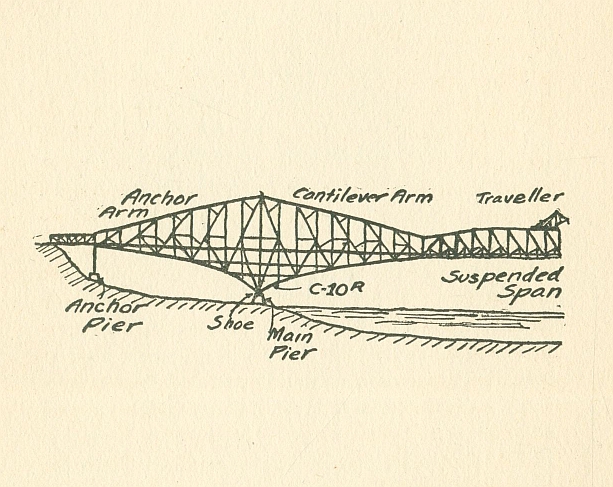
(Sketch of parts of a cantilever bridge)
I LOVE OF WOMAN
If meetings only lived up to their anticipations, life would be a succession of startling climaxes. It had been some months since Meade had seen Helen Illingworth. He had dreamed of meeting her every day and had pictured the meeting differently and more rapturously after every letter. When Abbott had received a telegram from Colonel Illingworth stating that he and his party, including his daughter, would arrive the next day, all the anticipations of months had been concentrated and Meade had imagined a romantic meeting in which the longings and desires of the period of separation would all be summed up in one dramatic moment. As a matter of fact the whole thing was casual and ordinary to the last degree. It always is.
In the first place, Dr. Severence, a retired physician, who was vice-president and financial man, and Curtiss, the chief engineer of the Bridge company, were hard upon Miss Illingworth's heels as she stepped down from the car to the station platform. He saw her, as it were, surrounded by prosaic men. None of these men was a possible rival. Each was old enough to be her father so he could not really be jealous of them except in so far as he was even jealous of the wind that kissed her cheek—at least that is the way he put it to himself. There was a vein of poetry in this engineer, as there is in every man who achieves in whatever profession, on whatever field of work he may adventure. Gradgrind does nothing great, he mounts to no heights, he wins nothing really worth the winning by his worship of the facts of life.
Meade had no time to indulge his disappointment. He was busy in the exchange of greetings. The woman he loved got the same welcome and the same handshake as her father and the other two men. The common-place conversation is scarcely worth recording. It was not until big Abbott, who had been belated by some sudden demand of work, came sweeping down the platform to engage the attention of the men that the anxious Meade had a moment with the girl herself.
Now Helen Illingworth had also been seeing visions, dreaming dreams and forecasting possibilities, so that she had been as disappointed as he. The only real satisfaction that either of them could take in the situation lay in the fact that the other was there. It was midsummer and the girl was dressed in some light filmy fabric which well became her radiant beauty. Meade could look at a bit of structural steel work and tell you all about it. All that he could have told you about the dress she wore, was that it was exquisitely appropriate, and presented an appearance of amazing simplicity for anyone who had the command of unlimited means for the adornment of her person. He could have figured out the cost of the most stupendous structure, but it never occurred to him that with a great price to a great artist Helen Illingworth had obtained that look of delightful simplicity. The gown he thought so modest and inexpensive, really represented the highest reach of the sartorial art as it is practiced by, and upon, fair womankind. He could not know that Miss Illingworth had spent æons of time and riches in proportion, with the assistance of the best dressmaker in New York, over this very gown, and what was more to the point, for this very purpose.
Her maid had lifted her eyebrows behind her mistress' back when she had been bidden to get out this dress for a visit to the wild and primitive section of the country in which the great International Bridge was being erected. The woman knew, from what she had heard, that there was nobody there except engineers, contractors, supervisors, and workmen, and why all this superb and costly finery should be wasted on the desert air she could not see. Even her father, who was ordinarily indifferent to what his daughter wore, noticed it and commented on it when she appeared.
"I've had the dress now for over a month," responded Helen in answer to his observation, "and I want to wear it once at least before it goes out of fashion."
It was not wasted on Meade, she decided, as she caught his rapturous glance; that is, the details were, but the effect produced was entirely satisfactory and quite what she had expected. She had never looked lovelier. She was not a fragile, ethereal woman; quite the reverse. That was one of ten thousand things Meade liked about her. She was modern and up-to-date in every good sense of the word. She could do all those athletic and practical things that modern young women can do and she could do them well. Was it riding, or swimming, or golfing, or driving a speed-boat or motor-car, she took them as an ordinary girl takes bridge or the latest fantastic dance.
Meade was intensely practical and efficient. He could do all of those things himself and many more and he liked to do them, and that is one reason why he had been attracted to her; yet not for that alone did he love her. On that soft summer afternoon she looked as subtly delicate as every man would at one time or another have the woman he loves appear, and as far removed from things strenuous as if in another world! Distance and absence had but intensified the man's passion. He awoke to a sudden and overwhelming realization that he had been a fool in that he had utterly failed even in his most ardent thought to appreciate the true beauty and rare quality of this wondrous woman.
A wise philosopher has pointed out that humanity may be looked at from three points of view. There is the real John, there is the John that John thinks John is, and there is the John the world thinks John is. Meade felt that he represented all three when he looked at Helen Illingworth. Amid the emotions which the sight of her inspired in him, as he answered mechanically the natural and ordinary questions put to him by the men of the party before Abbott came on the scene and relieved him of that necessity, came a swift feeling of despair. He was wearing the rough clothes, flannel shirt, khaki trousers, heavy shoes and leggings, which were his habitual use at work. Contrasted with her filmy and delicately colored fabric his well-worn olive-drab habiliments stood forth hideously. That is, he thought so, and the contrast somehow seemed typical of the difference between them as he considered her.
What was he to aspire to such loveliness? In what way did rough, rude, he measure up to such a graceful and dainty divinity? He was as humble as true lovers, of the male persuasion, usually are. She on the contrary was as arrogant as the opposite sex frequently is. The statement is made from the pre-matrimonial period! Yet, had he but known it, she was as pleased as he with the appearance of the beloved.
There was the careless insouciance of conscious power in the bearing of the engineer which differentiated him from most of the men with whom she had been thrown in contact during her life—the exceedingly well-trained, the exceedingly well-groomed young manhood of the present day. She recalled that even when her friends went for a hard day in the woods from the big house on the mountain above Martlet they always seemed to be clothed in outing togs immaculately new. Obviously the hand of little use with its daintier touch, was not that appertaining to Meade. He was made for mastery and for manful work, even as she for, in that dress, softness and sweet attractive grace. He looked strength and the fact that he was power in submission, and strength in subordination, and so obviously hers to command, gave her a delicate thrill; the same sort of thrill the great engine-driver feels when he lays his hand on the throttle. It is not only Budge and Toddy who love to see the wheels go 'round. And everybody wants to set them in motion. She looked covertly upon him as a lion-draped Omphale might have looked at Hercules, even though Meade bore no distaff in his hand.
The International Bridge was the biggest thing of the kind the Martlet Company or any other American structural plant had ever undertaken. It had been a constant topic of conversation wherever her father was. She had heard all about it and although, strictly speaking, the bridge was the work of Meade, Senior, yet she always identified it with Meade, Junior. There was a feeling in her mind that it was her bridge and that, through him, she commanded it. She was a supremely assured and entirely confident young lady, yet as the sheer and filmy mousseline-de-soie with its garniture of lace even more delicate was driven by the wind against the rough nondescript garment of the man by her side she experienced a passing sense of uneasiness, such as one might conceive the butterfly would feel in the presence of a steam hammer. Yet Helen Illingworth was not a butterfly and no more was Bertram Meade a steam hammer, at least not to her.
They were just two young people desperately in love, neither quite sure of the other, at least no assurance had been given or asked, and although the man was thirty and the woman twenty-four they loved just as if their passions had been born in the first unthinking hours of youth and maidenhood.
Experience and observation have established the fact that the whorls on the thumbs of human hands differ in tracery as one star differeth from another star in glory, and that so far as humanity can draw a general inference without having observed all the instances, no thumb is like any other thumb that has ever complemented fingers since Adam first inspected his pickers and stealers. The Power that can stamp this infinite variety in the human skin has seen to it that there are no duplications in human temperaments. Infinite is the variety of woman while women collectively are as various as that infinity raised to the nth power. The love story of every man and woman differs in some particular from that of every other man and woman. Again a sweeping deduction from perhaps inadequate observation. Yet men who have loved many have observed the variation in specific and particular instances and such single-hearted experiences as have been set down for the ruthless scrutiny of the ethic philosopher have borne out this contention.
But if it be true, as it is generally admitted, that love-making is individual and different, in one particular various woman changeth not. At sweet-and-forty given the conditions and the man she will love just as she might have—or did—at sweet-and-twenty. It well may be, God knows, that she will love the same way at sweet-and-sixty. Which is to say that although both the young people in this veracious romance had passed the period of—shall we say the Sweet Evelina age?—they were both affected just exactly the way they would have been affected if she had been eighteen and he twenty-one.
They were as awkward and constrained when left to themselves as if one had not been all over the world on man's jobs for a decade and the other had not queened it among the nicest girls of the land for half as many years. And with thoughts burning, passionate, and words embarrassingly torrential at hand to give them utterance they only spoke commonplaces!
"How is the bridge getting along?" asked the girl, repeating her father's words of a few minutes before, as these two fell behind the others marching down the long platform, while the maid standing by the private car with the porter looked curiously after the moving group and wondered if that grey-green, long-legged, young man was the reason for the New York gown!
"It's doing splendidly," was the answer, and even with his heart full of the girl by his side whom he longed to clasp in his arms but did not even dare touch the hem of her garment, some little enthusiasm came into his voice. "It is the greatest bridge that was ever erected," he said.
"How you love it," said the girl.
Did Meade love the bridge? Ah, there could be no doubt as to that.
He had studied its growth hour by hour. As the great steel web rose grandly from the pier under the hands of the busy workmen and the arms of the great traveler, his heart expanded with it. He took pride in it that increased as panel succeeded panel. He had followed it with even more heart-consuming interest and anxiety when they began to push the suspended span across the river on the outer end of the completed cantilever, toward its fellow rising on the other side. Its obsession of his soul was so strong and so complete, that he could scarcely tear himself away from it to do necessary work at his desk.
He lingered about it when the rest of the work-a-day world which was concerned with it had withdrawn to rest. Frequently late in the night he had arisen and had left the sheet-iron shack he occupied near the work (for the topography of the land and the course of the river had determined the location of the bridge far from any town), and had stood staring, fascinated, by its dim mysterious outline, high upraised against the stars, until its details were lost in the blackness overhead. Or were it moonlight, he had gazed bewitched by the great web of steel, all its mighty tracery delicately silvered, faintly outlined, lace-like, lofty, lifted high into the heavens.
He fell into a little reverie for a brief moment from which she recalled him.
"Well?" she asked.
Was there a little wistful, jealous note in her voice? He looked at her quickly as one essays a swift glance at the sun and then averted his eyes, and from the same cause. She blinded him. He really felt that he could not look at her continuously without declaring his passion before the whole world. There was much of the feudal champion in him. The civil engineer is the last survivor of the type in this modern and prosaic work-a-day world anyway. Nothing would have pleased him better than to have seized her before everybody, then and there, crushing that filmy gown against his rougher clothing, and to have borne her triumphantly away. Knight errant or cave man? There are points of similarity between them of which the world is perhaps not aware. He was ready to fill both roles, and counted himself unlucky in that there were no dragons present, although on occasion Colonel Illingworth might have essayed that part with some success.
"Yes, naturally," he found himself saying in a conventional tone of voice, "it means a great deal to me. My father——"
"Oh, your father," she began indifferently, although she knew and liked the great engineer.
"It is his crowning work and——"
"Your beginning."
"It is not in me, or in any engineer, to begin where my father left off," he said, "but in some way it is a beginning for me. What little I have done heretofore——"
"Little?"
"Yes. It isn't really very much. It seems more than it is. Anybody could have done it."
"Absurd."
"It doesn't amount to very much to me at least," he went on, smiling at her interruption, but pleased at it. "But this will count a great deal, because through father's kindness I had some hand——
"I believe you did it all," interrupted the girl.
He broke into sudden laughter and his merriment had that boyish ring she liked. He seemed to think that was a sufficient answer to that statement, for he went on quickly.
"How long shall you stay?"
And in spite of himself he could not keep his anxiety out of his voice.
"I think father's going on to the city some time tomorrow—probably in the morning."
Meade's face fell.
"So soon as that?"
"I will try to persuade him to stay longer. I've seen lots of bridges built but never one like the International, and I should enjoy standing by and watching you work."
"I don't do the work. Abbott does that, and the men, of course."
"Your work is the work that makes possible and profitable the labor of the others," she persevered. "You plan, you lead, the rest only follow. By the way, father told me to ask you and Mr. Abbott to dine with us tonight in the car."
Meade's mood changed into positive gloom.
"I can't," he said dejectedly.
"Have you some other engagement? Are you dining with some other people more to your fancy?"
"You know there is no one here but Abbott, the foremen, and the workmen."
"Why not, then?"
"I haven't any clothes, neither has Abbott. We left our dress suits behind us when we came into the wilderness to work."
"Oh," she laughed. "What difference does that make? Come just as you are. It will be a relief. I like you that way. I get so tired of black and white," she went on quickly to prevent him from taking advantage of her incautious admission.
Happiness came back to his soul at that. He had a half-formed notion of perpetually preserving these garments that she liked and hanging them up in his ancestral hall, as men did suits of armor which they had proved in strife, to which their descendants could point with pride. Just an old suit of olive drab which she liked the love of woman can dignify anything in the mind of the man she loves.
The half-formed project died, however: for one thing he had no ancestral halls.
"Really," he found himself saying, "it's awfully good of you, but I don't think I should with no garments suited to the occasion. I tell you what I'll do. I'll motor over to the town"—it lay some twenty-five or thirty miles away—"and get myself a proper outfit."
"It will take so long and I shall be here only until tomorrow," she said softly.
"Hang the clothes," said the man, radiant once more in that admission, "since you will allow it I will come with what I can rake up. But you'll have to tell me which fork to use and give me expert advice in those customs of polite society which I have almost forgotten out here in the wilderness."
"I'll do my best," returned the other. "And after dinner and you have had your smoke with the men, we will go down and look at the bridge by moonlight."
"And what will you do meanwhile if I should smoke with the men?"
"I will wait," said the woman with mock humility. "Women always wait while men smoke unless they smoke themselves, don't they?"
"And you have not learned that?"
"Not yet. It makes me feel dreadfully old-fashioned sometimes, but I have never even tried a cigarette. I don't wish to."
"I love——" he began, and then stopped amazed at his own hardihood, fearful of the possible consequences of his almost betrayal.
"You what?" she asked daringly, with another swift glance as swiftly withdrawn.
"I—I like women who do not smoke," he answered lamely, which was not at all what he intended to say, but which was nevertheless an approval of her course. "But if you think that with the possibility of but a few hours in your society I am going to sit around and smoke with your father or Abbott or Severence or anybody on earth you are sadly mistaken. I can smoke with men any time I wish, but I can only talk to you once in a lifetime."
"It isn't six months since you were at our house."
"Six months! It's a thousand years," he went on, "and I'm going to take you out on the bridge after dinner. It's great at any time. It's the most magnificent sight on earth even now, but in the moonlight—there it is now," he pointed as the little group walked past the station which had hid the view and the great structure suddenly was revealed to them.
Unconsciously the engineer used the neuter pronoun for the great structure which for all its sexlessness had still a being and a life.
It is the habit of man to imbue with personality the thing inanimate that he loves. Furthermore as love naturally is associated in the masculine mind with the opposite sex, he generally describes that genderless thing without life which is nearest his heart as "she." Witness the sailor and the ship, the railroader and the train, the chauffeur and the car. The bridge engineer is the exception to the rule. The great structures which he flings from pier to pier, which he stretches from bank to bank, which lift themselves above rivers and mountain gorges and arms of the sea, are always neuter. "It" is the proper pronoun.
The four men ahead had stopped and stood silent. There was something awe-inspiring and tremendous about the great, black, out-reaching, far-extending arms of steel. The first sight of it always gave the beholder a little shock. It was so huge, so massive, so grandly majestic, and withal so airy seen against the impressive background of deep gorge and palisaded wall and far-off mountains. So ether-borne was it in its perfect proportion that even dull and stupid people—and none of these were that—felt its overpowering presence. Meade and the girl stopped, too. After one glance at the bridge she looked at him. And that was typical. For the first time he was not at the moment aware of, or immediately responsive to, her glance. And that too was typical. She noted this with a pang of jealousy.
"You love the bridge," she said softly.
He straightened up and threw his head back and looked at her.
"I thought so," he said simply,—"until today, but now"—he stopped again.
"But now?" she asked.
"I have just learned what love really is and the lesson has not been taught me by the bridge," he answered directly.
II THE OTHER PASSIONS OF THE ENGINEER.
Yet Bertram Meade, the younger, did truly love the bridge which he had seen grow from the placing of the first shoe—the great steel base on top of the pier which carries the whole structure—to the completion of the soaring cantilever reaching out to meet its companion on the other side. Meade, Junior, although he had turned his thirtieth year, was indeed young for the position of Resident Engineer, in the interests of his father the designer, of such a bridge as the great International, which was to be the tie that bound, with web of steel, two great countries which lay breast to breast; already in touch save for the mighty river that flowed between them.
By no means would Meade, the younger, have been charged with the great responsibilities of the Bridge had it not been for two things, neither of which would have warranted his employment in that position by the Martlet Bridge Company, but which taken together induced them to give him a trial. The first was his exhaustive preparation and wide experience. No one had ever started in a life profession with better equipment than Bertram Meade. To a thorough technical training at Harvard in the Lawrence Scientific School, had been added a substantial record of achievement. A fine bridge which he had erected in faraway Burma, triumphantly achieving the design despite all sorts of difficulties, had attracted the attention of old Colonel Illingworth, the President of the Martlet Bridge Company.
He had kept the young man under his eye for a long time. When he commissioned his father, Bertram Meade, Senior, to prepare the plans for the great International, the most sought for and famous of bridges, he had noted with satisfaction that the older man, who stood first among the bridge engineers on the continent, had associated with himself his son. Meade, Junior, had recently returned from South America, where he had again shown his mettle. The two worked together in the preparation of the designs for what was to be the crown and triumph of the older man's life, the most stupendous of all the cantilever bridges in the world.
Indeed there was almost as much sentiment as science entering into the designing in the great engineer's soul. After the completion of the International he intended to retire from the active exercise of his profession. If he could withdraw with the consciousness that he had linked together two great peoples and that through the arteries of trade which ran across his bridge their hearts would beat in greater harmony, he would consider that the end had crowned all his work.
He had a high idea of his only son's ability. He was willing to proclaim it, to maintain it, and defend it against all comers except himself. When the two wills clashed he recognized but one way, his own. The relations between the two were lovely but not ideal. There was leadership not partnership, direction rather than co-operation. The knowledge and experience of the boy—for so he loved to call him—were of course nothing compared to those of his father. When, in discussing moot points, the younger man had been unconvinced by the calculations of the elder, he had been laughed to scorn in a good-natured way. His carefully-set-forth objections, even in serious matters, had been overborne generally, and by triumphant calculations of his own the father had re-enforced himself in his conclusions; and the more strongly because of the opposition.
Young Meade's position was rather anomalous anyway. He had no direct supervision of the construction. He was there as resident engineer representing his father. He had welcomed the position because it gave him an opportunity to see from the very beginning the erection of what was to be the greatest cantilever bridge the feet of the world had ever trod upon, the wheels of the world had ever rolled across.
He had followed with the utmost care, constantly reporting the progress to his father, every step taken under the superintendence of Abbott, a man of great practical ability as an erector, but of much less capacity as a scientific designer or office engineer. Meade had watched its daily growth with the closest attention. Like every other man in similar case, the work had got into his blood. It had become a part of his life. He watched it when he was in its presence, he listened for it when in the office and out of sight. The rat-tat-tat of the pneumatic riveters was music to him. Even the greater harmonies of the wind which blew ceaselessly through the deep gorge where the river ran two hundred feet below, diapasoned through his very brain.
In any mood or under any sky he liked it, even when the rains fell upon it and the winds screamed about it standing indifferent to both assaults. But perhaps it appealed to him most at twilight when the hardness and harshness of all the rigid lines of metal, still to be seen plainly in their completeness, were softened in the veiling obscurity of the half light, glowing palely red on the western hills. Then the bridge, poised upon its great pier with its gigantic arm extended over the water dark from the withdrawn sun flowing swiftly beneath, was most beautiful to him.
Yes, Bertram Meade loved the bridge; yet more he loved Helen Illingworth. Should the comparative be used? Right-minded men love many things. Even though they love honor and fame and opportunity and labor and persistence and achievement, they also love their kind; the aged parent, the loyal friend, the happy child. And some love sorrow and some love laughter, but all love woman.
Sometimes there is strife between these various passions. Happy the man who can enfold all the others within his heart without forfeiting or lessening his love for woman. Bertram Meade was that sort of man. He never troubled himself to decide among conflicting claims. They did not conflict. He loved the bridge as he loved his father; and as he loved Helen Illingworth primarily, there was no incompatibility of appeals in this trio of affection.
Sometimes, in fantastic moods, the younger Meade wondered if the bridge in some strange way could feel what it was to him, if it could know that it was more to him than to any man on earth. To Abbott it was a big job, to his father it was the crowning achievement of a lifetime of designing. To Meade, Junior, it was life itself. Because he had somehow decided that as the completion of the International meant much to his father, so also should it mean much to him. For on the day on which it stood finished and triumphant he would venture to ask Helen Illingworth that question which had trembled on his lips a hundred times since he had known her. Until that day he would keep silent.
After the woman, the young man almost idolized his father. Motherless from birth, the older man was all the family the younger had. His father's greatness had impressed itself upon him even before he was old enough to know what greatness was, or in what particular his father could lay claim to it. Nor was the older man so engrossed in his profession, as is often the case with greatness, as to neglect the smaller things in life. The young wife of the elder Meade, new-made a mother, died in childbirth and that made a great difference to the boy. Remorseful and repentant Meade was careful to make the boy his companion, by way of reparation at first and later because it was joy and its own reward to him. The two were thrown together the more by the untoward disappearance of the woman.
The childish admiration of the lad developed into an adoration of his father. When he grew up to be an engineer himself, on more than one occasion he was brought in contact with his father's work and he was able to appreciate its characteristic fineness, its superb solidity, the scientific mastery of the technique of the profession which it indicated. Perhaps his devotion to his father and to his profession, in which his aim had been to be worthy of the older man's great reputation, to live up to it, had so obsessed his mind that hitherto the attraction of womankind had not been very great.
Bertram Meade had enjoyed minor affairs of the heart, as have most young men, but they were ephemeral and evanescent until he met Helen Illingworth. He had taken her in to dinner in her father's house on his first visit to Martlet as the emissary of his own father about the plans of the bridge. It was summer and the Illingworths chose to pass a portion of it in the great big house on the mountain, the top of one of the peaks of the Allegheny range, where Colonel Illingworth could get down to the bridge works in the valley without difficulty if there was need.
Young Meade's life had been a roving one. He had met women all over the world, but he had never spent much of his time in social America and this was the first splendid American girl, gloriously representative of her class, with whom he had come into any intimate contact. He fell in love with her out of hand and although he scarcely dared to dream it—his experience had not made him very bold where such women as she were concerned—he did not fall alone.
There was back of Meade a solid record of substantial achievement in far countries and among strange peoples, where he had been confronted by unknown demands and beset by mysterious dangers. Straight and bronzed and tall and confident enough, except when he looked at her, with the assurance that comes from achievement, and with strength mental as well as physical written all over him, Meade was the modern representative of the ancient guild of soldiers of fortune. He looked at life as the knight-errant of other days who faced the world lordly a-horseback and laid it under tribute of his sword and spear, and to whom the service of woman was the highest duty, the greatest privilege, the supremest pleasure.
Meade was the means of communication between his father and her father. He was often at Martlet that summer. He met her in the city in the winter. He followed her for a brief visit to the South. The next summer found everything settled but a proposal on his part, and an acceptance upon hers. Proposals bear the same relation to love affairs that prefaces do to books. They seem to come first, but in reality they are the last things said or written. And for the time to speak or write he waited for the bridge, she for him.
Indeed Helen Illingworth had been very much vexed at her somewhat restrained lover. She resented it that a man who had been a construction engineer at home and abroad, could possibly be timid even before a woman. When he had not spoken the fateful words at their last meeting she could scarcely veil her disappointment from him. She made no effort to conceal it from herself. And when the engineer came to think of what had happened he cursed himself for a fool, because he had not put everything to the touch. Yet he felt the proper hesitation in which a man should always approach a woman, especially if he craves success. He was not sure of her. It might be that she would say no. The fall of the bridge could hardly have dismayed him more than that possibility. And it was after all better to wait until he had done his work and could point to his not inconsiderable share in it before he did speak. In his ignorance of the feminine heart he half fancied such an achievement might plead for him! He knew not that he needed it not.
So with father, bridge, and woman in his heart—the last as usual being first—Bertram Meade was very much a lover as he stood on the temporary siding and watched the engine drawing the special train, to the end of which was attached her father's private car, rolling down the track toward the bridge for a summertime excursion under the guise of an inspection tour.
If anybody could have weighed in a balance his respective passions, as he stood there by her side confronting the bridge, he would have discovered that for once at least father and bridge together were flying high into the air, uplifted by the power of a greater, a more natural and a final passion.
After all in the long run it is a woman, even though scarcely more than a stranger, who will win over the greatest bridge or the finest parent the world may know—especially in the case of a young man!
III THE WITNESS FOR THE DEFENSE
One of the pleasantest evidences of the possession of riches is in the luxury of a private car. Although Colonel Illingworth was personally a man of simple tastes as became an old campaigner, there was no appointment that wit could devise or that money could buy which was lacking to make his private car either more comfortable or more luxurious. Colonel Illingworth did not take large parties with him on the "Martlet," for so he had named the car. Indeed the two men and his daughter, with the cook or steward and the porter and the lady's maid, about exhausted the capacities of the car, so that there was an unusually large observation room at the end.
Anything that partook of luxury and refinement would have been of deep interest to Meade and Abbott, who had been removed from both for a long time on the work. But in its napery, glass, china, and silver, that dining table needed not to apologize to any other anywhere. The Colonel was most punctilious in dressing his part and although he willingly condoned the fact that neither Meade nor Abbott had brought evening clothes to the camp, he and his guests were arrayed to fit the table.
As for his daughter, she had put on her very best. The rude hand of mere man could not hold pencil sufficiently delicate to describe her radiant apparel. Meade, who sat nearest her, could not do it, albeit he never took his eyes off her if he could help it. Neither could the other men who looked at her so admiringly, even though one of these was her father and the other two were well and, considering the years and sizes of their several consorts, fatly married!
Again the French maid had lifted her brows surreptitiously when this gown had been ordered extracted from its wrappings and protecting tissues. She did not lift them quite so high however, because now with the sharpness of her sex and trade, she knew why Mademoiselle's best had been taken on the train and donned on this occasion. It was for the engineer who sat by her side at the table in the observation room.
If anything had been needed to reduce this said engineer to a condition of helpless impotency and despair it was this new gown. Some women's clothes wear the women, and others women wear! This is an orphic way of saying that some women clothes make, while others make the clothes. Oh, not by hand, not by any deft stitchery, but by personality. It was always difficult for mere man to describe one of Helen Illingworth's gowns, only an observing, and unprejudiced, woman could do that.
Of course every wise man knows, in spite of vehement assertion to the contrary, that as a rule women dress for other women, not for men. That claim that they dress for men is usually urged to placate the bill-payer and absolve the feminine conscience, but it is not true, that is generally speaking. In this instance, it was. There was no woman to be dazzled by Helen Illingworth's apparel in that car unless it was Celeste, the maid. No man is a hero to his valet, eke no woman a heroine to her maid. She did not usually care greatly about any impressions she made on Celeste, although the vivacious, enthusiastic expressions of approval she aroused in her factotum that night were balm to her soul. She wanted somebody to tell her how well she looked; not from vanity but as a forecast of the impression she would probably make on her engineer.
It had taken him little time to make his toilet. He rejoiced in a business suit, new and from the best tailor. He was a fastidious man in such matters, and it fitted him and became him amazingly. Abbott was dressed likewise. They were both scrubbed to within an inch of their lives, but climbing about the bridge their hands were scratched, roughened, stained, and torn. Aside from that, Meade was certainly most presentable, and old Abbott, in spite of his indifference to such matters, looked the able and powerful man he was.
The conversation at dinner was at first light and frivolous.
"I'm lost," began Abbott, "overpowered with all this silver and glass and china."
"Yes," laughed Meade, "we should have brought along our granite ware and tin cups, then we would be free from the dreadful fear that we are going to drop something or break something."
"You can break anything you like," said the Colonel with heavy pleasantry. "Make hash out of the china and cut glass," he went on with a delightful mixture of metaphors, "so long as the bridge stands."
"And that is going to be forever, isn't it, Mr. Meade?" asked the girl quickly.
"I don't think anything built by man will survive quite that long," he answered as much to her father and the others as to her, "but this gives every promise of lasting its time."
"You know," observed Curtiss, "there was some question in my mind about these big compression members. When I first studied your father's drawings I wondered if he had made the lacing strong enough to hold the webs."
"That matter was very thoroughly gone into," said Meade quickly. "It was the very point which I myself had questioned, but father is absolutely confident that we provided latticing enough to take up all the stresses. I looked into that matter myself," he went on with much emphasis.
"I guess it's all right," said Curtiss lightly. "I examined the webs and lacings carefully this afternoon. They seem to be as right as possible."
"Those trusses," said Abbott emphatically, "will stand forever. You need not worry about that."
"Are you going to finish this job on time?" asked Severence, the vice-president. "You know the financial end of it is mine, and much depends upon the date of completion."
"That depends upon you people at the shop, Doctor. If you get the stuff here to me I'll get it in place in short order," answered Abbott.
"There's an immense amount of work still to be done on the bridge, though," said Curtiss, "and you can't let up a minute if we are to complete it within the limits assigned."
"I don't expect to let up a minute. If necessary I'll get more men and work them in two shifts, or even three. Don't worry about that, gentlemen."
"We aren't worrying about anything with you and Meade on the job, Abbott," said the Colonel genially.
"Yes, you are, father," said the girl, "begging your pardon, you live bridge, and think bridge, and sleep bridge, and eat bridge, and drink bridge."
"Mercy," laughed the Colonel. "I must have a digestion that is a cross between that of an elephant and an ostrich. I'm glad I don't play it, too."
"You know what I mean," said his daughter. "Ever since the International has been started you have scarcely been able to give a thought even to me. I'm tired of it. I hope the old thing will soon be finished so that we can all go back to normal life again."
"I hope so, too," assented the Colonel, "and I guess you are right. The fact is the bridge is an obsession with us all. It is the biggest job the Martlet has ever handled. Indeed it is the biggest thing in the world. It's the longest cantilever, the greatest span, the heaviest trusses, the——"
"I've heard all about it," interrupted the girl, waving him into silence, "ever since you began it. Sometimes I think it's beginning to obsess me, too."
"You don't look like it," whispered Meade, under cover of the general laugh that greeted her remark.
"What do I look like?" she whispered back quickly in return.
But Meade had no opportunity to tell her save in so far as his eyes spoke for him because as the laughter died away the Colonel took up the conversation. That silent language which the young engineer spoke with his eyes, however, must have been quite intelligible and easy for her to understand. Her color was already high, but in the excitement of his glance in an indefinable anticipation of something, she could not exactly tell what, it deepened a little under that direct almost fierce glance.
"It is not exactly a subject for dinner conversation," said the Colonel with sudden gravity, which proved how keenly his daughter had realized his overpowering interest in the great undertaking, "but all of us here, even you, my dear, must realize how much that bridge means to us. I won't go so far as to say that its failure would ruin us, but it would be a blow both to our finances and our fame that it would be hard for us to survive."
"Have you ever known anything that my father designed to fail?" asked Meade somewhat hotly.
"No, and that is why we took his plan in spite of——"
"In spite of what, sir?"
"In spite of Curtiss here and some others."
"Mr. Curtiss," said Meade, turning to the chief engineer, "if it will add anything to your peace of mind I will assume my full share of responsibility for the matter. You know the books by Schmidt-Chemnitz the great German bridge engineer?"
Curtiss nodded.
"At first, I, that is we, thought that there might possibly be weakness in those compression members, but I checked them with the methods he advocates and then submitted the figures to my father and then he went through the whole calculation and applied coefficients he felt to be safe."
"I'm willing to take your father's judgment in the matter rather than Schmidt-Chemnitz', or anybody's," said Curtiss, "so successful has been his career."
"Now that I have seen the members in place I have no doubt that they will stand," said the Colonel.
"Sure they will," added Abbott with supreme and contagious confidence, an assurance which helped even Meade to believe.
"Of course we all know," said Dr. Severence, who had been long enough in touch with engineering to learn much about it, "that there is always more or less of experimenting in the design of a new thing like this."
"Yes," said the Colonel, "but we don't want our experiments to fail in this instance."
"They won't," said the young man boldly.
He had long since persuaded himself that he had been all wrong and his father all right, so that he entered upon his defense and the defense of the bridge with enthusiasm. He was ready to break a lance with anybody on its behalf.
"Well," began the Colonel, "we have every confidence in your father and in you. I don't mind telling you, Meade, it need not go any further, that when this bridge is completed we shall be prepared to make you personally a very advantageous offer for future relations with the Martlet Company if you care to accept it. On the strength of your probable acceptance we are already planning to venture into certain foreign fields which we have hitherto not felt it to our interest to enter."
"That is most kind of you, Colonel Illingworth," said the young man gratefully, "and it appeals to me very strongly. I have been associated with father latterly. He wants to retire with the completion of this bridge and before I open any office of my own I should like the advantage of further experience. Such a connection as you propose seems to me to be ideal, from my point of view. No man could have any better backing than the Martlet Bridge Company."
"Well, we shall look to you to be worthy of it," said the Colonel kindly.
His glance vaguely comprehended his daughter as he spoke. Colonel Illingworth was a very rich man. The Martlet Bridge Company was nearest his heart, but he had many other interests. His only daughter would eventually be the mistress of a great fortune. She could have married anybody—anywhere. Indeed Europeans of high station and ancient lineage had already indicated quite plainly their willingness to ally themselves with beauty and—is it doing them an injustice to say booty, as well?
But Miss Illingworth would have none of them. She was an American to the very core and so proud of it that no old-world title or position could buy her. None of these distinguished gentlemen of foreign birth who had come a-wooing had made any lasting impression upon her. She was now convinced, and for all her life she was sure, that she wanted more than anything else just one American man in the engineering profession! She could have him for the taking, she knew. And she wished he knew it, and would act upon the knowledge without further delay.
Meade was not poor. Of course, his means were limited compared to Colonel Illingworth's great fortune, but what he had earned, saved, and invested was sufficient—yes, even for two. And he would inherit much more. Old Meade had not been the greatest engineer of his generation for nothing. Independent and self-respecting, young Meade could not be considered a fortune-hunter by anybody. He was the kind of man to whom a decent father likes to intrust his daughter. Old Colonel Illingworth found himself gazing wonderingly at the two in a way that again deepened the flush of color in his daughter's cheek as she caught his look. She was relieved that Meade had not happened to observe it.
Had he been blessed with a son by his long dead wife he would have been proud if he had been the type of man that Meade was, thought the Colonel, as he mused on all these possibilities. Perhaps Meade and Helen might—who could tell? He sat silent, so far as he could as host, during the latter part of the dinner, in his turn seeing visions and dreaming dreams. There was a contagion of that sort of thing around that bridge, it would seem.
After dinner the men went out on the observation platform with their cigars and coffee. For those that liked it there was something in tall glasses in which ice tinkled when the glasses were agitated, but Meade declined all three.
"With your permission, sir," he said, "I am going to take Miss Illingworth out on the bridge. The moon is rising and——"
"I have heard so much about it," said the girl, standing by the door. "I want to see it when the workmen are all off and it is all quiet, in the moonlight."
"Very well," said the Colonel. "You will be careful of her, Meade?"
"I'll be more careful of her than we are of the bridge, sir," was the prompt answer.
"And you had better change your dress, Helen, before you go," said the Colonel, turning to Abbott and engaging him in conversation on technical matters.
"I'll wait for you at the front door of the car," said the engineer, his heart beating like a pneumatic riveter and sounding almost as loud in his ears.
As she turned to her stateroom he decided not to break the delicious anticipation of the coming adventure by talking about it to anyone or by seeing anyone but her. He just wanted to wait for her alone in the dark until she came, so he followed her down the corridor to the other end.
"I won't be long," she whispered as she left him.
He took that with a grain of salt. A second that she were away when she might have been with him, would be a long time to him, he knew.
IV THE PORTAGE THROUGH THE DUST
Now Helen Illingworth did not want to waste time any more than Bertram Meade did. It was, of course, the height of foolishness for her to explore a half-completed bridge, or an entirely finished one for that matter, in an elaborate and expensive dinner gown. But whatever her age or his they were at that period of life and love in which, if ever, humanity had a clear title to be foolish—and there you are!
Economy had not necessarily been inculcated in this young woman's mind and although she prized the dress it had served its purpose, since the man so obviously highly approved of it and her. If she spoiled it she spoiled it and that was all there was about it. She dismissed that possibility promptly. There was nothing else she could wear which was so exquisitely becoming, anyway, and especially in the moonlight. So, instead of taking her father's advice all she did was to cover her beautiful shoulders with a light wrap, gather the train of her gown in her hand and hasten to the car door in the shortest possible time. She did not even stop to change the light slippers and filmy stockings she wore, satin and silk of the same delicate tint and fabric to match her gown. It was a warm summer night and she needed no covering except nature's golden crowning on her head.
Every moment they were apart, since the sum-total in which they could be together was so small, was a moment lost. What were all the dresses and slippers on earth to the pressure of his hand, a glance from his eyes? She was very much in love with him and he with her then, and thereafter.
"Now," she said, coming out of the door of the car and descending the steps toward him, eagerly expectant, "I want a prize for my swiftness."
"A prize!" returned the man, "why, you've been gone years and years and years. You have had time to dress yourself a thousand times, and you haven't even changed your gown. What have you been doing? How have you idled away precious time you might have bestowed upon me?" he concluded reprovingly in mock severity.
"I think that it's less than sixty seconds since you said you would wait for me here," she laughed in joyous satisfaction.
"Of course, time seems shorter to you than it would to me," was his cool reply. "It naturally would. You don't have to wait for any man, things come always to you."
"If you can refer to me as a thing, Mr. Meade," she replied, "in this instance I have come to you."
"I thank heaven you have done so, but unfortunately I shall have to dismiss you."
"Dismiss me, why?"
"You can't go out on a bridge in that gown and those slippers, tramping over dirty tracks, piles of steel, rough wooden planks, paint and——"
"Can't I?" she said, "you just see."
"Really haven't you got anything for rough work that you could put on?"
"I have a walking suit."
"That would do."
"But it would take me half an hour to get out of this and into it and——"
"I hate to see you spoil your dress," he said uncertainly as she stopped.
Really what gown on earth was worth half an hour of her society? At least that is the way he felt about it, and evidently she felt the same way.
"It is settled, then," she said, slipping her arm through his as they walked down the long wooden platform near the siding. "You know," she continued, feeling herself obliged to speak since he was so portentously silent—ordinarily he was a fluent and ready man but something had got hold of him now and he was as shy and speechless as a boy—"You know," she went on, "I have heard so much about that bridge and how wonderful it is by moonlight that I rather felt that I ought to dress the part when I came to inspect it under such auspices."
"What about me?" he asked.
"You are dressed in the part, too," she continued, "yours is the strength and the power and masculinity of the bridge——"
"While you are its grace and beauty," he concluded as she hesitated.
"I didn't like to say it myself and I won't admit it is true, but——"
"You don't have to admit it," he said quickly. "In this half light you look as mystic and ethereal as——"
"And how do I look in the whole light, pray?"
"A trifle more substantial but not less beautiful and winning," was the prompt answer.
Really for a timid man, with women, he was doing very well he thought, and so did she.
"Do you prefer the ethereal woman, the dependent woman of the mid-Victorian period to her self-sufficient descendant of the present day?"
"I like a woman to be all things not to all men, but to me, at different times"—he ran the whole gamut of feminine possibilities in his desires, it seemed!—"There are times when the clinging mid-Victorian 'female' is the sweetest thing on earth to a man and there are times when the woman who can march shoulder to shoulder with you is the one woman you desire. Tears, laughter, submission, mastery—a man wants a woman in all her possible moods," he concluded oracularly.
"You want a great many things, it seems to me," she retorted mockingly.
"Yes, but only one woman."
"Well, you want her to be a great many things, then."
"I just want her to be herself."
Now Meade was perilously near that point when he would describe his love if he ventured to discuss it further in the words trite but true, "I love you because you're you!" That is what he meant anyway, and incidentally although our sense of humor even in our tenderest moments may spare us from the banality of the exact words, it is what all think and most say in one way or another under such circumstances.
"I hope some day you will meet this imaginary creature of infinite variety," said the woman softly.
"I hope so," was the somewhat surprising answer, at which she was not a little chagrined.
"You know you men have so many advantages over poor womankind, you are free to go everywhere and pick and choose," she went on, carefully concealing her discomfiture.
"To tell the truth, I have met the woman," the man admitted.
"Where, in Burma?"
"In America."
"America is a great country and there are a hundred million people in it, possibly half of them my sex.
"Your statistics are sadly in error."
"They are the latest, I believe."
"The latest in this instance are wrong. The population of America, as I see it, is only one."
This was direct and unequivocal. He was gaining courage, fast mastering his timidity. She was by way of being swept off her feet, so that woman-like she temporized. She changed the subject although it was the subject nearest her heart and the one she most wished to discuss; to wit, herself, in relation to him.
They had now reached the end of the platform in their slow progress, and as they turned about the temporary station and storehouse before them rose the bridge. The moon larger and more magnificent than she had ever been before to either of them—for when, since God set the night lights in the firmament, had there ever been an evening like that?—was rising over the high hills that sprang up from the steep cliff-like bank of the other side of the vast river. They saw her round red full face through an interlacing tracery of steel. The lower part of the bridge was still in deep shadow. Indeed the moon had just cleared the hills of the opposite bank of the great gorge cut by the broad river flowing swiftly in its darkness far below.
The base of the truss was yet almost invisible and the effect of the peak of the pyramid of steel brilliantly gilded by the high light and rising out of dark nothing was as wonderful as the picture of a mountain top glowing in the setting sun while all the valley is sunk in the ever deepening shadows. At the further end of the suspended arm extending far over the water the top of the traveler glistened in exactly the same way. The cantilever on the opposite shore, incomplete and sunk under a high rise of land, was still in shadow and not yet discernible.
Instinctively the two people stopped and gazed out and up and across. Unwittingly the woman drew a little near the man. He became more conscious than before of the light touch of her hand upon his arm. It was very still where they stood. The shacks of the workmen had been erected below the bridge about a quarter of a mile to the right along the banks of the little affluent of the main stream. They could hear faint but indistinguishable noises that yet indicated humanity coming from that direction. The fires in the machine house and in the engines were banked. Lazy curls of smoke rose to be blown away in the limitless areas of the upper air. In the darkness all the unsightly evidences of construction work were hidden.
"Oh," said the woman, drawing a long breath, "I don't wonder that you love it. Isn't it beautiful, flung up in the air that way? One would think it wasn't steel but silver and gold and——"
"Time was," said the man, "when I loved a thing like that above everything except my father, but now——"
In spite of herself the woman looked at him.
"But now?" she whispered as he hesitated, and then she turned her head half fearful of his answer.
"I am almost afraid to say it," he said, lowering his voice to match her own.
"A soldier of steel," she said, "and afraid!"
"Well then, all that was the second now takes the third place."
"And before your father comes?"
But she did not give him time to answer. Atalanta cast the golden apples before Hippomenes, but she delayed her pace while he picked them up. This girl would and would not. She threw her golden personality in his face, and when he reached for it she glided ahead again.
"Come," she said, "let us go out on the bridge."
"It looks beautiful," said the man, "like most things in the moonlight, but——"
"Even women?"
He nodded his head.
"But appearances are deceptive," he went on. "It's a rough place for you. Those little slippers you wear——"
He looked down and as if in obedience to his glance she outthrust her foot from her gown. It was not the smallest foot that ever upbore a woman. Quite the contrary. Which is not saying it was too large, not at all. It was just right for her height and figure, and its shape and shoe left nothing to be desired.
"Never mind the slippers," she said, "they are stronger than they look. They'll serve."
"But the distance between here and the bridge is inches deep in dust."
"Dust!" she exclaimed in dismay. "I don't mind rough walking, but dust——
"I never thought of that," admitted the man. "The fact is I have thought of nothing but you since I saw you, but now we'll have to go back or——"
"I shall not go back," she answered firmly.
"Well then, there is no help for it, pardon me."
He stepped down off the platform and before she knew what he would be at he lifted her straight up in his arms. He did not carry her like a baby, he held her erect, crushed against his breast and before she had time to utter a protest, or even to say a word, he started through the dusty roadway toward the bridge-head.
It was a strange position. There was nothing that she could do. He clasped her with a grip of iron, too tightly for her comfort, indeed, but the pressure he put upon her was due entirely to his own nervousness. She could not kick. She could not even move. Really she did not wish to. It was respectful enough even if a little absurd. What he was doing was so obviously the proper thing to spare her dainty slippers and silk stockings and other finery. And, if it were not, she could not help liking it. She knew she ought to protest, but the words did not come. While she was trying to think them up they had crossed the little desert that intervened between the portal of the bridge and the end of the platform. Then he set her down gently. She felt her feet strike solid plank and she was distinctly sorry that the journey was ended, the crossing had been made.
Another woman might have reproved him then, just as another woman might have screamed or tried to kick or beaten him over the head en route. Her arms had been free, but she had attempted none of these things. Perhaps love, perhaps a sense of humor, or both had saved her. He was glad to recognize the difference between her and the ordinary member of the sex. It flattered his discrimination that she had accepted so coolly and quietly, outwardly at least, his services as a matter of course.
"Thank you," she said simply, "that was very nice of you. You are wonderfully strong."
Now a man's bodily strength is something for which in a large measure he has no responsibility, for which he can claim no merit, but there is no subtler form of flattery that a woman may offer a man than to praise him for physical prowess. He feels much more satisfaction in being told that he has a strong arm than in having it pointed out that he carries a great brain, and Meade was pleased beyond measure.
"It's nothing," he said, which was scarcely true, because it was the greatest thing that had ever happened to him so far. "Those shoes of yours will be ruined on this planking, but at least there is little dust. If my feet were not so enormous I——"
Helen Illingworth laughed outright at the idea.
"My own shoes will have to do me and if they are ruined I can get another pair or a dozen."
"Bad lookout for your husband, if he happens to be a poor man."
"Oh, I wouldn't spend my husband's money as I do my father's," laughed the young woman with that indifference to father's money which is characteristic of the relationship, the age, and the sex.
"Could you be happy with a man who couldn't give you dresses like this and slippers and——"
"If I loved him I could be happy with him in rags," was the reckless answer.
They were now walking down the track on the floor of the approach-span of the bridge. There were two railroad tracks running out across the bridge to the end over the river, and the space between the rails was covered with rough planking. The man on guard at the entrance recognized the engineer and, with a word of greeting, the two adventurers passed him and marched down the track. They had now reached the anchor arm of the cantilever proper. On either side of them rose the ribs of the huge diamond-shaped truss, one point resting on the vast shoe on the pier and the other point, both the center and focus of the radiating arms of steel, far above their heads.
The moon, by this time, had passed the floor level and the cross bracing cast a network of shadows over them, upon track and floor beams and stringers. The silence of the half-light, the mystery of it all oppressed them a little. It was with beating hearts that they pressed on.
V FALL AND REVELATION
"It's rather confused in here," said the man, "but we will soon get out toward the end and then the view is magnificent. You can see up and down the river for miles and the night boat will be along in a few minutes."
"Isn't that it?" asked the woman, pointing up the river to where a cluster of lights rounded a huge bend not far away, and swung out in midstream.
"Yes," said the man, "if we listen I think we can hear her."
They both stopped, and sure enough faintly across the water came the noise of the clanking paddles of the big river steamer. With that sound also mingled the song of the night wind, for a wonder comparatively gentle, making strange, weird harmonies as it sifted through the taut and rigid bars of steel. She listened enchanted with the sound.
The big floor beams extended from one side to the other of the bridge, between the trusses at intervals of fifty feet. At right angles to them and six feet apart the stringers ran lengthways parallel to the trusses. Here and there pieces of timber false work had been thrown across the stringers for the convenience of the workmen, but as these two slowly moved toward mid-stream at last these pieces became fewer and finally there was nothing to be seen but the heavy floor beams and the lighter stringers.
After they passed the top of the pier and got beyond the small space of river bank on which the pier was set, there was nothing between them and the water, now moonlit and quivering, except these cross girders of steel on either hand beyond the planking in the tracks.
"Have you a clear head?" asked the man. "I mean does it affect you to be on high elevations? Do you get dizzy?"
"I never have," was the answer, "but——"
"I think I'll hold you," was the reply.
He grasped her firmly by the arm. The loose wrap she was wearing over her shoulders did not cover her arms and it was a bare arm that he took in his hand.
"I beg your pardon," he said quickly, "but——"
"It doesn't matter. I understand. You would better hold me, I might slip."
She was in fact as clear-headed as any woman on earth. She had stood alone and unsupported on the brink of precipices a thousand feet high, yet her heart had not beaten then as it was beating now and she had never felt the need of support before. There was something electric and compelling in the pressure of his strong hand upon the firm flesh of her round arm. She shrank closer to him, again unthinkingly, by a natural impulse.
The moon was now well clear of the brow of the highest hill. Its yellow was turning to silver and in its cold and beautiful illumination the whole river flowed bright beneath them. Every inch of the bridge was now clearly revealed in the white passionless light.
Their progress was now checked by a flat car, fortunately partially unloaded, which had been left on the track before them when the men knocked off work. They would complete its unloading in the morning. If Meade had been alone he would have crossed on one of the floor beams to the other track, but that was not to be thought of in the case of Helen Illingworth.
"Too bad," he said in deep disappointment, "I suppose we shall have to go back. I'll rout out one of the engine-drivers and get him to pull this car out of the way——"
"Can't you climb that car?"
"Certainly I can."
"Well, so can I if you help me."
"I'll help you this way," said Meade, having acquired a certain facility from his previous performance, as he lifted her up to the low platform of the truck, lower by the way than the level of an ordinary railroad car. Placing his hand upon it he vaulted to her side. They walked across it quickly, choosing the side that had been unloaded of its burden of iron for their path.
"Wait," said Meade as they reached its end.
He sprang down to the track and as she leaned forward he lifted her down also. Fifty feet away the bridge ended in the air. They were now almost directly beneath the traveler near the end of the suspended span. Its huge legs sprawled out like those of a gigantic animal on the extreme edges of the bridge on either side above their heads. The wooden platform on the track ran out half the distance to the bridge end. Slowly the two walked along it until but a few feet was left between them and the naked floor beams and the stringers carrying the ties to which the rails were bolted and the planks laid.
By the side of the track on the top of the stringers had been placed a pile of material surmounted by a large flat plate of steel which lay level upon it. It was triangular in shape, the blunt point turned inward. The base which was about six feet wide paralleled the course of the river. The plate on the top of the pile was raised about three feet above the level of the track. They stopped abreast of it.
"Can't we go any further?" asked the girl in low tones, still close to the young man, who still tightly clasped her arm.
It was a night and time in which to speak softly. Yet a whisper would not serve. Indeed there was always wind in the gorge and out there on the end of the bridge. It might be never so still on the shore but there was always a current of air where they were and it seemed to be coming stronger. The sound of it overhead was louder, and less pleasing. There was a threat in its notes as it swept through the steel. Her dress was whipped about her by its force. The drapery which she wore about her shoulders blew against him. She drew it around her with her free hand and looked at him for her answer.
"I'm afraid it wouldn't be safe to go any further," he said.
"But I must, I want to see the steamer."
"It will pass directly under the bridge."
"But this wooden platform will hide it, this and the pile of steel here."
"They have no business to pass under the bridge," said Meade. "They've been warned hundreds of times and orders have been issued."
"Why?"
"There is always danger that something might fall."
"At night with no one working?"
"Yes, even at night. We are never quite sure that everything has been made secure until we examine it. A bolt or a nut or a bar of steel or a tool, to say nothing of a beam, falling from such a height would kill anyone and the beam might sink the steamer, but they still come as near as they like. The passengers seem to wish it and the captains humor them. Besides the best water and the least current to fight against seem to be just under the bridge end yonder."
"Can't we go just a few steps nearer?"
"I would not have anything happen to you for the bridge itself and all the rest of the world."
"You couldn't say more than that, could you?"
"I could say much more than that if I——"
But she interrupted him again.
"Why can't I stand up there?"
"On that gusset plate?"
"Is that what you call it?"
"Yes, it bears the same relation to structural steel that a gusset does to a woman's dress. I don't suppose you know how to make a dress?"
"Do I not? You don't know that I have done some settlement work, do you?"
"No, but I am not surprised to find that you have done anything good and useful and beautiful."
"Well, it's hardly that last, but as it happens I could make a dress if——"
"If what?"
"If I were a poor man's wife and had to."
She laughed a little nervously.
"A dress like the one you are wearing?" he asked.
"Hardly that," she laughed again. "It took an artist to do that, and I would not want one like it in that case. I am only at best a plain sewer."
"Plain!" persisted he fatuously.
"Exactly. But can't I stand on that?"
"Wait," he answered.
He climbed to the center of it, lifted himself up and down on his feet to test it and found it solid apparently.
"I think so," he said at last, "but I shall have to put you up."
"Am I never to be allowed to climb anything myself?" she asked as he lifted her up and set her down on her feet in the middle of the plate of steel as gently as before.
"Not when I am by to help you," was his reply.
"Perhaps you do not know that I am one of the few women who have done some real mountain climbing?"
"I don't know anything at all about you except that I——"
"Oh, there comes the steamer," she cried. "I can see it beautifully from here."
"Be careful," was his answer, "you must not move. Stand perfectly steady. I am not so sure of that plate. Indeed, if you will permit me——"
He reached over from where he stood on the track below her and by her side and gathered the material of her dress into what could only be described as a bunch, which he held in an iron grasp.
"I do not think that is necessary," she said. "This plate seems as solid as the rest of the bridge and—oh, there's the steamer! She's right under us."
The big river craft was filled with light and laughter. The wind fortunately blew the smoke away from the bridge so that they had a clear and perfect view of her. There was a band playing aboard her. They heard the music above the beat of the whirling paddles, the song of the rising wind. The passengers were congregated about the rails on the upper decks staring upward. The bridge was as fascinating to them as it was to the people ashore evidently.
"How interesting," said the delighted girl. "Why don't you come up here yourself, you can see so much better?"
The man dropped her gown, lifted his right foot to the pile on the stringers to follow her suggestion. Thoughtlessly she stepped toward the outer end to give him room, quite forgetful of his caution. The gusset plate was not so securely bedded on that uneven pile as either of them had fancied. Before he could complete his step or warn her of the danger, it now bent forward. It tilted distinctly. In spite of herself, Helen Illingworth was carried still farther forward as in her excitement she sought to regain her balance and that disturbed the unstable equilibrium of the piece of steel still more. It began to slip downward, grating on the pile of beams as it moved; another second and it would be off and on its way irrevocably.
Meade threw himself at the girl. He lunged out and caught her just as she was slipping downward with the plate now almost perpendicular. To catch her he had to step to the very edge of the planking beyond which the rails ran naked on the ties.
With a tremendous effort he caught her by the waist and swung her up and in and backward. Fortunately the hypothenuse of the plate ran away from the pier or it might have swept her down in spite of all he could do. As it was he caught her furiously to his breast and stood fast on the brink quivering, heaving himself desperately backward as he sought to maintain his balance and take the backward step that meant safety.
Neither of them had said a word. A wild shout rose from the steamer as the huge plate dropped, like the blade of a mighty guillotine, straight down through the air. The floor plane of the bridge was two hundred feet above the water. The heavy piece of steel, weighing hundreds of pounds, was traveling with the velocity of a lightning flash when it neared the water. If it had struck the boat it would have cut it through like a knife. Fortunately it cleared the gangway by inches. In a second or more it had disappeared. Screams, shouts, arose from the boat which promptly sheered off into midstream.
Helen Illingworth's back had been toward Meade as he seized her. She had seen as he had everything that happened. Recovering himself at last he stepped back slowly, almost dragging her, until they were a safe distance from the edge.
"My God," he said hoarsely. "What a narrow escape."
"For the boat?"
"What do I care for the boat?"
"For me?"
"I thought you were gone."
"And so I should have been if you had not been there."
"If you had gone down I should have followed you, I swear."
His face was ghastly white in the moonlight. Sweat covered his forehead. He was shaking like a wind-blown leaf both on account of the strain of his sudden and terrific effort, and because of the reaction from the horror that had overwhelmed him as he saw her sliding.
"The whole world went black when I saw you go," he said slowly.
"Do you care that much?" asked the girl, trembling herself.
There was no necessity for maidenly reticence now.
"Care?" said the man, "care?"
"I'm all right now."
"You are more fortunate than I. I stood to lose you, you stood to lose only life. Don't you see? Can't you understand? My God!"
Suddenly he swept her to his breast as this time she faced him. She was very near him and she did not make the slightest resistance. It was the fourth time he had taken her in his arms that night, but this time there was all the difference in the world.
She had waited for this hour and she was glad. They had faced death too nearly for any hesitation now. She knew from what he had said to her that he loved her, and although he had not referred to it in any way she also knew that he had so superbly and magnificently saved her at the imminent risk of his own life. There had been swift yet eternal moments when it seemed that both of them, trembling on the brink, would follow the downward rush of the gusset plate. Now as he strained her to him, she lifted her face to him, glad that she was tall enough for him to kiss her with so slight a bend of the head.
There, under the great trusses of steel, amid the huge, gaunt, massive evidences of the power, of the might, of the mastery of man, two hearts spoke to each other in the silence, and told the story that was old before the first smelter had ever turned the first ore into the first bit of iron, before Tubal Cain ever smote the anvil; the story of love that began with creation, that will outlast all the iron in all the hills of the earth—that is as eternal as it is divine!
VI THEY CROSS THE BRIDGE TOGETHER
Ordinarily Meade's head was as clear as the air of a mountain top, his nerves as steady as the steel of the great bridge, but that night after the shock he had sustained he was almost afraid to attempt to return to the shore along the planks laid between the rails. No experience that he had ever gone through had so completely unnerved him. It was then the woman who played the man's part. As he said, all she had faced was loss of life; that was a simple thing in his mind compared to the loss of her; extravagant, foolish, if you will, but true.
He blamed himself, too, for having allowed her to climb up on that gusset plate. To be sure he had tested it, but, as the event proved, he had not tested it as thoroughly as he should. Indeed, the fact that the most precious thing on earth to him, the being he loved above all else together, had been nearly killed through his lack of care, his failure absolutely to make sure, smote him terribly. He strove, at first vainly, to control himself, but presently by the exercise of as iron a constraint as was ever imposed on nerves by the will of man, he succeeded in attaining some degree of composure.
After that wild embrace, that first rapturous meeting of lips, he had released her slightly, though he still held her closely and she had been quite content to be so arm-encircled and await his further pleasure.
"I'm quite calm, now," he began, "that is, I have mastered that awful horror and the nervous shock that came upon me when I saw you sliding away, and I am as composed as any man could be who is holding you in his arms."
"It's all over now, there is nothing to reproach yourself with. I am safe, thanks to you. I should not have ventured, anyway."
"Yes, but if it had not been for me you would never have been in danger. It was my fault. I should have made sure. I shall never forgive myself."
"But I forgive you gladly because I shall never forget that if I had not been in danger I might not now be here in your arms."
"Oh," exclaimed the man, "how sweetly you put it—nevertheless——"
"And if I were not here," she went on swiftly, too happy in her love to be mindful of anything else, "I certainly would not be doing—this."
And of her own motion she kissed him in the moonlight.
"And if you were not doing this," said he, making the proper return, "I might not have had the courage to tell you."
"You haven't told me anything—in words," she answered, fain to hear from his lips what she well knew from the beating of his heart.
"It's not too late then to tell you that I love you, that I am yours. To give myself to you seems to be the highest possibility in life, if you will only take me."
"And do you love me more than the bridge?"
"More than all the bridges in the world, past, present and to come; more than anything or anybody. I tell you I never knew what love was or what life was until I saw you sliding to your death."
Sometimes only death opens the eyes to the meaning of life.
"I'm glad I fell just as far as I did."
"One foot more and you would have been in the river."
"As it was I stopped just at the level of your heart."
"Yes, thank God."
"And your own quickness and noble strength."
"I thought I was too late when we trembled on yonder verge."
"Do you know you actually hurt me when you swept me so roughly to you, not but that there are some pains that surpass all joys."
"There was no time for gentle measures."
"I know, and I knew I was safe when you caught me. Somehow I expected you would do it. I knew that you would not let me fall."
"If I had not succeeded I should have followed you."
"I felt that, too," she answered dreamily.
"We must go back, dearest," he said at last, "I am so fearful for you even now that I am almost unwilling to try it. Every time I glance down through these interspaces between the stringers my blood runs cold."
"You supported me before; I will support you now," laughed the woman.
"No," said the man, "we will go together."
They turned toward the shore. He took her hand and slipped his other arm about her just as simply and naturally as if they had been any humble lover and his lass in the countryside.
"No place on earth will ever be what this bridge is to me," said the woman. "I knew you loved me, of course, at least I hoped so; at any rate I knew that I loved you——"
"I never dared dream that you could."
"But here the words were first spoken, here you first took me to your heart, here you kissed me first." She stopped and he with her, she flung her free hand up in the air. The moonlight fell softly upon her sweetly rounded arm. "Oh, beautiful bridge, oh, exquisite creation of stone and steel, you have gives my lover to me. The wind will never blow through you, the moon will never shine upon you without recalling that," she cried rapturously. She waited a moment while his heart whispered amen. "Let us go," she said reluctantly enough, loath to leave the place where death had stretched out his hand and love held him back.
"One more kiss," he pleaded, "and then——"
By and by they got to the end of the bridge.
"I shall carry you across the dust once again," he said as they passed out of sight of the watchman, who had seen the falling plate and heard it splash into the river; but being a discreet man and realizing that the engineer and the woman were safe he had made no outcry. Meade thereafter properly rewarded him for his discretion.
This time he held her differently. This time she slipped her arm about his neck and laid her head upon his breast and he carried her as he might have carried a child. When he set her down on the station platform, now quite deserted, they both discovered first that she had lost the light wrap that had shrouded her bare shoulders and next that in the violence with which he had seized her as she fell, the skirt of her dress, which had caught on a piece of steel, had been rent and torn. It did not affect her appearance, in fact in that moonlight, she looked positively heavenly to him at least.
Far down the platform they could see the lights of the car.
"Listen," she said as they walked slowly along. "You must not tell father anything about this little accident."
"I obey, but why not?"
"It would only worry him, and it was my fault."
"No, mine."
"I will not hear you say it."
"But I must speak to your father about——"
"And the sooner the better; he is in good humor with you and the bridge now. I have heard him speak well of you. He is intensely American and he has never been anxious to have me marry any foreign title, or even the fortune hunters of our own country who have wooed me. I believe he will be glad to give me to you."
"And if not?"
"I should hate to grieve my father, but——"
She turned and looked at him in the moonlight, her glorious golden head, her neck, her shoulders, her arms bare and beautiful in the celestial illumination which gave to the warm flesh a touch of coldness, and mingled purity with the passion she inspired and exhibited which made it almost holy in both their hearts.
He seized her hand and lifted it to his lips as a devotee, and she understood the reason for the little touch of old-world formality and reserve, when nought but his will prevented him from taking her to his heart and making her lips, her eyes, her face, his own.
"Now may God deal with me as I deal with you," he said fervently, "if I ever fail at least to try with all my heart and soul and strength to measure up to your sweetness and light."
"My prayer for myself, too," she whispered. "You need it not."
"You must wait here," she said, deeply touched, as they had now reached the steps of the car, "until I have changed my dress; father would notice, anybody would, that tear. When I have finished I will come back to you and then we will seek him and tell him."
Accordingly Meade stood obediently waiting outside the car in the shadow it cast. There was no one about. The servants had gone to bed. The porter of the car was nodding in his quarters waiting for the time to turn out the lights. The engineer had the long platform all to himself. After a time he chose to walk quietly up and down, thinking. The future looked very fair to him. To be sure he had nearly lost the woman he loved in the river, and it had been his fault. He overlooked the fact that she had disregarded his caution and stepped forward. But after all she had not fallen. He had caught her on the very brink. He could remember, he never would forget, those seconds, like hours, when he stood trembling, even swaying, upon the very edge of the bridge, with practically nothing but his precarious foothold between the two of them and the awful plunge into the river two hundred feet below. He could not think how he managed to retain his balance and draw her back with him, away from that perilous standing place; but he had done so and the result had been the confession which he had dared to make and to which she had vouchsafed that blessed return.
If only her father could see in him any fitness to be trusted with so priceless a treasure all would be well. Meade had never made a failure in his life, except in small ways which had only been of sufficient importance to teach him to cope with greater difficulties. His career had been practically one unbroken success. He had acquired a remarkably fine reputation for so young a man in his profession and he had gained it, not only because of his father's great eminence, but in spite of it; for the paternal renown had been something of a handicap in that he had at least been compelled to live up to it.
There are few tasks so hard as living up to a reputation, unless it is living one down. He was about to fall heir to such of his father's business and prestige as the one could transfer and the other take up. The great bridge was rising grandly and even he would share in the fame that it would bring to its designer. His forebodings had been unwarranted, his father's reasoning abundantly justified. He was glad. The woman he loved returned his affection. When she might have had anyone in the world she took—him! If only her father——
VII THE COLONEL MAKES CONDITIONS
"Bert," a sweet voice came to him out of the darkness, and the first familiar sound of his name from her lips confirmed all that had passed which, as he had waited, he almost had felt he had dreamed.
He turned to discover her standing in the door of the car dressed as she should have been for such an excursion had she at first followed her father's wise suggestion. His heart thrilled to the use of the familiar name. With a sort of boyish shyness he made answer in kind.
"Helen," he said, "shall I come up there?"
"I'm coming down to you."
Now whether she was afflicted with sudden weakness or he with sudden fear, it was quite apparent, had anyone been by to see, that no longer could she descend from car step to platform without much careful assistance; also she had to pay toll before he let her pass. There was no unwillingness in either case. Hand-in-hand they walked to the rear of the car, where the observation platform was still brightly lighted.
Abbott had gone and the other three men were on their feet. They were about to separate for the night, although it was still rather early.
"Father," said his daughter out of the darkness.
"Oh, you're there," answered the Colonel. "I wondered when you were coming back. I was just thinking of going to fetch you. Is Mr. Meade——?"
"I'm here, sir."
"Good-night, gentlemen," said the Colonel as the others turned away, leaving him alone on the platform.
He came to the edge and leaned over the brass railing.
"Are you two going to make a night of it?" he asked jocosely.