Front matter
Reading edition
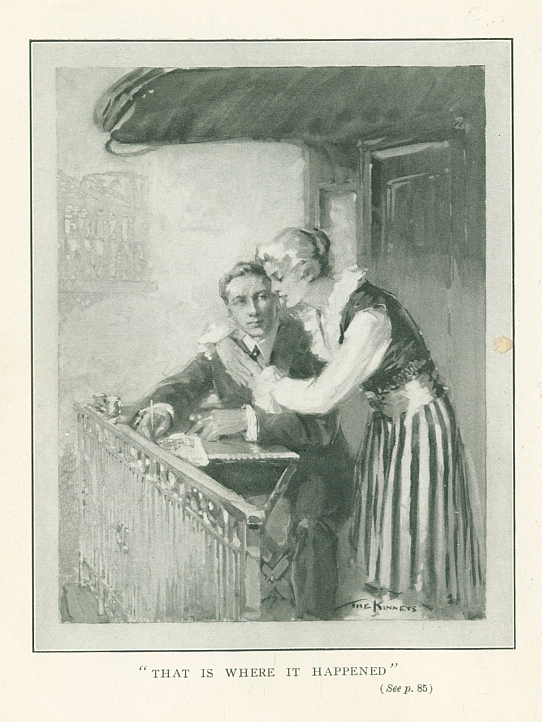
"THAT IS WHERE IT HAPPENED" (See p. 85)
WEB OF STEEL
By
CYRUS TOWNSEND BRADY Author of "The Chalice of Courage," "The Island of Surprise," etc.,
and
CYRUS TOWNSEND BRADY, JR. Civil Engineer
ILLUSTRATED BY THE KINNEYS
NEW YORK CHICAGO TORONTO Fleming H. Revell Company LONDON AND EDINBURGH
Copyright, 1916, by FLEMING H. REVELL COMPANY,
New York: 158 Fifth Avenue Chicago: 17 N. Wabash Ave. Toronto: 25 Richmond St., W. London: 21 Paternoster Square Edinburgh: 100 Princes Street
To MYRA Daughter—Wife
PREFACE
"Web of Steel," as those who read will see, is a book for men, about men, and written by men.* The authorship is placed in the plural advisedly. The book is a real collaboration. In the minds of the writers there is a further pleasant association in the fact that it is a book about a father and son by a father and son, although no one must identify the writers with the characters in the story because of that relationship.
It is said that the success of a book, like the success of almost everything else that man at least undertakes, depends upon women; that women buy, read, discuss, and promote a novel, and if the book has no appeal to women it is forever doomed. The authors have at least proved themselves men of courage, the publishers likewise, for it cannot be too insistently set forth that this is primarily a book for men. The authors hope that even with that expressed limitation it may nevertheless appeal to women in some measure, especially those who would fain enjoy—the authors are careful not to say usurp!—masculine place and function. Let no one imagine, either, the authors hasten to assure those who may honor them by reading this preface, that there are no women in the book. On the contrary the fortunes of at least one of the men and the fate of the other are woven around the eternal feminine whom the authors have striven to make as feminine and charming, as appealing and delightful, as their large experience with the other sex permits and warrants!
For the rest, whatever may be said of the fiction the authors rest confident in the engineering. Again let there be no misapprehension, this is a novel not a treatise; who runs may read, if he does not run too fast, and no scientific course is necessary for the comprehension of the story. The authors disavow any intention of picturing any engineers alive or dead, or any particular bridge or dam, in any particular locality. The whole thing is a work of the imagination except the calculations of the engineer, which are exact when not empiric!
The book is the result of genuine co-operation and accommodation. Father and son contended together in affection, albeit sometimes rather sharply, as to what should go in and what should come out. They are happy to have arrived at a substantial agreement which, while it satisfied neither author completely, yet produced a harmonious and consecutive story, with neither too much nor too little of the personality of either inserted or withdrawn to mar its symmetry. Now let all mankind read!
CYRUS TOWNSEND BRADY, Father; CYRUS TOWNSEND BRADY, Son.
THE HEMLOCKS, PARK HILL, Yonkers, N. Y.
CONTENTS
I
BRIDGE
I. Love of Woman II. The Other Passions of the Engineer III. The Witness for the Defense IV. The Portage Through the Dust V. Fall and Revelation VI. They Cross the Bridge Together VII. The Colonel Makes Conditions VIII. The Lovers Make Pictures on Paper and Heart
II
C-10-R
IX. The Deflection in the Member X. The Son of His Father Indeed XI. The Death Message on the Wire XII. The Failure XIII. The Woman's Choice XIV. For the Honor of the Son XV. For the Honor of the Father XVI. The Unaccepted Renunciation XVII. That Which Lay Between
III
DAM
XVIII. Picket Wire and Kicking Horse XIX. The New Rodman XX. The Valley of Decision XXI. Marshaling the Evidence XXII. Working Up XXIII. The Former and the Latter Rain XXIV. The Battle
IV
SPILL-WAY
XXV. The Ancient Art of Fascination XXVI. Once More Unto the Work XXVII. Brute Force or Finesse XXVIII. The Battle from Above XXIX. The Victors XXX. The Testimony of the Dead XXXI. At Last to the Stars