II C-10-R
Reading edition
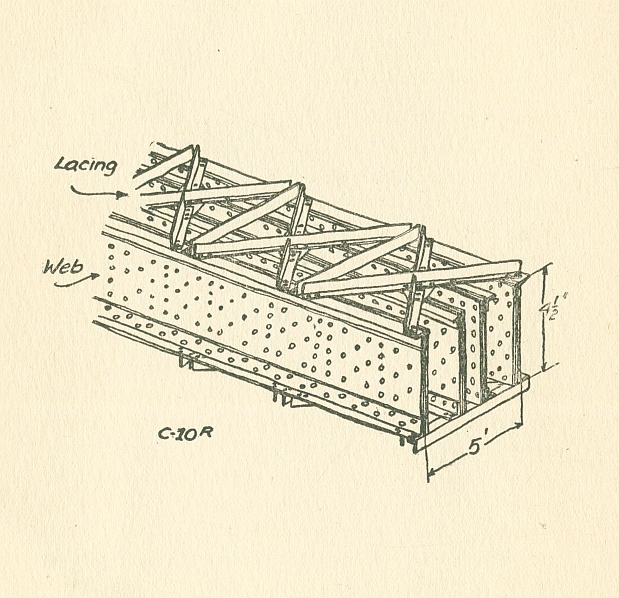
(sketch of part of a bridge truss)
IX THE DEFLECTION IN THE MEMBER
Three days after the departure of the Illingworth party the young engineer fell ill, very much to his disgust. His indisposition was not serious, but it took the painful, unpleasant, and debilitating form of follicular tonsilitis, which is about the meanest small thing that can lay a strong man low.
The bridge could undoubtedly get along without him, but nevertheless he fretted over the enforced withdrawal from his constant supervision of the work. Indeed in the end he had to pay for that very fretting, for he got up too soon and went out too quickly, and was promptly forced back to bed again as a consequence of his impatience.
Now, after a week's confinement in his cabin, he felt strong enough to venture out again and to attack his problems. They were personal problems now, much more intimate than before, for he was building not only the bridge but weaving in its web of steel his own future happiness.
Of course he had been able to get out on the rough porch of the galvanized iron shack which was his own and which, as has been noted, had been so placed that he had the bridge in full view and all the operations on it, and the day before he had even walked unsteadily down to the river bank, where he had been equally surprised and delighted at the progress that had been made. Abbott was a driver after his own heart. Really things seemed to have gone on just as well without him as if he had been present and, as he phrased it, on the job. He had not been lonely in his illness, for all of the chief men connected with the construction had done their best to beguile the tedium of his hours by visiting him whenever they could spare the time.
Abbott had been especially kind in his somewhat rough-and-ready way. The big construction superintendent was fond of Meade, although he held him in a little—contempt is a harsh word, disdain does not exactly express it, perhaps to say that he undervalued him would be best. Anyway, he regarded him more as a theoretical than a practical man and the inevitable antagonism between the theorist and the practical man, when they are not combined in one personality, was latent in Abbott's heart.
The building of a bridge in Burma was not the work of a practical man according to Abbott's idea. That was almost as ideal and visionary to the hard-headed veteran constructor as building one in the moon. Yet Abbott had a sneaking respect for the younger man, and more than a sneaking liking for him. Nightly, he brought to him details of the progress of the work. That evening, just before leaving, he remarked in the most casual manner in the world, as if it were a matter of little or no importance, that C-10-R was a trifle out of line.
Now C-10-R was the biggest member of the great right-hand truss on the north side of the river. It consisted of four parallel composite webs, each formed of several plates of steel riveted together. These webs were connected across their upper and lower edges by diagonal latticing made of steel angle bars. C-10-R and its parallel companion member, C-10-L, in the left-hand truss, carried the entire weight of the cantilever span to the shoe resting on the pier. These members were sixty feet long and five feet wide. The webs were over four feet deep and in size and responsibility the great struts were the most important of the whole structure.
To say that C-10-R was out of line meant that it had buckled, or bent, or was springing, and had departed from that rigid rectangularity and parallelism which was absolutely necessary to maintain the stability and immobility of the truss and the strength of the bridge. To the theorist nothing on earth could be more terribly portentous than such a statement, if it were true. To the practical man, who, to do him justice, had never dealt with such vast structures—and he was not singular in that because the bridge was unique on account of its size—the deflection noted meant little or nothing.
"Good God!" exclaimed Meade, aflame on the instant with anxious apprehension. The night was warm and he was dressed in his pajamas and had been lying on the bed. As if he had been shocked into action he sat up, forgetful of his weakness. "Deflection!" he fairly shouted at Abbott, who regarded him with half-amused astonishment, "in the principal compression member, a camber in C-10-R?" he continued, using an old technical term for such a deviation from the straight. "Why didn't you tell me?"
By this time Meade had got his feet into his slippers and was standing erect.
"It isn't enough to make any difference," answered Abbott quickly, perhaps a little disdainfully.
"It makes all the difference on earth," cried Meade. "It means the ruin of the bridge."
He reached for his jacket, hanging at the foot of the bed, and dragged it on him.
"Don't worry about it, youngster," said Abbott rather contemptuously, although he meant to be soothing. "I'm going to jack it into line and—here," he cried as Meade bolted out of the door, "you'd better not excite yourself that way. Come back to bed, man, and——"
But Meade was out of the house. It was summer and the sun had set, but the long twilight of the high latitude still lingered. There would be a moon in an hour or two, but none of its light would show for a long time; meanwhile a few of the brighter stars had appeared here and there in the graying light of the evening. Before him rose the gigantic structure of the bridge. For all its airiness it looked as substantial as the Rock of Gibraltar, and it looked even more substantial if possible, as the man, seizing a lantern and forgetting his weakness and everything, ran down beneath the overarching steel to the pierhead, climbed up to the shoe, and crawled out on the lower chord as rapidly as he could.
The genius of the father had been inherited in full measure by the son. Bertram Meade needed but one glance to see the deflection from the right line in the important member. For all his years of inexperience he was a better trained engineer than rough-and-ready Abbott. What appeared to the latter as a slight deflection, Meade saw in its true relation. There was a variation in the center of the member of an inch and a half at least, although unnoticeable to an untrained eye. It had all come in the last week. They had extended the suspended span far out beyond the edge of the cantilever and, with the heavy traveler at the end, the downward pressure on the great lower chord members had greatly increased.
It was a terribly heavy bridge at best. It had to be to sustain so long a span, the longest in the world. And the load, continuous and increasing, had brought about this, to the layman trifling, to the engineer mighty, bend. If it bent that way under that much of a load, what would it do when the whole great span was completed and it had to carry its transitory loads of traffic beside?
Not infrequently man is sensible of the weakness of a plan although he cannot demonstrate it. Per contra man rests confident in a conclusion at which he has arrived, although he cannot set forth the steps to justify it. When two such different views meet it is natural that age, experience, reputation, and authority shall carry the day. Although Bertram Meade, Junior, had never been persuaded in all particulars of the soundness of his father's design, and could not be persuaded, that vast experience, that great reputation, that undoubted ability with its long record of brilliant achievement had at last silenced him. He had accepted through loyalty that which he could not accept in argument. Once accepted, he acted accordingly, heartily seconding and carrying out the wishes of the older and, as the world would say, the abler man.
Now there is something empiric about every great engineering enterprise, but more especially if it presents a new problem. If there were not it would not be great. The work of the engineer in that event would be purely mechanical and devoid of that imaginative touch which always is a part of true greatness. Inevitably new stresses are to be provided for and no man can tell, until by the test of actual experience, whether or not he has absolutely succeeded in taking up that stress. There is no absolute certitude in empiric formulæ, because the whole range of conditions on which they are based is not known or cannot be duplicated by him who applies them.
Finally Meade concluded that, as usual, he had been wrong and the old man right, and he was glad indeed to be able to come to that decision. He was led the more easily and inevitably thereto because of a certain quality that all engineers possess, a habit of mind in which they all share. When the thing itself is before them concretely, especially if it looks to be of sufficient bigness, the invariable tendency of the engineer is to trust it despite previous calculations. It is there, it stands, it is; though it moves not it has a being; and the great monster strut, sixty feet long, seemed to him big enough and rigid enough, if placed on the fulcrum of Archimedes, to hold up and even to move the world.
The thing that smote the engineer hardest, as Abbott spoke, was that this weakness was exactly what he had foreseen and pointed out. It was the possibility of the inability of this great member to carry the stress that young Meade had deduced by using the formula of Schmidt-Chemnitz. It was this point, and this point particularly, that he had dwelt upon with his father and which they had argued to a finish. So strongly had he been impressed with the possible structural weakness of this member that he had put himself on record in writing to his father. The letter he had written had been destroyed, so he had been informed, but he remembered it perfectly. The old man had overborne him and now the little curve, one and a half to one and three-quarter inches in sixty feet, established the accuracy of his unheeded contention.
Although he could find no fault with his calculations he had decided he must have failed in some way, since he could not convince his father; and, in the face of the great experience and ability and the serene confidence of the old engineer, he had finally yielded the point. Had it been anyone else he would never have dropped it. He would have fought it out to the very end. Vainly now he wished he had not let the old habit of affection and the little touch of awe with which he regarded his father persuade him against his reason.
Affection and business never did mingle. Sentiment and science? Yes, they have a relation, but not when it comes to engineering calculations. Now just because he had given in to his father the old man would be ruined. The younger Meade's experience was not great enough to devise ways and means of strengthening the bridge entirely satisfactorily if the deflection continued. Perhaps no one could do that. A large part of it might even have to be taken down. The question would have to be referred to his father at the earliest possible moment, he reflected, as he noted the deflection. And he felt a generous pang of sorrow at the humiliation the older man would certainly feel when his error was proved to him.
Meade realized in a flash that he had been living as it were in a fool's paradise, lulled by his feeling that his father must be right. Other things than professional honor and reputation and material success were involved. When the bridge was completed he was to have for his wife the woman he loved, so the old Colonel had said. When the bridge was completed his father was to retire with this last work as his crown. When the bridge was completed his own career was to begin. Now! Good God! The pang that shot into his heart was almost as great as that which touched him when Helen Illingworth fell with the slipping gusset plate and he only caught her at the last moment.
He stopped, feeling suddenly ill, as a very nervous, high-strung man may feel under the sudden and unexpected physical demand of a great shock. The reaction between mental and physical conditions was immediate and overpowering. He was weak still from the tonsilitis. He leaned against the diagonal at the end of C-10-R, clinging to it tightly to keep from falling, and again that strange fit of trembling he had suffered from on the bridge with Helen Illingworth, for which he cursed himself as a coward, struck him. Abbott, who had followed more slowly, stopped by him, somewhat surprised, somewhat amused, more indignant than both.
"Abbott," said Meade fiercely as the erecting engineer joined him on the pierhead, "if you put another pound of load on that cantilever I will not be answerable for the consequences."
"What do you mean?"
"That deflection is nearly two inches deep now and every ounce or pound of added weight you put upon it will make it greater. Its limit will be reached mighty soon. If it collapses—" he threw up his hands—"the whole thing will go."
"Yes, if it collapses, that's true," said Abbott, "but it won't."
"You're mad," said Meade, taking unfortunately the wrong course with the older man.
"Why, boy," said Abbott, "that bridge will stand as long as creation. Look at it. That buckle doesn't amount to anything. It is only in one truss anyway. The corresponding member in the other truss is perfectly straight."
"Abbott, for God's sake, hear me," pleaded Meade in desperation. "Draw back the traveler and put no more men on the bridge. Stop work until we can get word to——"
"If I thought there was the least danger," said the other man, "I would do what you say, of course, but we are way behind now—weeks behind in spite of my driving. They don't seem to be able to get the stuff to me. There's a big penalty for non-completion of the contract within the limits. I get wires every day urging me on."
"I don't care what you get."
"You heard what the Colonel said last week."
"Yes, I heard, but it makes no difference, the work must stop."
"It can't—and it shan't," cried the other with sudden fierceness.
"Abbott!"
"Don't talk to me, boy. Damn the camber! I know my business. This isn't the first deflection I ever saw, is it?"
"No, of course not."
"Well, I tell you I can jack it back. That member's big enough and strong enough to hold up the world."
"What are you going to jack against?" Meade asked, and for the first time a little of Abbott's contempt appeared in the younger man's voice.
Abbott reflected that there was nothing firm enough to serve as a support for jacks and said rather grudgingly, for it seemed like a concession to the younger and junior engineer:
"Well, I can hook on to the opposite truss and pull it back with turn buckles."
"That will damage the other truss too much, Abbott," Meade retorted promptly. "It isn't possible."
"Then I'll think up some other scheme," returned Abbott indifferently, as if humoring the other. "We can't wait, we've got to hurry it along."
The two men made no special attempt to conceal their feelings. Abbott's indifference had been at first good-humored, but it was fast taking on another character and Meade's insistence and his evident bad opinion of the other man's obstinacy did not tend to make the discussion more amicable, or to convince either that the other was right or even that his opinions should be respected.
"Abbott, I'm just as much interested in finishing the job in a hurry as you are," explained Meade in a last effort to move him, and too late appealing to him more gently. "I—you see—Miss Illingworth, her father said——"
"Oh, you get the girl when the bridge is up?" asked Abbott shrewdly.
"Yes."
"Well, rest easy, son, that will only make me work the harder. I like you in spite of your fool ideas. I'm going to make a record for myself on this bridge. It's the biggest thing in the world. There's going to be no penalty against us on account of me. I won't stop work a minute," he explained patronizingly.
"There will be a bigger penalty if you don't do what I say, and paid in another way, in blood. And it will be your fault."
Now both men were angry and in their passion they confronted each other more resolute and fierce than ever.
"Look here," said Abbott, his fiery temper suddenly breaking from his control, "who are you anyway? You're only a kid engineer. Your father approved of the plan of this bridge. I guess we can afford to bank on his reputation rather than yours."
"Well, he doesn't know of this."
"Nobody is on the bridge now, and nobody is going to be on there until tomorrow morning. Wire him if you like. He'll wire Illingworth down at Martlet and we'll get word what to do."
"You won't put any men at work on the bridge until——"
"Not until tomorrow morning," said Abbott decisively, "if I don't hear from somebody at Martlet tomorrow morning the work goes on."
"But if my father wires you——"
"I take orders from the Martlet Company and no one else," was the short answer with which Abbott turned away in finality, so that the other realized the interview was over.
Meade wasted no more pleas on Abbott. As ill luck would have it something had happened to the telephone and telegraph wires between the city and the camp. After vainly trying to get a connection when he climbed back to the office Meade dressed himself, got a handcar, and was hurried to the nearest town on the railroad's main line. From there he sent a telegram and tried to get connection with New York by telephone, but failed. Moved by a natural impulse, in default of other means of communication, he jumped on the midnight train for New York. He would go himself in person and attend to the grave affair. Nothing whatever could be so important.
There had been some friction between Abbott and Meade before on occasions, not serious, but several times Meade had ventured to suggest something which to Abbott seemed useless and unnecessary, and the fact that subsequent events had more often than not proved Meade's suggestions to be worth while, had not put Abbott in altogether the best mood toward his young colleague. Abbott never forgot that Meade had really no official connection with the building of the bridge, and that he was only there as a special representative of his father, and although he could not help liking the younger man, Abbott would have been better pleased if he had been left alone.
He was too honorable and too competent a man to diverge in any way from the specifications and plans, but in all those matters which are sometimes of great moment and which are of necessity left to the discretion of the erector, he liked to be free to follow his own devices. Consequently he was not predisposed to view any suggestions from Meade with any great degree of cordiality, or to receive what had amounted to a positive command with any especial warmth. As he reflected on the heated debate in his room before he went to sleep he almost blamed himself for what he considered a censurable weakness in having suggested that Colonel Illingworth be bothered by wire with such a trifling proposition. And so obsessed was he by his conviction of the strength of the bridge and his ability to bring back the wavering member to its proper relationship to the other parts of the structure or, if he could not, of the comparative unimportance of the deflection, that after Meade's departure he almost found himself wishing that something would prevent communication between New York and Martlet until he had had a chance to show that he was right.
Meade had not gone about it in the right way to move a man of Abbott's temperament. He realized that as he lay awake on the sleeper speeding to New York. Abbott was a man who could not be driven. He was a tremendous driver himself and naturally he could not take his own medicine. If Meade had received the announcement more quietly and if he had by some subtle suggestion put the idea of danger into Abbott's mind all would have been well, for when he was not blinded by prejudice, or his authority or his ability questioned, Abbott was a sensible man thoroughly to be depended upon. But the news had come to Meade with such suddenness, Abbott had only casually mentioned it at the close of a lengthy conversation regarding the progress of the work as if it were a matter of no especial moment, that the sudden shock had thrown Meade off his balance.
Thereafter he could see nothing but danger and the necessity for action. How he should handle his superior, or rather the bridge's superior, was the last thing in his mind. Aside from his natural pride in his father and in the bridge and his fear that lives would be lost if it failed, unless he could get the men withdrawn, there was the complication of his engagement to Helen Illingworth.
Meade could not close his eyes, he could not sleep a moment on the train. His mind was in a turmoil. Prayers that he would get to his father and the bridge people in time to stop work and prevent loss of life, schemes for taking up the deflection, strengthening the member, and completing the bridge, and fears that he would lose the woman, stayed with him through the night.
He was too filled with anxiety and alarm to be anxious as to whether he was having a relapse or not, but it was a white-faced, bloodshot man in rough field garb—not intending or expecting to come to New York, he had not taken time to dress properly, he had dragged on the clothes at hand in his agitation—who half reeled through the gates of the Grand Central Station that morning while curious people looked at him with interest and amazement.
To add to his misfortune the train had been delayed by a disastrous freight wreck on the line, and was two hours late. Everything was against him. Even the taxicab burst a tire and delayed him further in his progress downtown. It was ten o'clock before he reached his father's office in the Uplift Building, when he should have arrived much earlier. It was with frantic haste that he ran to the elevator and then to the office.
X THE SON OF HIS FATHER INDEED
Meade, Senior, was an old man. Although unlike Moses his eye was dim and his natural force abated, the evidences of power were still apparent, especially to the observant. There rose the broad brow of the thinker. His power of intense concentration was expressed outwardly by a directness of gaze from the old eyes which, though faded, could flash on occasion. Other facial characteristics of that snow-crowned, leonine head, which bespoke that imaginative power without which a great engineer could not be in spite of all his scientific exactitudes, had not been cut out of his countenance by the pruning knife of time.
He was a great engineer and looked it, sitting alone in his office with the telegram crushed in his trembling hand, despite the fact that his gray face was the very picture of unwonted weakness, of impotency, and abiding horror. The message had struck him a terrific blow. He had reeled under it and had sunk down in the chair in a state of nervous collapse.
Time was when he would have rallied from the shock, when the stroke of fortune would have found him ready to deal blow for blow. But he was now too old for that. He saw himself for the little remainder of his life bereft of all title and dignity, shamed, dishonored, with the blood of men and the tears of women and little children upon him.
The telegram fairly burned the clammy palm of his hand. He would fain have dropped it yet he could not. Slowly he opened it once more. Ordinarily, powerful glasses stimulated his vision. He needed nothing to read it again. It is doubtful whether his eyes saw it or not and there was not need, for the message was burned into his brain.
To a layman the message was harmless enough, indeed, inexplicable, but to the great engineer it spelled failure in the great project with which he had fondly hoped to crown his long, distinguished, and honorable career. It meant financial ruin to great men who had trusted to his skill; death and destruction to smaller men who had confided in his assurance; deprivation, sorrow, hardship, starvation, to dependent women and children.
He read again the mysterious words.
"One and three-quarter inch camber in C-10-R."
There could be no mistake. The name that was signed to it was the name of his son, the young engineer, the child of his father's old age, whom he himself had trained to follow in his footsteps, to don the royal mantle of supremacy when he had laid it aside. Other things connected themselves with the hideous fact conveyed by the telegram. The boy, as the old man thought of him, had ventured to dispute his father's figures, to question his father's design, but the elder man had overborne him with his vast experience, his great authority, his extensive learning, his high reputation. Age had laughed youth to scorn.
And now the boy was right. Strange to say some little thrill of pride came to the old engineer at that moment. The boy in this was greater than he. But it was lost in the imminence and magnitude of the catastrophe. He tried to find out from the telegram when it had been sent. That day was a holiday—the birthday of one of the Worthies of the Republic—in some of the United States, New York and Pennsylvania among them, and only by chance had he come down to the office that morning. The wire was dated the night before. Perhaps even—no, the morning papers would have said if the inevitable accident had occurred. And he recalled that the state from which the bridge ran did not observe that day as a holiday. They would be working on the International as usual unless——
One and three-quarter inches of deflection! Good God! No bridge that was ever made could stand with a bend like that in the principal member of its compression chord, much less so vast a structure as that which was to span the greatest of rivers and to bring nation into touch with nation. He ought to do something, but what was there to do? Presently, doubtless, his mind would clear. But on the instant all he could think of was the impending ruin.
The Uplift Building, in which he had his offices, was mainly deserted on account of the holiday. The banks were closed and the offices and most of the shops and stores. It was very still in the hall and, therefore, he heard distinctly the door of the single elevator in service open with an unusual crash, then the sound of rapid footsteps along the corridor as of someone running. They stopped before the outer door of the suite which bore his name. Instantly he suspected a messenger of disaster. The door was opened, the office was crossed, a hand was on the inner door.
The old engineer strove vainly to rise to meet the bearer of evil tidings, but failed. His trembling limbs would not support him. He sank back almost as one dead waiting the shock, the blow. It was not so much of himself as of the consequences to others he thought, although the one failure would dissolve the fame he had gained by all the successes of the past.
When the door was opened, instinctively he put his arm across his eyes as if to shield himself from the attack.
"Father," exclaimed the newcomer.
"Thank God," said the old man, dropping his arm, "you are here."
"You got my telegram?"
The other silently exhibited the crumpled paper in his hand.
"What have you done?"
"Why, I—nothing."
"Good God! Nothing! Why, you must have received it early this morning. I—
"It's a holiday, don't you know? I only got it a few moments ago. The bridge?"
"Still stands."
"But for how long?"
"I can't say. The Martlet's resident engineer is mad. I begged, threatened, implored. I tried to get him to stop work, to take the men off the bridge, to withdraw the traveler, but he won't do it. Said you designed it, you knew. I was only a cub."
"But the camber?"
"He said, 'Damn the camber, I'll jack it into line again.' Like every other engineer who sees a big thing before him it looks to him as if it would last forever. I tried to get you on the telephone here and at the house last night and failed. I wired you. Then I jumped on the midnight express and——"
"What is to be done?" asked the old man.
Meade, Senior, was thankful that the younger man had not said, "I told you so," as well he might. But really his father's condition was so pitiful that the son had not the heart.
"Telegraph the Martlet Bridge Company at once," he answered.
"What shall we say?" asked the old man, uncertainly.
The young man shot a quick look at him, that question evidenced the violence of the shock. His father was old, broken, helpless, dependent, at last....
"Give me the blank," he answered, "I'll wire in your name."
He repeated the telegram that he had sent to his father and added these words as he signed the old man's name to it:
"Put no more load on the bridge. Withdraw men and traveler."
He read the message to his father. The old man nodded helplessly. The young man seized the telephone, called up the Western Union and soon the message was on the wire to the great bridge works in the Pennsylvania hills.
"Now, father," said the young man encouragingly, "don't give up. The Martlet people will pay attention to that message. Even if the bridge goes down, there will be no lives lost."
"How many men are working on it?"
"About two hundred. Abbott told me he wouldn't take a single man off. I wanted to tell them myself, but I couldn't do that. He is in charge. I am only representing you. He would not even agree to take direction from you."
"Of course not."
"We will get hold of the bridge people. Colonel Illingworth will telegraph Abbott to back up the traveler, withdraw the men, and get all possible load off the member. Pull yourself together. Let's figure out some way to strengthen it until we can replace it, or devise——"
"You are right, boy, you are right," said the old man, rising in his chair and turning toward his desk. "Let us get to work."
"Good," said the young man. "We ought to hear from Colonel Illingworth in half an hour and we'll pull the thing through yet."
XI THE DEATH MESSAGE ON THE WIRE
"I can't understand why we don't hear," said the young engineer, walking up and down the room in his agitation. "Two telegrams and now we can't get a telephone connection, or at least any answer after our repeated calls."
"It's a holiday there as well as here," said the older man. "There is no one in the office at Martlet."
"I'll try the telephone again. Someone may come in at any time."
He sat down at the desk, and after five minutes of feverish and excited waiting he finally did get the office of the Martlet Bridge Company. By a happy fortune it appeared that someone happened to come into the office just at that moment.
"This is Meade," began the young man, "the consulting engineer of the International Bridge. Understand? Yes. Well, at ten-thirty this morning I sent a telegram to Colonel Illingworth and an hour later I sent another. I've had no reply. I've been trying hard to get the office on the telephone ever since. What's that?" Young Meade turned to his father. "He says there's been no one in the office on account of the holiday. Both telegrams are on the desk. He just chanced to come in or I couldn't have got the message through."
"It's too late, too late," said the father, wringing his hands.
"Wait," said the son. He turned to the telephone again. "Give me your name—Johnson—you're one of the clerks there? Well, telephone Colonel Illingworth at his home and tell him to call me at this office at once. I'll hold this connection with you until I hear you've got him. It's most important. We're on the right track now, father," continued the young man reassuringly. "The bridge must be all right yet. We would have heard at once if it weren't. Keep up your courage. We're going to pull through, somehow."
In such talk a few anxious minutes passed.
"Yes," suddenly broke out the younger Meade, who had kept the receiver to his ear. "What! You can't find him? He isn't at home? He has gone away? Is the vice-president there—the superintendent—anybody? The men are having a jollification in the mountains, you say, and everybody has gone? How far away are they? Twenty miles! On the railroad? They went in wagons? There's no telephone? Now, listen, Johnson, this is what you must do. Get a car, the strongest and fastest you can rent and the boldest chauffeur, and a couple of men on horses too, and send up to that place wherever they are, and tell Colonel Illingworth that he must telephone me and come to his office at once. There are telegrams there that mean life and death and the safety of the bridge. You understand? Good. He says he'll do it, father. We've done all we can," he added. He hung up the receiver, sprang to his feet, looked at his watch. "It's so important that I'll go down there myself. I can catch the two-o'clock train, and that will get me there in two hours. You stay quietly here in the office and wait until I get in touch with those people. I mean, I want to know where I can reach you instantly."
"I'll stay right here, my boy. Go, and God bless you."
As usual when in a great hurry there were unexpected delays and the clock on the tower above the big structural shop was striking five when a rickety station wagon, drawn by an exhausted horse, which had been driven unsparingly, drew up before the office door. Flinging the money at the driver, Meade sprang down from his seat and dashed up the steps. He threw open the door and confronted Johnson.
"Did you get him?" he cried.
"He isn't here yet. I sent an automobile and two men on horseback and——"
The next minute the faint note of an automobile horn sounded far down the valley.
"I hope to God that is he," cried the young engineer, running to the window.
"That's the car I sent," said Johnson, peering over his shoulder. "And there are people in it. It's coming this way."
"Johnson," said Meade, "you have acted well in this crisis and I will see that the Bridge Company remembers it."
"Would you mind telling me what the matter is, Mr. Meade?"
"Matter! The International——"
"Bert," exclaimed a joyous voice, as Helen Illingworth, smiling in delighted surprise, stepped through the open door and stood expectant with outstretched hands.
Young Johnson was as discreet as he was prompt and ready. He walked to the window out of which he stared, with his back ostentatiously turned toward them. Most considerately he even whistled a little tune and drummed noisily upon the panes. After a quick glance at the other man, Meade swept the girl to his heart and held her there a moment. He did not kiss her before he released her. The woman's passionate look at him was caress enough and his own adoring glance fairly enveloped her with emotion. She looked at Johnson and her brow wrinkled in slight annoyance, but, though he felt unwelcome, that young man could not go and he had sense enough to know that he would be needed and that no more time could be wasted by the lovers. He coughed and turned as the two separated. It was the woman who recovered her poise quicker. To be sure she did not have the burden upon her shoulders that Meade had to support.
"What were you saying about our bridge when I came into the room?" she began, and Meade fully understood the slight but unmistakable emphasis in the pronoun—our bridge, indeed—"I was lying down this afternoon, but when I awakened my maid told me about your urgent calls for father," she ran on, realizing that some trouble portended and seeking to help her lover by giving him time. "I knew something must be wrong, so I came here. I didn't expect to see you. Oh, what is it?" she broke off, suddenly realizing from the mental strain in her lover's face, which the sudden sight of her had caused him to conceal for a moment, that something terribly serious had happened, and she turned a little pale herself as she asked the question, not dreaming what the answer would be.
"Helen," said the young man, stepping toward her and taking her hands again, "we're in awful trouble."
"If it is any trouble I can share, Bert," said the girl, flashing at him a look which set his pulses bounding—at least she was to be depended on—"you know you can count on me."
"I know I can," he exclaimed gratefully.
"Now tell me."
"The International Bridge is about to fail."
The color came to her face again. Was that all? came into her mind. That was serious enough, of course, but it would not matter in the long run. Through its structural weakness the bridge might fail; through Abbott's obstinacy and pig-headedness those men might die on it, his father's reputation might go and his own, but as he looked into the eyes of the woman he knew that all these things would make no difference to her. Heart once given, love once proffered, they were his to the end. Her father! Well, Colonel Illingworth was not the deciding voice, so she had said before. That thought flashed into Meade's mind. Yet the glad consciousness was accompanied by a firm resolution to abide by the conditions as set forth by Colonel Illingworth. Bridge and woman, they went together for him. Indeed he intended to save his father, even if his own life and happiness, interwoven with the bridge, were the price of his endeavor. No one should ever know. It would be his fault. It was. He should have insisted on his contentions.
He would never involve in his own ruin this glorious woman, whatever her trust, her affection, her willingness. That bright youthful life at least should not go down with the bridge. The awful Web of Steel should not catch her in its meshes. He would tear the rigid bars apart with his own bleeding hands before that should happen.
Yet he would not have been the man she loved, the man who loved her, if he had not thrilled to her splendid ardent devotion, her whole-hearted trust in him. He did not quite realize that, as it takes two to make a quarrel, no man, however determined upon a course, can absolutely settle a woman's relationship to him without her consent, especially when he loves her and has told her so and received her love in return.
How much of all this Helen Illingworth realized, what her thoughts were, what resolutions she came to, what determinations were her own, her lover could not tell. She recognized the awful gravity, the terrible seriousness, of the situation of course. The bridge meant much to her even if in quite a different way. It was there he had saved her from the awful fall. It was there that he had told her that he loved her. If she had been given the choice she would have embraced the risk for the avowal if it could not have been brought about otherwise. The bridge might fall, but it was as eternal as her affection in her memory. Their engagement, or their marriage, had been made dependent upon the successful completion of the bridge. What of that? The proviso meant nothing to her when she looked at the white-faced agonized man to whom she had given herself.
Who dared condition love? What parental injunction could bind the free movement of human hearts? Age? What did age know about it? Here were youth, sorrow, love, life. While they had being they belonged to each other. Not the trusses and stringers of the great bridge were stronger than the intangible ties that bound heart to heart, and the steel was not half so real. Bridges might come and bridges might go, reputations fail and disappear, property be lost in ruin and disaster—it would make no difference. She was his and he was hers. The senses of possession and possessed alike would and should have the mastery.
"It is terrible, of course," she said quietly.
"Appalling."
"But you can do nothing?"
"If I could do you think I'd let the bridge, and you, go without——"
"I'm not going with the bridge," was her quick and decisive interruption.
They had both forgotten the presence of young Johnson, who was not only decidedly uncomfortable, but desperately anxious. He was about to speak when, into this already broken scene, came another interruption.
There was a rush of wheels on the driveway outside, the roar of a motor. Before Meade could answer the statement, into the room burst Colonel Illingworth. He was covered with dust, his face was white, his eyes filled with anxiety. The character of the summons had disquieted him beyond measure. Back of him came Severence, the vice-president, and Curtiss, the chief engineer.
"Meade, what of the bridge?" he burst out, with a quick nod to his daughter, knowing that nothing else could have brought the engineer there, especially in the light of the messages received.
Colonel Illingworth had not stopped to hunt for a wayside telephone. The automobile driven madly, recklessly through the hills and over the rough roads, had brought him directly to the office in the shortest possible time.
"There is a deflection one inch and three-quarters deep in one of the compression members, C-10-R," was the prompt and terrible answer.
Colonel Illingworth had not been president of the Martlet Bridge Company for so long without learning something of practical construction. He was easily enough of an engineer to realize instantly what that statement meant.
"When did you discover it?" he snapped out.
"Last night."
"Is the bridge gone?"
"Not yet."
"Why didn't you let us know?"
"I telegraphed father and, not hearing from him, I came down on the midnight train. It is a holiday in New York as well as here. I just happened to meet father in the office. He sent a telegram to you and not hearing from you, duplicated it an hour later. I tried half a dozen times to get you on the telephone and finally, by a happy chance, got hold of young Johnson."
"Where are your father's telegrams?"
"Here."
Colonel Illingworth tore the first open with trembling fingers?
"Why didn't you tell Abbott?" asked the chief engineer.
"You know Abbott. He said the bridge would stand until the world caved in. Said he could jack the member into line. He wouldn't do a thing except on direct orders from here."
"Your father wires, 'put no more weight on the bridge.' What shall we do?" interposed Colonel Illingworth.
"Telegraph Abbott at once."
"If the bridge goes it means ruin to the company," said the agitated vice-president, who was the financial member of the firm and who could easily be pardoned for a natural exaggeration under the terrible circumstances.
"Yes, but if it goes with the men on, it means—Johnson, are you a telegraph operator?"
"Yes, sir."
"Take the key," said the Colonel, who, having been a soldier, thought first of the men.
Johnson sat down at the table where the direct wire ran from the Bridge Company to the Western Union office. He reached his hand out and laid his fingers on the key. Before he could give the faintest pressure to the instrument, it suddenly clicked of its own motion. Everybody in the room stood silent.
"They are calling us, sir," said Johnson.
Colonel Illingworth nodded.
"It is a message from Wilchings, the chief of construction foremen of," Johnson paused a moment, listening to the rapid click—"The International——" he said in an awestruck whisper.
It had come!
"Read it, man! Read it, for God's sake!" cried the chief engineer.
"The bridge is in the river," faltered Johnson slowly, word by word, translating the fearful message on the wire. "Abbott and one hundred and fifty men with it."
XII THE FAILURE
In spite of himself and his confidence in the bridge, and every look at the huge trusses rising from the massive piers and extending their long arms out to meet their sister trusses beginning to rise on the other side, re-enforced that confidence, Abbott felt a little uneasy the next morning. At bottom he had more respect for Meade's technical knowledge than he had displayed or even admitted to himself. The younger engineer's terrified alarm, his urgent pleading, his utter forgetfulness of the amenities that usually prevailed between them, his frantic but futile efforts to telephone, of which the operator told Abbott in the morning, his hurried departure to New York, were, to say the least, somewhat disquieting, much more so than he was fain to admit to himself.
Although it involved a hard and somewhat dangerous climb downward and took upwards of a half-hour of his valuable time, the first thing the erecting engineer did in the morning was to go down to the pier head and make a thorough and careful examination of the buckled member. C-10-R was the first great member of the right-hand truss, as you crossed the bridge, that sprang from the steel shoe and reached out over the water. It was, of course, a part of the great lower chord of the huge diamond-shaped truss, which, with its parallel sixty feet away on the other side of the bridge and its two opposites across the river, supported the whole structure. If anything were wrong, seriously, irreparably wrong, with the member and it gave way, the whole truss would go. The other truss would inevitably follow suit, and the cantilever would immediately collapse. Abbott realized that, of course, as he climbed carefully down to the pier head and stood on the shoe.
Now the member was composed of four steel webs, each one made up of several plates of steel riveted together to form one huge plate. These four parallel webs were bound into one member and held rigid by steel lacings, which criss-crossed above and below the edges of the four webs. These steel lacings were angle bars riveted to the several webs and were also riveted through plates where they crossed, and finally were fastened to the edges of the webs. It was this massive and imposing piece of structural steel work which had got a little out of line, and which Abbott, perturbed in spite of himself, had come down to inspect, to see if there were any real ground for Meade's excitement and alarm.
It is wonderful how well-trained our physical senses may become. The final perfections of curvature in a great lens are the results of refinements of the sense of touch in the manufacturer's hands. So much had long experience taught Abbott that, as he stood by the member and surveyed it throughout its length, he could easily see that it had buckled, although the deviation was so slight, about two inches at its maximum in sixty feet. He brought with him a line and, with infinite care and pains, he drew it taut across the slight concavity like a bow-string. He had estimated the camber, or the distance between the center of the bow and the string, at one and a half inches. As he made more careful measurements, he discovered that it was slightly over one and three-quarter inches. Did this denote an increase? Abbott thought not. The difference simply lay between an estimate, however careful, and the actual measurements.
An inch and three-quarters in seven hundred and twenty was scarcely noticeable, not noticeable at all to the untrained eye, unless actually squinting along the line, and it did not seem very much to Abbott, standing on the pier head and looking up through the network of struts and bracing and girders. As he stood there feeling himself an insignificant figure amid this great interwoven mass of steel, again the sense of its strength and stability came to him overpoweringly, so much so that he laughed aloud in a rather grim fashion at the unwonted nervousness which had been induced in his mind by Meade's words and actions.
He would have been content to have left the pier head and have climbed back to the floor of the bridge, but he was a conscientious man, so he pursued his investigations further. He climbed up on top of the member, which was easy enough by means of the criss-crossed lacing, and carefully inspected that lacing. He did not, of course, look at every one of the bars of steel that bound together the giant webs that made up the member, but he gave a very careful and minute scrutiny to the lacings at the center of the concavity, or sidewise spring from the right line.
He noticed, by getting down on his face and surveying the lacing bars closely, a number of fine hair-line cracks in the paint, surface traceries apparently, running here and there from the rivet holes. The rivets themselves had rather a strained look. Some of the outer rivets seemed slightly loose, where before they must have been tight, for the members, like all other parts of the bridge, had been carefully inspected at the shop and any looseness of the rivets would certainly have been noticed there. But, at the time these discoveries were made, Abbott's obsession as to the strength of the bridge had grown stronger. Lining it out, crawling over it, feeling its rigidity, he decided that these evident strains were to be expected. Of course the lacings that held the webs together would have to take up a terrific stress. They had been designed for that purpose.
The best engineer had made the design and now the best erector found no radical fault with it. The other members of the truss were still in line. Abbott clambered over to the next one and examined some of the lacings there. He found a few of those hair-line paint cracks; not quite so many, but still some. He had brought with him a small hammer and he struck the lacing here and there, straining his ear to see if he could discover any difference in resonance between those at this point, at which the greater stress was being brought, because of the curvature, and others in other places. There was a difference, but it would have taken a finer ear than Abbott's, somewhat deafened by the constant noise of the pneumatic riveters, to realize the danger in the slight increase in sharpness of the resonance of the lacings that were most strained. Largely because he did not find anything very glaring, and because he wanted to believe what he believed, the chief of construction left the pier head and clambered up to the floor with more satisfaction in his heart than his somewhat surprising anticipation, which had so unwillingly grown under the stimulus of Meade's persistence, had led him to expect.
The whistle was just blowing for the commencement of work when he got back to the bridge floor. He could not but reflect, as the men came swarming along the tracks to begin their day's work, that the responsibility for their lives lay with him. Well, Abbott was a big man in his way, he had assumed responsibilities before and was perfectly willing to do so again, both for men and bridge. The workmen at least had no suspicions or premonitions of disaster.
Wilchings, the chief erecting foreman, knew about the camber. It had not bothered him. As he approached the two exchanged greetings.
"You're out early, Mr. Abbott," said Wilchings.
"Yes, I've been down to examine C-10-R."
Wilchings laughed.
"That little spring is nothing." He looked over the track and through the maze of bracing at the member. "If we had a pier somewhere we could hold up the earth with that strut. You didn't find out anything, did you?"
"Not a thing except some hair-line cracks in the paint around the rivets."
"You'll often find those where there's a heavy load to take up. This bridge will stand long after you and I and every man on it has quit work for good."
Now Wilchings was a man of experience and ability, and if Abbott had needed any confirmation of his opinion this careless expression would have served. He did send him across the river to examine the half-completed cantilever on the other bank, upon which work had been suspended, awaiting shipments of steel. Wilchings later reported that it was all right, which was what he expected, of course, and this also added to Abbott's confidence.
The day was an unusually hard one. A great quantity of structural steel that had been delayed and which had threatened to hold up the work, arrived that day and the chief of construction was busier than he had ever been. He was driving the men with furious energy. Even under the best conditions it would be well-nigh impossible to complete the bridge on time. Abbott had pride in carrying out the contract and the financial question was a considerable one. Had it not been for that, perhaps, he would have paid more attention to Meade's appeal. So he hurried on the work at top speed.
But a man may be persuaded and yet not satisfied. All day long Abbott, confident, yet unforgetting, had in mind that questionable member. His work kept him on shore a large part of the time and the further away he got from it and from the powerful persuasiveness of the actually existent standing bridge, the stronger grew his unease. He sought to laugh himself out of it, to strengthen his convictions that it was nothing by self-ridicule. He worked himself up into a state of positive resentment and anger against Meade. He cursed him for a fool and himself likewise, still he could not get away from the thought. It was in his mind. Suppose—it was impossible to suppose!
Late in the afternoon, without saying anything to Wilchings, who had resumed his regular work, or to anybody in fact, Abbott went down to look at the member again. He climbed down a hundred feet or more to make another examination at the expense of much valuable time, for he had not passed so busy a day as that one since the bridge began. Abbott's judgment and reasoning told him that it was time thrown away. Nevertheless, despite his convictions, he went. He made another careful examination, and, in fact, duplicated his procedure of the morning. Everything was exactly as it had been. Those hair-line cracks had troubled him a little despite Wilching's remark. He studied them a second time. They were just as they had been, so far as he could tell, no larger, no more numerous. The lacings rang exactly the same under his hammer.
Abbott was cool enough ordinarily, but he was now so angry with himself for having given away to foolish fears, that, in a fit of temper, he threw the hammer into the water—and it was indicative of how the situation had got on his nerves—as he declared to himself that he would not go down there again. By this time old Meade and the bridge people and Curtiss, the chief engineer, must know all about it. He had actually visited the telegraph office a dozen times—unnecessarily, of course, since any wire would have been delivered at once to him. The fact that he had not heard from them gave him renewed confidence. They evidently regarded it of little moment. They were probably laughing at Meade, Junior, as they would laugh at him if they ever learned of his nervousness. He realized, of course, that he could never jack the springing member back into line. As Meade had said, there was nothing to jack against. Also it would be practically impossible to haul it back by turn-buckles attached to the parallel truss. Indeed he had only said these things carelessly. It would have to stay the way it was until he got definite instructions from Martlet what to do.
He climbed back to the floor of the bridge and spent the next half-hour inspecting the progress of the work. The suspended span had already been pushed out far beyond the end of the cantilever. The work on the other side of the river had been stopped. As soon as they got the suspended span halfway over they would transfer the workmen and finish the opposite cantilever. Abbott calculated that perhaps in another week they could get it out if he drove the men. He looked at his watch, grudgingly observing that it was almost five o'clock. The men were nothing to Abbott. The bridge was everything. That is not to say he was heartless, but the bridge and its erection were supreme in his mind. As he stood surveying the mighty structure he felt as Napoleon might have felt when he looked beyond the men and horses who would perish in the next battle he was planning, to the mighty end he had in view.
The material was arriving and everything was going on with such a swing and vigor that he would fain have kept them at work an hour or two longer. The men themselves did not feel that way. Some of the employees of the higher grades had got the obsession of the bridge, but to most of them it was the thing they worked at, by which they got their daily bread—nothing more.
Those who worked by the day were already laying aside their tools, and preparing for their departure. They always would get ready so that at the signal all that was left to do was to stop. The riveters, who were paid by the piece, kept at it always to the very last minute. As Abbott watched and waited he was unusually conscious in some strange way of the wild clamor of the work. He had been standing near the outer end of the cantilever and, as if to get rid of it, he turned and walked toward the bank. The pneumatic riveters were rat-tat-tatting on the rivet heads with a perfectly damnable iteration of insistent sound. The steam winch on the traveler was blowing off steam almost like a locomotive, preparatory to the rest of the night. A confused babel of voices, the clatter of hammers, the slithering, ringing sounds of swinging steel grating against steel as the huge cranes lifted the girders and braces and dropped them in their places, the deeper crash of beams being unloaded from the trucks and dropped heavily on the stringers and floor beams, the clanking of trucks, the grinding of wheels, the deep breathing of the locomotives, mingled in a hard, harsh, unharmonious diapason of horrid sound. Abbott's usual iron nerves had been severely strained that day. Ordinarily he was as indifferent to those noises as if he had been a deaf man. Now they irritated him. In his irritation he turned instinctively to the cause of it.
He was right above the pier head now. He looked down at it through the struts and floor beams and braces, fastening his gaze on the questioned member. There it stood satisfactorily, of course. Yet, something impelled him to walk out on the nearest floor beam to the extreme edge of the truss and look down at it once more, leaning far out to see it better. He could get a better view of it with nothing between it and him. It still stood bravely. It was all right, of course. He wished that he had never said a word about it to anyone. He did not see why he could not regard it with the indifference that it merited. As he stared down at it over the edge of the truss the whistle for quitting blew.
Every sound of work ceased after the briefest of intervals, except here and there a few riveters driving home a final rivet kept at it for a few seconds, but only for a few seconds. Then, for a moment a silence like death itself intervened. It even seemed as if the ever blowing wind had been momentarily stilled. That shrill whistle and the consequent cessation of the work always affected everybody the same way. There was inevitably and invariably a pause. The contrast between the noise and its sudden stoppage was so great that the men instinctively waited a few seconds and drew a breath before they began to light their pipes, close their tool boxes, pick up their coats and dinner pails, and resume their conversation as they strolled along the roadway to the shore.
It seemed to Abbott, who had often noted the psychological effect of the stoppage of work on the men, that it had never been so silent on the bridge before. There was almost always a breeze, sometimes a gale, blowing down or up the gorge through which the river flowed, but that afternoon not a breath was stirring. The void was as empty and as still as the hearts or minds of the workmen. Abbott found himself waiting in strained and unwonted suspense for the next second or two, when the silence would be broken almost as if by concerted effort by the men.
While he waited, his eyes were not idle. They were fixed on the member. The long warm rays of the afternoon sun illuminated it so clearly that he could see every detail of it. In that second immediately below him, far down toward the pier head he saw a sudden flash as of breaking steel. Low, but clear enough in the intense silence, he heard a popping sound like the snap of a great finger. Then the bright gleam of freshly broken metal caught his excited glance.
Abbott instantly realized what was happening. The lacing was giving way. Meade was right. The member would go and with it—— He had a second or two to call his own. The habit, the character of the man put them to the best use possible. The first pop or two was succeeded by a little rattle as it might be a rain of revolver shots heard from a distance, as the lacings gave way in quick succession. It was a sort of accompaniment to what Abbott shouted. He was a man with a powerful voice and he raised it to its limit and expanded it to its full compass.
The idle workmen, just beginning to laugh and jest, heard a great cry:
"Off the bridge, for God's sake!"
Two or three, among them Wilchings, who happened to be within a few feet of the landward end, without understanding why, but impelled by the agony, the appeal, the horror in the great shout of the master builder, leaped for the shore. On the bridge itself some stepped forward, some stood still staring, others peered downward. It takes minutes to tell it and to read it, but probably not three seconds passed between the first snap of the first lacing bar and the utter collapse of the member. The great sixty-foot webs of steel wavered like ribbons in the wind. The bridge shook as if in an earthquake. There was a heavy, shuddering, swaying movement and then the six-hundred foot cantilever arm plunged downward, as a great ship falls into the trough of a mighty sea. Sharp-keyed sounds cracked out overhead as the truss parted at the apex, the outward half inclining to the water, the inward half sinking straight down.
Shouts, oaths, screams rose, heard faintly above the mighty bell-like requiem of great girders, struts, and ties smiting other members and ringing in the ears of the helpless men like doom. Then, with a fearful crash, with a mighty shiver, the landward half collapsed on the low shore, like a house of cards upon which has been laid the weight of a massive hand. The river section, carrying the greater load at the top and torn from its base, plunged, like an avalanche of steel, two hundred feet down into the river, throwing far ahead of it, as from a giant catapult, the traveler on the outward end of the suspended span and a locomotive on the floor beneath.
Wilchings, and the few men safe on the shore, stood trembling, looking at the bare pier head, at the awful tangled mass of wreckage on the shore between the pier and the bank; floor beam and stringer, girder and strut, bent, twisted, broken in ragged and horrible ruin, while the water, deeper than the chasm it had cut, rolled its waves smoothly over the agitations of the great plunge beyond the pier. They stared sick and faint at the tangled, interwoven mass of steel, ribboning in every direction—for in the main the rivets held so it was not any defect of joints, but structural weakness in the body of the members that had brought it down—and inclosing as in a net many bodies that a few seconds before had been living men.
They had seen body after body hurled through the air from the outward end and, as they gazed fearfully in horror here and there dark figures floated to the surface of the water. They caught glimpses of white, dead faces as the mighty current rolled them under and swept them on. And no sound came from the hundred and fifty who had gone down with the bridge. The two-hundred foot fall would have killed them without the smashing and battering and crashing of the great girders that had fallen upon them or driven them from the floor and hurled them, crushed and broken, into the river.
They stared across the crumpled ruin between them and the pier and out beyond the now frightfully bare stretch of water to the uncompleted truss still rising grandly on the other side and the very contrast between its mass and strength and splendor emphasized the frightful, awe-inspiring nakedness of the battered pier before them.
Yes, Meade had been right. Abbott had one swift flash of acknowledgment, one swift moment packed with such regrets as might fill a lifetime—an eternity in a Hell of Remorse—before he, like the rest, had gone down with the bridge!
XIII THE WOMAN'S CHOICE
The message was received in ghastly silence. The blood ran cold in the veins as the people in the room took in the awful disaster. No one spoke for a moment, none moved. They had all been shocked into insensibility. Colonel Illingworth's face had lost its pallor. It was fiery red as if gorged with blood. Bertram Meade was whiter than any other man in the room. He was thinking of his father. What an end to such a career! One failure to outweigh a thousand successes.
The girl moved first. Her father and the young engineer were the two men in whom she was most interested, the two who were most deeply touched. They were both in agony, both in need of her. To which would she go? Unhesitatingly she stepped to the side of the younger. For this cause shall a woman leave her father and her mother! And never believe but that the father saw and understood even in the midst of his suffering. Youth thinks not, but fathers always know.
Helen Illingworth laid her hand on Meade's arm. She pressed close to his side. Together they confronted the older man. She had chosen.
"We are ruined," gasped the Colonel, tugging at his collar. "It's not so much the financial loss, although we put millions into that bridge, which now is only good for the scrap heap. We could stand that—but our reputation! We'll never get another contract. I might as well close the works. And it is your father's fault. It's up to him. He was the greatest bridge engineer on this continent. He revised our design. He changed it in accordance with his knowledge and experience and he gave us column formulas of his own. The blood of those men is upon his head. Well, sir, I'll let the whole world know how grossly incompetent he is, how——"
"Sir," said young Meade, standing very erect and whiter than ever, since the hour had come to take the blame, "the fault is mine. I made the calculations. I checked and rechecked them. Nobody could know with absolute certainty the ability of the lower chord members to resist compression. But whatever the fault, it is mine. My father had absolutely nothing to do with it. He is——"
"He's got to bear the responsibility," cried the Colonel passionately. "It has his name——"
"No, I tell you," thundered the younger man. "For I'll proclaim my own responsibility. You knew that I had much to do with it. You said at the time that you were playing in great luck because you got not only the experience of my father, but the knowledge and the latest methods of his son, for one figure. Now the fault is all mine and I'll publish the fact from one end of the world to the other."
"It's a load I wouldn't want to have on my conscience," said Colonel Illingworth.
"The ruin of a great establishment like the Martlet," added Dr. Severence.
"The dishonor to American engineering," said Curtiss.
"And the awful loss of life," continued the Colonel.
"I assume them all," protested the young man, forcing his lips to speak, although the cumulative burdens set forth so clearly and so mercilessly bade fair to crush him.
"It was only a mistake," protested Helen Illingworth, drawing closer to her lover's side, and with difficulty resisting a temptation to clasp him in her arms.
"A mistake!" exclaimed her father bitterly.
"You said yourself," urged the woman, turning to the chief engineer, "that you didn't know whether the designs would work out, that nobody could know, but you were convinced that they would."
"I did," admitted Curtiss.
"Under the circumstances, then," said the girl, "I stand by——"
"Wait," interrupted the father. "Meade, there is one consequence you have got to bear that you haven't thought of."
"What is that?"
"Helen."
"What do you mean?"
"Do you think I'd let my daughter marry a man who had ruined me, an incompetent engineer by his own confession, a——"
"It is just," said Meade. "I have nothing further to do here, gentlemen. I must go to my father."
"Just or not," cried Helen Illingworth, "I can't allow you to dispose of me in that way, father. If he is as blamable as he says he is, and as you say he is, now is the time above all others for the woman who loves him to stand by him."
"Miss Illingworth, you don't know what you are saying," said Meade, forcing himself into a cold formality he did not feel. "I am disgraced, shamed. There is nothing in life for me. My chosen profession—my reputation—everything is gone."
"The more need you have for me, then."
"It is noble of you. I shall love you forever, but——"
He turned resolutely away and walked doggedly out of the room. Helen Illingworth made a step to follow him.
"Helen," interposed her father, catching her almost roughly by the arm in his anger and resentment, "if you go out of this door after that man, I'll never speak to you again."
"Father, I love you. I'm sorry for you. I would do anything for you but this. You have your friends. That man, yonder, has nothing, nothing but me. I must go to him."
She turned and went out of the room without a backward look or another word, no one detaining her. Now it happened that by hurrying down the hill in the station wagon, which he had bidden wait for him, Bertram Meade had just caught a local train, which made connections with the Reading Express some twenty miles away, and Helen Illingworth in her dog-cart reached the station platform just in time to see it depart. She thought quickly and remembered that ten miles across the country another railroad ran and if she drove hard she could possibly catch a train which would land her in Jersey City a few minutes before the train her lover caught.
She ran to the telephone and called for her own car in a hurry. She jumped into it a few minutes later and told the chauffeur that she wanted to catch the next express on the Pennsylvania Road. The news of the fall of the bridge was already abroad in the town. The man had heard how Meade had taken the blame, and had caught the local by furious driving. He had heard how Miss Illingworth had followed. It had become known, through her maid, that Meade and the president's daughter were engaged. The chauffeur scented a romance at once. And he drove the car as he had never driven before.
The girl caught the express and reached Manhattan Junction on time. In this case there was no delay. She had decided en route that it would be impossible for her to get from the Pennsylvania station to the Reading station in Jersey City in time to intercept her lover in the short margin of time at her disposal and she had determined upon a course of action. She would ride to the Hudson Terminal in the city and then go first to the office of Bertram Meade, Senior. If he were not there she would go to his residence. She had visited both places before, and she was certain that she would find both Meades at one place or the other.
The newsboys on the street were already crying the loss of the bridge. She saw the story displayed in lurid red headlines as she sprang into the taxi and bade the chauffeur hurry her to the Uplift Building further downtown. The bill she handed him in advance made him recklessly break the speed-limit, too.
XIV FOR THE HONOR OF THE SON
Bertram Meade, Senior, had not left the office during the whole long afternoon. The stunning force of his son's utterly unexpected announcement had wrecked the father as surely as the defective member would wreck the bridge. The boy might delude himself with the youthful hope that something could be done to save it, but the old man knew that the bridge was doomed and he realized that his own ruin in professional fame would follow its downfall.
He sat alone in his office quietly waiting for the end, not as one awaiting a death sentence, but rather as one who had been tried, convicted, and sentenced might await the moment of execution. As to the drowning, in the brief interval preceding the final asphyxia, life unrolls in rapid review, so pictures of the past took form and shape in his mind. He recalled many failures. No success is uninterrupted and unbroken. The little stones of progress are planted on the recurrent hills of mistake. It is through constant blundering that we arrive. "Roses, roses all the way" generally ends in the gibbet. He had learned to achieve by failing as everybody else learns. But failures and mistakes, which were pardonable in the beginning of his career, could not be condoned now; those should have taught him. He realized too late that his later achievement had begot in him a kind of conviction of omniscience, a belief in his own infallibility, bad for a man. His pride had gone before, hard upon approached the fall. He had been so sure of himself that even when the possibility that he might be mistaken had been pointed out and even argued, he had laughed it to scorn. His son's arguments he had held lightly on account of his youth and comparative inexperience—to his sorrow he realized it, too late.
Again came that strange feeling of pride, the only thing which could in any way alleviate his misery or lighten his despair. It was his own son who had pointed out the possible defect. Youth more often than not disregards the counsel of age. In this case age had made light of the warnings of youth. It was a strange reversal he thought, grimly recognizing a touch of sardonic and terrible humor in the situation.
Of course in that swift survey of his career which he was making, he counted success after success, cumulating in magnitude and greatness. Not easily, not lightly, had he risen to the chief place in his profession. Verily his path to the stars had been through difficulties, as well as failure, and yet he recognized bitterly that no one would ever think of his success again in the face of this one awful failure. Certain words that he had read in his Bible came to him and seemed strangely applicable, though here was no question of moral guilt.
"When the righteous turneth away from his righteousness and committeth iniquity—shall he live? All his righteousness that he hath done shall not be mentioned; in his trespass that he hath trespassed and in his sin that he hath sinned, in them shall he die."
He had always rather felt some injustice in the proposition despite its divine sanction. He had questioned it. He did not question it now. He knew that when men looked at the finest structure due to his cunning devising and scientific planning they would say:
"Yes, that's one of Meade's designs. I wonder how long it will stand. You know he was responsible for the International."
In his case the end would not crown the work. It would destroy it. He would be remembered as one confounded like the builders of Babel, the tower by which men overpassed the limit divine.
"Whom the gods destroy they first make mad." Well, he had been mad enough. If he had only listened to the boy. And now there was nothing he could do but wait. Yes, as the long hours passed and the sun declined, and the evening approached, there suddenly flashed upon him that there was still something he could do. He had experienced some strange physical sensations during that afternoon, unease in his breast, some sharp pains about his heart. What did it mean? Was it mental or physical? He forgot them for the moment in the idea that had come to him.
When the bridge fell he would avow the whole responsibility, take all the blame. Fortunately for his plans his son had reduced to writing his views on the compression members, which had almost taken the form of protest, and this letter had been handed to his father. His first mind had been to tear it up after he had read it and had overborne the objections contained therein, but on second thought he had carefully filed it away with the original drawings. It was, of course, in the younger Meade's own handwriting.
He went to his private safe, unlocked it,—and that he was a long time over the combination might have been indicative of his state, but he thought of the delay with nothing but vexation—and brought out the plans. He had intended upon the completion of the bridge to give the letter back to the young man. He had keenly enjoyed by anticipation his prospective little triumph when time had proved the father right, the son wrong. He opened the drawings and found the letter attached to the sheet of drawings. He put back the other drawings and closed the safe without locking it. Then he went back to the desk and considered the document. There were the calculations of the younger Meade. He was too old and tired to verify them all and there was no need. The bridge itself was doing that.
But he read the letter over, and in the illumination of the event he wondered dumbly how he could have failed to see the clearness, the cogency of the arguments, the finality of the conclusions, even without the careful computations he could not now follow. He had been blind, mad. He laid the paper down on his desk and put his hand to his heart. Yes, that pang must be mental.
We look before and after. Some super-men, perhaps, see more at the first glance than at the second, but most men, even the great, comprehend more largely in the afterlook. These papers, when they were published, with his own comment or admission, would rehabilitate the younger Meade. They would do more to confirm his own damnation because it would appear from them that he had been unable even to see the truth when it was presented to him. Well, he would be condemned so completely anyway that any addition, or subtraction for that matter, would scarcely alter the state of affairs.
Of course he would submit those papers to the public at once. Was there anything else he could do? Yes. He sat down at the desk and drew a sheet of paper before him and began to write. Slowly, tremblingly, he persevered, carefully weighing his words before he traced them on the paper. He had not written very long before the door of the outer office opened and he heard the sound of soft footsteps entering the room. He recognized the newcomer. It was old Shurtliff, a man who had been his private secretary and confidential clerk for many years. He stopped writing and called to him.
To a wonderful capacity for divining his employer's mind and completing his often brief and unfinished sentences by an intuition which was almost uncanny, Shurtliff added a quietness of manner that would have been annoying to some men, but which was most admirably complementary to the brisk, brusque, hurried, energetic habit of his employer and friend, who was all action, who could never draw a plan even or make a design without leaving it at frequent intervals to walk up and down the room or to throw up his arms, to get motion and action into life.
Shurtliff was an old bachelor, gray, thin, tall, reticent. He had but one passion—Meade, Senior; but one glory—the reputation of the great engineer. Yes, and as there is no great passion without jealousy, Shurtliff was filled with womanly jealousy of Bertram Meade because his father loved him and was proud of him. Shurtliff knew all about the private affairs of the two engineers, father and son. He knew all about the protest of the younger Meade. The father had told him just what he intended to do with it.
Shurtliff's life was bound up in the office. Even holidays and Sundays found him there for a part of the time at least. He might not have anything at all to do, indeed his work had been growing lighter as the older Meade had gradually withdrawn himself from active practice, but the old secretary was only happy there. He could breathe more freely and think more pleasantly and live more contentedly in the office than anywhere else. He had few friends. None at all who weighed in the balance with the older Meade.
Shurtliff might have been a great man if left to himself or forced to act for himself. But pursuing a great passion so long as he had he had merged himself in the more aggressive personality of his employer and friend. He had received a good engineering education, but had got into trouble over a failure, a rather bad mistake in his early career, too big to be rectified, to be forgiven, or condoned. The older Meade had taken him up, had been kind to him, had offered to try to put him on his feet again, but Shurtliff had grown to love the temporary work in which he had been engaged and he had no wish for anything else.
His big failure had increased his natural timidity, so he stayed on. He had become a part of the old man's life. As years went by the secretary came to realize that he could never be anything else. The ambitions of youth were abandoned. He no longer dreamed dreams or saw visions. Well, why not? He was absolutely alone in the world. Meade had dealt generously with his humble coadjutor; Shurtliff reasoned, perhaps, that he had as much from life as was coming to him; his church, his modest club, the charities and benefactions he loved to indulge in, assurance for his old age, and Meade himself. What could such a man as he ask more?
It has been said that he was jealous of the younger Meade; not meanly, not unpleasantly jealous, more resentful perhaps at the relative amount of affection the god of his idolatry bestowed upon him. He knew that he had to take second place and that he ought to take second place, and that if he failed to do so it would have been a reflection upon the character of the man whose personality and fame were dearer to him than anything else. Yet he did not enjoy that position.
Young Meade had never been able to get very far into the personality of Shurtliff, but he liked him and respected him. He realized the man's devotion to his father and he understood and admired him. Aside from that jealousy the old man could not but like the young one. He was too like his father for Shurtliff to dislike him. The secretary wished him well, he wanted to see him a great engineer. Of course he could never be the engineer that his father was. That would not be in the power of man. But still, even if he never attained that height, he could yet rise very high. Shurtliff would not admit that there was anything on earth to equal Meade, Senior.
In his dry, quiet way he had laughed with the older man over the presumption in the younger man's protest and argument. Oh, not in the presence of the younger man of course, but he had thoroughly enjoyed it. He was waiting for the time to come for the return of the protest. Meade, Senior, who had accepted all this devotion without hesitation and perhaps without fully understanding it, had told him that as he had heard the protest and argument he should be present when it was returned. Shurtliff's own engineering skill was not sufficient, since it had only been kept up by association as a secretary to the elder man, not in active practice, to enable him to pass judgment on the point himself.
The secretary was greatly surprised that afternoon as he stopped beside his own desk in his little private office, partitioned from the outer room, to hear his name called from the inner office. He recognized his employer's voice, of course, yet there was a strange note in it which somehow gave him a sense of uneasiness. He went into the room at once and stopped aghast.
"Good God, Mr. Meade!" he exclaimed.
Ordinarily he was the quietest and most undemonstrative of men. There was something soft and subtle about his movements. An exclamation of that kind had hardly escaped him in the thirty years of their association. He checked himself instantly, but Meade, Senior, understood that something of his own mental turmoil, the agony inward and spiritual, must have appeared in the outward and visible. He did not doubt his face told the story. The completeness of the revelation and the terrible nature of the story he could not guess. The day before Shurtliff had left Meade a hale, hearty, vigorous, somewhat ruddy man. Now he found his employer old, white, trembling, stricken. Meade looked at Shurtliff with a lack-luster eye and with a face that was dead while it was yet alive.
"Mr. Meade," began the secretary a second time, "what is the matter?"
"The International Bridge," answered the other, and the secretary noticed the strangeness of his voice more and more.
"Yes, sir, what about it?"
"It's about to collapse. Perhaps it has failed already."
"Collapse? Impossible!"
Meade passed his hand over his brow and then brought it down heavily on the desk.
"As we sit here, maybe, it is falling," he added somberly in a sort of dull, impersonal way.
Into the mind of the secretary came a foolish old line: "London bridge is falling down, falling down!" He must be mad or Meade must be mad.
"I can't believe it, sir. Why?"
"There's a deflection in one of the lower chord members of one and three-quarters inches. It's bound to collapse. The boy was right, Shurtliff," explained Meade.
"That can't be, sir," cried out the secretary with startling energy.
He would not allow even the idol itself to say that its feet were of clay.
"It can and is. He was right and I was wrong. I am ruined."
"Don't say that, sir. You have never failed in anything. There must be some means."
"Shurtliff, you ought to know there is no power on earth could save that member. It's only a question of time when it will fail."
"But young Mr. Meade?"
"He telegraphed me last night—this morning. I didn't get the wire. He couldn't make telephone connections, so he came down on the night train. Abbott refuses to take the men off the bridge unless he gets orders from Martlet. We tried to get in touch with them. At last he went down himself. I am expecting a wire every minute. If the bridge will only stand until quitting time the men will all be off, and there won't be any lives lost, but if not——"
The secretary leaned back against the door-jamb, put his hand over his face, and shook like a leaf. The old man eyed him.
"Don't take it so hard," he said. "It's not your fault, you know."
"Mr. Meade," burst out the other man, "you don't know what it means to me. A failure myself, I have gloried in you. I—you have been everything to me, sir. I can't stand it."
"I know," said Meade kindly. He rose and walked over to the man, laid his hand on his shoulder, took his other hand in his own. "It hurts more, perhaps, to lose your confidence in me than it would to lose the confidence of the world."
"I haven't lost any confidence, sir. We all make mistakes. I made one, you know, and you took me up."
"It's too late for anybody to take me up. Men can't make mistakes at my age. No more of that. We have still one thing to do."
"And what is that, sir?"
"Set the boy right before the world."
"And ruin yourself?"
"Of course, the truth is what ruins me."
"But if I were your son, sir," said the secretary, "rather than see you ruined I would take the blame on myself. He can live it down."
"But he is not to blame. On the contrary he was right, and I was wrong. Here, Shurtliff, is his own letter. You know it, you saw him give it to me. You heard the conversation and I have written out a little account explaining it, stating that I made light of his protests, acknowledging that he was right and I was wrong, taking the whole blame upon myself. He will be back here tonight I am sure. I intended to give it to him."
"Oh, don't do that, Mr. Meade."
"You have no son of your own. You don't know what you ask."
"Let the boy bear it," urged Shurtliff desperately. "By my long service to you, I beg——"
The telephone bell rang.
"The Bridge!" clamored the insistent bell.
The two old men stared at the instrument. It was the weaker who acted, in obedience to a sign from the engineer. Staggering almost like a drunken man, Shurtliff left his place by the door and passing his companion, whose turn it was to shrink back against the wall, he reached his thin hand out and lifted up the telephone, its bell vibrating it seemed with angry, venomous persistence through the quiet room.
"It's a telegram," he whispered. "Yes, this is Mr. Meade's private secretary. Go on," he answered into the mouthpiece of the telephone.
There was another moment of ghastly silence while he took the message. It was typical of Shurtliff's character that in spite of the horrible agitation that filled him, he put the instrument down carefully on the desk, methodically hanging up the receiver before he turned to face the other man. He spoke deprecatingly. No woman could exceed the tenderness he managed to infuse into his ordinarily dry, emotionless voice.
"The bridge is in the river, sir."
"Of course, any more?"
"Abbott—and one hundred and fifty men with it."
"Oh, my God!" said the old man.
He staggered forward. Shurtliff caught him and helped him down into the big chair before the desk. The news had been discounted in his mind, still some kind of hope had lingered there. Now it was over.
"We must wire Martlet," he gasped out.
"The telegraph office said the message was addressed to you and Martlet, so they have got the news, sir."
"It won't be too late for the last editions of the evening papers, either," said the old man. "Shurtliff, I was going to give these documents to the boy when he got back, but I want them to appear simultaneously with the news of the failure of the bridge. Wait." He seized the pen and signed his name to the brief letter of exculpation.