Part 3 — PART III.
Reading edition
251
I
Really in the Woods
E seem to waste a powerful lot o' time goin' up an' down to yer camp; why don't ye stay thayer altogether?" said Raften one day, in the colourless style that always worried every one, for they did not know whether it was really meant or was mere sarcasm.
"Suits me. 'Tain't our choice to come home," replied his son.
"We'd like nothing better than to sleep there, too," said Yan.
"Well, why don't ye? That's what I'd do if I was a boy playin' Injun; I'd go right in an' play."
"All right now," drawled Sam (he always drawled in proportion to his emphasis), "that suits us; now we're a-going sure."
"All right, bhoys," said Raften; "but mind ye the pigs an' cattle's to be 'tended to every day."
"Is that what ye call lettin' us camp out—come home to work jest the same?"
"No, no, William," interposed Mrs. Raften; "that's not fair. That's no way to give them a holiday. Either do it or don't. Surely one of the men can 252 do the chores for a month."
"Month—I didn't say nothin' about a month."
"Well, why don't you now?"
"Whoi, a month would land us into harvest," and William had the air of a man at bay, finding them all against him.
"I'll do Yahn's chores for a fortnight if he'll give me that thayer pictur he drawed of the place," now came in Michel's voice from the far end of the table—"except Sunday," he added, remembering a standing engagement, which promised to result in something of vast importance to him.
"Wall, I'll take care o' them Sundays," said Si Lee.
"Yer all agin me," grumbled William with comical perplexity. "But bhoys ought to be bhoys. Ye kin go."
"Whoop!" yelled Sam.
"Hooray!" joined in Yan, with even more interest though with less unrestraint.
"But howld on, I ain't through—"
"I say, Da, we want your gun. We can't go camping without a gun."
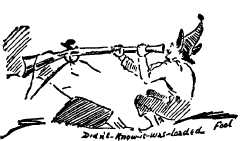
"Howld on, now. Give me a chance to finish. Ye can go fur two weeks, but ye got to go; no snakin' home nights to sleep. Ye can't hev no matches an' no gun. I won't hev a lot o' children foolin' wid a didn't-know-it-was-loaded, an' shootin' all the birds and squirrels an' each other, too. Ye kin hev yer bows an' arrows an' ye ain't likely to do no 253 harrum. Ye kin hev all the mate an' bread an' stuff ye want, but ye must cook it yerselves, an' if I see any signs of settin' the Woods afire I'll be down wid the rawhoide an' cut the very livers out o' ye."
The rest of the morning was devoted to preparation, Mrs. Raften taking the leading hand.
"Now, who's to be cook?" she asked.
"Sam"—"Yan"—said the boys in the same breath.
"Hm! You seem in one mind about it. Suppose you take it turn and turn about—Sam first day."
Then followed instructions for making coffee in the morning, boiling potatoes, frying bacon. Bread and butter enough they were to take with them—eggs, too.
"You better come home for milk every day or every other day, at least," remarked the mother.
"We'd ruther steal it from the cows in the pasture," ventured Sam, "seems naturaler to me Injun blood."
"If I ketch ye foolin' round the cows or sp'ilin' them the fur'll fly," growled Raften.
"Well, kin we hook apples and cherries?" and Sam added in explanation; "they're no good to us unless they're hooked."
"Take all the fruit ye want."
"An' potatoes?"
"Yes."
"An' aigs?"
254 "Well, if ye don't take more'n ye need."
"An' cakes out of the pantry? Indians do that."
"No; howld on now. That is a good place to draw the line. How are ye goin' to get yer stuff down thayer? It's purty heavy. Ye see thayer are yer beds an' pots an' pans, as well as food."
"We'll have to take a wagon to the swamp and then carry them on our backs on the blazed trail," said Sam, and explained "our backs" by pointing to Michel and Si at work in the yard.
"The road goes as far as the creek," suggested Yan; "let's make a raft there an' take the lot in it down to the swimming-pond; that'd be real Injun."
"What'll ye make the raft of?" asked Raften.
"Cedar rails nailed together," answered Sam.
"No nails in mine," objected Yan; "that isn't Injun."
"An' none o' my cedar rails fur that. 'Pears to me it'd be less work an' more Injun to pack the stuff on yer backs an' no risk o' wettin' the beds."
So the raft was given up, and the stuff was duly carted to the creek's side. Raften himself went with it. He was a good deal of a boy at heart and he was much in sympathy with the plan. His remarks showed a mixture of interest, and doubt as to the wisdom of letting himself take so much interest.
"Hayre, load me up," he said, much to the surprise of the boys, as they came to the creek's edge. His broad shoulders carried half of the load. The blazed trail was only two hundred yards long, and in two trips the stuff was all dumped down in front 255 of the teepee.
Sam noted with amusement the unexpected enthusiasm of his father. "Say, Da, you're just as bad as we are. I believe you'd like to join us."
"'Moinds me o' airly days here," was the reply, with a wistful note in his voice. "Many a night me an' Caleb Clark slep' out this way on this very crick when them fields was solid bush. Do ye know how to make a bed?"
"Don't know a thing," and Sam winked at Yan. "Show us."
"I'll show ye the rale thing. Where's the axe?"
"Haven't any," said Yan. "There's a big tomahawk and a little tomahawk."
Raften grinned, took the big "tomahawk" and pointed to a small Balsam Fir. "Now there's a foine bed-tree."
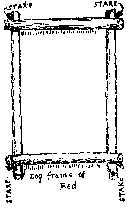
"Why, that's a fire-tree, too," said Yan, as with two mighty strokes Raften sent it toppling down, then rapidly trimmed it of its flat green boughs. A few more strokes brought down a smooth young Ash and cut it into four pieces, two of them seven feet long and two of them five feet. Next he cut a White Oak sapling and made four sharp pegs each two feet long.
"Now, boys, whayer do you want yer bed?" then stopping at a thought he added, "Maybe ye didn't want me to help—want to do everything yerselves?"
256 "Ugh, bully good squaw. Keep it up—wagh!" said his son and heir, as he calmly sat on a log and wore his most "Injun brave" expression of haughty approval.

The father turned with an inquiring glance to Yan, who replied:
"We're mighty glad of your help. You see, we don't know how. It seems to me that I read once the best place in the teepee is opposite the door and a little to one side. Let's make it here." So Raften placed the four logs for the sides and ends of the bed and drove in the ground the four stakes to hold them. Yan brought in several armfuls of branches, and Raften proceeded to lay them like shingles, beginning at the head-log of the bed and lapping them very much. It took all the fir boughs, but when all was done there was a solid mass of soft green tips a foot thick, all the butts being at the ground.
"Thayer," said Raften, "that's an Injun feather bed an' safe an' warrum. Slapin' on the ground's terrible dangerous, but that's all right. Now make your bed on that." Sam and Yan did so, and when it was finished Raften said: "Now, fetch that little canvas I told yer ma to put in; that's to fasten to the poles for an inner tent over the bed."
Yan stood still and looked uncomfortable.
"Say, Da, look at Yan. He's got that tired look that he wears when the rules is broke."
"What's wrong," asked Raften.
257 "Indians don't have them that I ever heard of," said Little Beaver.
"Yan, did ye iver hear of a teepee linin' or a dew-cloth?"
"Yes," was the answer, in surprise at the unexpected knowledge of the farmer.
"Do ye know what they're like?"
"No—at least—no—"
"Well, I do; that's what it's like. That's something I do know, fur I seen old Caleb use wan."
"Oh, I remember reading about it now, and they are like that, and it's on them that the Indians paint their records. Isn't that bully," as he saw Raften add two long inner stakes which held the dew-cloth like a canopy.
"Say, Da, I never knew you and Caleb were hunting together. Thought ye were jest natural born enemies."
"Humph!" grunted Raften. "We wuz chums oncet. Never had no fault to find till we swapped horses."
"Sorry you ain't now, 'cause he's sure sharp in the woods."
"He shouldn't a-tried to make an orphan out o' you."
"Are you sure he done it?"
"If 'twasn't him I dunno who 'twas. Yan, fetch some of them pine knots thayer."
Yan went after the knots; it was some yards into the woods, and out there he was surprised to see a tall man behind a tree. A second's glance showed it to be Caleb. The Trapper laid one finger on his 258 lips and shook his head. Yan nodded assent, gathered the knots, and went back to the camp, where Sam continued:
"You skinned him out of his last cent, old Boyle says."
"An' whoi not, when he throid to shkin me? Before that I was helpin' him, an' fwhat must he do but be ahfter swappin' horses. He might as well ast me to play poker and then squeal when I scooped the pile. Naybours is wan thing an' swappin' horses is another. All's fair in a horse trade, an' friends didn't orter swap horses widout they kin stand the shkinnin'. That's a game by itself. Oi would 'a' helped him jest the same afther that swap an' moore, fur he wuz good stuff, but he must nades shoot at me that noight as I come home wit the wad, so av coorse——"
"I wish ye had a Dog now," said the farmer in the new tone of a new subject; "tramps is a nuisance at all toimes, an' a Dog is the best med'cine for them. I don't believe old Cap'd stay here; but maybe yer near enough to the house so they won't bother ye. An' now I guess the Paleface will go back to the settlement. I promised ma that I'd see that yer bed wuz all right, an' if ye sleep warrum an' dry an' hev plenty to ate ye'll take no harrum."
So he turned away, but as he was quitting the clearing he stopped,—the curious boyish interest was gone from his face, the geniality from his voice—then in his usual stern tones of command:
259
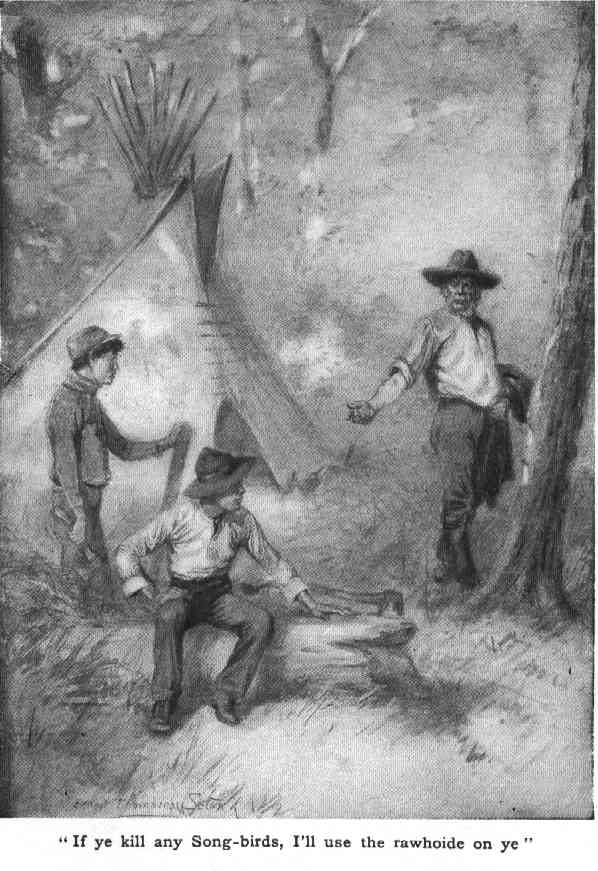
261 "Now, bhoys, ye kin shoot all the Woodchucks yer a mind ter, fur they are a nuisance in the field. Yer kin kill Hawks an' Crows an' Jays, fur they kill other birds, an' Rabbits an' Coons, fur they are fair game; but I don't want to hear of yer killin' any Squirrels or Chipmunks or Song-birds, an' if ye do I'll stop the hull thing an' bring ye back to wurruk, an' use the rawhoide on tap o' that."
262
II
The First Night and Morning
It was a strange new feeling that took possession of the boys as they saw Mr. Raften go, and when his step actually died away on the blazed trail they felt that they were really and truly alone in the woods and camping out. To Yan it was the realization of many dreams, and the weirdness of it was helped by the remembrance of the tall old man he had seen watching them from behind the trees. He made an excuse to wander out there, but of course Caleb was gone.
"Fire up," Sam presently called out. Yan was the chief expert with the rubbing-sticks, and within a minute or two he had the fire going in the middle of the teepee and Sam set about preparing the evening meal. This was supposed to be Buffalo meat and Prairie roots (beef and potatoes). It was eaten rather quietly, and then the boys sat down on the opposite sides of the fire. The conversation dragged, then died a natural death; each was busy with his thoughts, and there was, moreover, an impressive and repressive something or other all around them. Not a stillness, for there were many sounds, but beyond those a sort of voiceless background that showed up all the myriad voices. Some of 263 these were evidently Bird, some Insect, and a few were recognized as Tree-frog notes. In the near stream were sounds of splashing or a little plunge.
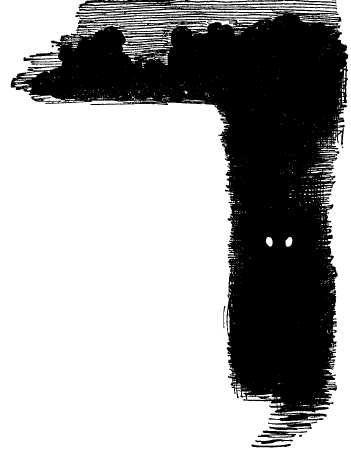
"Must be Mushrat," whispered Sam to the unspoken query of his friend.
A loud, far "Oho-oho-oho" was familiar to both as the cry of the Horned Owl, but a strange long wail rang out from the trees overhead.
"What's that?"
"Don't know," was all they whispered, and both felt very uncomfortable. The solemnity and mystery of the night was on them and weighing more heavily with the waning light. The feeling was oppressive. Neither had courage enough to propose going to the house or their camping would have ended. Sam arose and stirred the fire, looked around for more wood, and, seeing none, he grumbled (to himself) and stepped outside in the darkness to find some. It was not till long afterward that he admitted having had to dare himself to step out into the darkness. He brought in some sticks and fastened the door as tightly as possible. The blazing fire in the teepee was cheering again. The boys perhaps did not realize that there was actually a tinge of homesickness in their mood, yet both were thinking of the comfortable circle at the house. The blazing fire smoked a little, and Sam said:
"Kin you fix that to draw? You know more about it 'an me."
264 Yan now forced himself to step outside. The wind was rising and had changed. He swung the smoke poles till the vent was quartering down, then hoarsely whispered, "How's that?"
"That's better," was the reply in a similar tone, though there was no obvious difference yet.
He went inside with nervous haste and fastened up the entrance.
"Let's make a good fire and go to bed."
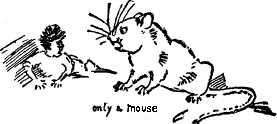
So they turned in after partly undressing, but not to sleep for hours. Yan in particular was in a state of nervous excitement. His heart had beaten violently when he went out that time, and even now that mysterious dread was on him. The fire was the one comfortable thing. He dozed off, but started up several times at some slight sound. Once it was a peculiar "Tick, tick, scr-a-a-a-a-pe, lick-scra-a-a-a-a-a-pe," down the teepee over his head. "A Bear" was his first notion, but on second thoughts he decided it was only a leaf sliding down the canvas. Later he was roused by a "Scratch, scratch, scratch" close to him. He listened silently for some time. This was no leaf; it was an animal! Yes, surely—it was a Mouse. He slapped the canvas violently and "hissed" till it went away, but as he listened he heard again that peculiar wail in the tree-tops. It almost made his hair sit up. He reached out and poked the fire together into a blaze. All was still and in time he dozed off. Once more he was wide awake in a flash and saw Sam sitting up in bed listening.
266
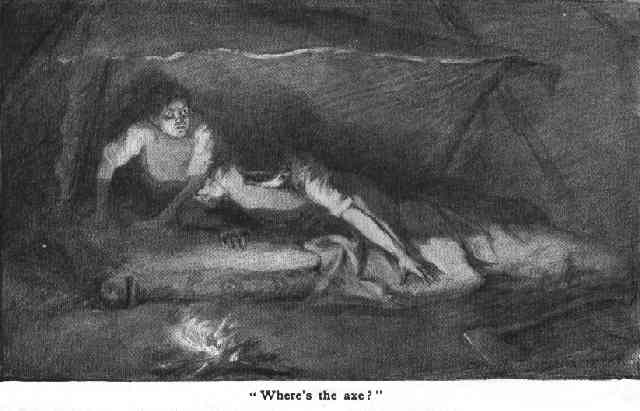
267 "What is it, Sam?" he whispered.
"I dunno. Where's the axe?"
"Right here."
"Let me have it on my side. You kin have the hatchet."
But they dropped off at last and slept soundly till the sun was strong on the canvas and filling the teepee with a blaze of transmitted light.
"Woodpecker! Woodpecker! Get up! Get up! Hi-e-yo! Hi-e-yo! Double-u-double-o-d-bang-fizz- whackety-whack-y-r-chuck-brrrrrrrrrrrrrrr-Woodpecker," shouted Yan to his sleepy chum, quoting a phrase that Sam when a child had been taught as the true spelling of his nickname.
Sam woke slowly, but knowing perfectly where he was, and drawled:
"Get up yourself. You're cook to-day, an' I'll take my breakfast in bed. Seems like my knee is broke out again."
"Oh, get up, and let's have a swim before breakfast."
"No, thank you, I'm too busy just now; 'sides, it's both cold and wet in that pond, this time o' day."
The morning was fresh and bright; many birds were singing, although it was July, a Red-eyed Vireo and a Robin were in full song; and as Yan rose to get the breakfast he wondered why he had been haunted by such strange feelings the night before. It was incomprehensible now. He wished that appalling wail in the tree-tops would sound again, so he might trace it home.
268 There still were some live coals in the ashes, and in a few minutes he had a blazing fire, with the pot boiling for coffee, and the bacon in the fryer singing sweetest music for the hungry.
Sam lay on his back watching his companion and making critical remarks.
"You may be an A1 cook—at least, I hope you are, but you don't know much about fire-wood," said he. "Now look at that," as one huge spark after another exploded from the fire and dropped on the bed and the teepee cover.
"How can I help it?"
"I'll bet Da's best cow against your jack-knife you got some Ellum or Hemlock in that fire."
"Well, I have," Yan admitted, with an air of surrender.
"My son," said the Great Chief Woodpecker, "no sparking allowed in the teepee. Beech, Maple, Hickory or Ash never spark. Pine knots an' roots don't, but they make smoke like—like—oh—you know. Hemlock, Ellum, Chestnut, Spruce and Cedar is public sparkers, an' not fit for dacint teepee sassiety. Big Injun heap hate noisy, crackling fire. Enemy hear that, an'—an'—it burns his bedclothes."
"All right, Grandpa," and the cook made a mental note, then added in tones of deadly menace, "You get up now, do you understand!" and he picked up a bucket of water.
"That might scare the Great Chief Woodpecker if the Great Chief Cook had a separate bed, but now he smiles kind o' scornful," was all the satisfaction 269 he got. Then seeing that breakfast really was ready, Sam scrambled out a few minutes later. The coffee acted like an elixir—their spirits rose, and before the meal was ended it would have been hard to find two more hilarious and enthusiastic campers. Even the vague terrors of the night were now sources of amusement.
270
III
A Crippled Warrior and the Mud Albums
"Say, Sam; what about Guy? Do we want him?"
"Well, it's just like this. If it was at school or any other place I wouldn't be bothered with the dirty little cuss, but out in the woods like this one feels kind o' friendly, an' three's better than two. Besides, he has been admitted to the Tribe already."
"Yes, that's what I say. Let's give him a yell."
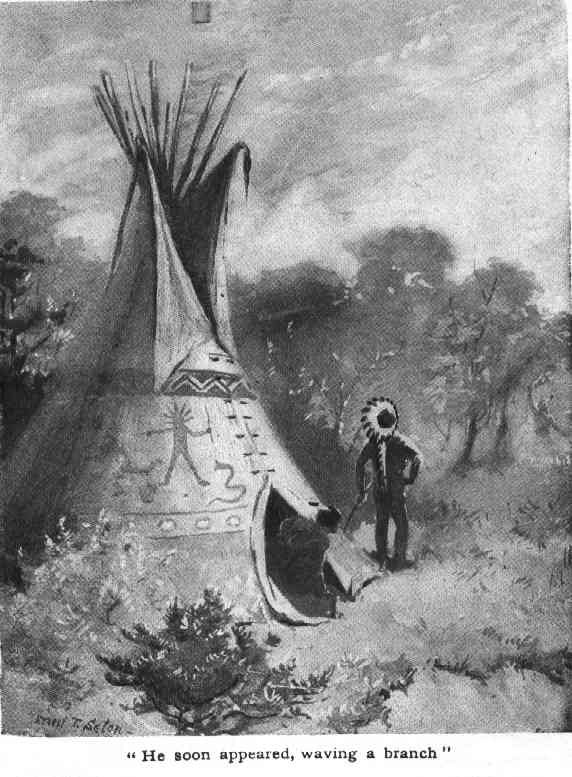
So the boys uttered a long yell, produced by alternating the voice between a high falsetto and a natural tone. This was the "yell," and had never failed to call Guy forth to join them unless he had some chore on hand and his "Paw" was too near to prevent his renegading to the Indians. He soon appeared waving a branch, the established signal that he came as a friend.
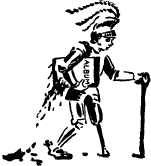
He came very slowly, however, and the boys saw that he limped frightfully, helping himself along with a stick. He was barefoot, as usual, but his left foot was swaddled in a bundle of rags.
"Hello, Sappy; what happened? Out to Wounded Knee River?"
271
273
"Nope. Struck luck. Paw was bound I'd ride the Horse with the scuffler all day, but he gee'd too short an' I arranged to tumble off'n him, an' Paw cuffled me foot some. Law! how I did holler! You should 'a' heard me."
"Bet we did," said Sam. "When was it?"
"Yesterday about four."
"Exactly. We heard an awful screech and Yan says, says he, 'There's the afternoon train at Kelly's Crossing, but ain't she late?'
"'Train!' says I. 'Pooh. I'll bet that's Guy Burns getting a new licking.'"
"Guess I'll well up now," said War Chief Sapwood, so stripped his foot, revealing a scratch that would not have cost a thought had he got it playing ball. He laid the rags away carefully and with them every trace of the limp, then entered heartily into camp life.
The vast advantage of being astir early now was seen. There were Squirrels in every other tree, there were birds on every side, and when they ran to the pond a wild Duck spattered over the surface and whistled out of sight.
"What you got?" called Sam, as he saw Yan bending eagerly over something down by the pond.
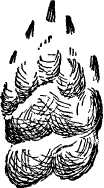
Yan did not answer, and so Sam went over and saw him studying out a mark in the mud. He was trying to draw it in his note-book.
"What is it?" repeated Sam.
"Don't know. Too stubby for a Muskrat, too much claw for a Cat, too small for a Coon, too many toes for a Mink."
274 "I'll bet it's a Whangerdoodle."
Yan merely chuckled in answer to this.
"Don't you laugh," said the Woodpecker, solemnly, "You'd be more apt to cry if you seen one walk into the teepee blowing the whistle at the end of his tail. Then it'd be, 'Oh, Sam, where's the axe?'"
"Tell you what I do believe it is," said Yan, not noticing this terrifying description; "it's a Skunk."
"Little Beaver, my son! I thought I would tell you, then I sez to meself, 'No; it's better for him to find out by his lone. Nothing like a struggle in early life to develop the stuff in a man. It don't do to help him too much,' sez I, an' so I didn't."
Here Sam condescendingly patted the Second War Chief on the head and nodded approvingly. Of course he did not know as much about the track as Yan did, but he prattled on:
"Little Beaver! you're a heap struck on tracks—Ugh—good! You kin tell by them everything that passes in the night. Wagh! Bully! You're likely to be the naturalist of our Tribe. But you ain't got gumption. Now, in this yer hunting-ground of our Tribe there is only one place where you can see a track, an' that is that same mud-bank; all the rest is hard or grassy. Now, what I'd do if I was a Track-a-mist, I'd give the critters lots o' chance to leave tracks. I'd fix it all round with places so nothing could come or go 'thout givin' us his impressions of the trip. I'd have one on each end of the trail coming in, an' one on each side of the creek where it comes in an' goes out."
275 "Well, Sam, you have a pretty level head. I wonder I didn't think of that myself."
"My son, the Great Chief does the thinking. It's the rabble—that's you and Sappy—that does the work."
But all the same he set about it at once with Yan, Sappy following with a slight limp now. They removed the sticks and rubbish for twenty feet of the trail at each end and sprinkled this with three or four inches of fine black loam. They cleared off the bank of the stream at four places, one at each side where it entered the woods, and one at each side where it went into the Burns's Bush.
"Now," said Sam, "there's what I call visitors' albums like the one that Phil Leary's nine fatties started when they got their brick house and their swelled heads, so every one that came in could write their names an' something about 'this happy, happy, ne'er-to-be-forgotten visit'—them as could write. Reckon that's where our visitors get the start, for all of ours kin write that has feet."
"Wonder why I didn't think o' that," said Yan, again and again. "But there's one thing you forget," he said. "We want one around the teepee."
This was easily made, as the ground was smooth and bare there, and Sappy forgot his limp and helped to carry ashes and sand from the fire-hole. Then planting his broad feet down in the dust, with many snickers, he left some very interesting tracks.

"I call that a bare track" said Sam.
276 "Go ahead and draw it," giggled Sappy.
"Why not?" and Yan got out his book.
"Bet you can't make it life-size," and Sam glanced from the little note-book to the vast imprint.
After it was drawn, Sam said, "Guess I'll peel off and show you a human track." He soon gave an impression of his foot for the artist, and later Yan added his own; the three were wholly different.
"Seems to me it would be about right, if you had the ways the toes pointed and the distance apart to show how long the legs wuz."
Again Sam had given Yan a good idea. From that time he noted these two points and made his records much better.
"Air you fellers roostin' here now?" said Sappy in surprise, as he noted the bed as well as the pots and pans.
"Yep."
"Well, I wanter, too. If I kin git hol' o' Maw 'thout Paw, it'll be O.K."
"You let on we don't want you and Paw'll let you come. Tell him Ole Man Raften ordered you off the place an' he'll fetch you here himself."
"I guess there's room enough in that bed fur three," remarked the Third War Chief.
"Well, I guess there ain't," said Woodpecker. "Not when the third one won first prize for being the dirtiest boy in school. You can get stuff an' make your own bed, across there on the other side the fire."
277 "Don't know how."
"We'll show you, only you'll have to go home for blankets an' grub."
The boys soon cut a Fir-bough bed, but Guy put off going home for the blankets as long as he could. He knew and they suspected that there was no chance of his rejoining them again that day. So after sundown he replaced his foot-rags and limped down the trail homeward, saying, "I'll be back in a few minutes," and the boys knew perfectly well that he would not.
The evening meal was over; they had sat around wondering if the night would repeat its terrors. An Owl "Hoo-hoo-ed" in the trees. There was a pleasing romance in the sound. The boys kept up the fire till about ten, then retired, determined that they would not be scared this time. They were barely off to sleep when the most awful outcry arose in the near woods, like "a Wolf with a sore throat," then the yells of a human being in distress. Again the boys sat up in fright. There was a scuffling outside—a loud and terrified "Hi—hi—hi—Sam!" Then an attack was made on the door. It was torn open, and in tumbled Guy. He was badly frightened; but when the fire was lighted and he calmed down a little he confessed that Paw had sent him to bed, but when all was still he had slipped out the window, carrying the bedclothes. He was nearly back to the camp when he decided to scare the boys by letting off a few wolfish howls, but he made himself very scary by doing it, and 278 when a wild answer came from the tree-tops—a hideous, blaring screech—he lost all courage, dropped the bedding, and ran toward the teepee yelling for help.
The boys took torches presently and went nervously in search of the missing blankets. Guy's bed was made and in an hour they were once more asleep.
In the morning Sam was up and out first. From the home trail he suddenly called:
"Yan, come here."
"Do you mean me?" said Little Beaver, with haughty dignity.
"Yep, Great Chief; git a move on you. Hustle out here. Made a find. Do you see who was visiting us last night while we slept?" and he pointed to the "album" on the inway. "I hain't shined them shoes every week with soot off the bottom of the pot without knowin' that one pair of 'em was wore by Ma an' one of 'em by Da. But let's see how far they come. Why, I orter looked round the teepee before tramplin' round." They went back, and though the trails were much hidden by their own, they found enough around the doorway to show that during the night, or more likely late in the evening, the father and mother had paid them a visit in secret—had inspected the camp as they slept, but finding no one stirring and the boys breathing the deep breath of healthy sleep, they had left them undisturbed.
279 "Say, boys—I mean Great Chiefs—what we want in camp is a Dog, or one of these nights some one will steal our teeth out o' our heads an' we won't know a thing till they come back for the gums. All Injun camps have Dogs, anyway."
The next morning the Third War Chief was ordered out by the Council, first to wash himself clean, then to act as cook for the day. He grumbled as he washed, that "'Twan't no good—he'd be all dirty again in two minutes," which was not far from the truth. But he went at the cooking with enthusiasm, which lasted nearly an hour. After this he did not see any fun in it, and for once he, as well as the others, began to realize how much was done for them at home. At noon Sappy set out nothing but dirty dishes, and explained that so long as each got his own it was all right. His foot was very troublesome at meal time also. He said it was the moving round when he was hurrying that made it so hard to bear, but in their expedition with bows and arrows later on he found complete relief.
"Say, look at the Red-bird," he shouted, as a Tanager flitted onto a low branch and blazed in the sun. "Bet I hit him first shot!" and he drew an arrow.
"Here you, Saphead," said Sam, "quit that shooting at little birds. It's bad medicine. It's against the rules; it brings bad luck—it brings awful bad luck. I tell you there ain't no worse luck than Da's raw-hide—that I know."
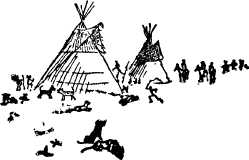
280 "Why, what's the good o' playin' Injun if we can't shoot a blame thing?" protested Sappy.
"You kin shoot Crows an' Jays if you like, an' Woodchucks, too."
"I know where there's a Woodchuck as big as a Bear."
"Ah! What size Bear?"
"Well, it is. You kin laugh all you want to. He has a den in our clover field, an' he made it so big that the mower dropped in an' throwed Paw as far as from here to the crick."
"An' the horses, how did they get out?"
"Well! It broke the machine, an' you should have heard Paw swear. My! but he was a socker. Paw offered me a quarter if I'd kill the old whaler. I borrowed a steel trap an' set it in the hole, but he'd dig out under it an' round it every time. I'll bet there ain't anything smarter'n an old Woodchuck."
"Is he there yet?" asked War Chief No. 2.
"You just bet he is. Why, he has half an acre of clover all eat up."
"Let's try to get him," said Yan. "Can we find him?"
"Well, I should say so. I never come by but I see the old feller. He's so big he looks like a calf, an' so old an' wicked he's gray-headed."
"Let's have a shot at him," suggested the Woodpecker. "He's fair game. Maybe your Paw'll give us a quarter each if we kill him."
281 Guy snickered. "Guess you don't know my Paw," then he giggled bubblously through his nose again.
Arrived at the edge of the clover, Sam asked, "Where's your Woodchuck?"
"Right in there."
"I don't see him."
"Well, he's always here."
"Not now, you bet."
"Well, this is the very first time I ever came here and didn't see him. Oh, I tell you, he's a fright. I'll bet he's a blame sight bigger'n that stump."
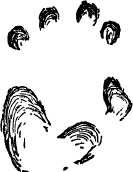
"Well, here's his track, anyway," said Woodpecker, pointing to some tracks he had just made unseen with his own broad palm.
"Now," said Sappy, in triumph. "Ain't he an old socker?"
"Sure enough. You ain't missed any cows lately, have you? Wonder you ain't scared to live anyways near!"
282
IV
A "Massacree" of Palefaces
"Say, fellers, I know where there's a stavin' Birch tree—do you want any bark?"
"Yes, I want some," said Little Beaver.
"But hold on; I guess we better not, coz it's right on the edge o' our bush, an' Paw's still at the turnips."
"Now if you want a real war party," said the Head Chief, "let's massacree the Paleface settlement up the crick and get some milk. We're just out, and I'd like to see if the place has changed any."
So the boys hid their bows and arrows and headdresses, and, forgetting to take a pail, they followed in Indian file the blazed trail, carefully turning in their toes as they went and pointing silently to the track, making signs of great danger. First they crawled up, under cover of one of the fences, to the barn. The doors were open and men working at something. A pig wandered in from the barnyard. Then the boys heard a sudden scuffle, and a squeal from the pig as it scrambled out again, and Raften's voice: "Consarn them pigs! Them boys ought to be here to herd them." This was sufficiently alarming to scare the Warriors off in great haste. They hid in the huge root-cellar and there 283 held a council of war.
"Here, Great Chiefs of Sanger," said Yan, "behold I take three straws. That long one is for the Great Woodpecker, the middle size is for Little Beaver, and the short thick one with the bump on the end and a crack on top is Sappy. Now I will stack them up in a bunch and let them fall, then whichever way they point we must go, for this is Big Medicine."
So the straws fell. Sam's straw pointed nearly to the house, Yan's a little to the south of the house, and Guy's right back home.
"Aha, Sappy, you got to go home; the straw says so."
"I ain't goin' to believe no such foolishness."
"It's awful unlucky to go against it."
"I don't care, I ain't goin' back," said Guy doggedly.
"Well, my straw says go to the house; that means go scouting for milk, I reckon."
Yan's straw pointed toward the garden, and Guy's to the residence and grounds of "J.G. Burns, Esq."
"I don't care," said Sappy, "I ain't goin'. I am goin' after some of them cherries in your orchard, an' 'twon't be the first time, neither."
"We kin meet by the Basswood at the foot of the lane with whatever we get," said the First War Chief, as he sneaked into the bushes and crawled through the snake fence and among the nettles and manure 284 heaps on the north side of the barnyard till he reached the woodshed adjoining the house. He knew where the men were, and he could guess where his mother was, but he was worried about the Dog. Old Cap might be on the front doorstep, or he might be prowling at just the wrong place for the Injun plan. The woodshed butted on the end of the kitchen. The milk was kept in the cellar, and one window of the cellar opened into a dark corner of the woodshed. This was easily raised, and Sam scrambled down into the cool damp cellar. Long rows of milk pans were in sight on the shelves. He lifted the cover of the one he knew to be the last put there and drank a deep, long draught with his mouth down to it, then licked the cream from his lips and remembered that he had come without a pail. But he knew where to get one. He went gently up the stairs, avoiding steps Nos. 1 and 7 because they were "creakers," as he found out long ago, when he used to 'hook' maple sugar from the other side of the house. The door at the top was closed and buttoned, but he put his jack-knife blade through the crack and turned the button. After listening awhile and hearing no sound in the kitchen, he gently opened the squeaky old door. There was no one to be seen but the baby, sound asleep in her cradle. The outer door was open, but no Dog lying on the step as usual. Over the kitchen was a garret entered by a trap-door and a ladder. The ladder was up and the trap-door open, but all was still. Sam stood over 285 the baby, grunted, "Ugh, Paleface papoose," raised his hand as if wielding a war club, aimed a deadly blow at the sleeping cherub, then stooped and kissed her rosy mouth so lightly that her pink fists went up to rub it at once. He now went to the pantry, took a large pie and a tin pail, then down into the cellar again. He, at first, merely closed the door behind him and was leaving it so, but remembered that Minnie might awaken and toddle around till she might toddle into the cellar, therefore he turned the button so that just a corner showed over the crack, closed the door and worked with his knife blade on that corner till the cellar was made as safe as before. He now escaped with his pie and pail.
Meanwhile his mother's smiling face beamed out of the dark loft. Then she came down the ladder. She had seen him come and enter the cellar, by chance she was in the loft when he reached the kitchen, but she had kept quiet to enjoy the joke.
Next time the Woodpecker went to the cellar he found a paper with this on it: "Notice to hostile Injuns—Next time you massacree this settlement, bring back the pail, and don't leave the covers off the milk pans."
Yan had followed the fence that ran south of the house. There was plenty of cover, but he crawled on hands and knees, going right down on his breast when he came to places more open than the rest. In this way he had nearly reached the garden when he heard a noise behind and, turning, he saw 286 Sappy.
"Here, what are you following me for? Your straw pointed the other way. You ain't playing fair."
"Well, I don't care, I ain't going home. You fixed it up so my straw would point that way. It ain't fair, an' I won't do it."
"You got no right following me."
"I ain't following you, but you keep going just the place I want to go. It's you following me, on'y keepin' ahead. I told you I was after cherries."
"Well, the cherries are that way and I'm going this way, and I don't want you along."
"You couldn't get me if you wanted me."
"Erh——"
"Erh——"
So Sappy went cherryward and Yan waited awhile, then crawled toward the fruit garden. After twenty or thirty yards more, he saw a gleam of red, then under it a bright yellow eye glaring at him. He had chanced on a hen sitting on her nest. He came nearer, she took alarm and ran away, not clucking, but cackling loudly. There were a dozen eggs of two different styles, all bright and clean, and the hen's comb was bright red. Yan knew hens. This was easy to read: Two stray hens laying in one nest, and neither of them sitting yet.
"So ho! Straws show which way the hens go."
He gathered up the eggs into his hat and crawled back toward the tree where all had to meet.
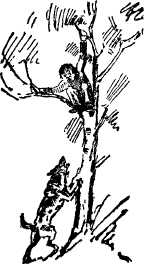
287 But before he had gone far he heard a loud barking, then yells for help, and turned in time to see Guy scramble up a tree while Cap, the old Collie, barked savagely at him from below. Now that he was in no danger Sappy had the sense to keep quiet. Yan came back as quickly as possible. The Dog at once recognized and obeyed him, but doubtless was much puzzled to make out why he should be pelted back to the house when he had so nobly done his duty by the orchard.
"Now, you see, maybe next time you'll do what the medicine straw tells you. Only for me you'd been caught and fed to the pigs, sure."
"Only for you I wouldn't have come. I wasn't scared of your old Dog, anyway. Just in about two minutes more I was comin' down to kick the stuffin' out o' him myself."
"Perhaps you'd like to go back and do it now. I'll soon call him."
"Oh, I hain't got time now, but some other time— Let's find Sam."
So they foregathered at the tree, and laden with their spoils, they returned gloriously to camp.
288
V
The Deer Hunt
That evening they had a feast and turned in to sleep at the usual hour. The night passed without special alarm. Once about daylight Sappy called them, saying he believed there was a Bear outside, but he had a trick of grinding his teeth in his sleep, and the other boys told him that was the Bear he heard.
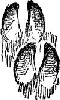
Yan went around to the mud albums and got some things he could not make out and a new mark that gave him a sensation. He drew it carefully. It was evidently the print of a small sharp hoof. This was what he had hungered for so long. He shouted, "Sam—Sam—Sapwood, come here; here's a Deer track."
The boys shouted back, "Ah, what you givin' us now!" "Call off your Dog!" and so forth.
But Yan persisted. The boys were so sure it was a trick that they would not go for some time, then the sun had risen high, shining straight down on the track instead of across, so it became very dim. Soon the winds, the birds and the boys themselves helped to wipe it out. But Yan had his drawing, and persisted in spite of the teasing that it was true.
289 At length Guy said aside to Sam: "Seems to me a feller that hunts tracks so terrible serious ought to see the critter some time. 'Tain't right to let him go on sufferin'. I think he ought to see that Deer. We ought to help him." Here he winked a volley or two and made signs for Sam to take Yan away.
This was easily done.
"Let's see if your Deer went out by the lower mud album." So they walked down that way, while Guy got an old piece of sacking, stuffed it with grass, and, hastily tying it in the form of a Deer's head, stuck it on a stick. He put in two flat pieces of wood for ears, took charcoal and made two black spots for eyes and one for a nose, then around each he drew a ring of blue clay from the bed of the brook. This soon dried and became white. Guy now set up this head in the bushes, and when all was ready he ran swiftly and silently through the wood to find Sam and Yan. He beckoned vigorously and called under his voice: "Sam—Yan—a Deer! Here's that there Deer that made them tracks, I believe."
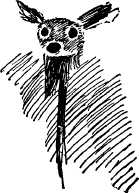
Guy would have failed to convince Yan if Sam had not looked so much interested. They ran back to the teepee, got their bows and arrows, then, guided by Guy, who, however, kept back, they crawled to where he had seen the Deer.
"There—there, now, ain't he a Deer? There—see him move!"
Yan's first feeling was a most exquisite thrill of pleasure. It was like the uplift of joy he had had the time he got his book, but was stronger. The 290 savage impulse to kill came quickly, and his bow was in his hand, but he hesitated.
"Shoot! Shoot!" said Sam and Guy.
Yan wondered why they did not shoot. He turned, and in spite of his agitation he saw that they were making fun of him. He glanced at the Deer again, moved up a little closer and saw the trick.
Then they hooted aloud. Yan was a little crestfallen. Oh, it had been such an exquisite feeling! The drop was long and hard, but he rallied quickly.
"I'll shoot your Deer for you," he said, and sent an arrow close under it.
"Well, I kin beat that," and Sam and Guy both fired. Sam's arrow stuck in the Deer's nose. At that he gave a yell; then all shot till the head was stuck full of arrows, and they returned to the teepee to get dinner. They were still chaffing Yan about the Deer when he said slowly to Guy:
"Generally you are not so smart as you think you are, but this time you're smarter. You've given me a notion."
So after dinner he got a sack about three feet long and stuffed it full of dry grass; then he made a small sack about two and a half feet long and six inches thick, but with an elbow in it and pointed at one end. This he also stuffed with hay and sewed with a bone needle to the big sack. Next he cut four sticks of soft pine for legs and put them into the four corners of the big sack, wrapping them with 291 bits of sacking to be like the rest. Then he cut two ears out of flat sticks; painted black eyes and nose with a ring of white around each, just as Sappy had done, but finally added a black spot on each side of the body, and around that a broad gray hand. Now he had completed what every one could see was meant for a Deer.
The other boys helped a little, but not did cease to chaff him.
"Who's to be fooled this time?" asked Guy.
"You," was the answer.
"I'll bet you'll get buck fever the first time you come across it," chuckled the Head Chief.
"Maybe I will, but you'll all have a chance. Now you fellers stay here and I'll hide the Deer. Wait till I come back."
So Yan ran off northward with the dummy, then swung around to the east and hid it at a place quite out of the line that he first took. He returned nearly to where he came out, shouting "Ready!"
Then the hunters sallied forth fully armed, and Yan explained: "First to find it counts ten and has first shot. If he misses, next one can walk up five steps and shoot; if he misses, next walks five steps more, and so on until the Deer is hit. Then all the shooting must be done from the place where that arrow was fired. A shot in the heart counts ten; in the gray counts five; that's a body wound—and a hit outside of that counts one—that's a scratch. If the 292 Deer gets away without a shot in the heart, then I count twenty-five, and the first one to find it is Deer for next hunt—twelve shots each is the limit."
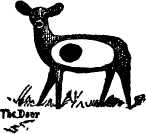
The two hunters searched about for a long time. Sam made disparaging remarks about the trail this Deer did not leave, and Guy sneaked and peaked in every thicket.
Sappy was not an athlete nor an intellectual giant, but his little piggy eyes were wonderfully sharp and clear.
"I see him," he yelled presently, and pointed out the place seventy-five yards away where he saw one ear and part of the head.
"Tally ten for Sappy," and Yan marked it down.
Guy was filled with pride at his success. He made elaborate preparation to shoot, remarking, "I could 'a' seen it twicet as far—if—if—if—it was—if I had a fair chance."
He drew his bow and left fly. The arrow went little more than half way. So Sam remarked, "Five steps up I kin go. It don't say nothing about how long the steps?"
"No."
"Well, here goes," and he began the most wonderful Kangaroo hops that he could do. He covered about thirty feet in those five steps, and by swerving a little aside he got a good view of the Deer. He was now less than sixty-five yards away. He fired and missed. Now Guy had the right to walk up five steps. He also missed. Finally at thirty yards Sam sent an arrow close past a tree, deep in the Deer's gray 293 flank.
"Bully shot! Body wound! Count five for the Great War Chief. All shooting from this spot now," said Yan, "and I don't know why I shouldn't shoot as well as the others."
"Coz you're the Deer and that'd be suicide," was Sam's objection. "But it's all right. You won't hit."
The objection was not sustained, and Yan tried his luck also. Two or three shots in the brown of the Deer's haunch, three or four into the tree that stood half way between, but nearly in line, a shot or two into the nose, then "Hooray!" a shot from Guy right into the Deer's heart put an end to the chase. Now they went up to draw and count the arrows.
Guy was ahead with a heart shot, ten, a body wound, five, and a scratch, one, that's sixteen, with ten more for finding it—twenty-six points. Sam followed with two body wounds and two scratches—twelve points, and Yan one body wound and five scratches—ten points. The Deer looked like an old Porcupine when they came up to it, and Guy, bursting with triumph, looked like a young Emperor.
"I tell you it takes me to larn you fellers to Deer hunt. I'll bet I'll hit him in the heart first thing next time."
"I'll bet you won't, coz you'll be Deer and can't shoot till we both have."
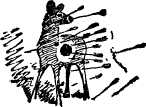
Guy thought this the finest game he had ever 294 played. He pranced away with the dummy on his back, scheming as he went to make a puzzle for the others. He hid the Deer in a dense thicket east of the camp, then sneaked around to the west of the camp and yelled "Ready!" They had a long, tedious search and had to give it up.
"Now what to do? Who counts?" asked the Woodpecker.
"When Deer escapes it counts twenty-five," replied the inventer of the game; and again Guy was ahead.
"This is the bulliest game I ever seen" was his ecstatic remark.
"Seems to me there's something wrong; that Deer ought to have a trail."
"That's so," assented Yan. "Wonder if he couldn't drag an old root!"
"If there was snow it'd be easy."
"I'll tell you, Sam; we'll tear up paper and leave a paper trail."
"Now you're talking." So all ran to camp. Every available scrap of wrapping paper was torn up small and put in a "scent bag."
Since no one found the Deer last time, Guy had the right to hide it again.
He made a very crooked trail and a very careful hide, so that the boys nearly walked onto the Deer before they saw it about fifteen yards away. Sam scored ten for the find. He fired and missed. Yan now stepped up his five paces and fired so hastily that he also missed. Guy now had a shot at it at 295 five yards, and, of course, hit the Deer in the heart.
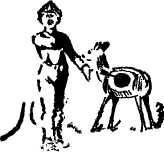
This succession of triumphs swelled his head nearly to the bursting point, and his boasting passed all bounds. But it now became clear that there must be a limit to the stepping up. So the new rule was made, "No stepping up nearer than fifteen paces."
The game grew as they followed it. Its resemblance to real hunting was very marked. The boys found that they could follow the trail, or sweep the woods with their eyes as they pleased, and find the game, but the wisest way was a combination. Yan was too much for the trail, Sam too much for the general lookout, but Guy seemed always in luck. His little piglike eyes took in everything, and here at length he found a department in which he could lead. It looked as though little pig-eyed Guy was really cut out for a hunter. He made a number of very clever hidings of the Deer. Once he led the trail to the pond, then, across, and right opposite he put the Deer in full view, so that they saw it at once in the open; they were obliged either to shoot across the pond, or step farther away round the edge, or step into the deep water, and again Guy scored. It was found necessary to bar hiding the Deer on a ridge and among stones, because in one case arrows which missed were lost in the bushes and in the other they were broken.
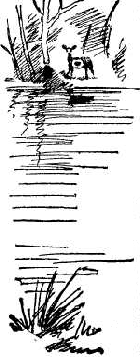
They played this game so much that they soon found a new difficulty. The woods were full of paper trails, and there was no means of deciding which was 296 the old and which the new. This threatened to end the fun altogether. But Yan hit on the device of a different colour of paper. This gave them a fresh start, but their supply was limited. There was paper everywhere in the woods now, and it looked as though the game was going to kill itself, when old Caleb came to pay them a visit. He always happened round as though it was an accident, but the boys were glad to see him, as he usually gave some help.
"Ye got some game, I see," and the old man's eye twinkled as he noted the dummy, now doing target duty on the forty-yard range. "Looks like the real thing. Purty good—purty good." He chuckled as he learned about the Deer hunt, and a sharp observer might have discerned a slight increase of interest when he found that it was not Sam Raften that was the "crack" hunter.
"Good fur you, Guy Burns. Me an' your Paw hev hunted Deer together on this very crik many a time."
When he learned the difficulty about the scent, he said "Hm," and puffed at his pipe for awhile in silence. Then at length:
"Say, Yan, why don't you and Guy get a bag o' wheat or Injun corn for scent: that's better than paper, an' what ye lay to-day is all clared up by the birds and Squirrels by to-morrow."
"Bully!" shouted Sam. (He had not been addressed at all, but he was not thin-skinned.) Within ten 297 minutes he had organized another "White massacree"—that is, a raid on the home barn, and in half an hour he returned with a peck of corn.
"Now, lemme be Deer," said Caleb. "Give me five minutes' start, then follow as fast as ye like. I'll show ye what a real Deer does."
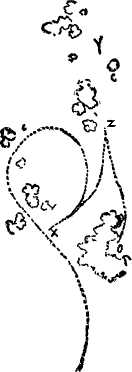
He strode away bearing the dummy, and in five minutes as they set out on the trail he came striding back again. Oh, but that seemed a long run. The boys followed the golden corn trail—a grain every ten feet was about all they needed now, they were so expert. It was a straight run for a time, then it circled back till it nearly cut itself again (at X, page 298). The boys thought it did so, and claimed the right to know, as on a real Deer trail you could tell. So Caleb said, "No, it don't cut the old trail." Where, then, did it go? After beating about, Sam said that the trail looked powerful heavy, like it might be double.
"Bet I know," said Guy. "He's doubled back," which was exactly what he did do, though Caleb gave no sign. Yan looked back on the trail and found where the new one had forked. Guy gave no heed to the ground once he knew the general directions. He ran ahead (toward Y), so did Sam, but Guy glanced back to Yan on the trail to make sure of the line.
They had not gone far beyond the nearest bushes before Yan found another quirk in the trail. It doubled back at Z. He unravelled the double, 298 glanced around, and at O he plainly saw the Deer lying on its side in the grass. He let off a triumphant yell, "Yi, yi, yi, Deer!" and the others came running back just in time to see Yan send an arrow straight into its heart.
299
VI
War Bonnet, Teepee and Coups
Forty yards and first shot. Well, that's what the Injuns would call a 'grand coup,' and Caleb's face wore the same pleasant look as when he made the fire with rubbing-sticks.
"What's a grand coup?" asked Little Beaver.
"Oh, I suppose it's a big deed. The Injuns call a great feat a 'coup,' an' an extra big one a 'grand coup.' Sounds like French, an' maybe 'tis, but the Injuns says it. They had a regular way of counting their coup, and for each they had the right to an Eagle feather in their bonnet, with a red tuft of hair on the end for the extra good ones. At least, they used to. I reckon now they're forgetting it all, and any buck Injun wears just any feather he can steal and stick in his head."
"What do you think of our head-dresses?" Yan ventured.
'Hm! You ain't never seen a real one or you wouldn't go at them that way at all. First place, the feathers should all be white with black tips, an' fastened not solid like that, but loose on a cap of soft leather. Each feather, you see, has a leather loop lashed on the quill end for a lace to run through and hold it to the cap, an' then a string running 300 through the middle of each feather to hold it—just so. Then there are ways of marking each feather to show how it was got. I mind once I was out on a war party with a lot of Santees—that's a brand of Sioux—an' we done a lot o' sneaking an' stealing an' scalped some of the enemy. Then we set out for home, and when we was still about thirty miles away we sent on an Injun telegram of good luck. The leader of our crowd set fire to the grass after he had sent two men half a mile away on each side to do the same thing, an' up went three big smokes. There is always some one watching round an Injun village, an' you bet when they seen them three smokes they knowed that we wuz a-coming back with scalps.
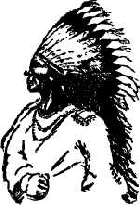
"The hull Council come out to meet us, but not too reckless, coz this might have been the trick of enemies to surprise them.
"Well, when we got there, maybe there wasn't a racket. You see, we didn't lose a man, and we brung in a hundred horses and seven scalps. Our leader never said a word to the crowd, but went right up to the Council teepee. He walked in—we followed. There was the Head Chief an' all the Council settin' smoking. Our leader give the 'How, an' then we all 'Howed.' Then we sat an' smoked, an' the Chief called on our leader for an account of the little trip. He stood up an' made a speech.
"'Great Chief and Council of my Tribe,' says he.
301
302
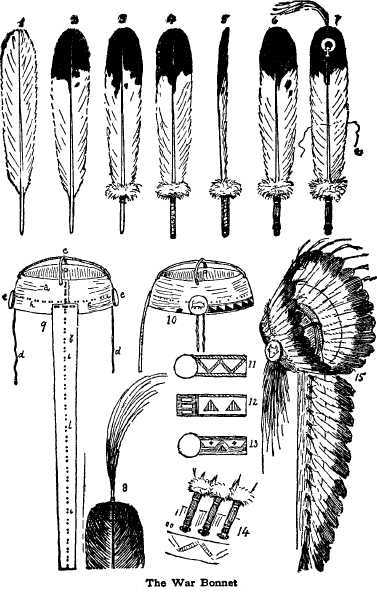
THE INDIAN WAR BONNET—HOW TO MAKE IT
1. The plain white Goose or Turkey feather. 2. The same, with tip dyed black or painted with indelible ink. 3. The same, showing ruff of white down lashed on with wax end. 4. The same, showing leather loop lashed on for the holding lace. 5. The same, viewed edge on. 6. The same, with a red flannel cover sewn and lashed on the quill. This is a 'coup feather.' 7. The same, with a tuft of red horsehair lashed on the top to mark a 'grand coup' and (a) a thread through the middle of the rib to hold feather in proper place. This feather is marked with the symbol of a grand coup in target shooting. This symbol may be drawn on an oval piece of paper gummed on the top of the feather. 8. The tip of a feather showing how the red horsehair tuft is lashed on with fine waxed thread. 9. The groundwork of the war bonnet made of any soft leather, (a) a broad band to go round the head, laced at the joint or seam behind; (b) a broad tail behind as long as needed to hold all the wearer's feathers; (c) two leather thongs or straps over the top; (d) leather string to tie under the chin; (e) the buttons, conchas or side ornaments of shells, silver, horn or wooden discs, even small mirrors and circles of beadwork were used, and sometimes the conchas were left out altogether; they may have the owner's totem on them, usually a bunch of ermine tails hung from each side of the bonnet just below the concha. A bunch of horsehair will answer as well; (hh) the holes in the leather for holding the lace of the feather; 24 feathers are needed for the full bonnet, without the tail, so they are put less than an inch apart; (iii) the lacing holes on the tail: this is as long as the wearer's feathers call for; some never have any tail. 10. Side view of the leather framework, showing a pattern sometimes used to decorate the front. 11, 12 and 13. Beadwork designs for front band of bonnet; all have white grounds. No. 11 (Arapaho) has green band at top and bottom with red zigzag. No. 12 (Ogallala) has blue band at top and bottom, red triangles; the concha is blue with three white bars and is cut off from the band by a red bar. No. 13 (Sioux) has narrow band above and broad band below blue, the triangle red, and the two little stars blue with yellow centre. 14. The bases of three feathers, showing how the lace comes out of the cap leather, through the eye or loop on the bottom of the quill, and in again. 15. The completed bonnet, showing how the feathers of the crown should spread out, also showing the thread that passes through the middle of each feather on inner side to hold it in place; another thread passes from the point where the two straps (c in 9) join, then down through each feather in the tail. The Indians now often use the crown of a soft felt hat for the basis of a war bonnet. N.B. A much easier way to mark the feather is to stick on it near the top an oval of white paper and on this draw the symbol with waterproof ink.
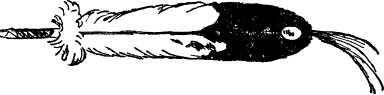
303 'After we left the village and the men had purified themselves, we travelled seven days and came to the Little Muddy River. There we found the track of a travelling band of Arapaho. In two days we found their camp, but they were too strong for us, so we hid till night; then I went alone into their camp and found that some of them were going off on a hunt next day. As I left I met a lone warrior coming in. I killed him with my knife. For that I claim a coup; and I scalped him—for that I claim another coup; an' before I killed him I slapped his face with my hand—for this I claim a grand coup; and I brought his horse away with me—for that I claim another coup. Is it not so,' sez he, turning to us, and we all yelled 'How! How! How!' For this fellow, 'Whooping Crane,' was awful good stuff. Then the Council agreed that he should wear three Eagle feathers, the first for killing and scalping the enemy in his own camp—that was a grand coup, and the feather had a tuft of red hair on it an' a red spot on the web. The next feather was for slapping the feller's face first, which, of course, made it more risky. This Eagle feather had a red tuft on top an' a red hand on the web; the one for stealing the horse had a horseshoe, but no tuft, coz it wasn't counted A1.
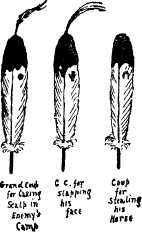
"Then the other Injuns made their claims, an' we all got some kind of honours. I mind one feller was allowed to drag a Fox tail at each heel when he danced, an' another had ten horseshoe marks on 304 an Eagle feather for stealing ten horses, an' I tell you them Injuns were prouder of them feathers than a general would be of his medals."
"My, I wish I could go out there and be with those fellows," and Yan sighed as he compared his commonplace lot with all this romantic splendour.
"Guess you'd soon get sick of it. I know I did," was the answer; "forever shooting and killing, never at peace, never more than three meals ahead of starvation and just as often three meals behind. No, siree, no more for me."
"I'd just like to see you start in horse-stealing for honours round here," observed Sam, "though I know who'd get the feathers if it was chicken stealing."
"Say, Caleb," said Guy, who, being friendly and of the country, never thought of calling the old man "Mr. Clark," "didn't they give feathers for good Deer-hunting? I'll bet I could lick any of them at it if I had a gun."
"Didn't you hear me say first thing that that there shot o' Yan's should score a 'grand coup'?"
"Oh, shucks! I kin lick Yan any time; that was just a chance shot. I'll bet if you give feathers for Deer-hunting I'll get them all."
"We'll take you up on that," said the oldest Chief, but the next interrupted:
"Say, boys, we want to play Injun properly. Let's get Mr. Clark to show us how to make a real war bonnet. Then we'll wear only what feathers we win."
305"Ye mean by scalping the Whites an' horse-stealing?"
"Oh, no; there's lots of things we can do—best runner, best Deer hunter, best swimmer, best shot with bow and arrows."
"All right." So they set about questioning Caleb. He soon showed them how to put a war bonnet together, using, in spite of Yan's misgivings, the crown of an old felt hat for the ground work and white goose quills trimmed and dyed black at the tips for Eagle feathers. But when it came to the deeds that were to be rewarded, each one had his own ideas.
"If Sappy will go to the orchard and pick a peck of cherries without old Cap gettin' him, I'll give him a feather with all sorts of fixin's on it," suggested Sam.
"Well, I'll bet you can't get a chicken out of our barn 'thout our Dog gettin' you, Mr. Smarty."
"Pooh! I ain't stealing chickens. Do you take me for a nigger? I'm a noble Red-man and Head Chief at that, I want you to know, an' I've a notion to collect that scalp you're wearin' now. You know it belongs to me and Yan," and he sidled over, rolling his eye and working his fingers in a way that upset Guy's composure. "And I tell you a feller with one foot in the grave should have his thoughts on seriouser things than chicken-stealing. This yere morbid cravin' for excitement is rooinin' all the young fellers nowadays."
306 Yan happened to glance at Caleb. He was gazing off at nothing, but there was a twinkle in his eye that Yan never before saw there.
"Let's go to the teepee. It's too hot out here. Come in, won't you, Mr. Clark?"
"Hm. 'Tain't much cooler in here, even if it is shady," remarked the old Trapper. "Ye ought to lift one side of the canvas and get some air."
"Why, did the real Injuns do that?"
"I should say they did. There ain't any way they didn't turn and twist the teepee for comfort. That's what makes it so good. Ye kin live in it forty below zero an' fifty 'bove suffocation an' still be happy. It's the changeablest kind of a layout for livin' in. Real hot weather the thing looks like a spider with skirts on and held high, an' I tell you ye got to know the weather for a teepee. Many a hot night on the plains I've been woke up by hearing 'Tap-tap-tap' all around me in the still black night and wondered why all the squaws was working, but they was up to drop the cover and drive all the pegs deeper, an' within a half hour there never failed to come up a big storm. How they knew it was a-comin' I never could tell. One old woman said a Coyote told her, an' maybe that's true, for they do change their song for trouble ahead; another said it was the flowers lookin' queer at sundown, an' another had a bad dream. Maybe they're all true; it comes o' watchin' little things."
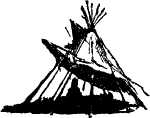
"Do they never get fooled?" asked Little Beaver
307 "Oncet in awhile, but not near as often as a White-man would.
"I mind once seeing an artist chap, one of them there portygraf takers. He come out to the village with a machine an' took some of the little teepees. Then I said, 'Why don't you get Bull-calf's squaw to put up their big teepee? I tell you that's a howler.' So off he goes, and after dickering awhile he got the squaw to put it up for three dollars. You bet it was a stunner, sure—all painted red, with green an' yaller--animals an' birds an' scalps galore. It made that feller's eyes bug out to see it. He started in to make some portygrafs, then was taking another by hand, so as to get the colours, an' I bet it would have crowded him to do it, but jest when he got a-going the old squaw yelled to the other—the Chief hed two of them—an' lighted out to take down that there teepee. That artist he hollered to stop, said he had hired it to stay up an' a bargain was a bargain. But the old squaw she jest kept on a-jabberin' an' pintin' at the west. Pretty soon they had the hull thing down and rolled up an' that artist a-cussin' like a cow-puncher. Well, I mind it was a fine day, but awful hot, an' before five minutes there come a little dark cloud in the west, then in ten minutes come a-whoopin' a regular small cyclone, an' it went through that village and wrecked all the teepees of any size. That red one would surely have gone only for that smart old squaw."
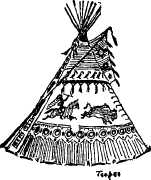
Under Caleb's directions the breezy side of the cover was now raised a little, and the shady side 308 much more. This changed the teepee from a stifling hothouse into a cool, breezy shade.
"An' when ye want to know which way is the wind, if it's light, ye wet your finger so, an' hold it up. The windy side feels cool at once, and by that ye can set your smoke-flaps."
"I want to know about war bonnets," Yan now put in. "I mean about things to do to wear feathers—that is, things we can do."
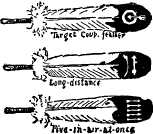
"Ye kin have races, an' swimmin' an bownarrer shootin'. I should say if you kin send one o' them arrers two hundred yards that would kill a Buffalo at twenty feet. I'd think that was pretty good. Yes, I'd call that way up."
"What—a grand coup?"
"Yes, I reckon; an' if you fell short on'y fifty yards that'd still kill a Deer, an' we could call that a coup. If," continued Caleb, "you kin hit that old gunny-sack buck plunk in the heart at fifty yards first shot I'd call that away up; an' if you hit it at seventy-five yards in the heart no matter how many tries, I'd call you a shot. If you kin hit a nine-inch bull's-eye two out of three at forty yards every time an' no fluke, you'd hold your own among Injuns though I must say they don't go in much for shooting at a target. They shoot at 'most anything they see in the woods. I've seen the little copper-coloured kids shooting away at butterflies. Then they have matches—they try who can have most arrers in the air at one time. To have five in the air at once is considered good. It means powerful fast work and 309 far shooting. You got to hold a bunch handy in the left hand fur that. The most I ever seen one man have up at once was eight. That was reckoned 'big medicine,' an' any one that can keep up seven is considered swell."
"Do you know any other things besides bows and arrows that would do?"
"I think that a rubbing-stick fire ought to count," interrupted Sam. "I want that in coz Guy can't do it. Any one who kin do it at all gets a feather, an' any one who kin do it in one minute gets a swagger feather, or whatever you call it; that takes care of Yan and me an' leaves Guy out in the cold."
"I'll bet I kin hunt Deer all round you both, I kin."
"Oh, shut up, Sappy; we're tired a-hearing about your Deer hunting. We're going to abolish that game." Then Sam continued, apparently addressing Caleb, "Do you know any Injun games?"
But Caleb took no notice.
Presently Yan said, "Don't the Injuns play games, Mr. Clark?
"Well, yes, I kin show you two Injun games that will test your eyesight."
"I bet I kin beat any one at it," Guy made haste to tell. "Why, I seen that Deer before Yan could—"
"Oh, shut up, Guy," Yan now exclaimed. A peculiar sound—"Wheet—wheet—wheet"—made Sappy turn. He saw Sam with an immense knife, whetting it most vigorously and casting a hungry, fishy glance from time to time to the "yaller moss-tuft" 310 on Guy's neck.
"Time has came," he said to nobody in particular.
"You better let me alone," whined Guy, for that horrible "wheet—wheet" jarred his nerves somehow. He looked toward Yan, and seeing, as he thought, the suggestion of a smile, he felt more comfortable, but a glance at Sam dispelled his comfort; the Woodpecker's face was absolutely inscrutable and perfectly demoniac with paint.
"Why don't you whet up, Little Beaver? Don't you want your share?" asked the Head Chief through his teeth.
"I vote we let him wear it till he brags again about his Deer-hunting. Then off she comes to the bone," was the reply. "Tell us about the Injun game, Mr. Clark."
"I pretty near forget it now, but le's see. They make two squares on the ground or on two skins; each one is cut up in twenty-five smaller squares with lines like that. Then they have, say, ten rings an' ten nuts or pebbles. One player takes five rings an' five nuts an' sets them around on the squares of one set, an' don't let the other see till all is ready; then the other turns an' looks at it while some one else sings a little song that one of the boys turned into:
"'Ki yi ya—ki yi yee, You think yer smart as ye kin be, You think yer awful quick to see But yer not too quick for me, Ki yi ya—ki yi yee.'
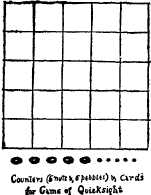
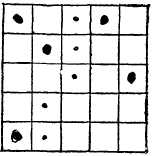
311 "Then the first square is covered with a basket or anything and the second player must cover the other skin with counters just the same from memory. For every counter he gets on the right square he counts one, and loses one for each on the wrong square."
"I'll bet I kin——" Guy began, but Sam's hand gripped his moss-tuft.
"Here, you let me alone. I ain't bragging. I'm only telling the simple truth."
"Ugh! Better tell some simple lies, then—much safer," said the Great Woodpecker, with horrid calm and meaning. "If ever I lift that scalp you'll catch cold and die, do ye know it?"
Again Yan could see that Caleb had to look far away to avoid taking an apparent interest.
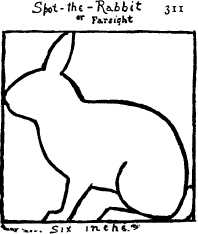
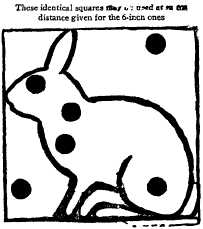
"There's another game. I don't know as it's Injun, but it's the kind o' game where an Injun could win. They first made two six-inch squares of white wood or card, then on each they made rings like a target or squares like the quicksight game, or else two Rabbits the same on each. One feller takes six spots of black, half an inch across, an' sticks them on one, scattering anyhow, an' sets it up a hundred yards off; another feller takes same number of spots an' the other Rabbit an' walks up till he can see to fix his Rabbit the same. If he kin do it at seventy-five yards he's a swell; if he kin do it at sixty yards he's away up, but less than fifty yards 312 is no good. I seen the boys have lots o' fun out o' it. They try to fool each other every way, putting one spot right on another or leaving some off. It's a sure 'nough test of good eyes."
"I'll bet——" began Sappy again, but a loud savage "Grrrr" from Sam, who knew perfectly well what was coming, put a stop to the bet, whatever it was.
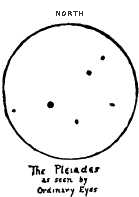
"There was two other Injun tests of eyes that I mind now. Some old Buck would show the youngsters the Pleiades—them's the little stars that the Injuns call the Bunch—an' ask 'How many kin you see?' Some could sho'ly see five or six an' some could make out seven. Them as sees seven is mighty well off for eyes. Ye can't see the Pleiades now—they belong to the winter nights; but you kin see the Dipper the hull year round, turning about the North Star. The Injuns call this the 'Broken Back,' an' I've heard the old fellers ask the boys: 'You see the Old Squaw—that's the star, second from the end, the one at the bend of the handle—well, she has a papoose on her back. Kin you see the papoose?' an' sure enough, when my eyes was real good I could see the little baby star tucked in by the big un. It's a mighty good test of eyes if you kin see that."
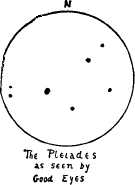
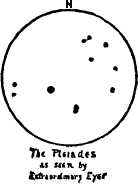
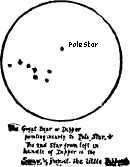
"Eh——" began Guy.
But "Grrrrrrrrr" from Sam stopped him in time. Again Caleb's eyes wandered afar. Then he stepped out of the teepee and Yan heard him mutter, 313 "Consarn that whelp, he makes me laugh spite o' myself." He went off a little way into the woods and presently called "Yan! Guy! Come here." All three ran out. "Talking about eyes, what's that?" An opening in the foliage gave a glimpse of the distant Burns's clover field. "Looks like a small Bear."
"Woodchuck! That's our Woodchuck! That's the ole sinner that throwed Paw off'n the mower. Where's my bone-arrer?" and Guy went for his weapons.
The boys ran for the fence of the clover field, going more cautiously as they came near. Still the old Woodchuck heard something and sat up erect on his haunches. He was a monster, and out on the smooth clover field he did look like a very small Bear. His chestnut breast was curiously relieved by his unusually gray back and head.
"Paw says it's his sins as turned his head gray. He's a hoary headed sinner, an' he ain't repented o' none o' them so far, but I'm after him now."
"Hold on! Start even!" said Sam, seeing that Guy was prepared to shoot.
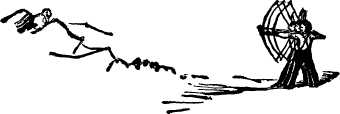
So all drew together, standing in a row like an old picture of the battle of Crecy. The arrows scattered about the Woodchuck. Most went much too far, none went near because he was closer than they had supposed, but he scuttled away into his hole, there, no doubt, to plan a new trap for the man with the mower.
314
VII
Campercraft
"How'd you sleep, Sam?"
"Didn't sleep a durn bit."
"Neither did I. I was shivering all night. I got up an' put the spare blanket on, but it didn't do any good."
"Wonder if there was a chills-and-fever fog or something?"
"How'd you find it, Sappy?"
"All right."
"Didn't smell any fog?"
"Nope."
The next night it was even worse. Guy slept placidly, if noisily, but Sam and Yan tumbled about and shivered for hours. In the morning at dawn Sam sat up.
"Well, I tell you this is no joke. Fun's fun, but if I am going to have the shivers every night I'm going home while I'm able."
Yan said nothing. He was very glum. He felt much as Sam did, but was less ready to give up the outing.
Their blues were nearly dispelled when the warm sun came up, but still they dreaded the coming 315 night.
"Wonder what it is," said Little Beaver.
"'Pears to me powerful like chills and fever and then again it don't. Maybe we drink too much swamp water. I believe we're p'isoned with Guy's cooking."
"More like getting scurvy from too much meat. Let's ask Caleb."
Caleb came around that afternoon or they would have gone after him. He heard Yan's story in silence, then, "Have ye sunned your blankets sense ye came?"
"No."
Caleb went into the teepee, felt the blankets, then grunted: "H-m! Jest so. They're nigh soppin'. You turn in night after night an' sweat an' sweat in them blankets an' wonder why they're damp. Hain't you seen your ma air the blankets every day at home? Every Injun squaw knows that much, an' every other day at least she gives the blankets a sun roast for three hours in the middle of the day, or, failing that, dries them at the fire. Dry out your blankets and you won't have no more chills."
The boys set about it at once, and that night they experienced again the sweet, warm sleep of healthy youth.
There was another lesson they had to learn in campercraft. The Mosquitoes were always more or less of a plague. At night they forced the boys 316 into the teepee, but they soon learned to smudge the insects with a wad of green grass on the hot fire. This they would throw on at sundown, then go outside, closing the teepee tight and eat supper around the cooking fire. After that was over they would cautiously open the teepee to find the grass all gone and the fire low, a dense cloud of smoke still in the upper part, but below it clear air. They would then brush off the Mosquitoes that had alighted on their clothes, crawl into the lodge and close the door tight. Not a Mosquito was left alive in it, and the smoke hanging about the smoke-vent was enough to keep them from coming in, and so they slept in peace. Thus they could baffle the worst pest of the woods. But there was yet another destroyer of comfort by day, and this was the Blue-bottle flies. There seemed more of them as time went on, and they laid masses of yellowish eggs on anything that smelled like meat or corruption. They buzzed about the table and got into the dishes; their dead, drowned and mangled bodies were polluting all the food, till Caleb remarked during one of his ever-increasing visits: "It's your own fault. Look at all the filth ye leave scattered about."
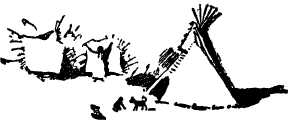
There was no blinking the fact; for fifty feet around the teepee the ground was strewn with scraps of paper, tins and food. To one side was a mass of potato peelings, bones, fish-scales and filth, and everywhere were the buzzing flies, to be plagues all 317 day, till at sundown the Mosquitoes relieved them and took the night shift of the office of torment.
"I want to learn, especially if it's Injun," said Little Beaver. "What had we best do?"
"Wall, first ye could move camp; second, ye could clean this."
As there was no other available camp ground they had no choice, and Yan said with energy: "Boys, we got to clean this and keep it clean, too. We'll dig a hole for everything that won't burn."
So Yan seized the spade and began to dig in the bushes not far from the teepee. Sam and Guy were gradually drawn in. They began gathering all the rubbish and threw it into the hole. As they tumbled in bones, tins and scraps of bread Yan said: "I just hate to see that bread go in. It doesn't seem right when there's so many living things would be glad to get it."
At this, Caleb, who was sitting on a log placidly smoking, said:
"Now, if ye want to be real Injun, ye gather all the eatables ye don't want—meat, bread and anything, an' every day put it on some high place. Most generally the Injuns has a rock—they call it Wakan; that means sacred medicine—an' there they leave scraps of food to please the good spirits. Av coorse it's the birds and Squirrels gets it all; but the Injun is content as long as it's gone, an' if ye argy with them that 'tain't the spirits gets it, but the birds, they say: 'That doesn't matter. The birds couldn't 318 get it if the spirits didn't want them to have it,' or maybe the birds took it to carry to the spirits!"
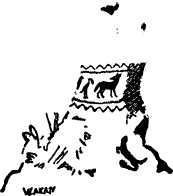
Then the Grand Council went out in a body to seek the Wakan Rock. They found a good one in the open part of the woods, and it became a daily duty of one to carry the remnants of food to the rock. They were probably less acceptable to the wood creatures than they would have been half a year later, but they soon found that there were many birds glad to eat at the Wakan; and moreover, that before long there was a trail from the brook, only twenty-five yards away, that told of four-foots also enjoying the bounty of the good spirits.
Within three days of this the plague of Bluebottles was over, and the boys realized that, judging by its effects, the keeping of a dirty camp is a crime.
One other thing old Caleb insisted on: "Yan," said he, "you didn't ought to drink that creek water now; it ain't hardly runnin'. The sun hez it het up, an' it's gettin' too crawly to be healthy."
"Well, what are we going to do?" said Sam, though he might as well have addressed the brook itself.
"What can we do, Mr. Clark?"
"Dig a well!"
"Phew! We're out here for fun!" was Sam's reply.
"Dig an Injun well," Caleb said. "Half an hour will do it. Here, I'll show you."
319 He took the spade and, seeking a dry spot, about twenty feet from the upper end of the pond he dug a hole some two feet square. By the time he was down three feet the water was oozing in fast. He got it down about four feet and then had to stop, on account of inflow. He took a bucket and bailed the muddy stuff out right to the bottom, and let it fill up to be again bailed out. After three bailings the water came in cold, sweet, and pure as crystal.
"There," said he, "that water is from your pond, but it is filtered through twenty feet of earth and sand. That's the way to get cool, pure water out of the dirtiest of swamps. That's an Injun well."
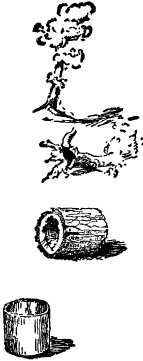
320
VIII
The Indian Drum
"Oh, that hair of horse and skin of sheep should Have such power to move the souls of men."
"If you were real Injun you'd make a drum of that," said Caleb to Yan, as they came to a Basswood blown over by a recent storm and now showing its weakness, for it was quite hollow—a mere shell.
"How do they do it? I want to know how."
"Get me the axe."
Yan ran for the axe. Caleb cut out a straight unbroken section about two feet long. This they carried to camp.
"Coorse ye know," said Caleb, "ye can't have a drum without skins for heads."
"What kind of skins?"
"Oh, Horse, Dog, Cow, Calf—'most any kind that's strong enough."
"I got a Calfskin in our barn, an' I know where there's another in the shed, but it's all chawed up with Rats. Them's mine. I killed them Calves. Paw give me the skins for killin' an' skinnin' them. Oh, you jest ought to see me kill a Calf—"
Guy was going off into one of his autopanegyrics when Sam who was now being rubbed on a sore 321 place, gave a "Whoop!" and grabbed the tow-tuft with a jerk that sent the Third War Chief sprawling and ended the panegyric in the usual volley of "you-let-me-'lones."
"Oh, quit, Sam," objected Little Beaver. "You can't stop a Dog barking. It's his nature." Then to Guy: "Never mind, Guy; you are not hurt. I'll bet you can beat him hunting Deer, and you can see twice as far as he can."
"Yes, I kin; that's what makes him so mad. I'll bet I kin see three times as far—maybe five times," was the answer in injured tones.
"Go on now, Guy, and get the skins—that is, if you want a drum for the war dance. You're the only one in the crowd that's man enough to make the raise of a hide," and fired by this flattery, Guy sped away.
Meanwhile Caleb worked on the hollow log. He trimmed off the bark, then with the hatchet he cleared out all the punk and splinters inside. He made a fire on the ground in the middle of the drum-log as it stood on end, and watching carefully, he lifted it off from time to time and chopped away all the charred parts, smoothing and trimming till he had the log down thin and smooth within and without. They heard Guy shouting soon after he left. They thought him near at hand, but he did not come. Trimming the drum-log took a couple of hours, and still Guy did not return. The remark from Caleb, "'Bout ready for the skins now!" called from Sam 322 the explanation, "Guess Old Man Burns snapped him up and put him to weeding the garden. Probably that was him we heard gettin' licked."
"Old Man Burns" was a poor and shiftless character, a thin, stoop-shouldered man. He was only thirty-five years of age, but, being married, that was enough to secure for him the title "Old Man." In Sanger, if Tom Nolan was a bachelor at eighty years of age he would still be Tom Nolan, "wan of the bhoys," but if he married at twenty he at once became "Old Man Nolan."
Mrs. Burns had produced the usual string of tow-tops, but several had died, the charitable neighbours said of starvation, leaving Guy, the eldest, his mother's darling, then a gap and four little girls, four, three, two and one years of age. She was a fat, fair, easy-going person, with a general sense of antagonism to her husband, who was, of course, the natural enemy of the children. Jim Burns cherished the ideal of bringing "that boy" up right—that is, getting all the work he could out of him—and Guy clung to his own ideal of doing as little work as possible. In this clash of ideals Guy's mother was his firm, though more or less secret, ally. He was without fault in her eyes: all that he did was right. His freckled visage and pudgy face were types of noble beauty, standards of comeliness and human excellence; his ways were ways of pleasantness and all his paths were peace; Margat Burns was sure of it.
323 Burns had a good deal of natural affection, but he was erratic; sometimes he would flog Guy mercilessly for nothing, and again laugh at some serious misdeed, so that the boy never knew just what to expect, and kept on the safe side by avoiding his "Paw" as much as possible. His visits to the camp had been thoroughly disapproved, partly because it was on Old Man Raften's land and partly because it enabled Guy to dodge the chores. Burns had been quite violent about it once or twice, but Mrs. Burns had the great advantage of persistence, and like the steady strain of the skilful angler on the slender line, it wins in the end against the erratic violence of the strongest trout. She had managed then that Guy should join the Injun camp, and gloried in his outrageously exaggerated accounts of how he could lick them all at anything, "though they wuz so much older'n bigger'n he wuz."