Part 2 — PART II
Reading edition
SANGER SAM

103
I
The New Home
AN was now fourteen years old long-legged, thin, and growing fast The doctor marked this combination and said: "Send him on a farm for a year."
Thus it was that an arrangement was made for Yan to work for his board at the farmhouse of William Raften of Sanger.
Sanger was a settlement just emerging from the early or backwoods period.
The recognized steps are, first, the frontier or woods where all is unbroken forest and Deer abound; next the backwoods where small clearings appear; then a settlement where the forest and clearings are about equal and the Deer gone; last, an agricultural district, with mere shreds of forest remaining.
Thirty years before, Sanger had been "taken up" by a population chiefly from Ireland, sturdy peasantry for the most part, who brought with them the ancient feud that has so long divided Ireland—the bitter quarrel between the Catholics or "Dogans" (why so called none knew) and Protestants, more usually styled "Prattisons." The colours of the Catholics were green and white; of the Protestants orange and blue; and hence another distinctive name of the 104 latter was "Orangemen."
These two factions split the social structure in two vertically. There were, in addition, several horizontal lines of cleavage which, like geological seams, ran across both segments.
In those days, the early part of the nineteenth century, the British Government used to assist desirable persons who wished to emigrate to Canada from Ireland. This aid consisted of a free ocean passage. Many who could not convince the Government of their desirability and yet could raise the money, came with them, paying their regular steerage rate of $15. These were alike to the outside world, but not to themselves. Those who paid their way were "passengers," and were, in their own opinion, many social worlds above the assisted ones, who were called "Emmy Grants." This distinction was never forgotten among the residents of Sanger.
Yet two other social grades existed. Every man and boy in Sanger was an expert with the axe; was wonderfully adroit. The familiar phrase, "He's a good man," had two accepted meanings: If obviously applied to a settler during the regular Saturday night Irish row in the little town of Downey's Dump, it meant he was an able man with his fists; but if to his home life on the farm, it implied that he was unusually dexterous with the axe. A man who fell below standard was despised. Since the houses of hewn logs were made by their owners, they reflected the axemen's skill. There 105 were two styles of log architecture; the shanty with corners criss-cross, called hog-pen finish, and the other, the house with the corners neatly finished, called dovetail finish. In Sanger it was a social black eye to live in a house of the first kind. The residents were considered "scrubs" or "riff-raff" by those whose superior axemanship had provided the more neatly finished dwelling. A later division crept in among the "dovetailers" themselves when a brickyard was opened. The more prosperous settlers put up neat little brick houses. To the surprise of all, one Phil O'Leary, a poor but prolific Dogan, leaped at once from a hog-pen log to a fine brick, and caused no end of perplexity to the ruling society queens, simply paralyzing the social register, since his nine fat daughters now had claims with the best. Many, however, whose brick houses were but five years old, denounced the O'Learys as upstarts and for long witheld all social recognition. William Raften, as the most prosperous man in the community, was first to appear in red bricks. His implacable enemy, Char-less (two syllables) Boyle, egged on by his wife, now also took the red brick plunge, though he dispensed with masons and laid the bricks himself, with the help of his seventeen sons. These two men, though Orangemen both, were deadly enemies, as the wives were social rivals. Raften was the stronger and richer man, but Boyle, whose father had paid his own steerage rate, knew all about Raften's father, and always wound up any discussion by 106 hurling in Raften's teeth: "Don't talk to me, ye upstart. Everybody knows ye are nothing but a Emmy Grant." This was the one fly in the Raften ointment. No use denying it. His father had accepted a free passage, true, and Boyle had received a free homestead, but what of that—that counted for nothing. Old Boyle had been a "PASSENGER," old Raften an "EMMY GRANT."

This was the new community that Yan had entered, and the words Dogan and Prattison, "green" and "orange and blue," began to loom large, along with the ideas and animosities they stood for.
The accent of the Sangerite was mixed. First, there was a rich Irish brogue with many Irish words; this belonged chiefly to the old folks. The Irish of such men as Raften was quite evident in their speech, but not strong enough to warrant the accepted Irish spelling of books, except when the speaker was greatly excited. The young generation had almost no Irish accent, but all had sifted down to the peculiar burring nasal whine of the backwoods Canadian.
Mr. and Mrs. Raften met Yan at the station. They had supper together at the tavern and drove him to their home, where they showed him into the big dining-room—living-room—kitchen. Over behind the stove was a tall, awkward boy with carroty hair and small, dark eyes set much aslant in the saddest of faces. Mrs. Raften said, "Come, Sam, and shake hands with Yan." Sam came sheepishly forward, 107 shook hands in a flabby way, and said, in drawling tones, "How-do," then retired behind the stove to gaze with melancholy soberness at Yan, whenever he could do so without being caught at it. Mr. and Mrs. Raften were attending to various matters elsewhere, and Yan was left alone and miserable. The idea of giving up college to go on a farm had been a hard one for him to accept, but he had sullenly bowed to his father's command and then at length learned to like the prospect of getting away from Bonnerton into the country. After all, it was but for a year, and it promised so much of joy. Sunday-school left behind. Church reduced to a minimum. All his life outdoors, among fields and woods—surely this spelled happiness; but now that he was really there, the abomination of desolation seemed sitting on all things and the evening was one of unalloyed misery. He had nothing to tell of, but a cloud of black despair seemed to have settled for good on the world. His mouth was pinching very hard and his eyes blinking to keep back the tears when Mrs. Raften came into the room. She saw at a glance what was wrong. "He's homesick," she said to her husband. "He'll be all right to-morrow," and she took Yan by the hand and led him upstairs to bed.
Twenty minutes later she came to see if he was comfortable. She tucked the clothes in around him, then, stooping down for a good-night kiss, she found his face wet with tears. She put her arms about him for a moment, kissed him several times, 108 and said, "Never mind, you will feel all right to-morrow," then wisely left him alone.
Whence came that load of misery and horror, or whither it went, Yan never knew. He saw it no more, and the next morning he began to interest himself in his new world.
William Raften had a number of farms all in fine order and clear of mortgages; and each year he added to his estates. He was sober, shrewd, even cunning, hated by most of his neighbours because he was too clever for them and kept on getting richer. His hard side was for the world and his soft side for his family. Not that he was really soft in any respect. He had had to fight his life-battle alone, beginning with nothing, and the many hard knocks had hardened him, but the few who knew him best could testify to the warm Irish heart that continued unchanged within him, albeit it was each year farther from the surface. His manners, even in the house, were abrupt and masterful. There was no mistaking his orders, and no excuse for not complying with them. To his children when infants, and to his wife only, he was always tender, and those who saw him cold and grasping, overreaching the sharpers of the grain market, would scarcely have recognized the big, warm-hearted happy-looking father at home an hour later when he was playing horse with his baby daughter or awkwardly paying post-graduate court to his smiling wife.
109 He had little "eddication," could hardly read, and was therefore greatly impressed with the value of "book larnin'," and determined that his own children should have the "best that money could git in that line," which probably meant that they should read fluently. His own reading was done on Sunday mornings, when he painfully spelled out the important items in a weekly paper; "important" meant referring to the produce market or the prize ring, for he had been known and respected as a boxer, and dearly loved the exquisite details of the latest bouts. He used to go to church with his wife once a month to please her, and thought it very unfair therefore that she should take no interest in his favourite hobby—the manly art.
Although hard and even brutal in his dealings with men, he could not bear to see an animal ill used. "The men can holler when they're hurt, but the poor dumb baste has no protection." He was the only farmer in the country that would not sell or shoot a worn-out horse. "The poor brute has wurruked hard an' hez airned his kape for the rest av his days." So Duncan, Jerry and several others were "retired" and lived their latter days in idleness, in one case for more than ten years.
Raften had thrashed more than one neighbour for beating a horse, and once, on interfering, was himself thrashed, for he had the ill-luck to happen on a prizefighter. But that had no lasting effect on him. He continued to champion the dumb brute in his own brutal way.
110 Among the neighbours the perquisites of the boys were the calfskins. The cows' milk was needed and the calves of little value, so usually they were killed when too young for food. The boys did the killing, making more or less sport of it, and the skins, worth fifty cents apiece green and twenty-five cents dry, at the tannery, were their proper pay. Raften never allowed his son to kill the calves. "Oi can't kill a poor innocent calf mesilf an' I won't hev me boy doin' it," he said. Thus Sam was done out of a perquisite, and did not forget the grievance.
Mrs. Raften was a fine woman, a splendid manager, loving her home and her family, her husband's loyal and ablest supporter, although she thought that William was sometimes a "leetle hard" on the boys. They had had a large family, but most of the children had died. Those remaining were Sam, aged fifteen, and Minnie, aged three.
Yan's duties were fixed at once. The poultry and half the pigs and cows were to be his charge. He must also help Sam with various other chores.
There was plenty to do and clear rules about doing it. But there was also time nearly every day for other things more in the line of his tastes; for even if he were hard on the boys in work hours, Raften saw to it that when they did play they should have a good time. His roughness and force made Yan afraid of him, and as it was Raften's way to say nothing until his mind was fully made up, and then say it "strong," Yan was left in doubt as to whether or not he was giving satisfaction.
111
II
Sam
Sam Raften turned out to be more congenial than he looked. His slow, drawling speech had given a wrong impression of stupidity, and, after a formal showing of the house under Mr. Raften, a real investigation was headed by Sam. "This yer's the paaar-le-r," said he, unlocking a sort of dark cellar aboveground and groping to open what afterward proved to be a dead, buried and almost forgotten window. In Sanger settlement the farmhouse parlour is not a room; it is an institution. It is kept closed all the week except when the minister calls, and the one at Raften's was the pure type. Its furniture consisted of six painted chairs (fifty cents each), two rockers ($1.49), one melodeon (thirty-two bushels of wheat—the agent asked forty), a sideboard made at home of the case the melodeon came in, one rag carpet woofed at home and warped and woven in exchange for wool, one center-table varnished (!) ($9.00 cash, $11.00 catalogue). On the center-table was one tintype album, a Bible, and some large books for company use. Though dusted once a week, they were never moved, and it was years later before they were found to have settled permanently into the varnish of the table. In 112 extremely uncostly frames on the wall were the coffin-plates of the departed members of the family. It was the custom at Sanger to honour the dead by bringing back from the funeral the name-plate and framing it on a black background with some supposed appropriate scripture text.
The general atmosphere of the room was dusty and religious as it was never opened except on Sundays or when the parson called, which instituted a sort of temporary Sunday, and the two small windows were kept shut and plugged as well as muffled always, with green paper blinds and cotton hangings. It was a thing apart from the rest of the house—a sort of family ghost-room: a chamber of horrors, seen but once a week.
But it contained one thing at least of interest—something that at once brought Sam and Yan together. This was a collection of a score of birds' eggs. They were all mixed together in an old glass-topped cravat box, half full of bran. None of them were labelled or properly blown. A collector would not have given it a second glance, but it proved an important matter. It was as though two New Yorkers, one disguised as a Chinaman and the other as a Negro, had accidently met in Greenland and by chance one had made the sign of the secret brotherhood to which they both belonged.
"Do you like these things?" said Yan, with sudden interest and warmth, in spite of the depressing 113 surroundings.
"You bet," said Sam. "And I'd a-had twice as many only Da said it was doing no good and birds was good for the farm."
"Well, do you know their names?"
"Wall, I should say so. I know every Bird that flies and all about it, or putty near it," drawled Sam, with an unusual stretch for him, as he was not given to bragging.
"I wish I did. Can't I get some eggs to take home?"
"No; Da said if I wouldn't take any more he'd lend me his Injun Chief gun to shoot Rabbits with."
"What? Are there Rabbits here?"
"Wall, I should say so. I got three last winter."
"But I mean now," said Yan, with evident disappointment.
"They ain't so easy to get at now, but we can try. Some day when all the work's done I'll ask Da for his gun."
"When all the work's done," was a favourite expression of the Raftens for indefinitely shelving a project, it sounded so reasonable and was really so final.
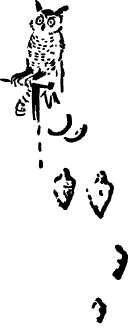
Sam opened up the lower door of the sideboard and got out some flint arrow-heads picked up in the ploughing, the teeth of a Beaver dating from the early days of the settlement, and an Owl very badly stuffed. The sight of these precious things set Yan all ablaze. "Oh!" was all he could say. Sam was 114 gratified to see such effect produced by the family possessions and explained, "Da shot that off'n the barn an' the hired man stuffed it."
The boys were getting on well together now. They exchanged confidences all day as they met in doing chores. In spite of the long interruptions, they got on so well that Sam said after supper, "Say, Yan, I'm going to show you something, but you must promise never to tell—Swelpye!" Of course Yan promised and added the absolutely binding and ununderstandable word—"Swelpme."
"Le's both go to the barn," said Sam.
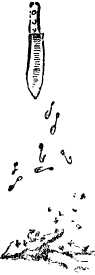
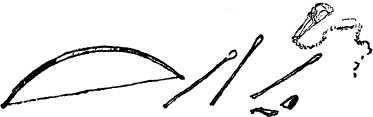
When they were half way he said: "Now I'll let on I went back for something. You go on an' round an' I'll meet you under the 'rusty-coat' in the orchard." When they met under the big russet apple tree, Sam closed one of his melancholy eyes and said in a voice of unnecessary hush, "Follow me." He led to the other end of the orchard where stood the old log house that had been the home before the building of the brick one. It was now used as a tool house. Sam led up a ladder to the loft (this was all wholly delightful). There at the far end, and next the little gable pane, he again cautioned secrecy, then when on invitation Yan had once more "swelped" himself, he rummaged in a dirty old box and drew out a bow, some arrows, a rusty steel trap, an old butcher knife, some fish-hooks, a flint and steel, a box full of matches, and some dirty, greasy-looking stuff that he said was 115 dried meat. "You see," he explained, "I always wanted to be a hunter, and Da was bound I'd be a dentist. Da said there was no money in hunting, but one day he had to go to the dentist an' it cost four dollars, an' the man wasn't half a day at the job, so he wanted me to be a dentist, but I wanted to be a hunter, an' one day he licked me and (Bud, that's my brother that died a year ago. If you hear Ma talk you'll think he was an angel, but I always reckoned he was a crazy galoot, an' he was the worst boy in school by odds). Wall, Da licked us awful for not feeding the hogs, so Bud got ready to clear out, an' at first I felt just like he did an' said I'd go too, an' we'd j'ine the Injuns. Anyhow, I'd sure go if ever I was licked again, an' this was the outfit we got together. Bud wanted to steal Da's gun an' I wouldn't. I tell you I was hoppin' mad that time, an' Bud was wuss—but I cooled off an' talked to Bud. I says, 'Say now, Bud, it would take about a month of travel to get out West, an' if the Injuns didn't want nothin' but our scalps that wouldn't be no fun, an' Da ain't really so bad, coz we sho'ly did starve them pigs so one of 'em died.' I reckon we deserved all we got—anyhow, it was all dumb foolishness about skinnin' out, though I'd like mighty well to be a hunter. Well, Bud died that winter. You seen the biggest coffin plate on the wall? Well, that's him. I see Ma lookin' at it an' cryin' the other day. Da says he'll send me to college if I'll be a dentist or a lawyer—lawyers 116 make lots of money: Da had a lawsuit once—an' if I don't, he says I kin go to—you know."
Here was Yan's own kind of mind, and he opened his heart. He told all about his shanty in the woods and how he had laboured at and loved it. He was full of enthusiasm as of old, boiling over with purpose and energy, and Sam, he realized, had at least two things that he had not—ability with tools and cool judgment. It was like having the best parts of his brother Rad put into a real human being. And remembering the joy of his Glen, Yan said:
"Let's build a shanty in the woods by the creek; your father won't care, will he?"
"Not he, so long as the work's done."
117
III
The Wigwam
The very next day they must begin. As soon as every chore was done they went to the woods to select a spot.
The brook, or "creek," as they called it, ran through a meadow, then through a fence into the woods. This was at first open and grassy, but farther down the creek it was joined by a dense cedar swamp. Through this there was no path, but Sam said that there was a nice high place beyond. The high ground seemed a long way off in the woods, though only a hundred yards through the swamp, but it was the very place for a camp—high, dry and open hard woods, with the creek in front and the cedar swamp all around. Yan was delighted. Sam caught no little of the enthusiasm, and having brought an axe, was ready to begin the shanty. But Yan had been thinking hard all morning, and now he said: "Sam, we don't want to be White hunters. They're no good; we want to be Indians."
"Now, that's just where you fool yourself," said Sam. "Da says there ain't nothin' an Injun can do that a White-man can't do better."
118 "Oh, what are you talking about?" said Yan warmly. "A White hunter can't trail a moccasined foot across a hard granite rock. A White hunter can't go into the woods with nothing but a knife and make everything he needs. A White hunter can't hunt with bows and arrows, and catch game with snares, can he? And there never yet was a White man could make a Birch canoe." Then, changing his tone, Yan went on: "Say, now, Sam, we want to be the best kind of hunters, don't we, so as to be ready for going out West. Let's be Injuns and do everything like Injuns."
After all, this had the advantage of romance and picturesqueness, and Sam consented to "try it for awhile, anyhow." And now came the point of Yan's argument. "Injuns don't live in shanties; they live in teepees. Why not make a teepee instead?"
"That would be just bully," said Sam, who had seen pictures enough to need no description, "but what are we to make it of?"
"Well," answered Yan, promptly assuming the leadership and rejoicing in his ability to speak as an authority, "the Plains Injuns make their teepees of skins, but the wood Injuns generally use Birch bark."
"Well, I bet you can't find skins or Birch bark enough in this woods to make a teepee big enough for a Chipmunk to chaw nuts in."
"We can use Elm bark."
119 "That's a heap easier," replied Sam, "if it'll answer, coz we cut a lot o' Elm logs last winter and the bark'll be about willin' to peel now. But first let's plan it out."
This was a good move, one Yan would have overlooked. He would probably have got a lot of material together and made the plan afterward, but Sam had been taught to go about his work with method.
So Yan sketched on a smooth log his remembrance of an Indian teepee. "It seems to me it was about this shape, with the poles sticking up like that, a hole for the smoke here and another for the door there."
"Sounds like you hain't never seen one," remarked Sam, with more point than politeness, "but we kin try it. Now 'bout how big?"
Eight feet high and eight feet across was decided to be about right. Four poles, each ten feet long, were cut in a few minutes, Yan carrying them to a smooth place above the creek as fast as Sam cut them.
"Now, what shall we tie them with?" said Yan.
"You mean for rope?"
"Yes, only we must get everything in the woods; real rope ain't allowed."
"I kin fix that," said Sam; "when Da double-staked the orchard fence, he lashed every pair of stakes at the top with Willow withes."
"That's so—I quite forgot," said Yan. In a few minutes they were at work trying to tie the four poles together with slippery stiff Willows, but it was no easy matter. They had to be perfectly tight or they 120 would slip and fall in a heap each time they were raised, and it seemed at length that the boys would be forced to the impropriety of using hay wire, when they heard a low grunt, and turning, saw William Raften standing with his hands behind him as though he had watched them for hours.
The boys were no little startled. Raften had a knack of turning up at any point when something was going on, taking in the situation fully, and then, if he disapproved, of expressing himself in a few words of blistering mockery delivered in a rich Irish brogue. Just what view he would take of their pastime the boys had no idea, but awaited with uneasiness. If they had been wasting time when they should have been working there is no question but that they would have been sent with contumely to more profitable pursuits, but this was within their rightful play hours, and Raften, after regarding them with a searching look, said slowly: "Bhoys!" (Sam felt easier; his father would have said "Bhise" if really angry.) "Fhat's the good o' wastin' yer time" (Yan's heart sank) "wid Willow withes fur a job like that? They can't be made to howld. Whoi don't ye git some hay woire or coord at the barrun?"
The boys were greatly relieved, but still this friendly overture might be merely a feint to open the way for a home thrust. Sam was silent. So Yan said, presently, "We ain't allowed to use anything but what the Indians had or could get in the woods."
121 "An' who don't allow yez?"
"The rules."
"Oh," said William, with some amusement. "Oi see! Hyar."
He went into the woods looking this way and that, and presently stopped at a lot of low shrubs.
"Do ye know what this is, Yan?"
"No, sir."
"Le's see if yer man enough to break it aff."
Yan tried. The wood was brittle enough, but the bark, thin, smooth and pliant, was as tough as leather, and even a narrow strip defied his strength.
"That's Litherwood," said Raften. "That's what the Injuns used; that's what we used ourselves in the airly days of this yer settlement."
The boys had looked for a rebuke, and here was a helping hand. It all turned on the fact that this was "play hours," Raften left with a parting word: "In wan hour an' a half the pigs is fed."
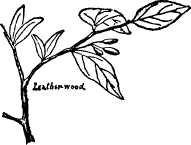
"You see Da's all right when the work ain't forgot," said Sam, with a patronizing air. "I wonder why I didn't think o' that there Leatherwood meself. I've often heard that that's what was used fur tying bags in the old days when cord was scarce, an' the Injuns used it for tying their prisoners, too. Ain't it the real stuff?"
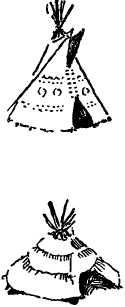
Several strips were now used for tying four poles together at the top, then these four were raised on end and spread out at the bottom to serve as the frame of the teepee, or more properly wigwam, since 122 it was to be made of bark.
After consulting, they now got a long, limber Willow rod an inch thick, and bending it around like a hoop, they tied it with Leatherwood to each pole at a point four feet from the ground. Next they cut four short poles to reach from the ground to this. These were lashed at their upper ends to the Willow rod, and now they were ready for the bark slabs. The boys went to the Elm logs and again Sam's able use of the axe came in. He cut the bark open along the top of one log, and by using the edge of the axe and some wooden wedges they pried off a great roll eight feet long and four feet across. It was a pleasant surprise to see what a wide piece of bark the small log gave them.
Three logs yielded three fine large slabs and others yielded pieces of various sizes. The large ones were set up against the frame so as to make the most of them. Of course they were much too big for the top, and much too narrow for the bottom; but the little pieces would do to patch if some way could be found to make them stick.
Sam suggested nailing them to the posts, and Yan was horrified at the idea of using nails. "No Indian has any nails."
"Well, what would they use?" said Sam.
"They used thongs, an'—an'—maybe wooden pegs. I don't know, but seems to me that would be all right."
123 "But them poles is hard wood," objected the practical Sam. "You can drive Oak pegs into Pine, but you can't drive wooden pegs into hard wood without you make some sort of a hole first. Maybe I'd better bring a gimlet."
"Now, Sam, you might just as well hire a carpenter—that wouldn't be Indian at all. Let's play it right. We'll find some way. I believe we can tie them up with Leatherwood."
So Sam made a sharp Oak pick with his axe, and Yan used it to pick holes in each piece of bark and then did a sort of rude sewing till the wigwam seemed beautifully covered in. But when they went inside to look they were unpleasantly surprised to find how many holes there were. It was impossible to close them all because the bark was cracking in so many places, but the boys plugged the worst of them and then prepared for the great sacred ceremony—the lighting of the fire in the middle.
They gathered a lot of dry fuel, then Yan produced a match.
"That don't look to me very Injun," drawled Sam critically. "I don't think Injuns has matches."
"Well, they don't," admitted Yan, humbly. "But I haven't a flint and steel, and don't know how to work rubbing-sticks, so we just got to use matches, if we want a fire."
"Why, of course we want a fire. I ain't kicking," said Sam. "Go ahead with your old leg-fire sulphur stick. A camp without a fire would be 'bout like last year's bird's nest or a house with the roof 124 off."
Yan struck a match and put it to the wood. It went out. He struck another—same result. Yet another went out.
Sam remarked:
"Pears to me you don't know much about lightin' a fire. Lemme show you. Let the White hunter learn the Injun somethin' about the woods," said he with a leer.
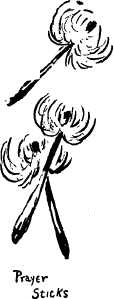
Sam took the axe and cut some sticks of a dry Pine root. Then with his knife he cut long curling shavings, which he left sticking in a fuzz at the end of each stick.
"Oh, I've seen a picture of an Indian making them. They call them 'prayer-sticks,'" said Yan.
"Well, prayer-sticks is mighty good kindlin'" replied the other. He struck a match, and in a minute he had a blazing fire in the middle of the wigwam.
"Old Granny de Neuville, she's a witch—she knows all about the woods, and cracked Jimmy turns everything into poetry what she says. He says she says when you want to make a fire in the woods you take—
"First a curl of Birch bark as dry as it kin be, Then some twigs of soft-wood, dead, but on the tree, Last o' all some Pine knots to make the kittle foam, An' thar's a fire to make you think you're settin' right at home."
125 "Who's Granny de Neuville?"
"Oh, she's the old witch that lives down at the bend o' the creek."
"What? Has she got a granddaughter named Biddy?" said Yan, suddenly remembering that his ancient ally came from this part of Sanger.
"Oh, my! Hain't she? Ain't Biddy a peach—drinks like a fish, talks everybody to death about the time she resided in Bonnerton. Gits a letter every mail begging her to come back and 'reside' with them some more."
"Ain't this fine," said Yan, as he sat on a pile of Fir boughs in the wigwam.
"Looks like the real thing," replied Sam from his seat on the other side. "But say, Yan, don't make any more fire; it's kind o' warm here, an' there seems to be something wrong with that flue—wants sweepin', prob'ly—hain't been swep' since I kin remember."
The fire blazed up and the smoke increased. Just a little of it wandered out of the smoke-hole at the top, then it decided that this was a mistake and thereafter positively declined to use the vent. Some of it went out by chinks, and a large stream issued from the door, but by far the best part of it seemed satisfied with the interior of the wigwam, so that in a minute or less both boys scrambled out. Their eyes were streaming with smoke-tears and their discomfiture was complete.
"'Pears to me," observed Sam, "like we got them holes mixed. The dooer should 'a 'been at the top, 126 sence the smoke has a fancy for usin' it, an' then we'd had a chance."
"The Indians make it work," said Yan; "a White hunter ought to know how."
"Now's the Injun's chance," said Sam. "Maybe it wants a dooer to close, then the smoke would have to go out."
They tried this, and of course some of the smoke was crowded out, but not till long after the boys were.
"Seems like what does get out by the chinks is sucked back agin by that there double-action flue," said Sam.
It was very disappointing. The romance of sitting by the fire in one's teepee appealed to both of the boys, but the physical torture of the smoke made it unbearable. Their dream was dispelled, and Sam suggested, "Maybe we'd better try a shanty."
"No," said Yan, with his usual doggedness. "I know it can be done, because the Indians do it. We'll find out in time."
But all their efforts were in vain. The wigwam was a failure, as far as fire was concerned. It was very small and uncomfortable, too; the wind blew through a hundred crevices, which grew larger as the Elm bark dried and cracked. A heavy shower caught them once, and they were rather glad to be driven into their cheerless lodge, but the rain came abundantly into the smoke-hole as well as through the walls, and they found it but little protection.
127
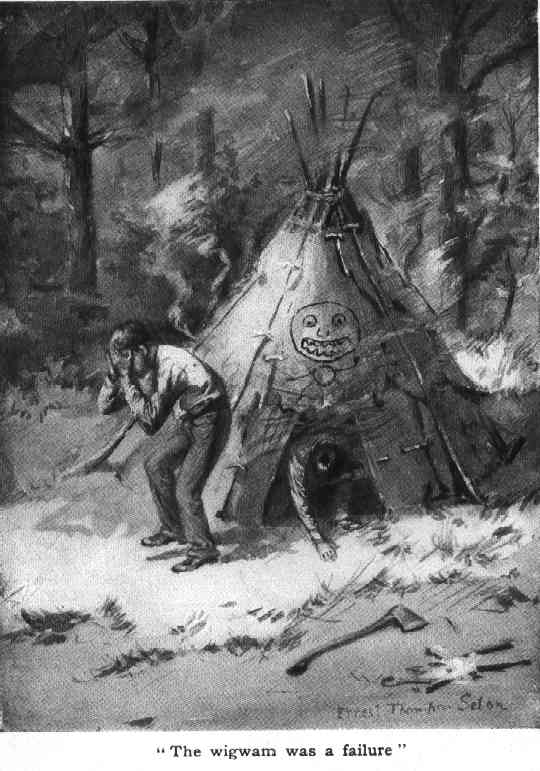
129 "Seems to me, if anything, a leetle wetter in here than outside," said Sam, as he led in a dash for home.
That night a heavy storm set in, and next day the boys found their flimsy wigwam blown down—nothing but a heap of ruins.
Some time after, Raften asked at the table in characteristic stern style, "Bhoys, what's doin' down to yer camp? Is yer wigwam finished?"
"No good," said Sam. "All blowed down."
"How's that?"
"I dunno'. It smoked like everything. We couldn't stay in it."
"Couldn't a-been right made," said Raften; then with a sudden interest, which showed how eagerly he would have joined in this forty years ago, he said, "Why don't ye make a rale taypay?"
"Dunno' how, an' ain't got no stuff."
"Wall, now, yez have been pretty good an' ain't slacked on the wurruk, yez kin have the ould wagon kiver. Cousin Bert could tache ye how to make it, if he wuz here. Maybe Caleb Clark knows," he added, with a significant twinkle of his eye. "Better ask him." Then he turned to give orders to the hired men, who, of course, ate at the family table.
"Da, do you care if we go to Caleb?"
"I don't care fwhat ye do wid him," was the reply.
Raften was no idle talker and Sam knew that, so as soon as "the law was off" he and Yan got out the 130 old wagon cover. It seemed like an acre of canvas when they spread it out. Having thus taken possession, they put it away again in the cow-house, their own domain, and Sam said: "I've a great notion to go right to Caleb; he sho'ly knows more about a teepee than any one else here, which ain't sayin' much."
"Who's Caleb?"
"Oh, he's the old Billy Goat that shot at Da oncet, just after Da beat him at a horse trade. Let on it was a mistake: 'twas, too, as he found out, coz Da bought up some old notes of his, got 'em cheap, and squeezed him hard to meet them. He's had hard luck ever since.
"He's a mortal queer old duck, that Caleb. He knows heaps about the woods, coz he was a hunter an' trapper oncet. My! wouldn't he be down on me if he knowed who was my Da, but he don't have to know."
131
IV
The Sanger Witch
The Sanger Witch dwelt in the bend of the creek, And neither could read nor write; But she knew in a day what few knew in a week, For hers was the second sight. "Read?" said she, "I am double read; You fools of the ink and pen Count never the eggs, but the sticks of the nest, See the clothes, not the souls of men."
—Cracked Jimmy's Ballad of Sanger.
The boys set out for Caleb's. It was up the creek away from the camp ground. As they neared the bend they saw a small log shanty, with some poultry and a pig at the door.
"That's where the witch lives," said Sam.
"Who—old Granny de Neuville?"
"Yep, and she just loves me. Oh, yes; about the same way an old hen loves a Chicken-hawk. 'Pears to me she sets up nights to love me."
"Why?"
"Oh, I guess it started with the pigs. No, let's see: first about the trees. Da chopped off a lot of Elm trees that looked terrible nice from her windy. She's awful queer about a tree. She hates to see 'em cut down, an' that soured her same as if she owned 'em.
132 Then there wuz the pigs. You see, one winter she was awful hard up, an' she had two pigs worth, maybe, $5.00 each—anyway, she said they was, an' she ought to know, for they lived right in the shanty with her—an' she come to Da (I guess she had tried every one else first) an' Da he squeezed her down an' got the two pigs for $7.00. He al'ays does that. Then he comes home an' says to Ma, 'Seems to me the old lady is pretty hard put. 'Bout next Saturday you take two sacks of flour and some pork an' potatoes around an' see that she is fixed up right.' Da's al'ays doin' them things, too, on the quiet. So Ma goes with about $15.00 worth o' truck. The old witch was kinder 'stand off.' She didn't say much. Ma was goin' slow, not knowin' just whether to give the stuff out an' out, or say it could be worked for next year, or some other year, when there was two moons, or some time when the work was all done. Well, the old witch said mighty little until the stuff was all put in the cellar, then she grabs up a big stick an' breaks out at Ma:
"'Now you git out o' my house, you dhirty, sthuck-up thing. I ain't takin' no charity from the likes o' you. That thing you call your husband robbed me o' my pigs, an' we ain't any more'n square now, so git out an' don't you dar set fut in my house agin'."
"Well, she was sore on us when Da bought her pigs, but she was five times wuss after she clinched the groceries. 'Pears like they soured on her stummick."
133 "What a shame, the old wretch," said Yan, with ready sympathy for the Raftens.
"No," replied Sam; "she's only queer. There's lots o' folk takes her side. But she's awful queer. She won't have a tree cut if she can help it, an' when the flowers come in the spring she goes out in the woods and sets down beside 'em for hours an' calls 'em 'Me beauty—me little beauty,' an' she just loves the birds. When the boys want to rile her they get a sling-shot an' shoot the birds in her garden an' she just goes crazy. She pretty near starves herself every winter trying to feed all the birds that come around. She has lots of 'em to feed right out o' her hand. Da says they think its an old pine root, but she has a way o' coaxin' 'em that's awful nice. There she'll stand in freezin' weather calling them 'Me beauties'.
"You see that little windy in the end?" he continued, as they came close to the witch's hut. "Well, that's the loft, an' it's full o' all sorts o' plants an' roots."
"What for?"
"Oh, for medicine. She's great on hairbs."
"Oh, yes, I remember now Biddy did say that her Granny was a herb doctor."
"Doctor? She ain't much of a doctor, but I bet she knows every plant that grows in the woods, an' they're sure strong after they've been up there for a year, with the cat sleepin' on them."
"I wish I could go and see her."
134 "Guess we can," was the reply.
"Doesn't she know you?"
"Yes, but watch me fix her," drawled Sam. "There ain't nothin' she likes better'n a sick pusson."
Sam stopped now, rolled up his sleeves and examined both arms, apparently without success, for he then loosed his suspenders, dropped his pants, and proceeded to examine his legs. Of course, all boys have more or less cuts and bruises in various stages of healing. Sam selected his best, just below the knee, a scratch from a nail in the fence. He had never given it a thought before, but now he "reckoned it would do." With a lead pencil borrowed from Yan he spread a hue of mortification all around it, a green butternut rind added the unpleasant yellowish-brown of human decomposition, and the result was a frightful looking plague spot. By chewing some grass he made a yellowish-green dye and expectorated this on the handkerchief which he bound on the sore. He then got a stick and proceeded to limp painfully toward the witch's abode. As they drew near, the partly open door was slammed with ominous force. Sam, quite unabashed, looked at Yan and winked, then knocked. The bark of a small dog answered. He knocked again. A sound now of some one moving within, but no answer. A third time he knocked, then a shrill voice: "Get out o' that. Get aff my place, you dirthy young riff-raff."
Sam grinned at Yan. Then drawling a little more than usual, he said:
135 "It's a poor boy, Granny. The doctors can't do nothin' for him," which last, at least, was quite true.
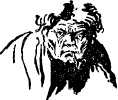
There was no reply, so Sam made bold to open the door. There sat the old woman glowering with angry red eyes across the stove, a cat in her lap, a pipe in her mouth, and a dog growling toward the strangers.
"Ain't you Sam Raften?" she asked fiercely.
"Yes, marm. I get hurt on a nail in the fence. They say you kin git blood-p'isinin' that way," said Sam, groaning a little and trying to look interesting. The order to "get out" died on the witch's lips. Her good old Irish heart warmed to the sufferer. After all, it was rather pleasant to have the enemy thus humbly seek her aid, so she muttered:
"Le's see it."
Sam was trying amid many groans to expose the disgusting mess he had made around his knee, when a step was heard outside. The door opened and in walked Biddy.
She and Yan recognized each other at once. The one had grown much longer, the other much broader since the last meeting, but the greeting was that of two warm-hearted people glad to see each other once more.
"An' how's yer father an' yer mother an' how is all the fambily? Law, do ye mind the Cherry Lung-balm we uster make? My, but we wuz greenies then! Ye mind, I uster tell ye about Granny? Well, here she is. Granny, this is Yan. Me an' him hed lots o' fun together when I 'resided' with his mamma, 136 didn't we, Yan? Now, Granny's the one to tell ye all about the plants."
A long groan from Sam now called all attention his way.
"Well, if it ain't Sam Raften," said Biddy coldly.
"Yes, an' he's deathly sick," added Granny. "Their own docther guv him up an said mortal man couldn't save him nohow, so he jest hed to come to me."
Another long groan was ample indorsement.
"Le's see. Gimme my scissors, Biddy; I'll hev to cut the pant leg aff."
"No, no," Sam blurted out with sudden vigour, dreading the consequences at home. "I kin roll it up."
"Thayer, thot'll do. Now I say," said the witch. "Yes, sure enough, thayer is proud flesh. I moight cut it out," said she, fumbling in her pocket (Sam supposed for a knife, and made ready to dash for the door), "but le's see, no—that would be a fool docther trick. I kin git on without."
"Yes, sure," said Sam, clutching at the idea, "that's just what a fool doctor would do, but you kin give me something to take that's far better."
"Well, sure an' I kin," and Yan and Sam breathed more freely. "Shwaller this, now," and she offered him a tin cup of water into which she spilled some powder of dry leaves. Sam did so. "An' you take this yer bundle and bile it in two gallons of wather and drink a glassful ivery hour, an' hev a loive 137 chicken sphlit with an axe an' laid hot on the place twicet ivery day, till the proud flesh goes, an' it'll be all right wid ye—a fresh chicken ivery toime, moind ye."
"Wouldn't—turkeys—do—better?" groaned Sam, feebly. "I'm me mother's pet, Granny, an' expense ain't any objek"—a snort that may have meant mortal agony escaped him.
"Niver moind, now. Sure we won't talk of yer father an' mother; they're punished pretty bad already. Hiven forbid they don't lose the rest o' ye fur their sins. It ain't meself that 'ud bear ony ill-will."
A long groan cut short what looked like a young sermon.
"What's the plant, Granny?" asked Yan, carefully avoiding Sam's gaze.
"Shure, an' it grows in the woods."
"Yes, but I want to know what it's like and what it's called."
"Shure, 'tain't like nothin' else. It's just like itself, an' it's called Witch-hazel.
"'Witch-hazel blossoms in the faal, To cure the chills and Fayvers aall,'
"as cracked Jimmy says."
"I'll show you some av it sometime," said Biddy.
"Can it be made into Lung-balm?" asked Yan, mischievously.
"I guess we'll have to go now," Sam feebly put in. "I'm feeling much better. Where's my stick? 138 Here, Yan, you kin carry my medicine, an' be very keerful of it."
Yan took the bundle, not daring to look Sam in the face.
Granny bade them both come back again, and followed to the door with a hearty farewell. At the same moment she said:
"Howld on!" Then she went to the one bed in the room, which also was the house, turned down the clothes, and in the middle exposed a lot of rosy apples. She picked out two of the best and gave one to each of the boys.
"Shure, Oi hev to hoide them thayer fram the pig, for they're the foinest iver grew."
"I know they are," whispered Sam, as he limped out of hearing, "for her son Larry stole them out of our orchard last fall. They're the only kind that keeps over. They're the best that grow, but a trifle too warm just now."
"Good-by, and thank you much," said Yan.
"I-feel-better-already," drawled Sam. "That tired feeling has left me, an' sense tryin' your remedy I have took no other," but added aside, "I wish I could throw up the stuff before it pisens me," and then, with a keen eye to the picturesque effect, he wanted to fling his stick away and bound into the woods.
It was all Yan could do to make him observe some of the decencies and limp a little till out of sight. As it was, the change was quite marked and the genial old witch called loudly on Biddy to see with 139 her own eyes how quickly she had helped young Raften "afther all the dochters in the country hed giv him up."
"Now for Caleb Clark, Esq., Q.C.," said Sam.
"Q.C.?" inquired his friend.
"Some consider it means Queen's Counsel, an' some claims as it stands for Queer Cuss. One or other maybe is right."
"You're stepping wonderfully for a crippled boy the doctors have given up," remarked Yan.
"Yes; that's the proud flesh in me right leg that's doin' the high steppin'. The left one is jest plain laig."
"Let's hide this somewhere till we get back," and Yan held up the bundle of Witch-hazel.
"I'll hide that," said Sam, and he hurled the bundle afar into the creek.
"Oh, Sam, that's mean. Maybe she wants it herself."
"Pooh, that's all the old brush is good for. I done more'n me duty when I drank that swill. I could fairly taste the cat in it."
"What'll you tell her next time?"
"Well, I'll tell her I put the sticks in the right place an' where they done the most good. I soaked 'em in water an' took as much as I wanted of the flooid.
"She'll see for herself I really did pull through, and will be a blamed sight happier than if I drank her old pisen brushwood an' had to send for a really 140 truly doctor."
Yan was silenced, but not satisfied. It seemed discourteous to throw the sticks away—so soon, anyway; besides, he had curiosity to know just what they were and how they acted.
141
V
Caleb
A mile farther was the shanty of Caleb Clark, a mere squatter now on a farm once his own. As the boys drew near, a tall, round-shouldered man with a long white beard was seen carrying in an armful of wood.
"Ye see the Billy Goat?" said Sam.
Yan sniffed as he gasped the "why" of the nickname.
"I guess you better do the talking; Caleb ain't so easy handled as the witch, and he's just as sour on Da."
So Yan went forward rather cautiously and knocked at the open door of the shanty. A deep-voiced Dog broke into a loud bay, the long beard appeared, and its owner said, "Wall?"
"Are you Mr. Clark?"
"Yep." Then, "Lie down, Turk," to a black-and-tan Hound that came growling out.
"I came—I—we wanted to ask some questions—if you don't mind."
"What might yer name be?"
"Yan."
142 "An' who is this?"
"He's my chum, Sam."
"I'm Sam Horn," said Sam, with some truth, for he was Samuel Horn Raften, but with sufficient deception to make Yan feel very uncomfortable.
"And where are ye from?"
"Bonnerton," said Yan.
"To-day?" was the rejoinder, with a tone of doubt.
"Well, no," Yan began; but Sam, who had tried to keep out of notice for fear of recognition, saw that his ingenuous companion was being quickly pumped and placed, and now interposed: "You see, Mr. Clark, we are camped in the woods and we want to make a teepee to live in. We have the stuff an' was told that you knew all about the making."
"Who told ye?"
"The old witch at the bend of the creek."
"Where are ye livin' now?"
"Well," said Sam, hastening again to forestall Yan, whose simple directness he feared, "to tell the truth, we made a wigwam of bark in the woods below here, but it wasn't a success."
"Whose woods?"
"Oh, about a mile below on the creek."
"Hm! That must be Raften's or Burns's woods."
"I guess it is," said Sam.
"An' you look uncommon like Sam Raften. You consarned young whelp, to come here lyin' an' tryin' to pull the wool over my eyes. Get out o' this now, or I'll boot ye."
143
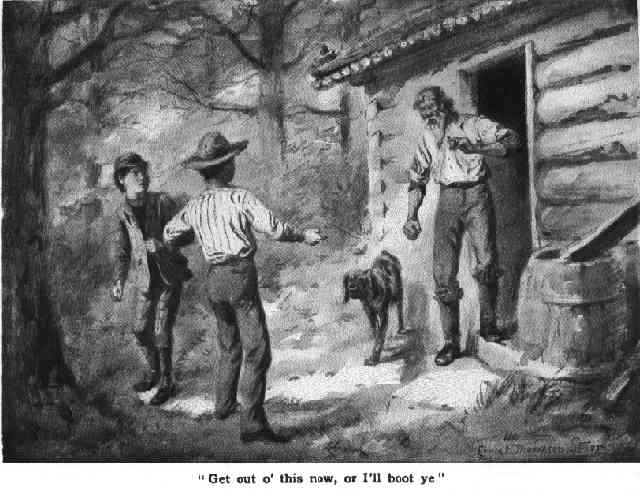
145 Yan turned very red. He thought of the scripture text, "Be sure your sin will find you out," and he stepped back. Sam stuck his tongue in his cheek and followed. But he was his father's son. He turned and said:
"Now see here, Mr. Clark, fair and square; we come here to ask a simple question about the woods. You are the only man that knows or we wouldn't 'a' bothered you. I knowed you had it in for Da, so I tried to fool you, and it didn't go. I wish now I had just come out square and said, 'I'm Sam Raften; will you tell me somethin' I want to know, or won't you?' I didn't know you hed anything agin me or me friend that's camping with me."
There is a strong bond of sympathy between all Woodcrafters. The mere fact that a man wants to go his way is a claim on a Woodcrafter's notice. Old Caleb, though soured by trouble and hot-tempered, had a kind heart; he resisted for a moment the first impulse to slam the door in their faces; then as he listened he fell into the tempter's snare, for it was baited with the subtlest of flatteries. He said to Yan:
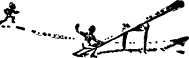
"Is your name Raften?"
"No, sir."
"Air ye owt o' kin?"
"No, sir."
146 "I don't want no truck with a Raften, but what do ye want to know?"
"We built a wigwam of bark, but it's no good, but now we have a big canvas cover an' want to know how to make a teepee."
"A teepee. H-m—" said the old man reflectively.
"They say you've lived in them," ventured Yan.
"Hm—'bout forty year; but it's one thing to wear a suit of clothes and another thing to make one. Seems to me it was about like this," and he took up a burnt stick and a piece of grocer's paper. "No—now hold on. Yes, I remember now; I seen a bunch of squaws make one oncet.
"First they sewed the skins together. No, first thar was a lot o' prayin'; ye kin suit yerselves 'bout that—then they sewed the skins together an" pegged it down flat on the prairie (B D H I, Cut No. 1).
147
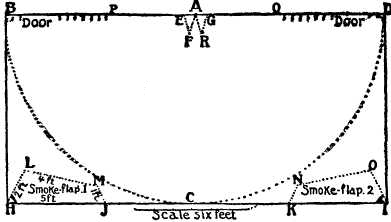
PATTERN FOR A SIMPLE 10-FOOT TEEPEE
"Then put in a peg at the middle of one side (A). Then with a burnt stick an' a coord—yes, there must 'a' been a coord—they drawed a half circle—so (B C D). Then they cut that off, an' out o' the pieces they make two flaps like that (H L M J and K N O I), an' sews 'em on to P E and G Q. Them's smoke-flaps to make the smoke draw. Thar's a upside down pocket in the top side corner o' each smoke-flap—so—for the top of each pole, and there is rows o' holes down—so (M B and N D, Cut No. 2)—on each side fur the lacin' pins. Then at the top of that pint (A, Cut 1) ye fasten a short lash-rope.
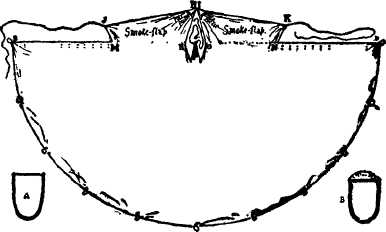
THE COMPLETE TEEPEE COVER—UNORNAMENTED
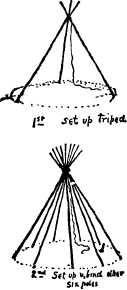
149 "Le's see, now. I reckon thar's about ten poles for a ten-foot lodge, with two more for the smoke-flaps. Now, when ye set her up ye tie three poles together—so—an' set 'em up first, then lean the other poles around, except one, an' lash them by carrying the rope around a few times. Now tie the top o' the cover to the top o' the last pole by the short lash-rope, hist the pole into place—that hists the cover, too, ye see—an' ye swing it round with the smoke-poles an' fasten the two edges together with the wooden pins. The two long poles put in the smoke-flap pockets works the vent to suit the wind."
In his conversation Caleb had ignored Sam and talked to Yan, but the son of his father was not so easily abashed. He foresaw several practical difficulties and did not hesitate to ask for light.
"What keeps it from blowin' down?" he asked.
"Wall," said Caleb, still addressing Yan, "the long rope that binds the poles is carried down under, and fastened tight to a stake that serves for anchor, 'sides the edge of the cover is pegged to the ground all around."
"How do you make the smoke draw?" was his next.
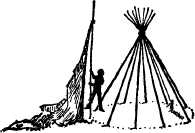
3rd set up tenth pole with teepee cover fastened to it by lash rope
"Ye swing the flaps by changing the poles till they is quartering down the wind. That draws best."
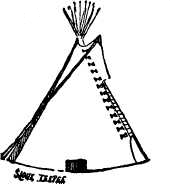
"How do you close the door?"
"Wall, some jest lets the edges sag together, but the best teepees has a door made of the same stuff as the cover put tight on a saplin' frame an' swung from 150 a lacin' pin."
This seemed to cover the ground, so carefully folding the dirty paper with the plan, Yan put it in his pocket, said "Thank you" and went off. To the "Good-day" of the boys Caleb made no reply, but turned as they left and asked, "Whar ye camped?"
"On the knoll by the creek in Raften's swamp."
"H-m, maybe I'll come an' see ye."
"All right," Sam called out; "follow the blazed trail from the brush fence."
"Why, Sam," said Yan, as soon as they were out of hearing, "there isn't any blazed trail; why did you say that?"
"Oh, I thought it sounded well," was the calm answer, "an' it's easy to have the blazes there as soon as we want to, an' a blame sight sooner than he's likely to use them."
151
VI
The Making of the Teepee
Raften sniffed in amusement when he heard that the boys had really gone to Caleb and got what they wanted. Nothing pleased him more than to find his son a successful schemer.
"Old Caleb wasn't so dead sure about the teepee, as near as I sized him up," observed Sam.
"I guess we've got enough to go ahead on," said Yan, "an' tain't a hanging matter if we do make a mistake."
The cover was spread out again flat and smooth on the barn floor, and stones and a few nails put in the sides to hold it.
The first thing that struck them was that it was a rough and tattered old rag.
And Sam remarked: "I see now why Da said we could have it. I reckon we'll have to patch it before we cut out the teepee."
"No," said Yan, assuming control, as he was apt to do in matters pertaining to the woods; "we better draw our plans first so as not to patch any part that's going to be cut off afterward."
"Great head! But I'm afraid them patches won't be awful ornamental."
152
"They're all right," was the reply. "Indians' teepees are often patched where bullets and arrows have gone through."
"Well, I'm glad I wa'n't living inside during them hostilities," and Sam exposed a dozen or more holes.
"Oh, get off there and give me that cord."
"Look out," said Sam; "that's my festered knee. It's near as bad to-day as it was when we called on the witch."
Yan was measuring. "Let's see. We can cut off all those rags and still make a twelve-foot teepee. Twelve foot high—that will be twenty-four feet across the bottom of the stuff. Fine! That's just the thing. Now I'll mark her off."
"Hold on, there," protested his friend; "you can't do that with chalk. Caleb said the Injuns used a burnt stick. You hain't got no right to use chalk. 'You might as well hire a carpenter.'"
"Oh, you go on. You hunt for a burnt stick, and if you don't find one bring me the shears instead."
Thus, with many consultations of Caleb's draft, the cutting-out was done—really a very simple matter. Then the patching was to be considered.
Pack-thread, needles and very l-o-n-g stitches were used, but the work went slowly on. All the spare time of one day was given to patching. Sam, of course, kept up a patter of characteristic remarks to the piece he was sewing. Yan sewed in serious silence. At first Sam's were put on better, but Yan learned fast and at length did by far the better sewing.
153
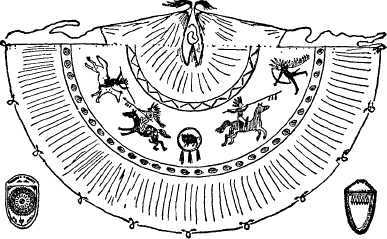
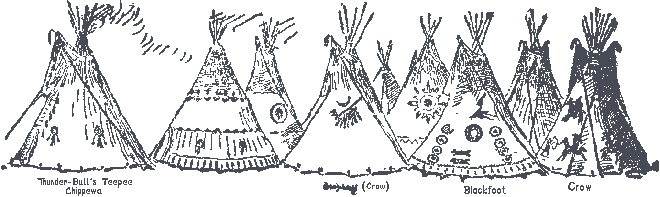
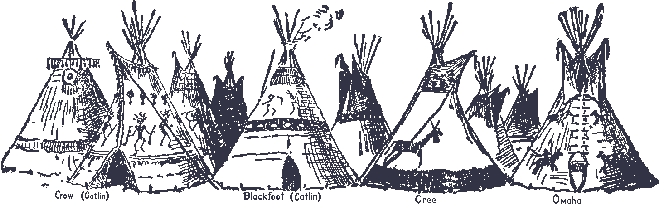
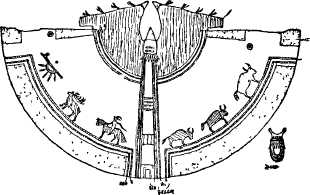
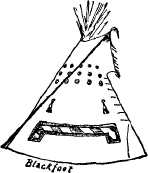
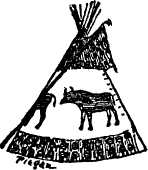
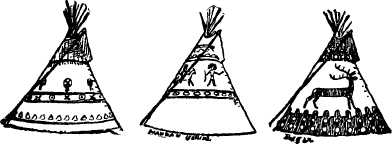
Decoration of Black Bull's Teepee: (Two Examples of Doors)
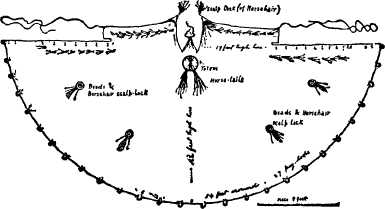
THUNDER BULL'S TEEPEE
154
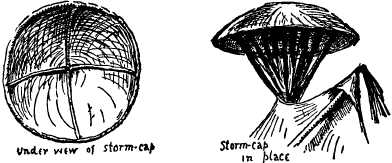
Notes on Making Teepee
The slimmer the poles are at the top where they cross the smaller the opening in the canvas and the less danger of rain coming in. In regions where there is much rain it is well to cut the projecting poles very short and put over them a "storm cap," "bull boat" or "shield" made of canvas on a rod bent in a three-foot circle. This device was used by the Mandans over the smoke-hole of their lodges during the heavy rains.
155 That night the boys were showing their handiwork to the hired hands. Si Lee, a middle-aged man with a vast waistband, after looking on with ill-concealed but good-natured scorn, said:
"Why didn't ye put the patches inside?"
"Didn't think of it," was Yan's answer.
"Coz we're goin' to live inside, an' need the room," said Sam.
"Why did ye make ten stitches in going round that hole; ye could just as easy have done it in four," and Si sniffed as he pointed to great, ungainly stitches an inch long. "I call that waste labour."
"Now see here," blurted Sam, "if you don't like our work let's see you do it better. There's lots to do yet."
"Where?"
"Oh, ask Yan. He's bossin' the job. Old Caleb wouldn't let me in. It just broke my heart. I sobbed all the way home, didn't I, Yan?
"There's the smoke-flaps to stitch on and hem, and the pocket at the top of the flaps—and—I—suppose," Yan added, as a feeler, "it—would—be—better—if—hemmed—all—around."
"Now, I tell ye what I'll do. If you boys'll go to the 'Corner' to-night and get my boots that the cobbler's fixing, I'll sew on the smoke-flaps."
"I'll take that offer," said Yan; "and say, Si, it doesn't really matter which is the outside. You can turn the cover so the patches will be in."
The boys got the money to pay for the boots, and after supper they set out on foot for the "Corner," 156 two miles away.
"He's a queer duck," and Sam jerked his thumb back to show that he meant Si Lee; "sounds like a Chinese laundry. I guess that's the only thing he isn't. He can do any mortal thing but get on in life. He's been a soldier an' a undertaker an' a cook He plays a fiddle he made himself; it's a rotten bad one, but it's away ahead of his playing. He stuffs birds—that Owl in the parlour is his doin'; he tempers razors, kin doctor a horse or fix up a watch, an' he does it in about the same way, too; bleeds a horse no matter what ails it, an' takes another wheel out o' the watch every times he cleans it. He took Larry de Neuville's old clock apart to clean once—said he knew all about it—an' when he put it together again he had wheels enough left over for a new clock.
"He's too smart an' not smart enough. There ain't anything on earth he can't do a little, an' there ain't a blessed thing that he can do right up first-class, but thank goodness sewing canvas is his long suit. You see he was a sailor for three years—longest time he ever kept a job, fur which he really ain't to blame, since it was a whaler on a three-years' cruise."
157
VII
The Calm Evening
It was a calm June evening, the time of the second daily outburst of bird song, the day's aftermath. The singers seemed to be in unusual numbers as well. Nearly every good perch had some little bird that seemed near bursting with joy and yet trying to avert that dire catastrophe.
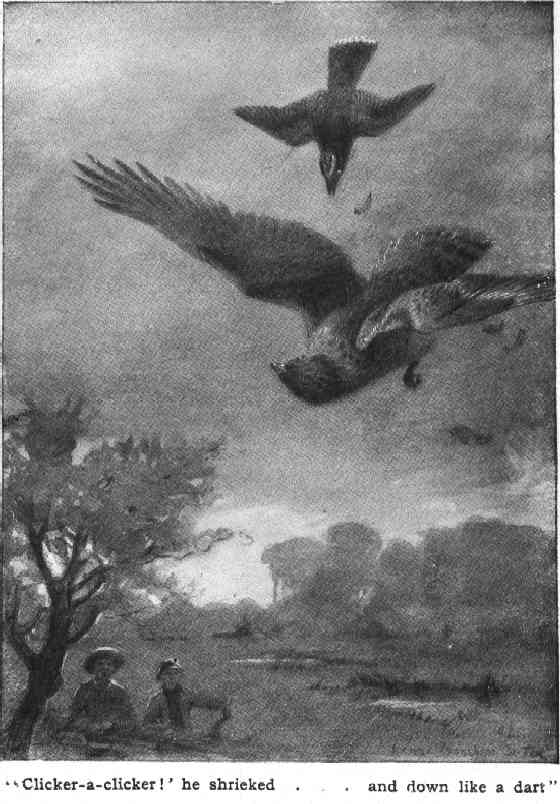
As the boys went down the road by the outer fence of their own orchard a Hawk came sailing over, silencing as he came the singing within a given radius. Many of the singers hid, but a Meadow Lark that had been whistling on a stake in the open was now vainly seeking shelter in the broad field. The Hawk was speeding his way. The Lark dodged and put on all power to reach the orchard, but the Hawk was after him now—was gaining—in another moment would have clutched the terrified musician, but out of the Apple trees there dashed a small black-and-white bird—the Kingbird. With a loud harsh twitter—his war-cry—repeated again and again, with his little gray head-feathers raised to show the blood-and-flame-coloured undercrest—his war colours—he darted straight at the great robber.
158 "Clicker-a-clicker," he fairly screamed, and made for the huge Hawk, ten times his size.
"Clicker-a-clicker!" he shrieked, like a cateran shouting the "slogan," and down like a black-and-white dart—to strike the Hawk fairly between the shoulders just as the Meadow Lark dropped in despair to the bare ground and hid its head from the approaching stroke of death.
"Clicker-a-clicker"—and the Hawk wheeled in sudden consternation. "Clicker-a-clicker"—and the dauntless little warrior dropped between his wings, stabbing and tearing.
The Hawk bucked like a mustang, the Kingbird was thrown, but sprung on agile pinions above again.
"Clicker-a-clicker," and he struck as before. Large brown feathers were floating away on the breeze now. The Meadow Lark was forgotten. The Hawk thought only of escape.
159
"Clicker-a-clicker," the slogan still was heard. The Hawk was putting on all speed to get away, but the Kingbird was riding him most of the time. Several brown feathers floated down, the Hawk dwindled in the distance to a Sparrow and the Kingbird to a fly dancing on his back. The Hawk made a final plunge into a thicket, and the king came home again, uttering the shrill war-cry once or twice, probably to let the queen know that he was coming back, for she flew to a high branch of the Apple tree where she could greet the returning hero. He came with an occasional "clicker-a-clicker"—then, when near her, he sprung fifty feet in the air and dashed 161 down, screaming his slogan without interruption, darting zigzag with the most surprising evolutions and turns—this way, that way, sideways and downward, dealing the deadliest blows right and left at an imaginary foe, then soared, and did it all over again two or three times, just to show how far he was from being tired, and how much better he could have done it had it been necessary. Then with a final swoop and a volley of "clickers" he dashed into the bush to receive the congratulations of the one for whom it all was meant and the only spectator for whose opinion he cared in the least.
"Now, ain't that great," said Sam, with evident sincerity and pleasure. His voice startled Yan and brought him back. He had been wholly lost in silent admiring wonder of the dauntless little Kingbird.
A Vesper Sparrow ran along the road before them, flitting a few feet ahead each time they overtook it and showing the white outer tail-feathers as it flew.
"A little Graybird," remarked Sam.
"No, that isn't a Graybird; that's a Vesper Sparrow," exclaimed Yan, in surprise, for he knew he was right.
"Well, I dunno," said Sam, yielding the point.
"I thought you said you knew every bird that flies and all about it" replied his companion, for the memory of this first day was strong with him yet.
Sam snorted: "I didn't know you then. I was just loadin' you up so you'd think I was a wonderful 162 feller, an' you did, too—for awhile."
A Red-headed Woodpecker, carrying a yellow butterfly, flew on a fence stake ahead of them and peeped around as they drew near. The setting sun on his bright plumage, the lilac stake and the yellow butterfly, completed a most gorgeous bit of colour and gave Yan a thrill of joy. A Meadow Lark on a farther stake, a Bluebird on another, and a Vesper Bird on a stone, each added his appeal to eye and ear, till Sam exclaimed:
"Oh, ain't that awful nice?" and Yan was dumb with a sort of saddened joy.
Birds hate the wind, and this was one of those birdy days that come only with a dead calm.
They passed a barn with two hundred pairs of Swallows flying and twittering around, a cut bank of the road had a colony of 1,000 Sand Martins, a stream had its rattling Kingfishers, and a marsh was the playground of a multitude of Red-winged Blackbirds.
Yan was lifted up with the joy of the naturalist at seeing so many beautiful living things. Sam felt it, too; he grew very silent, and the last half-mile to the "Corner" was passed without a word. The boots were got. Sam swung them around his neck and the boys set out for home. The sun was gone, but not the birds, and the spell of the evening was on them still. A Song Sparrow by the brook and a Robin high in the Elm were yet pouring out their liquid notes in the gloaming.
163 "I wish I could be always here," said Yan, but he started a little when he remembered how unwilling he had been to come.
There was a long silence as they lingered on the darkening road. Each was thinking hard.
A loud, startling but soft "Ohoo—O-hoo—O-hoooooo," like the coo of a giant dove, now sounded about their heads in a tree. They stopped and Sam whispered, "Owl; big Hoot Owl." Yan's heart leaped with pleasure. He had read all his life of Owls, and even had seen them alive in cages, but this was the first time he had ever heard the famous hooting of the real live wild Owl, and it was a delicious experience.
The night was quite dark now, but there were plenty of sounds that told of life. A Whippoorwill was chanting in the woods, a hundred Toads and Frogs creaked and trilled, a strange rolling, laughing cry on a marshy pond puzzled them both, then a Song Sparrow in the black night of a dense thicket poured forth its sweet little sunshine song with all the vigour and joy of its best daytime doing.
They listened attentively for a repetition of the serenade, when a high-pitched but not loud "Wa—wa—wa—wa—wa—wa—wa—wa!" reached their ears from a grove of heavy timbers.
"Hear that?" exclaimed Sam.
Again it came, a quavering squall, apparently much nearer. It was a rather shrill sound, quite unbirdy, and Sam whispered:
164 "Coon—that's the whicker of a Coon. We can come down here some time when corn's 'in roastin'' an' have a Coon hunt."
"Oh, Sam, wouldn't that be glorious!" said Yan. "How I wish it was now. I never saw a Coon hunt or any kind of a hunt. Do we have to wait till 'roasting-ear' time?"
"Oh, yes; it's easier to find them then. You say to your Coons, 'Me an' me dogs will meet you to-night at the nearest roastin'-ear patch,' an' sure nuff they'll keep the appointment."
"But they're around now, for we just heard one, and there's another."
A long faint "Lil—lil—lil—lil—lil—li-looo!" now sounded from the trees. It was like the other, but much softer and sweeter.
"There's where you fool yerself," replied Sam, "an' there's where many a hunter is fooled. That last one's the call of a Screech Owl. You see it's softer and whistlier than the Coon whicker."
They heard it again and again from the trees. It was a sweet musical sound, and Yan remembered how squally the Coon call was in comparison, and yet many hunters never learn the difference.
As they came near the tree whence the Owl called at intervals, a gray blot went over their heads, shutting out a handful of stars for a moment as it passed over them, but making no noise. "There he goes," whispered Sam. "That's the Screech Owl. Not much of a screech, was it?" Not long afterward Yan came across a line of Lowell's which says, "The 165 song of the Screech Owl is the sweetest sound in nature," and appreciated the absurdity of the name.
"I want to go on a Coon hunt," continued Yan, and the sentence was just tinged with the deep-laid doggedness that was usually lost in his courteous manner.
"That settles it," answered the other, for he was learning what that tone meant. "We'll surely go when you talk that way, for, of coorse, it kin be done. You see, I know more about animals than birds," he continued. "I'm just as likely to be a dentist as a hunter so far as serious business is concerned, but I'd sure love to be a hunter for awhile, an' I made Da promise to go with me some time. Maybe we kin get a Deer by going back ten miles to the Long Swamp. I only wish Da and Old Caleb hadn't fought, 'cause Caleb sure knows the woods, an' that old Hound of his has treed more Coons than ye could shake a stick at in a month o' Sundays."
"Well, if that's the only Coon dog around, I'm going to get him. You'll see," was the reply.
"I believe you will," answered Sam, in a tone of mixed admiration and amusement.
It was ten o'clock when they got home, and every one was in bed but Mr. Raften. The boys turned in at once, but next morning, on going to the barn, they found that Si had not only sewed on and hemmed the smoke-flaps, but had resewn the worst of the patches and hemmed the whole bottom of the teepee cover with a small rope in the hem, so that they were 166 ready now for the pins and poles.
The cover was taken at once to the camp ground. Yan carried the axe. When they came to the brush fence over the creek at the edge of the swamp, he said:
"Sam, I want to blaze that trail for old Caleb. How do you do it?"
"Spot the trees with the axe every few yards."
"This way?" and Yan cut a tree in three places, so as to show three white spots or blazes.
"No; that's a trapper's blaze for a trap or a 'special blaze,' but a 'road blaze' is one on the front of the tree and one on the back—so—then ye can run the trail both ways, an' you put them thicker if it's to be followed at night."
167
VIII
The Sacred Fire
"Ten strong poles and two long thin ones," said Yan, reading off. These were soon cut and brought to the camp ground.
"Tie them together the same height as the teepee cover——"
"Tie them? With what?"
"'Rawhide rope,' he said, but he also said 'Make the cover of skins.' I'm afraid we shall have to use common rope for the present," and Yan looked a little ashamed of the admission.
"I reckoned so," drawled Sam, "and so I put a coil of quarter-inch in the cover, but I didn't dare to tell you that up at the barn."
The tripod was firmly lashed with the rope and set up. Nine poles were duly leaned around in a twelve-foot circle, for a teepee twelve feet high usually has a twelve-foot base. A final lashing of the ropes held these, and the last pole was then put up opposite to the door, with the teepee cover tied to it at the point between the flaps. The ends of the two smoke-poles carried the cover round. Then the lacing-pins were needed. Yan tried to make them of Hickory shoots, but the large, soft pith came just where the point was needed. So Sam said, "You 168 can't beat White Oak for pins." He cut a block of White Oak, split it down the middle, then split half of it in the middle again, and so on till it was small enough to trim and finish with his knife. Meanwhile Yan took the axe to split another, but found that it ran off to one side instead of going straight down the grain.
"No good," was Sam's comment. "You must keep halving each time or it will run out toward the thin pieces. You want to split shingles all winter to larn that."
Ten pins were made eight inches long and a quarter of an inch thick. They were used just like dressmakers' stickpins, only the holes had to be made first, and, of course, they looked better for being regular. Thus the cover was laced on. The lack of ground-pegs was then seen.
"You make ten Oak pins a foot long and an inch square, Sam. I've a notion how to fix them." Then Yan cut ten pieces of the rope, each two feet long, and made a hole about every three feet around the base of the cover above the rope in the outer seam. He passed one end of each short rope through this and knotted it to the other end. Thus he had ten peg-loops, and the teepee was fastened down and looked like a glorious success.
Now came the grand ceremony of all, the lighting of the first fire. The boys felt it to be a supreme and almost a religious moment. It is curious to note 169 that they felt very much as savages do under the same circumstances—that the setting up of the new teepee and lighting its first fire is an act of deep significance, and to be done only with proper regard for its future good luck.
"Better go slow and sure about that fire. It'd be awfully unlucky to have it fizzle for the first time."
"That's so," replied Yan, with the same sort of superstitious dread. "Say, Sam, if we could really light it with rubbing-sticks, wouldn't it be great?"
"Hallo!"
The boys turned, and there was Caleb close to them. He came over and nodded. "Got yer teepee, I see? Not bad, but what did ye face her to the west fur?"
"Fronting the creek," explained Yan.
"I forgot to tell ye," said Caleb, "an Injun teepee always fronts the east; first, that gives the morning sun inside; next, the most wind is from the west, so the smoke is bound to draw."
"And what if the wind is right due east?" asked Sam, "which it surely will be when it rains?"
"And when the wind's east," continued Caleb, addressing no one in particular, and not as though in answer to a question, "ye lap the flaps across each other tight in front, so," and he crossed his hands over his chest. "That leaves the east side high and shuts out the rain; if it don't draw then, ye raise the bottom of the cover under the door just a little—that always fetches her. An' when you 170 change her round don't put her in under them trees. Trees is dangerous; in a storm they draw lightning, an' branches fall from them, an' after rain they keep on dripping for an hour. Ye need all the sun ye kin get on a teepee.
"Did you ever see Indians bring fire out of two sticks by rubbing, Mr. Clark?"
"Oh, yes. Most of the Injuns now carry matches, but in the early days I seen it done often enough."
"Does it take long? Is it hard?"
"Not so long, and it's easy enough, when ye know how."
"My! I'd rather bring fire out of two sticks than have a ten dollar bill," said Yan, with enthusiasm that meant much, for one dollar was his high-water mark of affluence, and this he had reached but once in his life.
"Oh, I dunno'; that depends," was Sam's more guarded response.
"Can you do it?" asked Yan.
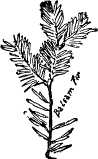
"Wall, yes, if I kin get the right stuff. Ye see, it ain't every wood that will do it. It's got to be jest right. The Plains Injuns use Cottonwood root, an' the Mountain Injuns use Sage-brush root. I've seen the Canadian Injuns use Basswood, Cedar and dry White Pine, but the Chippewas mostly use Balsam Fir. The easiest way is with a bow-drill. Have ye any buckskin?"
"No."
171 "Or a strip o' soft leather?"
"I've got a leather shoe-lace," said Yan.
"Rather slim; but we'll double it an' make it do. A cord will answer, but it frays out so soon." Caleb took the lace and the axe, then said, "Find me a stone 'bout the size of an egg, with a little hole into it—like a socket hole—'bout a quarter inch deep."
The boys went to the creek to seek a stone and Caleb went into the woods.
They heard him chopping, and presently he came back with a flat piece of very dry Balsam Fir, a fifteen-inch pin of the same, a stick about three feet long, slightly bent, some dry Pine punk and some dry Cedar.
The pin was three-quarters of an inch thick and was roughly eight-sided, "so the lace would grip." It was pointed at both ends. He fastened the lace to the bent stick like a bow-string, but loosely, so that when it had one turn around the pin it was quite tight. The flat piece of Balsam he trimmed down to about half an inch thick. In the edge of this he now cut a notch one-quarter inch wide and half an inch deep, then on the top of this fire-board or block, just beyond the notch, he made with the point of his knife a little pit.
He next scraped and shredded a lot of dry Cedar wood like lint. Then making a hole half an inch deep in the ground, he laid in that a flat piece of Pine punk, and across this he set the fire-board. The point of the pin or drill was put in the pit of the fire-board, which he held down with one foot; 172 the lace was given one turn on the pin, and its top went into the hole of the stone the boys brought. The stone was held firmly in Caleb's left hand.
"Sometimes," he remarked, "when ye can't find a stone, a Pine knot will do—ye kin make the socket-hole with a knife-point."
Now holding the bow in his right hand, he began to draw it back and forth with long, steady strokes, causing the pin to whirl round in the socket. Within a few seconds a brown powder began to run out of the notch of the fire-board onto the punk. The pit increased in size and blackened, the powder darkened, and a slight smoke arose from the pit. Caleb increased the pressure of his left hand a little, and sawed faster with the right. The smoke steadily increased and the black powder began to fill the notch. The smoke was rolling in little clouds from under the pin, and it even seemed to come from the heap of powder. As soon as he saw that, Caleb dropped the bow and gently fanned the powder heap. It still smoked. He removed the fire-board, and lifting the punk, showed the interior of the powder to be one glowing coal. On this he laid the Cedar tinder and over that a second piece of punk. Then raising it, he waved it in the air and blew gently for awhile. It smouldered and then burst into a flame. The other material was handy, and in a very short time they had a blazing fire in the middle of the new teepee.
174
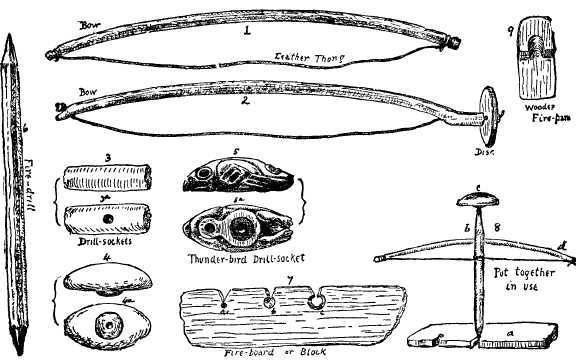
THE RUBBING-STICKS FOR FIRE-MAKING (See Description Below)
175 All three were pictures of childish delight. The old man's face fairly beamed with triumph. Had he failed in his experiment he would have gone off hating those boys, but having made a brilliant success he was ready to love every one concerned, though they had been nothing more than interested spectators of his exploit.
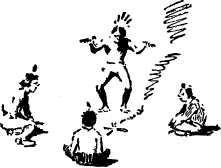
RUBBING-STICKS FOR FIRE-MAKING
Two tools and two sticks are needed. The tools are bow and drill-socket; the sticks are drill and fire-board. 1. The simplest kind of bow—a bent stick with a stout leather thong fastened at each end. The stick must not spring. It is about 27 inches long and 5/8 inch thick. 2. A more elaborate bow with a hole at each end for the thong. At the handle end it goes through a disc of wood. This is to tighten the thong by pressure of the hand against the disc while using. 3. Simplest kind of drill-socket—a pine or hemlock knot with a shallow hole or pit in it. 3a is under view of same. It is about 4½ inches long. 4. A more elaborate drill-socket—a pebble cemented with gum in a wooden holder. 4a is under view of same. 5. A very elaborate drill-socket; it is made of tulip wood, carved to represent the Thunderbird. It has eyes of green felspar cemented in with resin. On the under side (5a) is seen, in the middle, a soapstone socket let into the wood and fastened with pine gum, and on the head a hole kept filled with grease, to grease the top of the drill before use. 6. The drill, 12 to 18 inches long and about ¾ of an inch thick; it is roughly 8-sided so the thong will not slip, pointed at each end. The best wood for the drill is old, dry, brash, but not punky balsam fir or cotton-wood roots; but basswood, white cedar, red cedar, tamarack, and sometimes even white pine, will do. 7. Fire-board or block, about ¾ of an inch thick and any length handy; a is notch with pit just below shows the pit after once using and in good trim for a second time; c shows the pit bored through and useless; the notch is ½ inch wide and ¾ inch deep. 8. Shows the way of using the sticks. The block (a) is held down with one foot, the end of the drill in the pit, the drill-socket (c) is held on top in left hand, one end of the bow (d ) is held in the right hand the bow is drawn back and forth. 9. Is a little wooden fire-pan, not essential but convenient; its thin edge is put under the notch to catch the powder that falls.
176
IX
The Bows and Arrows
"I don't think much of your artillery," said Yan one day as they were shooting in the orchard with Sam's "Western outfit." "It's about like the first one I made when I was young."
"Well, grandpa, let's see your up-to-date make?"
"It'd be about five times as strong, for one thing."
"You couldn't pull it."
"Not the way you hold the arrow! But last winter I got a book about archery from the library and learned something worth while. You pinch the arrow that way and you can draw six or eight pounds, maybe, but you hook your fingers in the string—so—and you can draw five times as much, and that's the right way to shoot."
"Feels mighty clumsy," said Sam, trying it.
"Of course it does at first, and you have to have a deep notch in the arrow or you can't do it at all."
"You don't seem to manage any better than I do."
"First time I ever had a chance to try since I read about it. But I want to make a first-class bow and a lot of arrows. It's not much good going with one."
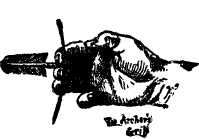
177 "Well, go ahead an' make an outfit if you know how. What's the best wood? Did the book tell you that?"
"The best wood is Spanish Yew."
"Don't know it."
"An' the next is Oregon Yew."
"Nope."
"Then Lancewood and Osage Orange."
'Try again."
"Well, Red Cedar, Apple tree, Hickory and Elm seem to be the only ones that grow around here."
"Hain't seen any Red Cedar, but the rest is easy."
"It has to be thoroughly seasoned winter-cut wood, and cut so as to have heart on one side and sap wood on the other."
"How's that?" and Sam pointed to a lot of half-round Hickory sticks on the rafters of the log house. "Those have been there a couple of years."
A good one of five feet long was selected and split and hewn with the axe till the boys had the two bow staves, five and one-half feet long and two inches square, with the line of the heart and sap wood down the middle of each.
Guided by his memory of that precious book and some English long bows that he had seen in a shop in town, Yan superintended the manufacture. Sam was apt with tools, and in time they finished two bows, five feet long and drawing possibly twenty-five pounds each. In the middle they were one and one-half inches wide and an inch thick (see page 183). This size they kept for nine inches each way, making an 178 eighteen-inch middle part that did not bend, but their two limbs were shaved down and scraped with glass till they bent evenly and were well within the boys' strength.
The string was the next difficulty. All the ordinary string they could get around the house proved too weak, never lasting more than two or three shots, till Si Lee, seeing their trouble, sent them to the cobbler's for a hank of unbleached linen thread and some shoemaker's wax. Of this thread he reeled enough for a strong cord tight around two pegs seven feet apart, then cutting it loose at one end he divided it equally in three parts, and, after slight waxing, he loosely plaited them together. At Yan's suggestion he then spliced a loop at one end, and with a fine waxed thread lashed six inches of the middle where the arrow fitted, as well as the splice of the loop. This last enabled them to unstring the bow when not in use (see page 183). "There," said he, "you won't break that." The finishing touch was thinly coating the bows with some varnish found among the paint supplies.
"Makes my old bow look purty sick," remarked Sam, as he held up the really fine new weapon in contrast with the wretched little hoop that had embodied his early ideas. "Now what do you know about arrers, mister?" as he tried his old arrow in the new bow.
"I know that that's no good," was the reply; "an' I can tell you that it's a deal harder to make an arrow 179 than a bow—that is, a good one."
"That's encouraging, considering the trouble we've had already."
"'Tisn't meant to be, but we ought to have a dozen arrows each."
"How do the Injuns make them?"
"Mostly they get straight sticks of the Arrow-wood; but I haven't seen any Arrow-wood here, and they're not so awfully straight. You see, an arrow must be straight or it'll fly crooked. 'Straight as an arrow' means the thing itself. We can do better than the Indians 'cause we have better tools. We can split them out of the solid wood."
"What wood? Some bloomin' foreign kind that no White-man never saw nor heard of before?"
"No sir-ree. There ain't anything better 'n White Pine for target and Ash or Hickory for hunting arrows. Which are we making?"
"I'm a hunter. Give me huntin' arrows every time. What's needed next?"
"Seasoned Ash twenty-five inches long, split to three-eighths of an inch thick, hot glue, and turkey-wing feathers."
"I'll get the feathers and let you do the rest," said Sam, producing a bundle of turkey-wings, laid away as stove-dusters, and then belied his own statement by getting a block of Ash and splitting it up, halving it each time till he had a pile of two dozen straight sticks about three-quarters of an inch thick.
180 Yan took one and began with his knife to whittle it down to proper size and shape, but Sam said, "I can do better than that," then took the lot to the workbench and set to work with a smoothing plane. Yan looked worried and finally said:
"Injuns didn't have planes."
"Nor jack-knives neither," was the retort.
That was true, and yet somehow Yan's ideal that he hankered after was the pre-Columbian Indian, the one who had no White-man's help or tools.
"It seems to me it'd be more Injun to make these with just what we get in the woods. The Injuns didn't have jack-knives, but they had sharp flints in the old days."
"Yan, you go ahead with a sharp stone. You'll find lots on the road if you take off your shoes and walk barefoot—awful sharp; an' I'll go ahead with the smoothing plane an' see who wins."
Yan was not satisfied, but he contented himself with promising that he would some day make some arrows of Arrow-wood shoots and now he would finish at least one with his knife. He did so, but Sam, in the meantime, made six much better ones with the smoothing plane.
"What about heads?" said he.
"I've been thinking," was the reply. "Of course the Indians used stone heads fastened on with sinew, but we haven't got the stuff to do that. Bought heads of iron with a ferrule for the end of the arrow are best, but we can't get them. Bone heads and horn heads will do. I made some fine ones once filing 181 bones into the shape, but they were awfully brittle; and I made some more of big nails cut off and set in with a lashing of fine wire around the end to stop the wood splitting. Some Indian arrows have no point but the stick sharpened after it's scorched to harden it."