Part 2 — PART II (continued 2)
Reading edition
"That sounds easy enough for me," said Sam; "let's make some of them that way."
So the arrows were made, six each with nail points filed sharp and lashed with broom wire. These were called "War arrows," and six each with fire-hardened wood points for hunting arrows.
"Now for the feathering," and Yan showed Sam how to split the midrib of a turkey feather and separate the vane.
"Le's see, you want twice twenty-four—that's forty-eight feathers."
"No," said Yan, "that's a poor feathering, two on each. We want three on each arrow—seventy-two strips in all, and mind you, we want all three that are on one arrow from the same side of the bird."
"I know. I'll bet it's bad luck to mix sides; arrows doesn't know which way to turn."
At this moment Si Lee came in. "How are ye gettin' on with the bows?"
"Waitin' for arrows now."
"How do ye put on the feathers?"
"White-men glue them on, and Injuns lash them on," replied Yan, quoting from memory from "that 182 book."
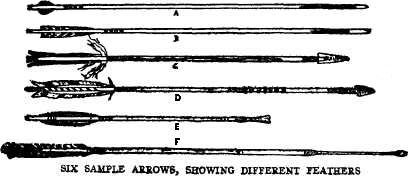
DESCRIPTION OF SIX SAMPLE ARROWS SHOWING DIFFERENT FEATHERS
A is a far-flying steel-pointed bobtail, very good in wind. B is another very good arrow, with a horn point. This went even better than A if there were no wind. C is an Omaha war and deer arrow. Both heads and feathers are lashed on with sinew. The long tufts of down left on the feathers are to help in finding it again, as they are snow-white and wave in the breeze. The grooves on the shaft are to make the victim bleed more freely and be more easily tracked. D is another Omaha arrow with a peculiar owner's mark of lines carved in the middle, E is a bone-headed bird shaft made by the Indians of the Mackenzie River. F is a war arrow made by Geronimo, the famous Apache chief. Its shaft is three joints of a straight cane. The tip is of hard wood, and on that is a fine quartz point; all being lashed together with sinew.
"Which is best?"
"Glued on flies better, but lashed on stands the weather better."
"Why not both?"
"Have no sinew."
"Let me show ye a trick. Where's yer glue an' linen thread?"
These were brought, whereupon Si added: "'Pears to me ye oughter put the feathers on last. Better cut the notch first."
"That's so; we nearly forgot."
"You nearly forgot, you mean. Don't drag me in the mud," said Sam, with owlish dignity. A small saw cut, cleaned up and widened with a penknife, proved the best; a notch one-fourth inch deep was quickly made in each arrow, and Si set about both glueing and lashing on the feathers, but using wax-end instead of sinew.
Yan had marked the place for each feather so that none would strike the bow in passing (see Cut page 183). He first glued them on, then made a lashing for half an inch on the projecting ends of the feather-rib, and another behind, carrying this second lashing back to the beginning of the notch to guard against the wood splitting. When he had trimmed all loose ends and rolled the waxed thread well on the bench with a flat stick, the threads seemed to disappear and leave simply a smooth black ring.
183
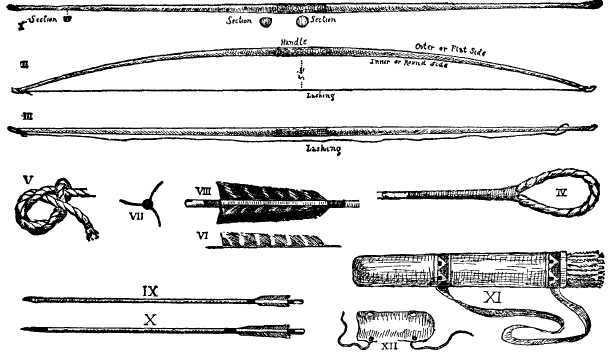
THE ARCHERY OUTFIT (Not all on scale)
I. The five-foot bow as finished, with sections at the points shown. II. The bow "braced" or strung. III. The bow unstrung, showing the loop slipped down. IV. The loop that is used on the upper end of the bow. V. The timber hitch always used on the lower end or notch of the bow. VI. A turkey feather with split midrib, all ready to lash on. VII. End view of arrow, showing notch and arrangement of three feathers. VIII. Part of arrow, showing feathering and lashing. IX. Sanger hunting arrow with wooden point; 25 inches long. X. Sanger war arrow with nail point and extra long feathers; it also is 25 inches long. XI. Quiver with Indian design; 20 inches long. XII. The "bracer" or arm guard of heavy leather for left arm, with two laces to tie it on. It is six inches long.]
185 Thus the arrows were made and set away for the glue to dry.
Next day Yan painted Sam's red and blue, his own red and white, to distinguish them as well as guard them from the damp. There was now one more thing, and that was a quiver.
"Do the Injuns have them?" asked Sam, with a keen eye to orthodoxy when it promised to cut short the hard work.
"Well, I should say so; couldn't live without them."
"All right; hurry up. I'm spoiling for a hunt. What are they made of?"
"Oh, 'most anything."
"Haven't got it."
"You're too fast. But some use Birch bark, some use the skin of an animal, and some use canvas now when other stuff is scarce."
"That's us. You mind the stuff left off the teepee?"
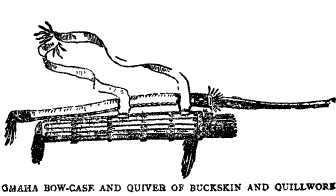
"Do till we get better." So each made a sort of canvas bag shorter than the arrows. Yan painted an Indian device on each, and they were ready.
"Now bring on your Bears," said the older boy, and feeling a sense of complete armament, they went out.
"See who can hit that tree." Both fired together and missed, but Sam's arrow struck another tree and split open.
"Guess we'd better get a soft target," he remarked. Then after discussion they got a large old corn sack full of hay, painted on it some rings around a bull's 186 eye (a Buffalo's eye, Sam called it) and set it up at twenty yards.
They were woefully disappointed at first in their shooting. It did seem a very easy mark, and it was disappointing to have the arrows fly some feet away to the left.
"Le's get in the barn and shoot at that," suggested Sam.
"We might hit it if we shut the door tight," was the optimistic reply. As well as needing practice, the boys had to learn several little rules about Archery. But Yan had some pencil notes from "that book" and some more in his brain that with much practice gradually taught him: To stand with his heel centres in line with the target; his right elbow in line with the arrow; his left hand fixed till the arrow struck; his right thumb always on the same place on his cheek when he fired, and the bow plumb.
They soon found that they needed guards for the left arm where the bow strings struck, and these they made out of the leg of an old boot (see Cut page 183), and an old glove to protect the fingers of the right hand when they practised very much. After they learned to obey the rules without thinking about them, the boys improved quickly and soon they were able to put all the arrows into the hay sack at twenty yards, increasing the distance later till they could make fair shooting at forty yards.
They were not a little surprised to find how much individuality the arrows had, although meant to be 187 exactly alike.
Sam had one that continued to warp until it was much bent, and the result was some of the most surprising curves in its flight. This he called the "Boomerang." Another, with a very small feather, travelled farther than any of the rest. This was the "Far-killer." His best arrow, one that he called "Sure-death," was a long-feathered Turkey shaft with a light head. It was very reliable on a calm day, but apt to swerve in the wind. Yet another, with a small feather, was correspondingly reliable on a windy day. This was "Wind-splitter."
The one Yan whittled with the knife was called the "Whittler," and sometimes the "Joker." It was a perpetual mystery, they never knew just what it would do next. His particular pet was one with a hollow around the point, which made a whistling sound when it flew, and was sometimes called the "Whistler" and sometimes the "Jabberwock," "which whiffled through the tulgy wood and burbled as it came."
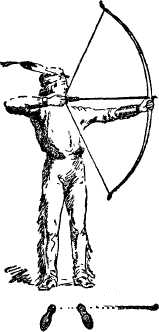
CORRECT FORM IN SHOOTING
The diagram at bottom is to show the centres of heels in line with target.
188
X
The Dam
One hot day early in July they were enjoying themselves in the shallow bathing-hole of the creek, when Sam observed: "It's getting low. It goes dry every summer."
This was not pleasing to foresee, and Yan said, "Why can't we make a dam?"
"A little too much like work."
"Oh, pshaw! That'd be fun and we'd have a swimming-place for all summer, then. Come on; let's start now."
"Never heard of Injuns doing so much work."
"Well, we'll play Beaver while we do it. Come on, now; here's for a starter," and Yan carried a big stone to what seemed to him the narrowest place. Then he brought more, and worked with enthusiasm till he had a line of stones right across the creek bed.
Sam still sat naked on the bank, his knees to his chin and his arms around them. The war-paint was running down his chest in blue and red streaks.
"Come on, here, you lazy freak, and work," cried Yan, and flung a handful of mud to emphasize the invite.
189 "My festered knee's broke out again," was the reply.
At length Yan said, "I'm not going to do it all alone," and straightened up his back.
"Look a-here," was the answer. "I've been thinking. The cattle water here. The creek runs dry in summer, then the cattle has to go to the barnyard and drink at the trough—has to be pumped for, and hang round for hours after hoping some one will give them some oats, instead of hustling back to the woods to get fat. Now, two big logs across there would be more'n half the work. I guess we'll ask Da to lend us the team to put them logs across to make a drinking-pond for the cattle. Them cattle is awful on my mind. Didn't sleep all night thinking o' them. I just hate like pizen to see them walking all the way to the barn in hot weather for a drink—'tain't right." So Sam waited for a proper chance to "tackle" his father. It did not come that day, but at breakfast next morning Raften looked straight at Yan across the table, and evidently thinking hard about something, said:
"Yahn, this yer room is twenty foot by fifteen, how much ilecloth three foot wide will it call fur?"
"Thirty-three and one-third yards," Yan said at once.
Raften was staggered. Yan's manner was convincing, but to do all that in his head was the miracle. Various rude tests were applied and the general opinion prevailed that Yan was right.
190 The farmer's face beamed with admiration for the first time. "Luk at that," he said to the table, "luk at that fur eddication. When'll you be able to do the like?" he said to Sam.
"Never," returned his son, with slow promptness. "Dentists don't have to figger on ilecloth."
"Say, Yan," said Sam aside, "guess you better tackle Da about the dam. Kind o' sot up about ye this mornin'; your eddication has softened him some, an' it'll last till about noon, I jedge. Strike while the iron is hot."
So after breakfast Yan commenced:
"Mr. Raften, the creek's running dry. We want to make a pond for the cattle to drink, but we can't make a dam without two big logs across. Will you let us have the team a few minutes to place the logs?"
"It ain't fur a swimmin'-pond, is it, ye mean?" said Raften, with a twinkle in his eye.
"It would do for that as well," and Yan blushed.
"Sounds to me like Sam talking through Yan's face," added Raften, shrewdly taking in the situation. "I'll see fur meself."
Arrived at the camp, he asked: "Now, whayer's yer dam to be? Thar? That's no good. It's narrer but it'd be runnin' round both ends afore ye had any water to speak of. Thayer's a better place, a bit wider, but givin' a good pond. Whayer's yer logs? Thayer? What—my seasoning timber? Ye can't hev that. That's the sill fur the new barrn; nor that—it's seasonin' fur gate posts. Thayer's two 191 ye kin hev. I'll send the team, but don't let me ketch ye stealin' any o' my seasonin' timber or the fur'll fly."
With true Raften promptness the heavy team came, the two great logs were duly dragged across and left as Yan requested (four feet apart for the top of the dam).
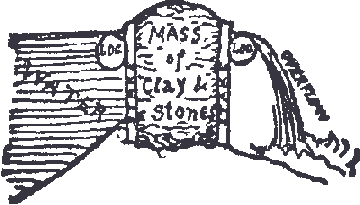
The boys now drove in a row of stakes against each log on the inner side, to form a crib, and were beginning to fill in the space with mud and stones. They were digging and filling it up level as they went. Clay was scarce and the work went slowly; the water, of course, rising as the wall arose, added to the difficulty. But presently Yan said:
"Hold on. New scheme. Let's open her and dig a deep trench on one side so all the water will go by, then leave a clay wall to it" [the trench] "and dig a deep hole on the other side of it. That will give us plenty of stuff for the dam and help to deepen the pond."
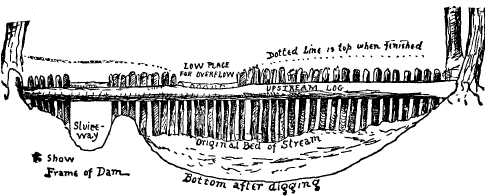
Thus they worked. In a week the crib was full of packed clay and stone. Then came the grand finish —the closing of this sluiceway through the dam. It was not easy with the full head of water running, but they worked like beavers and finally got it stopped.
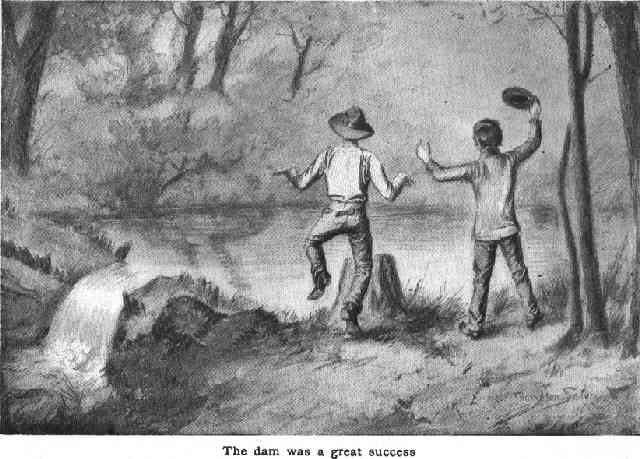
That night there was a heavy shower. Next day when they came near they heard a dull roar in the woods. They stopped and listened in doubt, then Yan exclaimed gleefully: "The dam! That's the 192 water running over the dam."
They both set off with a yell and ran their fastest. As soon as they came near they saw a great sheet of smooth water where the stony creek bottom had been and a steady current over the low place left as an overflow in the middle of the dam.
What a thrill of pleasure that was!
"Last in's a dirty sucker."
"Look out for my bad knee," was the response.
The rest of the race was a mixture of stripping and sprinting and the boys splashed in together.
Five feet deep in the deep hole, a hundred yards long, and all their own doing.
"Now, wasn't it worth it?" asked Yan, who had had much difficulty in keeping Sam steadily at play that looked so very much like work.
"Wonder how that got here? I thought I left that in the teepee?" and Sam pointed to a log that he used for a seat in the teepee, but now it was lodged in the overflow.
Yan was a good swimmer, and as they played and splashed, Sam said: "Now I know who you are. You can't hide it from me no longer. I suspicioned it when you were working on the dam. You're that tarnal Redskin they call 'Little Beaver.'"
"I've been watching you," retorted Yan, "and it seems to me I've run up against that copper-coloured scallawag—'Young-Man-Afraid-of-a-Shovel.'"
193
"No, you don't," said Sam. "Nor I ain't 'Bald- Eagle-Settin'-on-a-Rock-with-his-Tail-Hangin'-over-the 195 -Edge,' nuther. In fact, I don't keer to be recognized just now. Ain't it a relief to think the cattle don't have to take that walk any more?"
Sam was evidently trying to turn the subject, but Yan would not be balked. "I heard Si call you 'Woodpecker' the other day."
"Yep. I got that at school. When I was a kid to hum I heerd Ma talk about me be-a-u-tiful golden hair, but when I got big enough to go to school I learned that it was only red, an' they called me the 'Red-headed Woodpecker.' I tried to lick them, but lots of them could lick me an' rubbed it in wuss. When I seen fightin' didn't work, I let on to like it, but it was too late then. Mostly it's just 'Woodpecker' for short. I don't know as it ever lost me any sleep."
Half an hour later, as they sat by the fire that Yan made with rubbing-sticks, he said, "Say, Woodpecker, I want to tell you a story." Sam grimaced, pulled his ears forward, and made ostentatious preparations to listen.
"There was once an Indian squaw taken prisoner by some other tribe way up north. They marched her 500 miles away, but one night she escaped and set out, not on the home trail, for she knew they would follow that way and kill her, but to one side. She didn't know the country and got lost. She had no weapons but a knife, and no food but berries. Well, she travelled fast for several days till a rainstorm came, then she felt safe, for she knew her enemies could not trail her now. But winter was 196 near and she could not get home before it came. So she set to work right where she was.
"She made a wigwam of Birch bark and a fire with rubbing-sticks, using the lace of her moccasin for a bow-string. She made snares of the inner bark of the Willow and of Spruce roots, and deadfalls, too, for Rabbits. She was starving sometimes, at first, but she ate the buds and inner bark of Birch trees till she found a place where there were lots of Rabbits. And when she caught some she used every scrap of them. She made a fishing-line of the sinews, and a hook of the bones and teeth lashed together with sinew and Spruce gum.
"She made a cloak of Rabbit skins, sewed with needles of Rabbit bone and thread of Rabbit sinew, and a lot of dishes of Birch bark sewed with Spruce roots.
"She put in the whole winter there alone, and when the spring came she was found by Samuel Hearne, the great traveller. Her precious knife was worn down, but she was fat and happy and ready to set out for her own people."
"Well, I say that's mighty inter-est-in'," said Sam—he had listened attentively—"an' I'd like nothin' better than to try it myself if I had a gun an' there was lots of game."
"Pooh, who wouldn't?"
"Mighty few—an' there's mighty few who could." "I could."
197 "What, make everything with just a knife? I'd like to see you make a teepee," then adding earnestly, "Sam, we've been kind o' playing Injuns; now let's do it properly. Let's make everything out of what we find in the woods."
"Guess we'll have to visit the Sanger Witch again. She knows all about plants."
"We'll be the Sanger Indians. We can both be Chiefs," said Yan, not wishing to propose himself as Chief or caring to accept Sam as his superior. "I'm Little Beaver. Now what are you?"
"Bloody-Thundercloud-in-the-Afternoon."
"No, try again. Make it something you can draw, so you can make your totem, and make it short."
"What's the smartest animal there is?"
"I—I—suppose the Wolverine."
"What! Smarter'n a Fox?"
"The books say so."
"Kin he lick a Beaver?"
"Well, I should say so."
"Well, that's me."
"No, you don't. I'm not going around with a fellow that licks me. It don't fit you as well as 'Woodpecker,' anyhow. I always get you when I want a nice tree spoiled or pecked into holes," retorted Yan, magnanimously ignoring the personal reason for the name.
"Tain t as bad as beavering," answered Sam.
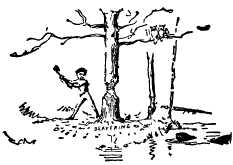
"Beavering" was a word with a history. Axes and timber were the biggest things in the lives of the Sangerites. Skill with the axe was the highest accomplishment. 198 The old settlers used to make everything in the house out of wood, and with the axe for the only tool. It was even said that some of them used to "edge her up a bit" and shave with her on Sundays. When a father was setting his son up in life he gave him simply a good axe. The axe was the grand essential of life and work, and was supposed to be a whole outfit. Skill with the axe was general. Every man and boy was more or less expert, and did not know how expert he was till a real "greeny" came among them. There is a right way to cut for each kind of grain, and a certain proper way of felling a tree to throw it in any given direction with the minimum of labour. All these things are second nature to the Sangerite. A Beaver is credited with a haphazard way of gnawing round and round a tree till somehow it tumbles, and when a chopper deviates in the least from the correct form, the exact right cut in the exact right place, he is said to be "beavering"; therefore, while "working like a Beaver" is high praise, "beavering" a tree is a term of unmeasured reproach, and Sam's final gibe had point and force that none but a Sangerite could possibly have appreciated.
199
XI
Yan and the Witch
The Sanger Witch hated the Shanty-man's axe And wildfire, too, they tell, But the hate that she had for the Sporting man Was wuss nor her hate of Hell!
—Cracked Jimmie's Ballad of Sanger.
Yan took his earliest opportunity to revisit the Sanger Witch.
"Better leave me out," advised Sam, when he heard of it. "She'd never look at you if I went. You look too blame healthy."
So Yan went alone, and he was glad of it. Fond as he was of Sam, his voluble tongue and ready wit left Yan more or less in the shade, made him look sober and dull, and what was worse, continually turned the conversation just as it was approaching some subject that was of deepest interest to him.
As he was leaving, Sam called out, "Say, Yan, if you want to stay there to dinner it'll be all right— we'll know why you hain't turned up." Then he stuck his tongue in his cheek, closed one eye and went to the barn with his usual expression of inscrutable melancholy.
Yan carried his note-book—he used it more and more, also his sketching materials. On the road he 200 gathered a handful of flowers and herbs. His reception by the old woman was very different this time.
"Come in, come in, God bless ye, an' hoo air ye, an' how is yer father an' mother—come in an' set down, an' how is that spalpeen, Sam Raften?"
"Sam's all right now," said Yan with a blush.
"All right! Av coorse he's all right. I knowed I'd fix him all right, an' he knowed it, an' his Ma knowed it when she let him come. Did she say onything about it?"
"No, Granny, not a word."
"The dhirty hussy! Saved the boy's life in sphite of their robbin' me an' she ain't human enough to say 'thank ye'—the dhirty hussy! May God forgive her as I do," said the old woman with evident and implacable enmity.
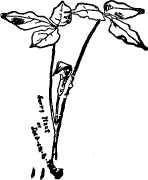
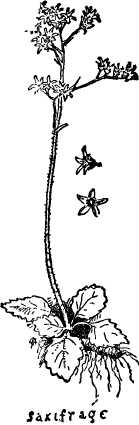
"Fwhat hev ye got thayer? Hivin be praised, they can't kill them all off. They kin cut down the trees, but the flowers comes ivery year, me little beauties—me little beauties!" Yan spread them out. She picked up an Arum and went on. "Now, that's Sorry-plant, only some calls it Injun Turnip, an' I hear the childer call it Jack-in-the-Pulpit. Don't ye never put the root o' that near yer tongue. It'll sure burn ye like fire. First thing whin they gits howld av a greeny the bhise throis to make him boite that same. Shure he niver does it twicet. The Injuns b'ile the pizen out o' the root an' ates it; shure it's better'n starvin'."
201 Golden Seal (Hydrastis canadensis), the plant she had used for Sam's knee, was duly recognized and praised, its wonderful golden root, "the best goold iver came out av the ground," was described with its impression of the seal of the Wise King.
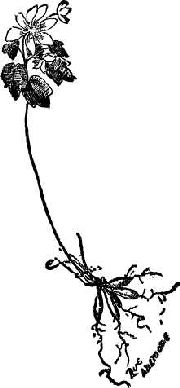
"Thim's Mandrakes, an' they're moighty late, an' ye shure got thim in the woods. Some calls it May Apples, an' more calls it Kingroot. The Injuns use it fur their bowels, an' it has cured many a horse of pole evil that I seen meself.
"An' Blue Cohosh, only I call that Spazzum-root. Thayer ain't nothin' like it fur spazzums—took like tay; only fur that the Injun women wouldn't live in all their thrubles, but that's something that don't consarn ye. Luk now, how the laves is all spread out like wan wid spazzums. Glory be to the Saints and the Blessed Virgin, everything is done fur us on airth an' plain marked, if we'd only take the thruble to luk.
"Now luk at thot," said she, clawing over the bundle and picking out a yellow Cypripedium, "that's Moccasin-plant wid the Injuns, but mercy on 'em fur bloind, miserable haythens. They don't know nothin' an' don't want to larn it. That's Umbil, or Sterrick-root. It's powerful good fur sterricks. Luk at it! See the face av a woman in sterricks wid her hayer flyin' an' her jaw a-droppin'. I moind the toime Larry's little gurrl didn't want to go to her 'place' an' hed sterricks. They jest sent fur me an' I brung along a Sterrick-root. First, I sez, sez I, 'Get me some b'ilin' wather,' an' I made tay an' give it to her b'ilin' hot. As share as Oi'm a livin' corpse, 202 the very first spoonful fetched her all right. Oh, but it's God's own gift, an' it's be His blessin' we know how to use it. An' it don't do to just go an' dig it when ye want it. It has to be grubbed when the flower ain't thayer. Ye see, the strength ain't in both places to oncet. It's ayther in the flower or in the root, so when the flower is thayer the root's no more good than an ould straw. Ye hes to Hunt fur it in spring or in fall, just when the divil himself wouldn't know whayer to find it.
"An' fwhat hev ye thayer? Good land! if it ain't Skunk's Cabbage! Ye sure come up by the Bend. That's the on'y place whayer that grows."
"Yes," replied Yan; "that's just where I got it. But hold on, Granny, I want to sketch all those and note down their names and what you say about them."
"Shure, you'd hev a big book when I wuz through," said the old woman with pride, as she lit her pipe, striking the match on what would have been the leg of her pants had she been a man.
"An' shure ye don't need to write down what they're good fur, fur the good Lord done that Himself long ago. Luk here, now. That's Cohosh, fur spazzums, an' luks like it; that's Moccasin, fur Highsterricks, an' luks like it; wall, thar's Skunk-root fur both, an' don't it luk like the two o' thim thigither?"
Yan feebly agreed, but had much difficulty in seeing what the plant had in common with the others.
"An' luk here! Thayer ye got Lowbelier, that some calls Injun tobaccer. Ye found this by the 203 crick, an' it's a little airly—ahead o' toime. That's the shtuff to make ye throw up when ye want to. Luk, ain't that lafe the livin' shape of a shtummick?
"Thayer's the Highbelier; it's a high hairb, an' it's moighty foine fur the bowels when ye drink the dry root.
"Spicewood" [Spicebush, Lindera benzoin], "or Fayverbush, them twigs is great fur tay—that cures shakes and fayver. Shure an' it shakes ivery toime the wind blows.
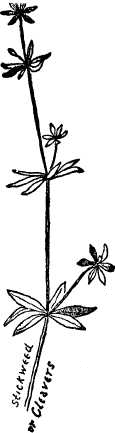
"That's Clayvers," she said, picking up a Galium. "Now fwhat wud ye think that wuz fur to cure?"
"I don't know. What is it?"
"Luk now, an' see how it's wrote in it plain as prent—yes, an' a sight plainer, fur I can read them an' I can't read a wurrud in a book. Now fwhat is that loike?" said she, holding up the double seed-pod.
"A brain and spinal column," said Yan.
"Och, choild, I hev better eyes than ye. Shure them's two kidneys, an' that's fwhat Clayver tay will cure better'n all the docthers in the wurruld, an' ye hev to know just how. Ye see, kidney thruble is a koind o' fayver; it's hatin', so ye make yer Clayver tay in cold wather; if ye make it o' warrum wather it just makes ye wuss an' acts loike didly pizen. Thayer's Sweatplant, or Boneset" [Eupatorium perfoliatum], "that's the thing to sweat ye. Wanst Oi sane a feller jest dyin' o' dry hoide, wuz all hoidebound, an' the docthers throid an' throid an' couldn't 204 help wan bit, till I guv his mother some Boneset leaves to make tay, an' he sweat buckets before he'd more'n smelt av it, an' the docthers thought they done it theirsilves!" and she cackled gleefully.
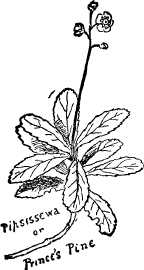
"Thayer's Goldthread fur cankermouth, an' Pipsissewa that cures fayver an' rheumatiz, too. It always grows where folks gits them disayses. Luk at the flower just blotched red an' white loike fayver blotches—an' Spearmint, that saves ye if ya pizen yerself with Spaszum-root, an' shure it grows right next it in the woods!
"Thayer's Wormseed fur wurrums—see the 'ittle wurrum on the leaves" [Chenopodium] "an' that thayer is Pleurisy root, an' thayer! well, thayer's the foinest hairb that iver God made to grow—that's Cure all. Some things cures wan thing and some cures another, but when ye don't know just what to take, ye make tay o' that root an' ye can't go wrong. It was an Injun larned me that. The poor miserable baste of a haythen hed some larnin', an' the minit he showed me I knowed it was so, fur ivery lafe wuz three in wan an' wan in three, an' had the sign o' the blessed crass in the middle as plain as that biler settin' on the stove."
Thus she chattered away, smoking her short pipe, expectorating on the top of the hot stove, but with true feminine delicacy she was careful each time to wipe her mouth on the back of her skinny arm.
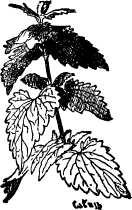
"An' that's what's called Catnip; sure Oi moind well the day Oi furst larned about that. It warn't a Injun 205 nor a docther nor a man at all, at all, that larned me that. It was that ould black Cat, an' may the saints stand bechuxt me an' his grane eyes! Bejabers, sometimes he scares me wid his knowin' ways, but I hev nothin' agin him except that he kills the wee burruds. He koind o' measled all wan winter an' lay around the stove. Whiniver the dooer was open he'd go an' luk out an' then come back an' meow an' wheen an' lay down—an' so he kep' on, gittin' waker an' worser, till the snow wuz gone an' grass come up, an' still he'd go a-lukin' toward the ayst, especially nights. Then thayer come up a plant I had never sane, right thayer, an' he'd luk at it an' luk at it loike he wanted it but didn't dar to. Thar was some foine trays out thayer in thim days afore the ould baste cut thim down, an' wan av thim hed a big limb, so—an' another so—an' when the moon come up full at jest the right time the shaddy made the sign av the crass an' loighted on me dooer, an' after it was past it didn't make no crass. Well, bejabers, the full moon come up at last an' she made the sign of the shaddy crass, an' the ould Cat goes out an' watches an' watches loike he wanted to an' didn't dar to, till that crass drapped fayer onto the hairbs, an' Tom he jumped then an' ate an' ate, an' from that day he was a well Cat; an' that's how Oi larned Catnip, an' it set me moind aisy, too, fur no Cat that's possesst 'll iver ate inunder the shaddy av the crass."
Yan was scribbling away, but had given up any attempt to make sketches or even notes beyond the 206 names of the plants.
"Shure, choild, put them papers wid the names on the hairbs an' save them; that wuz fwhat Docther Carmartin done whin Oi was larnin' him. Thayer, now, that's it," she added, as Yan took the hint and began slipping on each stalk a paper label with its name.
"That's a curious broom," said Yan, as his eye fell on the symbol of order and cleanliness, making strange reflections on itself.
"Yes; sure, that's a Baitche broom. Larry makes 'em."
"Larry?"
"Yes, me bhoy." [Larry was nearly sixty.] "He makes thim of Blue Baitche."
"How?" asked Yan, picking it up and examining it with intense interest.
"Whoi, shure, by whittlin'. Larry's a howly terror to whittle, an' he gets a Blue Baitche sapling 'bout three inches thick an' starts a-whittlin" long slivers, but laves them on the sthick at wan end till thayer all round loike that."
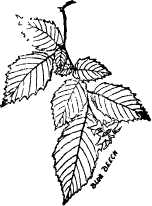
"What, like a fire-lighter?"
"Yis, yis, that's it, only bigger, an Blue Baitche is terrible tough. Then whin he has the sthick down to 'bout an inch thick, he ties all the slivers the wrong way wid a sthrand o' Litherwood, an' thrims down the han'el to suit, an' evens up the ind av the broom wid the axe an' lets it dhry out, an' thayer yer 207 is. Better broom was niver made, an' there niver wus ony other in th' famb'ly till he married that Kitty Connor, the lowest av the low, an' it's meself was all agin her, wid her proide an' her dirthy sthuck-up ways' nothin' but boughten things wuz good enough fur her, her that niver had a dacint male till she thrapped moi Larry. Yis, low be it sphoken, but 'thrapped' 's the wurrud," said the old woman, raising her voice to give emphasis that told a lurid tale.
At this moment the door opened and in came Biddy, and as she was the daughter of the unspeakable Kitty the conversation turned.
"An' sure it's glad to see ye I am, an' when are ye comin' down to reside at our place?" was her greeting to Yan, and while they talked Granny took advantage of the chance to take a long pull at a bottle that looked and smelled like Lung-balm.
"Moi, Biddy, yer airly," said Granny.
"Shure, an' now it was late whin I left home, an' the schulmaster says it's always so walking from ayst to west."
"An' shure it's glad Oi am to say ye, fur Yan will shtop an ate wid us. It ain't duck an' grane pase, but, thank God, we hev enough an' a hearty welcome wid ivery boite. Ye say, Biddy makes me dinner ivery foine day an' Oi get a boite an' a sup for meself other toimes, an' slapes be me lone furby me Dog an' Cat an' the apples, which thayer ain't but a handful left, but fwhat thar is is yourn. Help yerself, choild, an' ate hearty," and she turned down the 208 gray-looking bedclothes to show the last half-dozen of the same rosy apples.
"Aint you afraid to sleep here alone nights, Granny?"
"Shure fwhat hev Oi to fayre? Thayer niver wuz robbers come but wanst, an' shure I got theyer last cint aff av them. They come one night an' broke in, an' settin' up, Oi sez, 'Now fwhat are yez lukin' fur?'
"'Money,' sez they, fur thayer was talk all round thin that Oi had sold me cow fur $25.
"'Sure, thin, Oi'll get up an' help ye,' sez Oi, fur divil a cint hev Oi been able to set me eyes on sense apple harvest.'"
'"We want $25, or we'll kill ye.'
"'Faith, an' if it wuz twenty-five cints Oi couldn't help it,' sez Oi, 'an' it's ready to die Oi am,' sez Oi, 'fur Oi was confessed last wake an' Oi'm a-sayin' me prayers this minit.'
"Sez the littlest wan, an' he wa'n't so little, nigh as br'ad as that dooer, 'Hevn't ye sold yer cow?'
"'Ye'll foind her in the barrun,' sez Oi, 'though Oi hate to hev yez disturb her slapin'. It makes her drame an' that's bad fur the milk.'
"An' next thing them two robbers wuz laffin' at each other fur fools. Then the little wan sez:
"'Now, Granny, we'll lave ye in pace, if ye'll niver say a wurrud o' this'—but the other wan seemed kind o' sulky.
209 "'Sorra a wurrud,' sez Oi, 'an' good frinds we'll be yit,' an' they wuz makin' fur the dooer to clayer out whin I sez:
"'Howld on! Me friends can't lave me house an' naither boite nor sup; turn yer backs an' ye plaze, till Oi get on me skirt.' An' whin Oi wuz up an' dacint an' tould them they could luk, Oi sez, 'It's the foinest Lung balm in the land ye shall taste,' an' the littlest feller he starts a-coughin', oh, a turrible cough—it fair scairt me, like a hoopin' croup—an' the other seemed just mad, and the littlest wan made fun av him. Oi seen the mean wan wuz left-handed or let on he wuz, but when he reached out fur the bottle he had on'y three fingers on his right, an' they both av them had the biggest, blackest, awfulest lukin' bairds—I'd know them two bairds agin ony place—an' the littlest had a rag round his head, said he had a toothache, but shure yer teeth don't ache in the roots o' yer haiyer. Then when they wuz goin' the littlest wan put a dollar in me hand an' sez, 'It's all we got bechuxst us, Granny.' 'Godbless ye,' sez Oi, 'an' Oi take it kindly. It's the first Oi seen sense apple harvest, an' it's a friend ye hev in me whin ye nade wan,'" and the old woman chuckled over her victory.
"Granny, do you know what the Indians use for dyeing colours?" asked Yan, harking back to his main purpose.
"Shure, Yahn, they jest goes to the store an' gets boughten dyes in packages like we do."
210 "But before there were boughten dyes, didn't they use things in the woods?"
"That they did, for shure. Iverything man iver naded the good Lord made grow fur him in the woods."
"Yes, but what plants?"
"Faix, an' they differ fur different things."
"Yes, but what are they?" Then seeing how general questions failed, he went at it in detail.
"What do they use for yellow dye on the Porcupine quills—I mean before the boughten dyes came?"
"Well, shure an' that's a purty yellow flower that grows in the fall out in the field an' along the fences. The Yaller Weed, I call it, an' some calls it Goldenrod. They bile the quills in wather with the flower. Luk! Thar's some wool dyed that way."
"An' the red?" said Yan, scribbling away.
"Faix, an' they had no rale good red. They made a koind o' red o' berry juice b'iled, an' wanst I seen a turrible nice red an ol' squaw made b'ilin' the quills fust in yaller awhile an' next awhile in red."
"What berries make the best red, Granny?"
"Well, 'tain't the red wans, as ye moight think. Ye kin make it of Rosberries or Sumac or Huckleberries an' lots more, but Black Currants is redder than Red Currants, an' Squaw berries is best av them all."
"What are they like?"
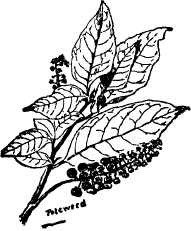
"Shure, an' Oi'll show ye that same hairb," and they wandered around outside the shanty in vain search. "It's too airly," said Granny, "but it's 211 round thayer in heaps in August an' is the purtiest red iver grew. 'An Pokeweed, too, it ain't har'ly flowerin' yit, but in the fall it hez berries that's so red they're nigh black, an' dyes the purtiest kind o' a purple."
"What makes blue?"
"Oi niver sane none in the quills. Thayer may be some. The good Lord made iverything grow in the woods, but I ain't found it an' niver seen none. Ye kin make a grane av the young shoots av Elder, but it ain't purty like that," and she pointed to a frightful emerald ribbon that Biddy wore, "an' a brown of Butternut bark, an' a black av White Oak chips an' bark. Ye kin make a kind o' grane av two dips, wan of yaller an wan av black. Ye kin dye black wid Hickory bark, an' orange (bad scran to it) wid the inner bark of Birch, an' yaller wid the roots av Hoop Ash, an' a foine scarlet from the bark av the little root av Dogwood, but there ain't no rale blue in the woods, an' that's what I tell them orange-an'-blue Prattisons on the 12th o' July, fur what the Lord didn't make the divil did.
"Ye kin make a koind of blue out o' the Indigo hairb, but 'tain't like this," pointing to some screaming cobalt, "an' if it ain't in the woods the good Lord niver meant us to have it. Yis! I tell ye it's the divil's own colour, that blue-orange an' blue is the divil's own colours, shure enough, fur brimstone's yaller; an' its blue whin it's burnin', that I hed from his riv'rince himself—bless him!"
212
XII
Dinner with the Witch
Biddy meanwhile had waddled around the room slapping the boards with her broad bare feet as she prepared their dinner. She was evidently trying to put on style, for she turned out her toes excessively. She spoke several times about "the toime when she resoided with yer mamma," then at length, "Whayer's the tablecloth, Granny?"
"Now, wud ye listen to thot, an' she knowin' that divil a clath hev we in the wurruld, an' glad enough to hev vittles on the table, let alone a clath," said Granny, oblivious of the wreck she was making of Biddy's pride.
"Will ye hay tay or coffee, Yahn?" said Biddy.
"Tea," was Yan's choice.
"Faix, an' Oi'm glad ye said tay, fur Oi ain' seen a pick o' coffee sense Christmas, an' the tay Oi kin git in the woods, but thayer is somethin' Oi kin set afore ye that don't grow in the woods," and the old woman hobbled to a corner shelf, lifted down an old cigar box and from among matches, tobacco, feathers, tacks, pins, thread and dust she picked six lumps of cube sugar, formerly white.
"Thayer, shure, an' Oi wuz kapin' this fur whin his riv'rence comes; wanst a year he's here, God bless 213 him! but that's fower wakes ahid, an' dear knows fwhat may happen afore thin. Here, an' a hearty welcome," said she, dropping three of the lumps in Yan's tea. "We'll kape the rest fur yer second cup. Hev some crame?" and she pushed over a sticky-handled shaving-mug full of excellent cream. "Biddy, give Yahn some bread."
The loaf, evidently the only one, was cut up and two or three slices forced into Yan's plate.
"Mebbe the butther is a little hoigh," exclaimed the hostess, noting that Yan was sparing of it. "Howld on." She went again to the corner shelf and got down an old glass jar with scalloped edge and a flat tin cover. It evidently contained jam. She lifted the cover and exclaimed:
"Well, Oi niver!" Then going to the door she fished out with her fingers a dead mouse and threw it out, remarking placidly, "Oi've wondered whayer the little divil wuz. Oi ain't sane him this two wakes, an' me a-thinkin' it wuz Tom ate him. May Oi be furgiven the onjustice av it. Consarn them flies! That cover niver did fit." And again her finger was employed, this time to scrape off an incrustation of unhappy flies that had died, like Clarence, in their favourite beverage.
"Thayer, Yan, now ate hearty, all av it, an' welcome. It does me good to see ye ate—thayer's lots more whayer that come from," though it was obvious that she had put her all upon the table.
214 Poor Yan was in trouble. He felt instinctively that the good old soul was wrecking her week's resources in this lavish hospitality, but he also felt that she would be deeply hurt if he did not appear to enjoy everything. The one possibly clean thing was the bread. He devoted himself to that; it was of poorest quality; one or two hairs looping in his teeth had been discouraging, but when he bit at a piece of linen rag with a button on it he was fairly upset. He managed to hide the rag, but could not conceal his sudden loss of appetite.
"Hev some more av this an' this," and in spite of himself his plate was piled up with things for him to eat, including a lot of beautifully boiled potatoes, but unfortunately the hostess carried them from the pot on the stove in a corner of her ancient and somber apron, and served him with her skinny paw.
Yan's appetite was wholly gone now, to the grief of his kind entertainer, "Shure an' she'd fix him up something to stringthen him," and Yan had hard work to beg off.
"Would ye like an aig," ventured Biddy.
"Why, yes! oh, yes, please," exclaimed Yan, with almost too much enthusiasm. He thought, "Well, hens are pure-minded creatures, anyway. An egg's sure to be clean."
Biddy waddled away to the 'barrun' and soon reappeared with three eggs.
"B'iled or fried?"
"Boiled," said Yan, aiming to keep to the safe side.
215 Biddy looked around for a pot.
"Shure, that's b'ilin' now," said Granny, pointing to the great mass of her undergarments seething in the boiler, and accordingly the eggs were dropped in there.
Yan fervently prayed that they might not break. As it was, two did crack open, but he got the other one, and that was virtually his dinner.
A Purple Blackbird came hopping in the door now.
"Will, now, thayer's Jack. Whayer hev ye been? I thought ye wuz gone fur good. Shure Oi saved him from a murtherin' gunner," she explained. "(Bad scran to the baste! I belave he was an Or'ngeman.) But he's all right now an' comes an' goes like he owned the place. Now, Jack, you git out av that wather pail," as the beautiful bird leaped into the half-filled drinking bucket and began to take a bath.
"Now luk at that," she shouted, "ye little rascal, come out o' that oven," for now the Blackbird had taken advantage of the open door to scramble into the dark warm oven.
"Thayer he goes to warrum his futs. Oh, ye little rascal! Next thing ye know some one'll slam the dooer, not knowin' a thing, and fire up, an' it's roastin' aloive ye'll be. Shure an' it's tempted Oi am to wring yer purty neck to save yer loife," and she drove him out with the harshest of words and the gentlest of hands.
Then Yan, with his arms full of labelled plants, set out for home.
216 "Good-boi, choild, come back agin and say me soon. Bring some more hairbs. Good-boi, an' bless ye. Oi hope it's no sin to say so, fur Oi know yer a Prattison an' ye are all on yez goin' to hell, but yer a foine bhoy. Oi'm tumble sorry yer a Prattison."
When Yan got back to the Raftens' he found the dinner table set for one, though it was now three in the afternoon.
"Come and get your dinner," said Mrs. Raften in her quiet motherly way. "I'll put on the steak. It will be ready in five minutes."
"But I've had my dinner with Granny de Neuville."
"Yes, I know!"
"Did she stir yer tea with one front claw an' put jam on yer bread with the other?" asked Raften, rather coarsely.
"Did she b'ile her pet Blackbird fur yer soup?" said Sam.
Yan turned very red. Evidently all had a good idea of what he had experienced, but it jarred on him to hear their mockery of the good old soul.
He replied warmly, "She was just as kind and nice as she could be."
"You had better have a steak now," said Mrs. Raften, in solicitous doubt.
How tempting was the thought of that juicy brown steak! How his empty stomach did crave it! But the continued mockery had stirred him. He would stand up for the warm-hearted old woman who had ungrudgingly given him the best she had—had given her all—to make a hearty welcome for a stranger. 217 They should never know how gladly he would have eaten now, and in loyalty to his recent hostess he added the first lie of his life:
"No, thank you very much, but really I am not in the least hungry. I had a fine dinner at Granny de Neuville's."
Then, defying the inner pangs of emptiness, he went about his evening chores.

218
XIII
The Hostile Spy
"Wonder where Caleb got that big piece of Birch bark," said Yan; "I'd like some for dishes."
"Guess I know. He was over to Burns's bush. There's none in ours. We kin git some."
"Will you ask him?"
"Naw, who cares for an old Birch tree. We'll go an' borrow it when he ain't lookin'."
Yan hesitated.
Sam took the axe. "We'll call this a war party into the enemy's country. There's sure 'nuff war that-a-way. He's one of Da's 'friends.'"
Yan followed, in doubt still as to the strict honesty of the proceeding.
Over the line they soon found a good-sized canoe Birch, and were busy whacking away to get off a long roll, when a tall man and a small boy, apparently attracted by the chopping, came in sight and made toward them. Sam called under his breath: "It's old Burns. Let's git."
There was no time to save anything but themselves and the axe. They ran for the boundary fence, while Burns contented himself with shouting out threats and denunciations. Not that he cared a straw for the Birch tree—timber had no value in that country—but 219 unfortunately Raften had quarrelled with all his immediate neighbours, therefore Burns did his best to make a fearful crime of the petty depredation.
His valiant son, a somewhat smaller boy than either Yan or Sam, came near enough to the boundary to hurl opprobrious epithets.
"Red-head—red-head! You red-headed thief! Hol' on till my paw gits hol' o' you—Raften, the Baften, the rick-strick Straften," and others equally galling and even more exquisitely refined.
"War party escaped and saved their scalps," and Sam placidly laid the axe in its usual place.
"Nothing lost but honour," added Yan. "Who's the kid?"

"Oh, that's Guy Burns. I know him. He's a mean little cuss, always sneaking and peeking. Lies like sixty. Got the prize—a big scrubbing-brush—for being the dirtiest boy in school. We all voted, and the teacher gave it to him."
Next day the boys made another war party for Birch bark, but had hardly begun operations when there was an uproar not far away, and a voice, evidently of a small boy, mouthing it largely, trying to pass itself off as a man's voice: "Hi, yer the —— ——. Yer git off my —— —— place —— ——"
"Le's capture the little cuss, Yan."
"An' burn him at the stake with horrid torture," was the rejoinder.
They set out in his direction, but again the appearance of Burns changed their war-party onslaught into 220 a rapid retreat.
(More opprobrium.)
During the days that followed the boys were often close to the boundary, but it happened that Burns was working near and Guy had the quickest of eyes and ears. The little rat seemed ever on the alert. He soon showed by his long-distance remarks that he knew all about the boys' pursuits—had doubtless visited the camp in their absence. Several times they saw him watching them with intense interest when they were practising with bow and arrow, but he always retreated to a safe distance when discovered, and then enjoyed himself breathing out fire and slaughter.
One day the boys came to the camp at an unusual hour. On going into a near thicket Yan saw a bare foot under some foliage. "Hallo, what's this?" He stooped down and found a leg to it and at the end of that Guy Burns.
Up Guy jumped, yelling "Paw—Paw—PAW!" He ran for his life, the Indians uttering blood-curdlers on his track. But Yan was a runner, and Guy's podgy legs, even winged by fear, had no chance. He was seized and dragged howling back to the camp.
"You let me alone, you Sam Raften—now you let me alone!" There was, however, a striking lack of opprobrium in his remarks now. (Such delicacy is highly commendable in the very young.)
"First thing is to secure the prisoner, Yan."
221 Sam produced a cord.
"Pooh," said Yan. "You've got no style about you. Bring me some Leatherwood."
This was at hand, and in spite of howls and scuffles, Guy was solemnly tied to a tree—a green one—because, as Yan pointed out, that would resist the fire better.
The two Warriors now squatted cross-legged by the fire. The older one lighted a peace-pipe, and they proceeded to discuss the fate of the unhappy captive.
"Brother," said Yan, with stately gestures, "it is very pleasant to hear the howls of this miserable paleface." (It was really getting to be more than they could endure.)
"Ugh—heap good," said the Woodpecker.
"Ye better let me alone. My Paw'll fix you for this, you dirty cowards," wailed the prisoner, fast losing control of his tongue.
"Ugh! Take um scalp first, burn him after," and Little Beaver made some expressive signs.
"Wah—bully—me heap wicked," rejoined the Woodpecker, expectorating on a stone and beginning to whet his jack-knife.
The keen and suggestive "weet, weet, weet" of the knife on the stone smote on Guy's ears and nerves with appalling effect.
"Brother Woodpecker, the spirit of our tribe calls out for the blood of the victim—all of it."
"Great Chief Woodpecker, you mean," said Sam, aside. "If you don't call me Chief, I won't call you 222 Chief, that's all."
The Great Woodpecker and Little Beaver now entered the teepee, repainted each other's faces, adjusted their head-dresses and stepped out to the execution.
The Woodpecker re-whetted his knife. It did not need it, but he liked the sound.
Little Beaver now carried a lot of light firewood and arranged it in front of the prisoner, but Guy's legs were free and he gave it a kick which sent it all flying. The two War-chiefs leaped aside. "Ugh! Heap sassy," said the ferocious Woodpecker. "Tie him legs, oh, Brother Great Chief Little Beaver!"
A new bark strip tied his legs securely to the tree. Then Chief Woodpecker approached with his knife and said:
"Great Brother Chief Little Beaver, if we scalp him there is only one scalp, and you will have nothing to show, except you're content with the wishbone."
Here was a difficulty, artificial yet real, but Yan suggested:
"Great Brother Chief Red-headed-Woodpecker-Settin'-on-a-Stump-with-his-Tail-Waggling-over-the Edge, no scalp him; skin his hull head, then each take half skin."
"Wah! Very good, oh Brother Big-Injun-Chief Great-Little-Beaver-Chaw-a-Tree-Down."
223
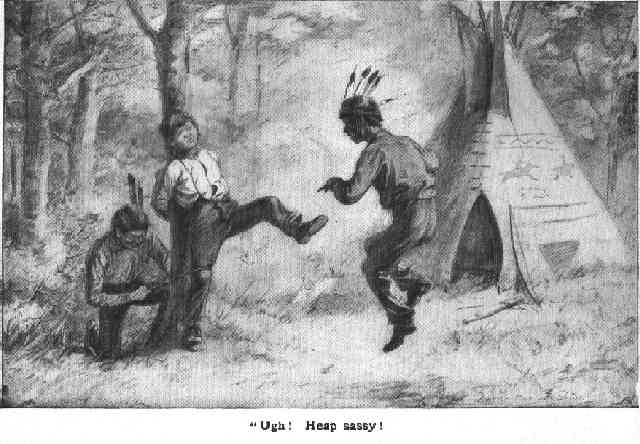
Then the Woodpecker got a piece of charcoal and proceeded in horrid gravity to mark out on the tow hair of the prisoner just what he considered a fair 225 division. Little Beaver objected that he was entitled to an ear and half of the crown, which is the essential part of the scalp. The Woodpecker pointed out that fortunately the prisoner had a cow-lick that was practically a second crown. This ought to do perfectly well for the younger Chief's share. The charcoal lines were dusted off for a try-over. Both Chiefs got charcoal now and a new sketch plan was made on Guy's tow top and corrected till it was accepted by both.
The victim had really never lost heart till now. His flow of threats and epithets had been continuous and somewhat tedious. He had threatened to tell his "paw" and "the teacher," and all the world, but finally he threatened to tell Mr. Raften. This was the nearest to a home thrust of any yet, and in some uneasiness the Woodpecker turned to Little Beaver and said:
"Brother Chief, do you comprehend the language of the blithering Paleface? What does he say?"
"Ugh, I know not," was the reply. "Maybe he now singeth a death song in his own tongue."
Guy was not without pluck. He had kept up heart so far believing that the boys were "foolin'," but when he felt the awful charcoal line drawn to divide his scalp satisfactorily between these two inhuman, painted monsters, and when with a final "weet, weet, weet" of the knife on the stone the implacable Woodpecker approached and grabbed his tow locks in one hand, then he broke down and wept bitterly.
226 "Oh, please don't——Oh, Paw! Oh, Maw! Let me go this time an' I'll never do it again." What he would not do was not specified, but the evidence of surrender was complete.
"Hold on, Great Brother Chief," said Little Beaver. "It is the custom of the tribes to release or even to adopt such prisoners as have shown notable fortitude."
"Showed fortitude enough for six if it's the same thing as yellin'," said the Woodpecker, dropping into his own vernacular.
"Let us cut his bonds so that he may escape to his own people."
"Thar'd be more style to it if we left him thar overnight an' found next mornin' he had escaped somehow by himself," said the older Chief. The victim noted the improvement in his situation and now promised amid sobs to get them all the Birch bark they wanted—to do anything, if they would let him go. He would even steal for them the choicest products of his father's orchard.
Little Beaver drew his knife and cut bond after bond.
Woodpecker got his bow and arrow, remarking "Ugh, heap fun shoot him runnin'."
The last bark strip was cut. Guy needed no urging. He ran for the boundary fence in silence till he got over; then finding himself safe and unpursued, he rilled the air with threats and execrations. No part of his statement would do to print here.
After such a harrowing experience most boys would have avoided that swamp, but Guy knew Sam at 227 school as a good-natured fellow. He began to think he had been unduly scared. He was impelled by several motives, a burning curiosity being, perhaps the most important. The result was that one day when the boys came to camp they saw Guy sneaking off. It was fun to capture him and drag him back. He was very sullen, and not so noisy as the other time, evidently less scared. The Chiefs talked of fire and torture and of ducking him in the pond without getting much response. Then they began to cross-examine the prisoner. He gave no answer. Why did he come to the camp? What was he doing—stealing? etc. He only looked sullen.
"Let's blindfold him and drive a Gyascutus down his back," said Yan in a hollow voice.
"Good idee," agreed Sam, not knowing any more than the prisoner what a Gyascutus was. Then he added, "just as well be merciful. It'll put him out o' pain."
It is the unknown that terrifies. The prisoner's soul was touched again. His mouth was trembling at the corners. He was breaking down when Yan followed it up: "Then why don't you tell us what you are doing here?"
He blubbered out, "I want to play Injun, too."
The boys broke down in another way. They had not had time to paint their faces, so that their expressions were very clear on this occasion.
Then Little Beaver arose and addressed the Council.
228 "Great Chiefs of the Sanger Nation: The last time we tortured and burned to death this prisoner, he created quite an impression. Never before has one of our prisoners shown so many different kinds of gifts. I vote to receive him into the Tribe."
The Woodpecker now arose and spoke:
"O wisest Chief but one in this Tribe, that's all right enough, but you know that no warrior can join us without first showing that he's good stuff and clear grit, all wool, and a cut above the average somehow. It hain't never been so. Now he's got to lick some Warrior of the Tribe. Kin you do that?"
"Nope."
"Or outrun one or outshoot him or something—or give us all a present. What kin you do?"
"I kin steal watermillyons, an' I kin see farder 'n any boy in school, an' I kin sneak to beat all creation. I watched you fellers lots of times from them bushes. I watched you buildin' that thar dam. I swum in it 'fore you did, an' I uster set an' smoke in your teepee when you wasn't thar, an' I heerd you talk the time you was fixin' up to steal our Birch bark."
"Don't seem to me like it all proves much fortitude. Have you got any presents for the oldest head Chief of the tribe?"
"I'll get you all the Birch bark you want. I can't git what you cut, coz me an' Paw burned that so you couldn't git it, but I'll git you lots more, an' maybe—I'll steal you a chicken once in awhile."
"His intentions are evidently honourable Let's take him in on sufferance," said Yan.
229 "All right," replied the head Chief, "he kin come in, but that don't spile my claim to that left half of his scalp down to that tuft of yellow moss on the scruff of his neck where the collar has wore off the dirt. I'm liable to call for it any time, an' the ear goes with it."
Guy wanted to treat this as a joke, but Sam's glittering eyes and inscrutable face were centered hungrily on that "yaller tuft" in a way that gave him the "creeps" again.
"Say, Yan—I mean Great Little Beaver—you know all about it, what kind o' stunts did they have to do to get into an Injun tribe, anyhow?"
"Different tribes do different ways, but the Sun Dance and the Fire Test are the most respectable and both terribly hard."
"Well, what did you do?" queried the Great Woodpecker.
"Both," said Yan grinning, as he remembered his sunburnt arms and shoulders.
"Quite sure?" said the older Chief in a tone of doubt.
"Yes, sir; and I bore it so well that every one there agreed that I was the best one in the Tribe," said Little Beaver, omitting to mention the fact that he was the only one in it. "I was unanimously named 'Howling Sunrise.'"
"Well, I want to be 'Howling Sunrise,'" piped Guy in his shrill voice.
"You? You don't know whether you can pass at all, you Yaller Mossback."
230 "Come, Mossy, which will you do?"
Guy's choice was to be sunburnt to the waist. He was burnt and freckled already to the shoulders, on arms as well as on neck, and his miserable cotton shirt so barely turned the sun's rays that he was elsewhere of a deep yellow tinge with an occasional constellation of freckles. Accordingly he danced about camp all one day with nothing on but his pants, and, of course, being so seasoned, he did not burn.
As the sun swung low the Chiefs assembled in Council.
The head Chief looked over the new Warrior, shook his head gravely and said emphatically: "Too green to burn. Your name is Sapwood."
Protest was in vain. "Sappy," he was and had to be until he won a better name. The peace pipe was smoked all round and he was proclaimed third War Chief of the Sanger Indians (the word War inserted by special request).
He was quite the most harmless member of the band and therefore took unusual pleasure in posing as the possessor of a perennial thirst for human heart-blood. War-paint was his delight, and with its aid he was singularly successful in correcting his round and smiling face into a savage visage of revolting ferocity. Paint was his hobby and his pride, but alas! how often it happens one's deepest sorrow is in the midst of one's greatest joy—the deepest lake is the old crater on top of the highest mountain. Sappy's eyes were not the sinister black beads of the wily Red-man, but a washed-out blue. His ragged, tow-coloured 231 locks he could hide under wisps of horsehair, the paint itself redeemed his freckled skin, but there was no remedy for the white eyelashes and the pale, piggy, blue eyes. He kept his sorrow to himself, however, for he knew that if the others got an inkling of his feelings on the subject his name would have been promptly changed to "Dolly" or "Birdy," or some other equally horrible and un-Indian appellation.
232
XIV
The Quarrel
"Say, Yan, I saw a Blood-Robin this morning."
"That's a new one," said Yan, in a tone of doubt.
"Well, it's the purtiest bird in the country."
"What? A Humming-bird?"
"Na-aw-w-w. They ain't purty, only small."
"Well, that shows what you know," retorted Yan, "'for these exquisite winged gems are at once the most diminutive and brilliantly coloured of the whole feathered race.'" This phrase Yan had read some where and his overapt memory had seized on it.
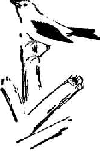
"Pshaw!" said Sam. "Sounds like a book, but I'll bet I seen hundreds of Hummin'-birds round the Trumpet-vine and Bee-balm in the garden, an' they weren't a millionth part as purty as this. Why, it's just as red as blood, shines like fire and has black wings. The old Witch says the Indians call it a War-bird 'cause when it flew along the trail there was sure going to be war, which is like enough, fur they wuz at it all the hull time."
"Oh, I know," said Yan. "A Scarlet Tanager. Where did you see it?"
"Why, it came from the trees, then alighted on the highest pole of the teepee."
233 "Hope there isn't going to be any war there, Sam. I wish I had one to stuff."
"Tried to get him for you, sonny, spite of the Rules. Could 'a' done it, too, with a gun. Had a shy at him with an arrow an' I hain't been bird or arrow since. 'Twas my best arrow, too—old Sure-Death."
"Will ye give me the arrow if I kin find it?" said Guy.
"Now you bet I won't. What good'd that be to me?"
"Will you give me your chewin' gum?"
"No."
"Will you lend it to me?"
"Yep."
"Well, there's your old arrow," said Guy, pulling it from between the logs where it had fallen. "I seen it go there an' reckoned I'd lay low an' watch the progress of events, as Yan says," and Guy whinnied.
Early in the morning the Indians in war-paint went off on a prowl. They carried their bows and arrows, of course, and were fully alert, studying the trail at intervals and listening for "signs of the enemy."
Their moccasined feet gave forth no sound, and their keen eyes took in every leaf that stirred as their sinewy forms glided among the huge trunks of the primeval vegetation—at least, Yan's note-book said they did. They certainly went with very little noise, but they disturbed a small Hawk that flew from a Balsam-fir—a "Fire tree" they now called it, since they had discovered the wonderful properties of the 234 wood.
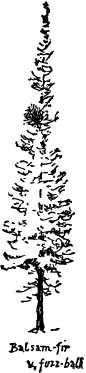
Three arrows were shot after it and no harm done. Yan then looked into the tree and exclaimed:
"A nest."
"Looks to me like a fuzz-ball," said Guy.
"Guess not," replied Yan. "Didn't we scare the Hawk off?"
He was a good climber, quite the best of the three, and dropping his head-dress, coat, leggings and weapon, she shinned up the Balsam trunk, utterly regardless of the gum which hung in crystalline drops or easily burst bark-bladders on every part.
He was no sooner out of sight in the lower branches than Satan entered into Guy's small heart and prompted him thus:
"Le's play a joke on him an' clear out."
Sam's sense of humour beguiled him. They stuffed Yan's coat and pants with leaves and rubbish, put them properly together with the head-dress, then stuck one of his own arrows through the breast of the coat into the ground and ran away.
Meanwhile Yan reached the top of the tree and found that the nest was only one of the fuzz-balls so common on Fir trees. He called out to his comrades but got no reply, so came down. At first the ridiculous dummy seemed funny, then he found that his coat had been injured and the arrow broken. He called for his companions, but got no answer; again and again, without reply. He went to where they all had intended going, but if they were there they 235 hid from him, and feeling himself scurvily deserted he went back to camp in no very pleasant humour. They were not there. He sat by the fire awhile, then, yielding to his habit of industry, he took off his coat and began to work at the dam.
He became engrossed in his work and did not notice the return of the runaways till he heard a voice saying "What's this?"
On turning he saw Sam poring over his private note-book and then beginning to read aloud:
"Kingbird, fearless crested Kingbird Thou art——"
But Yan snatched it out of his hands.
"I'll bet the rest was something about 'Singbird,'" said Sam.
Yan's face was burning with shame and anger. He had a poetic streak, and was morbidly sensitive about any one seeing its product. The Kingbird episode of their long evening walk was but one of many similar. He had learned to delight in these daring attacks of the intrepid little bird on the Hawks and Crows, and so magnified them into high heroics until he must try to record them in rhyme. It was very serious to him, and to have his sentiments afford sport to the others was more than he could bear. Of course Guy came out and grinned, taking his cue from Sam. Then he remarked in colourless tones, as though announcing an item of general news, "They say there was a fearless-crested Injun shot in the woods to-day."
236 The morning's desertion left Yan in no mood for chaffing. He rightly attributed the discourtesy to Guy. Turning savagely toward him he said, meaningly:
"Now, no more of your sass, you dirty little sneak."
"I ain't talkin' to you," Guy snickered, and followed Sam into the teepee. There were low voices within for a time. Yan went over toward the dam and began to plug mud into some possible holes. Presently there was more snickering in the teepee, then Guy came out alone, struck a theatrical attitude and began to recite to a tree above Yan's head:
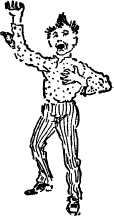
"Kingbird, fearless crested Kingbird, Thou art but a blooming sing bird—"
But the mud was very handy and Yan hurled a mass that spattered Guy thoroughly and sent him giggling into the teepee.
"Them's the bow-kays," Sam was heard to say. "Go out an' git some more; dead sure you deserve 'em. Let me know when the calls for 'author' begin?" Then there was more giggling. Yan was fast losing all control of himself. He seized a big stick and strode into the teepee, but Sam lifted the cover of the far side and slipped out. Guy tried to do the same, but Yan caught him.
"Here, I ain't doin' nothin'."
The answer was a sounding whack which made him wriggle.
237 "You let me alone, you big coward. I ain't doin' nothin' to you. You better let me alone. Sam! S–A–M! S–A–A–A–M!!!" as the stick came down again and again.
"Don't bother me," shouted Sam outside. "I'm writin' poethry—terrible partic'lar job, poethry. He only means it in kindness, anyhow."
Guy was screaming now and weeping copiously.
"You'll get some more if you give me any more of your lip," said Yan, and stepped out to meet Sam with the note-book again, apparently scribbling away. As soon as he saw Yan he stood up, cleared his throat and began:
"Kingbird, fearless crested—"
But he did not finish it. Yan struck him a savage blow on the mouth. Sam sprang back a few steps. Yan seized a large stone.
"Don't you throw that at me," said Sam seriously. Yan sent it with his deadliest force and aim. Sam dodged it and then in self-defense ran at Yan and they grappled and fought, while Guy, eager for revenge, rushed to help Sam, and got in a few trifling blows.
Sam was heavier and stronger than Yan, but Yan had gained wonderfully since coming to Sanger. He was thin, but wiry, and at school he had learned the familiar hip-throw that is as old as Cain and Abel. It was all he did know of wrestling, but now it stood him in good stead. He was strong with rage, too— and almost as soon as they grappled he found his 238 chance. Sam's heels flew up and he went sprawling in the dust. One straight blow on the nose sent Guy off howling, and seeing Sam once more on his feet, Yan rushed at him again like a wild beast. A moment later the big boy went tumbling over the bank into the pond.
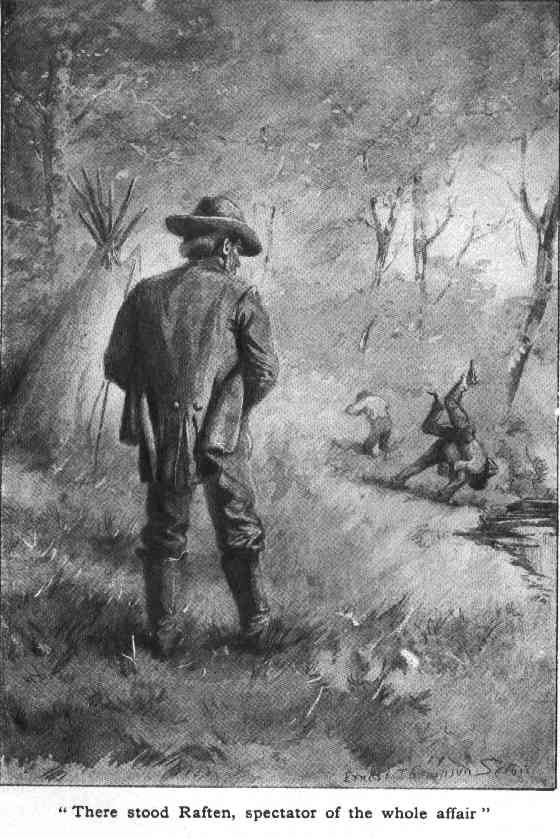
"You see if I don't get you sent about your business from here," spluttered Sam, now thoroughly angry. "I'll tell Da you hender the wurruk." His eyes were full of water and Guy's were full of stars and of tears. Neither saw the fourth party near; but Yan did. There, not twenty yards away, stood William Raften, spectator of the whole affair—an expression not of anger but of infinite sorrow and disappointment on his face—not because they had quarrelled—no—he knew boy nature well enough not to give that a thought—but that his son, older and stronger than the other and backed by another boy, should be licked in fair fight by a thin, half-invalid.
It was as bitter a pill as he had ever had to swallow. He turned in silence and disappeared, and never afterward alluded to the matter.
239
241
XV
The Peace of Minnie
That night the two avoided each other. Yan ate but little, and to Mrs. Raften's kindly solicitous questions he said he was not feeling well.
After supper they were sitting around the table, the men sleepily silent, Yan and Sam moodily so. Yan had it all laid out in his mind now. Sam would make a one-sided report of the affair; Guy would sustain him. Raften himself was witness of Yan's violence.
The merry days at Sanger were over. He was doomed, and felt like a condemned felon awaiting the carrying out of the sentence. There was only one lively member of the group. That was little Minnie. She was barely three, but a great chatterbox. Like all children, she dearly loved a "secret," and one of her favourite tricks was to beckon to some one, laying her pinky finger on her pinker lips, and then when they stooped she would whisper in their ear, "Don't tell." That was all. It was her Idea of a "seek-it."
She was playing at her brother's knee. He picked her up and they whispered to each other, then she scrambled down and went to Yan. He lifted her with a tenderness that was born of the 242 thought that she alone loved him now. She beckoned his head down, put her chubby arms around his neck and whispered, "Don't tell," then slid down, holding her dear innocent little finger warningly before her mouth.
What did it mean? Had Sam told her to do that, or was it a mere repetition of her old trick? No matter, it brought a rush of warm feeling into Yan's heart. He coaxed the little cherub back and whispered, "No, Minnie, I'll never tell." He began to see how crazy he had been. Sam was such a good fellow, he was very fond of him, and he wanted to make up; but no—with Sam holding threats of banishment over him, he could not ask for forgiveness. No, he would do nothing but wait and see.
He met Mr. Raften again and again that evening and nothing was said. He slept little that night and was up early. He met Mr. Raften alone—rather tried to meet him alone. He wanted to have it over with. He was one of the kind not prayed for in the Litany that crave "sudden death." But Raften was unchanged. At breakfast Sam was as usual, except to Yan, and not very different to him. He had a swelling on his lip that he said he got "tusslin' with the boys somehow or nuther."
After breakfast Raften said:
"Yahn, I want you to come with me to the schoolhouse."
"It's come at last," thought Yan, for the schoolhouse was on the road to the railroad station. But 243 why did not Raften say "the station"? He was not a man to mince words. Nothing was said about his handbag either, and there was no room for it in the buggy anyway.
Raften drove in silence. There was nothing unusual in that. At length he said:
"Yahn, what's yer father goin' to make of ye?"
"An artist," said Yan, wondering what this had to do with his dismissal.
"Does an artist hev to be bang-up eddicated?"
"They're all the better for it."
"Av coorse, av coorse, that's what I tell Sam. It's eddication that counts. Does artists make much money?"
"Yes, some of them. The successful ones sometimes make millions."
"Millions? I guess not. Ain't you stretchin' it just a leetle?"
"No, sir. Turner made a million. Titian lived in a palace, and so did Raphael."
"Hm. Don't know 'em, but maybe so—maybe so. It's wonderful what eddication does—that's what I tell Sam."
They now drew near the schoolhouse. It was holiday time, but the door was open and on the steps were two graybearded men. They nodded to Raften. These men were the school trustees. One of them was Char-less Boyle; the other was old Moore, poor as a church mouse, but a genial soul, and really put on the Board as a lubricant between Boyle and Raften. 244 Boyle was much the more popular. But Raften was always made trustee, for the people knew that he would take extremely good care of funds and school as well as of scholars.
This was a special meeting called to arrange for a new schoolhouse. Raften got out a lot of papers, including letters from the Department of Education. The School District had to find half the money; the Department would supply the other half if all conditions were complied with. Chief of these, the schoolhouse had to have a given number of cubic feet of air for each pupil. This was very important, but how were they to know in advance if they had the minimum and were not greatly over. It would not do to ask the Department that. They could not consult the teacher, for he was away now and probably would cheat them with more air than was needed. It was Raften who brilliantly solved this frightful mathematical problem and discovered a doughty champion in the thin, bright-eyed child.
"Yahn," he said, offering him a two-foot rule, "can ye tell me how many foot of air is in this room for every scholar when the seats is full?"
"You mean cubic feet?"
"Le's see," and Raften and Moore, after stabbing at the plans with huge forefingers and fumbling cumberously at the much-pawed documents, said together: "Yes, it says cubic feet." Yan quickly measured the length of the room and took the height with the map-lifter. The three graybeards 245 gazed with awe and admiration as they saw how sure he seemed. He then counted the seats and said, "Do you count the teacher?" The men discussed this point, then decided, "Maybe ye better; he uses more wind than any of them. Ha, ha!"
Yan made a few figures on paper, then said, "Twenty feet, rather better."
"Luk at thot," said Raften in a voice of bullying and triumph; "jest agrees with the Gover'ment Inspector. I towld ye he could. Now let's put the new buildin' to test."
More papers were pawed over.
"Yahn, how's this—double as many children, one teacher an' the buildin' so an' so."
Yan figured a minute and said, "Twenty-five feet each."
"Thar, didn't I tell ye," thundered Raften; "didn't I say that that dhirty swindler of an architect was playing us into the conthractor's hands—thought we wuz simple—a put-up job, the hull durn thing. Luk at it! They're nothing but a gang of thieves."
Yan glanced at the plan that was being flourished in the air.
"Hold on," he said, with an air of authority that he certainly never before had used to Raften, "there's the lobby and cloak-room to come off." He subtracted their bulk and found the plan all right—the Government minimum of air.
Boyle's eye had now just a little gleam of triumphant malice. Raften seemed actually disappointed 246 not to have found some roguery.
"Well, they're a shcaly lot, anyhow. They'll bear watchin'," he added, in tones of self-justification.
"Now, Yahn, last year the township was assessed at $265,000 an' we raised $265 with a school-tax of wan mill on the dollar. This year the new assessment gives $291,400; how much will the same tax raise if cost of collecting is same?"
"Two hundred and ninety-one dollars and forty cents," said Yan, without hesitation—and the three men sat back in their chairs and gasped.
It was the triumph of his life. Even old Boyle beamed in admiration, and Raften glowed, feeling that not a little of it belonged to him.
There was something positively pathetic in the simplicity of the three shrewd men and their abject reverence for the wonderful scholarship of this raw boy, and not less touching was their absolute faith in his infallibility as a mathematician.
Raften grinned at him in a peculiar, almost a weak way. Yan had never seen that expression on his face before, excepting once, and that was as he shook hands with a noted pugilist just after he had won a memorable fight. Yan did not know whether he liked it or not.
On the road home Raften talked with unusual freeness about his plans for his son. (Yan began to realize that the storm had blown over.) He harped on his favourite theme, "eddication." If Yan had only known, that was the one word of comfort that 247 Raften found when he saw his big boy go down: "It's eddication done it. Oh, but he's fine eddicated." Yan never knew until years afterward, when a grown man and he and Raften were talking of the old days, that he had been for some time winning respect from the rough-and-ready farmer, but what finally raised him to glorious eminence was the hip-throw that he served that day on Sam.
Raften was all right, Yan believed, but what of Sam? They had not spoken yet. Yan wished to make up, but it grew harder. Sam had got over his wrath and wanted a chance, but did not know how.
He had just set down his two buckets after feeding the pigs when Minnie came toddling out.
"Sam! Sam! Take Minnie to 'ide," then seeing Yan she added, "Yan, you mate a tair, tate hold Sam's hand."
The queen must be obeyed. Sam and Yan sheepishly grasped hands to make a queen's chair for the little lady. She clutched them both around the neck and brought their heads close together. They both loved the pink-and-white baby between them, and both could talk to her though not to each other. But there is something in touch that begets comprehension. The situation was becoming ludicrous when Sam suddenly burst out laughing, then:
"Say, Yan, let's be friends."
"I—I want—to—be," stammered Yan, with tears standing in his eyes. "I'm awfully sorry. I'll never 248 do it again."
"Oh, shucks! I don't care," said Sam. "It was all that dirty little sneak that made the trouble; but never mind, it's all right. The only thing that worries me is how you sent me flying. I'm bigger an' stronger an' older, I can heft more an' work harder, but you throwed me like a bag o' shavings, I only wish I knowed how you done it."
249