Part 3 — PART III. (continued 3)
Reading edition
"Hooray! Hooray! Hooray! One minute and forty-five seconds!" How Yan did cheer. Sam was silent, but his eyes looked a little less dull and stupid than usual, and Guy said "Pooh? That's nothin'."
Yan took out his pocket rule and went to the stump. As soon as he laid it on, he exclaimed "Seven and one-half inches through where you cut," and again he had to swing his hat and cheer.
"Well, old man, you surely did it that time. That's a grand coup if ever I saw one," and so, notwithstanding Guy's proposal to "leave it to Caleb," Sam got his grand Eagle feather as Axeman A1 of the Sanger Indians.
399
XVIII
The Owls And The Night-School
One night Sam was taking a last look at the stars before turning in. A Horned Owl had been hooting not far away.
"Hoo—hohoo-hoho—hoooooo."
And as he looked, what should silently sail to the top of the medicine pole stuck in the ground twenty yards away but the Owl.
"Yan! Yan! Give me my bow and arrow, quick. Here's a Cat-Owl—a chicken stealer, he's fair game."
"He's only codding you, Yan," said Guy sleepily from his blanket. "I wouldn't go."
But Yan rushed out with his own and Sam's weapons.
Sam fired at the great feathery creature, but evidently missed, for the Owl spread its wings and sailed away.
"There goes my best arrow. That was my 'Sure-death.'"
"Pshaw!" growled Yan, as he noted the miss. "You can't shoot a little bit."

But as they stood, there was a fluttering of broad wings, and there, alighting as before on the medicine pole, was the Owl again.
"My turn now! "exclaimed Yan in a gaspy whisper.
400 He drew his bow, the arrow flew, and the Owl slipped off unharmed as it had the first time.
"Yan, you're no good. An easy shot like that. Why, any idiot could hit that. Why didn't you fetch her?"
"'Cause I'm not an idiot, I suppose. I hit the same place as you did, anyway, and drew just as much blood."
"Ef he comes back again you call me," piped Guy in his shrill voice. "I'll show you fellers how to shoot. You're no good at all 'thout me. Why, I mind the time I was Deer-shooting——" but a fierce dash of the whole Tribe for Sappy's bed put a stop to the reminiscent flow and replaced it with whines of "Now you let me alone. I ain't doin' nothin' to you."
During the night they were again awakened by the screech in the tree-tops, and Yan, sitting up, said, "Say, boys, that's nothing but that big Cat Owl."
"So it is," was Sam's answer; "wonder I didn't think of that before."
"I did," said Guy; "I knew it all the time."
In the morning they went out to find their arrows. The medicine pole was a tall pole bearing a feathered shield, with the tribal totem, a white Buffalo, which Yan had set up to be in Indian fashion. Sighting in line from the teepee over this, they walked on, looking far beyond, for they had learned always to draw the arrow to the head. They had not gone twenty-five feet before Yan burst out in unutterable astonishment: 401 "Look! Look at that—and that———"
There on the ground not ten feet apart were two enormous Horned Owls, both shot fairly through the heart, one with Sam's "Sure-death" arrow, the other with Yan's "Whistler"; both shots had been true, and the boys could only say, "Well, if you saw that in print you would say it was a big lie!" It was indeed one of those amazing things which happen only in real life, and the whole of the Tribe with one exception voted a grand coup to each of the hunters.
Guy was utterly contemptuous. "They got so close they hit by chance an' didn't know they done it. If he had been shooting," etc., etc., etc.
"How about that screech in the tree-tops, Guy?"
"Errrrh."
What a fascination the naturalist always finds in a fine Bird. Yan revelled in these two. He measured their extent of wing and the length from beak to tail of each. He studied the pattern on their quills; he was thrilled by their great yellow eyes and their long, powerful claws, and he loved their every part. He hated to think that in a few days these wonderful things would be disgusting and fit only to be buried.
"I wish I knew hew to stuff them," he said.
"Why don't you get Si Lee to show you," was Sam's suggestion. "Seems to me I often seen pictures of Injun medicine men with stuffed birds," he added shrewdly and happily.
402 "Well, that's just what I will do."
Then arose a knotty question. Should he go to Si Lee and thereby turn "White" and break the charm of the Indian life, or should he attempt the task of persuading Si to come down there to work without proper conveniences. They voted to bring Si to camp. "Da might think we was backing out." After all, the things needed were easily carried, and Si, having been ambushed by a scout, consented to come and open a night-school in taxidermy.
The tools and things that he brought were a bundle of tow made by unravelling a piece of rope, some cotton wool, strong linen thread, two long darning needles, arsenical soap worked up like cream, corn-meal, some soft iron wire about size sixteen and some of stovepipe size, a file, a pair of pliers, wire cutters, a sharp knife, a pair of stout scissors, a gimlet, two ready-made wooden stands, and last of all a good lamp. The boys hitherto had been content with the firelight.
Thus in the forest teepee Yan had his first lesson in the art that was to give him so much joy and some sorrow in the future.
Guy was interested, though scornful; Sam was much interested; Yan was simply rapt, and Si Lee was in his glory. His rosy red cheeks and his round figure swelled with pride; even his semi-nude head and fat, fumbling fingers seemed to partake of his general elation and importance.
First he stuffed the Owls' throats and wounds with cotton wool.
403 Then he took one, cut a slit from the back of the breast-bone nearly to the tail (A to B, Fig. 1, page 405), while Yan took the other and tried faithfully to follow his example.
He worked the skin from the body chiefly by the use of his finger nails, till he could reach the knee of each leg and cut this through at the joint with the knife (Kn, Fig. 1, page 405). The flesh was removed from each leg-bone down to the heel-joint (Hl, Hl, Fig. 1), leaving the leg and skin as in Lg, Figure 2. Then working back on each side of the tail, he cut the "pope's nose" from the body and left it as part of the skin, with the tail feathers in it, and this, Si explained, was a hard place to get around. Sam called it "rounding Cape Horn." As the flesh was exposed Si kept it powdered thickly with corn-meal, and this saved the feathers from soiling.
Once around Cape Horn it was easy sailing. The skin was rapidly pushed off till the wings were reached. These were cut off at the joint deep in the breast (under J J, Fig. 1, or seen on the back, W J, Fig. 2), the first bone of each wing was cleared of meat, and the skin, now inside out and well mealed, was pushed off the neck up to the head.
Here Si explained that in most birds it would slip easily over the head, but in Owls, Woodpeckers, Ducks and some others one had sometimes to help it by a lengthwise slit on the nape (Sn, Fig. 2). "Owls is hard, anyway," he went on, "though not so bad as Water-fowl. If ye want a real easy bird for a starter, take a Robin or a Blackbird, or any land 404 Bird about that size except Woodpeckers."
When the ears were reached they were skinned and pulled out of the skull without cutting, then, after the eyes were passed, the skin and body looked as in Figure 2. Now the back of the head with the neck and body was cut off (Ct, Fig. 2), and the first operation of the skinning was done.
Yan got along fairly well, tearing and cutting the skin once or twice, but learning very quickly to manage it.
Now began the cleaning of the skin.
The eyes were cut clean out and the brains and flesh carefully scraped away from the skull.
The wing bones were already cleaned of meat down to the elbow joint, where the big quill feathers began, and the rest of the wing had to be cleared of flesh by cutting open the under side of the next joint (H to El, Fig. 1). The "pope's nose" and the skin generally was freed from meat and grease by scraping with a knife and rubbing with the meal.
Then came the poisoning. Every part of the bones and flesh had to be painted with the creamy arsenical soap, then the head was worked back into its place and the skin turned right side out.
When this was done it was quite late. Guy was asleep, Sam was nearly so, and Yan was thoroughly tired out.
"Guess I'll go now," said Si. "Them skins is in good shape to keep, only don't let them dry," so they were wrapped up in a damp sack and put away in a tin till next night, when Si promised to return and finish the course in one more lesson.
405
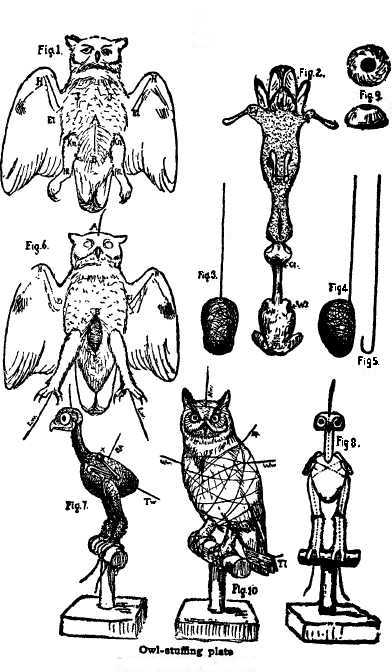
OWL-STUFFING PLATE
Fig. 1. The dead Owl, showing the cuts made in skinning it: A to B, for the body; El to H, on each wing, to remove the meat of the second joint. Fig. 2. After the skinning is done the skull remains attached to the skin, which is now inside out, the neck and body are cut off at Ct. Sn to Sn shows the slit in the nape needed for Owls and several other kinds. Fig. 3. Top view of the tow body, neck end up, and neck wire projecting. Fig. 4. Side view of the tow body, with the neck wire put through it; the tail end is downward. Fig. 5. The heavy iron wire for neck. Fig. 6. The Owl after the body is put in; it is now ready to close up, by stitching up the slit on the nape, the body slit B to C and the two wing slits El to H, on each wing. Fig. 7. A dummy as it would look if all the feathers were off; this shows the proper position for legs and wings on the body. At W is a glimpse of the leg wire entering the body at the middle of the side. Fig. 8. Another view of the body without feathers; the dotted lines show the wires of the legs through the hard body, and the neck wire. Fig. 9. Two views of one of the wooden eyes; these are on a much larger scale than the rest of the figures in this plate. Fig. 10. The finished Owl, with the thread wrappings on and the wires still projecting; Nw is end of the neck wire; Bp is back-pin—that is, the wire in the center of the back; Ww and Ww are the wing wires; Tl are the cards pinned on the tail to hold it flat while it dries. The last operation is to remove the threads and cut all the wires off close so that the feathers hide what remains.
407 While they were so working Sam had busied himself opening the Owls' stomachs—"looking up their records," as he called it. He now reported that one had lynched a young Partridge and the other had killed a Rabbit for its latest meal.
Next night Si Lee came as promised, but brought bad news. He had failed to find the glass Owl eyes he had hoped were in his trunk. His ingenuity, however, was of the kind that is never balked in a small matter. He produced some black and yellow oil paints, explaining, "Guess we'll make wooden eyes do for the present, an' when you get to town you can put glass ones in their place." So Sam was set to work whittling four wooden eyes the shape of well-raised buns and about three-quarters of an inch across. When whittled, scraped and smooth, Si painted them brilliant yellow with a central black spot and put them away to dry (shown on a large scale on page 405, Fig. 9, a and b).
Meanwhile, he and Yan got out the two skins. The bloody feathers on the breasts were washed clean in a cup of warm water, then dried with cotton and dusted all over with meal to soak up any moisture left. The leg and wing bones were now wrapped with as much tow as would take the place of the removed meat. The eye sockets were partly filled with cotton, then a long soft roll of tow about the length and thickness of the original neck was worked 408 up into the neck skin and into the skull and left hanging. The ends of the two wing bones were fastened two inches apart with a shackle of strong string (X, Fig. 2 and Fig. 7). Now the body was needed.
For this Si rolled and lashed a wad of tow with strong thread until he made a dummy of the same size and shape as the body taken out, squeezing and sewing it into a hard solid mass. Next he cut about two and a half feet of the large wire, filed both ends sharp, doubled about four inches of one end back in a hook (Fig. 5), then drove the long end through the tow body from the tail end out where the neck should join on (Figs. 3 and 4). This was driven well in so that the short end of the hook was buried out of sight. Now Si passed the projecting ends of the long wire up the neck in the middle of the tow roll or neck already there, worked it through the skull and out at the top of the Owl's head, and got the tow body properly placed in the skin with the string that bound the wing bones across the back (X, Fig. 7).
Two heavy wires each eighteen inches long and sharp at one end were needed for the legs. These were worked up one through the sole of each foot under the skin of the leg behind (Lw, Fig. 6), then through the tow body at the middle of the side (W, Fig. 7), after which the sharp end was bent with pliers into a hook and driven back into the hard body (after the manner of the neck wire, Fig. 4).
409 Another wire was sharpened and driven through the bones of the tail, fastening that also to the tow body (Tw, Fig. 7).
Now a little soft tow was packed into places where it seemed needed to fit the skin on, and it remained to sew up the opening below (Bc in Fig. 6), the wing slits (El, H, Fig. 6 and Fig. 1), and the slit in the nape (Sn Sn, Fig. 2) with half a dozen stitches, always putting the needle into the skin from the flesh side.
The projecting wires of the feet were put through gimlet holes in the perch and made firm, and Si's Owls were ready for their positions. They were now the most ridiculous looking things imaginable, wings floppy, heads hanging.
"Here is where the artist comes in," said Si proudly, conscious that this was himself. He straightened up the main line of the body by bending the leg wires and set the head right by hunching the neck into the shoulders. "An Owl always looks over its shoulder," he explained, but took no notice of Sam's query as to "whose shoulder he expected it to look over." He set two toes of each foot forward on the perch and two back to please Yan, who insisted that that was Owly, though Si had his doubts. He spread the tail a little by pinning it between two pieces of card (Tl, Fig. 10), gave it the proper slant, and now had the wings to arrange.
They were drooping like those of a clucking hen. A sharp wire of the small size was driven into the bend of each wing (0, Fig. 7), nailing it in effect to the body (Ww and Ww, Fig. 10). A long pin was 410 set in the middle of the back (Bp, Fig. 10), then using these with the wing wires and head wire as lashing points, Si wrapped the whole bird with the thread (Fig. 10), putting a wad of cotton here or a bit of stick there under the wrapping till he had the position and "feathering" perfect, as he put it.
"We can put in the eyes now," said he, "or later, if we soften the skin around the eye-sockets by putting wet cotton in them for twenty-four hours."
Yan had carefully copied Si's method with the second Owl, and developed unusual quickness at it.
His teacher remarked, "Wall, I larned lots o' fellows to stuff birds, but you ketch on the quickest I ever seen."
Si's ideas of perfection might differ from those of a trained taxidermist; indeed, these same Owls afforded Yan no little amusement in later years, but for the present they were an unmitigated joy.
They were just the same in position. Si knew only one; all his birds had that. But when they had dried fully, had their wrappings removed, the wires cut off flush and received the finishing glory of their wooden eyes, they were a source of joy and wonder to the whole Tribe of Indians.
411
XIX
The Trial of Grit
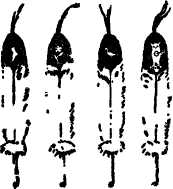
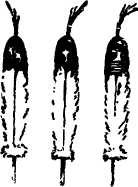
The boys had made war bonnets after the "really truly" Indian style learned from Caleb. White Turkey tail-feathers and white Goose wing-feathers dyed black at the tips made good Eagle feathers. Some wisps of red-dyed horsehair from an old harness tassel; strips of red flannel from an old shirt, and some scraps of sheepskin supplied the remaining raw material. Caleb took an increasing interest, and helped them not only to make the bonnet, but also to decide on what things should count coup and what grand coup. Sam had a number of feathers for shooting, diving, "massacreeing the Whites," and his grand tufted feathers for felling the pine and shooting the Cat-Owl.
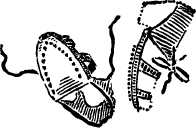
Among other things, Yan had counted coup for trailing. The Deer hunt had been made still more real by having the "Deer-boy" wear a pair of sandals made from old boots; on the sole of each they put two lines of hobnails in V shape, pointing forward. These made hooflike marks wherever the Deer went. One of the difficulties with the corn was that it gave no clue to the direction or doubling of the trail, but the sandals met the trouble, and with a very little corn to help they had an ideal trail. All became very expert, 412 and could follow fast a very slight track, but Yan continued the best, for what he lacked in eyesight he more than made up in patience and observation. He already had a grand coup for finding and shooting the Deer in the heart, that time, at first shot before the others came up even, and had won six other grand coups—one for swimming 200 yards in five minutes, one for walking four measured miles in one hour, one for running 100 yards in twelve seconds, one for knowing 100 wild plants, one for knowing 100 birds, and the one for shooting the Horned Owl.
Guy had several good coups, chiefly for eyesight. He could see "the papoose on the squaws back," and in the Deer hunt he had several times won coups that came near being called grand coup, but so far fate was against him, and even old Caleb, who was partial to him, could not fairly vote him a grand coup.
"What is it that the Injuns most likes in a man: I mean, what would they druther have, Caleb?" asked Sappy one day, confidently expecting to have his keen eyesight praised.
"Bravery," was the reply. "They don't care what a man is if he's brave. That's their greatest thing—that is, if the feller has the stuff to back it up. An' it ain't confined to Injuns; I tell you there ain't anything that anybody goes on so much. Some men pretends to think one thing the best of all, an' some another, but come right down to it, what every man, woman an' child in the country loves an' worships is pluck, clear grit, well backed up."
413
"Well, I tell you," said Guy, boiling up with enthusiasm at this glorification of grit, "I ain't scared o' nothin'."
"Wall, how'd you like to fight Yan there?"
"Oh, that ain't fair. He's older an' bigger'n I am."
"Say, Sappy, I'll give you one. Suppose you go to the orchard alone an' get a pail of cherries. All the men'll be away at nine o'clock."
"Yes, and have old Cap chaw me up."
"Thought you weren't scared of anything, an' a poor little Dog smaller than a yearling Heifer scares you."
"Well, I don't like cherries, anyhow."
"Here, now, Guy, I'll give you a real test. You see that stone?" and Caleb held up a small round stone with a hole in it. "Now, you know where old Garney is buried?"
Garney was a dissolute soldier who blew his head off, accidentally, his friends claimed, and he was buried on what was supposed to be his own land just north of Raften's, but it afterward proved to be part of the highway where a sidepath joined in, and in spite of its diggers the grave was at the crossing of two roads. Thus by the hand of fate Bill Garney was stamped as a suicide.
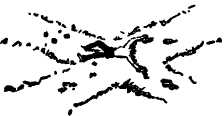
The legend was that every time a wagon went over his head he must groan, but unwilling to waste those 414 outcries during the rumbling of the wheels, he waited till midnight and rolled them out all together. Anyone hearing should make a sympathetic reply or they would surely suffer some dreadful fate. This was the legend that Caleb called up to memory and made very impressive by being properly impressed himself.
"Now," said he, "I am going to hide this stone just behind the rock that marks the head of Garney's grave, an' I'll send you to git it some night. Air ye game?"
"Y-e-s, I'll go," said the Third War Chief without visible enthusiasm.
"If he's so keen for it now, there'll be no holding him back when night comes," remarked the Woodpecker.
"Remember, now," said Caleb, as he left them to return to his own miserable shanty, "this is the chance to show what you're made of. I'll tie a cord to the stone to make sure that you get it."
"We're just going to eat. Won't you stay and jine with us," called Sam, but Caleb strode off without taking notice of the invitation.
In the middle of the night the boys were aroused by a man's voice outside and the scratching of a stick on the canvas.
"Boys! Guy—Yan! Oh, Guy!"
"Hello! Who is it?"
"Caleb Clark! Say, Guy, it's about half-past eleven now. You have just about time to go to Garney's grave by midnight an' get that stone, and if you 415 can't find the exact spot you listen for the groaning —that'll guide you."
This cheerful information was given in a hoarse whisper that somehow conveyed the idea that the old man was as scared as he could be.
"I—I—I—" stammered Guy, "I can't see the way."
"This is the chance of your life, boy. You get that stone and you'll get a grand coup feather, top honours fur grit. I'll wait here till you come back."
"I—I—can't find the blamed old thing on such a dark night. I—I—ain't goin'."
"Errr—you're scared," whispered Caleb.
"I ain't scared, on'y what's the use of goin' when I couldn't find the place? I'll go when it's moonlight."
"Err—anybody here brave enough to go after that stone?"
"I'll go," said the other two at the same time, though with a certain air of "But I hope I don't have to, all the same."
"You kin have the honour, Yan," said the Woodpecker, with evident relief.
"Of course, I'd like the chance—but—but—I don't want to push ahead of you—you're the oldest; that wouldn't be square," was the reply.
"Guess we'd better draw straws for it."
So Sam sought a long straw while Yan stirred up the coals to a blaze. The long straw was broken in two unequal pieces and hidden in Sam's hand. 416 Then after shuffling he held it toward Yan, showing only the two tips, and said, "Longest straw takes the job." Yan knew from old experience that a common trick was to let the shortest straw stick out farthest, so he took the other, drew it slowly out and out—it seemed endless. Sam opened his hand and showed that the short straw remained, then added with evident relief: "You got it. You are the luckiest feller I ever did see. Everything comes your way."
If there had been any loophole Yan would have taken it, but it was now clearly his duty to go for that stone. It was pride rather than courage that carried him through. He dressed quietly and nervously; his hands trembled a little as he laced his shoes. Caleb waited outside when he heard that it was Yan who was going. He braced him up by telling him: "You're the stuff. I jest love to see grit. I'll go with you to the edge of the woods—'twouldn't be fair to go farther—and wait there till you come back. It's easy to find. Go four panels of fence past the little Elm, then right across on the other side of the road is the big stone. Well, on the side next the north fence you'll find the ring pebble. The coord is lying kind o' cross the big white stone, so you'll find it easy; and here, take this chalk; if your grit gives out, you mark on the fence how far you did get, but don't you worry about that groaning—it's nothing but a yarn—don't be scairt."
"I am afraid I am scared, but still I'll go."
417 "That's right," said the Trapper with emphasis. "Bravery ain't so much not being scairt as going ahead when you are scairt, showing that you kin boss your fears."
So they talked till they struck out of the gloom of the trees to the comparative light of the open field.
"It's just fifteen minutes to midnight," said Caleb, looking at his watch with the light of a match, "You'll make it easy. I'll wait here."
Then Yan went on alone.
It was a somber night, but he felt his way along the field fence to the line fence and climbed that into the road that was visible as a less intense darkness on the black darkness of the grass. Yan walked on up the middle cautiously. His heart beat violently and his hands were cold. It was a still night, and once or twice little mousey sounds in the fence corner made him start, but he pushed on. Suddenly in the blackness to the right of the road he heard a loud "whisk," then he caught sight of a white thing that chilled his blood. It was the shape of a man wrapped in white, but lacked a head, just as the story had it. Yan stood frozen to the ground. Then his intellect came to the rescue of his trembling body. "What nonsense! It must be a white stone." But no, it moved. Yan had a big stick in his hand. He shouted: "Sh, sh, sh!" Again the "corpse" moved. Yan groped on the road for some stones and sent one straight at the "white thing." 418 He heard a "whooff" and a rush. The "white thing" sprang up and ran past him with a clatter that told him he had been scared by Granny de Neuville's white-faced cow. At first the reaction made him weak at the knees, but that gave way to a better feeling. If a harmless old Cow could lie out there all night, why should he fear? He went on more quietly till he neared the rise in the road. He should soon see the little Elm. He kept to the left of the highway and peered into the gloom, going more slowly. He was not so near as he had supposed, and the tension of the early part of the expedition was coming back more than ever. He wondered if he had not passed the Elm—should he go back? But no, he could not bear the idea; that would mean retreat. Anyhow, he would put his chalk mark here to show how far he did get. He sneaked cautiously toward the fence to make it, then to his relief made out the Elm not twenty-five feet away. Once at the tree, he counted off the four panels westward and knew that he was opposite the grave of the suicide. It must now be nearly midnight. He thought he heard sounds not far away, and there across the road he saw a whitish thing—the headstone. He was greatly agitated as he crawled quietly as possible toward it. Why quietly he did not know. He stumbled through the mud of the shallow ditch at each side, reached the white stone, and groped with clammy, cold hands over the surface for the string. If Caleb had put it there it was gone now. So he took his chalk and wrote on the stone "Yan."
419 Oh, what a scraping that chalk made! He searched about with his fingers around the big boulder. Yes, there it was; the wind, no doubt, had blown it off. He pulled it toward him. The pebble was drawn across the boulder with another and louder rasping that sounded fearfully in the night. Then at once a gasp, a scuffle, a rush, a splash of something in mud, or water—horrible sounds of a being choking, strangling or trying to speak. For a moment Yan sank down in terror. His lips refused to move. But the remembrance of the cow came to help him. He got up and ran down the road as fast as he could go, a cold sweat on him. He ran so blindly he almost ran into a man who shouted "Ho, Yan; is that you?" It was Caleb coming to meet him. Yan could not speak. He was trembling so violently that he had to cling to the Trapper's arm.
"What was it, boy? I heard it, but what was it?"
"I—I—don't know," he gasped; "only it was at the g-g-grave."
"Gosh! I heard it, all right," and Caleb showed no little uneasiness, but added, "We'll be back in camp in ten minutes."
He took Yan's trembling hand and led him for a little while, but he was all right when he came to the blazed trail. Caleb stepped ahead, groping in the darkness.
Yan now found voice to say, "I got the stone all right, and I wrote my name on the grave, too."
"Good boy! You're the stuff!" was the admiring response.
420 They were very glad to see that there was a fire in the teepee when they drew near. At the edge of the clearing they gave a loud "O-hoo—O-hoo— O-hoo-oo," the Owl cry that they had adopted because it is commonly used by the Indians as a night signal, and they got the same in reply from within.
"All right," shouted Caleb; "he done it, an' he's bully good stuff and gets an uncommon grand coup."
"Wish I had gone now," said Guy. "I could 'a' done it just as well as Yan."
"Well, go on now."
"Oh, there ain't any stone to get now for proof."
"You can write your name on the grave, as I did."
"Ah, that wouldn't prove nothin'," and Guy dropped the subject.
Yan did not mean to tell his adventure that night, but his excitement was evident, and they soon got it out of him in full. They were a weird-looking crowd as they sat around the flickering fire, experiencing as he told it no small measure of the scare he had just been through.
When he had finished Yan said, "Now, Guy, don't you want to go and try it?"
"Oh, quit," said Guy; "I never saw such a feller as you for yammering away on the same subjek."
Caleb looked at his watch now, as though about to leave, when Yan said:
"Say, Mr. Clark, won't you sleep here? There's lots o' room in Guy's bed."
"Don't mind if I do, seem' it's late."
421
XX
The White Revolver
In the morning Caleb had the satisfaction of eating a breakfast prepared by the son of his enemy, for Sam was cook that day.
The Great Woodpecker expressed the thought of the whole assembly when after breakfast he said: "Now I want to go and see that grave. I believe Yan wrote his name on some old cow that was lying down and she didn't like it and said so out loud!"
They arrived at the spot in a few minutes. Yes, there it was plainly written on the rude gravestone, rather shaky, but perfectly legible—"Yan."
"Pretty poor writing," was Guy's remark.
"Well, you sure done it! Good boy!" said Sam warmly. "Don't believe I'd 'a' had the grit."
"Bet I would," said Guy.
"Here's where I crossed the ditch. See my trail in the mud? Out there is where I heard the yelling. Let's see if ghosts make tracks. Hallo, what the—"
There were the tracks in the mud of a big man. He had sprawled, falling on his hands and knees. Here was the print of his hands several times, and in the mud, half hidden, something shining—Guy saw it first and picked it up. It was a white-handled Colt's revolver.
422 "Let's see that," said Caleb. He wiped off the mud. His eye kindled. "That's my revolver that was stole from me 'way back, time I lost my clothes and money." He looked it over and, glancing about, seemed lost in thought. "This beats me!" He shook his head and muttered from time to time, "This beats me!" There seemed nothing more of interest to see, so the boys turned homeward.
On the way back Caleb was evidently thinking hard. He walked in silence till they got opposite Granny de Neuville's shanty, which was the nearest one to the grave. At the gate he turned and said: "Guess I'm going in here. Say, Yan, you didn't do any of that hollering last night, did you?"
"No, sir; not a word. The only sound I made was dragging the ring-stone over the boulder."
"Well, I'll see you at camp," he said, and turned in to Granny's.
"The tap o' the marnin' to ye, an' may yer sowl rest in pace," was the cheery old woman's greeting. "Come in—come in, Caleb, an' set down. An' how is Saryann an' Dick?"
"They seem happy an' prosperin'," said the old man with bitterness. "Say, Granny, did you ever hear the story about Garney's grave out there on the road?"
"For the love av goodness, an' how is it yer after askin' me that now? Sure an' I heard the story many a time, an' I'm after hearin' the ghost last night, an' it's a-shiverin' yit Oi am."
423 "What did you hear, Granny?"
"Och, an' it was the most divilish yells iver let out av a soul in hell. Shure the Dog and the Cat both av thim was scairt, and the owld white-faced cow come a-runnin' an' jumped the bars to get aff av the road."
Here was what Caleb wanted, and he kept her going by his evident interest. After she tired of providing more realistic details of the night's uproar, Caleb deliberately tapped another vintage of tittle-tattle in hope of further information leaking out.
"Granny, did you hear of a robbery last week down this side of Downey's Dump?"
"Shure an' I did not," she exclaimed, her eyes ablaze with interest—neither had Caleb, for that matter; but he wanted to start the subject—"An" who was it was robbed?"
"Don't know, unless it was John Evans's place."
"Shure an' I don't know him, but I warrant he could sthand to lose. Shure an' it's when the raskils come after me an' Cal Conner the moment it was talked around that we had sold our Cow; then sez I, it's gittin' onraisonable, an' them divils shorely seems to know whin a wad o' money passes."
"That's the gospel truth. But when wuz you robbed, Granny?"
"Robbed? I didn't say I wuz robbed," and she cackled. "But the robbers had the best av intintions when they came to me," and she related at length her experience with the two who broke in when her Cow was reported sold. She laughed over 424 their enjoyment of the Lung Balm, and briefly told how the big man was sulky and the short, broad one was funny. Their black beards, the "big wan" with his wounded head, his left-handedness and his accidental exposure of the three fingers of the right hand, all were fully talked over.
"When was it, Granny?"
"Och, shure an' it wuz about three years apast."
Then after having had his lungs treated, old Caleb left Granny and set out to do some very hard thinking.
There had been robberies all around for the last four years; There was no clue but this: They were all of the same character; nothing but cash was taken, and the burglars seemed to have inside knowledge of the neighbourhood, and timed all their visits to happen just after the householder had come into possession of a roll of bills.
As soon as Caleb turned in at the de Neuville gate, Yan, acting on a belated thought, said:
"Boys, you go on to camp; I'll be after you in five minutes." He wanted to draw those tracks in the mud and try to trail that man, so went back to the grave.
He studied the marks most carefully and by opening out the book he was able to draw the boot tracks life-size, noting that each had three rows of small hobnails on the heel, apparently put in at home because so irregular, while the sole of the left was worn into a hole. Then he studied the hand tracks, selected the clearest, and was drawing the right 425 hand when something odd caught his attention.
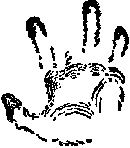
Yes! It appeared in all the impressions of that hand—the middle finger was gone.
Yan followed the track on the road a little way, but at the corner it turned southward and was lost in the grass.
As he was going back to camp he overtook Caleb also returning.
"Mr. Clark," he said. "I went back to sketch those tracks, and do you know—that man had only three fingers on his right hand?"
"Consarn me!" said Caleb. "Are you sure?"
"Come and see for yourself."
Yes! It surely was true, and Caleb on the road back said, "Yan, don't say a word of this to the others just now."
The old Trapper went to the Pogue house at once. He found the tracks repeated in the dust near the door, but they certainly were not made by Dick. On a line was a pair of muddy trousers drying.
From this night Yan went up and Guy went down in the old man's opinion, for he spoke his own mind that day when he gave first place to grit. He invited Yan to come to his shanty to see a pair of snow-shoes he was making. The invitation was vague and general, so the whole Tribe accepted. Yan had not been there since his first visit. The first part of their call was as before. In answer to their knock there was a loud baying from the Hound, then a voice ordering him back. Caleb opened the 426 door, but now said "Step in." If he was displeased with the others coming he kept it to himself. While Yan was looking at the snow-shoes Guy discovered something much more interesting on the old man's bunk; that was the white revolver, now cleaned up and in perfect order. Caleb's delight at its recovery, though not very apparent, was boundless. He had not been able to buy himself another, and this was as warmly welcomed back as though a long-lost only child.
"Say, Caleb, let's try a shot. I bet I kin beat the hull gang," exclaimed Sapwood.
Caleb got some cartridges and pointed to a white blaze on a stump forty yards away. Guy had three or four shots and Yan had the same without hitting the stump. Then Caleb said, "Lemme show you."
His big rugged hand seemed to swallow up the little gun-stock. His long knobbed finger fitted around the lock in a strange but familiar way. Caleb was a bent-arm shot, and the short barrel looked like his own forefinger pointing at the target as he pumped away six times in quick succession. All went into the blaze and two into the charcoal spot that marked the centre.
"By George! Look at that for shooting!" and the boys were loud in their praise.
"Well, twenty year ago I used to be a pretty good shot," Caleb proceeded to explain with an air of unnecessary humility and a very genial expression on his face. "But that's dead easy. I'll show you 427 some real tricks."
Twenty-five feet away he set up three cartridges in a row, their caps toward him, and exploded them in succession with three rapid shots. Then he put the revolver in the side pocket of his coat, and recklessly firing it without drawing, much less sighting or even showing it, he peppered a white blaze at twenty yards. Finally he looked around for an old fruit tin. Then he cocked the revolver, laid it across his right hand next the thumb and the tin across the fingers. He then threw them both in the air with a jerk that sent the revolver up ten feet and the tin twenty. As the revolver came down he seized it and shot a hole through the tin before it could reach the ground.
The boys were simply dumbfounded. They had used up all their exclamations on the first simple target trial.
Caleb stepped into the shanty to get a cleaning-rag for his darling, and Sam burst out:
"Well, now I know he never shot at Da, for if he did he'd 'a' got him sure."
It was not meant for Caleb's ears, but it reached him, and the old Trapper came to the door at once with a long, expressive "H-m-m-mrr."
Thus was broken the dam of silent scorn, for it was the first time Caleb had addressed himself to Sam. The flood had forced the barrier, but it still left plenty of stuff in the channel to be washed away by time and wear, and it was long before he talked 428 to Sam as freely as to the others, but still in time he learned.
There was an air of geniality on all now, and Yan took advantage of this to ask for something he had long kept in mind.
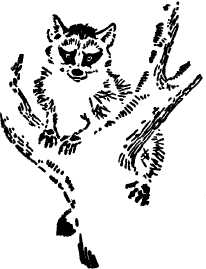
"Mr. Clark, will you take us out for a Coon hunt? We know where there are lots of Coons that feed in a corn patch up the creek."
If Yan had asked this a month ago he would have got a contemptuous refusal. Before the visit to Carney's grave it might have been, "Oh, I dunno—I ain't got time," but he was on the right side of Caleb now, and the answer was:
"Well, yes! Don't mind if I do, first night it's coolish, so the Dog kin run."
429
XXI
The Triumph Of Guy
The boys had hunted the Woodchuck quite regularly since first meeting it. Their programme was much the same—each morning about nine or ten they would sneak out to the clover field. It was usually Guy who first discovered the old Grizzly, then all would fire a harmless shot, the Woodchuck would scramble into his den and the incident be closed for the day. This became as much a part of the day's routine as getting breakfast, and much more so than the washing of the dishes. Once or twice the old Grizzly had narrow escapes, but so far he was none the worse, rather the better, being wiser. The boys, on the other hand, gained nothing, with the possible exception of Guy. Always quick-sighted, his little washed-out optics developed a marvellous keenness. At first it was as often Yan or Sam who saw the old Grizzly, but later it was always Guy.
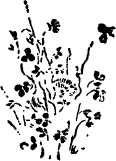
One morning Sam approached the game from one point, Guy and Yan from another some yards away. "No Woodchuck!" was the first opinion, but suddenly Guy called "I see him." There in a little hollow fully sixty yards from his den, and nearly a hundred from the boys, concealed in a bunch of clover, Guy saw a patch of gray fur hardly two inches square. "That's him, sure."

430 Yan could not see it at all. Sam saw but doubted. An instant later the Woodchuck (for it was he) stood up on his hind legs, raised his chestnut breast above the clover, and settled all doubt.
"By George!" exclaimed Yan in admiration. "That is great. You have the most wonderful eyes I ever did see. Your name ought to be 'Hawkeye'—that should be your name."
"All right," shrilled out Guy enthusiastically. "Will you—will you, Sam, will you call me Hawkeye? I think you ought to," he added pleadingly.
"I think so, Sam," said the Second Chief. "He's turned out great stuff, an' it's regular Injun."
"We'll have to call a Council and settle that. Now let's to business."
"Say, Sapwood, you're so smart, couldn't you go round through the woods to your side and crawl through the clover so as get between the old Grizzly and his den?" suggested the Head Chief.
"I bet I can, an' I'll bet a dollar—"
"Here, now," said Yan, "Injuns don't have dollars."
"Well, I'll bet my scalp—my black scalp, I mean—against Sam's that I kill the old Grizzly first."
"Oh, let me do it first—you do it second," said Sam imploringly.
"Errr—yer scared of yer scalp."
"I'll go you," said Sam.
Each of the boys had a piece of black horsehair that he called his scalp. It was tied with a string to the top of his head—and this was what Guy wished 431 to wager.
Yan now interfered: "Quit your squabbling, you Great War Chiefs, an' 'tend to business. If Woodpecker kills old Grizzly he takes Sapwood's scalp; if Sappy kills him he takes the Woodpecker's scalp, an' the winner gets a grand feather, too."
Sam and Yan waited impatiently in the woods while Guy sneaked around. The Woodchuck seemed unusually bold this day. He wandered far from his den and got out of sight in hollows at times. The boys saw Guy crawl through the fence, though the Woodchuck did not. The fact was, that he had always had the enemy approach him from the other side, and was not watching eastward.
Guy, flat on his breast, worked his way through the clover. He crawled about thirty yards and now was between the Woodchuck and his den. Still old Grizzly kept on stuffing himself with clover and watching toward the Raften woods. The boys became intensely excited. Guy could see them, but not the Woodchuck. They pointed and gesticulated. Guy thought that meant "Now shoot." He got up cautiously. The Woodchuck saw him and bounded straight for its den—that is, toward Guy. Guy fired wildly. The arrow went ten feet over the Grizzly's head, and, that "huge, shaking mass of fur" bounding straight at him, struck terror to his soul. He backed up hastily, not knowing where to run. He was close to the den.
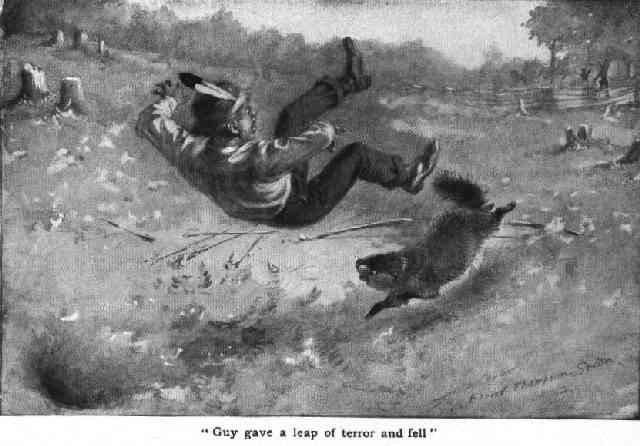
432 The Woodchuck chattered his teeth and plunged to get by the boy, each as scared as could be. Guy gave a leap of terror and fell heavily just as the Woodchuck would have passed under him and home. But the boy weighed nearly 100 pounds, and all that weight came with crushing force on old Grizzly, knocking the breath out of his body. Guy scrambled to his feet to run for his life, but he saw the Woodchuck lying squirming, and plucked up courage enough to give him a couple of kicks on the nose that settled him. A loud yell from the other two boys was the first thing that assured Guy of his victory. They came running over and found him standing like the hunter in an amateur photograph, holding his bow in one hand and the big Woodchuck by the tail in the other.
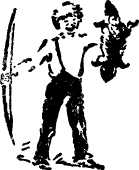
"Now, I guess you fellers will come to me to larn you how to kill Woodchucks. Ain't he an old socker? I bet he weighs fifty pounds—yes, near sixty." (It weighed about ten pounds.)
"Good boy! Bully boy! Hooray for the Third War Chief! Hooray for Chief Sapwood!" and Guy had no cause to complain of lack of appreciation on the part of the others.
He swelled out his chest and looked proud and haughty. "Wished I knew where there was some more Woodchucks," he said. "I know how to get them, if the rest don't."
"Well, that should count for a grand coup, Sappy."
433
435 "You tole me you wuz goin' to call me 'Hawkeye' after this morning."
"We'll have to have a Grand Council to fix that up," replied the Head Chief.
"All right; let's have it this afternoon, will you?"
"All right."
"'Bout four o'clock?"
"Why, yes; any time."
"And you'll fix me up as 'Hawkeye,' and give me a dandy Eagle feather for killing the Woodchuck, at four o'clock?"
"Yes, sure, only, why do you want it at four o'clock?"
But Guy seemed not to hear, and right away after dinner he disappeared.
"He's dodging the dishwashing again," suggested the Woodpecker.
"No, he isn't," said the Second Chief. "I believe he's going to bring his folks to see him in his triumph."
"That's so. Let's chip right in and make it an everlasting old blowout—kind of a new date in history. You'll hear me lie like sixty to help him out."
"Good enough. I'm with you. You go and get your folks. I'll go after old Caleb, and we'll fix it up to call him 'Hawkeye' and give him his grand coup feather all at once."
"'Feard my folks and Caleb wouldn't mix," replied Sam, "but I believe for a splurge like this Guy'd ruther have my folks. You see, Da has the mortgage on their place."
436 So it was agreed Sam was to go for his mother, while Yan was to prepare the Eagle feather and skin the Woodchuck.
It was not "as big as a bear," but it was a very large Woodchuck, and Yan was as much elated over the victory as any of them. He still had an hour or more before four o'clock, and eager to make Guy's triumph as Indian as possible, he cut off all the Woodchuck's claws, then strung them on a string, with a peeled and pithed Elder twig an inch long between each two. Some of the claws were very, very small, but the intention was there to make a Grizzly-claw necklace.
Guy made for home as fast as he could go. His father hailed him as he neared the garden and evidently had plans of servitude, but Guy darted into the dining-room-living-room-bedroom-kitchen-room, which constituted nine-tenths of the house.
"Oh, Maw, you just ought to seen me; you just want to come this afternoon—I'm the Jim Dandy of the hull Tribe, an they're going to make me Head Chief. I killed that whaling old Woodchuck that pooty nigh killed Paw. They couldn't do a thing without me—them fellers in camp. They tried an' tried more'n a thousand times to get that old Woodchuck—yes, I bet they tried a million times, an' I just waited till they was tired and give up, then I says, 'Now, I'll show you how.' First I had to point him out. Them fellers is no good to see things. Then I says, 'Now, Sam and Yan, you fellers stay here, an' just to show how easy 437 it is when you know how, I'll leave all my bosenarrers behind an' go with nothing.' Wall, there they stood an' watched me, an' I s-n-e-a-k-e-d round the fence an' c-r-a-w-l-e-d in the clover just like an Injun till I got between him an' his hole, and then I hollers and he come a-snortin' an' a-chatterin' his teeth at me to chaw me up, for he seen I had no stick nor nothin', an' I never turned a hair; I kep' cool an' waited till jest as he was going to jump for my throat, then I turned and gave him one kick on the snoot that sent him fifty feet in the air, an' when he come down he was deader'n Kilsey's hen when she was stuffed with onions. Oh, Maw, I'm just the bully boy; they can't do nothin' in camp 'thout me. I had to larn 'em to hunt Deer an' see things—an'—an'—an'—lots o' things, so they are goin' to make me Head Chief of the hull Tribe, an' call me 'Hawkeye,' too; that's the way the Injuns does. It's to be at four o'clock this afternoon, an' you got to come."
Burns scoffed at the whole thing and told Guy to get to work at the potatoes, and if he left down the bars so that the Pig got out he'd skin him alive; he would have no such fooling round his place. But Mrs. Burns calmly informed him that she was going. It was to her much like going to see a university degree conferred on her boy.
Since Burns would not assist, the difficulty of the children now arose. This, however, was soon settled. They should go along. It was two hours' toil for the mother to turn the four brown-limbed, nearly 438 naked, dirty, happy towsle-tops into four little martyrs, befrocked, beribboned, becombed and be-booted. Then they all straggled across the field, Mrs. Burns carrying the baby in one arm and a pot of jam in the other. Guy ran ahead to show the way, and four-year-old, three-year-old and two-year-old, hand in hand, formed a diagonal line in the wake of the mother.
They were just a little surprised on getting to camp to find Mrs. Raften and Minnie there in holiday clothes. Marget's first feeling was resentment, but her second thought was a pleasant one. That "stuck-up" woman, the enemy's wife, should see her boy's triumph, and Mrs. Burns at once seized on the chance to play society cat.
"How do ye do, Mrs. Raften; hope you're well," she said with a tinge of malicious pleasure and a grand attempt at assuming the leadership.
"Quite well, thank you. We came down to see how the boys were getting on in camp."
"They've got on very nicely sense my boy j'ined them," retorted Mrs. Burns, still fencing.
"So I understand; the other two have become very fond of him," returned Mrs. Raften, seeking to disarm her enemy.
This speech had its effect. Mrs. Burns aimed only to forestall the foe, but finding to her surprise that the enemy's wife was quite gentle, a truce was made, and by the time Mrs. Raften had petted and praised the four tow-tops and lauded Guy to the utmost 439 the air of latent battle was replaced by one of cordiality.
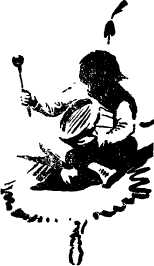
The boys now had everything ready for the grand ceremony. On the Calfskin rug at one end was the Council; Guy, seated on the skin of the Woodchuck and nearly hiding it from view, Sam on his left hand and Yan with the drum, on his right. In the middle the Council fire blazed. To give air, the teepee cover was raised on the shady side and the circle of visitors was partly in the teepee and partly out.
The Great War Chief first lighted the peace pipe, puffed for a minute, then blew off the four smokes to the four winds and handed it to the Second and Third War Chiefs, who did the same.
Little Beaver gave three thumps on the drum for silence, and the Great Woodpecker rose up:
"Big Chiefs, Little Chiefs, Braves, Warriors, Councillors, Squaws, and Papooses of the Sanger Indians: When our Tribe was at war with them—them—them—other Injuns—them Birchbarks, we took prisoner one of their warriors and tortured him to death two or three times, and he showed such unusual stuff that we took him into our Tribe—"
Loud cries of "How—How—How," led by Yan.
"We gave a sun-dance for his benefit, but he didn't brown—seemed too green—so we called him Sapwood. From that time he has fought his way up from the ranks and got to be Third War Chief—"
"How—How—How."
440 "The other day the hull Tribe j'ined to attack an' capture a big Grizzly and was licked bad, when the War Chief Sapwood came to the rescue an' settled the owld baste with one kick on the snoot. Deeds like this is touching. A feller that kin kick like that didn't orter be called Sapwood nor Saphead nor Sapanything. No, sirree! It ain't right. He's the littlest Warrior among the War Chiefs, but he kin see farder an' do it oftener an' better than his betters. He kin see round a corner or through a tree. 'Cept maybe at night, he's the swell seer of the outfit, an' the Council has voted to call him 'Hawkeye.'"
"How—How—How—How—How—"
Here Little Beaver handed the Head War Chief a flat white stick on which was written in large letters "Sapwood."
"Here's the name he went by before he was great an' famous, an' this is the last of it." The Chief put the stick in the fire, saying, "Now let us see if you're too green to burn." Little Beaver then handed Woodpecker a fine Eagle feather, red-tufted, and bearing in outline a man with a Hawk's head and an arrow from his eye. "This here's a swagger Eagle feather for the brave deed he done, and tells about him being Hawkeye, too" (the feather was stuck in Guy's hair and the claw necklace put about his neck amid loud cries of "How—How—" and thumps of the drum), "and after this, any feller that calls him Sapwood has to double up and give Hawkeye a free kick."
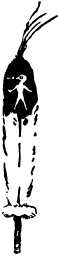
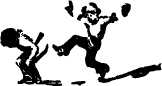
441 There was a great chorus of "How—How." Guy tried hard to look dignified and not grin, but it got beyond him. He was smiling right across and half way round. His mother beamed with pride till her eyes got moist and overflowed.
Every one thought the ceremony was over, but Yan stood up and began: "There is something that has been forgotten, Chiefs, Squaws and Pappooses of the Sanger Nation: When we went out after this Grizzly I was witness to a bargain between two of the War Chiefs. According to a custom of our Tribe, they bet their scalps, each that he would be the one to kill the Grizzly. The Head Chief Woodpecker was one and Hawkeye was the other. Hawkeye, you can help yourself to Woodpecker's scalp."
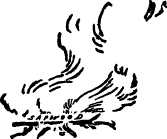
Sam had forgotten about this, but he bowed his head. Guy cut the string, and holding up the scalp, he uttered a loud, horrible war-whoop which every one helped with some sort of noise. It was the crowning event. Mrs. Burns actually wept for joy to see her heroic boy properly recognized at last.
Then she went over to Sam and said, "Did you bring your folks here to see my boy get praised?"
Sam nodded and twinkled an eye.
"Well, I don't care who ye are, Raften or no Raften, you got a good heart, an' it's in the right place. I never did hold with them as says 'There ain't no good in a Raften.' I always hold there's some good in every human. I know your Paw did buy the mortgage on our place, but I never did 442 believe your Maw stole our Geese, an' I never will, an' next time I hear them runnin' on the Raftens I'll jest open out an' tell what I know."
443
XXII
The Coon Hunt
Yan did not forget the proposed Coon hunt—in fact, he was most impatient for it, and within two days the boys came to Caleb about sundown and reminded him of his promise. It was a sultry night, but Yan was sure it was just right for a Coon hunt, and his enthusiasm carried all before it. Caleb was quietly amused at the "cool night" selected, but reckoned it would be "better later."
"Set down—set down, boys," he said, seeing them standing ready for an immediate start. "There's no hurry. Coons won't be running for three or four hours after sundown."
So he sat and smoked, while Sam vainly tried to get acquainted with old Turk; Yan made notes on some bird wings nailed to the wall, and Guy got out the latest improved edition of his exploits in Deer-hunting and Woodchuck killing, as well as enlarged on his plans for gloriously routing any Coon they might encounter.
By insisting that it would take an hour to get to the place, Yan got them started at nine o'clock, Caleb, on a suggestion from Guy, carrying a small axe. Keeping old Turk well in hand, they took the highway, and for half an hour tramped on toward the "Corners." Led by Sam, they climbed a fence 444 crossed a potato field, and reached the corn patch by the stream.
"Go ahead, Turk. Sic him! Sic him! Sic him!" and the company sat in a row on the fence to await developments.
Turk was somewhat of a character. He hunted what he pleased and when he pleased. His master could bring him on the Coon grounds, but he couldn't make him hunt Coon nor anything else unless it suited his own fancy. Caleb had warned the boys to be still, and they sat along the fence in dead silence, awaiting the summons from the old Hound. He had gone off beating and sniffing among the cornstalks. His steps sounded very loud and his sniffs like puffs of steam. It was a time of tense attention; but the Hound wandered, farther away, and even his noisy steps were lost.
They had sat for two long minutes, when a low yelp from a distant part of the field, then a loud "bow-wow" from the Hound, set Yan's heart jumping.
"Game afoot," said Sam in a low voice.
"Bet I heered him first," piped Guy.
Yan's first thought was to rush pell-mell after the Dog. He had often read of the hunt following furiously the baying of the Hounds, but Caleb restrained him.
"Hold on, boy; plenty of time. Don't know yet what it is."
445 For Turk, like most frontier Hounds, would run almost any trail—had even been accused of running on his own—and it rested with those who knew him best to discover from his peculiar style of tonguing just what the game might be. But they waited long and patiently without getting another bay from the Hound. Presently a rustling was heard and Turk came up to his master and lay down at his feet.
"Go ahead, Turk, put him up," but the Dog stirred not. "Go ahead," and Caleb gave him a rap with a small stick. The Dog dodged away, but lay down again, panting.
"What was it, Mr. Clark?" demanded Yan.
"Don't hardly know. Maybe he only spiked himself on a snag. But this is sure; there's no Coons here to-night. There won't be after this. We come too early, and it's too hot for the Dog, anyway."
"We could cross the creek and go into Boyle's bush," suggested the Woodpecker. "We're like to strike anything there. Larry de Neuville swears he saw a Unicorn there the night he came back from Garney's wake."
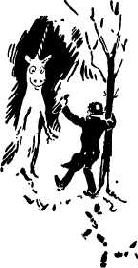
"How can you tell the kind of game by the Dog's barking?" asked Yan.
"H-m!" answered Caleb, as he put a fresh quid in his lantern jaw. "You surely can if you know the country an' the game an' the Dog. Course, no two Dogs is alike; you got to study your Dog, an' if he's good he'll larn you lots about trailing."
446 The brook was nearly dry now, so they crossed where they would. Then feeling their way through the dark woods with eyes for the most part closed, they groped toward Boyle's open field, then across it to the heavy timber. Turk had left them at the brook, and, following its course till he came to a pool, had had a bath. As they entered the timber tract he joined them, dripping wet and ready for business.
"Go ahead, Turk," and again all sat down to await the opinion of the expert.
It came quickly. The old Hound, after circling about in a way that seemed to prove him independent of daylight, began to sniff loudly, and gave a low whine. He followed a little farther, and now his tail was heard to 'tap, tap, tap' the brush as he went through a dry thicket.
"Hear that? He's got something this time," said Caleb in a low voice. "Wait a little."
The Hound was already working out a puzzle, and when at last he got far enough to be sure, he gave a short bark. There was another spell of sniffing, then another bark, then several little barks at intervals, and at last a short bay; then the baying recommenced, but was irregular and not full-chested. The sounds told that the Hound was running in a circle about the forest, but at length ceased moving, for all the barking was at one place. When the hunters got there they found the Dog half-way in a hole under a stump, barking and scratching.
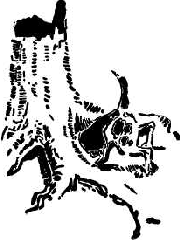
447 "Humph," said Caleb; "nothing but a Cottontail. Might 'a' knowed that by the light scent an' the circling without treeing."
So Turk was called off and the company groped through the inky woods in quest of more adventures.
"There's a kind of swampy pond down the lower end of the bush—a likely place for Coons on a Frog-hunt," suggested the Woodpecker.
So the Hound was again "turned on" near the pond. The dry woods were poor for scent, but the damp margin of the marsh proved good, and Turk became keenly interested and very sniffy. A preliminary "Woof!" was followed by one or two yelps and then a full-chested "Boooow!" that left no doubt he had struck a hot trail at last. Oh, what wonderfully thrilling horn-blasts those were! Yan for the first time realized the power of the "full cry," whose praises are so often sung.
The hunters sat down to await the result, for, as Caleb pointed out, there was "no saying where the critter might run."
The Hound bayed his fullest, roundest notes at quick intervals, but did not circle. The sound of his voice told them that the chase was straight away, out of the woods, easterly across an open field, and at a hot pace, with regular, full bellowing, unbroken by turn or doubt.
"I believe he's after the old Callaghan Fox," said the Trapper. "They've tried it together before now, an' there ain't anything but a Fox will run so straight and fetch such a tune out of Turk."
448 The baying finally was lost in the distance, probably a mile away, but there was nothing for it but to wait. If Turk had been a full-bred and trained Foxhound he would have stuck to that trail all night, but in half an hour he returned, puffing and hot, to throw himself into the shallow pond.
"Everything scared away now," remarked Caleb. "We might try the other side of the pond." Once or twice the dog became interested, but decided that there was nothing in it, and returned to pant by his master's feet.
They had now travelled so far toward home that a very short cut across fields would bring them into their own woods.
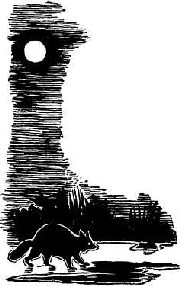
The moon arose as they got there, and after their long groping in the murky darkness this made the night seem very bright and clear.
They had crossed the brook below Granny de Neuville's, and were following the old timber trail that went near the stream, when Turk stopped to sniff, ran back and forth two or three times, then stirred the echoes with a full-toned bugle blast and led toward the water.
"Bow—bow—bow—bow," he bawled for forty yards and came to a stop. The baying was exactly the same that he gave on the Fox trail, but the course of the animal was crooked, and now there was a break.
They could hear the dog beating about close at hand and far away, but silent so far as tongue was concerned.
449 "What is it, Caleb?" said Sam with calm assurance, forgetting how recent was their acquaintance.
"Dunno," was the short reply.
"'Tisn't a Fox, is it?" asked Yan.
But a sudden renewal of "Bow—bow—bow—" from the Hound one hundred yards away, at the fence, ended all discussion. The dog had the hot trail again. The break had been along the line of a fence that showed, as Caleb said, "It was a Coon, 'cept it might be some old house Cat maybe; them was the only things that would run along top of a fence in the night time."
It was easy to follow now; the moonlight was good, and the baying of the Hound was loud and regular. It led right down the creek, crossing several pools and swamps.
"That settles it," remarked the Trapper decisively. "Cats don't take to the water. That's a Coon," and as they hurried they heard a sudden change in the dog's note, no longer a deep rich 'B-o-o-w-w.' It became an outrageous clamour of mingled yelps, growls and barks.
"Ha—heh. That means he's right on it. That is what he does when he sees the critter."
But the "view halloo" was quickly dropped and the tonguing of the dog was now in short, high-pitched yelps at one place.
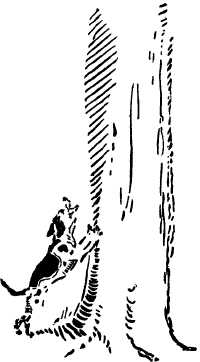
"Jest so! He's treed! That's a Coon, all right!" and Caleb led straight for the place.
The Hound was barking and leaping against a big Basswood, and Caleb's comment was: "Hm, 450 never knowed a Coon to do any other way—always gets up the highest and tarnalest tree to climb in the hull bush. Now who's the best climber here?"
"Yan is," volunteered Sam.
"Kin ye do it, Yan?"
"I'll try."
"Guess we'll make a fire first and see if we can't see him," said the Woodpecker.
"If it was a Woodchuck I'd soon get him for you," chimed in Hawkeye, but no one heeded.
Sam and Yan gathered stuff and soon had a flood of flickering red light on all the surrounding trees. They scanned the big Basswood without getting sight of their quarry. Caleb took a torch and found on the bark some fresh mud. By going back on the trail to where it had crossed the brook they found the footprint—undoubtedly that of a large Coon.
"Reckon he's in some hollow; he's surely up that tree, and Basswood's are always hollow."
Yan now looked at the large trunk in doubt as to whether he could manage it.
Caleb remarked his perplexity and said: "Yes; that's so. You ain't fifteen foot spread across the wings, are you? But hold on—"
He walked to a tall thin tree near at hand, cut it through with the axe in a few minutes, and threw it so as to rest against the lowest branch of the big Basswood. Up this Yan easily swarmed, carrying a stout Elm stick tied behind. When he got to the 451 great Basswood he felt lost in the green mass, but the boys below carried torches so as to shed light on each part in turn. At first Yan found neither hole in the trunk nor Coon, but after long search in the upper branches he saw a great ball of fur on a high crotch and in it two glowing eyes that gave him a thrill. He yelled: "Here he is! Look out below." He climbed up nearer and tried to push the Coon off, but it braced itself firmly and defied him until he climbed above it, when it leaped and scrambled to a lower branch.
Yan followed it, while his companions below got greatly excited, as they could see nothing, and only judged by the growling and snarling that Yan and the Coon were fighting. After another passage at arms the Coon left the second crotch and scrambled down the trunk till it reached the leaning sapling, and there perched, glaring at the hunters below. The old Hound raised a howl when he saw the quarry, and Caleb, stepping to one side, drew his revolver and fired. The Coon fell dead into their midst. Turk sprang to do battle, but he was not needed, and Caleb fondly and proudly wiped the old white pistol as though it alone were to be thanked for the clever shot.
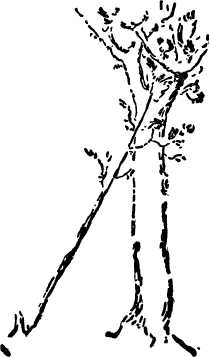
Yan came down quickly, though he found it harder to get down than up. He hurried excitedly into the ring and stroked the Coon with a mixture of feelings—admiring its fur—sorry, after all, that it was killed, and triumphant that he had led the way. 452 It was his Coon, and all admitted that. Sam "hefted" it by one leg and said, "Weighs thirty pounds, I bet."
Guy said: "Pooh! Tain't half as big as that there big Woodchuck I killed, an' you never would have got him if I hadn't thought of the axe."
Yan thought it would weigh thirty-five pounds. Caleb guessed it at twenty-five (and afterward they found out that it barely weighed eighteen). While they were thus talking the Dog broke into an angry barking such as he gave for strangers—his "human voice," Caleb called it—and at once there stepped into the circle William Raften. He had seen the lights in the woods, and, dreading a fire at this dry season, had dressed and come out.
"Hello, Da; why ain't you in bed, where you ought to be?"
Raften took no notice of his son, but said sneeringly to Caleb: "Ye ain't out trying to get another shot at me, air ye?" 'Tain't worth your while; I hain't got no cash on me to-night."
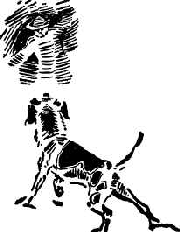
"Now see here, Da," said Sam, interrupting before Caleb could answer, "you don't play fair. I know, an' you ought to know, that's all rot about Caleb shooting at you. If he had, he'd 'a' got you sure. I've seen him shoot."
"Not when he was drunk."
"Last time I was drunk we was in it together," said Caleb fiercely, finding his voice.
453 "Purty good for a man as swore he had no revolver," and Raften pointed to Caleb's weapon. "I seen you with that ten years ago. An' sure I'm not scairt of you an' yer revolver," said Raften, seeing Caleb fingering his white pet; "an' I tell ye this. I won't have ye and yer Sheep-killing cur ramatacking through my woods an' making fires this dry saison."
"D—— you, Raften, I've stood all I'm goin' to stand from you." The revolver was out in a flash, and doubtless Caleb would have lived up to his reputation, but Sam, springing to push his father back, came between, and Yan clung to Caleb's revolver arm, while Guy got safely behind a tree.
"Get out o' the way, you kids!" snarled Caleb.
"By all manes," said Raften scoffingly; "now that he's got me unarrumed again. You dhirty coward! Get out av the way, bhoys, an Oi'll settle him," for Raften was incapable of fear, and the boys would have been thrust aside and trouble follow, but that Raften as he left the house had called his two hired men to follow and help fight the fire, and now they came on the scene. One of them was quite friendly with Caleb, the other neutral, and they succeeded in stopping hostilities for a time, while Sam exploded:
"Now see here, Da, 'twould just 'a' served you right if you'd got a hole through you. You make me sick, running on Caleb. He didn't make that fire; 'twas me an' Yan, an' we'll put it out safe enough. You skinned Caleb an' he never done you no harm. You run on him just as Granny de Neuville done 454 on you after she grabbed your groceries. You ought to be ashamed of yourself. Tain't square, an' 'tain't being a man. When you can't prove nothin' you ought to shut up."
Raften was somewhat taken aback by this outburst, especially as he found all the company against him. He had often laughed at Granny de Neuville's active hatred against him when he had done her nothing but good. It never occurred to him that he was acting a similar part. Most men would have been furious at the disrespectful manner of their son, but Raften was as insensitive as he was uncowardly. His first shock of astonishment over, his only thought of Sam was, "Hain't he got a cheek! My! but he talks like a lawyer, an' he sasses right back like a fightin' man; belave I'll make him study law instid of tooth-pullin'."
The storm was over, for Caleb's wrath was of the short and fierce kind, and Raften, turning away in moral defeat, growled: "See that ye put that fire out safe. Ye ought all to be in yer beds an' aslape, like dacint folks."
"Well, ain't you dacint?" retorted Sam.
Raften turned away, heeding neither that nor Guy's shrill attempt to interpolate some details of his own importance in this present hunt—"Ef it hadn't been for me they wouldn't had no axe along, Mr. Raften"—but William had disappeared.
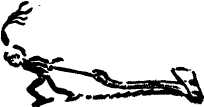
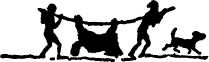
The boys put out the fire carefully and made somewhat silently for camp. Sam and Yan carried 455 the Coon between them on a stick, and before they reached the teepee they agreed that the carcass weighed at least eighty pounds.
Caleb left them, and they all turned in at once and slept the sleep of the tired camper.
456

XXIII
The Banshee's Wail and the Huge Night Prowler
Next day while working on the Coon-skin Sam and Yan discussed thoroughly the unpleasant incident of the night before, but they decided that it would be unwise to speak of it to Caleb unless he should bring up the subject, and Guy was duly cautioned.
That morning Yan went to the mud albums on one of his regular rounds and again found, first that curious hoof-mark that had puzzled him before, and down by the pond album the track of a very large bird—much like a Turkey track, indeed. He brought Caleb to see them. The Trapper said that one was probably the track of a Blue Crane (Heron), and the other, "Well, I don't hardly know; but it looks to me mighty like the track of a big Buck—only there ain't any short of the Long Swamp, and that's ten miles at least. Of course, when there's only out it ain't a track; it's an accident."
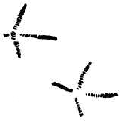
"Yes; but I've found lots of them—a trail every time, but not quite enough to follow."
That night after dark, when he was coming to camp with the product of a "massacree," Yan heard a peculiar squawking, guttural sound that rose from the edge of the pond and increased in strength, 457 drawing nearer, till it was a hideous and terrifying uproar. It was exactly the sound that Guy had provoked on that first night when he came and tried to frighten the camp. It passed overhead, and Yan saw for a moment the form of a large slow-flying bird.
Next day it was Yan's turn to cook. At sunrise, as he went for water, he saw a large Blue Heron rise from the edge of the pond and fly on heavy pinions away over the tree-tops. It was a thrilling sight. The boy stood gazing after it, absolutely rapt with delight, and when it was gone he went to the place where it rose and found plenty of large tracks just like the one he had sketched. Unquestionably it was the same bird as on the night before, and the mystery of the Wolf with the sore throat was solved. This explanation seemed quite satisfactory to everybody but Guy. He had always maintained stoutly that the woods were full of Bears right after sundown. Where they went at other times was a mystery, but he "reckoned he hadn't yet run across the bird that could scare him—no, nor the beast, nuther."
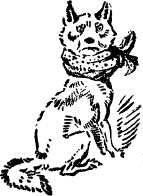
Caleb agreed that the grating cry must be that of the Blue Crane, but the screech and wail in the tree-tops at night he could shed no light on.
There were many other voices of the night that became more or less familiar. Some of them were evidently birds; one was the familiar Song-Sparrow, and high over the tree-tops from the gloaming sky they often heard a prolonged sweet song. It was 458 not till years afterward that Yan found out this to be the night-song of the Oven-bird, but he was able to tell them at once the cause of the startling outcry that happened one evening an hour after sundown.
The Woodpecker was outside, the other two inside the teepee. A peculiar sound fell on his ear. It kept on—a succession of long whines, and getting stronger. As it gave no sign of ending, Sam called the other boys. They stood in a row there and heard this peculiar "whine, whine, whine" develop into a loud, harsh "whow, whow, whow."
"It must be some new Heron cry," Yan whispered.
But the sound kept on increasing till it most resembled the yowling of a very strong-voiced Cat, and still grew till each separate "meow" might have been the yell of a Panther. Then at its highest and loudest there was a prolonged "meow" and silence, followed finally by the sweet chant of the Song-sparrow.
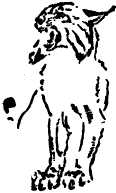
A great light dawned on Little Beaver. Now he remembered that voice in Glenyan so long ago, and told the others with an air of certainty:
"Boys, that's the yelling of a Lynx," and the next day Caleb said that Yan was right.
Some days later they learned that another lamb had been taken from the Raften flock that night.
In the morning Yan took down the tom-tom for a little music and found it flat and soft.
"Hallo," said he; "going to rain."
459 Caleb looked up at him with an amused expression. "You're a reg'lar Injun. It's surely an Injun trick that. When the tom-tom won't sing without being warmed at the fire they allus says 'rain before night.'"
The Trapper stayed late that evening. It had been cloudy all the afternoon, and at sundown it began to rain, so he was invited to supper. The shower grew heavier instead of ending. Caleb went out and dug a trench all round the teepee to catch the rain, then a leader to take it away. After supper they sat around the campfire in the teepee; the wind arose and the rain beat down. Yan had to go out and swing the smoke poles, and again his ear was greeted with the screech. He brought in an armful of wood and made the inside of the teepee a blaze of cheerful light. A high wind now came in gusts, so that the canvas flopped unpleasantly on the poles.
"Where's your anchor rope?" asked the Trapper.
Sam produced the loose end; the other was fastened properly to the poles above. It had never been used, for so far the weather had been fine; but now Caleb sunk a heavy stake, lashed the anchor rope to that, then went out and drove all the pegs a little deeper, and the Tribe felt safe from any ordinary storm.
There was nothing to attract the old Trapper to his own shanty. His heirs had begun to forget that he needed food, and what little they did send was of vilest quality. The old man was as fond of human society as any one, and was easily persuaded now to stay all night, "if you can stand Guy for a bedfeller." So Caleb and Turk settled down for a 460 comfortable evening within, while the storm raged without.
"Say, don't you touch that canvas, Guy; you'll make it leak."
"What, me? Oh, pshaw! How can it leak for a little thing like that?" and Guy slapped it again in bravado.
"All right, it's on your side of the bed," and sure enough, within two minutes a little stream of water was trickling from the place he had rubbed, while elsewhere the canvas turned every drop.
This is well known to all who have camped under canvas during a storm, and is more easily remembered than explained.
The smoke hung heavy in the top of the teepee and kept crowding down until it became unpleasant.
"Lift the teepee cover on the windward side, Yan. There, that's it—but hold on," as a great gust came in, driving the smoke and ashes around in whirlwinds. "You had ought to have a lining. Give me that canvas: that'll do." Taking great care not to touch the teepee cover, Caleb fastened the lining across three pole spaces so that the opening under the canvas was behind it. This turned the draught from their backs and, sending it over their heads, quickly cleared the teepee of smoke as well as kept off what little rain entered by the smoke hole.
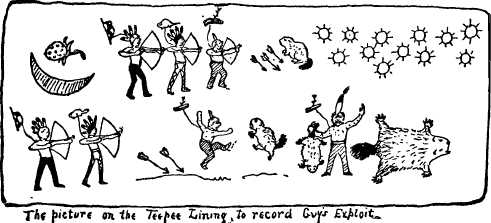
"It's on them linings the Injuns paint their records and adventures. They mostly puts their totems on the outside an' their records on the lining."
461 "Bully," said Sam; "now there's a job for you. Little Beaver; by the time you get our adventures on the inside and our totems on the out I tell you we'll be living in splendour."
"I think," answered Yan indirectly, "we ought to take Mr. Clark into the Tribe. Will you be our Medicine Man?" Caleb chuckled in a quiet way, apparently consenting. "Now I have four totems to paint on the outside," and this was the beginning of the teepee painting that Yan carried out with yellow clay, blue clay dried to a white, yellow clay burned to red, and charcoal, all ground in Coon grease and Pine gum, to be properly Indian. He could easily have gotten bright colours in oil paint, but scorned such White-man's truck, and doubtless the general effect was all the better for it.
"Say, Caleb," piped Guy, "tell us about the Injuns—about their bravery. Bravery is what I like," he added with emphasis, conscious of being now on his own special ground. "Why, I mind the time that old Woodchuck was coming roaring at me—I bet some fellers would just 'a' been so scared—"
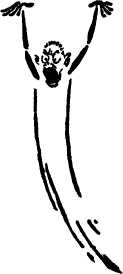
"Hssh!" said Sam.
Caleb smoked in silence. The rain pattered on the teepee without; the wind heaved the cover. They all sat silently. Then sounded loud and clear a terrifying "scrrrrrr—oouwurr." The boys were startled—would have been terrified had they been outside or alone.
"That's it—that's the Banshee," whispered Sam.
462 Caleb looked up sharply.
"What is it?" queried Yan. "We've heard it a dozen times, at least."
Caleb shook his head, made no reply, but turned to his Dog. Turk was lying on his side by the fire, and at this piercing screech he had merely lifted his head, looked backward over his shoulder, turned his big sad eyes on his master, then laid down again.
"Turk don't take no stock in it."
"Dogs never hear a Banshee," objected Sam, "no more than they can see a ghost; anyway, that's what Granny de Neuville says." So the Dog's negative testimony was the reverse of comforting.
"Hawkeye," said the Woodpecker, "you're the bravest one of the crowd. Don't you want to go out and try a shot at the Banshee? I'll lend you my Witch-hazel arrow. We'll give you a grand coup feather if you hit him. Go ahead, now—you know bravery is what you like."
"Yer nothin' but a passel o' blame dumb fools," was the answer, "an' I wouldn't be bothered talking to ye. Caleb, tell us something about the Indians."
"What the Injuns love is bravery," said the Medicine Man with a twinkle in his eye, and everybody but Guy laughed, not very loudly, for each was restrained by the thought that he would rather not be called upon to show his bravery to-night.
"I'm going to bed," said Hawkeye with unnecessary energy.
"Don't forget to roost under the waterspout you 463 started when you got funny," remarked the Woodpecker.
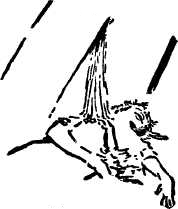
Yan soon followed Guy's example, and Sam, who had already learned to smoke, sat up with Caleb. Not a word passed between them until after Guy's snore and Yan's regular puffs told of sound sleep, when Sam, taking advantage of a long-awaited chance, opened out rather abruptly:
"Say, Caleb, I ain't going to side with no man against Da, but I know him just about as well as he knows me. Da's all right; he's plumb and square, and way down deep he's got an awful kind heart; it's pretty deep, I grant you, but it's there, O.K. The things he does on the quiet to help folks is done on the quiet and ain't noticed. The things he does to beat folks—an' he does do plenty—is talked all over creation. But I know he has a wrong notion of you, just as you have of him, and it's got to be set right."
Sam's good sense was always evident, and now, when he laid aside his buffoonery, his voice and manner were very impressive—more like those of a grown man than of a fifteen-year-old boy.
Caleb simply grunted and went on smoking, so Sam continued, "I want to hear your story, then Ma an' me'll soon fix Da."
The mention of "Ma" was a happy stroke. Caleb had known her from youth as a kind-hearted girl. She was all gentleness and obedience to her husband except in matters of what she considered right and wrong, and here she was immovable. She had always believed in Caleb, even after the row, and 464 had not hesitated to make known her belief.
"There ain't much to tell," replied Caleb bitterly. "He done me on that Horse-trade, an' crowded me on my note so I had to pay it off with oats at sixty cents, then he turned round and sold them within half an hour for seventy-five cents. We had words right there, an' I believe I did say I'd fix him for it. I left Downey's Dump early that day. He had about $300 in his pocket—$300 of my money—the last I had in the world. He was too late to bank it, so was taking it home, when he was fired at in going through the 'green bush'. My tobacco pouch and some letters addressed to me was found there in the morning. Course he blamed me, but I didn't have any shootin'-iron then; my revolver, the white one, was stole from me a week before—along with them same letters, I expect. I consider they was put there to lay the blame on me, an' it was a little overdone, most folks would think. Well, then your Da set Dick Pogue on me, an' I lost my farm—that's all."
Sam smoked gravely for awhile, then continued:
"That's true about the note an' the oats an' the Horse-trade—just what Da would do; that's all in the game: but you're all wrong about Dick Pogue—that's too dirty for Da."
"You may think so, but I don't."
Sam made no answer, but after a minute laid his hand on Turk, who responded with a low growl. This made Caleb continue: "Down on me, down on my Dog. Pogue says he kills Sheep 'an' every one is 465 ready to believe it. I never knowed a Hound turn Sheep-killer, an' I never knowed a Sheep-killer kill at home, an' I never knowed a Sheep-killer content with one each night, an' I never knowed a Sheep-killer leave no tracks, an' Sheep was killed again and again when Turk was locked up in the shanty with me."
"Well, whose Dog is it does it?"
"I don't know as it's any Dog, for part of the Sheep was eat each time, they say, though I never seen one o' them that was killed or I could tell. It's more likely a Fox or a Lynx than a Dog."
There was a long silence, then outside again the hair-lifting screech to which the Dog paid no heed, although the Trapper and the boy were evidently startled and scared.
They made up a blazing fire and turned in silently for the night.
The rain came down steadily, and the wind swept by in gusts. It was the Banshee's hour, and two or three times, as they were dropping off, that fearful, quavering human wail, "like a woman in distress," came from the woods to set their hearts a-jumping, not Caleb and Sam only, but all four.
In the diary which Yan kept of those times each day was named after its event; there was Deer day, Skunk-and-Cat day, Blue Crane day, and this was noted down as the night of the Banshee's wailing.