IV. OPENING STATEMENT OF THE PROSECUTION BY BRIGADIER GENERAL TELFORD TAYLOR, 9 DECEMBER 1946.[7]
Reading edition
IV. OPENING STATEMENT OF THE PROSECUTION BY BRIGADIER GENERAL TELFORD TAYLOR, 9 DECEMBER 1946.[7]
The defendants in this case are charged with murders, tortures, and other atrocities committed in the name of medical science. The victims of these crimes are numbered in the hundreds of thousands. A handful only are still alive; a few of the survivors will appear in this courtroom. But most of these miserable victims were slaughtered outright or died in the course of the tortures to which they were subjected.
For the most part they are nameless dead. To their murderers, these wretched people were not individuals at all. They came in wholesale lots and were treated worse than animals. They were 200 Jews in good physical condition, 50 gypsies, 500 tubercular Poles, or 1,000 Russians. The victims of these crimes are numbered among the anonymous millions who met death at the hands of the Nazis and whose fate is a hideous blot on the page of modern history.
The charges against these defendants are brought in the name of the United States of America. They are being tried by a court of American judges. The responsibilities thus imposed upon the representatives of the United States, prosecutors and judges alike, are grave and unusual. It is owed, not only to the victims and to the parents and children of the victims, that just punishment be imposed on the guilty, but also to the defendants that they be accorded a fair hearing and decision. Such responsibilities are the ordinary burden of any tribunal. Far wider are the duties which we must fulfill here.
These larger obligations run to the peoples and races on whom the scourge of these crimes was laid. The mere punishment of the defendants, or even of thousands of others equally guilty, can never redress the terrible injuries which the Nazis visited on these unfortunate peoples. For them it is far more important that these incredible events be established by clear and public proof, so that no one can ever doubt that they were fact and not fable; and that this Court, as the agent of the United States and as the voice of humanity, stamp these acts, and the ideas which engendered them, as barbarous and criminal.
We have still other responsibilities here. The defendants in the dock are charged with murder, but this is no mere murder trial. We cannot rest content when we have shown that crimes were committed and that certain persons committed them. To kill, to maim, and to torture is criminal under all modern systems of law. These defendants did not kill in hot blood, nor for personal enrichment. Some of them may be sadists who killed and tortured for sport, but they are not all perverts. They are not ignorant men. Most of them are trained physicians and some of them are distinguished scientists. Yet these defendants, all of whom were fully able to comprehend the nature of their acts, and most of whom were exceptionally qualified to form a moral and professional judgment in this respect, are responsible for wholesale murder and unspeakably cruel tortures.
It is our deep obligation to all peoples of the world to show why and how these things happened. It is incumbent upon us to set forth with conspicuous clarity the ideas and motives which moved these defendants to treat their fellow men as less than beasts. The perverse thoughts and distorted concepts which brought about these savageries are not dead. They cannot be killed by force of arms. They must not become a spreading cancer in the breast of humanity. They must be cut out and exposed, for the reason so well stated by Mr. Justice Jackson in this courtroom a year ago—
“The wrongs which we seek to condemn and punish have been so calculated, so malignant, and so devastating, that civilization cannot tolerate their being ignored because it cannot survive their being repeated.”
To the German people we owe a special responsibility in these proceedings. Under the leadership of the Nazis and their war lords, the German nation spread death and devastation throughout Europe. This the Germans now know. So, too, do they know the consequences to Germany: defeat, ruin, prostration, and utter demoralization. Most German children will never, as long as they live, see an undamaged German city.
To what cause will these children ascribe the defeat of the German nation and the devastation that surrounds them? Will they attribute it to the overwhelming weight of numbers and resources that was eventually leagued against them? Will they point to the ingenuity of enemy scientists? Will they perhaps blame their plight on strategic and military blunders by their generals?
If the Germans embrace those reasons as the true cause of their disaster, it will be a sad and fatal thing for Germany and for the world. Men who have never seen a German city intact will be callous about flattening English or American or Russian cities. They may not even realize that they are destroying anything worthwhile, for lack of a normal sense of values. To reestablish the greatness of Germany they are likely to pin their faith on improved military techniques. Such views will lead the Germans straight into the arms of the Prussian militarists to whom defeat is only a glorious opportunity to start a new war game. “Next time it will be different.” We know all too well what that will mean.
This case, and others which will be tried in this building, offer a signal opportunity to lay before the German people the true cause of their present misery. The walls and towers and churches of Nuernberg were, indeed, reduced to rubble by Allied bombs, but in a deeper sense Nuernberg had been destroyed a decade earlier, when it became the seat of the annual Nazi Party rallies, a focal point for the moral disintegration in Germany, and the private domain of Julius Streicher. The insane and malignant doctrines that Nuernberg spewed forth account alike for the crimes of these defendants and for the terrible fate of Germany under the Third Reich.
A nation which deliberately infects itself with poison will inevitably sicken and die. These defendants and others turned Germany into an infernal combination of a lunatic asylum and a charnel house. Neither science, nor industry, nor the arts could flourish in such a foul medium. The country could not live at peace and was fatally handicapped for war. I do not think the German people have as yet any conception of how deeply the criminal folly that was nazism bit into every phase of German life, or of how utterly ravaging the consequences were. It will be our task to make these things clear.
These are the high purposes which justify the establishment of extraordinary courts to hear and determine this case and others of comparable importance. That murder should be punished goes without the saying, but the full performance of our task requires more than the just sentencing of these defendants. Their crimes were the inevitable result of the sinister doctrines which they espoused, and these same doctrines sealed the fate of Germany, shattered Europe, and left the world in ferment. Wherever those doctrines may emerge and prevail, the same terrible consequences will follow. That is why a bold and lucid consummation of these proceedings is of vital importance to all nations. That is why the United States has constituted this Tribunal.
STATE MEDICAL SERVICES OF THE THIRD REICH
I pass now to the facts of the case in hand. There are 23 defendants in the box. All but three of them—Rudolf Brandt, Sievers, and Brack—are doctors. Of the 20 doctors, all but one—Pokorny—held positions in the medical services of the Third Reich. To understand this case, it is necessary to understand the general structure of these state medical services, and how these services fitted into the over-all organization of the Nazi State.
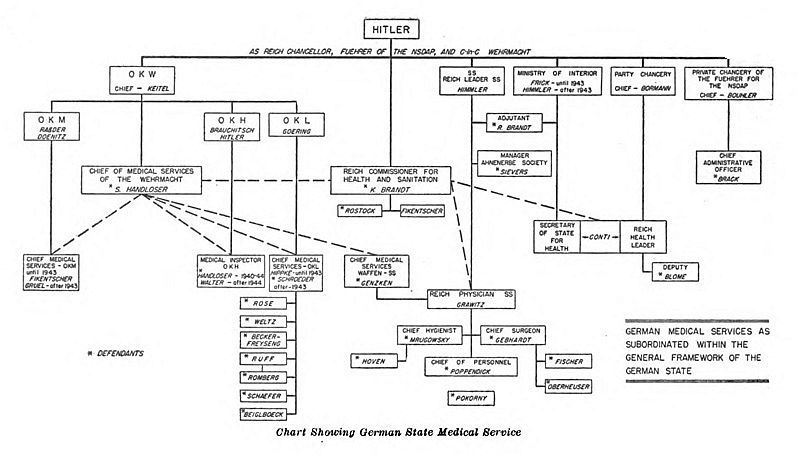
Chart Showing German State Medical Services
To assist the Court in this regard the prosecution has prepared a short expository brief [not introduced into evidence] which is already in the hands of the Court and which has been made available to defense counsel in German and English. The brief includes a glossary of the more frequent German words or expressions which will occur in this trial—most of them from the vocabulary of military, medical, or governmental affairs. It also includes a table of equivalent ranks [App. Vol. II] between the American Army and the German Army and the SS, and of the medical ranks used in the German Armed Forces and the SS. Finally, it includes a chart [see p. 30] showing the subordination of the several German medical services within the general framework of the German State. This chart has been enlarged and is displayed at the front of the courtroom.
Following this opening statement Mr. McHaney, in opening the presentation of evidence on behalf of the prosecution, will offer in evidence a series of detailed charts of the various German medical services, which have been certified as accurate by the defendants Handloser, Schroeder, Karl Brandt, Mrugowsky, and Brack. The chart to which I am now directing the attention of the Tribunal is a composite chart based upon those which Mr. McHaney will offer in evidence. The chart in the front of the courtroom to which I now refer will not be offered in evidence; it is intended merely as a convenient guide to the Court and to defense counsel to enable them to follow the opening statement and to comprehend the over-all structure of the German medical services.
All power in the Third Reich derived from Adolf Hitler, who was at one and the same time the head of the government, the leader of the Nazi Party, and the commander in chief of the armed forces. His title as head of the government was Reich Chancellor. He was the “Fuehrer” of the Nazi Party, and the “Supreme Commander” of the Wehrmacht. Immediately subordinate to Hitler were the chiefs of the armed forces, the principal cabinet ministers in the government, and the leading officials of the Nazi Party. The only defendant in the dock who was directly responsible to Hitler himself is the defendant Karl Brandt.
The Court will observe that the defendants fall into three main groups. Eight of them were members of the medical service of the German Air Force. Seven of them were members of the medical service of the SS. The remaining eight include the defendants Karl Brandt and Handloser, who occupied top positions in the medical hierarchy; it included the three defendants who are not doctors; the defendant Rostock, who was an immediate subordinate of Karl Brandt; the defendant Blome, a medical official of the Nazi Party; and the defendant Pokorny, whom we have grouped under the SS for reasons which will appear later.
I will deal first with the military side of the case. Hitler, as Supreme Commander of the German Armed Forces, exercised his authority through a staff called the Supreme Command of the Armed Forces, better known by its German initials, OKW (Oberkommando der Wehrmacht). The chief of this staff, throughout the period with which this case will concern itself, was Field Marshal Wilhelm Keitel.
Under the OKW came the High Commands of the three branches of the Wehrmacht: the Navy (OKM), the Army (OKH) and the Air Force (OKL). Grand Admiral Erich Raeder was the Commander in Chief of the German Navy until 1943, when he was succeeded by Grand Admiral Karl Doenitz. Prior to the outbreak of the war, the Commander in Chief of the German Army was Field Marshal von Brauchitsch. In December 1941 Brauchitsch was relieved and Hitler himself took this position. Hermann Goering was the Commander in Chief of the German Air Force with the rank of Reich Marshal, until the very last month of the war.
Each of the three branches of the Wehrmacht had its own medical service. For purposes of this case, the medical service of the Navy is not of much importance. During most of the war the defendant Handloser was the Chief of the Medical Service of the German Army; in 1944 he was succeeded in this capacity by Dr. Walter. The Chief of the Medical Service of the German Air Force until 1943 was Dr. Erich Hippke; from January 1944 until the end of the war, it was the defendant Schroeder. Subordinate to the defendant Schroeder are seven other defendants from the Air Force Medical Service, whose functions I will briefly describe later on.
I turn now to the second principal group of defendants—those affiliated with the SS. The SS was nominally a part of the Nazi Party, and came under Hitler in his capacity as Fuehrer of the NSDAP. In fact, during the years of the Nazi regime, the SS expanded into a vast complex of military, police, and intelligence organizations. The head of this extraordinary combine was Heinrich Himmler, with the title of Reich Leader SS. The SS had its own medical service, headed by Grawitz, who bore the title Reich Physician SS.
The SS in turn was divided into many departments, of which one of the most important was the Armed or Waffen SS. The members of the Waffen SS were trained and equipped as regular troops, were formed into regular military formations, and fought at the front side by side with the troops of the Wehrmacht. By the end of the war there were some 30 SS divisions in the line. The head of the Medical Service of the Waffen SS was the defendant Genzken.
Six other defendants were members of the SS Medical Service and therefore subordinated to Grawitz.
The German civilian medical services derived their authority both from the German Government and from the Party. The medical chief on the civilian side was Dr. Leonardo Conti, who committed suicide in October 1945. Dr. Conti occupied the position of State Secretary for Health in the Reich Ministry of the Interior. In this capacity Conti was a subordinate of the Minister of the Interior, Dr. Wilhelm Frick, until 1943, and thereafter to Heinrich Himmler who assumed the additional duties of Minister of the Interior in that year.
Conti also held the title in the Nazi Party of Reich Health Leader. His deputy in this capacity was the defendant Blome. As Reich Health Leader, Conti was subordinate to the Nazi Party Chancellery, the chief of which was Martin Bormann.
As the Court will see from the chart,[8] the three principal people in the hierarchy of German state health and medicine are the defendants Karl Brandt and Handloser, and the deceased Dr. Conti. In July 1942, Hitler issued a decree, a copy of which will later be read before the Court, which established the defendant Handloser as Chief of the Medical Services of the Wehrmacht. Shown on the chart here Handloser’s name appears in this capacity. Handloser was given supervisory and professional authority over the medical services of all three branches of the Wehrmacht. Inasmuch as the Waffen SS came to constitute an important part of the armed forces, Handloser’s supervisory authority also extended to the defendant Genzken, Chief of the Medical Service of the Waffen SS. In this position Handloser was charged with the coordination of all common tasks of the Medical Services of the Wehrmacht and the Waffen SS. He thus became the principal figure in German military medicine, just as Dr. Conti was the central figure in the field of civilian medicine.
Handloser and Conti, as will be seen from the chart, were not directly responsible to Hitler himself. Handloser’s responsibility ran to Hitler through the OKW, and Conti’s through the Ministry of the Interior and the chief of the Nazi Party Chancellery.
In 1942 Hitler for the first time established a medical and health official under his direct control. This official was the defendant Karl Brandt. A Hitler decree of July 1942 (NO-080) gave Brandt the title Plenipotentiary for Health and Medical Services, and empowered him to carry out special tasks and negotiations with reference to the requirements for doctors, hospitals, medical supplies, etc., between the military and civilian sectors of the health and sanitation systems. Brandt’s role, therefore, was to coordinate the requirements of the military and civilian agencies in the field of medicine and public health.
Dr. Karl Brandt had been the personal physician to Hitler since 1934. He was only 38 years old at the time he assumed the important duties conferred by the 1942 decree. His rise continued.
In September 1943 Hitler issued another decree which gave Brandt the title of General Commissioner for Sanitation and Health and empowered him to coordinate and direct the problems and activities of the entire administration for sanitation and health. (NO-081.) This authority was explicitly extended to the field of medical science and research.
Finally, in August 1944, Hitler appointed Dr. Brandt Reich Commissioner for Sanitation and Health, and stated that in this capacity Brandt’s office ranked as the “highest Reich authority.” (NO-082.) Brandt was authorized to issue instructions to the medical offices and organizations of the government, to the party, and the armed forces, in the field of sanitation and health.
Karl Brandt, as the supreme medical authority in the Reich, appointed the defendant Paul Rostock as his immediate subordinate to head the Office for Scientific and Medical Research. Rostock’s position reached into the activities of the medical societies, the medical colleges, and the Reich Research Council. Brandt also appointed Admiral Fikentscher, who had theretofore been the chief medical officer of the German Navy, as his subordinate to head the Office for Planning and Production. In this field, Fikentscher dealt with the principal labor authorities, the Ministry of Economics, and the Ministry for Armament and War Production.
As chief of the Medical Service of the German Air Force, the defendant Schroeder also held one of the most important positions in the German medical hierarchy. He and the defendant Handloser both held the rank of Generaloberstabsarzt, the highest rank in the German medical service and the equivalent of lieutenant general in the American Army. I do not propose to go into detail concerning the positions held by the seven defendants who were under Schroeder, inasmuch as Mr. McHaney will introduce charts which show in great detail the structure of the German Air Force Medical Service, and which have been authenticated by the defendant Schroeder himself. The defendant Rose held a high rank in the Air Force Medical Service equivalent to that of a brigadier general in the American Army and was appointed special adviser to Schroeder on matters pertaining to tropical medicine, held a chair at one of the most important German medical institutes, and is one of the most distinguished scientists in the dock. The defendant Becker-Freyseng headed Schroeder’s department for aviation medicine. The defendant Weltz was chief of the Institute for Aviation Medicine at Munich. The particular functions of the defendants Ruff, Romberg, Schaefer, and Beiglboeck will appear as we proceed with the presentation of the evidence.
I will likewise pass over very briefly the detailed functions of the six SS physicians who were shown on the chart as the subordinates of Grawitz. Detailed charts of the SS Medical Service, authenticated by the defendant Mrugowsky, will shortly be introduced in evidence. The defendant Gebhardt was Himmler’s personal physician and he held a rank in the SS equivalent to that of a major general in the American Army. He became the president of the German Red Cross. He was the chief surgeon on Grawitz’s staff, and also headed the hospital at Hohenlychen, in which capacity the defendants Oberheuser and Fischer were his assistants. The defendant Poppendick was the chief of Grawitz’s personal staff. The defendant Mrugowsky was Grawitz’s chief hygienist and also headed the Hygienic Institute of the Waffen SS. The defendant Hoven was the chief doctor of the Buchenwald concentration camp.
The defendant Pokorny is a private physician who had no official connection with the governmental medical service. We have shown him on the chart underneath the group of SS physicians for reasons which will appear in the course of presenting the evidence concerning sterilization experiments (par. 6 (I) of the indictment).
The three defendants who are not doctors are shown in the top right-hand corner of the chart. Two of them—Rudolf Brandt and Brack—are administrative officers. Rudolf Brandt had the rank of colonel in the SS, was sort of personal adjutant, and held an administrative office both in the SS and the Ministry of the Interior. Viktor Brack was the chief administrative officer in Hitler’s personal chancellery [Chancellery of the Fuehrer], the head of which was Philipp Bouhler.
The defendant Sievers, who held the rank of colonel in the SS, is a special case. He was a direct subordinate of Heinrich Himmler in the latter’s capacity as president of the so-called Ahnenerbe Society. The name of this society literally means “ancestral heritage”, and it was originally devoted to scientific and psuedo-scientific researches concerning the anthropological and cultural history of the German race. Later on an Institute for Military Scientific Research was set up within the Ahnenerbe Society. Sievers was the manager of the society and the director of the Institute for Military Scientific Research.
This concludes the general description of the German state medical services under the Nazi regime, and of the positions which the defendants occupied in the scheme of things. It is convenient at this point to refer to count four of the indictment, which charges that 10 of the defendants were members of an organization declared to be criminal by the International Military Tribunal, and that such membership is in violation of paragraph 1 (d) of Article II of Control Council Law No. 10. The organization in question is the SS.
This count concerns the defendant Karl Brandt, six of the defendants who were affiliated with the Medical Service of the SS, and three defendants who are not doctors. It does not concern any of the nine defendants on the military side, nor the defendants Rostock, Blome, Oberheuser, or Pokorny.
The International Military Tribunal’s declaration of criminality applies to all persons who had been officially accepted as members of any branch of the SS, and who remained members after 1 September 1939. The prosecution will show that all 10 defendants charged in count four were officially accepted as members of the SS and remained so after that date. The defendants Karl Brandt, Genzken, and Gebhardt held ranks in both the General or Allgemeine SS and the Waffen SS equivalent to that of a major general in the American Army. The defendants Mrugowsky, Hoven, Poppendick, and Fischer all held officer rank in the SS or Waffen SS, and all four of them, together with the defendants Genzken and Gebhardt, held positions in the SS Medical Service. The defendant Rudolf Brandt held the rank of colonel in the General (Allgemeine) SS, and was a personal assistant to Himmler in Himmler’s capacity as Reich Leader SS. The defendant Brack held officer rank in both the SS and the Waffen SS. The defendant Sievers held the rank of colonel in the SS, and was manager of the Ahnenerbe Society, which was attached to the SS Main Office.
The declaration of criminality by the International Military Tribunal does not apply when it appears that a member of the SS was drafted into membership in such a way as to give him no choice in the matter. Nor does it apply if it appears that the member had no knowledge that the organization was being used for the commission of criminal acts. For purposes of this case, these questions, the prosecution believes, will be academic. All of the defendants charged in count four held officer rank in the SS, and most of them held senior rank. They were moving spirits and personal participants in murder and torture on a large scale, and in a variety of other crimes. In this connection we respectfully invite the Tribunal’s attention to two statements by the International Military Tribunal which, under Article X of Ordinance No. 7, constitute proof in the absence of substantial new evidence to the contrary. In setting forth the criminal acts committed by the SS, the International Military Tribunal stated:[9]
“Also attached to the SS main offices was a research foundation known as the Experiments Ahnenerbe. The scientists attached to this organization are stated to have been mainly honorary members of the SS. During the war an institute for military scientific research became attached to the Ahnenerbe which conducted extensive experiments involving the use of living human beings.”
And again it was stated:[10]
“In connection with the administration of the concentration camps, the SS embarked on a series of experiments on human beings which were performed on prisoners of war or concentration camp inmates. These experiments included freezing to death and killing by poison bullets. The SS was able to obtain an allocation of Government funds for this kind of research on the grounds that they had access to human material not available to other agencies.”
CRIMES COMMITTED IN THE GUISE OF SCIENTIFIC RESEARCH
(Counts two and three, pars. 6, 7, 11, and 12)
I turn now to the main part of the indictment and will outline at this point the prosecution’s case relating to those crimes alleged to have been committed in the name of medical or scientific research. The charges with respect to “euthanasia” and the slaughter of tubercular Poles obviously have no relation to research or experimentation and will be dealt with later. What I will cover now comprehends all the experiments charged as war crimes in paragraph 6 and as crimes against humanity in paragraph 11 of the indictment, and the murders committed for so-called anthropological purposes which are charged as war crimes in paragraph 7 and as crimes against humanity in paragraph 12 of the indictment.
Before taking up these experiments one by one, let us look at them as a whole. Are they a heterogeneous list of horrors, or is there a common denominator for the whole group?
A sort of rough pattern is apparent on the face of the indictment. Experiments concerning high altitude, the effect of cold, and the potability of processed sea-water have an obvious relation to aeronautical and naval combat and rescue problems. The mustard gas and phosphorous burn experiments, as well as those relating to the healing value of sulfanilamide for wounds, can be related to air-raid and battlefield medical problems. It is well known that malaria, epidemic jaundice, and typhus were among the principal diseases which had to be combated by the German Armed Forces and by German authorities in occupied territories.
To some degree, the therapeutic pattern outlined above is undoubtedly a valid one, and explains why the Wehrmacht, and especially the German Air Force, participated in these experiments. Fanatically bent upon conquest, utterly ruthless as to the means or instruments to be used in achieving victory, and callous to the sufferings of people whom they regarded as inferior, the German militarists were willing to gather whatever scientific fruit these experiments might yield.
But our proof will show that a quite different and even more sinister objective runs like a red thread through these hideous researches. We will show that in some instances the true object of these experiments was not how to rescue or to cure, but how to destroy and kill. The sterilization experiments were, it is clear, purely destructive in purpose. The prisoners at Buchenwald who were shot with poisoned bullets were not guinea pigs to test an antidote for the poison; their murderers really wanted to know how quickly the poison would kill. This destructive objective is not superficially as apparent in the other experiments, but we will show that it was often there.
Mankind has not heretofore felt the need of a word to denominate the science of how to kill prisoners most rapidly and subjugated people in large numbers. This case and these defendants have created this gruesome question for the lexicographer. For the moment we will christen this macabre science “thanatology,” the science of producing death. The thanatological knowledge, derived in part from these experiments, supplied the techniques for genocide, a policy of the Third Reich, exemplified in the “euthanasia” program and in the wide-spread slaughter of Jews, gypsies, Poles, and Russians. This policy of mass extermination could not have been so effectively carried out without the active participation of German medical scientists.
I will now take up the experiments themselves. Two or three of them I will describe more fully, but most of them will be treated in summary fashion, as Mr. McHaney will be presenting detailed proof of each of them.
A. High-Altitude Experiments
The experiments known as “high-altitude” or “low-pressure” experiments were carried out at the Dachau concentration camp in 1942. According to the proof, the original proposal that such experiments be carried out on human beings originated in the spring of 1941 with a Dr. Sigmund Rascher. Rascher was at that time a captain in the medical service of the German Air Force, and also held officer rank in the SS. He is believed now to be dead.
The origin of the idea is revealed in a letter which Rascher wrote to Himmler in May 1941 at which time Rascher was taking a course in aviation medicine at a German Air Force headquarters in Munich. According to the letter, this course included researches into high-altitude flying and
“considerable regret was expressed at the fact that no tests with human material had yet been possible for us, as such experiments are very dangerous and nobody volunteers for them.” (1602-PS.)
Rascher, in this letter, went on to ask Himmler to put human subjects at his disposal and baldly stated that the experiments might result in death to the subjects but that the tests theretofore made with monkeys had not been satisfactory.
Rascher’s letter was answered by Himmler’s adjutant, the defendant, Rudolf Brandt, who informed Rascher that—
“* * * Prisoners will, of course, gladly be made available for the high-flight researches.” (1582-PS.)
Subsequently Rascher wrote directly to Rudolf Brandt asking for permission to carry out the experiments at the Dachau concentration camp, and he mentioned that the German Air Force had provided “a movable pressure chamber” in which the experiments might be made. Plans for carrying out the experiments were developed at a conference late in 1941, or early in 1942, attended by Dr. Rascher and by the defendants Weltz, Romberg, and Ruff, all of whom were members of the German Air Force Medical Service. The tests themselves were carried out in the spring and summer of 1942, using the pressure chamber which the German Air Force had provided. The victims were locked in the low-pressure chamber, which was an airtight ball-like compartment, and then the pressure in the chamber was altered to simulate the atmospheric conditions prevailing at extremely high altitudes. The pressure in the chamber could be varied with great rapidity, which permitted the defendants to duplicate the atmospheric conditions which an aviator might encounter in falling great distances through space without a parachute and without oxygen.
The reports, conclusions, and comments on these experiments, which were introduced here and carefully recorded, demonstrate complete disregard for human life and callousness to suffering and pain. These documents reveal at one and the same time the medical results of the experiments, and the degradation of the physicians who performed them. The first report by Rascher was made in April 1942, and contains a description of the effect of the low-pressure chamber on a 37-year-old Jew. (1971-A-PS.) I quote:
“The third experiment of this type took such an extraordinary course that I called an SS physician of the camp as witness, since I had worked on these experiments all by myself. It was a continuous experiment without oxygen at a height of 12 kilometers conducted on a 37-year-old Jew in good general condition. Breathing continued up to 30 minutes. After 4 minutes the experimental subject began to perspire and wiggle his head, after 5 minutes cramps occurred, between 6 and 10 minutes breathing increased in speed and the experimental subject became unconscious; from 11 to 30 minutes breathing slowed down to three breaths per minute, finally stopping altogether.
“Severest cyanosis developed in between and foam appeared at the mouth.
“At 5 minute intervals electrocardiograms from three leads were written. After breathing had stopped Ekg (electrocardiogram) was continuously written until the action of the heart had come to a complete standstill. About ½ hour after breathing had stopped, dissection was started.”
Rascher’s report also contains the following record of the “autopsy”:
“When the cavity of the chest was opened the pericardium was filled tightly (heart tamponade). Upon opening of the pericardium, 80 cc. of clear yellowish liquid gushed forth. The moment the tamponade had stopped, the right auricle of the heart began to beat heavily, at first at the rate of 60 actions per minute, then progressively slower. Twenty minutes after the pericardium had been opened, the right auricle was opened by puncturing it. For about 15 minutes, a thin stream of blood spurted forth. Thereafter, clogging of the puncture wound in the auricle by coagulation of the blood and renewed acceleration of the action of the right auricle occurred.
“One hour after breathing had stopped, the spinal marrow was completely severed and the brain removed. Thereupon, the action of the auricle of the heart stopped for 40 seconds. It then renewed its action, coming to a complete standstill 8 minutes later. A heavy subarachnoid oedema was found in the brain. In the veins and arteries of the brain, a considerable quantity of air was discovered. Furthermore, the blood vessels in the heart and liver were enormously obstructed by embolism.” (1971-A-PS.)
After seeing this report Himmler ironically ordered that if a subject should be brought back to life after enduring such an experiment, he should be “pardoned” to life imprisonment in a concentration camp. Rascher’s reply to this letter, dated 20 October 1942, reveals that up to the time the victims of these experiments had all been Poles and Russians, that some of them had been condemned to death, and Rascher inquired whether Himmler’s benign mercy extended to Poles and Russians. (1971-D-PS.) A teleptyped reply from the defendant, Rudolf Brandt, confirmed Rascher’s belief that Poles and Russians were beyond the pale and should be given no amnesty of any kind. (1971-E-PS.)
The utter brutality of the crimes committed in conducting this series of experiments is reflected in all the documents. A report written in May 1942 reflects that certain of these tests were carried out on persons described therein as “Jewish professional criminals.” In fact, these Jews had been condemned for what the Nazis called “Rassenschande,” which literally means “racial shame.” The crime consisted of marriage or intercourse between Aryans and non-Aryans. The murder and torture of these unfortunate Jews is eloquently reflected in the following report:
“Some of the experimental subjects died during a continued high-altitude experiment; for instance, after one-half hour at a height of 12 kilometers. After the skull had been opened under water, an ample amount of air embolism was found in the brain vessels and, in part, free air in the brain ventricles.
“In order to find out whether the severe psychic and physical effects, as mentioned under No. 3, are due to the formation of embolism, the following was done: After relative recuperation from such a parachute descending test had taken place, however before regaining consciousness, some experimental subjects were kept under water until they died. When the skull and cavities of the breast and of the abdomen were opened under water, an enormous amount of air embolism was found in the vessels of the brain, the coronary vessels, and the vessels of the liver and the intestines.” (NO-220.)
The victims who did not die in the course of such experiments, surely wished that they had. A long report written in July 1942 by Rascher, and by the defendants Ruff and Romberg, describes an experiment on a former delicatessen clerk, who was given an oxygen mask and raised in the chamber to an atmospheric elevation of over 47,000 feet, at which point the mask was removed and a parachute descent was simulated. The report describes the victim’s reactions—“spasmodic convulsions,” “agonal convulsive breathing,” “clonic convulsions, groaning,” “yells aloud,” “convulses arms and legs,” “grimaces, bites his tongue,” “does not respond to speech,” “gives the impression of someone who is completely out of his mind.” (NO-402.)
The evidence which we will produce will establish that the defendants Ruff and Romberg personally participated with Rascher in experiments resulting in death and torture; that the defendant Sievers watched the experiments for an entire day and made an oral report to Himmler on his observations; that the defendant Rudolf Brandt was the agent of Himmler in providing the human subjects for these experiments and in making many other facilities available to Rascher and rendering him general assistance; and that the defendant Weltz, in his official capacity, repeatedly insisted on supervision over and full responsibility and credit for the experiments. The higher authorities of both the German Air Force and the SS were fully informed concerning what was going on. Extensive correspondence will be introduced, for example, concerning the availability of the low-pressure chamber which the German Air Force furnished at Dachau, and concerning the availability of Rascher, who was an officer in the Air Force Medical Service, to conduct the experiments. Knowledge of, participation in, and responsibility for these atrocious crimes on the part of the defendants here charged will be clearly shown by the evidence.
B. Freezing Experiments
The deep interest of the German Air Force in capitalizing on the availability of inmates of concentration camps for experimental purposes is even more apparent in the case of the freezing experiments. These, too, were conducted at Dachau. They began immediately after the high-altitude experiments were completed and they continued until the spring of 1943. Here again, the defendant Weltz was directly in charge of the experiments, with Rascher as his assistant, as is shown in a letter written in May 1942 by Field Marshal Erhard Milch, the Inspector General of the German Air Force, to SS Obergruppenfuehrer Wolff, one of Heinrich Himmler’s principal subordinates, and this letter specifically requested that the freezing experiments be carried out at Dachau under Weltz’s supervision. (343-A-PS.)
The purpose of these experiments was to determine the most effective way of rewarming German aviators who were forced to parachute into the North Sea. The evidence will show that in the course of these experiments, the victims were forced to remain outdoors without clothing in freezing weather from 9 to 14 hours. In other cases, they were forced to remain in a tank of iced water for 3 hours at a time. The water experiments are described in a report by Rascher written in August 1942. (1618-PS.) I quote:
“Electrical measurements gave low temperature readings of 26.4° in the stomach and 26.5° in the rectum. Fatalities occurred only when the brain stem and the back of the head were also chilled. Autopsies of such fatal cases always revealed large amounts of free blood, up to ½ liter, in the cranial cavity. The heart invariably showed extreme dilation of the right chamber. As soon as the temperature in those experiments reached 28°, the experimental subjects died invariably, despite all attempts at resuscitation.”
Other documents set forth that from time to time the temperature of the water would be lowered by 10° Centigrade and a quart of blood would be taken from an artery in the subject’s throat for analysis. The organs of the victims who died were extracted and sent to the Pathological Institute at Munich.
Rewarming of the subjects was attempted by various means, most commonly and successfully in a very hot bath. In September, Himmler personally ordered that rewarming by the warmth of human bodies also be attempted, and the inhuman villains who conducted these experiments promptly produced four gypsy women from the Ravensbrueck concentration camp. When the women had arrived, rewarming was attempted by placing the chilled victim between two naked women.
A voluminous report on the freezing experiments conducted in tanks of ice water, written in October 1942, contains the following (NO-428):
“If the experimental subject were placed in the water under narcosis, one observed a certain arousing effect. The subject began to groan and made some defensive movements. In a few cases, a state of excitation developed. This was especially severe in the cooling of the head and neck. But never was a complete cessation of the narcosis observed. The defensive movements ceased after about 5 minutes. There followed a progressive rigor, which developed especially strongly in the arm musculature; the arms were strongly flexed and pressed to the body. The rigor increased with the continuation of the cooling, now and then interrupted by tonic-clonic twitching. With still more marked sinking of the body temperature, it suddenly ceased. These cases ended fatally, without any successful results from resuscitation efforts.
“Experiments without narcosis showed no essential differences in the course of cooling. Upon entry into the water, a severe cold shuddering appeared. The cooling of the neck and back of the head was felt as especially painful, but already after 5 to 10 minutes, a significant weakening of the pain sensation was observable. Rigor developed after this time in the same manner as under narcosis, likewise the tonic-clonic twitchings. At this point, speech became difficult because the rigor also affected the speech musculature.
“Simultaneously with the rigor, a severe difficulty in breathing set in with or without narcosis. It was reported that, so to speak, an iron ring was placed about the chest. Objectively, already at the beginning of this breathing difficulty, a marked dilatation of the nostrils occurred. The expiration was prolonged and visibly difficult. This difficulty passed over into a rattling and snoring breathing. * * *” [Emphasis not shown.]
During the winter of 1942 and 1943, experiments with “dry” cold were conducted. And Rascher reported on these in another letter to Himmler (1616-PS):
“Up to now, I have cooled off about 30 people stripped in the open air during nine to fourteen hours at 27° to 29°. After a time, corresponding to a trip of 1 hour, I put these subjects in a hot bath. Up to now, every single patient was completely warmed up within 1 hour at most, although some of them had their hands and feet frozen white.”
The responsibility among the defendants for the freezing experiments is substantially the same as for the high-altitude tests. The results were, if anything, ever more widely known in German medical circles. In October 1942, a medical conference took place here in Nuernberg at the Deutscher Hof Hotel, at which one of the authors of the report from which I have just quoted spoke on the subject “Prevention and Treatment of Freezing”, and the defendant Weltz spoke on the subject “Warming up after Freezing to the Danger Point.” Numerous documents which we will introduce show the widespread responsibility among the defendants, and in the highest quarters of the German Air Force, for these sickening crimes.
C. Malaria Experiments
Another series of experiments carried out at the Dachau concentration camp concerned immunization for and treatment of malaria. Over 1,200 inmates of practically every nationality were experimented upon. Many persons who participated in these experiments have already been tried before a general military court held at Dachau, and the findings of that court will be laid before this Tribunal. The malaria experiments were carried out under the general supervision of a Dr. Schilling, with whom the defendant Sievers and others in the box collaborated. The evidence will show that healthy persons were infected by mosquitoes or by injections from the glands of mosquitoes. Catholic priests were among the subjects. The defendant Gebhardt kept Himmler informed of the progress of these experiments. Rose furnished Schilling with fly eggs for them, and others of the defendants participated in various ways which the evidence will demonstrate.
After the victims had been infected, they were variously treated with quinine, neosalvarsan, pyramidon, antipyrin, and several combinations of these drugs. Many deaths occurred from excessive doses of neosalvarsan and pyramidon. According to the findings of the Dachau court, malaria was the direct cause of 30 deaths and 300 to 400 others died as the result of subsequent complications.
D. Mustard Gas Experiments
The experiments concerning mustard gas were conducted at Sachsenhausen, Natzweiler, and other concentration camps and extended over the entire period of the war. Wounds were deliberately inflicted on the victims, and the wounds were then infected with mustard gas. Other subjects were forced to inhale the gas, or to take it internally in liquid form, and still others were injected with the gas. A report on these experiments written at the end of 1939 described certain cases in which wounds were inflicted on both arms of the human guinea pigs and then infected, and the report states: “The arms in most of the cases are badly swollen and pains are enormous.”
The alleged purpose of these experiments was to discover an effective treatment for the burns caused by mustard gas. In 1944 the experiments were coordinated with a general program for research into gas warfare. A decree issued by Hitler in March 1944 ordered the defendant Karl Brandt to push medical research in connection with gas warfare. The defendant Rudolf Brandt sent copies of this decree to the defendant Sievers, to Grawitz, and others, and transmitted Hitler’s request that they confer soon with the defendant Karl Brandt “on account of the urgency of the order given him by the Fuehrer.” Subsequently, Sievers, who was thoroughly familiar with the mustard gas experiments being carried on in the concentration camps, reported the details of these experiments to the defendant Karl Brandt.
E. and F. Ravensbrueck Experiments Concerning Sulfanilamide and Other Drugs; Bone, Muscle, and Nerve Regeneration and Bone Transplantation
The experiments conducted principally on the female inmates of Ravensbrueck concentration camp were perhaps the most barbaric of all. These concerned bone, muscle, and nerve regeneration and bone transplantation, and experiments with sulfanilamide and other drugs. They were carried out by the defendants Fischer and Oberheuser under the direction of the defendant Gebhardt.
In one set of experiments, incisions were made on the legs of several of the camp inmates for the purpose of simulating battle-caused infections. A bacterial culture, or fragments of wood shavings, or tiny pieces of glass were forced into the wound. After several days, the wounds were treated with sulfanilamide. Grawitz, the head of the SS Medical Service, visited Ravensbrueck and received a report on these experiments directly from the defendant Fischer. Grawitz thereupon directed that the wounds inflicted on the subjects should be even more severe so that conditions similar to those prevailing at the front lines would be more completely simulated.
Bullet wounds were simulated on the subjects by tying off the blood vessels at both ends of the incision. A gangrene-producing culture was then placed in the wounds. Severe infection resulted within 24 hours. Operations were then performed on the infected areas and the wounds were treated with sulfanilamide. In each of the many sulfanilamide experiments, some of the subjects were wounded and infected but were not given sulfanilamide, so as to compare their reactions with those who received treatment.
Bone transplantation from one person to another and the regeneration of nerves, muscles, and bones were also tried out on the women at Ravensbrueck. The defendant Gebhardt personally ordered that bone transplantation experiments be carried out, and in one case the scapula of an inmate at Ravensbrueck was removed and taken to Hohenlychen Hospital and there transplanted. We will show that the defendants did not even have any substantial scientific objective. These experiments were senseless, sadistic, and utterly savage.
The defendant Oberheuser’s duties at Ravensbrueck in connection with the experiments were to select young and healthy inmates for the experiments, to be present at all of the surgical operations, and to give the experimental subjects post-operative care. We will show that this care consisted chiefly of utter neglect of nursing requirements, and cruel and abusive treatment of the miserable victims.
Other experiments in this category were conducted at Dachau to discover a method of bringing about coagulation of the blood. Concentration camp inmates were actually fired upon, or were injured in some other fashion in order to cause something similar to a battlefield wound. These wounds were then treated with a drug known as polygal in order to test its capacity to coagulate the blood. Several inmates were killed. Sulfanilamide was also administered to some and withheld from other inmates who had been infected with the pus from a phlegmon-diseased person. Blood poisoning generally ensued. After infection, the victims were left untreated for 3 or 4 days, after which various drugs were administered experimentally or experimental surgical operations were performed. Polish Catholic priests were used for these tests. Many died and others became invalids.
As a result of all of these senseless and barbaric experiments, the defendants are responsible for manifold murders and untold cruelty and torture.
G. Sea-Water Experiments
For the sea-water experiments we return to Dachau. They were conducted in 1944 at the behest of the German Air Force and the German Navy in order to develop a method of rendering sea-water drinkable. Meetings to discuss this problem were held in May 1944, attended by representatives of the Luftwaffe, the Navy, and I. G. Farben. The defendants Becker-Freyseng and Schaefer were among the participants. It was agreed to conduct a series of experiments in which the subjects, fed only with shipwreck emergency rations, would be divided into four groups. One group would receive no water at all; the second would drink ordinary sea-water; the third would drink sea-water processed by the so-called “Berka” method, which concealed the taste but did not alter the saline content; the fourth would drink sea-water treated so as to remove the salt.
Since it was expected that the subjects would die, or at least suffer severe impairment of health, it was decided at the meeting in May 1944 that only persons furnished by Himmler could be used. Thereafter in June 1944 the defendant Schroeder set the program in motion by writing to Himmler, and I quote from his letter (NO-185):
“Earlier you made it possible for the Luftwaffe to settle urgent medical matters through experiments on human beings. Today I again stand before a decision which, after numerous experiments on animals and also on voluntary human subjects, demands final solution: The Luftwaffe has simultaneously developed two methods for making sea-water drinkable. The one method, developed by a medical officer, removes the salt from the sea-water and transforms it into real drinking water; the second method, suggested by an engineer, only removes the unpleasant taste from the sea-water. The latter method, in contrast to the first, requires no critical raw material. From the medical point of view this method must be viewed critically, as the administration of concentrated salt solutions can produce severe symptoms of poisoning.
“As the experiments on human beings could thus far only be carried out for a period of 4 days, and as practical demands require a remedy for those who are in distress at sea up to 12 days, appropriate experiments are necessary.
“Required are 40 healthy test subjects, who must be available for 4 whole weeks. As it is known from previous experiments that necessary laboratories exist in the Dachau concentration camp, this camp would be very suitable.
“Due to the enormous importance which a solution of this question has for soldiers of the Luftwaffe and Navy who have become shipwrecked, I would be greatly obliged to you, my dear Reich Minister, if you would decide to comply with my request.”
Himmler passed this letter to Grawitz who consulted Gebhardt and other SS officials. A typical and nauseating Nazi discussion of racial questions ensued. One SS man suggested using quarantined prisoners and Jews; another suggested gypsies. Grawitz doubted that experiments on gypsies would yield results which were scientifically applicable to Germans. Himmler finally directed that gypsies be used with three others as a check.
The tests were actually begun in July 1944. The defendant Beiglboeck supervised the experiments, in the course of which the gypsy subjects underwent terrible suffering, became delirious or developed convulsions, and some died.
H. Epidemic Jaundice
The epidemic jaundice experiments, which took place at Sachsenhausen and Natzweiler concentration camps, were instigated by the defendant Karl Brandt. A letter written in 1943 by Grawitz stresses the enormous military importance of developing an inoculation against epidemic jaundice, which had spread extensively in the Waffen SS and the German Army, particularly in southern Russia. In some companies, up to 60 percent casualties from epidemic jaundice had occurred. Grawitz further informed Himmler that, and I quote:
“The General Commissioner of the Fuehrer, SS Brigadefuehrer Professor Dr. Brandt, has approached me with the request to help him obtain prisoners to be used in connection with his research on the causes of Epidemic Jaundice which has been furthered to a large degree by his efforts. * * * In order to enlarge our knowledge, so far based only on inoculation of animals with germs taken from human beings, it would not be necessary to reverse the procedure and inoculate human beings with germs cultivated in animals. Casualties (Todesfaelle) must be anticipated.”
Grawitz also had been doing research: on this problem with the assistance of a Dr. Dohmen, a medical officer attached to the Army Medical Inspectorate. Himmler made the following reply to the Grawitz letter (NO-011):
“I approve that eight criminals condemned in Auschwitz (eight Jews of the Polish Resistance Movement condemned to death) should be used for these experiments.”
Other evidence will indicate that the scope of these experiments was subsequently enlarged and that murder, torture, and death resulted from them.
I. Sterilization Experiments
In the sterilization experiments conducted by the defendants at Auschwitz, Ravensbrueck, and other concentration camps, the destructive nature of the Nazi medical program comes out most forcibly. The Nazis were searching for methods of extermination, both by murder and sterilization, of large population groups, by the most scientific and least conspicuous means. They were developing a new branch of medical science which would give them the scientific tools for the planning and practice of genocide. The primary purpose was to discover an inexpensive, unobtrusive, and rapid method of sterilization which could be used to wipe out Russians, Poles, Jews, and other people. Surgical sterilization was thought to be too slow and expensive to be used on a mass scale. A method to bring about an unnoticed sterilization was thought desirable.
Medicinal sterilizations were therefore carried out. A Dr. Madaus had stated that caladium seguinum, a drug obtained from a North American plant, if taken orally or by injection, would bring about sterilization. In 1941 the defendant Pokorny called this to Himmler’s attention, and suggested that it should be developed and used against Russian prisoners of war. I quote one paragraph from Pokorny’s letter written at that time (NO-035):
“If, on the basis of this research, it were possible to produce a drug which after a relatively short time, effects an imperceptible sterilization on human beings, then we would have a powerful new weapon at our disposal. The thought alone that the 3 million Bolsheviks, who are at present German prisoners, could be sterilized so that they could be used as laborers but be prevented from reproduction, opens the most far-reaching perspectives.”
As a result of Pokorny’s suggestion, experiments were conducted on concentration camp inmates to test the effectiveness of the drug. At the same time efforts were made to grow the plant on a large scale in hothouses.
At the Auschwitz concentration camp sterilization experiments were also conducted on a large scale by a Dr. Karl Clauberg, who had developed a method of sterilizing women, based on the injection of an irritating solution. Several thousand Jewesses and gypsies were sterilized at Auschwitz by this method.
Conversely, surgical operations were performed on sexually abnormal inmates at Buchenwald in order to determine whether their virility could be increased by the transplantation of glands. Out of 14 subjects of these experiments, at least 2 died.
The defendant Gebhardt also personally conducted sterilizations at Ravensbrueck by surgical operation. The defendant Viktor Brack, in March 1941, submitted to Himmler a report on the progress and state of X-ray sterilization experiments. Brack explained that it had been determined that sterilization with powerful X-rays could be accomplished and that castration would then result. The danger of this X-ray method lay in the fact that other parts of the body, if they were not protected with lead, were also seriously affected. In order to prevent the victims from realizing that they were being castrated, Brack made the following fantastic suggestion in his letter written in 1941 to Himmler, from which I quote (NO-203):
“One way to carry out these experiments in practice would be to have those people who are to be treated line up before a counter. There they would be questioned and a form would be given them to be filled out, the whole process taking 2 or 3 minutes. The official attendant who sits behind the counter can operate the apparatus in such a manner that he works a switch which will start both tubes together (as the rays have to come from both sides). With one such installation with two tubes about 150 to 200 persons could be sterilized daily, while 20 installations would take care of 3,000 to 4,000 persons daily. In my opinion the number of daily deportations will not exceed this figure.”
In this same report the defendant Brack related that, and I quote (NO-203):
“* * * the latest X-ray technique and research make it easily possible to carry out mass sterilization by means of X-rays. However, it appears to be impossible to take these measures without having those who were so treated finding out sooner or later that they definitely had been either sterilized or had been castrated by X-rays.”
Another letter from Brack to Himmler, in June 1942, laid the basis for X-ray experiments which were subsequently carried out at Auschwitz. The second paragraph of this letter forms a fitting conclusion to this account of Nazi depravity, and I quote (NO-205):
“Among 10 millions of Jews in Europe there are, I figure, at least 2 to 3 millions of men and women who are fit enough to work. Considering the extraordinary difficulties the labor problem presents us with, I hold the view that these 2 to 3 millions should be specially selected and preserved. This can, however, only be done if at the same time they are rendered incapable to propagate. About a year ago I reported to you that agents of mine have completed the experiments necessary for this purpose. I would like to recall these facts once more. Sterilization, as normally performed on persons with hereditary diseases, is here out of the question because it takes too long and is too expensive. Castration by X-rays, however, is not only relatively cheap but can also be performed on many thousands in the shortest time. I think that at this time it is already irrelevant whether the people in question become aware of having been castrated after some weeks or months, once they feel the effects.”
J. Typhus (Fleckfieber) and Related Experiments
From December 1941, until near the end of the war, a large program of medical experimentation was carried out upon concentration camp inmates at Buchenwald and Natzweiler to investigate the value of various vaccines. This research involved a variety of diseases—typhus, yellow fever, smallpox, paratyphoid A and B, cholera, and diphtheria. A dozen or more of the defendants were involved in these experiments which were characterized by the most cynical disregard of human life. Hundreds of persons died. The experiments concerning typhus—known in Germany as Fleckfieber or “spot fever”, but is not to be confused with American spotted fever—were particularly appalling.
The typhus experiments at Natzweiler were conducted by Dr. Eugen Haagen, an officer in the Air Force Medical Service and a professor at the University of Strasbourg. In the fall of 1943, through the defendant Sievers, Haagen obtained 100 concentration camp prisoners for experiments with typhus vaccines. Two hundred more prisoners were furnished in the summer of 1944. These experiments caused many fatalities among the prisoners.
The general pattern of these typhus experiments was as follows. A group of concentration camp inmates, selected from the healthier ones who had some resistance to disease, were injected with an anti-typhus vaccine, the efficacy of which was to be tested. Thereafter, all the persons in the group would be infected with typhus. At the same time, other inmates who had not been vaccinated were also infected for purposes of comparison—these unvaccinated victims were called the “control” group. But perhaps the most wicked and murderous circumstance in this whole case is that still other inmates were deliberately infected with typhus with the sole purpose of keeping the typhus virus alive and generally available in the bloodstream of the inmates.
The typhus murders at Buchenwald were carried out in 1942 and 1943 under the direction of the defendants Genzken and Mrugowsky. Requests for the human guinea pigs were turned over to, and filled by, the defendant Hoven. The bulk of the actual work was done by an infamous physician known as Dr. Ding, who committed suicide after the war. But Dr. Ding’s professional diary has survived.
The first entry in Ding’s diary, for 29 December 1941, reveals that here again the impetus for these murderous researches came from the Wehrmacht. This entry describes a conference sponsored by the defendant Handloser and Dr. Conti, respective heads of the military and civilian medical services of the Reich, which was also attended by the defendant Mrugowsky. Typhus had been making serious inroads on the German troops fighting in Russia. The account of this conference relates that, and I quote (NO-265):
“Since tests on animals are not of sufficient value, tests on human beings must be carried out.”
Other entries in the Ding diary quoted below are typical of those made over a period of 3 years, and give some idea of the mortality among the victims. (NO-265.)
“10 Jan 42: Preliminary test B: Preliminary test to establish a sure means of infection: Much as in smallpox vaccination, 5 persons were infected with virus through 2 superficial and 2 deeper cuts in the upper arm. All of the humans used for this test fell ill with true typhus. Incubation period up to 6 days.
“20 Feb 42: Chart of the case history of the preliminary tests to establish a sure means of infection were sent to Berlin. One death out of five sick.
“17 Mar 42: Visit of Prof. Gildemeister and Prof. Rose (department head for tropical medicine of the Robert Koch Institute) at the experimental station. All persons experimented on fell sick with typhus, except two, who, the fact was established later, already had been sick with typhus during an epidemic at the police prison in Berlin.
“9 Jan 43: By order of the surgeon general of the Waffen SS, SS Gruppenfuehrer and Major General of the Waffen SS, Dr. Genzken, the hitherto existing typhus research station at the concentration camp Buchenwald becomes the ‘Department for Typhus and Virus Research’. The head of the department will be SS Sturmbannfuehrer Dr. Ding. During his absence, the station medical officer of the Waffen SS, Weimar, SS Hauptsturmfuehrer Hoven will supervise the production of vaccines.
“13 and 14 Apr 43: Unit of SS Sturmbannfeuhrer Dr. Ding ordered to I. G. Farbenindustrie A. G., Hoechst. Conference with Prof. Lautenschlaeger, Dr. Weber and Dr. Fussgaenger about the experimental series ‘Acridine Granulate and Rutenol’ in the concentration camp Buchenwald. Visit to Geheimrat Otto and Prof. Prigge in the institute for experimental therapeutics in Frankfurt-on-Main.
“24 Apr 1943: Therapeutic experiments Acridine Granulate (A-GR2) and Rutenol (R-2) to carry out the therapeutic experiments Acridine Granulate and Rutenol, 30 persons (15 each) and 9 persons for control were infected by intravenous injection of 2 cc. each of fresh blood of a typhus sick person. All experimental persons got very serious typhus.
“1 Jun 1943: Charts of case history completed. The experimental series was concluded with 21 deaths; of these, 8 were in Buchenwald, 8 with Rutenol and 5 control.
“7 Sep 1943: Chart and case history completed. The experimental series was concluded with 53 deaths.
“8 Mar-18 Mar 1944: It is suggested by Colonel of this air corps, Prof. Rose, the vaccine ‘Kopenhagen’, produced from mouse liver by the National Serum Institute in Kopenhagen, be tested for its compatibility on humans. Twenty persons were vaccinated for immunization by intramuscular injection. * * * Ten persons were contemplated for control and comparison.
“16 Apr 1944: The remaining experimental persons were infected on 16 April by subcutaneous injection of 1/20 cc. typhus sick fresh blood. The following feel sick: 17 persons immunized: 9 medium, 8 seriously. Nine persons from the control: 2 medium, 7 seriously.
“13 Jun 1944: Chart and case history completed and sent to Berlin. Six deaths (3 ‘Kopenhagen’) (3 control).
“4 Nov 1944: Chart and case history completed. Twenty-four deaths.”
Copies of each of Dr. Ding’s official reports went to the defendants Mrugowsky and Poppendick as well as to the I. G. Farben laboratories at Hoechst. Nowhere will the evidence in this case reveal a more wicked and murderous course of conduct by men who claimed to practice the healing art than in the entries of Dr. Ding’s diary relating to the typhus experiments.
K. Poison Experiments
Here again the defendants were studying how to kill, and the scene is Buchenwald. Poisons were administered to Russian prisoners of war in their food, and German doctors stood behind a curtain to watch the reactions of the prisoners. Some of the Russians died immediately, and the survivors were killed in order to permit autopsies.
The defendant Mrugowsky, in a letter written in September 1944, has provided us with a record of another experiment in which the victims were shot with poisoned bullets, and I quote (NO-201):
“In the presence of SS Sturmbannfuehrer Dr. Ding, Dr. Widmann and the undersigned, experiments with aconitin nitrate projectiles were conducted on 11 September 1944 on 5 persons who had been condemned to death. The projectiles in question were of a 7.65 mm. caliber, filled with crystallized poison. The experimental subjects, in a lying position, were each shot in the upper part of the left thigh. The thighs of two of them were cleanly shot through. Afterwards, no effect of the poison was to be observed. These two experimental subjects were therefore exempted.
“During the first hour of the experiment the pupils did not show any changes. After 78 minutes the pupils of all three showed a medium dilation, together with a retarded light reaction. Simultaneously, maximum respiration with heavy breathing inhalations set in. This subsided after a few minutes. The pupils contracted again and their reaction improved. After 65 minutes the patellar and achilles tendon reflexes of the poisoned subjects were negative. The abdominal reflexes of two of them were also negative. After approximately 90 minutes, one of the subjects again started breathing heavily; this was accompanied by an increasing motor unrest. Then the heavy breathing changed into a flat, accelerated respiration, accompanied by extreme nausea. One of the poisoned persons tried in vain to vomit. To do so he introduced four fingers of his hand up to the knuckles into his throat, but nevertheless could not vomit. His face was flushed.
“The other two experimental subjects had already early shown a pale face. The other symptoms were the same. The motor unrest increased so much that the persons flung themselves up and then down, rolled their eyes and made meaningless motions with their hands and arms. Finally the agitation subsided, the pupils dilated to the maximum, and the condemned lay motionless. * * * Death occurred 121, 123, and 129 minutes after entry of the projectile.”
L. Incendiary Bomb Experiments
These experiments were likewise carried out at Buchenwald, and the Ding diary gives us the facts. In November 1943 five persons were deliberately burned with phosphorous material taken from an English incendiary bomb. The victims were permanently and seriously injured.
M. Jewish Skeleton Collection
I come now to charges stated in paragraphs 7 and 11 of the indictment. These are perhaps the most utterly repulsive charges in the entire indictment. They concern the defendants Rudolf Brandt and Sievers. Sievers and his associates in the Ahnenerbe Society were completely obsessed by all the vicious and malignant Nazi racial theories. They conceived the notion of applying these nauseous theories in the field of anthropology. What ensued was murderous folly.
In February 1942, Sievers submitted to Himmler, through Rudolf Brandt, a report from which the following is an extract (NO-085):
“We have a nearly complete collection of skulls of all races and peoples at our disposal. Only very few specimens of skulls of the Jewish race, however, are available with the result that it is impossible to arrive at precise conclusions from examining them. The war in the East now presents us with the opportunity to overcome this deficiency. By procuring the skulls of the Jewish-Bolshevik Commissars, who represent the prototype of the repulsive, but characteristic subhuman, we have the chance now to obtain a palpable, scientific document.
“The best, practical method for obtaining and collecting this skull material could be handled by directing the Wehrmacht to turn over alive all captured Jewish-Bolshevik Commissars to the Field Police. They in turn are to be given special directives to inform a certain office at regular intervals of the number and place of detention of these captured Jews and to give them special close attention and care until a special delegate arrives. This special delegate, who will be in charge of securing the ‘material’ has the job of taking a series of previously established photographs, anthropological measurements, and in addition has to determine, as far as possible, the background, date of birth, and other personal data of the prisoner. Following the subsequently induced death of the Jew, whose head should not be damaged, the delegate will separate the head from the body and will forward it to its proper point of destination in a hermetically sealed tin can, especially produced for this purpose and filled with a conserving fluid.
“Having arrived at the laboratory, the comparison tests and anatomical research on the skull, as well as determination of the race membership of pathological features of the skull form, the form and size of the brain, etc., can proceed. The basis of these studies will be the photos, measurements, and other data supplied on the head, and finally the tests of the skull itself.”
After extensive correspondence between Himmler and the defendants Sievers and Rudolf Brandt, it was decided to procure the skulls from inmates of the Auschwitz concentration camp instead of at the front. The hideous program was actually carried out, as is shown by a letter from Sievers written in June 1943, which states in part (NO-087):
“I wish to inform you that our associate, Dr. Beger, who was in charge of the above special project, has interrupted his experiments in the concentration camp Auschwitz because of the existing danger of epidemics. Altogether 115 persons were worked on, 79 were Jews, 30 were Jewesses, 2 were Poles, and 4 were Asiatics. At the present time these prisoners are segregated by sex and are under quarantine in the two hospital buildings of Auschwitz.”
After the death of these wretched Jews had been “induced” their corpses were sent to Strasbourg. A year elapsed, and the Allied armies were racing across France and were nearing Strasbourg where this monstrous exhibit of the culture of the master race reposed. Alarmed, Sievers sent a telegram to Rudolf Brandt in September 1944, from which I quote:
“According to the proposal of 9 February 1942, and your approval of 23 February 1942, Professor Dr. Hirt has assembled a skeleton collection which has never been in existence before. Because of the vast amount of scientific research that is connected with this project, the job of reducing the corpses to skeletons has not yet been completed. Since it might require some time to process 80 corpses, Hirt requested a decision pertaining to the treatment of the collection stored in the morgue of the Anatomy, in case Strasbourg should be endangered. The collection can be defleshed and rendered unrecognizable. This, however, would mean that the whole work had been done for nothing—at least in part—and that this singular collection would be lost to science, since it would be impossible to make plaster casts afterwards. The skeleton collection, as such is inconspicuous. The flesh parts could be declared as having been left by the French at the time we took over the Anatomy and would be turned over for cremating. Please advise me which of the following three proposals is to be carried out:
(1) The collection as a whole is to be preserved.
(2) The collection is to be dissolved in part.
(3) The collection is to be completely dissolved.”
The final chapter of this barbaric enterprise is found in a note in Himmler’s files addressed to Rudolf Brandt stating that:
“During his visit at the Operational Headquarters on 21 November 1944, Sievers told me that the collection in Strasbourg had been completely dissolved in conformance with the directive given him at the time. He is of the opinion that this arrangement is for the best in view of the whole situation.”
These men, however, reckoned without the hand of fate. The bodies of these unfortunate people were not completely disposed of, and this Tribunal will hear the testimony of witnesses and see pictorial exhibits depicting the charnel house which was the Anatomy Institute of the Reich University of Strasbourg.
I have now completed the sketch of some of the foul crimes which these defendants committed in the name of research. The horrible record of their degradation needs no underlining. But German medical science was in past years honored throughout the world, and many of the most illustrious names in medical research are German. How did these things come to pass? I will outline briefly the historical evidence which we will offer and which, I believe, will show that these crimes were the logical and inevitable outcome of the prostitution of German medicine under the Nazis.
GERMAN MEDICAL ORGANIZATION Before 1933
Two years after the reconstitution of the German Reich, in 1871, the German Medical Association (Deutscher Aerztevereinsbund) was created, which tied together the older local medical associations. This society existed until it was abolished by the Nazi Government. Its structure was democratic, and its interests included problems of hygiene and public health, and to an increasing extent, socio-medical problems especially in the field of sickness and disability insurance.
Bismarck’s legislation of 1881 established compulsory sickness insurance for workmen. In the course of the ensuing years, the vast bulk of the workmen were insured, and consequently most of the ordinary physician’s patients came to be insured patients. There were lists of physicians authorized to treat insured patients, and it was a matter of vital moment to every practicing physician to be listed. To protect their interest with respect to listing, fees, and other such problems, the German doctors founded a voluntary association for the defense of their economic interests known as the Hartmann Bund.
Questions of professional ethics, medical malpractice, etc., were handled in Germany in two distinct sets of medical boards or “Courts.” An entirely unofficial and voluntary system was established by the German Medical Association. The other, which was endowed with semi-official status, was called the Reich Chamber of Physicians. These chambers were elected by vote of the members and were supported by an assessment.
In addition to these organizations, there existed in Germany purely professional societies of doctors, where papers concerning scientific and practical problems were read and discussed, and which established connections with similar societies abroad. The German Government agencies which supervised the certification and licensing of physicians as well as their professional activities were the Ministry of Education and the Reich Health Office (Reichsgesundheitsamt) in the Ministry of the Interior. The latter supervised medical practice and licensing through the channels of the Ministries of the Interior of the various German states, although licensing was a federal function rather than a state function.
Medical education and training were rather standardized but good. The students spent 5 or 6 years at one of several of the medical universities; they took a final examination covering their clinical studies and then spent a year at an authorized hospital under supervision. Thereafter the interns were licensed and permitted to establish a practice. After two more years they became eligible to treat insurance patients, and, after submitting a thesis, could obtain the degree of doctor from a university.
Immediate Impact of Nazism on German Medicine
In the years immediately preceding the Third Reich, physicians’ organizations devoted to Party politics sprang up. One of these was the National Socialist Physicians’ Society, founded in 1929, in which Conti played a leading role. There was a rival association of Social Democratic Physicians, and a Socialist Society of Physicians. These societies proposed candidates for election to the Physicians’ Chambers, and thus the National Socialist Physicians’ Society and the Socialist associations came to compete with each other.
The notorious “boycott day” in Berlin, 1 April 1933, was a day of disgrace for German medicine. Members of the National Socialist Physicians’ Society, who knew the membership lists of the Socialist societies and the lists of Jewish physicians, broke into the apartments of their Socialist and Jewish colleagues in the early morning hours, pulled them out of their beds, beat them and brought them to the exhibition area near the Berlin Lehrter Station. There, all of them, including men up to 70 years old, were forced to run around the garden, as in a hippodrome, and they were shot at with pistols or beaten with sticks. There they had to stay for several days without sufficient food, and then were handed over to the SA which carried part of them to the cellars at the Hedemannstrasse jail for further tortures.
Thereafter, the members of the Socialist Society of Physicians were barred from all insurance practice because of “Communist and subversive activities.” In the subsequent listings of physicians issued by the insurance companies, the Jewish physicians were included in a separate list headed “Enemies of the State or Jews.” Soon, the insurance companies, even private ones, were no longer permitted to pay fees to the Jewish physicians. Immediately thereafter, Jewish physicians were excluded from all professional and scientific societies. At first, those who were war veterans were nominally allowed to carry on their insurance practice, but patients who kept going to them were threatened and exposed to all kinds of unpleasantness on the part of the insurance officials.
After the war began, certification and licensing were withdrawn from all Jewish physicians and they were degraded to the status of lay therapists. These physicians were forced to wear a blue shield with the Star of David and had to add a middle name such as “Sarah” or “Israel.” Their prescriptions likewise had to bear the Star of David, which exposed their patients to all kinds of unpleasantness when filling them at pharmacies, most of which had signs in their windows reading “Jews not wanted.”
At first, the Aryan physicians were allowed to treat Jewish patients, but finally they were prohibited from doing so. Hospitals refused admission to Jewish patients, apart from a few courageous ones who admitted them in defiance of the law. Jews were admitted to mental institutions in separate wards, but usually were quickly transported elsewhere for extermination.
In the early summer of 1943, Conti instigated and directed a wholesale persecution of doctors who were either foreigners or persons of so-called mixed blood and those related by marriage to Jews. At first, they were removed from their practice and sent off to posts under inferior Party doctors. In 1944, Conti went a step further and forbade these physicians to practice. They were drafted into the Speer organization, in which they were employed solely at manual labor, their living conditions being little better than those of concentration camp inmates.
Prostitution of German Medicine Under National Socialism
The totalitarian structure of the Nazi State demanded fundamental subordination of all principles of medicine to National Socialist population policy and racial concepts. The most emphatic and repelling expression of those new aims and goals came from the Nazi Director of Public Health in the Ministry of the Interior, Dr. Arthur Guett, who took office in 1933. In a book published in 1935 entitled “The Structure of Public Health in the Third Reich,” Guett announced that “the ill-conceived ‘love of thy neighbor’ has to disappear, especially in relation to inferior or asocial creatures. It is the supreme duty of a national state to grant life and livelihood only to the healthy and hereditarily sound portion of the people in order to secure the maintenance of a hereditarily sound and racially pure folk for all eternity. The life of an individual has meaning only in the light of that ultimate aim, that is, in the light of his meaning to his family and to his national state.”
The entire public health policy of the Third Reich was put in line with this pronouncement of principles. The Minister of the Interior, Frick, reorganized the Health Department in his ministry in such a way that police, public health, welfare administration and social services were all coordinated in pursuit of these goals. The beginnings of this reorganization started already in the summer of 1933 and were substantially completed by 1936. All these activities were concentrated under Dr. Guett, who was thus enabled to coordinate the practical application of his policy with his theoretical principles. Even psychiatric social service agencies, which did thorough and well-organized work prior to 1933, were reduced to mere screening stations for hereditary and racial selection.
All government-employed physicians had to take a special new course lasting 18 months and had to be Party members. The German Red Cross was likewise drawn into the orbit of the Nazi Party and the SS, in view of Dr. Grawitz’ appointment as president of the Red Cross. In 1945, after Grawitz’ suicide, the defendant Gebhardt succeeded him.
The Third Reich also completely reorganized the professional medical societies. The German Medical Association and the Hartmann Bund were abolished. All German physicians were reorganized through an organization derived from the Reich Physicians’ Chamber. This National Physicians’ Chamber was placed directly under a medical “fuehrer” with the title of “Reichsaerztefuehrer.” This position was also held by Conti. All doctors except those on active military duty were subordinate to him. His regional deputies were selected from the ranks of active National Socialists who terrorized the district branch societies. These deputies, who usually strutted about in SA or SS uniforms, were recruited mainly from the early members of the National Socialist Medical Association. It was their job to bring pressure on physicians to join and take part in various party organizations, such as the SA and SS.
A command performance, especially for younger physicians, was attendance at the so-called Fuehrer-School of German Physicians at Altrehse in Mecklenburg, which had been organized by the defendant Blome. There physicians were indoctrinated in the National Socialist point of view and way of life. The so-called comradely association and sports activity were merely window dressing for political spying. These courses finally became compulsory and had to be attended for several months annually.
The general respect, in which doctors were held, sunk in view of the decreasing level of general education and ability of the doctors. This was partly due to the constant occupation of the physicians’ time with Party functions, especially the time-consuming Party formations and marches which made it impossible for young physicians to develop scientific interests, so that recent graduates increasingly lost understanding and inclination for serious scientific study and long-range research.
Medical School and Medical Training Under the Nazis
On paper, medical training under the Nazis differed little from that of the pre-Nazi era. However, its fundamental spirit was ruinously distorted and medical standards suffered a dismal decline.
Medical students had to be “Aryan,” and were required to belong to the National Socialist Students’ League. The students’ entire course of studies was constantly interrupted by the demands of the various party organizations to which they were forced to belong. A student whose knowledge of the racial theories and Nuernberg laws was not sufficient would fail his medical examinations.
Chairs in the universities were filled in many cases by Nazi so-called “professors” who might or might not have a scientific background. The true scientific societies under the Nazi regime became less and less active, and the Nazi professors in the universities devoted more time and interest to their SA or SS organizations than to the teaching of medicine. These Nazi professors would don their brown SA or black SS uniforms on all possible occasions, exchanging them proudly for their academic gowns at all academic celebrations and meetings.
The worst Nazi politicians, like Streicher, were given the free run of university clinics, such as at Erlangen. This submissiveness to lay politicians led to a general decline of respect for German academic medicine not only on the part of their own public and abroad but even on the part of the very same politicians before whom they kowtowed. This went so far that Streicher, when addressing a full faculty meeting at the University of Erlangen in 1936, called the assembled professors “complete idiots” to their faces. This was by no means an isolated occurrence.
Particularly deplorable was the degradation of psychiatry. Psychiatric university teaching declined to the level of a mere rehashing of the Nuernberg and sterilization laws. The modern techniques of psychotherapy had been abandoned, and treatment deteriorated to pep talks full of Nazi indoctrination admonitions and threats. No wonder that these methods backfired against the best interest of the German war effort which they were foolishly intended to serve. The lack of proper understanding and treatment of German soldiers who developed combat fatigue or neuroses, on the part of their own medical personnel, drove many of them to surrender to the enemy; efforts to rehabilitate them and restore them to duty were frustrated by the ruinous infusion of Nazi doctrine.
Summary
The general decline of German medical conduct and the poisoning of German medical ethics which the Nazis brought about laid the basis for the atrocious experiments of which the defendants are accused.
Many of these were experiments in name only; we will show them to have been senseless and clumsy and of no real value to medicine as a healing art. The Nazi medical world was flooded with preposterous and wicked notions about superior and inferior races and developed a perverted moral outlook in which cruelty to subjugated races and peoples was praiseworthy. Training in SA and SS formations was hardly calculated to develop physicians who could comprehend even the bare elements of the doctor-patient relationship. In this noxious garden of lies, the seeds of the experiments were planted. In the climate of Nazi Germany, they grew with horrible rapidity.
CRIMES OF MASS EXTERMINATION; MURDER OF POLISH NATIONALS
From the preaching of Guett and others sprang the notions which underlie the crimes to which we will now turn. Here we leave behind all semblance, however fictitious, of science and research. Under these teachings, life and livelihood became the birthright of no one. The weak and the physically handicapped are in the way and must be pushed aside. Inferior peoples are born to be exterminated by the Herrenvolk.
The charges in paragraphs 8 and 13 of the indictment concern the defendants Blome and Rudolf Brandt. The original impetus for this terrible mass murder came from a fiend named Greiser, who was the German Governor of the northwest portions of Poland, which had been absorbed into the Reich under the name “Wartheland.” Early in 1942, Greiser was in the process of exterminating thousands of Jews in his territory, and he decided to turn his attention next to Poles infected with tuberculosis. I call the Tribunal’s special attention to the German word “Sonderbehandlung.” In the next document, as will be shown, it occurs frequently in Nazi correspondence and was used by them to mean extermination. In May 1942, Greiser wrote to Himmler as follows (NO-246):
“The special treatment [Sonderbehandlung] of about 100,000 Jews in the territory of my district approved by you in agreement with the Chief of the Reich Security Main Office, SS Obergruppenfuehrer Heydrich, can be completed within the next 2 to 3 months. I ask you for permission to rescue the district immediately after the measures are taken against the Jews, from a menace, which is increasing week by week, and to use the existing and efficient special commandos for that purpose.
“There are about 230,000 people of Polish nationality in my district who were diagnosed to suffer from tuberculosis. The number of persons infected with open tuberculosis is estimated at about 35,000. This fact has led in an increasing frightening measure to the infection of Germans, who came to the Warthegau perfectly healthy. In particular, reports are received with ever-increasing effect of German children in danger of infection. A considerable number of well-known leading men, especially of the police, have been infected lately and are not available for the war effort because of the necessary medical treatment. The ever-increasing risks were also recognized and appreciated by the deputy of the Reich Leader for Public Health (Reichsgesundheitsfuehrer) Comrade Professor Dr. Blome as well as by the leader of your X-ray battalion SS Standartenfuehrer Professor Dr. Hohlfelder.
“Though in Germany proper it is not possible to take appropriate draconic steps against this public plague, I think I could take responsibility for my suggestion to have cases of open TB exterminated among the Polish race here in the Warthegau. Of course only a Pole should be handed over to such an action, who is not only suffering from open tuberculosis, but whose incurability is proved and certified by a public health officer.
“Considering the urgency of this project I ask for your approval in principle as soon as possible. This would enable us to make the preparations with all necessary precautions now to get the action against the Poles suffering from open tuberculosis under way, while the action against the Jews is in its closing stages.”
Greiser’s proposal was supported in a letter from one, Koppe, the SS and police leader in that region, to the defendant Rudolf Brandt, to which Brandt replied stating that the matter was under consideration and that the final decision would rest with Hitler. Late in June, Himmler sent a “favorable” reply to Greiser cautioning him, however, that the exterminations should be carried out inconspicuously. Thereafter, consultations as to how to carry out the measure occurred between Greiser, Dr. Hohlfelder, and the defendant Blome. The views of Blome are embodied in a letter from him to Greiser written in November 1942. This letter contains an indescribably brutal analysis of the situation, in which Blome expresses agreement with the view that extermination of the tubercular Poles is the simplest and most logical solution, and expresses doubt as to its desirability only in that it would be difficult to keep such widespread slaughter secret, and that Hitler might think the program politically inexpedient if the facts should ever come out.
I quote from the letter of defendant Blome (NO-250):
“It was calculated that in 1939 there were among the Poles about 35,000 persons suffering from open tuberculosis and, besides this number, about 120,000 other consumptives in need of treatment. * * *
“With the settlement of Germans in all parts of the Gau an enormous danger has arisen for them. A number of cases of infection of settled children and adults occurs daily.
“Therefore, something basic must be done soon. One must decide the most efficient way in which this can be done. There are three ways to be taken into consideration:
1. Special treatment [Sonderbehandlung] of the seriously ill persons.
2. Most rigorous isolation of the seriously ill persons.
3. Creation of a reservation for all TB patients.
“For the planning, attention must be paid to different points of view of a practical, political, and psychological nature. Considering it most soberly, the simplest way would be the following: Aided by the X-ray battalion [Roentgen Sturmbann] we could reach the entire population, German and Polish, of the Gau during the first half of 1943. As to the Germans, the treatment and isolation are to be prepared and carried out according to the regulations for Tuberculosis Relief [Tuberkulosehilfe].
“The approximately 35,000 Poles who are incurable and infectious will be ‘specially treated’ [sonderbehandelt]. All other Polish consumptives will be subjected to an appropriate cure in order to save them for work and to avoid their causing contagion.
“According to your request I made arrangements with the offices in question, in order to start and carry out this radical procedure within half a year. You told me, that the competent office agreed with you as to this ‘special treatment’ and promised support. Before we definitely start the program, I think it would be correct if you would make sure once more that the Fuehrer will really agree to such a solution.
“There can be no doubt that the intended program is the most simple and most radical solution. If absolute secrecy could be guaranteed, all scruples—regardless of what nature—could be overcome. But I consider maintaining secrecy impossible. Experience has taught us that this assumption is true. Should those sick persons, having been brought, as planned, to the old Reich supposedly to be treated or healed, and they actually never return, the relatives of those sick persons in spite of the greatest secrecy would some day notice ‘that something was not quite right’.
“Therefore, I think it necessary to explain all those points of view to the Fuehrer before undertaking the program, as, in my opinion he is the only one able to view the entire complex and to come to a decision.”
The prosecution will introduce evidence to show that the program was in fact carried out at the end of 1942 and the beginning of 1943, and that as a result of the suggestions made by Blome and Greiser, many Poles were ruthlessly exterminated and that others were taken to isolated camps, utterly lacking in medical facilities, where thousands of them died.
EUTHANASIA
On 1 September 1939, the very day of the German attack on Poland, and after a great deal of discussion between Dr. Karl Brandt, Dr. Leonardo Conti, Philipp Bouhler, the Chief of the Chancellery of the Fuehrer, and others, Hitler issued the following authority to the defendant Karl Brandt (630-PS):
“Reichsleiter Bouhler and Dr. Brandt, M. D., are charged with the responsibility of enlarging the authority of certain physicians to be designated by name in such a manner that persons who, according to human judgment, are incurable can, upon a most careful diagnosis of their condition of sickness, be accorded a mercy death.
[Signed] Adolf Hitler”
After the receipt of this order, an organization was set up to execute this program, Karl Brandt headed the medical section and Philipp Bouhler, the administrative section. The defendant Hoven, as chief surgeon of the Buchenwald concentration camp, took part in the program and personally ordered the transfer of at least 300 to 400 Jewish inmates of different nationalities, mostly non-German, to their death in the euthanasia station at Bernburg. The defendants Brack and Blome participated in their capacities as assistants to Bouhler and Conti.