PETER KALM’s TRAVELS. (continued 3)
Johann Reinhold Forster translation
The Kalmia latifolia was likewise in full blossom at present. It rivals the preceding one, in the beauty of its colour; yet though they are conspicuous in regard to the colours and shape of their flowers, they are no ways remarkable for smell, such as the Magnolia is; for they have little or no smell at all. So equally and justly does nature distribute her gifts; no part of the creation has them all, each has its own, and none is absolutely without a share of them.
May the 30th. The Moravian Brethren, who arrived in great numbers from Europe, at New York, in May, brought two converted Greenlanders with them. The Moravians who were already settled in America, immediately sent some of their brethren from Philadelphia to the new comers, in order to welcome them. Among these deputies were two North American Indians, who had been converted to their doctrine, and likewise two South American Indians, from Surinam. These three kinds of converted Indians accordingly met at New York. I had no opportunity of seeing them; but all those who had seen them, and whom I conversed with, thought that they had plainly perceived a similarity in their features and shape, the Greenlanders being only somewhat smaller. They concluded from hence, that all these three kinds of Americans were the posterity of one and the same descendant of Noah, or that they were perhaps yet more nearly related. How far their guesses are to be relied upon, I cannot determine.
Ripe cherries were now already pretty common, and consequently cheap.
Yams are a species of roots, which are cultivated in the hottest parts of America, for eating, as we do potatoes. It has not yet been attempted to plant them here, and they are brought from the West Indies in ships; therefore they are reckoned a rarity here, and as such I ate them at Dr. Franklin’s to-day. They are white, and taste like common potatoes, but not quite so agreeable; and I think it would not be worth while to plant them in Sweden, though they might bear the climate. The plant these roots belong to is the Dioscorea alata.
The inhabitants make plenty of cheese. They are not reckoned so good as English cheese: however, some take them to be full as good when old; and so they seemed to me. A man from Boston in New-England told me, that they made very good cheese there: but they take care to keep the cattle from salt water, especially those who live near the sea-coasts; for it has been found, that the cheese will not become so good when the cows graze near salt water, as it will when they have fresh water. This, however, wants nearer examination, in my opinion.
May the 31st. About noon I left Philadelphia, and went on board a small yacht, which sails continually up and down upon the river Delaware, between Trenton and Philadelphia. We sailed up the river with fair wind and weather. Sturgeons leaped often a fathom into the air. We saw them continuing this exercise all day, till we came to Trenton. The banks on the Pensylvanian side were low; and those on the New Jersey side steep and sandy, but not very high. On both sides we perceived forests of tall trees, with deciduous leaves.
During the course of this month, the forenoon was always calm; but immediately after noon it began to blow gently, and sometimes pretty strongly. This morning was likewise fair; and in the afternoon it was cloudy, but did not rain.
The banks of the river were sometimes high, and sometimes low. We saw some small houses near the shore, in the woods; and, now and then, a good house built of stone. The river now decreased visibly in breadth. About three o’clock this afternoon we passed Burlington.
The banks of the river were now chiefly high and steep on the side of New Jersey, consisting of a pale brick-coloured soil. On the Pensylvanian side, they were gently sloping, and consisted of a blackish rich mould, mixed with particles of Glimmer (Mica). On the New Jersey side appeared some firs; but seldom on the other, except in a few places where they were accidentally brought over from New Jersey.
Towards night, after the tide had begun to ebb and the wind was quite subsided, we could not proceed, but dropped our anchor about seven miles from Trenton, and passed the night there. The woods were full of Fireflies, (Lampyris) which flew like sparks of fire between the trees, and sometimes across the river. In the marshes, the Bullfrogs now and then began their hideous roaring; and more than a hundred of them roared together. The Whip-poor-will, or Goatsucker, was likewise heard every where.
We saw abundance of chesnut-trees in the woods. They often stood in excessive poor ground, which was neither too dry nor too wet.
Tulip-trees did not appear on the road; but the people said there were some in the woods.
The Beaver-tree (Magnolia glauca) grows in the swamps. It was now in flower, and the fragrancy of its blossoms had so perfumed the air, that one could enjoy it before one approached the swamps; and this fine smell likewise shewed that a beaver-tree was near us, though we often happened not to see it.
The Phlox Glaberrima grows abundantly in the woods, and cuts a fine figure with its red flowers. It grows in such soil here as in Europe is occupied by the Lychnis viscaria and Lychnis dioica, or red Catchfly and Campion. The Phlox maculata grows abundantly in wet ground, and has fine red and odoriferous flowers. It grows on low meadows, where in Europe the Meadow-pinks, or Lychnis flos cuculi, would be met with. By adding to these flowers the Bartsia coccinea, the Lobelia cardinalis, and the Monarda didyma, which grow wild in this country, they are undoubtedly altogether adorned with the finest red imaginable.
The Sassafras-tree was abundant in the woods, and near the inclosures.
The houses which we passed by were most of them wooden. In one place, I saw the people building a house with walls of mere clay, which is likewise employed in making ovens for baking.
Buckwheat was already coming up in several places. We saw single plants of it all day in the woods, and in the fields, but always by the side of the road; from whence it may be concluded, that they spring up from lost and scattered seeds.
June the 4th. I found vines in several gardens, got from the old countries. They bear annually a quantity of excellent grapes. When the winters are very severe, they are killed by the frost, and die quite to the ground; but the next spring new shoots spring up from the root.
Strawberries were now sold in abundance about the town every day. An Englishman from Jamaica asserted, that in that island there were no strawberries. The snakes are very fond of strawberries. Those which they had here were not so good as the Swedish and Finland ones.
Red Clover was sown in several places on the hills without the town. The country people were now employed in mowing the meadows. Some were already mown; and the dry clover was put under cover, in order to be carried away the first opportunity.
June the 6th. Several gentlemen and merchants, between fifty and sixty years of age, asserted, that during their life they had plainly found several kinds of fish decrease in number every year; and that they could not get near so many fish now as they could formerly.
Long-Island is the name of an island opposite the town of New York, in the sea. The northern part of the island is much more fertile than the southern. Formerly there lived a number of Indians on this island; and there are yet some, which however decrease in number every year, because they leave the island. The soil of the southern part of the island is very poor; but this deficiency is made up by a vast quantity of oysters, lobsters, crabs, several kinds of fish, and numbers of water fowl, all which are there far more abundant than on the northern shores of the Island. Therefore the Indians formerly chose the southern part to live in, because they subsisted on oysters, and other productions of the sea. When the tide is out, it is very easy to fill a whole cart with oysters, which have been driven on shore by one flood. The Island is strewed with oystershells and other shells, which the Indians left there; these shells serve now for good manure for the fields. The southern part of the Island is turned into meadows, and the northern part into fields. The winter is more constant on the northern part, and the snow in spring lies longer there than on the southern part. The people are very fertile here, and commonly tall and strong.
June the 10th. At noon we left New York, and sailed up the river Hudson, in a yacht bound for Albany. All this afternoon we saw a whole fleet of little boats returning from New York, whither they had brought provisions and other goods for sale, which on account of the extensive commerce of this town, and the great number of its inhabitants, go off very well. The river Hudson runs from North to South here, except some high pieces of land which sometimes project far into it, and alter its direction; its breadth at the mouth is reckoned about a mile and a quarter. Some porpesses played and tumbled in the river. The eastern shore, or the New York side, was at first very steep and high; but the western was very sloping and covered with woods. There appeared farm-houses on both sides, surrounded with corn-fields. The ground of which the steep shores consisted was of a pale brick colour, and some little rocks of a grey sand-stone were seen here and there. About ten or twelve miles from New York, the western shore appears quite different from what it was before; it consists of steep mountains with perpendicular sides towards the river, and they are exactly like the steep sides of the mountains of Hall and Hunnebarg in West Gothland. Sometimes a rock projects like the salliant angle of a bastion: the tops of these mountains are covered with oaks, and other wood; a number of stones of all sizes lay along the shore, having rolled down from the mountains.
June the 11th. This morning we continued our voyage up the river, with the tide and a faint breeze. We now passed the Highland mountains, which were to the East of us; they consist of a grey sandstone, are very high and pretty steep, and covered with deciduous trees, and likewise with firs and red cedars. The western shore was full of rocks, which however did not come up to the height of the mountains on the opposite shore; the tops of these eastern mountains were cut off from our sight by a thick fog which surrounded them. The country was unfit for cultivation, being so full of rocks, and accordingly we saw no farms. The distance from these mountains to New York is computed at thirty-six English miles.
A thick fog now rose up from the high mountains. For the space of some English miles, we had hills and rocks on the western banks of the river; and a change of lesser and greater mountains and vallies covered with young firs, red cedars, and oaks, on the eastern side. The hills close to the river side are commonly low, but their height increases as they are further from the river. Afterwards we saw, for some miles together, nothing but high round mountains and valleys, both covered with woods; the valleys are in reality nothing but low rocks, and stand perpendicular towards the river in many places. The breadth of the river is sometimes two or three musket shot, but commonly not above one; every now and then we saw several kinds of fish leaping out of the water. The wind vanished away about ten o’clock in the morning, and forced us to get forwards with our oars, the tide being almost spent. In one place on the western shore we saw a wooden house painted red, and we were told, that there was a saw-mill further up; but besides this we did not perceive one farm or any cultivated grounds all this forenoon.
The water in the river has here no more a brackish taste; yet I was told that the tide, especially when the wind is South, sometimes carries the salt water up higher with it. The colour of the water was likewise altered, for it appeared darker here than before. To account for the first origin of rivers is very difficult, if not wholly impossible; some rivers may have come from a great reservoir of water, which being considerably encreased by heavy falls of rain or other circumstances, passed its old bounds and flowed to the lower countries, through the places where it met with the least opposition. This is perhaps the reason why some rivers run in so many bendings equally through fields of soft earth, as likewise there, where mountains, rocks, and stones, divert their passage. However it seems that some rivers derive their first origin from the creation itself, and that Providence then pointed out their course; for their existence can, in all probability, not be owing to the accidental eruption of water alone. Among these rivers we may rank the river Hudson: I was surprised on seeing its course, and the variety of its shores. It takes its rise a good way above Albany, and descends to New York, in a direct line from North to South, which is a distance of about a hundred and sixty English miles, and perhaps more; for the little bendings which it makes are of no signification. In many places between New York and Albany, are ridges of high mountains running West and East. But it is remarkable that they go on undisturbed till they come to the river Hudson, which cuts directly across them, and frequently their sides stand perpendicular towards the river. There is an opening left in the chain of mountains, as broad as the river commonly is, for it to pass through, and the mountains go on as before, on the other side, in the same direction. It is likewise remarkable, that the river in such places where it passes through the mountains is as deep, and often deeper than in the other places. The perpendicular rocks on the sides of the river are surprising, and it appears that if no passages had been opened by Providence, for the river to pass through, the mountains in the upper part of the country would have been inundated, since these mountains, like so many dykes, would have hindered the water from going on. Quere, Why does this river go on in a direct line for so considerable a distance? Why do the many passages, through which the river flows across the mountains, ly under the same meridian? Why are water-falls near some of these passages, or at least shallow water with a rocky ground?
We now perceived excessive high and steep mountains on both sides of the river, which echoed back each sound we uttered. Yet notwithstanding they were so high and steep, they were covered with small trees.
The Blue Mountains, which reared their towering tops above all the other mountains, were now seen before us, towards North, but at a great distance.
The country began here to look more cultivated, and less mountainous.
The last of the high western mountains is called Butterhill, after which the country between the mountains grows more spacious. The farms became very numerous, and we had a prospect of many corn-fields, between the hills: before we passed these hills we had the wind in our face, and we could only get forward by tacking, which went very slow, as the river was hardly a musket-shot in breadth. Afterwards we cast anchor, because we had both wind and tide against us.
Whilst we waited for the return of tide and the change of wind, we went on shore.
The Sassafras-tree (Laurus Sassafras) and the chesnut-tree grows here in great abundance. I found the tulip-tree (Liriodendron tulipifera) in some parts of the wood, as likewise the Kalmia latifolia, which was now in full blossom; though the flowers were already withering.
On several high grounds near the river, the people burnt lime. The master of the yacht told me, that they break a fine blueish grey limestone in the high grounds, along both sides of the river, for the space of some English miles, and burn lime of it. But at some miles distance there is no more limestone, and they find also none on the banks till they come to Albany.
We passed by a little neck of land, which projected on the western side in the river, and was called Dance. The name of this place is said to derive its origin from a festival which the Dutch celebrated here in former times, and at which they danced and diverted themselves; but once there came a number of Indians, who killed them all.
We cast anchor late at night, because the wind ceased and the tide was ebbing. The depth of the river is twelve fathoms here.
The fire-flies passed the river in numbers, at night, and sometimes settled upon the rigging.
June the 12th. This morning we proceeded with the tide, but against the wind. The river was here a musket-shot broad. The country in general is low on both sides, consisting of low rocks, and stony fields, which are however covered with woods. It is so rocky, stony, and poor, that nobody can settle in it, or inhabit it, there being no spot of ground fit for a corn-field. The country continued to have the same appearance for the space of some miles, and we never perceived one settlement. At eleven o’clock this morning we came to a little island, which lies in the middle of the river, and is said to be half-way between New York and Albany. The shores are still low, stony, and rocky, as before. But at a greater distance we saw high mountains, covered with woods, chiefly on the western shore, raising their tops above the rest of the country; and still further off, the Blue Mountains rose up above them. Towards noon it was quite calm, and we went on very slow. Here, the land is well cultivated, especially on the eastern shore, and full of great corn-fields; yet the soil seemed sandy. Several villages lay on the eastern side, and one of them, called Strasburg, was inhabited by a number of Germans. To the West we saw several cultivated places. The Blue Mountains are very plainly to be seen here. They appear through the clouds, and tower above all other mountains. The river is full an English mile broad opposite Strasburg.
They make use of a yellow Agaricus, or mushroom, which grows on maple-trees, for tinder; that which is found on the red-flowering maple (Acer rubrum) is reckoned the best, and next in goodness is that of the Sugar-maple (Acer saccarinum), which is sometimes reckoned as good as the former.
Rhinbeck is a place at some distance from Strasburg, further off from the river. It is inhabited by many Germans, who have a church there. Their clergyman at present was the Rev. Mr. Hartwig, who knew some Swedish, having been at Gothenburg for some time. This little town is not visible from the river-side.
At two in the afternoon it began again to blow from the south, which enabled us to proceed. The country on the eastern side is high, and consists of a well cultivated soil. We had fine corn-fields, pretty farms, and good orchards, in view. The western shore is likewise somewhat high, but still covered with woods, and we now and then, though seldom, saw one or two little settlements. The river is above an English mile broad in most places, and comes in a strait line from the North, so that we could not sometimes follow it with our eye.
June the 13th. The wind favoured our voyage during the whole night, so that I had no opportunity of observing the nature of the country. This morning at five o’clock we were but nine English miles from Albany. The country on both sides the river is low, and covered with woods, excepting a few little scattered settlements. Under the higher shores of the river are wet meadows, covered with sword-grass (Carex), and they formed several little islands. We saw no mountains; and hastened towards Albany. The land on both sides of the river is chiefly low, and more carefully cultivated as we came nearer to Albany.
As to the houses, which we saw, some were of wood, others of stone. The river is seldom above a musket-shot broad, and in several parts of it are sands, which require great experience for governing the yachts. At eight o’clock in the morning we arrived at Albany.
All the yachts which ply between Albany and New York, belong to Albany. They go up and down the river Hudson, as long as it is open and free from ice. They bring from Albany boards or planks, and all sorts of timber, flour, pease, and furs, which they get from the Indians, or which are smuggled from the French. They come home almost empty, and only bring a few merchandizes with them, among which rum is the chief. This last is absolutely necessary to the inhabitants of Albany; they cheat the Indians in the fur trade with it; for when the Indians are drunk, they will leave it to the Albanians to fix the price of the furs. The yachts are pretty large, and have a good cabbin, in which the passengers can be very commodiously lodged. They are commonly built of red Cedar, or of white Oak. Frequently, the bottom consists of white oak, and the sides of red cedar, because the latter withstands putrefaction much longer than the former. The red cedar is likewise apt to split, when it hits against any thing, and the river Hudson is in many parts full of sands and rocks, against which the keel of the yacht sometimes hits; therefore they choose white oak for the bottom, as being the softer wood, and not splitting so easily: and the bottom being continually under water, is not so much exposed to putrefaction, and holds out longer.
The Canoes which the yachts have along with them, are made of a single piece of wood, hollowed out; they are sharp on both ends, frequently three or four fathoms long, and as broad as the thickness of the wood will allow. The people in it do not row sitting, but commonly a fellow stands at each end, with a short oar in his hand, with which he governs and brings the canoe forwards. Those which are made here at Albany, are commonly of the white Pine; they can do service for eight or twelve years, especially if they be tarred and painted. At Albany they make them of the white pine, since there is no other wood fit for them; at New York they are made of the tulip-tree, and in other parts they are made of red or white cedars: but both these trees are so small, in the neighbourhood of Albany, that they are unfit for canoes; there are no seats in the canoes, for if they had any, they would be more liable to be overset, as one could not keep the equilibrium so well.
During summer, the wind blows commonly from the South, and brings a great drought along with it. Sometimes it rains a little, and as soon as it has rained the wind veers to North West, blowing for several days from that point, and then returning to the South. I have had frequent opportunities of seeing this change of wind happen very exactly, both this year and the following.
June the 15th. The enclosures were made of boards of fir-wood, of which there is abundance in the extensive woods, and many saw-mills to cut it into boards.
The several sorts of apple-trees grow very well here, and bear as fine fruit as in any other part of North America. Each farm has a large orchard. They have some apples here, which are very large, and very palatable; they are sent to New York, and other places as a rarity. They make excellent cyder, in autumn, in the country round Albany.
All the kinds of cherry-trees, which have been planted here, succeed very well.
Pear-trees do not succeed here. This was complained of in many other parts of North America. But I fear that they do not take sufficient care in the management and planting of them; for I have seen fine pears in several parts of North America.
Peach-trees have often been planted here, and never would succeed well. This was attributed to a worm which lives in the ground, and eats through the root, so that the tree dies. Perhaps the severity of the winter contributes much to it.
They plant no other fruit-trees at Albany besides these I have mentioned.
They sow as much hemp and flax here, as they want for home consumption.
They sow maize in great abundance: A loose soil is reckoned the best for this purpose; for it will not grow in clay. From half a bushel they reap a hundred bushels. They reckon maize a very good kind of corn, because the shoot recovers after being hurt by the frost. They have had examples here of the shoots dying twice in spring, to the very ground, and yet they shot up again afterwards, and afforded an excellent crop. Maize has likewise the advantage of standing much longer against a drought, than wheat. The larger sort of maize which is commonly sown here, ripens in September.
They sow wheat in the neighbourhood of Albany, with great advantage. From one bushel they get twelve sometimes; if the soil be good, they get twenty bushels. If their crop amounts only to ten bushels from one, they think it very trifling. The inhabitants of the country round Albany, are Dutch and Germans. The Germans live in several great villages, and sow great quantities of wheat, which is brought to Albany; and from thence they send many yachts laden with flour to New York. The wheat-flour from Albany is reckoned the best in all North America, except that from Sopus or King’s Town, a place between Albany and New York. All the bread in Albany is made of wheat. At New York they pay the Albany flour with several Shillings more per hundred weight, than that from other places.
Rye is likewise sown here, but not so generally as wheat.
They do not sow much barley here, because they do not reckon the profits very great. Wheat is so plentiful that they make malt of it. In the neighbourhood of New York, I saw great fields sown with barley.
They do not sow more oats than are necessary for their horses.
Potatoes are generally planted. Some people preferred ashes to sand for keeping them in during winter.
The Bermuda Potatoes (Convolvulus Batatas) have likewise been planted here, and succeed pretty well. The greatest difficulty is to keep them during winter; for they generally rot in that season.
The Humming-bird (Trochilus Colubris) comes to this place sometimes; but is rather a scarce bird.
The shingles with which the houses are covered are made of the White Pine, which is reckoned as good and as durable, and sometimes better, than the White Cedar (Cupressus thyoides). The White Pine is found abundant here, in such places where common pines grow in Europe, I have never seen them in the lower parts of the province of New York, nor in New Jersey and Pensylvania. They saw a vast quantity of deal from the White Pine on this side of Albany, which are brought down to New York, and from thence exported.
The woods abound with vines, which likewise grow on the steep banks of the river in surprising quantities. They climbed to the tops of trees on the bank, and bent them by their weight. But where they found no trees, they hung down along the steep shores, and covered them entirely. The grapes are eaten after the frost has attacked them; for they are too sour before. They are not much used any other way.
The vast woods and uninhabited grounds, between Albany and Canada, contain immense swarms of gnats, which annoy the travellers. To be in some measure secured against these insects, some besmear their face with butter or grease; for the gnats do not like to settle on greasy places. The great heat makes boots very uneasy; but to prevent the gnats from stinging the legs, they wrap some paper round them, under the stockings. Some travellers wear caps which cover the whole face, and have some gauze before the eyes. At night they lie in tents, if they can carry any with them; and make a great fire at the entrance, by the smoke of which the gnats are driven away.
The porpesses seldom go higher up the river Hudson than the salt water goes; after that, the sturgeons fill their place. It has however sometimes happened, that porpesses have gone quite up to Albany.
There is a report, that a whale once came up the river quite to this town.
The Fireflies (Lampyris) which are the same that are so common in Pensylvania during summer, are seen here in abundance every night. They fly up and down in the streets of this town. They come into, the houses, if the doors and windows are open.
Several of the Pensylvanian trees are not to be met with in these woods; viz.
Magnolia glauca, the Beaver-tree.
Nyssa aquatica, the Tupelo-tree.
Liquidambar styraciflua, the Sweet-gum tree.
Diospyros Virginiana, the Persimon.
Liriodendron tulipifera, the Tulip-tree.
Juglans nigra, the black Walnut-tree.
Quercus ——, the Swamp Oak.
Cercis Canadensis, the Sallad-tree.
Robinia pseudacacia, the Locust-tree.
Gleditsia triacanthos, the Honey-locust tree.
Annona muricata, the Papaw-tree.
Celtis occidentalis, the Nettle-tree. And a number of shrubs, which are never found here.
The more northerly situation of the place, the height of the Blue Mountains, and the course of the rivers, which flow here southward into the sea, and accordingly carry the seeds of plants from north to south, and not the contrary way, are chiefly the causes that several plants which grow in Pensylvania cannot be found here.
The American Elm-tree (Ulmus Americana) formed several high hedges. The soil of this island is a rich mould, mixed with sand, which is chiefly employed in maize plantations. There were likewise large fields of potatoes. The whole island was leased for one hundred pounds of New York currency. The person who had taken the lease, again let some greater and some smaller lots of ground, to the inhabitants of Albany, for making kitchen-gardens of; and by that means reimbursed himself. Portulack (Portulaca oleracea) grows spontaneously here in great abundance, and looks very well.
June the 20th. The tide in the river Hudson goes about eight or ten English miles above Albany, and consequently runs one hundred and fifty-six English miles from the sea. In spring, when the snow melts, there is hardly any flowing near this town; for the great quantity of water which comes from the mountains during that season, occasions a continual ebbing. This likewise happens after heavy rains.
The cold is generally reckoned very severe here. The ice in the river Hudson is commonly three or four feet thick. On the 3d of April some of the inhabitants crossed the river with six pair of horses. The ice commonly dissolves about the end of March, or beginning of April. Great pieces of ice come down about that time, which sometimes carry with them the houses that stand close to the shore. The water is very high at that time in the river, because the ice stops sometimes, and sticks in places where the river is narrow. The water has been often observed to rise three fathom higher than it commonly is in summer. The ground is frozen here in winter to the depth of three, four, or five feet. On the 16th of November the yachts are put up, and about the beginning or middle of April they are in motion again. They are unacquainted with stoves; and their chimnies are so wide that one could drive through them with a cart and horses.
The water of several wells in this town was very cool about this time; but had a kind of acid taste, which was not very agreeable. On a nearer examination, I found an abundance of little insects in it, which were probably Monoculi. Their length was different; some were a geometrical line and an half, others two, and others four lines long. They were very narrow, and of a pale colour. The head was blacker and thicker than the other parts of the body, and about the size of a pin’s head. The tail was divided into two branches, and each branch terminated in a little black globule. When these insects swim, they proceed in crooked or undulated lines, almost like Tadpoles. I poured some of this water into a bowl, and put near a fourth part of rum to it. The Monoculi, instead of being affected with it, swam about as briskly as they had done in the water. This shews, that if one makes punch with this water, it must be very strong to kill the Monoculi. I think this water is not very wholesome for people who are not used to it, though the inhabitants of Albany, who drink it every day, say, they do not feel the least inconvenience from it. I have been several times obliged to drink water here, in which I have plainly seen Monoculi swimming; but I generally felt the next day somewhat like a pea in my throat, or as if I had a swelling there; and this continued for above a week. I felt such swellings this year, both at Albany and in other parts. My servant, Yungstroem, likewise got a great pain in his breast, and a sensation as from a swelling, after drinking water with Monoculi in it: but whether these insects occasioned it, or whether it came from some other cause, I cannot ascertain. However, I have always endeavoured, as much as possible, to do without such water as had Monoculi in it. I have found Monoculi in very cold water, taken from the deepest wells, in different parts of this country. Perhaps many of our diseases arise from waters of this kind, which we do not sufficiently examine. I have frequently observed abundance of minute insects in water, which has been remarkable for its clearness. Almost each house in Albany has its well, the water of which is applied to common use; but for tea, brewing, and washing, they commonly take the water of the river Hudson, which flows close by the town. This water is generally quite muddy, and very warm in summer; and, on that account, it is kept in cellars, in order that the slime may subside, and that the water may cool a little.
We lodged with a gunsmith, who told us, that the best charcoals for the forge were made of the Black Pine. The next in goodness, in his opinion, were charcoals, made of the Beech-tree.
The best and dearest stocks for his muskets were made of the wood of the wild Cherry-tree; and next to these he valued those of the Red Maple most. They scarce make use of any other wood for this purpose. The black Walnut-tree affords excellent wood for stocks; but it does not grow in the neighbourhood of Albany.
June the 21st. Next to the town of New York, Albany is the principal town, or at least the most wealthy, in the province of New York. It is situated on the declivity of a hill, close to the western shore of the river Hudson, about one hundred and forty-six English miles from New York. The town extends along the river, which flows here from N. N. E. to S. S. W. The high mountains in the west, above the town, bound the prospect on that side. There are two churches in Albany, an English one and a Dutch one. The Dutch church stands at some distance from the river, on the east side of the market. It is built of stone; and in the middle it has a small steeple, with a bell. It has but one minister, who preaches twice every Sunday. The English church is situated on the hill, at the west end of the market, directly under the fort. It is likewise built of stone, but has no steeple. There was no service at this church at this time, because they had no minister; and all the people understood Dutch, the garrison excepted. The minister of this church has a settled income of one hundred pounds sterling, which he gets from England. The town-hall lies to the southward of the Dutch church, close by the river side. It is a fine building of stone, three stories high. It has a small tower or steeple, with a bell, and a gilt ball and vane at the top of it.
The fort lies higher than any other building, on a high steep hill on the West side of the town. It is a great building of stone, surrounded with high and thick walls; its situation is very bad, as it can only serve to keep off plundering parties, without being able to sustain a siege. There are numerous high hills to the west of the fort, which command it, and from whence one may see all that is done within it. There is commonly an officer and a number of soldiers quartered in it. They say the fort contains a spring of water.
The situation of Albany is very advantageous in regard to trade. The river Hudson, which flows close by it, is from twelve to twenty feet deep. There is not yet any quay made for the better lading of the yachts, because the people feared it would suffer greatly, or be entirely carried away in spring by the ice, which then comes down the river; the vessels which are in use here, may come pretty near the shore in order to be laden, and heavy goods are brought to them upon canoes tied together. Albany carries on a considerable commerce with New York, chiefly in furs, boards, wheat, flour, pease, several kinds of timber, &c. There is not a place in all the British colonies, the Hudson’s Bay settlements excepted, where such quantities of furs and skins are bought of the Indians, as at Albany. Most of the merchants in this town send a clerk or agent to Oswego, an English trading town upon the lake Ontario, to which the Indians resort with their furs. I intend to give a more minute account of this place in my Journal for the year 1750. The merchants from Albany spend the whole summer at Oswego, and trade with many tribes of Indians who come to them with their goods. Many people have assured me, that the Indians are frequently cheated in disposing of their goods, especially when they are in liquor, and that sometimes they do not get one half or even one tenth of the value of their goods. I have been a witness to several transactions of this kind. The merchants of Albany glory in these tricks, and are highly pleased when they have given a poor Indian a greater portion of brandy than he can bear, and when they can after that get all his goods for mere trifles. The Indians often find when they are sober again, that they have been cheated, they grumble somewhat, but are soon satisfied when they reflect that they have for once drank as much as they are able, of a liquor which they value beyond any thing else in the whole world, and they are quite insensible to their loss, if they again get a draught of this nectar. Besides this trade at Oswego, a number of Indians come to Albany from several parts, especially from Canada; but from this latter place, they hardly bring any thing but beaver-skins. There is a great penalty in Canada for carrying furs to the English, that trade belonging to the French West India Company; notwithstanding which the French merchants in Canada carry on a considerable smuggling trade. They send their furs, by means of the Indians, to their correspondents at Albany, who purchase it at the price which they have fixed upon with the French merchants. The Indians take in return several kinds of cloth, and other goods, which may be got here at a lower rate than those which are sent to Canada from France.
The greater part of the merchants at Albany have extensive estates in the country, and a great deal of wood. If their estates have a little brook, they do not fail to erect a saw-mill upon it for sawing boards and planks, with which commodity many yachts go during the whole summer to New York, having scarce any other lading than boards.
Many people at Albany make the wampum of the Indians, which is their ornament and their money, by grinding some kinds of shells and muscles; this is a considerable profit to the inhabitants. I shall speak of this kind of money in the sequel. The extensive trade which the inhabitants of Albany carry on, and their sparing manner of life, in the Dutch way, contribute to the considerable wealth which many of them acquire.
The avarice and selfishness of the inhabitants of Albany are very well known throughout all North America, by the English, by the French, and even by the Dutch, in the lower part of New York province. If a Jew, who understands the art of getting forward perfectly well, should settle amongst them, they would not fail to ruin him. For this reason nobody comes to this place without the most pressing necessity; and therefore I was asked in several places, what induced me to go to it, two years one after another. I likewise found that the judgment, which people formed of them, was not without foundation. For though they seldom see any strangers, (except those who go from the British colonies to Canada and back again) and one might therefore expect to find victuals and accommodation for travellers cheaper than in places, where travellers always resort to; yet I experienced the contrary. I was here obliged to pay for every thing twice, thrice, and four times as dear as in any part of North America which I have passed through. If I wanted their assistance, I was obliged to pay them very well for it, and when I wanted to purchase any thing, or to be helped in some case or other, I could presently see what kind of blood ran in their veins; for they either fixed exorbitant prices for their services, or were very backward to assist me. Such was this people in general. However, there were some amongst them who equalled any in North America, or any where else, in politeness, equity, goodness, and readiness to serve and to oblige; but their number fell far short of that of the former. If I may be allowed to declare my conjectures, the origin of the inhabitants of Albany and its neighbourhood seems to me to be as follows. Whilst the Dutch possessed this country, and intended to people it, the government took up a pack of vagabonds, of which they intended to clear the country, and sent them along with a number of other settlers to this province. The vagabonds were sent far from the other colonists, upon the borders towards the Indians and other enemies, and a few honest families were persuaded to go with them, in order to keep them in bounds. I cannot any other way account for the difference between the inhabitants of Albany, and the other descendants of so respectable a nation as the Dutch, who are settled in the lower part of New York province. The latter are civil, obliging, just in the prices, and sincere; and though they are not ceremonious, yet they are well meaning and honest, and their promises are to be relied on.
The inhabitants of Albany are much more sparing than the English. The meat which is served up is often insufficient to satisfy the stomach, and the bowl does not circulate so freely as amongst the English. The women are perfectly well acquainted with œconomy; they rise early, go to sleep very late, and are almost over nice and cleanly, in regard to the floor, which is frequently scoured several times in the week. The servants in the town are chiefly negroes. Some of the inhabitants wear their own hair, but it is very short, without a bag or queue, which are looked upon as the characteristics of Frenchmen; and as I wore my hair in a bag the first day I came here from Canada, I was surrounded with children, who called me Frenchman, and some of the boldest offered to pull at my French dress.
Their meat, and manner of dressing it, is very different from that of the English. Their breakfast is tea, commonly without milk. About thirty or forty years ago, tea was unknown to them, and they breakfasted either upon bread and butter, or bread and milk. They never put sugar into the cup, but take a small bit of it into their mouths whilst they drink. Along with the tea they eat bread and butter, with slices of hung beef. Coffee is not usual here; they breakfast generally about seven. Their dinner is butter-milk, and bread, to which they sometimes add sugar, then it is a delicious dish for them; or fresh milk and bread; or boiled or roasted flesh. They sometimes make use of butter-milk instead of fresh milk, to boil a thin kind of porridge with, which tastes very sour, but not disagreeable in hot weather. To each dinner they have a great sallad, prepared with abundance of vinegar, and very little or no oil. They frequently eat butter-milk, bread, and sallad, one mouthful after another. Their supper is generally bread and butter, and milk and bread. They sometimes eat cheese at breakfast, and at dinner; it is not in slices, but scraped or rasped, so as to resemble coarse flour, which they pretend adds to the good taste of cheese. They commonly drink very small beer, or pure water.
All the grounds were ploughed very even, as is usual in the Swedish province of Upland. Some were sown with yellow, and others with white Wheat. Now and then we saw great fields of flax, which was now beginning to flower. In some parts it grows very well, and in others it was but indifferent. The excessive drought which had continued throughout this spring, had parched all the grass and plants on hills and high grounds, leaving no other green, plant than the common Mullein (Verbascum Thapsus Linn.) which I saw in several places, on the driest and highest hills, growing in spite of the parching heat of the sun, and though the pastures and meadows were excessively poor, and afforded scarce any food at all, yet the cattle never touched the Mullein. Now and then I found fields with pease, but the Charlock, (Sinapis arvensis Linn.) kept them quite under. The soil in most of these fields is a fine mould, which goes pretty deep.
The wild vines cover all the hills along the rivers, on which no other plants grow, and on those which are covered with trees, they climb to the tops of them, and wholly cover them, making them bend down with their weight. They had already large grapes; we saw them abundant all this day, and during all the time that we kept to the river Hudson, on the hills, along the shores, and on some little islands in the river.
The white-backed Maize-thieves appeared now and then, flying amongst the bushes: their note is fine, and they are not so large as the black maize-thieves, (Oriolus Phœniceus). We saw them near New York, for the first time.
We found a Water-beech tree (Platanus occidentalis) cut down near the road, measuring about five feet in diameter.
This day, and for some days afterwards, we met with islands in the river. The larger ones were cultivated, and turned into corn-fields and meadows.
We walked about five English miles along the river to-day, and found the ground, during that time, very uniform, and consisting of pure earth. I did not meet with a single stone on the fields. The Red Maple, the Water-beech, the Water-asp, the wild Prune-tree, the Sumach, the Elm, the wild Vines, and some species of Willows, were the trees which we met with on the rising shores of the river, where some Asparagus (Asparagus officinalis) grew wild.
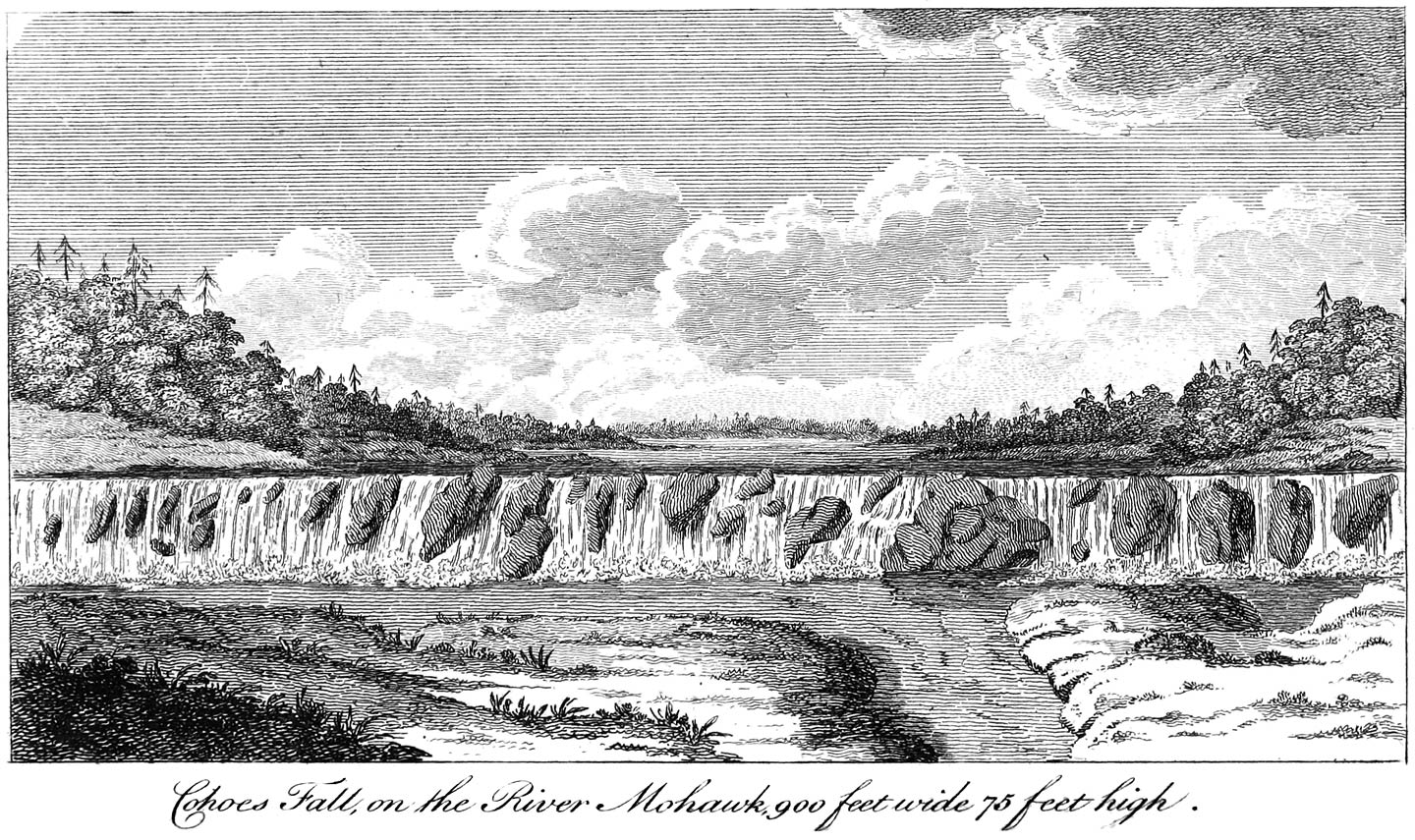
Cohoes Fall, on the River Mohawk, 900 feet wide 75 feet high.
We passed the night about six miles from Albany, in a countryman’s cottage. On the west side of the river we saw several houses, one after another, inhabited by the descendants of the first Dutch settlers, who lived by cultivating their grounds. About half an English mile beyond our lodgings, was the place where the tide stops in the river Hudson, there being only small and shallow streams above it. At that place they catch a good many sorts of fish in the river.
June the 22d. This morning I followed one of our guides to the water-fall near Cohoes, in the river Mohawk, before it falls into the river Hudson. This fall is about three English miles from the place where I passed the night. The country till the fall is a plain, and only hilly about the fall itself. The wood is cleared in most places, and the ground cultivated, and interspersed with farm-houses.
The Cohoes Fall is one of the greatest in North America. It is in the river Mohawk, before it unites with the river Hudson. Above and below the fall, the sides and the bottom of the river consist of hard rock. The river is three hundred yards broad here. At the fall there is a rock crossways in the river, running every where equally high, and crossing in a strait line with the side which forms the fall. It represents, as it were, a wall towards the lower side, which is not quite perpendicular, wanting about four yards. The height of this wall, over which the water rolls, appeared to me about twenty or twenty-four yards. I had marked this height in my pocket-book; and afterwards found it agreed pretty well with the account which that ingenious engineer, Mr. Lewis Evans, communicated to me at Philadelphia. He said, that he had geometrically measured the breadth and height of the fall, and found it nine hundred English feet broad, and seventy-five feet high. The representation of this fall, which is here joined, has been made by Mr. Evans. There was very little water in the river at present, and it only ran over the fall in a few places. In such places where the water had rolled down before, it had cut deep holes below into the rock, sometimes to the depth of two or three fathoms. The bed of the river, below the fall, was of rock, and quite dry, there being only a channel in the middle fourteen feet broad, and a fathom or somewhat more deep, through which the water passed which came over the fall. We saw a number of holes in the rock, below the fall, which bore a perfect resemblance to those in Sweden which we call Giants Pots, or Mountain Kettles. They differed in size; there being large deep ones, and small shallow ones. We had clear uninterrupted sun-shine, not a cloud above the horizon, and no wind at all. However, close to this fall, where the water was in such a small quantity, there was a continual drizzling rain, occasioned by the vapours which rose from the water during its fall, and were carried about by the wind. Therefore, in coming within a musket-shot of the fall, against the wind, our cloaths were wetted at once, as from a rain. The whirlpools, which were in the water below the fall, contained several kinds of fish; and they were caught by some people, who amused themselves with angling. The rocks hereabouts consist of the same black stone which forms the hills about Albany. When exposed to the air, it is apt to shiver into horizontal flakes, as slate does.
At noon we continued our journey to Canada in the canoe, which was pretty long, and made out of a white pine. Somewhat beyond the farm where we lay at night, the river became so shallow that the men could reach the ground every where with their oars; it being in some parts not above two feet, and sometimes but one foot deep. The shore and bed of the river consisted of sand and pebbles. The river was very rapid, and against us; so that our rowers found it hard work to get forward against the stream. The hills along the shore consisted merely of soil; and were very high and steep in some parts. The breadth of the river was generally near two musket-shot.
Sturgeons abound in the river Hudson. We saw them for several days together leap high up into the air, especially in the evening; our guides, and the people who lived hereabouts, asserted that they never see any sturgeons in winter time, because these fish go into the sea late in autumn, but come up again in spring and stay in the river all the summer. They are said to prefer the shallowest places in the river, which agreed pretty well with our observations; for we never saw them leap out of the water but in shallows. Their food is said to be several kinds of confervæ, which grow in plenty in some places at the bottom of the river; for these weeds are found in their bellies when they are opened. The Dutch who are settled here, and the Indians, fish for sturgeons, and every night of our voyage upon this river, we observed several boats with people who struck them with harpoons. The torches which they employed were made of that kind of pine, which they call the black pine here. The nights were exceedingly dark, though they were now shortest, and though we were in a country so much to the South of Sweden. The shores of the river lay covered with dead sturgeons, which had been wounded with the harpoon, but escaped, and died afterwards; they occasioned an insupportable stench during the excessive heat of the weather.
As we went further up the river we saw an Indian woman and her boy sitting in a boat of bark, and an Indian wading through the river, with a great cap of bark on his head. Near them was an island on which there were a number of Indians at present, on account of the sturgeon fishery. We went to their huts to try if we could get one of them to accompany us to Fort St. Frederic. On our arrival we found that all the men were gone into the woods a hunting this morning, and we were forced to engage their boys to go and look for them. They demanded bread for payment, and we gave them twenty little round loaves; for as they found that it was of great importance to us to speak with the Indians, they raised difficulties, and would not go till we gave them what they wanted. The island belonged to the Dutch, who had turned it into corn-fields. But at present they had leased it to the Indians, who planted their maize and several kinds of melons on it. They built their huts or wigwams on this island, on a very simple plan. Four posts were put into the ground perpendicularly, over which they had placed poles, and made a roof of bark upon them. They had either no walls at all, or they consisted of branches with leaves, which were fixed to the poles. Their beds consisted of deer-skins which were spread on the ground. Their utensils were a couple of small kettles, and two ladles, and a bucket or two of bark, made so close as to keep water. The sturgeons were cut into long slices, and hung up in the sunshine to dry, and to be ready against winter. The Indian women were sitting at their work on the hill, upon deer-skins. They never make use of chairs, but sit on the ground: however, they do not sit cross-legged, as the Turks do, but between their feet, which, though they be turned backwards, are not crossed, but bent outwards. The women wear no head-dress, and have black hair. They have a short blue petticoat, which reaches to their knees, and the brim of which is bordered with red or other ribbands. They wear their shifts over their petticoats. They have large ear-rings: and their hair is tied behind, and wrapped in ribbands. Their Wampum, or Pearls, and their money, which is made of shells, are tied round the neck, and hang down on the breast. This is their whole dress. They were now making several kinds of work of skins, to which they sowed the quills of the American Porcupines, having dyed them black or red, or left them in their original colour.
Towards evening, we went from hence to a farm close to the river, where we found only one man, looking after the maize and the fields; the inhabitants being not yet returned since the end of the war.
June the 23d. We waited a good while for the Indians, who had promised to come home, in order to shew us the way to Fort St. Ann, and to assist us in making a boat of bark, to continue our voyage. About eight o’clock three of the men arrived. Their hair was black, and cut short; they wore rough pieces of woollen cloth, of a bright green colour, on their shoulders, a shirt which covers their thighs, and pieces of cloth, or skins, which they wrap round the legs and part of the thighs. They had neither hats, caps, nor breeches. Two of them had painted the upper part of their foreheads, and their cheeks, with vermilion. Round their neck was a ribband, from which hung a bag down to the breast, containing their knives. They promised to accompany us for thirty shillings; but soon after changed their minds, and went with an Englishman, who gave them more. Thus we were obliged to make this journey quite alone. The Indians, however, were honest enough to return us fifteen shillings, which we had paid them before-hand.
Our last night’s lodging was about ten English miles from Albany. During the last war, which was just now ended, the inhabitants had all retreated from thence to Albany, because the French Indians had taken or killed all the people they met with, set the houses on fire, and cut down the trees. Therefore, when the inhabitants returned, they found no houses, and were forced to ly under a few boards which were huddled together.
The river was almost a musket-shot broad, and the ground on both sides cultivated. The hills near the river were steep, and the earth of a pale colour.
All this day along, we had one current after another, full of stones, which were great obstacles to our getting forward. The water in the river was very clear, and generally shallow, being only from two to four feet deep, running very violently against us in most places. The shore was covered with pebbles, and a grey sand. The hills consisted of earth, were high, and stood perpendicular towards the river, which was near two musket-shot broad. Sometimes the land was cultivated, and sometimes it was covered with woods.
The hills near the river abound with red and white clover. We found both these kinds plentiful in the woods. It is therefore difficult to determine whether they were brought over by the Europeans, as some people think; or whether they were originally in America, which the Indians deny.
We found Purslane (Portulaca oleracea) growing plentifully in a sandy soil. In gardens it was one of the worst weeds.
We found people returning every where to their habitations, which they had been forced to leave during the war.
The farms were commonly built close to the river, on the hills. Each house has a little kitchen-garden, and a still lesser orchard. Some farms, however, had large gardens. The kitchen-gardens afford several kinds of gourds, water-melons, and kidney-beans. The orchards are full of apple-trees. This year the trees had few or no apples, on account of the frosty nights which had happened in May, and the drought which had continued throughout this summer.
The houses hereabouts are generally built of beams of wood, and of unburnt bricks dried by the sun and the air. The beams are first erected, and upon them a gable with two walls, and the spars. The wall on the gable is made of boards. The roof is covered with shingles of fir. They make the walls of unburnt bricks, between the beams, to keep the rooms warmer; and that they might not easily be destroyed by rain and air, they are covered with boards on the outside. The cellar is below the house.
The farms are either built close to the river-side, or on the high grounds; and around them are large fields with maize.
The Sassafras-trees abound here, but never grow to any considerable height.
Chestnut-trees appear now and then.
The Cockspur Hawthorn (Cratægus Crus Galli Linn.) grows in the poorest soil, and has very long spines; which shews, that it may be very advantageously planted in hedges, especially in a poor soil.
This night we lodged with a farmer, who had returned to his farm after the war was over. All his buildings, except the great barn, were burnt.
June the 24th. The farm where we passed the night was the last in the province of New York, towards Canada, which had been left standing, and which was now inhabited. Further on, we met still with inhabitants: but they had no houses, and lived in huts of boards; the houses being burnt during the war.
As we continued our journey, we observed the country on both sides of the river to be generally flat, but sometimes hilly; and large trails of it are covered with woods of fir-trees. Now and then we found some parts turned into corn-fields and meadows; however, the greater part was covered with woods. Ever since we left Albany, almost half-way to Saratoga, the river runs very rapid; and it cost us a deal of pains to get upwards. But afterwards it becomes very deep, for the space of several miles; and the water moves very slowly. The shores are very steep, though they are not very high. The river is two musket-shot broad. In the afternoon it changed its direction; for hitherto its direction was from North to South, but now it came from N. N. E. to S. S. W. and sometimes from N. E. to S. W.
Anthills are very scarce in America; and I do not remember seeing a single one before I came to the Cohoes Fall. We observed a few in the woods to-day. The Ants were the same with our common red ones (Formica rufa Linn.) The Ant-hills consist chiefly of the slate-like mouldered stone which abounds here, there being nothing else for them.
Chestnut-trees grew scattered in the woods. We were told, that Mulberry-trees (Morus rubra Linn.) likewise grow wild here, but rather scarce; and this is the most northerly place where they grow in America; at least, they have not been observed further to the north. We met with wild parsneps every day; but commonly in such places where the land was or had been cultivated. Hemp grows spontaneously, and in great abundance, near old plantations.
The woods abound with Woodlice, which were extremely troublesome to us.
The Thuya occidentalis Linn. appeared along the shores of the river. I had not seen it there before.
The trees which grow along the shores, and on the adjacent hills, within our sight to-day, are elms, birches, white firs, alders, dog-trees, lime-trees, red willows, and chestnut-trees. The American Elder, (Sambucus Canadensis Linn.) and the wild vines, only appear in places where the ground has been somewhat cultivated, as if they were desirous of being the companions of men. The lime-trees and white walnut-trees are the most numerous. The horn-beams, with inflated cones, (Carpinus Ostrya Linn.) appeared now and then; but the water-beech and water-poplar never came within sight any more.
We frequently saw ground-squirrels and black squirrels in the woods.
At a little distance from Saratoga, we met two Indians in their boats of bark, which could scarce contain more than one person.
Near Saratoga the river becomes shallow and rapid again. The ground is here turned into corn-fields and meadows, but on account of the war, it was not made use of.
Saratoga has been a fort built of wood by the English, to stop the attacks of the French Indians upon the English inhabitants in these parts, and to serve as a rampart to Albany. It is situated on a hill, on the east-side of the river Hudson, and is built of thick posts driven in to the ground, close to each other, in the manner of palisades, forming a square, the length of whose sides was within the reach of a musket-shot. At each corner are the houses of the officers, and within the palisades are the barracks, all of timber. This fort has been kept in order and was garrisoned till the last war, when the English themselves in 1747 set fire to it, not being able to defend themselves in it against the attacks of the French and their Indians; for as soon as a party of them went out of the fort, some of these enemies lay concealed, and either took them all prisoners, or shot them.
I shall only mention one, out of many artful tricks which were played here, and which both the English and French who were present here at that time, told me repeatedly. A party of French, with their Indians, concealed themselves one night in a thicket near the fort. In the morning some of their Indians, as they had previously resolved, went to have a nearer view of the fort. The English fired upon them, as soon as they saw them at a distance; the Indians pretended to be wounded, fell down, got up again, ran a little way, and dropped again. Above half the garrison rushed out to take them prisoners; but as soon as they were come up with them, the French and the remaining Indians came out of the bushes, betwixt the fortress and the English, surrounded them, and took them prisoners. Those who remained in the fort had hardly time to shut the gates, nor could they fire upon the enemy, because they equally exposed their countrymen to danger, and they were vexed to see their enemies take and carry them off in their fight and under their cannon. Such French artifices as these made the English weary of their ill-planned fort. We saw some of the palisades still in the ground. There was an island in the river, near Saratoga, much better situated for a fortification. The country is flat on both sides of the river near Saratoga, and its soil good. The wood round about was generally cut down. The shores of the river are high, steep, and consist of earth. We saw some hills in the north, beyond the distant forests. The inhabitants are Dutch, and bear an inveterate hatred to all Englishmen.
We lay over night in a little hut of boards erected by the people who were come to live here.
June the 25th. Several saw-mills were built here before the war, which were very profitable to the inhabitants, on account of the abundance of wood which grows here.
The boards were easily brought to Albany, and from thence to New York, in rafts every spring with the high water; but all the mills were burnt at present.
This morning we proceeded up the river, but after we had advanced about an English mile, we fell in with a water-fall, which cost us a deal of pains before we could get our canoe over it. The water was very deep just below the fall, owing to its hollowing the rock out by the fall. In every place where we met with rocks in the river, we found the water very deep, from two to four fathoms and upwards; because by finding a resistance it had worked a deeper channel into the ground. Above the fall, the river is very deep again, the water glides along silently, and increases suddenly near the shores. On both sides till you come to Fort Nicholson, the shore is covered with tall trees. After rowing several miles, we passed another water-fall, which is longer and more dangerous than the preceding one.
We intended to have gone quite up to Fort Nicholson in the canoe, which would have been a great convenience to us; but we found it impossible to get over the upper fall, the canoe being heavy, and scarce any water in the river, except in one place where it flowed over the rock, and where it was impossible to get up, on account of the steepness, and the violence of the fall. We were accordingly obliged to leave our canoe here, and to carry our baggage through unfrequented woods to Fort Anne, on the river Woodcreek which is a space from forty-three to fifty English miles, during which we were quite spent, through the excess of heat. Sometimes we had no other way of crossing deep rivers, than by cutting down tall trees, which stood on their banks, and throwing them across the water. All the land we passed over this afternoon was almost level, without hills and stones, and entirely covered with a tall and thick forest, in which we continually met with trees which were fallen down, because no one made the least use of the woods. We passed the next night in the midst of the forest, plagued with muskitoes, gnats, and wood-lice, and in fear of all kinds of snakes,
June the 26th. Early this morning we continued our journey through the wood, along the river Hudson. There was an old path leading to Fort Nicholson, but it was so overgrown with grass, that we discovered it with great difficulty. In some places we found plenty of raspberries, some of which were already ripe.
Fort Nicholson is the place on the eastern shore of the river Hudson, where a wooden fortification formerly stood. We arrived here some time before noon, and rested a while. Colonel Lydius resided here till the beginning of the last war, chiefly with a view of carrying on a greater trade with the French Indians; but during the war, they burnt his house, and took his son prisoner. The fort was situated on a plain, but at present the place is all overgrown with a thicket. It was built in the year 1709, during the war which Queen Anne carried on against the French, and it was named after the brave English general Nicholson. It was not so much a fort, as a magazine to Fort Anne. In the year 1711, when the English naval attempt upon Canada miscarried, the English themselves set fire to this place. The soil hereabouts seems to be pretty fertile. The river Hudson passed close by here.
Some time in the afternoon, we continued our journey. We had hitherto followed the eastern shore of the river Hudson, and gone almost due North; but now we left it, and went E. N. E. or N. E. across the woods, in order to come to the upper end of the river Woodcreek, which flows to Fort St. Frederic, where we might go in a boat from the former place. The ground we passed over this afternoon was generally flat, and somewhat low. Now and then we met with rivulets, which were generally dried up during this season. Sometimes we saw a little hill, but neither mountains nor stones, and the country was every where covered with tall and thick forests. The trees stood close, and afforded a fine shade; but the pleasure which we enjoyed from it was lessened by the incredible quantity of gnats which fill the woods. We found several plants here, but they were far from each other, (as in our woods where the cattle have destroyed them,) though no cattle ever came here. The ground was every where thick covered with leaves of the last autumn. In some places we found the ground over-grown with great quantities of moss. The soil was generally very good, consisting of a deep mould, in which the plants thrive very well. Therefore it seems that it would answer very well if it were cultivated: however, flowing waters were very scarce hereabouts; and if the woods were cleared, how great would be the effects of the parching heat of the sun, which might then act with its full force!
We lodged this night near a brook, in order to be sufficiently supplied with water, which was not every where at hand during this season. The muskitoes, punchins or gnats, and the woodlice, were very troublesome. Our fear of snakes, and of the Indians rendered this night’s rest very precarious and unsecure.
Punchins, as the Dutch call them, are the little gnats (Culex pulicaris Linn.) which abound here. They are very minute, and their wings grey, with black spots. They are ten times worse than the larger ones, (Culex pipiens Linn.) or muskitoes; for their size renders them next to imperceptible; they are every where careless of their lives, suck their fill of blood, and cause a burning pain.
We heard several great trees fall of themselves in the night, though it was so calm, that not a leaf stirred. They made a dreadful cracking.
June the 27th. We continued our journey in the morning. We found the country like that which we passed over yesterday, except meeting with a few hills. Early this morning we plainly heard a fall in the river Hudson.
In every part of the forest we found trees thrown down either by storms, or age; but none were cut down, there being no inhabitants; and though the wood is very fine, yet nobody makes use of it. We found it very difficult to get over such trees, because they had stopped up almost all the passages, and close to them was the chief residence of rattle-snakes, during the intenseness of the heat.
About two o’clock this afternoon we arrived at Fort Anne. It lies upon the river Woodcreek, which is here at its origin no bigger than a little brook. We stayed here all this day, and next, in order to make a new boat of bark, because there was no possibility to go down the river to Fort St. Frederic, without it. We arrived in time, for one of our guides fell ill this morning, and could not have gone any further with his burthen. If he had been worse, we should have been obliged to stop on his account, which would have put us under great difficulties, as our provisions would soon have been exhausted, and from the desart place where we were, we could not have arrived at any inhabited place in less than three or four days. Happily we reached the wish’d-for place, and the sick man had time to rest and recover.
About Fort Anne we found a number of mice, of the common kind. They were probably the offspring of those which were brought to the fort in the soldier’s provisions, at the time when it was kept in a state of defence.
We met with some apple and plumb-trees, which were certainly planted when the fort was in a good condition,
June the 28th. The American Elm, (Ulmus Americana Linn.) grows in abundance, in the forests hereabouts. There are two kinds of it. One was called the White Elm, on account of the inside of the tree being white. It was more plentiful than the other species, which was called the Red Elm, because the colour of the wood was reddish. Of the bark of the former the boats made use of here are commonly made, it being tougher than the bark of any other tree. With the bark of hiccory, which is employed as bast, they sow the elm-bark together, and with the bark of the red elm they join the ends of the boat so close as to keep the water out. They beat the bark between two stones; or for want of them, between two pieces of wood.
The making of the boat took up half yesterday, and all this day. To make such a boat, they pick out a thick tall elm, with a smooth bark, and with as few branches as possible. This tree is cut down, and great care is taken to prevent the bark from being hurt by falling against other trees, or against the ground. With this view some people do not fell the trees, but climb to the top of them, split the bark, and strip it off, which was the method our carpenter took. The bark is split on one side, in a strait line along the tree, as long as the boat is intended to be; at the same time, the bark is carefully cut from the stem a little way on both sides of the slit, that it may more easily separate; the bark is then peeled off very carefully, and particular care is taken not to make any holes into it; this is easy when the sap is in the trees, and at other seasons the tree is heated by the fire, for that purpose. The bark thus stript off is spread on the ground, in a smooth place, turning the inside downwards, and the rough outside upwards, and to stretch it better, some logs of wood or stones are carefully put on it, which press it down. Then the sides of the bark are gently bent upwards, in order to form the sides of the boat; some sticks are then fixed into the ground, at the distance of three or four feet from each other, in the curve line, in which the sides of the boat are intended to be, supporting the bark intended for the sides; the sides of the bark are then bent in the form which the boat is to have, and according to that the sticks are either put nearer or further off. The ribs of the boat are made of thick branches of hiccory, they being tough and pliable. They are cut into several flat pieces, about an inch thick, and bent into the form which the ribs require, according to their places in the broader or narrower part of the boat. Being thus bent, they are put across the boat, upon the back, or its bottom, pretty close, about a span, or ten inches from each other. The upper edge on each side of the boat is made of two thin poles, of the length of the boat, which are put close together, on the side of the boat, being flat, where they are to be joined. The edge of the bark is put between these two poles, and sewed up with threads of bast, of the mouse-wood, or other tough bark, or with roots. But before it is thus sewed up, the ends of the ribs are likewise put between the two poles on each side, taking care to keep them at some distance from each other. After that is done, the poles are sewed together, and being bent properly, both their ends join at each end of the boat, where they are tied together with ropes. To prevent the widening of the boat at the top, three or four transverse bands are put across it, from one edge to the other, at the distance of thirty or forty inches from each other. These bands are commonly made of hiccory, on account of its toughness and flexibility, and have a good length. Their extremities are put through the bark on both sides, just below the poles, which make the edges; they are bent up above those poles, and twisted round the middle part of the bands, where they are carefully tied by ropes. As the bark at the two ends of the boat cannot be put so close together as to keep the water out, the crevices are stopped up with the crushed or pounded bark of the red elm, which in that state looks like oakum. Some pieces of bark are put upon the ribs in the boat, without which the foot would easily pierce the thin and weak bark below, which forms the bottom of the boat, for the better security of which, some thin boards are commonly laid at the bottom, which may be trod upon with more safety. The side of the bark which has been upon the wood, thus becomes the outside of the boat, because it is smooth and slippy, and cuts the water with less difficulty than the other. The building of these boats is not always quick; for sometimes it happens that after peeling the bark off an elm, and carefully examining it, it is found pierced with holes and splits, or it is too thin to venture one’s life in. In such a case another elm must be looked out; and it sometimes happens that several elms must be stripped of their bark, before one is found fit for a boat. That which we made was big enough to bear four persons, with our baggage, which weighed somewhat more than a man.
All possible precautions must be taken in rowing on the rivers and lakes of these parts with a boat of bark. For as the rivers, and even the lakes, contain numbers of broken trees, which are commonly hidden under the water, the boat may easily run against a sharp branch, which would tear half the boat away, if one rowed on very fast, exposing the people in it to great danger, where the water is very deep, especially if such a branch held the boat.
To get into such a dangerous vessel, must be done with great care, and for the greater safety, without shoes. For with the shoes on, and still more with a sudden leap into the boat, the heels may easily pierce through the bottom of the boat, which might sometimes be attended with very disagreeable circumstances, especially when the boat is so near a rock, and close to that a sudden depth of water; and such places are common in the lakes and rivers here.
I never saw the muskitoes (Culex pipiens) more plentiful in any part of America than they are here. They were so eager for our blood, that we could not rest all the night, though we had surrounded ourselves with fire.
The Whipperiwill or Whip-poor-Will cried all night on every side. The Fireflies flew in numbers through the woods at night.
Fort Anne derives its name from Queen Anne; for in her time it served as a fortification against the French. It lies on the Western side of the river Woodcreek, which is here as inconsiderable as a brook, of a fathom’s breadth, and may be waded through in any part, during this season. The fort is built in the same manner as the forts Saratoga and Nicholson, that is to say, of palisades, within which the soldiers were quartered, and at the corners of which were the lodgings of the officers. The whole consisted of wood, because it was erected only with a view to resist irregular troops. It is built on a little rising ground which runs obliquely to the river Woodcreek. The country round about it is partly flat, partly hilly, and partly marshy, but it consists merely of earth, and no stones are to be met with, though ever so carefully sought for. General Nicholson built this fort in the year 1709; but at the conclusion of the war, then carrying on against the French, it shared the same fate with Saratoga and Fort Nicholson, being burnt by the English in 1711. This happened with the following circumstance: In 1711 the English resolved to attack Canada, by land and by sea, at the same time. A powerful English fleet sailed up the river St. Lawrence to besiege Quebec, and General Nicholson, who was the greatest promoter of this expedition, headed a numerous army to this place by land, to attack Montreal, at the same time from hence; but a great part of the English fleet was shipwrecked in the river St. Lawrence, and obliged to return to New England. The news of this misfortune was immediately communicated to General Nicholson, who was advised to retreat. Captain Butler who commanded Fort Mohawk, during my stay in America, told me that he had been at Fort Anne in 1711, and that General Nicholson was about to leave it, and go down the river Woodcreek, in boats ready for that purpose, when he received the accounts of the disaster which befel the fleet. He was so enraged, that he endeavoured to tear his wig, but it being too strong for him, he flung it to the ground, and trampled on it, crying out Roguery, treachery. He then set fire to the fort, and returned. We saw the remains of the burnt palisades in the ground; and I asked my guides, Why the English had been at so great an expence in erecting the fort, and why they afterwards burnt it without any previous consideration? They replied, that it was done to get money from the government once more, for the rebuilding of the fort, which money coming into some people’s hands, they would appropriate a great part of it to themselves, and erect again a wretched, inconsiderable fort. They further told me, that some of the richest people in Albany had promoted their poor relations to the places for supplying the army with bread, &c. with a view to patch up their broken fortunes; and that they had acquired such fortunes as rendered them equal to the richest inhabitants of Albany.
June the 29th. Having compleated our boat, after a great deal of trouble, we continued our journey this morning. Our provisions, which were much diminished, obliged us to make great haste; for by being obliged to carry every thing on our backs, through the woods to Fort Anne, we could not take a great quantity of provisions with us, having several other very necessary things with us; and we did always eat very heartily. As there was very little water in the river, and several trees were fallen across it, which frequently stopped the boat, I left the men in the boat, and went along the shore with Yungstroem. The ground on both sides of the river was so low, that it must be under water in spring and autumn. The shores were covered with several sorts of trees, which stood at moderate distances from each other, and a great deal of grass grew between them. The trees afforded a fine shade, very necessary and agreeable in this hot season; but the pleasure it gave was considerably lessened by the numbers of gnats which we met with. The soil was extremely rich.
As we came lower down the river, the dykes, which the beavers had made in it, produced new difficulties. These laborious animals had carried together all sorts of boughs and branches, and placed them across the river, putting mud and clay in betwixt them, to stop the water. They had bit off the ends of the branches as neatly as if they had been chopped off with a hatchet. The grass about these places was trod down by them, and in the neighbourhood of the dykes we sometimes met with paths in the grass, where the beavers probably carried trees along. We found a row of dykes before us, which stopped us a considerable while, as we could not get forwards with the boat, till we had cut through them.
As soon as the river was more open, we got into the boat again, and continued our journey in it. The breadth of the river, however, did not exceed eight or nine yards, and frequently it was not above three or four yards broad, and generally so shallow, that our boat got on with difficulty. Sometimes it acquired such a sudden depth, that we could not reach the ground with sticks of seven feet length. The stream was very rapid in some places, and very slow in others. The shores were low at first, but afterwards remarkably high and steep, and now and then a rock projected into the water, which always caused a great depth in such places. The rocks consisted here of a grey quartz, mixed with a grey limestone, lying in strata. The water in the river was very clear and transparent, and we saw several little paths leading to it from the woods, said to be made by beavers, and other animals, which resorted here to drink. After going a little more than three English miles, we came to a place, where a fire was yet burning, and then we little thought that we had narrowly escaped death last night, as we heard this evening. Now and then we met with several trees lying across the river, and some dykes of beavers, which were troublesome to us.
Towards night we met with a French serjeant, and six French soldiers, who were sent by the commander of Fort St. Frederic, to accompany three Englishmen to Saratoga, and to defend them in case of necessity, against six French Indians, who were gone to be revenged on the English, for killing the brother of one of them in the last war. The peace was already concluded at that time, but as it had not yet been proclaimed in Canada, the Indians thought they could take this step; therefore they silently got away, contrary to the order of the Governor of Montreal, and went towards the English plantations. We here had occasion to admire the care of Providence for us, in escaping these barbarians. We found the grass trod down all day along, but had no thoughts of danger, as we believed that every thing was quiet and peaceable. We were afterwards informed, that these Indians had trod the grass down, and passed the last night in the place where we found the burning brands in the morning. The usual road which they were to take, was by Fort Anne, but to shorten their journey they had gone an unfrequented road. If they had gone on towards Fort Anne, they would have met us without doubt, and looking upon us all as Englishmen, for whose blood they were gone out, they could easily have surprised and shot us all, and by that means have been rid of the trouble of going any further to satisfy their cruelty. We were greatly struck when the Frenchmen told us how near death we had been to-day. We passed the night here, and though the French repeatedly advised and desired me not to venture any further with my company, but to follow them to the first English settlement, and then back to Fort St. Frederic, yet I resolved, with the protection of the Almighty, to continue my journey the next day.
We saw immense numbers of those wild pigeons flying in the woods, which sometimes come in incredible flocks to the southern English colonies, most of the inhabitants not knowing where they come from. They have their nests in the trees here; and almost all the night make a great noise and cooing in the trees, where they roost. The Frenchmen shot a great number of them, and gave us some, in which we found a great quantity of the seeds of the elm, which evidently demonstrated the care of Providence in supplying them with food; for in May the seeds of the red maple, which abounds here, are ripe, and drop from the trees, and are eaten by the pigeons during that time: afterwards, the seeds of the elm ripen, which then become their food, till other seeds ripen for them. Their flesh is the most palatable of any bird’s flesh I ever tasted.
Almost every night, we heard some trees crack and fall, whilst we lay here in the wood, though the air was so calm that not a leaf stirred. The reason of this breaking I am totally unacquainted with. Perhaps the dew loosens the roots of trees at night; or, perhaps there are too many branches on one side of the tree. It may be, that the above-mentioned wild pigeons settle in such quantities on one tree as to weigh it down; or perhaps the tree begins to bend more and more to one side, from its center of gravity, making the weight always greater for the roots to support, till it comes to the point, when it can no longer be kept upright, which may as well happen in the midst of a calm night as at any other time. When the wind blows hard, it is reckoned very dangerous to sleep or walk in the woods, on account of the many trees which fall in them; and even when it is very calm, there is some danger in passing under very great and old trees. I was told, in several parts of America, that the storms or hurricanes sometimes only pass over a small part of the woods, and tear down the trees in it; and I have had opportunities of confirming the truth of this observation, by finding places in the forests, where almost all the trees were thrown down, and lay all in one direction.
June the 30th. This morning we left our boat to the Frenchmen, who made use of it to carry their provisions; for we could not make any further use of it, on account, of the number of trees which the French had thrown across the river during the last war, to prevent the attacks of the English upon Canada. The Frenchmen gave us leave to make use of one of their boats, which they had left behind them, about six miles from the place where we passed the last night. Thus we continued our journey on foot, along the river; and found the country flat, with some little vales here and there. It was every where covered with tall trees, of the deciduous kind; among which the beech, the elm, the American lime-tree, and the sugar-maple, were the most numerous. The trees stand at some distance from each other; and the soil in which they grow is extremely rich.