PETER KALM’s TRAVELS.
Johann Reinhold Forster translation
New Jersey, Raccoon.
December the seventh, 1748.
In the morning I undertook again a little journey, to Raccoon, in New Jersey.
It does not seem difficult to find out the reasons, why the people multiply more here than in Europe. As soon as a person is old enough, he may marry in these provinces, without any fear of poverty; for there is such a tract of good ground yet uncultivated, that a new-married man can, without difficulty, get a spot of ground, where he may sufficiently subsist with his wife and children. The taxes are very low, and he need not be under any concern on their account. The liberties he enjoys are so great, that he considers himself as a prince in his possessions. I shall here demonstrate by some plain examples, what effect such a constitution is capable of.
Maons Keen, one of the Swedes in Raccoon, was now near seventy years old: he had many children, grandchildren, and great-grandchildren; so that, of those who were yet alive, he could muster up forty-five persons. Besides them, several of his children and grandchildren died young, and some in a mature age. He was, therefore, uncommonly blessed. Yet his happiness is not comparable to that which is to be seen in the following examples, and which I have extracted from the Philadelphia gazette.
In the year 1732, January the 24th, died at Ipswich, in New England, Mrs. Sarah Tuthil, a widow, aged eighty-six years. She had brought sixteen children into the world; and from seven of them only, she had seen one hundred and seventy-seven grandchildren and great-grandchildren.
In the year 1739, May the 30th, the children, grand and great-grandchildren, of Mr. Richard Buttington, in the parish of Chester, in Pensylvania, were assembled in his house; and they made together one hundred and fifteen persons. The parent of these children, Richard Buttington, who was born in England, was then entering into his eighty-fifth year: and was at that time quite fresh, active, and sensible. His eldest son, then sixty years old, was the first Englishman born in Pensylvania.
In the year 1742, on the 8th of January, died at Trenton, in New Jersey, Mrs. Sarah Furman, a widow, aged ninety-seven years. She was born in New England; and left five children, sixty-one grandchildren, one hundred and eighty-two great-grandchildren, and twelve great-great-grandchildren, who were all alive when she died.
In the year 1739, on the 28th of January, died at South Kingston, in New England, Mrs. Maria Hazard, a widow, in the hundredth year of her age. She was born in Rhode Island, and was a grandmother of the then vice-governor of that island, Mr. George Hazard. She could count altogether five hundred children, grandchildren, great-grandchildren, and great-great-grandchildren. When she died, two hundred and five persons of them were alive; a grand-daughter of hers had already been grandmother near fifteen years.
December the 9th. In every country, we commonly meet with a number of insects; of which many, though they be ever so small and contemptible, can do considerable damage to the inhabitants. Of these dangerous insects, there are likewise some in North America: some are peculiar to that country, others are common to Europe likewise.
I have already, in the preceding volume, mentioned the Mosquitoes, as a kind of disagreeable gnats; and another noxious insect, the Bruchus Pisi, which destroys whole fields with pease. I shall here add some more.
There are a kind of Locusts which about every seventeenth year come hither in incredible numbers. They come out of the ground in the middle of May, and make, for six weeks together, such a noise in the trees and woods, that two persons who meet in such places, cannot understand each other, unless they speak louder than the locusts can chirp. During that time, they make, with the sting in their tail, holes into the soft bark of the little branches on the trees, by which means these branches are ruined. They do no other harm to the trees or other plants. In the interval between the years when they are so numerous, they are only seen or heard single in the woods.
There is likewise a kind of Caterpillars in these provinces, which eat the leaves from the trees. They are also innumerable in some years. In the intervals there are but few of them: but when they come, they strip the trees so entirely of their leaves, that the woods in the middle of summer are as naked as in winter. They eat all kinds of leaves, and very few trees are left untouched by them; as, about that time of the year the heat is most excessive. The stripping the trees of their leaves has this fatal consequence, that they cannot withstand the heat, but dry up entirely. In this manner, great forests are sometimes entirely ruined. The Swedes who live here shewed me, here and there, great tracts in the woods, where young trees were now growing, instead of the old ones, which, some years ago, had been destroyed by the caterpillars. These caterpillars afterwards change into moths, or phalænæ, which shall be described in the sequel, in their proper places.
In other years the Grass-worms do a great deal of damage in several places, both in the meadows and corn-fields. For the fields are at certain times over-run with great armies of these worms, as with the other insects; yet it is very happy that these many plagues do not come all together. For in those years when the locusts are numerous, the caterpillars and grass-worms are not very considerable, and it happens so with the latter kinds, so that only one of the three kinds comes at a time. Then there are several years when they are very scarce. The grass-worms have been observed to settle chiefly in a fat soil; but as soon as careful husbandmen discover them, they draw narrow channels with almost perpendicular sides quite round the field in which the worms are settled; then by creeping further they all fall into the ditch, and cannot get out again. I was assured by many persons that these three sorts of insects followed each other pretty closely; and that the locusts came in the first year, the caterpillars in the second, and the grass-worms in the last: I have likewise found by my own experience that this is partly true.
Moths, or Tineæ, which eat the clothes, are likewise abundant here. I have seen cloth, worsted gloves, and other woollen stuffs, which had hung all the summer locked up in a shrine, and had not been taken care of, quite cut through by these worms, so that whole pieces fell out: Sometimes they were so spoiled that they could not be mended again. Furs which had been kept in the garret were frequently so ruined by worms, that the hair went off by handfuls. I am however not certain whether these worms were originally in the country, or whether they were brought over from Europe.
Fleas are likewise to be found in this part of the world. Many thousands were undoubtedly brought over from other countries; yet immense numbers of them have certainly been here since time immemorial. I have seen them on the grey squirrels, and on the hares which have been killed in such desart parts of this country, where no human creature ever lived. As I afterwards came further up into the country, and was obliged to lie at night in the huts and beds of the Indians, I was so plagued by immense quantities of fleas, that I imagined I was put to the torture. They drove me from the bed, and I was very glad to sleep on the benches below the roof of the huts. But it is easy to conceive that the many dogs which the Indians keep, breed fleas without end. Dogs and men lie promiscuously in the huts; and a stranger can hardly lie down and shut his eyes, but he is in danger of being either squezed to death, or stifled by a dozen or more dogs, which lie round him, and upon him, in order to have a good resting place. For I imagine they do not expect that strangers will venture to beat them or throw them off, as their masters and mistresses commonly do.
Bugs (Cimex lectularius) are very plentiful here. I have been sufficiently tormented by them, in many places in Canada: But I do not remember having seen any with the Indians, during my stay at Fort Frederic. The commander there, Mr. de Lousignan, told me, that none of the Illinois and other Indians of the western parts of North America knew any thing of these vermin. And he added, that he could with certainty say this from his own experience, having been among them for a great while. Yet I cannot determine whether bugs were first brought over by the Europeans, or whether they have originally been in the country. Many people looked upon them as natives of this country, and as a proof of it said, that under the wings of bats the people had often found bugs, which had eaten very deep into the flesh. It was therefore believed that the bats had got them in some hollow tree, and had afterwards brought them into the houses, as they commonly fix themselves close to the walls, and creep into the little chinks which they meet with. But as I have never seen any bugs upon bats, I cannot say any thing upon that subject. Perhaps a louse or a tick (Acarus) has been taken for a bug. Or, if a real bug has been found upon a bat’s wing, it is very easy to conceive that it fixed on the bat, whilst the latter was sitting in the chinks of a house stocked with European bugs.
As the people here could not bear the inconvenience of these vermin, any more than we can in Sweden, they endeavoured to expel them by different means. I have already remarked in the preceding volume, that the beds to that purpose were made of Sassafras wood, but that they were only temporary remedies. Some persons assured me that they had found from their own experience, and by repeated trials, that no remedy was more effectual towards the expulsion of bugs, than the injecting of boiling water into all the cracks where they are settled, and washing all the wood of the beds with it; this being twice or thrice repeated, the bugs are wholly destroyed. But if there are bugs in neighbouring houses, they will fasten to one’s clothes, and thus be brought over into other houses.
The Mill-beetles, or Cock-roaches, are likewise a plague of North America, and are settled in many of its provinces. The learned Dr. Colden was of opinion that these insects were properly natives of the West Indies, and that those that were found in North America were brought over from those islands. To confirm his opinion, he said, that it was yet daily seen how the ships coming with goods from the West Indies to North America brought mill-beetles with them in great numbers. But from the observations which I have made in this country, I have reason to believe that these insects have been on the continent of North America since time immemorial. Yet notwithstanding this I do not deny their being brought over from the West Indies. They are in almost every house in the city of New York; and those are undoubtedly come over with ships. But how can that be said of those mill-beetles, which are found in the midst of the woods and desarts?
The English likewise call the Mill-beetles, Cock-roaches, and the Dutch give them the name of Kackerlack. The Swedes in this country call them Brodoetare, or Bread-eaters, on account of the damage they do to the bread, which I am going to describe. Dr. Linnæus calls them Blatta Orientalis. Many of the Swedes call them likewise Kackerlack. They are not only observed in the houses, but in the summer they appear often in the woods, and run about the trees, which are cut down. On bringing in all sorts of old rotten blocks of wood for fewel, in February, I discovered several cock-roaches settled in them; they were at first quite torpid, or as it were dead; but after lying in the room for a while, they recovered, became very lively, and began to run about. I afterwards found very often, that when old rotten wood was brought home in winter, and cut in pieces for fewel, the cock-roaches were got into it in numbers, and lay in it in a torpid state. In the same winter, a fellow cut down a great dry tree, and was about to split it. I then observed in a crack, some fathoms above the ground, several cock-roaches together with the common ants. They were, it seems, crept up a great way, in order to find a secure place of abode against winter. On travelling in the middle of October 1749, through the uninhabited country between the English and French colonies, and making a fire at night near a thick half rotten tree, on the shore of lake Champlain, numbers of cock-roaches came out of the wood, being wakened by the smoke and the fire, which had driven them out of their holes. The Frenchmen, who were then in my company, did not know them, and could not give them any name. In Canada the French did not remember seeing any in the houses. In Pensylvania, I am told, they run in immense numbers about the sheaves of corn, during the harvest. At other times they live commonly in the houses in the English settlements, and lie in the crevices, especially in the cracks of those beams which support the ceiling, and are nearest to the chimney.
They do a deal of damage by eating the soft parts of the bread. If they have once made a hole into a loaf, they will in a little time eat all the soft part in it, so that on cutting the loaf, nothing but the crust is left. I am told they likewise eat other victuals. Sometimes they bite people’s noses or feet, whilst they are asleep. An old Swede, called Sven Laock, a grandson of the Rev. Mr. Laockenius, one of the first Swedish clergymen that came to Pensylvania, told me, that he had in his younger years been once very much frightened on account of a cock-roach, which crept into his ear whilst he was asleep. He waked suddenly, jumped out of bed, and felt that the insect, probably out of fear, was endeavouring with all its strength to get deeper. These attempts of the cock-roach were so painful to him, that he imagined his head was bursting, and he was almost senseless; however he hastened to the well, and bringing up a bucket full of water, threw some into his ear. As soon as the cock-roach found itself in danger of being drowned, it endeavoured to save itself, and pushed backwards out of the ear, with its hind feet, and thus happily delivered the poor man from his fears.
The Wood-lice are disagreeable insects, which in a manner are worse than the preceding; but as I have already described them in a peculiar memoir, which is printed among the memoirs of the Royal Academy of Sciences for the year 1754, I refer my readers to that account.
December the 11th. This morning I made a little excursion to Penn’s Neck, and further over the Delaware to Wilmington. The country round Penn’s Neck has the same qualities as that about other places in this part of New Jersey. For the ground consists chiefly of sand, with a thin stratum of black soil. It is not very hilly, but chiefly flat, and in most places covered with open woods of such trees as have annual leaves, especially oak. Now and then you see a single farm, and a little corn field round it. Between them are here and there little marshes or swamps, and sometimes a brook with water, which has a very slow motion.
The woods of these parts consist of all sorts of trees, but chiefly of oak and hiccory. These woods have certainly never been cut down, and have always grown without hindrance. It might therefore be expected that there are trees of an uncommon great age to be found in them; but it happens otherwise, and there are very few trees three hundred years old. Most of them are only two hundred years old; and this convinced me that trees have the same quality as animals, and die after they are arrived at a certain age. Thus we find great woods here, but when the trees in them have stood an hundred and fifty or an hundred and eighty years, they are either rotting within, or losing their crown, or their wood becomes quite soft, or their roots are no longer able to draw in sufficient nourishment, or they die from some other cause. Therefore when storms blow, which sometimes happens here, the trees are broke off either just above the root, or in the middle, or at the summit. Several trees are likewise torn out with their roots by the power of the winds. The storms thus cause great devastations in these forests. Every where you see trees thrown down by the winds, after they are too much weakened by one or the other of the above mentioned causes to be able to resist their fury. Fire likewise breaks out often in the woods, and burns the trees half way from the root, so that a violent gust of wind easily throws them down.
On travelling through these woods, I purposely tried to find out, by the position of the trees which were fallen down, which winds are the strongest hereabouts. But I could not conclude any thing with certainty, for the trees fell on all sides, and lay towards all the points of the compass. I therefore judged, that any wind which blows from that side where the roots of the tree are weakest and shortest, and where it can make the least resistance, must root it up and throw it down. In this manner the old trees die away continually, and are succeeded by a young generation. Those which are thrown down lay on the ground and putrify, sooner or later, and by that means encrease the black soil, into which the leaves are likewise finally changed, which drop abundantly in autumn, are blown about by the winds for some time, but are heaped up, and lie on both sides of the trees, which are fallen down. It requires several years before a tree is intirely reduced to dust. When the winds tear up a tree with the roots, a quantity of loose soil commonly comes out with and sticks to them for some time, but at last it drops off, and forms a little hillock, which is afterwards augmented by the leaves, which commonly gather about the roots. Thus several inequalities are formed in the woods, such as little holes land hills; and by this means the upper soil must likewise be heaped up in such places.
Some trees are more inclined to putrify than others. The tupelo-tree (Nyssa), the tulip-tree (Liriodendron), and the sweet gum-tree (Liquidambar), became rotten in a short time. The hiccory did not take much time, and the black oak fell sooner to pieces than the white oak; but this was owing to circumstances. If the bark remained on the wood, it was for the greatest part rotten, and entirely eaten by worms within, in the space of six, eight, or ten years, so that nothing was to be found but a reddish brown dust. But if the bark was taken off, they would often lie twenty years before they were entirely rotten. The suddenness of a tree’s growth, the bigness of its pores, and the frequent changes of heat and wet in summer, cause it to rot sooner. To this it must be added, that all sorts of insects make holes into the stems of the fallen trees, and by that means the moisture and the air get into the tree, which must of course forward putrefaction. Most of the trees here have deciduous or annual leaves. Many of them begin to rot whilst they are yet standing and blooming. This forms the hollow trees, in which many animals make their nests and places of refuge.
The breadth of the Delaware directly opposite Wilmington is reckoned an English mile and a half; yet to look at it, it did not seem to be so great. The depth of the river, in the middle, is said to be from four to six fathoms here.
December the 12th. The Joiners say, that among the trees of this country they chiefly use the black walnut-trees, the wild cherry-trees, and the curled maple. Of the black walnut-trees (Juglans nigra) there is yet a sufficient quantity. However careless people take pains enough to destroy them, and some peasants even use them as fewel. The wood of the wild cherry-trees (Prunus Virginiana) is very good, and looks exceedingly well; it has a yellow colour, and the older the furniture is, which is made of it, the better it looks. But it is already difficult to get at it, for they cut it every where, and plant it no where. The curled maple (Acer rubrum) is a species of the common red maple, but likewise very difficult to be got. You may cut down many trees without finding the wood which you want. The wood of the sweet gum-tree (Liquidambar) is merely employed in joiner’s work, such as tables, and other furniture. But it must not be brought near the fire, because it warps. The firs and the white cedars (Cupressus thyoides) are likewise made use of by the joiners for different sorts of work.
The millers who attended the mill which stood here, said, that the axle-trees of the wheels of the mill were made of white oak, and that they continued good three or four years, but that the fir-wood does not keep so well. The cogs of the mill-wheel, and the pullies, are made of the wood of the white walnut-tree, because it is the hardest which can be got here. The wood of mulberry-trees is of all others reckoned the most excellent for pegs and plugs in ships and boats.
At night I went over the river Delaware, from Willmington, to the ferrying-place, on the New Jersey side.
December the 13th. In the morning I returned to Raccoon.
The roads are good or bad according to the difference of the ground. In a sandy soil the roads are dry and good; but in a clayey one they are bad. The people here are likewise very careless in mending them. If a rivulet be not very great, they do not make a bridge over it; and travellers may do as well as they can to get over: Therefore many people are in danger of being drowned in such places, where the water is risen by a heavy rain. When a tree falls across the road, it is seldom cut off, to keep the road clear, but the people go round it. This they can easily do, since the ground is very even, and without stones; has no underwood or shrubs, and the trees on it stand much asunder. Hence the roads here have so many bendings.
The farms are most of them single, and you seldom meet with even two together, except in towns, or places which are intended for towns; therefore there are but few villages. Each farm has its corn-fields, its woods, its pastures and meadows. This may perhaps have contributed something towards the extirpation of wolves, that they every where met with houses, and people who fired at them. Two or three farm-houses have generally a pasture or a wood in common, and there are seldom more together; but most of them have their own grounds divided from the others.
There is a great mixture of people of all sorts in these colonies, partly of such as are lately come over from Europe, and partly of such as have not yet any settled place of abode. Hence it frequently happens that when a clergyman has married such a couple, the bridegroom says he has no money at present, but would pay the fee at the first opportunity: however he goes off with his wife, and the clergyman never gets his due. This proceeding has given occasion to a custom which is now common in Maryland. When the clergyman marries a very poor couple, he breaks off in the middle of the Liturgy, and cries out Where is my fee? The man must then give the money, and the clergyman proceeds; but if the bridegroom has no money, the clergyman defers the marriage till another time, when the man is better provided. People of fortune, of whom the clergyman is sure to get his due, need not fear this disagreeable question, when they are married.
However, though the parson has got licences to marry a couple, yet if he be not very careful, he may get into very disagreeable circumstances; for in many parts of the country there is a law made, which, notwithstanding the governor’s licence, greatly limits a clergyman in some cases. He is not allowed to marry a couple who are not yet of age, unless he be certain of the consent of their parents. He cannot marry such strangers as have bound themselves to serve a certain number of years, in order to pay off their passage from Europe, without the consent of their masters; if he acts without their consent, or in opposition to it, he must pay a penalty of fifty pounds, Pensylvania currency, though he has the licence, and the certificate of the two men who are to answer for any objection. But parents or masters give themselves no concern about these men, but take hold of the clergyman, who is at liberty to prosecute those who gave him the certificate, and to get his damages repaid. With the consent of the parents and masters he may marry people without danger to himself. No clergyman is allowed to marry a negro with one of European extraction, or he must pay a penalty of one hundred pounds, according to the laws of Pensylvania.
There is a very peculiar diverting custom here, in regard to marrying. When a man dies, and leaves his widow in great poverty, or so that she cannot pay all the debts with what little she has left, and that, notwithstanding all that, there is a person who will marry her, she must be married in no other habit than her shift. By that means, she leaves to the creditors of her deceased husband her cloaths, and every thing which they find in the house. But she is not obliged to pay them any thing more, because she has left them all she was worth, even her cloaths, keeping only a shift to cover her, which the laws of the country cannot refuse her. As soon as she is married, and no longer belongs to the deceased husband, she puts on the cloaths which the second has given her. The Swedish clergymen here have often been obliged to marry a woman in a dress which is so little expensive, and so light. This appears from the registers kept in the churches, and from the accounts given by the clergymen themselves. I have likewise often seen accounts of such marriages in the English gazettes; which are printed in these colonies; and I particularly remember the following relation: A woman went, with no other dress than her shift, out of the house of her deceased husband to that of her bridegroom, who met her half way with fine new cloaths, and said, before all who were present, that he lent them his bride; and put them on her with his own hands. It seems, he said that he lent the cloaths, lest, if he had said he gave them, the creditors of the first husband should come, and take them from her; pretending, that she was looked upon as the relict of her first husband, before she was married to the second.
December the 21st. It seems very probable, from the following observations, that long before the arrival of the Swedes, there have been Europeans in this province; and, in the sequel, we shall give more confirmations of this opinion. The same old Maons Keen, whom I have already mentioned before, told me repeatedly, that on the arrival of the Swedes in the last century, and on their making a settlement, called Helsingburg, on the banks of the Delaware, somewhat below the place where Salem is now situated; they found, at the depth of twenty feet, some wells, inclosed with walls. This could not be a work of the native Americans, or Indians, as bricks were entirely unknown to them when the Europeans first settled here, at the end of the fifteenth century; and they still less knew how to make use of them. The wells were, at that time, on the land; but in such a place, on the banks of the Delaware, as is sometimes under water, and sometimes dry. But since, the ground has been so washed away, that the wells are entirely covered by the river, and the water is seldom low enough to shew the wells. As the Swedes afterwards made new wells for themselves, at some distance from the former, they discovered, in the ground, some broken earthen vessels, and some entire good bricks; and they have often got them out of the ground by ploughing.
From these marks, it seems, we may conclude, that in times of yore, either Europeans or other people of the then civilized parts of the world, have been carried hither by storms, or other accidents, settled here, on the banks of the river, burnt bricks, and made a colony here; but that they afterwards mixed with the Indians, or were killed by them. They may gradually, by conversing with the Indians, have learnt their manners, and turn of thinking. The Swedes themselves are accused, that they were already half Indians, when the English arrived in the year 1682. And we still see, that the French, English, Germans, Dutch, and other Europeans, who have lived for several years together in distant provinces, near and among the Indians, grow so like them, in their behaviour and thoughts, that they can only be distinguished by the difference of their colour. But history, together with the tradition among the Indians, assures us, that the above-mentioned wells and bricks cannot have been made at the time of Columbus’s expedition, nor soon after; as the traditions of the Indians say, that those wells were made long before that epocha. This account of the wells, which had been inclosed with bricks, and of such bricks as have been found in several places in the ground, I have afterwards heard repeated by many other old Swedes.
December the 22nd. An old farmer foretold a change of the weather, because the air was very warm this day at noon, though the morning had been very cold. This he likewise concluded, from having observed the clouds gathering about the sun. The meteorological observations annexed to the end of this volume will prove that his observation was just.
December the 31st. The remedies against the tooth-ach are almost as numerous as days in a year. There is hardly an old woman but can tell you three or four score of them, of which she is perfectly certain that they are as infallible and speedy in giving relief, as a month’s fasting, by bread and water, is to a burthensome paunch. Yet it happens often, nay too frequently, that this painful disease eludes all this formidable army of remedies. However, I cannot forbear observing the following remedies, which have sometimes, in this country, been found effectual against the tooth-ach.
When the pains come from the hollowness of the teeth, the following remedy is said to have had a good effect: A little cotton is put at the bottom of a tobacco-pipe; the tobacco is put in upon it, and lighted; and you smoke till it is almost burnt up. By smoking, the oil of the tobacco gets into the cotton, which is then taken out, and applied to the tooth as hot as it can be suffered.
The chief remedy of the Iroquois, or Iroquese, against the tooth-ach occasioned by hollow teeth, I heard of Captain Lindsey’s lady, at Oswego; and she assured me, that she knew, from her own experience, that the remedy was effectual. They take the seed capsules of the Virginian Anemone, as soon as the seed is ripe, and rub them in pieces. It will then be rough, and look like cotton. This cotton-like substance is dipped into strong brandy, and then put into the hollow tooth, which commonly ceases to ache soon after. The brandy is biting or sharp, and the seeds of the anemone, as most seeds of the Polyandria Polygynia class of plants (or such as have many Stamina, or male flowers, and many Pistilla, or female flowers) have likewise an acrimony. They therefore, both together, help to assuage the pain; and this remedy is much of the same kind with the former. Besides that, we have many seeds which have the same qualities with the American anemone.
The following remedy was much in vogue against the tooth-ach which is attended with a swelling: They boil gruel, of flour of maize, and milk; to this they add, whilst it is yet over the fire, some of the fat of hogs, or other suet, and stir it well, that every thing may mix equally. A handkerchief is then spread over the gruel, and applied as hot as possible to the swelled cheek, where it is kept till it is gone cool again. I have found, that this remedy has been very efficacious against a swelling as it lessens the pain, abates the swelling, opens a gathering, if there be any, and procures a good discharge of the Pus.
I have seen the Iroquese boil the inner bark of the Sambucus Canadensis, or Canada Elder, and put it on that part of the cheek in which the pain was most violent. This, I am told, often diminishes the pain.
Among the Iroquese, or Five Nations, upon the river Mohawk, I saw a young Indian woman, who, by frequent drinking of tea, had got a violent tooth-ach. To cure it, she boiled the Myrica asplenii folia, and tied it, as hot as she could bear it, on the whole cheek. She said, that remedy had often cured the tooth-ach before.
January the 2nd, 1749. Before the Europeans under the direction of Columbus, came to the West Indies, the savages or Indians (who lived there since times immemorial) were entirely unacquainted with iron, which appears very strange to us, as North America, almost in every part of it, contains a number of iron mines. They were therefore obliged to supply this want with sharp stones, shells, claws of birds and wild beasts, pieces of bones, and other things of that kind, whenever they intended to make hatchets, knives, and such like instruments. From hence it appears, that they must have led a very wretched life. The old Swedes who lived here, and had had an intercourse with the Indians when they were young, and at a time when they were yet very numerous in these parts, could tell a great many things concerning their manner of living. At this time the people find accidentally, by ploughing and digging in the ground, several of the instruments which the Indians employed, before the Swedes and other Europeans had provided them with iron tools. For it is observable that the Indians at present make use of no other tools, than such as are made of iron and other metals, and which they always get from the Europeans: Of this I shall be more particular, in its proper place. But having had an opportunity of seeing, and partly collecting a great many of the ancient Indian tools, I shall here describe them.
Their hatchets were made of stone. Their shape is similar to that of the wedges with which we cleave our wood, about half a foot long, and broad in proportion; they are made like a wedge, sharp at one end, but rather blunter than our wedges. As this hatchet must be fixed on a handle, there was a notch made all round the thick-end. To fasten it, they split a stick at one end, and put the stone between it, so that the two halves of the stick come into the notches of the stone; then they tied the two split ends together with a rope or something like it, almost in the same way as smiths fasten the instrument with which they cut off iron, to a split stick. Some of these stone-hatchets were not notched or furrowed at the upper end, and it seems they only held those in their hands in order to hew or strike with them, and did not make handles to them. Most of the hatchets which I have seen, consisted of a hard rock-stone: but some were made of a fine, hard, black, apyrous stone. When the Indians intended to fell a thick strong tree, they could not make use of their hatchets, but for want of proper instruments employed fire. They set fire to a great quantity of wood at the roots of the tree, and made it fall by that means. But that the fire might not reach higher than they would have it, they fastened some rags to a pole, dipped them into water, and kept continually washing the tree, a little above the fire. Whenever they intended to hollow out a thick tree for a canoe, they laid dry branches all along the stem of the tree, as far as it must be hollowed out. They then put fire to those dry branches, and as soon as they were burnt, they were replaced by others. Whilst these branches were burning, the Indians were very busy with wet rags, and pouring water upon the tree, to prevent the fire from spreading too far on the sides and at the ends. The tree being burnt hollow as far as they found it sufficient, or as far as it could without damaging the canoe, they took the above described stone-hatchets, or sharp flints, and quartzes, or sharp shells, and scraped off the burnt part of the wood, and smoothened the boats within. By this means they likewise gave it what shape they pleased. Instead of cutting with a hatchet such a piece of wood as was necessary for making a canoe, they likewise employed fire. A canoe was commonly between thirty and forty feet long. The chief use of their hatchets was, according to the unanimous accounts of all the Swedes, to make good fields for maize-plantations; for if the ground where they intended to make a maize-field was covered with trees, they cut off the bark all round the trees with their hatchets, especially at the time when they lose their sap. By that means the tree became dry, and could not take any more nourishment, and the leaves could no longer obstruct the rays of the sun from passing. The smaller trees were then pulled out by main force, and the ground was a little turned up with crooked or sharp branches.
Instead of knives they were satisfied with little sharp pieces of flint or quartz, or else some other hard kind of a stone, or with a sharp shell, or with a piece of a bone which they had sharpened.
At the end of their arrows they fastened narrow angulated pieces of stone; they made use of them, having no iron to make them sharp again, or a wood of sufficient hardness: these points were commonly flints or quartzes, but sometimes likewise another kind of a stone. Some employed the bones of animals, or the claws of birds and beasts. Some of these ancient harpoons are very blunt, and it seems that the Indians might kill birds and small quadrupeds with them; but whether they could enter deep into the body of a great beast or of a man, by the velocity which they get from the bow, I cannot ascertain; yet some have been found very sharp and well made.
They had stone pestles, about a foot long, and as thick as a man’s arm. They consist chiefly of a black sort of a stone, and were formerly employed, by the Indians, for pounding maize, which has, since times immemorial, been their chief and almost their only corn. They had neither wind-mills, water-mills, nor hand-mills, to grind it, and did not so much as know a mill, before the Europeans came into the country. I have spoken with old Frenchmen, in Canada, who told me, that the Indians had been astonished beyond expression, when the French set up the first wind-mill. They came in numbers, even from the most distant parts, to view this wonder, and were not tired with sitting near it for several days together, in order to observe it; they were long of opinion that it was not driven by the wind, but by the spirits who lived within it. They were partly under the same astonishment when the first water-mill was built. They formerly pounded all their corn or maize in hollow trees, with the above-mentioned pestles, made of stone. Many Indians had only wooden pestles. The blackish stone, of which the hatchets and pestles are sometimes made, is very good for a grindstone, and therefore both the English and the Swedes employ the hatchets and pestles chiefly as grindstones, at present, when they can get them.
The old boilers or kettles of the Indians, were either made of clay, or of different kinds of pot-stone, (Lapis ollaris). The former consisted of a dark clay, mixt with grains of white sand or quartz, and burnt in the fire. Many of these kettles have two holes in the upper margin, on each side one, through which the Indians put a stick, and held the kettle over the fire, as long as it was to boil. Most of the kettles have no feet. It is remarkable that no pots of this kind have been found glazed, either on the outside or the inside. A few of the oldest Swedes could yet remember seeing the Indians boil their meat in these pots. They are very thin, and of different sizes; they are made sometimes of a greenish, and sometimes of a grey pot-stone, and some are made of another species of apyrous stone; the bottom and the margin are frequently above an inch thick. The Indians, notwithstanding their being unacquainted with iron, steel, and other metals, have learnt to hollow out very ingeniously these pots or kettles of pot-stone.
The Indians employ hooks made of bone, or bird’s claws, instead of fishing-hooks. Some of the oldest Swedes here told me, that when they were young, a great number of Indians had been in this part of the country, which was then called New Sweden, and had caught fishes in the river Delaware, with these hooks.
They made fire by rubbing one end of a hard piece of wood continually against another dry one, till the wood began to smoke, and afterwards to burn.
Such were the tools of the antient Indians, and the use which they made of them, before the Europeans invaded this country, and before they (the Indians) were acquainted with the advantages of iron. North America abounds in iron-mines, and the Indians lived all about the country before the arrival of the Europeans, so that several places can be shewn in this country, where at present there are iron-mines, and where, not a hundred years ago, stood great towns or villages of the Indians. It is therefore very remarkable that the Indians did not know how to make use of a metal or ore which was always under their eyes, and on which they could not avoid treading every day. They even lived upon the very spots where iron ores were afterwards found, and yet they often went many miles in order to get a wretched hatchet, knife, or the like, as above described. They were forced to employ several days in order to sharpen their tools, by rubbing them against a rock, or other stones, though the advantage was far from being equal to the labour. For they could never cut down a thick tree with their hatchets, and with difficulty they felled a small one. They could not hollow out a tree with their hatchets, or do a hundredth part of the work which we can perform with ease, by the help of our iron hatchets. Thus we see how disadvantageous the ignorance and inconsiderate contempt of useful arts is. Happy is the country which knows their full value!
January the 5th. Christmas-day was celebrated this day by the Swedes and English, for they kept then to the old stile.
January the 16th. The common mice were in great abundance in the towns and in the country; they do as much mischief as in the old countries. Oldmixon in his book, the British Empire in America, vol. i. p. 444, writes, that North America had neither rats nor mice before European ships brought them over. How far this is true I know not. It is undoubted, that in several desart places, where no man ever lived, I have seen and killed the common mice, in crevices of stones or mountains; and is it probable that all such mice as are spread in this manner, throughout the inland parts of the country, derive their origin from those which were brought over from Europe?
Rats likewise may be ranked among those animals which do great damage in this country. They live both in the cities and in the country, and destroy the provisions. Their size is the same with that of our rats, but their colour differs; for they are grey, or blue-grey. I enquired of the Swedes, Whether these rats had been here prior to the arrival of the Europeans, or whether they came over in the ships? But I could not get an answer which I might depend upon. All agreed, that a number of these dangerous and mischievous animals were every year brought to America, by ships from Europe and other countries. But Mr. Bartram maintained, that before the Europeans settled here, rats had been in the country; for he saw a great number of them on the high mountains, which are commonly called the Blue Mountains, where they lived among stones, and in the subterraneous grottoes which are in those mountains. They always lie very close in the day-time, and you hardly ever see one out; but at night they come out, and make a terrible noise. When the cold was very violent, they seemed quite torpid; for during the continuance of the cold weather, one could not hear the least noise, or shrieking, occasioned by them. It is to be observed, that neither the Swedes nor the English have any dark windows in their houses here. There is hardly a dormer-window in the garret; but only loose boards. The walls in the wooden houses are frequently not closed, even with moss; so that the rooms, though they have fires in them, are no warmer than the outside apartment, or hall. The rooms where the servants sleep have never any fire in them, though the winter is pretty severe sometimes. The rats have, therefore, little or no warmth in winter; but as soon as a milder season makes its appearance, they come out again. We observed several times this winter, that the rats were very active, and made an unusual noise all night, just before a severe cold. It seems, they had some sensation of cold weather being at hand; and that they therefore eat sufficiently, or stored up provisions. In mild weather, they were used to carry away apples, and other provisions: therefore, we could always conclude, with certainty, when the rats made an uncommon noise at night, or were extremely greedy, that a severe cold would ensue. I have already observed in the preceding volume, p. 312, that the grey squirrels in this country have the same quality. When these, and the common mice, eat maize, they do not consume the whole grains, but only the loose, sweet and soft kernel, and leave the rest.
January the 21st. The cold now equalled that of Sweden, though this country is so much more southerly. The Celsian or Swedish thermometer was twenty-two degrees below the freezing point, in the morning. As the rooms are without any shutters here, the cracks in the walls not closed with moss, and sometimes no fire-place or chimney in the room, the winters here must be very disagreeable to one who is used to our Swedish warm winter-rooms. But the greatest comfort here is, that the cold is of a very short duration. Some days of this month, the room which I lodged in was such, that I could not write two lines before the ink would freeze in my pen. When I did not write, I could not leave the ink-stand on the table; but was forced to put it upon the hearth, or into my pocket. Yet, notwithstanding it was so cold, as appears from the meteorological observations at the end of this volume, and though it snowed sometimes for several days and nights together, and the snow lay near six inches high upon the ground, yet all the cattle are obliged to stay, day and night, in the fields, during the whole winter. For neither the English nor the Swedes had any stables; but the Germans and Dutch had preserved the custom of their country, and generally kept their cattle in stables during winter. Almost all the old Swedes say, that on their first arrival in this country, they made stables for their cattle, as is usual in Sweden; but as the English came, and settled among them, and left their cattle in the fields all winter, as is customary in England, they left off their former custom, and adopted the English one. They owned, however, that the cattle suffered greatly in winter, when it was very cold, especially when it froze after a rain, and that some cattle were killed by it in several places, in the long winter of the year 1741. About noon, the cattle went out into the woods, where there were yet some leaves on the young oak; but they did not eat the leaves, and only bit off the extremities of the branches, and the tops of the youngest oaks. The horses went into the maize fields, and ate the dry leaves on the few stalks which remained. The sheep ran about the woods, and on the corn fields. The chickens perched on the trees of the gardens, at night; for they had no particular habitations. The hogs were likewise exposed to the roughness of the weather, within a small inclosure.
A small kind of birds, which the Swedes call Snow-bird, and the English Chuck-bird, came into the houses about this time. At other times, they sought their food along the roads. They are seldom seen, but when it snows. Catesby, in his Natural History of Carolina, calls it Passer nivalis; and Dr. Linnæus, in his Systema Naturæ, calls it Emberiza hyemalis.
The river Delaware was now covered with ice opposite Philadelphia, and even somewhat lower, and the people could walk over it; but nobody ventured to ride over on horseback.
January the 22d. There are partridges in this country; but they are not of the same kind with ours. The Swedes called them sometimes rapphons (partridges), and sometimes aekkerhoens (quails). Some of the English likewise called them partridges, others quails. Their shape is almost the same with that of the European partridges, and their nature and qualities the same: I mean, they run and hide themselves, when pursued. But they are smaller, and entirely different in colour. In this work I cannot insert, at large, the descriptions which I have made of birds, insects, quadrupeds, and plants; because it would swell my volume too much. I only observe, that the feet are naked, and not hairy; the back is spotted with brown, black, and white; the breast is dark yellow; and the belly whitish, with black edges on the tips of the feathers. The size is nearly that of a hazel-hen, or tetrao bonasia. Above each eye is a narrow stroke of whitish yellow. These birds are numerous in New Sweden, i. e. this part of the country. On going but a little way, you meet with great coveys of them. However, they keep at a great distance from towns; being either extirpated, or frightened there by the frequent shooting. They are always in lesser or greater coveys, do not fly very much, but run in the fields, and keep under the bushes and near the inclosures, where they seek their food. They are reckoned very delicious food; and the people here prepare them in different ways. For that purpose they are caught, and shot in great numbers. They are caught by putting up a sieve, or a square open box, made of boards, in the places they frequent. The people strew some oats under the sieve, and lift it up on one side by a little stick; and as soon as the partridges are got under the sieve, in order to pick up the oats, it falls, and they are caught alive. Sometimes they get several partridges at once. When they run in the bushes, you can come very near them, without starting them. When they sleep at night, they come together in an heap. They scratch in the bushes and upon the field, like common chickens. In spring they make their nests, either under a bush or in the maize fields, or on the hills in the open air: they scratch some hay together, into which they lay about thirteen white eggs. They eat several sorts of corn, and seeds of grass. They have likewise been seen eating the berries of sumach, or rhus glabra. Some people have taken them young, and kept them in a cage till they were tame: then they let them go; and they followed the chickens, and never left the court-yards.
The inclosures made use of in Pensylvania and New Jersey, but especially in New York, are those, which on account of their serpentine form resembling worms, are called worm-fences in English. The poles which compose this fence are taken from different trees; but they are not all of equal duration: the red cedar is reckoned the most durable of any, for it holds out above thirty years; but it is very scarce, and grows only in a single place hereabouts, so that no fences can be made of it. It is true, the fences about Philadelphia (which however are different from the worm-fences) are all made of red cedar; but it has been brought by water from Egg-harbour, where it grows in abundance. The supports on which the poles lie are made of the white cedar, or Cupressus thyoides, and the poles which are laid between them of the red cedar or Juniperus Virginiana. Next to the cedar-wood, oak and chesnut are reckoned best. Chesnut is commonly preferred, but it is not every where so plentiful as to be made into fences; in its stead they make use of several sorts of oak. In order to make inclosures, the people do not cut down the young trees, as is common with us, but they fell here and there thick trees, cut them in several places, leaving the pieces as long as it is necessary, and split them into poles of the usual thickness; a single tree affords a multitude of poles. Several old men in this country told me, that the Swedes on their arrival here, made such inclosures as are usual in Sweden, but they were forced to leave off in a few years time, because they could not get posts enough; for they had found by experience that a post being put into the ground would not last above four or six years before the part under ground was entirely rotten; but the chief thing was, that they could not get any switches for to tie them together; they made some of hiccory, which is one of the toughest trees in this country, and of the white oak; but in the space of a year or two the switches were rotten, and the fence fell in pieces of itself, therefore they were forced to give over making such inclosures. Several of the new comers again attempted, but with the same bad success, to make fences with posts and switches. The Swedish way of inclosing therefore will not succeed here. Thus the worm-fences are one of the most useful sorts of inclosures, especially as they cannot get any post, made of the woods of this country, to stay above six or eight years in the ground without rotting. The poles in this country are very heavy, and the posts cannot bear them well, especially when it blows a storm; but the worm-fences are easily put up again, when they are thrown down. Experience has shewn that an inclosure made of chesnut or white oak seldom holds out above ten or twelve years, before the poles and posts are thoroughly rotten: when the poles are made of other wood, the fences hardly stand six or eight years. Considering how much more wood the worm-fences require, (since they run in bendings) than other inclosures which go in strait lines, and that they are so soon useless, one may imagine how the forests will be consumed, and what sort of an appearance the country will have forty or fifty years hence, in case no alteration is made; especially as wood is really squandered away in immense quantities, day and night all the winter, or nearly one half of the year, for fewel.
Beavers were formerly abundant in New Sweden, as all the old Swedes here told me. At that time they saw one bank after another raised in the rivers by beavers. But after the Europeans came over in great number, and cultivated the country better, the beavers have been partly killed, and partly extirpated, and partly are removed higher into the country, where the people are not so numerous. Therefore there is but a single place in Pensylvania where beavers are to be met with; their chief food is the bark of the beaver-tree, or Magnolia glauca, which they prefer to any other. The Swedes therefore put branches of this tree near the beaver-dykes, into traps, which they laid for the beavers, whilst they were yet plentiful; and they could almost be certain of good success. Some persons in Philadelphia have tamed beavers, so that they go a fishing with them, and they always come back to their masters. Major Roderfert, in New York, related that he had a tame beaver above half a year in his house, where he went about quite loose, like a dog. The major gave him bread, and sometimes fish, which he was very greedy of. He got as much water in a bowl as he wanted. All the rags and soft things he could meet with he dragged into a corner, where he was used to sleep, and made a bed of them. The cat in the house, having kittens, took possession of his bed, and he did not hinder her. When the cat went out, the beaver often took the kitten between his fore paws and held it to his breast to warm it, and doated upon it; as soon as the cat returned he gave her the kitten again. Sometimes he grumbled, but never did any hurt, or attempted to bite.
February the 10th. In the morning I went to Philadelphia, where I arrived towards night. On my arrival at the ferry upon the river Delaware, I found the river quite covered with drifts of ice, which at first prevented our crossing the water. After waiting about an hour, and making an opening near the ferry, I, together with many more passengers, got over, before any more shoals came on. As it began to freeze very hard soon after the twelfth of January (or New Year, according to the old style) the river Delaware was covered with ice, which by the intenseness of the frost grew so strong, that the people crossed the river with horses at Philadelphia. The ice continued till the eighth of February, when it began to get loose, and the violent hurricane, which happened that night, broke it, and it was driven down so fast, that on the twelfth of February not a single shoal came down, excepting a piece or two near the shore.
Crows flew in great numbers together to-day, and settled on the tops of trees. During the whole winter we hardly observed one, though they are said to winter there. During all this spring they commonly used to sit at the tops of trees in the morning; yet not all together, but in several trees. They belong to the noxious birds in this part of the world, for they chiefly live upon corn. After the maize is planted or sown, they scratch the grains out of the ground and eat them. When the maize begins to ripen, they peck a hole into the involucrum which surrounds the ear, by which means the maize is spoiled, as the rain passes through the hole which they have made, and occasions the putrefaction of the corn. Besides eating corn, they likewise steal chickens. They are very fond of dead carcasses. Some years ago the government of Pensylvania had given three-pence, and that of New Jersey four-pence premium for every head of a Crow, but this law has now been repealed, as the expences are too great. I have seen the young Crows of this kind in several places playing with tame ones whose wings were cut. The latter hopped about the fields, near the farm-houses where they belonged to, but always returned again, without endeavouring to escape on any occasion. These American Crows are only a variety of the Royston Crow, or Linnæus’s Corvus Cornix.
February the 12th. In the afternoon I returned to Raccoon from Philadelphia.
On my journey to Raccoon, I attentively observed the trees which had yet any leaves left. The leaves were pale and dried up, but not all dropt from the following trees:
The Beach-tree, (Fagus sylvatica) whether great or small; it always kept a considerable part of its leaves during the whole winter even till spring. The greater trees kept the lowermost leaves.
The white oak (Quercus alba). Most of the young trees which were not above a quarter of a yard in diameter, had the greatest part of their leaves still on them, but the old trees had lost most of theirs, except in some places where they have got new shoots. The colour of the dry leaves was much paler in the white oak than in the black one.
The black oak (as it is commonly called here). Dr. Linnæus calls it the red oak, Quercus rubra. Most of the young trees still preserved their dried leaves. Their colour was reddish brown, and darker than that of the white oak.
The Spanish oak, which is a mere variety of the black oak. The young trees of this kind likewise keep their leaves.
When I came into any wood where the above kinds of oaks were only twenty years, and even not so old, I always found the leaves on them.
It seems that Providence has, besides other views, aimed to protect several sorts of birds, it being very cold and stormy about this time, by preserving even the dry leaves on these trees. I have this winter at several times seen birds hiding in the trees covered with old leaves during a severe cold or storm.
February the 13th. As I began to dig a hole to-day, I found several insects which were crept deep into the ground in order to pass the winter. As soon as they came to the air, they moved their limbs a little, but had not strength sufficient for creeping, except the black ants, which crept a little, though slowly.
Formica nigra, or the black ant, were pretty numerous, and somewhat lively. They lay about ten inches below the surface.
Carabus latus. Some of these lay at the same depth with the ants. This is a very common insect in all North America.
Scarabæus; chesnut-coloured, with a hairy thorax; the elytræ shorter than the abdomen, with several longitudinal lines, beset with hair. It is something similar to the cock-chaffer, but differs in many respects. I found it very abundant in the ground.
The red ants (Formica rufa) which in Sweden make the great ant-hills, I likewise found to-day and the following day; they were not in the ground, for when my servant Yungstroem cut down old dry trees, he met with a number of them in the cracks of the tree. These cracks were at the height of many yards in the tree, and the ants were crept so high, in order to find their winter habitation: As soon as they came into a warm place, they began to stir about very briskly.
February the 14th. The Swedes and the English gave the name of blue bird to a very pretty little bird, which was of a fine blue colour. Linnæus calls it Motacilla Sialis. Catesby has drawn it in his Natural history of Carolina, vol. I. pl. 47, and described it by the name of Rubecula Americana cærulea; and Edwards has represented it in his Natural history of birds, plate and page 24. In my own journal I called it Motacilla cærulea nitida, pectore rufo, ventre albo. In Catesby’s plate I must observe, that the colour of the breast ought to be dirty red or ferruginous; the tibiæ and feet black as jet; the bill too should be quite black; the blue colour in general ought to be much deeper, more lively and shining; no bird in Sweden has so shining and deep a blue colour as this: The jay has perhaps a plumage like it. The food of the blue bird is not merely insects, he likewise feeds upon plants; therefore in winter, when no insects are to be met with, they come to the farm-houses in order to subsist on the seeds of hay, and other small grains.
February the 17th. Cranes (Ardea Canadensis) were sometimes seen flying in the day-time, to the northward. They commonly stop here early in spring, for a short time, but they do not make their nests here, for they proceed on more to the north. Certain old Swedes told me, that in their younger years, as the country was not yet much cultivated, an incredible number of cranes were here every spring; but at present they are not so numerous. Several people who have settled here, eat their flesh, when they can shoot them. They are said to do no harm to corn, or the like.
February the 23d. This morning I went down to Penn’s Neck, and returned in the evening.
Snow lay yet in several parts of the woods, especially where the trees stood very thick, and the sun could not make its way: however it was not above four inches deep. All along the roads was ice, especially in the woods, and therefore it was very difficult to ride horses, which were not sharp shoed. The people who are settled here know little of sledges, but ride on horseback to church in winter, though the snow is sometimes near a foot deep. It lays seldom above a week before it melts, and then some fresh snow falls.
A few of these birds are said to winter in swamps, which are quite overgrown with thick woods; and they only appear in mild weather. But the greatest number go to the south at the approach of winter. To-day I saw them, for the first time this year. They flew in great flocks already. Their chief and most agreeable food is maize. They come in great swarms in spring, soon after the maize is put under ground. They scratch up the grains of maize, and eat them. As soon as the leaf comes out, they take hold of it with their bills, and pluck it up, together with the corn or grain; and thus they give a great deal of trouble to the country people, even so early in spring. To lessen their greediness of maize, some people dip the grains of that plant in a decoct of the root of the veratrum album, or white hellebore, (of which I shall speak in the sequel) and plant them afterwards. When the maize-thief eats a grain or two, which are so prepared, his head is disordered, and he falls down: this frightens his companions, and they dare not venture to the place again. But they repay themselves amply towards autumn, when the maize grows ripe; for at that time, they are continually feasting. They assemble by thousands in the maize-fields, and live at discretion. They are very bold; for when they are disturbed, they only go and settle in another part of the field. In that manner, they always go from one end of the field to the other, and do not leave it till they are quite satisfied. They fly in incredible swarms in autumn; and it can hardly be conceived whence such immense numbers of them should come. When they rise in the air they darken the sky, and make it look quite black. They are then in such great numbers, and so close together, that it is surprising how they find room to move their wings. I have known a person shoot a great number of them on one side of a maize-field, which was far from frightening the rest; for they only just took flight, and dropped at about the distance of a musket-shot in another part of the field, and always changed their place when their enemy approached. They tired the sportsman, before he could drive them from off the maize, though he killed a great many of them at every shot. They likewise eat the seeds of the aquatic tare-grass (Zizania aquatica) commonly late in autumn, after the maize is got in. I am told, they likewise eat buck-wheat, and oats. Some people say, that they even eat wheat, barley, and rye, when pressed by hunger; yet, from the best information I could obtain, they have not been found to do any damage to these species of corn. In spring, they sit in numbers on the trees, near the farms; and their note is pretty agreeable. As they are so destructive to maize, the odium of the inhabitants against them is carried so far, that the laws of Pensylvania and New Jersey have settled a premium of three-pence a dozen for dead maize-thieves. In New England, the people are still greater enemies to them; for Dr. Franklin told me, in the spring of the year 1750, that, by means of the premiums which have been settled for killing them in New England, they have been so extirpated, that they are very rarely seen, and in a few places only. But as, in the summer of the year 1749, an immense quantity of worms appeared on the meadows, which devoured the grass, and did great damage, the people have abated their enmity against the maize-thieves; for they thought they had observed, that those birds lived chiefly on these worms before the maize is ripe, and consequently extirpated them, or at least prevented their spreading too much. They seem therefore to be entitled, as it were, to a reward for their trouble. But after these enemies and destroyers of the worms (the maize-thieves) were extirpated, the worms were more at liberty to multiply; and therefore they grew so numerous, that they did more mischief now than the birds did before. In the summer 1749, the worms left so little hay in New England, that the inhabitants were forced to get hay from Pensylvania, and even from Old England. The maize-thieves have enemies besides the human species. A species of little hawks live upon them, and upon other little birds. I saw some of these hawks driving up the maize-thieves, which were in the greatest security, and catching them in the air. Nobody eats the flesh of the purple maize-thieves or daws (Gracula quiscula); but that of the red-winged maize-thieves, or stares (Oriolus Phœniceus) is sometimes eaten. Some old people have told me, that this part of America, formerly called New Sweden, still contained as many maize-thieves as it did formerly. The cause of this they derive from the maize, which is now sown in much greater quantity than formerly; and they think that the birds can get their food with more ease at present.
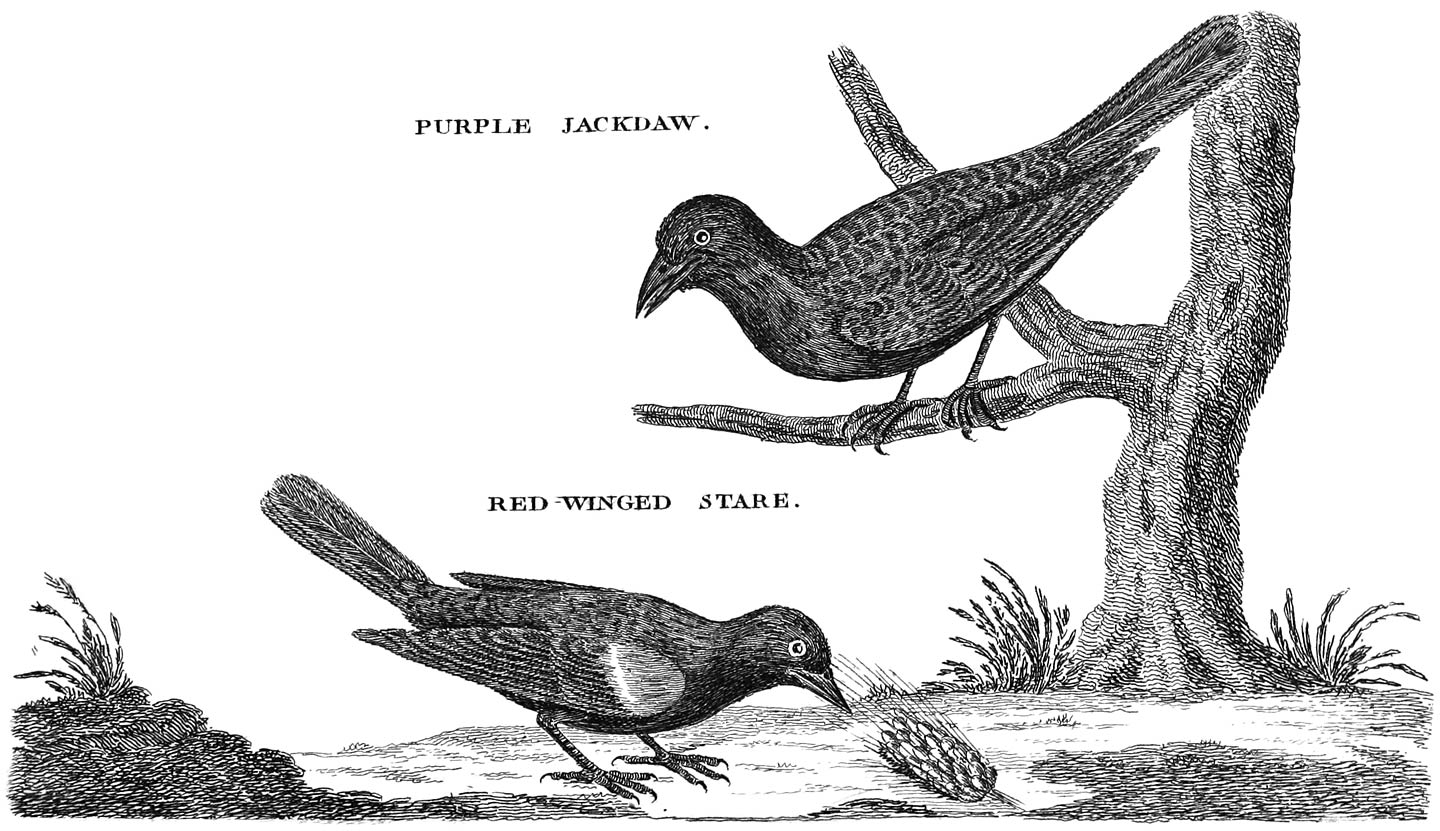
PURPLE JACKDAW. RED-WINGED STARE.
The American whortleberry, or the Vaccinium hispidulum, is extremely abundant over all North America, and grows in such places where we commonly find our whortle-berries in Sweden. The American ones are bigger, but in most things so like the Swedish ones, that many people would take them to be mere varieties. The English call them Cranberries, the Swedes Tranbær, and the French in Canada Atopa, which is a name they have borrowed from the Indians. They are brought to market every Wednesday and Saturday at Philadelphia, late in autumn. They are boiled and prepared in the same manner as we do our red whortle-berries, or Vaccinium vitis idæa; and they are made use of during winter, and part of summer, in tarts and other kinds of pastry. But as they are very sour, they require a deal of sugar; but that is not very dear, in a country where the sugar-plantations are not far off. Quantities of these berries are sent over, preserved, to Europe, and to the West Indies.
March the 2d. Mytilus anatinus, a kind of muscle-shells, was found abundantly in little furrows, which crossed the meadows. The shells were frequently covered on the outside, with a thin crust of particles of iron, when the water in the furrows came from an iron mine. The Englishmen and Swedes settled here seldom made any use of these shells; but the Indians who formerly lived here broiled them and ate the flesh. Some of the Europeans eat them sometimes.
The snow still remained in some parts of the wood, where it was very shady, but the fields were quite free from it. The cows, horses, sheep, and hogs, went into the woods, and sought their food, which was as yet very trifling.
March the 3d. The Swedes call a species of little birds, Snofogel, and the English call it Snow-bird. This is Dr. Linnæus’s Emberiza hyemalis. The reason why it is called snow-bird is because it never appears in summer, but only in winter, when the fields are covered with snow. In some winters they come in as great numbers as the maize-thieves, fly about the houses and barns, into the gardens, and eat the corn, and the seeds of grass, which they find scattered on the hills.
March the 7th. Several people told me, that it was a certain sign of bad weather here when a thunder-storm arose in the south or south west, if it spread to the east and afterwards to the north: but that on the contrary, when it did not spread at all, or when it spread both east and west, though it should rise in south or south west, yet it would prognosticate fair weather. To-day it was heard in south west, but it did not spread at all. See the meteorological observations, at the end of this volume.
Till now the frost had continued in the ground, so that if any one had a mind to dig a hole he was forced to cut it through with a pick-ax. However it had not penetrated above four inches deep. But to-day it was quite gone out. This made the soil so soft, that on riding, even in the woods, the horse sunk in very deep.
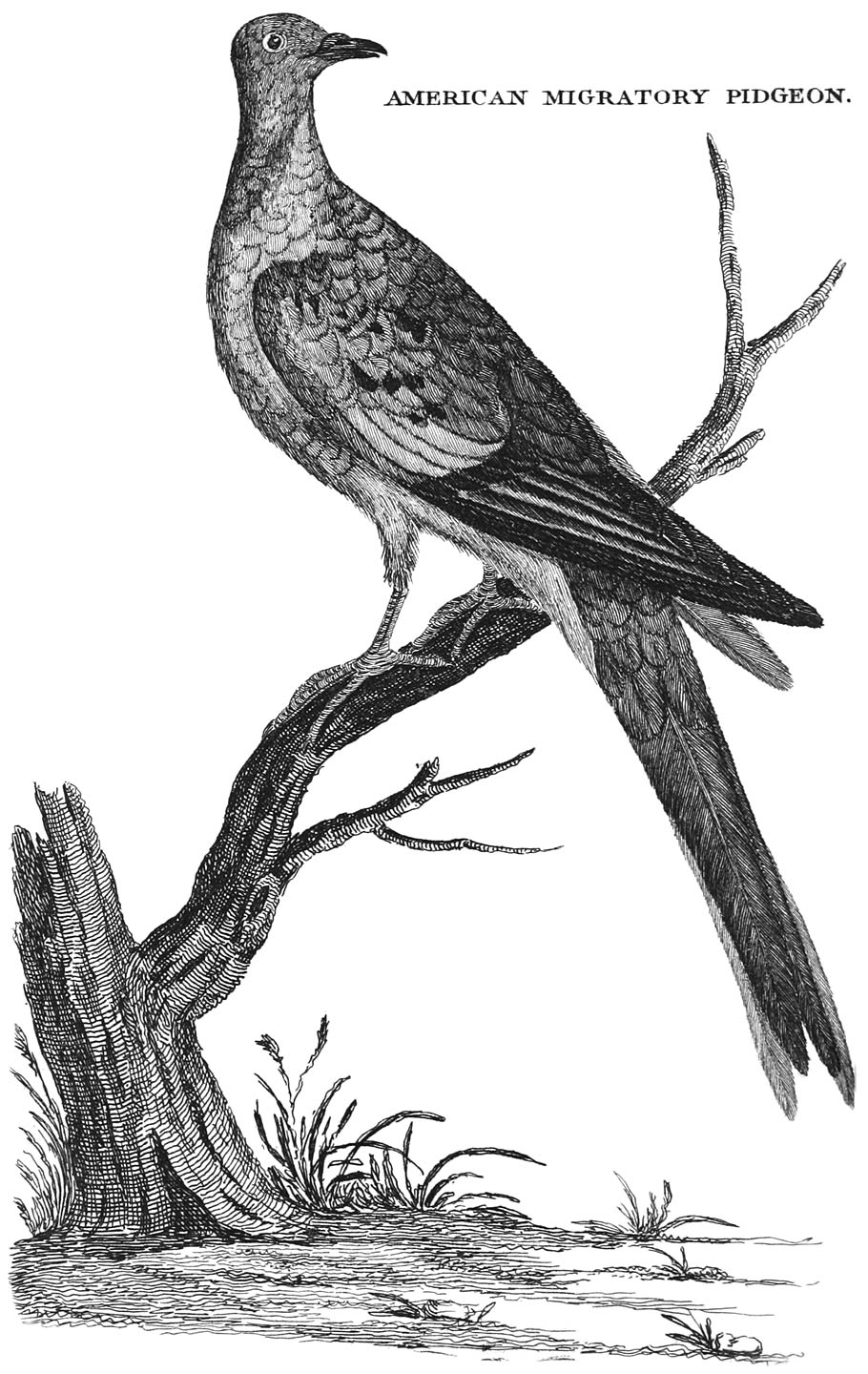
AMERICAN MIGRATORY PIDGEON.
I often enquired among the old Englishmen and Swedes, whether they had found that any trees were killed in very severe winters, or had received much hurt. I was answered, that young hiccory trees are commonly killed in very cold weather; and the young black oaks likewise suffer in the same manner. Nay sometimes black oaks, five inches in diameter, were killed by the frost in a severe winter, and sometimes, though very seldom, a single mulberry-tree was killed. Peach-trees very frequently die in a cold winter, and often all the peach-trees in a whole district are killed by a severe frost. It has been found repeatedly, with regard to these trees, that they can stand the frost much better on hills, than in vallies; insomuch, that when the trees in a valley were killed by frost, those on a hill were not hurt at all. They assured me that they had never observed that the black walnut-tree, the sassafras, and other trees, had been hurt in winter. In regard to a frost in spring, they had observed at different times, that a cold night or two happened often after the trees were furnished with pretty large leaves, and that by this most of the leaves were killed. But the leaves thus killed have always been supplied by fresh ones. It is remarkable that in such cold nights the frost acts chiefly upon the more delicate trees, and in such a manner, that all the leaves, to the height of seven and even of ten feet from the ground, were killed by the frost, and all the top remained unhurt. Several old Swedes and Englishmen assured me they had made this observation, and the attentive engineer, Mr. Lewis Evans, has shewn it me among his notes. Such a cold night happened here, in the year 1746, in the night between the 14th and 15th of June, new style, attended with the same effect, as appears from Mr. Evans’s observations. The trees which were then in blossom, had lost both their leaves and their flowers in these parts which were nearest the ground; sometime after they got fresh leaves, but no new flowers. Further it is observable, that the cold nights which happen in spring and summer never do any hurt to high grounds, damaging only the low and moist ones. They are likewise very perceptible in such places where limestone is to be met with, and though all the other parts of the country be not visited by such cold nights in a summer, yet those where limestone lies have commonly one or two every summer. Frequently the places where the limestone lies are situated on a high ground; but they suffer notwithstanding their situation; whilst a little way off in a lower ground, where no limestone is to be found, the effects of the cold nights are not felt. Mr. Evans was the first who made this observation, and I have had occasion at different times to see the truth of it, on my travels, as I shall mention in the sequel. The young hiccory-trees have their leaves killed sooner than other trees, in such a cold night, and the young oaks next; this has been observed by other people, and I have found it to be true, in the years 1749 and 1750.
March the 11th. Of the genus of Wood-peckers, we find here all those, which Catesby in his first volume of the Natural History of Carolina, has drawn and described. I shall only enumerate them, and add one or two of their qualities; but their description at large I defer for another occasion.
Picus principalis, the King of the Wood-peckers, is found here, though very seldom, and only at a certain season.
Picus pileatus, the crested Wood-pecker; this I have already mentioned.
Picus auratus, the gold-winged Wood-pecker: This species is plentiful here, and the Swedes call it Hittock, and Piut; both these names have a relation to its note; it is almost continually on the ground, and is not observed to pick in the trees; it lives chiefly on insects, but sometimes becomes the prey of hawks; it is commonly very fat, and its flesh is very palatable. As it stays all the year, and cannot easily get insects in winter, it must doubtless eat some kinds of grass or plants in the fields. Its form, and some of its qualities, make it resemble a cuckow.
Picus Carolinus, the Carolina Wood-pecker. It lives here likewise, and the colour of its head is of a deeper and more shining red than Catesby has represented it, vol. i. p. 19. t. 19.
Picus villosus, the spotted, hairy, middle-sized Wood-pecker is abundant here; it destroys the apple-trees by pecking holes into them.
Picus erythrocephalus, the red-headed Wood-pecker. This bird was frequent in the country, and the Swedes called it merely Hackspick, or Wood pecker. They give the same name to all the birds which I now enumerate, the gold-winged wood-pecker excepted. This species is destructive to maize-fields and orchards, for it pecks through the ears of maize, and eats apples. In some years they are very numerous, especially where sweet apples grow, which they eat so far, that nothing but the mere peels remain. Some years ago there was a premium of two pence per head, paid from the public funds, in order to extirpate this pernicious bird, but this law has been repealed. They are likewise very fond of acorns. At the approach of winter they travel to the southward. But when they stay in numbers in the woods, at the beginning of winter, the people look upon it as a sign of a pretty mild winter.
Picus varius, the lesser, spotted, yellow-bellied Wood-pecker. These birds are much more numerous than many people wished; for this, as well as the preceding and succeeding species, are very hurtful to apple-trees.
Picus pubescens, or the least spotted Wood-pecker. This species abounds here. Of all the wood-peckers it is the most dangerous to orchards, because it is the most daring. As soon as it has pecked a hole into the tree, it makes another close to the first, in a horizontal direction, proceeding till it has pecked a circle of holes round the tree. Therefore the apple-trees in the orchards here have several rings round their stems, which lie very close above each other, frequently only an inch distant from each other. Sometimes these wood-peckers peck the holes so close, that the tree dries up. This bird, as Catesby remarks, is so like the lesser spotted wood-pecker, in regard to its colour and other qualities, that they would be taken for the same bird, were not the former (the Picus pubescens) a great deal less. They agree in the bad quality, which they both possess, of pecking holes into the apple-trees.
Rana ocellata are a kind of frogs here, which the Swedes call, Sill-hoppetosser, i. e. Herring-hoppers, and which now began to quack in the evening, and at night, in swamps, pools, and ponds. The name which the Swedes give them is derived from their beginning to make their noise in spring, at the same time when the people here go catching what are called herrings, which however differ greatly from the true European herrings. These frogs have a peculiar note, which is not like that of our European frogs, but rather corresponds with the chirping of some large birds, and can nearly be expressed by picet. With this noise they continued throughout a great part of spring, beginning their noise soon after sun-setting, and finishing it just before sun-rising. The sound was sharp, but yet so loud that it could be heard at a great distance. When they expected rain they cried much worse than commonly, and began in the middle of the day, or when it grew cloudy, and the rain came usually six hours after. As it snowed on the 16th of the next month, and blew very violently all day, there was not the least sign of them at night, and during the whole time that it was cold, and whilst the snow lay on the fields, the frost had so silenced them, that we could not hear one; but as soon as the mild weather returned, they began their noise again. They were very timorous, and it was difficult to catch them; for as soon as a person approached the place where they lived, they are quite silent, and none of them appeared. It seems that they hide themselves entirely under water, except the tip of the snout, when they cry. For when I stepped to the pond where they were in, I could not observe a single one hopping into the water. I could not see any of them before I had emptied a whole pool, where they lodged in. Their colour is a dirty green, variegated with spots of brown. When they are touched they make a noise and moan; they then sometimes assume a form, as if they had blown up the hind part of the back, so that it makes a high elevation; and then they do not stir, though touched. When they are put alive into spirits of wine, they die within a minute.
The Hazels (Corylus avellana) were now opening their blossoms. They succeeded best in a rich mould, and the Swedes reckoned it a sign of a good soil where they found them growing.
March the 13th. The alder (Betula Alnus) was just blossoming.
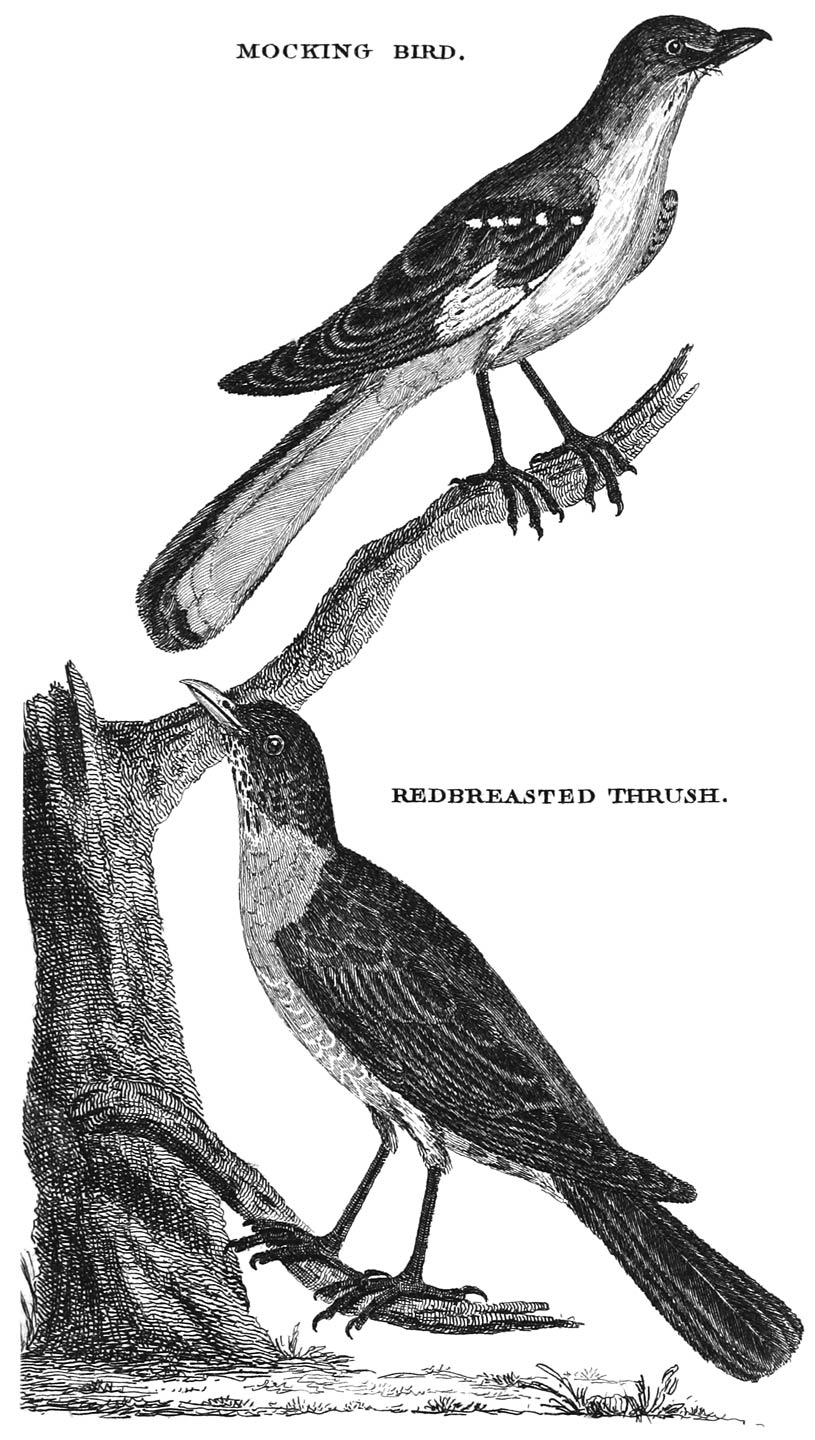
MOCKING BIRD. REDBREASTED THRUSH.
The Dracontium foetidum grew plentifully in the marshes and began to flower. Among the stinking plants, this is the most fœtid; its nauseous scent was so strong, that I could hardly examine the flower; and when I smelled a little too long at it, my head ached. The Swedes call it Byorn-blad (bear’s-leaf) or Byorn-retter (bear’s-root.) The English call it Polecat-root, because its effluvia are as nauseous and fœtid, as those of the polecat, which I have mentioned before. The flowers are purple-coloured; when they are in full flower, the leaves begin to come out of the ground; in summer the cattle do not touch it. Dr. Colden told me, that he had employed the root in all cases where the root of the arum is made use of, especially against the scurvy, &c. The Swedish name it got, because the bears, when they leave their winter habitations, are fond of it in spring: It is a common plant in all North America.
The Draba verna was abundant here, and now appeared in flower.
The Veratrum album was very common in the marshes, and in low places over all North America. The Swedes here call it Dack, Dackor or Dackretter, that is puppet-root, because the children make puppets of its stalks and leaves. The English call it Itch-reed or Ellebore. It is a poisonous plant, and therefore the cattle never touch it; however it sometimes happens that the cattle are deceived in the beginning of spring, when the pastures are bare, and eat of the fine broad green leaves of this plant, which come up very early; but such a meal frequently proves fatal to them. Sheep and geese have likewise often been killed with it. By means of its root, the maize is preserved from the greediness of voracious birds, in the following manner: The roots are boiled in water, into which the maize is put as soon as the water is quite cool; the maize must ly all night in it, and is then planted as usual. When the maize-thieves, crows, or other birds, pick up or pluck out the grains of maize, their heads grow delirious, and they fall, which so frightens the rest that they never venture on the field again; when those which have tasted the grains recover, they leave the field, and are no more tempted to visit it again. By thus preparing maize, one must be very careful that no other creatures touch it; for when ducks or fowls eat a grain or two of the maize which is thus steeped, they become very sick; but if they swallow a considerable quantity they die. When the root is thrown away raw, no animal eats it; but when it is put out boiled, its sweet taste tempts the beasts to eat it. Dogs have been seen to eat a little of it, and have been very sick after it; however they have recovered after a vomit, for when animals cannot free themselves of it by this means, they often die. Some people boil the root, and wash the scorbutic parts with the water or decoct. This is said to cause some pain, and even a plentiful discharge of urine, but it re-establishes the patient. When the children here are plagued with vermin, the women boil this root, put the comb into the decoction, and comb the head with it, and this kills them most effectually.
The food of these Indians was very different from that of the inhabitants of the other parts of the world. Wheat, rye, barley, oats, and rice-groats, were quite unknown in America. In the same manner it is with regard to the fruits and herbs which are eaten in the old countries. The maize, some kinds of beans, and melons, made almost the whole of the Indian agriculture and gardening; and dogs were the only domestic animals in North America. But as their agriculture and their gardening were very trifling, and they could hardly live two months in a year upon their produce, they were forced to apply to hunting and fishing, which at that time, and even at present, are their chief subsistence, and to seek some of the wild plants and trees here. Some of the old Swedes were yet alive, who in their younger years had an intercourse with the Indians, and had seen the minutiæ of their œconomy. I was therefore desirous of knowing which of the spontaneous herbs they made use of for food at that time; and all the old men agreed that the following plants were what they chiefly consumed:
Hopniss or Hapniss was the Indian name of a wild plant, which they ate at that time. The Swedes still call it by that name, and it grows in the meadows in a good soil. The roots resemble potatoes, and were boiled by the Indians, who eat them instead of bread. Some of the Swedes at that time likewise ate this root for want of bread. Some of the English still eat them instead of potatoes. Mr. Bartram told me, that the Indians who live farther in the country do not only eat these roots, which are equal in goodness to potatoes, but likewise take the pease which ly in the pods of this plant, and prepare them like common pease. Dr. Linnæus calls the plant Glycine Apios.
Katniss is another Indian name of a plant, the root of which they were likewise accustomed to eat, when they lived here. The Swedes still preserve this name. It grows in low, muddy and very wet ground. The root is oblong, commonly an inch and an half long, and one inch and a quarter broad in the middle; but some of the roots have been as big as a man’s fists. The Indians either boiled this root or roasted it in hot ashes. Some of the Swedes likewise eat them with much appetite, at the time when the Indians were so near the coast; but at present none of them make any use of the roots. A man of ninety-one years of age, called Nils Gustafson, told me, that he had often eaten these roots when he was a boy, and that he liked them very well at that time. He added that the Indians, especially their women, travelled to the islands, dug out the roots, and brought them home; and whilst they had them, they desired no other food. They said that the hogs, which are amazingly greedy of them, have made them very scarce. The cattle are very fond of its leaves. I afterwards got fond of these roots roasted, and in my opinion they tasted well, though they were rather dry: The taste was nearly the same with that of the potatoes. When the Indians come down to the coast and see the turneps of the Europeans, they likewise give them the name of katniss. Their katniss is an arrow-head or Sagittaria, and is only a variety of the Swedish arrow-head or Sagittaria sagittifolia, for the plant above the ground is entirely the same, but the root under ground is much greater in the American than in the European. Mr. Osbeck in his voyage to China, vol. i. p. 334, of the English edition, mentions, that the Chinese plant a Sagittaria, and eat its roots. This seems undoubtedly to be a variety of this katniss. Further in the north of this part of America, I met with the other species of Sagittaria which we have in Sweden.
Taw-ho and Taw-him was the Indian name of another plant, the root of which they eat. Some of them likewise call it Tuckah; but most of the Swedes still knew it by the name of Taw-ho. It grows in moist ground and swamps. Hogs are very greedy of the roots, and grow very fat by feeding on them. Therefore, they often visit the places where these roots grow; and they are frequently seen rooting up the mud, and falling with their whole body into the water, so that only a little of the back part was out of the water. It is therefore very plain, that these roots must have been extirpated in places which are frequented by hogs. The roots often grow to the thickness of a man’s thigh. When they are fresh, they have a pungent taste, and are reckoned a poison in that fresh taste. Nor did the Indians ever venture to eat them raw, but prepared them in the following manner: They gathered a great heap of these roots, dug a great long hole, sometimes two or three fathoms and upwards in length, into which they put the roots, and covered them with the earth that had been taken out of the hole; they made a great fire above it, which burnt till they thought proper to remove it; and then they dug up the roots, and consumed them with great avidity. These roots, when prepared in this manner, I am told, taste like potatoes. The Indians never dry and preserve them; but always take them fresh out of the marshes, when they want them. This Taw-ho is the Arum Virginicum, or Virginian Wake-robin. It is remarkable, that the Arums, with the plants next akin to them, are eaten by men in different parts of the world, though their roots, when raw, have a fiery pungent taste, and are almost poisonous in that state. How can men have learnt, that plants so extremely opposite to our nature were eatable; and that their poison, which burns on the tongue, can be conquered by fire. Thus the root of the Calla palustris, which grows in the north of Europe, is sometimes used instead of bread on an exigency. The North American Indians consume this species of Arum. Those of South America, and of the West Indies, eat other species of Arums. The Hottentots, at the Cape of Good Hope, in Africa, prepare bread from a species of Arum or Wake-robin, which is as burning and poisonous as the other species of this plant. In the same manner, they employ the roots of some kinds of Arum as a food, in Egypt and Asia. Probably, that severe but sometimes useful mistress, necessity, has first taught men to find out a food, which the first taste would have rejected as useless. This Taw-ho seems to be the same with what the Indians in Carolina call Tuckahoo; and of which see Vol. I. p. 287.