DESCRIPTION OF A JOURNEY FROM UPPER EGYPT THROUGH THE DESERTS OF NUBIA TO BERBER AND SUAKIN, AND FROM THENCE TO DJIDDA IN ARABIA. (continued 5)
Reading edition
We remained but a short time at this place, and then continued our route along the banks of the river for about an hour, for the most part among the date trees, which line the borders of the desert. These trees were larger than any I had seen in Egypt. At the end of one hour we forded the river, without any difficulty, as the water hardly reached above the knees of the camels. In less than half an hour from the opposite bank, we came to the village of Atbara, so named from its vicinity to the river. As the caravan was to remain here some days, the first care of every one was to choose a proper halting-place. The Souakin merchants alighted on an open ground in front of the village, where they formed several parties among themselves. The Tekaýrne and myself took possession of some thick thorny bushes on one side of the village, within which, after a few hours labour with the axe, each cut a small birth, just large enough to contain himself and his baggage, while the slaves were ordered to sleep before the entrance. We thus secured our goods from pilferers, and by spreading a few mats over the bushes, procured a comfortable shade.
The village, or more properly encampment, of Atbara, consisted of several long irregular rows of tents, formed of mats made of the leaves of the Doum tree, and containing about two hundred families of Bisharein. This is the general mode of dwelling throughout the tract of desert country lying between Egypt and Abyssinia. The bare skins of the Nubian sheep and goats not furnishing the inhabitants with the necessary materials for making tent-coverings of wool or goats’ hair, like the eastern Bedouins, their place is supplied with mats. They fix a row of poles, about twelve or fifteen feet high, into the ground, opposite to each other, and converging at the top; over these they fasten others horizontally; upon which mats are thrown in such a way as to present every where an inclined plane for the rain to run off. Every tent is furnished with two or three Angareygs, which take up nearly the whole of the interior, so that a very small part remains for any one to stand in; nor is this very necessary, as the Bisharein pass the greater part of their time reclined upon the Angareyg.[57] In the smaller tents both sexes live together; but in the larger there is a partition across the tent, behind the Angareygs, which divides it into a front and back apartment; the latter is occupied by the women, and serves also as the kitchen; though the women never think of concealing themselves from strangers. All persons of quality have separate tents for their women, to which they sometimes add an open shed, for the reception of strangers. Whenever the Bedouins remove, the tents are struck, and the poles, mats, &c. are loaded upon camels.
Atbara is the residence of the chief of the tribe Hammadab (هامّداب); which must not be confounded with the Hameydab (حميداب,) a tribe of Ababde. The Hammadab are one of the strongest tribes of the Bisharye nation:[58] the chief had travelled with us from Shendy, where he had purchased some slaves and horses. There are always a few inhabitants in this place who trade with Shendy, and wait here for the arrival of the Souakin caravans. As soon as it was known in the neighbourhood that a caravan had arrived, and intended to stop a few days, a great number of Bisharein came with Dhourra, sheep, butter, and milk, in order to barter these articles for Dammour and drugs, especially Mehleb, cloves, and incense, or Libban, from the west. Scarcely any of these people understand the Arabic language, except those who trade to Berber and Shendy; but it is understood by almost all their slaves, the greater part of whom are educated among the inhabitants on the Nile. Their dress, or rather undress, was every where the same, consisting only of a Dammour shirt, worn by both men and women; I thought the latter remarkably handsome; they were of a dark brown complexion, with beautiful eyes, and fine teeth; their persons were slender and elegant. They seemed to be under no fear of jealousy in their husbands or fathers, as they came laughing and joking quite close to our tents, and those who could not speak Arabic endeavoured to make themselves understood by signs. The beauties seemed to be fully conscious of their charms; but it was easy to perceive that they flirted with us for no other purpose than to make a better bargain for their Dhourra and milk, than the less handsome ones could obtain; and they all betrayed bad faith in their dealings with us. I had already heard in Egypt, that the Bisharein are not jealous of their women; it is with them a law of honour never to suspect their wives till they have the most unequivocal proofs of their incontinency. A Bisharye seeing a stranger kiss his wife, would laugh it off, but death would inevitably ensue if he caught her in adultery.
The Bisharein of Atbara, like all their brethren, are a handsome and bold race of people; they go constantly armed, and are seldom free from quarrels. Drunkenness is as common among them as it is among the Arabs of Shendy, and we heard every night some loud dispute in the Bouza huts. They are much addicted to pilfering, and notwithstanding all our precautions, every person in the caravan lost some small articles of baggage; several camels were also stolen, but they were afterwards returned through the interference of the chief, who exacted a handsome present for his trouble. Their propensity to theft is not the worst part of their character; they appear to be treacherous, cruel, avaricious, and revengeful, and are restrained in the indulgence of these passions by no laws either divine or human. One of the people of this village, who had come with us from Shendy, found on his arrival, that two of his best camels had been stolen. Suspecting one of his neighbours to be the thief, he came to the Tekaýrne, to know whether they would, by charms, inform him if his suspicions were well founded; but they refused to give him any distinct answer, or to meddle in the business. The man then swore that if he ever ascertained who the thief was, he would cut the throats of all his children, maim his camels, and reduce him to such poverty, as would oblige him to feed with the cattle in the woods. The Bisharein are all Mussulmans, but they observe none of the rites prescribed by that religion, thus forming a remarkable contrast to the Negroe Hadjis who pass this way, and who never omit any of the exterior duties of the Musselman faith. The inhospitable character of the Bisharein would alone prove them to be a true African race, were it not put beyond all doubt by their language. Not a drop of milk could be had without purchasing it, and the women obliged us to pay for the use of some old earthen pots which we were in need of during our stay; no one would even interpret between us and such of the people as were ignorant of Arabic, without exacting at least a handful of Dhourra for his trouble; this avaricious spirit is conspicuous in all their actions, and it is not merely caravan passengers, from whom it is natural for them to extort some profit, that are thus treated; the poor Negroe pilgrims who pass this place in their way to Taka complain bitterly of the pitiless inhabitants of the banks of the Atbara.
Dhourra, and a small quantity of Loubye, or kidney-beans, are sown in the woods close to the river, without any previous preparation of the ground. Water-wheels are unknown. The extent of fertile soil is equal on both sides of the river; but nothing is cultivated on the left bank, on account of the depredations of the Djaalein on that side. In years when the river does not overflow the banks, they draw all their supplies from Taka. The same trees grow near the village which I saw on the west bank; the Nebek was the most common; its fruit is so abundant that the camels are sometimes fed upon it. The Oshour occupies the intervals between the larger trees, and leaves but little space for the growth of the Dhourra. A great number of turtle-doves and pigeons flew about; they have numerous enemies in a species of eagle, which is very little larger than the eagle Rakham of Egypt; the body is quite black, the head bald, and of a deep purple red, like that of the turkey. The Bisharein say that tigers abound in the woods, and that very large serpents are sometimes seen; but though I crossed the woods every day to bring water from the river, I never saw any quadrupeds, except innumerable hosts of rats, of the largest size, running among the Dhourra stubble, great numbers of which the slaves killed, and were delighted to eat. The large ants, which are said to be extremely obnoxious in Kordofan and Darfour, are never seen any where to the east of the Nile. During high water crocodiles are found in the river, but no hippopotami. The rhinoceros is unknown here.
The cattle of the Bisharein are very fine, and in great abundance. Their camels had just been sent to the nearest mountains, where some rains had fallen, to feed upon the fresh herbage, while those in our caravan were driven every morning into the woods to feed upon the twigs of the acacias. The flocks of sheep and goats were following the camels to the mountains; we bought two large sheep for one dollar’s worth of Dammour. The chief and some of his relatives keep horses, and wear coats of mail; there are a couple of asses belonging to every tent.
The river Atbara joins the Mogren at about two days from this village, beyond which the united stream bears the latter name. The Mogren is said to rise in the Bisharye mountains, but it is almost dry in summer; and even in the rainy season, appears to be nothing but a collection of torrents. The direct road from hence to Souakin does not cross it, whence it is evident that its course must be much more from the northward than is generally laid down in the maps. I have already stated that we found very little water in the Atbara; a few weeks before, it must have been almost dried up; for in the bed of the united stream, where we crossed it near Damer, we found nothing but some stagnant pools. During our stay at Atbara we had several light showers at night, and the days were cloudy, often with foggy mornings. On the 3d and 4th of June the river fell suddenly, leaving the greater part of the bed quite dry. I afterwards observed in our way to Taka, that the fall must have been at least one foot. The banks are not more than twenty-five feet high; I did not measure the river’s breadth, but from a clear impression left on my mind, I conjecture the banks to be distant from each other at most from four to five hundred paces. The current of the stream was so slow as hardly to be perceptible.
The women of Atbara shave their heads on the death of their nearest relatives; a custom prevalent also among several of the peasant tribes of Arabs in Upper Egypt. The law of retaliation is said to exist among the Bisharein in all its force; their tribes are in continual war with each other; their national enemies are the Shukorye on one side, and the Hadendoa on the other. The Hammadab who live at Atbara have for neighbours, up the river, towards Goz Radjeb, the Beni Kurb, and in the desert the Baterab, both of the Bisharye race. The Hammadab cultivate the banks of the Atbara as low as its junction with the Mogren, below which commence the territories of the Djaalein. From thence to Berber is four long journeys, but the road is very little frequented, and the only places these people communicate with are Shendy, Goz Radjeb, and Taka, and with the Bisharein of the mountains to the northward.
After remaining three or four days at Atbara the chief of the village collected passage duty from every individual, according to the number of his slaves. Each slave pays one Tob Dammour, and the same is levied upon every camel’s load, whatever it may consist of. Those merchants who are supposed, or known to carry gold, are taxed arbitrarily, which, as may readily be conceived, gives rise to many disputes. I paid on the whole one Tob and a half; but the Souakin merchants were extremely dissatisfied with the chief on account of his extortions, and told him that they would never again return by this route. It is, however, the safest road to Souakin, the desert on this side being inhabited by tribes friendly to the Hadherebe, and to Souakin; and I was informed that the chief of Atbara is obliged to divide with several of those tribes the sums which he derives from the caravan. The road, on the contrary, from Souakin to Damer, lies through the pasturing-places of some potent Bisharye tribes inimical to Souakin, and cannot be passed but by caravans sufficiently strong to repel any attack. The day after we had paid the duties, the chief sent to every party of traders a large dish of Dhourra made into a liquid paste, and some Bouza for the use of the caravan.
The caravan, on quitting Atbara, was to divide into two parties, the one taking the direct road through the desert to Souakin, the other proceeding by Taka. The former route, for the three first days, takes a direction more easterly than Souakin, to the well of Gengerab, when it passes in a direct line to Souakin, by three watering-places, situated two days from each other. The entire journey is of ten or twelve days; the road abounds with pasturage and many encampments of Bedouins are met with in the fertile valleys, which are watered by winter torrents, giving birth to luxuriant crops of wild herbage. The part of the caravan proceeding to Taka, intended to sell there the Dammour and tobacco which they had brought from Sennaar; some of them purposed returning immediately afterwards to Shendy, while others intended to go on to Souakin. I determined to take the Taka road, and had the pleasure of seeing the Negroe merchants in whose company I travelled, follow my example. They had many slaves; their camels were weak, and on the Taka road they knew that water was to be met with daily.
May 31st.—The merchants destined for Souakin had left us on the preceding night. We departed ourselves in the morning, following the banks of the Atbara, and passing over a plain about two miles in breadth, overgrown with Doum trees and Oshour, among which the Dhourra stubble was still standing. I observed several hamlets in the thick groves of acacia trees near the river. At the end of three hours we halted upon a sandy beach near the river, where I saw several skeletons of crocodiles of moderate length lying on the ground. There appeared not the smallest elevation of ground; as far as the eye could reach, the horizon was unbroken in every direction, and the country on both sides of the river was an uninterrupted flat. A great number of rats ran, at every step, among the legs of the camels, and the slaves amused themselves the whole day with hunting them. From this place we took a short cut, leaving the river at some distance to the right, and proceeded over a gravelly and sandy plain, in a direction south. After a day’s march of about ten hours we again reached the river, and encamped for the night.
June 1st.—We continued to follow the bed of the river; the banks on both sides are overgrown with trees. This district belongs to the Beni Kurb. The soil is fertile, but bears no traces whatever of cultivation; the inhabitants of several hamlets or encampments appear to be exclusively shepherds. At a spot, where we came close to the bed of the river, I calculated its breadth at about ten minutes walk. At the end of four hours we passed Om Daoud, a large encampment of the tribe of Nefidjab of the Bisharein; this is the most southern boundary of the Bisharye dominions, and the beginning of the territory of the Hadendoa, a very powerful tribe, of which I shall again have occasion to speak; the son of their Shikh had come with us from Shendy, and we had therefore little to fear, except from their pilfering habits. The caravan halted near the village, and I walked up to the huts to look about me. My appearance on this occasion, as on many others, excited an universal shriek of surprise and horror, especially among the women, who were not a little terrified at seeing such an outcast of nature as they consider a white man to be, peeping into their huts, and asking for a little water or milk. The chief feeling which my appearance inspired I could easily perceive to be disgust, for the Negroes are all firmly persuaded that the whiteness of the skin is the effect of disease, and a sign of weakness; and there is not the least doubt, that a white man is looked upon by them as a being greatly inferior to themselves. At Shendy the inhabitants were more accustomed to the sight if not of white men, at least of the light-brown natives of Arabia; and as my skin was much sun-burnt, I there excited little surprise. On the market days, however, I often terrified people, by turning short upon them, when their exclamation generally was: Owez billahi min es-sheyttan erradjim (اعوز باللّه من الشيطان الرّجيم), “God preserve us from the devil!” One day, after bargaining for some onions with a country girl in the market at Shendy, she told me, that if I would take off my turban and shew her my head, she would give me five more onions; I insisted upon having eight, which she gave me; when I removed my turban she started back at the sight of my white closely shaven crown, and when I jocularly asked her whether she should like to have a husband with such a head, she expressed the greatest surprise and disgust, and swore that she would rather live with the ugliest Darfour slave.
On the side of the desert near the village of Om Daoud, were a number of tombstones; the small-pox made great ravages here last year. According to the Nubian custom, the graves were covered with pebbles of white quartz, and a pole was stuck down at each end. We here fell in with a large caravan of Bisharein, who were travelling the same road with us as far as Goz Radjeb, where they intended to purchase Dhourra. The Souakin traders entertained great suspicions of them, as they belonged to a tribe which was not altogether friendly, and we therefore kept carefully separated from them, and upon the watch.
From Om Daoud we continued along the Atbara, making occasionally short cuts across the desert. Our general direction was S. E. b. S. After a march of nine hours and a half, having seen that the Bisharein caravan had alighted at some distance from us, we halted; our chief was afraid to continue our route and halt farther on, lest we should be surprised; he thought it more prudent to have the enemy in view, than behind us, and we kept under arms the whole of the night. We lighted a fire, and placed our baggage in such a manner as to serve as a protection to us, in case of an attack. The Bisharein, however, were probably in as much fear of us as we were of them; for they remained the next morning on their halting place, while we continued our journey.
June 2d.—We travelled this morning about four hours, in a south-east direction, over a plain of cultivable soil, though distant several miles from the river. No mountains were any where visible. We rested during the mid-day hours in a grove of Nebek, Syale, and Allobe trees. I here observed several unknown birds; one was of the size and shape of a black-bird, with a long tail striped with white. I saw some large crows with a white neck. The Bisharein seemed to have no names in their language for these different birds; amongst them it is a great scandal to eat the flesh of birds, and I several times heard them sneeringly call the Egyptians “bird-eaters.” On resuming our journey we entered the sandy desert in the direction of S. E. b. E. In the afternoon the Souakin traders chased with their swiftest dromedaries a wild beast which they descried at a distance; they called it in Arabic Homar el Wahsh (حمار الوحش), which means the wild ass. It did not come near enough to be distinctly seen; but they say it is of the size of a hyæna, with a head and tail much resembling those of an ass: it has no horns. In the Arabian deserts they speak of an animal to which they give the same name; whether it is really the same animal I am not certain. The ground was covered in every direction with innumerable footsteps of the Gazelle species, some of which appeared to belong to animals of a much larger size than any I had yet seen. At the end of four hours, we halted in a Wady with trees. The heat during the day was very oppressive; at night we had a shower of rain. Along the whole route I observed in the form of the sand-hills, and in the shape of the trees, evident proofs of the prevalence of strong easterly winds. A high insulated mountain in the plain bore east, four hours distant.
June 3d.—We saw this morning, while travelling in the plain, a mirage of the brightest azure, as pure and clear as those I had witnessed in the desert between Egypt and Berber. After a march of four hours (direction south), we again reached the river, nearly opposite the large village of Goz Radjeb (قوز رجب), an Arabic name. The banks on both sides were quite barren. We encamped under some Oshour trees, large enough to afford shade to the whole party. It was our intention to remain here a few days, as the Hadherebe thought the market of Goz Radjeb a fit place for disposing of a part of their merchandize. In approaching the river I saw at a distance two insulated hills close to each other in the plain, and at a short distance from the river; and when we drew nearer to them, I was extremely surprised to see upon the summit of the largest a huge fabric of ancient times. Being naturally short-sighted, and my vision having been further impaired by two attacks of ophthalmia while I was in Upper Egypt, I could not trust my eyes, and therefore asked my companions what it was that appeared like a building upon the hill. “Don’t you see,” they replied, “that it is a church?” (Kenise, كنيسه, a name often applied by the Egyptians to their ancient temples, which they ascribe to the Christians) “and no doubt the work of infidels.” We continued to approach the hill, and encamped at about half an hour’s distance from it. As soon as we had alighted, and placed our baggage in order, I started for the hills, in great eagerness to examine these Ethiopian remains; but a loud cry from the Souakin people brought me back. “The whole country,” they said, “is infested by the peasants of Goz Radjeb; you will not be able to move a hundred paces alone, without being attacked.” Indeed several suspicious looking persons were seen lurking among the trees that lined the banks of the river farther on. My companions added, that the hill was inhabited by Hadendoa robbers, who lived in caverns in it, and were at war with all their neighbours. As they could have no interest in deceiving me, I readily believed them, and returned, not with the intention of abandoning my design, but in the hope of being able the next day to concert measures with some of the country people who might come to barter with us, for their accompanying me to the ruins, which I was then fully determined to visit, whatever might be the consequences. Unfortunately I was deceived in my expectations; and I shall never forgive myself for the momentary irresolution which prevented me from examining the most interesting object which occurred during my journey.
A party of our people had crossed the river to Goz Radjeb to inquire after the state of the market. About two hours after sunset, when we were retiring to sleep,[59] they returned, and soon after the chief of the caravan came to us, crying: “Make haste, the caravan is in fear; if we remain here we shall be attacked. Fill your water-skins, and load your camels, for we shall depart immediately.”[60] In such cases, every feeling gives way to that of self-preservation. Forgetting for a moment the temple, I ran with two skins to the river, while my slave got the camel ready, and by the time I returned with my filled skins, the chief had set off. The people who went to Goz Radjeb had been there secretly informed that a large party of Bisharein intended to surprise us, and the immediate departure of the caravan became in consequence advisable, as it would have been very difficult to pass the river during the night, in order to take refuge at Goz, where we might have been moreover besieged for a long while. We proceeded in silence along the bank of the river; I passed the foot of the hill, but the night was cloudy, and its darkness prevented me from catching the smallest glimpse of the ruins. The barking of dogs proved to me that our people had told me the truth in saying that the rocks were inhabited. Our merchants seemed much frightened, the greatest silence was observed, no pipes were permitted to be lighted, lest the burning ashes might indicate the direction of our march, and nothing was heard but the groans of a few infirm female slaves, and the whips of their cruel masters, who obliged them to follow the caravan on foot, having lent the camels upon which they rode to some people of Goz, for the transport of goods to Taka. I cast a last look towards the object of my curiosity, and lamented the ill fortune, which last year, when at the most southern point which I reached on the Nile, had prevented me from seeing the temple of Soleb in Mahass, and now again, when I had gained the farthest term of my journey southwards, had equally thwarted my desires, and had deprived the public of what many persons might perhaps have thought the most valuable fruit of this difficult journey. May a more fortunate or a more courageous traveller be hereafter able to examine what I have thus merely pointed out.
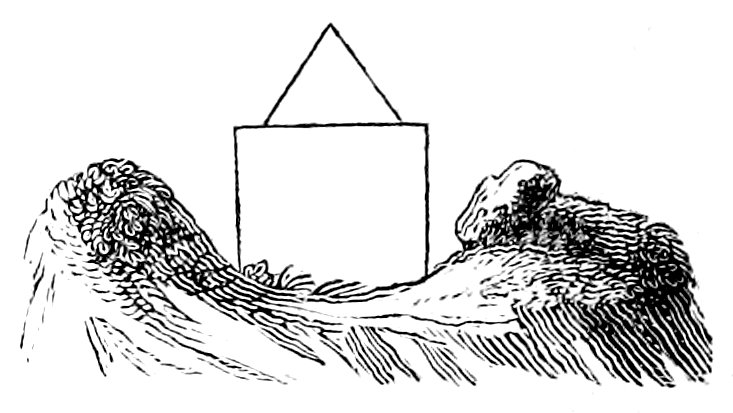
The rock of these hills is granite; while passing them in the night, I picked up several stones, which I found the next morning to be red coarse-grained granite. The hill upon which the ruin stands appears to be the highest, being about three or four hundred feet above the river, with sloping sides covered with large irregular blocks, and masses of rock. It is perpendicular on the side towards the river, between which and the hill is a space of about thirty yards, where the road passes. The building appears to be just over the precipice, and to face the river. What I could distinguish of it were two high and extremely massive walls, with an equally massive flat roof; on the roof was a sort of cupola, the sides of which appeared to be perpendicular. I could perceive no columns, or any other building. The ruin itself is enclosed on all sides by high rocks, which hide the greater part of it from view; and in the day time I was unable to get a sight of it in front. As far as I could judge its walls must be between thirty and forty feet in height, and I suppose them to be built of granite, as they were of the same hue as the surrounding rocks. I had no telescope with me, and can therefore give no accurate details respecting these remains; but the whole building, with the exception of the pointed roof, appeared to me to be of the rudest construction, and of the remotest antiquity. I asked the Souakin merchants if they had ever seen any similar ruins in this neighbourhood, but they had never gone higher up the river, and could therefore give me no positive information, and no natives appeared whom I could question on the subject.
The village of Goz Radjeb stands in the sandy plain, at a distance of about a quarter of a mile from the left bank of the river. It is named Goz from its situation among sands. Its inhabitants are said to be a mixture of all sorts of Arabs, Bisharein, Hadendoa, Djaalein, and Shukorye, who have settled here principally for the purposes of trade. As far as I could judge, agriculture forms no part of their occupation, and I understood that they draw all their Dhourra from the neighbouring district of Taka. They possess cattle, which feed in the summer on the bank of the river, and in winter in the interior of the desert. Goz is under the dominion of Sennaar, and its chief, like that of Shendy, is of the reigning family of Wold Adjib (ولد عجيب). The inhabitants carry on a brisk trade with Sennaar and Shendy, and sometimes visit the market of Damer, where, as at Shendy, they sell their cattle. Slaves are always to be found in the market of Goz, which is frequented sometimes by Souakin traders, but more usually by the Bisharye and Hadendoa Bedouins, for, although they are enemies, yet, in these countries, as among the Arabian Bedouins, a free passage is allowed through a hostile territory, under certain restrictions. The caravans from Souakin to Sennaar, which do not wish to pass by Atbara or Shendy, take the route by Goz, from whence they proceed straight across the desert to Sennaar. In the winter pools of water abound in the sands; but in summer the caravans are obliged to carry water with them for the whole journey of six days; this desert is said also to be destitute of trees. The route is only attempted during the hot season, because the Bedouins Shukorye encamp there during the winter, and render the road dangerous. Although the barrenness which prevails in this route in the summer often proves fatal to the slaves, the traders nevertheless prefer it to incurring the expenses which attend a stay at Shendy, and the payment of passage duties at Atbara. We marched about four hours during the night, and then rested upon deep sandy ground near some thorny trees and tamarisks.
June 4th.—We set out before sun-rise. Our road lay over an immense plain, without the smallest elevation, except the abovementioned hills to our left, which, in the morning, bore N. N. E. and at mid-day, when we halted, N. W. The soil of the plain consists of clay, with very few stones, and is almost as fertile as that on the banks of the Nile; it is over-grown with many different species of wild herbs, and what appeared to me remarkable, each species occupied a separate spot, seldom mixing with those adjoining it, so that the whole plain had the appearance of an immense sheet of patterns. Many of the herbs were now withered.
Our direction was E. N. E.; during the morning a part of our companions quitted the caravan, and took a more southerly route towards the southern parts of the country of Taka. About noon we descried some trees at a distance, and as the heat of the sun was extremely great, every one hastened in search of a shady place. The surface of the ground, as well as the trees, afforded proofs of the prevalence of strong easterly winds. In the afternoon we entered upon a completely barren, gravelly plain, without trees or the slightest vegetation of any kind, and without any elevation, or other land marks to guide the traveller. In the evening there were some vivid flashes of lightning, which served as a direction for the march, as the people of the caravan knew the quarter from whence they came; the horizon was cloudy, and threatened rain. After a march of about eleven hours we encamped, much tired, in a Wady of trees, a part of the caravan having gone astray during the night.
June 5th.—It appeared that we had all missed our road yesterday, owing to the extreme flatness and barrenness of the plain; for we started to-day in the direction of E. S. E. After about an hour’s march we reached the boundaries of the province of Taka; where we found a rich soil as fine as that near the Nile, and much like it in colour; the march of the camels was obstructed by thick groves of Oshour and acacias. A most violent gust of wind arose, and blew about the dust and sand in such a manner, that we were unable to see ten yards before us; we in consequence lost our way among the trees, and after wandering about for some time, during which we frightened several shepherds, who mistook us for Bisharye enemies, and hastily drove away their flocks, we reached, after a three hours march, an encampment of Hadendoa Bedouins, where we rested. One of our chief guides or Khobara (خبرا) was married to a relative of the chief of this encampment. We alighted in the open area surrounded by the tents, which, as in Arabia, were pitched in a Douar or circle (دوار). Towards evening we were visited by another hurricane, the most tremendous I ever remember to have witnessed. A dark blue cloud first appeared, extending to about 25° above the horizon; as it approached nearer, and increased in height, it assumed an ash gray colour with a tinge of yellow, striking every person in the caravan, who had not been accustomed to such phænomena, with amazement at its magnificent and terrific appearance; as the cloud approached still nearer, the yellow tinge became more general, while the horizon presented the brightest azure. At last, it burst upon us in its rapid course, and involved us in darkness and confusion; nothing could be distinguished at the distance of five or six feet; our eyes were filled with dust; our temporary sheds were blown down at the first gust, and many of the more firmly fixed tents of the Hadendoa followed; the largest withstood for a time the force of the blast, but were at last obliged to yield, and the whole camp was levelled with the ground. In the mean time the terrified camels arose, broke the cords by which they were fastened, and endeavoured to escape from the destruction which appeared to threaten them, thus adding not a little to our own embarrassment. After blowing about half an hour with incessant violence, the wind suddenly abated, and when the atmosphere became clear, the tremendous cloud was seen continuing its havoc to the north-west. Similar hurricanes frequently happen at this time of the year, their consequences, however, are never more disastrous than what I have just detailed; in a few minutes the tents were raised, and every thing was again put in order.
The Hadendoa showed us little hospitality; we encamped in the very midst of them, that we might not be exposed to any hostile attacks in the night, during the whole of which we kept watch to preserve our baggage from their pilfering propensities. The wells were at some distance from the encampment, and as the road to them, which lay through the wood, was unsafe for strangers, the Hadendoa made us pay for the water they supplied us with. The guide and his relations feasted upon a sheep that had been slaughtered in honour of him; a few pounds of the roasted meat were sent from their board to the party of black merchants to which I belonged, and presently afterwards the Shikh of the Douar sent a slave to beg some cloves, which could not be refused, as they were evidently considered as a return due for the meat. In the Arabian deserts, such meanness would disgrace a Bedouin and the whole tribe to which he belongs.
June 6th.—Our people did not like to remain longer with the Hadendoa, because the smallness of their encampment, and its distance from any market, left our people little hopes of disposing of their goods; we therefore, against the opinion of our chief, moved on this morning in a S. S. E. direction, over the fertile grounds of Taka, which consist every where of a rich soil, but uncultivated, with trees, and wild herbs in great abundance. After a winding march of three hours through the woods, we came to a large encampment called Filik, where we intended to stop. We entered through one of the openings made in the high thick enclosure formed of the thorny branches of trees, with which all these encampments are surrounded, and we pitched our huts in the square area within. Many of the merchants had friends here, in whose tents they took up their quarters. The black traders kept close together, and as I knew that we should, at all events, remain here for several days, I hired a Bedouin, for a handful of tobacco, to construct for me a small tent of mats, which might at least afford me shelter from the sun.
Taka (بلاد التاكا Bellad el Taka). The country of Taka, or as it is also called by its inhabitants, El Gash (القاش), is famous all over these countries for its extreme fertility. It extends in a SE. direction for about three long days journeys in length, and one in breadth, and is peopled entirely by tribes who are part settlers and part Bedouins. One day’s journey, in a SE. direction from Filik, which is an encampment of Hadendoa, begin the encampments of the Bedouins called Melikinab; further on live the Bedouins Segollo; one day’s journey from the Melikinab, begin the tribe of Hallenga, which is divided into the Upper and Lower, the former dwelling about one day’s journey beyond the latter. Taka forms part of the country of Bedja,[61] which includes the course of the river Atbara from Goz Radjeb, and continues, as I was informed, to the south, as far as the mountains (of Abyssinia, I suppose), while, to the north, the chain of mountains called Langay marks the boundary of Bedja, thus including many deserts, and several hilly districts. Taka itself, however, is an entirely flat country, or rather low ground, bounded on the N. and W. by deserts, and on the SE. by a chain of mountains called Negeyb, which, from what I learnt, runs parallel with the Red Sea. Of the nature of its frontiers to the south I cannot speak with certainty, but I believe it to be a country interspersed with mountains and fertile valleys.
The reason why Taka is so fertile, and has become so populous, is its regular inundation, a fact of which not a doubt can be entertained, although I found it impossible to obtain exact information of the causes of this inundation, or of the circumstances attending it. About the latter end of June, or sometimes not till July, for the period does not seem to be so fixed as that of the rise of the Nile,[62] large torrents coming from the S. and SE. pour over the country, and in the space of a few weeks (or according to some, in eight days), cover the whole surface with a sheet of water, varying in depth from two to three feet; these torrents are said to lose themselves in the eastern plain, after inundating the country, but the waters remain upwards of a month in Taka; and if I am to believe the reports of several persons who had seen the Nile, and could draw a comparison, the waters, on subsiding, leave a thick slime, or mud, upon the surface, similar to that left by the Nile. It is certain that immediately after the inundation is imbibed, the Bedouins sow the seed upon the alluvial mud, without any previous preparation whatever. The inundation is usually accompanied by heavy rains, which set in a short time before the inundation, and become most copious during its height. I was informed that the rains are ushered in by hurricanes of incredible violence, blowing from the south every evening after sun-set. The rains last several weeks longer than the inundation; but they are not incessant, falling in heavy showers at short intervals. In the winter and spring, the people of Taka obtain their water from deep wells, extremely copious, dispersed all over the country, but at a considerable distance from each other; they are in groups of half a dozen together, with large mud basins round them for the cattle to drink from, and as they supply the adjacent country to the distance of four or five miles, they are crowded the whole day with shepherds and their flocks. The water of most of these wells is brackish; but it is said that there is always found one in each group of which the contents are sweeter than the rest. They are dug to the depth of from twenty-five to forty feet, and are not lined on the sides with either brick or stones.
The produce of Taka is very disproportioned to what it might be in such a fine soil, every part of which is inundated, and where the inundation rarely fails. The people appear to be ignorant of tillage. They have no regular fields; and the Dhourra, their only grain, is sown among the thorny trees, and Oshour, by dibbling large holes in the ground, into each of which a handful of the seed is thrown. After the harvest is gathered, the peasants return to their pastoral occupations; they seem never to have thought of irrigating the ground for a second crop with the water which might every where be found by digging wells. Not less than four-fifths of the ground remain unsown; but as the quantity of Dhourra produced is, generally, sufficient not only for their own consumption, but also for the supply of others, they never think of making any provisions for increasing it, notwithstanding that when the inundation is not copious, or only partial (no one remembers its ever failing entirely), they suffer all the miseries of want. Twenty-four Mouds of Dhourra were bought here with one piece of Tob Dammour; at Shendy the same price is given for seven Mouds. Calculating the price by dollars, nearly the same quantity of Dhourra is obtained here for one Spanish dollar, as in Upper Egypt, which is the cheapest corn-market in the East.[63] The Dhourra is of the best quality, and of the same species as that of Upper Egypt, and the countries on the Nile, but it is much larger grained, whiter, and better flavoured; it is therefore in great request, and when I was at Souakin, in the house of the Turkish officer of the customs, I eat of loaves made of this Dhourra, which were little inferior to wheaten bread. In the Djidda market the Taka Dhourra is sold twenty per cent. dearer than that grown in Egypt. I believe nothing else is cultivated except a few Bamyes and Loubyes. The people are extremely fond of onions, which have become a kind of currency between them and the Souakin traders; but no one has ever tried to grow them in Taka.
Taka is as celebrated for its herds of cattle as for its Dhourra; they are very numerous; the cows are particularly handsome, and have all humps on the back, like those on the Nile; they serve, as in Darfour and Kordofan, for a medium of exchange. The price of a large fat cow was four pieces of Dammour, or ninety-six Mouds of Dhourra, which is equivalent to about two Erdeybs, or thirty bushels. The price of a strong camel is one-fourth more. As it was now the hottest part of the year, just before the period of the rains, when the ground is quite parched up, I saw few cattle. According to the annual custom, the herds had been sent several months before to the Eastern desert, where they feed in the mountains and fertile valleys, and where springs of water are found. After the inundation, they are brought back to the plain. The camels of Taka are highly prized, from an idea that the young shoots of the acacia trees, on which they feed in the woods, render them stronger than camels fed with other food. The people use the skin of the long neck of the camel, sowed up on one side, and left open on the other, as sacks to transport their grain in, when travelling; their form is very convenient for loading. The quantity of cattle would be even greater than it is, were it not for the wild beasts which inhabit the forests, and destroy great numbers of them; the most common of these are lions, and what they call tigers, but which I suppose to be leopards or panthers. I never saw any of these animals, but I heard their howlings every night. The flocks of the encampment, near which a few sheep are always kept, are driven in the evening into the area within the circle of tents, and the openings in the thorny enclosure already described are filled up with a heap of thorns. No one dares stir out of this entrenchment during the night; it is sufficiently strong to be impenetrable to the wild beasts, which prowl about it the whole of the night, filling the air with their dismal howls, which are answered by the incessant barking of the dogs within. It rarely happens that either lions or tigers are killed in these countries; when such an occurrence happens, it is in self-defence; for the inhabitants having no other weapons than swords and lances,[64] have little chance of conquering the king of the forest, of which this district appears to be a favourite haunt. Some of the Shikhs, but very few, have lion skins in their tents; they appeared to be of middling size; but if the testimony of the Hadendoa may be credited, a lion here sometimes reaches the size of a cow. Persons are frequently killed by them. In the woods wolves (ذيب), Gazelles, and hares abound; and the Bedouins relate stories of serpents of immense size, which often devour a sheep entire. The fiercest animals, however, that inhabit these woods are the Bedjawy, or inhabitants of Bedja, themselves. Great numbers of asses are kept by all these Bedouins. In the mountains of Negeyb, the Giraffa is said to be very numerous; I saw a piece of the skin of one in the tent of a Hadendoa. Locusts are always seen in Taka, which seems to be their breeding-place, from whence they spread over other parts of Nubia. However innumerable their hosts may be, they appear to be incapable of destroying the verdure of this country, as sometimes happens in Egypt and Syria. Those I saw were of the largest size, with the upper wings of a red, and the lower of a yellow colour. The trees are full of pigeons, and crows in large flocks. I do not remember having seen any birds remarkable for their plumage. From the acacia trees gum arabic is collected, which is sold at Souakin to the Djidda merchants; from Djidda it finds its way to Egypt; but it is of an indifferent quality, owing, probably, to the moisture of the soil; for the best gum is produced in the driest deserts.
The Hadendoa Bedouins, the only inhabitants of Taka seen by me, evidently belong to the same nation as the Bisharein, and all the Eastern Nubians, with whom they have the same features, language, character, and manners. They are the strongest of the four tribes who people Taka; the Melikinab are the weakest. All these people are partly cultivators and partly Bedouins. Each tribe has a couple of large villages built in the desert, on the border of the cultivable soil, where some inhabitants are always to be found, and to which the whole population, excepting those who tend the cattle in the interior of the desert, repairs during the rainy season. When the waters subside the Bedouins then spread over the whole district, pitching their Douars or camps in those places where they hope for the best pasturage, and moving about from month to month, until the sun parches up the herbage; the settlers in the village meantime sow the ground adjoining the neighbouring desert. The camps consist of huts formed of mats, like those of Atbara. There are also a few huts with mud walls, resembling those in the countries on the Nile, but smaller: even of the settlers, however, the greater part prefer living in the open country, under sheds, to inhabiting close dwellings. Besides the villages just described, there are others within the fertile districts, which are built upon insulated sandy spots, like islands, somewhat elevated above the general level. I enquired whether there were any marshes, or large ponds of stagnant water in Taka, but was answered in the negative.
The encampment where we remained consisted of from one hundred and fifty to two hundred tents, divided into four Douars, or circles; these were separated from each other by fences lower than the general thorny enclosure, by which the whole were surrounded. In every settlement in Taka, as at Shendy and Atbara, there are several Bouza huts, and many public women, with some of whom even the most respectable of the Souakin merchants took up their quarters. These women seemed to me to be more decent in their behaviour than those of the same description in the countries on the Nile; at least they seldom appeared abroad during the day, whereas the others were seen walking about at all hours. Both sexes wear the common Nubian dress, a Dammour shirt, and a cloke of the same stuff thrown over the shoulders. I observed one peculiarity amongst the women, that of wearing brass or silver rings on their toes; many of them wear leathern aprons, instead of the Dammour cloth which the Nubian women generally wrap round the middle; the same custom prevails amongst the Bedouins of the Hedjaz. In their tents they suspend various ornaments of white shells, Woda (وضع), from the Red Sea, intermixed with black ostrich feathers. All the women go unveiled, and the most respectable think it no shame whatever to receive a man in their tent, and to be seen chatting with him during the husband’s absence. This, however, never happened to me, for whenever I presented myself before a tent, the ladies greeted me with loud screams, and waved with their hands for me to depart instantly. Nothing astonished them more than my beard and mustachios; for the beards of the Bedouins never grow long or thick, and they cut their mustachios very short, it being a disgrace amongst them to wear them long, and considered as great a mark of slovenliness as an unshorn beard among Europeans.
In almost every village we found one or two individuals who had been on the Hadj, and who exercised the functions of Fakys. They are the only persons who trouble themselves about religious ceremonies, the people generally being entirely ignorant of the Mohammedan law and religion. In some instances they act directly contrary to the dictates of Mohammed, as for example, in eating the blood of slaughtered animals, which is prepared by placing it over the fire till it coagulates, when some salt is mixed with it, and butter poured upon it. Cows blood is most esteemed for this dish, which is equally common in Darfour, as I was informed by the Negroe slaves from that country. They eat no flesh raw excepting the liver, or kidneys; these the Arabian Bedouins, and the inhabitants of Syria, also eat raw with salt. The raw marrow of cows is considered a great dainty. When their cattle is near the encampment they live almost wholly upon milk, particularly that of the camel. When a company is collected, a large bowl of milk is set on the ground in the midst of them, and is handed round at intervals of about five minutes, for every one to sip a little; when emptied the bowl is filled again, and thus continues as long as the guests remain.
The Hadendoa are very indolent; the business of the house is left to the wives and slaves, while the men pass the day either in paying an idle visit to some neighbouring encampment, or at home reclined upon the Angareyg, smoking their pipes, and generally going drunk to bed in the evening. To each other they shew great hospitality, but towards strangers I never saw a more pitiless race of people, which is the more remarkable from its being so contrary to the general disposition of the Bedouins, one of whose first considerations is how to supply the wants of the stranger. Inhospitality to strangers seems to be a marked characteristic both of this people and of those of Souakin. In the market village near our encampment I could never obtain a drop of water without paying for it in Dhourra; and in our own encampment I was obliged to pay for the hire of a mat for a few minutes, to spread a little Dhourra meal upon in order to dry it in the sun. The poor Negroe pilgrims who pass through Taka in their way to Mekka, complain bitterly of this want of hospitality. Several of them were here during our stay, and lived in the encampment; they used to go round in the evening with their wooden bowls to beg for a little bread, when they knew that the people were at supper; but from two hundred tents they never could collect enough to make a meal sufficient for themselves; and myself and companions were obliged to entertain two of them every evening at supper. Where no feelings of generosity exist, the baser passions easily find access. The people of Taka are as noted for their bad faith as for their inhospitality; they live in continual broils with each other, which are not terminated by open hostility, but by a warfare of treachery, wherein each man endeavours to surprise and destroy his enemy by secret contrivances. Even in their own encampments they are armed with a spear, sword, and shield; and when they go to any distance it is generally in parties. During my stay two men were murdered in the woods by some persons unknown. The people of the caravan never ventured out of the encampment except in large parties; in the evening it was our practice to form a small caravan to proceed to the wells to fill our water-skins, taking care to keep as close together as possible. Treachery is not considered here as criminal or disgraceful, and the Hadendoa is not ashamed to boast of his bad faith, whenever it has led to the attainment of his object. The Souakin people assured me that no oath can bind a man of Taka; that which alone they hesitate to break is when they swear, “By my own health” (وحياة عافيتي). A Hadendoa seldom scruples to kill his companion on the road in order to possess himself of the most trifling article of value, if he entertains a hope of doing it with impunity; but the retaliation of blood exists in full force. Among the Hallenga, who draw their origin from Abyssinia, a horrible custom is said to attend the revenge of blood; when the slayer has been seized by the relatives of the deceased, a family feast is proclaimed, at which the murderer is brought into the midst of them, bound upon an Angareyg, and while his throat is slowly cut with a razor, the blood is caught in a bowl, and handed round amongst the guests, every one of whom is bound to drink of it, at the moment the victim breathes his last. I cannot vouch for the truth of this, although several persons asserted it to be a fact, and I heard no one contradict it. I might, perhaps, have come to the knowledge of several other strange customs amongst these savages, had I understood their language, or met with many of them who spoke Arabic; it was not sufficient to have found one or two who were acquainted with that language, for they will not endure to be plagued with questions, when no advantage is to be gained by answering them, and a traveller circumstanced as I was, can only obtain information of this kind by listening to general conversation, or by endeavouring to draw it insensibly to the subject upon which he wishes to be informed.
To treachery the people of Taka add a great propensity to theft. We had all occasion to complain of their pilfering habits, but particularly a Sowakiny, who lodged in the tent of one of the principal Bedouins of the encampment: his leathern sack was cut open during the night, and one hundred ounces of gold taken out of it. We missed every morning some trifles; but our precautions were such, that nothing of value could be taken away without awakening us. One day when I was in the market-place measuring some Dhourra, the Ferdes (or quarter of a piece) of Dammour, which I had thrown over my shoulder to expose it for sale, was taken off without my immediately missing it, although all the bye-standers saw the thief walking off with it. As soon as I discovered the robbery I pursued him, but as I found him armed, and more than a match for me, and as others interfered in his favour, I thought myself fortunate in recovering two-thirds of the value of the Dammour in Dhourra, the thief keeping the remainder to himself for the trouble he had had in stealing the whole.
Their own quarrels, and their national enmity to the Bisharein, with whom they are never known to be at peace, have rendered the people of Taka a warlike nation. They use the same weapons as the inhabitants of the Nile countries; bows and arrows are unknown amongst them. Their chiefs keep horses, and arm themselves with coats of mail. They are said to be brave, but I never saw scars on any part of their bodies except the back. The same remark applies to all the people of Nubia, where I have never seen any individuals with scars upon their breasts, while the backs of most of the men bear the marks of large wounds, in which they seem to pride themselves. The shield is said to protect the sides from blows. I found a custom here, which in my journey towards Dóngola I had been told of, as existing among the Bisharein; when a young man boasts of his superior prowess, in the presence of another, the latter draws his knife and inflicts several flesh wounds in his own arms, shoulders, and sides; he then gives the knife to the boaster, who is bound in honour to inflict still deeper wounds upon his own body, or yield for ever in reputation to his antagonist. They are certainly a strong and hardy race of men; and are more robust and muscular than any Bedouins I ever saw. During winter they live almost wholly upon flesh and milk, tasting very little bread; and it is to this they attribute their strength. The only disease which they dread is the small-pox, which made great ravages among them last year, and had not yet entirely disappeared; a neighbouring encampment was still infected, and all communication had in consequence been cut off between it and the surrounding encampments. The disease was first brought here by the Souakin merchants, from whence it has spread over all the countries on the Nile.
On the skirts of the desert, at a quarter of an hour from our encampment, was a village called Souk Hadendoa, or the market-place of Hadendoa (the Arabic word Souk سوق being used in the native idiom), the residence of the great chief of the Taka Hadendoas. On the sands behind the village a market is held once a week, which is frequented by great numbers of Bedouins and country-people; I visited it twice, and occasioned no little amusement and astonishment among the strangers, to whom I was an object of the greatest curiosity; but I always excited much more contempt and disgust amongst the women than amongst the men. The Black traders with whom I lived accompanied me to this market, where we sold various articles brought from Shendy, for Dhourra, which is the common currency here. Bedouins who take dollars are seldom found at Taka, but Dammour is in great demand. The following were the articles brought to market by the country people, besides cattle. A variety of mats and baskets made of reeds, and of the leaves of the Doum tree, which is common in the valleys of the desert to the N. and E. Earthen pots for cooking, and for ablution (Ibareik alloudhou اباريق اللوضو); the latter are of the annexed form, and are bought by the Souakin people and carried to the Hedjaz; all the Negroes, and other poor Hadjis carry one of them for their daily ablutions.—Camel saddles; ropes, made of reeds; hides; water-skins; a few fowls, which are met with all over Nubia; dried camel’s flesh (butter was no where to be procured, the flocks being at a distance); the Allobe and Nebek fruits; of the latter they make here a sort of viscid jelly, which has an agreeable taste. Tama, the bark of a tree similar to that which I observed at Shendy under the name of Gyrfe, of like taste, and used for the same purposes; in the mountains south of Hallenga it is called Basinya. Gum arabic. Gharab, the pulse of the acacia, with which leather is tanned. Salt, brought from Souakin, which forms a considerable article. Black Ostrich feathers; these are the feathers of the female ostrich; the white feathers are sold privately to the Souakin traders. Some blacksmiths attend the market; a slave works the bellows, while the master is employed in mending knives, lance heads, or the iron chains which are used for tying the fore legs of the camels during the night.

The principal article sold by the foreign merchants is tobacco, as well the produce of Sennaar as of Persia and the Yemen; that which comes from the latter countries is called here Suratty, and is the yellow leaved sort called Tombac in the Hedjaz and Egypt, and which is smoked in the East in the Persian pipe or Nargyle; being much stronger than the Sennaar tobacco, it is preferred in Taka principally for the manufacture of snuff, of which the people are very fond; the snuff is prepared by mixing natron or salt with the pulverised tobacco. No man or woman is seen without a small gourd, the size of a goose’s egg, in which they carry their snuff. The Souakin traders sell here also natron, which they bring from Shendy; all kinds of spices, especially cloves, which are in great demand among the Hallenga; incense, beads, and hardware; but the chief articles are tobacco, Dammour, and cloves. Dhourra is taken in exchange for all these articles, and is the main object with the merchants from Souakin, because that place depends solely upon Taka for its supply of this necessary of life, none, or very little, being cultivated in its neighbourhood. The Dhourra of Taka is imported into Souakin in such quantities that many ship-loads of it can at any time be sent from thence to Djidda, where it is always to be purchased in the markets. I need hardly add, that the intercourse between Taka and Souakin is in consequence extremely brisk; a fortnight seldom passes without some arrivals from the latter place; and as camels are very cheap, the expense of transport is proportionally small; nevertheless the Dhourra at Souakin was just four times dearer than at Taka, twelve measures being sold for one dollar; but it was still sufficiently cheap to enable the dealers to transport it to Djidda, and there sell it to advantage. During the last famine Taka supplied the whole valley of the Nile from Shendy to Mograt with Dhourra. There are several market places in the district similar to the one I have described; that of the Hallenga is said to be the largest, and Dhourra is even cheaper there than it is in this part of Taka. The Tob Dammour was there worth from thirty-two to thirty-six Mouds. Several of our people rode thither to sell their tobacco.
The direct road from Taka to Shendy is rendered unsafe by the incursions of the Shukorye, which obliges the Taka people bound for that place to go by Goz Radjeb and Atbara. Small caravans sometimes go straight from Taka to Sennaar for Dammour and tobacco; from the most southern limits of the Hallenga they travel half a day to the village of Menan; from thence three days across a sandy desert, without water, to the river Atbara, where its banks are inhabited by the Arabs Omran, who speak Arabic. From the Atbara they reach, after two days desert journey, the Arabs Dhebdayle (ضبدايله), who possess considerable herds of cows and camels. From thence a journey of one day among woods and cultivated spots, to the village of Dender, and two days more, across a desert bring them to Sennaar, making in the whole a journey of eight or nine days, slow march, but not in a straight line. This route is much frequented by the Negroe pilgrims. The above distances were given to me by a man from Dar Saley, who performed the journey with a boy, and without a guide. He was well treated by the Arabs Omran, from whose tents he performed the journey to Menan across the desert, without a guide, directing his course by the stars. The accuracy of his statements I believe may be depended on. The following is the account which I received of the route towards Ras el Fil, but I am not so well convinced of its correctness as of that of the preceding.
From the last settlements of the Hallengas, one long journey to the Arabs Fohara (فحاره); from thence to Wady Omran (امرن), one day and a half. To Ayaye (عيايه) one day; and from thence in two days to Ras el Fil (راس الفيل), on the route from Sennaar to Gondar. Three days below the Arabs Omran, towards Goz on the Atbara, is a large settlement of Shukorye, called Gabaryb (قباريب), which was stated to be as large as Shendy; its name often occurred in the conversations of the people of Taka.
Great animosity seems to prevail between the Hallengas and the Abyssinians, the latter never being mentioned by them without some opprobrious epithet, the mildest of which is Kafer. I had heard in Upper Egypt, and at Berber, that caravans sometimes depart from the Hallengas for Massouah; and I was afterwards told at Djidda, by some Massouah merchants, that Hallengas were sometimes seen at that place with cows for sale; but I could hear of no such intercourse during my stay at Taka. The Hallengas have a slight commercial intercourse with the Abyssinians of the province called Walkayt. Had I seen the least probability of making my way towards Massouah, I should have attempted it, for that part of the country appeared to me to be very interesting; it would have led me through the dwellings of many tribes who form the links of the chain by which the Abyssinians are connected with the Arabs, and whose manners, no doubt, present striking originalities; but after what I observed of the character of the people of Taka, I did not think that I should have the smallest chance of being able to protect my little property after quitting my companions the Souakin merchants; and from what I saw of the hospitality of these people, I was certain that if once stripped I should perish of want. To have engaged one of these savages as a guide would have been of little avail, had he even proved faithful, as he could not have ensured my safety for more than one day’s journey, or as far as the limits of his own tribe. I should then have fallen among strangers, all intent upon plundering me of whatever I possessed, while I should have had nothing to offer in my defence, and could hardly have made myself understood, very few people in those parts speaking Arabic. I hope, therefore, I shall not be blamed for abandoning this project, while, on the other hand, I had reasonable hopes of reaching Souakin in safety. I heard at Taka that Souakin and Massouah were at equal distances from the Hallengas.
I was not molested during my stay at Taka, and nothing particularly disagreeable happened to me; but I learnt afterwards, that I had nearly been reduced to a most distressing situation, a grown up slave of one of my companions having formed the design of stealing my camel, and selling it at a neighbouring encampment, in which case I should probably never have recovered it. Our camels were driven into the woods every morning to feed, under the care of the slaves; mine was entrusted to my own slave-boy; during the mid-day heat, when the slaves sometimes indulged in sleep, camels belonging to the caravan were occasionally lost, and mine would certainly have shared the same fate, had not the man who intended to steal it communicated his intention to another, who informed me of it. I complained to his master, who reprimanded him severely, and from that day I never permitted my camel to pasture abroad, but kept it in the camp, and fed it with Dhourra. To prevent their best camels from being stolen, the merchants are in the habit of fastening their fore legs with heavy iron chains, which being locked on, and not removable without a key, prevent at least any attempt to drive off the animal suddenly. The day after our arrival the chief of the encampment treated the whole party with a breakfast and supper of Dhourra, in a state of thin paste, sent round to each mess. Two days after, he ordered a couple of cows to be slaughtered, in honour of our arrival; a part of the flesh was intended for my companions the Tekaýrne and myself, but the slaves of the Souakin merchants got hold of it, and it disappeared in an instant. In return for this hospitality we were obliged to make a present to the chief, of a Ferde Dammour, equivalent to about twelve measures of Dhourra, for each slave in the caravan, which amounted in all to nearly twenty times the value of the bread and meat he had given us. No direct duties are paid here, neither do the Taka people pay any at Souakin.
By the 14th the merchants of the caravan had sold all their cotton stuffs and tobacco; and some of them had already set off with a small party on their return to Goz Radjeb. We had learnt that, on the morning of our departure from opposite that place, the Bisharein arrived there in superior force, but that they retired again when they found, by the extinguished fires of the caravan and the cold ashes, that we had got a long start of them. On the eve of our departure from Taka the caravan was joined by several people of the place with loads of Dhourra. Our own merchants had converted all their goods into Dhourra, and had loaded their camels to the utmost they could bear. A large party of Negroe pilgrims also joined, and we formed in all a caravan of about three hundred camels. Our departure was extremely irregular; the principal chief had set out on the 14th, and we thought that we should remain several days longer, when the second chief broke up suddenly, and began to load. One of my companions was thus obliged to abandon an outstanding debt, which made him a loser to the amount of twenty measures of Dhourra; he hesitated long whether or not he should stay behind, in order to recover it, and repair to Souakin with some future caravan; but prudence got the better of avarice, and we marched off early on the morning of the 15th of June. Before our final departure we were beset by all the people of the Douar endeavouring to obtain some small presents from us before we left them; they had plagued us during the whole of our stay, especially the women, who left no arts of coquetry untried, in order to possess themselves of the objects of their wishes. One of the cousins of the chief, who had just been married, was particularly importunate. Knowing that she looked on me with disdain and derision, I could not help admiring her subtilty and address in persuading me by signs, that she had conceived a great affection for me, giving me plainly to understand that for a handful of cloves she would refuse me nothing. Her own people probably knew that the whole was a trick to get from me something of value; it was some satisfaction to me, therefore, that all her arts were ineffectual, and that she did not succeed in obtaining the smallest present from me.
During the whole of my stay in this encampment, as well as at Shendy, I affected the greatest sanctity of manners, imitating, as far as possible, the Fakys, whose character is the more respected in these countries from their enjoying the reputation of great learning, and of exemplary private conduct. This is the character of the whole body, but it is well known how unworthy many individuals are of it, and that all their actions are governed by hypocrisy. Superstitious prejudices, and respect for a religion which appears more awful from the great bulk of the people being ignorant of its tenets; fear, perhaps, of incantations, and the great respect shewn towards each other, still tend to keep up the popular belief that a Hadji must be a being superior in virtue and sanctity; and if he ever proves the contrary, no one is bold enough to accuse him, as the whole body would then become the enemy of the accuser. It is much the same with the Olemas in Turkey and Arabia; their real character is well known; but they continue to enjoy great credit, because no one likes to be the first to raise his hand against them; and they are protected by the government, which finds them useful in enslaving the multitude, and in directing public opinion.
During the two last days of our stay at Taka, we were greatly alarmed by intelligence from Souakin that a man of Taka had been killed there by a Hadherebe. The Hadendoa deliberated whether they should not detain all the individuals of the caravan till they knew the result of the affair, and they would probably have done it had not another Bedouin arrived soon after, with information that the business had been settled by the Souakiny paying the price of blood.
JOURNEY FROM TAKA TO SOUAKIN.
June 15th.—Just as we started a violent wind rose and continued the whole of the morning; the sand flew about in every direction, and caused us to miss our way. Our general direction was N. E. by N. We passed alternately sandy and fertile ground, the latter, which traverses the desert in narrow strips, is regularly inundated by the waters of Taka. At the end of about four hours we reached the extremity of this cultivable tract, where high acacias were growing. Here we found the principal chief of the caravan waiting for us. In the afternoon we continued in the same direction, over the desert plain, and halted after a day’s march of nine or ten hours. After sunset we were involved in a violent whirlwind, during which the camels became unruly, and we were obliged to remain on the spot till it ceased.
June 16th.—We continued in the direction of N. E. by N. We had now with us eighteen or twenty of the Tekaýrne, or Negroe pilgrims. Tekroury, the singular of this name, is not derived from a country called Tekrour, as is generally supposed in the East, and which has misled all the Arabian geographers, but from the verb Takorror (تكرّر), to multiply, renew, to sift, to purify, to invigorate; i. e. their religious sentiments, by the study of the sacred book, and by pilgrimage. The appellation is bestowed on all Negroes who come from the west, in search of learning (Taleb Olm, طالب عُلم—or simply Taleb), or for the Hadj, of whatever country they may be. They do not call themselves by this name of Tekroury, which many assured me they had never heard till they reached the limits of Darfour. All these pilgrims can read and write a little; and they all belong to the class styled Faky (plur. Fakiha). I never found any of them quite illiterate. After making some progress in the schools of their country, (schools being met with in all the Mohammedan countries of Africa,) they proceed to Mekka for the Hadj, or in order to study the Koran and the commentaries upon it, in that place and Medinah; or to Cairo, for the same purpose; but the greater part go for the Hadj; at present there are not more than twelve in the mosque El Azhar at Cairo, and I did not find above double that number in the great mosque at Mekka, where they are occupied chiefly in learning the Koran by heart, in the belief, that they can never forget a chapter which they have once learnt in the Beit ullah (house of God). The greater part of the Tekaýrne who visit Mekka come from the schools of Darfour, the principal of which are at Kondjara, in the neighbourhood of Kobbe. Those from the most western countries who pass this road are from Bahr el Ghazal and Bagerme. All the Black Hadjis from the countries to the west of Bagerme, from Bournou as far as Timbuctou, either travel with the Fezzan, or great Moggrebyn pilgrim caravan, or proceed by sea from the coast of Barbary. Their motives for undertaking the journey are, partly a sincere desire to fulfil the precepts of their religion, and partly the ambition of enjoying afterwards the credit which the Hadj confers in their own country upon those who have performed it, and which is of course in proportion to the difficulty of the journey.
Some of the Tekaýrne of Darfour and Kordofan are possessed of considerable property, and trade during their journey. At Djidda I met with a man from Darfour with three or four female attendants, and half a dozen female slaves, which formed his household, besides the slaves he carried with him for sale; but the greater part of them are quite destitute, and find their way to Mekka, and back to their own country, by begging, and by what they can earn by their manual labour on the road. The equipments of all these pilgrims are exactly alike, and consist of a few rags tied round the waist, a white woollen bonnet, a leathern provision sack, carried on a long stick over the shoulder, a leathern pouch containing a book of prayers, or a copy of a few chapters of the Koran, a wooden tablet, one foot in length, by six inches in breadth, upon which they write charms, or prayers, for themselves or others to learn by heart, an inkstand formed of a small gourd, a bowl to drink out of, or to collect victuals in from the charitable, a small earthen pot for ablution, and a long string of beads hanging in many turns round the neck. The Tekaýrne seldom travel alone, at least they never set out alone upon their journey; they generally form parties of about half a dozen, and as opportunity offers, join some caravan on the road, or proceed by themselves. Their usual route to Mekka is by Siout, by Sennaar, or by Shendy. Those from the most western countries meet at Darfour; after which, such only as can afford to travel with the Darfour caravan, (which requires capital sufficient to buy camels and provisions for the journey through the desert), repair to Siout, from whence they proceed to Djidda, by the way of Kosseir. The pilgrims who go by Sennaar come from Kordofan, and pursue their journey by three different routes; viz. 1, through the interior of Abyssinia, by Gondar and Axum, to Massouah; 2, along the Nile from Sennaar to Shendy; and, 3, from Sennaar to Taka, by the way of Ras el Fil, and from thence to Hallenga, by which they escape the journey through the desert. Those who travel by the first route complain of being ill-treated by the Christians of Abyssinia, of never being allowed to enter any house, or even court-yard, and of being fed like dogs (as they express it) before the threshold. They, however, always obtain a copious evening meal. At Massouah they remain a few weeks, till they earn by their labour sufficient to pay their passage-money by sea either to the nearest coast of Yemen, which is one dollar, or to Djidda, which is two dollars. Their usual rendezvous is Hodeyda, the sea-port of Yemen, from whence they proceed to Mekka, by land, passing through the hospitable tribes of Bedouins in the mountains of the Hedjaz. I estimate the number of Negroe pilgrims who pass by this route annually to Mekka at about one hundred and fifty, or two hundred. Many Tekaýrne are settled in the sea-ports of Yemen, as well as at Djidda and Mekka. The third route is preferred by all pilgrims who are able to make a common purse in order to buy a camel for the transport of water and provisions; and they are sure of finding at Taka, after a short stay, some merchants from Souakin, in whose company they can proceed to that place.
The route most frequented by them is that from Darfour or Kordofan straight to Shendy. The latter part only of this route presents any difficulty; in the inhabited districts they everywhere find hospitable people, who pride themselves in giving alms to the poor Fakiha. But from the limits of the dominions of Kordofan to Shendy is a journey of five days through a desert, without water, the dread of which often induces them to take either the circuitous route by Sennaar, or to wait at Kordofan for the rainy season, when water is found in plenty in the barren tract. At Shendy they generally remain some time to recruit their strength, visiting every evening the residence of the foreign merchants, and sitting down without ceremony to their supper. In general, the Tekroury is under little anxiety; wherever he finds himself comfortably situated there he will remain for weeks together; and he prefers taking a circuitous road of fourteen days through a country where he knows that he will find charitable inhabitants, to passing a desert or inhospitable tract of only two days. From Shendy they all proceed to Damer, and this road is never unfrequented by parties, consisting of half a dozen or a dozen of them. On arriving at a village they disperse among its families, and re-assemble again in the evening to partake in common of the victuals which the charity of the inhabitants has provided for them.
At Damer the two principal pilgrim routes separate, and they either proceed along the Nile towards Egypt, or ascend the banks of the Mogren and Atbara, as far as Goz Radjeb, from whence they cross over to Taka and to Souakin. The former is a long but a less fatiguing journey; and the nearer they approach Egypt the more charity they find among the inhabitants on the Nile. The Arabs Sheygya pique themselves on their bounty to the Tekaýrne, in return for which the pilgrim is sure to be stripped of every thing of value that he may possess. Their little property is tolerably secure on the road from Darfour to Shendy, where they are protected by the government; but from thence they are in a very different predicament. At Shendy they usually exchange whatever they possess for gold, as they can secrete it with greater facility than any other article of value; but as this is known to be their practice, they are frequently ill-treated on the road, in consequence of it. I have been assured by many, that among the Bedouins of Atbara and Taka, as well as among the Sheygya, they are often stripped to the skin, in search of their gold, and that all their books, and even their inkstands, are examined, no means being left untried to rob them of the little cash or gold they may have about them. The Sheygya compensate, in some degree, for their rapacity, by their otherwise hospitable conduct; but the Bedouins on the Atbara and at Taka are as uncharitable as they are greedy of booty, and subject the poor travellers to great hardships.
The pilgrims who follow the course of the Nile, stop a short time in the villages of Upper Egypt, in many of which are foundations annexed to the revenues of the mosques,[65] for the entertainment of the passing Tekaýrne during three days. At Esne every one receives one piaster from the mosque, at parting. If they are entirely destitute of money they endeavour, by manual labour, or by writing charms, to collect as much as will pay, at the time of the Hadj their passage from Kosseir to Djidda, otherwise they rely on the charity of some Turkish Hadji, to pay it for them. The Kosseir route is most usually followed by them; few visit Cairo, although there is a public foundation in the mosque El Azhar, in which a small number of them, not exceeding, I think, forty (for more than that number seldom unite together, except in the time of the Hadj), are fed daily with bread and broth. Those who pass Cairo follow the great pilgrim caravan to Mekka, and the Emir el Hadj has strict orders from the Sultan, to furnish with food and water all the Negroes who have no beasts of burthen of their own.
The route most frequented by the Negroe pilgrims is that from Damer along the Mogren to Taka, and from thence to Souakin; I do not over-rate the number who pass this way at five hundred annually; as I have before said, they never travel in large parties; but a few are seen almost daily passing along the banks of the river. At Damer, such as can possibly afford it, buy asses, and load them with Dhourra meal for their provisions on the road; these proceed in parties of twenty, and make with their sticks a determined resistance when assailed by robbers in the open country; in the villages or encampments they are certain of protection from the chief, at least that they shall not be robbed of their beasts and provision. From Taka they proceed with the caravans to Souakin, where they wait till they find a ship to convey them to Djidda. The usual fare is from one to two dollars. While I was at Souakin, a party of at least fifty returned to Taka, because the masters of the vessels, then lying in the harbour, refused to take less than two dollars for each passenger; they offered one dollar, and this being refused, they quitted Souakin with the intention, after reaching Taka, of proceeding to Massouah, where they were certain that one dollar, which was all they could afford, would provide them a conveyance to the coast of the Yemen; for the sake of this advantage they entered upon a journey of at least thirty days, and reckoned that on so well frequented a road they should be able to defray their expenses by labour or by begging. Distance is scarcely ever taken into consideration by these pilgrims, nor indeed by any Bedouins or traders in those countries; fatigue they care little about; loss of time still less; one object only occupies their attention, under the two forms of a direct gain and the saving of expense. When I come to speak of Souakin, I shall have an opportunity of adding some further remarks on the conveyance of these pilgrims by sea; and in my description of my journey in the Hedjaz, I shall have occasion to recur to the subject, and to describe the proceedings of the Tekaýrne after their arrival in Arabia.
It will readily be conceived that the danger and fatigue incident to the journey prove fatal to great numbers of the pilgrims; perhaps one-sixth fall victims to their zeal; the greater part of the diseases by which they are attacked on the road arise from their being almost destitute of clothing; many perish in the deserts through want and fatigue, and others are murdered; but as all who die on the road are looked upon as martyrs, these contingencies have little effect in diminishing the annual numbers, or in diverting others from their purpose. Although the greater number of the pilgrims are stout young men, yet it is not rare to see women following their husbands to the Hadj; and almost incredible as it may seem, one of the men who joined our caravan at Taka was blind. He had come from Borgho, to the west of Darfour, in company with three others, and was continually led by a stick, which one of his companions held in his hands as he marched before him; I saw this man afterwards begging in the mosque at Mekka, and again at Medina, sitting on the threshold of the temple, exclaiming, as he appealed to the charity of the Hadjis, “I am blind, but the light of the word of God, and the love of his prophet, illumine my soul, and have been my guide from Soudan to this tomb!” He received very liberal alms, and would probably return to his home richer than he left it.
Some of the Tekaýrne are men of power and wealth in their own country, but travel as paupers, in order to escape the dangers attendant on riches in the journey. During our encampment in the plain near Souakin, I saw a young Tekroury sleeping in a lonely spot, while another, kneeling by him, kept off the flies from his face. On enquiry, I learnt from the other Negroes, that he was the son of a great chief in Dar Saley, who had been educated with the Fakys, and had set out upon this journey, with a camel, and one servant only. At Shendy he had exchanged the camel for an ass; the servant had become his friend and companion, and both mixed in the crowds of the poorest pilgrims. It is principally owing to a few examples such as these, that the generality of the inhabitants of the countries through which the pilgrims pass are so uncharitable and cruel to them; they think that every Tekroury is a king of Soudan in disguise, with abundance of gold about him. During the Mamelouk government in Egypt, the Begs were very liberal in their donations to the Tekaýrne; but the present government shows little compassion to them, and no Tekroury is permitted to embark at Kosseir, without first paying a fixed rate for his passage to the masters of the ships, which almost all belong to the government. In Africa, as well as in Arabia, the country people, wherever the black Fakys pass, are eager to procure amulets of their writing, which are supposed to possess greater virtue than those of any other class of pilgrims. There lives at present, in Cairo, near the Kara-meydan, a Tekroury, who has been for many years famous for his amulets, and who makes large sums of money by writing them. In general the Negroe pilgrims are industrious, and rarely ask for charity where they can procure a subsistence by their own labour.
The routes of the Negroe caravans from Kordofan to Dongola or Berber, laid down in the Maps of Africa, are at present quite unfrequented. There is no direct communication whatever between Kordofan and Berber, and that between Kordofan and Dóngola has only been established since the arrival of the Mamelouks in those parts. The route from Berber to Souakin is seldom chosen by the Hadjis, from their dread of the merciless Bisharein, and from the little chance they have of joining caravans of traders, who very seldom pass this way.
To return to our march, we crossed this morning a tract of flat country. At the end of two hours we came to a small pool of water, the effect of the rain that had fallen here occasionally for the last fortnight, and of which we had several showers during our stay at Taka. At about four hours distance on our right was a chain of mountains extending in a S. E. direction, and as I computed, from two to three thousand feet in height; I was told that they are all inhabited by Hadendoas, and that they abound in pasturage. We here met a caravan from Souakin, loaded with salt, one of the principal articles in the Taka trade; it is brought from Souakin and exported by the merchants of Taka towards the Atbara, and among the Bedouin tribes in the neighbourhood, where no salt whatever is found. After a march of four hours we came to a Wady full of trees and shrubs; further on we crossed several other valleys that bore traces of violent torrents rushing through them during the rainy season. At the end of five hours we stopped in one of the Wadys during the mid-day hours. The soil is in general sandy; a species of low oak tree, very much resembling the Balout of Syria, grows here; the Oshour also abounds. In the afternoon we entered upon rocky uneven ground, where I found fine rose-coloured quartz in thick layers among the sand-stone. The chain of mountains seen in the morning was no longer visible. At the end of eight hours we halted at Wady Lado, a low ground extending in a westerly direction. Here are a great many Doum trees, and the valley is full of excellent pasturage; it is inhabited by the Bedouins Hadendoa. In summer, they procure their water from several wells; but when we passed plenty of rain water was found among the clusters of rocks which are dispersed through the Wady. A chain of hills runs from hence eastward. We alighted early in the evening, that our cattle might enjoy the pasture.