DESCRIPTION OF A JOURNEY FROM UPPER EGYPT THROUGH THE DESERTS OF NUBIA TO BERBER AND SUAKIN, AND FROM THENCE TO DJIDDA IN ARABIA. (continued 2)
Reading edition
The village belongs to the district of Berber, which comprises also three other large villages to the south of it: Goz el Souk (قوز السوق), or Goz[10] the market place, Goz el Funnye (قوز الفنّيَه), and to the north el Hassa (الحَصَّه), about three quarters of an hour distant from Ankheyre. It is a mode of division prevalent all over Upper Egypt and Nubia, to divide the country into Wadys, or vallies, each of which is composed of several villages. The name of the district is frequently applied to the principal village, and thus the word Berber is often used in speaking only of Ankheyre. The name of Berber has probably given rise to the appellation by which the Nubians are generally designated in Egypt, where they are called Berábera (plural of Bérbery); but this name is not in use in their own country, for, as I have already mentioned, in my former Journal, they are known among themselves by the names of Nouba and Kenous. The Egyptians seeing traders of the same complexion coming both from Berber and from the district of Ibrim, have applied the same name to both nations; and for a similar reason, the people of Berber are often confounded with those of Sennaar, and called Senáry.
The inhabitants of Berber are Arabs of the tribe of Meyrefab (ميريفاب). In common with all the different Arab tribes who inhabit the Nile valley, from Upper Egypt to Sennaar, they report that their origin is from the Sherk, or east (من الشرق), meaning Arabia. The name of Meyrefab however does not appear to be from an Arabic root, and bears more resemblance to the Bisharein language. None of the tribes who live on the banks of the Nile are large, and each district is seldom more than one day’s march in length. The territory of the Arabs Sheygya[11] is the largest. The settlements of the Meyrefab extend only for six or eight hours along the river, but many of them inhabit the neighbouring districts, as foreign settlers. They say that the Meyrefab can arm a body of one thousand free Arabs, and five hundred slaves, but in their wars with their neighbours, they seldom appear with more than four or five hundred men. Their chief is a man of their own tribe, who assumes the title of Mek (an abbreviation of Melek, king), which is common to all the petty chieftains of these countries, as far as Darfour and Sennaar. The authority of the Mek is confined to the reigning family, but is not hereditary from father to eldest son; for the king of Sennaar, who, since the succession of the royal family of Funnye has extended his authority along the Nile as far north as the southern limits of Wady Mahass, nominates to the governorship of this place any member of the family of Temsah whom he pleases, or rather he sells it to the highest bidder, after the Mek’s decease. With the exception of this nomination, the king of Sennaar exercises no authority over Berber, but he sends every four or five years one of his people to collect, in the way of tribute, some presents, consisting of gold, horses, and camels; about twenty horses and thirty camels. The kings of Dóngola, until the invasion of the Mamlouks, had always paid a similar tribute to Sennaar, and the Sheygya were bound to the same, but the latter having of late become powerful, have refused to pay it any longer. A similar tribute is exacted of the petty tribes between the Sheygya and Berber, and the king of Sennaar names their chiefs in the same manner as he does that of Berber. Many strangers beside the Meyrefab have settled at Berber, particularly natives of Dóngola and Ababde Arabs from Upper Egypt; many of these have taken up their constant residence here, others are married at Berber, and have another family in Egypt.
The Mek exercises only a feeble authority over the Arabs of his tribe, especially those who belong to powerful families; nor does he exact any taxes from the fields or their produce, but he is oppressive to strangers, the taxes and other exactions from whom make up the best part of his income. The tribute which he pays to Sennaar is collected from the whole tribe, and he takes care not to be a loser by the contribution. The sums paid to Sennaar for recognizing him in his office, after the decease of his predecessor, are generally made up by a forced loan from any caravan that may then be passing; and whichever individual of the reigning family possesses the greatest influence, and most friends and money to secure his election at Sennaar, easily places himself at the head of the government.
The four villages of Berber are all at about half an hour’s walk from the river situated in the sandy desert, on the borders of the arable soil. Each village is composed of about a dozen of quarters, Nezle (نزله), standing separate from one another, at short distances. The houses are generally divided from each other by large court-yards, thus forming no where any regular streets. They are tolerably well built, either of mud or of sun-baked bricks, and their appearance is at least as good as those of Upper Egypt. Each habitation consists of a large yard divided into an inner and outer court. Round this yard are the rooms for the family, which are all on the ground floor; I have never seen in any of these countries a second story, or staircase. To form the roof, beams are laid across the walls; these are covered with mats, upon which reeds are placed, and a layer of mud is spread over the whole. The roof has a slope to let the rain water run off, which in most houses is conducted by a canal to the court-yard, thus rendering the latter in time of rain a dirty pond. Two of the apartments are generally inhabited by the family, a third serves as a store room, a fourth for the reception of strangers, and a fifth is often occupied by public women. The rooms have seldom more than one very small window, so that to have them well lighted the door must be kept open. The doors are of wood, and have the same wooden locks and keys (Dabbé) which are used in Syria and Egypt, but of still coarser workmanship. I have seldom seen any furniture in the rooms, excepting a sofa or bedstead, which is an oblong wooden frame, with four legs, having a seat made either of reeds, and then called Serír, or of thin stripes of ox-leather drawn across each other, and then called Angareyg (a Bishary word). The best of the latter kind are brought from Sennaar; many of them are exported to Upper Egypt, and Arabia, and they are used all over the black countries. The honoured stranger always has an Angareyg brought to him upon his arrival, which serves as a bed for the night, and a sofa in the day, and it is said that the peculiar smell of the leather keeps it free from vermin. Mats made of reeds are spread in the inner part of the rooms where the women sleep, as well as in other rooms, where the men take a nap during the mid-day hours, a luxury never dispensed with in these countries. When they sleep they generally spread a carpet made of pieces of leather sown together, stretching themselves out upon this, and preferring, according to the general custom of the Arabs, to sleep without any pillow, and with the head lying upon the same level with the rest of the body. In the store-room Dhourra is kept, either in heaps upon the floor, or in large receptacles formed of mud, to preserve it from rats and mice. Swarms of these animals nevertheless abound, and they run about the court-yards in such quantities that the boys exercise themselves in throwing lances at them, and kill them every day by dozens. Besides the Dhourra, the store rooms generally contain a few sheep-skins full of butter, some jars of honey, some water-skins for travellers, and if the proprietor be a man in easy circumstances, some dried flesh. The inner court is generally destined for the cattle, camels, cows and sheep, and it has a subdivision, where are preserved the dry Dhourra stalks, which become the usual food of the cattle, when the summer heats have dried up all the verdure which the inundation had produced. The outer court in the generality of houses, contains a well of brackish water, fit only for cattle; here the male-inhabitants of the house and strangers sleep, during the hot season, either upon mud benches adjoining the rooms, or upon Angareygs, or upon the ground; here the master’s favourite horse is fed, and here all business is transacted in the open air. I have already mentioned a room of public women, often met with in these habitations. Indeed there are very few houses of people called here respectable, where such women are not lodged, either in the court-yard itself, or in a small room adjoining the yard, but without its gate; in the house where I lodged, we had four of these girls, one of whom was living within the precincts, the three others in contiguous apartments. They are female slaves, whom their masters, upon marrying or being tired of them, have set at liberty, and who have no other livelihood but prostitution, and the preparation of the intoxicating drink called Bouza. Female slaves are often permitted to make a traffic of their charms before they are at liberty, in order that they may acquire a sufficient sum of money to purchase it. When at liberty their former owners take care to make them pay house rent; some masters are said to participate in their gains, and generally afford them protection in the quarrels which frequently happen.
The night of our arrival at Berber, after we had supped, and that the neighbours who had come to greet us had retired, three or four of these damsels made their appearance, and were saluted with loud shouts by my companions, who were all their old acquaintance. Some Angareygs were brought into the open court-yard, which the principal people of our party having taken possession of, the women proceeded to give them “the welcome,” as they call it. The men having undressed to their loins, and stretched themselves at full length upon the Angareygs, were rubbed by the women with a kind of perfumed grease, much in the same manner as is used after coming out of the bath. This operation lasted for about half an hour, but the parties remained together for the whole night, without being in the least annoyed by the neighbourhood of those who were lying about in the court-yard. During the whole of our stay at Berber we had these damsels almost every evening at our quarters, and the same was the case in the other houses occupied by travellers. The rooms of the women were scarcely for a moment free from visitors. They prepare, as I have already stated, the Bouza, and as it is difficult for any person to indulge in the drinking of this liquor in his own house, where he would be immediately surrounded by a great number of acquaintance, it is generally thought preferable to go to the women’s apartment, where there is no intrusion. Many of these women are Abyssinians by birth, but the greater part of them are born at Berber of slave parents (مولُدَّين). They are in general handsome, and many of them might even pass for beauties in any country.
The women of Berber, even those of the highest rank, always go unveiled, and young girls are often seen without any covering whatever, except a girdle of short leathern tassels about their waists. Many, both men and women, blacken their eyelids with Kohel or antimony, but the custom is not so general as in Egypt. The women of the higher classes, and the most elegant of the public women, throw over their shirts, white cloaks with red linings of Egyptian manufacture, made at Mehalla el Kebir, in the Delta. Both sexes are in the almost daily habit of rubbing their skins with fresh butter. They pretend that it is refreshing, prevents cutaneous complaints, and renders the surface of the skin smoother; the men, in reference to their frequent quarrels, add, that it renders the skin tougher and firmer, and more difficult to be cut through with a knife. I can say from my own experience that I have found great relief during the mid-day heats, from rubbing my breast, arms, and legs with butter, or my feet, if I was fatigued with walking. The cutaneous eruption called the prickly heat, which is so common in Egypt, is never seen here, and I had often occasion to admire the smooth and delicate appearance of the skin, even in men who were very much exposed to the sun. It is by the nature of their skin that these Arabs distinguish themselves from the Negroes; though very dark coloured, their skin is as fine as that of a white person, while that of the Negroes is much thicker and coarser. The hands of the latter are as hard as a board, while the touch of the Arabs, who are not of the labouring class, is as soft as that of the northern nations. The perfumed grease, which is made use of only upon extraordinary occasions, is a preparation of sheep’s fat mixed with soap, musk, pulverized sandalwood, senbal, and mahleb. It has an agreeable odour, and the men pretend that it is a powerful stimulant; but the truth seems to be, that they generally use it before they visit their mistresses.
The people of Berber are a very handsome race. The native colour seems to be a dark red-brown, which if the mother is a slave from Abyssinia becomes a light brown in the children, and if from the Negro countries, extremely dark. The men are somewhat taller than the Egyptians, and are much stronger and larger limbed. Their features are not at all those of the Negro, the face being oval, the nose often perfectly Grecian, and the cheek bones not prominent. The upper lip however is generally somewhat thicker than is considered beautiful among northern nations, though it is still far from the Negro lip. Their legs and feet are well formed, which is seldom the case with the Negroes. They have a short beard below the chin, but seldom any hair upon their cheeks. Their mustachios are thin, and they keep them cut very short. Their hair is bushy and strong, but not woolly; it lies in close curls, when short, and when permitted to grow, forms itself into broad high tufts “We are Arabs, not Negroes,” they often say; and indeed they can only be classed among the latter by persons who judge from colour alone.
The Meyrefab, like the other Arab tribes of these parts of Africa, are careful in maintaining the purity of their race. A free born Meyrefab never marries a slave, whether Abyssinian or black, but always an Arab girl of his own or some neighbouring tribe, and if he has any children from his slave concubines, they are looked upon only as fit matches for slaves or their descendants. This custom they have in common with all the eastern Bedouins, while, on the contrary, the inhabitants of the towns of Arabia and Egypt are in the daily habit of taking in wedlock Abyssinian as well as Negroe slaves.
In marrying, the bride’s father receives, according to the Mussulman custom, a certain sum of money from the bride-groom, for his daughter, and this sum is higher than is customary in other parts inhabited by Arabs. The daughters of the Mek are paid as much as three or four hundred dollars, which the father keeps for them as a dowry. Few men have more than one wife, but every one who can afford it keeps a slave or mistress either in his own or in a separate house. Kept mistresses are called companions (فيقه), and are more numerous than in the politest capitals of Europe. Few traders pass through Berber without taking a mistress, if it be only for a fortnight. Drunkenness is the constant companion of this debauchery, and it would seem as if the men in these countries had no other objects in life. The intoxicating liquor which they drink is called Bouza (بوزه). Strongly leavened bread made from Dhourra is broken into crumbs, and mixed with water, and the mixture is kept for several hours over a slow fire. Being then removed, water is poured over it, and it is left for two nights to ferment. This liquor, according to its greater or smaller degree of fermentation, takes the name of Merin, Bouza, or Om Belbel (ام بلبل), the mother of nightingales, so called because it makes the drunkard sing. Unlike the other two, which being fermented together with the crumbs of bread, are never free from them, the Om Belbel is drained through a cloth, and is consequently pure and liquid. I have tasted of all three. The Om Belbel has a pleasant prickly taste, something like Champagne turned sour. They are served up in large roundish gourds open at the top, upon which are engraved with a knife a great variety of ornaments. A gourd (Bourma بُرمه) contains about four pints, and whenever a party meet over the gourd, it is reckoned that each person will drink at least one Bourma. The gourd being placed on the ground, a smaller gourd cut in half, and of the size of a tea-cup, is placed near it, and in this the liquor is served round, to each in turn, an interval of six or eight minutes being left between each revolution of the little gourd. At the beginning of the sitting, some roasted meat, strongly peppered, is generally circulated, but the Bouza itself (they say) is sufficiently nourishing, and, indeed, the common sort looks more like soup or porridge, than a liquor to be taken at a draught. The Fakirs or religious men, are the only persons who do not indulge (publicly at least) in this luxury; the women are as fond of it, and as much in the habit of drinking it, as the men. A Bourma of Bouza is given for one measure of Dhourra, three-fourths of the measure of Dhourra being required to make the Bourma, and the remainder paying for the labour.
In other respects the people of Berber are abstemious, and they often fast the whole day, for the sake of being able to revel in the evening. The chief article of food is Dhourra bread. As they have no mills, not even hand-mills, they grind the Dhourra by strewing it upon a smooth stone, about two feet in length and one foot in breadth, which is placed in a sloping position before the person employed to grind. At the lower extremity of the stone, a hole is made in the ground to contain a broken earthen jar, wooden bowl, or some such vessel, which receives the Dhourra flower. The grinding is effected by means of a small stone flat at the bottom; this is held in both hands and moved backwards and forwards on the sloping stone by the grinder, who kneels to perform the operation. If the bread is to be of superior quality, the Dhourra is well washed and then dried in the sun; but generally they put it under the grinding stone without taking the trouble of washing it. In grinding, the grain is kept continually wet by sprinkling some water upon it from a bason placed near, and thus the meal which falls into the pot, resembles a liquid paste of the coarsest kind, mixed with chaff and dirt. With this paste an earthen jar is filled, containing as much as is necessary for the day’s consumption. It is left there from twenty-four to thirty-six hours, during which time it slightly ferments and acquires a sourish taste. No leaven is used; the sour liquid is poured in small quantities upon an iron plate placed over the fire, or when no iron is at hand, upon a thin well smoothed stone: and if the iron or stone is thoroughly heated, the cake is baked in three or four minutes. As each cake is small, and must be baked separately, it requires a long time to prepare a sufficient quantity; for it is the custom to bring several dozen to table while hot, in a large wooden bowl; some onion sauce, or broth, or milk, is then poured upon them, the sauce is called Mallah (ملَّاح). The bread is never salted, but salt is mixed with the sauce. This dish is the common and daily food both at dinner and supper. Although very coarse it is not disagreeable, and the sourish taste, renders it peculiarly palatable during the heat of the mid-day hours. It is of easy digestion, and I always found it agree with me; but if left to stand for a day it becomes ill tasted, for which reason it is made immediately before dinner or supper. Cakes of this kind, but still thinner, and formed of a paste left for two or three days to turn quite sour, are made for travelling provision. After being well toasted over the fire, they are left to dry thoroughly in the sun, they are then crumbled into small pieces and put into leather bags, called Abra (ابره). They thus keep for many months, and serve to the traders upon occasions, when it is impossible to prepare a supper with fire. Some melted butter is poured over a few handfuls of this food, and appetite is seldom wanting to make it palatable. Sometimes the crumbs are soaked in water, and when the water has acquired a sourish taste it is drank off; this is called by the traders “the caravan beverage, Sharbet el Jellabe (شَربة الجَلَّابه).”
Meat is often brought upon the table boiled or roasted, and milk is a principal food of the people. Dates are a great dainty; they are imported by the Dongola merchants from Mahass, and are used only upon extraordinary occasions. They are often boiled together with bread, meat, and milk. Coffee is drank only by the merchants and the very first people, and even by them it is not in daily use. The coffee is not the Arabian or Mokha coffee, but that which grows wild in the south-western mountains of Abyssinia, from whence it is imported by the Sennaar merchants. It is sold thirty per cent. cheaper than the Mokha coffee in Egypt, but its shape and taste appear to be the same.
The effects which the universal practice of drunkenness and debauchery has on the morals of the people may easily be conceived. Indeed every thing discreditable to humanity is found in their character, but treachery and avidity predominate over their other bad qualities. In the pursuit of gain they know no bounds, forgetting every divine and human law, and breaking the most solemn ties and engagements. Cheating, thieving, and the blackest ingratitude, are found in almost every man’s character, and I am perfectly convinced that there were few men among them or among my fellow travellers from Egypt who would have given a dollar to save a man’s life, or who would not have consented to a man’s death in order to gain one. Especial care must be taken not to be misled by their polite protestations, and fine professions, especially when they come to Egypt: where they represent their own country as a land inhabited by a race of superior virtue, and excellence. On the contrary, infamous as the eastern nations are in general, I have never met with so bad a people, excepting perhaps those of Suakin. In transactions among themselves the Meyrefab regulate every matter in dispute by the laws of the strongest. Nothing is safe when once out of the owner’s hands, for if he happens to be the weaker party, he is sure of losing his property. The Mek’s authority is slighted by the wealthier inhabitants: the strength of whose connections counterbalances the influence of the chief. Hence it may well be supposed that family feuds very frequently occur, and the more so, as the effects of drunkenness are dreadful upon these people. During the fortnight I remained at Berber, I heard of half a dozen quarrels occurring in drinking parties, all of which finished in knife or sword wounds. Nobody goes to a Bouza hut without taking his sword with him; and the girls are often the first sufferers in the affray. I was told of a distant relation of the present chief, who was for several years the dread of Berber. He killed many people with his own hands upon the slightest provocation, and his strength was such, that nobody dared to meet him in the open field. He was at last taken by surprise in the house of a public woman, and slain while he was drunk. He once stript a whole caravan, coming from Daraou, and appropriated the plunder to his women. In such a country, it is of course looked upon as very imprudent to walk out unarmed, after sunset; examples often happen of persons, more particularly traders, being stripped or robbed at night in the village itself. In every country the general topics of conversation furnish a tolerable criterion of the state of society; and that which passed at our house at Ankheyre gave the most hateful idea of the character of these people. The house was generally filled with young men who took a pride in confessing the perpetration of every kind of infamy. One of their favourite tricks is to bully unexperienced strangers, by enticing them to women who are the next day owned as relations by some Meyrefab, who vows vengeance for the dishonor offered to his family; the affair is then settled by large presents, in which all those concerned have a share. The envoy whom Ibrahim Pasha sent in 1812 to the king of Sennaar was made to suffer from a plot of this kind. Upon his return from Sennaar to Berber, he was introduced one evening to a female, at whose quarters he passed the night. The Mek of Berber himself claimed her the next morning as his distant relation. “Thou hast corrupted my own blood.” (انت فَسلَة في دَمّي) said he to the envoy, and the frightened Turk paid him upwards of six hundred dollars, besides giving up to him the best articles of his arms and baggage. I had repeated invitations to go in the evening to Bouza parties, but constantly refused. Indeed a stranger, and especially an unprotected one, as I was, must measure all his steps with caution, and cannot be too prudent.
Upon our first arrival the people appeared to me very hospitable. Every morning and evening large dishes of bread and meat and milk, often much more than we could eat, were sent to us from different quarters. This lasted for five or six days, when those who had sent the dishes came to ask for presents, as tokens of friendship; this was well understood to be a demand of repayment; and we found ourselves obliged to give ten times the value of what we had eaten. In general foreign merchants are considered as “good morsels” (لقُمةَ as the Arabs say), of which every body bites off as much as he can; we were the whole day beset by people who came to ask for presents, but our companions were old traders; they well knew to whom it would have been imprudent to deny a favour, but never made the smallest present, except when necessary. I have had people running after me the whole day praying to have a piece of soap to wash their shirt. Had I listened to them I should have had ten demands of the same kind the next day. It may be taken as a general rule in these countries never to make any presents unasked, or to give more than half of what is requested, for a traveller will find it more useful to his purposes to have the reputation of parsimony, than that of generosity. The same advice would not be suitable in Syria or Egypt, and it may here be remarked, that of all the duties which belong to the traveller, that of knowing the proper seasons for making or withholding presents is the most troublesome and difficult, not only in the Negroe countries, but in every part of the East known to me.
Among the plagues that await the traveller in Berber the insolence of the slaves is the most intolerable. Being considered as members of the family in which they reside, they assume airs of importance superior even to those of their masters. The latter are afraid to punish or even seriously to reprimand them for their offences, as they can easily find opportunities of running away, and by going to the Bedouins or the Sheygya they are safe from any further pursuit. One of the slaves of Edris, to whom I had already made some little presents, tore my shirt into pieces because I refused to give it him, and when I applied to Edris for redress, he recommended patience to me, for that no insult was meant. The grown up slaves are always armed; they hold themselves upon a par with the best Arabs, and feel humbled only by the conviction that they cannot marry the Arab girls. The insolence of the slaves, as well as of the people in general, is in nothing more displayed than their behaviour with regard to smoking; if they see a stranger with a pipe in his mouth, they often take it from him without saying a word, and are unwilling to return it before they have smoked it out. To a smoker, as all the orientals are, nothing can be more disagreeable. The people of Berber are themselves immoderately fond of tobacco, but they smoke only at home when they expect no visitors, and scarcely ever carry their pipes abroad, because tobacco is a very dear commodity, and they fear lest the best whiff should fall to the lot of others. I have often seen the Egyptian traders, men who would rather give up their dinner than their pipe, reduced to desperation by the impudence of their Berber visitors.
In a small treatise on physiognomy by Ali Ben Mohammed El Ghazali, wherein he paints the characters of the different Mohammedan nations, he thus describes the Nubians: “They are a people of frolic, folly and levity, avaricious, treacherous and malicious, ignorant and base, and full of wickedness and lechery.” This picture is true in every part, applied to the people of Berber; for besides what I have already said of them, they are of a very merry facetious temper, continually joking, laughing, and singing. Even the elderly men are the same, and they have at least retained one good quality of their Arabian ancestors; they are not proud. The Mek of Berber is satisfied with common civility, and assumes no distinction of rank; the slaves of his family, shew much more haughtiness than himself.
The people of Berber, can be very polite when they think proper. In receiving strangers and in offering them hospitality, they assume an air of goodness of heart, and patriarchal simplicity, which might dupe the most practised traveller, but consummate hypocrites as they are, they seldom deceive those, who have been at Berber before. Their language is full of complimentary phrases, and they ask after your health and welfare in a dozen different forms of speech. After a long absence they kiss and shake hands with eagerness. Women are saluted by men in a very respectful manner, by touching their foreheads with the right hand, and then kissing the part of the fingers which touched the woman’s head. A common question asked in saluting is Shedid? (strong?). A still more curious expression, and one which I never heard before, is نَعلَك طَيب Naalak Tayeb, “is your sole well?” meaning, “are you strong enough to walk about as much as you like?” On meeting a person for the first time after the death of a near relation, they kneel down upon one knee by his side, and repeat in a howling tone of voice, as a lamentation, “Fi’Sabil Allah, fi’Sabil Allah” (في سَبيل اللَّه), literally, “in the road of God,” but signifying that the deceased went through the right way of God and may hope to obtain the divine protection. Then they lift up the person, either man or woman, by the hand, and the common salutation passes between them.
With some surprise, I observed that in an avowed Mussulman country, the usual salute of “Salamun aleykum,” is quite out of use. The general expression of salute is only the word Tayeb? (well); repeated several times. The religious men only say sometimes, “Salam Salam,” without any other word; but they never are answered, as usual among Mussulmen, with Aleykum essalam, the common reply being “Tayeb, ent tayeb? well, are you well? The members of the Mek’s family are saluted by the appellation of “Ya Arbab” (يا آرباب), plur. of “Rab,” (lord). They have the title of “Ras,” meaning head, as Ras Edris, Ras Mohammed, &c. which is used all over these countries; and from hence the same title seems to have been introduced into Abyssinia. Government is called with the pompous title of Es Saltane (السلطَنه), which is not applied to the existing chief, but to the government in general.
I lived too short a time at Berber to be able to witness their peculiar customs in wedding, burying, circumcising, &c. &c. which are no doubt different from the true Mohammedan customs, as prescribed by the law. Upon the death of a person, they usually kill either a sheep, or, if the relations are wealthy, a cow or camel. During our stay at the house of Edris, he killed a cow for a relation of his, who died several months before, in the time of famine, when it was impossible to find a cow to slaughter for that purpose. Almost all the religious men of Ankheyre were sent for to read some passages of the Koran in a separate room. A great number of women assembled in another room, singing to the tambourine, and howling horribly during the greater part of the night. Many poor people were treated in the court yard, with broth and the roasted flesh of the cow, while the choice morsels were presented to the friends of Edris.
I have more than once mentioned the Fakirs,[12] or religious men. They are likewise known by the appellation of Fakih (فقيه), i. e. a man learned in the law.[13] There are few respectable families who have not a son or relation that dedicates his youth to the study of the law. At the age of twelve or fourteen he is sent to some of the neighbouring schools, of which those of Damer, on the road to Shendy, of Mograt,[14] and of the Sheygya are at present the most celebrated. There they are taught to read and write, and to learn by heart as much of the Koran and of some other prayer books, as their memory can retain.[15] They are taught the secret of writing amulets or charms; and at the age of twenty they return to their homes, where they live, affecting great uprightness of conduct and strictness of morals, which amount however to little more than not to smoke tobacco, or drink Bouza in public, and not to frequent the resorts of debauchery.
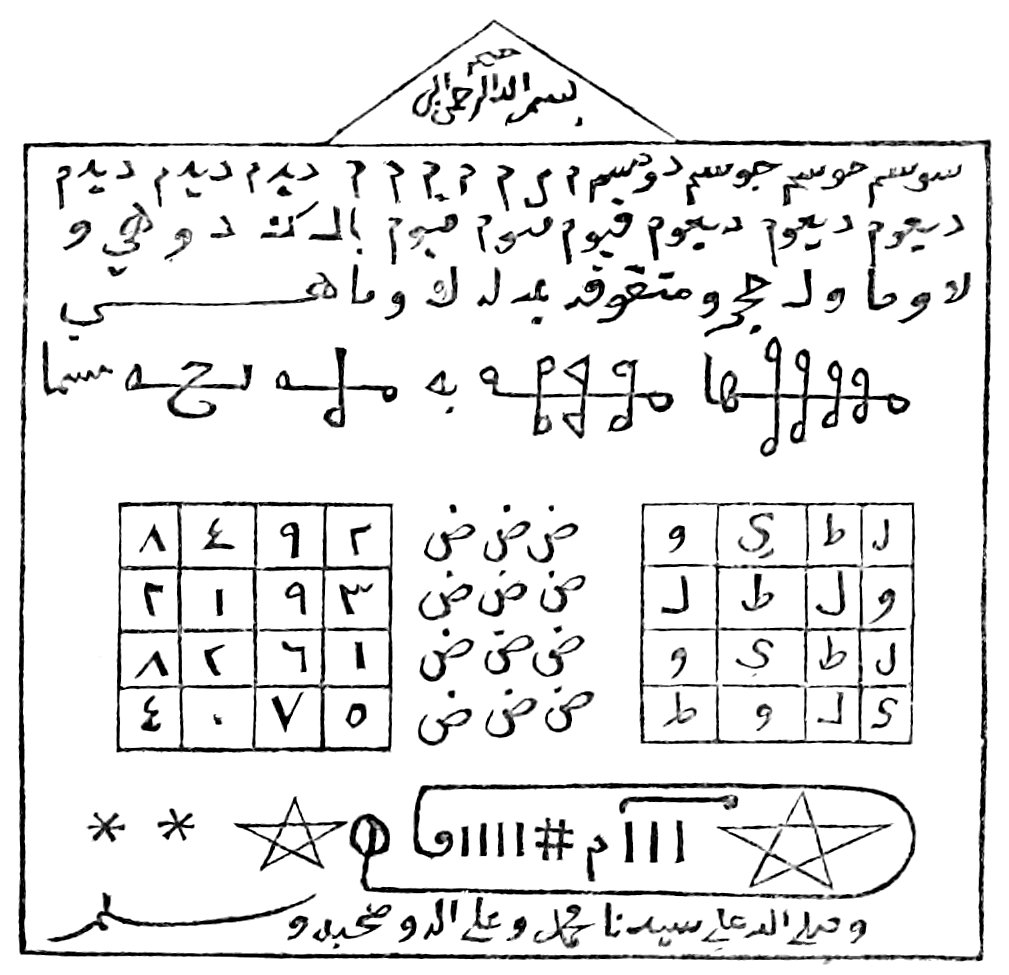
Sometimes they write amulets upon a piece of paper, which if the unhappy lover swallows, it will force the object of his love to listen to his intreaties. There are particular Fakirs famous for love receipts; others for febrifuges, &c. The following are two amulets, one of which was given to me at Berber, and the other at Damer. If to the former, the proper name is added, no female is capable of withstanding the charm, at least such was the assurance given to me by the Fakir Mansur, from whom I bought the secret for a string of wooden beads, but I never yet had an opportunity of trying its efficacy.
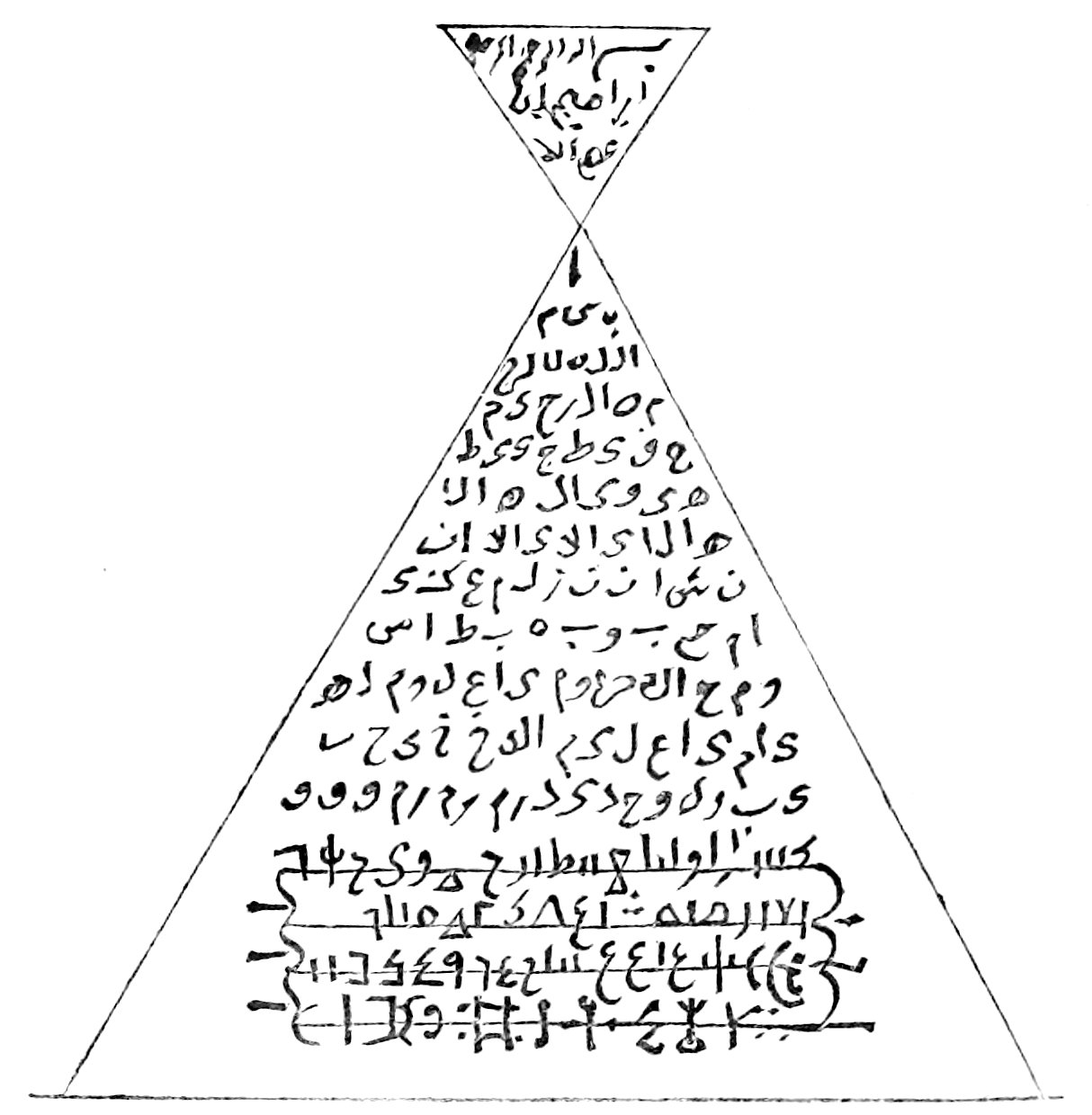
The following is an amulet which protects the owner from being wounded.
The people of Berber appear to be a healthy race. There seemed to be few invalids, and the place being situated on the skirts of the desert, the air is certainly wholesome. I was told of a fever called wardé (ورده), from woid (rose), which seems to be epidemic, and often proves mortal; the people of Dóngola are very subject to it; it exists during the time of high water, but does not make its appearance every year. The plague is unknown, and from what I heard during my former journey in Nubia, I have reason to believe that it never passes the cataract of Assouan. The small-pox is very destructive whenever it gains ground. Last year it was added to famine, and deaths were very numerous. It had been brought to Berber by the people of Taka, who had received it from the Souakin traders; it spread over all the country up the Nile. Grown people were attacked as well as children; it was observed even, that the latter suffered less and that more of them escaped. About one-third of those who were attacked recovered, but they bore the marks on their skin, especially on the arms and face, which were covered with innumerable spots and scars; very few instances happen where the disease is of a mild kind, or where it leaves but few marks. Inoculation, Dak-el-Jedri (دق الجدري), is known, but not much practised; little benefit being supposed to arise from it. The incision is usually made in the leg. Of the large family of Temsah (our landlord’s), fifty-two persons died within a few months, and while I am writing this (at Cairo, December 1815), I hear from some traders, that the same disease has again broken out, and that almost the whole family, including Edris, have perished. Their only cure for the small pox is to rub the whole body with butter three or four times a day, and to keep themselves closely shut up. The disease generally visits them every eight or ten years. They are infinitely more afraid of it than the Levantines are of the plague: and great numbers of the inhabitants emigrate to the mountains, to fly from the infection. I have heard it said in Egypt, that the small pox is rendered more dangerous in the negroe countries than elsewhere, by the thickness of the negroe skin, the fever being increased by the resistance of such a skin, to the efforts of the poison to break through it. This may be true with respect to the negroe slaves, but is not probable at Berber, where the people’s skin is quite as soft as ours. I saw few instances of ophthalmia. Venereal complaints are said to be common, but if it be so, their consequences appear to be less fatal than in Egypt, for I never saw any of those ulcered faces, or mangled noses, which are so common in the northern valley of the Nile.
The Meyrefab are partly shepherds, and partly cultivators. After the inundation, they sow all the ground which has been inundated, with Dhourra, and a little barley. Just before they sow, they turn up the ground with the spade. The plough is not in use among them; last year an Egyptian employed one for the first time. They have very few water wheels, not more than four or five in the districts of Ankheyre and Hassa. They sow only once a year, and as the banks of the Nile are very high, higher in general than in Upper Egypt, many spots of arable soil remain without being inundated. The deficiency is not often supplied, as in Upper Egypt, by artificial irrigation, for the purpose of procuring several crops from the same land, so that it may easily be conceived, that famine often visits them. Thus it happened the year before my arrival, when one moud of Dhourra was sold for half a Spanish dollar. The country, however, appears, at no very remote period, to have enjoyed a more flourishing state of culture than it does at present; for I observed in the fields vestiges of deep canals, which are at present entirely neglected, although by their help, even part of the adjoining desert plain might be rendered cultivable. Dhourra is the principal produce of the ground, and the chief food both of man and beast. Wheat is not sown at Berber, and very little is found in any of the adjoining countries. The Dhourra is of the same species as that of Upper Egypt, but the stalks are much higher and stronger, rising often to the height of sixteen or twenty feet. No vegetables are grown except onions, kidney beans (Loubieh), the esculent mallow, or Bahmieh,[16] and the Melukhyeh (ملوخيه), all of which are common in Egypt. No fruits whatever are cultivated, and if I am rightly informed, the lotus nebek, which grows wild, is the only one known.
The Berberys rear a large quantity of cattle, of the best kind, which in winter and spring time, after the rains, is pastured in the mountains of the Bisharein, where the keepers live like Bedouins in huts and tents. During the latter part of the spring, the cattle feed upon the wild herbs, which grow among the Dhourra stubble as thickly as grass in a meadow. In summer time, when the herbs are dried up, and there is scarcely any pasture upon the mountains, they are fed at home with the dry stalks, and leaves of the Dhourra. The principal riches of the shepherds consist in their cows and camels. They have sheep and goats, but the greater part having been consumed during the last famine, they are at present not numerous. The cows are of a middling size, and not strongly built: they have small horns, and upon the back, near the fore shoulder, there is a hump of fat. This breed is unknown in Egypt; it begins in Dóngola, and all along the Nile, as far as Sennaar, no others are seen. The cows represented in the battle-pieces on the walls of several ancient temples in Upper Egypt, have the same excrescence. I saw the same species in the Hedjaz. Cows are kept for their milk, but principally for their meat, and there are a few for the purpose of turning the water-wheels.
The camels are of the best breed, much stronger, and more endured to fatigue even than the celebrated breeds of Upper Egypt: their dromedaries surpass all that I saw in the Syrian and Arabian deserts. The camels have very short hair, and have no tufts on any part of their body. The Hedjin or dromedary, is not of a different species from the camel of burthen, but they are very careful of the breed, and an Arab will undertake a journey of several days to have his dromedary covered by a celebrated male. At present there is a great demand for camels for the Egyptian market; they are bought up by the Pasha to be sent to Arabia, for the transport of army provisions, and every month three or four hundred are marched off through the desert; yet a camel is worth here only from eight to twelve dollars, though sold at Daraou for thirty or forty, and at Cairo for fifty or sixty dollars.
The sheep of these southern countries have no wool, but are covered with a thin short hair, resembling that of goats; hence the inhabitants set little value upon them, and rear them for the table only. Almost every family keeps two asses; they are of a strong breed, and are employed chiefly to bring home the produce of the fields, and transport the nitrous earth called Sabakha (سَبَخه), which is procured in the mountain: the inhabitants cover their fields with this earth, previously to sowing their seed, but whether as manure, or as a corrective to the fatness of the soil, I could not learn. Egyptian asses are much in demand, because they run faster than the native; they are rode by the great people, and are eagerly purchased on the arrival of every caravan. Horses are numerous; every family of respectability keeping at least one, and many two or three. The Arabs in the Nubian countries ride stallions only. In their wars with their neighbours, the Meyrefab bring into the field a considerable number of horsemen, who generally decide the battle. The horses are of the Dóngola breed, which, as I have already stated in my journey towards that country, is one of the finest races in the world. They are fed upon Dhourra, and its dried leaves serve instead of straw or hay: for several weeks in the spring they are pastured in the green barley. A horse costs from fifteen to forty dollars. They are not called Hoszan, as in Egypt, but Hafer (حافِر). The saddles, which are of the same form as those used in Dóngola, Sennaar, and Abyssinia, somewhat resemble those of the European cavalry, having a high pommel in front, bending forward on the horse’s neck. When entering on a campaign, the back, sides, neck, and breast of the horses are covered with pieces of woollen stuff, thickly quilted with cotton, which are said to be impenetrable by the lance and sword; they are called Lebs (لِبْس), the name given to a similar covering used by the Eastern Bedouins, but which the Meyrefab work in a neater manner, and lighter, though stronger.
Almost all the people of Berber, who are cultivators, employ the time not required by their fields, in commercial transactions; the place has thus become a principal mart for the southern trade, and the more so, as all the caravans from Sennaar and Shendy to Egypt necessarily pass here. Berber itself carries on trade with Egypt, and many small caravans load and depart from hence, without waiting for supplies from the southern markets. Almost every article of the Negro trade, including slaves, may be purchased at Berber, from fifteen to twenty per cent. dearer than at Shendy. Berber has a public market; but the late famine, and the great mortality caused by the small pox, had occasioned a momentary suspension, which had not been removed at the period of our arrival.
The common currency of the country at Berber, and all the way from thence to Sennaar, is Dhourra, and Spanish Dollars; every thing of minor value has its price fixed in Dhourra, which is measured by Selgas (سلقا), or handfuls. Eighteen Selgas make one Moud, or measure: one Selga is as much as can be heaped upon the flat extended hand of a full-grown man. It may easily be conceived that disputes frequently arise between buyers and sellers, from the unequal size of their hands; in such case a third person is usually called in to measure the Dhourra: ten Mouds are now given for one dollar. If a considerable quantity of Dhourra is to be measured out, the contents of a wooden bowl, or other vessel, is previously ascertained in handfuls, and this vessel is then used. They have, it is true, Mouds, or measures of wood, but nobody trusts to them, the hand-measure being always preferred. Besides the Dhourra, another substitute for currency is the Dammour (دمّور), a coarse cotton cloth, which is fabricated in the neighbourhood of Sennaar, and principally used by the people of this country for their shirts: one piece of Dammour is exactly sufficient to make one shirt for a full grown man; this is called Tob, or Thob Dammour (توب دمّور, plural تياب). When I was at Berber, one dollar was paid for two Tob. The Tob Dammour is divided into two Ferde Dammour; the Ferde (فرده) makes a long napkin, used by the slaves to wrap round their waists. The Ferde contains two Fittige, (فِتقِه) which serve for nothing else than a currency; thus I remember to have bought some tobacco with a Fittige. Dhourra is generally the most acceptable medium, as sellers will not always take the Dammour at the real market price, which, moreover, varies on the arrival of every caravan from the south. Slaves, camels, horses, or any other articles of large amount, are paid for in dollars, or Tob Dammour; but the broker takes his commission in Dhourra, which he readily converts into dollars. In commerce, two reals, or dollars, are called Kesme (قِسمه); four are termed Mithkal (مثقال); eight, or half an ounce, Nosfwokye (نصف وقيه), and sixteen are called Puma, or Wokye. These denominations were taken originally from the gold weights, one ounce of gold being generally worth about sixteen dollars; but they have now become fixed appellations, and sixteen dollars are called Wokye, even though the ounce of gold should be worth eighteen or twenty dollars, as was the case during my stay at Berber.
In Cordofan, besides Dhourra and Dokhen, the usual currency is small pieces of iron, which are wrought into lances, knives, axes, &c.; besides these pieces of iron, cows are used as a representative of money in large bargains, and are thus continually transferred from one person to another.
I shall enter more into detail on the different articles of Negro trade, when I come to speak of the Shendy market; both places deal in the same commodities; there is much less trade, however, at Berber, than at Shendy, from its having no direct intercourse with any southern state, except Shendy, while the latter is visited by slave caravans from all quarters, and is at present the first commercial town, perhaps, of Africa, south of Egypt, and east of Darfour. All the slaves, and every other article for sale in the Berber market, come from Shendy; yet the Egyptian merchants often prefer this market to the more southern ones, notwithstanding the increased charges; because they can finish their business more quickly, and profit by the first opportunity to return through the desert. During my stay at Berber, a caravan set out for Daraou, consisting of about two hundred and fifty camels, and twenty slaves; several of my companions having disposed of their merchandize, returned with it. Still, however, the Berber market contains but a small quantity of goods, and is fit only for the Egyptian traders with small capitals.
In Upper Egypt the caravans from Berber are commonly called Sennaar caravans; for the Egyptians having little knowledge of the southern countries, all the caravans which arrive from thence are classed under the two heads of Darfour and Sennaar, according as they enter Egypt from the western or the eastern desert: the latter comprise the caravans from Sennaar, Shendy, Berber, Mahass, and Seboua. Every caravan arriving at Berber from the south remains there for some time, in order to engage proper guides, and make other preparations for the journey across the desert. Many of the Ababde are settled here, and are always ready to undertake the journey; for twenty dollars none will refuse to accompany a caravan, and they serve both for guides and protectors. Many traders are well acquainted with the route, but if unaccompanied by an Ababde, they would be stripped by any Bedouin of the same tribe whom they might happen to meet on the road. The caravans must pay at Berber a transit duty to the Mek, the collection of which, from every individual, requires several days. The Mek exacts from each person coming from Egypt, without reference to the number of loads or camels he may have, or whether he be a master or a servant, five Tob Dammour; his officers must be paid one Tob, his slaves one Tob; and whenever the chiefs of the Bisharein of the tribes of Are-ab and Ali-ab, or their relations, meet a caravan here, they demand one Tob more; this demand is made because the Bisharein are masters of the desert from hence to the wells of Naby: to the north of Naby the country is reckoned to be in the dominions of the Ababde, and may thus be said to form part of Egypt, the Ababde being tributary to the government of Egypt. The seven Tobs are collected by the Mek, who distributes to his people their portion; the Bisharein collect their Tob themselves; and if none of them happen to be present, the caravan does not pay any thing on their account. The Mek takes his payment either in dollars or in Dammour, or if the people of the caravan have no ready cash upon their arrival, which frequently happens, their last farthing being often invested in goods previously to their quitting Egypt, he then takes merchandize, but at a value fixed by himself. The Ababde are exempted from this transit duty, because they are themselves, as is said, “Ahl Soltane,” or independent people, in their own mountains; and it is held that one chief cannot with honour take any thing as duty from another. But the fact is, that the people of Berber are afraid of them, because, when any quarrels happen between them and the Ababde, the latter descend from their mountains and make plundering incursions towards Berber, carrying off cattle and slaves in the night. The Bisharein traders also pass duty free, but their numbers are very small; only three or four merchants of their tribe frequent this route.
The Mek exacts no fixed toll from the caravans arriving from the south, and here entering the desert, because these traders come from the capital of his sovereign; but he receives some trifling presents from each trader, proportionate to the number of his camel-loads and slaves.
The above are not the only duties exacted by the Mek and his party. They enquire after the particular merchandize brought by every merchant from Egypt, and then ask for presents beyond what is due to them: the Mek is assisted in this enquiry by the traders themselves, who inform against each other, in order to ingratiate themselves in his favour. The first week of our stay at Berber was passed in continual endeavours on the part of the Mek to obtain various presents, and corresponding efforts in the traders to elude them. Having been always represented as a very poor man in the caravan, the Mek took only three dollars from me at first; but being afterwards informed that I had some dollars in my girdle, he obliged me to give him a fourth. Were it not for his apprehensions of the more powerful chief of Shendy, and of a total interruption of the transport trade by way of Berber, he would certainly prove still more vexatious to traders by his demands. I calculate his yearly income from the caravans at about three or four thousand Spanish dollars; he spends this sum in keeping a large establishment of male and female slaves, of horses, and fine dromedaries; and in feeding daily about fifty people belonging to his household, as well as strangers. He must likewise make frequent presents to his relatives, and his party, to strengthen his influence over them; thus he has never been able to accumulate any considerable capital.
The most wealthy man of Berber, next to the Mek, was pointed out to me, with the observation that he possessed about two thousand dollars, which he gained last year, during the famine, by happening to have a full-stocked granary. The generality of the people styled respectable possess from three to six hundred dollars each, including the value of their cattle, household furniture, &c.
Berber has few channels of commercial intercourse, except Daraou and Shendy. I was told that caravans used formerly to go from hence to Dóngola, not along the Nile, because they would then be stopped at every village for toll, but across the mountains on the western bank of the river. Since the Arabs Rebatat have been at war with all their neighbours, that road has been continually infested by them, and has therefore been discontinued. At present the intercourse with Dóngola is carried on by way of Shendy only, from whence the caravans depart in a straight direction across the mountains. Many merchants from Dóngola are settled here; they trade principally in dates and tobacco; and their wives and slaves have the reputation of making the best Bouza. The Bisharein Bedouins, and the husbandmen on the banks of the river Mogren (the Mareb of Bruce), repair to Berber to buy Dammour; and they purchase from the Egyptian traders beads, antimony, nutmegs, and the various ingredients used in the preparation of the perfumed grease already mentioned. Caravans also arrive occasionally from Taka, across the eastern mountains, a journey of ten or twelve days, to buy the same articles, or to exchange ox hides and camels for them. Small caravans, composed principally of Bisharein, come also from Souakin, a journey of ten days, with spices and India piece goods, chiefly cambrics. This route is not frequented by foreign traders, from apprehension of the treachery of the Bisharein; but if any pilgrims happen to be at Berber, in their way to Mekka, when one of these caravans sets out on its return, they often take the same route, in which water is found in plenty. The usual route of the Negro pilgrims, however, is either along the banks of the Nile, or by way of Taka, of which I shall speak hereafter. I had myself some idea of trying the journey to Taka, from whence I had reason to hope that I might reach the northern frontiers of Abyssinia, in the direction of Massouah. As there were many people at Berber who had come from Sennaar, and as these, upon being questioned, by my companions, about my pretended lost relation, all agreed that no white man was then in Sennaar, I was obliged to resort to the supposition that he had quitted it, and gone on towards Abyssinia; I was thus enabled to make enquiries concerning the route across the desert to Taka, and towards Souakin, without creating suspicion; and my companions pressed me much to travel in the latter direction, and to wait at Berber till a favourable opportunity should offer for setting out. They would, no doubt, have been glad to see me undertake a journey of evident peril, thinking that if I perished, they would be entirely rid of me, for they could not divest themselves of some secret apprehensions that, if I ever returned to Egypt, I should find means of being revenged upon them for their behaviour towards me. Upon closer enquiry, however, I found that this route is quite impracticable for strangers; the people of Berber, even, are afraid to trust themselves, except in large numbers, with the Bisharein, who will kill their companions if they have a prospect of the smallest gain; and persons recommended by the Mek himself are not more secure. The traveller must always carry with him some little merchandize and baggage, in order to barter on the road for provisions, and this is more than sufficient to excite the cupidity of the Bisharein, and render him the victim of their treachery. In the course of my enquiries on this occasion, I was informed that, about five or six years before, a man had reached Berber from Egypt, who was supposed to be a Christian, because he made notes of his journey in writing.[17] It was said that he made considerable presents to the Mek, who strongly recommended him to a small party of Bisharein; he set out for Souakin in their company, but was murdered by them in the road, and on their return, a small present purchased their peace with the Mek.
I heard afterwards that, about eight or ten years since, an avowed Christian, who spoke very little Arabic, and passed Sennaar, in his way from the north (I suppose from Egypt), was murdered by the Arabs in the mountains between Sennaar and Abyssinia, but not in the caravan route. When at Shendy, I enquired after such a traveller, but nobody knew any thing of him. Had he come by the western caravan route from Darfour and Kordofan, I think I must have heard of him, because white people (and this person was said to be white) are much more noticed in that quarter, than in the route from Egypt; and he must have been seen by some of the Kordofan travellers, with several of whom I became acquainted at Shendy. I did not hear that he was seen writing a journal.
The success of a traveller, in this part of the world, depends greatly, I may say wholly, upon his guides and fellow travellers, and their being well disposed towards him. If he is not thoroughly acquainted with the language of the country it will be very difficult for him to select proper persons for his guides or companions, or to elude the snares laid for him by villainy or treachery; it is in vain to suppose that fortune will throw in his way honest or friendly people, who are too scarce ever to be calculated upon, in preparing for a journey through these countries. The traveller must consider himself as surrounded by some of the most worthless of the human race, among whom he must think himself fortunate, if he can discover any less depraved than the rest, whom he can place some degree of confidence in, and make subservient to his views; and which can only be done by identifying their interest with his own safety. Above all, he must never be seen taking notes. I am fully convinced, that if I had ever been detected by my companions with my journal in my hand, it would have given rise to the most injurious reports, and blasted all my hopes of success. While travelling through the desert I took my notes with much more ease than during my stay at Berber. Being mounted on a good ass, I used to push on ahead of the caravan, and then alight under some tree, or rock, where I remained, unobserved, apparently occupied only in smoking my pipe, until the caravan came up; but at Berber, and at Shendy also, I was often at a great loss how to withdraw from the persons who surrounded me in the house where we lodged; and it was unsafe to walk so far from the village into the fields, as not to be observed. The having persons thus continually hanging about me, was the most disagreeable circumstance attending my stay in these countries. I might have escaped it in some measure, perhaps, by taking a lodging for myself, which I could have readily procured, but then I should have been entirely unprotected in the house of a stranger, who might have proved worse even than my companions; I should also have been unmercifully annoyed the whole day by visitors begging presents, and the little baggage I had would have been much less secure. On the contrary, by continuing to live with my old companions from Daraou, my person was far less noticed than if I had resided alone, my expenses were not so great, I acquired a good deal of information as to the mode of carrying on the trade, and found myself in some degree secure, by the respectability of my companions, however little disposed they might be to protect or favour me.
Merchants always prefer taking up their abode in some respectable house, and if possible in that of a relation of the chief, because they are then protected by the authority of their landlord, who would resent any serious insult offered to his guests. Our Ababde guides, who were in no fear of any importunities, or insolence from the Meyrefab, took up their quarters in the house of a poor Fakir, where they were much more comfortable, and more at their ease than ourselves. My companions made me contribute two dollars for my share of the landlord’s bill; I paid, besides, one dollar for my quota of the presents given to those who had sent us some dishes of meat at different times; one dollar I exchanged for Dhourra to feed my ass, and for a little tobacco: these, together with four dollars to the chief at Berber, and three to the chief of the caravan, who had a right to exact five; five dollars paid for the carriage of my baggage, and four for that of my water-skins through the desert, amounted to so considerable a sum, when compared with the state of my purse, that I could not help entertaining some melancholy thoughts on my future prospects.
When the day was at length fixed for our departure for Shendy, whither the greater part of the merchants intended to carry their goods, some presents were made up amongst our party for our landlord Edris: he was not easily satisfied; his old wife too had some claims; but after much quarrelling, he at last accepted merchandize to the value of twenty dollars, as a recompense for having entertained us in his house fourteen days. We were about a dozen in number, but the daily expense did not, certainly, amount to more than one-third, or half a dollar; for, except on the first day, when he killed a lamb for us, we never partook of any other dish from his kitchen than Dhourra bread, with butter, one large dish of which was served up at mid-day, and another late at night. As we were only passengers, and had no slaves with us, our meals were provided by the master of the house; but when traders return hither, on their way to Egypt, accompanied, as they usually are, by a number of female slaves, the latter dress their masters victuals, and the owner of the house is then paid only for his lodgings.
The preceding details respecting Berber are for the greater part applicable to Shendy, and, as far as I could learn, to all the petty Mekdoms from thence to Sennaar.
The country on the western side of the Nile, opposite to Berber, is not cultivated, but I was told that, in following the course of the river, on that side, considerable settlements of Arabs are met with, especially in the country of Mograt, which is inhabited by the Arabs Rebatat, an independent tribe like the Meyrefab, extending two or three days journey along the Nile. One of its principal places is Bedjem (بجم), three long days from Berber; it is at present the residence of Hedjel, the chief of Mograt, who succeeded his relation Naym, the famous robber, already mentioned: The latter had accumulated great riches by robbing the Egyptian caravans; he expended the greater part in purchasing young female slaves, and was fond of boasting of the enjoyments of his Harem. He generally waylaid the caravans between Berber and the wells of Nedjeym, but sometimes he followed them as far as Shigré. He had frequently been fired at, but his strong coat of mail being proof against a distant musket shot, he had acquired the reputation of being a sorcerer, furnished with amulets to render him invulnerable to mortals. Some Faky having told the merchants that, as his amulets were written in defence of leaden bullets only, he might be killed with silver ones, several of the traders melted Spanish dollars into large slugs, with which they loaded their guns. Naym’s true amulet, however, was the distant firing and bad aim of his assailants. Whenever he apprehended that the strength of a caravan might be superior to his own, he used to halt at some distance from the travellers, and having ordered some particular party to withdraw from the rest, assured them that it was not against them that his intentions were directed; having thus succeeded in separating a part, he easily dispersed the remainder. He always kept his word with those who thus retired, and allowed their loaded camels to proceed untouched, although, on some other occasion, perhaps, they might be comprised amongst the number attacked. His success is the strongest proof of the cowardice and bad faith of the traders who were capable of thus abandoning their companions; such conduct, in the Arabian deserts, would consign a tribe to everlasting infamy.
Naym shewed less cruelty towards the helpless travellers than might be expected from an African robber. After stripping the caravan, he generally permitted them to take as many camels, and as much provision as would carry them to Egypt, or back to Berber; and as he knew the greater part of the merchants personally, he often returned them a slave or two at parting. Several Ababdes having been killed in one of his attacks, the whole tribe was inspired with the desire of revenge, and it was not long before they found an opportunity of exercising it. The large caravan which left Sennaar for Egypt in 1812, in company with the envoys of the Pasha, was escorted by several hundred armed Ababdes. They halted for many days at Berber, in order to prepare for their journey through the desert. During this time the Ababde chief of the caravan received secret intelligence that Naym had taken a new bride, and had fixed a certain day for his nuptials. The caravan was ordered to leave Berber on the preceding day, and the chief, accompanied by about one hundred armed camel-riders, set out the night before, for the purpose, as he said, of dividing the number of camels, and thus watering the animals with more ease at Shigré. When he had proceeded some distance into the desert, instead of following the direct road, he turned westwards, and hastened across the mountains towards Mograt. Reaching the residence of Naym, he surrounded the house and set fire to it, when Naym sallied forth and was killed, with about half a dozen of his companions. His head was carried to Egypt, and his ears sent to Mohammed Aly Pasha, then in the Hedjaz. The unfortunate bride was obliged to marry one of her husband’s murderers, who brought her to Egypt, from whence she afterwards found means to escape to Dóngola, and is now again with her family at Mograt. The fate of Naym, however, has not prevented another robber from succeeding him in these mountains: his name is Kerar, and he is chief of the Ababdes of the tribe of Asheybab. In 1814, he plundered several caravans, composed mostly of people of Berber, and retreated with his booty to his tents in the mountains of Ottaby. The Pasha of Egypt has made many attempts to seize him, but hitherto without success.
At present, as may well be conceived, there is very little intercourse between Berber and Mograt, or the more distant country of the Sheygya, except by Negro pilgrims, who follow the inhabited banks of the Nile to Egypt. The war now carried on between the Sheygya, and the Mamelouks in Dóngola is unfavourable to mercantile speculations. Several battles have been fought, in which about one hundred and fifty of the Sheygya, and fifty of the Mamelouks, have been killed. The latter captured some horses and slaves, but being unable to subdue their adversaries, and tired of a fruitless and harassing warfare, they have withdrawn their forces from the southern limits of Dóngola, and concentrated themselves in its northern provinces towards Argo, where they still remain. Their principal chief, Ibrahim Beg el Kebir, died of old age in 1813, and Abdurrahman Beg el Manfoukh is now considered as the head man amongst them. Several of the Begs, instead of going to Dóngola, came from Egypt across the desert to Berber, and Selim Beg el Towyl (سليم بك الطويل) lived for several months in the same house we occupied. The chief of Berber being afraid of the Mamelouks, behaved to the Beg with the greatest appearance of kindness and generosity. Many persons at Berber believed that I belonged to the Mamelouks, and that I had made my escape from Upper Egypt, in order to join them. Though I disliked this report, yet I preferred it to being supposed to belong to the household or army of the Pasha of Egypt. The circumstance of his having sent an envoy to Sennaar, had made people suspect that he had some design upon these countries; the chiefs every where viewed his increasing strength in Egypt with great jealousy, and he was much disliked by all merchants, on account of the heavy duties he had laid on the imports from the south; I therefore took great care to avoid exciting any suspicion that I was in his interest, and concealed the letters of recommendation I had with me, which I intended to make use of only in case of the utmost necessity.
The distance from Berber to the southern limits of the country of the Arabs Sheygya is four long days journey across the mountains on the western side of the Nile. A district called Djohfe (جهفه), where trees and springs are met with, forms a part of these mountains. The former king of Kordofan, El Hashemy (الهاشمي), retired to these mountains after having been dispossessed of his territory by the present chief, called Metsellim, an officer of the King of Darfour, and he remained encamped there for several years, with a troop of followers; but he was at last so hard pressed by the Sheygya, as to be obliged to retire to Shendy, and to put himself under the protection of Nimr, the Mek of that place, by whom he was afterwards killed, having engaged, with the Mek’s brothers, in a conspiracy against him.
JOURNEY FROM BERBER TO SHENDY.
After having settled all our accounts at Berber, our caravan, reduced to about two-thirds of its original number, set out again on the afternoon of the 7th of April. Several of the merchants had returned to Egypt, others remained at Berber to sell their goods, as did also many Ababdes, who had their families there, and who intended to remain till the return of the caravan from Shendy. I was not sorry to leave Berber; for the character of the inhabitants is such, that a stranger can never consider himself safe for a moment amongst them. Several of the first people of the town advised me strongly to remain, and wait for the opportunity of proceeding with a Taka caravan; but alone, I should have been entirely at the mercy of the Meyrefab, who, no doubt, intended to plunder me; I therefore resolved to proceed as far as Shendy, where I thought I should be more likely to meet with a safe conveyance towards the Red Sea.
We proceeded this evening about two miles through the sands, and stopped at the village of Goz el Funnye (قوز الفنّيه), belonging to Berber. Here we alighted in the court-yard of the house of a Fakir, a trader well known in Egypt, who entertained us hospitably, and asked for no presents. Whenever he visits Egypt, he quarters himself in like manner upon his acquaintance at Daraou. Late in the evening our host Edris paid us a last farewell visit, and insisted upon some further presents. After much disputing, he wrested from the Daraou traders a fine shield, worth eight dollars, the value of which we were obliged to pay him by a general contribution, in order to recover it.
April 8th. There are many ruins of modern buildings at Goz, which is now in decay; formerly, it was the chief place in Berber, and it is so mentioned by Bruce. In several places are public wells or pits of brackish water, where travellers water their beasts, the banks of the river being steep, and the descent to it very difficult. We pursued our way along the skirts of the desert, over a perfectly level plain or arable track of land, about two miles in breadth, which lay between us and the Nile. The ground was every where overgrown with the Oshour tree (عُشور), so often mentioned in my journey along the Nile towards Dóngola, and in the previous one through Arabia Petræa. Our path was well trodden, and might be called a high road; numerous paths diverged from it in every direction into the eastern desert. After about two hours march, we reached a woody tract, where Sant and Sellam trees grow. The country on the western side of the Nile was, as far as I could see, perfectly flat, without any mountains or hills; but a white line, indicating the sands of the desert, was every where discernible beyond the narrow stripe of arable land which borders the course of the stream. We met many travellers, on horseback and on dromedaries, and women and children either riding alone on asses, or driving loaded asses before them. This road appears to be perfectly safe for the inhabitants of the country, though it would not be so for strangers, without a proper guide. We had taken two men from Ankheyre to escort us to the limits of the Wady Berber. At the end of three hours and a half, we entered the district of Ras el Wady; and at the end of four hours reached the village of that name (راس الوادي), where we were obliged to stop, as a transit duty is here levied upon merchants. Ras el Wady is a considerable village, larger than Ankheyre, but not so well built, and containing many huts made of mats. We went straight to the Mek’s dwelling, and encamped on the open ground before it. This Mek, whose name is Hamze, is a relation of Noureddyn, the Mek of Berber (مك حمزه ابن عم المك نورالدين في بربر), but is quite independent of him, Ras el Wady being a principality of itself, although I think that most of its inhabitants are Meyrefabs, and of the same tribe with those who people Berber. Like the latter place, however, it is subject to the king of Sennaar, by whom the Mek is appointed. Hamze is much dreaded by the caravan travellers, especially the Egyptians. The Daraou traders supposing that they might, perhaps, on my account, experience some ill treatment from this chief, and convinced, at all events, that my society could no longer be of any advantage to them, as they saw that I fought for every handful of Dhourra, determined to abandon me entirely. We had halted for some minutes in the plain, near a pond of water, before the village. On starting again, they ordered me, in a contemptuous manner, to keep off, and not to come near their party any more. The boys accompanied these orders with a shouting similar to that which is made in driving dogs away, and then beating my ass with the but-end of their lances, they drove him into the desert.
I had always endeavoured to keep on good terms with our Ababde companions, who, bad as they were, were still better than the Daraou people; I now asked them whether they intended to leave me to the mercy of the Meyrefab robbers, or would permit me to make one of their party. They immediately consented to my joining them, and my situation became thus materially bettered. During the whole of our stay at Berber, no dirty villainous trick or joke was left untried by my companions from Daraou to hurt my feelings and render me contemptible; at last, well assured that my bodily strength was superior to that of any of their party (for I had several times thrown the strongest of them in wrestling), the boys attempted to tire my patience by an incessant teazing, which I could not easily resent upon them, and which I thought it necessary to put up with, because I was afraid, that if I should leave the party abruptly I might expose myself to some more deliberate mischief, which I could not estimate, and had not the means of preventing.
The Mek Hamze gave us a very cold reception. We remained from morning, till late in the evening, before he sent us any food; and my companions said, that if he should hear of any of us having eaten in the meanwhile of our own provisions, he would consider it as a great affront, because we were now his guests. Two of our merchants went up to the Mek, to negociate with him, about the sum to be paid, while the rest were all busily engaged in defending the baggage from the rapacity of the inhabitants, who had at first collected round it in great numbers, and inquiring, with apparent friendly concern, about our welfare, had soon after placed themselves in the midst of it. There was no open quarrel, but many things were found missing, and amongst the rest I lost my pipe. Late at night we were informed that the Mek would not be satisfied with less than ten dollars for each camel’s load, and four dollars from each trader; I was comprised among the latter, and the sum was paid down, partly in cash, and partly in goods. The Ababdes paid nothing, and for some presents given to them, they even secured several Egyptian camel loads from taxation, by claiming them as their own. I had reason to be afraid that the Mek would take my gun, for I had heard that he is in the habit of seizing upon all the fire-arms he can; in the preceding night, therefore, I made a pretended bargain for it with the Ababde chief, in the presence of the caravan, well knowing that my companions themselves would otherwise have betrayed me. The Ababde chief now declared to the Mek’s people that the gun was his, which nobody could deny. It was thus saved, but the Ababde took a dollar for his trouble.
The Mek remained in his house the whole night, without our seeing him; but his son came down to ask for some presents for himself, which were flatly refused. He then inquired if there was any jolly fellow amongst us, who would keep him company at the Bouza shop. One of the Egyptians stepped forward, and had the honour of being led by him to a common brothel just by, where they sat drinking and singing the whole of the night.
April 9th. This morning Mek Hamze made his appearance; on quitting his house, he walked across the plain, and set himself down on a stone bench, near a house, in front of our baggage. It being a hot day, he was quite naked, with the exception of a towel tied round his loins, and his hair had just been smeared with grease. He was attended by six or eight slaves, one of whom carried a small water-flask, very prettily made of leather, of Sennaar manufacture; another his sword, and a third his shield; so that his Mekship had altogether a most proud and commanding appearance. The merchants, who had expected to be permitted to depart early in the morning, were alarmed, and apprehended the levy of a new contribution. We all went up to him, kissed his hand, and stood before him in the most humble posture. He said he was glad to see us, that he was a great friend to traders, but that of late they had become very niggardly; he then insisted upon a present for his son, and seeing a fine ass in the caravan, told him to mount it. The owner of the ass offered in vain six dollars, as a ransom; the animal was carried to the Mek’s stable, and we were then permitted to depart. This ass happened to be the very one which had carried me through the desert. Understanding, while on the road, that Egyptian asses were in great demand in the southern countries, especially among the great people, and mine having become famous in the caravan, for his great strength and activity, I foresaw that it would be difficult for me to preserve him from the avidity of the Meks, and I therefore exchanged him on the night preceding our arrival at Berber, for one of a smaller size, and of inferior strength, belonging to one of the traders from Daraou, who gave me a dollar into the bargain; he undoubtedly flattered himself that he had over-reached me, little thinking that any body would take the ass from him, and reckoning upon selling it afterwards for ten or twelve dollars. At Berber he contrived to save the animal from the clutches of Mek Noureddyn; but Mek Hamze’s rapacity was of a more determined kind, and made him sorely repent of his bargain with me. He pretended to insist upon taking back the ass he had exchanged with me; but the Ababdes took my part, and even secretly praised me for having led him into the scrape.
A large party of Bisharein was encamped near Ras el Wady; they had come to purchase Dhourra for their summer provision. The brother of Mek Hamze had lately gone to Souakin, on his way to Arabia, with several slaves and fine horses, which he meant to offer as a present to the Sherif Hamoud, the chief of Yemen, expecting, of course, some suitable presents in return. Speculations of this sort are often made in these countries. Some of the dromedaries belonging to Mek Hamze were very fine animals, and their bridles and saddles were very fantastically ornamented. Every chief keeps a couple of dromedaries of the best race, for show, and, whenever he rides out, he is followed by them, mounted by two of his slaves.
We departed from Ras el Wady in the course of the morning. The Mek sent two of his relations, to accompany us to the limits of his jurisdiction. Our road lay partly through barren sands, and partly through thin woods of acacia trees. In two hours we passed several hamlets, where Doum trees were numerous, and in the neighbourhood of which a large island is formed in the river. The inhabitants of these hamlets are said to be great robbers, and this was, probably, the reason why our two guides made us halt here, and demanded ten dollars for having accompanied us so far. Fond as the traders are of their money, they thought that circumstances required them to submit to the imposition, and the money was paid. At this time our caravan was reduced to about twenty camels; many of the lesser traders, in order to elude the payment of passage-money, having already preceded us, and passed during the night through the desert to the east of Ras el Wady; others, who had no camels to mount, had engaged a man of Goz to conduct them by night along a perilous path by the side of the river, and they joined us again beyond the territory of Mek Hamze.
At a short distance from the hamlets, we came to a great number of new tombstones, in the desert, the melancholy proofs of the terrible ravages of the small-pox. According to the Nubian custom, and which I had already observed in the Berábera country, every tomb was covered with white pebbles, and pieces of quartz. The plain of the eastern desert is here interrupted by several sandy and gravelly hillocks. At the end of four hours, after passing through a wood of acacia trees, we reached the river Mogren (مُقرن), not Mareb, as Bruce writes it, a name quite unknown here. After descending a high bank, we passed for at least a mile, over deep sands in the bed of the river, and then came to a pool of stagnant water, about twenty paces broad, where the water reached up to the ankle: in many places there were similar pools, but no where any running stream. I estimated the height of the banks at thirty feet, and I observed the high-water marks to be about twenty feet from the bottom, from whence it is evident that this river can never inundate the adjacent country; indeed this fact was confirmed by my companions, who told me that during the time of high-water they pass the river in a boat brought from Damer for the purpose, and that they had never seen the country on either side of the river inundated, except by the waters of the Nile. The verdant banks of the Mogren, covered with fresh herbage and tamarisk bushes, afforded a delightful scene, which I was permitted to enjoy for a full hour, as many of the camels, in ascending the steep banks on the south side of the river, stumbled, and threw their loads, thus occasioning a delay.
The Mogren forms the boundary between the territories of Ras el Wady and Damer. On its southern banks several water-wheels were at work, drawing up the water from some of the pools. The regular distribution of the fields, and the small channels for irrigation, shewed that agriculture is here more attended to than in the districts we had passed. The banks of the Mogren, for about two days journey above its confluence with the Nile, are inhabited by the Arabs, or Bedouins Djaalein (جاعلين); they are quite independent, and their tribes are widely spread over these countries as high as Sennaar. They are the strongest Arab tribe in this neighbourhood; they cultivate some Dhourra fields on the banks of the river, and feed many cattle.
After passing the Mogren, we rode across a sandy barren plain, overgrown with Oshour, of which I saw trees twenty feet high, and then re-entered upon the arable soil, where we were met by some of the Shikhs of Damer, whom our advanced party had despatched to meet us, and to serve as an escort against the robberies of the Djaaleins, several of whose horsemen were seen hovering about, at a little distance from the caravan, with evidently bad intentions. At the end of six hours, and after sun-set, we entered Damer (دامر), a place of considerable note and reputation in this part of the world, and whose inhabitants, I was glad to find, are of a much better disposition than their neighbours of Berber. Having now joined the Ababdes of our caravan, I accompanied them to the house where they took up their quarters. We entered the dwelling of a Dóngola merchant, an old friend of my companions; he happened to be absent, but his wife gave us a kind reception, and cleaned two rooms in her court-yard, where the goods and baggage were deposited. We found here some Kordofan merchants, who had just come from Dóngola, by way of Shendy, and who gave us the latest news concerning the Mamelouks.
At Damer, from 10th to 15th April. Damer is a large village or town,[18] containing about five hundred houses. It is clean, and much neater than Berber, having many new buildings, and no ruins. The houses are built with some uniformity, in regular streets, and shady trees are met with in several places. It is inhabited by the Arab tribe of Medja-ydin (مجايدين), who trace their origin from Arabia; the greater part of them are Fokara, or religious men. They have no Shikh, but a high pontiff, called El Faky el Kebir (the great Faky), who is their real chief, and decides all matters in dispute. The family of Medjdoule, in whom this office is established, has the reputation of producing necromancers, or persons endowed with supernatural powers, from whom nothing remains hidden, and whose spells nothing can withstand. Innumerable stories are related of their magic powers, of which the following is a specimen: Abdallah, the father of the present Faky, caused a lamb to bleat in the stomach of the thief who had stolen, and afterwards eaten it. The Faky is resorted to in all cases where property is stolen, and as every body entertains the greatest terror of his supposed omniscience, it is generally an easy task with him to perform wonders. If I am not mistaken, the office of the great Faky is hereditary; of course it is essential that the successor should be a shrewd man, and well instructed in the Mussulman law, these being absolutely necessary to enable him to act his part. The great Shikh, however, is not the only person in the place who possesses magical powers; there are many Fakys of less note, who enjoy a similar credit, in proportion always to their sanctity and learning, and thus the whole town of Damer has acquired great reputation. Here are several schools, to which young men repair from Darfour, Sennaar, Kordofan, and other parts of Soudan, in order to acquire a proficiency in the law, sufficient to enable them to make a figure as great Fakys in their own countries. The learned men of Damer have many books, but they treat exclusively of religious and judicial subjects. Amongst others, I saw a copy of the Koran worth at least four hundred piasters, and a complete copy of Bochari’s Commentaries upon the Koran, worth double that sum, at the Cairo book-market. These books are brought from Cairo by the young Fakys of Damer themselves, many of whom go to study there in the mosque El Azher, or in the great mosque at Mekka, where they remain for three or four years, living during that time principally upon alms and stipends. In the schools at Damer they teach the true reading of the Koran, and deliver lectures on the Tefsyn (explanations of the Koran), and on the Touhyd, or the nature of God, and his divine attributes. They have a large well built mosque, but without a minaret; it rests upon arches built of bricks, and the floor is covered with fine sand. This is the coolest spot in Damer, and much resorted to by strangers to pass a few hours in sleep after the mid-day prayers. Around an open place adjoining the mosque are a number of school-rooms. Many Fakys have small chapels near their own houses, but the Friday’s prayers are always performed in the great mosque. The chief Fakys live with great ostentation of sanctity, and the Faky el Kebír leads the life of a hermit; he occupies a small building in the midst of a large square in the town. One part of this building is a chapel, and the other a room about twelve feet square, in which he constantly resides day and night, without any attendants, and separated from his own family. He lives upon what his friends or disciples send him for breakfast and supper. About three o’clock in the afternoon he quits his chamber, after having been shut up all the morning, occupied in reading, and takes his seat upon a large stone bench before the building. He is here joined by all his fraternity, and business is then transacted until long after sun-set. I went once to kiss his hands, and found him a venerable figure, entirely wrapped up in a white cloke. He asked me from whence I came, in what school I had learnt to read, and what books I had read; and he seemed satisfied with my answers. Near him sat a Moggrebyn Shikh, a native of Mekinéz, who had come from Mekka, to serve as his scribe, and who transacted all the public business. I was told that this person had found means to amass a large sum of money.