CHAP. LXVIII.
Reading edition
FIRST RESIDENCE IN THE DESERT. — POLITICAL COMBINATIONS. — GREAT MOSQUE. — GROUND-PLAN OF THE TOWN.
October 11th.This was an important moment for myself, as, with the exception of an occasional visit to the Sheikh, who lived only a few yards across the street, and an almost daily promenade on my terrace, I had not moved about since my arrival. With a deep consciousness of the critical position in which I was placed, I followed my protector, who, mounted on his favourite white mare, led the way through the streets of the town, along which the assembled natives were thronging in order to get a glance at me. Leaving the high mounds of rubbish which constitute the groundwork of the northern part of the town on our left, and pursuing a north-north-easterly direction over a sandy tract covered with stunted bushes, and making only a short halt near a well five miles from the town, for the purpose of watering our horses, after a march of two miles more we reached the camp, which could easily be recognised at a great distance by two large white cotton tents, whose size and situation made them conspicuous above some smaller leathern dwellings. It was just about sunset; and the open country with its rich mimosas, and with the camp on the rising ground, the white sandy soil of which was illumined by the last rays of the setting sun, presented an interesting spectacle. The younger inhabitants of the camp, including Bábá Ahmed and ʿAbidín, two favourite boys of the Sheikh, one five, the other four years of age, came out to meet us; and I soon afterwards found myself lodged in an indigenous tent of camel’s hair, which was pitched at the foot of the hill, belonging to Mohammed el Khalíl, a relative of the Sheikh, who had come from his native home in Tíris, on the shores of the Atlantic, in order to share his uncle’s blessing.
In this encampment we passed several days in the most quiet and retired manner, when my friend revealed to me his course of action. It was his intention, he said, to bring the old chief Galaijo, from the place of his exile in Champagóre, back to this part of Negroland, which he had formerly ruled, and to reinstate him, by the aid of the Tawárek, in the government of Másina with the residence Hamda-Alláhi, of which he was to deprive the family of Lebbo. But even if it was true, as he said, that the Fúlbe themselves, as well those settled between Fermágha and Gúndam, as those inhabiting the provinces of Dalla, Dwenza, and Gilgóji, were opposed to the government of Lebbo, such a project appeared to me to require a greater share of perseverance and determination than, from all that I had seen, I could believe my noble friend possessed. However, he entertained no doubt at that time that Alkúttabu, the great chief of the Tawárek himself, would come to his aid without delay and conduct me, under his powerful protection, safely along the banks of the Niger.
However exaggerated the projects of my protector were, considering his mild disposition, and although by exasperating the Fúlbe more and more he no doubt increased the difficulties of my situation, the moving of his encampment outside the town afforded me a great deal of relief, both in consequence of the change of air which it procured me, and of the varied scenery. I could also get here a little exercise, although the more open the country was, the greater care I had to take of my safety. In the morning, particularly, the camp presented a very animated sight. The two large white tents of cotton cloth, with their top-covering, or “sarámme,” of chequered design, and their woollen curtains of various colours, were half opened to allow the morning air to pervade them. The other smaller ones were grouped picturesquely around on the slope, which was enlivened by camels, cattle, and goats, that were just being driven out. All nature was awake and full of bustle, and the trees were swarming with white pigeons. In the evening, again, there were the cattle returning from their pasturage, the slaves bringing water on the backs of the asses, and the people grouped together in the simple place of devotion, laid out with thorny bushes, in order to say their prayers, guided by the melodious voice of their teacher, who never failed to join them. At this time a chapter of the Kurán was chanted by the best instructed of the pupils, and continued often till a late hour at night, the sound of these beautiful verses, in their melodious fall, reverberating from the downs around; at other times animated conversation ensued, and numerous groups gathered on the open ground by the side of the fire.
We returned into the town on the 13th. The first day had passed off rather quietly, save that a party of twelve Imóshagh, of the tribe of the Igwádaren, partly mounted on camels, partly on horses, trespassed on the hospitality of the Sheikh. I had an opportunity of inspecting their swords, and was not a little surprised at finding that they were all manufactured in the German town of Solingen, as indeed were almost all the swords of these Tawárek, or Imóshagh.
The interests of the different members of the family now began to clash. The Sheikh himself was firm in his opposition against the Fúlbe, and requested me in future, when I visited him, to come to his house fully armed, in order to show our adversaries that I was ready to repulse any violence; and it was in vain that I protested that, as I came with peaceable intentions, nothing could be farther from my wish than to cause any disturbance in the town. Meanwhile his brother, Sídi Alawáte, suborned one of the Sheikh’s pupils to make another attempt to convert me to Islamism. This man, who was one of the most learned followers of the Sheikh, having resided for nearly thirty years in the family, first with the Sheikh Sídi Mohammed, then with his eldest son El Mukhtár, who succeeded him in the dignity of a Sheikh during Major Laing’s residence in Ázawád, and finally with the Sheikh el Bakáy himself, originally belonged to the Arab tribe of the Welád Ráshid, whose settlements in Wádáy I have mentioned on a former occasion. Partly on this account, partly on account of his great religious knowledge, and his volubility of speech, he possessed great influence with all the people, although his prudence and forbearance were not conspicuous. But finding that his usual arguments in favour of his creed did not avail with me, he soon desisted. This was the last time these people attempted to make me a proselyte to their religion, with the exception of some occasional serious advice from my friends under the temporary pressure of political difficulties.
The emír of the place, of the name of Kaúri, who was a good-natured man, and whose colleague, Belle, was absent at the time, having advised my protector to take me again out of the town for a few days, till the kádhi Áhmed Weled Fʿaamme, who was going to Hamda-Alláhi, and who was especially hostilely disposed towards me, should have left, we again set out, on the morning of the 17th October; but, having stayed in the encampment that night and the following morning, we returned to the town the same afternoon, but left again on the morning of the 20th, when the kafla of the Tawátíye was ready to set out on their journey to the north, and stayed with them during the heat of the day. They were encamped in about twenty-four small leathern tents, round the well where we had a few days previously watered our horses, and mustered more than fifty muskets, each of them being armed, moreover, with a spear and sword; but notwithstanding their numbers, and the circumstance that a rather respectable man, of the name of Háj Áhmed, the wealthiest person of Insála or ʿAín-Sála, was among them, and was to accompany them as far as Mʿamún, I felt no inclination to go with this caravan, and thus to deprive myself of the opportunity of surveying the river, nor did my protector himself seem to find in this northerly road any sufficient guarantee for my safe return home. I therefore only made use of this opportunity in order to send to Europe, by way of Ghadámes, a short report of my arrival in Timbúktu, and a general outline of the political circumstances connected with my stay in the city.
The caravan having started the following morning, we stayed two days longer in the camp, and then once more returned into the town, without any further difficulty, in the company of Sídi Álawáte, who had come out to join us with a body of armed followers, and who behaved now, on the whole, much more amiably towards me. He even gave me some interesting particulars with respect to Ségo[129], which place he had visited some time before, levying upon Dembo, then king of Bámbara, a heavy contribution of gold. This king who was sprung from a Púllo mother, had succeeded his father Farma, the son of the king mentioned by Mungo Park under the name of Mansong, two years previously.[130]
The Fúlbe, however, did not give up their point, and, as they did not find themselves strong enough to proceed to open violence, made an indirect attack upon me by putting in irons on the 27th some Arabs or Moors, on the pretext of having neglected their prayers, thereby protesting strongly enough against a person of an entirely different creed staying in the town. The emír Kaúri himself, who, on the whole, seemed to be a man of good sense, was in a most awkward position; and when the kádhi informed him, that, if he was not able to execute the order which he had received from his liege lord, he should solicit the assistance of the people of Timbúktu, he refused to have recourse to violence till he had received stricter orders to that effect and more effectual aid; for, in the event of his having driven me out, and anything having befallen me, the whole blame would be thrown upon him, as had been the case with Sídi Bú-Bakr the governor, who, obeying the orders of Mohammed Lebbo, had obliged the Ráís (Major Laing) to leave the town, and thus, in some measure was the cause of his death, that distinguished traveller having thrown himself in despair into the arms of Hámed Weled ʿAbéda, the chief of the Berabísh, who murdered him in the desert.
But, on the other hand, the emír endeavoured to dissuade my protector, who was about to send a messenger to Alkúttabu[131], the great chief of the Awelímmiden, to summon him to his assistance, from carrying out his intention, fearing lest the result of this proceeding might be a serious conflict between the Tawárek and the Fúlbe. However, from all that I saw, I became aware that the chance of my departure was more remote than ever, and that, at least this year, there was very little prospect of my leaving this place; for the messenger whom the Sheikh was to send to the Tárki chief, and of whose departure there had been much talk for so long a time, had not yet left, and the chief’s residence was several hundred miles off. I therefore again protested to my friend that it was my earnest desire to set out on my home journey as soon as possible, and that I felt not a little annoyed at the continual procrastination.
Several circumstances concurred at this time to make me feel the delay the more deeply, so that notwithstanding my sincere esteem for my protector, I thought it better, when he again left the town in the evening of the 27th, to remain where I was; for after my return from our last excursion, in consequence of the severe cold during the night, I had been visited by a serious attack of rheumatism, which had rendered me quite lame for a day or two.
With regard to the means of my departure, the Waláti, whom I had sent out at a great expense to bring my horses and camels from the other side of the river, had brought back my horses in the most emaciated condition. As for the camels, he had intended to appropriate them to his own use; but I defeated his scheme by making a present of them to the Sheikh. This brought all the Waláti’s other intrigues to light, especially the circumstance of his having presented a small pistol (which I had given to himself) to Hammádi, the Sheikh’s rival, intimating that it came from me, and thus endangering my whole position, by making the Sheikh believe that I was giving presents to his rivals and his enemies. But my protector acted nobly on this occasion; for he not only warned me against the intrigues of the Waláti, and would not lend an ear to his numerous calumnies against me, but he even preferred me, the Christian, to my Mohammedan companion, the Méjebrí, ʿAlí el Ágeren, who was sometimes led, through fear, to take the part of the Waláti; and the Méjebrí, who thought himself almost a sheríf, and was murmuring his prayers the whole evening long, felt not a little hurt and excited when he found that the Sheikh placed infinitely more reliance upon me than upon himself.
In order to convince the Sheikh how sensible I was of the confidence which he placed in me, I made a present of a blue cloth kaftan to Mohammed Boy, the son of the chief Galaijo, who had studied with him for a year or two, and was now about to return home by way of Hamda-Alláhi. But, unluckily, I had not many such presents to offer, and a nobleman of the name of Muláy ʿAbd e’ Salám, who had sent me a hospitable present of wheat and rice, was greatly offended at not receiving from me a bernús in return.
Meanwhile the Fúlbe, or Fullán, sent orders to Dár e’ Salám, the capital of the district of Zánkara, that their countrymen inhabiting that province should enter Timbúktu as soon as the Sheikh should leave it. The latter, in order to show these people the influence he possessed, decided upon taking me with him on an excursion to Kábara, which is the harbour on the river, where the Fúlbe were generally acknowledged to possess greater power than in Timbúktu, on account of the distance of the latter from the water. I followed him gladly, that I might have an opportunity of observing the different aspect of the country two months after the date when I had first traversed it. In fact the landscape had now a very different appearance, being entirely changed in consequence of the abundant rains which had fallen in September and October. The whole sandy level, which before looked so dull and dreary, was now covered with herbage; while that part of the road nearer the town had been a little cleared of wood, apparently in order to prevent the Tawárek from lurking near the road and surprising travellers. Further on, when we approached the village of Kábara, all the fields were overgrown with water-melons, which form a considerable branch of the industry of the inhabitants.
We dismounted, at length, close to Kábara, in the shade of a talha tree, clearing the ground and making ourselves as comfortable as possible. A great number of people collected round us, not only from the village of Kábara, but also from the town; even the governor, or emír, Kaúri, came out to see what we were doing here.
By way of making some sort of popular display, and showing his enemies the extent of his authority, my protector here distributed the presents which he had destined for Boy and his companions, who, before returning to their home in the province of Galaijo, were first going to pay their compliments to the sheikho Áhmedu in Hamda-Alláhi. He also sent the very bernús which I had intended for ʿAbd e’ Salám to ʿAbd Alláhi[132], the uncle of the young sheikho Áhmedu of Hamda-Alláhi. While the emír walked up and down, at some distance from the spot where we had taken up our position, in order to have a look at me, we were treated hospitably by the inspector of the harbour (a cheerful old man of the name of ʿAbd el Kásim, and of supposed sheríf origin), with several dishes of excellent kuskus, one of which fell to my share: and I was delighted to see that, notwithstanding the decline of everything in this distracted region, the old office of an inspector of the harbour still retained a certain degree of importance. But I lamented that I was not allowed to survey at my leisure the general features of the locality, which had entirely changed since my first visit to this place. The river had inundated the whole of the lowlands, so that the water, which had before only formed a narrow ditch-like channel, now presented a wide open sheet, affording easy access to the native craft of all sizes.
Having then mounted in the afternoon, after a pleasant ride we reached the town; but instead of directly entering the dilapidated walls, we turned off a little to the west, towards a small plantation of date trees (marked 9 in the plan of the town), of the existence of which I had had no previous idea; for small and insignificant as it was, it claimed considerable interest in this arid tract, there being at present only four or five middle-sized trees, rather poor specimens of the hájilíj, or balanites, inside the town; although we know that before the time of the conquest of Songhay by the Moroccains, the city was not so poor in vegetation; but the inspector of the harbour having fled on that occasion with the whole fleet, the bashá Mahmúd cut down all the trees in and around the town for the purpose of ship-building.
The little oasis consisted of three nearly full-grown date-trees, but of small size, only one of them bearing fruit, while around there were about ten very young bushes, which, if not well taken care of, scarcely seemed to promise ever to become of any value. The plantation, poor as it was, owed its existence to the neighbourhood of a deep well, of immense size, being about thirty yards in diameter and five fathoms deep, wherein the water collects.
Having loitered here a few moments, and visited a small and poor plantation in the neighbourhood belonging to the Tawáti, Mohammed el ʿAísh, we turned off towards the Jíngeré-bér, or “great mosque,” which by its stately appearance made a deep impression upon my mind, as I had not yet had an opportunity of inspecting it closely. It was here especially that I convinced myself, not only of the trustworthy character of Caillié’s report in general, of which I had already had an opportunity of judging, but also of the accuracy with which, under the very unfavourable circumstances in which he was placed, he has described the various objects which fell under his observation. I was only permitted to survey the outside of the mosque; as to the interior, I was obliged to rely upon the information which I received from the more intelligent of the natives.
The mosque is a large building, but a considerable portion of it is occupied by an open courtyard, wherein the larger tower is enclosed, while the principal part of the building includes nine naves, of different dimensions and structure; the westernmost portion, which consists of three naves, belonging evidently to the old mosque, which, together with the palace, was built by Mansa Músa, the king of Melle, as is even attested by an inscription over the principal gate, although it has become somewhat illegible. The chief error which Caillié has committed in describing this mosque relates to the smaller tower, the position of which he has mistaken, and the number of gateways on the eastern side, there being seven instead of five. Caillié also states the greatest length of the building to be 104 paces; while my intelligent friend Mohammed ben ʿAísh assured me that, after measuring it with the greatest accuracy, he found it to be 262 French feet in length, by 194 in width.[133]
If this building, which stands just at the western extremity, and forms the south-western corner of the town, were situated in the centre, it would be infinitely more imposing; but it is evident that in former times the mosque was surrounded by buildings on the western side. The city formerly was twice as large.
While we were surveying this noble pile, numbers of people collected round us,—this being the quarter inhabited principally by the Fúlbe, or Fullán,—and when we turned our steps homewards, they followed us along the streets through the market, which was now empty, but without making the least hostile manifestation. On the contrary, many of them gave me their hands.
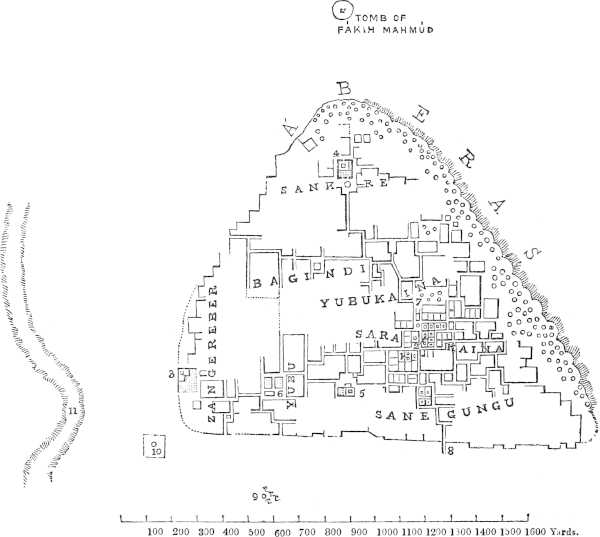
Soon after my arrival in the place, I had sent home a small plan of the town. This I now found to be inaccurate in some respects; and I here therefore subjoin a more correct plan of the town, although on a rather small scale,—the circumstances under which I resided there not having allowed me to survey the greater part of it accurately enough for a more minute delineation.
The city of Timbúktu, according to Dr. Petermann’s laying down of it from my materials, lies in 17° 37′ N. and 3° 5′ W. of Greenwich. Situated only a few feet above the average level of the river, and at a distance of about six miles from the principal branch, it at present forms a sort of triangle, the base of which points towards the river, whilst the projecting angle is directed towards the north, having for its centre the mosque of Sánkoré. But, during the zenith of its power, the town extended a thousand yards further north, and included the tomb of the fáki Mahmúd, which, according to some of my informants, was then situated in the midst of the town.
PLAN OF TIMBUKTU. 1. House of the Sheikh Áhmed el Bakáy, with another house belonging to the same close by, and having in front of it a small square, where he has established a “msíd,” or place of prayer for his pupils, several of whom pass the night here. 2. House belonging likewise to the Sheikh, where I myself was lodged, the ground plan of which I have given above. 3. Great mosque, “Gíngere (Jíngeré, or Zángeré) bér, Jámʿa el kebíra,” begun by Mansa Músa, king of Melle, A.D. 1327, and forming, for many centuries, the centre of the Mohammedan quarter. 4. Mosque Sánkoré, in the quarter Sánkoré, which is generally regarded as the oldest quarter of the town. The mosque has five naves, and is 120 feet long by 80 feet wide. 5. Mosque Sídi Yáhia, much smaller than the two other large mosques. 6. Great market-place, or Yúbu. 7. Butchers’ market, where in former times the palace, or “Mʿa-duk,” or Mʿa-dugu, is said to have been situated. 8. Gate leading to Kábara. 9. Well, surrounded by a small plantation of date trees. 10. Another well, with a small garden, belonging to Mohammed el ʿAísh. 11. Spot in a shallow valley, up to which point small boats ascended from the Niger, in the winter 1853-4.
The circumference of the city at the present time I reckon at a little more than two miles and a half; but it may approach closely to three miles, taking into account some of the projecting angles. Although of only small size, Timbúktu may well be called a city—medína—in comparison with the frail dwelling-places all over Negroland. At present it is not walled. Its former wall, which seems never to have been of great magnitude, and was rather more of the nature of a rampart, was destroyed by the Fúlbe on their first entering the place in the beginning of the year 1826. The town is laid out partly in rectangular, partly in winding, streets, or, as they are called here, “tijeráten,” which are not paved, but for the greater part consist of hard sand and gravel, and some of them have a sort of gutter in the middle. Besides the large and the small market there are few open areas, except a small square in front of the mosque of Yáhia, called Túmbutu-bóttema.
Small as it is, the city is tolerably well inhabited, and almost all the houses are in good repair. There are about 980 clay houses, and a couple of hundred conical huts of matting, the latter, with a few exceptions, constituting the outskirts of the town on the north and north-east sides, where a great deal of rubbish, which has been accumulating in the course of several centuries, is formed into conspicuous mounds. The clay houses are all of them built on the same principle as my own residence, which I have described, with the exception that the houses of the poorer people have only one courtyard, and have no upper room on the terrace.
The only remarkable public buildings in the town are the three large mosques: the Jíngeré-bér, built by Mansa Músa; the mosque of Sánkoré, built, at an early period, at the expense of a wealthy woman; and the mosque Sídi Yáhia, built at the expense of a kádhi of the town. There were three other mosques: that of Sídi Háj Mohammed, Msíd Belál, and that of Sídi el Bámi. These mosques, and perhaps some little msíd, or place of prayer, Caillié must have included when he speaks[134] of seven mosques. Besides these mosques, there are at present no distinguished public buildings in the town; and of the royal palace, or Mʿa-dugu, wherein the kings of Songhay used to reside occasionally, as well as the Kasbah, which was built in later times, in the south-eastern quarter, or the “Sane-gungu”[135], which already at that time was inhabited by the merchants from Ghadámes[136], not a trace is to be seen. Besides this quarter, which is the wealthiest, and contains the best houses, there are six other quarters, viz. Yúbu, the quarter comprising the great market-place (yúbu) and the mosque of Sídi Yáhia, to the west of Sane-gungu; and west of the former, forming the south-western angle of the town, and called from the great mosque, Jíngeré-bér or Zángeré-bér. This latter quarter, from the most ancient times, seems to have been inhabited especially by Mohammedans, and not unlikely may have formed a distinct quarter, separated from the rest of the town by a wall of its own. Towards the north, the quarter Sane-gungu is bordered by the one called Sara-káina, meaning literally the “little town,” and containing the residence of the Sheikh, and the house where I myself was lodged. Attached to Sara-káina, towards the north, is Yúbu-káina, the quarter containing the “little market,” which is especially used as a butchers’ market. Bordering both on Jíngeré-bér and Yúbu-káina, is the quarter Bagíndi, occupying the lowest situation in the town, and stated by the inhabitants to have been flooded entirely in the great inundation which took place in 1640. From this depression in the ground, the quarter of Sánkoré, which forms the northernmost angle of the city, rises to a considerable elevation, in such a manner, that the mosque of Sánkoré, which seems to occupy its ancient site and level, is at present situated in a deep hollow—an appearance which seems to prove that this elevation of the ground is caused by the accumulation of rubbish, in consequence of the repeated ruin which seems to have befallen this quarter pre-eminently, as being the chief stronghold of the native Songhay. The slope which this quarter forms towards the north-eastern end, in some spots exceeds eighty feet.
The whole number of the settled inhabitants of the town amounts to about 13,000; while the floating population, during the months of the greatest traffic and intercourse, especially from November to January, may amount, on an average, to 5000, and under favourable circumstances to as many as 10,000. Of the different elements composing this population, and of their distinguishing features, I shall say a few words in another place. I now revert to the diary of my own proceedings.
In the evening of the next day I again went with the Sheikh out of the town to the tents, where we were to stay two days, but where we in fact spent six; my friend finding himself very happy in the company of his wife, to whom he was sincerely attached. Not only my companions, but even I myself, began to find it rather tedious in the dull encampment, as I had scarcely any books with me to pass away my time, and my situation not allowing me to enter too closely into the discussions of my companions, as in that case they would have redoubled their endeavours to convert me to their creed, and would scarcely have allowed me to depart at all.
Almost the whole of the time which I spent here the Sheikh left me quite to myself, sometimes not quitting his tent for a whole day; but at other times we had some pleasant and instructive conversation. Among other subjects a rather animated discussion arose one day. An Arab, of the name of ʿAbd e’ Rahmán, a near relation of my host, and of a rather presumptuous character, who had come on a visit from Ázawád, was extremely anxious to know the motives which induced me to visit this country, and scarcely doubted that it could be anything else than the desire of conquest. In order to show them of what little value the possession of the country would be to the Europeans, I jestingly told them, that our government, being informed that the natives of these tracts fed on sand and clay, had sent me out to discover how this was done, in order to provide, in a similar way, for the poor in our own country. The Arab was naturally greatly surprised at my statement. But the Sheikh himself laughed very heartily, and inquired, with an expression of doubt, whether there were poor people among the Christians.
Another evening, when the Sheikh was cheerfully sitting with us round the fire, we had an interesting conversation concerning the worship of idols. In order to overcome the prejudice of his pupils with regard to the greater nobility and superiority of the Arab race, and to show them that their forefathers had not been much better than many of the idolatrous nations at the present day, he gave them an account of the superstitions of the ancient Arabs, and in the course of his conversation exhibited unmistakable proofs of an enlightened and elevated mind, of which the letter, which I shall communicate in another place, will give further proof.
Occasionally we received here also some interesting visits from Arabs or other people; the most conspicuous person among them being a man of the name of Fífi, the inspector of the harbour of Yówaru, a man of cheerful temperament, and a great friend of the Sheikh’s. He had a perfect knowledge of the course of the river between Timbúktu and Jafarábe, the groups of islands forming the boundary between the Mohammedan kingdom of Másina and the Pagan kingdom of Bámbara, and very important for the trade along the river, as the boats coming from Timbúktu must here discharge their merchandise, which has to be conveyed hence to Sansándi on the backs of asses; but unfortunately my informant spoke nothing but Songhay. The state of retirement in which I was obliged to live deprived me of the opportunity of cultivating the language of the natives; which was moreover extremely repulsive to me on account of its deficiency in forms and words, so that I found it next to impossible to express in it any general idea, without having recourse to some other foreign language. The Songhay of this region, having been deprived of all their former independent character more than two centuries and a half ago, and having become degraded and subject to foreigners, have lost also the national spirit of their idiom, which, instead of developing itself, has become gradually poorer and more limited; but I have no doubt that the dialect spoken by those still independent people in Dargol and Kulman is far richer, and anybody who wishes to study the Songhay language must study it there. The Arab visitors[137] to the town at this period were especially numerous, this being the most favourable season for the salt trade. A few months later scarcely a single Arab from abroad frequents the town.
The private life of the people in these encampments runs on very tranquilly, when there is no predatory incursion, which however is often enough the case. Most of these mixed Arabs have only one wife at a time, and they seem to lead a quiet domestic life, very like that of the Sheikh himself. I scarcely imagine that there is in Europe a person more sincerely attached to his wife and children than my host was. In fact, it might be said that he was a little too dependent on the will of his wife. The difference which I found between the position of the wife among these Moorish tribes, and that which she enjoys among the Tawárek, is extraordinary, although even the Tawárek have generally but one wife; but while the latter is allowed to move about at her pleasure quite unveiled, the wife even of the poorest Arab or Moor is never seen unveiled, being generally clad in a black under and upper gown, and the wives of the richer and nobler people never leave their tents. The camp life of course would give to coquettish women a fair opportunity of intrigue; but in general I think their morals are pretty chaste, and the chastisement which awaits any transgression is severe, a married wife convicted of adultery being sure to be stoned. An incident happened during my present stay at the tents which gave proof of love affairs not being quite unusual here,—a Tárki, or rather Ámghi, having been murdered from motives of jealousy, and brought into our camp. But I must confess that I can scarcely speak of the mode of life in an Arab or Moorish encampment; for the camp of the Sheikh, as a chief of religion, is of course quite an exception; and moreover the neighbourhood of the Fúlbe or Fullán, who, in their austere religious creed, view all amusements with a suspicious eye, has entirely changed the character of these Moorish camps around the town, and it may be in consequence of this influence that there was no dancing or singing here.
Notwithstanding trifling incidents like these, which tended occasionally to alleviate the tediousness of our stay, I was deeply afflicted by the immense delay and loss of time, and did not allow an opportunity to pass by of urging my protector to hasten our departure; and he promised me that, as I was not looking for property, he should not keep me long. But, nevertheless, his slow and deliberate character could not be overcome, and it was not until the arrival of another messenger from Hamda-Alláhi, with a fresh order to the Sheikh to deliver me into his hands, that he was induced to return into the town.
My situation in this turbulent place now approached a serious crisis; but, through the care which my friends took of me, I was not allowed to become fully aware of the danger I was in. The Sheikh himself was greatly excited, but came to no decision with regard to the measures to be taken; and at times he did not see any safety for me except by my taking refuge with the Tawárek, and placing myself entirely under their protection. But as for myself I remained quiet, although my spirits were far from being buoyant; especially as, during this time, I suffered severely from rheumatism; and I had become so tired of this stay outside in the tents, where I was not able to write, that, when the Sheikh went out again in the evening of the 16th, I begged him to let me remain where I was. Being anxious about my safety, he returned the following evening. However, on the 22nd, I was obliged to accompany him on another visit to the tents, which had now been pitched in a different place, on a bleak sandy eminence, about five miles east from the town, but this time he kept his promise of not staying more than twenty-four hours. It was at this encampment that I saw again the last four of my camels, which at length, after innumerable delays, and with immense expense, had been brought from beyond the river, but they were in a miserable condition, and furnished another excuse to my friends for putting off my departure, the animals being scarcely fit to undertake a journey.