CHAP. LXV.
Reading edition
ARRIVAL AT KÁBARA. — ENTRANCE INTO TIMBÚKTU.
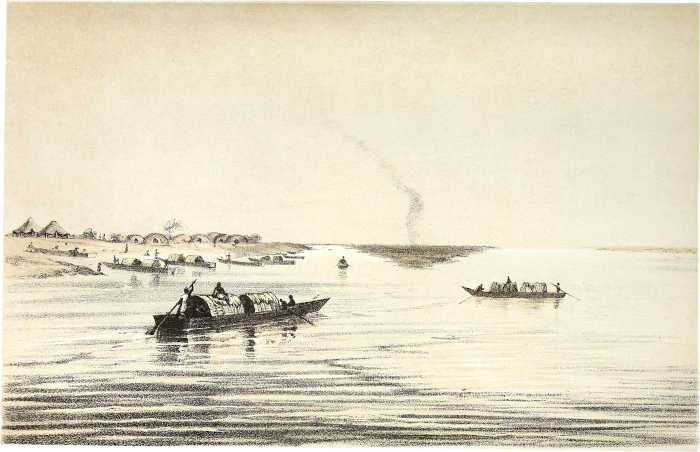
September 7th, 1853.Thus the day broke which, after so many months’ exertion, was to carry me to the harbour of Timbúktu. We started at a tolerably early hour, crossing the broad sheet of the river, first in a north-easterly, then in an almost northerly direction, till finding ourselves opposite the small hamlet Tásakal, mentioned by Caillié[83], we began to keep along the windings of the northern bank which, from its low character, presented a very varying appearance, while a creek, separating from the trunk, entered the low ground. The river a month or two later in the season inundates the whole country to a great distance, but the magnificent stream, with the exception of a few fishing-boats, now seemed almost tenantless, the only objects which in the present reduced state of the country animated the scenery being a number of large boats lying at anchor in front of us near the shore of the village Koróme. But the whole character of the river was of the highest interest to me, as it disclosed some new features for which I had not been prepared; for, while the water on which Koróme was situated formed only by far the smaller branch, the chief river, about three quarters of a mile in breadth, took its direction to the south-east, separated from the former by a group of islands called Day, at the headland of which lies the islet of Tárashám.[84]
It was with an anxious feeling that I bade farewell to that noble river as it turned away from us, not being sure whether it would fall to my lot to explore its further course, although it was my firm intention at the time to accomplish this task if possible. Thus we entered the branch of Koróme, keeping along the grass which here grows in the river to a great extent, till we reached the village, consisting of nothing but temporary huts of reed, which, in the course of a few weeks, with the rising of the waters, were to be removed further inland. Notwithstanding its frail character, this poor little village was interesting on account of its wharfs, where a number of boats were repairing. The master of our own craft residing here (for all the boatmen on this river are serfs, or nearly in that condition), we were obliged to halt almost an hour and a half; but in order not to excite the curiosity of the people, I thought it prudent to remain in my boat. But even there I was incommoded with a great number of visitors, who were very anxious to know exactly what sort of person I was. It was here that we heard the unsatisfactory news that El Bakáy, whose name as a just and intelligent chief alone had given me confidence to undertake this journey, was absent at the time in Gúndam, whither he had gone in order to settle a dispute which had arisen between the Tawárek and the Berabísh; and as from the very beginning, when I was planning my journey to Timbúktu, I had based the whole confidence of my success upon the noble and trustworthy character which was attributed to the Sheikh El Bakáy by my informants, this piece of information produced a serious effect upon me.
Drawn by J. M. Bernatz, from a Sketch by Dr. Barth. M. & N. Hanhart, lith. et impt. THE ÍSA (NIGER) AT KORÓME. Sepr. 5th. 1853.
At length we set out again on our interesting voyage, following first a south-easterly, then a north-easterly direction along this branch, which, for the first three miles and a half, retained some importance, being here about 200 yards wide, when the channel divided a second time, the more considerable branch turning off towards Yélluwa and Zegália, and other smaller hamlets situated on the islands of Day, while the watercourse which we followed dwindled away to a mere narrow meadow-water, bearing the appearance of an artificial ditch or canal, which, as I now heard, is entirely dry during the dry season, so that it becomes impossible to embark directly at Kábara for places situated higher up or lower down the river. But at that time I had formed the erroneous idea that this canal never became navigable for more than four months in the year, and thence concluded that it would have been impossible for Caillié to have reached Kábara in his boat in the month of April. The navigation of this water became so difficult, that all my people were obliged to leave the boat, which, with great difficulty was dragged on by the boatmen, who themselves entered the water and lifted and pushed it along with their hands. But before we reached Kábara, which is situated on the slope of a sandy eminence, the narrow and shallow channel widened to a tolerably large basin of circular shape; and here, in front of the town, seven good-sized boats were lying, giving to the whole place some little life. Later in the season, when the channel becomes navigable for larger boats, the intercourse becomes much more animated. During the palmy days of the Songhay empire, an uninterrupted intercourse took place between Gágho and Timbúktu on the one side, and between Timbúktu and Jenni on the other, and a numerous fleet was always lying here under the orders of an admiral of great power and influence. The basin has such a regular shape, that it looks as if it were artificial; but, nevertheless, it may be the work of nature, as Kábara from the most ancient times has been the harbour of Timbúktu, and at times seems even to have been of greater importance than the latter place itself.
A branch of the river turns off to the east, without however reaching the main trunk, so that in general, except when the whole country is inundated, boats from Kábara which are going down the river must first return in a south-westerly direction towards Koróme, in order to reach the main branch. Even at the present time, however, when this whole region is plunged into an abyss of anarchy and misrule, the scene was not entirely wanting in life; for women were filling their pitchers or washing clothes on large stones jutting out from the water, while a number of idle people had collected on the beach to see who the stranger was that had just arrived.
Drawn by J. M. Bernatz, from a Sketch by Dr. Barth. M. & N. Hanhart, lith. et impt. KÁBARA. Sepr. 8th. 1853.
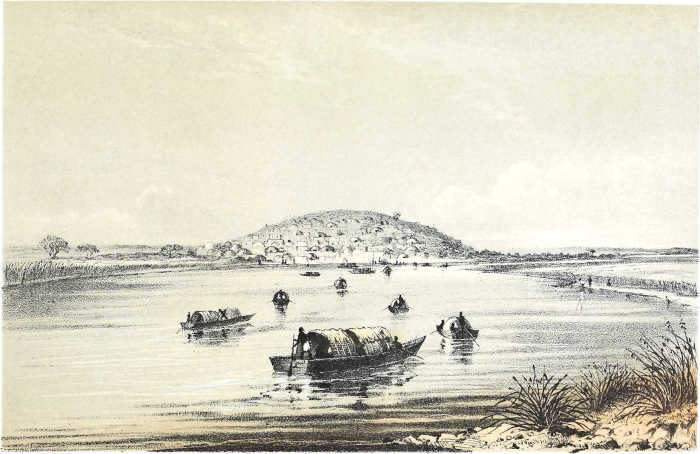
At length we lay to, and sending two of my people on shore, in order to obtain quarters, I followed them as soon as possible, when I was informed that they had procured a comfortable dwelling for me. The house where I was lodged was a large and grand building (if we take into account the general relations of this country), standing on the very top of the mound on the slope of which the town is situated. It was of an oblong shape, consisting of very massive clay walls, which were even adorned, in a slight degree, with a rude kind of relief; and it included, besides two anterooms, an inner courtyard, with a good many smaller chambers, and an upper story. The interior, with its small stores of every kind, and its assortment of sheep, ducks, fowls, and pigeons, in different departments, resembled Noah’s ark, and afforded a cheerful sight of homely comfort which had been preserved here from more ancient and better times, notwithstanding the exactions of Fúlbe and Imóshagh.
Having taken possession of the two ante-rooms for my people and luggage, I endeavoured to make myself as comfortable as possible; while the busy landlady, a tall and stout personage, in the absence of her husband, a wealthy Songhay merchant, endeavoured to make herself agreeable, and offered me the various delicacies of her store for sale; but these were extremely scanty, the chief attraction to us, besides a small bowl of milk seasoned with honey, being some onions, of which I myself was not less in want than my people for seasoning our simple food; but fresh ones were not even to be got here, the article sold being a peculiar preparation which is imported from Sansándi, the onions, which are of very small size, being cut into slices and put in water, then pounded in a wooden mortar, dried again, and, by means of some butter, made up into a sort of round ball, which is sold in small pats of an inch and a half in diameter for five shells each: these are called “láwashi” in Fulfúlde, or “gabú” in the Songhay language. Besides this article, so necessary for seasoning the food, I bought a little bulánga, or vegetable butter, in order to light up the dark room where I had taken up my quarters; but the night which I passed here was a very uncomfortable one, on account of the number of mosquitoes which infest the whole place.
Thus broke the 6th of September,—a very important day for me, as it was to determine the kind of reception I was to meet with in this quarter. But notwithstanding the uncertainty of my prospects, I felt cheerful and full of confidence; and, as I was now again firmly established on dry soil, I went early in the morning to see my horse, which had successfully crossed all the different branches lying between Kábara and Sarayámo; but I was sorry to find him in a very weak and emaciated condition.
While traversing the village, I was surprised at the many clay buildings which are to be seen here, amounting to between 150 and 200; however, these are not so much the dwellings of the inhabitants of Kábara themselves, but serve rather as magazines for storing up the merchandise belonging to the people of, and the foreign merchants residing in, Timbúktu and Sansándi. There are two small market-places, one containing about twelve stalls or sheds, where all sorts of articles are sold, the other being used exclusively for meat. Although it was still early in the day, women were already busy boiling rice, which is sold in small portions, or made up into thin cakes boiled with bulánga, and sold for five shells each. Almost all the inhabitants, who may muster about 2000, are Songhay; but the authorities belong to the tribe of the Fúlbe, whose principal wealth consists of cattle, the only exception being the office of the inspector of the harbour,—a very ancient office, repeatedly mentioned by Áhmed Bábá,—which at present is in the hands of Múláy Kásim, a sheríf whose family is said to have emigrated originally from the Gharb or Morocco, but who has become so Sudánised that he has forgotten all his former knowledge of Arabic. On account of the cattle being driven to a great distance, I found that milk was very scarce and dear. The inhabitants cultivate a little rice, but have some cotton, besides bámia, or Corchorus olitorius, and melons of various descriptions.
Having returned to my quarters from my walk through the town, I had to distribute several presents to some people whom El Waláti chose to represent as his brothers and friends. Having then given to himself a new, glittering, black tobe of Núpe manufacture, a new “háf,” and the white bernús which I wore myself, I at length prevailed upon him to set out for the town, in order to obtain protection for me; for as yet I was an outlaw in the country, and any ruffian who suspected my character might have slain me, without scarcely anybody caring anything about it; and circumstances seemed to assume a very unfavourable aspect: for there was a great movement among the Tawárek in the neighbourhood, when it almost seemed as if some news of my real character had transpired. Not long after my two messengers were gone, a Tárki chief, of the name of Knéha, with tall and stately figure, and of noble expressive features, as far as his shawl around the face allowed them to be seen, but, like the whole tribe of the Kél-hekíkan to which he belongs, bearing a very bad character as a freebooter, made his appearance, armed with spear and sword, and obtruded himself upon me while I was partaking of my simple dish of rice; notwithstanding which, he took his seat at a short distance opposite to me. Not wishing to invite him to a share in my poor frugal repast by the usual “bismillah,” I told him, first in Arabic and then in Fulfúlde, that I was dining, and had no leisure to speak with him at present. Whereupon he took his leave, but returned after a short while, and, in a rather peremptory manner, solicited a present from me, being, as he said, a great chief of the country; but as I was not aware of the extent of his power, and being also afraid that others might imitate his example, I told him that I could not give him anything before I had made due inquiries respecting his real importance from my companion who had just gone to the town. But he was not at all satisfied with my argument; representing himself as a great “dhálem,” or evil-doer, and that as such he might do me much harm; till at length, after a very spirited altercation, I got rid of him.
He was scarcely gone, when the whole house was filled with armed men, horse and foot, from Timbúktu, most of them clad in light blue tobes, tightly girt round the waist with a shawl, and dressed in short breeches reaching only to the knee, as if they were going to fight, their head being covered with a straw hat of the peculiar shape of a little hut with regular thatchwork, such as is fashionable among the inhabitants of Másina and of the provinces further west. They were armed with spears, besides which some of them wore also a sword: only a few of them had muskets. Entering the house rather abruptly, and squatting down in the ante-chambers and courtyard, just where they could find a place, they stared at me not a little, and began asking of each other who this strange-looking fellow might be, while I was reclining on my two smaller boxes, having my larger ones and my other luggage behind me. I was rather at a loss to account for their intrusion, until I learned, upon inquiry from my landlady, that they were come in order to protect their cattle from the Tawárek, who at the time were passing through the place, and who had driven away some of their property. The very person whom they dreaded was the chief Knéha, who had just left me, though they could not make out his whereabouts. Having refreshed themselves during the hot hours of the day, these people started off; but the alarm about the cattle continued the whole of the afternoon, and not less than 200 armed men came into my apartments in the course of an hour.
My messengers not returning at the appointed time from their errand to the town, I had at length retired to rest in the evening, when shortly before midnight they arrived, together with Sídi Álawáte, the Sheikh El Bakáy’s brother, and several of his followers, who took up their quarters on the terrace of my house in order to be out of the reach of the mosquitoes; and after they had been regaled with a good supper, which had been provided beforehand by some of the townspeople, I went to pay my respects to them.
It was an important interview; for, although this was not the person for whom my visit was specially intended, and whose favourable or unfavourable disposition would influence the whole success of my arduous undertaking, yet for the present I was entirely in his hands, and all depended upon the manner in which he received me. Now my two messengers had only disclosed to himself personally, that I was a Christian, while at the same time they had laid great stress upon the circumstance that, although a Christian, I was under the special protection of the Sultan of Stambúl; and Sídi Álawáte inquired therefore of me, with great earnestness and anxiety, as to the peculiar manner in which I enjoyed the protection of that great Mohammedan sovereign.
Now it was most unfortunate for me that I had no direct letter from that quarter. Even the firmán with which we had been provided by the Bashá of Tripoli had been delivered to the governor for whom it was destined, so that at the time I had nothing with me to show but a firmán which I had used on my journey in Egypt, and which of course had no especial relation to the case in question. The want of such a general letter of protection from the Sultan of Constantinople, which I had solicited with so much anxiety to be sent after me, was in the sequel the chief cause of my difficult and dangerous position in Timbúktu; for, furnished with such a letter, it would have been easy to have imposed silence upon my adversaries and enemies there, and especially upon the merchants from Morocco, who were instigated by the most selfish jealousy to raise all sorts of intrigues against me.
Having heard my address with attention, although I was not able to establish every point so clearly as I could have wished, the sheikh’s brother promised me protection, and desired me to be without any apprehension with regard to my safety; and thus terminated my first interview with this man, who, on the whole, inspired me with a certain degree of confidence, although I was glad to think that he was not the man upon whom I had to rely for my safety. Having then had a further chat with his telamíd or pupils, with whom I passed for a Mohammedan, I took leave of the party and retired to rest in the close apartments of the lower story of the house.
Wednesday, September 7th.After a rather restless night, the day broke when I was at length to enter Timbúktu; but we had a good deal of trouble in performing this last short stage of our journey, deprived as we were of beasts of burden; for the two camels which the people had brought from the town in order to carry my boxes, proved much too weak, and it was only after a long delay that we were able to procure eleven donkeys for the transport of all my luggage. Meanwhile the rumour of a traveller of importance having arrived had spread far and wide, and several inhabitants of the place sent a breakfast both for myself and my protector. Just at the moment when we were at length mounting our horses, it seemed as if the Tárki chief Knéha was to cause me some more trouble, for in the morning he had sent me a vessel of butter in order thus to acquire a fair claim upon my generosity; and coming now for his reward, he was greatly disappointed when he heard that the present had fallen into the hands of other people.
It was ten o’clock when our cavalcade at length put itself in motion, ascending the sandhills which rise close behind the village of Kábara, and which, to my great regret, had prevented my obtaining a view of the town from the top of our terrace. The contrast of this desolate scenery with the character of the fertile banks of the river which I had just left behind was remarkable. The whole tract bore decidedly the character of a desert, although the path was thickly lined on both sides with thorny bushes and stunted trees, which were being cleared away in some places in order to render the path less obstructed and more safe, as the Tawárek never fail to infest it, and at present were particularly dreaded on account of their having killed a few days previously three petty Tawáti traders on their way to Árawán. It is from the unsafe character of this short road between the harbour and the town, that the spot, about halfway between Kábara and Timbúktu, bears the remarkable name of “Ur-immándes,” “he does not hear,” meaning the place where the cry of the unfortunate victim is not heard from either side.
Having traversed two sunken spots designated by especial names, where, in certain years when the river rises to an unusual height, as happened in the course of the same winter, the water of the inundation enters and occasionally forms even a navigable channel; and leaving on one side the talha tree of the Welí Sálah, covered with innumerable rags of the superstitious natives, who expect to be generously rewarded by their saint with a new shirt, we approached the town: but its dark masses of clay not being illuminated by bright sunshine, for the sky was thickly overcast and the atmosphere filled with sand, were scarcely to be distinguished from the sand and rubbish heaped all round; and there was no opportunity for looking attentively about, as a body of people were coming towards us in order to pay their compliments to the stranger and bid him welcome. This was a very important moment, as, if they had felt the slightest suspicion with regard to my character, they might easily have prevented my entering the town at all, and thus even endangered my life.
I therefore took the hint of Álawáte, who recommended me to make a start in advance in order to anticipate the salute of these people who had come to meet us; and putting my horse to a gallop, and gun in hand, I galloped up to meet them, when I was received with many saláms. But a circumstance occurred which might have proved fatal, not only to my enterprise, but even to my own personal safety, as there was a man among the group who addressed me in Turkish, which I had almost entirely forgotten; so that I could with difficulty make a suitable answer to his compliment; but avoiding farther indiscreet questions, I pushed on in order to get under safe cover.
Drawn by J. M. Bernatz, from a Sketch by Dr. Barth. M. & N. Hanhart, lith. et impt. ARRIVAL AT TIMBÚKTU. Septr. 7th. 1853.
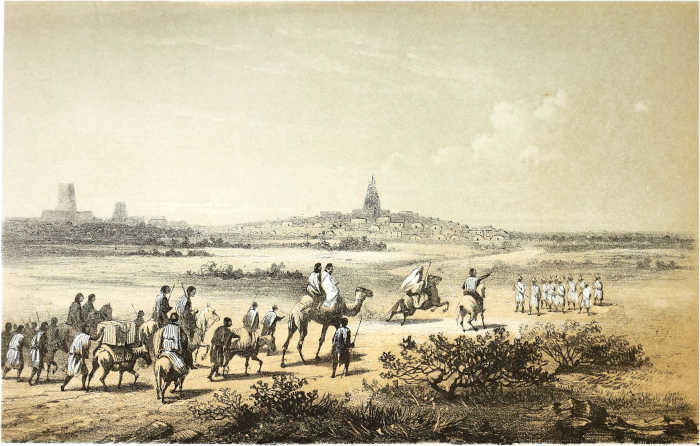
Having then traversed the rubbish which has accumulated round the ruined clay wall of the town, and left on one side a row of dirty reed huts which encompass the whole of the place, we entered the narrow streets and lanes, or, as the people of Timbúktu say, the tijeráten, which scarcely allowed two horses to proceed abreast. But I was not a little surprised at the populous and wealthy character which this quarter of the town, the Sáne-Gúngu, exhibited, many of the houses rising to the height of two stories, and in their façade evincing even an attempt at architectural adornment. Thus, taking a more westerly turn, and followed by a numerous troop of people, we passed the house of the Sheikh El Bakáy, where I was desired to fire a pistol; but as I had all my arms loaded with ball I prudently declined to do so, and left it to one of my people to do honour to the house of our host. We thus reached the house on the other side of the street, which was destined for my residence, and I was glad when I found myself safely in my new quarters.
But before describing my residence in this town, I shall make a few general remarks with regard to the history of Songhay and Timbúktu.