CHAP. LVIII.
Reading edition
STATE OF INSECURITY ALONG THE MOST FREQUENTED HIGHROAD. — GANDO.
Sunday, May 8th.At length I was able to pursue my journey, which now, as soon as I had passed Sókoto, was to lead me into almost unknown regions, never trodden by European foot.
I was escorted out of the town, in grand style, by the ghaladíma with six horsemen, and then pursued my former track to Sókoto, the character of which was but little changed, on account of the vegetation having only just begun to be vivified and restored by the first showers of the rainy season. The little stream which skirts the foot of the hill on which the town of Sókoto is situated, and where we had watered our horses on our former excursion, now began gradually to increase, although as yet it exhibited but few signs of that considerable volume which I found here on my home journey the next year.
I was lodged in my old quarters, in the house of the ghaladíma, and was treated by my old friends Módibo ʿAlí and Sʿaíd with great hospitality. Although most anxious, on account of the season, to continue my journey with the shortest possible delay, I remained here the four following days, in order to procure what was still wanted in my outfit for the long journey before me, but principally from regard to the interests of my companion ʿAlí el Ágeren, who had here to arrange some business; hence we did not set out until the 14th of May.
There had been so heavy a shower the preceding afternoon, that a large stream broke through the roof of my dwelling and placed my whole room several inches under water. I passed, therefore, a most uncomfortable night, and when I got up in the morning I had a very bad headache. Every thing, also, was extremely wet, so that it took us a long time to get ready our camels, and it was eight o’clock when we left the kófa-n-Tarámnia, which, though the widest of the gates of the town, did not allow my two largest boxes to pass without damage.
A grandson of Módibo ʿAlí, together with Shékho the chief of the Zoromáwa, escorted me outside the town. The first was certainly sincere: but as for the second, I could not expect that he was in earnest in wishing me success in my undertaking; for the Zoromáwa, who are the chief traders of the country, viewed my enterprise with a great deal of mistrust, as they were told that I wanted to open an intercourse along the river.
Thus we entered the large open plain, which is only bounded, at the distance of about three miles to the north, by a low chain of hills, and scarcely dotted with a single tree. But the monotonous country at present was not quite wanting in signs of life, the plentiful fall of rain having inspired the inhabitants of the several villages which were scattered about with sufficient confidence to trust their seed to the ground. Having then passed a larger village, called Kaffaráwa, we crossed a considerable depression or hollow, stretching from S.W. to N.E., with plenty of water, and with extensive grounds of yams, a branch of cultivation which, in these swampy valleys of Kebbi, is carried on to some extent; and this depression was soon succeeded by others of a like nature. Numerous herds of cattle were here grazing on the intervening pasture-grounds, which were adorned with sycamores and monkey-bread trees; and this continued till we reached Bodínga, and took up our quarters in a small cluster of huts lying on the outside, close to the wall. This time I did not enter the town, but I did so on my return journey, when I satisfied myself of the considerable size of the town, and the state of decay and desolation into which it has at present relapsed.
Sunday, May 15th.While we were loading our camels, the governor of the town, who is a son of Módibo ʿAlí, of the name of Mohámmedu, came out to pay me his compliments. He was of a cheerful disposition, and had treated us hospitably the preceding evening. He even accompanied me to a considerable distance, till we left, on our right, the town of Sifáwa or Shifáwa, an important place in the history of the Púllo reformer ʿOthmán dan Fódiye, but at present almost desolate and reduced to great misery, presenting a fair specimen of the state of the province of Gando, which we here entered.
The country here, as well as near Bodínga, is almost exclusively adorned with monkey-bread trees, and the soil seemed to be very parched; but a little further on we descended into a depression which, having been already fertilised by the rain, was just being sown. Further on, the ground continuing undulating, we watered our horses at a rich source of living water which rushed out from the rocks at the side of a small hamlet. We then passed a large and comfortable-looking place called Dendi (perhaps after a portion of that tribe, which settled here) and adorned with a profusion of trees, among which the dorówa or Parkia, the góreba or dúm palm, and the gigíña or deléb palm were most conspicuous. Towards the south-east side it was bordered by a depression full of yams and fresh herbage, and fringed by numbers of monkey-bread trees. Even a little market-place was to be seen; and the place seemed so attractive to my people, that they would fain have spent here the rest of the day, and they were not at all pleased when I insisted on continuing our march. A little after noon we passed a pretty village with a small dyeing-place. Besides corn-fields, where the crops were already two inches out of the ground, indigo was cultivated to a great extent. We then entered upon rocky ground, and, five miles further on, reached the place Shagáli, separated into two groups along the northern slope of an eminence, and surrounded on three sides by a deep and wide ravine, which made the access to it very difficult. Here we were rather inhospitably received,—the former mayor having been deposed, and a new one not yet installed in his place.
Monday, May 16th.Early in the morning we pursued our journey, through a rather hilly country broken by several small watercourses, full of cultivated ground and fine timber, principally monkey-bread trees, which now exhibited a more cheerful appearance, as they were clad in fresh foliage. We passed several villages, where we again observed some signs of industry in the shape of dyeing, and, about six miles and a half from Shagáli, left the considerable place Señína (the same town which a few days before had been attacked by the enemy) on our left, situated on a small hilly chain. Here we entered a tract of country at present desolate, and thickly covered with underwood, and greatly infested by the independent inhabitants of Kebbi; but it was only of small extent, and, about four miles beyond Señína, we entered, by a steep rocky descent, the fine valley of Sála, which is intersected by a considerable sheet of water.
We took up our quarters in the walled town of Sála, the dwellings of which were almost lost in the most splendid vegetation, among which one of the finest tamarind trees I have ever seen was greatly distinguished, attracting to its dense foliage countless flights of birds, which were gathering from all sides to pass the night here in cheerful communion. The wider-spreading foliage of the tamarind and monkey-bread trees was very picturesquely diversified by a large number of gónda trees, or Carica Papaya, while in front of the principal gate a most splendid rími or bentang tree, was starting forth as a proud landmark, pointing out to the traveller the site of the gate. The camels, who suffered greatly from thirst, immediately on our arrival were sent off to the brook of living water, which is formed at the foot of the rocky cliff a little to the north of the place where we had descended from the higher ground.
Tuesday, May 17th.We reached Gando, the residence of another powerful Púllo prince (as powerful as that of Sókoto), after a march of six hours, through a country richly provided by nature, and partly, at least, well inhabited. Hill and dale alternated, the depressions and cavities offering suitable grounds for the cultivation of yams. The vegetable kingdom also displayed its larger members in great variety. In the village Babanídi, which we passed about two miles from Sála, we observed the three species of palms which are common to Negroland, in the same locality—viz., the dúm, the date, and the deléb palm, while, near a swampy sheet of water before we came to Masáma, I caught sight of the first banána or áyaba tree that I had seen since I had left Ádamáwa, with the exception of those young offshoots which I had observed in Bamúrna. Near this latter place, which was situated at the border of a deep valley, a large swamp spread out covered with rank reed-grass; and beyond the town of Masáma we had to cross another large and irregular valley or fáddama, where, even at this season of the year, a large sheet of water was formed, which, according to the statement of the natives, was full of alligators.
The towns also exhibited a considerable degree of industry in their dyeing-places; and a short distance from our halting-place we even passed large hollows about two fathoms in depth, and one in particular where iron had been dug out. Small marketing stalls in some places lined the road, and the town of Masáma, with its straggling suburbs, presented an animated spectacle; but cattle were greatly wanting, nothing but sheep being seen, as all the horned cattle had been carried away by the predatory bands of Argúngo.
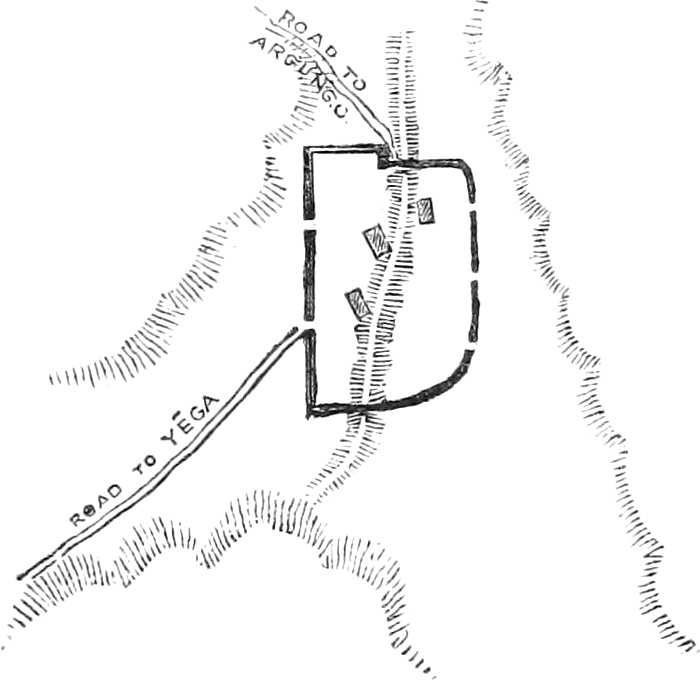
As we approached the town of Gando, I could not help wondering how the people had been led to choose this locality as the seat of a large empire, commanded as it was by hilly chains all around, in the manner shown in the accompanying woodcut, while the rising ground would have offered a far more suitable locality. But the situation of the town is on a par with the character of its dominion—without commanding strength, and quite incapable of keeping together that large agglomeration of provinces which have gathered around it. However, for a provincial town, the interior is very pleasant and animated, being adorned with a variety of trees, among which the banana is prominent.
Having sent a messenger in advance, I soon obtained quarters in the house of El Khassa, the chief eunuch of the court; but they were extremely narrow and unpleasant, although I had a very good clay house for myself.
Thus I had entered the residence of another very important Púllo chief, whose dominion extended several hundred miles over the country which I had to traverse, and whose friendship it was of the utmost importance for me to secure, as his provinces inclose both banks of the Niger, while the dominion of the sultan of Sókoto does not reach the principal branch at all. It was the more unfavourable that the present ruler of this very extensive kingdom should be a man without energy, and most inaccessible to a European and a Christian. His name is Khalílu, and he is the son of ʿAbd Alláhi[58], the brother of the great Reformer ʿOthmán, to whom that remarkable man, at his death, gave the western part of his vast domains, while he installed the celebrated Sultan Bello over the eastern portion. Khalílu succeeded to his brother Mohammed Wáni about seventeen years ago, and has since lived in a state of the greatest seclusion, well fitted for a monk, but by no means suited to the ruler of a vast empire, employing one of his brothers in order to keep up a certain show of imperial dignity where it was absolutely necessary. Thus, during the first few years of his reign, he had employed ʿAbd el Kádiri, and was now employing Halíru, or, as the name is written, Hadhíru. Even by Mohammedans he is scarcely ever to be seen except on Fridays. It appeared, from my first arrival, extremely doubtful whether he would allow me to see his holy face; and after a vain struggle, merely in order that, by an untimely obstinacy in matters of form, I might not frustrate all my schemes of discovery, I agreed at length to deliver my present to the messengers of the sultan, in his palace, without seeing him. This present consisted of almost the same number of articles as I had given to the emír of Sókoto, with the exception of the silver-mounted pistols. I gave him three bernúses—one of yellow, one of red cloth, and the third of the kind called heláli; a háík or jeríd of the finest quality, a Stambúli carpet, two entire pieces of muslin, a red cap, four loaves of sugar, three phials of rose oil, a pair of razors, five looking-glasses, a pound of cloves, and another of benzoin.
It was very unfortunate that a foreigner and an adventurer, who had no other interest than his own selfishness, became the go-between with me and the sultan, and found ample opportunities, owing to the monkish character of the latter, for advancing his own interests, in the thousand embarrassments which he caused me. This was El Bakáy, a person who made me hate his very name, though it afterwards became so dear to me on account of my protector in Timbúktu being called by the same. However, he also was an Arab from the west, and from the tribe of the Kunta, but not connected in any way with the family of the sheikh. After having tried his fortune in several other places along the Niger, especially in Zágha and Yélu, he had at length settled down here, constituting himself a sort of consul of the Arabs, and, in the miserable state into which affairs were plunged in this court, soon exercising a great influence over the principal and the secondary rulers; for, besides Khalílu, his several brothers enjoyed a large share of authority, to all of whom I had, in consequence, to make suitable presents besides. The most remarkable amongst them were the above-mentioned Halíru and Bú-Bakr Maiguña, the latter an aspiring and restless man, who occasionally distinguished himself by acts of great violence, and to whom, in consequence, I had to make a more respectable present, in order to ensure myself against any predatory proceedings on his part.
My present to the sultan himself seemed at first to have given great satisfaction; but after a few days, matters assumed a different aspect, and I was told that the pistols which I had given to ʿAlíyu were of more value than the whole of the presents which Khalílu had received from me, while the empire of the latter extended over a larger tract of country than that of the former; and I was clearly given to understand that it was not in my power either to proceed or even to retrace my steps, unless I gave much larger presents. After a protracted and serious dispute with El Bakáy and my broker ʿAlí el Ágeren, I came at length to the determination of sacrificing the second handsome pair of silver-mounted pistols which I possessed, and then at length I had some prospect of being allowed to proceed on my journey, although the state of the country before me was really such as to make progress appear very difficult, and it was certainly very doubtful whether I should be able to reach the river. After much trouble and a great number of presents, however, which I had to give to the crafty Arab, I managed even to obtain a letter of franchise from Khalílu written with his own hand, but in so general a style that it had not much the character externally of an official document, although its contents were altogether very satisfactory, guaranteeing full security to any Englishmen visiting his territories, and commanding the officers of the various provinces to respect their property and to facilitate their proceedings.
Besides the presents to be given to all these people, I had also to make a fresh sacrifice to my Arab ʿAlí el Ágeren; for, notwithstanding the arrangement which I had previously made with him, when he saw the difficulties I was in, and being aware that the easy part of my journey was now over, he threatened to leave me if I did not accept the conditions which he prescribed to me. I had also the misfortune to lose, during my stay here, my best camel, which I had bought from the governor of Kátsena for 60,000 shells; so that I was obliged to purchase another animal from Bú Bakr Maiguña at the price he demanded, camels here being very scarce.
Notwithstanding all this disagreeable business, which occasionally cost me much bitter reflection, greatly enhanced by the advance of the season, the month of May being at an end, and that of June having set in with violent rains, I passed the time during my residence in this place not quite uselessly, especially as I was so fortunate as to obtain here from a learned man of the name of Bokhári, a son of the late Mohammed Wáni, a copy of that most valuable historical work of Áhmed Bábá, to which my friend ʿAbd el Káder, in Sókoto, had first called my attention, but without being able to satisfy my curiosity; and I spent three or four days most pleasantly in extracting the more important historical data of this work, which opened to me quite a new insight into the history of the regions on the middle course of the Niger, whither I was bending my steps, exciting in me a far more lively interest than I had previously felt in a kingdom the great power of which, in former times, I here found set forth in very clear and distinct outlines, and I only lamented that I had not time enough to copy the whole.
As for the town of Gando itself, there was not much to be seen; and the situation of the place, hemmed in as it is in a narrow valley, did not admit of long excursions; moreover, the insecurity of the neighbourhood was so great that it was not possible, at least in a northerly direction, to proceed many yards from the wall. Several times during my stay the alarm was given that the enemy was approaching; and the whole political state of the place was plunged into the most terrible disorder, the enemy being established in several strong places at scarcely half a day’s journey distance, Argúngo being the residence of Dáúd the rebellious chief of the independent Kábáwa. A numerous foray (“yáki,” or, as the Fúlbe say, “konno”) left early in the morning of the 29th of May, but returned the same evening amid the noisy manifestations of the inhabitants. They had however only given an additional proof of their cowardly disposition, inasmuch as they had not even dared to attack the enemy, who had just succeeded in ransacking the town of Yára, and were carrying all the unfortunate inhabitants into slavery.
The interior of the place was not quite without its charms, the whole of the town being intersected, from north to south, by the broad and shallow bed of a torrent, which exhibited fine pasture-grounds of fresh succulent herbage, while it was skirted on both sides by a dense border of exuberant vegetation, which altogether is much richer in this place than either in Sókoto or Wurno, being surpassed only by the fine vegetable ornament of Kanó. The rains are extremely plentiful in Gando, causing here quite an exceptional state in the productive power of the soil; and to this circumstance we have partly to ascribe the fact that very fine bananas are grown here in considerable quantity: and the fruit being just ripe at the time, formed a very pleasant variation to my usual food. The onion of Gando is remarkable for its size and quality, compared with that of all the neighbouring districts; and it is well for the traveller, in whatever direction he may intend to go, to lay in a supply of this wholesome article. But the place is extremely dull, and the market very insignificant—a fact easily to be explained by the desperate state of the provinces around, although the situation of the capital, as a central place for commerce, is rather favourable. But the town of Jéga has not yet lost, in this respect, the whole of its former importance, and is still the great entrepôt for that coarse kind of coloured silk which is imported from the north, and which, notwithstanding its very inferior character, is nevertheless so greatly sought after by the natives for adorning their leatherwork. It is, perhaps, in consequence of the little trade which is carried on, that the people of Gando have applied themselves with more industry to supplying their own want of cotton cloth—and no one can deny that their cotton strips are of first-rate quality: their dyeing, on the contrary, is very coarse, and they seem quite unable to give to the dyed cloth that lustre which so eminently distinguishes the manufactures of Núpe and Kanó; but nevertheless this cloth of Gando is in great demand as far as Libtáko.
The kingdom or empire of Gando, according to its titles, comprises a number of wealthy provinces, all lying along that great West-African river which opens such an easy access into this continent, or on its branches; although nobody who stays in the capital for any length of time would suppose that it holds such a preeminent rank. I shall give some further details respecting these provinces in the Appendix[59]; here I will only enumerate them by name. They are, the western half of Kebbi, Maúri or Árewá, Zabérma, Déndina (comprising Kénga-koy and Zágha), a great part of Gurma (comprising the provinces of Galaijo, Toróde, Yágha, and Libtáko), with a small portion of Borgu or Barba, a large portion of Yóruba with the capital Alóri or Ilórin, and, on the east side of the river, the provinces of Yaúri and Núpe or Nyffi. But at that time most of these provinces were plunged into an abyss of anarchy, which could not fail to impart to the capital a more sombre aspect than it may possess in general.