Front matter (continued 7)
Reading edition
"If he cannot utilize my services, sir, and he can have but little political work to do now, I shall be glad if you will attach me to one of the regiments where you think I may be most useful."
"You had better talk it over with Macgregor first. You know him, of course; and if he does not want you, I will attach you to my own staff. With your knowledge of the Afghan language, your services might be invaluable in obtaining information; or, should we make a sortie—and we have already made one with effect—I should be glad, if you wish it, to attach you either to the infantry or cavalry, whichever you prefer. Now that you have told us about yourself, please give us any details you can of what you saw of the fighting?"
"It can hardly be said that there was any fighting, sir; until the last day the troops were so completely surrounded, and I may say overwhelmed by the camp followers, that they were practically unable to use their arms. General Shelton with the rear-guard fought nobly, and covered the retreat into Jugduluk, until the time when he was enticed with the general into Akbar's camp, and there held as a hostage. By what I heard, the handful of men left, only about a hundred and fifty all told, fought desperately to break their way through a barricade with which the Afghans had blocked the top of the pass. Only ten officers succeeded in breaking through, and of these all but one were killed on the road. All the soldiers died fighting at the barricade, and many officers. The last Sepoy had fallen two days before."
"It has been a bad business," General Sale said, "bad not only in its terrible result, but in the manner in which affairs were conducted. We here received with astonishment the news that four thousand five hundred British troops were cooped up by a horde of Afghans without one single attempt being made to bring on a battle in the open. Officers and men alike were astounded when Pottinger's first letter arrived, saying that negotiations were continued after the murder of Macnaghten. However, all this is a matter for future investigation. And now a personal question. Can you tell me how it was that my wife, Lady Macnaghten, and the other ladies, escaped uninjured? I only know from Pottinger that the ladies and children were handed over to the protection of Akbar, and that those who had husbands were also accompanied by them."
"The ladies were always kept close behind the advanced guard, sir. As these showed an unbroken front, the Afghans allowed them to pass without opposition, falling upon the confused mass behind them."
"Do you think that Akbar was a sharer in this treacherous attack?"
"I think his conduct was doubtful in the extreme, sir. He certainly did try more than once to persuade the Ghilyze chiefs to allow the survivors to pass on unmolested, but by that time the passions of the Afghans were absolutely beyond control. I myself have great doubts whether he would have interfered had he not been well aware that his interference would be useless. But this is only my opinion, based upon the facts, that in the first place he himself shot Macnaghten, whom he had invited to a conference; in the second place, he took no step whatever to carry out the condition to supply baggage animals and provisions; and lastly, because I know that long before the column set out on its march, he sent out orders to the Ghilzye chiefs to attack you."
"The case certainly looks very black against him," the general said; "but at least we may hope that, as his family are in our hands in India, he will protect the hostages."
"I hope, sir, that he will hand them over to the Nawab, who appears to me to be a thoroughly honest man. Undoubtedly he did his best to persuade the chiefs to agree to the treaty with us. He certainly did send in some provisions to the camp, and generally we formed a high opinion of his kindness of heart. Your fortifications are stronger than I expected to find them, from what I have heard, sir."
"Yes, the men have worked incessantly at them ever since we came here. The mud walls can scarcely be said to have existed when we marched in. There was no parapet, the ditch was filled in with rubbish, and the walls had so crumbled away that carts could cross over them at almost every point. Fortunately the men were in good heart, and all, Europeans and Sepoys, have worked with an energy beyond praise. The moat has been cleared out and filled with water, the walls have been scarped, and a parapet twelve feet high erected. The bastions have been put in order; and though, had we been seriously attacked at first, we must have retired to the citadel, we are now ready to withstand any assault."
Angus next went to Macgregor, who received him most warmly.
"I am glad indeed to see you, Campbell. Pottinger mentioned you in his reports as doing invaluable service with Boyd and Johnson. You will not find much in our line here. When the sword is once drawn, there is nothing for us to do until it becomes a question of our dictating terms, a contingency not likely to arise for some time."
"Had you hard fighting to get here?" Angus asked.
"No fighting at all. As we marched down from Gundamuck, the natives all supposed that we were on our way to Peshawur, and when we suddenly turned and marched towards the city, it was too late for them to think of resistance, and they simply bolted on one side of the town as we marched in on the other. We were bitterly disappointed when we saw the state of the walls, and it was a question for some time whether we should not content ourselves with holding the citadel only. But it was at last determined, for a time at least, to hold the town, as our retirement to the citadel would look like weakness. Another consideration was, that once in the citadel we should be shut up entirely, for, as you see, it stands in the middle of the town, and with the streets crowded with the enemy, there would be no getting out to obtain provisions.
"The result has proved the wisdom of the step we took. The walls are now strong enough to be obstinately defended, and from their extent we have been able to sally out at one gate or another and bring in provisions. We had but two days' food when we arrived here; now we have succeeded in gathering in a sufficient quantity to keep the troops on half rations for two months, and I hope that before it is finished we shall be relieved from Peshawur. We gave the natives a handsome thrashing on the day before we got in here. They attacked us in great force, trying especially to carry off our baggage, but the infantry repulsed them splendidly. However, they came on to renew the attack. The cavalry were placed in ambush, and the troops, after at first advancing, suddenly wheeled round and went off at the double. The enemy, believing that they had achieved a great victory, rushed after them. As soon as they reached an open space, the cavalry fell upon them. For months they had been inactive, being of no use among the hills. Now was their chance, and in a moment they were in the thick of the Afghans. They made terrible havoc among them, and thus it was that we were able to enter the town without further trouble. The next day, the 13th of November, Broadfoot was appointed garrison engineer. He had a small corps of sappers with him, and they soon set to work.
"On the morning of the 16th, the enemy were thick in the gardens round the town, the principal body being on the hillside. It was resolved to give them another lesson. They were, as could be seen from the highest point in the city, some five thousand strong, and Colonel Monteith of the 35th Bengal Infantry, took out eleven hundred men at daybreak. The advance was covered by the guns which had been mounted on the walls, and their shrapnel soon drove the enemy into the open. The infantry pressed forward and scattered them, and the cavalry completed their rout. It was this defeat that so cowed them for a time, that I was able to fetch in grain, sheep, firewood, and other necessaries. I may mention that I took upon myself, as soon as we came in here, the post of commissariat officer. It was not until the end of the month that they again mustered in force sufficient to attack us; they contented themselves with hovering round and keeping up a desultory fire.
"On the 1st of December, however, they gathered in great numbers, and seemed to threaten an attack. Colonel Dennie commanded this time, and he took out the greater portion of the garrison and a couple of guns. It was noon when he sallied out. Abbot's guns commenced the action by pouring a tremendous fire of grape into the thick mass. They fled in wild confusion; the cavalry cut them up terribly, and the infantry overtook and bayoneted many of them. It could scarcely be called a fight. The day was won directly the guns opened fire, and we did not lose a single man. Since that time they have not ventured to attack us.
"News came day after day of the terrible mess at Cabul. The news was kept as far as possible from the troops, so as not to discourage them; but, of course, since Brydon came in, the truth of the terrible massacre had to be told. I am happy to say that, although filling them with wrath and indignation, it has in no way abated their spirit. During the six weeks' rest we have had since the battle of the 1st of December, we have, as you see, really done wonders in the way of fortification, and consider that we are in a position to repulse any attack however formidable."
"When do you expect that a relief column will arrive from Peshawur?"
"That is a grave question which I cannot answer. Our last news was that Brigadier-general Wyld was on the point of advancing, but from the tone in which he wrote he had evidently no great hope of success. His four Sepoy regiments had been corrupted by the Sikhs, who, having themselves a great repugnance to enter the passes, had endeavoured, and successfully, to inspire the Sepoys with the same feeling. The Sikhs, who were to co-operate with him, were themselves in a state of open mutiny, and threatened to kill General Avitable if he interfered with them. He intended, however, to advance, as the case was so urgent, but with little hope of success. He was without cavalry, and had but two guns on Sikh carriages, which would probably break down after a few rounds had been fired. It was the letter of a brave man surrounded with difficulties, but ready to attempt almost the impossible to bring aid to us. I fear, however, that there is little chance of our relief until reinforcements from India reach Peshawur."
This opinion was justified when, on the 28th, news was brought that the movement had failed. On the 15th Colonel Moseley had started under cover of night with the 53rd and 64th native regiments to occupy the fortress of Ali Musjid, which had been held by a small corps of men of one of the native tribes under Mr. Mackeson. They had been true to their salt, and had resisted every attack of the Afridis. Moseley's force arrived there at daybreak, and met with but little opposition on the way. But it was discovered that, owing to some blunder, only fifty supply bullocks had been sent on instead of three hundred and fifty that should have accompanied the force. Therefore, instead of having a month's provisions, they had but enough for a few days. Brigadier Wyld started on the morning of the 19th to relieve them, but on the preceding day the Sikh troops refused to enter the pass and marched back to Peshawur. Nevertheless, Wyld determined to press forward with the two native regiments. As soon, however, as the enemy attacked them the Sepoys at the head of the column wavered and opened an aimless fire.
In vain the Brigadier and the officers endeavoured to persuade them to advance. They would not move forward, nor would the rest of the troops advance to their assistance. The two guns broke down after a round or two, and what little spirit remained among the Sepoys evaporated at once, and the column had to fall back. One of the guns was spiked and left behind, the Sepoys refusing to make any effort to bring it off. The Brigadier, who with several of our officers was wounded, saw that it was impossible to persevere, and the force fell back beyond the pass. Moseley could obtain no news, and was unaware of the repulse of the relieving column. Although the troops were on half rations supplies were nearly exhausted. The water was bad, and numbers of the Sepoys fell ill, and on the 23rd he determined to evacuate the fortress. Two officers volunteered to hold it, but the Sepoys would not support them, and the former native garrison had lost heart; so, on the 24th, the force marched out. The Afridis mustered strongly to oppose the retreat. The Sepoys, animated now by the hope of safety, fought well. Two British officers were killed, most of the baggage lost, and some of the sick and wounded had to be abandoned, but the main body got through safely.
Such was the news that was brought by a native in our pay, together with a letter from Brigadier Wyld saying that it would be impossible to renew the attempt until reinforcements of at least one British regiment with some guns arrived. But the news that help was still far distant in no way discouraged the garrison of Jellalabad, who redoubled their efforts to strengthen the fortifications and to prepare by their own unaided efforts for the worst.
At Peshawur Wyld's repulse bore the natural consequences. The discontent among the Sepoy's increased, many deserted, and expressions of determination never to enter the pass again were common among them. Sickness broke out, and when on the 25th of February General Pollock, who had been selected to command the force gathered there, and invested with full authority on all other matters, arrived, he found a thousand men in hospital; a week later the number was increased to eighteen hundred.
No better man than Pollock could have been chosen. He possessed at once great firmness, kindness of heart, and a manner calculated to inspire confidence. He declared to the central authorities at once that, even with the brigade which had come up with him, to advance up the pass would be to court another defeat. The four Sepoy regiments that had been engaged could, in their present state, not be counted on for service, and the force at his disposal was therefore no greater than that which Wyld had lost. He set to work in the first place to restore confidence. It was a difficult task. Many even among the officers had become affected with the spirit of defection, and did not hesitate to express their opinion that an advance through the Khyber Pass would involve a repetition of the Cabul disaster. The new Sepoy regiments were at once visited by emissaries from those of Wyld's brigade and from the Sikhs, who endeavoured in every way to persuade them also to refuse to enter the pass, and succeeded in the case of the 26th native regiment, who joined the four other battalions in refusing to advance. On the day after his arrival General Pollock visited all the hospitals, enquired into the ailments of the sick, and talked encouragingly to them. Then he went to the Sepoy regiments, enquired into the cause of their discontent, and exhorted them to return to their duty, and not to bring disgrace upon regiments that had so many times in the past proved their courage and loyalty.
His task was a hard and difficult one, but his method of mildness and firmness combined gradually restored their spirits and discipline; and the knowledge that reinforcements were on their way, with a good proportion of European troops, including cavalry and artillery, greatly aided his efforts. Still, until these reinforcements arrived, Pollock could do nothing but reply to the urgent letters of Sale and Macgregor by pointing out his inability to move.
On the 19th of February Angus was with Macgregor on the walls of Jellalabad. The men were as usual working hard and steadily, grateful in the thought that their long labour had borne its fruits, and that in a few days they would be able to lay by their picks and shovels, the work that they had been set to do having been accomplished.
"Another week," Captain Havelock, who was acting as Persian interpreter to Macgregor, said to Angus, "and the whole work which Broadfoot traced out will be finished. In one respect I am sorry that it should be so, for there is nothing like active work for keeping men's spirits up and preventing them from feeling the effects of idleness. I think—" and he stopped abruptly. There was a sudden tremor of the earth and a deep sound like thunder, then they were both thrown off their feet. The walls, the houses, the whole city, swayed and shook. Then came the crash of falling houses, wild shouts of alarm and pain; the earth crumbled beneath them, and they rolled down together into the moat. On finding that they were unhurt they scrambled up the slope of earth. A terrible sight presented itself. A third of the buildings in the town had fallen. But this was not the worst. Several of the bastions had been destroyed; almost all the parapets were thrown down; several great breaches were made in the wall, one of them eighty feet in length; and the moat had in many places been filled up with the debris of the wall and parapet. The soldiers were extricating themselves or helping their comrades from the earth that had almost overwhelmed them; others were standing gazing with a dazed air at the destruction that had been wrought.
"We had better go to head-quarters," Havelock said, "and see what has happened there."
They made their way with difficulty through the ruins that blocked the streets. The movements of the earth still continued, and they had all they could do to keep their feet. On reaching head-quarters they found to their satisfaction that all was safe. The general and Macgregor had both been occupied in writing despatches to Peshawur, and had rushed out into the little courtyard of the house. The offices round it fell in ruins at their feet, but the dwelling-house, although it swayed to and fro, did not fall. Enquiries were at once set on foot, when it was found that no lives had been lost among the garrison, although two natives had been killed by the fall of their houses.
No time was lost. The whole of the garrison were told off into working parties, and in half an hour were diligently at work repairing the wall at the most important points. They worked until late at night, by which time the breaches were scarped, the rubbish all cleared away, and the ditches dug out again, while a parapet of gabions was erected along the great breach. A parapet was erected on the remains of the bastion which flanked the approach to the Cabul gate, that had been entirely ruined, a trench had been dug, and a temporary parapet raised on every bastion round the place. Never, probably, was so much work accomplished by an equal number of men in the same time. Day after day the work was continued, until by the end of the month the parapets were restored, the breaches built up, the rampart increased in thickness, every battery re-established, and the gates entrenched; and yet the troops were in hourly anxiety that their work might be again destroyed, for during the month succeeding the great earthquake fully a hundred shocks were felt.
So extraordinary was the vigour with which the repairs had been accomplished, that when Akbar Khan moved down with his forces early in March and saw the formidable defences, he and his followers were unable to understand it, and declared that the preservation of Jellalabad from destruction must have been the result of witchcraft, for no other town or village had escaped. While at work the garrison had been in constant expectation of attack, for Akbar's army lay but a few miles from the town. But the success of the two sorties had shown the Afghan leader that he had very different foes to deal with from the dispirited force that had been annihilated in the passes. Here were men ready to work and to fight, while those at Cabul had done neither; and he resolved to attempt to starve them out, hoping for the same success as had attended a similar step at Cabul. He kept on, therefore, drawing in more closely, harassing the foraging parties, and having occasional skirmishes with the bodies of cavalry sent out to protect the grass-cutters.
On the night of the 10th the enemy threw up sangars, small defences of earth or stone, at many points round the town, and from behind them opened a brisk fire. There was a report that behind these shelters they were mining towards the walls, and a strong party of infantry and cavalry, with two hundred of Broadfoot's sappers, commanded by Colonel Dennie, were sent out. As they poured out through the gate, Akbar advanced with his forces; but the guns on the ramparts received them with a heavy fire, and although they came on several times as if prepared to give battle, they eventually drew back, unable to withstand the storm of shot and shrapnel. The working parties of sappers set to work to destroy the sangars, and in doing so discovered that there was no foundation for the report that the enemy were mining. When the work was done, the troops began to fall back to the town, as ammunition was beginning to run short. On seeing their retirement the Afghans again advanced; but on our troops halting and facing them, they at once turned and fled, having lost considerably by our artillery and musketry fire. Dennie's force sustained no loss in killed, but Broadfoot was wounded, and the loss of his services as engineer was serious.
Time passed quietly. The whole of the ground had been cleared of trees, houses, and walls for some distance round the town, and the Afghans were no longer able to crawl up under shelter and keep up a galling fire on our men. Early in April a messenger brought in news that Pollock had now received his reinforcements, and would advance in a day or two, the Sepoys having recovered their health and spirits. His force had been joined by the 9th Foot, the 3rd Dragoons, nine guns, and the 1st Native Cavalry.
On the 5th these started from Jumrood. Brigadier Wyld commanded the advance guard, General M'Caskill the rear. Two columns of infantry were to scale the height on either side of the pass, Major Davis in command of that on the right, Colonel Moseley of that on the left. At three o'clock in the morning they started. The heights on either side and the pass were crowded with the enemy, who were always well informed of the British movements by the natives in the town. They expected that the force would all move along the road, and anticipated an easy success. The two flanking parties moved off so quietly in the dim light of the morning that they were not perceived by the enemy until they began to scale the heights. Then a lively combat began, and the Afghans learned for the first time that even among their own hills the British could beat them.
The difficulties of the ascent were great, but the moral of the Sepoys was now completely restored, and they stormed the heights on either side with great gallantry, driving the Afghans before them. While this was going on, the main column in the valley had cleared away a formidable barricade that had been erected at the mouth of the pass, and which could not have been destroyed without much loss had the Afghans maintained their position on the hills. Pollock now advanced, and the Afghans, who had assembled in large numbers at the mouth of the pass, bewildered at finding themselves outflanked, fell back, and the column with its great convoy of animals moved forward.
The number of draught animals was very large, although the baggage of the advancing force had been cut down to the narrowest dimensions, in order that provisions and ammunition for the garrison at Jellalabad might be taken on. The march occupied the greater part of the day. The heat was great, and the troops suffered from thirst; but animated by their success, they thought little of this, and before nightfall bivouacked round Ali Musjid, whose garrison had evacuated the place when they saw that the day had gone against them. All night long the Afghans kept up a fire from among the hills, but did not attempt an attack. The Sikhs had joined the main body, as the general, doubtful as to their fidelity, had sent them by another pass. The general's estimate of them was not a mistaken one. They were left to occupy Ali Musjid and guard the pass, but shortly after the army had moved on they quitted the position and marched away, seizing some of the baggage animals on their way up, and, throwing their loads on the ground, employing them to carry their own baggage.
The crushing and altogether unexpected defeat that the tribesmen had suffered had its effect. They had found themselves beaten at their own game and withdrew at once to their fastnesses, and Pollock's force marched on without meeting with any serious opposition.
CHAPTER XVIII
THE ADVANCE ON CABUL
The garrison of Jellalabad found themselves pressed for provisions at the end of March, and on the 1st of April made a gallant sortie, and swept into the town a flock of five hundred sheep and goats. On the 5th Macgregor's spies brought in news from Akbar's camp that it was reported there that Pollock had been beaten with great loss in the Khyber Pass, and on the following morning Akbar's guns fired a royal salute in honour of the supposed victory. Sale, now confident of the fighting powers of his men, determined to make a great effort to break up the blockade; as if Pollock had really been defeated it would be some time before relief could come to them, and they could not hope again to make such a capture as that which they had effected on the 1st. A council of war was held, and action was decided upon, as success would not only free them from all apprehensions of being starved out, but would effect a diversion in favour of Pollock.
The force was but a small one for the enterprise which they moved out to undertake. The centre column, consisting of the 13th Regiment, mustering five hundred bayonets, was under the command of Colonel Dennie; the right, consisting of some three hundred and fifty men of the two native regiments and a detachment of sappers, was commanded by Captain Havelock; the left column was about the same strength, under Lieutenant-colonel Monteith; the light field battery and a small cavalry force were to support them. They advanced from the city at daylight on the 7th. Akbar Khan drew up his force, six thousand strong, before his camp, his right resting on a fort, and his left on the Cabul river. Havelock's column commenced the fight by attacking the enemy's left, while Dennie advanced to the assault of the fort, which was vigorously defended. Dennie himself fell mortally wounded by an Afghan ball, but his men captured the place in gallant style. A general attack now took place on Akbar's camp. The artillery advanced at a gallop, and poured their fire into the Afghan centre, the 13th and Colonel Monteith's column pierced their right, while Havelock drove back their left from the support afforded by the river.
The Afghans fought sturdily, their musketry keeping up a heavy fire, and large bodies of horse again and again threatened Havelock's column, while three guns from a hidden battery opened fire. The struggle, however, was a short one. Their cannon were taken, every position held by them was captured, and by seven o'clock they were in full retreat. Two cavalry standards were taken, four guns lost by the Cabul and Gundamuck forces were recaptured, a vast quantity of ordnance stores destroyed, and the whole of the enemy's tents burnt. The loss of the Afghans had been heavy, and several chiefs were among the fallen. The loss of the victors was small indeed. Colonel Dennie and ten Sepoys were killed, three officers and some fifty men wounded. A day or two later Pollock's force reached Jellalabad, and the joy of both parties was great.
Indeed, no stronger contrast can be found than that between the leading and conduct of the force at Cabul and that at Jellalabad. The one showed the British leader and the British soldier at their worst, the other the British commander and men at their best. It may be confidently affirmed that had Sale been in the place of Elphinstone, with full power of action, the fight in the passes would never have taken place, and within three days of the murder of Burnes the Afghan host would have been a mob of fugitives, and Cabul would have been in our hands. The British soldier is always best in the attack. He is ready and eager to fight against any odds, but when kept in a state of inaction, under a commander in whom he has lost all confidence, he speedily deteriorates. Happily there are few examples in our military history such as those of Cabul and Walcheren, where the British soldier has been placed in such a position.
While Pollock was forcing the Khyber Pass the reign of Shah Soojah came to a sudden end. After the departure of the British no hostility was shown towards him by the Afghans, and he continued at the Bala Hissar in the position of nominal sovereign of Afghanistan the Nawab having willingly resigned the difficult and dangerous post and accepted that of wuzeer. He himself had his troubles. Most restless and dangerous of these Afghan leaders was Aneen-oollah-Khan, who had played fast and loose with the British while secretly working against them. He demanded the surrender to him of the hostages. The Nawab steadily refused, and as threats of force were used against him, raised a body of three thousand men for their protection. These, however, were corrupted by Aneen, but the Nawab remained faithful to his trust. On the 4th of April Shah Soojah left the Bala Hissar with his retinue to go down to join Akbar Khan. An ambush was laid for him by one of the sons of the Nawab. These poured in a volley, and Shah Soojah fell dead, shot through the head. The Nawab was filled with horror at the deed, and swore an oath never again to see his son beneath his roof or suffer him to be named in his presence.
While Jellalabad was being besieged, the situation at Candahar had been precarious. Ghuznee had been captured by the tribesmen after a gallant defence, and its garrison had been massacred. Kelat-i-Ghilzye was besieged, and without hope of succour. Candahar was surrounded by the insurgent Dooranees, but these had been twice defeated by General Nott. During one of these expeditions the city was in imminent danger, for the enemy, gradually retiring, drew the sortie-party a considerable distance from the walls, and then at night slipped away and attacked the place. One of the gates was destroyed by fire, and for many hours the issue of the contest was doubtful. At last, however, the assailants were beaten off with very heavy loss. A force marching up to the relief of the town, under General England, being very badly handled, were opposed on their way up from Quettah, and fell back and remained there until Nott sent a peremptory order for them to advance again.
He himself marched to meet them, and on the united force arriving at Candahar, the town was placed beyond all risk of capture. Nott was preparing to march on Cabul, while Pollock advanced on Jellalabad; but, to the stupefaction and disappointment of all, an order arrived from Calcutta for the abandonment of Candahar and the return of the force to India. There had been a change of governors. Lord Ellenborough had succeeded Lord Auckland, and immediately set to work to overthrow the whole policy of his predecessor. Similar orders were sent to Pollock. The latter, however, mindful of the honour of his country, and the safety of the hostages and ladies, replied that, being almost without carriage, it would be impossible for him to retire at once, thus gaining time, which he utilized by entering into negotiations with Akbar Khan for the release of their prisoners.
Both generals wisely kept the order they had received a secret from the troops, who would have been profoundly disheartened. However, no secret had been made as to the orders issued in Calcutta, and the news soon spread all over India, and reached Pollock's camp, that the army was to be withdrawn. Pollock did his best to throw doubts upon the truth of the reports by marking out a new camp two miles in advance, and arranging with the natives to bring in supplies there, so as to give grounds for a belief that, so far from leaving the town, he was preparing for an advance. In the meantime he had written an urgent letter pointing out the evils and difficulties of an immediate withdrawal, and the immense advantage that would arise by striking a heavy blow before retiring, and so to some extent retrieving the reputation of the British army.
The letter had its influence, and the governor wrote:
It would be desirable undoubtedly, before finally quitting Afghanistan, that you should have an opportunity of striking a blow at the enemy, and since circumstances seem to compel you to remain there till October, the governor-general earnestly hopes that you will be able to draw the enemy into a position in which you may strike such a blow effectually.
This was good news. Every effort was being made to collect carriage cattle in Hindostan for the purpose of the withdrawal, and Pollock determined to turn these to account. If there was carriage enough to enable him to fall back upon Peshawur, there would be carriage enough for him to advance on Cabul. In the meantime negotiations were going on for the release of the captives. The married families had, on the day of their arrival at Akbar's camp, been placed in a small fort with Pottinger, Lawrence, and Mackenzie. Two days later they were taken down to Jugduluk, where they found General Elphinstone, Brigadier Shelton, and Captain Johnson, and thence travelled down to a fort, the property of the father of Akbar's wife. The party consisted of nine ladies, twenty officers and fourteen children; seventeen European soldiers, two women and a child were confined in another part of the fort.
Here they remained three months. Two more officers were brought in, and a month after their arrival two other survivors, Major Griffiths and Captain Souter, were added to the party. On the day after Akbar's defeat they were hastily taken away and carried to Tezeen, and thence to a place called Zanda, far up in the hills. General Elphinstone had been bed-ridden for some weeks, and was left behind at Tezeen, where he died. Akbar Khan sent in his remains to Jellalabad. Civil war was raging in Cabul. Shah Soojah's second son had succeeded him, but he was altogether without power. Some of the chiefs supported him, others opposed; but finally the Bala Hissar was stormed by Akbar, who was now the most powerful chief in Afghanistan. Pollock was still harassed by letters from Lord Ellenborough insisting upon his retiring; but public opinion throughout India was so opposed to a course that would bring the deepest disgrace upon the British power, that at last, in August, he wrote to Nott saying that he must withdraw his force from Afghanistan, but that if he chose he might take the route through Ghuznee and Cabul. He similarly issued his orders for Pollock to retire, but added that "you will be at liberty to first march to Cabul to meet Nott."
Both had been preparing for the movement. Pollock had sent several expeditions against hostile tribesmen, and had recovered one of the captured guns. On the 20th of August he left Jellalabad with eight thousand troops, and on the 23rd reached Gundamuck. The next day the village was cleared of a strong body of the enemy. While concentrating his troops there and waiting intelligence from Nott, the British force remained at Gundamuck till the 7th of September. On the 1st, Futteh Jung, who had succeeded his father, rode into camp. Akbar Khan had stripped him of all power and all his wealth, and imprisoned him in the Bala Hissar, from which he had now escaped, and with much difficulty made his way to Pollock's camp to seek the protection of the British government. On the 7th the first division of the army, under the command of Sale, moved forward; the second division, under General M'Caskill, marched on the following day. Sale found the hills commanding the roads through the Jugduluk Pass occupied by large bodies of the enemy, who opened a heavy fire. The guns replied, and the infantry then in three columns dashed up the hills and drove the Ghilzyes from them.
One strong body had taken refuge at an apparently inaccessible point, but the British storming party scaled the height, and the enemy fled without waiting for the assault at close quarters. Thus on the hills where the Afghans had massacred Elphinstone's troops they were now taught that, if well led, the British soldier could defeat them in a position they had deemed impregnable. At Tezeen the second division joined the first. The force halted for a day, and the Afghans, believing that this betokened indecision, mustered their forces for a final engagement. Akbar had, as he had threatened to do if they advanced, sent off the captives to the Bamian Pass, with the intention of selling them as slaves to the Turkomans.
On the 13th the two armies were face to face. The valley of Tezeen was commanded on all sides by lofty hills, and these now swarmed with men. The enemy's horse entered the valley, but the British squadrons charged them, drove them in headlong flight, and cut down many. The infantry climbed the hills on both sides under a terrible fire from the Afghan guns. To these they made no reply, well knowing that their muskets were no match for the long firearms of the enemy. As soon, however, as they reached the summit, they fixed bayonets and charged with a mighty cheer. Only a few of the enemy stood their ground, and fell, the rest fled. All day firing was kept up, until at last the enemy occupying the highest ridges were, in spite of a sturdy resistance, driven off, fairly beaten on their own ground and in their own style of warfare.
Our troops fought with extraordinary bravery. They were animated by a desire to wipe out the disgrace that had fallen on our arms, and were maddened by the sight of the numerous skeletons of their comrades in the Jugduluk. Akbar Khan saw that all was up, and fled, while the tribesmen scattered to their homes, and the army marched forward without opposition to Cabul.
In the meantime, Nott had been busy. On the 29th of May he inflicted a decisive defeat upon the Dooranees outside the walls of Candahar. On the 7th of August the army evacuated that city, and on the 27th arrived at Mookoor. Up to this point no opposition whatever had been offered. The inhabitants had been friendly, and supplies were obtained without difficulty. But the Afghan governor of Ghuznee had raised all the country, and had taken up a very strong position near the source of the Turnuck.
On the 28th the forces met. The position of the enemy was unknown, as a thick mist covered the country. The cavalry rode forward to reconnoitre, cut up a party of Afghan infantry in the plain, and pursuing them hotly came upon hills crowded by the enemy, who opened a heavy fire. They fell back in an orderly manner, when a body of the enemy's horse appeared on the hill above them. A squadron of native cavalry charged them, but were cut up by the fire of a body of Afghan foot who had hitherto been hidden. The enemy's horse poured down, and the troopers, already suffering from the infantry fire, turned and fled. The panic spread, and the whole of the cavalry were soon in flight. Two British officers had been killed and three wounded, and fifty-six men disabled. Nott, on hearing the loss, marched out with his infantry, but on reaching the scene of the fight found that the enemy had retired.
On the afternoon of the next day Nott, marching forward, came upon a fort held by the enemy. Our artillery opened upon it with little effect. The Afghan army, some ten thousand strong, had been watching us, and now opened an artillery fire from the heights, and its foot men moved forward to the attack; but as they neared us our infantry charged with a cheer and they broke and fled. Two of their guns, and their tents, magazines, and stores were captured. On the 5th of September Nott encamped before Ghuznee, and began to prepare for the assault. The enemy, however, were in no humour for fighting; the greater portion of the tribesmen had scattered to their homes after their defeat. The garrison lost heart altogether and evacuated the city, and the governor set off with a few followers for Cabul. The next morning the British entered the town without firing a shot. On the following day, however, the governor returned with a large number of the tribesmen who had just arrived, and on the 14th Nott attacked them. A hard battle was fought, but it was indecisive. On the following morning the enemy disappeared; they had received the news of the defeat of Akbar at Tezeen. The column, however, was again harassed when the troops advanced, but they cleared the way in good style. The tribesmen here had been actively engaged in the Cabul insurrection, and twenty-six of their forts were burned as punishment. On the 17th the army encamped four miles from the city, and learned that Pollock had occupied Cabul two days previously.
Angus Campbell had taken no part in the operations of that advance. On the 26th of August news had arrived at Gundamuck by a messenger from the moonshee, Mohun Lal, who had throughout kept the force at Jellalabad well supplied with news of what was passing at Cabul; he now sent to say that on the previous day Akbar had despatched all the captives under an escort of three hundred horse to Bamian, and that they were to be taken on to Khooloom, and there handed over to the governor. Once there, it was certain that they would remain in captivity among the tribes until death released them. As soon as he heard the news Angus went to Macgregor.
"I am going to ask," he said, "if you will allow me to go on an expedition on my own account. I was thinking that it was just possible that the captives might be overtaken. It is probable that they will halt some time at Bamian, and certainly we could come up to them there. With so many women and children it will be impossible for the convoy to move fast, and they may stay at Bamian until the result of our operations here are known. You have already promised me that the part taken by Sadut Khan shall be forgiven, seeing that he did his best to persuade Akbar to give protection to the retreating army, and also because he showed great kindness to me when I was in his hands. If you can obtain permission from the general I will start at once in disguise for his fort in the mountain. I cannot but think that he will aid me, and I might, with four of his followers, who have come from Bamian, and are personally well known to me, succeed in some way in rescuing at least a few of the captives. Eldred Pottinger, Captain Boyd, and Captain Johnson are all dear friends of mine, and I would willingly run any risk in the endeavour to save them. Possibly, if we overtake the party, we may in some way cause a delay which would enable any rescue party sent off when you reach Cabul to get up in time."
"It is a brave offer, Campbell, but the enterprise seems to me an almost desperate one. However, I don't think that I should be justified in refusing it, and I am sure that if anyone could succeed, you will do so. When will you start?"
"In ten minutes, sir, if you will furnish me with an authority to offer a bribe to the officer in command of their escort."
"I will go and see the general at once. He is well aware, from the report that I have made, of the kindness Sadut showed you, and of his efforts to save our army. I have no doubt that the chief has fought against us in the last battle, but that was only natural. I feel sure that above all things Pollock would embrace any offer that promises the slightest chance of rescuing the hostages, but the risk would be terrible, Campbell."
"Of course there would be risk," Angus agreed, "but I do not see how it would be exceptionally great. I have journeyed as an Afghan two or three times already without detection, and I could just as well do so again. At any rate, I am willing to undertake the enterprise. It would, of course, be useful for me to take a considerable sum of money to win over the guard; still more useful if the general would authorize me to offer terms that would tempt the cupidity of the commander, as we have always found that the Afghans are ready to do almost anything for bribes."
"I will take you at once with me to the general. He is well acquainted with the services you rendered Pottinger at Herat, and have rendered the army ever since it began its march from the Indus, and he knows the favourable report that has been sent in by Pottinger and Burnes."
Angus had, indeed, been introduced by Sir Robert Sale to General Pollock on his arrival at Cabul. On reaching his tent they found him for the moment unoccupied. He listened gravely to Macgregor's statement of the offer that Angus had made.
"It is a noble proposal, Mr. Campbell," he said, in his usual kindly and courteous way, "but the risk seems to me terrible, and should anything happen to you, the service would be deprived of one of its most promising and meritorious officers. At the same time, there seems a fair possibility that you may succeed in rescuing one or more of the captives. Of course it would be quite out of the question that any of the ladies could escape. There would be a hot pursuit, and only horsemen well mounted could hope to get off. However, I do not feel justified in refusing any offer that affords a shadow of hope of saving such men as Pottinger, and will do all that Mr. Macgregor suggests to facilitate your operations. You will doubtless pass through Cabul, and I will at once write a letter to Mohun Lal, requesting him to give you authority, in his name as well as mine, for payment to the leader of the prisoners' escort of any sum in reason. At present native opinion is strong that we shall not be able to force the passes, and the name of the moonshee may have greater effect than any promise on my part; but at the same time, until you can get into communication with the captives and learn something of the officer and his disposition, it would be madness to attempt to bribe him. The difficulties of the journey appear to me to be great, but not insuperable. The real difficulty will only begin when you overtake the captives' escort."
"I feel that, sir, but I rely greatly upon the men I hope to obtain from Sadut. Although not of his tribe, they have attached themselves most strongly to him. They are strong, resolute men, and as one of them was a petty chief near Bamian, he may be able to gather a few others to aid me. I shall, of course, be very glad to have authority to offer a bribe to the officer in command of the party, but I rely chiefly upon these men and my own efforts, at any rate as far as Pottinger is concerned. Captains Boyd and Johnson can hardly leave their families. Possibly, by the aid of these men, I may be able to collect a sufficient number of fighting men to make a sudden attack upon the escort, and to carry off all the captives to some hiding-place among the hills, and there keep them until you send on a force to bring them in. Of course I must be entirely guided by circumstances, but it is impossible for me to have any fixed plan until I see how matters stand."
"I can quite see that, Mr. Campbell, and that, greatly as you may desire to rescue the whole party, it is Eldred Pottinger who is the first object of your expedition."
"That is so, colonel. He was most kind to me in Herat, and it is to him I owe my present position; therefore he is my first object. If I can free him it will be a great step gained towards rescuing the others. I feel sure that he would not think for a moment of leaving his companions to their fate. But his name as the defender of Herat is known to every Afghan, and he would be able to bring a great influence to bear upon the tribesmen round Bamian, whose interests must lie quite as much with Herat as with Cabul."
The general nodded approvingly.
"I see that you have thought matters over well. If you will call here again in half an hour the letter for the moonshee shall be ready for you, and a thousand pounds in gold."
At the appointed time Angus called upon the general, and received the money and letter; then returning to his own tent, he rode out with Azim. When fairly away from the camp they dismounted and put on their Afghan disguises. They had brought an orderly with them, who took back the clothes they had discarded and Angus's sword to Macgregor's tent, he having undertaken to have them brought up to Cabul with his own baggage. They had no difficulty as to the way, as the path they had followed with Sadut had come down close to Gundamuck. They had little fear of being interfered with on the road. The Afghans would have gathered in the passes, and should they meet any they would only have to say that their village near Gundamuck had been burnt by the British, and they were now on their way to join Sadut and fight under his orders.
Although they saw several parties in the distance making their way towards the pass, they did not encounter any within speaking distance, and just at sunset reached Sadut's fort.
They had passed through the village unnoticed. Tribesmen were frequently coming and going, and there was nothing to distinguish them from others. They dismounted in front of the fort. A man was sitting at the top of a ladder, and Angus held up his hand to him, and Hassan—for it was the man who had twice captured him—at once waved his hand in welcome, and stood up.
"You have come willingly this time," he said with a smile, as Angus reached him. "Of course you wish to see Sadut Khan. He is within. It is lucky that you have arrived to-day, for to-morrow he sets out."
Sadut greeted him with pleasure mingled with surprise.
"I did not expect to see you here, my friend."
"No, I suppose not, chief; but I am on a mission with which I am sure you will sympathize, and in which I hope you will aid me, so far as to spare me Hassan and his four men."
"What is its nature?" the chief asked. "I know that you would not come and offer me English money to abstain from fighting again."
"I should not think of such a thing, Sadut. I know that you are a fair and open enemy, and I think the better of you for fighting for your country. I may say that General Pollock has been informed of your kindness to me, and that you did your utmost to make Akbar keep his word to grant protection to the retiring army, and I can assure you that, in any event, no harm will happen to you or yours. I will tell you what I have come for. Do you know that all the hostages, ladies and children, have been sent away by Akbar from Cabul, that they are to be taken over the Bamian Pass to Khooloom, and handed over to the governor there, and that, doubtless, they will be sold as slaves to the Turkomans?"
"I had not heard it," Sadut said angrily. "It is a disgrace to us. They were delivered up trusting to our word and honour, and it is a foul deed of Akbar to harm them in any way after taking his oath for their protection. It is infamous! infamous!" and he walked up and down the room in fierce indignation. "What should we say," he burst out, "if the families of Dost Mahomed and Akbar himself were to be sold by your people as slaves to some barbarous race? Could we complain if, when the news of this treatment of the hostages becomes known in India, Dost Mahomed's family should be treated in a similar way?" Then he stopped abruptly. "What is it that you have come to ask of me? The thing is done, and cannot be undone. Akbar and I are ill friends now, for I have bearded him in the council and denounced his conduct. Certainly I have no influence that could assist you. I am an Afghan, and am pledged to join the force that will oppose the march of your troops up the passes, and I am a man of my word. But even were I free to help you, I could be of little assistance. I have here not more than thirty or forty fighting men, and I doubt if even these would obey me on such an enterprise. I might ride to my own fort and summon the Momunds, whom I have so far kept quiet; but the enterprise would be a desperate one, we should set all the other tribes against us, and they would not risk destruction merely for the sake of rescuing a few white men and women. Their sympathies are all with the tribes round Cabul, and they share in their hatred of the infidel invaders. It would be as much as I could do to keep them quiet, and certainly I should fail if I called upon them to embark on such an enterprise."
"I have no intention of asking it of you, chief. I am going myself to see what can be done to save my friends, and have come to ask you to allow Hassan and his men to go with me. They are from Bamian, and at Bamian it is likely that the captives will be kept for some time. I should, of course, pay them well for their aid."
"You can take them," the chief said at once. "They are good men and faithful to me, and I rely upon them as I could not do on any of my own tribesmen. I will call them in at once."
Hassan and his four men entered the room a minute later.
"Hassan," Sadut said, "you and your men have proved yourselves true and faithful followers from the day when you left your homes to carry me over the passes, although you all thought that there was no hope of our getting through. You have fought by my side in Kohistan; you twice at my orders carried off my friend here. He appreciates the service you did him, and is in sore need of five men upon whom he can rely to the utmost. He has come to ask me to let you go with him. A sore disgrace has fallen upon our nation. Akbar Khan has sent the men who placed themselves in his hands as hostages, and the women whom he swore to protect, over the Hindoo Koosh to be sold as slaves to the Usbegs. My word has been given to fight against the army of Gundamuck if it attempts to ascend the passes, and I at least will keep faith. This British officer is going to attempt to free some of the captives. How he will do so I know not, but my best wishes will go with him. He thinks it likely that the escort of the prisoners will halt for some little time at Bamian, and you more than any others might therefore be able to help. I do not order you to go, but I ask you to do so. It is a good work, and concerns the honour of every Afghan."
"And moreover," Angus said, "I will pay a thousand rupees to you, and five hundred to each of your followers. I will hand them over to you at once, and if we are successful I will pay you as much more."
The sum was a huge one in their eyes. It would suffice to settle them in comfort for the rest of their lives. Hassan looked at his men, and saw by the expression of their faces that they were more than willing to accept the offer. He held out his hand to Angus, "We are your servants," he said, "and will serve you truly, and if needs be, lay down our lives for you, not only for the sake of the money you offer us, but because Sadut Khan has told us that for the honour of the nation these people ought to be released. We have been comrades in danger before, and were nigh dead when you rescued us when buried in the snow. I see not how this enterprise can be carried out; but we will do what you tell us, and men cannot do more. When do we start?"
"Every hour is of consequence," Angus replied. "Can you find your way across the mountains in the dark? if so, we will start at once."
"I certainly can find the way."
"You must all have a meal first," Sadut said. "Besides, you will need horses. They shall be brought in and got ready for you in an hour. See that the English officer's horses have a good feed, and that his servant eats with you. The food will be ready in half an hour."
No time was lost, and in an hour and a half after the arrival of Angus at the fort the party set out. Fortunately the moon was nearly full, and Hassan had so frequently gone down to Cabul from the fort that he had no difficulty whatever in following the track. This in many places was so steep that all had to dismount and lead their horses down. However, they reached Cabul an hour before sunrise, and all lay down in an empty hut for three or four hours' sleep.
Then Angus, with Hassan and three of his men, entered the town, leaving Azim and the other man to look after the horses. As there were numbers of tribesmen in the streets, they attracted no attention whatever. Proceeding to the house of the moonshee, Angus enquired if Mohun Lal was in.
"He is busy. He does not grant audiences till ten o'clock."
Angus moved away and returned at half-past nine. Already five or six persons were waiting to see the moonshee, and by ten the number had considerably increased. It was eleven before Angus's turn arrived. The moonshee was alone. Angus took out his letter and handed it to him. He knew Mohun Lal well, having often taken communications to him from Burnes.
The Afghan read the letter, and looked up in surprise.
"You are well disguised indeed, sahib," he said, rising, "for, often as I have seen you before, I did not recognize you in the slightest, but thought it was, as usual, an Afghan peasant with complaints to make against plunderers. So you have undertaken the dangerous mission of endeavouring to rescue some of the prisoners. Truly you English have courage thus to thrust yourself into the midst of enemies, and on such a mission. However, I will do what I can to help you. I do not say that it is altogether hopeless, for I know my man; the commander of the escort is Saleh Mahomed. He is an adventurer, and has served under many masters. He was at one time a subaltern in one of your native regiments, but deserted with his men to Dost Mahomed just before the fight at Bamian. Such a man might be bought over, but not cheaply."
"General Pollock said he left the sum to be offered to him entirely to you."
Mohun Lal thought for some time, and then said:
"I should say that a pension of a thousand rupees a month, and a present of thirty thousand would tempt him as much as a larger sum. It would, I think, be best for you to disguise yourself now as a Cashmerian. You know Syud Moorteza?"
"I know him well," Angus said; "he helped Captain Johnson to collect grain from the villages."
"It would be as well for you to use his name. As an Afghan, Saleh might doubt you. Altogether, it would be more likely that a man who may be considered a neutral should be employed on such a mission, and the offer to sell goods would make an opening. Of course you could take the dress you now wear with you in case of necessity. It would be too dangerous for me to give you a letter, for if Saleh, when you opened the subject to him, at once ordered you to be arrested, it would certainly be found on you, and would cost me my life. You will require to take a small escort with you, or you might be robbed at the first place you come to."
"I have five men with me," Angus replied. "They come from Bamian; one of them is a petty chief there, and might, if I find that Saleh cannot be approached, persuade or bribe some of the people there to aid."
"I fear you would not succeed in that way. Saleh had, I believe, two hundred and fifty men with him. I suppose you will start at once?"
"Our horses are outside the town, and we shall mount as soon as I return to them."
"I wish you good fortune. There are many Afghans who feel deeply the disgrace Akbar has brought upon himself, and upon all of us, by breaking his plighted word."
Taking leave of the moonshee, Angus joined his companions, and after having bought in the bazaar a costume suitable for a trader from Cashmere, and two bales of goods from that country, left the city.
CHAPTER XIX
THE BRITISH CAPTIVES
"Why are you going as a Cashmerian?" Hassan asked. "I thought that you were going in the disguise that you now have on."
"I had intended to, Hassan; but Mohun Lal suggested that as a trader I should have more chance of going among the escort than as an Afghan, and I see that this would be so. And, moreover, as Afghans can enter into fellowship with the men of the escort better than I can, and as you come from Bamian, no doubt would arise as to the truth of your story, namely that, having been absent for more than two years from home, you were anxious to get home, and that as this trader had offered you money to serve as his escort it was a good opportunity for you to return."
Hassan nodded. "That makes a good story of it, certainly."
The change of disguise was made, two ponies were purchased to carry the bales of goods and provisions for the journey, and they then started. In buying his goods Angus had only purchased two costly shawls, which he intended as a present for Saleh, or, if he failed with him, for one of the officers under him. With this exception, the bales were filled with trifles such as might tempt the soldiers, and with stuffs which would, he was sure, be very welcome to the ladies, who must, naturally, be in a sore plight for garments, as what baggage they had started with must have been lost in the passes, and they could have had little opportunity of replenishing their wardrobe during their captivity.
They travelled rapidly, halting only for a few hours when it was necessary to give their horses a rest. As the ladies were carried in litters, and there was no reason why they should be hurried on their journey, Angus knew that he must be gaining fast upon the captives and their escort, and indeed he reached Bamian only a few hours after them.
He put up at a little khan, while Hassan and his men went off to their village to see the families from whom they had been so long separated. Hassan found his wife in undisturbed possession of the little fort, and there was great joy in the village when it was found that he and his men had returned with funds that would enable them to pass the coming winter in comfort, and largely to increase their stock of animals. That evening two or three sheep were killed, and a general feast was held in honour of the return of the chief and his followers. As nothing was talked of in the little town but the arrival of the British captives, Angus had no difficulty in learning that these had been lodged in a little fort close to the place. He did not attempt to open his bales of goods, although several of the people came to him to ask him to do so, for so few traders had visited the place since the troubles began, that the stores had long been empty. There had, too, been a good deal of plundering since the British force there had retired. Angus was obliged to explain that he had only brought a few trifles with him, as his purpose was to buy Turkoman carpets and other goods at Khooloom, and that he had sold off almost all the stock he had brought from Cashmere at Cabul.
Leaving Azim at the khan to see that his goods were not stolen, he strolled out. The place was full of the men of the escort, who showed much discontent on finding that neither fruit nor any other of the little luxuries to which they were accustomed could be bought at Bamian. Angus had no difficulty in entering into conversation with some of them. He had brought with him a considerable quantity of good tobacco, and when he produced a pouch and invited them to fill their pipes he at once won their good-will.
"How quickly have you come from Cabul? Was there any news when you left there?"
"We have travelled fast," he said. "You have had three days' start of us, and I arrived here this afternoon. No, there was no news. They say that the infidels are halting at Gundamuck. The chiefs are gathering in the passes with all their forces, but have not yet moved."
"I should have thought that they would have had enough of our passes; they will meet with the same fate as those who tried to go down them."
"It should be so," Angus replied. "Who can withstand your people when they are fighting among your own hills? You must have travelled slowly, since we gained three days upon you."
"We made very short journeys," the man said. "You see, we were encumbered with these women and children, for whom it must have been rough work, for the nights are already cold. I shall be glad when we get to Khooloom and hand them over to the governor there. But I will say for them that they have borne up bravely. I can tell you that we are all disgusted at having to be making this journey with them instead of taking our share of the spoil that will be gathered in the passes."
"Yes, it must be annoying to brave men to be thus wasting their time when great things are being done, to say nothing of losing their share of the booty to be gathered. Have you a good commander?"
"Yes, we have no cause to grumble on that account. Saleh Mahomed is a bold soldier and a cheerful fellow, is not unduly harsh, and as long as we keep our arms in good order, and obey his orders, he asks no questions when one of us comes in with a sheep fastened to his saddle. But there has been no chance of getting anything to help out our rations, for the two or three little villages we have passed since we left the valley are for the most part deserted. There are women there, but the men have not yet come down from the hills with the flocks, and none of us have tasted meat since we started. Saleh Mahomed is a man who has travelled much and seen many things. He was an officer in the English army, but he would not fight against us, and two years ago, when Dost Mahomed with his army came here, he went over to him with his company of Sepoys. He was not a chief, but was a tribesman near the frontier. There are many of them, they say, in the service of the infidels; and he had done well for himself."
"I suppose the captive women must be in want of warm clothes. I have not a large stock of goods, but among them are several warm robes, which I would sell cheaply to them, for I wish to clear away my remaining stock, as I intend to buy Turkoman carpets at Khooloom and Balkh; and besides these I have some stuff which doubtless the women here would buy to make garments for the children. Think you that Saleh would let me traffic with them?"
"That I could not say; but if you have anything in your pack that would please him he might perhaps let you do so. You seem a good fellow, if you like I will take you to him to-morrow morning."
"Thank you for your offer. When I meet you I will have a pound of good tobacco, which I shall beg you to accept."
"I will be here. I shall be one of the guards to-night round the fort, but shall be free in the morning."
"Does Saleh Mahomed sleep there?"
"No, it is a miserable and dirty place. He lodges at the house of the headman there."
Early in the morning Hassan came down to the khan. "Now, sahib, you have only to tell us what you want us to do, and you can rely upon us."
"For the present there is nothing. I am going to see Saleh Mahomed this morning, and try to get permission to sell some of my goods to the captives. I may then be able to learn something of his disposition towards them, and how he behaved to them during the journey. It is important that I should know this before giving him the message from the moonshee."
"It would be well to do so, master; but from what I hear the moonshee has been negotiating with many of the chiefs, who are willing enough to take his money, but who do not carry out their part of the bargain. However, I have not heard that any of them have denounced him. He is always considered to be the chief agent of the English, but as he spends English gold freely, and as it is well to have some one in Cabul through whom negotiations could be entered into with them, no one interferes with him."
"The only thing that you can do for the present is to go round among your friends, talk to them about the captives, and say that it is a disgrace that they should be sent as captives among the Usbegs after having received promises of protection, and having willingly submitted themselves as hostages. Of course you will do it carefully; but if you can create a feeling in their favour, and make them afterwards win over a portion of the escort, something might be done. Of course you can say, and truly, that Sadut Khan, Dost Mahomed's nephew by marriage, is most indignant at this breach of faith, and that you believe that many other chiefs share his feeling."
"I will set about it at once. The tribesmen here have not the same animosity against the English as those at Cabul. The English troops when they were here behaved well; they took no man's goods without payment, and the tribesmen got better prices for their sheep and cattle than they had ever got before. They care little who rules at Cabul, and it is nothing to them whether it is the Barukzyes or a Dooranee."
The next morning Angus met the Afghan soldier. "Here is the tobacco I promised you; it is good stuff."
"If it is like that you gave me yesterday, I shall be very content. Now, come with me to Saleh; he is a good fellow if you find him in the humour." The officer was alone when they entered. "Saleh Mahomed," the soldier said, "this is a trader from Cashmere, Syud Moorteza; he will tell you his business. He seems to be a good fellow, and has some excellent tobacco."
Having thus introduced Angus he left the room.
"What is it that you want with me?" Saleh asked in Persian. Angus replied in the same language, "I am a trader, my lord, and wish to get rid of some of the wares I am carrying. They are but few, as I am going north to purchase and not to sell. I would willingly rid myself of a part of them. Among them are warm dresses and stuffs. I am told that the persons in your charge are but thinly clad, and I doubt not that they would willingly buy these goods of me."
The Afghan laughed. "They would willingly have them, no doubt; but as to buying, they are altogether without money. Those who were in charge of them saw to that before they were handed over to me."
"I should not mind that, my lord. I have had dealings with Englishmen who have come up to Cashmere, and they generally take a store of shawls and other things back with them to India. We always find that they are true to their word, and we take their orders as willingly as gold—more so, indeed, because the shroffs in India take them anywhere, and it saves our having to send money there for the purchase of goods in India. Thus, then, if they gave me orders on their people at Calcutta or Bombay, I would more willingly accept them than gold, which is a dangerous commodity to carry."
"But you say that you are going to purchase goods."
"That is so, my lord, but I do not carry money to do so. I pay for them with orders upon a merchant at Herat to whom I am well-known, and who acts as my agent, and buys for me such goods as I require from Persia. I have not come empty-handed to you, my lord. It is right that if you do me the favour of allowing me to trade with your prisoners, you should share in the benefit. I have with me here a cashmere shawl. I do not say that it is worthy of your acceptance, but it is handsome and of the best wool, and will make a warm girdle."
Saleh was fond of finery. "Let me look at it," he said.
Angus undid the parcel and held the shawl up, and closely watched the Afghan as he examined it. He saw that he was pleased with it. However, the chief said, "I say not that it is not a good shawl, but it is not of the best quality. I have been at Srinagar."
"'Tis not of the best, my lord—I would not try to deceive one like yourself—but it is the best I have, and I can hardly hope to make more than its value from these people."
"It is worth about two hundred rupees," Saleh said.
"Your lordship is not to be deceived, that is the very sum I gave for it; but it is worth much more here."
"You seem to be an honest man," Saleh said, throwing the shawl down on the divan from which he had risen. "And in truth I should be well content that the prisoners were better supplied with garments in the cold weather that is setting in. I am ordered to conduct them safely to Khooloom, but nought was said against my providing them with such comforts on the way as they could obtain. To-day I am busy; I have to see that the men are well quartered and fed. To-morrow if you come here with your goods I will myself take you to the place where they are confined; but mind that no word is said to them save concerning your merchandise."
"What words should I say, my lord? But doubtless one of your men will be present and see that I confine myself to my business."
"Then come at this hour to-morrow."
Angus bowed deeply and then left, delighted that he had obtained permission to see the captives.
That day the prisoners were taken to another fort, Saleh being moved by their complaints of the dirt and want of accommodation in the little fort in which they were crowded. The place was but a little better than the one they had left, but there was somewhat more room.
Hassan came to Angus in the evening. "I have seen many of my friends," he said, "and have spoken as you told me. They are indignant. I told them that Dost Mahomed and his family, and that of Akbar, are honourably treated in India, and are allowed a large income by the government there, and live with every comfort and luxury, and it is a disgrace to our nation that such treatment should be meted out to the officers who are hostages, and the ladies and their families. I do not say that they will be disposed to hazard their own safety by taking any active measures, but if the soldiers were to show any disposition favourable to the captives, they would assuredly take no hostile steps against them."
"I have strong hopes that I may succeed with Saleh. He has taken a bribe from me to permit me to sell goods to the prisoners, and he may be willing to take a vastly greater one to release them."
"My men have been going about among the soldiers, sahib. They are discontented at this journey they have taken, and at the prospect of a still farther one, and if their commander gave them the order to return, they would not, I think, hesitate to obey."
"Let your men continue at that work, but let them be careful not to appear to be too warmly interested. Let them avoid at present all mention of captives, and simply inflame the men's minds by talking of the hardships of their being sent on such a journey when so much booty is likely to be picked up in the passes. It is not likely that if Saleh orders them to proceed on their journey they will refuse to do so, but if he learns from his officers that the men would gladly obey him if he ordered them to return, it may help him to decide to accept the offer I have to make him. I shall put off doing so till the last moment, because at any time news may come that Pollock and Nott are both beating back all opposition and advancing on Cabul, and in that case he may see that his interest lies in siding with them rather than with Akbar."
In the morning Angus rode with Saleh to the fort, Azim following with the pony carrying the bales of goods. Two men stood as sentries on the platform on the top of the plain, half a dozen others were posted round it. The officer in charge came out.
"Have you anything to report, Suleiman?"
"No, captain, except that the prisoners complain that this place is little better than the last they were confined in."
"They are particular, these ladies and gentlemen," Saleh said with a laugh. "The place might be better, no doubt, but they will be lucky if they do not find themselves very much worse lodged when they get among the Usbegs."
"Major Pottinger was asking, captain, that a few blankets should be given them for the use of the women and children."
"We will see about it. However, this trader here has some warm robes to sell, and they may just as well pay for the things themselves as that I should put my hand into my pocket, for my instructions said nothing about buying things of this sort for them; and from the manner in which Prince Akbar gave me my orders, I should say that the more they suffered the better he would be pleased. However, I am sorry for them, and have given permission to this Cashmerian to see them and try to sell his goods to them."
The officer looked doubtful. "I do not think there is a rupee among them."
"No, but the trader has faith that if they give him notes for his goods, their people will assuredly cash them."
"He must be a very confiding fellow," the officer said.
"No; by what he says the shroffs of all the large cities in India are always ready to take the notes of English officers, and that he himself has done so in Cashmere.
"At any rate you can take him up to their apartments, but remain in the room while he bargains with them. I do not mind his carrying on his trade, but see that he in no way communicates with them save in the matter of his business."
Saleh went up with Angus, followed by the officer and Azim, who was assisted by the soldiers to carry up the goods. A sentry was sitting before the door at the top of the stairs with his musket across his knee. As Saleh came up, he rose and took a key hanging on a nail on the wall beside him and opened the door.
"I hear that you are still not content with your lodging, Captain Johnson," Saleh said as he entered. "Well, what would you have? These towers are all alike, and do not come up to our ideas of comfort in Cabul; and as glass is scarcely known in Bamian, no doubt you feel it cold at night."
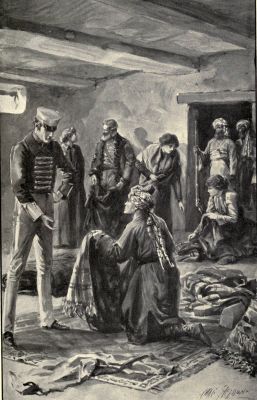
ANGUS SHOWS HIS GOODS TO THE PRISONERS.
"If we had a few blankets to hang across the windows the ladies would not feel it so much, Saleh."
"That is so; and as I am anxious that they should not, while under my charge, feel greater discomfort than necessary, I have permitted this trader, Syud Moorteza, to enter. He has, he tells me, some warm robes and other things which he is ready to sell, and as I told him that before you came into my charge all your money had been taken away, he is ready to take your notes upon a banker at Calcutta or Bombay in payment."
Captain Johnson knew the Cashmerian, as he had rendered invaluable assistance in obtaining grain. Angus, who was acquainted with him, had the more willingly adopted his name because the man was about his own height and build, and there was even some resemblance in feature. Captain Johnson therefore looked with interest at the trader, who was standing a little behind Saleh. For a moment he seemed puzzled but Angus had his hand on his chin and suddenly moved two fingers across his lips and very slightly shook his head. Johnson understood the gesture, and replied to Saleh: "The man is right; he may be sure that whatever happens to us our friends will see that he is paid for any goods we may buy of him. We will write a letter in Persian, which you can read to our friends, saying that this man has trusted us and that our orders are to be honoured."
The ladies, who were in the next room, were called in. The Afghan commander, who had nothing to do, remained with his officer, being interested in the contents of the trader's bales. Azim opened them, and spread the articles out on the floor for inspection. Angus was greatly concerned at the appearance of the ladies, to all of whom he was known. His disguise, however, had so completely changed his appearance that none of them recognized him. His face was darkened, his eyebrows and hair had been stained black, and by the assistance of some false hair the latter was arranged in the fashion worn by the man he represented. Syud Moorteza was of the Hindoo religion, and Angus had imitated his caste marks on the forehead, which alone greatly altered his appearance. But the ladies scarcely looked at him. Their delight at seeing the warm robes and woollen cloths was great indeed. Here was a prospect that their sufferings from cold would be alleviated, and that their children could now be warmly clad.
Among the smaller articles in his bale Angus included a good supply of needles and thread, buttons, and other small necessaries. The ladies saw at once that from the soft woolen cloths they would be able to make an abundance of warm clothing for the children. Angus expatiated after the manner of a trader on the quality of his goods. Holding up a warm robe to Captain Johnson, he said: "This would suit you, my lord; it will keep you warm in the coldest night."
"You have not more than enough for the ladies," Captain Johnson said. "If there is anything over after they have made their purchases, we shall be glad to take the rest of your cloth. We can wind it round us."
"But feel the quality of this robe, my lord," Angus urged, with a wink that was understood by the officer, who at once took hold of it. As he did so Angus slipped a note, which he had folded to the smallest possible dimensions, into his hands.
"Yes, it is good material," he said quietly; "but, as I have just said, these must be for the ladies." And he turned away as if unwilling to be tempted, and presently sauntered into the next room. In order to keep up his character Angus asked fully five times the proper value for his goods. But the captives had no thought of bargaining; for these goods would be of the greatest comfort to themselves and their children, as coverings for the night, and as wraps during the passage of the passes, for in addition to the clothes and cloth, there were silk mufflers for the neck, and warm jackets lined with astrakhan fur. Nor were the needles and thread less prized. Their clothes and those of the children were in rags, and they would be most useful for mending, as well as the making of new clothes. Some of them almost cried with joy at the thought of the comfort that this would be to their little ones.
In a few minutes the greater portion of the contents of the bales was disposed of. "The best way," Pottinger said, "will be for Lawrence, Mackenzie, and myself, as the three political officers, to give this man an order signed by the three of us on our agent at Calcutta, and I will write an open letter to accompany it, authorizing any British officer or banker to cash the note when it is presented, and to send it on to my agent. The man has done us an inestimable service, and it will facilitate his getting the money. Where are you thinking of cashing this?" he asked.
"At Herat."
"Then I will also give you a note to a trader there. He has a shop in the great bazaar, and is a friend of mine. He has relations with business men in India, and will, I am sure, cash it for you at once should you desire cash, or will furnish you in exchange with bills on some merchant in Candahar." He then mentioned the trader's name.
"That will suit me well," Angus said. "I know the man by name, having been myself at Herat. He is of good repute, and I am sure that he or any other merchant having dealings in India would gladly cash the order, as it would be far safer to send than money."
It was not until the purchases had all been made that Captain Johnson re-entered the room, came and stood by Angus, asking a few questions as to the goods; when the two Afghans were looking another way he passed a note into the pretended merchant's hand. Presently he said: "But we have no pen and ink to write this order?"
"I have them, sahib," Angus said, taking an ink-bottle and pen, such as were always carried by traders, from his pocket, together with several sheets of paper. The price of all the goods was added up; then Pottinger wrote an order for the amount, which was signed by himself, Lawrence, and Mackenzie. Then Johnson took Pottinger aside as if to discuss the terms of the letters.
"That man is not Syud Moorteza at all," he said. "Don't turn round and look at him. He has given me a note, and I am answering it. Who do you think it is?"
"I have been a little puzzled, not by his face, but by his voice. I have it now—it is Angus Campbell."
"You have guessed right. He has come up by himself through the passes to try and overtake us. He bears a message from Mohun Lal to Saleh, saying that he shall be given a pension of a thousand rupees a month and a present of thirty thousand if he will hand over the captives to the British general when he reaches Cabul. He has asked my opinion as to whether it would be safe to make the proposition to the man, or whether he had better wait until news comes that Pollock has defeated Akbar in the passes. I have told him that I have already sounded Saleh, and that though he passed the matter off, I believe he is open to take a bribe if he hears that Nott and Pollock are making their way up. He says that if bad news comes—and I think it would then be useless to approach Saleh—he will make an attempt with some men he has with him to effect your escape, and also mine, and that of Mackenzie and Lawrence. Boyd, of course, would not leave his wife and family, and it would be impossible to take the women and children with us."
"Campbell is a splendid fellow!" Pottinger said. "He behaved wonderfully well at Herat, and I was sure that in time he would make a very fine officer. It is a noble thing, his undertaking such a tremendous risk."
The letters were now written and handed to Angus. Saleh, however, took them from his hands and read them, and then handed them back, after assuring himself that there was nothing written but what had been agreed upon. Then he and the officer went downstairs with Angus and Azim, the latter carrying easily enough the one small bale that sufficed for the goods unsold.
"You have made a nice sum out of this," Saleh said.
"I have had a long journey with my goods," Angus replied humbly; "but they were well contented, and paid without bargaining the prices I asked. I feel, my lord, that I am greatly indebted to you for the opportunity. I have not money with me—we traders never carry cash, and I shall have to wait many months before I receive the price of the goods—nevertheless, my lord, I will willingly give you in token of my gratitude another shawl equal to the last; I have brought with me only two. And you can select any goods you like from those remaining. There are many silk things among them, for they only bought such as were needed for wear."
Saleh was well satisfied, and telling Angus that he might call round in the evening with some of the silk embroidered scarfs, he allowed him to return to the camp. Two days passed, and then a horseman rode in with the news that Akbar had been defeated at Tezeen, but would fight another battle, and, as he was being joined by many chiefs, would doubtless overthrow the infidels. The news spread rapidly and caused much excitement in the camp, which was heightened by the fact that the man said that there was a report that Ghuznee had been captured by the British force that was marching from Candahar.