Front matter (continued 2)
Reading edition
"It is like playing at war," Pottinger said irritably; "except in that first charge they have never really come to blows. It is skirmishing rather than fighting. Here there are some ten or twelve thousand men, taking both sides, cavalry, infantry, and a few guns. I don't think that when our men come in again it will be found that they have lost a hundred, and I don't suppose the Persians have lost much more. It is a fair field for fighting, and between two European forces of the same strength a long day's battle would probably have caused three or four thousand casualties. One would think that neither party was in earnest. Certainly the Heratees are, though I don't suppose the Persian soldiers have any particular personal interest in the matter."
The action was altogether indecisive, and at the end of the day the Persians held no ground beyond the village where their infantry first opened fire, while the Heratees had gained nothing by their sortie. When the Afghans re-entered the walls it was found that Pottinger's estimate as to the amount of loss was very near the truth; there were between twenty-five and thirty killed, and some four times as many wounded, more or less seriously. They of course claimed a victory, and were highly satisfied with their own doings, but the operations only tended to show that neither party had any eagerness for real fighting.
On the 7th of February Pottinger said: "I have received permission to go into the Persian camp to-morrow. Kamran has given me a message on his part to the Persian king. It is an appeal to him to retire. He says that when Khorassan was in rebellion he refused the entreaties of its chief to aid them, although at that time he could have raised ten thousand horsemen, and might, with the rebels of Khorassan, have marched to Teheran. He had sent one of his highest officers to congratulate the Shah on his succession, and now the latter is without provocation marching against him. He prays him therefore to retire, to aid him with guns and men to recover the dominions he has lost in Afghanistan, and if he be successful he will hand over Herat to him. Yar Mahomed has also given me a message to the Persian minister, just the sort of message I should have expected from him. He declares that he is devoted to the Shah and to him, but that he is bound to stand by his master. That whatever might be his own wish, the Afghans would never surrender the city, and that he dare not propose such a thing to them, but that he shall ever remain the faithful servant of the Shah and of the minister whom he regards as his father. I will take you with me if you wish, but that must be a matter for your own consideration."
"I should, of course, like to go," Angus said, "but I do not know that it would be wise for me to do so. Mr. M'Neill may be in the Persian camp. It is not probable that I should be recognized, still there must be many officials there who came frequently to see him at the embassy, and who would know me. Should one of these declare that I was a member of the mission, it might create a very bad impression against M'Neill, as it would seem that he was in secret communication with Kamran."
"That is just what I was thinking," Pottinger said, "and I must say that I agree with you. It certainly would be awkward for him if it were known that one of his suite was in Herat. Yes, I think it would be better that you should not go. We shall certainly be the centre of curiosity while we are in the camp, and there would be no possibility of private communications between you and M'Neill. But should I see him have you any message for him? I think we have agreed that when this business is over it will be much better for you to go with me back to India than to return to Teheran."
"Yes, I have quite settled that," Angus said. "With the kind offer you have made to present me to your uncle I should think that the prospect of my obtaining advancement there is very much greater than it is in Persia, where I might be left altogether in the lurch if M'Neill were recalled. I shall be obliged, therefore, if you will tell him of my intention, and thank him for me very heartily for his kindness. He will, I am sure, approve of the step, for he has several times told me that he was sorry he could see no chance of my obtaining more than a clerkship at the mission, and advised me on no account to think of remaining there if I could see my way to doing better for myself."
"I will be sure to give M'Neill the message if I see him but I don't expect to be long in the camp. I am charged with such a ridiculous message that there is no likelihood of any discussion taking place. The minister will, of course, scoff at Yar Mahomed's declarations of respect for the Shah and affection for himself, and the Shah, after taking the trouble to collect an army and come here himself, is not likely to retire at the request of Kamran. My real hope in going is that I may find a British officer with the Persians. There is almost certain to be one, as the Russians have, it is said, several. Through him I may send messages to friends at home and to my uncle in Scinde. They must all begin to feel anxious about me."
Angus saw his companion ride out the next morning with some anxiety as to his reception, but with no particular regret that he did not accompany him. He had often been in the encampments of the Persian troops before the army left Teheran, and there would therefore be nothing new to him in the scene. Pottinger as usual wore the dress of an Afghan of some standing, and was accompanied only by one mounted attendant and a runner to hold his horse. A small party of Afghans rode with him for some distance beyond the walls, and then, shouting good wishes for his return in safety, left him. Angus continued to watch the men at their work for two or three hours, and then took his place on the walls again and watched for his comrade's return. It was not, however, till the 10th that he came back to Herat.
On the previous day he was prevented from returning by a violent storm which raged from morning till night, and considerable anxiety was felt in the town. That he had gone on a mission from Kamran was generally known, but none save the Shah and his wuzeer were aware of its nature. Angus was much alarmed, as he thought it too probable that his friend had been shot by the Persian outposts as soon as he arrived among them, for there was nothing to show that he came as an envoy. He was therefore greatly relieved when a native brought the news to him that the Englishman was returning. As the news spread it caused great excitement. When Pottinger rode in at the gate a great crowd had assembled there, and all thronged round him asking for information. He replied that they must enquire of the wuzeer, who alone could deliver it. As he saw Angus in the crowd he shouted to him, "As I expected, nothing has come of it; meet me at the house."
An hour later Pottinger arrived there. "I was getting very anxious about you," Angus said, "and was beginning to fear that you had been shot by the Persian outposts."
"I was a little uncomfortable myself, and I kept a good look-out, as you may suppose. The roads led through those ruined villages, and at any moment I might have a bullet whizzing about my ears. Presently I saw some Persian soldiers running towards the road, and I told my man to take off his turban and wave it to show that our intentions were peaceable. When they perceived this they came straggling up. I told them that I was an English officer, and the bearer of messages to the Shah and his minister. They seemed delighted, chiefly perhaps from the fact of my being an Englishman, but also because they hoped that I had come with an offer of surrender. However, they shouted 'Welcome, welcome! the English were always friends of the Shah.' The officer who commanded the picket turned out to be a major who had served under Major Hart, and who knew all the English officers who had of late years been in Persia. He took me to the major-general commanding the attack, who turned out to be a Russian in the Persian service commanding a corps of Russians—men who had left their own country for doubtless good reasons. At any rate, he received me courteously. We had tea, and smoked a pipe together, and he then sent me on with an escort to the Persian camp.
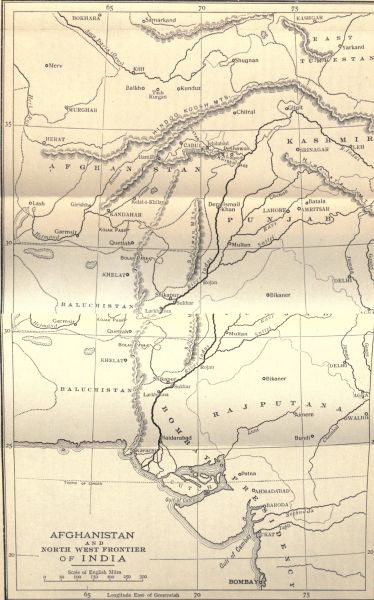
AFGHANISTAN AND NORTH WEST FRONTIER OF INDIA
"The news that someone had come in from Herat to arrange terms for its submission having preceded me, almost the whole camp came out to see me, and if my escort had not used their iron ramrods most vigorously upon the heads and shoulders of the crowd I should never have got through. When I reached the minister's tent he received me graciously, but we did not enter into business; it was necessary that the Shah should first decide whether he would receive me.
"I had learned from the Russian general that Colonel Stoddart was in camp. As it was known before I left India that he would accompany the Persians I had letters for him, and received permission to go to his tent to deliver them. His astonishment at finding that I was a British officer was, as you may imagine, great. However, I had but little time to talk, for in a few minutes a message came that I was to go back at once to the minister, or, as he is called there as well as here, the wuzeer. Stoddart accompanied me. The Persian asked me what were the messages that, as he had been informed, Kamran and Yar Mahomed had sent to the Shah and himself. I told him that I could only deliver Kamran's message to the Shah, and that I thought his own message had better be given him privately.
"The wuzeer, who is a bilious and excitable little man, sent everyone out from the tent but Stoddart and myself, and I then delivered the message. We had a long discussion. The wuzeer declared that the English themselves had put down Herat as forming part of the Persian dominions in the map that Burnes had made. I said that I thought not. He produced the map to convince me, but to the little man's intense disgust he found that he was altogether wrong. He then appealed to Stoddart. The latter, as our military representative at the Shah's court, replied diplomatically that he had no instructions on the subject, and would refer the case to the envoy at Teheran. (M'Neill, by the by, has not yet reached the camp.) Stoddart said that he was not aware that the Persian government had annexed Herat, as its ruler had, both with the British government and the late Shah, been acknowledged as sovereign in Afghanistan; so, as I expected, nothing came of the interview. We went back to Stoddart's tent, and shortly afterwards were sent for by the Shah. He received us with courtesy, and I delivered Kamran's message.
"The Shah replied, speaking with dignity and calmness, and stating his complaints against Kamran, that he had permitted his soldiers constantly to make incursions into Persian dominions, robbing and slaying, and carrying off Persian subjects to sell as slaves; then gradually warming up as he recited a number of such forays and depredations, he denounced Kamran as a treacherous liar, and said that he would not rest satisfied until he had planted a Persian garrison in the city of Herat. Of course there was nothing more to be said. We were formally, though courteously, dismissed, and I went back with Stoddart to his tent, where I remained till this morning. I was by no means sorry that the tremendous storm yesterday afforded an excuse for stopping, and I enjoyed my day of quiet talk with Stoddart immensely.
"He thinks that if the Persians do but make an attack with all their strength the town must be taken, in which I entirely agree with him. He said, however, that, as the slackness of their fire for some time past has shown, the Persians are heartily sick of the business, and if the Shah had some really good excuse for retiring he would gladly do so. I said that the best excuse would be some strong action on the part of our government. He replied that he had himself urged this upon M'Neill, and that the envoy had already written urgently home in that sense. Of course I told him of your being there. He had already heard from M'Neill that he had sent you here to encourage Kamran to hold out. He asked a good deal about you, and quite agreed with me that with your knowledge of languages—and I told him that in the three months during which you had been here you had already learned enough Pushtoo to converse in it freely—you would be sure to get an appointment in India, as it was extremely probable that an army would shortly be sent into Afghanistan to support Shah Soojah against Dost Mahomed, especially as the latter had received Vickovich, an aide-de-camp to the governor of Orenburg, as an envoy at Cabul.
"Of course I had heard about the intention of supporting Dost Mahomed before I started. I know that my uncle and Mr. Burnes, who is our agent at Cabul, are both strongly opposed to this. Dost Mahomed has always defeated Shah Soojah, he is firmly established on his throne, and Burnes believes that he is very well disposed towards us. However, that is not our affair; but if there should be such an expedition it much increases your chance of obtaining an official post. I took the opportunity to write to my uncle and to send my report to the Indian government, and in both cases I stated that I had received the most valuable assistance from a young gentleman who was temporarily attached to the mission at Teheran, and who, speaking as he did, Persian, Pushtoo, and Arabic, would, I considered, be of great service should any difficulties arise with Afghanistan. I said that I had seized the opportunity of recommending you, as it was possible that I myself might fall in the defence of Herat."
"It was awfully kind of you, Pottinger, and I am extremely obliged to you."
"I felt that I was acting in the interest of the Indian government as well as of yourself. The siege may last for another month yet, and by the end of that time you will be able to pass as easily as an Afghan as you now can as a Persian, and may be invaluable; for as we have as yet had very little contact with Afghanistan there are not, I should say, half a dozen officers in our service who can speak Pushtoo—probably not one who could do so well enough to pass as a native. I myself knew but little of it when I started, so my disguise was that of a Cutch horse-dealer, and I passed through Afghanistan as a native of India. Even now I do not speak Pushtoo as well as you do, having devoted myself to Persian, while you have been working at Afghan. For your sake I hope that the siege may last for some time yet, as it may be a great advantage to you when you apply for an official post to be able to say that you can pass anywhere as a native."
CHAPTER IV
A STURDY DEFENCE
Pottinger's belief that the Shah was anxious to bring the war to a conclusion was confirmed by the arrival of the major he had met when going into the Persian camp, with instructions from the Russian general, endorsed by the minister, to endeavour to persuade the Afghans to consent to the terms offered by the Shah. It was better, he urged, for them to settle their differences among themselves than to employ mediation. He warned them that as the English had come to India under the pretence of trading, and had finally conquered the whole country, they should on no account be trusted. He assured them that the Shah had no desire to interfere in the internal administration of Herat, the present movement was not an expedition against Herat but against Hindostan, and that all true Mohammedans should join the Shah's army, and that he would lead them to the conquest and plunder of all India and Turkestan.
Pottinger was sent for privately, and consulted by the Kamran and the wuzeer as to what answer should be sent. His advice was taken, and the next day the envoy returned to his camp with vague assurances of regard, and the suggestion that if the Persians were really inclined for peace, the best proof that they could give of the sincerity of their inclination would be the retirement of the besieging force. There was much excitement in the city when the proposals brought by the Persian officer became known, and many of the older men began to argue that it did not matter much whether Kamran was called prince or king, or whether the supremacy of the Persian Shah was or was not acknowledged in Herat, as long as no Persian garrison was placed in the city. The wuzeer, however, remained firm. He declared that he had no confidence in the Persians, that he desired to be guided by the advice and be aided by the mediation of the English, and that if the Shah would place the conduct of negotiations in the hands of Colonel Stoddart, he on his part would trust everything to Lieutenant Pottinger, and would accept whatever was decided upon by the two English officers.
"That was his own decision, and not mine," Pottinger said, when he returned from an interview with the wuzeer. "There is no doubt that, ruffian as he is in many respects, he is a clever man. You see, he shifts all the responsibility for the continuance of the war off his shoulders on to those of the Persians, for their refusal to accept the decision of the British officer in their camp will convince the Afghans that the Persians will be satisfied with nothing but their destruction."
Two days later the Persian officer returned to Herat with a letter stating that the Shah had no desire to possess himself of the town, but only claimed that his sovereignty should be acknowledged. The answer was the same as before. Kamran was willing to do all that was required if the Persian army would but retire. The negotiations were carried on for a day or two longer, but though both parties desired peace, the one would not surrender, the other would not retire and acknowledge failure. Hostilities, therefore, continued without intermission, and a fortnight later the Persians gained possession of a fortified place three hundred yards from the north-east angle of the wall. The Afghans stationed there had made but a poor resistance, and upon entering the town their faces were smeared with mud, and they were sent through the city accompanied by a crier who proclaimed their cowardice.
A month passed without any incident of importance, and at the end of that time M'Neill arrived at the Persian camp. Every effort had been made to hinder him on his way from Teheran, and he was at first coldly received. A week later he had an audience with the Shah, and stated to him that the attack upon Herat was an obvious violation of the treaty between Great Britain and Herat, and the British government would therefore be justified in taking active measures to enforce its terms. The Shah upon this consented to accept the British mediation.
Three days later, however, the Persians made a serious attack. Some new batteries opened against the ramparts near the great mosque. Their fire was this time concentrated, and the wall crumbled so rapidly that by the evening a practicable breach had been made. The Afghans, however, did not lose heart, declaring that they trusted to themselves, and not to their walls, to defend the city. They had, indeed, gained an advantage in the middle of the day. They blew in a mine that had been carried almost up to the wall, and taking advantage of the alarm caused by the explosion rushed out and furiously attacked the besiegers, carrying the trenches for some distance before a strong Persian force came up and drove them back again. So heavy a fire was then opened from the trenches on the musketeers on the walls, that these were completely overpowered, and were unable to show a head above the parapets. As evening came on the Persians shouted that an English officer wished to enter the town, but the wuzeer shouted back that no one would be allowed to enter at that hour. The next day Major Todd, who was attached to the embassy, entered the town. He was in full regimentals, and his appearance excited the most lively admiration of the populace. He announced that the Shah was ready to accept the mediation of the British government. He was received with the greatest courtesy by Shah Kamran, who after the interview took a cloak from his own shoulders and sent it by the wuzeer to Major Todd, who returned to the Persian camp with the assurance of Kamran's desire to accept the mediation of the British minister.
But though apparently both parties had at last arrived at an understanding, that evening the aspect of affairs became more warlike than ever. The Persian trenches were filled with men, the bodies of horse and foot on the line of investment were strengthened, and there were all appearances that an assault would be made that evening; and the Afghan chiefs were called together and each had his post assigned to him. But scarcely had they separated when Mr. M'Neill himself arrived. He was conducted at once to Kamran's palace, and the greater part of the night was spent in discussion. It was nearly dawn when the minister accompanied Pottinger to the latter's residence. As he had arranged when he arrived that he would sleep at Pottinger's, a room had been prepared for him, Angus sat up for several hours, but then feeling sure that the minister would at once retire to bed on his return, had lain down. When he awoke it was half-past six, and dressing hastily he went into the sitting-room that he shared with Pottinger, and to his surprise found Mr. M'Neill writing there. The minister greeted him cordially.
"I heard all about you from Colonel Stoddart, and approve highly of your remaining here to give Pottinger what aid you can during the siege. I also think that you have done very wisely in determining, as Pottinger told Stoddart you had done, to go to India. I myself will write to the English government saying what you have done, how intelligently you carried on your work at the mission, and recommending you for an appointment on the northern frontier either with the army or the resident at Scinde, or perhaps better still, with Mr. Burnes at Cabul."
At this moment Pottinger entered the room, and he was as surprised as Angus had been at seeing the minister at work after only a couple of hours in bed. There was another meeting with Kamran, who placed himself entirely in the hands of the British envoy, and said that he would gladly consent to any terms agreed upon by him. At the conclusion of the meeting Mr. M'Neill returned at once to the Persian camp.
To the disappointment of all, Major Todd rode in two days later with the surprising news that the Shah had entirely changed his attitude, and absolutely refused to submit the dispute to British arbitration, and that unless the whole people of Herat acknowledged themselves his subjects, he would take possession of the city by force of arms. This sudden change was the result of the arrival of the Russian representative, Count Symonwich, on the morning of the day of M'Neill's visit to the city. The Russian party at once became ascendant. He himself took the conduct of the operations of the siege, the officers with him taught the Persian soldiers how to construct batteries, and Russian money was freely distributed among them. Pottinger's task of explaining to Kamran the news brought by Major Todd was an unpleasant one; but the old man took the news quietly, and said that he never expected anything else, for the Persians had always been noted for their treachery and want of faith. The news, however, caused great discouragement in the town, and it was determined at a meeting of the chiefs that they would send to the Russian ambassador and place themselves under the protection of his master. Meeting after meeting was held, at all of which Pottinger was present. Sometimes he was received and listened to with respect, and other times he was treated with marked discourtesy.
The influence of Mr. M'Neill at the Persian court declined rapidly, while that of the Russians became supreme. For some months past he had failed to obtain any satisfaction for matters of serious complaint. As far back as October a courier bearing despatches from Colonel Stoddart to him at Teheran had been seized by a Russian officer, stripped and imprisoned by the Persians, and his despatches taken from him. The British resident in the Persian Gulf had been grossly insulted by the governor of Bushire, and the Persian government had continued to evade its obligations under the commercial treaty between the two nations. So marked was the indignity with which M'Neill was now treated in the Persian camp, that on the 7th of June he left it with Colonel Stoddart and all his suite and attendants, a step equivalent to a rupture of the relations between Great Britain and Persia.
In the meantime the pressure of famine and sickness became more and more intense in Herat. The city was altogether without drainage, and the stench from the bodies of those who had died or been killed, and of the dead animals, was dreadful. But although much depressed, the courage of the Afghans still sustained them, and when on the 13th of June the Persians surprised the outer works, they held the connecting passage and defended it until assistance came, when the garrison poured out, rushed down the slope, and dislodged the assailants with much slaughter. Another attempt on the same day at a fresh point was equally unsuccessful, and the storming party were twice repulsed. Pottinger was now armed with an authority that he had not before possessed, for he had been appointed by M'Neill British envoy at Herat. The news of the departure of the embassy, and Pottinger's assurances that this was a prelude to war between England and Persia, had but little effect. It was certain that the city could not possibly hold out many weeks, and it might be months before the arrival of a British fleet and army could influence the Persians.
Happily, however, Lord Auckland, Governor-General of India, had not waited for instructions from home, but at the news of the investment of Herat, and the outrage upon our resident in the Persian Gulf, had begun to take steps early in the spring; and on the 4th of June two transports and some vessels of war left Bombay harbour with detachments of two British regiments and a marine battalion, and on the 19th anchored off the island of Karrack in the Persian Gulf.
Upon the 24th of June Herat went through the most terrible experience of the siege. At daybreak a heavy fire opened from the Persian batteries on all four sides of the city. It ceased suddenly after a time. Pottinger, who was at breakfast, exclaimed to Angus, as he leapt up from his seat: "They are going to assault; the batteries have done their work. Quick, to the wall!"
Warning the soldiers they came upon as they ran, they made their way to the wall. Just as they arrived there another gun was fired, and at the signal the batteries on all sides again broke into life. A storm of rockets carried dismay into the town, the mortars dropped their shells into it, and most conclusive of all, a rattle of musketry broke out, growing every moment in power. Against five points was the assault directed. That on the gate of Candahar was repulsed, and the enemy chased back to their trenches. That upon the south-west angle was but a feint, and was never pushed home against the western gate. The Russian regiment under Sampson, and a strong force under a Persian officer, pressed up to the breach; but the Persian was killed and Sampson carried off wounded, and the troops fled after suffering immense loss. The attack on the north-western face was similarly repulsed, but the fifth contest was desperate. The storming party gained the fausse braye. The Afghans defending it fought desperately, and all fell at their post. The storming party rushed up the slope. The officers and leading men were mown down by a heavy musketry fire, but after a fierce struggle the upper fausse braye was carried, and some of the assailants gained the head of the breach.
But now the Afghan reserves were brought up, and the Persians on the breach were driven back. Again and again, the Persians fighting this time with desperate courage, struggled to effect a lodgment, only to be repulsed, and fell back in confusion on their comrades behind. For a long time the issue was doubtful; a desperate hand-to-hand conflict raged, the assailants and defenders swayed up and down the breach, which was covered with corpses and slippery with blood.
Yar Mahomed arrived almost at the same time as Pottinger and Angus, for these, before coming here, had seen that all was going well at the other points attacked.
They had observed as they came along men leaving the breach by twos and threes under pretence of assisting wounded comrades, and Pottinger saw to his dismay that the men were losing heart. As they came to the breach they found other soldiers coming up. The wuzeer was sitting down close by. Pottinger ran up to him. "You must encourage your men, wuzeer; go forward and join them, or all will be lost."
The Afghan scarcely seemed to hear what he said. "You must come," Pottinger repeated loudly; "there is no time to be lost." Then he turned to Angus: "Do what you can," he said. "I must rouse the wuzeer; evidently his nerves have suddenly given way."
Glad at last to be free to join in the struggle, Angus drew his sword and ran down, thrusting back those who were mounting, and pushed his way forward to the front, shouting in Pushtoo: "Fight, men! fight for your faith, your wives, and your children! Everything is going on well elsewhere. Are you alone going to fail?"
The bearded Afghans, astonished at seeing this young Englishman rushing forward in advance of them, followed him, and again the Persians were beaten back. But although the Afghans in front had been animated by the lad's example, those behind were still dropping off. The wuzeer, aroused by the vigorous exhortations of Pottinger, had risen up and neared the breach. The Persians were renewing their attack, and the wuzeer called upon his men to fight. The fugitives paused irresolute. The wuzeer's heart failed him again, and he turned back, his action still further discouraging the men. Pottinger, in the most vehement language, exhorted him to set an example. Again he turned and advanced, but again shrank back. Pottinger now instead of entreating reviled and threatened him, called him opprobrious names, and at last, seizing him by his arm, dragged him forward to the breach. This astounding treatment maddened the Afghan. He shouted to the soldiers to fight, and as they continued to fall back, seized a large staff, and, rushing like a madman upon the soldiers, drove them forward again with a shower of heavy blows, while Pottinger sword in hand seconded him. Cooped up as they were, and seeing no other outlet of escape, many of them leapt wildly down over the parapet, rushed down the slope, and fell upon the Persian stormers. Believing that great reinforcements must have arrived, these were seized by a panic, abandoned their position, and fled.
Herat was saved entirely by the energy and courage of the young English lieutenant. Pottinger's first question was as to his companion. He had, while urging the wuzeer to advance, caught sight of him fighting desperately in the midst of the Persians, and he at once made his way down to that spot. He was not long in discovering Angus, who was lying insensible, bleeding from a number of sabre wounds. Calling four Afghans, he ordered him to be carried on to the wall. There he bandaged his wounds, and then had him placed on a stretcher and carried to their lodging, taking on himself to send an order to the wuzeer's own medical attendant to go there at once and attend to his wounds. Then he turned his attention to the wuzeer. The mind of the minister had been almost unhinged by the terrible events, and he was still wandering about in a confused and bewildered way. Several of the other chiefs were similarly affected, and were unable for days afterwards to perform their usual duties.
The soldiers themselves, instead of being excited over their victory, were as gloomy and depressed as if they had suffered a defeat. The peril had been so great, the city had been so nearly lost, that there was a general feeling that another such attack would be successful. Their confidence hitherto had rested upon the wuzeer, and on the conviction that their courage was infinitely greater than that of the Persians, and they had found that the Persians could now fight as well and stoutly as they themselves. They were humiliated by knowing that it was to a young English officer they owed it that the Persians had failed in their object, and that another young Englishman, scarce more than a boy, had led their best and bravest into the thick of the fray, and had himself penetrated beyond them into the midst of the Persians and had fallen there. None appreciate bravery more than do the Afghans. It was not so much that Pottinger had exposed himself recklessly to the shower of bullets with which the Persians in their trenches swept the spot where he was standing with the wuzeer, but that he should have ventured to abuse, revile, and even forcibly drag their dreaded leader forward astounded them.
All Herat felt that it was he who had saved the city, and the fame of the deed spread through the country round, and men when they came in sought him out and kissed his hand with enthusiasm. A deep gloom, however, hung over the city. Even the work of repairing the damaged fortifications was carried on apathetically. They had repulsed the Persians, but it was felt that nothing but a miracle could enable them to withstand another such assault. Food was all but exhausted, the treasury was empty, the inhabitants could not be fed, the soldiers could not be paid. But an equal amount of depression was felt in the Persian camp. Five assaults had all failed, and some eighteen hundred of their best troops had fallen. The loss of officers had been enormous; the Russian general, Berowski, had been killed, and two of the principal Persian generals. Another Russian general, Sampson, and two pashas had been wounded, and almost all the field officers of the regiments engaged in the attack were hors de combat.
Pottinger's position was a very painful one. The need for money to pay the troops was absolute, and the wuzeer, when he had recovered from the effects of his scare, instituted a reign of terror even more terrible than anything the wretched inhabitants had ever before felt. The soldiers went from house to house, and all suspected of possessing money were seized and tortured. Even ladies of rank were so treated, and the very inmates of Kamran's zenana were threatened and had to contribute their jewels. Pottinger felt that it was solely owing to his influence that the city had so long held out, and as he went through the streets starving men reproached him as the author of their sufferings. He did all that he could, but that was little. Men of all ranks came to him imploring his aid and protection. Some he was able to save, but for others he could do nothing. Never was a young soldier placed in so terrible a dilemma. As a man he was agonized by the sufferings he saw round him—sufferings he could at once bring to an end by advising the wuzeer to surrender: as a soldier and an Englishman, he felt that it was his duty to hold out to the bitter end.
His position became still more difficult when, a fortnight after the assault, the Persians again opened negotiations, demanding, however, as a first step that he should be expelled from the city. Pottinger declared that no thought of personal safety should persuade him to stand in the way of any arrangement conducive to the safety of Herat and the welfare of his country, and that if these could be gained by his departure he would willingly leave the town. But Yar Mahomed was undecided. He felt that the dismissal of the man who had saved Herat would be a stain on his character, and, moreover, that the Persians having obtained his dismissal, would become still more exorbitant in their demands. He had long expected the arrival of a relieving force of Turkomans, and Pottinger was convinced that ere long the intervention of England would compel the Persians to fall back. The bombardment of the city had not been renewed since the repulse of the attack, and the Persians relied now solely upon famine to reduce it, and maintained a strict blockade.
In order to mitigate the horrors he saw around him, Pottinger undertook that all who voluntarily brought in their money should be reimbursed at his recommendation by the British government. This brought some money in, though slowly, and July passed. Then a deserter from the Persian camp brought in news that there was a report that a great British army had landed in the Persian Gulf, had taken Bushire, and was advancing. This report had fortunately enormously magnified the strength of the British expedition, and the news gave fresh life to the defenders of Herat. The Persians again opened negotiations, waiving the question of the expulsion of Pottinger, but the wuzeer was less inclined than before to yield to the Persian demands.
M'Neill was on his way to the frontier when he was informed of the arrival of the British expedition to the Persian Gulf, and at the same time received instructions from the Foreign Office in anticipation of the refusal of the Shah to retire from before Herat. Fortified by these instructions, he despatched Colonel Stoddart to the Persian camp with a message to the Shah. He arrived there on the 11th of August, and on the next day had an interview with the Shah, who welcomed him with cordiality, and listened to the message from the British government.
"It means, then," he said, "that if I do not leave Herat there will be war?"
"It all depends upon your Majesty's answer," Stoddart replied.
Two days later Stoddart was again summoned to the royal presence. "We consent," the Shah said, "to the whole of the demands from the British government. We will not go to war. Were it not for the sake of their friendship, we should not return from before Herat. Had we known that by our coming here we should risk the loss of their friendship, we certainly should not have come at all."
In reply, Colonel Stoddart said he thanked God that his Majesty had taken so wise a view of the real interests of Persia. But as he left the audience, he hinted to the Persian minister that although the Shah's answer was very satisfactory, it would be more satisfactory still to see it at once reduced to practice. Although rumours reached the city that the Persians were about to leave, it was not for another week that the rumours became a certainty. An effort was made to induce the wuzeer to make some concessions that would give a better grace to the withdrawal of the Shah. Some of the conditions suggested were refused by Pottinger's advice; but on the 4th of September the Persian prisoners in the town were sent into camp, and on the 9th the Persian army began their march back to Teheran.
It was time indeed that they did so, for they had but three or four days' supply of forage remaining, and their flour and grain were almost all exhausted. Their failure to capture so weakly fortified a place was, in Pottinger's opinion, due to the fact that there was no union of effort. The commanders of the various sections of the army acted independently, and except when, under the command of the Russians, they made a simultaneous attack, they never acted in concert with each other. It was his opinion that the Shah might have carried the city by assault the very first day that he reached Herat. He declared that the Persians were equally as brave as and far better soldiers than the Afghans, and that they had an ample supply of artillery to capture a strong fortress if properly employed.
For a week after the struggle of the 24th of June Angus Campbell lay between life and death. He had lost a great quantity of blood, and when first carried to his room his Armenian friends believed him to be dead. Pottinger, who had hurried back as soon as he saw that there was no chance of a renewal of the assault, went to Kamran's and obtained some spirits, and with the aid of these the action of the heart, which had before been so slight that the pulse could not be felt, was stimulated, and respiration grew stronger. Kamran's doctor had already declared that none of the wounds were in themselves dangerous, but that he despaired of the patient recovering. Pottinger, however, by no means despaired; he procured some fresh meat, and ordered a servant to make the strongest broth possible, and to pour a spoonful between the patient's lips every few minutes. Angus was wrapped in warm blankets, and a large bottle of hot water placed against his feet. The wounds had already been carefully dressed and bandaged by the surgeon, for although almost entirely ignorant as to the use of drugs, Afghan doctors had abundant practice in the treatment of wounds.
Pottinger remained two or three hours, and then, seeing that Angus was breathing regularly though feebly, and that the pulse could now be felt at the wrist, hurried off to see that the work of repairing the breach had been taken in hand, Kajar's wife undertaking to look after the patient. For a week the issue of the struggle was doubtful; then the improvement, although slow, was distinct, and day by day some slight advance was made. The ladies of Kamran's zenana were much interested in the young Englishman, and frequently sent down presents of fruit and perfumes. Both were welcome. The air of Herat was very unfavourable to wounds, but a little scent sprinkled on a muslin curtain drawn across the window to some extent neutralized the terrible stenches of the town, and a handkerchief steeped in water to which a little of the perfume had been added, was laid lightly over the bandages.
In three weeks Angus was able to sit up for a time, and a week later he walked across the room. His progress was now more rapid, and by the end of July he was able to sit on a donkey as far as the city wall, where he could breathe a purer air than that of the city, and by the end of August he could walk freely about the town. But he was listless and without energy. It was now certain that in a very short time the Persians would draw off.
"You must be out of this as soon as you can, Angus," Pottinger said to him one evening. "What you want is some mountain air. You will never get better as long as you remain in this pestilential atmosphere. It is enough to kill a healthy dog, and I only wonder that the whole population has not been swept away. When M'Neill was here, he told me that if our people interfered and Herat was saved he should appoint me officially as the British resident envoy. He said that he was sure the British government would send money and do all that was possible to alleviate the misery that has been suffered by the inhabitants; and although I would infinitely rather have other employment, it seems to me that it is clearly my duty to stay here. It is largely owing to me that these poor people have suffered for ten months the horrors of the siege, and the least I can do is to help them now, for if I did not you may be sure that any money sent by England would simply remain in the coffers of Kamran and the wuzeer. It is said, and I quite believe it, that a large proportion of the money wrung by torture from these wretched people has been retained by Yar Mahomed. It is therefore absolutely necessary, if the people are to be fed, their houses rebuilt, and matters tided over till trade recovers, that a British officer be here to receive and superintend the distribution of British money. But the very day the gate is open you had better be off. You speak Afghan now perfectly, and I am glad to see that Azim has picked it up too. He is a capital fellow, and has watched over you since you have been ill as if you had been his father. The question is, do you feel strong enough to travel through the mountains? If not, there is nothing for it but for you to return to Teheran and stay there till your strength is restored."
Angus shook his head. "I don't think that I could stand the journey across the plains," he said, "nor that I should pick up much at Teheran, while I believe that in the hills I should soon get braced up. There is nothing really the matter with me now, except that I feel lazy. If there had been fighting going on, and there was something I must do, I should soon shake it off; but what with the sight of the misery of the people here, and the stinks, and the heat, I feel myself that I am making no progress. I believe I shall be a different man as soon as I am once out of this place and on my way to the hills. It will soon be getting cold up there, and in a fortnight I shall be fit for anything."
"I think you are right, Angus; I would give a good deal myself for a few hours in the fresh mountain air. I do think that you are strong enough to travel quietly. Of course you will have to do so, as I did, in disguise; and indeed this will be much more necessary now than it was a year ago. It is well known that the chiefs at Candahar have been long negotiating with Persia, and have offered to place themselves under the Shah's protection, and that, encouraged and pushed on by Russia, they have meditated an invasion of India. The news of the failure here will no doubt moderate their ardour, but from all that has been learned from Afghans who have come into the town during the siege, there is throughout the whole country a feeling of deep excitement at the prospect of another Mohammedan invasion of India, and a conviction that the whole country would rise and join the Persians were they to advance to Candahar.
"The Afghans consider that Russian influence really means Persian influence, whereas we know that it is just the other way, and that Russia only uses Persia as her cat's-paw. As for the Persians, we know now what they are worth, and that a British division would be sufficient to smash them up. But the Afghans don't know that. They believe that Persia is the Persia of old, and that with her aid they could assuredly drive the British out of India. This being the state of feeling, your chance of getting through were it discovered that you were British would be small indeed. You must pass as a Persian who, having long traded with Herat, has learnt the Afghan language. It would be a natural story that, finding that Herat is ruined, and that there can be no trade between it and Persia for a long time, you are travelling south with the intention of fixing yourself at Candahar, and of trading between that town and India on the one side and Persia on the other. You can account for your not having merchandise with you by saying that owing to the presence of the Persian army, and marauders from Herat, and the general disturbance of the country, it would not have been safe to travel with merchandise."
"I will certainly carry out your plan," Angus said. "I don't think there will be any difficulty in getting through. But I do wish that you were coming with me."
"I hope it will not be very long before I follow you, for I think there will be some stirring work there soon."
Angus was well provided with money. He had received from Mr. M'Neill a sum that would not only cover all the expenses of his journey to Herat, but would enable him either to return to Teheran or proceed to India, as circumstances might determine. In addition to this, he had received a year's salary in recognition of the risk he incurred. He had this sum still in his possession. The money he had brought from Tabriz he had left at the embassy, Mr. M'Neill promising to send an order for the amount should he write for it from India.
CHAPTER V
IN CANDAHAR
On the 15th of September Angus started, after a tearful farewell from his Armenian friends. Their gratitude to him and Pottinger was unbounded. The presence and influence of their two English guests had preserved them from the rapacity and cruelty of the wuzeer, while all other merchants and traders in the town had been maltreated and robbed, and in many cases had died under the tortures inflicted to wring from them treasures it was believed they possessed. Kajar and his brother and their families alone enjoyed an immunity from persecution. Both had determined that they would leave Herat, and taking with them their workmen, establish themselves at Teheran or Tabriz, where the profit of their work might be less, but they would at least be able to enjoy it in security, such as could never be hoped for as long as Yar Mahomed was the virtual ruler of Herat.
The period that had elapsed since Angus left Teheran had changed him much. He was no longer a boy, for he had been doing man's work. He was now nearly eighteen years old, and had attained his full height of nearly six feet. His illness had pulled him down much, and sharpened his features, and except for his lighter colour, he really more closely resembled an Afghan than the Persian trader he was dressed to represent. The pallor caused by his illness had been succeeded by a deep tan, caused by his passing so many hours daily in the sun during his convalescence.
"I am glad to be out of Herat," Azim said, as he looked back at the walls.
"So am I, Azim. I thought at one time that I was never coming out at all."
"It is a very bad place, master. In Persia the governors squeeze the people a bit, and sometimes there is much grumbling, but the worst of them are very much better than Yar Mahomed, who is a son of Sheitan, whom may Allah confound."
"He is a scoundrel," Angus agreed heartily. "I wonder myself that the people of Herat have not long since risen and torn him to pieces. I know that if I had been a merchant there I should have tried to stir them up to do it."
Azim shook his head. "They cannot trust each other, effendi. There are many who would like to do as you have said, but there are many who cannot trust their own neighbours."
"Then I would do it myself. Look how many old men were tortured to death; some of them must have had sons. Had my father been so tortured I would have lain in wait for the wuzeer day after day in some empty house—there are plenty of them in one of the streets by which he usually went from his palace to the walls—and as he rode past I would have put a bullet in his head. I would then have escaped from the back of the house if possible. No one would have seen who had fired the shot, and I should have been safe if once away. If I were overtaken I would put a pistol to my head, so as to avoid being tortured to death. I cannot understand thirty or forty thousand people continuing to support the rule of a tyrant, when one bold man could put an end to it."
Once on his way Angus felt new life in his veins, and in a week he had entirely shaken off the feeling of lassitude that had oppressed him in the poisoned air of Herat, and felt equal to any ordinary exertion. As he had expected, he met with no difficulties whatever on his way, for on the road between Herat and Candahar the Afghans were accustomed to see Persian traders passing, and no suspicion whatever was felt that Angus and his attendant were other than they represented themselves to be. The journey was a long one, but Angus did not hurry. It was pleasant to him, after being for a year cooped up in the besieged city, to travel quietly in the fresh mountain air. The scenery was all new to him, and though Azim felt the cold a good deal, Angus enjoyed it immensely. He made short stages, and never exceeded twenty miles a day, and often, when he arrived at a village which offered fair accommodation, he was content to stay when only fourteen or fifteen had been traversed. As this was the great high-road of trade there were khans in almost every village, and there was no difficulty in purchasing the necessaries of life. Everywhere the talk was of war.
Once beyond the territory over which Shah Mahomed ruled, the news that the Persians had failed to take Herat and had retired had excited regret. It had been regarded as certain that the place would fall, and all had anticipated the march of a Persian and Russian army to Candahar, to be followed by a grand invasion of India. The mountaineers had felt sure that the army would gladly pay whatever was demanded for permission to pass unmolested; that they would be ready to pay high prices for provisions and the hire of transport animals, so that they would enrich themselves in the first place, and then have a chance of sharing in the plunder of India, and the destruction of the infidels. Angus was appealed to by all with whom he conversed to explain how it was that the Shah with his great army had failed to take Herat. He was eagerly questioned, too, with regard to Russia, a country of which they had heard many strange rumours. Were they very strong? were they really in alliance with Persia? were they infidels? if so, how was it that the Shah was friendly with them?
To the first of these questions Angus could only reply that, not having been in the Persian camp, he was unable to give them information. There were certainly Russian generals and officers leading the Persians at the siege of Herat. They were infidels, and neighbours of the Persians. For himself, he thought that while no doubt the Shah wished to be at peace with such powerful neighbours, he would be wise not to trust them very far. He could not really wish for them to become more powerful, and if they aided him, it could only be for their own objects. As a peaceful man he himself only desired to trade, and left these matters to wiser heads. But at the same time he knew that Russia was constantly extending its dominions at the expense of its neighbours; and that, as it was a Christian country, it certainly could not be thinking of invading India for the benefit of the Mohammedans of that country, or those of Afghanistan—certainly not those of Persia. Whatever the Shah and the military officers might think, the trading classes were uneasy at the influence that Russia was gaining, and apprehensive of the growing power and proximity of a neighbour possessed of such immense forces, and of ambitious views.
Two months after leaving Herat Angus entered Candahar. The journey had been wholly without any incident of importance. The appearance of Candahar somewhat resembled that of Herat. Situated in a fertile plain, with a range of craggy hills at no great distance, and surrounded by a wall, it was incapable of offering any prolonged resistance to the attack of a European force provided with siege artillery. The town was a comparatively modern one, being founded in 1754 on the site of an ancient city. It was built on a regular plan, the streets all crossing each other at right angles. Like Herat, it had four principal streets meeting in the centre, each of these 150 feet wide, and lined with shops. Streams of water ran down almost every street.
The town made a very favourable impression on Angus after the ruin and dirt of Herat. As a Persian he felt at home here, for Persian inscriptions and names met his eye everywhere, as throughout Afghanistan the whole of the trade is carried on by Persians or by natives of India, the Afghans themselves deeming the profession of arms the only one honourable. The upper classes among them all habitually spoke Persian; which language was generally employed in writing and in all official communications. Angus put up at a khan which he learned was frequented by traders passing through the city, and soon made the acquaintance of several merchants lodging there. From them he learned much more of the state of affairs than he had gathered in the Afghan villages he had passed through on the journey. The English were, it was said, gathering a great army in Scinde with the intention of placing Shah Soojah on the throne of Afghanistan instead of Dost Mahomed.
Of all the blunders that have been committed from the time of our first arrival in India, none is comparable, in point of injustice, hopeless blundering, or misfortune, to the policy thus inaugurated in Afghanistan. Shah Soojah was the head of the Dooranee tribe, and had been overthrown by the Barukzyes, who had gradually attained a power which the Dooranee monarch was unable to withstand. The four princes of that tribe divided the kingdom between themselves, and after waging many wars against each other Dost Mahomed, the youngest of the four brothers, became ruler of Cabul. During these wars Peshawur had been captured by the great Sikh ruler, Runjeet Sing. In 1834 Shah Soojah made an effort to recover his kingdom, but was defeated, and again became a fugitive in British India.
Dost Mahomed, alarmed at the preparations made by the Sikhs for still further dismembering his country, and by the fact that his two brothers, who were Lords of Candahar, might at any moment take advantage of his troubles with the Sikhs to throw off his authority altogether, was anxious to enter into an alliance with the British, all the more so as he had learned of the ever-increasing influence of Russia in Persia. Lord Auckland sent Captain Burnes to Cabul; nominally his purpose was to arrange for a larger commercial intercourse between the two countries. He was received with great honour in Cabul, but he had come altogether unprovided with the customary presents, and Dost Mahomed reasonably felt this as a studied slight. Nevertheless he exerted himself to the utmost to obtain the alliance of the British. But Burnes had no authority whatever to treat with him, and could give him no assurances that aid would be forthcoming if, on the fall of Herat, which was considered certain, the Persians and Russians, aided by the Candahar chiefs, who were known to be in correspondence with them, were to invade his territory. Nor could he obtain any promise that the British would use their influence with Runjeet Sing to restore Peshawur.
Burnes saw how sincere was the desire of the Ameer for a close friendship with England, and wrote strongly to Lord Auckland in favour of an alliance with him. He pointed out that Dost Mahomed was firmly seated at Cabul, where he had reigned for ten years, that Shah Soojah had no adherents, and even if placed on the throne could not maintain himself there. Colonel Pottinger, the resident in Scinde, also gave the same advice, but Lord Auckland paid no attention whatever to their representations. A weak man, he was guided chiefly by Mr. Macnaghten, his secretary, a comparatively young man, with great ambition and an unbounded belief in himself, but, as events proved, with few of the qualities required in a man placed in a highly responsible and difficult position in India. Burnes was instructed to insist upon the Ameer's binding himself to make no alliances whatever without the consent of England, and at the same time he was to refuse to give any pledges in return for such a concession.
A more preposterous demand was never made upon an independent sovereign. For a long time the Ameer strove in vain to obtain some sort of conditions, and at length, finding this hopeless, he threw himself into the arms of the Russian agent, whom he had hitherto treated with great coldness. Burnes's position became intolerable, and he was recalled; and Lord Auckland at once prepared to place Shah Soojah on the throne by force. Runjeet Sing was asked to join in the undertaking, and at a great durbar held in the Punjaub, the conditions were arranged, under which Shah Soojah was to pay a large amount to Runjeet as well as to the British for the aid they were to give him. As if it was not enough to have united all Afghanistan against us, the people of Scinde, who had hitherto been on good terms with us, were treated as if they were enemies. They were ordered to furnish provisions and carriage for the army, and to pay large sums of money, although they had, by the terms of a treaty with us, been guaranteed against any claim whatever for money or services. It would seem, indeed, that Lord Auckland and Mr. Macnaghten had neglected no step whatever that could ensure the failure of their enterprise. When, after the war, the papers relating to the policy that had occasioned it were published in the form of a blue-book, it is significant that the passages in the letters of Burnes and Pottinger remonstrating against the course proposed by Lord Auckland were suppressed, dishonesty being thus added to the terrible blunders of the weakest and most obstinate of the governor-generals of India—blunders that caused not only the utter destruction of a British army, but led to an almost equally unjust war for the conquest of Scinde.
As far as Angus could learn the Candahar princes were making no preparations whatever to take part in the war. The general idea was that they would gladly see Dost Mahomed overthrown and Shah Soojah placed on the throne, feeling certain that the latter would not be able to retain his position, and that they would have a far better chance of becoming masters of the whole of Afghanistan then than they could have so long as their brother remained on the throne. Three days after his arrival an officer from the palace called upon Angus and requested him to accompany him there, as the princes wished to question him as to the reasons for the Persians retiring from before Herat. On arriving at the palace he was shown into a small chamber, where Kihur-el-Khan, with two of his brothers, was sitting.
"I have heard that you have arrived here, and that you passed by Herat just as your Shah had left with his army."
"That is so, Prince," Angus said, bowing deeply.
"You have come hither for purposes of trade? From what city do you come?"
"From Tabriz. I represent one of the largest merchants there." And he mentioned the name of a well-known trader. "When I left it was considered certain that Herat would speedily be captured, and that the Shah would move forward here, having, it was said, entered into an alliance with you. 'Therefore,' my patron said to me, 'go you to Candahar. Doubtless, in future, trade with Northern India will go by that route instead of by sea, and Candahar will be a mighty centre of trade. Therefore go and see for yourself what are the prospects, and the price at which goods can be carried from the present frontier to that city and thence into Scinde. Find out for me whether there are any hindrances to trade along the road, what are the charges for permission to travel through the passes held by various tribes, and the disposition of the people towards traders.'"
"How was it that you did not turn back when you found that your army was retiring without having captured Herat?"
"I thought it best still to go on as I had come so far," Angus replied. "The Shah, it is true, was retiring, but he might return in the spring; and I could not doubt that with your powerful friendship he would the next time succeed, and the information that I should gain would enable my patron to send off without delay a large caravan of merchandise if he found it expedient to do so."
"Were you in the Persian camp?"
"No, your highness. An army when it is retiring is best avoided by peaceful men. When all goes well the camp officers see that traders are not meddled with by the soldiers, but when things are not going favourably and there is discontent in camp, discipline is relaxed, and it is useless for those who are robbed or maltreated to make complaints."
"That is no doubt true, but doubtless you heard a good deal from those who have been in the camp. How did men say it was that they failed to capture Herat, which is but a weak town?"
"Some say one thing and some another, your highness. Some declare that had it not been for a British officer who happened to be there the place would have fallen in a very short time. Others say that it could have been taken easily had all the Persian generals been of one mind, but that each acted for himself, and that only once did all attack at the same time."
The Prince nodded. He had seen very many times the evil of divided counsels, and knew how necessary it was that there should be a strong leader who could make himself obeyed by all.
"And what do people say about the Russians? We know that they had officers there. We hear that they are a great people, and are good friends with Persians."
"Opinions are divided, Prince. There are those who believe that their friendship will indeed be a great advantage to Persia. There are others, especially among the trading class, who think otherwise, and believe that Russia is too strong to be a real friend, and that it would be far better to maintain a close alliance with England, which would support them against Russia, and which lies so far away across the seas that it could gain nothing by meddling in her affairs or taking her territory."
"But it is reported that it is the English who have now interfered and have saved Herat, and are sending a fleet and an army to compel Persia to desist."
"That is what was reported and generally believed, Prince, but I cannot say how truly; I merely heard the common talk on the way."
"But why should England have interfered? What does it matter to them whether Herat belongs to Persia or to the Suddozye, Prince Kamran."
"According to the opinion of the traders in Tabriz, England would not have cared at all had Persia been strong and been fighting only for the conquest of Herat, but it was known that England regards with great jealousy the approach of Russia to India, and considers that as Persia was certainly acting under the influence of Russia, it was the latter who would be the real masters of Herat, and not the Persians. Then, too, it was said—though we know that rumour often lies—that Russia and Persia had many friends in Afghanistan, and that the conquest of Herat would only be the first step to further advances south."
Kihur-el-Khan frowned. Such an undertaking had certainly been made by him and his brothers, but the retreat of the Persians from Herat at the dictation of the English, and the fact that the latter were now gathering an army with the avowed purpose of placing Shah Soojah on the throne of Afghanistan, gravely altered the position. They had no love for their brother, and had a British force advanced through the Khyber passes to Cabul, and placed Shah Soojah on the throne, they would certainly have rendered no assistance to Dost Mahomed, for they felt sure that Soojah would not be able to maintain himself, and saw that there was a good chance that in the confusion which would prevail, they themselves might obtain the mastery of Cabul. But as the English army was evidently intending to advance through the Bolan Pass, it would probably in the first place march on Candahar, and they themselves would, in consequence of their intrigues with Persia and Russia, be regarded as enemies. He was therefore silent for a minute or two, and then said: "If the Shah has retired because he is afraid of the English, he will not venture to send another army to aid us against them."
"I do not think that he could do so. His army suffered very heavily."
"I hear that you speak the language of our country. How is that?" the Afghan asked suddenly.
"I do not speak it well, your highness," replied Angus, who had thought is possible that this question might be asked him. "Having known for some time that I should make this journey hither, I studied for a time with a slave who had been bought by a merchant of my employer's acquaintance, who had himself bought him from the Turkomans in a journey that he made in their country. But I speak it only well enough to make my way through the country, and to obtain such necessaries as may be required on the journey, and to converse in some fashion with such travellers as I might meet on the road or in the khans."
"It was reported to me that you spoke so that all could understand you," he said. "It was this that seemed strange to me that you, a Persian, should speak Pushtoo. I will speak to you further another day."
As Angus returned to the khan, he felt that he was an object of suspicion. Up to the point when the Prince had sharply and suddenly asked how he came to speak Pushtoo, his bland manner had led him to believe that he had been simply desirous of obtaining the last news from the frontier. But this showed him unmistakably that the Prince had learned something which had excited his suspicions that he was there either as an emissary from Kamran, or of Russia or Persia, desirous of ascertaining the position of affairs at Candahar, the forces at the disposal of the princes, and the feeling among the people in general with reference to a protectorate, or occupation by one or other of those powers. Angus knew the naturally suspicious character of Eastern princes. In Persia no one ever ventured to discuss any public affairs openly. In Herat, hated as Kamran and Yar Mahomed were, no one dared breathe a word of aught but adulation, for the slightest suspicion of disloyalty sufficed to bring about the ruin and death of the unfortunate man on whom it fell.
The last words of the Prince were in fact a sentence of imprisonment to the city for an indefinite time. The Prince might not send for him again for months. But the mere intimation that he would do so was sufficient. He could not continue his journey without running the risk of being pursued and brought back again, in which case he might first be tortured to extract any secret he might possess, and then be put to death. He might, for aught he knew, be already spied upon, and everything that he said or did reported. Consequently, when he reached the khan, he took care to evince no appearance of thoughtfulness or uneasiness, but chatted with the traders there upon commercial matters, respecting the advantages of Cabul and Candahar as trading centres, the amount of the taxes laid upon goods in the two cities, and other topics that would naturally be of interest to a merchant intending to establish himself in Afghanistan.
He was under no uneasiness as to Azim. He had instructed him carefully in the account he should give of himself, the city from which he came, the merchants whose agent he was, the route he had followed, and other similar matters, so that their stories should correspond in all respects. When all had lain down for the night, Angus was able to think over quietly what was to be done. As to remaining where he was, it was clearly out of the question. For aught he knew, the British force said to be gathering to advance on Cabul might be months before it was put in motion, or the expedition might be abandoned altogether. Even if the advance was made, it might not pass through Candahar, and he might be detained in that city for an indefinite time. It was evident, therefore, that he must somehow escape. The question was how this could be managed. What disguise could he adopt, and how could he evade the vigilance of those who were watching him? The matter was rendered all the more difficult by the fact that there were practically but two roads open to him, that through the Kojak Pass to Quettah, and that to the north-east through Kelat-i-Ghilzye and Ghuznee to Cabul. If he moved off either of these regular lines of traffic he would be unable to give any reason for his divergence, and in any case would be subject to plunder. Even on these roads it was only as a travelling merchant he would be respected, and as a travelling merchant he would be quickly overtaken by the Prince's followers.
Think as he would, no plan occurred to him, and he at last went to sleep determining to consult Azim, in whose sharpness he had much faith. In the morning, accordingly, as soon as he was up, he sauntered across the yard to where the boy was watching the horses feed, and preventing other less fortunate animals from robbing them.
"Azim," he said, "the Princes have their suspicions of me, and have as much as ordered me not to leave the town; try and think over some manner in which we may get away, and if overtaken may not be recognized. I do not wish to talk with you now, because for aught we know a spy may be at present watching us, but at mid-day I will come out and speak to you again. In the meantime think it over. Now, when the horses have done feeding, take your basket, go into the bazaar, and buy food for our dinner, so that anyone who may be watching us may suppose that I have merely been giving you orders what to purchase."
He then went out into the town, and spent the morning looking into the shops, and asking questions as to the prices of the goods, so that he might appear to be ascertaining what profits would be made. He also went to several shops which happened to be untenanted, asked the rent, and made enquiries about the accommodation. At dinner-time he went over to where Azim was squatting, attending to two earthenware pots that were simmering over a small charcoal fire, which he was fanning to keep it going.
"I can think of nothing, master."
"Then to-night, Azim, after everyone is asleep, get up quietly and go round to the back of the khan. I will join you there, and we will talk it over together. Do not be surprised if I keep you waiting some time. Some of these people may sit up late talking. I cannot move till all are asleep. It is quite possible that someone who is lodging at the khan may be watching us."
It was indeed late before the talk ceased and all lay down to sleep. Angus waited for another hour and then got up quietly and went out. Two minutes later he joined Azim. "Well, lad, have you thought of any plan yet?"
"Nothing, master; unless we leave our animals and goods behind us."
"That we could do," Angus said. "I can get rid of the goods to-morrow. Why leave the animals?"
"Because, sir, they will be looking for a man with a fair complexion, and a boy, mounted on horses."
"That is so; but if we left the horses behind us and walked it would be just as bad."
"I did not think of walking, master. I thought that perhaps you might buy a camel and go on that."
"That would be better certainly, Azim. We might both darken our faces, and in my Afghan dress might make our way easily enough, if it were not that we should be hotly pursued, and then a man and boy, however they were dressed, or however they were travelling, would be sure to be closely examined. I have it!" he said after a pause. "You might go as a woman; well wrapped up, little more than your eyes would be seen. You might ride on the camel, and I might lead it. In that way we might pass as natives of some village among the hills. The first difficulty, however, is how to buy a camel. I have my Afghan dress, and, if I were sure that I was not watched, could get to some quiet spot, change my Persian dress for it, and go boldly into a shop and buy a woman's clothes for you; I could then go down into the quarter where the tribesmen encamp and buy a camel. But if I were caught doing so, it would be almost proof positive that I was going to try to leave the city, and in that case I should no doubt be arrested and thrown into prison at once."
"We might steal one," Azim suggested. "There are many always grazing outside the wall while their masters are here doing their business."
"Yes, but they have not saddles. However, I will think it over, Azim. Your idea about having a camel has certainly shown me a way in which we can get away if it is managed well, and I ought to be able to find some plan by which we can carry it out. It is of no use talking any longer over it, there is no hurry for a day or two; and the longer I appear to be really engaged in looking for a place of business, the more careless the watch may become."
Angus did not go to sleep that night, but thinking the situation over in every way decided that the first step to be taken was to ascertain for certain whether they were watched. If they were not, the matter would be comparatively easy, but if his every movement were followed, he could see no way out of the difficulty. When he paid his usual visit to Azim in the morning, he said: "I want to find out if I am followed. I will walk straight along this street towards the southern gate. When I get to the last turning to the left, I will turn up it; then I shall be out of the crowd. Do you keep a good long way behind me. I shall go on for some distance, and then mount the wall and walk along there, looking over the country. I want you to observe if any man follows me. You must be so far off that even if he looks round he will not recognize you. I don't want you to find out this time who he is, we can do that later on; I only want to know if I am followed. Each time I turn a corner he is likely to look round before he turns, so when you see him getting near a corner that I have turned, hide yourself if you can."
"I understand, master."
Accordingly, when half an hour later Angus came out, the lad waited for a time, and then followed him. His master was out of sight, and Azim walked quickly till he saw him looking as usual into one of the shops, and then dropped behind again and followed slowly until Angus turned off the street that he had named. Azim walked still more slowly, and on reaching the corner saw him a considerable distance ahead. There were but a few people about, for beyond the four principal streets were many large open spaces dotted here and there with ruined walls of houses that had stood there at the time when the city was far more populous than it was at present. Angus was walking at a steady pace, as if he had some definite object in view, and of the various people in sight only one, who was about half way between him and Azim, was walking at anything like the same rate. A hundred yards farther Angus turned to the right. Azim kept on until he saw the man he was watching was close to that point; he then stepped aside into an empty piece of ground between two houses. Half a minute later he looked out; the man was no longer visible. He walked on fast until he reached the corner, and saw the man again turn off after Angus. They were near the wall now, and the boy went forward with greater caution than before. When he got to where he had last seen his master, he caught sight of him on the wall some fifty yards away. The man who had been following him had stopped at a low wall, and over it was watching Angus furtively. That settled the point, and Azim at once returned to the khan. It was an hour later before Angus came in. He did not pay any attention to Azim, but went in and engaged in talk as usual with some of the occupants. It was an hour before he came out to the yard.
"Well, lad?" he asked.
"You were watched, master. A man followed you all the way, and hid behind a wall to watch you when you went on the wall. I thought at the time that I might have crept up to him and stabbed him if I had wanted to, but of course I would not without your orders."
"No, that would not have done at all till we are ready to go; and I don't like stabbing anyhow. Still, I will think it over. Come round again to the same meeting-place to-night; by that time I shall have decided what to do."
CHAPTER VI
AN ESCAPE
"I think, Azim," Angus said, when they met that night "you must buy some clothes for yourself. You may be pretty sure that no one is watching you. You must not get them at any shop in the main street, because there are always passers-by who stop and listen to the bargains made; but there are some by-streets where there are a few shops. Of course you will go into a Persian's. If you give a fair price—not too high, you know, so as to seem too anxious to buy—I don't suppose he will trouble much what you may want them for. You must make out some likely story—say, for example, that your master keeps a sharp look-out over you, and that you want to be able to go out sometimes in such a dress that he would not know you if he met you. I don't know that that is a good excuse, but I am unable to think of a better one. All you will want will be a long white robe coming over the head and down to the eyebrows, and falling to the feet; and a white cloth coming across the face below the eyes, and falling down over the throat. There is no occasion to buy other garments. A rug torn asunder and wrapped round the waist, falling to the feet, so as to fill up the outside robe, is all that will be required. But the more I think of it, Azim, the greater appears the difficulty about the camel; indeed, now that we have ascertained about this spy, it seems to me hardly possible to make a start without being pursued at once."
Azim nodded approvingly. "That is just what I think, master. But I could put a knife into him, and then all trouble would be over."
"I don't like the idea of killing the man, Azim."
"You killed many men at Herat."
"That was in battle, which is a very different thing from stabbing a man to enable us to get away."
Azim shook his head. This was quite beyond him. "He is fighting against you now, master. If the princes find out that you are English they will put you in a dungeon and most likely kill you, and kill me too, so as to shut my mouth. This man is paid to act as a spy on you. Why not kill him? Thousands of people were killed or died at Herat. I cannot understand why one man should not be killed, when we can perhaps get free away if he is dead."
"If he found us escaping and attacked us, we could kill him, Azim, but it is not an Englishman's way to kill men, except in fight."
Azim shook his head. To his mind this was very foolish. "Perhaps we might make him prisoner, Azim."
"Where could we put him in prison?" Azim enquired, with his eyes wide open in surprise.
"I don't mean in a prison, Azim, I mean in some empty house or some out-of-the-way place; we might tie his arms and legs and gag him."
Azim's eyes twinkled. "I see, master, you do not like to use a knife. Good, we can bind and hide him. Perhaps no one would come for a long time, may be a year, and, finding only a skeleton, would not bother about him. He would just say it was some fellow killed by robbers."
"No, no, Azim," Angus said in a tone of horror. "I never thought of such a thing. No doubt someone would come along and let him out."
"Someone might come, master. He might come a few minutes after we had gone, then they would catch us at once. If someone did not come in an hour, why should he come in a week or a month?"
Angus was silent. "No, Azim, you don't quite understand me. I meant that he should be gagged and bound after dark, and then be left in some place a little distance from the road, where he would not be seen till morning. Then the first person who came along would turn aside and look at him, and he would be loosed, but we should have got twelve hours' start."
"That would be a good plan, master. But how should we get the camel?"
"In that case we should make a start without it, for we might ride fifty miles, perhaps a good deal more than that, before it would be discovered that we had gone. We could do that in our present dress, and then I could put on my Afghan clothes and go into a village off the road and say that the horses were tired and that I wanted to go on, and so buy a camel."
Azim shook his head. "Anyone who wanted to go on fast, master, would not buy a camel."
Angus uttered an exclamation of disgust, and Azim struck another blow at his plan by saying, "How would you get the horses out, master? The gates are shut at dark. You could not tie up the spy till after the gates were shut, and in the morning he might be found, and we should be caught as we went out."
"I am getting altogether stupid," Angus said. "Of course you are right; the horses could not be sent out beforehand, for if the spy saw them going out he would at once inform his employers, and I should be arrested. Ah, I have an idea! That trader from Scinde, who arrived here yesterday, was saying that as he intended to stay here for some time he would sell his horses if he could get a fair price for them. I might say that I would buy two of them, as they are better than mine, and as I wanted to travel fast, I would give him my two and some money for them. I dare say he would be willing to do that, as our horses would sell more easily than his. One can always sell a poor horse, while one might have to wait some time before finding a purchaser for a good one. I don't suppose really there is much difference in value between his and mine, and he would think he was making a good bargain. I should say that for certain reasons, which it would not be necessary to explain to him, it must be a part of the bargain that he should deliver them outside the city, and that one of his men should take them out during the day and wait for us at a spot we could agree upon."
"That would be a capital plan, master."
"Then we will carry it out, Azim."
"Shall I get the woman's dress?"
"Yes, you may as well do that. We may want all sorts of disguises before we get down. We need not talk any longer now; at any rate we certainly shall not try the plan to-morrow. We must not appear in any hurry with the trader, and there are several things we shall have to talk over when I have struck a bargain with him."
The next night Angus was able to inform his follower that he had made his arrangements with the Scinde trader. "I am to buy his horses," he said, "and he will deliver them in the way I want. Without saying it, he evidently understood that I wanted to get quietly out of the city to escape some trouble. He asked a very reasonable price, but he would have nothing to do with my horses. He said that if there should be any trouble about my leaving, the change of horses might be noticed. If he said he had bought them of me, and sold me two of his, he might get into trouble too. However, I afterwards talked to one of the other merchants, who was going away in a day or two, and told him that I might be kept here for a considerable time, and should therefore be glad to get rid of my horses. He said he would be glad to buy them, as he was taking down a number of Heratee carpets and other things. So we struck a bargain at once, and he paid me the money and I gave him the receipt.
"I said that you would continue to look after the horses as usual until we started, so that matter is quite arranged. The Scinde man will keep the horses I have bought with his others till he sends them out through the gate. When he does so, he will put our saddles on them. Now for our plans to-morrow. I shall go out as usual in the morning; the spy will of course follow me. While I am away make up our rugs and disguises and fasten them upon the saddles, and take these to the new horses, so that the trader's servant will put them on with the saddles and take them out with the horses before sunset. He is to stop at those three palm-trees that grow by the roadside a quarter of a mile out of the town. Even if the spy is looking on as they go out of the yard, he will have no idea that I have anything to do with the horses.
"When you have seen to that, you will buy twenty yards of rope for us to get down over the wall. I shall start at about four o'clock. I shall go exactly the same way as I did the last time you followed me. It is a very lonely part there. He is sure to watch me very closely, as he will wonder why I choose that way for my walks. I shall stay there for a bit, and shall lean over the wall as if I were calculating its depth and intended to make my escape there. He is sure to be intent on watching my movements, and will get up as close as he can. Then is your time to steal up. Do you think that you can do it without his hearing you? If not, I should think that a better plan will be for you to hide close to the way we shall come back. I shall not return till it is beginning to get dark, and he will probably keep closer to me than he would going, so as to better watch my movements. When he comes along you will spring out and knock him down, and I will, as you shout, run back to your assistance."