Front matter (continued 3)
Reading edition
"I shall not want any assistance, master," Azim said confidently. "I am sure I am quite as strong as he is, and as I shall take him by surprise I shall have no difficulty in managing him."
"Don't use your sword, Azim."
"No, master, I will get a thick stick."
"Of course you will bring the rope with you, Azim; the twenty yards will be ample to spare a length to tie him up with, and to reach to the ground from the top of the wall. You may as well put enough food for a couple of days in the saddle-bags, and a supply of grain for the horses, then we shall not have to stop to buy anything."
The day passed quietly. Azim bought the heaviest staff that he could find, and brought it back and stowed it away during his master's absence, as he did not think that the latter would approve of its weight. He considered his master's objection to his stabbing the spy to be a weakness which he was quite unable to understand. At four o'clock Angus started, and a few minutes later the trader's servant led the two horses he had bought through the streets and out at the southern gate. Azim waited till he saw him go, as there was no occasion for him to follow the spy closely, and indeed it had been arranged that he should not do so, lest the spy should this time notice him and perhaps take alarm. He therefore strolled leisurely along until he neared the spot where Angus was standing on the wall. The spy had taken up his post nearer to him than before, and was evidently watching narrowly what he was doing. As he might turn round suddenly, Azim seated himself behind a ruined hut within a couple of yards of the road, and there patiently waited until, as darkness fell, Angus came along.
"I am here, master," Azim said.
"Take care of yourself," Angus replied without stopping; "he will probably have pistols, and certainly a knife."
"All right, master."
Azim stood up now grasping the heavy staff firmly in both hands. Listening intently he heard a minute later a soft footstep, and the spy passed him keeping his eye fixedly on the figure ahead of him. Azim sprang out, and swinging his staff round his head, brought it with all his strength against the back of the man's head, just below his turban. He fell without a sound.
"He is down, master," the lad cried.
Angus, who had been listening for the sound of a struggle and had heard the blow, came running back.
"Why, it was almost like the sound of a pistol," he said, as he saw the motionless figure.
"Yes, master, I was obliged to hit him hard, because, as you said, he might have pistols."
"You have stunned him," Angus went on, going up to the prostrate figure. "Now, cut off a length of that rope and we will tie him up securely."
He tied the man's legs, and then turned him over. The inertness of the body struck him, and he placed his ear over his heart. "He is dead," he said. "He is not breathing, and his heart is not beating. You have hit him too hard."
"Well, I did hit him hard, master. It is a misfortune, but perhaps it is all for the best. Undoubtedly it was Allah's will that he should die."
"Well, it cannot be helped," Angus said, "and undoubtedly it will make it safer for us. Well, let us move on."
"Do you go on, master, and I will take his clothes off and drag him into this hut. He may lie there for months before anyone comes along and looks in."
"Very well, I will walk on to the wall; don't be long."
Five minutes later Azim rejoined him carrying a bundle.
"We do not want to be bothered with the clothes," Angus said.
"No, master; but if we left them there, they might be found to-morrow morning. Someone might recognize the man by them, so I thought it would be better to carry them away with us for a few miles, and then throw them in some bushes. I have got his pistols and knife. He was well paid, master; he had ten gold pieces in his sash—here they are."
"Put them in your own pocket, Azim. I do not want to have anything to do with them; they are your spoil."
Azim, who had no compunction in the matter, at once put the little bag into his sash. The rope was now fastened to the battlement, and they slid down. The wall was about forty feet high, and unprovided with a moat. They started at once for the place where the horses were to be waiting for them; a quarter of an hour's brisk walk took them there. Angus made a present to the man in charge of them, who, while they were tightening the girths, at once wrapped himself in the blanket he had brought out and lay down to sleep till morning.
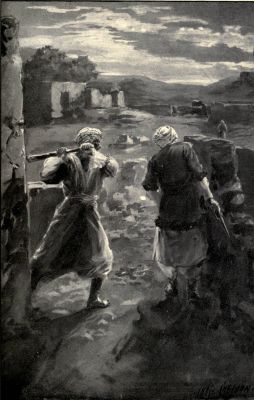
AZIM SURPRISES THE SPY.
"We need not press the horses," Angus said as they rode off. "We shall certainly have twelve hours' start, and I hope twenty-four. It all depends on how often the man reports to his employer, who is no doubt an official at the palace. Probably he goes once a day, though, as there has been nothing suspicious about our movements and no signs of any intention of leaving, he may have been ordered to go only every two or three days unless he has news to give. Of course in that case we are all right; but if he reports every evening, how long a start we shall get depends entirely upon what sort of a man the official is. In any case, he would hardly give a thought to his spy not coming in this evening, but would suppose that I had been out till late. When he does not appear in the morning, if the official is of a suspicious nature he will enquire for the man, and when he is not found will send down to the khan to see if he is there, and to ascertain if things are going on as usual.
"When the news is brought him that the man is not there, and that we have been out all night, he will become alarmed. He will go himself and question the traders there, and will doubtless ascertain that I have sold our horses. I don't suppose he will hear that we have bought others. The trader will see that there is going to be trouble about it, and is likely to hold his tongue and tell his servant to be silent on the subject; and as the official could have no reason for imagining that we should sell our horses and buy others, he will conclude that we have made our escape over the wall on foot. That is the report which he will probably make to the Prince, and we may safely calculate that it will be afternoon before parties of horse are sent off in pursuit by the Herat, Ghuznee, and Quettah roads, and will probably be instructed to enquire for two young Persians on foot. They will lose time by stopping at every village to make enquiries, and after going forty or fifty miles will begin to feel sure that we have not come along that road, but have gone by one of the others, or perhaps hidden up in some village at a distance from the road.
"They may have instructions to go as far as Quettah; but suppose they get thirty miles before sunset—and they certainly won't get farther than that, as they will have to make enquiries, and will probably halt as soon as it gets dark,—we shall have a start of nearly sixty miles before morning, and will hide up and go on as soon as it is dark, and shall be another thirty or forty before they start next day; so we shall then be some sixty miles ahead of them and within from twenty to thirty from Quettah. We will skirt round the town without going into it, and then make down the Bolan Pass. I don't think there is the least chance of any pursuit being kept up beyond Quettah, and we can travel at our own pace down the pass. We shall have to lay in a good stock of provisions at the last village we pass before beginning to descend, and must travel at night, for otherwise we may be plundered by the tribesmen, who have the worst possible reputation."
"How long is the pass, master?"
"Fifty-five miles long, Mr. Pottinger told me. He says that it is a frightful place. A river runs through it, and in the wet season anyone caught in it would be drowned, for in some places the sides are perpendicular, and the channel is only sixty or seventy feet wide. There are caves along there in which the tribesmen hide, and rush out and plunder, and often kill, travellers. We must get through in two nights, and must be extremely careful where we stop for the day, choosing some place where we can hide ourselves and our horses."
"Well, master," Azim said after a pause, "if it is the will of Allah that we are to get through, we shall; if not, not."
"That is it, Azim. I do not think that there is much fear of our lives. We know that travellers do use that pass. I believe they generally pay so much to one of the chiefs of the tribesmen, and we will do the same if, on arriving at the top of the pass, we find that we can arrange it. We shall want money to take us from Dadur across the plain to the Indus. It is a barren and desolate country, and we shall have to buy some supplies at Dadur. Coming down without merchandise, the tribesmen will make sure that we have money, as we should naturally have sold the goods we brought from Persia at Candahar, and must intend buying a fresh stock in India. Therefore, you may be sure, that if captured we should be stripped of every penny we have about us."
They rode for eight hours, and reckoned that they had made some fifty miles. They gave the horses a good feed and lay down until daylight, for they were now at the foot of the Kojuk, a gorge so steep and difficult that it could not be passed at night. Just as they were starting, three tribesmen rode up, and in the name of the local chief demanded two gold tomauns, one for each horse and rider, as tribute for a free passage. As the money was paid without question, they rode off without giving further trouble. The passage was long and difficult, and in many cases they had to lead their horses. Once through, they allowed the animals another hour's rest and a feed, and then mounting, rode on briskly again. A few miles farther on they halted in a clump of trees, and slept until nightfall, and then rode another twenty miles. As speed was of less consequence than keeping their horses in fair condition, they turned off at a little stream, followed it for half a mile up, and then halted in a dip through which it ran. Here there was good grass for the horses. They remained for the rest of that day, and until within three hours of daybreak next morning. As Angus had calculated, they saw at sunrise the mud fort and town of Quettah standing on its rocky eminence. They made a detour, and came down upon the road again round the town, and then rode briskly down the Shawl valley. The country round was rich and fertile, and dotted with villages, orchards, and vineyards. They stopped late in the afternoon at a village near the entrance to the pass. Two armed men came out from a hut as they drew up. The leader said, "Our chief is master of the pass, travellers find it wise to pay for right of passage."
"That we are ready to do," Angus said. "But does your chief guarantee that we shall go unmolested down to Dadur?"
"The chief cannot guarantee that, he can only guarantee you from hurt or damage from his people. He is lord of the eastern side of the pass, but there are others—men of no account, and who own no chief—among the mountains to the west. They sometimes waylay travellers. Our chief punishes them when he can do so; but it is seldom that he is able to catch them. He does all that he can, for he wishes well to traders and others who pass along, for when ill happens to them others are afraid to pass, and he loses his tribute. When a large caravan comes up, and is able to pay handsomely, he furnishes an escort of twenty men or more; but he will not send less than twenty, for a smaller party might not be able to defend the caravan, and he would suffer loss of honour from failing to give protection to those to whom he guaranteed it."
"We cannot afford to pay for an escort of twenty men, and have but little to be robbed of, for you see we carry no merchandise, having disposed of what we bought at Herat and Candahar, and sent the proceeds by sure hands back to Persia."
As their attire gave no signs of their being men of substance, the tribesman said: "In that case you will only have to pay one tomaun each; that is the price for a man and horse, and the same for each camel- or horse-load of goods; that is the regular toll."
"That we can pay. As to the brigands you speak of, we must take our chance."
He handed the money to the man, who in return gave him a little white-and-red flag, which he was to show should he encounter any of his tribesmen. They stopped here all day, and purchased food for their journey.
"I should think it would be a very good thing, Azim," Angus said in the afternoon, "if we could engage a guide. We might break our necks making our way down here in the dark. I will speak to those two fellows. I suppose they are on duty here, and cannot go themselves, but there may be others of the tribe in the village; or, if not, some of the people here may be accustomed to going down the pass with caravans."
Angus went to the hut occupied by the two tribesmen and called them out. "We are intending to travel at night," he said, after offering them a packet of tobacco. "In that way we may escape being seen by these brigands."
"It will be almost impossible for you to go at night—quite impossible without a guide."
"That is what we came to you about. Are there any of your tribe who would act as a guide for us? How long would it take us?"
"It would take you four nights' journey. You could do it in two stages if your horses are sure-footed and you travelled in the day, but at night it would take four at least. How much would you be willing to pay?"
"How much would be charged?" Angus said quietly.
"You should have two men," the man answered, "two men who know the pass well. Yakoob and I could go with you. We have been here six days, and two others will come to take our places and collect tolls to-morrow, so we shall be free. We know every foot of the pass, having travelled up and down it scores of times. We cannot guarantee your safety, but you would have a better chance with us than with others. We will take you into Dadur. We do not promise to fight; when twenty attack four, fighting is foolish. We have our horses; there are parts where the pass opens out and the bottom is level."
"Well, how much would you charge?"
The two men talked together in an undertone, and then the one who had before spoken turned again to Angus. "We would take you for three gold pieces each."
"It is a large sum," Angus said; "but as I hear in the village that it is not safe to go unless with a large caravan, and that it might be three weeks or a month before a sufficiently large number of travellers arrive, we will pay you that."
"It is a bargain, then," the man said. "We had best start at four o'clock; the descent here is very steep, and it is not overlooked from the hills to the west. Therefore, we can go down there by daylight, and then rest our horses for an hour and move forward again when it is quite dark. You had better buy four black blankets, to cut up and tie round the horses' feet, so that when we are passing the bad points, where the brigands generally lurk, no noise will be made in climbing over the boulders or slipping on smooth rocks. It will be necessary, of course, to get food for us all and for the horses."
"I will buy that to-morrow," Angus said. "I suppose it would be of no use taking torches?"
"You might take some," the man said. "In some places the rocks are so steep that no one could look down from above, and at these points there are no caves where the thieves would be hiding, and we should certainly get on a good deal faster with torches."
"I will take some then. Have you ever been through by night before?"
The man shook his head. "We have not. It is seldom attempted; but it is because you are willing to travel so that we are ready to accompany you, for the brigands would expect no one at that time, and will most likely be asleep."
"Then, if we are attacked we must be taken prisoners?"
"No," the man said; "there are many places where the hills can be ascended by men who know them. Should we be attacked near one of these spots we must leave our horses and fly; that is what we should do, and what I should advise you to do also. A man's life is worth more than a horse and saddle. Of course in the daytime there would be no escape in that way, for they would bring us down with their matchlocks; but at night we could elude them, and if they did follow us we could defend ourselves, taking shelter and shooting them as they came up."
"Well, it is a satisfaction, anyhow," Angus said, "that there would be a chance for us. Our horses are good beasts, but we value our lives more."
"I think they are honest fellows," he went on after telling Azim the substance of his conversation with the tribesmen. "They say that the Afghans have a treacherous disposition, but I believe these men can be trusted to keep their engagements. They did not exaggerate the difficulties of the journey as some would have done, nor did they pretend that they would join in a hopeless fight. In fact, although of course the actual difficulties of the journey would be very much greater in the dark than in daylight, they evidently considered that the danger from the other tribesmen would be by no means great."
It was, however, a terrible journey, and Angus felt that without the guidance of the tribesmen it would have been an impossible one. They knew exactly where the river was fordable, and on which side the pass was most free from great boulders and obstruction, and where torches could be safely used. But at times progress was terribly slow, their horses having to pick their way among rocks and boulders, and taking more than an hour to cover a mile. At other times they were able to go at a brisk walk, and even break into a trot. Whenever they neared spots where the caves frequented by the robbers were situated, the horses' feet were muffled, and they were led with the greatest care. It was indeed comparatively seldom that the riders mounted; where it was dangerous to have torches, they walked along by the side of their horses, allowing the animals to pick their own way, which they were able to do better than they could have done if led.
The horses Angus had bought having made the ascent of the pass were to some extent accustomed to the work, and not having to carry the weight of the riders were able, save in exceptional places, to get along more easily than Angus and Azim were able to do. Both of these had many falls, and would have had many more had not their guides at such times stood close beside them and rendered them assistance, often warning them of obstacles of which they themselves were unable to make out the faintest outline.
Several times they saw the glow of fires burning in the caverns. At such points the strictest silence was observed. They had purchased Afghan shoes at the village, and round these had wound strips of thick woollen stuff like felt, so that their steps were as noiseless as those of the horses. The stirrups were fastened over the animals' backs so as to avoid contact with rocks; and any slight sound that might be made was to a great extent drowned by the murmur and rattle of the rapid stream.
The long halts during the daytime were made at points, carefully chosen by the guides, at the foot of precipitous rocks. Fragments that had fallen from above formed a bank at a short distance from the foot, the greater part of the rocks having bounded outwards with the impetus of their fall. Between the bank and the cliff there was a depression partly filled with splinters of rock. It was, however, considerably lower than the bank, and the men and horses stationed in it were hid alike from observation from above and from the eye of those passing along the valley. Here they slept on beds composed of their saddles and rugs laid on the rough stones, their guides by turn keeping watch. As a whole they got on faster than the guides had anticipated, and were fairly down at the mouth of the pass at daybreak on the fourth morning after their start. Here the tribesmen received their pay, Angus adding another pound to the amount agreed on, for the care and assistance given. They waited two days at Dadur to allow their horses rest. Here they were fortunate in finding two men well acquainted with the road. They had so far guided a party who were proceeding up the pass to Quettah, and as they were now returning, were glad enough to accept the offer of a couple of pounds to act as guides across the desert. In accordance with their advice two rough ponies were bought to carry water-skins and provisions, while smaller skins were to be taken on their own horses, as the country to be traversed was for a considerable distance a waterless desert. Even this part of the journey would not be accomplished without danger, for the Belooches of the district were to a man plunderers, and cared nothing for the authority of the Khan of Khelat. The distance from Dadur to Shikarpore is nearly a hundred and fifty miles across a flat and dreary country, almost unpopulated; but as they were unencumbered by baggage, and carried sufficient water for their wants and those of their horses, it was performed in seven days. At Rojhan they came upon Captain Thompson, who was in command of a party which had gone forward to examine the state of the water-supply, and if necessary to sink more wells. He was surprised when a young Persian trader addressed him in English, and informed him that he had just come through from Herat. This was quite enough to assure a warm welcome, and the officer put him up for the night in his own tent and made him in all respects comfortable.
After hearing something of the siege of Herat, and of his journey, he asked anxiously as to the water-supply in the villages on the way to Dadur. On hearing that few of them were much better supplied than Rojhan he threw up his hands in despair.
"Two or three thousand natives ought to have been engaged," he said, "and a couple of hundred set to work to dig deep wells in these villages. A hundred wells would be little enough for the army, its horses and baggage animals, and its native followers. Even when they are dug the water runs into them slowly. I have sent down my report from here. There are only three wells, one of which Sir Alexander Burnes sank when he was here a week ago; the others contain such bad water as to be quite unfit for human use. I am really frightened at the thought of what will take place before the army gets to Dadur. However, I hear that they will not advance for another month, and that some very energetic steps will be made to secure a water-supply before they come along."
On the following day Angus passed several working parties who were engaged under the superintendence of Major Leech, assistant to Sir Alexander Burnes—for Captain Burnes had been knighted as a reward for his services in Cabul. With the exception of these parties they scarcely encountered a human being on the way down, except in the miserable little villages which were situated where the soil permitted the cultivation of a scanty crop, which was for the most part cut when green and sold to passing travellers. Angus was heartily glad when Shikarpore came in sight. He had learned from Captain Thompson that Shah Soojah had arrived there with a native army which he had raised, that the Bengal army under General Cotton, which had marched down by the Indus, was expected to arrive there in a day or two, and that the Bombay army under Sir John Keane was but a few days behind.
Upon entering the town he was glad to see British uniforms in the street, and addressing in English the first officer he met, he found that the division of General Cotton had arrived two days before.
"I have just come from Herat," Angus said. "I left there after the siege was raised. I have some despatches from Lieutenant Pottinger, which should be given either to Colonel Pottinger or to Sir Alexander Burnes."
"Burnes is here. I think that Colonel Pottinger is at Sukkar, he was there a few days ago; you will find Burnes at the head-quarters. He is the political officer and so forth of the army; but Macnaghten is envoy and commissioner to Soojah, and generally at the head of all political business."
The army was encamped round the town, and Angus had no difficulty in finding the quarters of Sir Alexander Burnes. Dismounting a short distance away, he left Azim to look after the horses and went towards the tent. He was stopped by a sentry, who on learning that he wished to see Sir Alexander, called an attendant. The latter, coming up, took Angus's name in, and reappearing at the entrance almost immediately, signed to him to enter.
CHAPTER VII
IN THE SERVICE
"I am glad to see you, Mr. Campbell," Sir Alexander Burnes said as the lad entered his tent. "Colonel Pottinger was asking me only three or four days ago to keep a look-out for you. He had received a letter from his nephew saying that you were going to travel down via Candahar, and that he was afraid that you would not manage to get through. I myself received a letter from Lieutenant Pottinger speaking very highly of services that you had rendered, and I understand that both he and Mr. M'Neill, our minister in Persia, spoke very favourably of you in their despatches to the Governor-general. How have you got through?"
"I had very little difficulty, sir, except that I was detained at Candahar, and had to effect my escape secretly." And he gave a short account of his journey, and the manner in which he had escaped from Candahar and avoided recapture.
"You managed it very cleverly, Mr. Campbell. I will take you in at once to Macnaghten, who is supreme here, for Shah Soojah is at present little more than a puppet. I have no doubt that he will be very glad to learn what is the feeling throughout the country as to Shah Soojah. I may tell you in confidence that I am convinced that a terrible blunder has been made in taking up his cause. I was, as you no doubt know, several months at Cabul, and I am convinced that Dost Mahomed was sincere in his desire for our friendship, and that he can support himself against his brothers at Candahar, who have, as we know, been intriguing with Persia and Russia. I have all along urged the Indian Government to give him warm support and to enter into a firm alliance with him. However, the Governor-general and his advisers have taken the other view, and I have only to do my best to carry out their orders, although I have strongly represented my own opinion.
"I do not think that Government has any idea of the difficulties to be encountered. So far as fighting goes there is no doubt whatever that the Afghans cannot stand against us, but the operation of feeding the troops and animals will be a troublesome one indeed. The heat will increase every day, and even the march up to Quettah will present enormous difficulties, as you who have just descended the pass will readily understand; but the great problem will not be how to place Shah Soojah on the throne but how to maintain him there. I tell you this because Macnaghten, who really knows nothing of the matter, is extremely sanguine. I warn you that it will be as well that you should not express any strong opinion against the enterprise. It is determined upon, and will be carried out, and without in any way shaking his opinion you would only set him against you and might seriously injure your own prospects. As it is, he has much to irritate him. There have already been serious troubles with the Ameers of Scinde, who have been treated in a very high-handed manner instead of being conciliated in every possible way. This alone has vastly added to the difficulty, by rendering it almost impossible to obtain carriage or provisions.
"Then he differs greatly from General Cotton, who, since his arrival here two days ago, has shown himself an officer who has an immense opinion of his own dignity. As general in command he declines to take any orders, or indeed to listen to any advice, from Macnaghten. This is certainly not Macnaghten's fault, who, although, as I consider, mistaken in his opinions, is very conciliating in his manner, and would willingly avoid all friction, which can but be disadvantageous to the enterprise on which he has set his heart. Cotton's transport is really insufficient for his own army; Shah Soojah has hardly any transport at all. Cotton cares not in the slightest about the Shah or the Shah's army, and, to say the truth, they are of no great value.
"Macnaghten, however, attaches, and reasonably from his point of view, great importance to the fact that Shah Soojah should appear as arriving to claim his throne as an independent prince with his own army, supported by his allies the British, and not as a mere puppet forced upon the Afghans by British bayonets; and he is therefore most anxious that he and his force should occupy as prominent a position as possible. It is as well for me to give you these hints as to the situation before you see Macnaghten, and to warn you against speaking to him strongly of any hostile opinions as to Shah Soojah's chances that you may have gathered on your journey. When a man has an open mind it is well to give him both sides of the case, but when he has pledged his reputation and thrown himself heart and soul into one side of the case it is worse than useless to endeavour to turn him, especially when the die is cast and the day for drawing back is past. If my opinion, gathered from nine months' residence in Cabul and almost daily interviews with Dost Mahomed, has been altogether unheeded, certainly yours, gathered in a passing trip through the country, would have no effect whatever beyond setting him against you."
"Thank you, sir, I will be careful; and indeed my opinion would in any case be of little value. I certainly conversed a good deal with the natives on my way from Herat to Candahar, but at that city I spoke only to Persian merchants, and had no intercourse whatever on my way down, except with my guides in the Bolan passes."
"Well we will call on him now," Sir Alexander Burnes said, taking his cap.
Mr. Macnaghten's tent was next to his own, and he at once took Angus in with him.
"I have come, Mr. Macnaghten, to introduce to you Mr. Angus Campbell, who has just come down through Candahar from Herat. His name was, I know, very favourably mentioned both by Lieutenant Pottinger and Mr. M'Neill. He has brought down letters of introduction to me and Colonel Pottinger."
"I know your name well, sir," Macnaghten said. "Mr. M'Neill told us that you had been in his service, and had gone to Herat on a mission to induce Shah Kamran to hold out to the last, and that when the siege was raised you had started from there with the intention of journeying down through Afghanistan into Scinde, in hopes of obtaining employment in some capacity where your knowledge of Persian and Arabic would be of service. I also understand, by Lieutenant Pottinger's last despatch, that you have learned Pushtoo. The Governor-general was very favourably impressed with these reports, and authorized me to employ you at once as one of the junior assistants. I should think, Sir Alexander, that you can employ Mr. Campbell to greater advantage than I can, as the work of making the arrangements for the advance of the army is in your hands."
"I shall be very glad of an addition to my staff, for as we get on I foresee that the three officers who now assist me will be altogether insufficient; and the high terms in which Mr. M'Neill and Lieutenant Pottinger have written about him, and the fact that he has been able to travel about the country unsuspected, shows his fitness for such work."
"You must understand, Mr. Campbell," Macnaghten said, "I cannot guarantee that the position will be a permanent one, as all such appointments in the service must be confirmed by the Court of Directors; but I shall at once acquaint Lord Auckland of your arrival here and of your nomination, and I have no doubt that he will himself confirm it so far as this expedition continues, and will strongly recommend the Court of Directors that your appointment to the service shall be a permanent one, in view of your exceptional knowledge of Persian and Pushtoo."
"I thank you very much indeed, sir, and will do my best to merit your good opinion."
As Angus left the tent with Sir Alexander Burnes he said: "I am indeed obliged to you, sir. I had hoped that I might obtain an appointment of some sort, but I never hoped for one like this. It is the work, too, of all others that I should like, and you may rely on me to carry out your orders to the full extent of my power."
"I have no doubt you will, Mr. Campbell. I am glad to have one of my officers speak Pushtoo, for although both in Scinde and Afghanistan Persian is the language most spoken by the upper classes, it is of no use with the peasants. In the work of digging wells, bargaining for fodder for the horses, and so forth, Pushtoo will be very useful, for although it differs from the language of the Belooches, it is near enough for them to understand it; and, of course, when we are once through the Bolan it is the language of all the countrymen."
"May I ask what dress it will be proper for me to wear?"
"As it is a civil appointment you will not wear uniform, but either the ordinary civilian dress, or, if you like, a dress of oriental character. I generally dress so, and it certainly has its advantages, and favourably predisposes chiefs you may have to visit. A British uniform they understand, but a purely civilian dress is too simple for them, and does not convey any sense of importance."
"Very well, sir; I am glad that you have decided so. I have no civilian clothes with me, and should find it very difficult, if not impossible, to get them here."
"Your appointment will be a thousand rupees a month, so long as the campaign lasts; after that it would, of course, depend upon the future employment you might have. If you would like to draw a month's pay in advance you can do so."
"No, thank you, sir; I am fairly provided with money."
"I have four officers employed on similar duty, Mr. Campbell, I will introduce you to them at once; and you will, of course, mess with our party."
Major Leech, the chief assistant, was away on duty, but the other three officers were at once sent for. "Captain Jones, Captain Arbuthnot, and Lieutenant Macgregor, I wish to introduce to you Mr. Campbell, whom I have just appointed as one of my political assistants. He has distinguished himself greatly under Lieutenant Pottinger throughout the siege of Herat, and was previously an assistant to Mr. M'Neill, our ambassador at the court of Persia. He speaks Persian, Arabic, and Pushtoo, and has been specially recommended to the Governor-general by Mr. M'Neill and Pottinger. He has now made his way from Herat through Candahar, and the fact that he has done so safely shows that he knows how to use these languages to advantage."
As Lieutenant Pottinger's gallant defence of Herat was the theme of general admiration throughout India, Angus could not have had a better introduction, and he was warmly received by the three officers, who at once took him away with them.
"You will share my tent with me," Lieutenant Macgregor said. "I am alone at present. You have a horse, of course, and a servant, I suppose?"
"I have a very fair horse, and an excellent servant, who is a young fellow, a Persian, the son of a door-keeper at the embassy. He was with me through the siege, and I found him invaluable. He is a strong fellow, and has plenty of courage and shrewdness; I should never have got away out of Candahar had it not been for his assistance.
"Sir Alexander has advised me to get an Eastern dress, as I cannot wear uniform; and I must see about that at once, for this Persian dress would in any case have been out of place, and my journey down the Bolan has ruined it altogether. But in the first place, I shall be obliged if you will tell me where my two horses are to be put up."
"Your horse will be picketed with ours in our tents; our servants' horses are in the line behind them. Is that your man over there with the two horses? I will send an orderly to tell him to take them over and picket them. Now, I suppose you want something to eat? We had tiffin an hour ago, but the servants can get something for you."
"Thank you; I will go down into the town. I had something before mounting this morning, and I own I should not care about going into the mess-tent till I have got something to wear a little more respectable than these clothes."
"Oh, that is nonsense. Besides, you need not go into the mess-tent. I will order them to warm something up at once, and to bring it into my tent. We are all wanting to hear more about Herat. The official despatches only give us bare facts."
For the next two hours Angus was fully occupied in relating his experiences of the siege to the three officers; after that he went down with Azim to the town. There he bought for himself a dress such as would be worn by a native of some rank—a white turban, a blue tunic opening at the breast and showing a white cambric shirt, several white robes, and loose white linen trousers tightened in at the ankle. He bought a good supply of under-linen and a couple of pairs of native riding-boots. For Azim he bought clothes appropriate to a retainer of a Mohammedan gentleman. As he was unable to procure a camp bed of European make, he bought a native charpoy, which could be taken to pieces and conveniently carried. He had found that his fellow-officers had each three native servants—a butler or body servant, a syce for their riding horses, and a man who looked after and led on the line of march two baggage animals. He had no difficulty in engaging a syce, and let the question of the baggage animals stand over until next day.
Azim would, of course, act as his personal servant. The lad, who had during the past year become imbued with the spirit of adventure, was delighted to hear that his master was to accompany the army. He had, during his stay in Herat, picked up the language, and could converse in it as fluently as Angus himself was able to do; and although he had no pleasant recollections of the journey from Candahar, he felt sure that it would be a very different affair when accompanying a British army. He expressed as much to his master, who said:
"I should not make so sure of that, Azim. We had no great difficulty in obtaining provisions for ourselves, but it will be a very different thing with an army of thousands of men, with an even larger number of camp followers and five or six thousand camels. Except just round one of those little villages, we did not see a blade of grass from the time we left the Shawl valley, and how the animals will exist till we get up to Quettah I have no idea. Once there no doubt we shall do fairly well, but we shall have a very bad time on the journey, unless I am mistaken. If I had the management of affairs, I should send off at once the whole of the camels with a sufficient escort as far as Dadur. There they should leave the provisions and forage they took up, and return here to accompany the army with a further supply. No doubt it would cause a month's delay, but it would be better to do that than to lose half our baggage animals and to risk famine for the troops."
"I believe," Captain Arbuthnot said when Angus joined the others, "that ten days' supply are ready at Dadur, and twenty days' supply at Quettah."
"Certainly there were no supplies at Dadur when I came through, but I know nothing about Quettah," Angus said; "still I think that if any supplies of consequence had been collected there I should have heard about it from the men who guided us through the pass."
"There were no troops there, then?"
"No, not the slightest sign of them, nor did we pass any on the march down from Candahar; but of course the Khan of Khelat may have collected a great force of Belooches, and if he did so, he would naturally keep them at Khelat until he heard that the army was approaching, as it would be an immense deal of trouble to victual them in the pass."
"I know that Mr. Macnaghten received news which induced him to believe that a large force would be likely to march down from Candahar, and that the attitude of the princes was altogether hostile. It is on account of that news that we are going to advance in two or three days' time, instead of waiting for another three weeks for a larger stock of supplies to be collected. It was but ten days ago that the commissary-general sent off four thousand camels to bring up supplies from the rear. However, they will be useful for the Bombay column which is coming up, as it is arranged that we shall collect transport and supplies for them.
"Therefore the decision has been taken to march at once, so that we can ascend the pass before the enemy send a sufficient force to hold it against us. No doubt the report that we were not going to leave here for another three weeks has been sent up to Candahar. The Prince is sure to have agents and spies here. We ought to be at the foot of the Bolan before it is known in Candahar that we have started. As to Khelat, the Khan has sent in assurances of his friendship, and I expect he will make himself safe by assuming neutrality; but the Belooches are a warlike people, and born plunderers, and his authority is very slight, except in Khelat and the district near it. We are sure to have trouble with the mountaineers, but beyond having to protect the convoy strongly, I do not suppose we shall have serious fighting with them. I expect that we shall be sent off to-morrow or next day to Khelat and Quettah, perhaps one of us may even go to Candahar. I know that Mr. Macnaghten thinks that possibly the princes may not take an active part on Dost Mahomed's side. Everyone knows that they have no great love for their brother; which is not surprising, for he, who is the youngest of the family, has managed to secure the sovereignty. Besides, they would see that if they took up arms in his favour the whole brunt of the fighting would fall upon them, for Cabul could render them no real assistance. They are very shifty gentlemen, and though they may make a show of force at first, it would probably be only for the purpose of securing advantageous terms for themselves."
"I saw them when I was at Candahar," Angus said, "and they, or at least one of them, questioned me closely; but supposing me to be a Persian just arrived from Herat, he naturally said nothing about a British invasion. His great anxiety was to know what the intentions and power of Russia and Persia were. No doubt the plans that were formed were entirely disconcerted by the Shah's retreat from before Herat. I saw no signs whatever of any gatherings of the Afghans, nor was the subject ever alluded to in the conversations I had with traders at the place where I lodged."
At this moment a native officer came in and said that Sir Alexander desired to see Captains Arbuthnot and Jones. As they buckled on their swords the latter said: "You have told us about Herat, Mr. Campbell, and this evening I hope you will tell us about your journey down."
When the officers returned Angus found that Arbuthnot was not mistaken as to the probable work they would have to perform, for he was to accompany Major Todd the next morning with an escort of cavalry for Khelat. They were to see the Khan and arrange with him for supplies to be sent to Dadur. Captain Jones was to remain there to see that his promises were carried out, and Arbuthnot, unless he learned that a force from Candahar had arrived at Quettah, was to go on there and see to the collection of grain and cattle.
"A squadron of cavalry is going forward to-morrow morning, Campbell. Four hundred labourers are going with it, and you are to be in special charge of half of them. Of course, they will have eight or ten headmen, but they will want looking after all the same. They are to dig wells at Burshoree; the other half, under you, Macgregor, are to do the same thing at Meerpoor. It is a thousand pities it was not done before, for the army is to begin its advance the day after to-morrow. However, you will gain a couple of days on them, and that is something. If you meet Major Leech, who is at work improving the roads, you will, of course, report yourself to him, and he will doubtless be able to advise you as to the best place for the wells."
Angus heard the news with much satisfaction. In the first place it meant active work, and in the second it would save him from the slow and toilsome march of the army, which would, he felt sure, be accompanied with enormous hardship. The four officers dined together. Sir A. Burnes was not present, as he was dining with General Cotton and Mr. Macnaghten. After dinner Angus related his adventure at Candahar; how he evaded pursuit, and his passage through the pass. He had hardly finished when he was sent for to the general's tent.
"I have just been telling General Cotton, Mr. Campbell," said Mr. Macnaghten, "that you arrived this morning from Candahar. He wishes to learn as much as you can tell him of the state of the pass at present, and of the country between Dadur and this place. I told him that I had not been able to find time to question you on these points."
"In the first place," the general said, "what is the state of the Bolan?"
"As I only travelled during the night I cannot tell you very much about it. The river is not high, and there is no difficulty whatever on that score. The ground is generally extremely rough, and covered not only with rounded boulders, but by rocks that will prove very trying to the feet of the animals. We bandaged very thickly the hoofs of our horses to deaden the sound, and so saved them from being lamed, which they otherwise would certainly have been. The bandages were of felt, and these were completely cut to pieces the first night. After that we cut up one of the water-skins I had with me, and we covered the felt with the leather, but even this was cut to pieces, and had to be renewed the next night. Although this is the general character of the pass, there are places at which, by skirting the foot of the hills at points where the pass opens out—and the hills are not precipitous, although everywhere steep—it is possible for mounted men to go along at a fast walk, the stones being much smaller, and like, I should think, what I have heard of a sea-beach, though I never saw one, at least that I can remember."
"Still, there were no insurmountable difficulties, Mr. Campbell?"
"No, sir, though there were places where certainly not more than two laden camels could pass abreast."
"Well, next as to the country between this place and Dadur. We know about it as far as the edge of Beloochee Desert; what is it beyond that? Did you suffer from want of water?"
"No, sir, at the villages where we stopped there was always water; but there were, as far as I saw, but a few small wells, which would seem to me very insufficient for the supply of an army and its train."
"Well, we are going to dig more wells," Mr. Macnaghten said rather impatiently. "If the water will run into three or four wells it would run into fifty. Now, about forage?"
"There were small patches of cultivation round each of the villages; at Bhag more than elsewhere, as it lies nearer to the foot of the hills; but at Meerpoor, Burshoree, and Rojhan I should not say there were more than twenty or thirty acres of cultivated land. At Bhag I was strongly advised to take the road at the foot of the hills to Dundeaver down to Larkhanna, and from there to follow the Indus up to Sukkar; but the guides said that I should be more likely to be troubled by the Beloochees along that route, and as it was also twice as far I took the straight way here."
"Thank you. We will not detain you any longer, Mr. Campbell, and we are obliged for the information that you have given us."
Angus bowed and retired. He felt that Mr. Macnaghten was vexed that he could not report better upon the chances of obtaining sufficient supplies of forage and water. But he felt that it was clearly better that he should give, in the plainest terms, the true state of affairs, for when, as he was sure would be the case, there was immense suffering of men and animals, the blame would fall upon him if he had given a more hopeful account than the facts warranted.
Sir A. Burnes sent for him on leaving the general's tent.
"You did quite right in not giving a rose-coloured description of the state of things along the line of march, Mr. Campbell. Of course neither Mr. Macnaghten nor General Cotton liked it. Neither of them, in fact, has the slightest idea of the troubles ahead of them, and both were inclined to view me as a pessimist. However, it will not matter to you very greatly whether Macnaghten is pleased with you or not, because your reports will be sent in to me. This sort of work will not last very long. I have only undertaken it because Major Garden, General Cotton's quarter-master-general, has been taken ill. Major Craikie, the adjutant-general, will go forward with me the day after to-morrow to superintend matters generally. I hope by that time to have a thousand more men for well-digging. Major Leech has gone to Sebee to cut a dam there on the river Naree, which it is hoped will fill the small water-courses and greatly assist us. I have more fear about forage than water. You can dig wells and cut dams, but you can't get a crop to grow at a day's notice. However, we must hope for the best."
The next morning at three o'clock Angus and Lieutenant Macgregor started with the labourers and an escort of fifty native cavalry.
"I am very glad to be off, Campbell," Macgregor said. "It has been disheartening work for some time. Somehow or other nothing has gone smoothly since we started. Of course I am only a sub, but certainly it seems to me that so far there has been an enormous amount of unnecessary friction, and that the chiefs have not gone the right way to work. I don't believe myself in this Shah whom we are going to force upon the Afghans. Dost Mahomed is worth a dozen of him, and no one who knows anything of the affairs of Afghanistan is able to understand why Lord Auckland and Macnaghten and the rest of them should ever have conceived the idea of supplanting a man who has shown himself really desirous of our alliance and friendship, and who undoubtedly possesses the support of a majority of his countrymen, by one who has never shown any talent, who has no party whatever in Afghanistan, and is a member of a discredited and fallen family.
"Still, that is their affair; but matters have been complicated by the manner in which the Emirs of Scinde have been treated. Instead of regarding them, as they have always shown themselves, as friendly to us, we have gone out of our way to render them hostile, by the manner in which we have, in absolute contradiction of the terms of their treaty with us, compelled them to furnish carriage, provisions, and money. Had they been a conquered country we could not have carried matters with a higher hand. It will be sure to lead to trouble some day, and certainly adds immensely to our difficulties. Now, the very fact that, in the days when he was for a short time ruler in Afghanistan, Soojah advanced all sorts of preposterous claims of suzerainty over a large portion of Scinde, was in itself a reason why, if we took the absurd step of placing him on the throne of Cabul, we should have advanced from Peshawur through Jellalabad direct, instead of taking this roundabout journey through Scinde. Of course there would have been great difficulties in the Khyber, and we should have had to encounter fierce opposition from the hill-tribesmen, but that will have to be met in any case. And after installing Soojah at Cabul, we could have gradually extended his power—or ours, for of course he would be but a puppet in our hands—through Ghuznee to Candahar. Of course you won't hear any talk like this among the officers of the Bombay or Bengal army. They know and care nothing about the matter. It is just among the men who have been employed here in the north, and who know something about it, that there is any doubt as to the wisdom of the affair. I know Burnes considers that the whole thing is a mistake. Colonel Pottinger, who, as our resident in Scinde, knows a great deal about the Afghans, says little, but I know that he disapproves of it; and so, I think, do all of us juniors, who have worked either under him, or with Burnes, or up in the Punjaub, and have, of course, always taken an interest in the affairs of Afghanistan, especially since Russian influence has become so preponderant in Persia. Well, we can only hope for the best, and do our best in our own little way. Thank goodness, whatever comes of it, we have no responsibility in the affair."
"I really know very little about it," Angus said; "but I do know that it will be a terrible business getting the army to Quettah, and that directly it was determined to come this way arrangements should have been made to dig sufficient wells to ensure a supply of water at every watering-place, and to collect stores of forage and grain. I really don't see how it is to be done now. From all that I could hear as I came down, there will be a lot of trouble with the Beloochees."
The difficulties of the advance had already been felt. Great numbers of camels had died between Sukkar and Shikarpore, and those that accompanied the party of well-diggers were enfeebled, and looked as if they had accomplished a long forced march instead of the strong and fresh animals one would expect to see setting out on such an enterprise. The first halting-place was Jagan. The next day they started at the same early hour and proceeded to Janeedera. Here they had passed beyond the boundary of the Scinde Ameers, and had entered the territory over which the Khan of Khelat held nominal authority. At this place there was a small mud fort, outside of which straw had been collected for the use of the cavalry, and to guard this a small party of Shah Soojah's troops had been posted. These, however, had been attacked and driven off by a Beloochee band, and the straw carried away. However, there was sufficient water in the wells for the men and animals.
The next day's march was a long one, but at Rojhan a certain amount of forage had been collected, and there was a fair supply of water. The country so far had been barren, with occasional bushes, but beyond Rojhan they had nothing but an absolutely flat surface of sand, without a blade of grass or a bush to break the level expanse; across this desert the party toiled on for twenty-seven miles. A little water was carried by the camels, but this supply was soon exhausted, and with parched lips and throats the men plodded on, knowing that until the end of the journey no water could be obtained. Scarce a word was spoken during the painful journey. Passing over the ground as he came down at a canter, Angus had thought but little of it; he had done it in less than four hours, and there was no trouble from the dust. It was very different now. It was fourteen hours from the time of starting before they reached Burshoree, the mounted men having to accommodate their pace to that of the labourers, and the dust rose in dense clouds.
A part of the cavalry rode ahead, the rest some half a mile behind the main body of the footmen. But before half the journey was done these began to straggle, and the dust had no time to settle before the horsemen came along. Fully half the labourers, indeed, threw themselves down on the sand incapable of going farther, and lay there until the cool evening air revived them, and it was long after midnight before many of them reached Burshoree. Here a considerable number of wells had already been dug by the party under Major Leech. The water was muddy, and trickled in but slowly. Still it was water, and men and horses drank it eagerly as fast as it could be brought up in buckets and emptied into troughs which had been erected.
Although the village—a mere collection of native huts, surrounded by a wall as a protection against the plundering Beloochees—offered a most uninviting prospect, Angus was well pleased that he had arrived at the end of his journey, and had not, like Macgregor, another day's march to perform. The latter started as usual at three o'clock, and an hour later Angus, with some difficulty, roused his two hundred weary men and set them to work, promising them that if they laboured hard he would allow them to rest during the heat of the day. Cheered by the promise, the labourers set to work under their headmen. Each of these had charge of twenty workmen; these were divided into two gangs and worked wells close together. Angus had nothing to do save to exercise a sort of general superintendence. The soil became much more firm a few feet below the surface, and as the sides stood satisfactorily it was not necessary to make the wells of any great depth. It was found that four men only could be employed on each, two working in the bottom and the others bringing up the earth with buckets and ropes, consequently, the number of the wells was largely increased. After three days of prodigious toil, water was reached in the majority of the wells, and by the end of the fourth day fifty had been added to those already dug. The liquid, however, oozed in but slowly, and when a well was emptied it was two or three hours before water could again be drawn from it; thus although the amount that could be obtained altogether was considerable, it was still wholly insufficient for the supply of an army. Five-and-twenty of the native cavalry were kept constantly on the alert, for parties of plundering Beloochees hovered round, and several of the well-diggers who, in spite of orders, ventured to wander some distance away were robbed and killed.
The next morning General Thackwell, with a body of cavalry, a small force of infantry, and some irregular horse, rode into the place. He brought with him an order from Sir A. Burnes for Angus to accompany him. The well-diggers were to remain there and continue their work. The general had intended to stop there for two or three days, but finding that no forage could be procured, he started the next morning early and rode through Meerpoor to Oostar, a distance of twenty-seven miles, where, as had been reported by Major Leech, there was a small reservoir of water, and a store of straw and grass had been collected. Angus stopped for an hour at Meerpoor and had a talk with Macgregor, whose men had also accomplished a great deal of work, and who bewailed his fate at having to remain there instead of going forward with General Thackwell.
CHAPTER VIII
THE ADVANCE
The cutting of the dam of the Naree did not afford so much aid as had been hoped for, for the thirsty soil absorbed the water almost as fast as it poured out, and it was not until many days later that it began to fill the little irrigation canals at the villages through which the army passed. After resting two days at Oostar, the force proceeded to Bhag, a town of some size. Here water was found in abundance, and grain in considerable quantities, and also a supply of carrots, which were eagerly purchased by the officers for the use of their horses. At the various places where they halted Angus acted as interpreter, and rode out with a small body of cavalry to villages at which they learned a certain amount of forage could be obtained.
At Bhag, to his great satisfaction, Sir Alexander Burnes joined the party. He had paid a visit to the Khan of Khelat, and obtained from him stringent orders to the headmen of villages and others to do all in their power to aid the army. The inhabitants were all to be set to work to dig the holes, for which they would receive payments from the British. The Khan also promised to despatch to Dadur what supplies he could gather, but explained that unfortunately there was a much greater difficulty than usual in collecting provisions, as the previous season had been a very bad one, and in many parts of the country the villagers had not been able to gather sufficient for their own needs. As Angus had heard the same at Candahar, at the village near Quettah, and from his guide, there could be no doubt that this excuse was a genuine one, and indeed the officers who had been engaged in Scinde and in the country bordering the Indus affirmed that the supplies obtainable there were also vastly smaller than had been anticipated.
Throughout the next week Angus was continually employed in riding among the towns in the khanate, interviewing headmen, and expediting the despatch of convoys. He was always accompanied by a troop of cavalry, for plundering parties of Beloochees were making their way on all sides towards the line followed by the army, where they murdered stragglers, captured lagging camels, and were so bold that they ventured close to the outskirts of the villages occupied by the British camps, robbed the natives of the moneys paid them for forage or grain, and rendered it necessary that every convoy should be protected by a considerable escort. After a week of this work, Angus received orders to join the force that was gathering at Dadur. During the last two days' march the difficulties with regard to water had disappeared. The villages had all been situated on the Bolan river, and little irrigation canals enabled the cultivation of a considerable tract of country to be carried on, which supplied forage in sufficient quantity for the first division of the army which came along.
Dadur, a town of some four thousand inhabitants, stands on the eastern branch of the Bolan river, whose banks were fringed with high reeds and groves of dwarf trees. The country round was well cultivated, and the fields were covered with young crops of wheat and barley. Close to the town were gardens, and the whole presented an agreeable appearance to the troops, who had for nearly three weeks been painfully making their way across country which, even at its best points, was little more than a sandy desert. Here Angus again met Sir Alexander Burnes, who had been making the greatest efforts to accumulate supplies at the town. His success, however, had been very small, nor had Major Leech, who was also at Dadur, been more fortunate. It had been reckoned that twenty days' supplies for the whole army would have been accumulated there, but not more than sufficient for two or three days had been gathered, and General Cotton, on arriving there with the Bengal army, decided that it was necessary for at least a portion of the army to advance without delay.
Sir Alexander Burnes started at once with Major Cureton of the 16th Lancers, with a troop of that regiment, three companies of the Native Infantry, and a strong party of sappers and miners, to survey the pass up to Quettah. Major Leech was sent to Khelat to maintain a strong pressure upon the Khan, and it was still hoped that stores might be collected by the time the Bombay army came along. The report sent down was satisfactory inasmuch as the physical difficulties of the journey were concerned. In spite of the fact that heavy rains had fallen, the river had not risen sufficiently to interfere seriously with the passage of troops and animals, and on the 16th of March the Horse Artillery, 2nd Light Cavalry, the 13th Regiment of the line, and the 48th Native Infantry, started early in the morning, forded by torchlight the Bolan river, and at eight o'clock pitched their camp in the valley, where they were to rest for the day.
The road had so far offered no difficulties, except that the river had to be forded no fewer than eight times. The baggage animals which started at midnight had already arrived, but the tents were pitched with some difficulty owing to the rocky nature of the ground, which necessitated the use of iron tent-pegs instead of the wooden ones previously used. Fortunately, owing to the pause that had been made by the advance parties at Dadur, and the abundance of succulent food they had obtained there, the animals had recovered to a large extent from their previous fatigues and hardships, and the journey through the pass was accomplished with less loss and suffering than had occurred during the march from Sukkar. Vast numbers of animals, however, died, and the troops, who had started full of life and strength, were sadly changed, many of them being utterly worn out and a mere shadow of their former selves. The rumour that had precipitated the march by three weeks, upset all the transport arrangements, and caused so vast an amount of suffering, proved to be false—no forward movement had been made by the Candahar princes, and except for some little trouble with the marauding villagers, the march was entirely unopposed.
Once in the Shawl valley the fatigues of the army were over for the time, but in spite of the efforts of Sir A. Burnes and his assistants, only a very small amount of food and forage had been collected in readiness for them. So small indeed was the supply that it was necessary to place both the troops and native followers on reduced rations of flour, rice, and ghee. Meat, however, was plentiful. The proceedings of the Khan of Khelat were not of a character to inspire confidence in him. While protesting strongly his friendship for us, he told our officers frankly that he was certain Shah Soojah would not retain his position for a day after the British troops marched away; that the whole feeling of the country was against him, and that although, had he advanced with only a native army raised by himself, he might have been accepted, the people would never submit to a sovereign thrust upon them by British bayonets.
Opinions differed much as to his sincerity. Those who doubted it pointed to the fact, that although he was said to have large stores of provisions at Khelat, he had scarcely sold any to our troops, and had failed in all his promises in that direction. On the other hand, Sir A. Burnes maintained that the stores of provisions spoken of did not exist; and that in any case, having no belief in the possibility of Shah Soojah maintaining himself, it was but natural that he should hang back until he saw how matters went, for if he were to give any active aid to the British he would be considered a traitor by his countrymen, and would imperil his khanate and his life when our protection was withdrawn from him. The question was never satisfactorily cleared up. Some of those who took part in the proceedings and wrote on the subject regarded him as a very ill-used man, while others considered the measures afterwards taken against him as being fully justified by his conduct.
As it was absolutely necessary that food should be obtained, parties were sent into the villages and a rigorous search instituted, and in this way a considerable quantity of hidden grain was discovered. This was taken and paid for at the market price. In Quettah itself one very large store was found and taken up for the use of the army.
The climate was pleasant, and in spite of reduced rations the men benefited by the halt, which was not without its excitement, for large bands of plunderers hovered round, attacks were frequently made upon parties going out with camels to graze, and expeditions to punish the villages to which the marauders belonged were undertaken. At length General Sir John Keane, who was in command of the whole expedition, arrived at Quettah, to the satisfaction of the army, for it was thought that some decision must now be arrived at. It was evident to all that, unless something were done, famine would ere long stare them in the face. The European troops could indeed exist upon meat, but the native troops and camp followers, the greater portion of whom were not meat-eaters, were already in sore distress, the supply of grain and rice barely sufficing to keep life together. The hope was justified. As soon as the general arrived the heads of the departments were assembled and arrangements were made for an advance. The greater portion of the Bombay army arrived soon after their commander, and although the men were still weakened by privation the army was in most respects perfectly capable of carrying out the work successfully. There was, however, one serious drawback which threatened to destroy their efficiency: the horses of the cavalry and artillery and the animals of the transport were so weakened by want of grain and hay that they were altogether unfit for hard work.
It was upon the 7th of April that the army moved forward, seven weeks having elapsed since they started from Shikarpore. The march to Candahar was long and painful, several passes had to be traversed, food became more and more scarce, and hundreds of animals died daily. Beloochee plunderers during the first portion of the journey, and Afghan raiders during the second, hung along the line of march, murdering all who straggled, capturing camels, at times even threatening an attack in force. They were able to do this, as our cavalry horses were so broken down that they could scarcely proceed beyond a walk. The Candahar princes with a large following came out to give battle; but Hajee Khan Kakur, one of the leading chiefs, had been bribed by our political officers, and deserting, came into our camp with a large body of followers, and this so disheartened the princes, and excited so much fear among them of further treachery, that they withdrew at once to Candahar, and a few hours after their arrival there took the northern road. After immense suffering from want of water and food, the army entered the city on the 26th of April, Shah Soojah having gone on with Hajee Kakur and made a formal entry into the town two days previously.
Angus had had little to do during the march from Quettah. The chances of obtaining forage or food at the deserted villages near the line of march were so small that Sir John Keane decided that it would be useless to endeavour to obtain anything there, especially as an officer leaving the main body had to be accompanied by a strong escort to protect him from the bands of marauders, and it was deemed inadvisable to give the horses any work that could be avoided. Angus's own animal, being accustomed to the country, suffered less than those from the plains, and in order to spare it as much as possible, and keep it in such a condition that it would be fit for work were he ordered to make any expedition, he generally walked by its side the greater part of the day, preferring this, indeed, to sitting on horseback and moving at the snail's pace necessitated by the difficulties of the road and the slow progress of the weakened animals of the baggage train. Among these the mortality had been terrible, and one writer estimated that no fewer than thirty thousand transport animals died on the road between Sukkar and Candahar.
Shah Soojah had at first established himself in his camp outside the city, but two days after the arrival of the army he took up his abode at the palace. He was accompanied by his own officials and by Macnaghten and Burnes and their assistants.
"What are you smiling at, Campbell?" Lieutenant Macgregor, who had been his companion and tent-fellow since they left Dadur, asked as they rode together into the city.
"I am thinking of the difference between my position in this procession, and the fact that I am going to take up my quarters in the palace, and the position I occupied when I was last here—a pretended trader, suspected and watched, and obliged to escape by night."
"Yes, it is a change, certainly," Macgregor said, "and one for the better, though, after what we have gone through and all we may have to go through before we leave this wretched country, I don't think it would be safe to assert that it is less dangerous now than it was then. From the time we left Shikarpore till we arrived here three days ago, we have never had a decent meal, we have practically never had enough to eat, we have suffered horribly from thirst, we have never dared to ride a hundred yards beyond the column or camp; we have lived, in fact, dogs' lives—not the life of a respectable dog in England, but of a starving cur in an Indian bazaar. We don't know much about the future; I don't suppose we shall suffer from hunger and thirst as we have done, but our dangers of other kinds will certainly not be abated. Everything looks smooth enough here. I don't think there is any enthusiasm at all for Soojah, but there is no doubt that the princes were hated, and the people heartily glad to be rid of them. I fancy that we shall not have much difficulty in reaching Cabul. They say Ghuznee is a strong place, but we have taken scores of places in India that the natives considered impregnable. Still, considering the way in which these marauding Afghans hover round us, I think we shall have a very uncomfortable time of it."
As the soldiers were not at first allowed to enter the city, the merchants there speedily established a temporary bazaar outside the walls. Here vendors of rose-water, of sherbet, and of a drink concocted of the juice of fruits, took up their stalls. People from the country round brought in loads of lucerne, wheat, barley, wood, and chopped straw. Other merchants displayed posteens, pelisses made of sheep-skins, with the wool inside and embroidered outside with blue, red, and yellow thread; fowls, sheep, onions, milk, tobacco, and spices were also on sale, and before long the horse-dealers of Herat brought down large numbers of good animals, which were eagerly bought up by officers who had lost their chargers. As soon as the soldiers were allowed to enter the town they poured into it. Wheaten cakes, cooked meat, and mulberries tempted their appetite, and a little later plums and apricots were brought in in great profusion.
The scenes in the streets were very amusing. The British soldiers and Sepoys with their large variety of uniforms mingled with the people of the town and country round. Some of these wore long cloaks of chintz or woollen cloth, with large turbans; their hair, beards, and moustaches being allowed to grow very long, and the beards being dyed red. Others were closely shaven, and dressed in jackets and trousers of blue linen, and tunics of brown cloth with long hanging sleeves, their heads being protected by skull-caps of various colours.
With May the heat, which already had been great, became even more oppressive. Water was abundant, but the troops and camp followers were still on short rations of food. The price of grain was enormously high, and there was no chance of the magazines being replenished until the fields were ripe for harvest.
It was not until nearly three weeks after possession was taken of the capital that a force was despatched under Brigadier Sale in pursuit of the princes—a grievous mistake; for Shah Soojah had entered Candahar on the day they left, and as they were greatly encumbered by their baggage train, the ladies of the harems, and a host of camp followers, they might easily have been overtaken; whereas, after their escape, they became the centre of intrigues against the Ameer.
In June the harvest ripened, large quantities of grain were bought up by the commissariat, and preparations began for the advance to Cabul. Candahar was quiet and apathetic. So far no signs were visible of any enthusiasm for their new ruler among the people. Not only did none of the neighbouring chiefs come in to pay their allegiance, but the Shah's orders were everywhere disregarded. Marauding bands harassed and sometimes attacked convoys coming up; and even close to the city it was dangerous for the soldiers to move many hundred yards beyond the limits of their camps. The health of the troops was far from good. The plains of Candahar, fertile as they are, are unhealthy, as water can be found everywhere six or seven feet below the surface. The native troops suffered comparatively little, but the European soldiers were attacked by dysentery, jaundice, and fever, and large numbers were carried off by these diseases.
At the end of June the necessary amount of grain was accumulated by the arrival of a large caravan from Mooltan. The army was now to cut itself entirely free from its former lines of supplies, and would have to depend solely, upon the country for food, as the ever-increasing boldness of the Beloochees in the Bolan Pass, and of the Afghan marauders between Quettah and Candahar, had made it impossible for convoys, unless very strongly guarded, to make their way up.
The advance began at two o'clock on the morning of the 28th, and four hours later, after passing through a fertile district, the troops encamped at the village of Killa Azim. Here they obtained barley for their animals, and peasants from other villages brought in an abundance of chopped straw for the camels. At midnight the trumpet sounded, and an hour later the army moved forward again as far as Kheil. Four days' further march brought them to Kelat-i-Ghilzye, the chief town of the Ghilzye tribes. Two or three hundred of their horsemen galloped away as the troops approached.
Marching ten miles a day, the army followed the valley of the Turnak, which afforded an ample supply of water for all their needs. The country was mountainous and desolate, the dreariness being only broken by small villages with their orchards and patches of cultivated ground. Grain was brought in in abundance. The force was now far above the plain, the heat ceased to be oppressive even in the middle of the day, and the mornings and evenings were delightfully cool. Nevertheless, the number of sick increased, owing to the bad quality of the flour and the absence of vegetables. The country now became more thickly populated, little villages, with the fortified dwellings of their chiefs, being thickly scattered about. The hostile tribesmen followed the march on both flanks, and many skirmishes took place; on one occasion the Ghilzye marauders made an attack on the line of march, but were driven off with heavy loss. On the 17th a nephew of the Ameer rode in with fifteen followers. He had gone to Ghuznee with his brother to aid in its defence, but suspicions being entertained by Mohummed Hyder, the governor, of their fidelity, his brother was seized and put to death, and he himself only escaped a similar fate by flight.
As they approached Ghuznee, Sir Alexander Burnes said to Angus: "Mr. Campbell, I shall be glad if you will resume your Afghan costume and ride to-morrow at daybreak with a party of six of Hajee Khan Kakur's men, and ascertain whether the enemy are in strength outside the fortress and intend to oppose our approach. If they do, we shall leave the baggage here under a strong guard and proceed to attack them. If they retire into the fortress, we shall advance as we have been doing, for possibly the siege may last some time, and it would be as well to take our ammunition and stores with us. Will you undertake that mission? I do not wish you, of course, to approach the enemy very closely. They will naturally take you for a party coming to join them, and will pay no attention to you. Half a mile will be near enough for you to go to the fortress. The disguise is only necessary because they too may have parties out, and should any come suddenly upon you, you would pass without suspicion or question; and indeed should you be stopped, your knowledge of the language is quite good enough to pass in any case. I have requested Hajee Khan to choose well-mounted men. We shall remain here to-morrow, and the general will send out a troop of cavalry to meet you on your return half-way between this and Ghuznee, so that should you be pursued, you will know that you will meet with succour before going many miles. The fortress itself is some twelve miles from this camp."
"I will undertake it willingly, Sir Alexander."
Accordingly on the following morning Angus set out. Azim asked leave to accompany him, but he refused.
"Your horse is not a very fast one," he said. "It is a good beast, but we may have to ride for our lives, and you would soon be left behind. It is not a dangerous expedition, but in a country like this there is always the possibility of a surprise."
After riding for two miles the fortress of Ghuznee was seen. It was situated on a high rock and surrounded by a wall of great height and strength, and was regarded by the Afghans as absolutely impregnable. As they approached, and could make out the strength of the fortifications, it seemed to Angus that, except by famine, it would be next to impossible to capture it. The general had left the few heavy cannon he had brought with him at Candahar because of the extreme difficulty of getting transport, and the light field-pieces could make but small impression indeed on these massive walls. When he approached within a mile he halted. There were no signs of any Afghan force in front of it. It was, of course, possible that they might sally out when they saw the army approaching, but at present there was nothing to show that they meant to do so. He was about to turn, when he was suddenly seized from behind, and in a moment his hands were bound tightly to his side by the sashes of two of his escort. The Afghans burst into a shout of triumph.
"Infidel dog," one said, "did you think because Hajee Khan Kakur is a traitor that all his men are also. You came to see Ghuznee. You shall see the inside as well as the outside."
Angus was brave, but a shudder ran through him as he thought of the fate that awaited him. The Afghans never spared those who fell into their hands, and fortunate were those who were speedily killed, for in many cases they were tortured before they were done to death. It had never occurred to him to doubt for a moment the good faith of the men who accompanied him; and yet, now he thought over it, such a possibility should have been foreseen, since there was no reason why the men should be traitors to their race, although for the moment they had obeyed their commander's orders and ridden with him into the British camp. They might even have remained faithful to him had not this opportunity of rejoining their countrymen presented itself. Even in the midst of his own deadly peril he was glad to think that, by his refusal to allow Azim to accompany him, he had saved him from the fate that awaited himself.
He knew well that no entreaties would avail to soften the heart of the Afghan commander, and determined that, whatever came, he would maintain a firm countenance and meet his fate bravely. The gate of the fortress stood open. The men as they entered said a few words to the guards stationed there.
"We were forced," they said, "to accompany the traitor Hajee Khan Kakur to the camp of the infidel, but we have taken the first opportunity to desert, and have brought with us this man, who is one of their officers, as a prisoner."
"Why trouble to bring him as a prisoner?"
"We thought that Mohummed Hyder would like to question him, and are bringing him here to show that we are true men."
Climbing a steep road, they entered a great courtyard. Here they dismounted, and their leader, a sub-officer, went forward to the governor's house, followed by two others, between whom Angus walked. The leader entered, the others remained outside until he returned.
"Follow me with the captive," he said, "Mohummed Hyder will speak to him."
A minute later Angus stood before the governor. He was seated on a divan, and several other chiefs of importance were standing or sitting round.
"They tell me," the governor said, "that you can speak our tongue?"
"I can do so," Angus said quietly.
"Where did you learn it?"
"In Herat, where I fought during the siege, against the Persians."
"And now you come hither as a spy?"
"Not as a spy. I came here only to view the fortress from a distance."
"Is it true that the kafirs are bringing no big guns with them?"
As the governor was doubtless well informed as to the strength of the British army and the number of its guns, Angus felt that there could be no harm in answering the question.
"They are not," he said.
"How do they intend to take Ghuznee? Will they fly over the walls or burrow through the rock?" the governor said scoffingly. "Are they madmen, who think they can tear down the walls of Ghuznee with their finger-nails?"
"I know nothing of the plans of the general," Angus replied. "But the British have taken many strong places in India when it seemed that it could not be done."
"They will not take Ghuznee. When the first shot is fired at its walls we will throw over to them your head and your limbs, to show that we despise them and mock their foolish effort. Take him away, Yakoob. Do you see him safely bestowed."
Angus was led to a cell in one of the turrets on the wall. His weapons had been taken from him when he was first captured, and when he reached the prison his arms were unbound by the leader of the band, who carried off the sashes to the men to whom they belonged. A massive door was closed behind them, and Angus heard two heavy bolts shot—a proof that the tower was often used as a prison. Listening, he heard another door at the foot of the turret closed and bolted. The window was a mere loophole, but it commanded a view of the road by which he had been brought up. The cell was circular in shape, and some ten feet in diameter; it was absolutely bare. Angus stood for some little time looking through the loophole. It was three feet wide on the inner side, but narrowed to six inches at the outlet; the wall was more than two feet thick, and of solid stone.
"It is evident that there is no possibility of escape," he said aloud as he turned away from the loophole. "Even if I could widen the hole so to be able to creep through, there is a fall of a hundred feet or so; and there is nothing of which a rope could be made. I have my knife," he said, "fortunately they did not think of looking in my pockets; but though it has a good long blade, and I might at the end sell my life as dearly as possible, and force them to kill me, it can be of no earthly use here, for there is nothing to cut except that rough plank in the corner, which was, I suppose, brought up for some purpose or other and forgotten."
The day passed slowly. No one came near him until, just as the sun was setting, two soldiers came in bringing a jug of water and some bread. Angus had little sleep that night. He dozed off occasionally, but the hardness of the stone floor and the cold speedily roused him, and he was glad indeed when daylight returned and the sun shone out. An hour later, when looking from his prison window, he perceived a party of horsemen. Long before he could distinguish their figures he made sure that they were British troops, from the fact that two or three rode ahead, and the rest, evidently an escort, in a close body behind them. They approached within musket-shot. As soon as they did so a fire of matchlocks broke out from the walls. They drew off a little, and then turned and rode off. There was no doubt that they were a reconnoitring party, who had ridden forward to ascertain the best spot for an attack.
Two hours later three regiments of infantry came up, followed by a battery. The object of their approach was to discover whether Ghuznee was held in force, for reports had reached the camp that the greater portion of the garrison had retired. It answered its purpose, for the guns of the fortress opened fire, and for an hour there was an exchange of shot between them and the battery. The object of the reconnaissance being fulfilled, the British returned to their camp. Not until five o'clock was any further movement perceptible; then Angus saw a long dark line ascending the pass. On reaching its head the column made a wide detour, so as to keep beyond the range of the guns of the fortress, and then entered a rocky and difficult country to the east. As he knew that the gates had all been walled up with masonry with the exception of that through which the road from Cabul entered it, he had no doubt that it was intended to encamp on that side, thus cutting off the fortress from relief by the army assembled under another of the Ameer's sons, and at the same time preventing the flight of the garrison. As long as it was light the column was still passing on—a long line of baggage waggons and native followers, guarded by bodies of troops against any sortie that might be made. During the night occasional shots were fired from the fortress, and at various points of the plain and on the surrounding hills fires raised gave indications of gatherings of tribesmen.