Front matter (continued 5)
Reading edition
"Are you awake, Hassan?"
"I am awake," he replied, "but am bound down hand and foot."
They cleared the snow off until they saw a foot. Taking hold of this together they pulled and gradually drew one of the men out. The other three were extricated more easily. They found that these had not suffered so much from a sense of suffocation as the first party had done, as, the ends of the roll being open, a certain amount of air had found its way through the snow. Half an hour's hard work sufficed to rescue the occupants of the other tent. The three were unconscious, but the cold blast speedily brought them round.
"What is to be done next?" Angus asked Hassan.
"The gale is still far too severe for us to move," the latter answered. "We had best clear away the snow over the tents, and then take to them again."
After two hours' work the tents were cleared. The men had worked from above, throwing out the snow over the sides of the mound, so that when they had finished the tents lay at the bottoms of sloping holes. A meal was then eaten, and lifting the upper covering of felt they lay down again and closed it over them. The sun was in the east, and they knew that some fifteen hours had elapsed since the gale had struck them. A mound of snow had marked where the horses were lying. They did not interfere with these, for Hassan said that the horses would be able to breathe through the snow, and probably the heat of their bodies had melted it immediately round them, and they would be much warmer than if the snow were cleared off. Before turning in Hassan and his men managed to erect the tent of their leaders. Lying as it did in a crater of snow, it was sheltered from the force of the wind. Holes were made with a dagger on each side of the slit that Angus had cut, and the edges tied together by a strip of leather. A couple of lamps and oil were taken from the sack in which they were carried, and also the bag of corn, and the little party after filling their vessels with snow and hanging them over the lamps, and closing the entrance to the tent, soon felt comfortable again.
"It has been a narrow escape," Sadut said. "Had it not been for your thinking of cutting the tent, and so enabling us to make our way out, the whole caravan would assuredly have perished. Now, we have only an imprisonment for another day or two at most, and can then proceed on our journey."
The next morning the gale had ceased, though the snow continued to fall. By mid-day the sky cleared, and all issuing out from their shelters prepared for a start. It took them an hour's work to extricate the horses; one of these, a weakly animal, had died, the others appeared uninjured by their imprisonment. All the vessels in the camp had been used for melting snow, and a drink of warm water with some flour stirred into it was given to each of the animals, and an extra feed of corn. As soon as they had eaten this, the baggage was packed on their backs, and the party moved forward. It was heavy work. The snow that had fallen since the force of the wind had abated was soft, and the animals sank fetlock-deep in it. But after three hours' travelling, they reached the end of the pass and began to descend. Two hours later they halted at a spot where a wall of rock afforded shelter against the wind from the north.
"Allah be praised that we have reached this point!" Hassan said. "Now the worst is over. I can see that we shall have another storm before an hour is past, they generally follow each other when they once begin. But here we are safe, and it was for this that I said 'No' when you proposed that we should halt at the mouth of the pass."
The tents were soon erected, great stones being placed on the lower edge to steady them against the gusts of wind. Then a diligent search was made for wood, and enough bushes were found to make a good fire. Strips of meat from one of the frozen sheep were cooked, the kettles were boiled, cakes of flour and ghee were baked, and the travellers made a hearty meal. The horses were each given half a bucket of warm water, thickened with flour, and a double feed of grain. Then all sat round the fire smoking and talking until it burned low, when, in spite of their sheep-skin coats, the bitter cold soon made itself felt. They had scarcely turned into their tents when the storm, as Hassan had predicted, burst. Except for an occasional gust they felt it but little, and slept soundly until morning, when they found that light snow had eddied down, and was lying two feet deep. The day was spent in cooking and attending to their own wants and those of the horses.
For two days they were prisoners, then the gale abated, and they continued their journey, and late that evening arrived at the village of Chol. Here they were received with hospitality by the natives, who were astounded that in such weather the caravan should have made its way over the pass. Resting here for two days, they travelled to Kala Sarkari. Sadut now took the lead, for the chief of the village seeing three horses loaded with merchandise demanded toll; but, Sadut announcing himself as a nephew of Dost Mahomed, and saying that the whole party were under his protection, the threatening attitude that the inhabitants began to assume was at once calmed. Four days' travel, with halts at small villages, took them to Balkh. Here, on declaring himself, Sadut was received with great honour, and was entertained at the governor's house, where Dost Mahomed was lying ill. No attention was bestowed upon Hassan and his followers, who walked behind him, and were reported as having been the means of his safety. Angus with his party kept some little distance in the rear and took up their quarters at a khan unnoticed, but when Sadut was seen to call early the next morning upon the Persian trader and remain with him for a considerable time, it was understood that they were under his protection, and no enquiries were made by the authorities of the town.
On the third day Sadut said to Angus: "I regret that the Ameer is ill. Had it not been for that he would have received you. I told him of the services you have rendered me, and that but for you a few hours would have ended my life. He said that he would like to see so noble a man, and to give him a fitting testimonial of gratitude for the service done to his sister's son. He requested me to bring you to him as soon as he is able to rise from his couch; and when he enters Cabul in triumph, as he assuredly will do ere long, he hopes that you will establish yourself there. I can promise you that your business shall flourish."
"I thank you heartily, Khan, for having spoken to the Ameer about me," Angus said gravely, "but I cannot receive a present from Dost Mahomed. I have intended many times to tell you more about myself, and I feel that I must do so now. You are my friend, and I cannot remain in a false position with you. As long as we were travelling together, no harm was done; it mattered not to you who was the man who had aided you in your extremity. But the case is different now. You were then a sorely wounded man, who needed what aid I could give you; now you are a close relation of Dost Mahomed, and a powerful Afghan chief, so the case is changed. Dost Mahomed, and no doubt yourself, know what is passing in Cabul by means of your friends there, who see all that is going on. The English general, on the other hand, knows nothing of what is passing beyond the ground patrolled by his cavalry.
"It was important for him to learn what was passing on this side of the mountains, and he selected me, an officer in his army, on account of my knowledge of Persian and Pushtoo, to cross the mountains and ascertain what prospect there was of Dost Mahomed's returning with an army to Cabul in the spring. I confide my secret to you as to a friend. You can see that it would be impossible for me to accept presents from Dost Mahomed in my character of a Persian merchant, and for the same reason I should abstain from questioning you, or even allowing you to give me any information as to the military preparations going on. To do so would be to take an unfair advantage of the chances that enabled me to be of service."
Angus had thought the matter over, and knew that while such work as he was engaged in would, if discovered, cost him his life, it would be regarded by the Afghans as a legitimate means of obtaining information; and although if caught he would be killed as an enemy, his action would be regarded as showing that he was a man of great bravery thus to place himself in the power of an enemy. This was the view, indeed, in which Sadut Khan regarded it.
"You have done well to tell me," he said gravely. "It was truly the act of a brave man not only to risk discovery here, but to undertake the terrible adventure of crossing the passes when winter had fairly set in, in order to obtain information for your general. Still more do I wonder that you should have burdened yourself with the care of an enemy, one who was fighting against your people. It was wonderful on the part of a Persian trader, it is far more so on the part of one against whom I was fighting, who is not of my religion, who was engaged upon an enterprise of such a nature, and to whom speed was a matter of the greatest importance. Had it not been for the slow pace at which you travelled with me, you might have crossed all the passes before they were blocked. I shall fight against your people as before, but I shall respect them now I see that although our religions differ, there are good things in their beliefs as in ours, and that even the Koran has no lessons in charity and kindliness stronger than those that you have learned from the teaching of your own religion.
"What I thought wonderful on the part of a Persian merchant is still more marvellous on the part of an English officer, who could have no possible interest in saving a dying man; and who, indeed, might have gained credit by delivering him into the hands of his countrymen, since so long as I was a prisoner in their hands, I should be a hostage for the quiet behaviour of my people. You can do no harm to us by your enquiries here; it is known by all on this side of the mountains that the Ameer will in the spring endeavour to turn out the usurper; it is known already to every sheik from Candahar to Jellalabad. Whether he will come with ten thousand or twenty thousand men matters little; when he appears, all Afghanistan will rise. Your generals might have been sure that it would be so without sending to make enquiries. I cannot tell you with what force we shall come. It will not be a great army; even in summer a large force could scarcely traverse the passes. It is not on the force that he will take from here that Dost Mahomed relies; it is on the host he will gather round him when he crosses the mountains. We have learned that the disaffection to Soojah is everywhere on the increase. There were many who did not love the Barukzyes, but they know now that things are worse instead of better since the change, for the man has made himself hated by his arrogance, his contempt for the people in general, and the extortion exercised by his tax-gatherers.
"There is no secret in all this, your own officers must know it. What you will not learn, for the decision will not be made until the spring, is the line by which the Ameer will advance. There are many passes by which he may then cross; or he may go round by Herat, and gather forces as he advances. Or again, he might go east, and crossing by the passes there, come down through Chitral to Jellalabad."
"That I can well understand, Khan. Of course I have already learned that there is no doubt that Dost Mahomed is preparing to cross the passes in the spring, and that he is sure of the support of the tribesmen on this side of the mountains."
"He could gather a very large army if he chose," Sadut said, "but the difficulty of transporting food for so large a body would be very great, I think that ten thousand men will be the utmost he could move with. I am doing no harm in telling you this, because you would soon learn it in the town, and it is certain that your people could not prevent his passing the Hindoo Koosh, since he has so many routes to choose from. His force is not like your army, which, moving with great trains of baggage, cannon, and ammunition, could only cross by one or two passes; we can move wherever our horses can climb. And now I will leave you, for I have some business to attend to; but I will return this evening."
CHAPTER XII
TROUBLES THICKEN
Angus saw that as he could not hope to obtain further information, however long he might stay, and as he had fulfilled the main object of his mission by discovering that Dost Mahomed would not be content with remaining master of the northern province, but would certainly advance in the spring, he could do no good by remaining any longer. The information that he could give would enable Macnaghten and Burnes to show the Indian government that their intention of withdrawing more troops in the early spring would be disastrous; and it was with this special object in view that he had been sent. He had on the two previous days sold a portion of his goods, but had held out for the prices with which they were marked. He was now more willing to bargain, as he wished to travel in future as lightly as possible. Accordingly, before nightfall he had disposed of nearly half the stock with which he had started; but he had at the same time purchased a certain amount of goods from Turkestan, as these would be more appropriate as merchandise when he started from Balkh for Herat. Sadut came again in the evening.
"My friend," he said, "I have been thinking over your position. Doubtless you might stay here for some time without its being suspected that you were other than you seemed to be, but a chance word from one of your men might betray you, and as you have really learned all that there is to learn, it seems to me that there is no use in your tarrying any longer here. It is true that Dost Mahomed, for my sake, would protect you, even were you discovered. Still, you know the nature of our people, and were it rumoured that you were an infidel, you might be torn to pieces before either the Ameer or myself knew aught about it."
"I have come to the same conclusion. If I thought I could gain anything by remaining I should do so, whatever the risk; but as it would be useless to stay, I intend to leave to-morrow. I have a long journey to make via Herat; the sooner I am off the better. My men are now packing up my goods and preparing for a start at daylight."
"I felt so sure that this would be your course that I have brought with me an order from the Ameer to the governor and headmen of all towns and villages through which you may pass, enjoining them to give you good treatment, as he holds you in high esteem for having rendered most valuable services to me."
"I thank you very heartily," Angus replied. "This will greatly facilitate my journey and save me from all small annoyances. I trust that we shall meet again."
"I hope so indeed. Never shall I forget the debt of gratitude that I owe you. Perhaps some day I may be able to repay that debt to a small extent. Remember, that in case of need you may rely upon me to the utmost. At any rate, you must not refuse to accept this; it is a present from Dost Mahomed, not to an English officer, but to a Persian merchant who has saved the life of his sister's son. He talks continually while with me of the nobility of your action, and when I told him that you were going he had his turban brought and took out this gem, which was its chief ornament, and bade me hand it you in remembrance of the deed. I told him you had said that you would receive no present for a simple act of humanity. More I could not tell him without revealing your secret, though I know that it would be safe with him. You cannot refuse to take this. As for myself, I am here an exile far away from my own people, and have but this to give you as a token of my love. It is my signet ring. If you send it to me I will go through fire and water to come to you. My tribesmen will all recognize it, and will do anything in their power for its possessor."
Angus saw that, offered as it was, he should greatly hurt the Afghan's feelings if he refused the immense ruby surrounded by diamonds that Dost Mahomed had sent him.
"I will not refuse the gift of the Ameer so given to me, and shall cherish it as my most valued possession and the gift of a man whom I for one, and I may say most British officers, consider to be very badly treated by us. I know from Sir Alexander Burnes that Dost Mahomed was most anxious for our alliance. Shah Soojah is as unpopular among us as among his own people. Of course, as soldiers, it is not our business to concern ourselves with politics; that is a matter for the government only. Still we cannot but have our feelings, and I am sure that should the fortune of war ever place Dost Mahomed in our hands he would receive honourable treatment. Your gift I shall prize as highly, as a token of our warm friendship, and trust that the time may never come when I have to put its virtue to the test, though I well know that I could in necessity rely upon any help that you might be able to give me."
After talking for some time of the best route to follow, Sadut Khan took an affectionate leave, and Angus started the next morning with his party. Before setting out he bestowed handsome gifts upon Hassan and his followers, whom he had learned to like greatly for the devotion they had shown to Sadut and the energy and courage with which they had worked during the journey. Travelling from twenty to five-and-twenty miles a day, with occasional halts, he reached Cabul after two months of travel. His journey had been greatly facilitated by the order that he carried from Dost Mahomed. He had not entered Herat, as it was probable that he would be recognized there. Avoiding the city, he travelled by the same route as before to Girishk, and then took a road running a few miles north of Candahar and falling into the main road at Kelat-i-Ghilzye.
His first step was to see Sir Alexander Burnes and to report to him that assuredly Dost Mahomed would come south with a considerable force as soon as the passes were opened. His following would not itself be very formidable, but he relied upon being joined by all the tribesmen south of the hills.
"Your news is most opportune," the agent said, "and can hardly fail to induce the Governor-general to alter his determination to withdraw the greater part of our force in the spring. Already we have not a man too many for contingencies that may arise. Now, tell me about your journey. The winter set in so severely directly you left us that I have been seriously uneasy about you. I had only one message from Mackenzie after you had left, it was brought by a native; and he told me that you had passed through, but that the weather had changed for the worse the day after you started, and the universal opinion among the natives was that you and your party had perished."
Angus gave an account of his journey. He had thought over the question whether it would be wise to mention the episode of the wounded Afghan, but he concluded that it would be better to do so, as Mackenzie, when he rejoined the force, might casually mention that he had a sick man with him; and he therefore told the whole story as it happened.
"I admire your humanity, Mr. Campbell, though it seems almost quixotic to burden yourself with a wounded man. But, as you say, it was evident that if you could manage to carry him through he might be of great service to you. Undoubtedly he would have been a valuable prisoner to have in our hands, but his gratitude to you may prove valuable to us, for the Momunds are a powerful tribe, and your conduct to him cannot but have inspired him with a better feeling towards us than he has hitherto shown."
"He may have less animosity, sir, but I fear that he will still be found fighting against us. On the way he spoke many times of his determination to continue the struggle until Afghanistan was free from the infidel; I am convinced that his indignation at the treatment of Dost Mahomed, and his fanaticism are so strong that no private matter is likely to shake them."
The winter passed quietly, and the attention of Burnes and Macnaghten was turned rather towards the frontier than to the state of things round Cabul. Yar Mahomed, virtual ruler of Herat, although he was receiving large sums of money from us, was known to be intriguing with Persia, and trying to form an alliance with the Shah to expel the British from Afghanistan. Russia had sent an expedition against Khiva, and the conquest of this little state would bring her more closely to the frontier of Afghanistan. Dost Mahomed, however, had gone on a visit to the Ameer of Bokhara, and had been detained for the present by that treacherous ruler; thus for a time the prospect of an invasion on his part was greatly diminished.
In the spring Macnaghten and Shah Soojah returned to Cabul. The former continued to ignore the warnings of Sir A. Burnes, as to the ever-growing hostility of the Afghans to the British and the man they had forced upon them. His advice and that of Burnes had been so far followed that the force at Cabul had not been diminished; but, not content with this, Macnaghten continued to urge on the Indian government the necessity of sending a great force to occupy Herat and another to cross the mountains and thwart the projects of the Russians by carrying our arms into Bokhara. Moreover, he was continually applying for money to meet the expenses of Shah Soojah's government. As if the drain that these demands would entail upon the Indian treasury and upon the Indian army were not sufficient, he insisted upon the necessity of conquering the Punjaub, where, since the death of Runjeet Sing, the attitude of the population had been increasingly hostile.
It is difficult to understand how any perfectly sane man could have made such propositions. It would have needed the whole army of India to carry them out, to say nothing of an enormous outlay of money. Although the Governor-general and his council firmly declined to enter upon the wild schemes proposed to them, Macnaghten did not cease to send them lengthy communications urging the absolute necessity of his advice being followed.
As the summer came on there were everywhere signs of unrest. In April the Ghilzyes cut the communications near Candahar, but were defeated by a small body of troops sent from that city. The Beloochees, whose country had been annexed, were bitterly hostile, and convoys were cut off. Candahar was invested by them, Quettah besieged, and Khelat captured. With the exception of Macnaghten himself, there was scarcely an officer in the army but was conscious of the tempest that was gathering round them. Shah Soojah was as unpopular among them as among the native population. Macnaghten was almost as unpopular as the Shah. Everyone knew that it was his influence that had first induced Lord Auckland to enter upon this war, and the levity with which he replied to every warning, and the manner in which he deferred to Shah Soojah in every respect, and allowed him to drive the tribesmen to despair by the greed of the tax-gatherers, incensed the officers of the army to the utmost.
In the spring the little garrison of Bamian were on the point of being reinforced by a Sepoy battalion when Dr. Lord, who had been sent as political officer, received information that led him to believe that Jubbar Khan, one of Dost Mahomed's brothers, who was in charge of Dost's family at Khooloom, was ready to come in. One of his sons had already done so, and Lord thought that by sending forward a force to the fortress of Badjah he would quicken Jubbar Khan's movements. It had the desired effect, and Jubbar Khan came into Bamian bringing with him Dost Mahomed's family and a large party of retainers. This, however, in no way improved the position of the little party at Badjah, for the natives in the vicinity exhibited the greatest hostility. The officer in command sent a detachment under Sergeant Douglas to escort another officer to Badjah. The party was, however, attacked, and although they made a gallant resistance, they would have been destroyed had not two companies of Ghoorkas arrived on the spot and beat off the enemy.
In August the startling news arrived that Dost Mahomed had escaped from Bokhara. He was received with open arms by the governor of Khooloom and a large force speedily gathered round him. Early in September he advanced upon Bamian with eight thousand men. Badjah was attacked, and although the Ghoorka regiment kept back the assailants, it was evident that so advanced a post could not be held, and the force retreated, leaving all their baggage behind them. A regiment of Afghan infantry had been raised and were stationed at Bamian, but on hearing of Dost Mahomed's approach they deserted to a man, most of them joining the enemy. Even Macnaghten could no longer shut his eyes to the serious nature of the position. Cabul was full of Sikh emissaries, who were stirring up the population to revolt, promising them that the Sikh nation would join in driving out the infidel. Reinforcements under Colonel Dennie reached Bamian on the 14th of September, and on the 17th Dost Mahomed with his army approached the place. Ignorant that the whole force was upon him, Dennie sent Mackenzie with two guns and four companies of native infantry and some four hundred Afghan horse, and himself followed with four more companies in support.
On joining the advanced party, he found that the whole of Dost Mahomed's force was in front of him. In spite of the enormous disparity of numbers, he determined to attack; a wise resolution, for although in our Indian wars the natives often fought bravely when they attacked us, they seldom offered a vigorous opposition when we took the offensive. Mackenzie's two guns opened fire with shrapnel, which had a terrible effect upon the dense masses of the enemy. These were unable to withstand the fire, and soon began to fall back. Mackenzie followed them, and again opened fire. Before long, Dost Mahomed's levies broke and fled; and Dennie launched the Afghan horsemen in pursuit. These cut down great numbers of the enemy, and dispersed them in all directions. The effect of this signal defeat was at once apparent. The Governor of Khooloom entered into negotiations without delay, and pledged himself not to harbour or assist Dost Mahomed; the country south of Khooloom was divided, he taking half, while the southern portion came under the authority of Shah Soojah.
The victory caused great satisfaction in Cabul, but this feeling was short-lived. Dost Mahomed after his defeat went to Kohistan, where there was great discontent among the chiefs, some of whom were already in revolt. General Sale sent a force from Jellalabad, which attacked a fortified position held by them, but the assault was repulsed with heavy loss. It was about to be renewed, when the Kohistanees evacuated the fort and fled. The fact, however, that our troops had met with a repulse had a great effect upon the minds of the natives. For the first time the Afghans had successfully withstood an attack by British soldiers.
Throughout the month of October Dost Mahomed was busy, and at one time approached within forty miles of Cabul, when guns were hastily mounted on the citadel to overawe the town, and orders sent to the force at Bamian to return at once. Dost, however, moved no nearer. Sir Robert Sale was pursuing him, and it was not until the 27th that he moved down again towards Cabul, and on the 29th the greater part of the force there marched out to give him battle.
On the 2nd of November the two armies came face to face in the valley of Purwandurrah. The Ameer at once moved from the village to the neighbouring heights, and the British cavalry galloped to outflank the Afghan horse. These were comparatively few in number, but headed by Dost Mahomed himself, they advanced steadily to meet the Indian cavalry. Gallantly as Indian troops have fought on numberless fields, on this occasion they disgraced themselves utterly. Turning rein as the Afghans approached, they galloped away in headlong flight, pursued by the Afghans until within range of the British guns. Their officers in vain attempted to arrest their flight, charging alone into the midst of the enemy. Two of them were killed when surrounded by enemies, Dr. Lord was shot, and the other two cut their way through their assailants and reached the British line covered with wounds. No more disgraceful affair has taken place in the story of our wars in India than this rout of Indian cavalry by a third of their number of wild horsemen.
But even yet the affair might have been retrieved had an officer like Dennie been in command; had the guns opened and the infantry advanced it might still have been a repetition of the victory of Bamian. But Sir A. Burnes was in authority, and, easily discouraged, as was his nature, he gave no orders, but sent off word to Macnaghten that there was nothing for it but to fall back to Cabul. Suddenly, however, the position was changed by Dost Mahomed himself. As he rode back after the victorious charge he thought over his position. His imprisonment at Bokhara had not broken his spirit, but it had affected him by showing him that the Mohammedans of Central Asia could not be trusted to work together or to unite to beat back the ever-advancing wave of infidel aggression by the British on the south, and the Russians on the west. But more than this, the defection of his brother at Khooloom, and the surrender by him of his family, had convinced him that it would be vain for him to continue to struggle to regain the throne that he had lost. The Kohistanees had risen before he joined them, and he had the satisfaction of showing that his bravery was in no way shaken by his misfortune, and of gaining a success of a most striking description. Now at least he could lay down his sword with honour. Accordingly, without telling anyone of his intention, he rode off the field with a single attendant, and on the following day reached Cabul and rode to the British Embassy.
As he approached it he saw Macnaghten returning from his evening ride. His attendant galloped forward and asked if the gentleman was the British envoy, and on Macnaghten saying that he was so, he then returned to his master; and Dost Mahomed riding forward, dismounted, saluted the envoy, and handed him his sword, saying that he had come to surrender and to place himself under his protection. Macnaghten returned it to him, and told him to remount, and they rode together into the residency, Dost Mahomed asking eagerly for news of his family, of whom he had not heard since their surrender. Being assured that they were well and were honourably treated, he was greatly relieved. A tent was pitched for him, and he wrote at once to his son, begging him to follow his example. He conversed freely with Macnaghten, gave him the history of his wanderings and adventures, and assured him that there was no occasion to place a guard over him, as his mind had quite been made up before he came in, and nothing short of force would compel him to leave. His only anxiety was that he should not be sent to England, and on Macnaghten assuring him that this would not be the case, and that an ample maintenance would be assigned to him in India, he became perfectly contented and calm.
As a result of his letter, three days later his eldest son, Mahomed Afzul, came into camp and surrendered. Dost remained two days at Cabul, where he was visited by many of the British officers, all of whom were impressed most strongly by him, comparing him very favourably with the man for whom we had dethroned him. Macnaghten wrote most warmly in his favour to the Governor-general, urging that he should be received with honour and a handsome pension assigned to him. He was sent down to India with a strong escort, where he was kindly received by the Viceroy, who settled upon him a pension of two lacs of rupees, equivalent to £20,000.
Unfortunately, just at the time that the ex-Ameer returned to Cabul a European regiment, a battery of horse artillery, and a regiment of native infantry were recalled to India, and with them went Sir Willoughby Cotton, and the command for the time being remained in the hands of Sir Robert Sale.
Angus Campbell had not accompanied Sir A. Burnes when he left Cabul with the force which marched out to encounter Dost Mahomed, but had been left in charge of the office at Cabul. He was now his chief's first civil assistant, his temporary appointment to the civil service having been approved and confirmed by the Court of Directors at home in consequence of the very warm report in his favour sent by Eldred Pottinger and Mr. M'Neill. Sir A. Burnes, too, had in his letters spoken several times of his energy and usefulness, and on his return from his expedition through the passes, both Burnes and Macnaghten had reported most highly both of his volunteering to undertake so dangerous a mission, and of the manner in which he had carried it out. In return the directors had sent out an order for his promotion to a higher grade, and had ordered that a present of £1000 should be given him in token of their recognition of his conduct.
"Your foot is well on the ladder now," Sir A. Burnes had said on acquainting him with the decision of the board. "You will now have your name on their books as one of the most promising of the younger officers of the Company, and you may be sure that they will keep their eye upon you. Macnaghten will shortly return to England, and I have long been promised the succession to his post. I shall certainly request, and no doubt my wishes will be acceded to in such a matter, that you should hold the position of my chief assistant. As such you will have many opportunities of doing good service, as you will naturally proceed on missions to the chiefs of neighbouring peoples, and will so qualify yourself for some important post in the future."
Macnaghten, indeed, was extremely anxious to leave. Bodily and mentally he had suffered from the strain and anxiety. He had been promised a high post in India, probably the succession to the governorship of Bombay, but it was considered advisable that he should remain at his present post till the country was more settled. The winter passed quietly. With the submission of Dost Mahomed and his sons there was now no rival to Shah Soojah, no head round whom those discontented with the Ameer's rule could rally. He was the less unwilling to remain, as he thought that an era of peace had now begun, and that his anxieties were at an end. He was soon, however, undeceived. On Shah Soojah's first arrival in India he had naturally looked to the Dooranees for aid against the Barukzyes, who had so long oppressed them, and had made many promises of remission of taxation as an incentive to their zeal. These promises had so far been kept, that no taxes whatever had been exacted from the Dooranees; but in view of the absolute necessity of raising an income for the expenses of the government, and for the personal expenditure of the Ameer and his favourites, it became necessary that all should contribute to some extent to the revenue.
Although this tax was but a tithe of that which they had paid under Barukzye rule, the Dooranees of the district of the north-west of Candahar rose in rebellion, and General Nott marched out from that city and defeated them in a pitched battle. For a time the movement was crushed, but the discontent remained. This was rendered more formidable by the fact that the Heratees had taken up so offensive an attitude that our mission there had been withdrawn, and proofs were obtained that its ruler was fomenting the discontent in the western province, and was encouraging the disaffected by promising them assistance.
In May more serious trouble arose, this time with the Ghilzyes. It had been determined to restore the dismantled fort of Kelat-i-Ghilzye. The tribesmen viewed the work with hostility, and assembled in larger numbers, and Nott sent a force against them under Colonel Winder, with four hundred British troops, a Sepoy battalion, a battery of horse artillery, and a small body of cavalry. The Ghilzyes advanced to the attack in great force. The battle was long and desperate, but the volleys of grape from the guns, and the steady fire from the infantry, at last turned the scale, and after five hours' fighting the Ghilzyes retired. The Dooranees were again in arms, and three thousand men were assembled under their chief at Girishk. A small force, under Colonel Woodburn, marched out against them and defeated them, but having no cavalry on which he could rely, he could not prevent the rebels from retiring in fair order. Major Rawlinson, the political officer at Candahar, again warned Macnaghten that the situation in western Afghanistan was extremely threatening, but was answered that this was an unwarrantable view of our position, and that there were "enough difficulties, and enough of croakers, without adding to the number needlessly."
But Rawlinson was perfectly right, and Macnaghten was living in a fool's paradise. The defeated chief of the Dooranees was joined by another, and in August a force of eight hundred cavalry, of whom some were regulars, three hundred and fifty infantry, and four guns, under Captain Griffin, met the insurgents. They were strongly posted in a succession of walled gardens and small forts, but the fire of the guns and infantry drove them from the enclosure, and the cavalry then charged them with great effect and scattered them in all directions. Another defeat was inflicted upon the Ghilzyes in the same month. For the moment all was quiet again; the only drawback to Macnaghten's satisfaction was that Akbar Khan, Dost Mahomed's favourite son, was still in the north, and was reported to be gathering troops somewhere near Khooloom. In September Macnaghten received news of his appointment to the governorship of Bombay, and began his preparations for leaving Cabul, and Burnes looked forward to receiving at last the appointment for which he had so long waited. His position had been in every respect irksome. His views differed from those of Macnaghten; he saw the dangers of the position which Macnaghten refused to recognize. The reports he addressed to the envoy were generally returned with a few lines in pencil of contemptuous dissent; but he believed that with power to act in his hands he should be able to remedy the blunders that had been made, and to restore peace and contentment in Afghanistan.
The troops were now commanded by General Elphinstone, who had succeeded Cotton. He was a brave old officer, but almost incapacitated by infirmities. He obtained the post simply as senior officer, and was wholly unfitted for command in such a critical time and in such a position. Probably had it not been for the assurances of Macnaghten that all was going on well, and that the trifling risings had been crushed without difficulty, Lord Auckland would have yielded to the opinion of his military advisers and appointed General Nott. Had he done so the greatest disaster that ever fell upon the British army might have been avoided.
Nothing could be worse than the position in which the British camp and mission were established. They were on low ground, commanded on every side by hills, and surrounded by forts and villages. They were nearly a mile in extent, defended only by so contemptible a ditch and rampart, that an English officer for a bet rode a pony across them. The commissariat compound was near the cantonment, and occupied an extensive space with the buildings and huts for the officers. It, too, had a rampart, but this was even less formidable than that which surrounded the camp.
Things had now settled down. Many of the officers had sent for their wives and children, and Lady Macnaghten, Lady Sale, and others were established in comfortable houses. The climate was exhilarating, the officers amused themselves with cricket, horse-racing, fishing, and shooting, and lived as if they had been at a hill station in India, instead of in a mountainous country surrounded by bitter foes. October came in quietly, though Pottinger, who was now in Kohistan, sent unfavourable reports of things there. But these were as usual pooh-poohed by Macnaghten. The latter's troubles with the Indian government, however, continued unabated. The expenses of the occupation of Afghanistan, amounting to a million and a quarter a year, were a terrible drain upon the revenues of India, and it had become necessary to raise a loan to meet the outlay, and the question of a withdrawal from Afghanistan was being seriously discussed.
None of the good results that had been looked for had been achieved, nor did it appear likely that the situation would improve; for it was evident to all unbiassed observers that the Ameer was upheld solely by British bayonets, and that when these were withdrawn the whole fabric we had built up at so enormous an expense would collapse. The uneasiness of the Indian government was increased by the fact that a change of ministry was imminent at home, and that the Conservatives, who had always opposed the invasion of Afghanistan, would at once take steps for the withdrawal of the troops from the country; and the investigation which would be made into the whole affair would create intense dissatisfaction in England, and lead to the recall of the Indian politicians responsible for it. The news stirred Macnaghten to fury; but he saw that it was necessary to make retrenchments, and accordingly he largely cut down the subsidies paid to the chiefs. The consequence was, that the leaders of the whole of the powerful tribes, including those round Cabul, the Kohistanees, Ghilzyes, and Momunds, at once entered into a hostile federation against the British.
Sale's brigade, that was about to start on its way to India, was ordered to attack the Ghilzyes at Jellalabad, and on the 9th Colonel Monteith was sent with a Sepoy regiment, a squadron of cavalry, and a party of sappers and miners, to keep the passes clear. The force was, however, attacked at the first halting-place, and Sir Robert Sale marched with the 13th Regiment to clear the pass from his end. Joined by Monteith's force, he succeeded in driving the natives from their heights, the Sepoys and the British soldiers vying with each other in climbing the almost inaccessible crags. The 13th retired down the valley, and Monteith encamped in the Khoord Cabul pass. He was attacked at night, the enemy being aided by the treachery of the Afghan horsemen, who admitted them within their lines. They were, however, beaten off, and Monteith was joined by Sale on the following day. Negotiations were then opened with the Ghilzyes; terms were made, but broken by the treacherous tribesmen a few hours after they had been signed.
On his way back to Jellalabad Sale was attacked more than once in great force, and with difficulty cut his way down. Macnaghten, who had determined to leave on the 1st of October, but had postponed his departure for a short time, wrote on that day that he hoped the business just reported was the expiring effort of the rebels.
Angus had remained with Burnes at Cabul. The latter was much depressed by the occurrences that had taken place. He had greatly disapproved of Macnaghten's wholesale cutting down of the subsidies of the chiefs.
"How unfortunate am I!" he said many times to Angus. "Had Macnaghten gone but two months earlier, this would never have happened. It has been money alone that has kept the tribesmen quiet, and the very worst form of retrenchment has been chosen. Had he gone I should have acted in a very different way. In the first place, I should have told the Ameer frankly that the troubles were solely caused by the rapacity of the men he had appointed to receive the taxes. These must be dismissed, and honest and faithful ones appointed in their place. It is the abominable tyranny with which the taxes—of which I believe but a small portion ever get into the treasury—are collected that has brought about the trouble. With proper administration the revenue could be doubled, and the taxation would press much more lightly upon the people than it does at present. Now the evil is done, and I shall have to take over the administration when everything points to a terrible catastrophe, with which my name will ever be associated."
CHAPTER XIII
THE MURDER OF SIR A. BURNES
October passed quietly, and Macnaghten arranged to leave on the 2nd of November. Burnes had received several warnings as to the formidable nature of the confederacy of the chiefs. Mohun Lal, the principal moonshee, who had been down to Sale's camp, told him that if the conspiracy was not crushed in its infancy it would become too strong to be suppressed. Burnes replied that he had no power at present, but that as soon as Macnaghten left he would conciliate the chiefs by raising their allowances to the former point. On the 1st of November Mohun Lal again expressed his opinion of the danger. Burnes replied that he feared the time was coming when the British would have to leave the country. He was in one of his moods of depression, but from this he recovered in the evening, and congratulated Macnaghten upon leaving when everything was quiet.
At the very time he was speaking the hostile chiefs were assembled together, and were discussing the methods that were to be taken to overthrow the British power. They determined that the first step was to forge a document in the Ameer's name, ordering all the people to rise, and at the same time to spread a report that it was the intention to seize all the principal chiefs and send them prisoners to England. It was singular that they should not have waited a few days, for the Indian government had sent peremptory orders that the whole force at Cabul, with the exception of a single brigade, should return with Macnaghten to India.
The chiefs decided that as a first step a tumult should arise in the city, and this they at once set about exciting. They had no idea that it would succeed, and none of them ventured to take any part in it, as it was only intended to excite the passions of the rabble of the city. Early the next morning a friendly Afghan brought Burnes news that the residency was about to be attacked. He did not believe the intelligence, as the city had of late been as quiet as usual; but on sending out some of his servants into the street they reported that there was certainly an unusual stir and excitement. He wrote to Macnaghten saying so, but stating that he did not think the matter at all serious, although at the same time he requested that a military guard should be sent to him in order to overawe any disaffected persons.
Angus had gone out early with Azim. The latter had for some days past spent his time in the city, and each evening had returned with the rumours he had gathered. The talk in the lower quarters was all of the understanding at which the chiefs had arrived, and the general opinion was that in a few days these would pour down with all their forces and annihilate the infidels.
Angus himself noticed the sullen expression on the faces of the lower class and the manner in which they scowled at him as he passed, and quite agreed with his follower that the troubles he had long foreseen were about to come to a head. When in the streets, too, he had an uneasy consciousness that he was being followed. Several times he turned sharply round, but in the throng of natives in the streets he could recognize no face that he knew. This morning the feeling was particularly strong, although, as he had often done before, he assured himself that it was pure fancy on his part.
"I am not conscious of feeling nervous," he said to Azim, "but I must be getting so. It has been a very anxious time all the year, and I suppose that without my knowing it it must have told upon me. However, I will turn down this quiet street, and if anyone is following us we shall certainly detect him."
A hundred yards down another lane crossed the one he had taken. Azim had looked several times, but no one else turned down the lane, which was entirely deserted. As they passed the corner of the next lane some men suddenly sprang upon them. Cloths were thrown over their heads, and in spite of their struggles they were lifted up and carried along rapidly. In a couple of minutes they stopped. Angus heard a door open. They were borne along what he thought was a passage, thrust into a room, and a door was slammed to and locked behind them. They tore off their mufflers and looked around. It was a room of no great size, with strongly-barred windows. There were cushions on a divan that ran along one side. On a low table in the middle of the room were two cold chickens, a pile of fruit, a large jar of water, and two bottles of native wine.
"What on earth does this mean?" Angus said, "and why have we been carried off?"
Azim did not attempt to reply.
"We are prisoners, that is certain," Angus went on; "but it would certainly look as if they meant to make us comfortable, and the room must have been prepared in readiness for our reception. I see no hope of getting away; the windows are very strongly barred, and," he continued as he walked across and looked out, "this little yard is surrounded by houses without windows on the ground floor, and with no door that I can see. I suppose there is one below us; anyhow, if we could get through these bars we should be no nearer liberty, for at best we could only re-enter the house, and possibly the door is fastened on the inside. There are certainly men in the house; I heard voices in the passage just now, and no doubt one of the fellows is stationed there. The only reason I can imagine for their carrying us off is that we are to be kept as hostages. Of course I am known to be Burnes's chief civilian assistant, and they might think that if I were in their hands he would be willing to make some concessions to get me back again. It is of no use worrying over it; we are not so badly off as we were in that snow-storm in the pass. The best thing we can do for the present is to make a meal, for we did not take anything before we started."
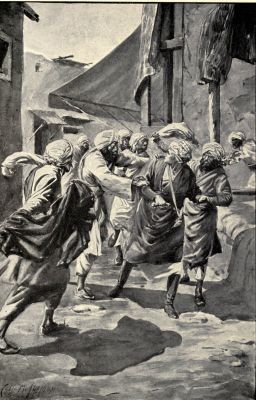
AS THEY PASSED THE CORNER ... SOME MEN SPRANG ON THEM.
They had just finished their breakfast when the sound of musketry was plainly heard.
"There is fighting going on," Angus exclaimed. "What can it mean? There are no troops in the city except the native guards at our house and the treasury next door. It is either a fight between two factions in the city, or they are attacking our place. It is maddening being fastened up here just at this moment. The news brought by that Afghan this morning that we were to be attacked must be true, though Sir Alexander altogether disbelieved it. He was in one of his happiest humours this morning, as to-day he was to obtain the goal of his hopes and to be the resident political officer, with all power in his hands. When he is in that mood he disbelieves all unpleasant tidings, while in his fits of depression he gives credit to every rumour that reaches his ear. Still, the house should be able to hold out against a mob until help arrives from the camp; but whether or not, my place should be by his side whatever comes of it."
"If there is really a rising in the town, sir, we are certainly safer here than we should be in the streets, or even in the house."
"That may be," Angus said impatiently, "but my duty is to be there." He paced restlessly up and down the room.
Presently Azim said: "I can't think how the men who seized us knew that we were coming along. It was quite by chance that you turned down the lane."
"They must have been close to us when we did so," Angus said, "and must at once have run round by another lane and posted themselves at the corner where we were seized. We were not walking fast, and there would have been time for them to get there before us if they had run. But why should they have taken this trouble? and why should they have prepared this place beforehand for our reception? It beats me altogether."
After the firing had continued for a few minutes it ceased; then they could hear a confused roar of shouting.
"Good heavens!" Angus exclaimed, "they must have taken the house. The troops cannot have arrived in time, or we should have heard sharp volleys. This is maddening."
"Well, sir," Azim said philosophically, "if we had not been carried off we should have been in the house when they attacked it, and should have shared the fate of the others, whatever it may be."
"That is true enough," Angus agreed; "still, I ought to have been there. Ah!" he broke off suddenly, "they have not taken either your sword or mine, or my pistols"—for although not in military uniform the civilians generally carried swords, a necessary precaution when the whole native population always went about armed; and Angus in addition carried pistols also concealed in his dress. "It is extraordinary that they should not have disarmed us."
"I do not think that they intended to do us harm," Azim said; "they could have cut our throats had they chosen to do so, when they brought us here, without fear of discovery. Why should they leave us our swords and provide a good meal for us if they intended to murder us afterwards?"
"That is so, Azim, and it makes the affair more incomprehensible. I tried to get at my pistols as they carried me along, but they held my arms too tightly for me to do so. It seems to me possible that this is the work of someone who was aware of the intended attack, and who doubted whether the troops would not enter the city and slaughter many of the inhabitants, and so thought that by producing us at the right moment he would not only clear himself, from any charge of taking part in the affair, but would earn a reward for having saved our lives. I certainly have no friend in the city who would be likely to seize me for any other object. Of course, I was in communication with most of the important persons here, but it has been simply in an official way."
"Whoever it is must have been watching you for some days, master, if, as you thought, he has been following you whenever you went out."
"I can have no doubt on that subject now, Azim," and Angus sat thinking for some time. "I think," he said suddenly, "it must be Sadut Khan; if so, we are safe. We know that he was with the Ameer, and rode with him when he defeated our cavalry, and it has been reported that he has since returned to his tribe, though we have no certain information about it. It is possible that, knowing we were about to be attacked by the whole force of the tribesmen, he has borne his promise in mind, and has employed men to watch me and take steps, if necessary, to secure my safety. That certainly would explain what before it seemed impossible to understand."
The noise in the town still continued. At one time there was sound of heavy musketry firing.
"The troops have entered the city," Angus exclaimed; "there will be hard fighting, for in the narrow streets an armed mob can offer a desperate resistance even to the best troops. But in the end they will put down this tumult, and if Sir Alexander has been murdered, exact a heavy penalty for his death."
In half an hour the firing gradually abated, and the musket shots came more faintly through the air. "Our men are falling back, Azim, there can be little doubt about that by the sound. There cannot be any great number of troops engaged. What on earth can Macnaghten and Elphinstone be doing?"
The roar of shouting in the streets became louder, and there was an occasional sound of firearms. "It is quite evident that the mob are in entire possession of the city, Azim. They are looting the traders' quarter, and probably murdering all the whites who have taken up their residence there."
These fears were fully justified. The houses of Sir Alexander Burnes and Captain Johnson, the paymaster of the Ameer's troops, adjoined each other. Johnson had, fortunately for himself, slept that night in the camp. Sir Alexander had with him his brother, Lieutenant Burnes, and Lieutenant Broadfoot, his military secretary, who had just arrived. Curiously enough, it was the anniversary of the disastrous fight at Purwandurrah, in which fight Broadfoot's eldest brother had been killed. Soon after Angus had gone out the Ameer's minister arrived and repeated the warning already given by the friendly Afghan. Burnes could no longer doubt that there was danger, but he refused to leave his house, saying that as soon as the news that there was a tumult reached the camp, the troops would be at once despatched to put it down. He, however, wrote urgently to Macnaghten for support, and sent messengers to the most powerful native chief in the town begging him to calm the people, and assure them that all grievances should be redressed.
One of the messengers was killed on the way, the other managed to return to the house desperately wounded. The gathering in the street increased every moment. Burnes with the two officers went out on to a balcony, and from thence harangued the mob. His voice was drowned by yells and curses, weapons were brandished, and an attack was made on the doors of both houses. Part of the mob were fanatics, who thought only of slaying the infidels, but a still larger party were animated solely by a desire to share in the sack of the Ameer's treasury next door. The native guards both of Sir Alexander and the treasury opened fire, and for a time maintained themselves with the greatest bravery. Of the English officers, Broadfoot was the first to fall, shot through the heart. The position became more and more desperate. A party of the insurgents had set fire to the stables and forced their way into the garden. Burnes was still attempting to lull the fury of the crowd. Long ere this troops should have arrived to his rescue, but there were no signs that they were approaching. At last, seeing that all was lost, he disguised himself and went out into the garden with a man who had sworn by the Koran to convey him and his brother safely into camp. No sooner, however, did they issue out than the traitor shouted: "This is Burnes."
The mob rushed upon the brothers and hewed them to pieces. The defenders of the two houses fought bravely to the last, but were finally slaughtered to a man.
Sir Alexander Burnes owed his death to the faults of others rather than his own. Having been previously at Cabul as the British agent, and speaking the language perfectly, it was to him the people made their complaints, to him they looked for redress. They knew nothing of Macnaghten. When they found their condition growing from bad to worse, their taxes increasing, their trade at a stand-still, food extremely dear, and employment wanting, it was on Burnes that they laid the blame; and yet he was all the time endeavouring, but in vain, to persuade Macnaghten that it was absolutely necessary to compel the Ameer to abandon a course that was exasperating for people of all classes, from the most powerful chiefs to the poorest inhabitants of the city. Burnes was unquestionably a man of great ability, and had he been in Macnaghten's place with full power and responsibility, things would probably have turned out differently.
The expedition from the first was a gigantic blunder, undertaken in the teeth of his remonstrances. In any case it was doomed to failure. It was impossible that we could maintain on the throne a man hated by the whole of his subjects—a race of fighting men, jealous to the last degree of their independence, and able to take full advantage of the natural strength of the country. But under the administration of an officer at once firm and resolute, and anxious to conciliate them in every way, the British force might have remained until the Indian government could no longer support the expense of the occupation, and could then have withdrawn quietly with the puppet who had proved himself so utterly incapable of conciliating the people upon whom we had thrust him.
The great fault in the character of Burnes was instability—his alternate fits of sanguine hopefulness and deep depression, and his readiness to believe what suited his mood of the moment. These characteristics were no doubt heightened by the unfortunate position in which he found himself. He had had every reason to expect that in view of his previous residence in Cabul and his knowledge of the character of the people, he would have the post of political officer of the Afghan capital, and he only accepted a secondary position upon the understanding that Macnaghten's appointment was a temporary one, and that he would succeed him. When, however, months and years elapsed, and he was still without any recognized position whatever, when his advice was never adopted and his opinions contemptuously set aside by a man infinitely his inferior, he naturally came to take the worst view of things, and his fits of depression became more frequent. At last he fell, not because his house was isolated, for it could have held out until aid had come, but because the three men whose duty it was to rescue him—Macnaghten, the Ameer, and Elphinstone—were alike vacillating, undetermined, and incompetent.
The Ameer was the only one of these three to take any steps. When he heard of the riot he sent down a regiment of Hindoostanee troops to rescue Burnes. Instead, however, of marching outside the town to the end of the street in which Burnes's house was situated, they entered the city by the nearest gate, and tried to make their way through a maze of narrow lanes. Their advance was desperately opposed. From every house and roof a fire of musketry was kept up, and, after losing two hundred of their number, they fled in utter confusion to the shelter of the citadel. Elphinstone in his report says that he received the news at half-past seven that the town was in a ferment, and shortly after the envoy came and told him that it was in a state of insurrection, but that he did not think much of it, and expected the revolt would shortly subside. Macnaghten suggested that Brigadier Shelton's force should proceed to the Bala Hissar to operate as might seem expedient, while the remaining force was concentrated in the cantonment, and assistance if possible sent to Sir Alexander Burnes.
It was not, however, until between nine and ten that Shelton received his orders; and almost directly afterwards another note arrived telling him not to move, as the Ameer had objected. To this Shelton replied that in an insurrection of the city there was no time for indecision, and recommended the general at once to resolve upon what measures he would adopt. He was then told to march immediately to the Bala Hissar, where he would receive further instructions from Macnaghten. Just as he was marching off, a note came from this officer telling him to halt for further orders. He sent an engineer to ask the reason for this order, but the officer was cut down by an Afghan while dismounting just outside the square where the Ameer was sitting. Soon after this the military secretary himself came with orders for him to enter the citadel. When he arrived there, the Ameer asked him who sent him and what he came there for, and he was forbidden to enter the town. All that he could do was to cover the retreat of the Ameer's Hindoostanee troops. In consequence of all these delays, it was twelve o'clock before Shelton moved into the Bala Hissar, by which time Burnes and his friends had been murdered and the riot had spread. Houses were burned, shops sacked, and the families of several British officers massacred.
It is certain that had the slightest energy been shown, and had a small body of troops been despatched when Burnes's first request for help arrived, the riot would have been nipped in the bud, for all accounts agree that for a considerable time not more than three hundred men took part in the attack, and even when Shelton urged the necessity for prompt measures Burnes might have been saved. Except in the case of the rising at Meerut in the Indian Mutiny, never did such disastrous effects result from the incompetence of a British general.
The day passed slowly to Angus. It was maddening to be helpless when great events were happening. Until it became quite dark no one came near them, but at seven o'clock they heard the bolt of the door withdrawn, and a man entered with a torch, by whose light they at once recognized Hassan, their guide over the passes.
"You here, Hassan!" Angus exclaimed. "I had always thought of you as back again in your tower near Bamian. Is it you who has thus made us prisoners?"
"We were sorry to use force, effendi, but there was no other way. Sadut Khan charged us to look after your safety, and we have kept you in sight for some days. He was living in this house in disguise. He was absent yesterday evening to take part in the conference with the other chiefs, and did not return until after midnight. Then he said, 'There will be a tumult in the city to-morrow, Hassan, and probably the house of the officer Burnes will be attacked. What will come of it I do not know. I myself and the other chiefs are leaving at once, so that if things go badly we can disavow any connection with the affair. The young officer, my friend, is, as you know, at Burnes's house. He must be rescued. Prepare this room for him. If he leaves the house before the attack begins, you must seize him and carry him in here. If his servant is with him, bring him also; he too must be saved. He waited on me kindly, and did all in his power for me. If he should not leave the house, then you and your followers must join the mob and keep together, forcing yourselves to the front, so that you will be the first to enter the house. Take long cloaks to throw round them, and get them out, even at the cost of your lives.'
"I told him that it should be done. You saved his life, and you also saved ours, for we should have been suffocated in the snow-storm had you not cut your way out and come to our rescue. So it has been done. We were glad indeed when we saw you come out. Had you not turned down that lane, I should have come up and accosted you, and, telling you that I had an important message to deliver to you, should have asked you to come with me to a quiet spot, where I might deliver it safely. As it was, directly you turned down, we ran round, and, as you know, captured you without noise and without being observed by you. You will, I trust, pardon me for having laid hands on you; but I had orders from the Khan, who told me that I should have to use force, as he was sure you would not, however great the danger, he persuaded to leave Burnes."
"What has happened?"
"The Englishman and two others with him have been killed. One of the Ameer's regiments entered the town, but was driven back. There is looting going on everywhere. Many have been killed, and many houses burnt."
"But what is our army doing?"
"Nothing. There is a force at the Bala Hissar, the rest are under arms in their camp."
"It seems impossible!" Angus exclaimed. "However," he went on, stifling his indignation for the time, "I have to thank you deeply, Hassan, you and Sadut Khan, for having saved our lives. Assuredly you took the only way to do so; for had you only told me of the danger that threatened Sir Alexander Burnes, I should have returned to warn him and share his fate, whatever it might be. As it was, I cannot blame myself that I was absent. I thank you with all my heart. Pray tell the Khan when you see him that I am deeply grateful to him. He has nobly redeemed his promise, and I hope some day to thank him in person."
"Now, sahib, we will start at once," Hassan said. "I have clothes for you to put over your own, and there is no fear of our being suspected. We will take you to within shot of your camp."
He called out, and his four men entered, bringing with them Afghan disguises. When these were put on, they sallied out at once. The five men were fully armed, and long Afghan guns were given to Angus and Azim. The streets were full of people, for the most part in a state of wild excitement, though the better class looked grave at the prospect of the retribution that would probably fall upon the city, perhaps to-morrow or certainly in a day or two. None paid any attention to the group, who differed in no respect from the majority of those around them. Issuing from one of the gates, they made their way to the cantonments. When within a few hundred yards the Afghans stopped. After a hearty farewell and renewed thanks, Angus and Azim left them. They had taken off their disguises, and offered them to Hassan to carry back, but he said, "You had best keep them; you may want them again. There is no saying what may happen." And they accordingly carried them with them.
In a short time they were challenged by a sentry, and halted till the latter had called a sergeant and four men. Then they went forward. Angus was recognized at once, as he was known by sight to everyone in the camp. In a short time they met an officer, who told them the news of the massacre of Burnes, his brother, and Broadfoot, and their guard, which was already known, as one man had escaped the general slaughter, and had, after hiding for some hours, come into the camp. Angus went at once to Macnaghten's house and sent in his name. The envoy came out into the hall. "I am glad to see that you have escaped, Mr. Campbell. I thought that all had perished, though your name is not specially mentioned as among the victims."
"I was not in the house, sir," Angus replied. "Sir Alexander Burnes had sent me out to gather information, and I and my servant were suddenly seized and carried into a house, where we were kept as prisoners all day. After it was dark we made our escape, having obtained disguises from a friendly Afghan."
"Well, I am glad," Macnaghten said; "but you must excuse me now, for the general is here, and we are holding a council. You had better for to-night take up your quarters in poor Burnes's tent. I shall have time to attend to matters to-morrow."
Although Burnes had his residence in the city, he had a large tent not far from the envoy's house. This he occupied when he had business in camp, and it was here that he received natives who brought him news, or who had grievances that they wished to report to him. Here Angus lay down for the night, with a deep feeling of thankfulness that his life had been spared, mingled with a foreboding that the troubles had only begun, and that there was yet much peril in store before the army were safely out of Afghanistan.
In the morning Angus again went up to the envoy's. "I have been thinking, Mr. Campbell," Macnaghten said when he entered, "as far as I have been able to think on any one subject, how your services can be best utilized temporarily. I think that, if you would not mind, you might be attached to the commissariat, and assist Captain Boyd and Captain Johnson."
"I will gladly do so, sir," Angus said. "I will take up the work at once."
"Anticipating your consent, I have already written a letter for you to take to those officers."
Glad to have work before him, Angus went at once to the commissariat camp. The two officers were at breakfast. Both rose and congratulated him heartily on his escape. "How on earth did you manage it?"
He gave as brief an account as he had done to Sir William Macnaghten, and then handed them the letter he had received from the envoy. "That is good news," Captain Johnson said heartily. "We shall be glad indeed to have your aid. I will have a tent pitched for you at once by the side of ours. Of course you have not breakfasted. Sit down with us. What do you think of the state of affairs? You know a good deal more than we do of the disposition of the Afghan chiefs."
"I think things look very bad," Angus said gravely. "After what seems to me the imbecility shown yesterday, to which the death of my chief is due, it is impossible to feel anything like confidence in the general."
"That is the universal feeling in camp," Captain Johnson said. "If we had Sale here I believe everything would go right, but poor Elphinstone is only fit for a snug armchair in a comfortable club. He is no more able to cope with a crisis like this than an old woman would be. In fact, for choice I would take the average old woman.
"Orders have been given for an attack upon the town to-day, but it is more than likely that it will be countermanded. If Elphinstone can make up his mind to throw his whole force, with the exception of a strong camp guard, against the city, we should certainly carry it. No doubt there might be a considerable loss of life, but that could not be helped. It would certainly be successful. Then I should say we ought to turn the whole of the Afghan population out of the town, move all our provisions and stores there, and settle down for the winter. We could beat off any attack that the Afghans could make against us. As it is, we are terribly anxious about the stores. You know that I originally established all the magazines for the Ameer's army in the Bala Hissar. Then Macnaghten came up with the Ameer from Jellalabad, and he told me that the Ameer objected to the magazines being there. That was quite enough for Macnaghten. He always gives in to the Ameer's wishes, however ridiculous. So we had to leave the storehouses I had built and move out bag and baggage.
"The only place that I could get was the camel sheds half-way between this and the town, and unless a strong garrison is sent down there the Afghans are certain to take possession of them. But Boyd's stores are even more important. They are within four hundred yards of the defences of the camp, and contain all our grain, our hospital stores, our wine and beer, our sugar, and everything else. And if his stores and mine are both lost, we shall have starvation staring us in the face at the end of a week. Just look out over the plain. Since daylight there has been a steady stream of men from the hills, and from all the villages round, flocking into the city; they have heard of the capture of my treasury, and are eager to share in the looting. If they succeed in capturing the stores and provisions, God help us all."
CHAPTER XIV
A SERIES OF BLUNDERS
Numerous as had been the blunders, and great the mismanagement up to the 2nd of November, matters might yet have been retrieved had the conduct of affairs been in resolute and energetic hands. Macnaghten was personally a brave and fearless man. Had he at last felt the necessity for strong measures, an attack upon the city would certainly have been attended with success. Now that the first burst of hate and passion had passed, the inhabitants were filled with apprehension at the punishment that would fall upon them, and none doubted that the British army would at once attack the town. The army itself expected this, and, furious at the treacherous massacre of Sir Alexander Burnes and his comrades, were burning for the order to attack.
The troops were under arms early, but no orders were issued for a forward movement. Some hours later the 35th regiment of Native Infantry, with two mountain guns, came in from Khoord Cabul, having brushed aside the opposition it had met with on its march. With this valuable addition to the fighting strength in the camp all opposition could have been easily overcome, and yet until three o'clock in the afternoon nothing whatever was done. By this time what could have been effected with comparative ease in the early morning had become a far more difficult operation. Vast numbers of the tribesmen had been pouring into the city since daybreak, and the two miles of plain between the camp and the city, which earlier in the day could have been traversed without a shot being fired, were now covered by a host of fierce enemies; and yet, after wasting so many valuable hours, the general, instead of throwing the whole of the force in the cantonments, and that of Brigadier Shelton at the Bala Hissar, against the city, sent only three companies of infantry and two guns to the attack.
Naturally this handful of men failed; and it was well for them that they did not penetrate into the city, for had they done so they would assuredly have been overwhelmed before they had gone fifty yards. However, the officer in command, seeing the impossibility of the task set him, withdrew his detachment in good order. The result of the day's operation, if it could be so called, was disastrous, the troops, who had until then been eager to be led against the enemy, and confident of success, were irritated and dispirited, and lost all confidence in their commander; while, on the other hand, the Afghans were jubilant over what they considered the cowardice of the enemy. The next day the misfortune invited by the passive attitude of our troops happened. Only eighty men were in charge of the commissariat fort. The little party were commanded by Lieutenant Warren. Early in the day a threatening force of the enemy approached, and Warren sent a messenger urgently asking for reinforcements.
But the Afghans had already occupied an old fort that commanded the road between the camp and the commissariat fort. Considering the enormous importance of the stores, an overwhelming force should have been sent out to drive off the assailants, and to occupy the fort in such strength that it could be held against any assault. Instead of doing this, two companies only of the 44th Regiment were sent. The two captains in command were killed by the fire from the Afghan fort, other officers were wounded, and the men fell so fast that the officer who was senior in command, seeing the impossibility of reaching the store, drew them off. Then an order was issued—which was practically the death-warrant of the army—by General Elphinstone, for a party of cavalry to go out and bring in the little garrison. This party suffered even more severely than the preceding one. From every wall, building, and orchard a storm of musketry broke out, and the troopers, after suffering great loss, again retired. The news that the general intended to abandon the store struck dismay into the officers of the commissariat. Captain Boyd hurried to head-quarters, and urged the general to send a force that would sweep away all opposition, and to hold the fort at all hazards. The general promised to send a reinforcement, but no relief was sent.
As night was coming on, Captain Boyd and Captain Johnson again went to the general and pointed out in the strongest language the result that would follow the abandonment of the stores. The unhappy old man hesitated, but on a letter being brought in from Lieutenant Warren saying that the enemy were mining the walls, and some of the Sepoys, seeing their position was desperate, were deserting, he promised that a strong detachment should be sent at two o'clock in the morning to storm the Afghan fort and relieve the guard at the commissariat stores. Orders were accordingly issued, but these were presently countermanded, and it was decided that the force should not move until daylight.
By that time it was too late. Warren had repulsed an attack on the walls, but seeing that the enemy were preparing to fire the gate and renew the attack, he retired through a passage that had on the previous day been dug under the wall, and reached the camp in safety. But this was not the only disaster that happened that day. Captain Johnson's store of provisions for the use of the Ameer's troops, on the outskirts of the city, was also attacked. Captain Mackenzie, who was in command of the little garrison there, defended his post throughout the day with the greatest gallantry; but water was scarce, and ammunition failing, and large numbers of women and children were in the fort, with great quantities of baggage. Urgent letters were sent asking for reinforcements, but no reinforcements came. Had they arrived the situation would have been saved. The Kuzzilbashes were ready to side with the British. Several of their commanders were with Mackenzie, but when they saw that no help was sent, they refused to join a cause that seemed to them lost. All night the fighting went on, and all next day, until his men were utterly worn out, and the ammunition exhausted. No more could be done, and when night came on, he moved out of the fort and fought his way to the cantonments—a brilliant action, which showed what could be accomplished by a mere handful of men well led.
While Mackenzie was thus fighting for the stores under his charge, the troops in the cantonments were condemned to see crowds of Afghans looting the stores within four hundred yards of our camp, carrying off the supplies that had been garnered for their subsistence through the winter, and this without a man being set in motion or a gun brought to bear upon the plunderers.
Furious at the imbecility of their leaders, the soldiers clamoured to be led against the enemy. Unable to resist the demand, the general ordered the 37th Native Infantry to move out; but instead of being led straight against the enemy, the officer in command hesitated and halted, and soon fell back with the indignant Sepoys.
General Elphinstone was already talking of making terms with the enemy, and seemed to despair of victory when no attempt had been made to gain a success. On the 6th, however, a party of the 37th were again sent out under Major Griffiths. Again it was seen what could be done by an energetic officer. The Afghan fort was stormed, the enemy were driven out, and were routed by a party of horse, who dashed at them gallantly. The troops could be no longer restrained, and cavalry, infantry, and artillery poured out; but there was no general plan, and the consequence was, that although desultory fighting went on all day, nothing was accomplished. Had any general plan of operation been laid down, and a combined action fought, the enemy would have been utterly unable to withstand our troops, worked up to fury as these were by the disgraceful inaction that had been forced upon them. In the meantime, starvation would have already stared the troops in the face had not Captains Boyd and Johnson, aided by Angus and other officers of their department, gone out to the native villages and succeeded in purchasing a certain amount of grain. But already the troops were on half rations, and even these scanty supplies could not long be available.
The general, while his troops were out fighting, wrote to Macnaghten, urging that negotiations should be opened with the enemy, and saying, "Our case is not yet desperate, but it is becoming so very fast."
Macnaghten himself was conscious of this, conscious that, under such leading, the situation was fast becoming desperate, and he employed the moonshee, Mohun Lal, who was still in Cabul under the protection of the Kuzzilbash chief, to endeavour to bribe the chiefs of the Ghilzyes. Two lacs of rupees were offered. The chiefs gave a favourable reply, and then Macnaghten, with his usual instability, was seized with a suspicion that they were not sincere, and abruptly broke off the negotiations, thereby mortally offending the Ghilzye chiefs.
Fresh danger was threatening in another direction. Mahomed Akbar Khan, the second son of Dost Mahomed, was on his way with a force from the north, and had already advanced as far as Bamian. Mohun Lal suggested that an emissary should be sent to offer him a large allowance if he would join the British. His suggestion was carried out, and money was spent in other quarters lavishly.
But it was now too late. A quarter of the sum would, a fortnight earlier, have sufficed to satisfy the demands of all the chiefs of the tribesmen. Now that success had encouraged the assailants of our force, and the whole population had taken up arms against us, inspired alike by fanaticism and hatred and thirsting for blood, it was doubtful whether even the chiefs could restrain them had they chosen to do so.
In their letters and journals the officers still spoke with kindness and respect of their unfortunate general. He had been a brave and able soldier, but age and terrible infirmities had rendered him altogether incapacitated for action. He had for months been suffering from gout, and had almost lost the use of his limbs. Only once or twice, after his arrival to assume the command, had he been able to sit on horseback; for the most part he was wholly unable to walk. Sometimes he was confined altogether to his couch; at others he was able to be taken out in a palanquin. His mind was also enfeebled by suffering. On the very day of the first outbreak he had been a little better, and had mounted his horse; but he had suffered a very severe fall, and was carried back to his quarters.
It was altogether inexcusable that Lord Auckland, against the advice of the commander-in-chief and the remonstrances of his other military advisers, should have appointed such a man to a command which, beyond all others in India, demanded the greatest amount of energy and activity. There were many men who might have been worthily selected, men with a knowledge of the political conditions of Afghanistan, of the feelings of the people, of their language and of their country.
General Elphinstone knew nothing of these things, and depended entirely upon the advice of others. Had he relied solely upon that of Macnaghten, things might have gone differently, but he asked advice from all around him, and took the last that was offered, only to change his mind again when he heard the opinion of a fresh counsellor. He was himself conscious that the position was too onerous for him, and sent down a medical certificate of his incapacity for action, and requested to be relieved. The request had been granted, and he was to have returned to India with Macnaghten, but unhappily no other officer had been appointed to succeed him. It is upon Lord Auckland, rather than upon the unfortunate officer, who, in the teeth of the advice of his counsellors and of all common sense, was thrust into a position for which he was wholly unsuited, that the blame of the catastrophe of Cabul should be laid.
Macnaghten, in hopes that Brigadier Shelton, a brave officer, but hot-tempered and obstinate, would be able to influence the general and to put an end to the deplorable indecision that paralysed the army, persuaded Elphinstone to send for him to come in from the Bala Hissar to the camp and bring in with him a regiment of the Ameer's troops. He came into the cantonment of the 9th, and his arrival was hailed with the greatest satisfaction, as it was believed that at last something would be done. Unfortunately, however, Shelton's energy and the general's weakness were as oil on water. No two men were less calculated to pull together. Shelton enforced his arguments with a vehemence that seemed to the general insubordinate in the extreme; while the brigadier, on the other hand, was unable to make allowance for the physical and mental weakness of the general, and was maddened by the manner in which orders that had but an hour before been issued were countermanded.
On the morning of the 10th the enemy mustered in great force, and occupying a small fort within musket-shot of the defences, opened a galling fire. Macnaghten only obtained the general's consent to a party going out to capture the fort by telling him that unless he gave the order he should himself take the responsibility of doing so, for that at any risk the fort must be captured. Thereupon Shelton was instructed to take two thousand men and attack it. When they were on the point of starting Elphinstone countermanded the orders. Shelton, in a fury, laid the case before the envoy, who was as eager as himself, and the general was again persuaded to give the order and the force advanced.
It was intended to blow open the gate with powder, but by some accident only a wicket by the side of the main entrance was blown in. Led by Colonel Mackrell the storming party, consisting of two companies of Europeans and four of native infantry, advanced. They could with difficulty make their way through the narrow entrance, for they were exposed as they did so to a heavy musketry fire, but two officers and a few soldiers pushed through, and the garrison, believing that the whole column was following them, fled through the opposite gate. But unhappily they were not followed. A body of Afghan cavalry threatened to attack the storming party outside, and these, native and British alike, were seized with an unaccountable panic and fled. In vain their officers endeavoured to arrest their flight. The events of the previous week had terribly demoralized them. Shelton set them a noble example by remaining on horseback alone, and at last shamed them into returning. Again the Afghan horse approached, and again they fled. Again Shelton's expostulations and example brought them back. The guns in the cantonments drove the Afghans off, and Shelton led his men up to the capture of the fort.