Front matter (continued 6)
Reading edition
In the meantime the handful of men who had entered the fort had been engaged in a desperate struggle for life. The Afghans, discovering how small was the number of their assailants, re-entered the fort and fell upon them in overwhelming numbers. When Shelton's force entered, Colonel Mackrell had fallen mortally wounded, and was carried into the cantonments to die. Lieutenant Bird, with two Sepoys, were the sole survivors. They had, when the enemy poured in, taken possession of a stable and barricaded themselves there, and had successfully repulsed every attack. When they were rescued their ammunition was almost exhausted, but they were uninjured, and no fewer than thirty dead Afghans lying in front of the stable bore mute testimony to the steadiness and accuracy of their aim.
Several small forts were abandoned by the enemy, and a quantity of grain was found in them, but as no measures were taken to convey it into the camp, it was lost again when the troops retired. Desultory fighting went on all the afternoon without any decisive results, and the next two or three days passed quietly.
In the meantime the moonshee was making every effort to bring over some of the chiefs to our side. Macnaghten was sending off letter after letter to the political officer with Sale, urging the necessity for an instant advance of the force at Jellalabad. On the 13th the enemy occupied a hill within range of the cantonment, and planting two guns there opened a steady fire. Macnaghten spent hours in endeavouring to persuade the general and brigadier of the absolute necessity for driving the enemy off the hill, but without success, and it was not until he took the responsibility upon himself that a detachment under Shelton was ordered to be sent. It was then four o'clock in the afternoon. The troops advanced in three columns, and the infantry rushed forward with such impetuosity that the two guns with them could not arrive in time to herald their attack. The detachment poured in a volley within ten yards' distance, but they were unsteady from their exertions in mounting the hill, and their fire took no effect. A minute later the Afghan cavalry charged down upon them. The attack was unexpected, the men in confusion, and the Afghans rode through and through the ranks. The British troops retreated down the slope, where they re-formed behind the reserve; the guns opened fire with great effect, and the infantry again marched up the hill.
Our cavalry now came into action and drove the enemy before them. The infantry carried the height, and the enemy fled, abandoning their guns. It was now getting dark. A party of the Ameer's infantry removed one of the guns; but the Afghan marksmen were keeping up a heavy musketry fire, and the troops, British as well as Sepoys, were so demoralized that they refused to advance and carry off the other. It was therefore spiked and rolled down the hill, while the smaller gun was brought by the Ameer's troops into the cantonment. The enemy, now strongly reinforced, attempted to intercept the retreat, but were beaten off.
On the 15th Major Pottinger and another officer came in wounded, and reported that the Ghoorka regiment that had been retiring from Kohistan had been entirely destroyed. They defended themselves courageously against overwhelming forces, and held the barracks they occupied until maddened by thirst; then they rushed to a stream, where the enemy fell upon them and cut them to pieces, the two mounted officers alone escaping after innumerable dangers. On the 17th Macnaghten heard that there was no hope whatever of assistance from Sale, who was himself surrounded with difficulties. He now urged that the force should all retire to the Bala Hissar, behind whose strong walls they could have maintained themselves. But Shelton vehemently opposed the step, which would have saved the army from destruction, urging that the abandonment of the cantonments would be an acknowledgment of defeat.
On the 23rd of November the enemy again appeared on the hill from which they had been driven, and a strong force moved out against it. Strangely enough, however, they only took one gun with them. The day was disgraceful as well as disastrous, for the British force was signally defeated and the gun was lost, and the troops re-entered the cantonment in headlong flight, hotly pursued by the Afghans till they reached the protection of the earthworks. Their conduct showed how completely the imbecility and vacillation of their commanders, and the effect of the insufficient rations on which they had to subsist, had destroyed the moral of the troops. The men who a month before could have driven the Afghans before them like sheep, were now unable to cope with them even when in superior numbers.
On the 24th Elphinstone addressed a letter to Macnaghten stating his opinion that their position could no longer be maintained, and that he should at once enter into negotiations with the enemy. He accordingly sent a message to the insurgent chiefs inviting them to send in a deputation to discuss the conditions of the treaty. Two of their leaders came in, but as they demanded that the British should surrender at discretion, giving themselves up, with all their arms, ammunition, and treasure, as prisoners of war, Macnaghten resolutely rejected the offered terms.
Angus had been constantly employed from the day he reached the cantonments. His work was to go out with small parties of the natives employed by the commissariat to bring in the grain that Boyd and Johnson had purchased. There was no slight risk in the work, for although the villagers were glad to sell their corn on good terms, the party who fetched it ran the risk of being cut off by any band of tribesmen they might encounter.
Of an evening he talked over the situation and prospects with the two officers. Absorbed in work as they all were, they were less influenced by the feeling of hopelessness than those who had nothing to do but to rage over the trap into which they had fallen through the incapacity of their leaders. Still, they did not attempt to disguise from themselves the magnitude of the danger.
"I have no faith in any treaty that could be made," Boyd said. "An Afghan is only bound by his word as long as it pays him to keep it. They will take Macnaghten's money, and will promise that we shall be allowed to go down the passes without molestation; but I am mistaken indeed if we shall not be attacked the moment we enter them. If they do so, few of us will ever get through. The men are weak now from want of sufficient food. They are utterly dispirited and demoralized, as is shown by their shameful flight yesterday. Besides, they will be encumbered with a host of camp followers, women, and children. I am still of opinion that our only hope is to take refuge in the Bala Hissar, and Shelton's vehement opposition has already put a stop to that. For myself, I would rather that they attacked us here, even if the attack meant our annihilation. It would be better to die so than cooped up hopelessly in the passes. At best the march would be a terrible one. The cold is severe already, and we hear that the snow is deep in the passes; not so deep as to render them impracticable, but deep enough to render the passage a terrible one."
"Of course we are bound to stay with the rest and do our best to the end. Were it not for that, we three might escape. We all speak the language well enough to pass as natives. You, indeed, have already done so. However, of course that is not to be thought of; indeed, it would probably amount to the same thing in the end, for we could scarcely hope to reach either Jellalabad or Candahar."
"No, it is not to be thought of, Johnson," his companion said. "We have to do our duty to the last. I still hope that the general may yet have an hour of inspiration and deliver battle in good order. I believe that the troops would fight well if they did but see that they were properly handled."
On the following day they learned that Akbar Khan had arrived. He was greeted with great enthusiasm and much firing of guns. Macnaghten had a faint hope that he would side with us, as his father, mother, and brothers were in our hands in India; but, on the other hand, he had every reason for bitter animosity against the British, who had, without any ground for complaint, invaded the country and dethroned his father. The prince bore the reputation of being frank, generous, and far brighter and more cheerful than the majority of his countrymen; at the same time he was passionate and impulsive, given to sudden bursts of anger. The wrongs that he and his family had suffered were, indeed, at present predominant in his mind. For two years he himself had been an exile from his country. His father, who had tried so hard to gain the friendship of the British, had been dethroned by them; and as it was notorious that their captives were always honourably treated, he felt that no action upon his part would recoil upon their heads.
He himself was now the heir to the throne if he could win it. He was extremely popular among the people, who hailed his advent as giving them a leader whom they could rely upon, under whom the chiefs of the tribesmen could lay aside their mutual jealousy and animosity and join in the effort to drive the foe for ever from their country. He did not, however, at once assume the chief authority. The Nawab Mahomed Zemaun Khan, a cousin of Dost Mahomed, had been proclaimed Ameer by the tribesmen, and all orders were sent forth in his name. He was a man of humane and honourable nature, of polished manners, and affable address.
As soon as he learned the state of affairs, Akbar Khan took immediate steps to prevent further supplies being taken into camp. He burned the villages where grain had been sold, and placed bands of men to attack any parties coming out from the camp to purchase grain. Day after day passed, messengers came and went between Macnaghten and the Nawab, but nothing was done; the food supply dwindled; only three days' rations remained in camp.
The supplies doled out were scarcely sufficient to keep life together. The oxen and other baggage animals were in such a state of starvation as to be wholly unfit for service. The store of fuel had long been used up, some men died of cold, and all suffered much. Macnaghten was still hopeful, and early in December again urged a retirement, but in vain. The enemy had now guns planted in several positions, and kept up an almost constant cannonade on the camp. On the 8th there were but three days' half rations left, and the general informed Macnaghten by letter that it was absolutely necessary to surrender upon the best terms that could be obtained; and the three senior officers also signed the letter, saying that they concurred in it. On the 11th there was but one day's food left for the fighting men, the camp followers were starving. Again and again Macnaghten urged that a force should sally out and at all costs bring in provisions, but the general knew that the men could not be relied upon to fight. The time had come when even Macnaghten saw that all hope had gone save in surrender. He drew out the rough draft of a treaty, and met the leading chiefs of the Afghans at about a mile from the river.
By this treaty the British were to evacuate Afghanistan. They were to be supplied with provisions for the journey, Shah Soojah was to abdicate, and to have the option of accompanying them; but if he did so, his wife and family were to remain as hostages until Dost Mahomed and his family were released. The troops at Jellalabad were also to retire, as well as those at Ghuznee and Candahar. Four British officers were to be left as hostages, to return to India on the arrival of Dost Mahomed and his family on the frontier. The conference lasted two hours, and its main stipulations were agreed to. The meeting then broke up, on the understanding that the British troops were to evacuate the cantonments in three days, and that provisions should in the meantime be sent in. The treaty was a humiliating one, but Macnaghten was not to blame for it. When the three military chiefs had declared that there was nothing for it but surrender, he was forced to make the best arrangement he could, and the terms of the treaty were as good as could have been expected in the circumstances.
When the conference broke up Captain Trevor, one of Macnaghten's staff, accompanied the chief to the city as a hostage for the sincerity of the envoy. On the 11th the Bala Hissar was evacuated. Akbar Khan pledged himself to conduct the garrison safely to the cantonments, and kept his promise, succeeding in inducing the crowds of horsemen who gathered round to let the little detachment pass. The provisions, however, were not sent in as agreed, and the chiefs refused to send them until the garrisons were withdrawn from the forts they occupied round the cantonments. The parties were each suspicious of the other's good faith. On the 18th snow began to fall heavily. Macnaghten tried desperately to win over some of the chiefs, lavishing money among them. The Afghans made fresh demands, and demanded more hostages, and Lieutenants Conolly and Airey were handed over to them.
On the 22nd Akbar Khan sent in fresh proposals, to the effect that the British were to remain in Afghanistan till the spring, and then to withdraw as if of their own free-will. Shah Soojah was to remain as Ameer, and Akbar as his minister. As a reward for these services Akbar was to receive an annuity of £40,000 and a bonus of £300,000. Macnaghten accepted the terms, and agreed to meet Akbar. The offer was so strange that Elphinstone and others thought that it was probably a plot. Macnaghten replied that he did not think that it was so, but in any case he would go. After breakfast he sent for the officers of his staff, Lawrence, Mackenzie, and Trevor, who had returned, and begged them to accompany him to the meeting. An hour later they set out with a few horsemen. As they rode on Macnaghten admitted to his officers that he was well aware that it was a dangerous enterprise, but that he was playing for a heavy stake and the prize was worth the risk. "At all events," he said, "a thousand deaths are preferable to the life I have of late been leading."
The parties met at some hillocks six hundred yards from the cantonments, where some horse-cloths had been spread upon the snow by Akbar Khan's servants. Macnaghten presented to Akbar a splendid horse he had admired. They dismounted, and Macnaghten took his place on the blankets. Trevor, Mackenzie, and Lawrence sat behind him. Suddenly the envoy and his companions were violently seized from behind. The three officers were dragged away, and each compelled to mount horses ridden by Afghan chiefs, who rode off through the crowd. Trevor unfortunately slipped from his insecure seat, and was instantly cut to pieces, while the other two reached Mahomed Khan's fort alive. In the meantime the envoy himself was struggling desperately on the ground with Akbar Khan. Exasperated by the resistance of his victim, whom he had only intended to seize, the Afghan's passion blazed out, and drawing from his girdle a pistol, which Macnaghten had given him the day before, he shot him through the body. Instantly his followers closed round and hacked him to pieces.
Thus died a gentleman who, in other circumstances, might have made a great reputation for himself. Possessed of unusual talent, his course was marred by his propensity to believe all that he wished, to disbelieve all that ran counter to his own sanguine projects. During the last month of his life he did all that man could do to avert a catastrophe, but he had been unable to instil his spirit into any of the military commanders, or to induce them to take the only course to redeem the position, by giving battle to the foe that surrounded them. He was the author of the ill-fated expedition to Afghanistan, he was its noblest victim. His peculiar temperament was fatal to him. Even when there was no longer any ground for hope he still continued to be sanguine. He had all along believed in himself, and scoffed at the warnings of men who knew the country and people—of Burnes, Rawlinson, Pottinger, and others.
He was thoroughly sincere; he was always able to convince himself that what he believed must be true, and he acted accordingly. He was not a strong man; had he been so the course of events might have been altered. He deferred in every way to Shah Soojah's wishes, however much these might be opposed to his own judgment. He allowed him to misgovern the country, to drive the natives to desperation by the exactions of his tax-gatherers, and to excite the bitterest animosity of the chiefs by the arrogance with which he treated them. A strong man would have put a stop to all this—would have intimated to the Ameer that he held the throne solely by the assistance of British bayonets, and that unless he followed British counsels he would at once yield to the oft-repeated wishes of the Indian government and order the retirement of the troops.
CHAPTER XV
A DOOMED ARMY
Even the murder of the British envoy within sight of the camp failed to arouse the military authorities from their deadly lethargy. Sullenly the troops remained in their cantonments. Not a man was put in motion to avenge the deed or to redeem the honour of the army. The only idea was to renew the negotiations that had been broken short by the murder of their political chief. The commissariat had nothing to do. Beleaguered as they were, it was impossible to collect provisions unless a strong force was sent out, and the military authorities refused to allow a man to be put in motion. They had no confidence in their soldiers, and the soldiers had none in them. It was their leaders who had made them what they were. Macnaghten in his wrath had spoken of them as miserable cowards, but they were not cowards. They had at first full confidence in themselves, and if ordered would gladly have attacked the Afghan forces in the open and have carried Cabul by storm. But kept in enforced inactivity, while fort after fort was wrested from them without an effort being made to relieve the garrisons, while the whole of their provisions for the winter were carried off before their eyes by an enemy they despised, and feeling that on the few occasions on which they were led from their entrenchments there was neither plan nor order—no opportunity for showing their valour, none for engaging in battle, they lost heart. Day by day they were exposed to continual insults from their exultant foes, day by day exposed to a heavy cannon and musketry fire, while the food served out was insufficient to maintain their strength—almost insufficient to keep them alive. It is not wonderful that their fighting powers were lost, and that they had become little more than a rabble in uniform.
Angus had now no official duties to perform, and he spent much of his time with his old friend Eldred Pottinger, now a major, who, after Macnaghten's murder, took his place, by right of seniority as well as of energy and talent, as chief political officer. He had been employed in the west, but had been sent to Cabul, and very shortly afterwards had proceeded to Kohistan, returning almost the sole survivor of the little force that was stationed there. His counsel since then had always been for energetic measures, but his voice, like that of Macnaghten, availed nothing. He had, however, taken no prominent part in affairs, having been confined to his bed by the wound he had received. He was now recovering from it, and took up the work with the same energy as he had displayed at Herat. As he said to Angus, "It seems to be my fate to have to do with incapable men. At Herat it was Yar Mahomed and Kamran, here it is Shelton and Elphinstone. Elphinstone and Kamran have both in their younger days been fighting men. Both are utterly worn out bodily and mentally by disease and age.
"Shelton is a brave man, a hard fighter, but his temper overmasters him. When in the field he shows personal gallantry, but no military capacity whatever. At first he was always in opposition to the general; he has given that up as useless, and beyond always endeavouring to thwart his chief when the latter was roused to momentary flashes of energy by Macnaghten, he has sunk into a deep gloom, as if he regarded it as absolutely hopeless to struggle further. I would that any other than myself had been placed in the position I now hold. The terms proposed to Macnaghten were hard enough, they will be still harder, still more disgraceful, now. But however disgraceful they may be, they will be accepted by the military leaders, and my name will be associated with the most humiliating treaty a British officer has ever been called upon to sign."
His previsions were correct. Negotiations were renewed without the slightest allusion being made to the murder of Macnaghten, and as if such an event had never happened. While these were going on, little food was allowed to enter camp—enough to sustain life, but no more. At last the terms were settled. The Afghan chiefs agreed to supply provisions, and to send in baggage animals, upon payment being made for them. Six officers were to be handed over as hostages, all muskets and ordnance stores in the magazines, all money in the treasury, and all goods and property belonging to Dost Mahomed, were to be surrendered, and Dost himself and his family to be returned. No provision whatever was made for the safety of the man we had placed upon the throne. Pottinger endeavoured in vain to obtain better conditions. He received no support from the military chiefs; and even when at last he agreed to the terms, he did so with little hope that they would be observed.
Warnings came from friends in the city that no dependence whatever could be placed upon the chiefs, and that in spite of all promises the force would certainly be attacked on its way down through the passes. No step was taken by the chiefs to send in either provisions or carriage animals, and the escort that was to accompany them did not make its appearance. On the 5th of January the military authorities determined to march out, contrary to the advice of Pottinger, who argued that without carriage and provisions, and without the protection of the chiefs as promised, the prospects of four thousand troops and twelve thousand followers being able to make their way down through the passes was small indeed.
Angus had come to rely very much upon Azim for information as to what was passing outside the cantonment. The latter had during the three years come to speak the Afghan language perfectly, and in the attire of a peasant often went out after dark, mixed with the insurgents, and entered the city. He had each time he went out brought back a less hopeful report than on the previous one, and Angus was the more impressed since the young fellow was generally cheery, and disposed to look on the bright side of things, taking indeed comparatively little interest in what was going on around him, having absolute confidence that his master would find some way out of any difficulty that might confront him.
"I quite agree with all you say, Azim, but I am powerless to act in any way. If I were here as a private person I should certainly disguise myself and endeavour to make my way down to Candahar, but as an officer I must remain at my post, come what may, and share the fate of the rest. But if you are disposed to try and get down, I will not throw any obstacle in your way, and will furnish you with money sufficient to pay your way either back to Persia or down into India, where, with your knowledge of languages, you will have no difficulty in finding employment."
Azim laughed. "No, master, whatever comes, I will stay with you. Just as you are in the employment of government and cannot leave, so am I in your employment."
Angus did not attempt to push the matter further, for he felt that it would be useless; and indeed, although he would have done what he could to procure his follower's safety, he felt that he would be a great loss to him in many ways. They had been so long together, and had gone through so many dangers in companionship, that he regarded Azim as a friend rather than as a servant.
"When you have been in the city, Azim, have you ever seen our friend Sadut?"
"No, sir; I have heard that he has been in the city many times, and that he was with the Afghan horsemen who drove our people in, but I have not seen him. Should I speak to him if I do so?"
"Yes, you might thank him in my name, and your own, for having saved our lives the other day; but on no account say anything to him about the future. I cannot make any overtures for help to a man who, though a friend of my own, is fighting against us. And indeed, however willing he might be to aid me to the best of his power, he could not do so. If we are really attacked in the pass, mixed up as we shall be with the camp followers, we could not be found in the crowd; and you may be sure that the tribesmen and the Ghazee fanatics will be mad with bloodshed and hate, and that even a chief would be unable to stand between them and their victims. Even if he were to send a messenger to me to say that he and his men would again save me, if I would let him know in which part of the column I shall ride, I should refuse to do so. It would be an act of treachery on my part to others, weaker and less able to take care of themselves than I am."
On the afternoon of the day when the force moved out of the cantonments Eldred Pottinger sent for Angus.
"Are you ready to undertake a hazardous mission?" he asked. "It is so hazardous that I would send no one upon it, were it not that I consider that those who stay here are running as great a risk. After the murder of Burnes and Macnaghten, I have not the smallest faith in the chiefs keeping to their promises, and the manner in which they have failed now to carry out the terms of the treaty heightens my distrust in them. I do not believe that any of the messengers that have been sent down of late have succeeded in getting through; and indeed, until to-day it was impossible to say whether we should really start or not. The messages sent down were necessarily vague, and were indeed only requests for aid. I know, and no doubt Sale knows, that it is as difficult for him to fight his way up the passes as it is for us to make our way down; but now that, in spite of my advice, Elphinstone and Shelton and the other officers have decided to wait no longer, but to start at once, a specific message must be sent."
"I am ready to try to get through," Angus said. "I have no doubt that while we have been negotiating here, the tribesmen from all the country round have been gathering in the passes. The only way would be for me to join some party of men from the villages going that way. Once fairly in the pass and among the tribesmen, I could leave the party and mingle with others. Of course it would be slow work going on afoot, but I should say that it would be quite impossible on horseback."
"I have not much hope that the mission will be of any real use, for Sale is himself besieged in Jellalabad. Still, one must make an attempt. I shall enter in my journals—trusting that they will some day be recovered—that as a last hope I have accepted the offer of Mr. Angus Campbell to carry a message to General Sale saying that we are starting, and begging him, if it be possible, to make a diversion in our favour by advancing as far as he can to meet us. I will not give you any written document. You are well known to many of the officers who went down with Sale, therefore no question can arise as to the message you bear being a genuine one. If you were searched and any letter found upon you, it would be your death-warrant. Still, I believe if anyone could get through alive, you can."
"I will do my best anyhow," Angus said, "and I will start as soon as it becomes dark. It is all easy enough as far as Khoord Cabul, after that I shall keep a sharp look-out; if I overtake any party of villagers I shall join them."
"I shall come and say good-bye to you before you start, Campbell."
Angus returned at once to his tent. "You have my disguise ready and your own, Azim?"
"Yes, sir, I have both ready, and have two of their long guns and some daggers and pistols."
"I have my own pistols, Azim."
"Yes, master, and it will be as well to take them; but they would be seen directly if you had them in your girdle."
"No doubt they would, Azim, but there are a good many English pistols among them now. There were three pairs they got at Sir Alexander's house, and there have been several officers killed since. I can give out that I took part in the fight at Sir Alexander's and got these pistols as my share of the plunder."
"Are you going anywhere, master?"
"Yes, I am going to try to get down through the passes to Jellalabad. We shall start as soon as it is dark. It will be a terribly dangerous journey, but I hardly think it will be more dangerous than going down with the troops."
"What are we to take, master? I will get it ready."
"There is not much that we can take. I will go down to the store myself and get eight or ten pounds of ground grain. There is not much of it, for the mills have all been smashed, and we have had to serve the grain out whole; but I know that there are two or three sacks left in the stores. There is no meat to be had, nor spirits—not that I would take spirits if I could get them, for if they were found upon me it would excite suspicion at once. Another thing, I must stain myself. My face and hands are nearly as brown as those of the Afghans, but if we were searched and they took our things off, they would see in an instant that I was a white. I don't know how we are to get stain."
"I should think, master, that if we were to bake some grain quite black, and then pound it and pour boiling water over it so as to make it like very strong coffee, it might do."
"A very good idea. Well, I shall not want you for the next two hours. I shall go round and see some of my friends and say good-bye to them. Mind, whatever you do don't say a word to anyone about our leaving."
"I will be sure not to do that, master."
Azim went out to a little tent of thick native blanket a few yards from that of his master. There he sat looking through the entrance until he saw his master leave his tent. Five minutes later he issued out in his Afghan dress, long coat lined with sheep-skins, black lamb's-wool cap, high boots, and sheep-skin breeches, and at once set off at a brisk walk. There were at all times many Afghans in the camp, and indeed many of the camp followers had, since the cold set in, adopted the same dress; therefore no attention was paid to him, and no questions were asked by the sentries as he passed out at the gates. As soon as he got among the gardens and enclosures he broke into a run, which he continued until he reached a village a mile and a half away, and here he entered one of the cottages.
"Have you news for us?" one of the four men sitting there said.
"Yes, and good news. My master starts as soon as it is dark. He will be on foot, and he is going to try and make his way down through the passes."
"That is good news indeed," the Afghan said. "I was afraid that we should never get a chance. Which road will he go by?"
"I can't say exactly, but he is sure to leave by the western gate. He would have more chance of getting away unnoticed on that side. Of course we shall both be in our Afghan dress."
"We will be on the look-out. I suppose that he will be armed?"
"Yes, he will carry one of your long guns and a brace of pistols. You had best choose some spot where you can close on him suddenly, for he would certainly fight till the last."
"We will be careful," the man said. "I don't want to get a pistol ball in my body. We shall follow at a distance until we find a convenient spot."
"He is sure to keep along at the foot of the hill so as to avoid your people on the plain."
"It will suit us best also, as we shall not have far to carry him."
"Mind, you must make a struggle when you seize me as if I was violently resisting. Then, when we start you must order me to walk, and threaten to blow out my brains if I try to escape. My master can learn the truth afterwards. If he were to know it now, he would be furious with me; but in a few days, when fighting is going on in the passes, and a great disaster occurs, he will thank me for having prevented him from throwing away his life, especially as he knows perfectly well that the English in Jellalabad could not come out to assist those here."
When Angus returned to the tent he found Azim busy roasting the grain. The Afghan costume had been laid aside.
"Everything is ready, master. The grain is nearly done, and it won't take me long to pound it up. I got a few sticks down at the stores and the kettle is just boiling."
"Then as soon as it is ready I will stain myself, but I sha'n't put on the Afghan dress until the last thing. Have you cooked some of the flour?"
"Yes, sir, I have made four cakes. They are baking in the ashes now. I thought perhaps you would eat one before we started, and we can carry the others for to-morrow."
"I wish, Azim," Angus said, "that there was some chance of this journey being useful, but I feel convinced that no good can come of it. The moonshee has sent in a report that confirms the rumours we heard. There can be no doubt that General Sale is strongly beleaguered in Jellalabad, and will have all his work to do to hold the place, and therefore it will be absolutely impossible for him to fight his way up the pass."
"Then why should you go, master?"
"Because I have been asked to go as a forlorn hope; and also because, however great the risk I may run, I do not think that it is greater than it would be if I went down with the army. We have no baggage animals. We have food for only three days more, and it will only last that time by cutting down the rations still further. The unfortunate camp followers are for the most part without warm clothing of any sort, and will die by thousands. As to the troops, I have no doubt that most of them will fight when they know that unless they cut their way through they are doomed, but their chance of victory is small. Here in the open plain they might even now, if well led and worked up to enthusiasm by a stirring speech, thrash the Afghans, numerous as these may be; but pent up in the passes, under a fire from every hillside by a foe they cannot reach—for in their present weak state they could never scale the mountains—I believe it will be a massacre rather than a fight. At any rate, if we are to be killed, I would rather be shot as a spy than go through such awful scenes as there will be before a bullet finishes me."
"I don't want to die at all, master; but if it be the will of Allah, so be it. But, as you say, I would rather be killed straight off than struggle on through the snows in the passes and get killed in the end."
As soon as it became dusk, Angus and his follower put on their disguises. A few minutes later Eldred Pottinger came in.
"Well, as far as looks go you will pass anywhere, Campbell, and certainly as regards language there is no fear of your being suspected. The real difficulty will be in explaining where you came from. Every village has sent its contingent of fighting men, and if it happened that you met anyone from the place you pretended to come from, the consequences would be very awkward."
"I intend to give out that I have come down from Arcab, which is a little village to the south of Ghuznee. I went out there once with a detachment to buy some cattle. It is hardly likely that any of the men from that place would have come here, for they would naturally join the bands that are threatening our garrison there. Of course I can invent some story to account for my not doing the same."
Pottinger nodded. "Well, Campbell, I hope that you will get well through it. As I told you, I have not a shadow of hope that Sale will be able to lend a hand to us. Still, although it is but one in a thousand chances, I feel that it ought to be attempted; and in your case I say honestly that I consider there is no greater risk in your going down by yourself, and having your own wits to depend upon, than in going down with the army—if one can call this broken and dispirited soldiery an army—for in that case the bravest and clearest head would share the fate, whatever that may be, of the dullest and most cowardly."
"I quite see that, and agree with you that nothing can be slighter than the chances of the army getting down safely. Be assured that whatever happens, so far from blaming you, I shall consider that you did the best for me by sending me on this mission."
"I will walk with you to the gate," Pottinger said. "In the daytime there is no check upon anyone passing in or out, but at night the sentries are on the alert, and as you are both armed, you would certainly be stopped."
A minute was spent in packing their scanty stores into the pockets of their coats, then they started for the gate. Here Pottinger, after seeing them through, shook hands cordially not only with Angus but with Azim, whom he had learned to like and value for the devotion he showed to his master in Herat. They proceeded on their way without meeting any parties of Afghans until they neared the foot of the hill, then, as they were passing along a path through an orchard, a party of men suddenly sprang out upon them, and they were thrown down on their faces before either had time to offer any resistance. Angus, indeed, had repressed the natural impulse to try to draw one of his pistols. Resistance would have meant death, and it seemed to him that these could only be plunderers.
"What are you doing, fools?" he exclaimed. "Do you not see that we are friends?"
No answer was given. His captors were binding his hands tightly to his side; then before raising him they muffled his head in a blanket. He was then lifted to his feet. He heard the men say to Azim that he was to accompany them, and that if he attempted escape he would at once be shot. A man on each side of him put his hands on his shoulder, and one said: "You are to walk quietly with us; escape is impossible, and it were well for you not to attempt it."
Angus indeed felt that escape was out of the question. He was unable to conjecture into whose hands he had fallen. They were not bent upon plunder, for had they been so, they would have taken his arms, searched him, and probably cut his throat afterwards. It seemed impossible to him that they could know he was a British officer, and the only conceivable explanation he could think of was that men had been scattered all round the cantonment to prevent anyone from leaving, or going out with messages to one or other of the chiefs, and that they had seen him and Azim come out, had followed and seized them, and were now taking them to some chief to be questioned as to why they were in the British camp after dark, and for what purpose they had left. Certainly the affair reminded him of his friendly capture at Cabul; but it seemed to him altogether impossible that Sadut could have learned that he was about to start on a mission, or that had he even learned it, he could have known that he and Azim would have followed the road on which they had been captured. He soon found that the path they were following was an upward one, and as it became steeper and steeper, he was sure that he was being taken into the hills.
Once or twice he addressed his captors, but received no answer. He walked, as far as he could tell, for two hours. At last there was a pause. He heard a door open, and felt that he was being taken into a hut. Then for the first time the pistols and knives were taken from his sash. His captors, after addressing a few whispered words to some men who were already in the hut, retired, closing the door behind them and piling heavy stones against it. The blanket was then taken off his head. A bright fire was burning in the hut, which he saw was some fifteen feet square. Four men, armed to the teeth, were standing by the fire. There was no door save the one by which they had been brought in, and it was evident that the hut consisted only of this room.
"You are unhurt, I hope," he said to Azim.
"Yes. I was knocked down before I had time to think of doing anything."
"Do you know where they have brought us?"
"No. They threw a cloth over my head."
"How could this have happened, Azim? I cannot understand it at all."
"No more can I, sir."
"When we started to fight against the infidels we never thought that we should be attacked by our own countrymen. It seems to me that there must be some mistake." Then he turned to the Afghans. "Why are we brought here? What harm have we done?"
"That I know not," the man said. "You must have done something, or our comrades would not have brought you here. That is their business."
"It seems to me," Angus said angrily, "it is our business too. Our tribe are not at war with any others, and it is a new thing that Afghans should attack each other when all are uniting to fight the strangers."
"I know nothing about it. I only know that our comrades brought you here, and left us to look after you. There are plenty of traitors among the men who have taken the infidel's gold. They will all be reckoned with when we have finished with the white men. Well, they did not tell us to keep you bound, and we will take off the cords if you swear by the faith that you will make no attempt to escape."
Angus hesitated. It seemed to him that if two of the four men slept he and Azim could, if unbound, snatch at their weapons, and at least make a fight for it; that chance would be gone if he gave his word.
"No," he said; "I will make no bargain with men who have deprived me of my liberty."
"Well, just as you like," the other said, seating himself by the fire, "it makes no matter to us."
"We may as well sit down too," Angus said, and advancing near the fire he sat down by the side of the Afghans. Azim did the same.
"Where did you say you came from?" the man who had been the spokesman of the party asked. Angus briefly named the village he had before decided upon, and then sat looking silently at the fire. He saw that his chance of being able to discover at present any plan for escape was very small. Presently one of the men said, "Let us have supper," and rising he went to a corner of the hut, where the carcass of a sheep was hanging from the rafters. He cut off a leg, divided this into slices, which he spitted on a ramrod, and then put it over the fire. In the meantime another had unceremoniously placed the four cakes that were taken from the captives in the embers to warm up. When the meat was done, the leader said to Angus: "We do not wish to starve you. We will untie the hands of one of you, and let him eat; when he has done, we will fasten him up again, and let the other eat in the same way."
This was done. When they were again securely bound Angus said in Pushtoo: "You may as well lie down now, friend. Perhaps in the morning the men who have taken us will find out that they have made a mistake and will let us go, with apologies for having treated friends so roughly." They lay down close together, but Angus was afraid even to whisper to his follower, lest it should excite the suspicion of their guard. For an hour he remained watchful, then he saw two of the Afghans lie down, but the other two lighted their pipes, and were evidently going to keep watch. He had tried quietly once or twice to see if the cords that bound him could be loosened, but he found that although they had not been tied unpleasantly tight, they were securely fastened, and did not yield in the slightest to his efforts. He therefore gave up the idea of trying to free himself from them; and indeed, even if the guards should all sleep, the prospect was hopeless, for from the noise made in rolling the rocks against the door, it was certain that this could not be opened without waking the sleepers. It would therefore be necessary as a preliminary to kill all of them, and even then he might not be able to break open the door. At any rate, there was nothing to do at present. After trying in vain to discover an explanation of their capture he fell asleep. He woke several times in the night, but found that two men were always on guard. The next morning he heard the stones removed from the door, but no one entered. The Afghans breakfasted, and this time permitted their captives to share the meal with them. From time to time one or other of the Afghans went to the door and looked out, and at two o'clock one of them said, "The infidels are moving."
The others went out. "Have you thought of any way of escape?" Angus whispered in Persian to his follower.
"I can think of nothing," Azim murmured.
As there seemed no obstacle to their going out Angus joined his captors. He could see on the snow which covered the plain below, the dark masses of the troops surrounded by a host of camp followers, while beyond these hovered hordes of Afghans. From time to time horsemen rode in, evidently delivered some message, and then went off again.
The departure of the troops had been fatally delayed. It was ordered to begin at eight o'clock in the morning, and at that hour they stood to their arms. The day was clear and bright, and although four miles from the camp, Angus could clearly see what was going on. Although it was now two in the afternoon, only a portion of the troops had left the camp, and it was not till six o'clock, when night had already fallen, that the rear-guard left it.
Already confusion had set in; the ranks of the soldiers were broken up by the terrified camp followers, and presented the appearance of a vast mob rather than an organized army. Had they started at the hour fixed they might have reached Khoord Cabul in safety, but the loss of time was fatal. Only six miles were accomplished, and it was two o'clock in the morning before the whole gathered, when it was seen that their numbers were already diminished. The wretched camp followers, accustomed to the heat of the plains of India, and thinly clad, were the first to succumb. Hundreds, especially of women and children, sat down in the snow and were frozen to death. Already the Afghans were hanging on the flanks, and sometimes making rushes and cutting down many of the unresisting multitude.
Soon after two o'clock a native came up to the hut and delivered an order to the Afghans, who at once cut up the remainder of the sheep, and divided it between them. Then their leader said, "We are to move." The ropes that bound the prisoners were loosened. One end was tied round the wrist of each captive, the other being wound round the waist of an Afghan, allowing a slack of a yard and a half. As soon as this was done the party moved off. They descended the hill for some distance, and then followed the lower slopes in the direction in which the army was moving. They kept on till long after midnight, and then halted at a deserted hut. Far behind them they could see the flames of the burning cantonments, which had been fired by the Afghans as soon as they had removed everything of the slightest value. In the morning Angus saw that their halting-place was high up above the entrance of the Khoord Cabul Pass. There was as yet no sign of the army, but in the afternoon it was seen approaching in a confused mass. The night had been a dreadful one; soldiers and camp followers, horses and baggage and cattle were huddled in a confused mass. No warm clothes had been served out to the followers, and hundreds were frozen to death during the night, while others were so badly frost-bitten that they were unable to walk.
As soon as the troops started again the Afghan horsemen attacked the rear, seizing the baggage, capturing the guns, and cutting down all they encountered. At noon Akbar Khan, with six hundred horsemen, rode up. Pottinger sent Captain Skinner with six horsemen to communicate with him. Akbar said that he had been sent out by the Nawab to protect them from the attacks of the Ghazees. His instructions were to demand other hostages as security for the evacuation of Jellalabad, and to arrest the progress of the force, supplying it in the meantime with everything it required, until news of the evacuation of Jellalabad by Sale was received. The troops, however, did not halt until they reached the entrance of the Cabul Pass. The night was even more dreadful than the preceding day had been. The Sepoys burned their caps and accoutrements to obtain a little warmth, and numbers were frozen to death. At daybreak the crowd of soldiers and camp followers began to push forward, their only thought now being how to escape death.
Akbar Khan spent some hours in negotiations. Four more hostages were demanded; Pottinger volunteered to be one of them, Captain Lawrence had been specially named, and Pottinger chose Mackenzie as the third. It was agreed that the force should move down through the Khoord Cabul Pass to Tezeen, there to await tidings of the evacuation of Jellalabad.
CHAPTER XVI
ANNIHILATION OF THE ARMY
In terrible confusion the crowd of fugitives—they were now nothing more—all entered the terrible pass. The Ghilzyes at once commenced their attack. In vain did Akbar Khan and his chiefs endeavour to restrain the fanatics. From the hillsides, from every rocky crag they opened a murderous fire. That day three thousand men fell, either from the musket fire or from the knives of the Afghans. The dooly-bearers had all deserted on the first day, the greater portion of the camels and ponies had been captured. So far the ladies had escaped; they all rode next to the advanced guard, as this was considered the safest point, for the soldiers here maintained some sort of order, and the Afghans, therefore, devoted their attention to the helpless crowd in the rear. Again the column halted in the snow.
In the morning the camp followers made another rush ahead, but the troops, who were ordered to march at ten o'clock, did not move, for in spite of all the remonstrances of the officers, the general countermanded the order, believing that Akbar Khan would send in provisions and troops to protect them. Another terrible night was passed, and then Captain Skinner rode into camp with a new proposal from Akbar Khan, namely, that all the English ladies of the force should be placed under his charge, and that they might be accompanied by their husbands. Pottinger remembering that Akbar Khan's family were in the hands of the British, and believing that he was sincere in his wish to save the ladies and children from destruction, sanctioned the proposal. Elphinstone at once accepted it. It was the choice of two evils. On the one hand Akbar Khan had proved faithless, and on the other certain death awaited the ladies. They were insufficiently clad, had scarcely tasted food since they left Cabul, and had passed three terrible nights in the snow. Undoubtedly it was the wiser course to trust them to Akbar Khan. Accordingly a party of Afghan horse rode in, and Lady Macnaghten, Lady Sale, and ten other ladies, some twenty children, and eight officers rode away under their escort.
The next morning the survivors started. The Sepoys had already lost the greater portion of their numbers; the remainder threw away their guns, which they could no longer use owing to their hands being frost-bitten, and joined the disorganized rabble in front. They were attacked in a narrow gorge, and the pass was soon choked with dead and dying. Not a single Sepoy survived. Of the sixteen thousand men, soldiers and camp followers, that had left Cabul four days before, not more than a quarter were now alive. Akbar Khan watched the slaughter that was going on, declaring that he was powerless to restrain the Ghilzyes, whom even their own chiefs could not control. He advised that the remnant of the British army should lay down their arms and place themselves under his protection. The general very properly refused the offer, for Akbar Khan had already acknowledged that he was incapable of restraining the tribesmen.
The march was continued. The rear-guard was commanded by Shelton, and nobly they did their work, repulsing several attacks of the enemy, and giving time for those ahead to pursue their way. Before daybreak they started again in hopes that they might reach Jugduluk that day. Despair gave the soldiers strength, and they moved off quietly in order to obtain a start of the camp followers, who paralysed their action. The latter, however, were soon on their feet, and as usual endeavoured to push on ahead of the troops. For some miles the retreat was uninterrupted, but presently a heavy fire opened on the rear-guard. The camp followers then rushed in a tumultuous crowd past the troops, and when, a little later, the head of the column was attacked, they again fled to the rear, not only hampering the movements of the soldiers, but carrying many of them away by the impetus of their rush. Steadily until day broke the Afghan marksmen maintained their fire. Soon afterwards the advanced guard reached a village ten miles from Jugduluk, and halting only till the rear-guard came up again pushed forward. Shelton, with a handful of the rear-guard, kept the Afghans at bay, and covered the retreat until all arrived in Jugduluk, where they took their post behind some ruined walls. There was, however, little rest for them; the Afghans, in ever-increasing numbers, posted themselves on the heights and opened a terrible fire. Three bullocks were found among the camp followers; these were instantly killed and served out to the famishing soldiers, who devoured them raw. Again Akbar's party approached, and Captain Skinner went out to remonstrate with him for permitting the continued attacks, but the Afghan prince declared himself incapable of repressing his men, as his orders were disregarded.
A handful of the 44th Regiment issued out and made a gallant rush at the enemy and drove them back, but as the main body did not follow their example, they again retired behind the ruined walls. All night long and through the next day the force remained at Jugduluk. Akbar Khan sent in a message inviting the general, Shelton, and Captain Johnson to a conference, and promised to send in provisions. This promise he as usual broke, and insisted on retaining the three officers as hostages.
The conference was resumed the next morning. Akbar now seemed in earnest in his desire to put a stop to the slaughter; but the petty chiefs of the tribes between Jugduluk and Jellalabad were now present, and these would listen neither to his entreaties nor commands, nor to the offer of large sums of money. They thirsted for blood, and were determined to extirpate the infidels. Mahomed Shah Khan, to whose daughter Akbar was married, then came forward and asked whether the British would pay two lacs of rupees for safe-conduct to Jellalabad. The general agreed to this, and it seemed that at last the safety of the survivors was ensured. At eight o'clock in the evening the survivors, who now numbered but a hundred and twenty of the 44th and twenty-five artillerymen, again set forth. No provisions had been sent in during the two days' halt, and all were terribly reduced by famine. The Afghans rushed down among the camp followers, killing them unresistingly. The soldiers, however, held together, and, bayonet in hand, drove off their assailants until they reached the Jugduluk Pass. They struggled up the narrow and terribly steep ascent until when near the summit they came upon a barricade composed of bushes and branches of trees. Here the column was thrown into great confusion, the camp followers crowding upon the soldiers. The latter fought with desperation, while the Afghans massacred the unresisting camp followers.
Twelve officers fell here. Their number was large in proportion to that of the men. They had been no better clothed, and had suffered equally from cold and hunger; but they did not give way to the depression that during the first two marches had reigned among the troops. They were upheld, too, by the feeling of responsibility, and the necessity of keeping up an appearance of cheerfulness and hopefulness in order to encourage the men. After desperate fighting some twenty officers and twenty-five soldiers managed to break their way through the barricade, and at daybreak reached Gundamuck. There were but two rounds of ammunition remaining in the men's pouches. Most of them were already wounded, but they were resolute not to lay down their arms, and when called upon to do so they refused. Then the mob of Afghans rushed down upon them. One officer and a few privates were taken prisoners, but seven officers succeeded in cutting their way through, and being mounted, left the Afghans behind them, and reached Futtehbad, but sixteen miles from Jellalabad. Here, however, they were attacked by the peasantry. Two were cut down at once; the others rode off, but were pursued and overtaken. Four of them were killed, and one only, Dr. Brydon, reached Jellalabad alive, the sole survivor of four thousand five hundred fighting men and twelve thousand camp followers, with the exception only of those who had been taken over by Akbar as hostages.
This, the greatest disaster that ever befell a British army, was due to the vacillation and weakness that had characterized every action since the murder of Sir Alexander Burnes. Had the force pressed forward at once on the morning when it left its cantonment, the greater portion would probably have reached Jellalabad, but two days had been lost before the army reached Khoord Cabul Pass, about ten miles from the city. There were fresh halts, fresh delays, fresh futile negotiations again and again, and during the time thus thrown away the enemy from all the mountains round were gathering in the passes to oppose them, and building the fatal barricade in the pass of Jugduluk. Had the force pushed forward with only an occasional halt of a few hours, they would not have been enfeebled by hunger. By slaying the baggage animals an abundance of food could have been obtained for all, the opposition they encountered would have been comparatively feeble, and cold would have been their only formidable antagonist. Truly it seemed that a curse had fallen upon the army; that it was Divine retribution for a most unjust and iniquitous war.
Each day Angus and his followers had been taken along, always being halted in positions whence they could see the terrible tragedy that was being enacted. Angus was half mad with grief and with fury that he was not in his place among the troops. Azim in vain endeavoured to comfort him, by pointing out that it was not his fault that he was not there, but that he had been sent away from the army by the order of his superior; and that even had he not been taken prisoner, he would not be a sharer in what was going on in the pass.
"That is true, Azim, but it is a poor consolation to me. I feel sure that Pottinger foresaw what would happen, and that it was as an act of friendship, in giving me a chance of getting through safely, that he sent me down. It was no doubt kindly meant, but I would a thousand times rather have shared the fate of the rest."
"Well, master, for my part I own that I am glad we are up here. I have no wish to be killed, especially as it would do no good to anyone. Why should a man throw away his life? Allah has given it to us, and we shall die when our time comes. But it would be wicked to throw it away uselessly."
"It is all very well to talk like that, Azim, when one is in safety, but when one sees one's comrades being slaughtered, a man would not be worthy of the name did he not long to be with them and to die fighting by their side. Indeed, we know not at present whether our lives are to be saved. We know not into whose hands we have fallen, or why we should thus be taken along to be spectators of this massacre. The whole thing is bewildering to me."
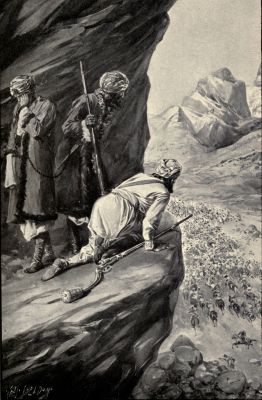
ANGUS WAS HALF MAD WITH GRIEF AND WITH FURY THAT HE WAS NOT IN HIS PLACE AMONG THE TROOPS
They now generally conversed in Persian. Their guards, although keeping as strict a watch as ever on them, interfered with them but little. Fortunately the worst scenes took place at night, and were therefore hidden from those on the hill, the incessant rattle of musketry alone telling of the relentless pursuit. On the night of the 12th the roar of fire had been louder than ever. At last it ceased suddenly. Angus and his guards alike remained awake, Angus listening in agony to the sounds of the combat, the Afghans talking together in low tones.
"What do you think has happened?" he asked them when some minutes had passed without the sound of a shot being heard.
"Either Akbar Khan has succeeded in persuading the Ghilzye chiefs to spare what few there are left of the infidels, or the last man has been slain."
Angus felt that the latter was by far the more probable solution, and throwing himself down on the ground he burst into tears. The eight days of mental suffering had shaken him terribly, and now, feeling that his worst fears had been realized, he broke down altogether. Before daybreak his captors moved some distance farther up into the mountains, and by the cautious manner in which they made their way, often pausing to look back and round, Angus concluded that they were desirous of avoiding all contact with their countrymen. He had indeed before observed how careful they were to avoid the Afghans scattered on the hillside, and he now concluded that they must be taking him to the tower of the chief, to be dealt with as he might direct, either shot at once or held by him as a hostage, for whose delivery he might obtain a handsome sum should the British again advance up the passes.
All day they travelled among the hills. At last they came upon a large village. There were no men about, doubtless all had gone to take part in the fray. The women came out and eagerly questioned them as to the fighting on the night before.
"We know nothing," the leader said. "We believe that the last of the infidels has fallen, but we know nothing for certain."
Without pausing they took the two prisoners, whose appearance had created no surprise, as they were taken for natives, to the chief's tower, a much larger building than the abodes of most of the petty chiefs. Standing upon a crag of rock, it overlooked the village; entrance was only obtainable by a ladder leading to a door some thirty feet above the rock. Their coming had been observed. An old man stood at the door.
"So you are back, Suffyd?"
"Yes, as you see. Has the chief returned?"
"No; it is two weeks since we saw him last. He started then with all the fighting men from here and the other villages; but I expect it will not be long before he returns, for, from what we have heard, the work must be nearly done."
The party ascended the ladder, and the leader spoke a word or two with the old man, who looked greatly surprised. The captives were taken into a room, which by its furnishing was evidently one of the chief's private apartments.
"You are free to move about the house," the leader said, "but you must not leave it."
In a few minutes a woman entered, bringing a dish of boiled grain with portions of mutton in it. She gave the usual Afghan salutation. She was followed by another woman with a jug of water, two mugs, and a bottle. These were placed on a low table, and then without another word they left the room. A minute later they returned with a large earthenware dish full of burning charcoal.
"This is a good beginning, Azim," Angus said, his spirits rising at the sight of the hot food; for although they had not been actually starved, they had been on extremely short rations when their supply of flour was exhausted, their captors being, like themselves, reduced to a handful of unground grain each day. "This does not look as if they meant to cut our throats. Evidently our Afghan is acting under orders. Those orders must have been that we were to be well treated."
They ate a hearty meal; then Angus said:
"See what there is in that bottle, Azim."
The cork had already been taken out, and Azim poured some of the liquor into a tin, and handed it to his master. The latter smelt it.
"It is Afghan spirits," he said, "the same as they sell in the bazaars in Cabul."
He filled it up with water, and drank it off.
"Now, Azim, do you do the same."
Azim, who was not a very strict Mohammedan, and had more than once tasted the forbidden drink at Cabul, needed no pressing.
"Well, master," he said, as he put the cup down, "after all this is better than lying dead and frozen down in the pass."
Angus, warmed with the good meal and by the draught that he had taken, could not disagree with his follower.
"I begin to think that you are right, Azim, though I did not believe so yesterday. It is certain that had I joined my countrymen I should have perished with them, and assuredly I have been saved from eight days of awful suffering and from death—if, indeed, we are saved from death."
"I think we can feel certain of that, master. This is not the way the Afghans treat a man whose throat they intend to cut. They certainly do not make a pillau for him, or provide him with a bottle of spirits."
"Do you know, I have been thinking, Azim," Angus said after a short silence, "that if it had been possible for Sadut Khan to know that we intended to leave camp in disguise, this might be his work again. But he could not have known it. No one but you and I, and Major Pottinger, and the three or four officers to whom I said good-bye, knew anything about it. Besides, he would have sent the men who captured us before, and who knew us by sight. And even supposing, which seems to be impossible, that this was his doing, why not have sent us here straight, instead of taking eight days to do a journey that could have been made easily in two, and forcing me to witness the awful scenes in the passes? It is all most extraordinary."
"However, there is no question, sir, that whoever our captor may be, he has been the means of saving our lives."
"There can be no doubt of that, Azim; and though I may not feel that at present, I shall in the future be very grateful to him. Even if he were to have us shot directly he comes here, I should still be grateful, for it would be a sudden death and not a lingering one, as it has been to those below. Well, it is of no use puzzling ourselves over the matter. I suppose we shall learn how it all came about when the chief, whoever he be, returns here. In the meantime we are certainly a great deal better off than we have been for the past two months in cantonments."
"That we are, master. To begin with, I am warm for the first time since the winter set in; and in the next place, I have had a good meal, and do not feel that I could grumble at anything. As to your mission, you said yourself that nothing could come of it, even if you succeeded in getting through, so that in that respect nothing has been lost by our journey being so suddenly brought to an end."
The next day some of the men who had been away with their chief returned, and the old man in charge told Angus that only one man out of all who had started from Cabul had reached Jellalabad, but that several officers had been taken as hostages, including the two generals, Major Pottinger and Captain Johnson, and two others; also, that all the ladies and children, and the ladies' husbands, had accepted the protection of Akbar.
It was a relief, indeed, to Angus to find that his friends Pottinger and Johnson had been saved, and as Captain Boyd was one of the married officers, he also must have escaped the massacre. As to the fate of Elphinstone and Shelton he was indifferent, it was to them that the misfortune that had befallen the army was largely due; but the thought that his three greatest friends had escaped gave him much pleasure. With these exceptions, that but one man out of sixteen thousand five hundred should have escaped was appalling. That the loss had been terrible he was well aware, but he was hardly prepared for the total annihilation of the force.
Another two days passed. They continued to be well fed and treated, and the women who waited upon them seemed to regard them as guests rather than as captives, talking freely with them, and only being silent when Angus endeavoured to find out the name of their chief. It was evident that on this point they had orders to keep silent. On the third day they heard a stir in the village, and shouts of acclamation and welcome. The room in which they were confined was at the back of the house, and they were therefore unable to obtain a view of what was passing.
"We shall learn our fate now, Azim," Angus said.
"I have no fear of its being a bad one, master. We cannot doubt that orders were given that we should be well treated. If we are kept prisoners till the spring, for my part I shall not grumble if they continue to treat us as well as they have been doing."
They heard the sound of many footsteps and loud talking, then the door opened and Sadut Khan entered. He advanced with both hands outstretched to Angus.
"My dear friend," he said, "how thankful I am that you have been saved where so many have perished!"
"And so it is you, chief, to whom I owe my life?" Angus said, returning the warm grasp of Sadut's hand. "I did not thank you at first, for it seemed to me shameful that an English officer should not share in the fate of his comrades."
Sadut smiled. "But in no case would you have shared their fate. It is not from that I have saved you, but from being killed on your way down. Knowing that the passes were full of our people, I was sure that you must have been taken and murdered. No story you could have told would have availed you. You were not a Ghilzye, nor a member of any of the tribes there, and you would assuredly have been detected and killed had I not saved you."
"That is so, Sadut; and although at first I was half-mad at being unable to join my countrymen, I saw before the end came that, had I done so, my life would have been thrown away uselessly."
"Exactly; and that was why I ordered that you should be enabled to see all that passed. From what I had seen of you, I was sure that at first you would bitterly resent being taken prisoner, and that even if you knew into whose hands you had fallen you would resist; and it was for that reason that I did not this time employ Hassan and his followers to seize you, though all through your journey they kept close at hand, to use my name and authority should any party of tribesmen meet you—not that I had much fear of your detection had they done so. The men with you had orders that in case they did meet such a party, they were to treat you both, not as captives, but as forming part of their own band. Still, it was as well that Hassan should be at hand in case of need."
"I thank you with all my heart, Sadut. I could not have done so at first, but I can do so now; you have indeed saved my life. A few days ago that seemed to me as nothing, for I felt that I was dishonoured in looking on at the massacre of my countrymen. I have had time to think it over since, and I now know that the view I took was exaggerated. Could I have joined them it was plainly my duty to have done so, but if I was a prisoner no blame could attach to me. Have you, chief, taken part in this terrible business?"
"No. With twenty of my own horsemen I rode with Akbar, who is my friend and relative, but I had no intention of drawing my sword against your people. I knew that they had been promised protection, and I thought that Akbar and his force were going to escort them. His word had been given, and I did not think he would withdraw it.
"I do not think it was his intention to do so. He could have done much more than he did, but he could not have saved the fugitives. The Nawab was alone among the Afghan chiefs in the sincerity of his assurances. Akbar had no influence with the Ghilzye chiefs, and even had he influenced them they could not have restrained their tribesmen and the Ghazees. The die was cast. It was Allah's will that those who had invaded the country without any pretext, dethroned Dost Mahomed, who had eagerly sought their alliance, and forced a man we all hated upon us, should meet their fate. Over and over again we implored Akbar, for the sake of his pledge and his word, to assist your people; even if, in his efforts to do so, he fell, then his name would go down as long as our nation existed as one who died in defence of his oath and his honour. He was all along irresolute. At times he did his best short of attacking the Ghilzyes, at other times he held aloof altogether from the scene. At any rate, I can feel that my honour is not soiled. I was not one of those who signed the treaty, but I have done my best to prevent that treaty from being violated. Had your people sallied out from the cantonments and given us battle, I should have fought against them. But even had there been no treaty, I would not have taken part in the massacre of men who were practically defenceless, and who were in no way responsible for the crime of their government."
"I am glad to hear you say so, chief. I should have been grieved indeed had you taken part in so treacherous and terrible a massacre. But how did you learn that I was going to try to make my way down to Jellalabad? That I have never been able to understand."
"I kept a watch over you the whole time, my friend. Either Hassan, or one of his men who knew you, was always in the camp, dressed as one of the camp followers."
"But even then I cannot imagine how he could have told that I was going. I knew it myself but a few hours before I started, and only Major Pottinger and three or four of my friends were aware of it."
"My watch was a good one," the chief said, "and when two Afghans issued from your tent you may be sure the news was quickly brought to the men who had for some days been lying in readiness, and who were prepared to repeat the adventure in the city."
Suddenly, to the astonishment of Angus, Azim threw himself on his knees. "Master!" he exclaimed, "you can kill me, but I own that it was I who betrayed you. I had met Hassan in the camp, and he told me that assuredly no white man would escape alive, that it was settled that all should be attacked and slain in the passes. He said that Sadut Khan had resolved to save you, but that to do this with certainty it would be necessary that he should be informed as to your movements, and where you would ride when the army started. He said that unless I helped them it might be impossible to save you. Then I agreed to do so, and met him or one of his men every day. As soon as you had left the tent after telling me of your expedition, I ran to the spot where I knew I should find Hassan, and told him that we were going alone. He said at once that it would be certain death were you to try to go down the pass, and that you must be carried off as soon as you had left the camp. I knew well that you would be greatly angered, and that if you suspected me you would kill me for my treachery; but that was nothing compared to your life, and so I turned traitor to you, and am willing now that you should order me to be taken out and beheaded."
Angus held out his hand to his faithful follower. "I should have been angry at first—grieved and angry too, but I cannot be angry now. You did what you believed to be best for me, and I acknowledge that it has turned out so. Your treachery was but an act of fidelity, and undoubtedly was the means of saving my life. You did wrong, but it was with the best intentions. You ought to have confided in me."
"But I knew that if I did so you would not have consented."
"That is true enough; still, I was the best judge of what was consistent with my honour. However, next to Sadut Khan I owe you my life, and it would be but poor gratitude were I to reproach you. Let us say no more about it. I shall remember always that you saved my life, and shall forget that you somewhat betrayed my trust. I have for four years past regarded you as my friend rather than as my servant, and I shall esteem you even more so in the future."
Azim retired with tears of joy in his eyes. Sadut and Angus had a long talk together. As if by mutual consent, the subject of the late events was avoided, and the conversation was upon their journey across the Bamian and Sadut's doings since that time.
"I stayed at Khooloom until the governor, whom we had trusted implicitly, handed over Dost Mahomed's family and mine to your people. I happened to be away at the time, and on my return two days later was warned by Hassan of what had taken place. When Dost returned from captivity among the Turkomans, of course I joined him and accompanied him to Kohistan, and fought by his side in the battle of Purwandurrah. The Ameer had said no word even to me of his intention to surrender, and I was thunder-struck when I heard that he had given himself up. I remained there, and took part in the attack on the Ghoorka regiment, at Charekar. After that I returned home. My fortress, as you know, lies far to the west among the Momunds. This place does not belong to me, but to the husband of a sister of mine. She is at present at my place with her husband, who is ill; and as I wished to be nearer to the scene of action, he begged me to use his fort as a residence. I desired to hold myself aloof from the negotiations, as I knew that most of the chiefs were open at any moment to betray the cause for British gold. Still, I was often down in the city, where I own the house to which you were taken. I no longer hated your people as infidels—your kindness to me showed me that there was goodness in your religion as well as in mine—but I was still ready to fight against them as the invaders of my country."
"And now, chief, what do you propose to do with me?"
"That is for you to decide, my friend. I know what you will say, but, though I may regret it deeply, I shall certainly offer no opposition. You are my guest, and it is not for me to dictate to you. I should be happy if you would stay with me till these troubles have passed, but I place myself wholly at your disposal, whatever you may decide upon."
"Thank you, indeed. It is clear to me that if it is in my power I should immediately rejoin our forces."
"I was sure that that would be your wish, and I will send you down with a strong escort to Peshawur."
"I would rather join Sale at Jellalabad."
Sadut Khan shook his head. "In that case," he said, "I shall have rescued you in vain. Sale's force is already besieged, and it will be but a repetition of Cabul. By orders of Akbar Khan, the Ghilzye chiefs have all risen. The town is practically without fortifications, though I hear that the white soldiers have been labouring hard to put the place in a state of defence. But if the army at Cabul could not withstand us, still less will Sale's force, which is only a third of its strength, hold Jellalabad."
"You forget, chief, that they are commanded by a man, and not by an utterly incapable person. They are not dispirited by forced inaction or want of food. I do not say that Jellalabad may not be taken, but I feel sure that it will offer a sturdy resistance, and the news of what has happened in the passes will only fill the soldiers with fury. At any rate, Sale's is the only force that remains of the army to which I was attached, and it is there that it is my duty, with your permission, to go. I am sure that were you in my place that would also be your decision."
"So be it," Sadut said after a long pause. "Were you to go to Peshawur you might meet your death there also, as doubtless a force will endeavour to relieve Jellalabad, and in that case you would certainly go with them. They will never force their way through the Khyber Pass. From what I hear the Sepoys at Peshawur are almost in a state of mutiny. The Sikhs have sapped their loyalty, and have assured them that they will never be able to force the pass; and when they do move forward they cannot be depended upon to stand by the British troops so that your danger may be as great one way as another. However, Jellalabad is your choice and not mine. The citadel there is strong, and when the town is captured, as it certainly will be soon, the troops can retire there, and may hold out until they make terms and are allowed to return to India."
"I do not think they will make terms, Sadut. They have had a terrible lesson as to the manner in which treaties are respected by the greater portion of your chiefs, and are not likely to trust again to any promises, but will hold out until they have fired their last cartridge."
"They cannot hope to defend themselves," Sadut said positively. "Akbar Khan will himself head the army."
"I do not think, Sadut, that you know yet what a British soldier can do when well led. There has been no great battle fought since we entered Afghanistan, and you must not judge them by the small fights that took place round Cabul; the soldiers there had lost heart and confidence in their commander. It will be a very different thing when you meet them confident in themselves and in their leaders. Believe me, your hosts, however large, do not frighten them. You know how they have overcome many of the best fighting races in India, and that in the teeth of odds as great as can be brought against them here. I say not a word against the courage of your people, but they want discipline and training, and even a host of men fighting each for himself, cannot withstand the charge of well-disciplined soldiers."
"Why did they not come up the passes, then, to aid their friends."
"Because they were deficient in carriage, they were in a country altogether hostile to them, they had many sick, and must have left a strong force to guard them. There may have been other reasons of which I know not, but these are sufficient. For a force to enter these passes without animals to carry their food and their wounded would have been madness. And I believe that Sale has not more than twelve hundred bayonets, a force sufficient to do wonders in the plains, but which could hardly fight their way up the passes against thousands of good marksmen, as the Afghans assuredly are, armed with guns which carry much farther than their own, and firing in safety behind inaccessible rocks. But whether Jellalabad can resist all attacks, as I believe, or whether the place falls, is a matter which does not affect my resolution. It is my duty to be there, and if you will afford me means of getting there I will assuredly go."
"We will start to-morrow, then, and the sooner we are off the better. The news of what has happened in the passes will spread like flame through the country, and every fighting man will turn out to complete the work. There is a pathway from here which goes straight down to Gundamuck. I will ride with you with half a dozen of my followers; there are plenty of ponies on the hills. Certainly no questions will be asked, no suspicions can arise. When we get near Jellalabad we shall see how you can best enter. I will ride round the place with you. As I am a friend of Akbar's, it will be supposed that I am examining the place to see where an attack had best be made. There are many orchards and small villages round. When we are as near the town as we can get, you can slip from your horse as we go through an orchard. Keep under cover in the gardens until close to the walls. When you get within musket-shot you can tie a white cloth to your gun, and you will then be safe."
This plan was carried out, and two days later, after a grateful parting from his preserver, Angus stood at the edge of the moat opposite one of the gates.
CHAPTER XVII
JELLALABAD
A sentry had already sent down word that two Afghans had approached carrying a white flag, and an officer appeared on the wall.
"What do you want?" he asked.
"We want to come in, Thompson. I am Angus Campbell, and have escaped almost by a miracle."
There was a shout of pleasure, and a minute later the gate was opened, and Thompson ran out and warmly shook Angus by the hand.
"I am delighted to see you," he said. "We all thought you among the slain in the passes. What an awful time it has been since we left Cabul on our way, as we believed, to India! We can scarcely believe the terrible news even now. We have learnt but little from Brydon, who was, he thought, the only survivor, except the hostages who, he tells us, were given over a few days before the end came. He was desperately wounded, and could scarce sit his horse when he arrived, and has been too ill to give us any details."
"I can give very little, for I was not with the army. I started the evening before they left camp, on a mission from Pottinger to Sir Robert Sale. Pottinger did not think that any help could possibly come, but at the same time he thought it right to make one more effort to communicate with your general, and to tell him that they were on the point of starting. I had gone but a short distance when I was captured. Fortunately the men who took me were followers of Sadut Khan. I was taken to his fort. He was absent at the time; when he returned he at once gave me my liberty, and escorted me to within a quarter of a mile of the wall, as a return for a service I had rendered him two years ago."
"That was a piece of luck indeed. Then you saw nothing of it?"
"Yes, I saw a great deal. My captors were, I suppose, anxious to see what was going on, and we followed the course of the army, keeping on the hill; and, except for the fighting at night, I saw almost the whole of the tragedy."
While they were talking they were approaching the head-quarters of the general. Angus was well known to Sir Robert, to whom he had often carried messages and notes from Burnes or Macnaghten. When their first greeting was over, he repeated the story he had told Captain Thompson. He thought it best to say no word of his escape being the result of a preconcerted plan on the part of Sadut Khan, as he felt that some might suspect that he was privy to the scheme, and had taken advantage of the friendship of the Momund chief to make his escape.
"I am not so surprised as I might otherwise have been," the general said, "since I received a letter from Pottinger yesterday. Akbar had allowed him to send it down, thinking that the information that Elphinstone, Shelton, Lawrence, Mackenzie, and Pottinger himself were all right might induce us to submit to terms. He said, 'I trust that before this you will have heard that we are about to start from Mr. Angus Campbell, who nobly accepted the desperate mission of penetrating through the passes and bringing you word of our intention. Should he have arrived safely, I beg to recommend him most strongly to the authorities for accepting the mission, which seemed almost a hopeless one. He has rendered great service during the time the troops have been in cantonments, by aiding the commissariat officers in bringing in grain.' As you had not arrived we naturally feared that you had been murdered on your way down. I am glad indeed that you have escaped. You will now, of course, give your assistance to Macgregor, our political officer."