THROUGH THE SIKH WAR (continued 8)
Reading edition
Pennycuick's brigade of Colin Campbell's division were as roughly handled; they had, through some blunder or other, advanced unsupported by artillery, and orders were given by their commander that they were not to fire but to charge the enemy's guns. The 24th, the European regiment of the brigade, the strongest battalion of the force, advanced in magnificent order under a terrific fire of musketry and artillery, drove all opposition before them, and captured the guns opposed to them. They had commenced spiking them, when some of the Bunnoo regiments, lying concealed in the brushwood on rising ground behind the guns, opened a tremendous fire of musketry. The troops were thrown into some confusion by this sudden attack, and fell back, and as they did so they were literally mown down by the enemy's fire. General Pennycuick fell dead; his son, a young ensign, stood across his father's body and defended it until he fell dead beside it. Colonel Brooks was also killed. Eleven other officers fell, and ten were wounded either among the guns or in the retreat that followed. The Sikh cavalry pressed hard on the retiring soldiers, while their musketry and artillery swept their ranks, and upwards of five hundred men were killed and wounded. The regiment was in fact almost annihilated. The position this brigade attacked was afterwards found to have been the strongest along the Sikh line. The two native regiments of the brigade had advanced in line with the 24th, but suffered far less severely in the retreat, the efforts of the Sikhs being concentrated against the white regiment.
The other brigade of the division, at whose head Colin Campbell had placed himself, was more fortunate. The 61st Foot repulsed several desperate attacks, and pouring in heavy volleys swept the Sikhs before it. Wheeling round it fought its way along, and retook the guns from which the 24th had been driven. The capture of the guns was, however, but of little avail, for as soon as they were abandoned the Sikhs managed to draw the spikes, and in a few minutes they were again in action. Two native regiments fought worthily by the side of the 61st.
The cavalry on the extreme left, under General Thackwell, did good work by checking a very large body of Sikh horsemen, a squadron of the 3d Dragoons charging and riding right through them; then gathering again with a desperate effort they cut their way back to their friends, two officers and thirty-six men having been killed or wounded in this brilliant charge.
Night was now approaching. A portion of the jungle had been for the moment cleared, but beyond this the Sikhs still swarmed, and during the battle large bodies had worked round and had only been prevented by the fire of the guns from falling on the rear. Nothing more could be done; some of the officers advised that the force should fall back to the village of Chillianwalla, in order to obtain water and to afford protection to the baggage Lord Gough at first refused to do so, on the ground that any wounded left behind would be massacred. The troops, especially the Sepoys, were, however, so distressed by thirst, that the wounded were as far as possible collected, and the force concentrated round Chillianwalla.
Had the enemy attacked at night the consequence would have been terrible, for the regiments were broken up and separated, and the confusion was absolute; but at eight o'clock the rain came down in torrents, and this and the fact that their own loss had been severe, especially among the gunners, checked the ardour of the Sikhs, and probably saved the British force. In the morning the enemy were seen encamped on an eminence three miles distant. The cavalry scoured the field of battle to collect any wounded that had been left, and bring in the captured guns. Twelve small cannon, however, were the only trophies of the fight. The rolls were called, and the loss ascertained: it consisted of eighty-nine officers, two thousand three hundred and fifty-seven men killed and wounded—an enormous loss in proportion to the number of men engaged. Six guns were lost, together with the ammunition that had accompanied several of the corps into the fight.
It was so far a drawn battle that the armies at night occupied the same positions they had held at the commencement of the battle, but the advantage was all with the Sikhs, for the fighting strength of the four English regiments that had formed the backbone of the force was lessened by half; while the Sikhs had proved to their delight that British troops were not always invincible, and that occasionally they were even subject to panic. The result was that their confidence was greatly increased, and their losses were far more than balanced by the great number of recruits who, at the news of the repulse of the British attack, poured into Sher Singh's camp.
The British army remained stationary at Chillianwalla from the 13th of January to February. Large numbers of the Sikhs at various times penetrated to Dingee, and cut the lines of communication through that place; there was indeed another line open through Hayleh, where the force that had been engaged at Sadoolapore had remained since that battle, to prevent the Sikhs from advancing towards Lahore. The regiments that had been left behind at Ramnuggur rejoined the army, their place being taken by the 53d Regiment from Lahore.
General Whish's force which had captured Mooltan was now on its way to join that of Lord Gough. The siege of Mooltan had been renewed after the departure of Sher Singh's army, and reinforcements having reached General Whish, it was pushed on with great vigour. Two breaches were effected in the walls of the fort, and the great mosque, which was used as a magazine by the rebels, was pierced by a shell, which caused a terrific explosion, entirely destroying the building, leaving a great chasm where it had stood, levelling the Sikh works near it, and killing five hundred men. Soon after this misfortune, Moolraj, finding further resistance impossible, came out and surrendered unconditionally, just as the British columns were formed up in readiness to storm the breaches. He was taken to Calcutta and there tried; he was found guilty, but it being considered that he had acted under a pressure from his troops that he was unable to resist, he was sentenced only to imprisonment for life.
At the battle of Chillianwalla Percy Groves had been severely wounded. He was sitting on his horse with Mr. Fullarton and two or three other political officers at a distance of a hundred yards from the head-quarters staff, when Pope's cavalry issued in headlong flight from the jungle. An exclamation of dismay burst from each member of the little party.
"It is a regular stampede," Mr. Fullarton exclaimed; "there come the Sikhs after them! Why, they are comparatively a handful! What on earth possesses the men? Why, they will be over the guns! Did you ever see such madness?"
On came the fugitives.
"To the right there!" Mr. Fullarton shouted, "or these madmen will ride us down."
They had but just got clear of the front when the cavalry swept past; before they could go farther half a dozen Sikh horsemen rode at them. The civilians all carried pistols, and these they used with some effect. Two of the Sikhs fell, the rest rushed on them. Percy had no sword, and thought that his end had come; when there was a shout, and his two followers rode past him, and fiercely fell upon the Sikhs.
Percy turned round in time to see two of the civilians cut down by the tulwars of the other Sikhs, while Mr. Fullarton tried with his pistol to ward off a blow aimed at him. The force of the blow struck it down and the sword fell on his shoulder. Before the Sikh had time to strike again he was shot by Bhop Lal, and the latter and his comrade then attacked the remaining two Sikhs furiously. Akram Chunder ran one through with his sword. Bhop Lal seriously wounded the other, who wheeled his horse round and fled at full speed.
A moment later there was a thunder of hoofs, and the Lancers who had rallied, came dashing down. Percy, furious at seeing Mr. Fullarton fall, exclaimed, "Give me one of those tulwars, Bhop Lal." The man sprang from his horse and handed him the one that had fallen from the hand of the Sikh he had shot.
As the Lancers came along Percy with his two companions fell in behind them. They rode over many of the Sikh horsemen; the rest fled, and were hotly pursued back to the jungle, many of them being cut down. The impetus of the charge took the Lancers well into the wood. A blaze of musketry flashed out in front of them; a fresh troop of horsemen charged down, and a moment later they were engaged in a hand-to-hand contest. A tall Sikh rode at Percy, and they at once engaged in single combat. Percy's steady training at the fortress with sword and tulwar was useful to him now. The Sikh's shield gave him an advantage, but this was counter-balanced by Percy's being accustomed to thrust as well as strike. For some time the contest was doubtful, and then, after feinting at the Sikh's head to make him throw up his shield, Percy ran him through the body. He heard a warning shout from Bhop Lal as he did so, and the next moment another Sikh rode at him, knocking his horse off its legs, while at the same moment a crashing blow fell on his helmet. After that he remembered nothing.
When he opened his eyes it was dark. Presently he could hear talking all round him; he listened, and heard that the language was Punjaubi. He wondered to himself how he had got there, then he recalled a fight and gradually recollected his horse falling. "I must be wounded," he said to himself. "Yes, my head throbs fearfully; but how is it that I am here? the Sikhs always kill the wounded."
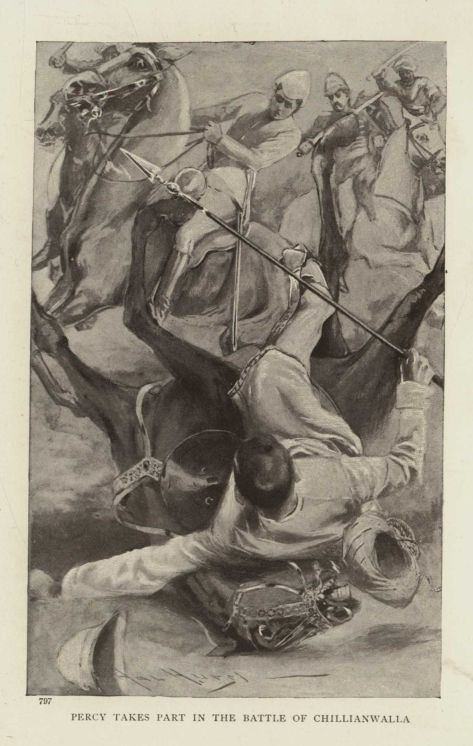
PERCY TAKES PART IN THE BATTLE OF CHILLIANWALLA
He made an effort to raise himself on one elbow, when he felt a hand laid on him, and a voice which he recognized as that of Akram Chunder whispered in his ear:
"Do not stir, sahib; thanks to the Great One that you have recovered. We were sure that you were not dead; the blow was a heavy one, but as you were falling when he struck, the tulwar did not catch you quite fairly, and the helmet helped to turn it, so that, instead of cleaving your skull, it has but shaved off a portion of your scalp and half your ear."
"But how is it you are here with me?"
"We were both fighting, sahib, and knew that you could hold your own against the Sikh you were engaged with. Suddenly, just as from the corner of my eye I saw that you had disposed of him, another rode at you. I gave a shout, and cut down the man I was fighting with; but before I could turn my horse you were down. I shot the Sikh, and then I and Bhop Lal, who had just rid himself of his man, leapt off our horses, intending to lift you on to one of them; but at that moment the Lancers began to fall back, and we saw that it was too late, so each seizing you under one arm, we sprang with you into a bush.
"Then, while Bhop Lal stayed with you, I ran out again, caught up the mantle of a Sikh who had fallen within a yard of the bush, and sprang in again. We wrapped you in the mantle, then crawled on, dragging you with us into a very thick patch of bush, where you are lying now. A moment later half a dozen Sikh infantry, pushing their way through the bushes, came close. One of them caught sight of us, and cried, 'What are you doing here, comrades!' 'My brother is sorely wounded,' I said, 'and we have stopped to close his eyes before we go on to have another fight with the Feringhees.' 'You must make haste, then,' he said, 'or there will be none of them left to fight with.'
"We heard large numbers of them pass along a short distance off, then volley after volley of grape came crashing through the jungle, and they fell back again. 'I will mix with them,' Bhop Lal said; 'you stop with our sahib. One is less likely to be seen than two. Your story is good enough to account for one if they catch sight of you, but it is not good enough for two of us.'
"For two hours the battle went on, but not near us again. The banging of cannons and muskets was as bad as at Ferozeshah. Sometimes I thought one side was winning, sometimes the other. Sometimes I could hear Sikh yells of triumph, sometimes a deep roar even above the din of the musketry, and knew that it was an English cheer, for I had heard it before. Occasionally men came along, having strayed from their parties; and each told a different story. Some said that many of their cannons had been captured by the Feringhees; others declared that the Feringhees were almost destroyed. Bhop Lal sat down only ten or twelve yards away, and I could hear him talking to them. Presently I heard him ask had anyone any water? 'I have a wounded comrade somewhere not far off in the jungle, and I want some for him.' Somebody lent him a water-gourd. He went off behind, and some minutes later worked round here with it. He would not come straight, for some of them might have followed him into the bushes, to see if they could do anything for his comrade, but this was not likely, for there are scores of wounded men round here. However, we tore off some rags and wetted them, and laid them on your wound, and we poured a little of it into my water-flask to sprinkle your face, and drop between your lips from time to time, and then Bhop Lal went back again with the remainder."
"But how has the battle ended, Akram?"
"It has ended just as it began—the white troops have all gone up to Chillianwalla and the other villages there. The Sikhs hold the jungle. They captured six of the guns our cavalry rode over, and they have lost twelve, but all small ones. I hear that almost all their gunners are killed, for the British took several of the batteries, though they could not hold them; and you know, sahib, the Sikhs will never leave their guns, but will stand by them till they are cut down. The men about here don't know what is going to be done. Some say that they will attack to-morrow; others say that though they have shown that they are more than a match for the Feringhees, it would be too much to attack them in their own positions, especially as they have not enough gunners to work the pieces.
"Perhaps we shall attack in the morning, Akram."
"I do not think so, sahib; they say that one of the white regiments had scarcely a man left, and that the others have lost half their strength. The general, sahib, is a great man for fighting, but he must see that until he gets more troops he can never force his way through the jungle up to Russool."
There was presently a sound of someone forcing his way through the bushes, then a voice said, "I bring orders that all are to fall back. It is not that we are beaten, as everyone knows; we have won a great victory, and have taught the Feringhees that they are not invincible, but food and water cannot be brought down here, therefore all must go up and get food and drink and rest for the night. The Feringhees have had enough, and will not attack again to-morrow morning; but if they do, we will come down again and welcome them."
There was a murmur of satisfaction, for the Sikhs had taken up their position some hours before the British attacked them, and were eager for food, as although spirits had been freely served out, the supply of food in the camp was small, and many had eaten nothing that day. Bhop Lal moved off with the others, but in five minutes was back again. As in the dark he was unable to find the clump of bush in which Percy was hidden, Akram called to him in a low voice.
"How is the sahib?" Bhop Lal asked, as he pushed his way in.
"I am better," Percy answered. "You have saved my life between you. Have they all gone?"
"All that can walk, sahib; there are numbers of wounded lying about, but there is nothing to prevent our starting off now."
"I don't think that I can walk yet," Percy said. "Perhaps in a little time I may be able to do so."
"I am afraid not, sahib; but that makes no difference; we can carry you easily. Akram, do you stoop down on one side, and I will do so on the other. Now, sahib, put your arms round our necks; we will clasp our hands under you, and you can sit then as in a chair."
Percy himself was able to give but little assistance, but he felt himself lifted up and held firmly; then slowly and steadily the two men carried him through the jungle. Once or twice they were asked by a figure on the ground who they were, but the answer in their own language, that they were looking for a comrade who had fallen, sufficed, as it was too dark under the trees for it to be seen that they were already carrying a burden.
"It was well that they didn't know we had you with us, sahib. Had they done so, we should like enough have had a musket-ball after us. A wounded Sikh is as dangerous as one standing on his feet."
But Percy did not reply; he only heard the words as if spoken a long distance off. A little farther and he was conscious of nothing. His bearers carried him a hundred yards beyond the jungle, and then laid him down again, sprinkled some water in his face, and poured a few drops between his lips; but as he gave no sign of returning consciousness, Akram Chunder said, "We had better take him on again. It is from loss of blood he has fainted, and we must get him to camp. First, I will again try to bandage his wound."
He unwound several yards of muslin from his turban, and bound up Percy's head. Then they lifted him and went forward, this time at a faster pace than before, for there was now no fear of giving Percy pain. They had to be careful, however; the ground they were crossing was that over which the cavalry had retreated, and it was thickly dotted with the bodies of the fallen. Once past this, they pressed rapidly up the slope to Chillianwalla. To their surprise they approached unchallenged, for they had been afraid that their reply in a native tongue would have brought a shot from a sentry; but such was the confusion, and so exhausted were the men, that while some regiments had thrown out sentries, others had not done so, and they were fortunate in having come upon an unguarded spot. A little farther and they entered the village. Numbers of men were lying asleep in the streets. Presently an officer came along.
"What have you there?"
"An officer, sahib, wounded," Akram Chunder, who had picked up a few words of English, replied.
"Where have you got him from?" the officer asked in Hindustani.
Akram could understand the question, but could not answer it in the same language, and answered him in Punjaubi.
"We brought him out from the jungle over there, sahib."
"I don't understand you," the officer muttered; and then aloud in Hindustani, "Come along with me to those lights, that is one of the hospitals."
They went with him to the door of one of the largest buildings in the village, and entered. The floor was covered with prostrate figures. Four or five surgeons with orderlies holding torches were engaged in bandaging, probing for bullets, or, in one case, in amputating.
"Doctor," the officer said, "here are two fellows who look like Sikhs, though I suppose they are not; they have got a wounded officer, but where they found him I have no idea. Do any of you speak Punjaubi? They may be able to tell us what those fellows over there are doing."
But none of the surgeons spoke the language.
"We will just see who the man is they have brought in," the officer, who was a colonel, said; "he seems dead by his attitude. Put him down there, men."
The two men understood his gesture, and laid Percy on the floor.
"He is not dead, but he is mighty near it," the surgeon said, as he felt his pulse. "Ah, this is what it is, a cut from one of those tulwars. He is bleeding to death. Give me that brandy bottle, orderly."
He poured a spoonful or two between Percy's lips, then laid some lint over the wound, and firmly bandaged it.
"Give him another spoonful, orderly, while I go on to the next; he will come round presently."
"Is it mortal, doctor?"
"No, it is a very nasty wound, but I don't think it has cut through the skull; the sword must have been turned a little. I will examine it in the morning when I get breathing time."
"I know him now," the colonel said; "it is that young civilian who came in the day we crossed the Chenab. Yes, these are the two native servants who always rode behind him. Come along with me, men; I must take you to someone who talks Punjaubi. You shall come back to your master afterwards; he is lucky in having two such faithful servants."
The men did not fully understand him, but Akram Chunder gathered the meaning, and with a look at their master they followed the officer from the hospital.
CHAPTER XX.
GUJERAT.
The officer kept on nearly to the end of the village, and then opened a door and went in. "Mansfield, you understand Punjaubi. These two fellows are the servants of that young civilian—Groves, I think, is his name—the man that was with Edwardes, you know, at Mooltan, and was taken prisoner by Sher Singh, and escaped after the battle of Sadoolapore."
"Yes, I know him. What of him?"
"They have just brought him in with his head laid open badly with a tulwar. He has pretty nearly bled to death, but the surgeon who has dressed his wounds thinks he will get over it. I want you to ask these fellows where they have brought him from. I expect he is one of the party who were fallen upon by the Sikhs who came on after our cavalry. I know there were two of them killed, and Fullarton is desperately wounded. I cannot understand how it was our fellows didn't find Groves when they were collecting the wounded."
"Where did you bring your master in from?" Major Mansfield asked in Punjaubi.
"We have brought him in from the jungle over there, sahib," Akram Chunder replied.
"From the jungle?" Major Mansfield repeated.
"He joined the Lancers who came up and drove back the Sikh horsemen; he went on with them into the jungle, and in the fight there he was cut down by a Sikh just after he had run another through."
"The dickens he was!" the officer exclaimed. "Then how on earth was it that he wasn't killed when the Lancers fell back again? They have never spared any wounded that fell into their hands."
Akram Chunder related how he and his comrade had dismounted and concealed his master, had kept him in the midst of the Sikh infantry till they retired, and had then carried him up to the village.
"You are fine fellows," the officer said warmly, "noble fellows;" and he shook them both by the hand, to the astonishment of the colonel who had brought them in, and of the other officers who crowded the little cottage. Turning round Major Mansfield repeated the story he had heard. All broke into loud exclamations of admiration.
"Wait a moment," the colonel said, "we shall have time to talk about that afterwards. The important point is to find out from them whether they know what the Sikhs are doing to-night."
The question was then put, and when Akram Chunder repeated the order he had heard given, that the Sikhs were all to retire to Russool, there was a deep and general feeling of relief.
"That is the best news I have heard for many a day," the colonel exclaimed; "for if they had fallen upon us to-night, which I half expected they would do, it would have been a frightful business. I must take these men to Lord Gough at once. He will be even more glad than I am to hear the news, for he must feel the responsibility terribly. You might as well come along, Mansfield, to act as interpreter; he may have no one with him just at present who speaks the language."
The story was told to the commander-in-chief and Sir Henry Lawrence, who was now his chief political adviser.
"The information is most valuable if true," Sir Henry Lawrence said. "I suppose there is no doubt these two men are Mr. Groves' servants; because, as you say, he was brought in insensible. That is a very important point, for they might be two Sikhs sent in with this story to put us off our guard."
"Major Mansfield says that he recognizes their faces, Sir Henry."
"I would not say that I absolutely recognize them, but they certainly look to me like the two men whom I have seen riding with Mr. Groves."
"Do not let us make any mistake about it. The matter can be easily settled. If these men have been in camp for a month they must be well known."
"I will find one of Mr. Fullarton's men, sir. Groves was living in his tent, so any of the servants there would know them."
While the major was away Sir Henry Lawrence cross-examined Akram Chunder and Bhop Lal as to their story. In three or four minutes Major Mansfield returned, bringing with him Ram Singh.
"This is Mr. Fullarton's servant, sir."
"Do you know these two men?" Sir Henry asked.
"Yes, sahib, I know them well. They are Mr. Groves' servants. They have been with him for four or five years; they were with him at Ferozeshah and Sobraon."
"So they were," Lord Gough said, getting up from the camp-chair in which he was sitting and looking at them closely. "I remember their being with him at Ferozeshah. Mr. Groves carried messages for me several times when most of my staff were down, and I noticed then how coolly those fellows rode after him whenever he moved away from my side."
"There is no farther doubt about the story," Sir Henry Lawrence said, "and these men have clearly saved Mr. Groves in the way they have stated."
"Tell them, Sir Henry," Lord Gough said, "that I consider them to be very fine fellows, and that I thank them for their conduct in having rescued their master. As for the information they have given, that is our affair, and we can reward it. I should be glad if you could give them a hundred rupees each as a present out of your information fund."
Sir Henry repeated Lord Gough's message to the men, laying stress upon the difference between the action of saving their master's life and the information they had brought. "For the first," he said, "the commander-in-chief desires to pay you honour. Had you belonged to one of our native regiments he would have made you officers. As it is, he can only say that he honours you for your conduct, and himself thanks you for having saved the life of that very promising young officer, Mr. Groves. The information you have brought is valuable, and for that he asks me to make you a present of a hundred rupees each. You lost your horses, of course?"
"Yes, sahib, ours and the master's."
"Come round to me in the morning. I will give you an order to receive the two hundred rupees and to take the three horses, as it is likely enough they came back with the Lancers; if not, to take three of the Sikh horses that came in with them. How is your master going on?" he asked Ram Singh.
"He is better, sahib; he can talk now, and he has asked several times whether Mr. Groves has been heard of. It will do him good to know he has been brought back."
The interview was now over, and the two men went back to the hospital, and on their arrival there, were delighted to find that Percy was conscious, and sat with him by turns through the night. He was greatly pleased to hear that Mr. Fullarton had not been killed, as he feared.
"Have you had anything to eat?" he asked towards morning.
"No, sahib, but that does not matter."
"It matters a great deal," he said. "I am sure I do not know how you are to draw rations here, and there will be no means of buying anything."
He thought a little, and when, half an hour later, the principal surgeon stopped beside him to ask him how he felt he said, "I feel queer about the head, and weak, but that is all. I am worrying about my men, sir. I do not see how they are to draw rations."
"I can manage that," the surgeon replied. "If they are willing to help here I will put them on the list as hospital orderlies and draw rations for them with the others. I shall be very glad if they will do so, for I am short of hands, and want help terribly. We never calculated on such a crowd of wounded as we have got, and as, at present, they certainly won't be able to spare us fighting men to act as hospital orderlies, I shall be very pleased to have your fellows. Then one of them will be able to look specially after you."
Akram Chunder and his companion embraced the offer with great satisfaction when Percy translated it, and were soon at work in their new duties. As soon as the morning meal had been served Percy told Akram that he had better go at once to Sir Henry Lawrence to get the order for their horses. "There is no time to be lost about that," he said. "They are so good that they will be snapped up at once for the use of officers who have lost their own chargers."
Akram found the horses, as he had hoped, in the lines of the Lancers, but when he produced his order and claimed them he was scoffed at.
"Look here, Bill; here is a likely tale," one of the men said to another. "This chap has got an order signed Henry Lawrence, to take the horses belonging to himself and another chap wherever he may find them in camp, and I am blowed if he doesn't pitch upon these two chargers that the major and Captain Wilkins have chosen for themselves. Why, anyone can see with half an eye that they are English hunters, or have got a lot of English blood in them anyway. You get out of this, Johnny, or I may put my fist between your two eyes."
Akram quietly walked off, and held the paper out to the first officer he met.
"Are your horses here?" the latter asked after reading it.
"Yes, sahib."
The officer was as incredulous as the troopers had been, that a native, evidently of no high position, could have owned such horses; and the major, coming up and hearing the story, angrily ordered Akram out of camp as a rogue. The man went quietly back towards the political officer's house, but on the way he met Major Mansfield. He saluted and told him the story, "I will go back with you," the major said; "it is no use troubling Sir Henry Lawrence." Major Mansfield's interposition proved efficient, and as soon as the story of how the two men had sacrificed their horses and had saved their master's life was told, the major gave orders that Akram should take the two animals. "I heard there was a civilian and two men joined our squadron when they charged, though nobody noticed them fall back with it. But how on earth came two Sikh servants to have such horses as those?"
"Groves' uncle is the Colonel Groves who was in the Sikh service under Runjeet Singh, and he has held the fortress of Djarma ever since. I know he got two or three English thoroughbreds over, and bred some horses. The third horse is evidently a native, and not a particularly good one."
"Which is your master's horse, man?"
"He rides sometimes one and sometimes the other of these two, sahib. His own horse is over there," and he pointed towards Russool; "he had to leave it behind when he escaped from Sher Singh. That was a splendid horse. These are good, but nothing to Sheik. He bought this native pony when he escaped, and would have ridden it, but we could not let our master be riding on a little native horse while we were on fine horses that his uncle gave us."
"That accounts for it, you see, major."
"Well, I am sorry to give them up, but of course there is no help for it. Groves is certainly lucky in having two such servants, and it would be a shame indeed for them to lose their horses after having behaved so uncommonly well."
So the horses were taken over and picketed with those of the surgeons', and for the next three weeks the two men worked in the hospital. Percy had for a few days been very ill; fever set in from the inflammation of his wound; but as soon as that abated he gained strength rapidly, and at the end of three weeks took his discharge and reported himself to Sir Henry Lawrence as ready for service.
"You won't be fit for service for another month, Mr. Groves. But it is just as well for you to be out of hospital, for you will pick up strength faster now than you would in there."
By this time the camp extended over a large space of ground. Everything was in excellent order, and but few signs were visible of the terrible struggle that had taken place a few weeks before. Percy shared a tent with another young civilian. His head was still bandaged up, and it would be a long time before he could wear any but the softest head-gear. He consulted the doctors rather anxiously as to whether the hair would grow again on the patch, three inches wide, from the top of his head down to his ear.
"Probably it will, but there is no saying, Groves. If it does grow it will probably come white."
"I don't much care what colour it comes," Percy said, "if only it does come so as to hide my ear, or rather my half ear."
"I should not bother about that," the surgeon said. "You can let the hair at the top of the head grow long, it will hide the scar, ear and all. It will look better than a white patch there."
"I suppose it would," Percy said, regarding himself in the little hand-mirror rather ruefully. "A white patch certainly would not look well, and the people one meets would be always asking how it came, which would be a frightful nuisance. Still, if it comes white I could dye it, I suppose."
"I should not bother about it, Groves; it is an honourable scar."
"Yes, that is all very well, doctor; but it is a scar for all that."
During the fortnight that had elapsed before the camp was broken up, Percy did no work, but took a short ride morning and evening. During the heat of the day he sat in the shade at the entrance of his tent and read.
On the 11th of February the Sikhs made a great demonstration, drove in a patrolling party, and seemed as if they wished to bring on another battle. A column threatened the rear of the camp, and the spies brought in news that they had determined upon attacking us. Lord Gough had no wish to bring on a battle on ground where the Sikhs, if beaten, could again retire into the jungle. The army therefore remained in their lines. It was observed that the array of tents round Russool had considerably diminished. The next day it had entirely disappeared.
Great anxiety was felt in camp as to what had become of the Sikhs, and all sorts of reports were current as to Sher Singh's intentions. Some believed that he intended to cross the Chenab at Wuzeerabad, and to march upon Lahore. The garrison there was a very weak one, and could have offered but a slight resistance if attacked by so large a force, aided as it certainly would be by a rising of the populace. Another report was to the effect that Sher Singh had stated that his intention was to make forced marches to Umritsur, to cross the Sutlej, and advance to Delhi and capture and sack the place before any force could be gathered to arrest his progress. Were not one or other of these plans intended, the only explanation why the Sikhs should desert their strongly intrenched and almost inaccessible position, was that they found extreme difficulty in supplying their force with food there; and indeed it was known from deserters that they had for some time been suffering from famine. Moreover they might consider that if successfully attacked on the flank they would be cut off by the deep ravine between their intrenchments and Russool, and by the river still farther behind, from making their escape.
Late in the evening of the 12th some spies brought in the information that Sher Singh was marching for Gujerat. In the neighbourhood of this town the Sikhs had, in past times, gained several important victories, and they regarded the locality as being specially sacred and propitious to them. The country round was rich and fertile, and they would have no difficulty in obtaining provisions. It is true that they would have to fight in the open, but their confidence had been restored by their success at Chillianwalla. There was, too, a probability that from Gujerat the approach of General Whish's force, which was hurrying up from Mooltan, might be intercepted.
Chuttur Singh had joined his son with a force from the Peshawur district a few days after the battle, and the army with which he retired was little short of fifty thousand men. On the 13th Percy rode out with a number of other English officers to inspect the Sikh works round Russool. These were found to be extremely formidable, well placed, and constructed with great skill, and all congratulated themselves that the army had been spared the terrible loss that would certainly have befallen it in carrying the position. That evening Brigadier Cheape of the Royal Engineers, who had conducted the siege of Mooltan, arrived with a body of native cavalry, having pushed on rapidly and left the main body of General Whish's force some days in the rear.
On the morning of the 14th news came that the Sikhs had occupied Gujerat, capturing the small body of Pathan horse stationed there under the command of Lieutenant Nicholson. Major Lawrence was also a prisoner in Sher Singh's camp, having, with his wife, been treacherously handed over to the Sikhs by an Afghan chief with whom they had taken refuge.
The next morning at four o'clock the troops marched for Lussoore. Conflicting reports came in as to the course of the Sikh army; but the balance of probability was that they were still remaining in the vicinity of Gujerat. General Whish had already sent a force to bar their passage should they try to cross at Wuzeerabad. The army moved slowly forward so as to be able to meet the Sikhs should they advance, but no engagement was desired until Whish, with the Bengal and Bombay troops who had been engaged with him in the siege of Mooltan, should join.
On the 20th the army reached Shadeewal, effected a junction with two of General Whish's brigades, and was now ready to encounter the enemy. On the following morning it advanced towards Gujerat, across a plain cultivated in many places and dotted with clumps of trees. The drums of the Sikhs beating to arms could be heard in the distance, and the line of battle was formed. General Gilbert's division was on the right. Next to him was the division of General Whish. Separated from them by a deep nullah was Colin Campbell's division, and on the left the Bombay troops under Brigadier-general Dundas. Each of these divisions was accompanied by batteries of field and horse artillery. Part of the cavalry was on either flank, while two regiments of native cavalry and two of infantry were in rear covering the baggage.
The Sikhs opened fire while our force was still a considerable distance away, and the line was halted and the artillery and skirmishers moved to the front. Just behind the line of the infantry there was a lofty mound commanding a view of the whole plain, and on this the staff and all the political officers who were free to choose their position took up their post.
"It will be nothing to-day," Akram Chunder said to Percy. They had dismounted, Bhop Lal taking charge of the three horses while his comrade had posted himself just behind his master. "If they could not stop the English before, when they had great intrenchments and heavy guns, what chance can they have now?"
The British guns speedily opened fire, and very soon obtained the mastery over those of the Sikhs, whose fire slackened. In a short time their guns were withdrawn, the infantry falling back with them to a village in a strong position where they were almost hidden from sight. The British infantry moved forward as soon as the enemy's fire slackened, Penny's brigade of Gilbert's division advancing to storm the village. It was flanked by two Sikh batteries, and the brigade advanced under a shower of balls, dashed across a deep nullah, poured in a heavy volley, and then went at the village with the bayonet. The Sikhs in the village fought stoutly, many of them shutting themselves up in the houses and defending themselves till the last.
As soon as the British showed on the other side of the village the guns of the Sikh batteries opened upon them. The battery of horse-artillery galloped up and replied vigorously; the whole line of infantry pressed forward, and the enemy deserted their guns and fled. The 2d Bengal Europeans, that had suffered heavily at Chillianwalla, sustained a loss of six officers and one hundred and forty-three men killed or wounded, while of the two native regiments with them the 31st lost one hundred and twenty-eight and the 70th forty-four killed or wounded.
This position carried, the whole line advanced, and although the enemy fought with dogged courage they were everywhere beaten back. Harvey's brigade with considerable loss carried the village of Chowta-kabrah gallantly. The Sikhs as they retired were pounded by the guns of three troops of horse-artillery, but the enemy's artillery fire was so heavy that one battery had to send to the rear for horses before it could move its guns, while another suffered such losses that they were obliged to get men from the 10th Foot to work the pieces. The Sikh cavalry made frequent efforts to work round the right flank and get into the rear, but were checked each time by a troop of horse-artillery and by the 14th Dragoons, although at one time a party penetrated so closely to the heavy guns where Lord Gough had taken up his station, that his personal escort charged and drove them back.
Steadily the whole line pressed forward. The Sikh infantry several times gathered in great numbers, supported by their cavalry, to make a rush to meet us, but were each time checked by the accurate and rapid fire of our artillery, and were pressed back until Gujerat was passed on its eastern side by Campbell's division, and by the Bombay troops on its west. The latter had met with but little resistance. On the right of the Sikh line the Afghan horse, fifteen hundred strong, with a large number of the Sikh irregulars, now threatened our left flank. They were charged by the Scinde horse and two squadrons of the 9th Lancers, driven from the field, and two of their standards taken. The whole of the enemy's right wing now fled and were pursued by the British cavalry and horse-artillery, and the rout of the Sikhs was complete.
The infantry halted to collect the guns, ammunition, and baggage of the Sikhs; but for many miles the cavalry and a troop of the Bombay horse-artillery pursued the flying foe, scattering them whenever they tried to rally, capturing many guns, and killing vast numbers of fugitives, no quarter being given by the cavalry, who remembered that every one of their own wounded comrades had been killed and mutilated by them. The cavalry did not halt until they had reached a point fourteen miles from the field of battle.
The Sikh troops who had remained in Gujerat offered a stout resistance, but were, after some hard fighting, overcome. A singular proof was given that the Bunnoo regiments retained the discipline they had learned from British officers to the last, for when resistance fairly ceased the Sikh sentries placed round the native hospitals were found marching backward and forward on their beats as unconcernedly as if absolutely unconscious of the events that were taking place.
Fifty-three guns were captured. They had in almost every case been defended to the last. One large gun had been the object of fire by a whole British battery. All the men had been killed but two; but as the British line advanced these two alone continued to work it. One fell with a musket-ball, but the other, unaided, fired two more rounds, and only when the British line was close at hand sought safety in flight. The Afghan horse, after leaving the field, did not draw rein until they crossed the river Jhelum, a distance of over thirty miles.
The loss of the army in this great victory was comparatively trifling, but 5 officers and 76 men were killed, 24 officers and 595 men wounded. The loss of the Sikhs was very large. They had brought sixty pieces of artillery into the field, and carried off but seven of them. General Gilbert's division followed up the enemy with such rapidity that the Sikh chieftains, despairing of successful resistance, surrendered in numbers. Chuttur Singh and Sher Singh were among the first to propose surrender, and all the other leaders, with the exception of two, came in. Forty-one guns were handed over, and 16,000 men laid down their arms. In all, the enemy lost 167 guns during the campaign. Their possession of so large an amount of ordnance was a great surprise to the British, who had believed that in the previous campaign they had captured almost the whole of the Sikh guns. The greater portion of these pieces had doubtless been hidden by the sirdars, those captured in the Sutlej campaign having for the most part been the artillery of the regular army. As a proof that this was the case, an immense number of guns were found buried in the earth at Govindghur when we took possession of that place. All the Sikhs who surrendered or were captured after the battle of Gujerat were allowed to return to their homes after being deprived of their arms. They were permitted to carry away their clothes and horses.
Chuttur Singh and Sher Singh surrendered at Wuzeerabad. They came in on elephants, with a few retainers and a small escort of Bunnoo infantry. All had to lay down their arms before crossing the ford to meet Lord Gough, who with his staff and a large number of officers was on the opposite bank. Sher Singh had released Major Lawrence from his confinement, and had sent him to the British head-quarters to negotiate the terms of surrender, and that officer met him as with his father he crossed the bridge. The scene was an impressive one, as Chuttur Singh and his son, the two men who had involved their country in the struggle and had brought such terrible disasters upon it, dismounted from their elephants and paid their respects to the British general. Sher Singh was a rebel against his own government as well as against us, but at least he had not ill-treated the three or four British officers, or the two British ladies, who had fallen into his hands, and had sent back unharmed the few British soldiers who had been captured and brought into his camp. Major Edwardes' despatches too had completely established the fact that he had for a long time, under most difficult circumstances, been faithful, and that he had at last yielded to something very like force on the part of his soldiers. Although, therefore, his reception by Lord Gough was cold, it was very different to that which he would have received had his rebellion, like that of Moolraj, been sullied by the murder in cold blood of English prisoners.
As the rajah drew off from his interview with the commander-in-chief his eye fell upon Percy. He ordered his mahout to stop his elephant. Percy rode forward to him, and conversed with him for several minutes, Sher Singh expressing his satisfaction that he had met with no injury in effecting his escape.
"I liked you, and always treated you well, did I not? and you will stand my friend now?" he asked anxiously.
"I am but a young officer, and my friendship can little avail your Highness," Percy said; "but assuredly I will testify, and have already testified, that I was well treated. I was allowed to keep my servants and my horses, I was well fed and cared for, and, save that I had not my liberty, had everything that I could desire. I thank your Highness sincerely for the manner in which I was treated."
Percy was reining back his horse when he heard a low whinny. He turned round with a start, and saw one of the rajah's officers struggling with his horse, which was trying to turn aside out of the procession. "Why, Sheik, is it you?" Percy shouted in delight. And the horse, rearing up, all but unseated its rider, made two bounds to his side, and thrust its head against his hand.
The little stir caused Sher Singh to look around. "It is my horse, rajah," Percy said; "it knows me again."
The rajah nodded. "I had forgotten it," he said. "I knew that you had escaped, and never gave a thought to your horse. You must give it up, Aliram; it is the property of the sahib."
With an angry scowl the native alighted.
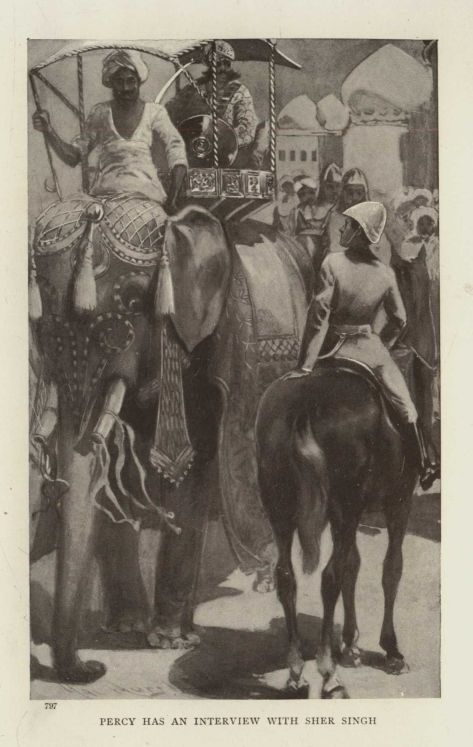
PERCY HAS AN INTERVIEW WITH SHER SINGH
"I shall not leave you horseless," Percy said. And riding back through the officers, who were looking on in amazement at the scene, he joined his two followers, who were sitting their horses at some little distance in the rear. Both gave a loud exclamation of pleasure as Percy rode up, leading Sheik. He was himself mounted on Bhop Lal's horse. He dismounted and sprang on to Sheik. "Bhop Lal, mount your own horse and take the one you are on to the Sikh officer. You will find him standing there. He annexed Sheik, but I don't want to give him the mortification of tramping on foot after the rajah." Bhop Lal did as he was ordered, and then rejoined Percy, who was overjoyed at recovering the splendid animal his uncle had given him.
On the 30th of March the governor-general issued a proclamation declaring the Punjaub annexed to the British dominions in India. A large pension was assigned to Dhuleep Singh, who was placed under the tuition of an English officer, and the administration of the Punjaub was intrusted to a board consisting of Sir Henry Lawrence, his brother John, and Mr. Mansoll, a civilian, to whom was assigned the financial administration of the province.
Two days after the surrender of Sher Singh, Percy obtained two months' leave of absence, and started for Djarma, which was distant about a hundred miles from Wuzeerabad. The passage of Gilbert's division north had already restored tranquillity, and he followed the main road as far as Rawal Pindee, where a British garrison had, been left, without encountering the slightest interruption. Then he struck off along the foot of the hills on his way to the fortress thirty miles off.
At Rawal Pindee he heard that his uncle had ridden in with two hundred horsemen on the arrival of General Gilbert at the town, and had placed his troops at the general's disposal. These was, however, no occasion for their services, the Afghans having already evacuated the district of Peshawur, and there being no longer any Sikh force under arms sufficient to offer resistance to the British column.
"We need not be afraid of Ghoolab Singh this time, sahib," Akram Chunder said as they rode out of Rawal Pindee.
"No. The old fox has played his game as well now as he did in the last campaign. Throughout, he continued to promise to join Sher Singh, as we learnt when we were prisoners, while, on the other hand, he lent money to our people when they needed it for purchasing provisions. But it was not until just before Gujerat, when he saw that there was no longer the least doubt which side would prove triumphant, that he really put his troops in motion and offered to act in any way he might be required against the Sikhs. However, he knows now that there is no possibility of his ever getting a foothold across the Jhelum. It is certain that in a week or two we shall hear that the whole of the Punjaub is annexed by England, and I and my uncle might pay him a visit at Serinagur without the least fear that he would receive us in any but a courteous and hospitable manner. Djama is as good as British territory now. I daresay my uncle has got the British flag waving over the fortress already. The Indian government have no reason either to like or trust Ghoolab, and, if he gave them cause, have only to stretch out their hand to take Cashmere.
"It would be the best thing that could happen for the country," said Akram. "Then the people would be able to till their fields and weave their shawls in peace and quiet, afraid neither of foreign invaders nor of oppressive rulers."
As they approached the fortress they could see a flag waving over its highest point.
"I thought my uncle would have it up," Percy exclaimed. "It is too far away to see the colours, but I am sure what they are."
Percy rode fast now, walked up the long hill, and then galloped to the gate. It was open and the drawbridge down. He waved his hand to the men who saluted as he rode in, and kept on without drawing rein until he sprang from his horse at the steps, where his uncle, who had been warned of his approach, stood waiting to meet him.
"Welcome back, Percy; welcome back! It is eleven months since you rode out, and you have no doubt gone through much, though I have heard nothing of you."
"There were no means of sending letters, uncle; but I have often thought of you, and wondered how you have been getting on."
"I sent three letters off, Percy. Did you get none of them?"
"None, uncle."
"And you know nothing of what has happened since you have been away?"
"Nothing," Percy repeated, struck by his uncle's grave face. "Nothing serious has happened, I hope?"
"Come in, lad," the colonel said, taking his arm and leading him into the private apartments.
Percy looked round, expecting to see the Ranee appear.
"She is gone, lad."
"Gone, uncle!"
"Ay, lad, she died ten months ago, a month after you left us."
Percy stood aghast. "My dear uncle, how sorry I am! I never dreamt of such a home-coming as this. My poor aunt! What a terrible loss for you!"
"Terrible, lad. I am getting over it now, but for a time I was crushed, indeed for some days I was myself at death's door, and only pulled through by God's mercy."
"Why, what was it, uncle? Fever?"
"Poison, lad."
"Poison, uncle!" Percy repeated, horror-struck.
"That is what it was, my boy. Ghoolab's work again, I have no doubt, though I cannot prove it. Would to heaven I could, for I would ride to Serinagur with a hundred men, force my way into his presence if need be, accuse him of the deed, and blow out his brains. But I have not a shadow of proof. It happened, as I told you, a month, or maybe six weeks, after you had left. The news had come of the rising at Mooltan and the murder of Agnew and Anderson. We were in great anxiety about you, knowing you were with them, Mahtab especially; but, as I told her, had you been killed also, we should have heard of it, and that you were not the sort of fellow to be caught in a trap, and I had no doubt you had got out of it somehow. A day or two after, she said to me, 'You must be especially careful now, Roland. Ghoolab has a hand in every trouble that takes place in the Punjaub. No doubt he will do as he did before, play one side against the other, send promises to each and do nothing until he sees how matters go; but he will think that at any rate if there is war and strife he will be free to do as he likes up here in the north, and he will likely enough try once again to encompass your life.' I felt that that was probable enough, and kept a more vigilant guard than usual. One day after dining we were both taken suddenly ill. Two hours later she was dead. I pulled through, but I looked death very closely in the face."
"And did you find out who the murderer was, uncle?"
"No, my boy, nor have I found out now. I am sure as to the mover in the plot, but not as to his instrument. I found, as soon as I had recovered, that the cook and other servants had all been seized and caged up. Had I died, no doubt they would all have been tortured and put to death; but the officers knew me well enough to feel sure that I should be angry at it did I recover. I had no ground for suspicion against one more than another. I cross-questioned the cook closely, but beyond protesting his innocence I could get nothing out of him. He had cooked the dinner as usual, but was not, as he said, all the time standing over his pots. Any of the other servants might while his back was turned, or while bringing things up from the cool cellar as he required them, have dropped poison into the cooking pot. There was no denying this. The other servants with equal vehemence protested their innocence. The officers wanted me to use torture, but this I would not hear of. I might have tortured half a dozen innocent men before I came to the guilty one. Besides having an Englishman's abhorrence of such means, I could not rely on anything wrung from a man. A weak man while he is in his agony will acknowledge anything required of him, will confess any crime, will accuse anyone; while a guilty one of stronger nerve will die protesting his innocence. They were all examined closely, but none could say that he saw any stranger, that is, anyone outside the household, enter the kitchen; but as at times the room seems to have been entirely empty, anyone might have slipped in unperceived."
"And since then you have suspected no one, uncle?"
"No one, Percy. None of the servants have left, all are still with me."
"What! have you kept them still about you?"
"Yes. All appeared so utterly distressed and broken-down at the death of their mistress, and at the suspicion that rested upon them, that I could not bring myself to discharge them. Indeed, so great was the fury of the people throughout the whole district, that I believe had I turned them out through the gates, their lives would have been sacrificed. Besides, how could I rely upon a fresh set of servants more than upon those who have been with us long, and who apparently cared for us? Moreover, there was a certainty that every one of them would suspect the others, and that each would make every effort to find out the one by whose deed suspicion and disgrace had fallen upon them. They would naturally watch each other as a cat watches mice. The kitchen would never be left empty again. There would be at least two in it, and it would be next to impossible for the attempt to be repeated unseen. The cook himself might indeed have slipped poison into the curry or other dish before compounding it, but I was convinced that whoever was the assassin it was not the cook himself, for he must have known that suspicion would fall upon him, and that had I died his torture and death were certain."
"Then you think that it was someone outside your house, uncle?"
"I do not say that, Percy. I only say that I suspect no one. After the discovery that the rascally steward you shot was a traitor, I can never feel sure of anyone, therefore it may have been one of the servants, it may have been one of the soldiers, it may have been a stranger inside the gates. At any rate no fresh attempt has been made, but it was some time, Percy, before I got to enjoy my food again."
CHAPTER XXI.
RETIRED.
Percy had felt hungry when he rode into the fortress, but although he saw his uncle eat as heartily as usual, his appetite seemed to desert him, and he ate very sparingly of each dish placed before him. His uncle smiled.
"You are not such a good trencher-man as you were, Percy."
"Oh, I am all right, uncle; but just at first the thought that any of these dishes may be poisoned is an unpleasant one."
"You will get over it in time. Frankly, I do not think that there is any ground for uneasiness. From the day Gough crossed the Sutlej I felt safe; from the day Gujerat was won I have felt absolutely at my ease. I have no longer the slightest fear of Ghoolab. This district is part of the Punjaub, and the Punjaub will assuredly be annexed to British India."
"Yes, uncle, they say the proclamation will be out in another fortnight or so."
"That being so, lad, Ghoolab's game is finally up. Did I die to-morrow, surely no nominee of his would obtain the appointment of governor, or whatever your people call him, of a district adjoining Cashmere. He may not like me, he may owe me a grudge for thwarting him so long, but he has no longer the slightest interest in my death; and although Ghoolab would without scruple remove a hundred men who stood in his way, he would not run the slightest risk—and there is always a certain risk of a tool turning traitor—when there was nothing whatever to be gained by it."
"I hear that you rode into Rawal-Pindee to meet General Gilbert's column, as it came through."
"Yes, I took all my cavalry over, but by the time we got there all opposition had ceased, and the sirdars were pouring in to make their submission, and beg for forgiveness. So there was no occasion for their services. Of course he thanked me, and said that he would report my offer."
"I almost thought you might come down and join us, uncle."
"I thought it over, lad, but there might have been trouble here in my absence; but I thought I would keep my force together, so that if there should be any tough fighting in the north, I should be able to march away horse and foot to join our men. I did not calculate upon so complete and sudden a collapse of the Sikhs. Now we have talked enough about myself; it is time that you tell me the story of your adventures, of which as yet I know nothing, and how you came by that desperately ugly wound on your head."
It was late before Percy finished the story of his adventures.
"You have had great luck, lad, to have got so well out of your scrapes," the colonel said. "Well, it is late now, and we must be off to bed; we shall have plenty of time to talk matters over in the morning."
"I should think, uncle," Percy said, when they had lighted their cigars after breakfast, "that the government will recognize your position, and either grant you the same power over your district that the sirdars have over their estates, or else that they will appoint you as their official over the district."
"I have no doubt they would do so, Percy, were I willing to accept it; but I have quite made up my mind to give it all up and go home."
"You have, uncle!" Percy exclaimed in surprise.
"Yes, I have stuck here all these years for three reasons: first, because I am an obstinate beggar, and would not be turned out; secondly, because my wife would not have liked to leave her native land, and would never have been happy in England; thirdly, because the people of my district have been rich and prosperous under me, and I was not going to hand them over to be pillaged and robbed by one of these Sikh harpies. Now, however, the case is altogether changed. If I go, I go of my own free will and choosing. Mahtab has gone, and there is no longer anything to tie me to India. Lastly, I can with confidence hand over the district to English administrators, secure that the people will not be taxed unfairly, and will be safe from all oppression and extortion. During the last two years I have reduced my force here considerably. I was certain that after the lesson we gave them, there was no fear of their ever again making an open assault on the place. I began by not filling up vacancies caused by death or from men being superannuated. Fortunately, there is a good deal of cultivable land down this valley, and, indeed, in other parts of the district, and I have given grants of small holdings to all who were willing to take their discharge."
"I noticed that there was a great change in the valley below, since I went away, uncle, that fields have been marked out, and that there was quite a village down where the Sikhs were encamped when they besieged us."
"Yes, over two hundred holdings have been taken up there. I granted them free of all taxes for the first three years, gave those men who had no savings a little assistance in the way of a loan, and in time there will be a large and, I hope, thriving village there. I have urged the men to keep up a certain organization among themselves,—to form, in fact, a kind of military colony, so as to be in a position to resist dacoits or attacks by the marauding hill tribes. I have similarly settled that other valley three miles to the north; altogether I have given a start to nearly a thousand of the men. They have served me faithfully, and nothing would induce me to go away and abandon them. I think that it is very likely a force may be formed by our people for the protection of the frontier; and, as you and Mr. Fullarton, with whom I have had a good deal of correspondence, and the Lawrences, are all aware that the men have behaved most faithfully and can be trusted, I hope I shall be able to get all those who wish to continue soldiering to be mustered into the service."
"I should think you might manage that, uncle; one or other of the Lawrences, perhaps both, are certain to be appointed commissioners of the Punjaub. Of course, I am not in a position to speak to them on such a subject, but I am sure Mr. Fullarton would do so. I did not see him after I was wounded, as before I was about he had been taken down to Lahore. I heard that he was recovering fast, and was expected to rejoin the head-quarters camp in a short time. Having been so long on the frontier, I should think probably he will get a large district here, but at any rate he would, I am sure, bring your matter before the Lawrences."
"I should think it by no means improbable, Percy, that they may appoint you district magistrate, or collector, or whatever they call it, of this district; that is, if they keep it as a district."
"I should think they are not likely to do that, uncle. Rawal-Pindee will be made, I should say, the centre of a district of which this will form part. Still, possibly I may be appointed an assistant in this district, as I know the country and the people so well; and if so, I will follow up the methods that have made it in your hands the most flourishing little corner of the Punjaub, in spite of the greater part of it being merely hill country."
"Well, Percy, I don't think you can do better than stick to it. You have got a splendid start in the service, and have every chance of rising in it rapidly. It is good for you to work, and the exciting scenes you have passed through during the last four years have been a good preparation for making you an active and efficient officer. But what I want to say is this: if your health fails, or if, sooner or later, you marry and would like to settle down at home, or if from any other cause you want to leave the service, remember there is no occasion for you to work for your living. I am a rich man, and, thank God, I do not owe my wealth to grinding the last penny out of the natives. I could have retired and lived more than comfortably in England had I chosen to do so when Runjeet Singh died, for the Old Lion, with all his faults, was the most liberal of masters to those who served him well. Since then I have, of course, largely increased my means. I had but to pay a fixed sum annually to Lahore, and the revenue of the district has multiplied itself by ten since I took charge of it. I could, therefore, give you an income sufficient to keep you comfortably at home during my lifetime, and it will, of course, all come to you at my death. Still, much as I should like to have you with me, I think that, at any rate, it would be better for you to remain in the service of the Company for some years. It is a bad thing for any man to have nothing to do, and there is no better training than that afforded by the civil service of the Company."
"Thank you very much, uncle. I like the service greatly, so far as I have seen of it; and I should certainly wish to remain in it. Even if I did not like India, I should do so. I think that a man with health and strength ought to have a career, and not to owe everything to another, however close a relation he may be. I certainly hope to be appointed to the Punjaub, and I should think there would always be a spice of excitement here. There are sure to be constant troubles with the Afghans and hill tribes all round it. I have been awfully lucky in getting noticed so young, and so gaining at least eight or ten years' start of fresh comers of my own age from England; and I feel, above all things, how indebted to you I am for this."
"You are indebted to me that you came out to India, Percy, but almost everything else is due to yourself. The turning-point in your career was when you sat down on board ship to take your first lesson in Punjaubi. It was the steadfastness with which you stuck to your studies during your voyage which won for you the liking and patronage of Mr. Fullarton, and so enabled you to take part in the Sutlej campaign. There you showed pluck and presence of mind, and so gained the attention of Sir Henry Hardinge and of the commander-in-chief. After that it was the fact that you had got up Pathan, which procured for you your early appointment and your nomination to accompany Agnew. Had it not been for that you would have been out of all this last business. I have done what little I could in the way of teaching you to ride well and use your weapons, and have given you the best advice I could; but beyond that everything has depended on yourself. I feel proud of you, lad, very proud of you, and I only wish Mahtab had been here to share my satisfaction. She was as fond of you, lad, as if she had been your mother. Life here has been altogether different since I lost her; and the sorest point of all is the thought that the blow that struck her was aimed at me."
"I know that you must feel that, uncle. I can quite understand your wanting to get away from here now."
Percy did not take the whole of his leave. His uncle was restless and unsettled, and when, a week later, the news came of the annexation of the Punjaub, Percy said:
"Why should you stop, uncle? The sooner you are away the better, and I do not care to stay here longer. The place is not the same as it was; besides, I cannot help feeling that just at the present time it would be better for me to be at head-quarters. There is nothing like being on the spot when changes are being made."
"I think you are right there, lad. I have been telling my officers what you said about trying to get them into the Company's employment, and all have expressed their willingness to remain in the district and hold themselves in readiness to join should they receive a message from you. I have but eight hundred men left now, and have given it to be understood that I shall give them fifty rupees each when they are disbanded, and a grant of land large enough to keep them. I have no doubt the grant will be confirmed, as the authorities will be glad enough to see a body of men, who might be troublesome if turned adrift, settle down as cultivators, so adding to the revenue. Well, there is nothing to stay for. I will put it in orders this evening, that as the whole country has now been taken over by the British government, the force will be disbanded to-morrow."
The next day the troops paraded for the last time. The colonel made them a little speech, thanking them for the fidelity they had shown, and expressing his deep regret at leaving them. He told them that if a force should be raised by the British for service on the frontier, his nephew would endeavour to procure enrolment in its ranks for such of them as desired it; that he had set aside a tract of land for them, and that Nand Chund had his authority to divide it fairly among them; and that he himself, as a token of his appreciation of their faithful services, had directed fifty rupees to be given to each man in addition to the pay due to him, and that his vakeel was writing for each a paper testifying to his services, which he himself would sign, and which they would find useful in their dealings with British officials.
When he had finished the men broke their ranks and crowded round him, tears flowing down most of their faces, calling down blessings upon him, and pouring out their regret at leaving the service of so good and kind a master. It was with some difficulty that the colonel, who was himself deeply affected, extricated himself from them and returned to his residence. The next morning he and Percy started. The colonel had made a very handsome present to Bhop Lal and Akram Chunder, and they of course accompanied them; but in addition the whole of the cavalry mounted and formed a voluntary escort to them as far as Rawal-Pindee.
Travelling quietly they reached head-quarters on the day when the proclamation was read to the troops, amid the booming of cannon, announcing to the Punjaub that it was now an integral portion of British India. Percy introduced his uncle to Mr. Fullarton, and the latter took him to Sir Henry Lawrence, with whom, during a stay of a week in the British camp, he had several long conversations, the chief-commissioner being desirous of ascertaining the views of one of such long experience in the country.
Colonel Groves was strongly of opinion that henceforth there would be no more trouble in the Punjaub. "The Sikh power is altogether broken," he said; "the former danger to India existed in the fact that hitherto they had been so successful in war that they had come to consider themselves almost invincible, and that the great army Runjeet had got together was demoralized by inactivity, and each man thirsted for an opportunity to distinguish himself, and dreamt of a share in the plunder of India. The population in general were, in his opinion, peace-loving and industrious; they had suffered terribly under the exactions of the grasping sirdars, who amassed fortunes out of their toil, and of the tax-gatherers, who had to collect vast sums for the maintenance of the army. That army had ceased to exist—Gujerat and Chillianwalla had accounted for the greater part of those who had escaped Ferozeshah and Sobraon. I believe," he said, "that in the course of a generation there will be no more orderly or loyal province than the Punjaub. There will be always a certain number of restless and adventurous spirits, but for these there will in time, I presume, be an opening in the regiments which, when you feel that you can trust them, will be raised here as in other parts of India. There is no finer fighting material to be found than among the Sikhs, and the fidelity with which they have fought to the last for their country is an earnest of that which they will show to our colours when they once take a pride in them."
He then instanced the conduct of his own men, who had proved faithful to him throughout, and had fought as bravely against the Sikh forces as they had formerly done under the Sikh flag. "They were for the most part," he said, "men of hill tribes, and Pathan rather than Sikh by blood, and should you be raising a force for the defence of the frontier against Afghans or hill men, you would find them admirably suited to the service. They are already well drilled and accustomed to discipline, and I promised them, when I disbanded them the other day, that I would speak to you in their favour, and would guarantee their fidelity should they be admitted into the Company's service."
"I will think the matter over," Sir Henry Lawrence said; "a force of that kind, if it could be relied upon, would be of immense service."
"Well, Sir Henry, there is one ready at hand. If I might venture to suggest, I should say, if my nephew happens to have an appointment in the Punjaub, it would be useful he should go for a week or two to the district with the officer charged to raise the force; in a few days he would produce a squadron two hundred strong of well-drilled cavalry, and four or five hundred infantry, with a complement of native officers thoroughly up to their work."
"Your nephew will certainly have an appointment in the Punjaub, Colonel Groves. He has proved himself a most efficient and zealous officer, and his knowledge of Punjaubi and Pathan, and of the country, would be thrown away in any other province. I had his early record in my hands when I was Resident at Lahore. Major Edwardes has written very strongly of the valuable assistance Mr. Groves rendered him, and he has been very useful during the late campaign. I can promise you that his appointment will show that his services have been thoroughly appreciated. I consider him an exceedingly promising young officer, and shall be glad to have an assistant on whom I can so thoroughly rely in any emergency."
"There is one thing I want to say to you, sir, and that is, that, when I disbanded my regiments, I gave to each man a grant of an acre or two of land in a valley so far untilled, but good land, and capable of irrigation. I had previously planted a thousand of them in two similar colonies, both of which are doing well. I hope that the grants may be confirmed."
"That they certainly would in any case, Colonel Groves; it is a great thing to have so many men, who might otherwise be troublesome, settled on the land; but, indeed, as your grants were made previous to the formal annexation, they would in any case remain good."
At the end of the week Colonel Groves left the camp and took a boat to go down the Indus. The short stay among his countrymen, from whom he had been for many years separated, had done him good, and dispelled the melancholy thoughts with which he had ridden down from the fortress, which had been for some twelve years his home. He had met with great hospitality during his stay in camp, for all were interested in the talk and adventures of one who had been among the best known of Runjeet Singh's officers, and his hearty and genial manner had won for him the liking of all who met him.
Ten days later Percy, who was getting somewhat tired of idleness, received a message saying that he was to appear before the commissioners on the following day. Sir Henry, as president, addressed him when he appeared.
"Mr. Groves, I am happy to say that my brother and Mr. Mansell thoroughly agree with me that at the present moment experience rather than age must guide us in the distribution of our appointments. Although you have been but a short time in the Company's service, you have a wide experience in the country, and your knowledge of its languages is invaluable at the present juncture. We feel that you are naturally specially acquainted with the wants and necessities of that portion of the country in which you have lived for upwards of two years, and have therefore determined to appoint you to the charge of the strip of country lying north of Dhangah and running along by the side of the Jhelum. It will be about twenty miles wide, and will extend to the end of the narrow projection of country running up into Cashmere. The line will run to the east of Rawal-Pindee, and will include all the hill country, and will touch Torbeylah on the eastern branch of the Indus. It will therefore be about a hundred and twenty miles long, and will of course include your uncle's former district. Your appointment will be that of a deputy-commissioner. It will be a sub-district, either of the district of Rawal-Pindee or of Peshawar; that is not settled yet, but at any rate you will communicate direct with me. It is an important appointment for so young a civil servant, but I am sure that you will justify our choice. I congratulate you, Mr. Groves, upon having worthily earned an appointment such as this. You will start within two days for your post, and we think that it will be advantageous for you to make Djarma your head-quarters; there are, of course, several much more important places in the district; but in the first place it is, I believe, strongly fortified, it is distant about midway between the northern and southern points, and it possesses the advantage that in case of need you might collect a force from among the men who served under your uncle, and who are personally known to you. Lieutenant Purchas will accompany you; he is commissioned to raise a police force of a hundred mounted men; he will be stationed at Djarma, and will, of course, be subject to your orders, and responsible for the maintenance of order in the district. We have also decided upon raising a frontier force, and shall, as a beginning, raise two troops of cavalry and six companies of infantry. Major Mellish, who will have the command, will follow you to Djarma in a few days, and I shall be obliged if you will assist him in raising half that number in your neighbourhood. No doubt the force will be considerably increased later; at present it is but an experiment, and while it is desirable that the corps should start with a number of trained men, we have decided that it would be better to have an admixture of recruits from Pathan tribes on the other side of the Indus, both because they will know the country there, and because it is undesirable that the whole force should be composed of men acquainted with each other."
Percy expressed his thanks to the commissioners for the honour they had done him in the appointment, and especially for having selected him to the post he should have preferred to all others. "I can answer, sir," he said, "that should any emergency ever occur, I could in the course of a couple of days raise a thousand men for any service required."
Ten years later Percy was able to fulfil the promise. He had three years before been removed to a more important appointment, that of the district between the Jhelum and Chenab rivers, when the news of the outbreak of the mutiny sent a thrill through India, and it was evident that it would extend over the whole of the Bengal army. He received a message from Mr. Montgomery, commissioner at Lahore—Sir John Lawrence, who had succeeded his brother as chief-commissioner of the Punjaub, being at the time at Rawal-Pindee—saying, "Come to me at once." Ten minutes later he was on horseback, and, accompanied by his two faithful servants, rode to Lahore, and on his arrival was at once received by the commissioner.
"Mr. Groves," he said, "I fear there is no doubt that the sepoys throughout the Punjaub will go with the rest. We have a few days' respite, but I fear that it is certain they will rise. They must be disarmed if possible, crushed if necessary. I think that the Sikhs as a whole will be true to us. They have experienced ten years of good government, and I believe they appreciate it. If they are faithful, we may not only hold this province, but help the north-west; if they are against us, India is lost for a time. My intention is, as soon as the sepoys have been dealt with, to raise regiments among the Sikhs, and march them south. What do you think?"
"It will depend a great deal on their chiefs, sir; if they are faithful, I believe the people in general will at any rate not take part against us."
"I have received assurances of fidelity from the Rajah of Putiala and many others; some have offered to place their troops at our disposal, others not only troops but money."
"Then I have no doubt of the population sir; they have always looked to their chiefs, and if they are staunch the people will follow their lead."
"Why I have specially sent for you is this, Mr. Groves. You know your old district thoroughly, and have personal influence there; would you undertake to raise a force at once, whom you could trust to fight against the sepoys? There are the garrisons at Peshawur, Nowshera, Rawal-Pindee, and other places."
"I think I can undertake that, sir."
"Then, in heaven's name, start at once. Take a fresh horse from my stable, get remounts wherever you can, and ride as if for your life. The troops at Meerut and Delhi have both risen and massacred the officers and all the Europeans; and although it may be a few days before the news is generally known, you are aware how strangely fast news travels in India, and assuredly this will be the signal for the rising of the sepoys everywhere. I hope to be able to deal with those here and at Mean Meer."
Feeling half-stupefied at the intelligence of the risings at Meerut and Delhi, Percy hurried off.
"I have to ride with all speed to Djarma," he said to his followers; "it is a matter of life and death, and I have not a moment to lose. The commissioner has ordered one of his own horses to be brought round for me to start with, and I shall change as often as I can on the road. Do you follow on as quickly as you can."
Five minutes later he dashed out through the northern gate, of Lahore. He had already performed a long and rapid ride, and had nearly two hundred miles before him; but he made the journey without rest, save to eat something whenever a fresh horse was being procured for him, and in twenty hours from his leaving Lahore he rode into Djarma. The force there had, he heard, been summoned six hours previously by a messenger from Sir John Lawrence to join him instantly at Rawal-Pindee. In half an hour after his arrival he had despatched a dozen messengers to the valleys where his uncle's men had been settled; then he threw himself down on a couch, and ordered that he should not be disturbed for four hours.
At the end of that time he was aroused, and going out found that some four hundred men from the valley below had already come in; the greater portion were old soldiers, but some had brought their sons in with them, and all were equally ready to serve. Three hours more, and the force had swelled to twelve hundred men, and included many of the colonel's old officers, among them Nand Chund, who had saved money and settled down quietly after the troops had been disbanded. The old soldiers had all brought their arms with them, and the new recruits had also for the most part arms of some kind; others were found, and distributed among them. The old officers naturally fell into their positions, and the vacancies were filled up by men who had been under-officers.
There were two hundred cavalry-men among them, but of these not more than half had horses of any kind; but messengers had also been sent off to many of the land-owners in that part of the district, begging them to lend horses for the service of the government, and assuring them of payment for them on a fair scale should they not be returned; and a sufficient number for the unmounted men were now forthcoming. Eight hours after his arrival at Djarma, Percy rode out at the head of two hundred cavalry and one thousand infantry. Nand Chund was left behind, with directions to raise instantly another regiment of infantry and as many horsemen as he could engage in the whole district, and to join him as speedily as possible.
"I could raise five regiments if it were necessary," Nand Chund said; "when the people know that you are to be their leader, every man who can bear arms will be ready to follow you."
"A regiment will be enough for the present, Nand Chund. No one can say how many will be required afterwards. Choose young and active men; we shall have long marches and much to go through. You can say that I have no doubt that all who do faithful duty will be permanently retained in the service if they choose."
Percy did not go to Rawal-Pindee, for he knew that there were European troops there, and the place was safe, and he feared that his force might be detained there. His corps made a tremendous day's march, and placed themselves on the main northern road, where, three hours later, the sepoys came along from the Attock and Nusserabad. Warned of their approach by the clouds of dust, Percy placed his troops in a grove, and when they came along, with the drums beating and colours flying, poured in a volley and attacked them. Taken by surprise, great numbers were killed, and the rest fled and were pursued by him at the head of the cavalry, and very few of them succeeded in effecting their escape.
The next morning Percy marched his infantry as far as Attock, and leaving them there to prevent the passage of any mutineers, pushed forward with the cavalry to Peshawur. Here he aided the irregular cavalry under Colonel Nicholson in cutting up the sepoys who had mutinied at the frontier stations. For the next fortnight he scoured the northern district, dispersing bodies of the mutineers and keeping order. His infantry he had sent down to Lahore to be employed as required. At the end of that time he received an order to report himself there with his cavalry.